
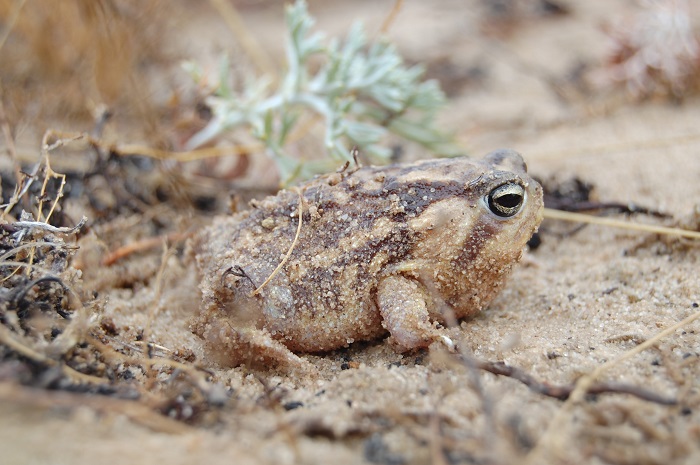
Cover photo by Ryan van Huysteen.
Find the Sand Rain Frog in the FBIS database (Freshwater Biodiversity Information System) here.
Family Brevicepitidae
Identification
The Sand Rain Frog

West Coast National Park, Western Cape
Photo by JK. Boyce
Habitat
The Sand Rain Frog occurs in coastal lowlands and lower slopes in the Fynbos and Thicket biomes; it does not extend into the Succulent Karoo Biome to the north. It inhabits sandy substrates in Dune Thicket and probably in Limestone Fynbos and Sand Plain Fynbos, although occurrence in the latter two veld types, sensu stricto, requires confirmation. This species occurs in well-vegetated areas and is not recorded from unstable dunes, or places where a coastal plain is absent and Mountain Fynbos descends to the coast. The sandy substrate along the Breede River serves as a passage along which B. rosei occurs at least as far inland as Bontebok National Park (3420AB), where it is found in riverine thicket along the banks of the river (H. Braack pers. obs.).
Behaviour
Little is known of the biology of the Sand Rain Frog. Aestivation probably takes place during the dry season. This species also produces a cocoon to protect itself against dessication (Channing 2001).
Calling occurs both at night and during the day, mainly during and after rain showers in winter and spring (June–November). Dense mist may be sufficient to trigger calling (pers. obs.). Males have been observed to call from elevated positions in bushes and sedges, up to a meter above the ground (FitzSimons 1946; Channing 2001; pers. obs.). When disturbed, these individuals will sometimes drop to the ground and lie still (FitzSimons 1946; H. Braack pers. comm.).

Blaauwberg Conservation Area, Western Cape
Photo by Trevor Hardaker
Adhesive amplexus lasts for four or five days and the male assists the female in burrowing into the sand with movements of his feet (Channing 2001). Other details of breeding are not known.
Status and Conservation
The Sand Rain Frog is not threatened at present. However, much of its habitat has been, and continues to be, destroyed by coastal and agricultural development and by the spread of invasive alien vegetation, especially Rooikrans Acacia cyclops. The species does use alien thickets, especially on Robben Island (Crawford and Dyer 2000), but it is not known how the population densities of frogs in indigenous and alien vegetation compare.
Given the species’ narrow distribution range, it is clear that its populations are vulnerable to fragmentation and local extinction. In view of the current lack of clarity regarding the status of B. r. rosei and B. r. vansoni, they should be considered separately in assessments of conservation needs. Adequate protection could be afforded by a series of coastal reserves. In the west, the Sand Rain Frog is known from the West Coast and Cape Peninsula national parks and the Rocher Pan Nature Reserve, and in the south from the De Hoop and De Mond nature reserves, and Bontebok National Park.
Distribution
The Sand Rain Frog has a coastal distribution; nowhere does the species occur more than 45 km inland. The distribution extends from Lambert’s Bay (3218AB) on the west coast, to Gouritsmond (3421BD) on the south coast. An aural record from Wilderness (3422BB) requires confirmation (H. Braack pers. comm.). The species is common on Robben Island (3318CD; Crawford and Dyer 2000).
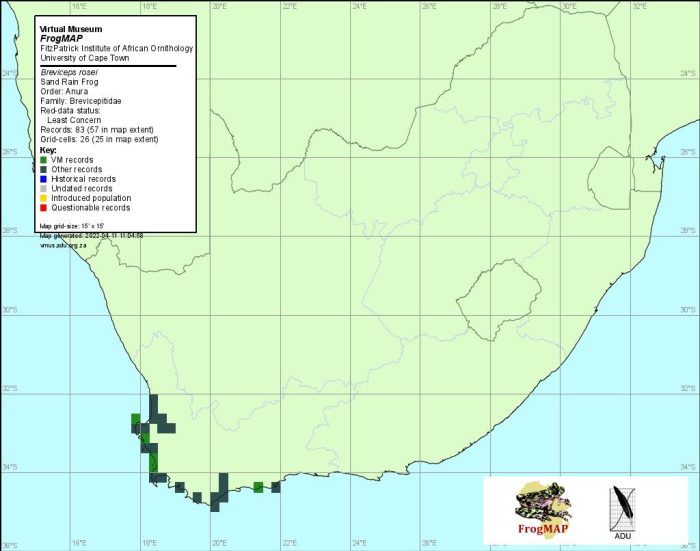
Some authors follow Poynton (1964) in recognizing two subspecies, that is, B. r. rosei northwest of False Bay, and B. r. vansoni east of False Bay, on the basis of differences in colour pattern, but these differences do not appear to be consistent (Passmore and Carruthers 1995). Field and molecular studies are required to clarify the status of these taxa.
The atlas data for this species is incomplete along the south coast.
Further Resources
The use of photographs by JK. Boyce, Ryan van Huysteen, and Trevor Hardaker is acknowledged.
Sand Rain Frog Breviceps rosei Power, 1926
Other Common Names: Rose’s Rain Frog; Rose’s Short-headed Frog (Alt. English); Rose se Blaasoppadda (Afrikaans)
Recommended citation format: Harrison, JA; Tippett, RM. (2025). Sand Rain Frog Breviceps rosei. Biodiversity and Development Institute, Cape Town. Available online at https://thebdi.org/2022/02/02/sand-rain-frog-breviceps-rosei/
This species text has been updated and expanded from the text in the
2004 frog atlas: Harrison, JA. (2004). Sand Rain Frog Breviceps rosei. In Minter LR et al 2004.
References:
Minter, LR; Burger, M; Harrison, JA; Braack, HH; Bishop, PJ; Kloepfer, D. (Editors). (2004). Atlas and Red Data Book of the Frogs of South Africa, Lesotho and Swaziland. Smithsonian Institution, Washington, and Avian Demography
Unit, Cape Town.
Carruthers, V; du Preez, L. (2017). Frogs of southern Africa: A Complete Guide. Struik Nature, Cape Town.
Channing, A. (2001) Amphibians of Central and Southern Africa. Protea Book House, Pretoria
Claus, B; Claus, R. (2002). Common Amphibians and Reptiles of Botswana. Gamsberg Macmillan, Windhoek.
