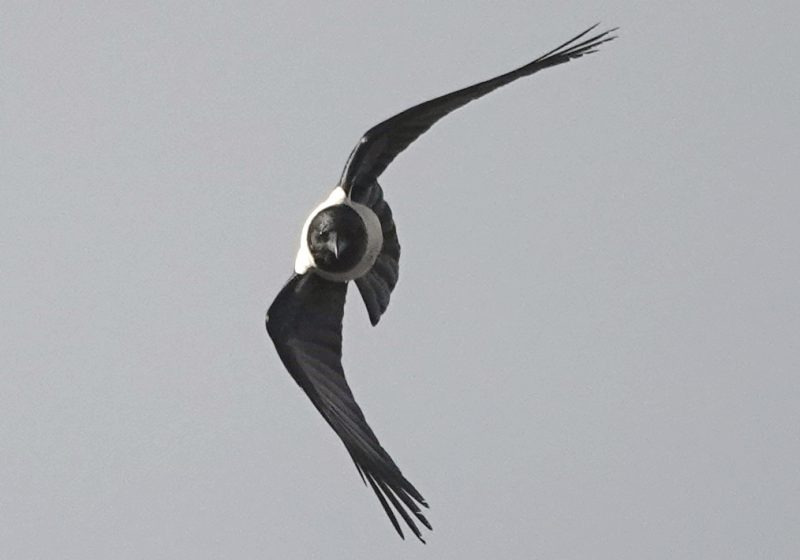
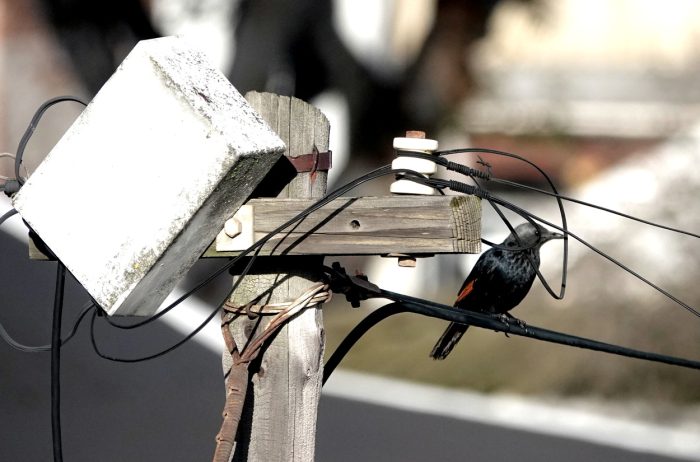
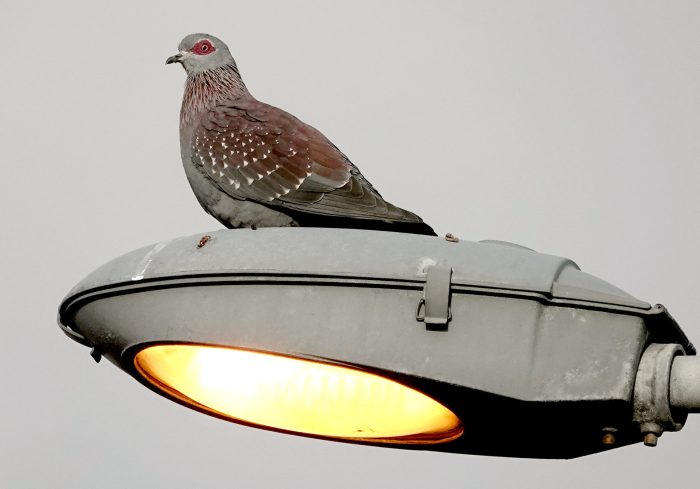
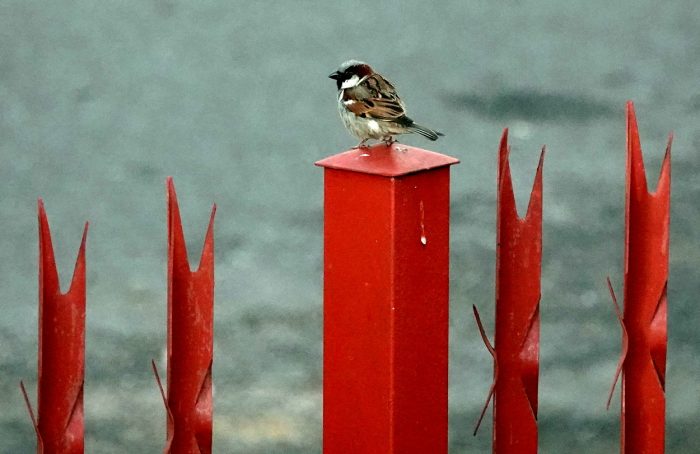
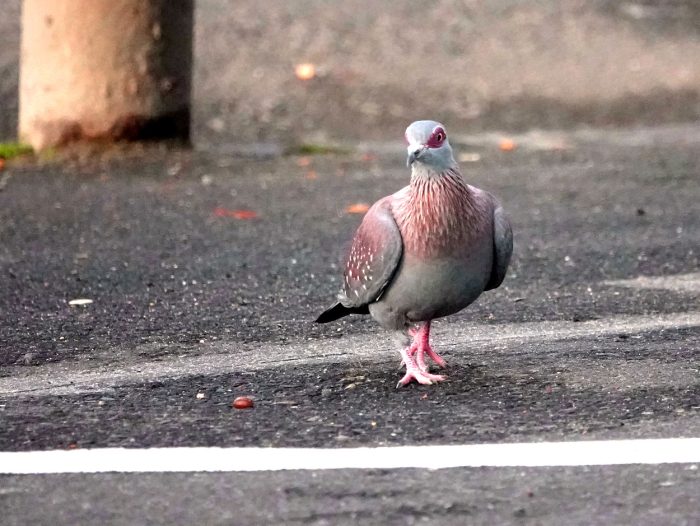
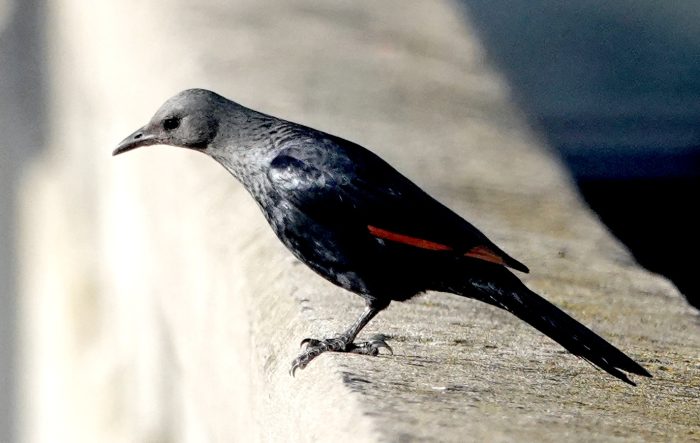
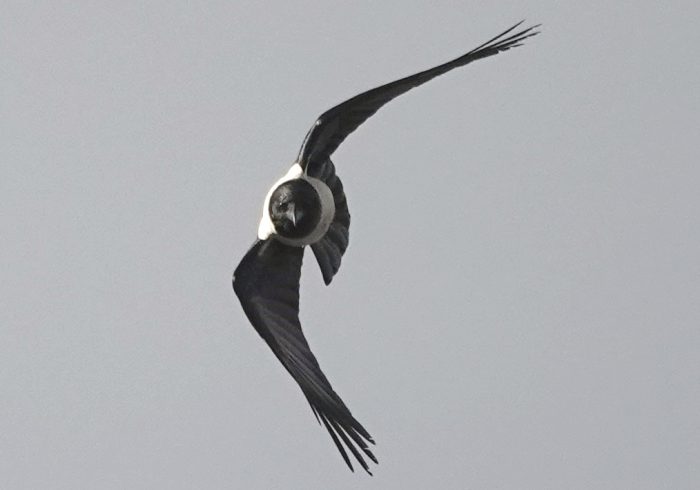
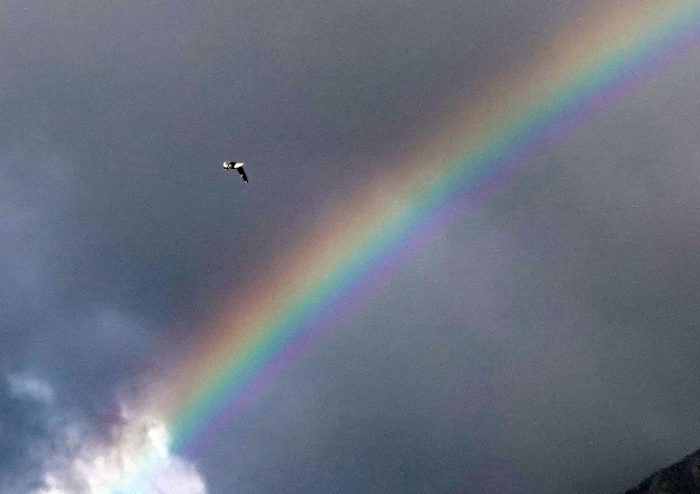
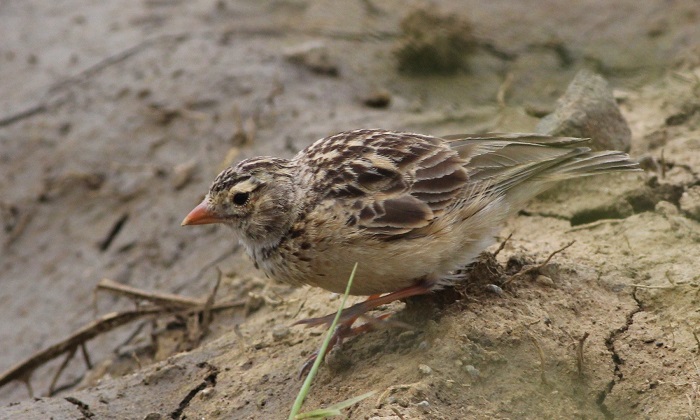
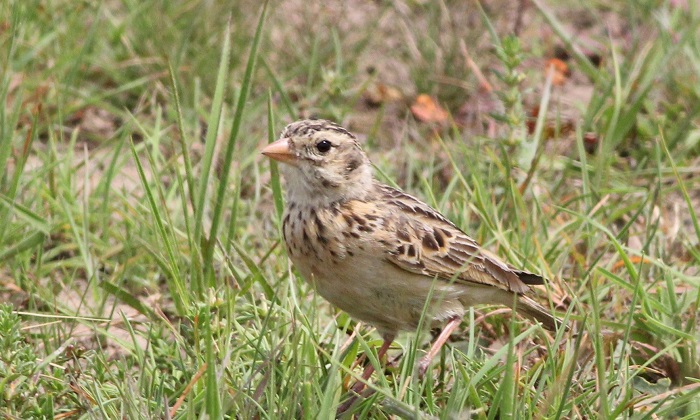
Birds succeed in making a living in pretty hard circumstances. This includes the jungles of tar, concrete, wires with assorted purposes strung between poles, with a few palm trees in the mix. Here’s an example of industrial biodiversity in Maitland, a suburb of Cape Town
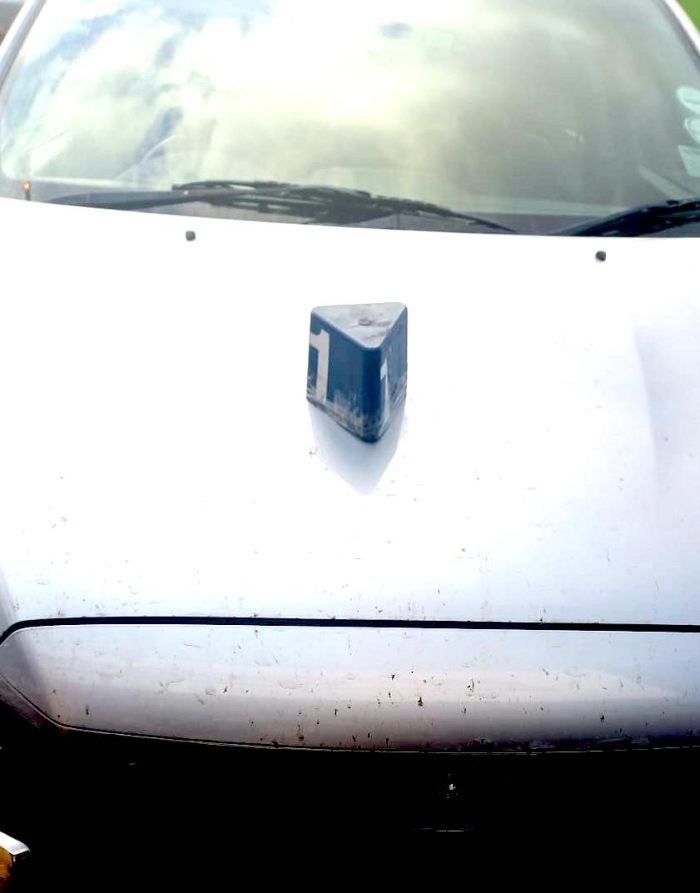
These tyres had given me 50,000 km, and had more than reached the legal limit. With a bird ringing course, 700 km away, looming next week, it was time for decisive action. So, at 08h00 today, the magnetic triangle showing that this vehicle was number one in the queue was put on the bonnet. Replacing four tyres, wheel alignment, etc, takes about an hour. You can use that hour or lose it. I had taken my camera, and in the hope that I could wander around outside, instead of reading old magazines about irrelevant topics in the waiting lounge, however comfortable that is. The hour produced enough of interest to generate this little blog. A camera trap would probably have produced some nightlife, in the form of rats, but the focus here is only on birds.
Birds and steel
We seldom look up when we are on pavements and crossing roads. That makes sense, because we should avoid bumping into other pedestrians, and getting knocked over by vehicles. But the birds have endless opportunities to inspect the infrastructure above us.
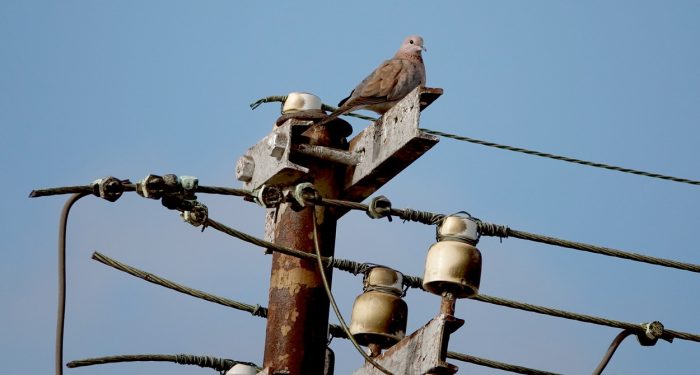
The Laughing Dove is amused by the Heath Robinson-ness of the wiring. But it is quite neatly done. One wonders when it was done, probably measured in decades, and how many kilowatts of electricity have flown safely along those wires. The pole is a bit rusty, and could use a coat of paint to prolong its life. BirdPix 291957
The winter storms of 2024 have played havoc with Cape Town’s road, and and water has exploited every little weakness, enlarging cracks and turning them into potholes. The texture provides a modest degree of camouflage for the Rock Doves. BirdPix 291963
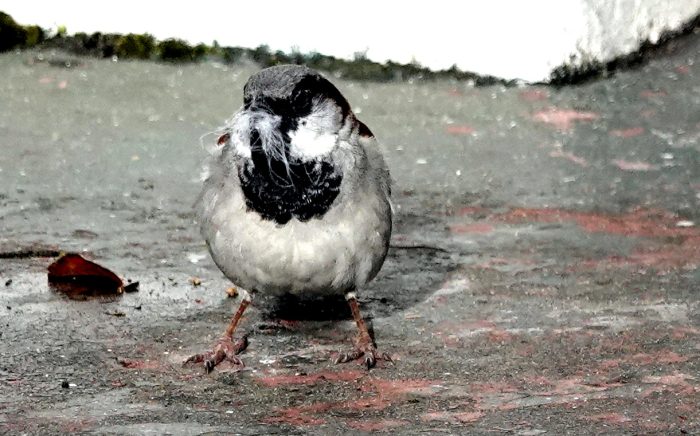
It is 5 September, so it is spring and its breeding season for the House Sparrows. This down feather, possibly from a dove, is destined to become lining for a nest. In the meantime it has been manipulated into a scruffy horseshoe moustache which an ancient cowboy would be proud of. BirdPix 291961
This part of Maitland generally lacks much in the way of green …
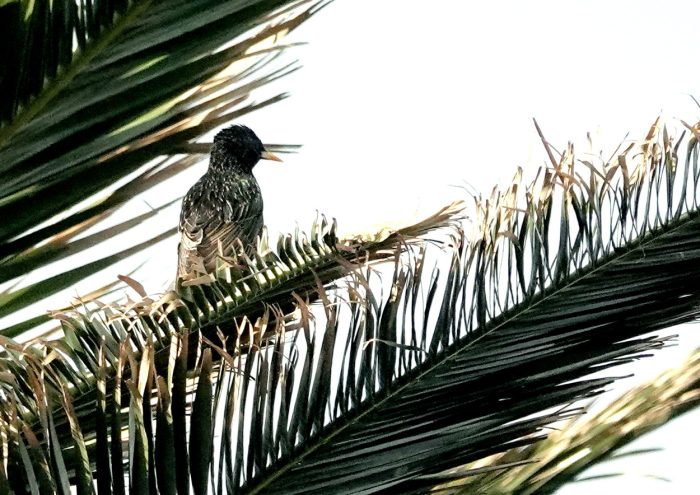
… but this palm tree is precious, not only for the nesting Common Starlings, but especially because it provides a landmark to find the tyre shop, and gives its name to the business …. BirdPix 291958
While I was still engrossed in photography, my tyres were fitted and the wheels aligned! Now I feel more comfortable setting off for the bird ringing course at New Holme, starting next Monday.
The industrial biodiversity of Maitland doesn’t have much variety, but the antics of the birds filled an hour with interest and amusement. The BirdPix section of the Virtual Museum benefitted too!
On 31 August we held an Open Day for bird ringing at Grotto Bay Private Nature Reserve. We caught 62 birds of 19 species (list at the bottom of this blog), including a few recaptures of birds which had been ringed in the last two years. The most-caught species was Cape Weaver, as these were breeding in the reeds in the pond at the Conservation Centre (see the photo above). This was followed by White-backed Mousebird. In addition to ringing three Chestnut-vented Warblers, it was exciting to catch a Layard’s Warbler, a bird not caught very often. Also exciting for me was a ringing lifer, Cape Penduline Tit.
Southern Double-collared Sunbird being ringed and released. Photo : SuzetteVorster
This was the BDI’s third ringing event at Grotto Bay Private Nature Reserve. There is a report here on the bird ringing here on 27 May last year here. The first trip escaped without a blog! Here is a list of (almost!) all the reports of BDI ringing courses and events which have already taken place. There is a list of future courses here. If you want to find out more about bird ringing, send an email to ring@thebdi.org.
The Long-billed Crombec has a remarkably short tail. It is when you see this bird in the hand that you can actually see the size of the tail feathers. Photo : Suzette Vorster
Thanks to Michelle van Acker, chair of the conservation committee, and the community at Grotto Bay Private Nature Reserve for hosting us! The Tygerberg Bird Club ringers helped with the ringing. Thank you to Suzette Vorster and Sue Gie for photography. We plan to do more Open Days for bird ringing at Grotto Bay in future. Keep looking here.
One of the most important components of a training as a bird ringer is to learn the skill of being able to extract birds from mistnets safely. This is a Cape Robin-chat. Photo : Suzette Vorster
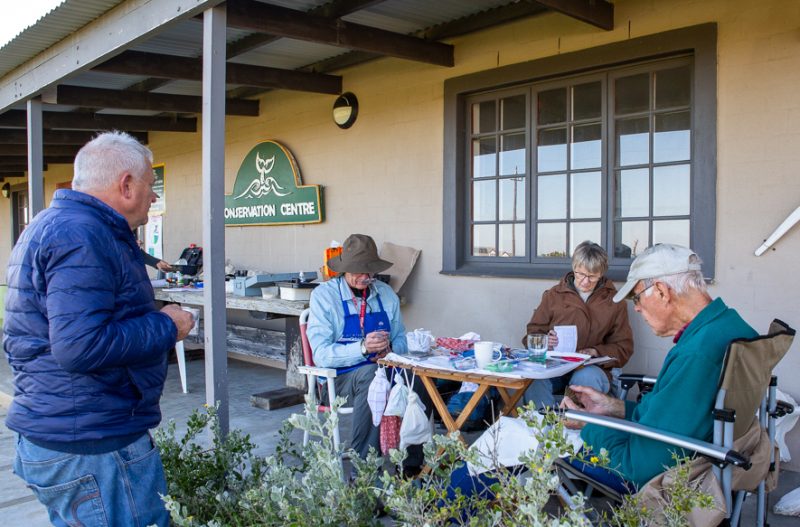
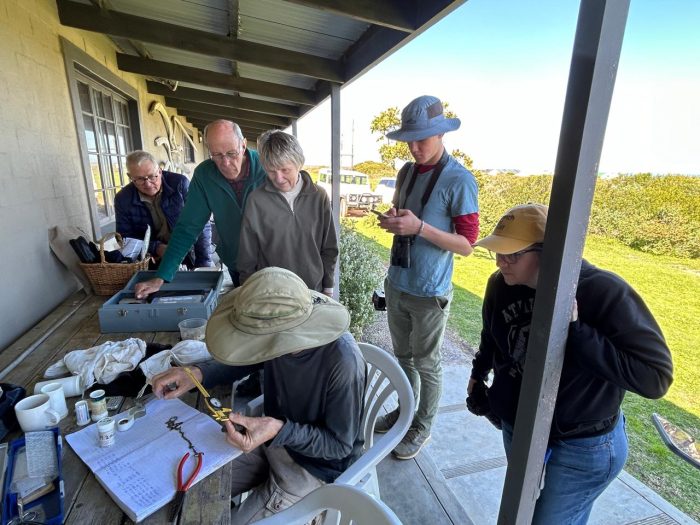
The ringing station at Grotto Bay is on the verandah of the Conservation Centre. It is an excellent venue, and the BDI is grateful that we are privileged to hold these events here. Photo : Sue Gie
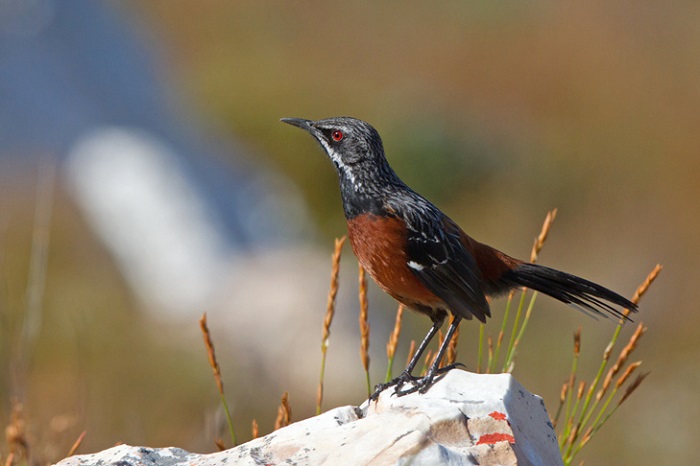
Cover image: Cape Rockjumper by Duncan Butchart – Hermanus, Western Cape – BirdPix No. 86016
Rockjumpers belong to the Family CHAETOPIDAE. The family is endemic to southern Africa and comprises 1 genus and 2 species. Rockjumpers are smallish passerine birds of high mountainous habitats. The genus Chaetops means ‘bristle eye’ which refers to their conspicuous eye lashes. Their taxonomic affinities are uncertain, but research indicates they are most closely related to the Rockfowl (Picatharthidae) of West Africa.
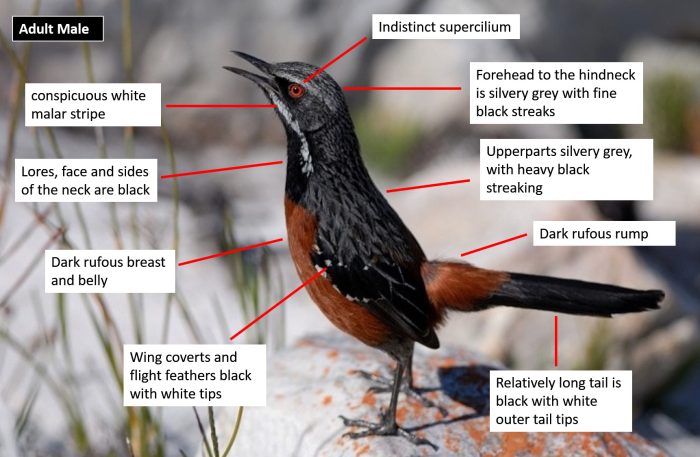
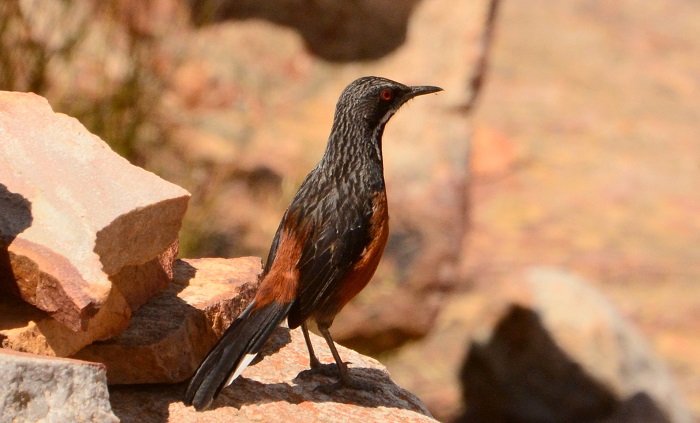
The Cape Rock Jumper is a handsomely plumaged species. In adult males the forehead, crown, ear coverts and hind neck are silvery grey with fine black streaks. The supercilium is silvery-grey and rather indistinct. The lores, face and sides of the neck are black with a conspicuous white malar stripe. The rest of the upper parts, including the mantle, scapulars and back feathers are silvery grey, with heavy black streaking. The rump and upper tail coverts are a rich dark rufous. The relatively long tail is black with white outer tail tips. The chin, throat and upper breast are jet black. The breast and belly are richly coloured in dark rufous, while the vent and thighs are blackish. Under tail coverts black, with whitish tips. The wing coverts and flight feathers are black with white tips. The relatively long legs are an adaptation to bounding around on rocky mountain slopes. The legs and feet are black and the eyes are orange-red.
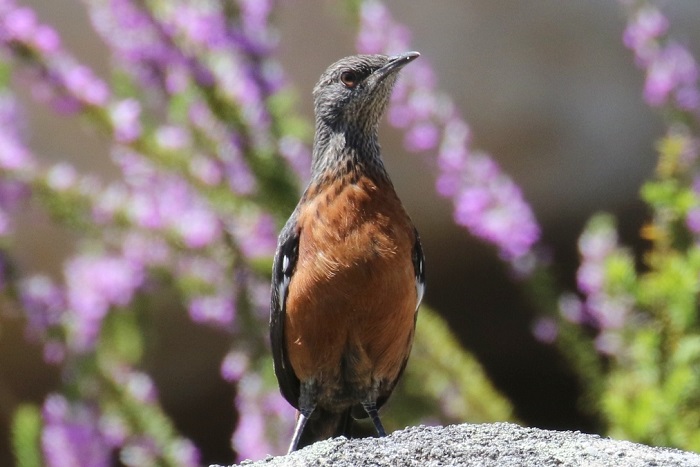
Adult females differ from males in having a grey and buff mottled face and neck with an indistinct buff-grey malar stripe. The upper parts are brownish-grey with dark streaks. The rump and upper tail coverts are dark rufous but paler than in males. The tail and wings are brownish black and the flight feathers carry white tips. The breast and belly are dark rufous but duller and paler than in males and the breast shows fine brown streaks. The eyes are reddish-brown..
Juveniles resemble adult females but are less strongly marked overall.
The Cape Rockjumper most resembles the Drakensberg Rockjumper (Chaetops aurantius) but confusion is unlikely as their distributions do not overlap. Females are similar to female and juvenile Cape Rock Thrush (Monticola rupestris) and Sentinel Rock Thrush (Monticola explorator) but those species have rufous (not black) tails and lack the white outer tail tips.
Status and Distribution
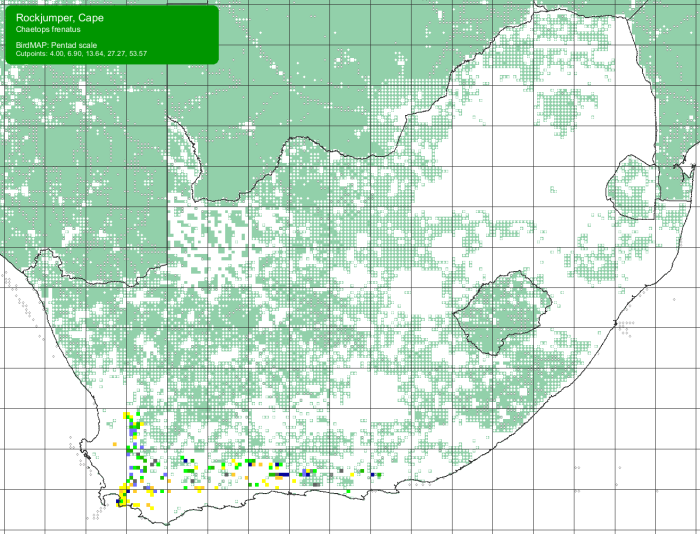
SABAP2 distribution map for Cape Rockjumper (Chaetops frenatus) – August 2024. Details for map interpretation can be found here.
The Cape Rockjumper is a locally common resident and is endemic to South Africa. The distribution ranges from Piketberg and the Cederberg Mountains, south to Cape Hangklip near the village of Rooi-Els, Western Cape, and east along the Cape Fold Mountains to Uitenhage, Eastern Cape. The range does not overlap with that of the Drakensberg Rockjumper, but is separated by only 100 km or so.
The Cape Rockjumper is near threatened and threats include the rampant spread of alien vegetation.
Habitat
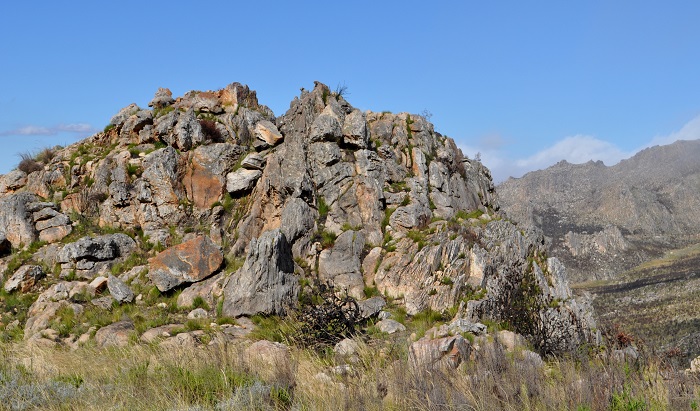
Typical habitat Swartberg Pass, Western Cape Photo by Ryan Tippett
The Cape Rockjumper inhabits mountain fynbos on windswept, high rocky slopes or ridges. It also occurs down to sea level in the extreme west of its range at Rooi-Els, Western Cape. The Cape Rockjumper is restricted to higher rainfall parts of the Fynbos Biome.
Cape Rockjumpers are gregarious and normally encountered in pairs or small family groups. They are unobtrusive and typically scuttle about over and between rocks and boulders. Forages by scratching and probing on the ground, searching in sand and at the base of bushes and boulders. The diet consists mostly of arthropods like caterpillars, beetles, bugs, flies, grasshoppers, spiders, scorpions along with the occasional vertebrate such as small lizards or frogs.
Cape Rockjumpers are territorial and territories are usually maintained year-round. Boundary disputes are usually brief and involve much calling, chasing and posturing with heads held high and tails fanned to expose conspicuous white tips.
The Cape Rockjumper is often a facultative cooperative breeder. A group comprises a monogamous breeding pair and sometimes 1 or 2 additional helpers, often the offspring from the previous breeding season. Helpers assist with nest building, incubation and the rearing of chicks.
The nest is a bulky open cup, made from dry grass, twigs, moss and lichen. The bowl is lined with fine plant material and bits of fur. The nest is well hidden and is placed on the ground, usually beneath a rock slab, but sometimes also under a grass tuft, rock overhang or bush. The nest site is chosen on the leeward side of a rock to guard against the prevailing south-east winds.
Eggs are laid from late July to January with a peak between September and October. Clutches consist of 2 plain white eggs, laid on successive days. Incubation duties are shared by both sexes and probably also helpers. The incubation period lasts up to 21 days and the nestling period takes 18 to 21 days. Young birds are unable to fly for at least 5 days after initially leaving the nest but are able to run well over rocky slopes and hide in crevices or dense vegetation if approached. Both adults and helpers feed the young and remove faecal sacs from the nest.
Cape Rockjumpers are multiple brooded and sometimes attempt to breed up to 3 times in one breeding season.
Species text in the first Southern African Bird Atlas Project (SABAP1), 1997.
The use of photographs by Corne Rautenbach, Duncan Butchart, Georg Jacobs, Gerald Wingate, Johan van Rensburg, Maans Booysen, Pamela Kleiman, Salome Willemse and Trevor Hardaker is acknowledged.
Virtual Museum (BirdPix > Search VM > By Scientific or Common Name).
Other common names: Kaapse berglyster (Afrikaans); Sauteur du Cap, Chétopse bridé (French); Kaapse Rotsspringer (Dutch); Kap-Felsenspringer (German); Saxícola-do-Cabo (Portuguese).
List of bird species in this format is available here.
Recommended citation format: Tippett RM 2024. Cape Rockjumper Chaetops frenatus. Biodiversity and Development Institute. Available online at https://thebdi.org/2024/09/01/cape-rockjumper-chaetops-frenatus/
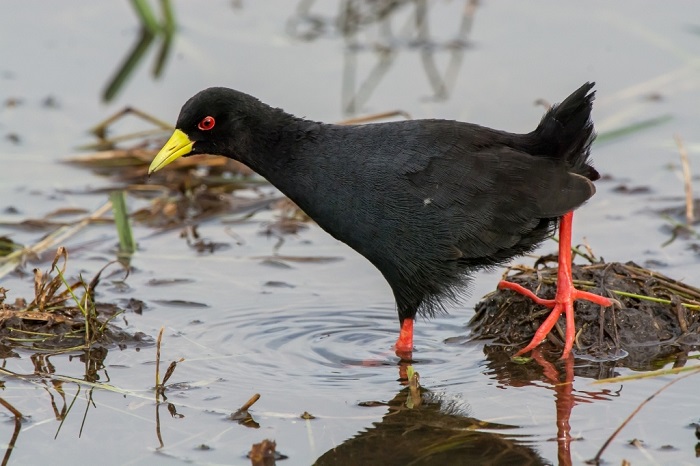
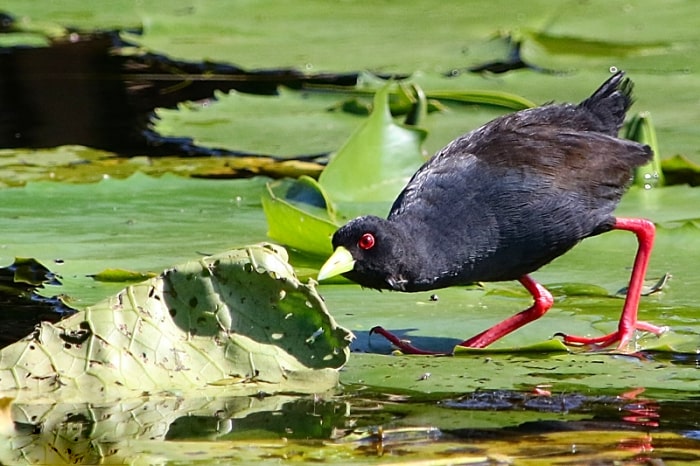
Cover image of Black Crake by Anthony Paton – Kruger National Park, Limpopo – BirdPix No. 41149
Crakes belong to the Family: RALLIDAE. This family also includes Rails, Flufftails, Gallinules, Moorhens and Coots etc. Their physiology is diverse, but most have laterally compressed bodies, short tails, short rounded wings and well developed legs and feet. The bill structure is variable. Most birds in this family inhabit wetlands or forest undergrowth and are usually vocal and highly secretive.
Identification
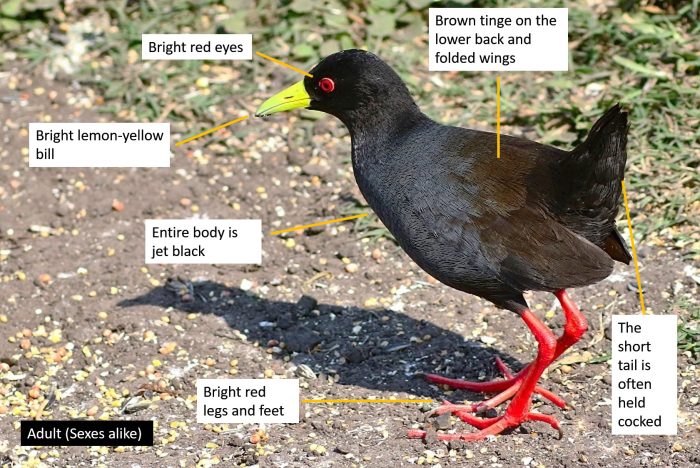
The Black Crake is a smallish and striking, all-black water bird.
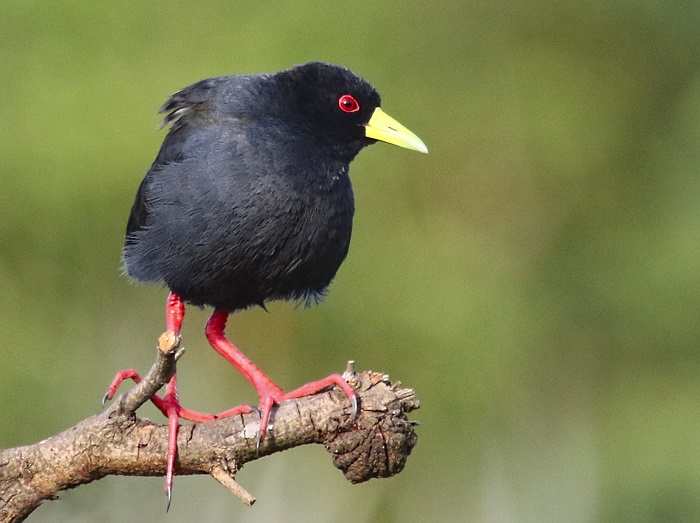
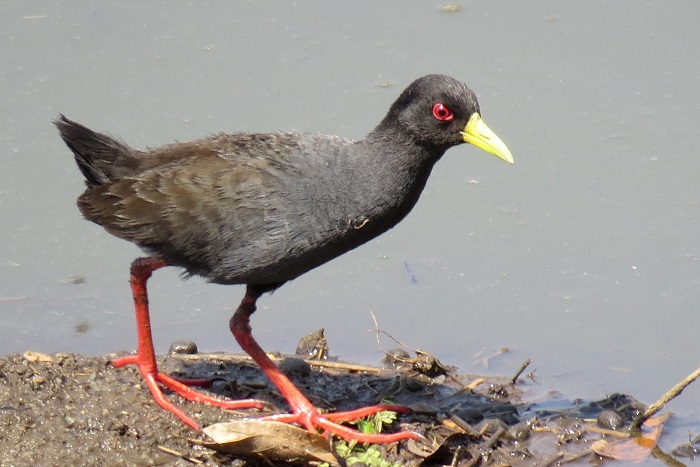
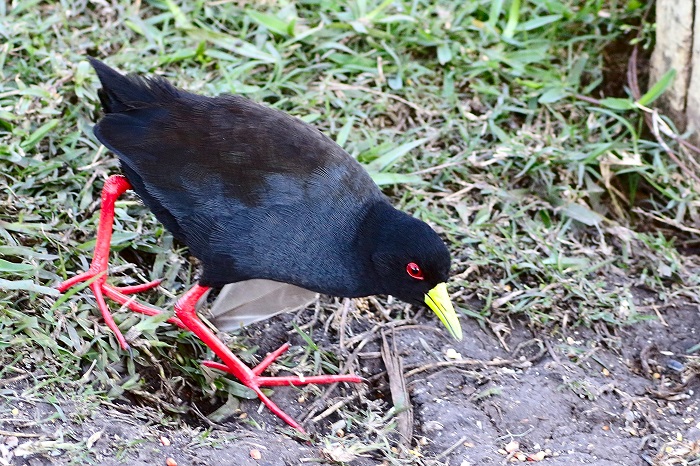
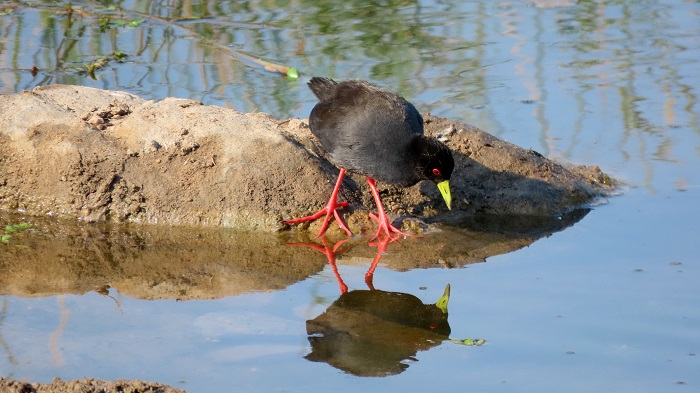
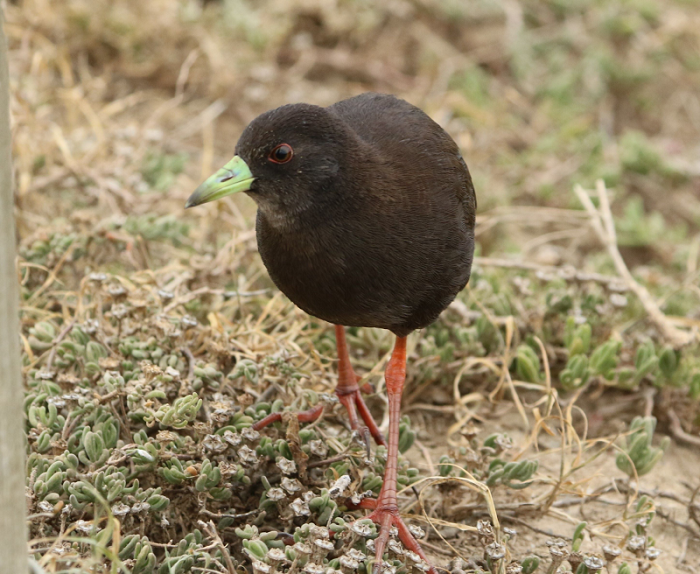
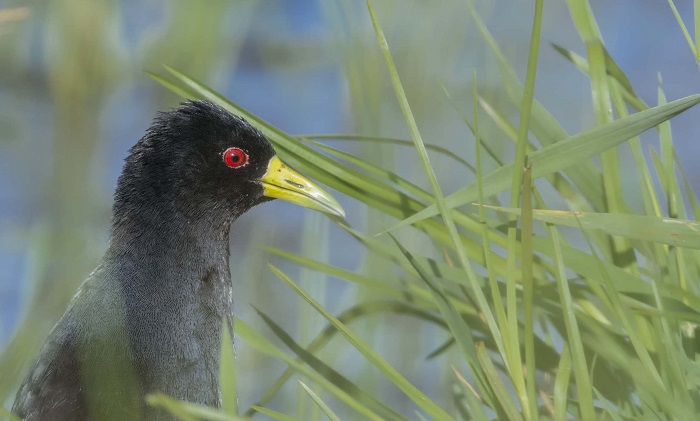
The entire body is jet-black (sometimes with a brownish hue on the folded wings and lower back). The bill is bright greenish-yellow and the eyes are vivid red. The well developed legs and feet are bright red in breeding condition or dull red during the non-breeding season.
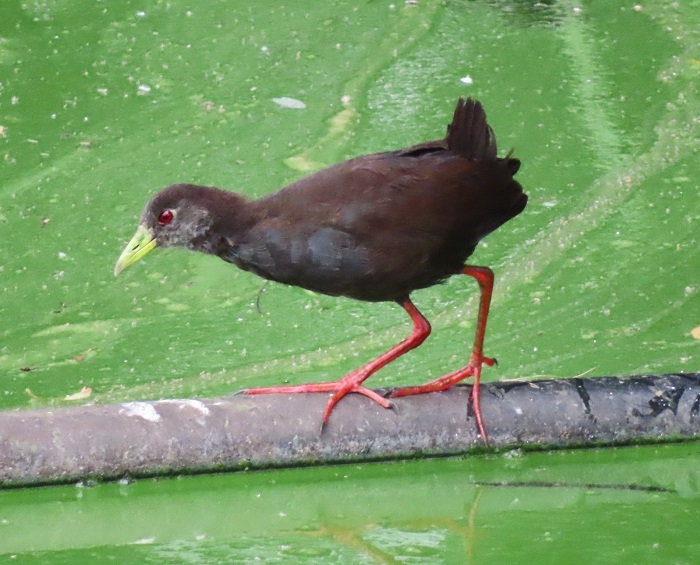
Juveniles have dark olive-brown upper parts, dark grey under parts and a whitish throat. The bill is dull greenish-yellow and the red legs are duller than those of the adults.
Adult Black Crakes are unmistakable and unlike any other African bird.
The Black Crake is generally a common resident with some local movements during dry periods. The Black Crake is found throughout sub-Saharan Africa, except for arid regions. It is the commonest and most widespread crake species in Africa.
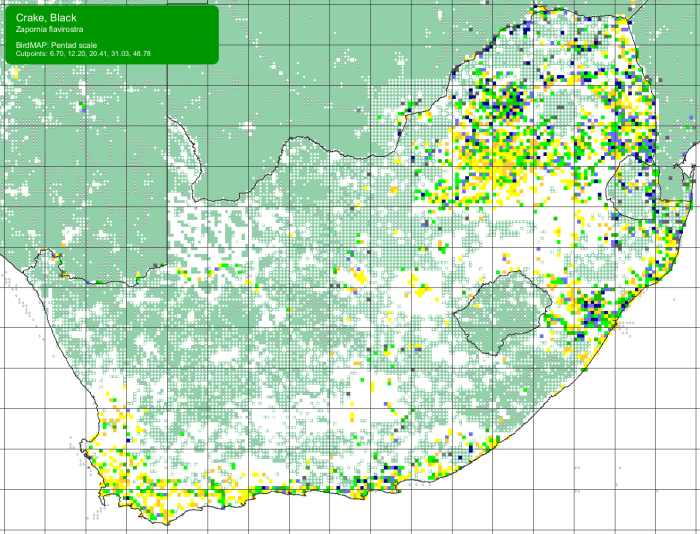
SABAP2 distribution map for Black Crake (Amaurornis flavirostra) – August 2024. Details for map interpretation can be found here.
In southern Africa, the Black Crake occurs in northern Namibia and Botswana, most of Zimbabwe and Mozambique, northern and eastern South Africa and along the eastern littoral to the Western Cape. There are scattered records elsewhere including the semi-arid and arid parts of Namibia and the Karoo where it may be very localised.
The Black Crake is not threatened. There is no evidence of any range contractions but it has likely been affected by the continual loss of wetland habitats in some areas. Conversely, the Black Crake is often common at a variety of man-made water bodies.
Habitat
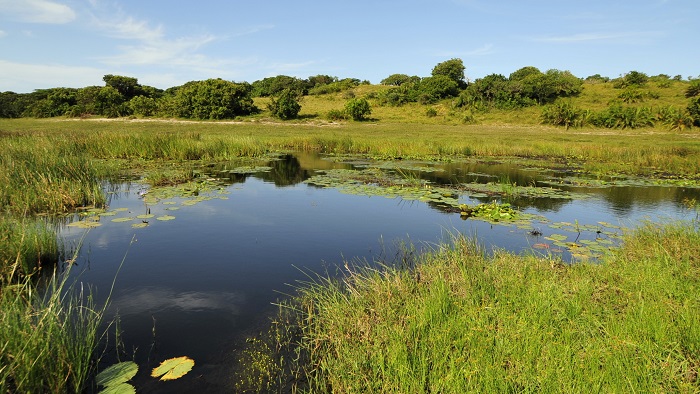
Typical aquatic habitat. Kosi Bay, iSimangaliso Wetland Park, KwaZulu-Natal Photo by Ryan Tippett
The Black Crake occupies a wide range of fresh and brackish wetland habitats, including marshes, pans, dams, ornamental ponds, rivers, streams, estuaries and sewage ponds. It frequents still and flowing water, and both seasonal and perennial wetlands. The Black Crake prefers dense, tangled vegetation such as reedbeds, sedges, Papyrus (Cyperus papyrus) stands and rank grass. Also inhabits swampy thickets, bushes and other thick growth near water.
Behaviour
The Black Crake is largely sedentary but may be locally nomadic in the drier parts of its range in response to rainfall and water levels. The Black Crake is usually solitary but can also be found in pairs or in small family groups.
The Black Crake is most active by day and sometimes also on moonlit nights, becoming very active after rain. The main activity period is during the morning and late afternoon, but forages throughout the day in winter. The Black Crake flies reluctantly but strongly when disturbed. They will usually fly back into cover, but prefer to run away through vegetation and over water plants. The Black Crake swims well, even under water, but usually only when threatened. Adults are known to build platforms in vegetation for resting or preening and pairs, helpers and young frequently engage in allopreening.
The Black Crake is less shy than most others in the family, and often forages in the open, especially during the winter months when breeding is over. They can become quite tame and confiding, and are sometimes regular visitors at picnic spots and garden bird feeders when these adjoin wetland habitats. It is regularly seen walking across floating plants or in areas of short grass and along muddy shorelines. Black Crakes often clamber into bushes and low trees, especially over water. Also climbs high up above the water in dense reedbeds or Papyrus stands.
The Black Crake is omnivorous and has a varied diet that includes earthworms, molluscs, crustaceans, insects and their larvae, frogs, tadpoles, small fish, bird eggs and the nestlings of weavers and other bird species. The Black Crake is even known to kill and eat small birds caught in mist nets. Also consumes the seeds, stems and leaves of various water plants, including duckweed (Lemna sp) and the seeds of water lilies (Nymphaea spp). The Black Crake frequently scavenges when the opportunity arises, feeding on dead crabs, frogs, fish, insects and small birds etc.
The Black Crake forages by pecking and probing food off of water plants, muddy substrate and from the water surface. They will also climb reeds to snatch insects. Catches small fish, tadpoles and aquatic insects by rapidly immersing the head and neck into shallow water. Meticulously searches under debris and fallen plants and pulls down the leaves of water plants to search for prey. They will also forage in cultivated areas, gardens and dry or burned ground near water.
Additionally, Black Crakes have been observed perching on the backs of Warthogs (Phacochoerus aethiopicus) and Hippopotamus (Hippopotamus amphibius), most likely in the hope of gleaning ectoparasites. The Black Crake is also known to associate with foraging animals near the waters edge such as warthogs in order to catch disturbed prey.
The Black Crake is a monogamous, cooperative breeder. They are strongly territorial and males set up territories at the start of the breeding season. Territory establishment is accompanied by increased vocalisations. They are aggressive when marking out and defending territories and readily chase off conspecifics and other species. Territories are not defended post breeding.
The Black Crake is multiple-brooded, producing more than one clutch during the breeding season. The Offspring of the previous brood often remain as ‘helpers’ during subsequent breeding attempts. The helpers assist with incubation and in rearing the young of the following brood. They often remain with the family group until the end of the breeding season. The breeding season runs from October to April in southern Africa. Under suitable conditions, breeding may occur throughout the year, but in most regions there are seasonal peaks. In southern Africa these peaks occur during November and again between January and March.
The nest is a deep cup made from the leaf-blades and stems of aquatic plants. It is usually well hidden among vegetation and bits of plant stems and other vegetation are sometimes pulled over the nest to form a canopy. The nest is usually placed over water, anywhere from just above the water level to 3 meters up. The nest may occasionally be built on firm ground near water or floating, attached to emergent vegetation.
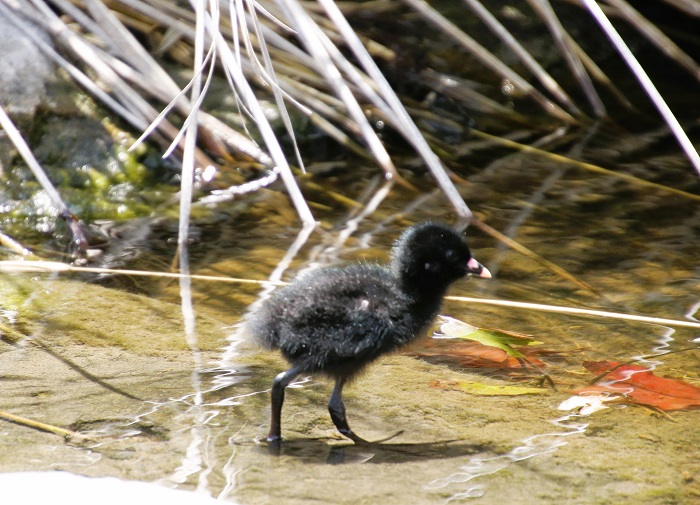
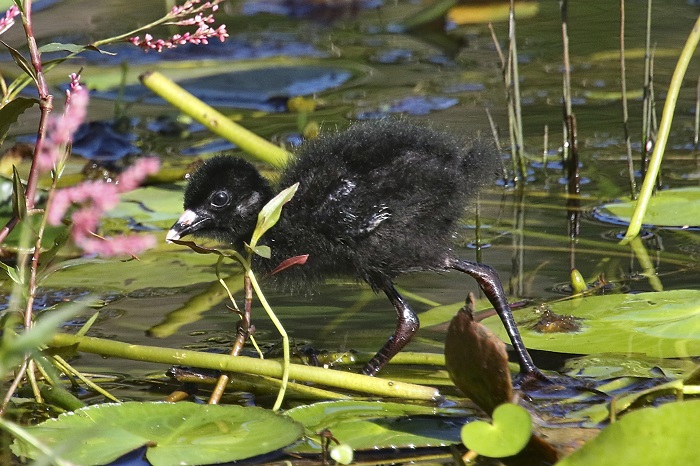
Clutch size ranges from 2 to 6 eggs, laid at 1 day intervals. The incubation period lasts for 13 to 19 days and is done by both sexes, sometimes with helpers from the previous brood. Incubation changeovers are often accompanied by raucous duetting. The eggs hatch asynchronously. The newly hatched young have pink and black bills and are covered in black down. Chicks are precocial and are able to move away from the nest within 1 day of hatching. They are fully fledged at 5 weeks old.
Species text from the first Southern African Bird Atlas Project (SABAP1), 1997.
The use of photographs by Anthony Paton, Felicity Ellmore, Jean Hirons, Johan van Aarde, Johan Van Rooyen, Lia Steen, Ruth Robinson, Terry Terblanche, Tony Archer is acknowledged.
Virtual Museum (BirdPix > Search VM > By Scientific or Common Name).
Other common names: Swartriethaan (Afrikaans); umJekejeke ,umJengejenge (Zulu); Hukunambu (Tswana); Zwart Poseleinhoen (Dutch); Marouette à bec jaune, Râle à bec jaune (French); Mohrenralle, Negerralle (German); Franga-d’água-preta (Portuguese)
A list of bird species in this format is available here.
Recommended citation format: Tippett RM 2024. Black Crake Amaurornis flavirostra. Biodiversity and Development Institute. Available online at https://thebdi.org/2024/08/20/black-crake-amaurornis-flavirostra/
Cover image of African Darter by Graeme Hatley – Stanford, Western Cape – BirdPix No. 285516
Darters belong to the Family: ANHINGIDAE. Anhingas and darters are large water birds with long, slender necks, short legs, long pointed bills and long tails. Males and females are the same size. Anhingas and darters are typically brown or black in colour. The family comprises a single genus with 4 recognised species. Their closest relatives are gannets, then cormorants and herons.
Identification
The African Darter is a large, conspicuous and distinctive water bird. It is a large, cormorant-like bird, with a dagger-like bill and a very long, slender neck.
The sexes differ slightly in breeding plumage coloration. The adult breeding male has a rufous-chestnut fore neck and upper breast. The head is relatively small and has a white stripe that extends from below the eye, across the cheek and down the neck. The chin is cream-coloured and the lower breast and belly is blackish-brown. The upper parts are dusky-brown with elongate white-striped scapulars and wing coverts. The flight feathers and underwings are black. The tail is rounded or wedge-shaped and relatively long. Adult breeding females differ slightly from breeding males, having a paler brown crown and neck. The cheek stripe is cream (not white) and is less well defined.
In both sexes the bill is yellowish horn-grey to greenish horn-grey. The eyes are usually golden yellow, but are sometimes brown or red. The legs and feet are pale to dark brown and the feet are totipalmate (fully webbed).
Non-breeding adults are paler, duller and browner than breeding adults, especially on the neck and mantle. At this time the white cheek stripe is reduced and less conspicuous.
Juveniles resemble the adult female, but have pale buffy brown underparts. The bill is grey-green and the facial skin is dark green.
The African Darter is unlikely to be mistaken for another species. It is most similar to Cormorants and the African Finfoot (Podica senegalensis). Cormorants have shorter, thicker necks and hook-tipped bills. The African Finfoot is easily recognised by its red bill (dark in juveniles), legs and feet.
The African Darter is generally a locally common resident with some local movement in the non-breeding season.
SABAP2 distribution map for African Darter (Anhinga rufa) – August 2024. Details for map interpretation can be found here.
It is widely distributed in sub-Saharan Africa, Madagascar and parts of the Middle-East, occurring wherever there is suitable aquatic habitat. The African Darter is widespread in southern Africa but is localised in the arid west, where it is confined to large rivers and dams. It avoids the driest parts of the Northern Cape, Botswana and Namibia where surface water is scarce, and is also largely absent from the Lesotho plateau.
The range of the African Darter has increased across southern Africa due to the construction of dams and their stocking with fish. However, in some areas the African Darter is impacted by the loss and degradation of wetlands and river systems. It is sometimes seen as a pest at fish farms and trout dams where it may be illegally persecuted, but this impact is considered minimal.
Habitat
Typical freshwater habitat with open water and dead trees on which to perch. Phongolo Nature Reserve, KwaZulu-Natal Photo by Ryan Tippett
The African Darter inhabits still and slow-moving freshwater bodies with open water like lakes, dams, rivers and sewage ponds. It is scarce in turbulent water, fast-flowing rivers and in areas with dense floating vegetation. Prefers places with dead trees, rocks or banks where it can rest after feeding. The African Darter also forages in estuaries and coastal lagoons but typically avoids other marine habitats.
Behaviour
African Darter (Anhinga rufa) Franskraal, Western Cape Photo by Corrie du Toit
The African Darter can be somewhat gregarious when feeding but may also be encountered solitarily.
Sits very low in the water, typically with only the neck and head protruding, snake-like above the surface, hence the colloquial name of ‘Snakebird’. Rarely sits higher in the water with the upper parts exposed. Dives by thrusting forward like a cormorant and glides smoothly through the water, barely leaving a ripple. Enters the water silently, direct from their perch, but can also land on water, using the feet as brakes.
African Darter (Anhinga rufa) Northcliff, Johannesburg, Gauteng Photo by Anthony Paton
The African Darter is well adapted to spending time underwater. The body plumage is very absorbent and its bones are more solid, containing less air than in similar diving birds like cormorants, resulting in reduced buoyancy. The African Darter is neutrally buoyant underwater at a depth of around 3 meters. The feet are fully webbed and the legs are set far back to aid propulsion under water. The flight feathers are waterproof, allowing the African Darter to fly even when completely drenched. However, they prefer to perch on a dead tree or rock after foraging to allow the body feathers to dry off. They typically sit with their wings spread for up to 1.5 hours, raising the body feathers and orienting the body towards the sun. They sometimes beat their wings slowly to accelerate drying or to generate body heat. Several individuals may aggregate at favoured resting sites. They gular-flutter to cool down During hot weather. This is achieved by frequently vibrating the throat membranes, which increases airflow resulting in improved evaporation.
The African Darter roosts communally at night, usually in trees or large reedbeds. They mostly roost close to their feeding areas, but will sometimes commute up to 10 km, either singly or in loose groups. They fly well, with regular flaps and glides, and does not fly in formation like many other water birds. The neck is extended in flight, showing a characteristic kink. The African Darter soars from time to time, somewhat resembling a long-necked raptor.
A juvenile African Darter (Anhinga rufa) Hanover district, Northern Cape Photo by Ryan Tippett
The African Darter feeds mostly on fish but also takes frogs, tadpoles and aquatic arthropods. They are non-selective regarding fish prey, consuming a wide range of suitably sized species. In some places where fish are absent, like on farm dams in the Karoo, they feed almost exclusively on frogs and large tadpoles.
African Darter (Anhinga rufa) Alberton, Johannesburg, Gauteng Photo by Anthony Paton
The African Darter forages at depths of up to 6 meters, mostly in the mid-water or along the bottom. Dives usually last for 30 to 100 seconds, increasing in duration with water depth. They hunt using stealth, preferring to ambush prey rather than chase it down. As they are neutrally buoyant underwater, they are able to wait motionless while suspended in the midwater, wings half open. Prey is speared by rapidly thrusting the neck forwards. The neck is flexible with a special hinge mechanism between the 8th and 9th vertebrae. Prey is speared with the bill slightly open. Small prey is mostly speared with the upper mandible while larger prey items are impaled with both mandibles.
Captured prey is brought to the surface where it is tossed in the air and caught in the bill before being swallowed head first. Some small prey may be swallowed underwater. Prey is swallowed head first to prevent sharp fin spines from snagging in the throat. Occasionally catches prey too large to swallow, and after a struggle, is eventually abandoned. After feeding they usually wash their face and bill by wiping them against the feathers on their backs.
.
African Darter (Anhinga rufa) Somerset West, Western Cape Photo by Corrie du Toit
The African Darter is monogamous and breeds mainly in the spring and summer months (September to March) in South Africa. They usually breed colonially, often with other water birds like White-breasted and Reed Cormorants, African Spoonbills and herons.
The nest is a fairly large untidy platform of sticks or dead reeds, with a shallow bowl lined with grass. Built in tree fork, often over water or on island; also in large reedbed. Pairs work together to construct the nest. The male collects the nesting material and the female weaves it into the nest. The nest site and nesting material is fiercely guarded against other birds that may attempt to steal nest material. The nest is sometimes completed in as little as 1 day, but the pair will continue to add material during incubation and early chick rearing. The African Darter usually builds a new nest at the start of each breeding season.
African Darter (Anhinga rufa) Johannesburg, Gauteng Photo by Anthony Paton
Eggs are laid throughout the year in north-eastern South Africa, Botswana and Zimbabwe with slight peaks in spring and late summer. Egg laying is mainly from October to December in south-eastern South Africa and between August and October in the Western Cape.
Clutch size ranges from 2 to 7 greenish white eggs. They are laid at irregular intervals and incubation starts with the first-laid egg which leads to asynchronous hatching. The incubation period takes 21 to 27 days to completion and duties are shared by both sexes. The African Darter lacks a brood patch and so incubates with the feet. Incubation shifts are fairly short, with several changeovers per day.
The newly hatched young are altricial and hatch out naked with their eyes closed. White down begins to show on their bodies after 2 days. Chicks are fed by both parents, initially by regurgitation, thereafter the chicks insert their heads into the adult’s throat to take food stored in the adults crop. Adults also bring water to the chicks in hot weather. Young birds leave the nest at 5 to 6 weeks old and are fully fledged at 7 weeks.
The African Darter has a recorded lifespan of at least 12 years.
African Darter (Anhinga rufa) Franskraal, Western Cape Photo by Corrie du Toit
Further Resources
Species text from the first Southern African Bird Atlas Project (SABAP1), 1997.
The use of photographs by Anthony Paton, Bryan Groom, Corrie du Toit, Gregg Darling, Kevin Lavery, Les Underhill, Mark Stanton, Terry Terblanche, Tony Archer and Werner Van Goethem is acknowledged.
Virtual Museum (BirdPix > Search VM > By Scientific or Common Name).
A list of bird species in this format is available here.
Recommended citation format: Tippett RM 2024. African Darter Anhinga rufa. Biodiversity and Development Institute. Available online at https://thebdi.org/2024/08/13/african-darter-anhinga-rufa/
We visited Botuin Cottages between 4 and 7 August to enjoy the spring flowers and do some birding and ringing. Flowers and feathers. It was also a test run to evaluate whether we should repeat the initiative next year, and on a larger scale! The answer was an unambiguous YES. Read on to understand why this was such an easy decision.
Plants
Namaqualand is famous for its carpets of spring flowers. The flower season averages August and September, but sometimes it is earlier or later, and sometimes it is much shorter than two months; it depends on the rainfall. The period we were there, 4 to 7 August, is usually early in the season, and that proved to be the case this year.
Salome Willemse, our hostess at Botuin, told us that the best displays were at the Maskam Guest Farm, and we ended up going there twice. We went back because it was so good the first time (and also because Dieter found a bird ringing site with real potential – see below).
White daisies stretching back to the Maskam Mountain
Orange and yellow daisies
It is easy to focus solely on the panoramas of daisies. But there are equally big rewards for zooming in on individual plants. There’s a selection below!
Dimorphotheca sinuata. Known as Namaqualand Daisy in English, and as Jakkalsblom in Afrikaans
Babiana curviscapa. Common names are Perde-uintjie and Bobbejaantjie. Endemic to Namaqualand
Gorteria diffusa. The common name is, appropriately, Beetle Daisy
Lapeirosia jaquinni
Mesembryanthemum spp.
Oxalispurpurea. Syringa purpurea
Dimorphotheca sinuata. Known as Namaqualand Daisy in English, and as Jakkalsblom in Afrikaans
Birds
Lots of bird species have the southern edges of their ranges near Vanrhynsdorp. The districts straddles a variety of bird habitats; there is a discussion about this here.
On this trip, our focus was not so much on making an overall list of the species we saw, but on getting photographs which were good enough for identification purposes, and uploading these to the BirdPix section of the Virtual Museum. Table 1 has a list of species for which we submitted records to BirdPix. If you can see a species for long enough to get a photograph, it must be a species which has a realistic chance of being seen by other visitors. At the end of Table 1 there are links to websites which give fairly comprehensive species lists for this area.
The Blue Cranes in the photo on top are near the edge of their range. During the first bird atlas project, which ended in 1991, Blue Cranes were rare vagrants this far north of Cape Town. The range has steadily extended northward, and this pair now breeds here.
Salome Willemse’s garden at Botuin is an oasis in the desert, and the birds grasp that. The common birds are here in abundance. The vagrants passing through find this garden a magnet.
It was in Botuin’s garden that Salome noticed that the Cape Bulbuls were steadily being replaced by African Red-eyed Bulbuls. African Hoopoes are regular visitors. There is a resident Namaqua Warbler. This European Golden Oriole would have snuck through the garden undetected on 30 June 2023, but it failed to detect a mistnet!
Birders are notorious for seeking out the local sewage works, and especially so in arid areas. The Vanrhynsdorp sewage works never fails to be a pleasure for the eyes, and it is only mildly offensive to the nose.
There is usually an interesting variety of waterbirds on the series of pans at the sewage works. Among the species we saw were Lesser Flamingo, Maccoa Duck and Blue-billed Teal. The small reedbed in one of the pans has a breeding colony of weavers. The trees and shrubs in the sewage works area host many species of “bush birds”. Here an African Stonechat poses in front of the Maskam Mountain, more commonly known as Gifberg, Not many sewage works have a backdrop as impressive as this. We often do bird ringing here, putting mistnets up in the dark, long before dawn. Sunrise paints those sandstone cliffs with a kaleidoscope of colours.
Except for flamingo on the left, perfect balance. Scenic sewage works
This pan, along the Mauerskop Road is usually dry. After the winter rains it contained about 10 cm of water at the deepest, and about as many species of birds. Here are three, all actively feeding in the shallows along the edge of the pan: Black-winged Stilt, Pied Avocet and Cape Teal. The coordinates for this spot are 31.6491 S, 18.7815 E
Bird ringing
Dieter Oschadleus reports. “Ringing was limited to a few nets and spring traps and one ringer. Ringing was conducted at Botuin, Vanrhynsdorp sewage works and at a new site – Maskam Guest Farm. Only spring traps were used at the sewage works, although nets would have worked well becasue the weavers were breeding – one Cape Weaver nest contained newly hatched chicks (but too small to ring!). Of the 49 birds caught, eight had brood patches – four Cape Robin-chats, one each of Cape Sparrow, Cape Weaver, Southern Fiscal and Karoo Scrub Robin. So the breeding season is underway.
“At Maskam, a net was placed in front of an outbuilding that had a stock of old oats. Cape Weavers were flying in and out through the day, and thus 17 were caught – 14 adult males, two immature males and a breeding female. Mostly adult males were using this food source, so the catch seems representative of those visiting here. There were several colonies in thorny Prosopis trees scattered around a nearby dam.
“Table 2 below has a list of the species handled, and the numbers of each species.”
These Cape Weavers were gently intercepted in the mistnet. Through the door there is an infinite supply of oats, consumed by the birds with the owner’s approval
Measuring the tail of a Laughing Dove. Botuin in Vanrhynsdorp is one of the locations at which we train bird ringers. For a list of future ringing courses, go to Upcoming BDI Events. Go to Links to Reports to read up about past bird ringing courses.
Botuin is also one of our long-term bird ringing sites. We are reaching the stage at which a fair proportion of the birds we catch are already ringed. These retraps will enable us to estimate survival rates of many species for which this information, crucial for understanding conservation priorities, is not available. We have written a blog on the value of bird ringing.
If you would like to be put on the list of people who will be the first to get news about the dates for the 2025 editions of “Flowers and Feathers” next spring, please send an email to chat@thebdi.org.
Thanks
Dieter Oschadleus wrote the section about bird ringing. Ancarene and Awie van der Westhuizen welcomed us to ring at Maskam Guest Farm. Jean Ramsay took the close up photos of the flowers. Salome Willemse identified the flowers. Thanks especially to Salome for the invitation, and for the amazing hospitality at Botuin Cottages.
Table 1. BirdPixing records for Vanrhynsdorp trip 4 to 7 August 2024
For a list of the species recorded in the quarter degree grid cell into which the Maskam Guest Farm falls, technically called 3118DA, and find the full species list here. and that link contains a map of the area to which it refers. Botuin and the Vanrhynsdorp sewage works fall into grid cell 3118DB, with species list here. On the way to Vanrhynsdorp on 4 August, we stopped to get petrol on the N7 at Winkelhoek, Piketberg. We got photos of six bird species (final column of table above), and added them to the BirdPix section of the Virtual Museum.
Table 2. Ringing totals for Vanrhynsdorp trip 4 to 7 August 2024
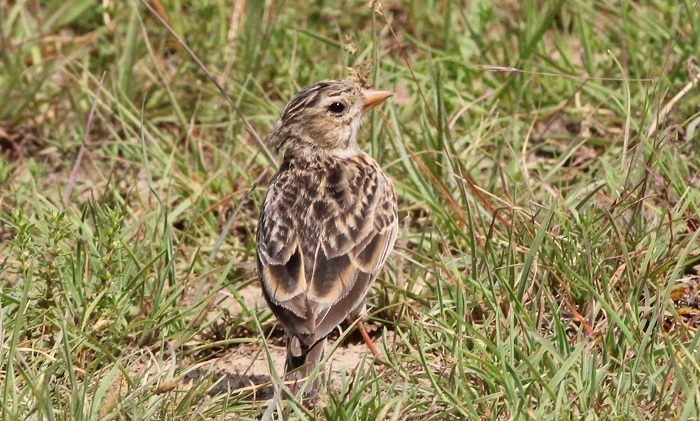
Cover image of Botha’s Lark by Maans Booysen – Daggakraal, Mpumalanga – BirdPix No. 213508
Larks are passerine birds of the family ALAUDIDAE. The larks are a group of mostly Old World passerine birds. Most species are found in Africa, followed by Asia and Europe with two species occurring in North America and one species in Australia. Habitats vary, but many are characteristic of open, dry regions. The family contains 21 genera and 100 species.
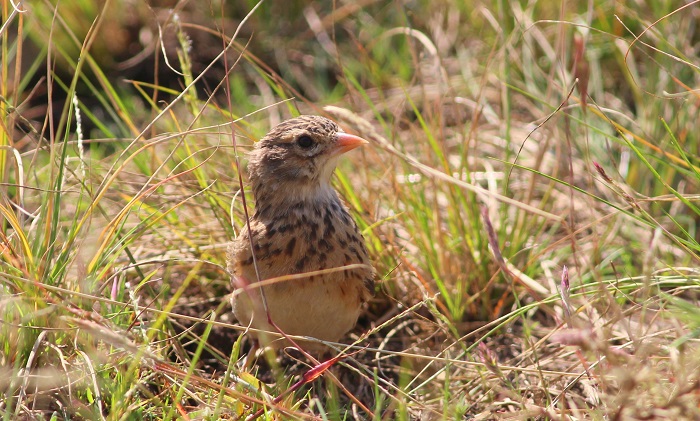
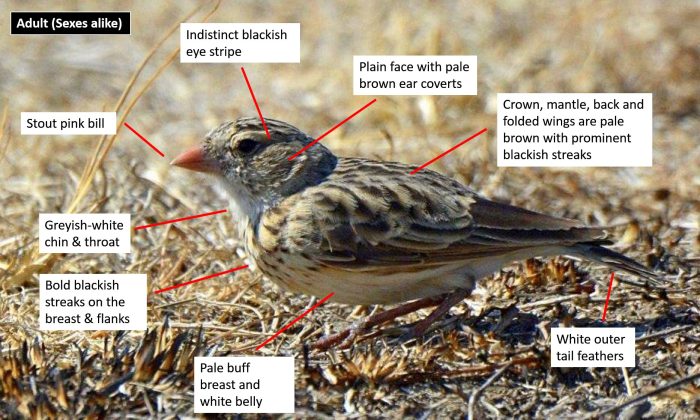
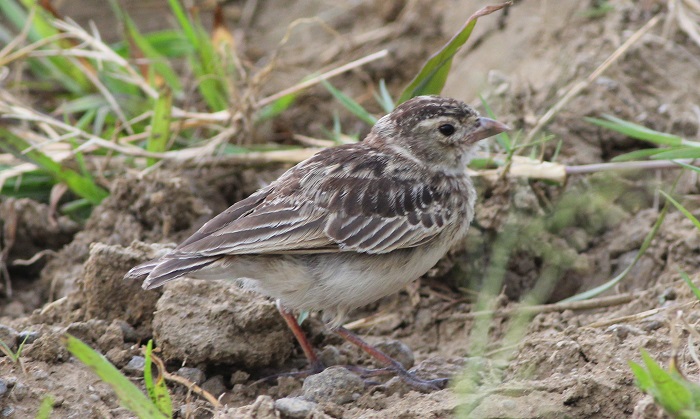
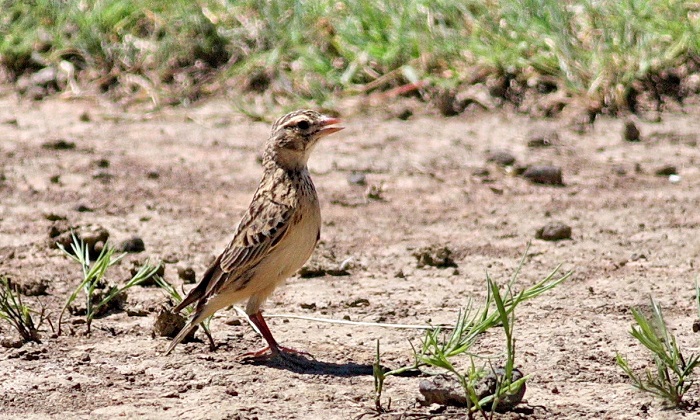
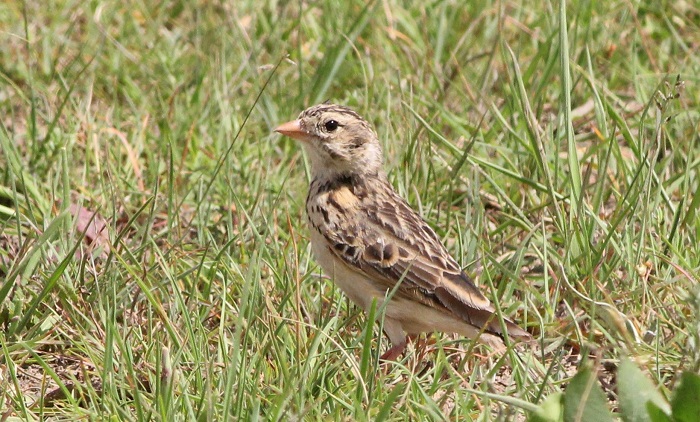
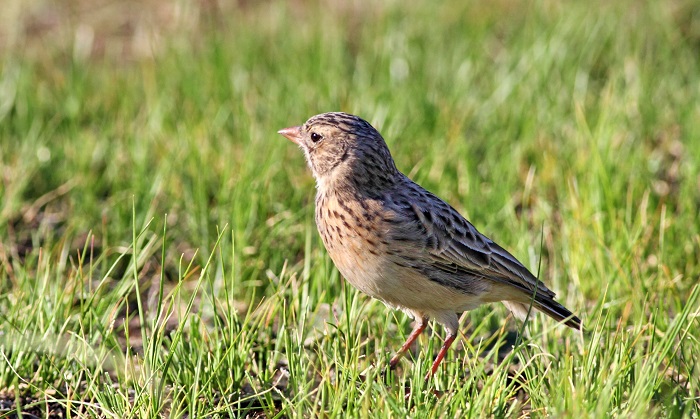
Botha’s Lark is a small species with a short, stout pink bill. The face is relatively plain with pale brown ear coverts. The supercilium is cream or buff-coloured and there is an indistinct blackish eye stripe. The sides of the neck are buffy brown. Upperparts, including the crown, mantle, back and folded wings are brown with prominent blackish streaks. The chin and throat are greyish white and the breast, upper belly and flanks are buff-coloured with a slight rufous wash, heavily streaked in blackish brown. The lower belly and under tail coverts are pale buff to white.
The tail is dusky brown with broad white outer tail feathers. Eyes are brown and the legs and feet are pink. The sexes are alike.
Juveniles resemble the adults but have irregular whitish spots on the crown and back, with buff-tipped flight and tail feathers. The breast has diffuse, brown streaks, lacking the blackish streaks of the adults. The bill is horn-coloured (not pink).
Botha’s Lark is most likely to be mistaken for the Pink-billed Lark (Spizocorys conirostris). The latter has a rufous-buff (not whitish) belly and under tail coverts. It also has less extensive streaking on the breast, a less prominent supercilium, a heavier bill and buffy (not white) outer tail feathers.
Uncommon to Rare (formerly locally common) resident and local nomad.
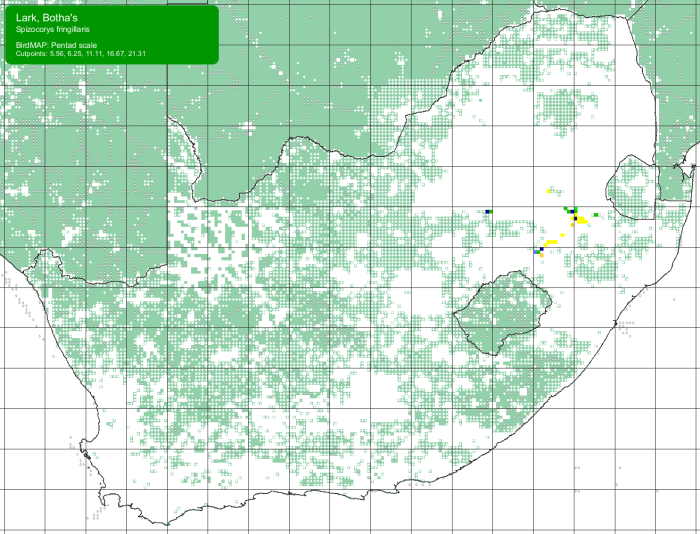
Botha’s Lark is endemic to South Africa and is found nowhere else in the world. It has a very small and restricted distribution, mainly in the Vaal River catchment, from north-eastern Free State to western Mpumalanga.
Botha’s Lark is South Africa’s most threatened terrestrial bird species and is currently listed as Endangered. However, it is soon to be re-listed to Critically Endangered. The population of Botha’s Lark was possibly as large as 20 000 birds in the early 1980s but fell to under 2500 by 2015. The latest estimates from 2023 and 2024 indicate as few as 340 individuals may survive in the wild.
SABAP2 distribution map for Botha’s Lark (Spizocorys fringillaris) – July 2024. Details for map interpretation can be found here.
Botha’s Lark is patchily distributed within a small range. It does not occur in any protected area, and no longer occurs at the Type locality. Most of its preferred habitat has been transformed by agriculture, over grazing and forestry.
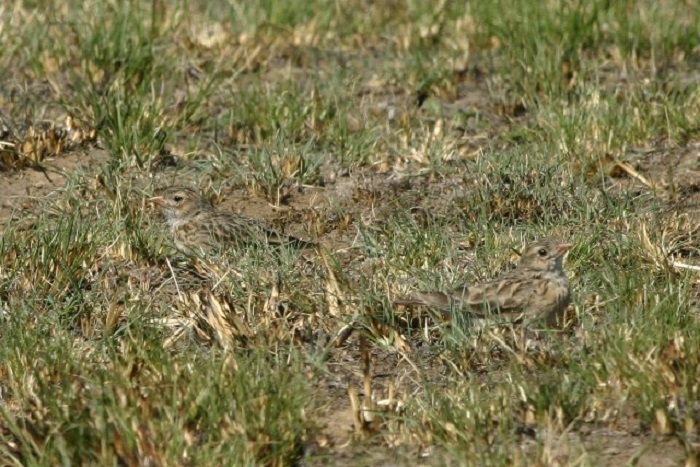
Botha’s Lark is sometimes seen in small groups of up to 10 birds, but is usually solitary or found in pairs. They are generally resident and sedentary but moves locally in response to veld conditions like fire and drought.
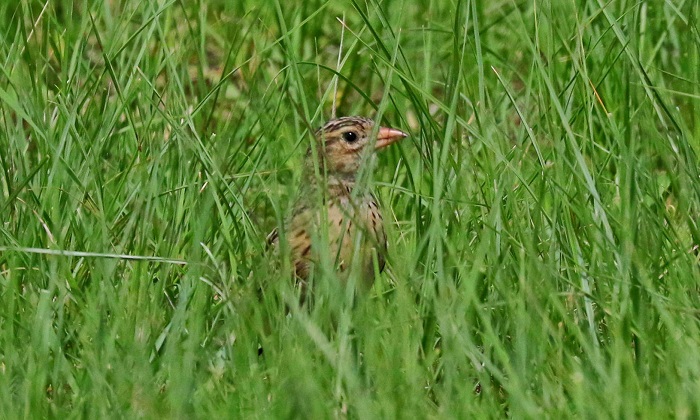
Botha’s Lark is inconspicuous and easily overlooked. Unlike most larks, no aerial display has been recorded. They flush readily, fanning the tail on take-off (showing white outer tail feathers), and usually flying in a wide circle whilst calling. The flight is undulating and ends with a vertical dive into grass cover.
Botha’s Lark forages in the typical lark manner by walking about briskly while watching the ground, pausing now and then to look around. Occasionally darts after prey or jumps into the air to snatch a morsel, and does not dig for food. Botha’s Lark eats invertebrates, including beetles, grasshoppers and moths. They also consume seeds particularly outside of the breeding season.
Botha’s Lark is dependent on surface water and drinks regularly.
Botha’s Lark is monogamous and nests solitarily or in loose groups. Neighbouring nests can as little as 20 m apart. There is evidence of synchronous breeding among groups, likely to make the most of good veld conditions.
The nest is a cup of dry grass lined with grass strips and sometimes sheep’s wool or hair. The nest is built into an excavated hollow in the ground between grass tufts or on occasion against a small shrub or among sheep dung. The nest is built in 3 days and egg-laying starts 1 to 3 days after nest completion.
Botha’s Lark breeds from October to January, depending on veld conditions. Two or three eggs are laid per clutch at one day intervals. The eggs are cream-coloured, heavily marked with dark brown and grey-brown speckles. Botha’s Lark is single brooded but has been recorded to re-lay within five days of an early clutch failure. Incubation starts upon clutch completion and the incubation period lasts for 13 days. Incubation duties are shared by both sexes.
Chicks are fed and cared for by both parents and are apparently fed almost exclusively on insects, mainly grasshoppers. Adults typically forage nearby and usually fly overhead calling when an intruder approaches. Chicks are ready to leave the nest after a further 11 to 15 days.
Further Resources
Species text for Botha’s Lark in the first Southern African Bird Atlas Project (SABAP1), 1997.
The use of photographs by Dave Rimmer, Johan van Rensburg, Jorrie Jordaan, Karis Daniel and Maans Booysen is acknowledged.
Virtual Museum (BirdPix > Search VM > By Scientific or Common Name).
Other common names: Vaalrivierlewerik (Afrikaans); Finkenlerche (German); Alouette de Botha (French); Botha-leeuwerik (Dutch); Cotovia de Botha (Portuguese).
List of bird species in this format is available here.
Recommended citation format: Tippett RM 2024. Botha’s Lark Spizocorys fringillaris. Biodiversity and Development Institute. Available online at https://thebdi.org/2024/08/02/bothas-lark-spizocorys-fringillaris/
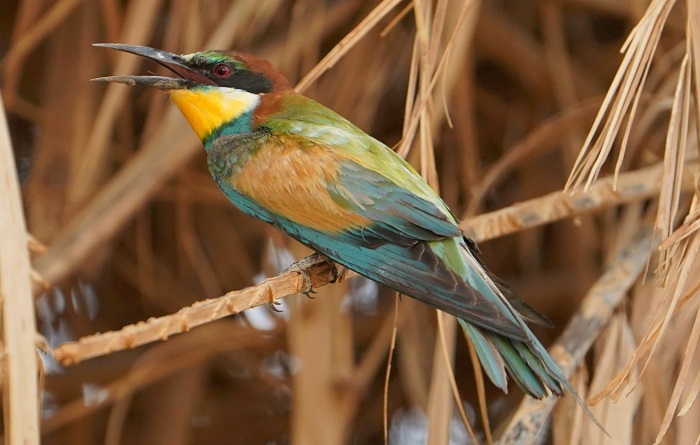
Cover image: European Bee-eater by Neels Putter – Thabazimbi district, Limpopo – BirdPix No.153941
Bee-eaters belong to the Family: MEROPIDAE. This family contains three genera and 27 species. Most species are found in Africa and Asia, with a few in southern Europe, Australia, and New Guinea. They are characterised by richly coloured plumage, slender bodies, and usually elongated central tail feathers. All have long decurved bills and medium to long wings, which may be pointed or rounded.
Identification
The European Bee-eater is a large, distinctively plumaged bee-eater. The sexes are similar but females are slightly paler and less colourful than males.
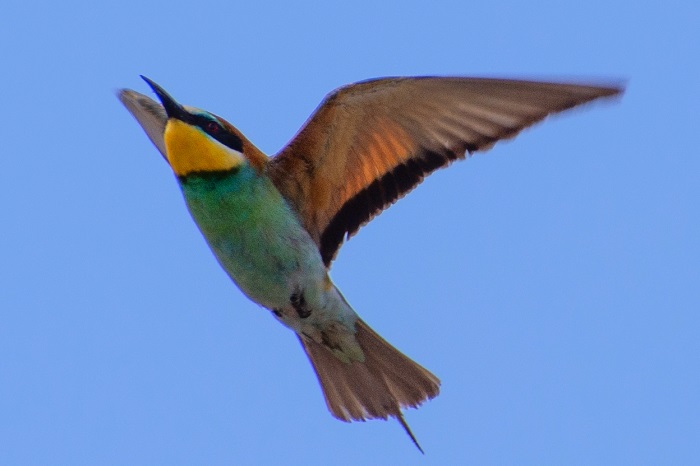
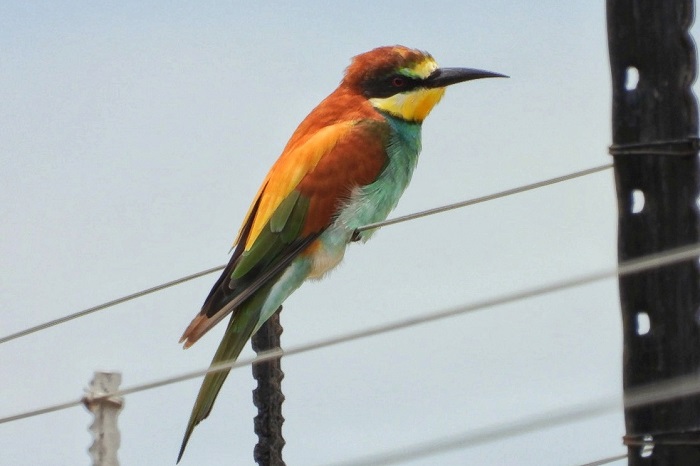
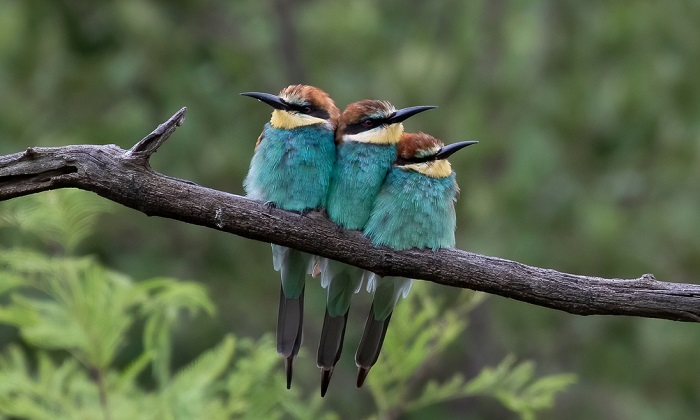
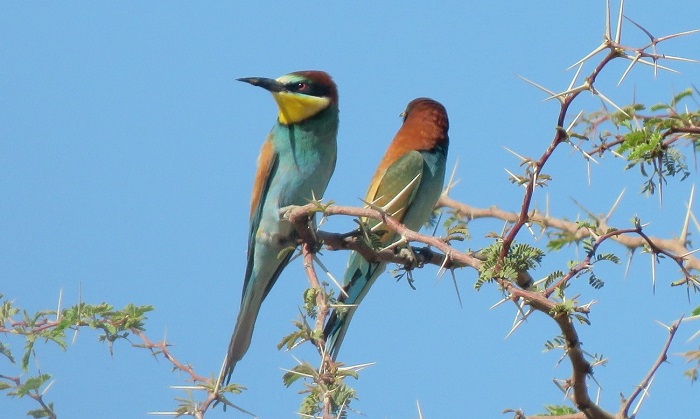
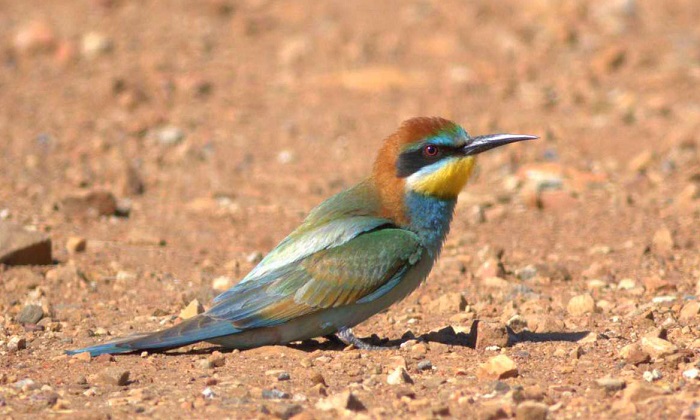
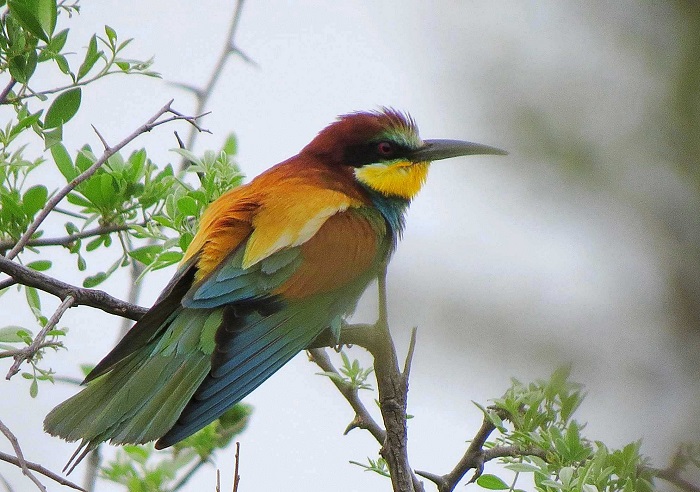
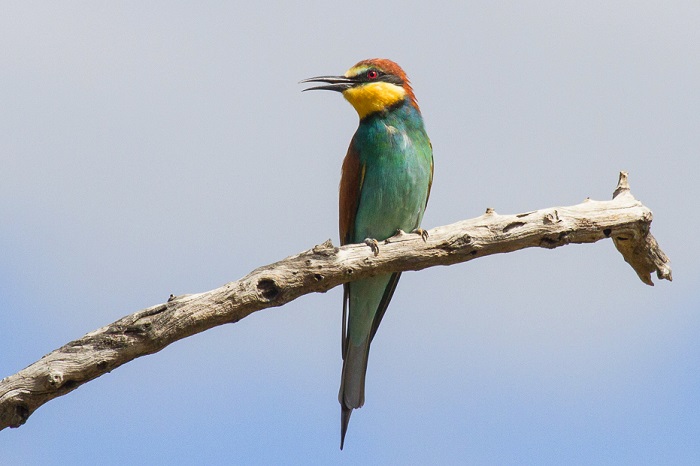
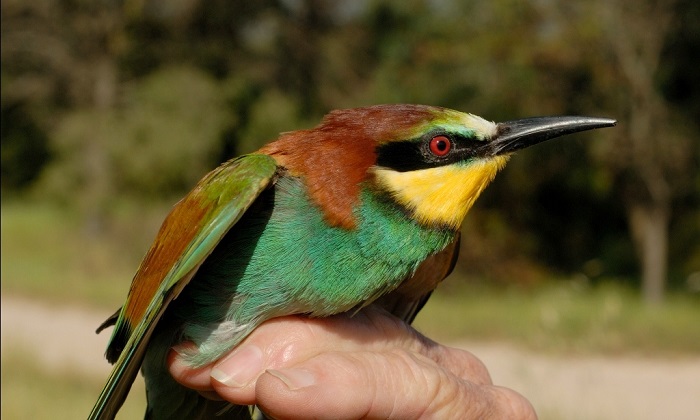
The crown and back are chestnut and the mantle is golden-yellow. The forehead and supercilium are whitish blue, merging into the chestnut crown. The face has a black mask that stretches from the lores to the ear coverts with a narrow, pale blue stripe below. The chin, throat and cheeks are bright yellow. There is a distinct black band on the upper breast that neatly divides the yellow throat from the breast. The breast, belly and vent are entirely rich turquoise blue, fading to whitish-blue on the under tail coverts.
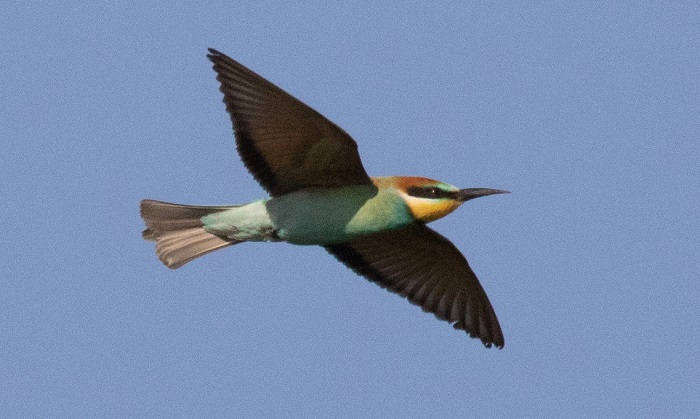
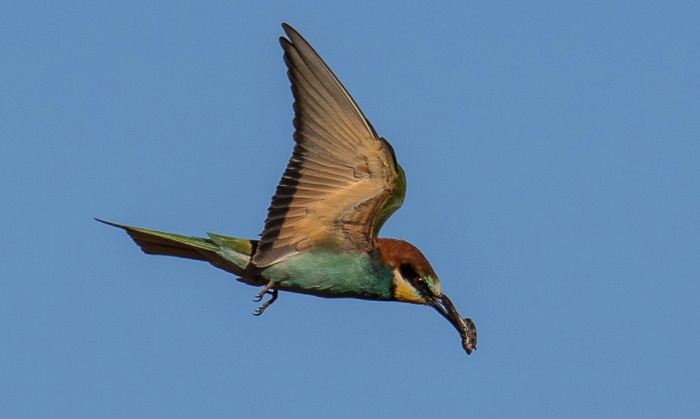
The underwings are pale rufous with the black-tipped flight feathers forming a conspicuous trailing edge on both the lower and upper wing. The upper wings are green to blue-green with rufous wing coverts. The upper tail is mainly blue-green with the dark-tipped central rectrices that project out into points. The bill is black, moderately long and decurved. The eyes are deep red. Legs and feet are purplish brown.
Local breeding birds are more intensely coloured than Palearctic-breeding migrants, but the two are morphologically indistinguishable.
Juvenile European Bee-eater (Merops apiaster). Note the indistinct black breast band and lack of tail streamers. Brits district, North West Photo by Andrew keys
Juveniles are similar to the adult female but are duller and greener. They lack central tail streamers and the black breast band is indistinct.
The European Bee-eater is unlikely to be mistaken for another species due to the combination of its yellow throat and black breast-band. Additionally the turquoise underparts, and brown inner wing contrasting with the blue-green outer wing are diagnostic
In southern Africa the European Bee-eater is a Common Palearctic breeding migrant and intra-African breeding migrant.
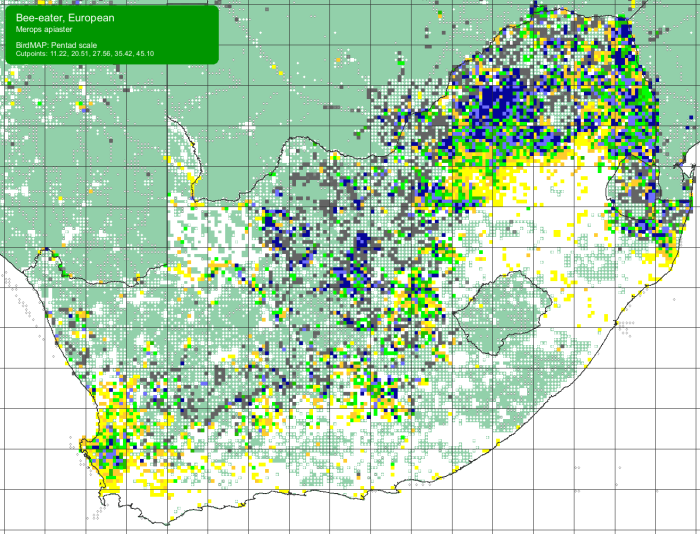
SABAP2 distribution map for European Bee-eater (Merops apiaster) – July 2024. Details for map interpretation can be found here.
It is the most widespread of all bee-eater species. The European Bee-eater is largely a Palaearctic species breeding across Europe to central Asia as far as northern India and western Mongolia. Birds on migration occur throughout the Middle-East as well as north and east Africa. The non-breeding grounds are found in west, central and southern Africa.
The European Bee-eater is widespread throughout most of southern Africa. It is absent only from the mesic eastern parts of South Africa and the most arid parts of Namibia, Botswana and the Northern Cape. There is an isolated breeding population in southern Africa that breeds in the Western, Eastern and Northern Cape, western Free State and southern Namibia. It is thought that these birds have their non-breeding grounds in tropical Africa.
The Palaearctic-breeding population is not threatened. The population that breeds in southern Africa has been estimated to number around 20 000 birds but the current trends in the size of this population are unknown.
Habitat
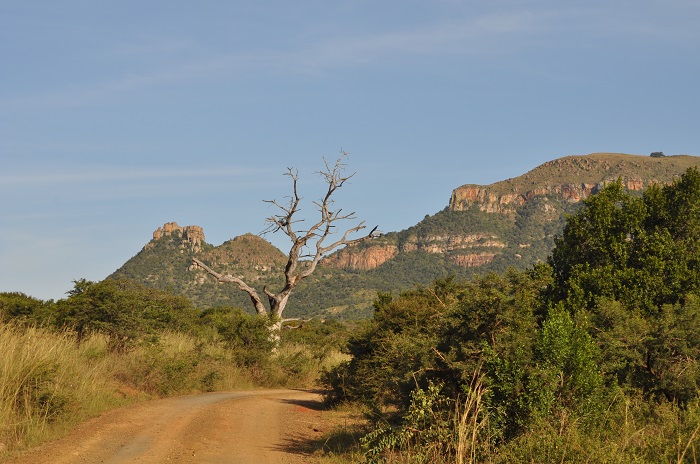
Woodland habitat in north-eastern South Africa Ithala Game Reserve, KwaZulu-Natal Photo by Ryan Tippett
The European Bee-eater occurs in a variety of habitats including woodland, savanna, semi-arid Karoo scrub, fynbos and grassland. It often forages over adjoining freshwater habitats like rivers, marshes and dams. It avoids very arid habitats and also regions with high rainfall.
The population that breeds in southern Africa inhabits the Fynbos, Nama-Karoo and Succulent Karoo biomes.
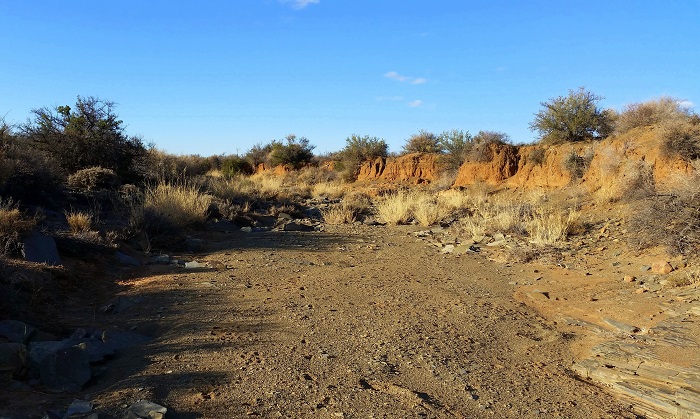
Breeding habitat in the Northern Cape. A single pair attempted to breed here in 2023. Carnarvon district, Northern Cape Photo by Ryan Tippett
Behaviour
The European Bee-eater is highly gregarious at all times and is usually found in loose flocks of 20 to 100 birds. Roosts communally in flocks, usually in leafy trees sleeping shoulder to shoulder.
The European Bee-eater departs its Eurasian breeding grounds between mid August and early October. They migrate by day in flocks, high in the upper airspace. The first birds arrive in southern Africa from early September, but most arrive in October. They depart north again during late March and early April. Birds that breed in Southern African arrive from central Africa in late August into September, and also depart during March and April.
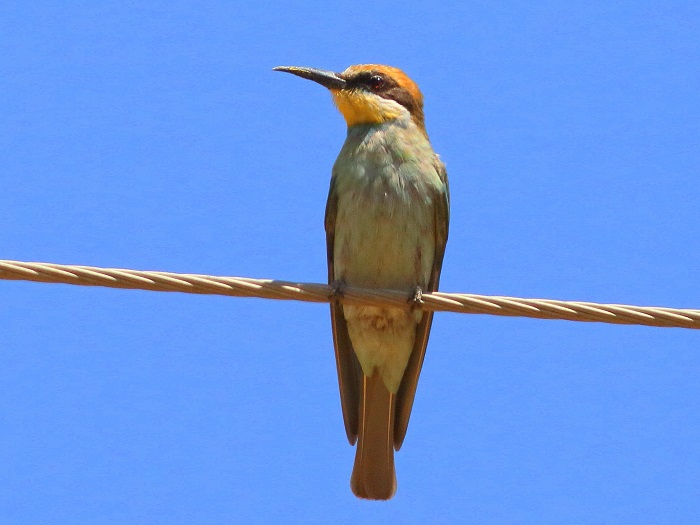
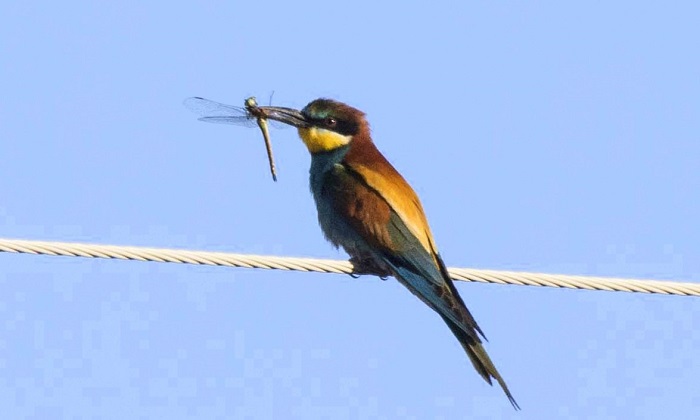
European Bee-eaters bathe frequently by dipping the head in water whilst flying, before perching to preen vigorously. Drinks by skimming the water surface like a swallow, or by hovering. The European Bee-eater rests for long periods on prominent perches such as dead tree branches or telephone wires. Flocks spend much time sunbathing and dustbathing. Sunbathing is usually performed socially, on a perch, but occasionally also sunbathes on the ground. Sunbathing is interspersed with preening, scratching and stretching.
The flight is graceful due to the long wings and tail, allowing for effortless gliding and long swoops broken up by bursts of flapping to maintain momentum. The flight action and speed varies as they dive, twist and turn in pursuit of prey.
European Bee-eaters hunt insects on the wing, either hawking from a perch or in bouts of circling flight, lasting up to 20 minutes or so. Prey is captured up to 150m into the air but sometimes hunts close to the ground, chasing insects disturbed by animals.
The European Bee-eater consumes a wide array of flying insects including small and large bees and wasps, ant and termite alates, flies, dragonflies, butterflies, moths, bugs, cicadas, water scorpions, mantids, beetles, grasshoppers and locusts.
Small non-venomous insects like swarming ants and termites are eaten in flight. Larger insects and those that sting are carried back to a perch in the tip of the bill. Here they are beaten, and rubbed against the perch to remove the sting and venom. The insect is then tossed into the mouth and swallowed.
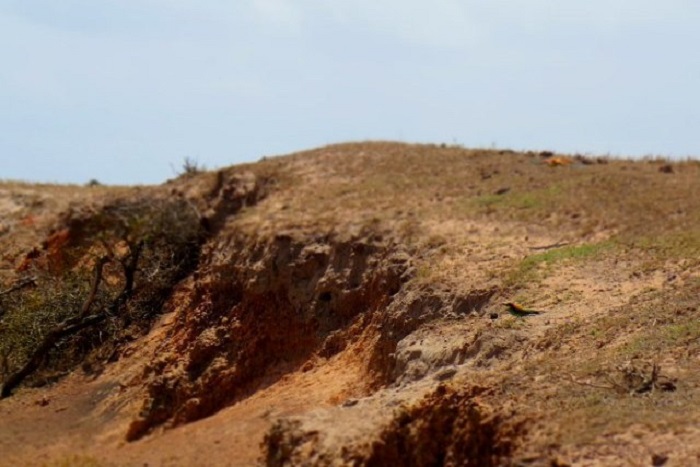
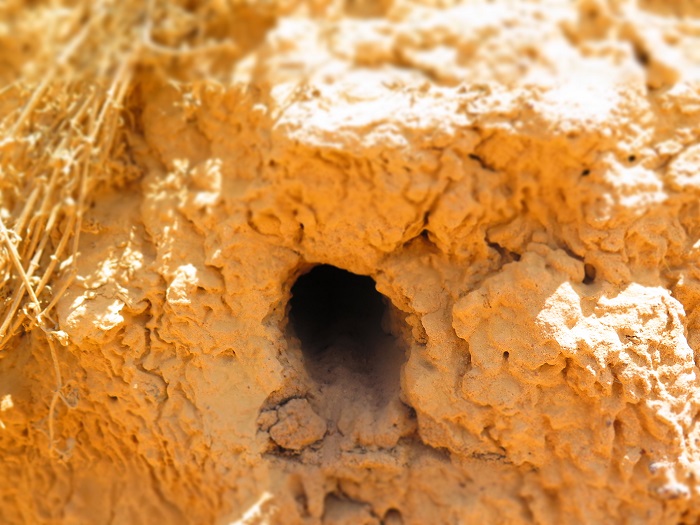
The European Bee-eater breeds from September to January in southern Africa. They are monogamous, with pair bonds lasting for several years and sometimes even for life. The European Bee-eater is mostly a colonial nester but some pairs also nest solitarily. Each year pairs reoccupying the same regularly used breeding sites. Most colonies in southern Africa number from 10 to 30 active nests. Most nesting sites are in vertical banks, either along dry river courses or in trenches, road cuttings, erosion dongas or sand quarries etc.
The nest is a tunnel 1.5 to 2m long and is excavated by both sexes. Digging is initially started with the bill, and then later with the feet to clear out excess sand. The tunnel may be horizontal or inclined slightly upwards and ends in an enlarged egg chamber. The eggs are laid on bare soil or on the accumulated remains of insects in tunnels that have been used previously.
In South Africa clutch size varies from 4 to 6 plain white eggs. European Bee-eaters are single brooded but will replace a clutch in the event of an early failure. They are facultative co-operative breeders with some juveniles or non-breeding adults remaining with the pair as helpers. Further details regarding nesting are a little vague for southern Africa, but can be expected to be similar to data from Europe. The incubation duties are shared by both sexes and lasts for around 20 days. The nestling period lasts for another 31 days and the young are brooded and fed by both sexes or by helpers.
This species text is adapted from the first Southern African Bird Atlas Project (SABAP1), 1997.
The use of photographs by Andre Harmse, Andrew Keys, Ashwell Glasson, Crystelle Wilson, Dave West, Derek Solomon, Gerald Wingate, Lance Robinson, Les Underhill, Mohamed Salah, Neels Putter, Tino Herselman, Tony Archer and Vaughan Jessnitz is acknowledged.
Virtual Museum (BirdPix > Search VM > By Scientific or Common Name).
Other common names: Eurasian Bee-eater (Alt. English); Europese byvreter (Afrikaans); Morôkapula (Tswana); Bijeneter (Dutch); Guêpier d’Europe (French); Europäischer Bienenfresser (German); Abelharuco-europeu (Portuguese).
Recommended citation format: Tippett RM 2024. European Bee-eater Merops apiaster. Biodiversity and Development Institute. Available online at https://thebdi.org/2024/07/29/european-bee-eater-merops-apiaster/
Having started out in life on the eastern buttress of Table Mountain, the Liesbeek River loses its freedom and is condemned to run most of its course imprisoned in a concrete canal. It is liberated for a kilometre or so as it passes through the Cape Town suburb of Observatory. Biodiversity does its best to flourish in this section. The focus here is mainly on one component of that biodiversity, the birds.
In the mornings, the best place to bird is on the east bank, with the sun behind you. The road on this side runs alongside Valkenberg, and ends at the Wild Fig restaurant. In the afternoons, there is parking opposite the Hartleyvale sportsfields. There are lots of people out walking and jogging, some with dogs and some with binoculars.
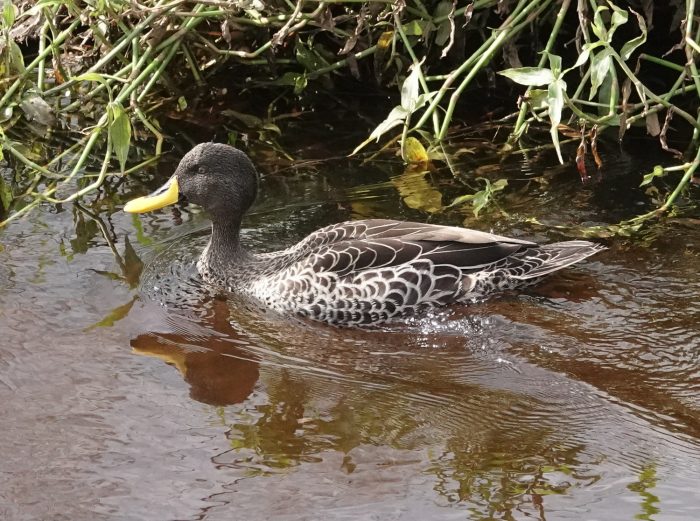
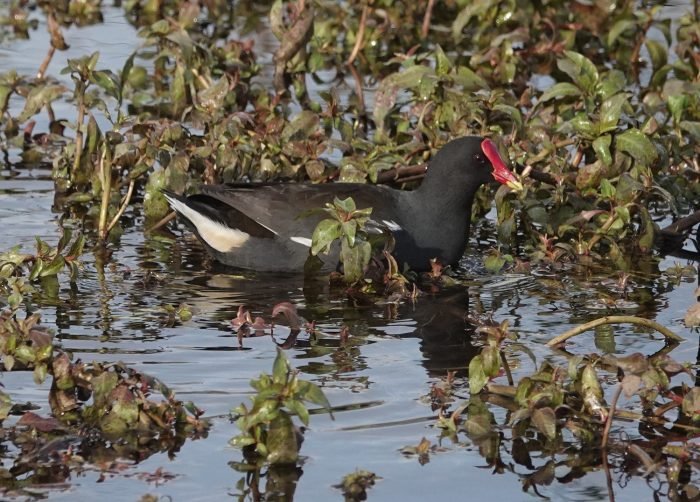
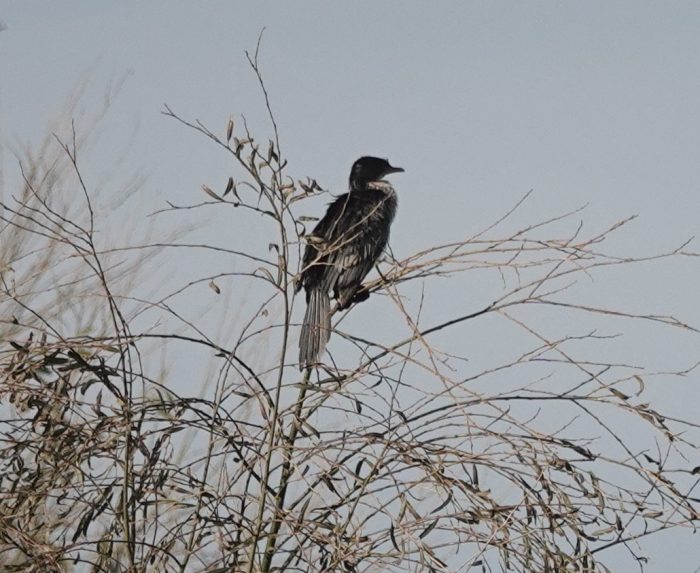
Among the first species you ought to see on the river and in the vegetation along the edges are Yellow-billed Duck, Common Moorhen and Reed Cormorant. Because the river is not wide, and because the birds are, to some extent, habituated to the presence of people, you get to see them close up. This is part of what makes this wetland, insignificant in the grand scheme of things, so good for birding!
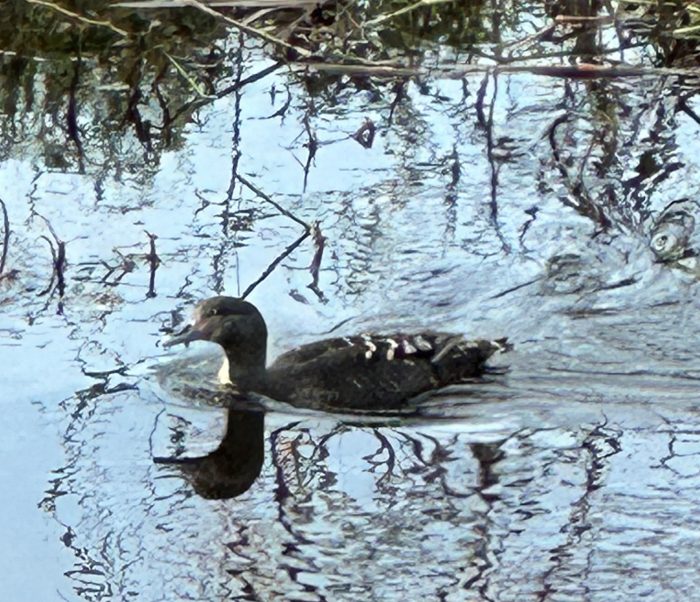
There are lots of species that you cannot expect to see on every visit to this piece of the Liesbeek River. African Black Ducks tend to be shy and swim away. Little Egrets are regular.
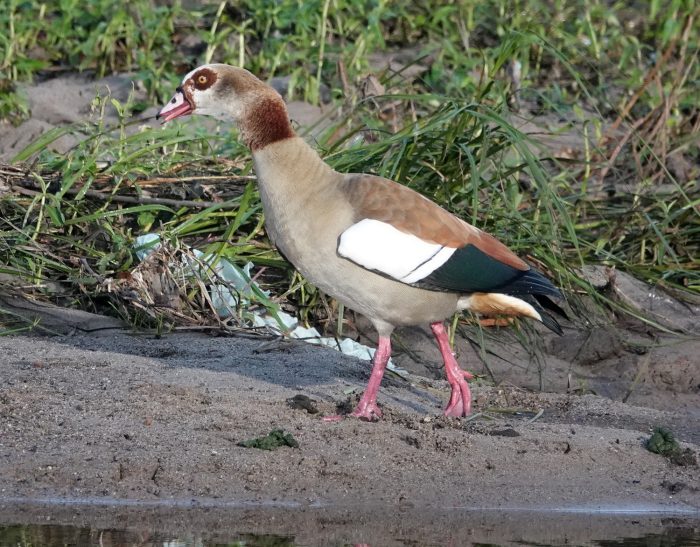
By and large. you expect to see African Black Ducks swimming away from you. Sharon Stanton was lucky to see this one swimming past. BirdPix record 285513Little Egret, hunting with its yellow feet. These birds have two strategies for finding food; they either stand motionless waiting for the next meal to arrive, or they do the moving, and actively search. This bird engaged in foot-trembling; while standing in water up to its “knees”, it vibrated a leg as a ploy to goad a potential prey item to move and reveal itself. BirdPix record 285323Egyptian Goose. BirdPix record 285336
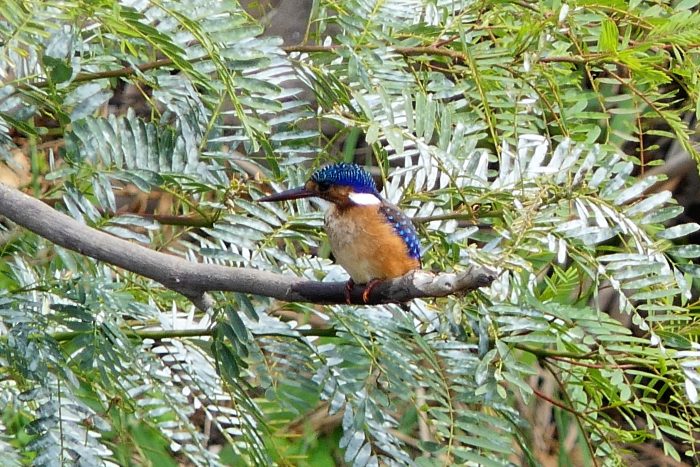
Birding is an activity that does not suffer from the law of diminishing returns. The greatest rewards go to those who spend the extra 10 minutes quietly at a spot waiting for the action. At this spot, you need to be continuously alert for the blue flash, aka the Malachite Kingfisher. If you are lucky, you can follow the flight to where it perches; but it often disappears out of sight.
The blue flash has, for once, perched in sight, and enabled Sharon Stanton to get this record of a Malachite Kingfisher. BirdPix record 207320
The birds are not only on the river, but also above it. The airspace over the river is an avian highway, used as a navigational guide. Much of the overhead traffic consists of Hartlaub’s Gulls. Other species that pass by are Hadada Ibises, Pied Crows, and the occasional Kelp Gull.
These Hadada Ibises flew overhead, but landed a couple of hundred metres upstream, on the lawn between the Wild Fig restaurant and the river. BirdPix record 285328
From time to time, inspect the four floodlight towers around the main hockey field. Occasionally, there are used by raptors such as the Lanner Falcon. There are no photos to illustrate this behaviour in BirdPix, and the best we can do right now is this Rock Dove on the floodlights of one of the minor hockey fields.
Rock Dove, placeholder for a more exciting record to come! BirdPix record 285331Southern Fiscal perched outside the historic Protea Hotel. BirdPix record 285329Bronze Mannikins are steadily spreading across the southern suburbs. The original introduction was probably in Newlands, and by 2024 they have worked their way north at least as far as Observatory. BirdPix record 285321
In terms of keeping a watchful eye over the Liesbeek River, the pivotal group is the Friends of the Liesbeek. This volunteer group “aims to create an awareness of the importance of the Liesbeek River as a green corridor in an urban setting and to rehabilitate, enhance, and conserve it and its environs.” The website of the Friends of the Liesbeek has sections on the history of the river and good discussion of the river’s ecology. The general lack of litter in the river is attributable to one of the key initiatives of the Friends, the Liesbeek Maintenance Project.
For a year in 2020/21, the Cape Bird Club undertook bird counts along this lower section of the Liesbeek River, as far as the confluence with the Black River. There is a report on these counts in the club’s magazine, Promerops, in the July 2022 issue (you need to scroll down to page 22 to read the report of the counts).
Bird List
This list of species is based mainly on the photographic records in the BirdPix section of the Virtual Museum. A few species (e.g. Greater Flamingo and Fort-tailed Drongo) have been omitted because they are not species you can realistically expect to encounter here. In an hour’s visit, you can hope to see about half of the 30 species listed here, and most of them you will be able to see within twenty metres! The species with links have BDI descriptions. These species texts have headings such as Identification, Habitat, Distribution, Breeding, in that order.
Cape Canary – reeds and edges Levaillant’s Cisticola – reedbeds Red-knobbed Coot – river Reed Cormorant – feeds in the river, and sits and dries its wings, on the islands in the river and on trees Pied Crow – mostly flying over Red-eyed Dove – lawns and trees Rock Dove – lawns and trees African Black Duck – river Yellow-billed Duck – river, and resting on islands Cattle Egret– lawns and banks Little Egret – feeds in shallow water Southern Fiscal – trees Egyptian Goose – river, and resting on islands and the banks Helmeted Guineafowl – banks and lawns Hartlaub’s Gull – flying over, using the river as guideline, feeding in river, resting on islands and banks Grey Heron – in the river African Sacred Ibis– flying over, sometimes in the river Hadada Ibis – flying over, noisily, and feeding on the lawns Giant Kingfisher – along the river Malachite Kingfisher – along the river, especially the quiet places Pied Kingfisher – along the river, often hovering Blacksmith Lapwing – on the banks and islands Bronze Mannikin – new arrival, in the vegetation along the banks Common Moorhen – in the river, often disappearing into the reeds Black Sparrowhawk – trees African Spoonbill – in the river Common Starling – anywhere Red-winged Starling – on the lawns and in the trees Cape Wagtail – muddy edges and lawns Cape Weaver – nests in the trees and reedbeds
This is not a comprehensive list. There are Cape White-eyes in the trees, and warblers in the reedbeds!
Otters
This remarkable sighting comes from the Facebook group of the Friends of the Liesbeek, posted in 2018!
If you are exceptionally lucky, you can see a Cape Clawless Otter here. Sue Kingma’s text perfectly captures the significance of this awesome observation.
Even though this record was made six years ago, otters do still occur along the river. The challenge is having a camera at the ready!
This dragonfly is a Broad Scarlet, photographed in this section of the Liesbeek River on 19 February 2021, by Sharon Stanton and Heleen Louw. It is record 124626 in OdonataMAP.
Thanks
Sharon Stanton, Heleen Louw, Jean Ramsay and Kevin Winter helped in assembling concepts and photographs. Thank you.
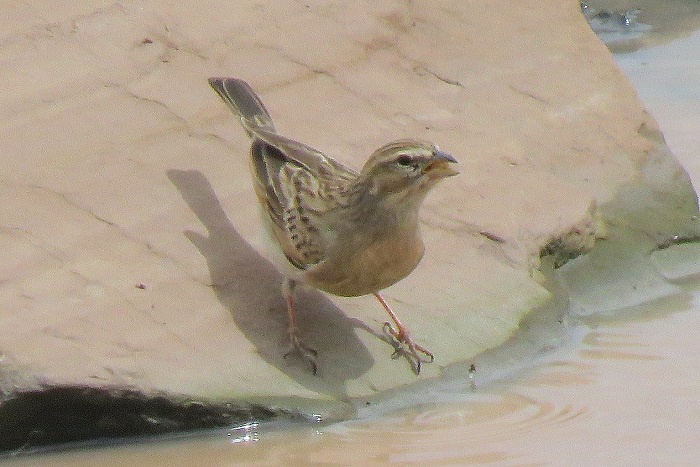
Cover image of Lark-like Bunting by Les Underhill – Vanrhynsdorp district, Western Cape – BirdPix No. 274357
Buntings belong to the Family: EMBERIZIDAE. The buntings are a group of Old World passerine birds forming the genus Emberiza, which is the only genus in the family. The family contains 44 species. They are seed-eating birds with stubby, conical bills, comparatively long tails, and short legs. The feet are relatively large for scratching on the ground.
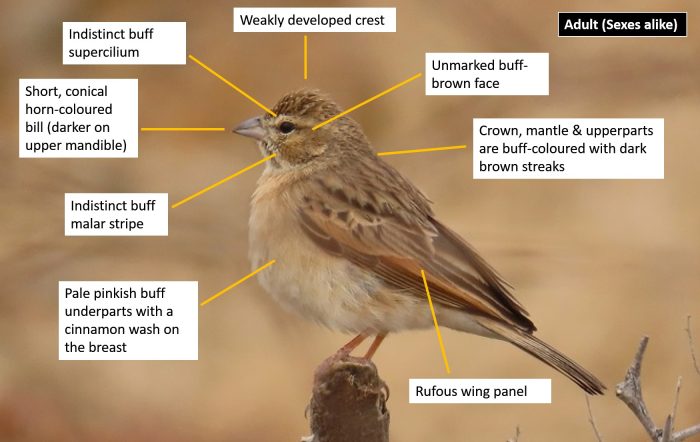
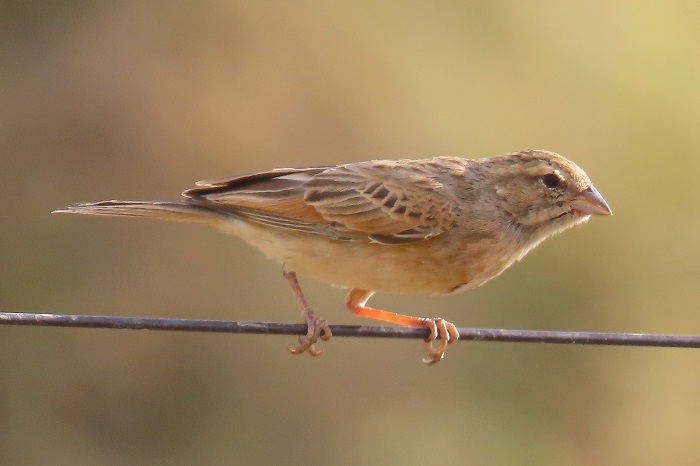
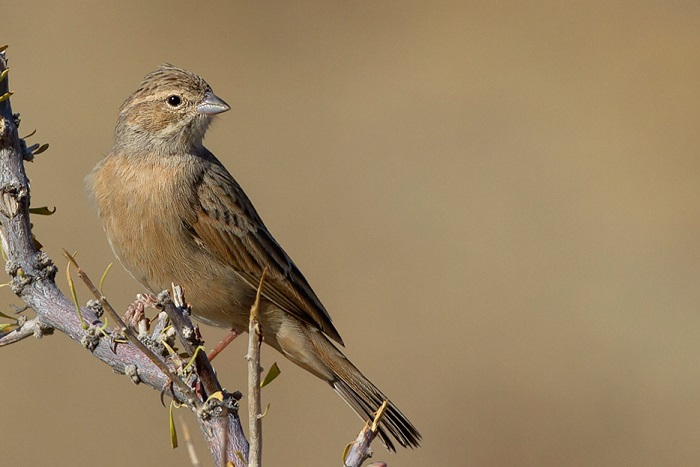
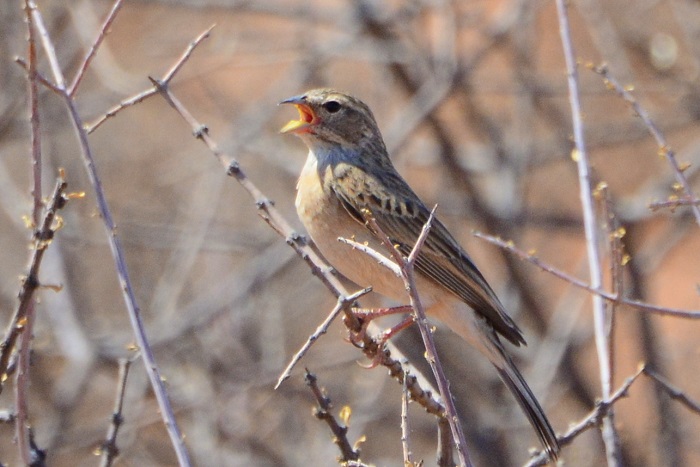
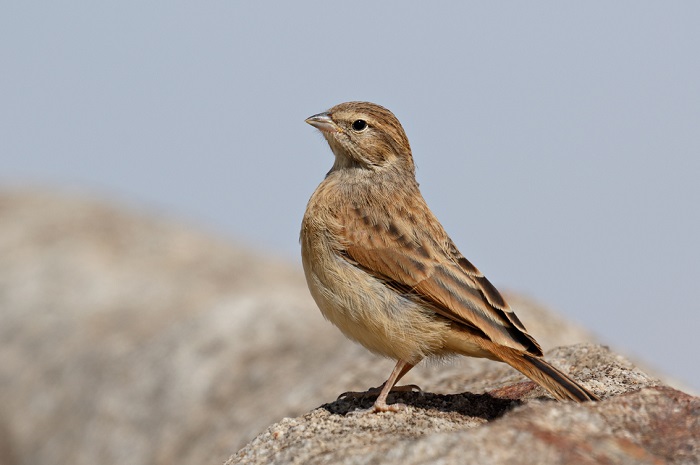
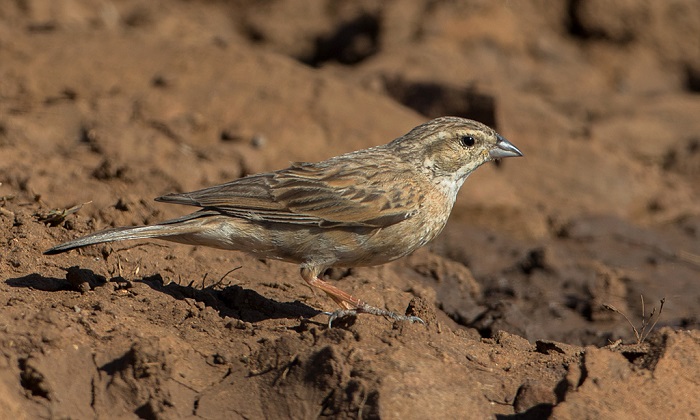
The Lark-like Bunting is a small, drab species. Adults have an overall light buffy brown appearance. The crown and nape are buff-brown with feint olive-brown streaks. The crown is sometimes raised into a weak crest. The face is buff-brown and unmarked. The supercilium and moustachial stripe are pale buff. The remainder of the upperparts are buff-coloured with dark brown streaks, especially on the mantle. The rump is plain buff-brown and the longish tail is dark brown, each tail feather with buff edging. The feathers in the folded wing are brown with buff edges except for the coverts which are pale rufous. The underparts are pale pinkish buff with a cinnamon wash on the breast, fading to pale buff on the lower belly and undertail coverts. The small, conical bill has a dark horn-coloured upper mandible and a paler lower mandible. The eyes are dark brown and the legs and feet are pinkish-brown. The sexes are alike.
Immature birds closely resemble the adults but are paler with a slightly mottled breast.
The Lark-like Bunting has a superficial resemblance to larks, hence the common name, but can easily be mistaken for a host of small brownish birds. The Lark-like Bunting is best separated from larks by its short, conical bill, longish tail, short legs and hopping gait.
Buntings generally have shorter legs and longer tails than other similar seed eating birds. The Lark-like Bunting is best identified by its characteristic ‘chut’ call-note, usually given in flight.
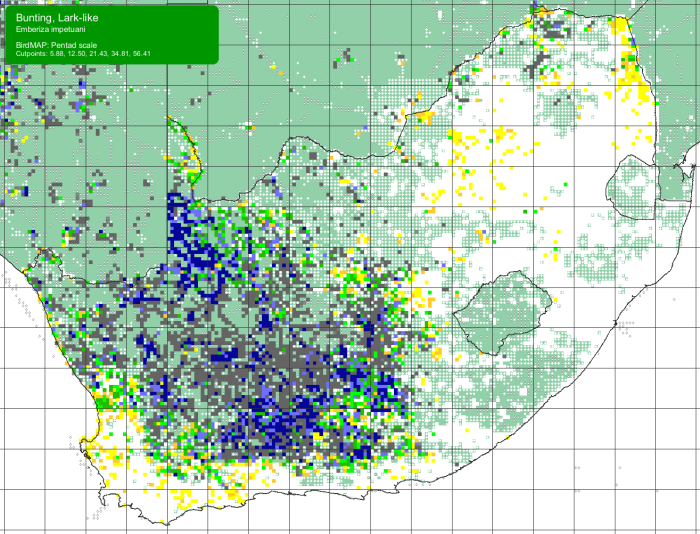
The Lark-like Bunting is a common to very common nomad. It is near-endemic to southern Africa, extending marginally into Angola where it occurs on the coastal plain as far north as Benguela. It is sometimes also recorded as a rare vagrant in Zambia and the Democratic Republic of the Congo.
SABAP2 distribution map for Lark-like Bunting (Emberiza impetuani) – July 2024. Details for map interpretation can be found here.
The Lark-like Bunting is widespread in southern Africa, especially in the arid and semi-arid regions of Namibia, Botswana and western South Africa. It is subject to periodic eruptions into areas where it does not usually occur such as southern Zimbabwe and the eastern lowveld of South Africa, mostly during very dry years. The Lark-like Bunting is a sporadic visitor to the coastal lowlands of the Western Cape, varying in abundance between years.
There is no evidence that the range of the Lark-like Bunting has recently changed. It is not considered threatened and is common in a wide range of habitats.
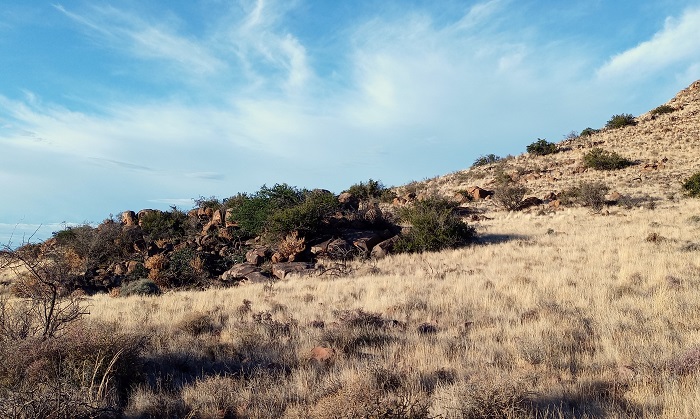
The Lark-like Bunting inhabits Karoo shrublands, desert grassland, arid and semi-arid savanna, sparsely vegetated rocky ridges, dry watercourses and grass covered sand dunes. It also occurs in degraded or overgrazed habitats including erosion gullies, old fields and road verges. Occasionally found in gardens on farms and in Karoo villages. The Lark-like Bunting occurs mostly in strandveld during irruptions into the coastal lowlands of the Western Cape.
Habitat in the Nama Karoo Carnarvon district, Northern Cape Photo by Ryan Tippett
Behaviour
Lark-like Buntings are mostly gregarious, in flocks from 6 to many hundreds of birds, especially at water. They are occasionally also seen in pairs when breeding. Regularly associates with sparrowlarks and other seed eaters like canaries. The Lark-like Bunting is often confiding and flushes reluctantly, usually not flying far. The flight is erratic and undulating.
The Lark-like Bunting is highly nomadic in response to rainfall, often appearing and disappearing overnight. Their arrival after rain corresponds with peak plant growth and seed production.
Forages on bare, stony and sparsely vegetated ground, sometimes jumping up to reach grass seeds. They generally hop but sometimes walk in a lark-like fashion. The Lark-like Bunting feeds on seeds and small insects. They mostly eat grass seeds, also cereals like wheat, as well as the seeds of forbs and small shrubs. Insect prey includes termite alates, small caterpillars and beetles etc.
They need to drink regularly and are usually not found too far from water. They often drink in the company of other small, granivorous birds.
The Lark-like Bunting is an opportunistic and irregular breeder due to the highly variable and erratic rainfall of arid areas. Breeding generally peaks in spring in the winter rainfall areas and in late summer and autumn in summer rainfall regions. The Lark-like Bunting is monogamous and is a solitary nester, although nests are sometimes less than 20m apart. Nests are placed on the ground, often under a shrub or at the base of an overhanging rock or stone. The nest is a shallow cup of grass and roots and is built entirely by the female.
Clutch size varies from two to four eggs. The egg colouration may be white or pale greenish to bluish white, with variable red, brown or grey spots, speckles or blotches. The incubation period takes up to 13 days. The newly hatched young are undescribed and the nestling period lasts for another 12 to 13 days. The predation rate on eggs and nestlings is often very high.
Species text in the first Southern African Bird Atlas Project (SABAP1), 1997.
The use of photographs by Cobus Elstadt, Gregg Darling, Karis Daniel, Katharina Reddig, Lappies Labuschagne, Les Underhill and Philip Nieuwoudt is acknowledged.
Virtual Museum (BirdPix > Search VM > By Scientific or Common Name).
Other common names: Vaalstreepkoppie (Afrikaans); Lerchenammer (German); Bruant des rochers (French); Leeuwerikgors (Dutch); Escrevedeira-cotovia (Portuguese).
List of bird species in this format is available here.
Recommended citation format: Tippett RM 2024. Lark-like Bunting Emberiza impetuani. Biodiversity and Development Institute. Available online at https://thebdi.org/2024/07/24/lark-like-bunting-emberiza-impetuani/