Find the Goldtail in the FBIS database (Freshwater Biodiversity Information System) here.
Family Platycnemidide
Identification
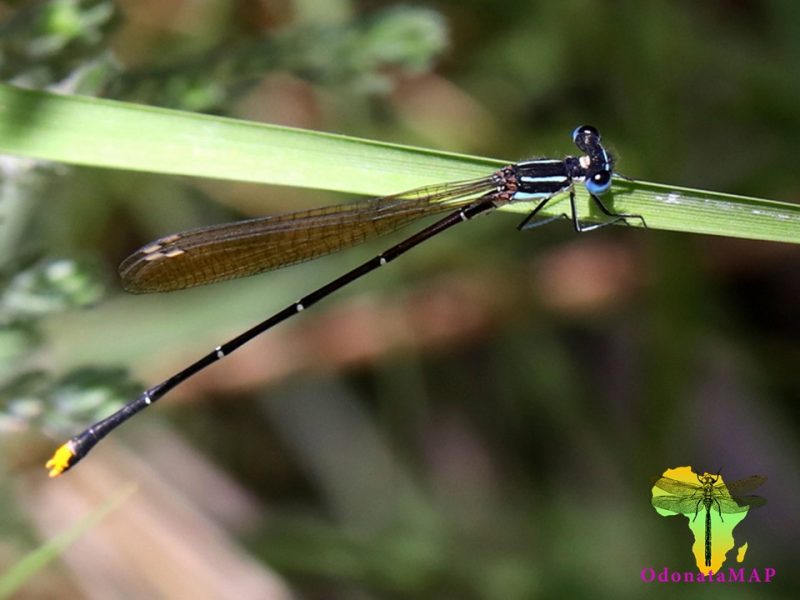
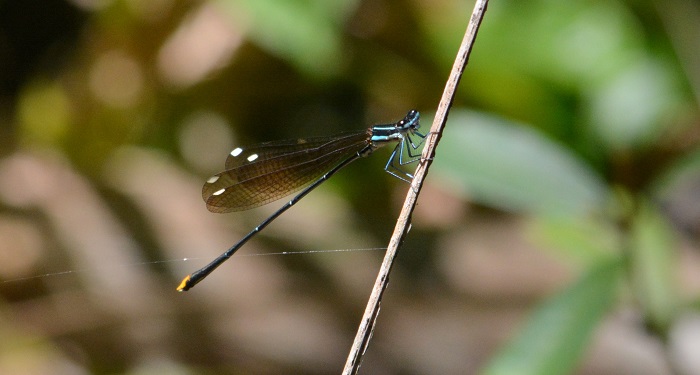
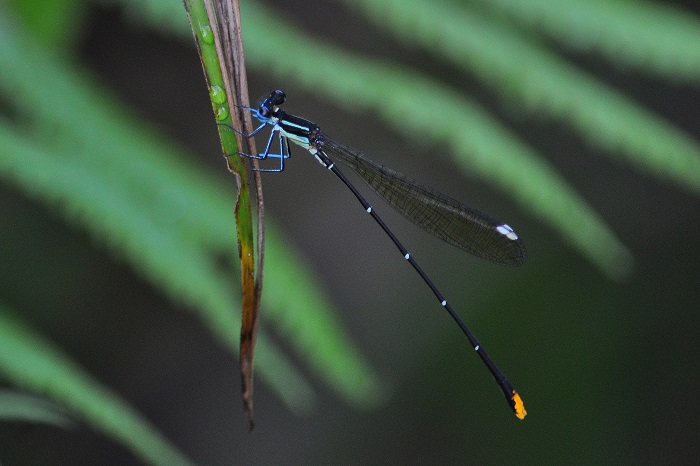
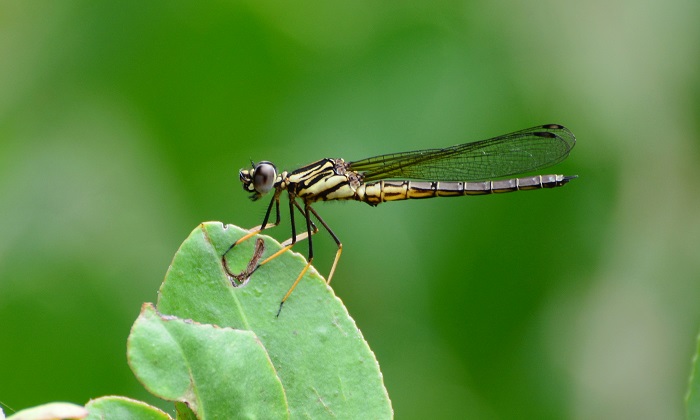
GoldtailAllocnemis leucosticta – Male Moordkuil River, Western Cape Photo by Ryan Tippett
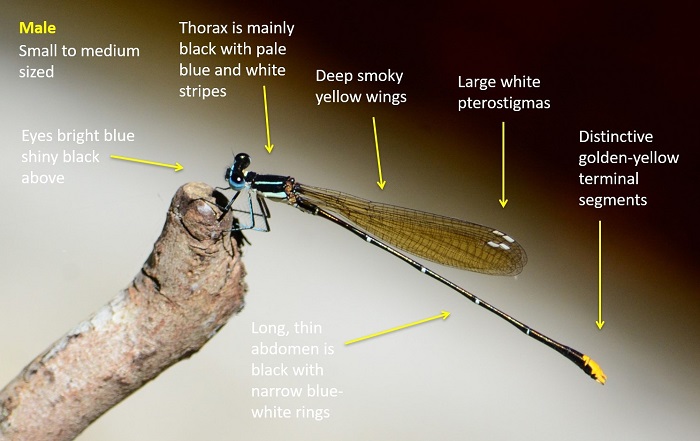
Small to medium sized
Length up to 46mm; Wingspan reaches 57mm.
The Goldtail is a distinctive and easily recognised damselfly. It is unlike any other species in the region.
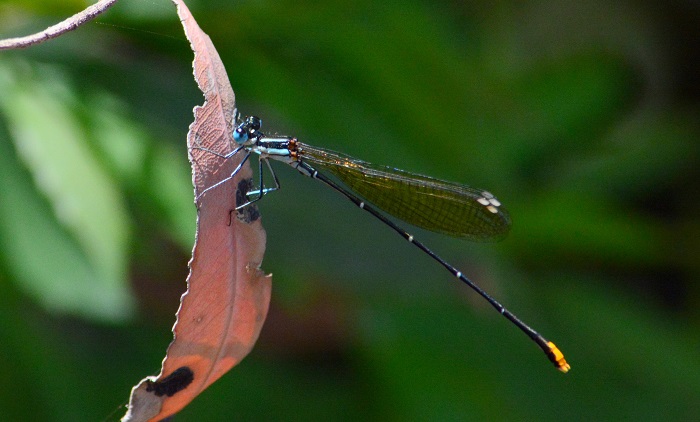
Largely black above and pale below with light blue-green stripes on the thorax. The diagnostic features include amber-washed wings with large white pterostigmas, and the males have golden-yellow terminal segments on the abdomen.
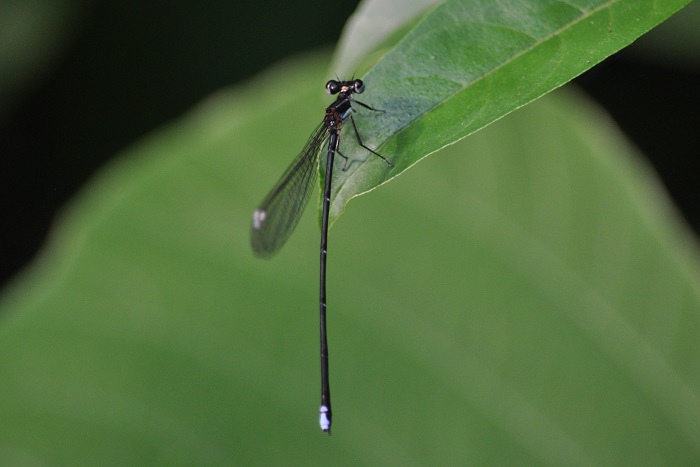
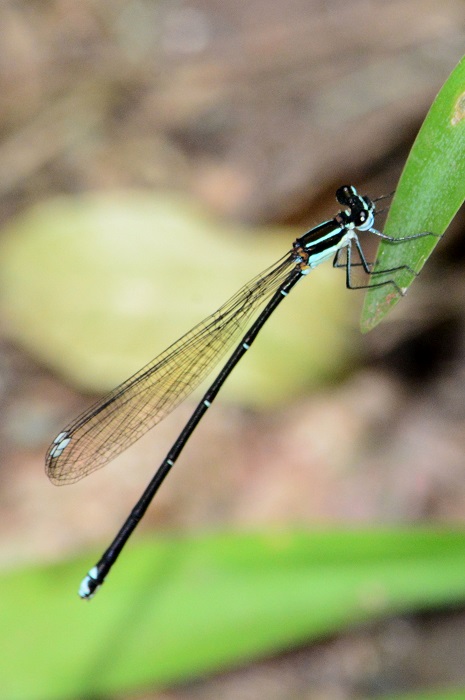
Females are similar but lack the golden yellow abdomen tips.
GoldtailAllocnemis leucosticta – Female Everton, KwaZulu-Natal Photo by Rob Dickinson
Habitat
The Goldtail is a shade-loving species of forested or well-wooded streams and rivers. It prefers streams that have clear, shallow water. The Goldtail mostly inhabits mid to high altitude areas, but occurs at sea level in some places in KwaZulu-Natal and the Southern Cape. Allocnemis leucosticta is occasionally found at more open streams surrounded by grass and bushes, particularly in fynbos and montane grassland habitats.
Typical habitat – Ngome Forest, KwaZulu-Natal Photo by Ryan Tippett
Behaviour
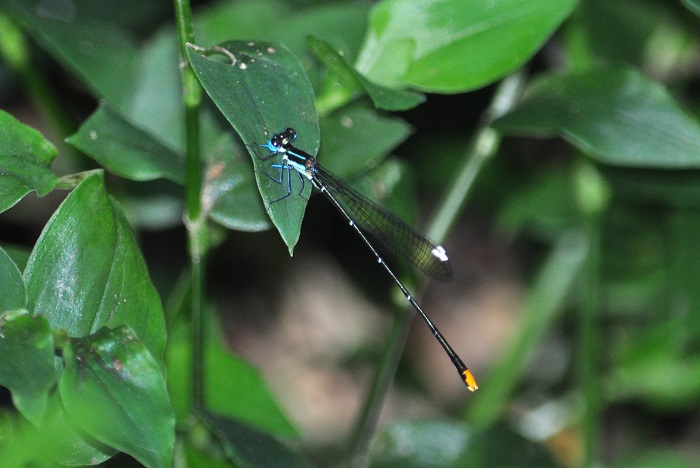
The males are rather noticeable as they sit in exposed positions over the stream in dappled sunlight. The Goldtail’s white pterostigmas and yellowish wings are conspicuous in flight, even in poor light conditions. The females are often found near the males, but are less numerous and not as conspicuous. Allocnemis leucosticta almost always perches on twigs, stems, or vegetation over or close to the water.
The Goldtail is most active from October to April (See Phenology below).
GoldtailAllocnemis leucosticta – Male Seweweekspoort, Western Cape Photo by Ryan Tippett
Status and Conservation
The Goldtail is common but localised due to its habitat requirements. It is listed as Least Concern in the IUCN Red List of Threatened Species. Goldtails are fairly sensitive to habitat degradation. They are intolerant of dirty water, but can be found on streams with some alien vegetation.
GoldtailAllocnemis leucosticta – Female Ferncliffe Forest, KwaZulu-Natal Photo by Ryan Tippett
Distribution
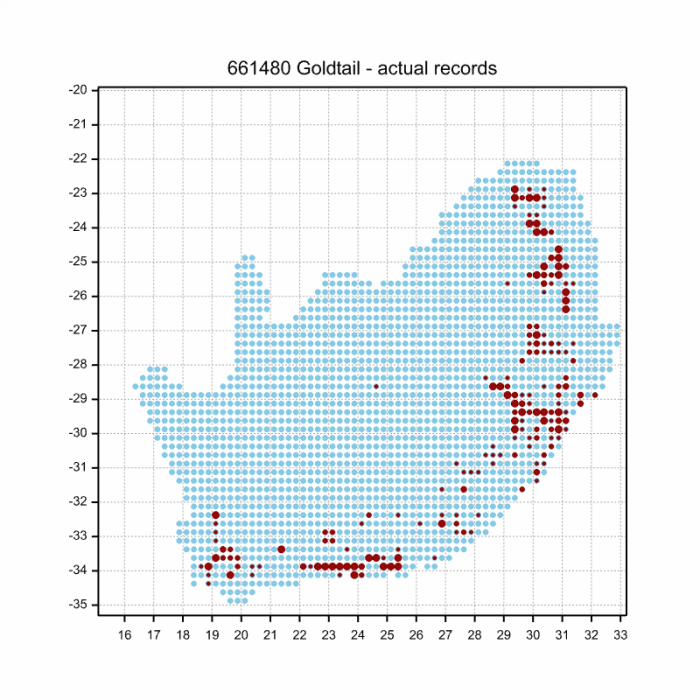
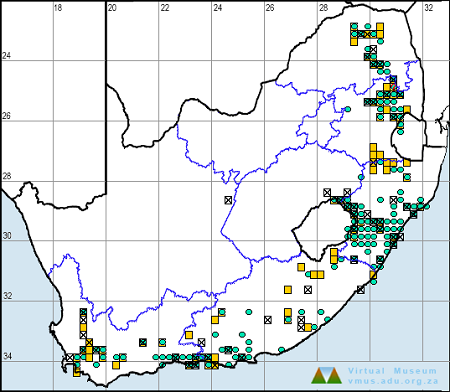
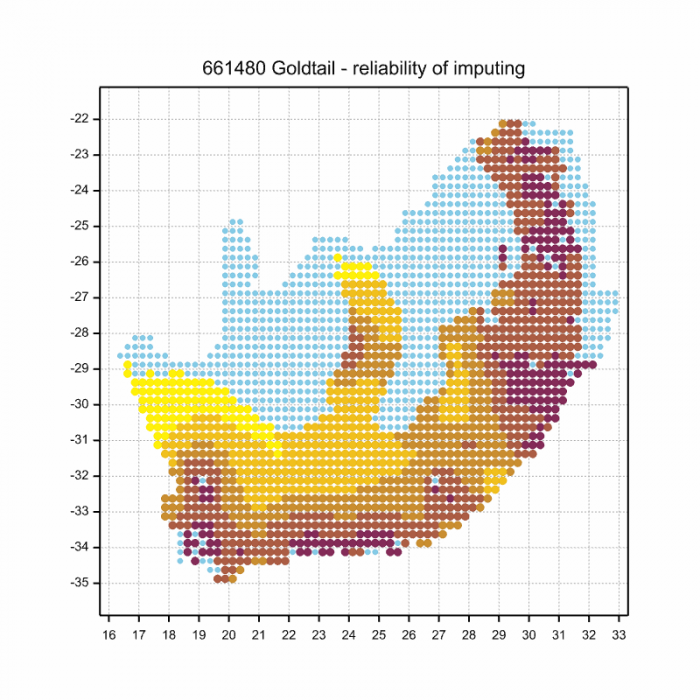
The Goldtail is endemic to South Africa and eSwatini (Swaziland). It is found in mid to high altitude escarpment areas, ranging from Table Mountain in the Western Cape to the Soutpansberg in Limpopo.
GoldtailAllocnemis leucosticta – Male Mtunzini, KwaZulu-Natal Photo by Ryan Tippett
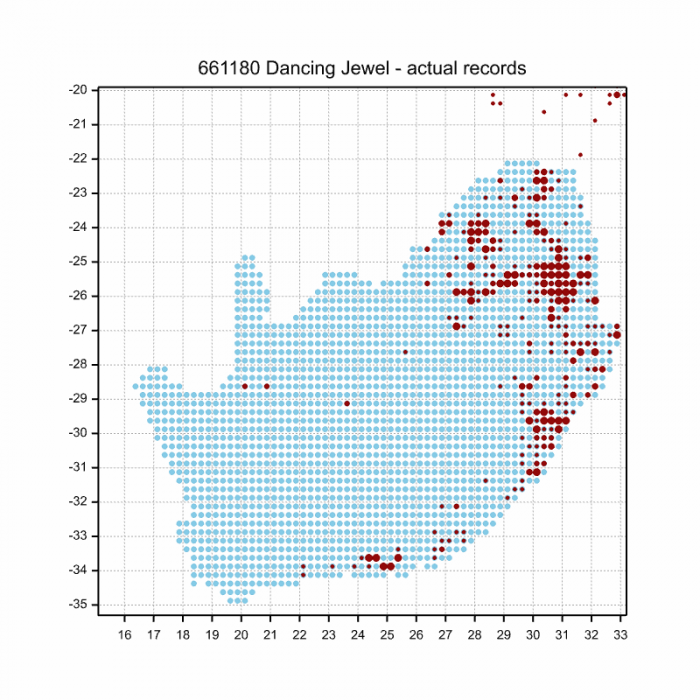
Below is a map showing the distribution of records for Goldtail in the OdonataMAP database as at February 2020.
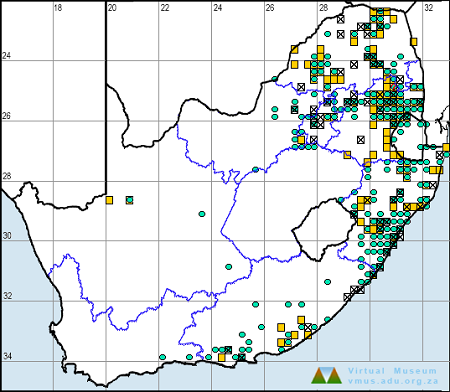
Below is a map showing the distribution of records for Goldtail in the OdonataMAP database as of December 2024.
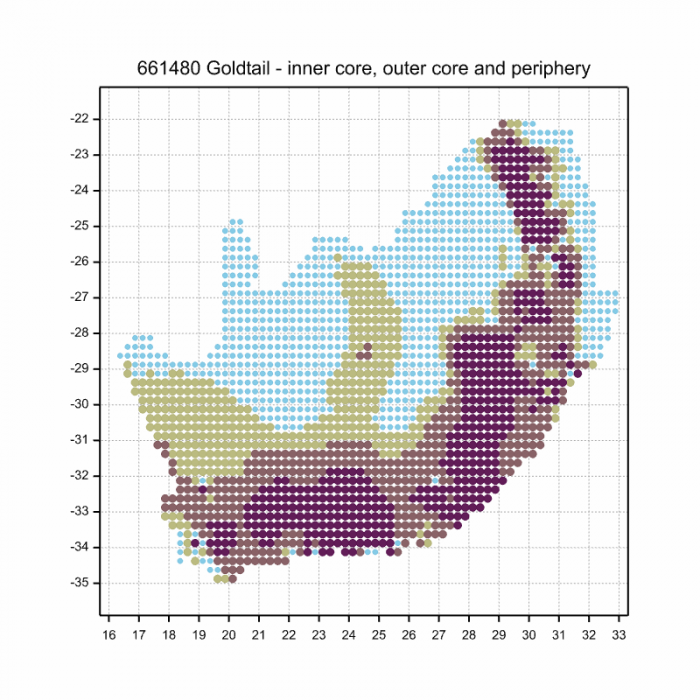
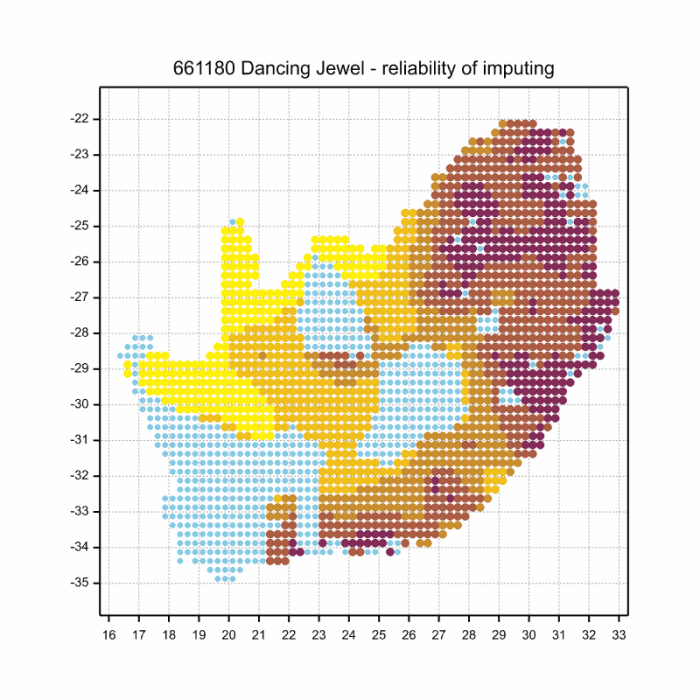
The next map below is an imputed map, produced by an interpolation algorithm, which attempts to generate a full distribution map from the partial information in the map above. This map will be improved by the submission of records to the OdonataMAP section of the Virtual Museum.
Ultimately, we will produce a series of maps for all the odonata species in the region. The current algorithm is a new algorithm. The objective is mainly to produce “smoothed” maps that could go into a field guide for odonata. This basic version of the algorithm (as mapped above) does not make use of “explanatory variables” (e.g. altitude, terrain roughness, presence of freshwater — we will be producing maps that take these variables into account soon). Currently, it only makes use of the OdonataMAP records for the species being mapped, as well as all the other records of all other species.
The basic maps are “optimistic” and will generally show ranges to be larger than what they probably are. These maps use the data in the OdonataMAP section of the Virtual Museum, and also the database assembled by the previous JRS funded project, which was led by Professor Michael Samways and Dr KD Dijkstra
GoldtailAllocnemis leucosticta – Male Ferncliffe Forest, KwaZulu-Natal Photo by Ryan Tippett
Phenology
GoldtailAllocnemis leucosticta – Male National Botanical Gardens, Pietermaritzburg, KwaZulu-Natal Photo by Ryan Tippett
Further Resources
The use of photographs by Corrie du Toit and Rob Dickinson is acknowledged. All other photographs by Ryan Tippett.
GoldtailAllocnemis leucostictaSelys, 1863
Other common names: Goudstertjie (Afrikaans)
Recommended citation format: Loftie-Eaton M; Navarro R; Tippett RM; Underhill L. 2025. Goldtail Allocnemis leucosticta. Biodiversity and Development Institute. Available online at https://thebdi.org/2020/03/02/goldtail-allocnemis-leucosticta/
References: Tarboton, M; Tarboton, W. (2019). A Guide to the Dragonflies & Damselflies of South Africa. Struik Nature.
Samways, MJ. (2008). Dragonflies and Damselflies of South Africa. Pensoft
Samways, MJ. (2016). Manual of Freshwater Assessment for South Africa: Dragonfly Biotic Index. Suricata 2. South African National Biodiversity Institute, Pretoria
Martens, A; Suhling, F. (2007). Dragonflies and Damselflies of Namibia. Gamsberg Macmillan.
GoldtailAllocnemis leucosticta – Female iXopo district, KwaZulu-Natal Photo by Ryan Tippett
Find the Boulder Jewel in the FBIS database (Freshwater Biodiversity Information System) here.
Family Chlorocyphidae
Identification
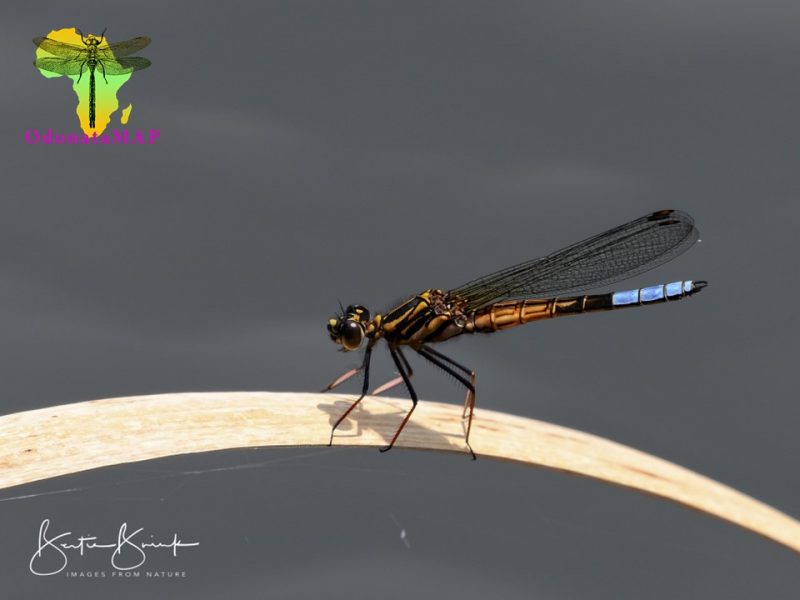
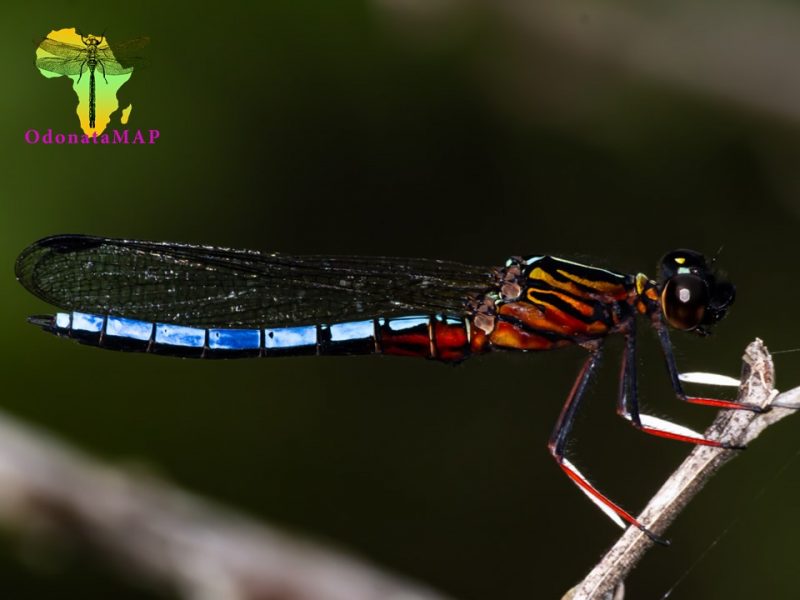
Boulder JewelPlatycypha fitzsimonsi – Male Moordkuil River, Western Cape Photo by Ryan Tippett
Small size
Length up to 34mm; Wingspan attains 54mm.
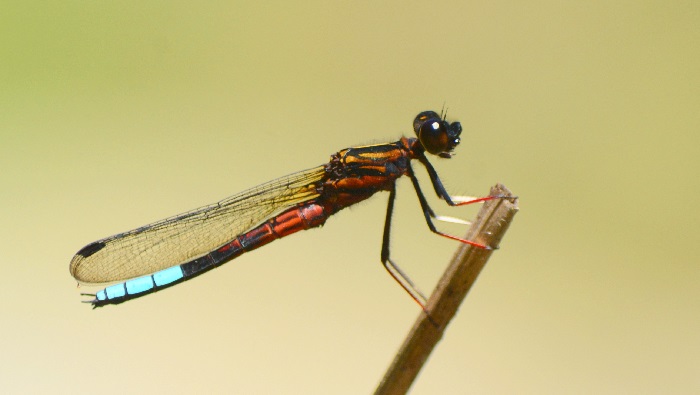
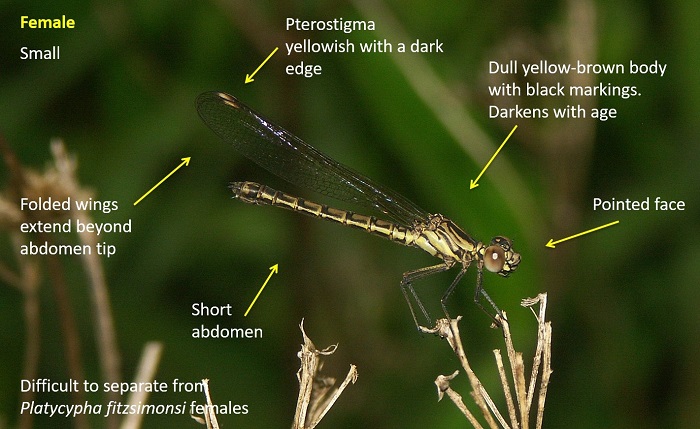
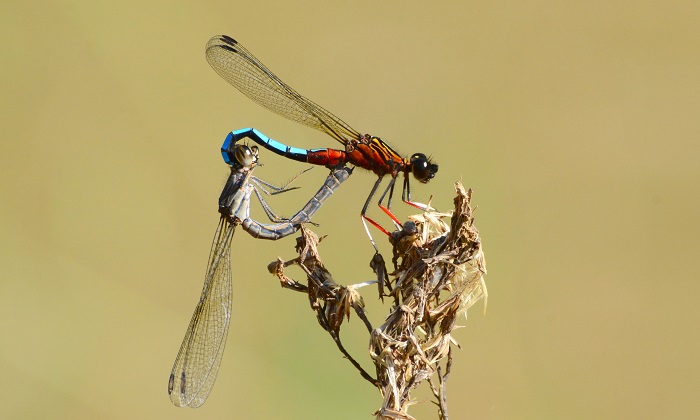
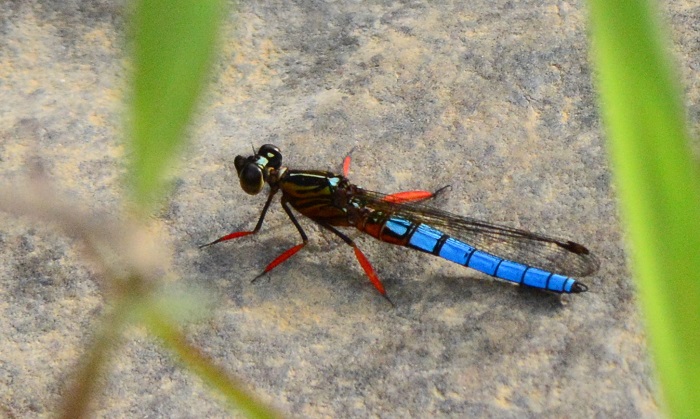
Adult males are distinctive, easily recognised, and unlike any other South African species. The bright red and black colouration is diagnostic. Only the upper parts of the last four abdominal segments are vivid blue. Females are drab beige-brown with darker brown and black markings.
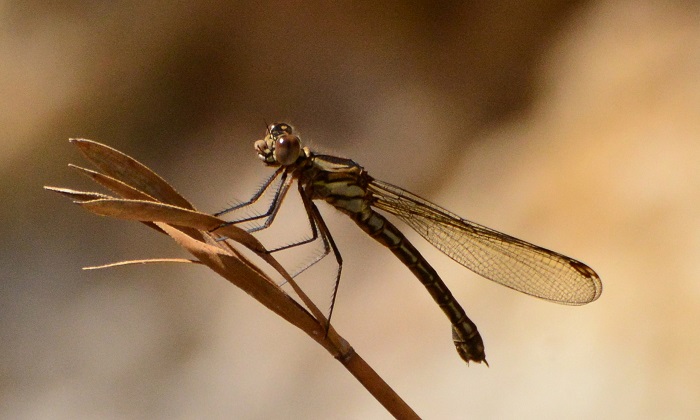
Females and immature males are very similar to those of the Dancing Jewel Platycypha caligata. They are best identified by their association with the males.
Boulder JewelPlatycypha fitzsimonsi – Female Kogelberg Nature Reserve, Western Cape Photo by Corrie Du Toit
Habitat – Kogelberg Nature Reserve, Western Cape Photo by Sharon Stanton
The Boulder Jewel frequents swift, rocky streams and rivers in both open and wooded habitats. It is most common in fynbos and grassland in cooler, mid-altitude areas. Often found alongside the more common Dancing Jewel (Platycypha caligata), but the Boulder Jewel generally prefers more open habitats. The Boulder Jewel is the only Platycypha species in the Western Cape.
The Boulder Jewel is found up to 500m above sea level in the Western Cape but occurs up to 1500m above sea level in the Eastern Cape, KwaZulu-Natal, and Mpumalanga.
Habitat – Oribi Gorge Nature Reserve, KwaZulu-Natal Photo by Ryan Tippett
Behaviour
Territorial males perch low down, close to the water. Boulder Jewels sit predominantly on rocks but will also rest on overhanging or emergent twigs, reeds and grass. The females are usually found alongside the males. Boulder Jewels are perch hunters, taking short, low flights across the water. Platycypha fitzsimonsi males are well noted for having an eye-catching courtship display. The male hovers in front of a perched female. His legs hang down vertically as he twists or waves them, alternately flashing red and white.
Active from October to May (See Phenology below).
Boulder JewelPlatycypha fitzsimonsi – Female Tradouws Pass, Western Cape Photo by Ryan Tippett
Status and Conservation
The Boulder Jewel is fairly common but localised and is listed as Least Concern on the IUCN Red List of Threatened Species. It is moderately sensitive to habitat change as it does occur on rivers with some alien plant growth. However, the Boulder Jewel is intolerant of polluted or turbid, dirty water.
Boulder JewelPlatycypha fitzsimonsi – Male Moordkuil River, Western Cape Photo by Ryan Tippett
Distribution
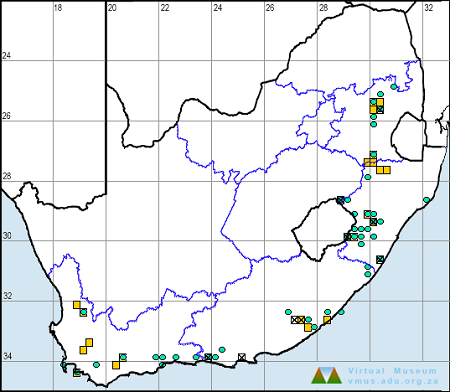
The Boulder Jewel is endemic to South Africa. Its range follows the escarpment, from the Cedarberg in the Western Cape up to Mpumalanga.
Below is a map showing the distribution of records for Boulder Jewel in the OdonataMAP database as at February 2020.
Below is a map showing the distribution of records for Boulder Jewel in the OdonataMAP database as at December 2024.
The next map below is an imputed map, produced by an interpolation algorithm, which attempts to generate a full distribution map from the partial information in the map above. This map will be improved by the submission of records to the OdonataMAP section of the Virtual Museum.
Ultimately, we will produce a series of maps for all the odonata species in the region. The current algorithm is a new algorithm. The objective is mainly to produce “smoothed” maps that could go into a field guide for odonata. This basic version of the algorithm (as mapped above) does not make use of “explanatory variables” (e.g. altitude, terrain roughness, presence of freshwater — we will be producing maps that take these variables into account soon). Currently, it only makes use of the OdonataMAP records for the species being mapped, as well as all the other records of all other species.
The basic maps are “optimistic” and will generally show ranges to be larger than what they probably are. These maps use the data in the OdonataMAP section of the Virtual Museum, and also the database assembled by the previous JRS funded project, which was led by Professor Michael Samways and Dr KD Dijkstra
Further Resources
The use of photographs by Bertie Brink, Corrie du Toit, and Sharon Stanton is acknowledged.
Other common names: Fitzsimon’s Jewel (Alt. English); Klipjuweeltjie (Afrikaans).
Recommended citation format: Loftie-Eaton M; Navarro R; Tippett RM; Underhill L. 2025. Boulder Jewel Platycypha fitzsimonsi. Biodiversity and Development Institute. Available online at https://thebdi.org/2020/03/02/boulder-jewel-platycypha-fitzsimonsi/
References: Tarboton, M; Tarboton, W. (2019). A Guide to the Dragonflies & Damselflies of South Africa. Struik Nature.
Samways, MJ. (2008). Dragonflies and Damselflies of South Africa. Pensoft
Samways, MJ. (2016). Manual of Freshwater Assessment for South Africa: Dragonfly Biotic Index. Suricata 2. South African National Biodiversity Institute, Pretoria
Dancing JewelPlatycypha caligata – Female Pietermaritzburg, KwaZulu-Natal Photo by Christopher Willis
Habitat
The Dancing Jewel is a species of perennial streams and rivers. They prefer shallow, flowing and rocky stretches that are flanked by overhanging trees, bushes, and less often reeds. The Dancing Jewel is often found in shaded places under overhanging vegetation, especially during the heat of the day.
Typical habitat Pongola River, KwaZulu-Natal Photo by Ryan Tippett
Behaviour
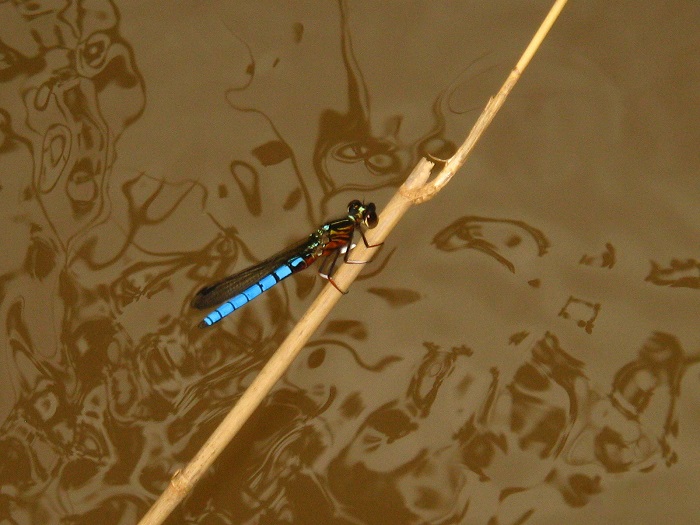
Territorial males are normally found low down, on a rock or twig close to the waters edge. The females are usually found alongside the males. The Dancing Jewel frequently sits in the sun but retreats into the shade when it gets too hot. Dancing Jewels are perch hunters, taking short, low flights across the water. Immature males often sit higher up, away from the territorial males. Platycypha caligata males are well noted for having an eye-catching courtship display. The male hovers in front of a perched female, his legs hanging vertically as he twists or waves them, alternately flashing red and white.
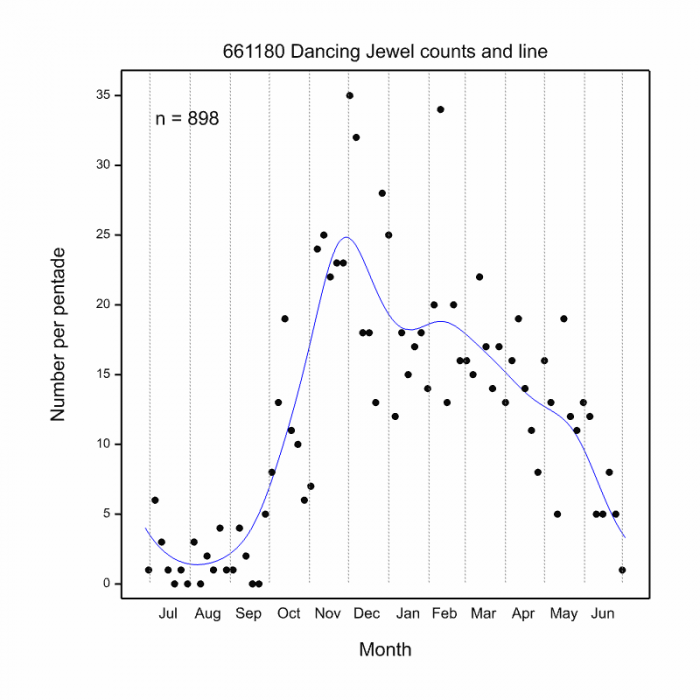
The Dancing Jewel is recorded all year round in places, but is most active from October to May (See Phenology below).
Dancing JewelPlatycypha caligata – Mating pair Mkuze River, KwaZulu-Natal Photo by Ryan Tippett
Status and Conservation
Platycypha caligata is a common and widespread species of the eastern parts of South Africa. The Dancing Jewel is listed as of Least Concern in the IUCN Red List of Threatened Species. It is reasonably resistant to habitat degradation and is not confined to pristine habitats.
Dancing JewelPlatycypha caligata – Male Amakhosi Game Reserve, KwaZulu-Natal Photo by Ryan Tippett
Distribution
The Dancing Jewel is found in eastern, central, and southern Africa from Ethiopia to Angola and South Africa.
It is widespread in the northern and eastern regions of South Africa. Its range extends down the east and southern coastline, marginally reaching the Western Cape. The Dancing Jewel is mostly absent from the drier central and western regions but is present on the Orange/Vaal system and its major tributaries.
Dancing JewelPlatycypha caligata – Immature male Mkuze River, KwaZulu-Natal Photo by Ryan Tippett
Below is a map showing the distribution of records for Dancing Jewel in the OdonataMAP database as at February 2020.
Below is a map showing the distribution of records for Dancing Jewel in the OdonataMAP database as of December 2024.
The next map below is an imputed map, produced by an interpolation algorithm, which attempts to generate a full distribution map from the partial information in the map above. This map will be improved by the submission of records to the OdonataMAP section of the Virtual Museum.
Ultimately, we will produce a series of maps for all the odonata species in the region. The current algorithm is a new algorithm. The objective is mainly to produce “smoothed” maps that could go into a field guide for odonata. This basic version of the algorithm (as mapped above) does not make use of “explanatory variables” (e.g. altitude, terrain roughness, presence of freshwater — we will be producing maps that take these variables into account soon). Currently, it only makes use of the OdonataMAP records for the species being mapped, as well as all the other records of all other species. The basic maps are “optimistic” and will generally show ranges to be larger than what they probably are. These maps use the data in the OdonataMAP section of the Virtual Museum, and also the database assembled by the previous JRS funded project, which was led by Professor Michael Samways and Dr KD Dijkstra.
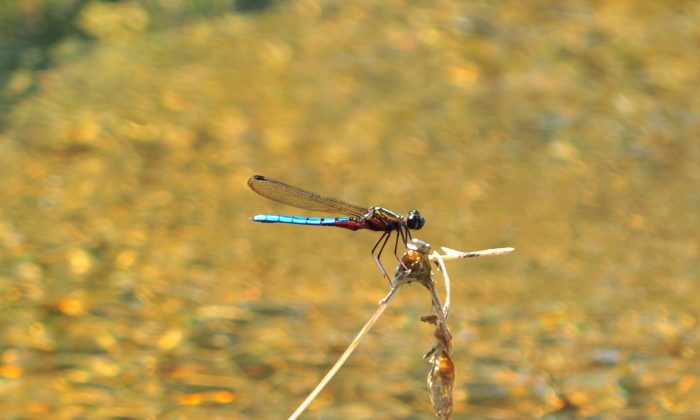
Dancing JewelPlatycypha caligata – Male Pongola River, KwaZulu-Natal Photo by Ryan Tippett
Phenology
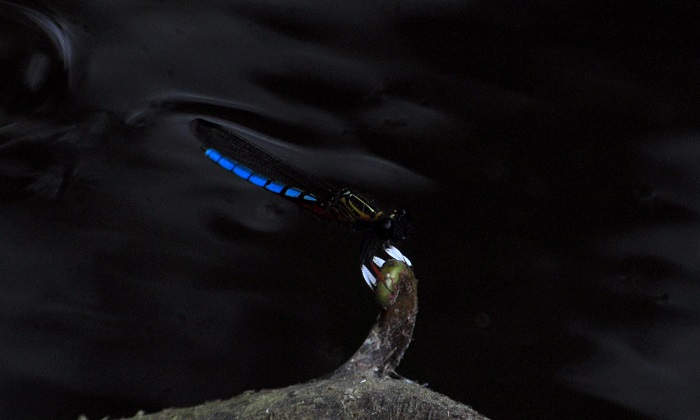
Dancing JewelPlatycypha caligata – Males are conspicuous even in low light conditions. Mseleni River, KwaZulu-Natal Photo by Ryan Tippett
Further Resources
The use of photographs by Christopher Willis and Gert Bensch is acknowledged. All other photographs by Ryan Tippett.
Dancing JewelPlatycypha caligata(Selys, 1853)
Other common names: Dancing Broad-legged Jewel (Alt. English); Dansende Juweeltjie (Afrikaans)
Recommended citation format: Loftie-Eaton M; Navarro R; Tippett RM; Underhill L. 2025. Dancing Jewel Platycypha caligata. Biodiversity and Development Institute. Available online at https://thebdi.org/2020/03/02/dancing-jewel-platycypha-caligata/
References: Tarboton, M; Tarboton, W. (2019). A Guide to the Dragonflies & Damselflies of South Africa. Struik Nature.
Samways, MJ. (2008). Dragonflies and Damselflies of South Africa. Pensoft
Samways, MJ. (2016). Manual of Freshwater Assessment for South Africa: Dragonfly Biotic Index. Suricata 2. South African National Biodiversity Institute, Pretoria
Martens, A; Suhling, F. (2007). Dragonflies and Damselflies of Namibia. Gamsberg Macmillan.
Dancing JewelPlatycypha caligata – Male Palmiet Nature Reserve, KwaZulu-Natal Photo by Ryan Tippett
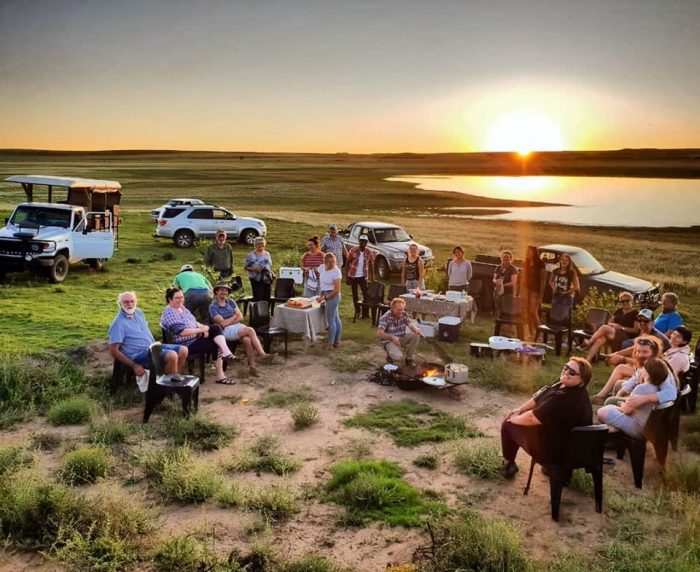
First BDI Citizen Science Conference, Karoo Gariep Nature Reserve, Hanover
The really important things at conferences happen outside of the formal programme. The First BDI Citizen Science Conference took this idea to its limits. The formal programme consisted of two talks and a song at the braai on Friday evening (14 February), and a series of presentations and discussions from 11h00 to 15h30 on Saturday. The programme was designed not to disrupt the biodiversity activities! People started gathering from Wednesday, most had arrived by Thursday, and the last few came on Friday.
The most important thing that conference organizers need to provide is opportunities for people to engage with each other, to form friendships, to learn from each other, and to make plans for activities to do together. If you read the “highlights” paragraphs written by the people who attended, we achieved these things in abundance.
The Karoo Gariep Nature Reserve is 700 km from Cape Town and 700 km from Johannesburg, and this makes it the perfect overnight stop for exodus to the coast every summer. Even though, for most people, it is far to travel to a conference, the Karoo Gariep Nature Reserve is not only a great place to spend a night, it is a biodiversity paradise. It was a fantastic venue for us, and we are grateful to PC and Marisca Ferreira, and their team, for the amazing hospitality.
Being in the centre of the country it also attracted some of the key citizen scientists who live here, and who are generally neglected. Rick Nuttall came from Bloemfontein, Tino Herselman from Middelburg, Ryan and Jana Tippett from Carnarvon, and Altha Liebenberg from Danielskuil. From farther afield was Itxaso Quintana, our intern this year from the Global Training Programme of the Basque Country in Spain, and Laban Njoroge, who is firstly passionate about dragonflies and secondly is Head of Entomology at the National Museums of Kenya in Nairobi, in charge of a collection of three million insects.
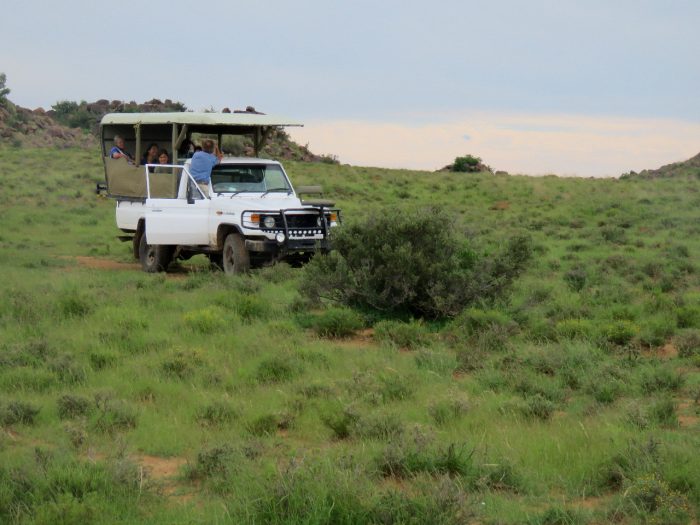
PC and his gameviewer full of citizen scientists
We asked PC, our host at the Karoo Gariep Nature Reserve, how he felt about the invasion of his property by a crowd of citizen scientists: “My first reaction was that it brought a lot of awesome people together to contribute to science and thus to conservation. It seemed to me that people who love nature and are conservation-minded are calm and in balance. They were easy going and laughed a lot. Is this the difference that nature gives back to us for looking after it? The Citizen Science Conference and the involvement of the BDI is already having a positive impact on the area around Karoo Gariep Nature Reserve. Given time, it will grow and have a dramatic outcome.”
Itxaso Quitana, intern from the Basque Country, Spain: “The overall experience in the Karoo was amazing. It wasn’t just because of the landscape and the biodiversity you can find at area, but also because we were treated with so much care. PC gave us so much information about the history, biodiversity and management of the farm. What I really enjoyed about the week was meeting all the citizen scientists, people passionate about nature and with so much knowledge about it. The week was about caring for nature and learning about it. I noticed that a network was created between people that have interest for nature which has a lot of potential. For me personally, I have learnt so much by joining different people going out to the field; I learnt about the habitat, behaviour, identification and interesting facts of so many species that were new for me. Definitively, my interest about the ecosystems of this country increased so much during that week. I am looking forward to the next meeting. Thank you so much for inviting me!”
Itxaso Quitana, intern from the Basque Country, Spain
Alouise Lynch, Director of Bionerds. “The Great Karoo has always been one of my favourite destinations in South Africa. The solitude and large open spaces speak to my soul, and echo my feelings that silence is more powerful than words. The BDI Citizen Science Conference at Karoo Gariep Nature Reserve refreshed these feelings for me. PC, with his novel outlook on life and conservation, was a breath of fresh air – to me it felt completely surreal to finally meet a farmer who is actually a conservationist at heart. The Karoo Gariep Nature Reserve is a beautiful expanse of grassy-karoo that hides its biodiversity under the veil of ‘the land of thirst’. I knew we were definitely going to have some interesting experiences on this property, but I never expected the diversity I encountered during our stay. It was also wonderful to put names to faces that I have been communicating with via social media for years. It was wonderful to see that, although everyone had their own VM project and species focus, there was this common thread of a passion for life and biodiversity that linked us all together. What was striking to me was that everyone had the freedom to do what they felt important at any specific time period which meant we could cover a variety of biological disciplines over a short period of time. Many bioblitz-style surveys rely on people banding together in one group. So it was refreshing to be able to head off on my own to do some botanizing without feeling that I was withholding anything from anyone. The biodiversity on Karoo Gariep Nature Reserve was mind-blowing; it was great to see so many nocturnal predators so relaxed in a farming environment. I found the botanical diversity particularly striking and could have spent a whole week amongst the grassland and shrubland areas. The BDI surely chose a sterling spot for the first BDI Citizen Science Conference. Thank you to PC and his whole team for making us feel like we have been friends for years!”
Ryan Tippett, hosting the BDI Carnarvon BioBash in April 2020, said: “The conference was a fantastic event. Jana and I booked for only three nights at first. We did not know what to expect. Right from the moment we arrived we felt at ease, the friendliness and enthusiasm that we felt from everyone involved was amazing! To be surrounded by such like-minded and passionate people was infectious and everyone was so eager to share their finds with the group. The venue and the hospitality of PC and his team played a huge part in the success of this event. So we stayed a fourth night!
“In terms of the nature, we could not have been there at a better time. All the rain meant that the biodiversity was out in full display. Everyone found and saw new creatures that they had never seen before. Being out in the veld surrounded by enthusiasm was definitely my highlight!
“The conference was a great success. A lot of networking and idea sharing was done. Solid friendships were made all around. Our upcoming BioBash in April, is proof!”
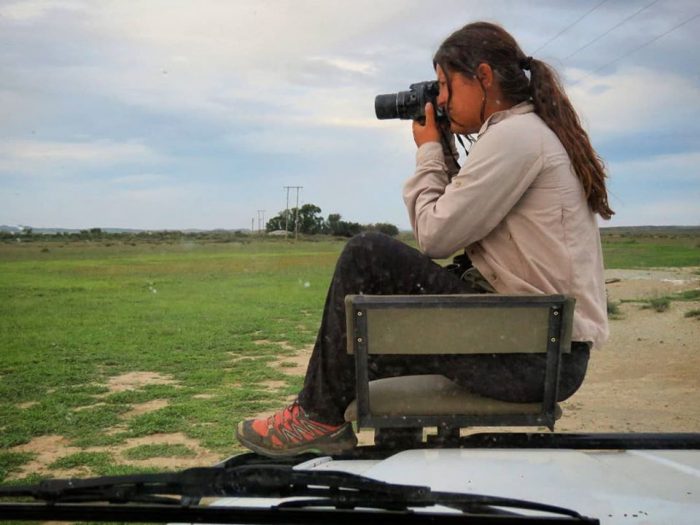
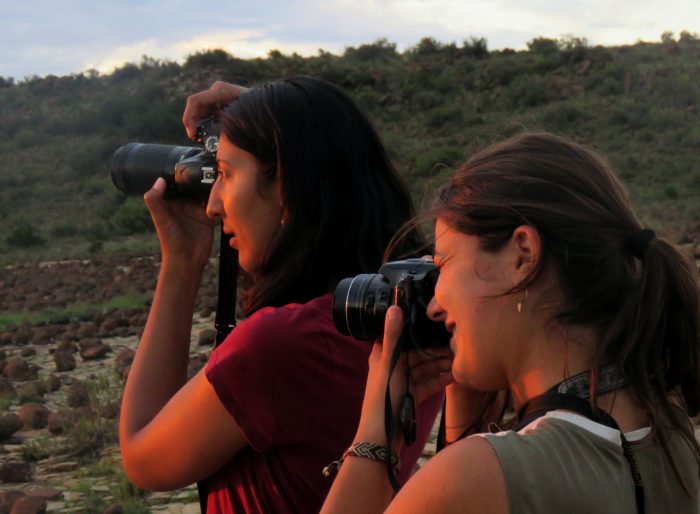
BioMAPping in action, Karis Daniel (left) and Itxaso Quitana (right)
Karis Daniel, MSc student at UCT: “I was deeply impressed by the contagious enthusiasm within our citizen science community. One of my favourite moments from the conference took place when we were driving in convoy to a dam on PC’s property. Though the distance was short, we took quite some time to reach the dam because halfway, we all stopped our vehicles to admire a Pantala dragonfly. (Several people also climbed out to take photographs!) To me, moments like this captured the heart of the BDI Citizen Science Conference. Though many attendees specialized in one or two taxa, all were equally happy to dedicate their mornings, afternoons, or evenings to learning about a different organisms, or to engage in discussions of natural history, species identification, conservation management, and more. Group outings became treasure hunts, with each participant bringing and sharing incredible knowledge and excitement for some aspect of the natural world. The remarkable shared passion we experienced as well as the shared joy of understanding nature allowed meaningful connections between attendees to rapidly form and flourish. I truly believe many of these connections will continue beyond the conference to last a lifetime.”
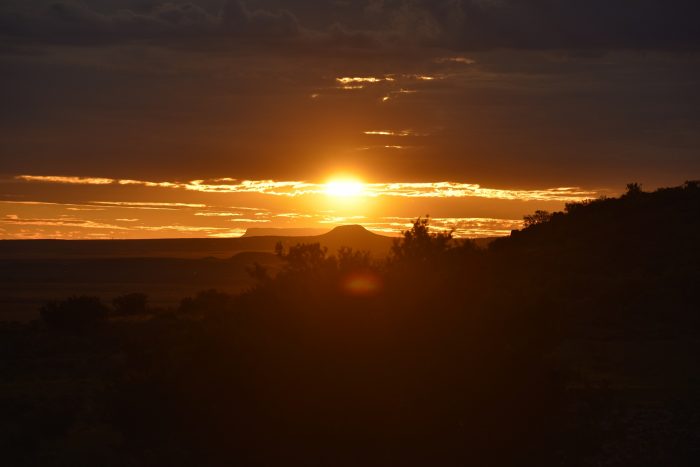
Karoo sunset – photo by Karis Daniel
Laban Njoroge, Head of Entomology, National Museums of Kenya, Nairobi: “The first time I heard the name Karoo was in geography and history classes in Kenya many years ago. It appeared to me like a great place full of history. Because I never expected to visit it, I put the Karoo out of my mind. So when an invitation came towards end of 2019 to attend the BDI Citizen Science Conference in the heart of the Karoo, I thought this was a dream come true. I was lucky enough to get facilitation from a CEPF (Critical Ecosystem Partnership Fund) grant to attend this, and to share about my dragonflies research in the highlands of Kenya. The experiences of the Karoo were overwhelming to me. My mind tried so hard to relate what I read to what I was now experiencing first hand. First impression when I got there, I thought our teachers lied to us about the Karoo. The place was lush green with many different and colourful flowers. There was so much life, unlike what I expected. My phone has never before taken so many photos. However, I was informed that what I was experiencing was an exception rather than the norm. I felt lucky to have been able to see Karoo insect species that most locals have probably never seen. I found myself spending lots of time at night around the lights to see as many insects as possible. I was eager to see the dragonflies of the Karoo. So early mornings and before the brunch, we would go in a team to make trips to nearby water points. An encouraging number of about 12 species was sighted. These will all go into the OdonataMAP section of the Virtual Museum. The storms, the thunder, the lightening and the smell of the rain made a lasting impression in me. My last late afternoon was spent watching the drops from a light drizzle make ripples in Seekoei river as the noisy weaver birds came back to roost. How will I ever forget the Khoi rock engravings and the stone tools that the Khoi used back in the days? I have seen many stars at night in Kenya but those in the Karoo seemed exaggerated. The conference team was great. Everyone was kind and helpful. They took keen interest in what I do back in Kenya and they also shared their stories. What thrilled me most is the enthusiasm with which everyone did they work. It mattered little if one was into birds, scorpions, aardvarks or lizards. This was a Eureka moment to me. What I am now telling Kenyans back home is that now I know why every guidebook comes from South Africa.”
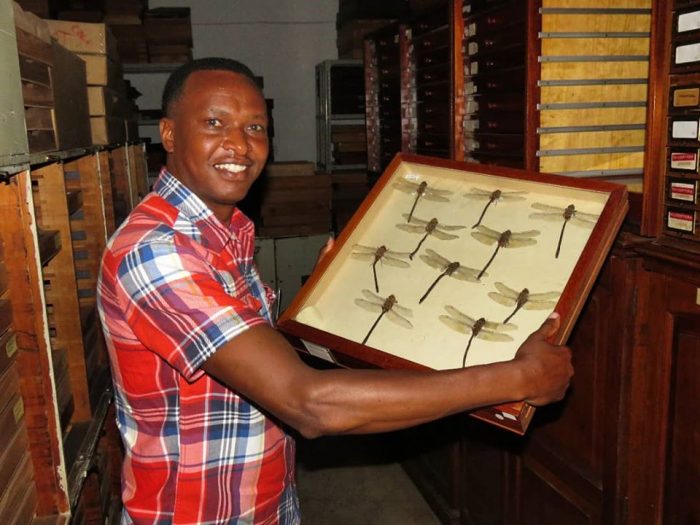
Laban in his entomology collection in Nairobi, with the drawer of Black Emperors, Africa’s largest dragonfly!
Upcoming Events
The Second BDI Citizen Science Conference is tentatively planned to be back at the Karoo Gariep Nature Reserve. The core dates are the weekend of 26–28 February 2021, but everyone will be welcome from a few days earlier to a few days after. Please put these dates in your diary.
There’s a move afoot to have an event in between the 1st and the 2nd conferences. If we pull it off, it will be the 1.5th BDI Citizen Science Conference. The dates are already firm: Wednesday 12 August 2020 to Wednesday 19 August 2020, with the weekend 14-16 as core.
The 1.5th conference is driven by the need to do a big data collection drive in the Karoo Gariep Nature Reserve in late winter/early spring. In addition, PC’s neighbour has invited us to visit his farm, and he has a boat on the Vanderkloof Dam. So there the potential exists to visit islands in the dam. How cool is that!? Please let Megan Loftie-Eaton (megan@thebdi.org) know if you are interested in the 1.5th conference.
For both the 1.5th and 2nd conferences, the “formal” programme will be similar to 1st: Friday evening and then Saturday 11h00 to 15h30. The 1st conference was a great demonstration that the “real” business takes place outside of the sessions.
And before all of these, there is a BDI Carnarvon BioBash from Wednesday 15 April to Wednesday 22 April 2020. If you would like more information on this, contact Les Underhill (les@dragonflyatlasthebdi.org).
OdonataMAP – Shoot The Dragons Week 6
OdonataMAPpers managed to snap and map 839 dragonflies and damselflies from 6 countries: Namibia, Nigeria, Sierra Leone, South Africa, Swaziland, and Zambia.
Corrie du Toit OdonataMAPped this beautiful Tropical Bluetail Ischnura senegalensis (photo below) at New Holme Guest Farm on Karoo Gariep Nature Reserve during the BDI’s Citizen Science Conference.
Overall, for the week, Jean Hirons submitted the most OdonataMAP records with 107, followed by Chris Small on 78 and Andries and Joey de Vries with 77 records. Awesomely well done OdonataMAPpers! http://vmus.adu.org.za/
FrogMAP in the news
The FrogMAP database played a key role at the start of Peta Brom’s Master’s project. Part of her thesis has been summarized into this paper: The role of cultural norms in shaping attitudes towards amphibians in Cape Town, South Africa. The paper is in the Open Access journal PLOS ONE, and anyone can download it: https://journals.plos.org/plosone/article?id=10.1371%2Fjournal.pone.0219331
Here is the Abstract: “Urban ecosystems are increasingly viewed as an important component within strategies for wildlife conservation but are shaped as much by natural systems as they are by social and political processes. At the garden scale, attitudes and preferences govern design and maintenance choices including the decision to encourage or discourage specific faunal presence. At the global scale, charismatic taxa that are well-liked attract more conservation funding and volunteer stewardship. Amphibians are a class of animals that are both loved and loathed making them a suitable subject for comparing and unpacking the drivers of preference and attitudes towards animals. We conducted a mixed methods survey of 192 participants in three adjacent neighbourhoods in Cape Town, South Africa. The survey included both quantitative and qualitative questions which were analysed thematically and used to explain the quantitative results. The results revealed that attitudes formed during childhood tended to be retained into adulthood, were shaped by cultural norms, childhood experiences and the attitudes of primary care-givers. The findings are significant for environmental education programmes aimed at building connectedness to nature and biophilic values.”
Peta is now a PhD student, researching monkey beetles.
LacewingMAP
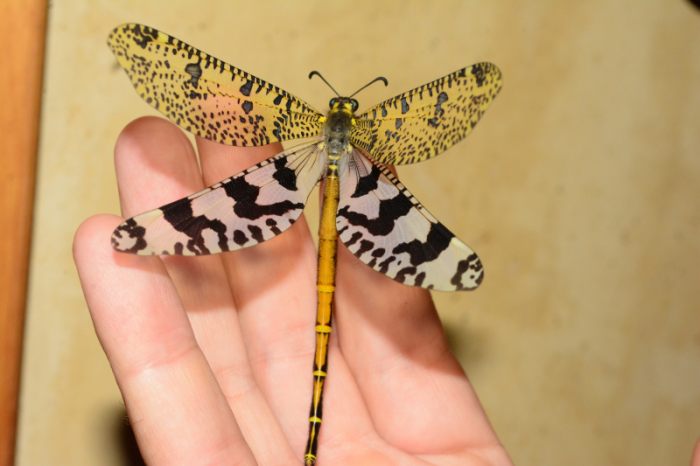
Palpares speciosus – LacewingMAP record by Ryan Tippett Mervyn Mansell writes: This is a Cape endemic, widespread in the Western Cape and parts of Northern and Eastern Cape Provinces. Frequently found in fynbos and Karoo biomes. Extends about as far eastwards as Grahamstown and is then replaced by its adelphotaxon (sister-species) Palpares caffer to the north as far as Zimbabwe. This was the first antlion to be described from Africa, by Linnaeus. The large black larvae live in soil among grass tussocks.
LacewingMAP seems a bit of a Cinderella section of the Virtual Museum. Only 0.7% of the 2019 records into the Virtual Museum were for LacewingMAP (compared with 32% for LepiMAP!!). And no citizen scientist embraces the lacewings as their main taxon of interest. For all of us, lacewings constitute a minor by-catch. In spite of this, Mervyn Mansell, who does the IDs for LacewingMAP, and who would describe himself as a “lacewinger”, is passionately enthusiast about what we are achieving. Mervyn says: “Please keep up the enthusiasm for the LacewingMAP project. It is certainly enhancing our distribution knowledge for many taxa, besides sensitizing the general public to these incredible creatures.”
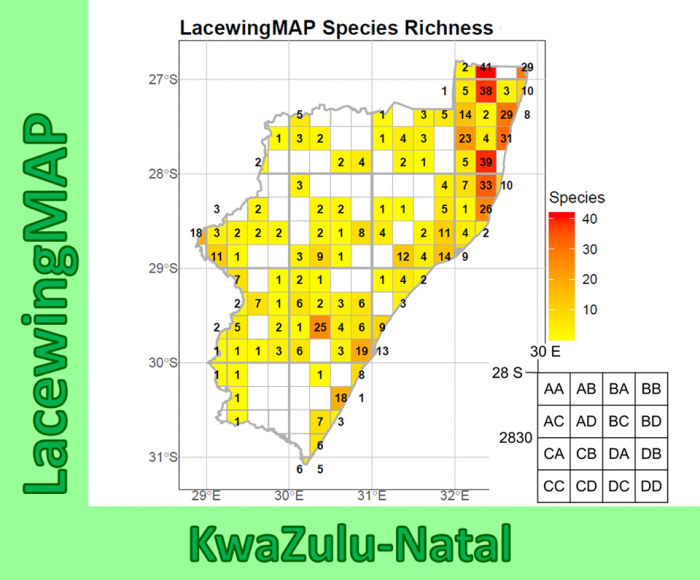
The map below shows the numbers of species of lacewing per quarter degree grid cell in the KwaZulu-Natal. This map is counting species only (not genus or family). Clearly, there is a huge amount of lacewinging to be done; but it is impressive how few grid cells in KwaZulu-Natal have no data.
One great tip from Mervyn on being a lacewinger. When you stop and buy fuel at night, these places are invariably well lit. Do a close scrutiny of all the windows, window sills, pillars, etc, at these places for lacewings (and for moths!).
Find the Spotted Spreadwing in the FBIS database (Freshwater Biodiversity Information System) here.
Family Lestidae
Identification
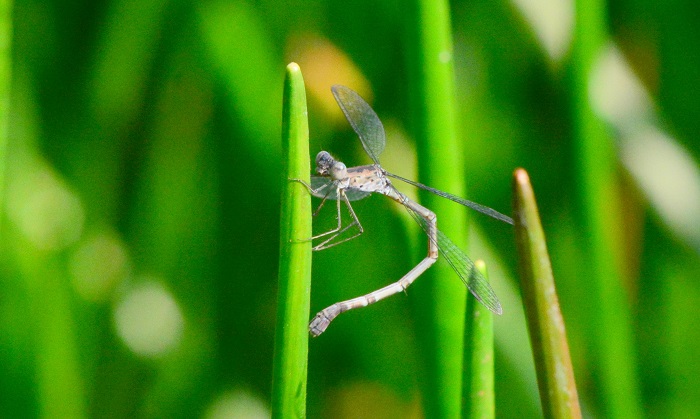
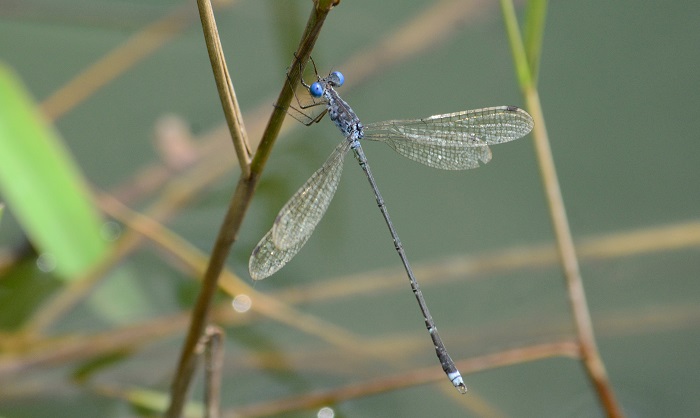
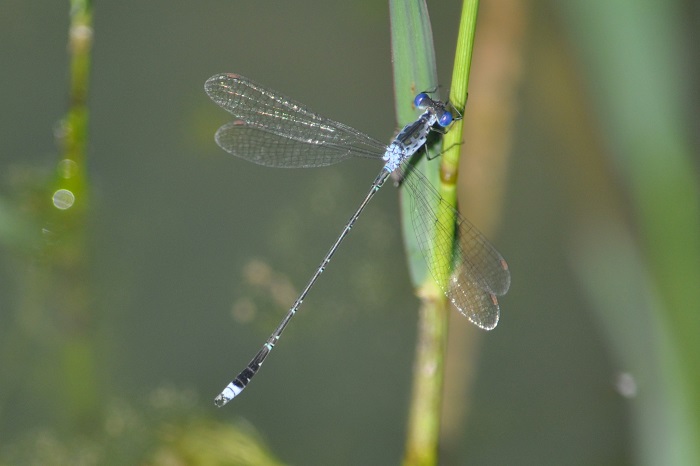
Spotted SpreadwingLestes tridens Near Hluhluwe, KwaZulu-Natal Photo by Ryan Tippett
Small and slender
Length up to 42mm; Wingspan up to 46mm
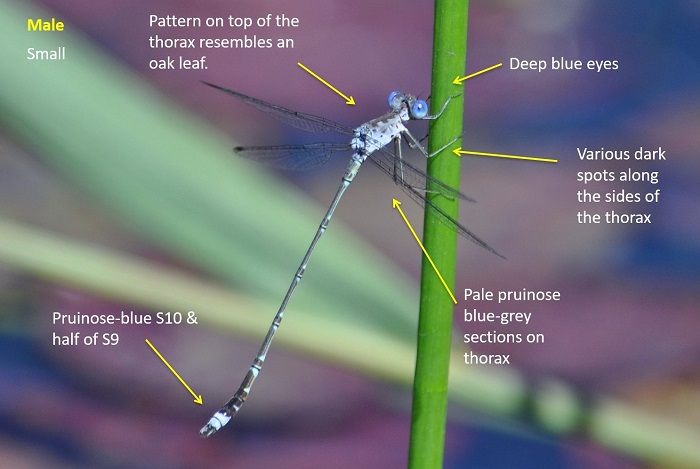
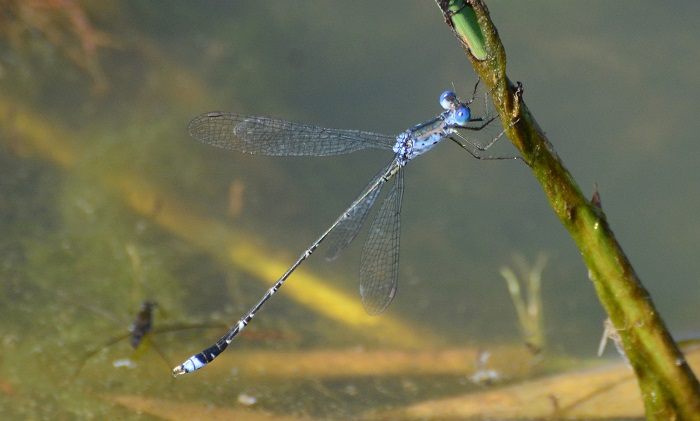
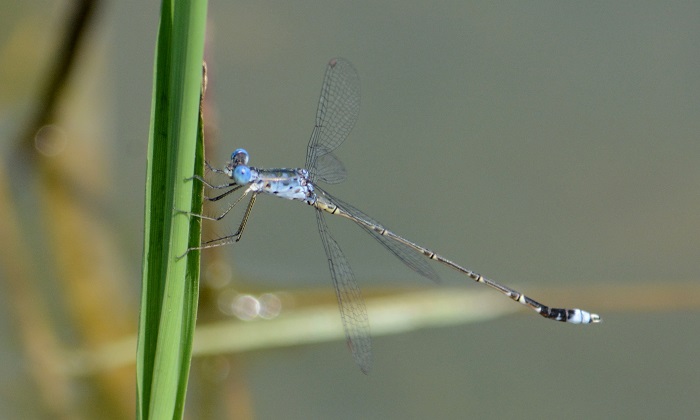
The Spotted Spreadwing is very similar to Lestes dissimulans (Cryptic Spreadwing). Males of the two are best seperated by the shape of the claspers. The pale pruinose blue terminal segments of Lestes tridens only extend half way up segment 9, whereas it extents to the top of segment 9 in Lestes dissimulans. The Spotted Spreadwing also shows a more distinctive pattern on the upper thorax.
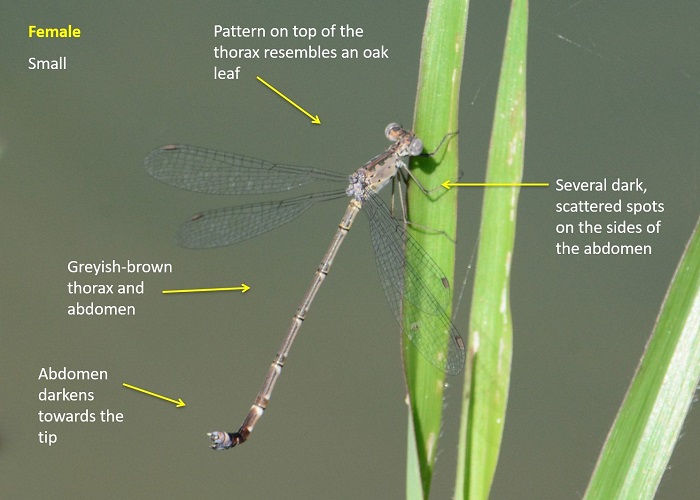
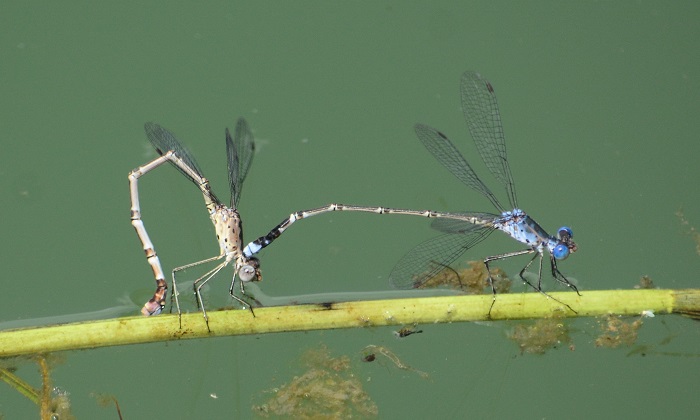
Females of the two are closely similar and best recognised by their association with the males.
Spotted SpreadwingLestes tridens Near Hluhluwe, KwaZulu-Natal Photo by Ryan Tippett
Habitat
The Spotted Spreadwing frequents both perennial and ephemeral, still-water habitats. They prefer shallow areas of pans, dams and ponds. The Spotted Spreadwing favours tall emergent or flooded grass but also inhabits areas with sedges and reeds. They can often be seen perched on waterlily flowers when they grow close to or among the flooded grass.
Habitat – Near Hluhluwe, Kzn Photo by Ryan Tippett
Behaviour
During the hottest and coolest times of the day, Spotted Spreadwings are mostly inactive and spend long periods hanging vertically from emergent grass stems. At mid-morning, the males are often very active as they chase each other from stem to stem. The females are frequently seen with the males. Spotted Spreadwings are easily overlooked. Their blue-grey colouration and slender bodies blend perfectly with the grass and glare from the water.
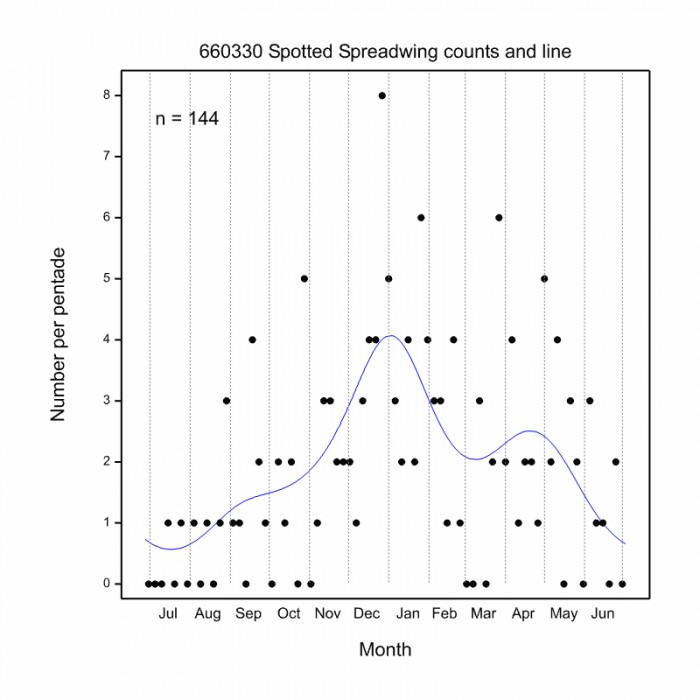
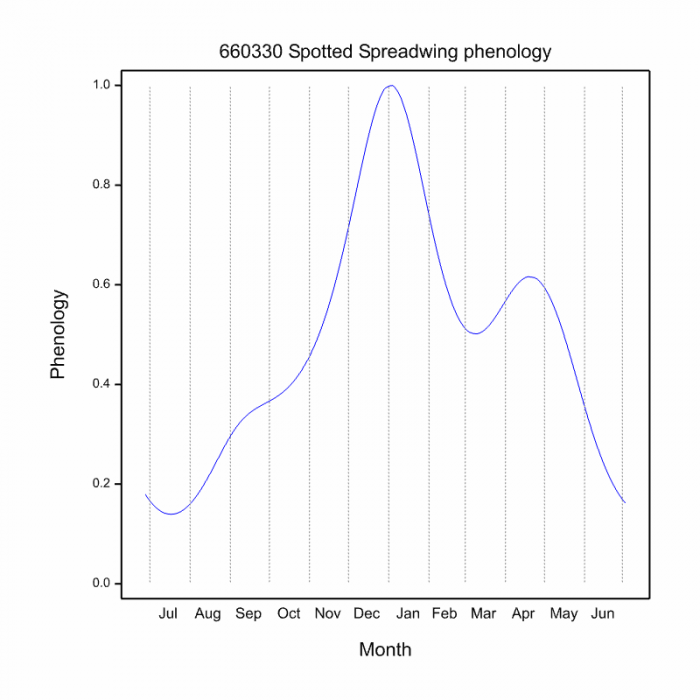
The Spotted Spreadwing is most active from September to May, but flies all year at some sites (See Phenology below).
Spotted SpreadwingLestes tridens – pair Near Hluhluwe, KwaZulu-Natal Photo by Ryan Tippett
Status and Conservation
Lestes tridens is a rather localised species, but it is often fairly common where it occurs. It is listed as of Least Concern in the IUCN Red List of Threatened Species. The Spotted Spreadwing has adapted to utilise suitable man-made dams and waterholes and is fairly resistant to habitat degradation.
Spotted SpreadwingLestes tridens – Male Near Hluhluwe, KwaZulu-Natal Photo by Ryan Tippett
Distribution
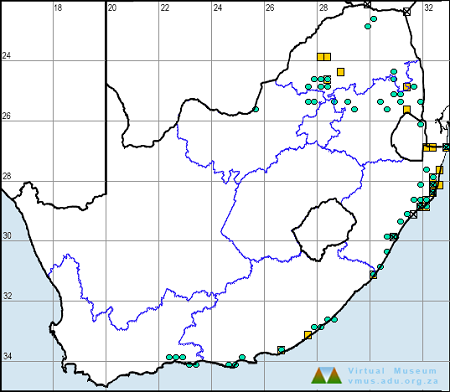
The Spotted Spreadwing is native to much of the southern half of Africa, where it is widespread, but localised. Its range also extends to East and Central Africa, and parts of West Africa. In South Africa, the Spotted Spreadwing is found in the warmer northern and eastern areas, extending down the east coast to near Mossel Bay.
Spotted SpreadwingLestes tridens – Female Near Hluhluwe, KwaZulu-Natal Photo by Ryan Tippett
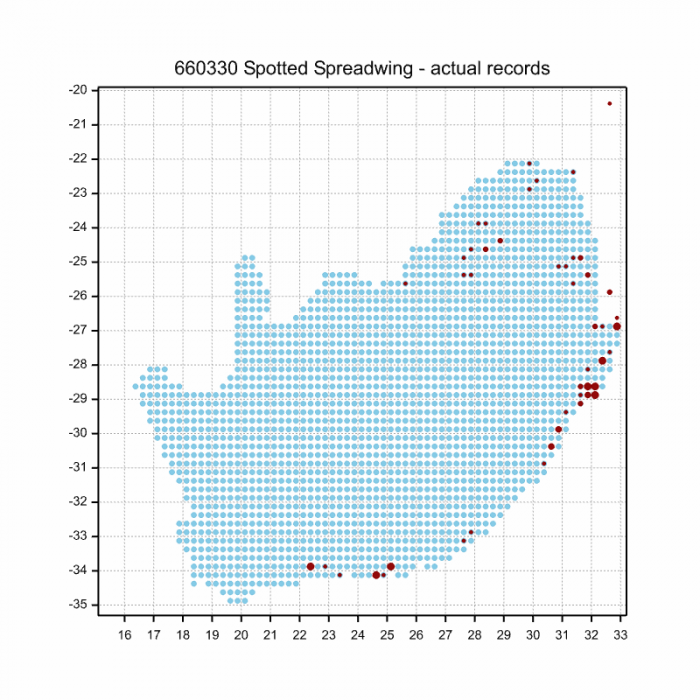
Below is a map showing the distribution of records for Spotted Spreadwing in the OdonataMAP database as at February 2020.
Below is a map showing the distribution of records for Spotted Spreadwing in the OdonataMAP database as of December 2024.
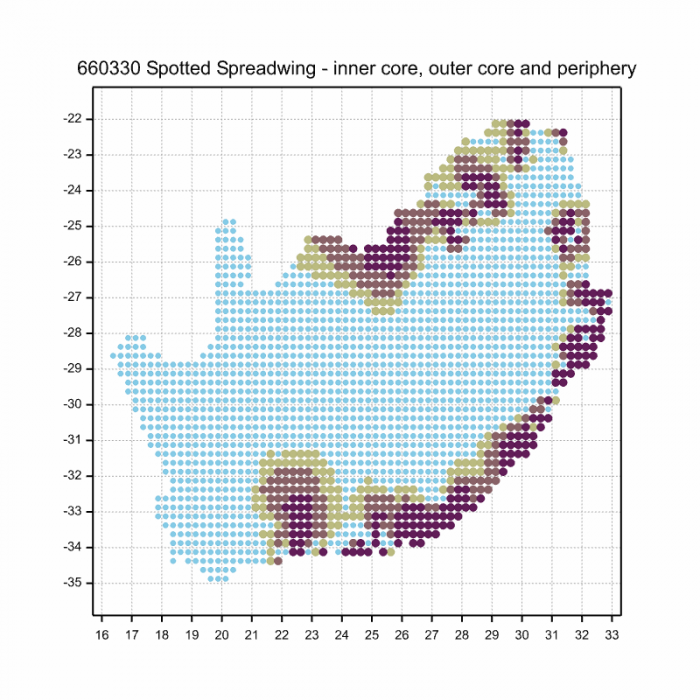
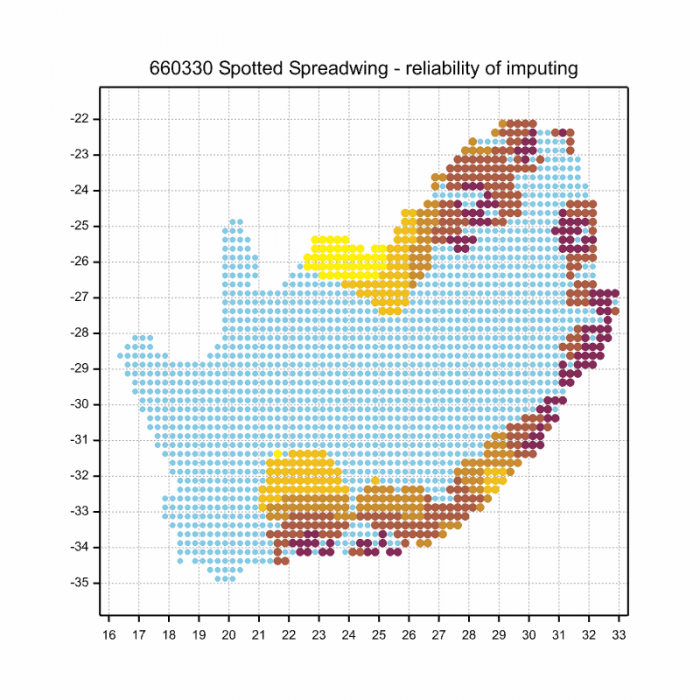
The next map below is an imputed map, produced by an interpolation algorithm, which attempts to generate a full distribution map from the partial information in the map above. This map will be improved by the submission of records to the OdonataMAP section of the Virtual Museum.
Ultimately, we will produce a series of maps for all the odonata species in the region. The current algorithm is a new algorithm. The objective is mainly to produce “smoothed” maps that could go into a field guide for odonata. This basic version of the algorithm (as mapped above) does not make use of “explanatory variables” (e.g. altitude, terrain roughness, presence of freshwater — we will be producing maps that take these variables into account soon). Currently, it only makes use of the OdonataMAP records for the species being mapped, as well as all the other records of all other species. The basic maps are “optimistic” and will generally show ranges to be larger than what they probably are.
These maps use the data in the OdonataMAP section of the Virtual Museum, and also the database assembled by the previous JRS funded project, which was led by Professor Michael Samways and Dr KD Dijkstra.
Spotted SpreadwingLestes tridens – Male Near Hluhluwe, KwaZulu-Natal Photo by Ryan Tippett
Phenology
Spotted SpreadwingLestes tridens – Male Near Hluhluwe, KwaZulu-Natal Photo by Ryan Tippett
Further Resources
The use of photographs by Felicity Grundlingh is acknowledged. All other photographs by Ryan Tippett.
Spotted SpreadwingLestes tridensMacLachlan, 1895
Other common names: Gevlekte Spanvlerkie (Afrikaans)
Recommended citation format: Loftie-Eaton M; Navarro R; Tippett RM; Underhill L. 2025. Spotted Spreadwing Lestes tridens. Biodiversity and Development Institute. Available online at https://thebdi.org/2020/02/28/spotted-spreadwing-lestes-tridens/
References: Tarboton, M; Tarboton, W. (2019). A Guide to the Dragonflies & Damselflies of South Africa. Struik Nature.
Samways, MJ. (2008). Dragonflies and Damselflies of South Africa. Pensoft
Samways, MJ. (2016). Manual of Freshwater Assessment for South Africa: Dragonfly Biotic Index. Suricata 2. South African National Biodiversity Institute, Pretoria
Martens, A; Suhling, F. (2007). Dragonflies and Damselflies of Namibia. Gamsberg Macmillan.
Spotted SpreadwingLestes tridens – Male Near Hluhluwe, KwaZulu-Natal Photo by Ryan Tippett
The Cryptic Spreadwing is similar to Lestes tridens (Spotted Spreadwing), but differs in the structure of the claspers and the amount of pruinose blue on segments 9 and 10 on the abdomen. Lestes dissimulans also has plain or indistinct markings on the top of the thorax. Lestes tridens shows a bolder and more distinctive marking on the upper thorax.
Females of the two are very similar and best separated by their association with the males.
The Cryptic Spreadwing frequents both perennial and seasonal still-water habitats. It prefers shallow areas of pans, dams, and ponds with tall emergent or flooded grass. The Cryptic Spreadwing inhabits hot savanna regions.
Behaviour
The Cryptic Spreadwing is a fairly inactive species that spends long periods hanging vertically from emergent grass stems. The females are frequently seen alongside the males. Cryptic Spreadwings are well camouflaged and easily overlooked. Their blue-grey colouration and slender bodies blend perfectly with the grass and glare from the water.
The Cryptic Spreadwing is most active from October to March (See Phenology below).
Status and Conservation
Lestes dissimulans is an uncommon and highly localised species in South Africa. It is listed locally as Vulnerable in the IUCN Red List of Threatened Species. The species is listed as of Least Concern for Africa in general due to its relatively wide distribution. The Cryptic Spreadwing is not very tolerant of habitat degradation and is mostly found in pristine habitats.
Distribution
Lestes dissimulans occurs from the far North of KwaZulu-Natal to Limpopo in South Africa, and then widely across southern, eastern, central, and western Africa.
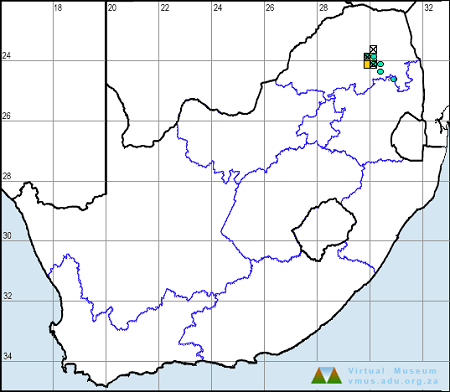
Below is a map showing the distribution of records for Cryptic Spreadwing in the OdonataMAP database as at February 2020.
Below is a map showing the distribution of records for Cryptic Spreadwing in the OdonataMAP database as of December 2024.
The next map below is an imputed map, produced by an interpolation algorithm, which attempts to generate a full distribution map from the partial information in the map above. This map will be improved by the submission of records to the OdonataMAP section of the Virtual Museum.
Ultimately, we will produce a series of maps for all the odonata species in the region. The current algorithm is a new algorithm. The objective is mainly to produce “smoothed” maps that could go into a field guide for odonata. This basic version of the algorithm (as mapped above) does not make use of “explanatory variables” (e.g. altitude, terrain roughness, presence of freshwater — we will be producing maps that take these variables into account soon). Currently, it only makes use of the OdonataMAP records for the species being mapped, as well as all the other records of all other species. The basic maps are “optimistic” and will generally show ranges to be larger than what they probably are.
These maps use the data in the OdonataMAP section of the Virtual Museum, and also the database assembled by the previous JRS funded project, which was led by Professor Michael Samways and Dr KD Dijkstra.
Phenology
Further Resources
The use of photographs by Marita Beneke and Niall Perrins is acknowledged.
Cryptic SpreadwingLestes dissimulansFraser, 1955
Other common names: Kriptiese Spanvlerkie (Afrikaans)
Recommended citation format: Loftie-Eaton M; Navarro R; Tippett RM; Underhill L. 2025. Cryptic Spreadwing Lestes dissimulans. Biodiversity and Development Institute. Available online at https://thebdi.org/2020/02/27/cryptic-spreadwing-lestes-dissimulans/
References: Tarboton, M; Tarboton, W. (2019). A Guide to the Dragonflies & Damselflies of South Africa. Struik Nature.
Samways, MJ. (2008). Dragonflies and Damselflies of South Africa. Pensoft
Samways, MJ. (2016). Manual of Freshwater Assessment for South Africa: Dragonfly Biotic Index. Suricata 2. South African National Biodiversity Institute, Pretoria
Martens, A; Suhling, F. (2007). Dragonflies and Damselflies of Namibia. Gamsberg Macmillan.
Find the Elegant Malachite in the FBIS database (Freshwater Biodiversity Information System) here.
Family Synlestidae
Identification
Elegant MalachiteChlorolestes elegans – Male Limpopo, South Africa Photo by Gerhardt Diedericks
Large size
Length up to 63mm; Wingspan attains 76mm.
In South Africa, due to its habitat and restricted distribution, the Elegant Malachite should only be confused with Chlorolestes tessellatus (Forest Malachite) and Chlorolestes fasciatus (Mountain Malachite). The Elegant Malachite is the larger of the three species, with very little size overlap. Chlorolestes elegans has a yellow lower thorax stripe that curves noticeably upwards towards the wing bases (diagnostic). Chlorolestes tessellatus shows a less obviously curved stripe that grades to brown nearer the wing bases. Both species have forms with banded and unbanded wings. The best method for identification remains the males unique clasper morphology.
The Elegant Malachite is found in Malawi, Mozambique, South Africa, and Zimbabwe, where its natural habitats are rivers and streams in tropical and subtropical moist montane forests. It favours clear, rocky streams in densely vegetated, shady areas with pools and running water. The Elegant Malachite is only recorded above 1200m above sea level in South Africa.
Behaviour
The Elegant Malachite perches in dappled light with its wings outstretched, where it is well camouflaged.
It is on the wing from November to May (See Phenology below).
Status and Conservation
The Elegant Malachite is uncommon and highly localised. It is listed as Near Threatened in the IUCN Red List of Threatened Species. It is vulnerable to habitat loss.
Distribution
The Elegant Malachite ranges from the Limpopo province in South Africa, up along the Eastern Highlands of Zimbabwe and adjacent Mozambique to southern Malawi and Parts of northern Mozambique. It has a localised and disjunct distribution.
In South Africa, the Elegant Malachite is restricted to the northern escarpment forests between Wolkberg and the Soutpansberg in Limpopo.
Below is a map showing the distribution of records for Elegant Malachite in the OdonataMAP database as at February 2020.
Below is a map showing the distribution of records for Elegant Malachite in the OdonataMAP database as of December 2024.
The next map below is an imputed map, produced by an interpolation algorithm, which attempts to generate a full distribution map from the partial information in the map above. This map will be improved by the submission of records to the OdonataMAP section of the Virtual Museum.
Ultimately, we will produce a series of maps for all the odonata species in the region. The current algorithm is a new algorithm. The objective is mainly to produce “smoothed” maps that could go into a field guide for odonata. This basic version of the algorithm (as mapped above) does not make use of “explanatory variables” (e.g. altitude, terrain roughness, presence of freshwater — we will be producing maps that take these variables into account soon). Currently, it only makes use of the OdonataMAP records for the species being mapped, as well as all the other records of all other species. The basic maps are “optimistic” and will generally show ranges to be larger than what they probably are.
These maps use the data in the OdonataMAP section of the Virtual Museum, and also the database assembled by the previous JRS funded project, which was led by Professor Michael Samways and Dr KD Dijkstra.
Phenology
The next two graphs shows how the occurrence of Elegant Malachites varies within the year, i.e. the phenology. There are only 17 records in the database for this species, so these results need to be treated with caution. The first plot shows the number of records in each pentade, five-day periods, which start on 1 July and end on 30 June the following year. The maximum number of records in a pentade is three, in a pentade in May. The blue line is generated by a smoother, an algorithm which aims to separate the “signal” from the “noise”, and shows the pattern of seasonality for this species. The second plot shows only the blue line, and it is scaled to lie between zero and one, for easy comparison between species.
Tentatively (because the sample size is only 17), this phenology plot shows that the flight period of the Elegant Malachite is from November to May. The bimodality (i.e. having two peaks) is almost certainly an artefact caused by the tiny size of the sample. Lots more records of Elegant Malachites are needed in OdonataMAP to improve the phenology plot.
Further Resources
The use of photographs by Desire Darling and Gerhard Diedericks is acknowledged.
Elegant MalachiteChlorolestes elegansPinhey, 1950
Other common names: Elegante Malagiet (Afrikaans).
Recommended citation format: Loftie-Eaton M; Navarro R; Tippett RM; Underhill L. 2025. Elegant Malachite Chlorolestes elegans. Biodiversity and Development Institute. Available online at https://thebdi.org/2020/02/27/elegant-malachite-chlorolestes-elegans/
References: Tarboton, M; Tarboton, W. (2019). A Guide to the Dragonflies & Damselflies of South Africa. Struik Nature.
Samways, MJ. (2008). Dragonflies and Damselflies of South Africa. Pensoft
Samways, MJ. (2016). Manual of Freshwater Assessment for South Africa: Dragonfly Biotic Index.Suricata 2. South African National Biodiversity Institute, Pretoria
Find this species in the FBIS database (Freshwater Biodiversity Information System) here.
Family Libellulidae
Identification
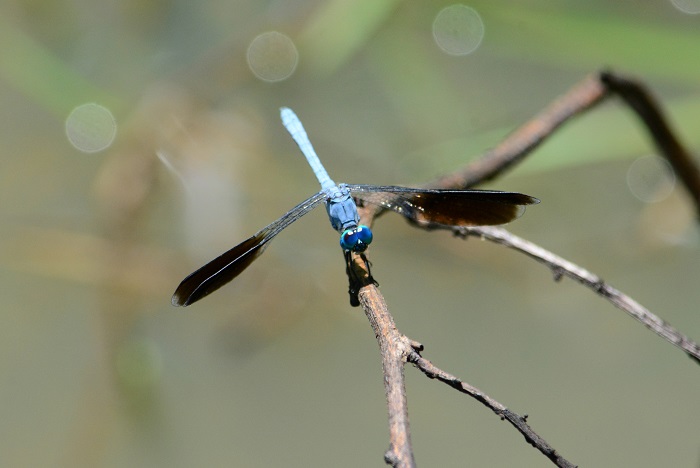
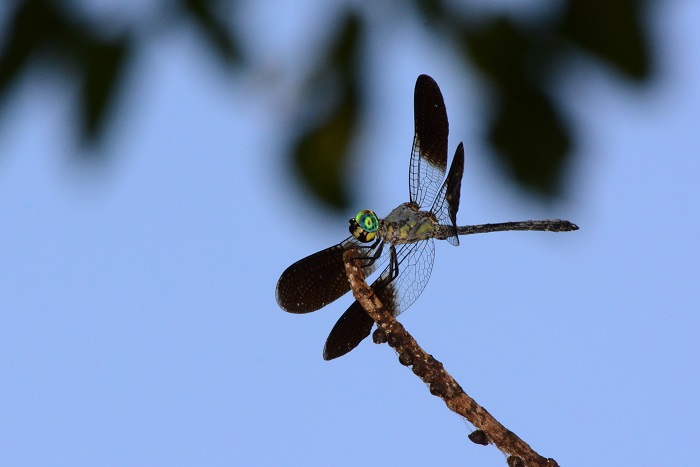
Black-splashed ElfTetrathemis polleni – Banded Male Ndumo Game Reserve, KwaZulu-Natal Photo by Ryan Tippett
Small size. Length up to 35mm; Wingspan attains 63mm.
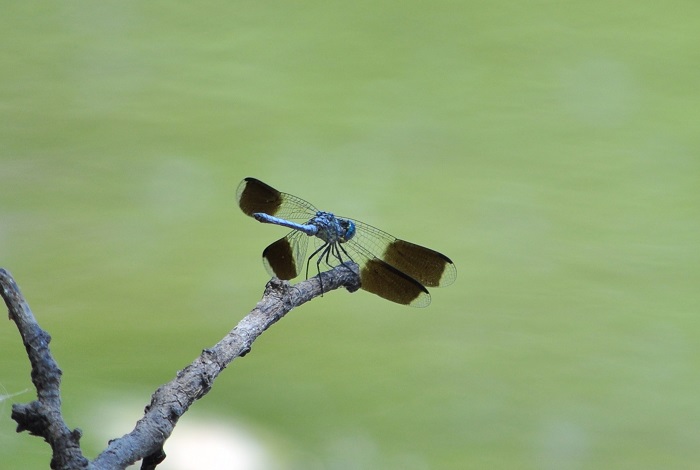
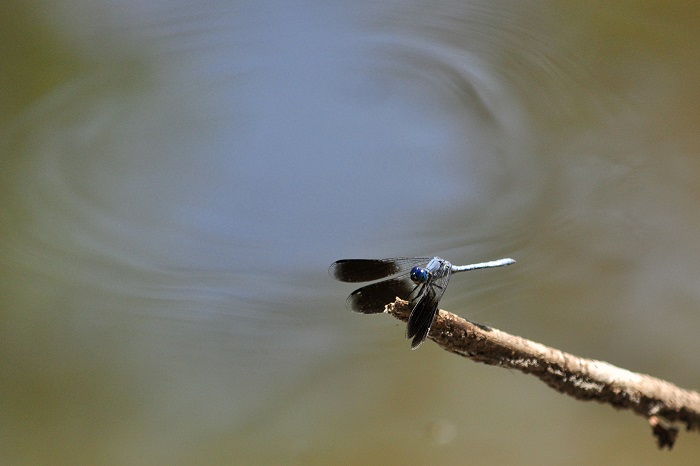
The Banded male Black-splashed Elf is striking and distinctive. Unbanded males can be mistaken for skimmers (Orthetrum spp.) or the Inspector (Chalcostephia flavifrons)but can be separated on wing venation and behaviour.
Females are quite similar to those of Notiothemis jonesi (Eastern Forestwatcher). They are best identified by wing venation. Black-splashed Elf females have a four-sided discoidal cell in the forewings, while the fore wings of Notiothemis jonesi have a triangular discoidal cell.
Black-splashed ElfTetrathemis polleni – Female Enseleni Nature Reserve, KwaZulu-Natal Photo by Ryan Tippett
Habitat
The Black-splashed Elf is a shade-loving species of calm, forested rivers, streams, and pools where trees overhang the water. They inhabit coastal, swamp, and riverine forests, and are sometimes also found in dense woodland along streams. The Black-splashed Elf is found mostly in warmer regions.
Habitat – Mkhuze Game Reserve, KwaZulu-Natal Photo by Ryan TippettHabitat – Kosi Bay, KwaZulu-Natal Photo by Ryan Tippett
Behaviour
Male Black-splashed Elfs perch conspicuously on bare, overhanging branches and twigs, usually 1 to 3m above the water. Females are not seen as often and frequently sit higher up and slightly further away from the water. The flight is fast, and the males’ black wing splashes give a fluttering effect. They don’t fly for long and quickly return to their perch. The Black-splashed Elf characteristically sits with the wings drooped forward and the abdomen held up at an angle.
Black-splashed ElfTetrathemis polleni – Banded Male Kuleni Game Park, KwaZulu-Natal Photo by Ryan Tippett
Status and Conservation
Tetrathemis polleni is a common but localised species. It is listed as of Least Concern in the IUCN Red List of Threatened Species. The Black-splashed Elf is most numerous in undisturbed habitats but can occur at suitable man-made ponds and impoundments. It is moderately sensitive to habitat degradation. This species tolerates some turbid or stagnant water and abandons sites extensively lined with alien trees. The Black-splashed Elf is sensitive to the deforestation of overhanging indigenous trees, resulting in a loss of shady habitat.
Black-splashed ElfTetrathemis polleni – Banded Male Enseleni Nature Reserve, KwaZulu-Natal Photo by Ryan Tippett
Distribution
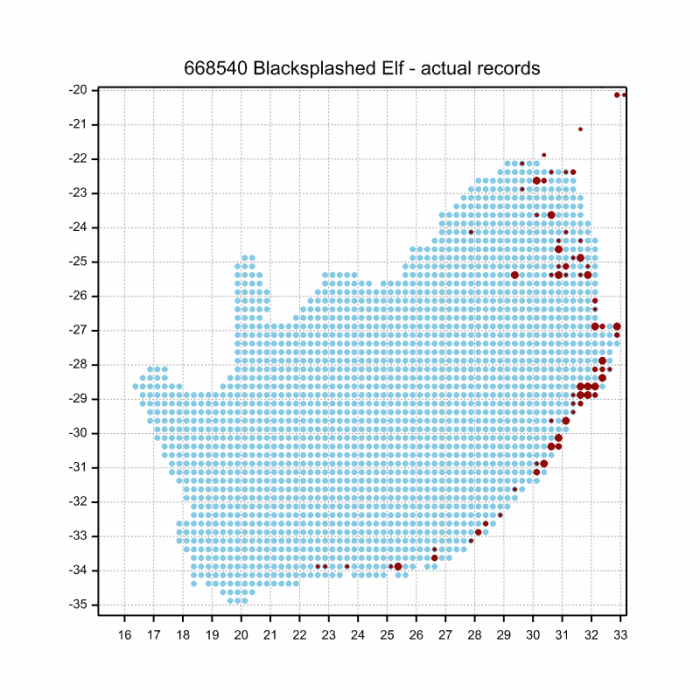
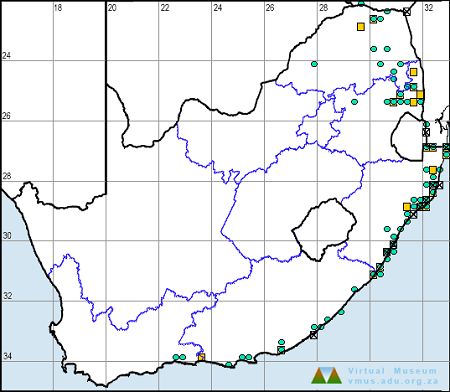
The Black-splashed Elf is most widespread in the Eastern parts of Africa, from South Africa to Uganda, Somalia, and Ethiopia. There is also a population in West Africa ranging from Nigeria to Guinea.
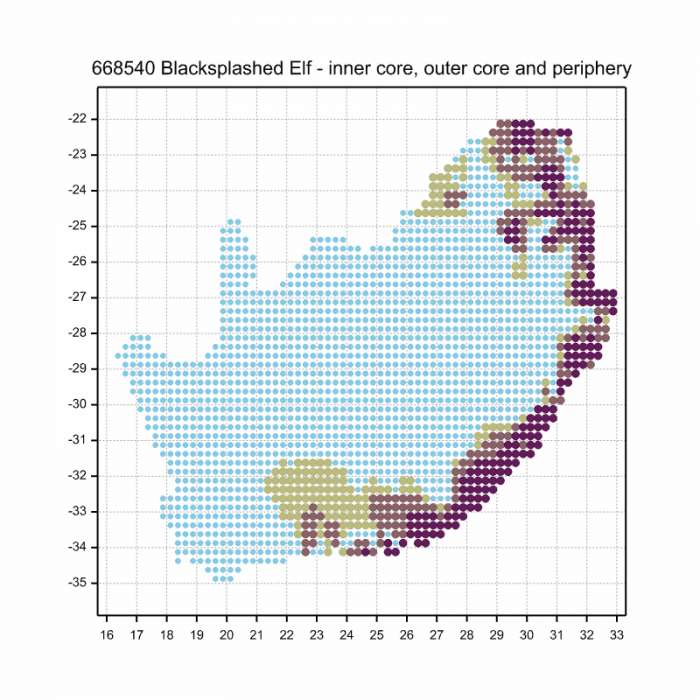
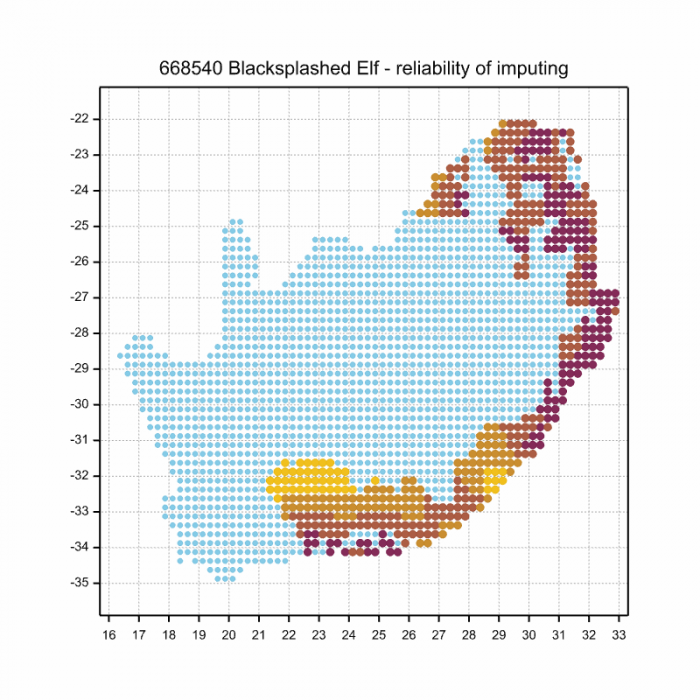
In South Africa, the Black-splashed Elf is found in the north and east, extending down the east coast as far as George, Western Cape.
Black-splashed ElfTetrathemis polleni – Banded Male Kuleni Game Park, KwaZulu-Natal Photo by Ryan Tippett
Below is a map showing the distribution of records for Black-splashed Elf in the OdonataMAP database as at February 2020.
Below is a map showing the distribution of records for Black-splashed Elf in the OdonataMAP database as of December 2025.
The next map below is an imputed map, produced by an interpolation algorithm, which attempts to generate a full distribution map from the partial information in the map above. This map will be improved by the submission of records to the OdonataMAP section of the Virtual Museum.
Ultimately, we will produce a series of maps for all the odonata species in the region. The current algorithm is a new algorithm. The objective is mainly to produce “smoothed” maps that could go into a field guide for odonata. This basic version of the algorithm (as mapped above) does not make use of “explanatory variables” (e.g. altitude, terrain roughness, presence of freshwater — we will be producing maps that take these variables into account soon). Currently, it only makes use of the OdonataMAP records for the species being mapped, as well as all the other records of all other species. The basic maps are “optimistic” and will generally show ranges to be larger than what they probably are.
These maps use the data in the OdonataMAP section of the Virtual Museum, and also the database assembled by the previous JRS funded project, which was led by Professor Michael Samways and Dr KD Dijkstra.
Black-splashed ElfTetrathemis polleni – Banded Male False Bay, iSimangaliso Wetland Park, KwaZulu-Natal Photo by Ryan Tippett
Further Resources
The use of photographs by Alan Manson is acknowledged.
Other common names: Swartspikkeldwergie (Afrikaans)
Recommended citation format: Loftie-Eaton M; Navarro R; Tippett RM; Underhill L. 2025. Black-splashed Elf Tetrathemis polleni. Biodiversity and Development Institute. Available online at https://thebdi.org/2020/02/26/black-splashed-elf-tetrathemis-polleni/
References: Tarboton, M; Tarboton, W. (2019). A Guide to the Dragonflies & Damselflies of South Africa. Struik Nature.
Samways, MJ. (2008). Dragonflies and Damselflies of South Africa. Pensoft
Samways, MJ. (2016). Manual of Freshwater Assessment for South Africa: Dragonfly Biotic Index. Suricata 2. South African National Biodiversity Institute, Pretoria
Black-splashed ElfTetrathemis polleni – Banded Male Ndumo Game Reserve, KwaZulu-Natal Photo by Ryan Tippett
Find this species in the FBIS database (Freshwater Biodiversity Information System) here.
Family Libellulidae
Identification
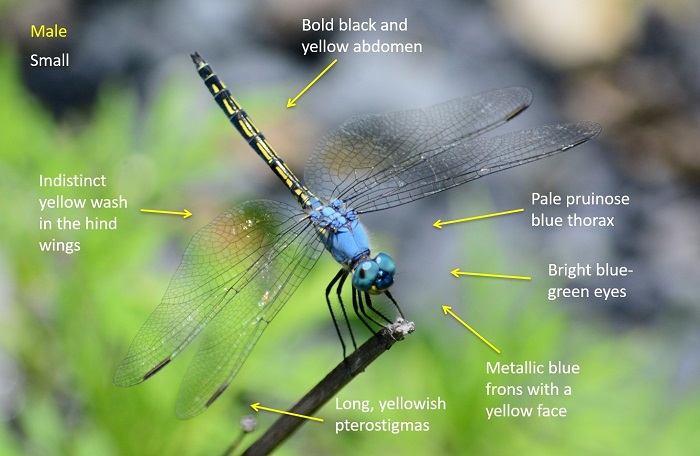
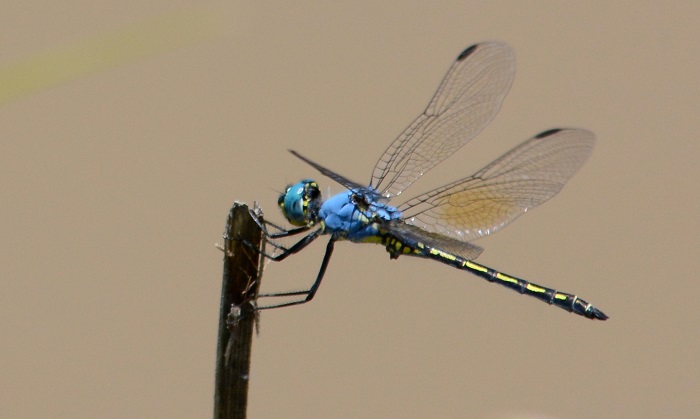
Jaunty DropwingTrithemis stictica – Male Wilge River, Free State Photo by Ryan Tippett
Small size
Length up to 38mm; Wingspan reaches 66mm.
Male Jaunty Dropwings are distinctive and unmistakable within South Africa. The combination of pale blue thorax, Greenish-blue eyes, and striking yellow and black abdomen is diagnostic. There are other very similar species further north in Africa, notably the Marsh Dropwing Trithemis palustris.
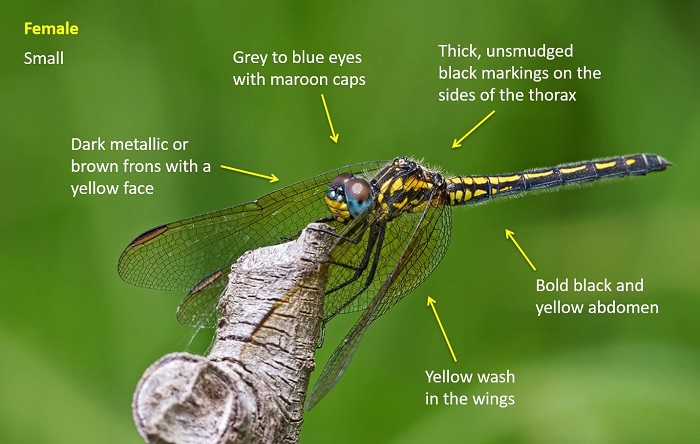
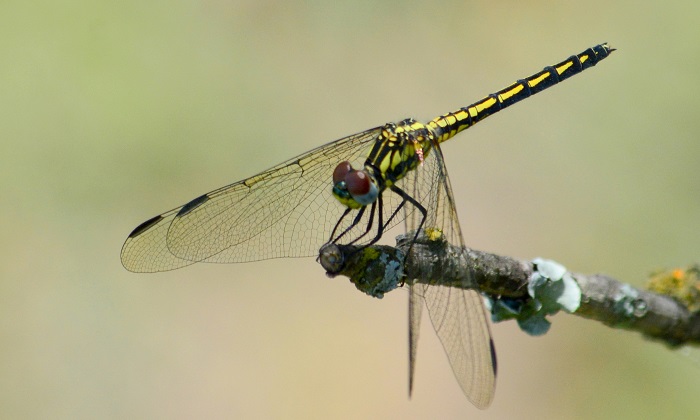
Jaunty DropwingTrithemis stictica – Female Near Oyster Bay, Eastern Cape Photo by Desire Darling
Females can be easily confused with those of other dropwing species, especially the Navy Dropwing (Trithemis furva). Elegant Dropwing females can be told by the thick, un-smudged black markings on the sides of the thorax and the bold black and yellow abdomen pattern.
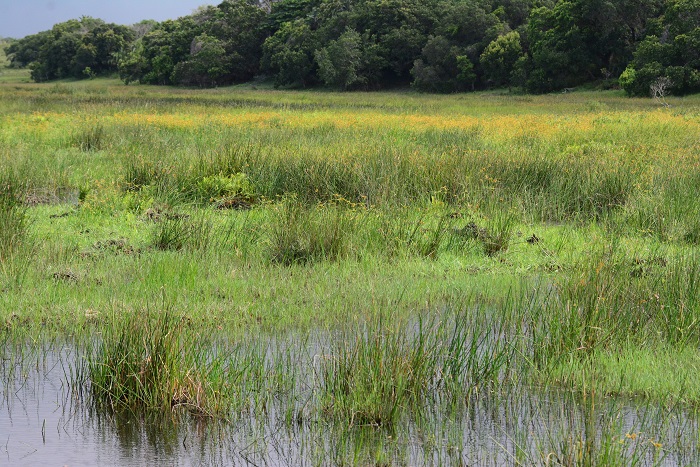
Typical marsh habitat Near Kosi Bay, KwaZulu-Natal Photo by Ryan Tippett
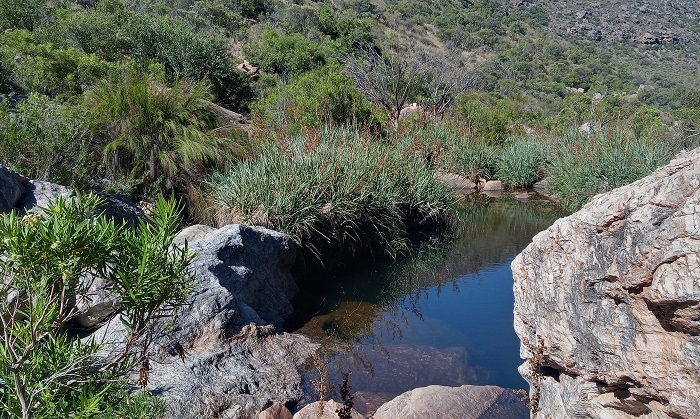
The Jaunty Dropwing frequents the vegetated margins of still water environments, such as marshes, pans, dams, and the quiet pools and backwaters of rivers and streams. It is seldom found at running water. Jaunty Dropwings prefer areas rich in vegetation, like sedges, reeds, and emergent grass.
The Jaunty Dropwing is often found at vegetated pools along slow-moving rivers. Gifberg, Western Cape Photo by Ryan Tippett
Behaviour
The Jaunty Dropwing likes to sit in exposed, sunny positions. During the heat of the day, they can often be seen in the ‘obelisk’ position, pointing their abdomens at the sun to reduce the amount of direct sunlight on their bodies. Jaunty Dropwings are perch hunters and spend as much time perched as they do darting off to intercept prey, or to chase off a rival.
Jaunty DropwingTrithemis stictica – Male Wilge River, Free State Photo by Ryan Tippett
Status and Conservation
Trithemis stictica is a common and widespread species. It is listed as of Least Concern in the IUCN Red List of Threatened Species. The Jaunty Dropwing is reasonably tolerant of habitat degradation and is commonly found at suitable man-made water bodies.
Jaunty DropwingTrithemis stictica – Female Wilge River, Free State Photo by Ryan Tippett
Distribution
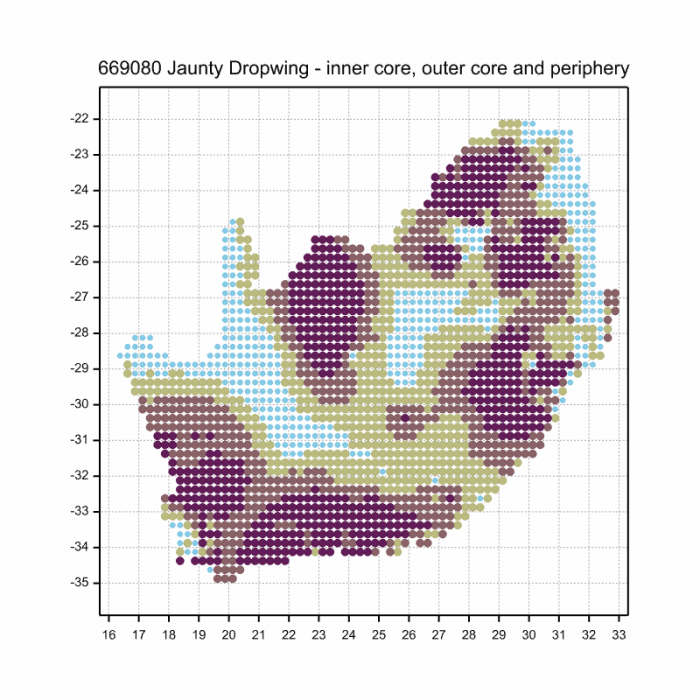
The Jaunty Dropwing has a wide distribution throughout most of sub-Saharan Africa and is also found on Madagascar. It is widespread in South Africa but avoids the arid and semi-arid central and western parts of the country.
Below is a map showing the distribution of records for Jaunty Dropwing in the OdonataMAP database as at February 2020.
Below is a map showing the distribution of records for Jaunty Dropwing in the OdonataMAP database as at December 2024.
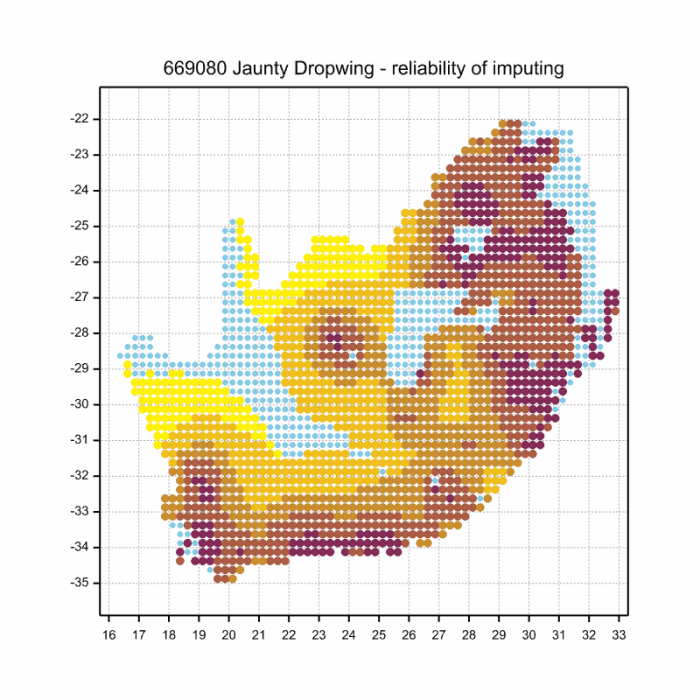
The next map below is an imputed map, produced by an interpolation algorithm, which attempts to generate a full distribution map from the partial information in the map above. This map will be improved by the submission of records to the OdonataMAP section of the Virtual Museum.
Ultimately, we will produce a series of maps for all the odonata species in the region. The current algorithm is a new algorithm. The objective is mainly to produce “smoothed” maps that could go into a field guide for odonata. This basic version of the algorithm (as mapped above) does not make use of “explanatory variables” (e.g. altitude, terrain roughness, presence of freshwater — we will be producing maps that take these variables into account soon). Currently, it only makes use of the OdonataMAP records for the species being mapped, as well as all the other records of all other species. The basic maps are “optimistic” and will generally show ranges to be larger than what they probably are.
These maps use the data in the OdonataMAP section of the Virtual Museum, and also the database assembled by the previous JRS funded project, which was led by Professor Michael Samways and Dr KD Dijkstra.
Jaunty DropwingTrithemis stictica – Male Sodwana Bay, iSimangaliso Wetland Park, KwaZulu-Natal Photo by Ryan Tippett
Further Resources
The use of photographs by Desire Darling and Gerhard Diedericks is acknowledged.
Other common names: Vrolike Valvlerkie (Afrikaans)
Recommended citation format: Loftie-Eaton M; Navarro R; Tippett RM; Underhill L. 2025. Jaunty Dropwing Trithemis stictica. Biodiversity and Development Institute. Available online at https://thebdi.org/2020/02/26/jaunty-dropwing-trithemis-stictica/
References: Tarboton, M; Tarboton, W. (2019). A Guide to the Dragonflies & Damselflies of South Africa. Struik Nature.
Samways, MJ. (2008). Dragonflies and Damselflies of South Africa. Pensoft
Samways, MJ. (2016). Manual of Freshwater Assessment for South Africa: Dragonfly Biotic Index. Suricata 2. South African National Biodiversity Institute, Pretoria
Martens, A; Suhling, F. (2007). Dragonflies and Damselflies of Namibia. Gamsberg Macmillan.
Jaunty DropwingTrithemis stictica – Male Seweweekspoort, Western Cape Photo by Ryan Tippett
Find this species in the FBIS database (Freshwater Biodiversity Information System) here.
Family Libellulidae
Identification
Orange-winged DropwingTrithemis kirbyi – Male Near Carnarvon, Northern Cape Photo by Ryan Tippett
Small
Length up to 37mm; Wingspan up to 63mm
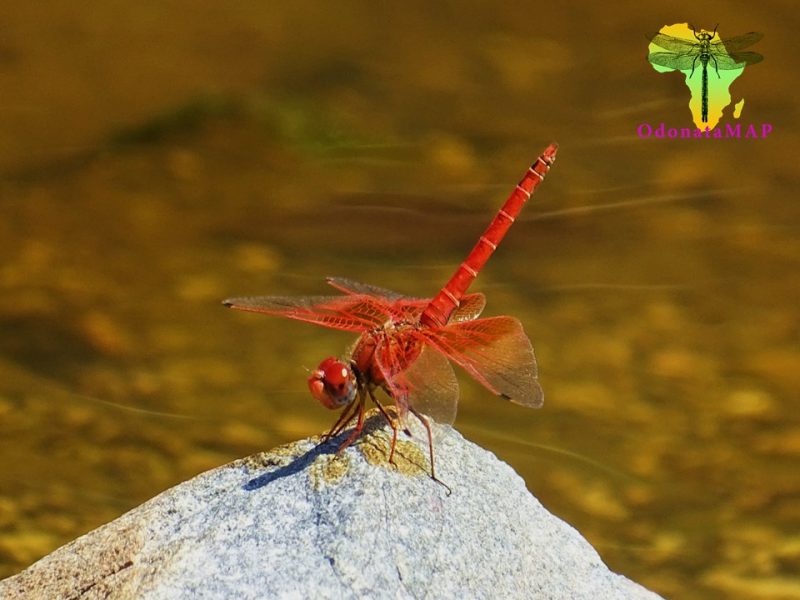
Both sexes of the Orange-winged Dropwing are readily identifiable. Males could be mistaken for the Red Groundling (Brachythemis lacustris), but are bright-orange-red (not deep red), and have slender abdomens with a tapered waist. The Orange-winged Dropwing also has a more elongate build, all black pterostigmas (not black and white), and unmarked red eyes.
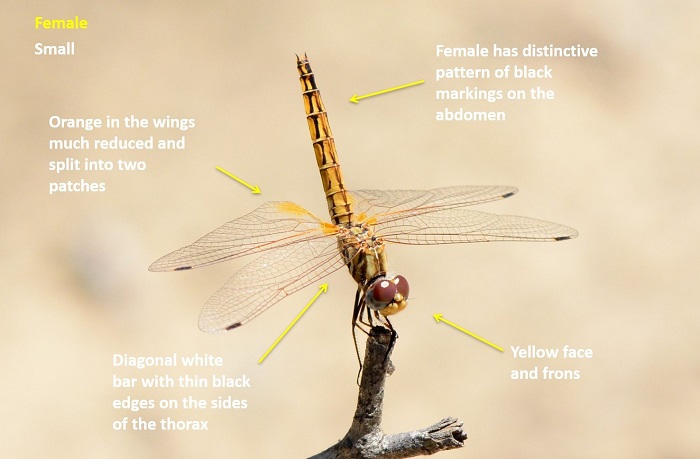
Females are similar to other Trithemis species but can be separated on their distinctive abdomen pattern.
Orange-winged DropwingTrithemis kirbyi – Female Near Hluhluwe, KwaZulu-Natal Photo by Ryan Tippett
Habitat
The Orange-winged Dropwing inhabits a wide range of natural and man-made water bodies, including rivers, streams, lakes, pans, dams, concrete reservoirs, swimming pools and drinking troughs. They prefer rocky habitats and areas with bare ground adjacent to the water. Bare concrete, gravel and bricks surrounding artificial water bodies provide ideal habitat. They can be found at both still and running water, and also make use of temporary and somewhat brackish water. Trithemis kirbyi can be particularly common at water points in dry arid regions.
Typical habitat near Vanrhynsdorp, Western Cape Photo by Ryan Tippett
Behaviour
The Orange-winged Dropwing is a conspicuous species that sits in the open on rocks or bare ground and sometimes on branches or reeds. Females are often found near the males but are far less conspicuous. Males can be very active as they restlessly chase each other or intercept prey. The flight is rapid but not sustained and they quickly return to a perch. During hot conditions, Orange-winged Dropwings are often seen perched with their abdomens held vertically upwards (see image below). This is a form of thermoregulatory behaviour to minimise exposure to sunlight and thus prevent overheating. This is known as ‘obelisk posture’ or ‘sky-pointing’.
Orange-winged DropwingTrithemis kirbyi – Male Near Upington, Northern Cape Photo by Ryan Tippett
Status and Conservation
Trithemis kirbyi is an abundant and widespread species. It is listed as of Least Concern in the IUCN Red List of Threatened Species. Orange-winged Dropwings are highly adaptable and resitant to habitat change. They have made great use of man-made impoundments and have doubtless benefited from this. This species is often more prevalent at degraded habitats than in pristine areas.
Orange-winged DropwingTrithemis kirbyi – Female Carnarvon district, Northern Cape Photo by Ryan Tippett
Distribution
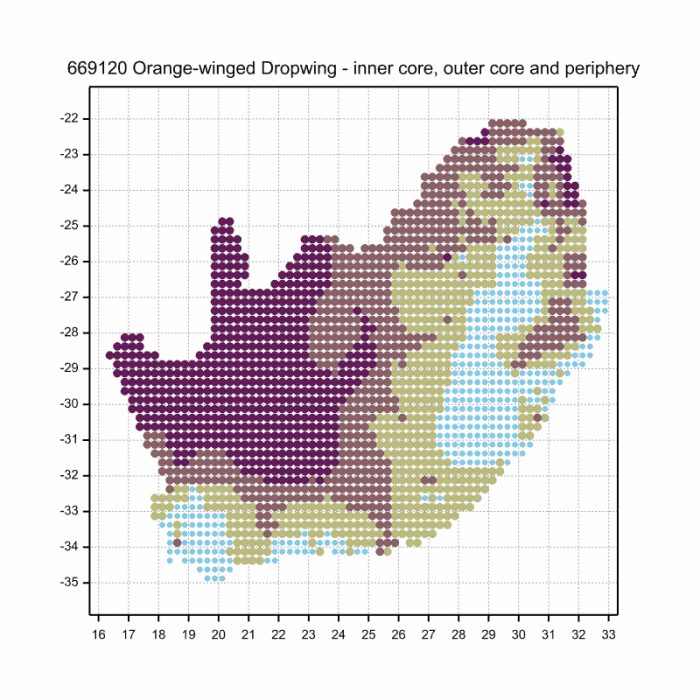
The Orange-winged Dropwing has a wide distribution. It is found virtually throughout Africa and in parts of the Middle East and southern Europe (Spain). It extends eastwards to India and Sri Lanka and also occurs on many islands in the Indian Ocean. The Orange-winged Dropwing occurs throughout southern Africa, including arid regions.
Below is a map showing the distribution of records for Orange-winged Dropwing in the OdonataMAP database as at February 2020.
Below is a map showing the distribution of records for Orange-winged Dropwing in the OdonataMAP database as of December 2024.
The next map below is an imputed map, produced by an interpolation algorithm, which attempts to generate a full distribution map from the partial information in the map above. This map will be improved by the submission of records to the OdonataMAP section of the Virtual Museum.
Ultimately, we will produce a series of maps for all the odonata species in the region. The current algorithm is a new algorithm. The objective is mainly to produce “smoothed” maps that could go into a field guide for odonata. This basic version of the algorithm (as mapped above) does not make use of “explanatory variables” (e.g. altitude, terrain roughness, presence of freshwater — we will be producing maps that take these variables into account soon). Currently, it only makes use of the OdonataMAP records for the species being mapped, as well as all the other records of all other species. The basic maps are “optimistic” and will generally show ranges to be larger than what they probably are.
These maps use the data in the OdonataMAP section of the Virtual Museum, and also the database assembled by the previous JRS funded project, which was led by Professor Michael Samways and Dr KD Dijkstra.
Orange-winged DropwingTrithemis kirbyi – Male Mkuze River, KwaZulu-Natal Photo by Ryan Tippett
Further Resources
The use of photographs by Riëtte Griesel is acknowledged. All other photographs by Ryan Tippett.
Other common names: Kirby’s Dropwing, Scarlet Rock Glider (Alt. English); Oranjevlerk-valvlerkie (Afrikaans)
Recommended citation format: Loftie-Eaton M; Navarro R; Tippett RM; Underhill L. 2025. Orange-winged Dropwing Trithemis kirbyi. Biodiversity and Development Institute. Available online at https://thebdi.org/2020/02/26/orange-winged-dropwing-trithemis-kirbyi/
References: Tarboton, M; Tarboton, W. (2019). A Guide to the Dragonflies & Damselflies of South Africa. Struik Nature.
Samways, MJ. (2008). Dragonflies and Damselflies of South Africa. Pensoft
Samways, MJ. (2016). Manual of Freshwater Assessment for South Africa: Dragonfly Biotic Index. Suricata 2. South African National Biodiversity Institute, Pretoria
Martens, A; Suhling, F. (2007). Dragonflies and Damselflies of Namibia. Gamsberg Macmillan.
Orange-winged DropwingTrithemis kirbyi – Male Near Vosburg, Northern Cape Photo by Ryan Tippett