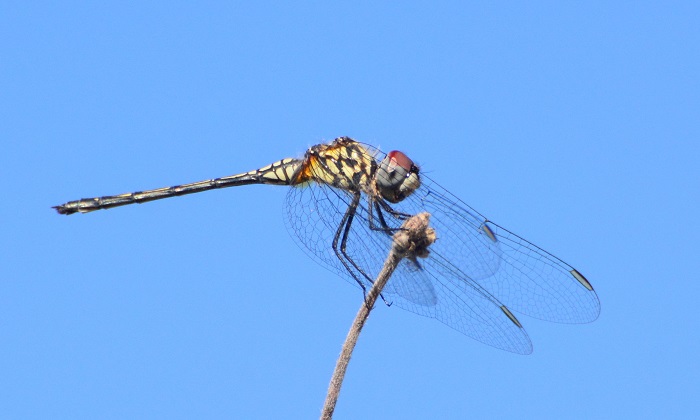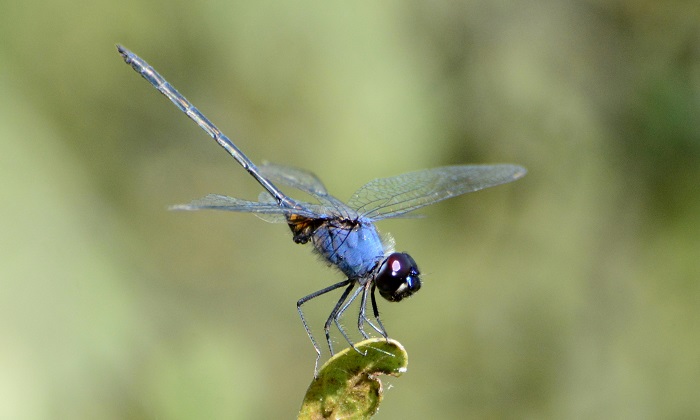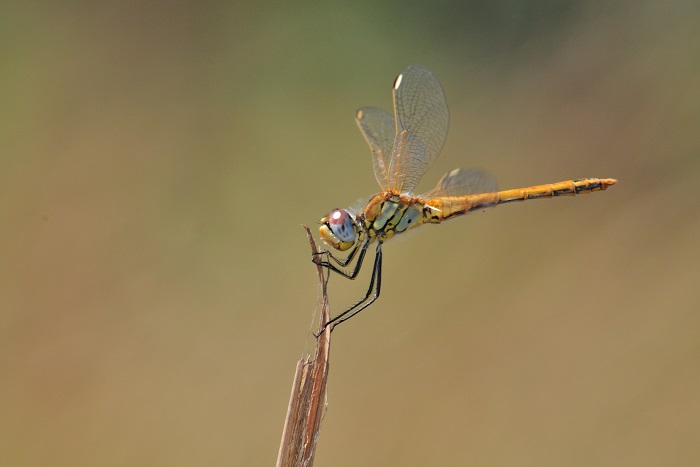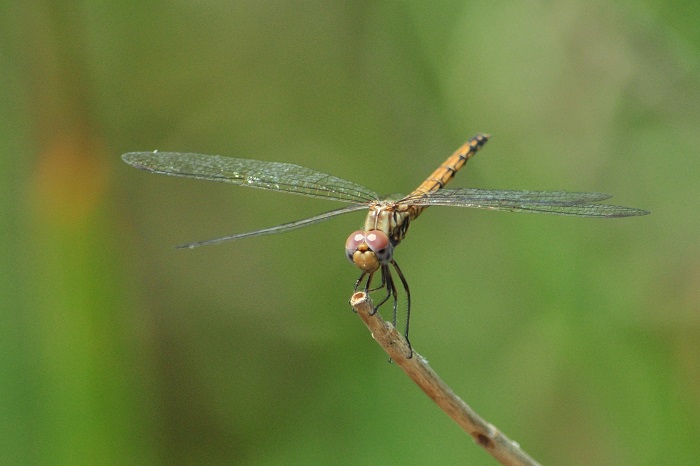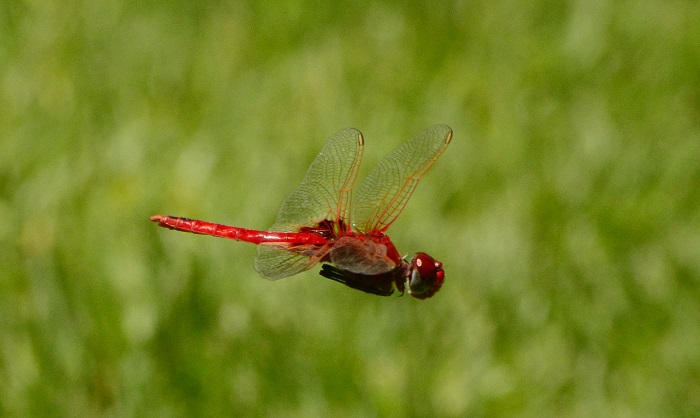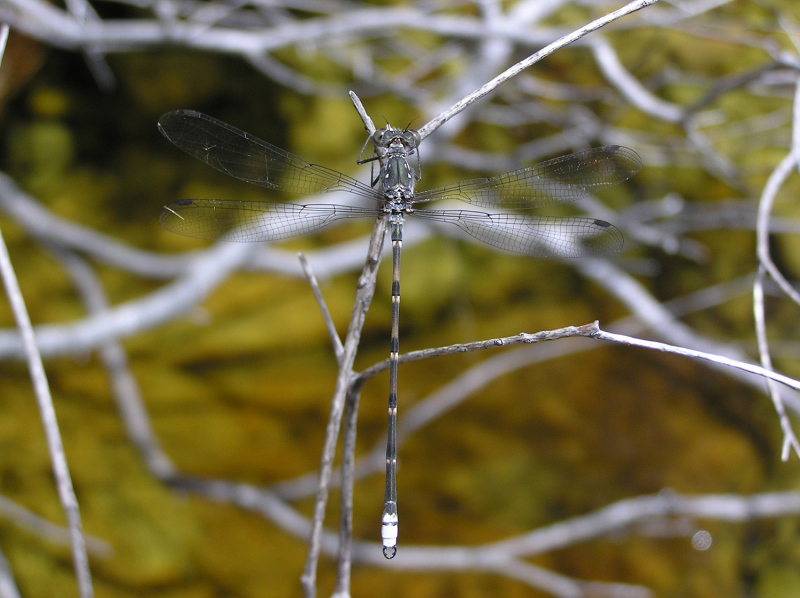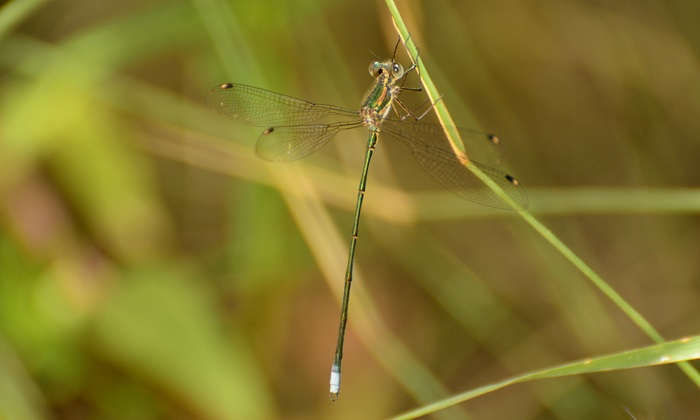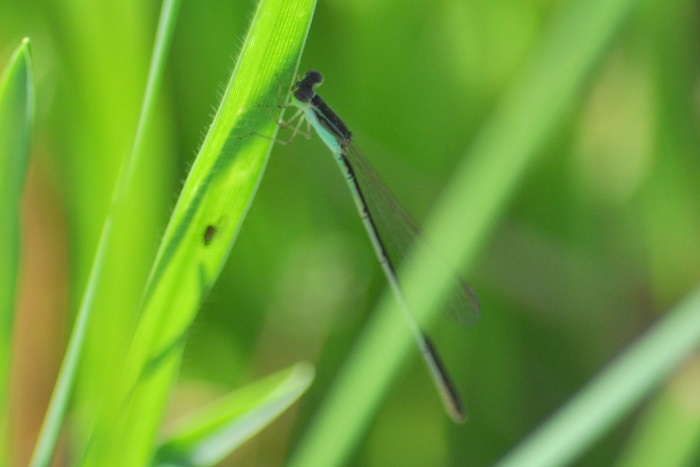
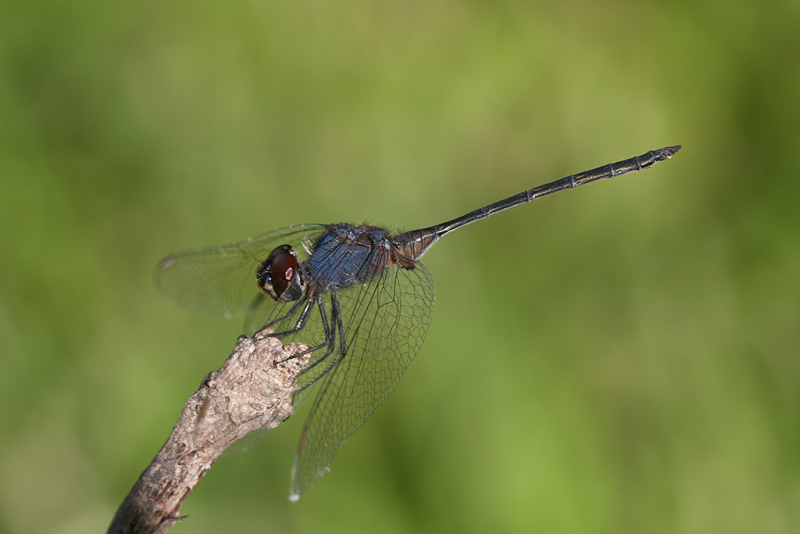
Navy Dropwing (Trithemis furva)

Cover photo by Sharon Stanton.

Find this species in the FBIS database (Freshwater Biodiversity Information System) here.

Family Libellulidae

Identification

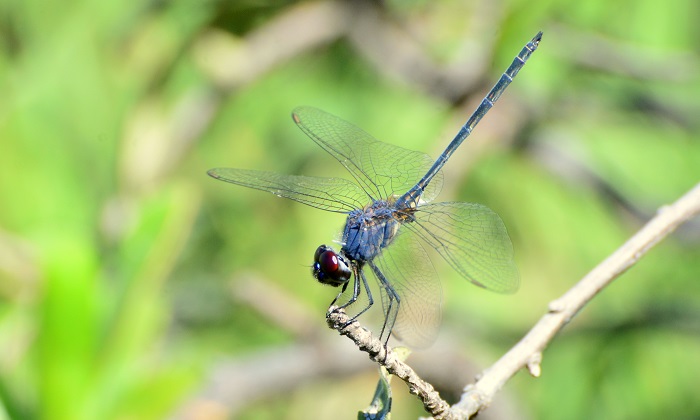
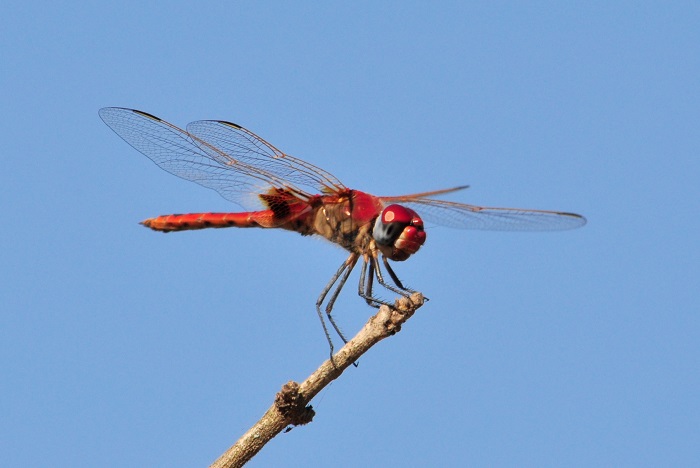
Navy Dropwing Trithemis furva – Male
Near Mosselbay, Western Cape
Photo by Ryan Tippett

Small to Medium size

Length up to 41mm; Wingspan attains 67mm.

The Navy Dropwing is only likely to be confused with the very similar Trithemis dorsalis (Highland Dropwing). Males of the two are best identified in the hand by examining the shape of the secondary genitalia. In addition, the males can (mostly) be told apart by checking the last Ax vein in the front wings. In Trithemis furva the last Ax vein extends as far as the subcostal vein and does not reach the radial vein. Trithemis dorsalis shows Ax veins that cross the subcostal vein to meet up with the radial vein.

The two species can also be tentatively identified based on their preferred habitat choice. Although they co-occur at many sites, the Navy Dropwing is more numerous than the Highland Dropwing at lower altitudes.

Navy Dropwing males could also be confused with the Denim Dropwing (Trithemis donaldsoni), but that species is larger and paler blue in colouration.

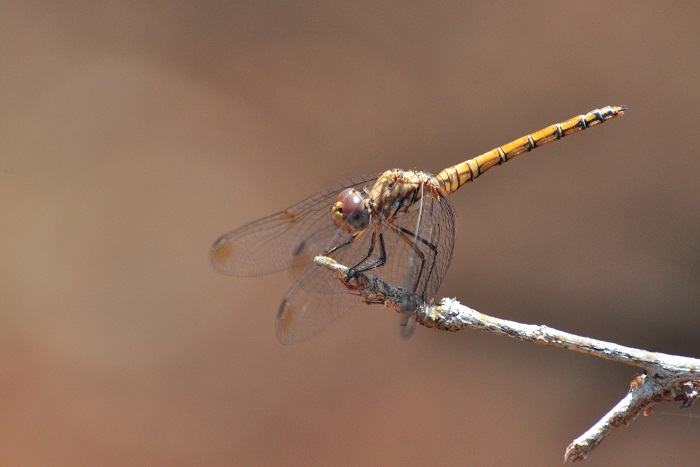
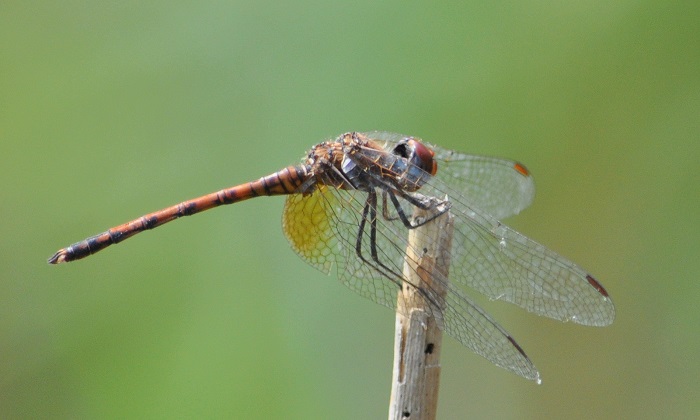
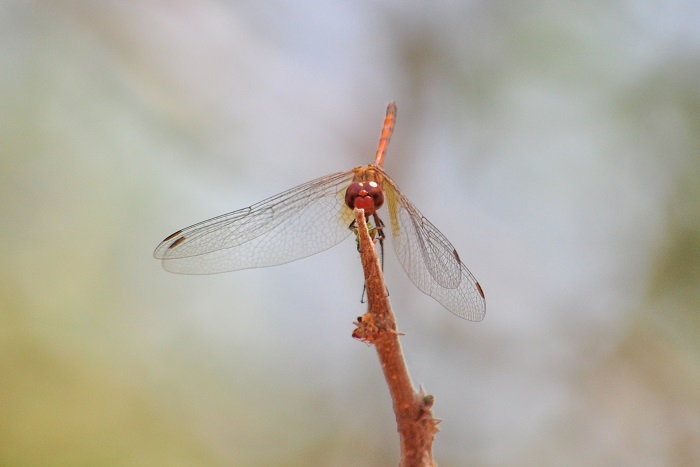
The Female Navy dropwing is readily identified by the black ‘smudged’ markings on the sides of the thorax.

Click here for more details on identification of the Navy Dropwing.

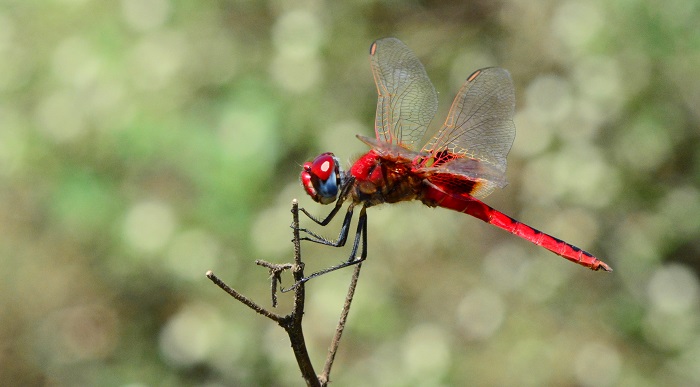
Navy Dropwing Trithemis furva – Female
Quaggaskloof Dam, Western Cape
Photo by Ryan Tippett

Habitat

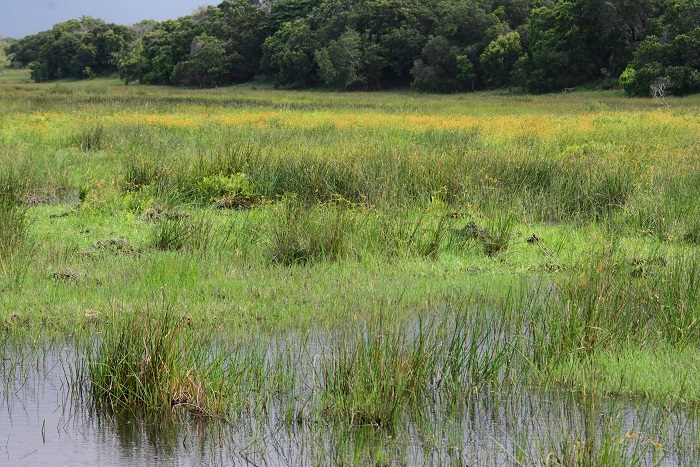
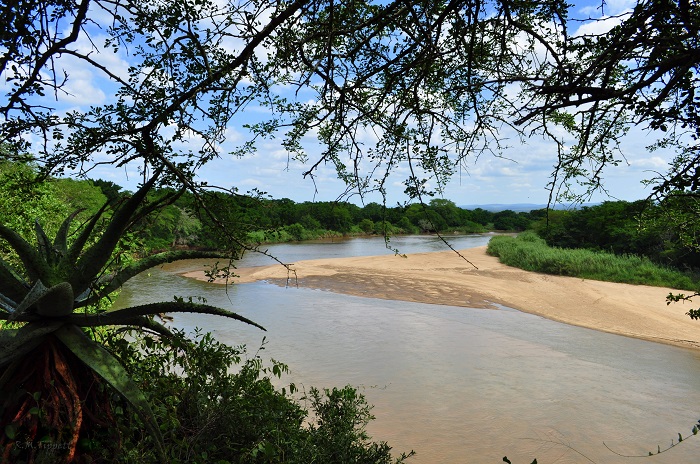
The Navy Dropwing is a species of rivers and streams. It favours stretches of shallow, flowing water with exposed rocks and fringing grass, reeds and sedge for perching on. The Navy Dropwing is less frequent along still or slow-moving sections. Occasionally also found along the verges of dams and lakes.

Habitat – Oribi Gorge Nature Reserve, KwaZulu-Natal
Photo by Ryan Tippett

Behaviour

The Navy Dropwing is a conspicuous species that perches in the open on rocks and emergent or fringing vegetation. Perches with its wings drooped forward like others in the genus. The Navy Dropwing is mostly found below 700m above sea level, but it is known to occur up to 1700m above sea level in some places.

On the wing from October to May but sometimes found all year in warmer areas.

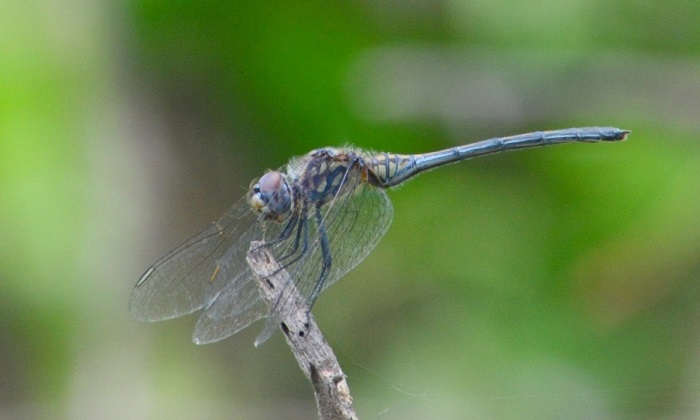
Navy Dropwing Trithemis furva – Male
Orange River near Prieska, Northern Cape
Photo by Ryan Tippett

Status and Conservation

The Navy Dropwing is a common species throughout its range. It is listed as of Least Concern in the IUCN Red List of Threatened Species.

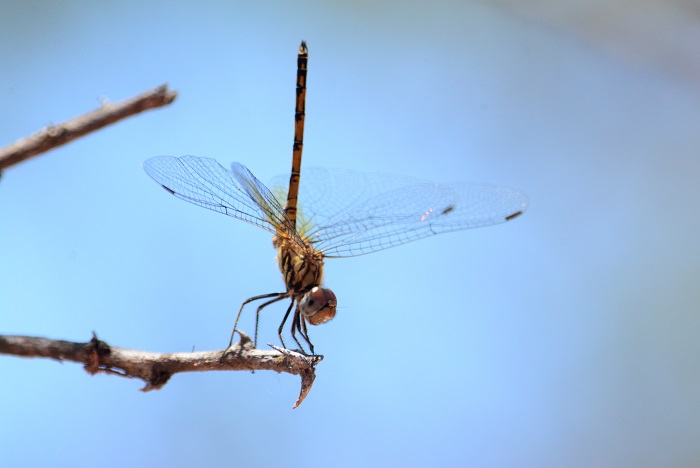
Navy Dropwing Trithemis furva – Female
Cedarberg, Western Cape
Photo by Ryan Tippett

Distribution

The Navy Dropwing is found throughout much of Southern, Central, and East Africa. It is largely absent from West and North Africa.

Trithemis furva occurs widely in South Africa. It is only absent from the central Karoo and Kalahari, likely due to the lack of perennial rivers.

Navy Dropwing Trithemis furva – Male
Palmiet Nature Reserve, KwaZulu-Natal
Photo by Ryan Tippett

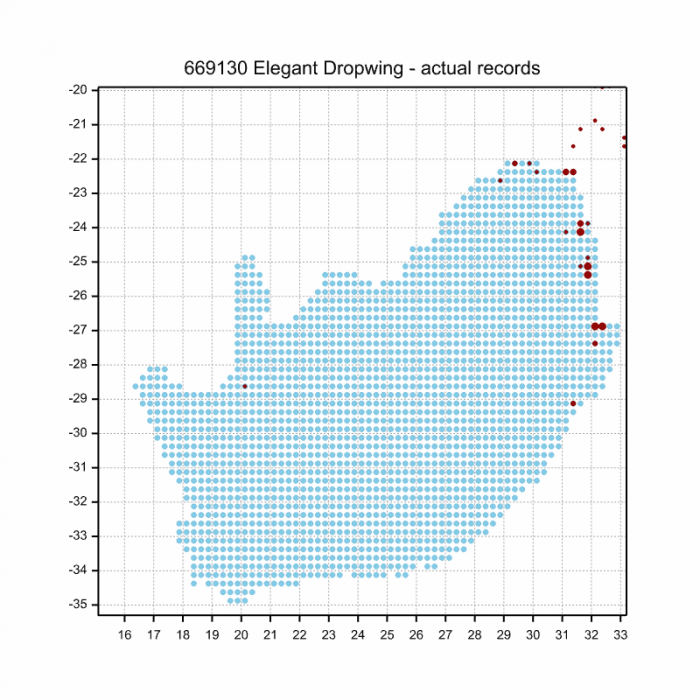
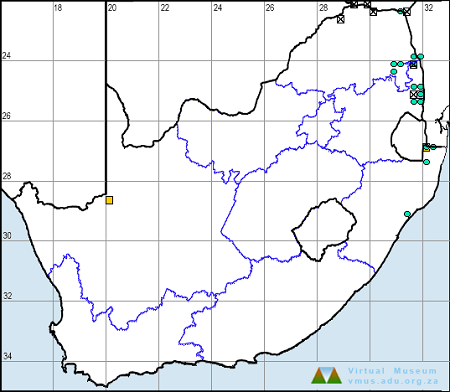
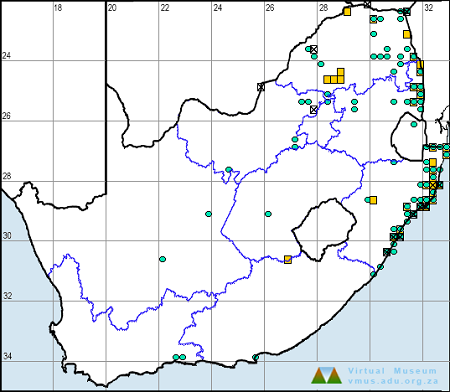
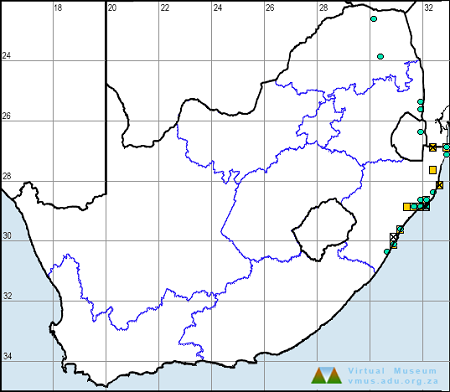
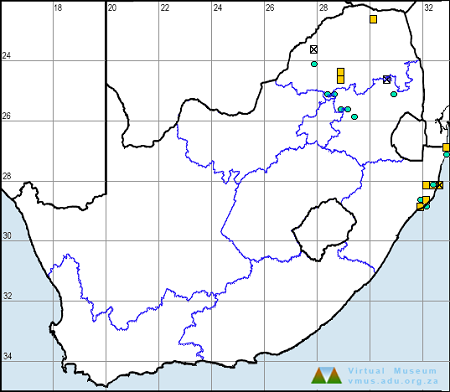
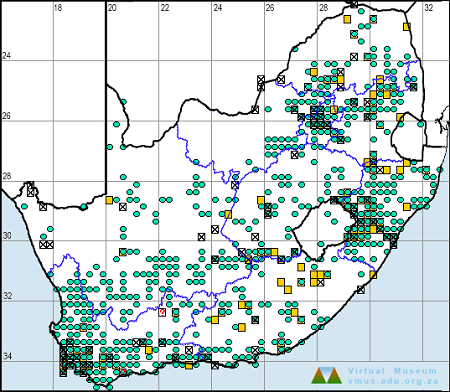
Below is a map showing the distribution of records for Navy Dropwing in the OdonataMAP database as at February 2020.

Below is a map showing the distribution of records for Navy Dropwing in the OdonataMAP database as of December 2024.
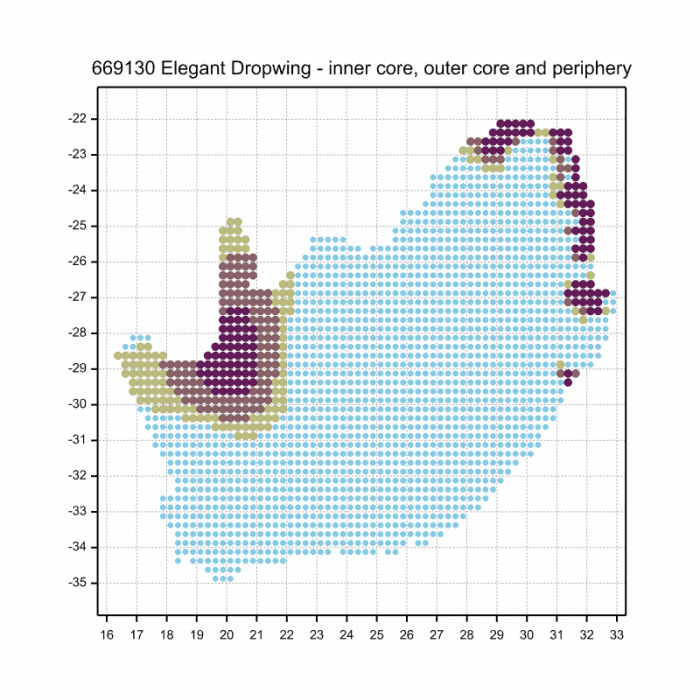
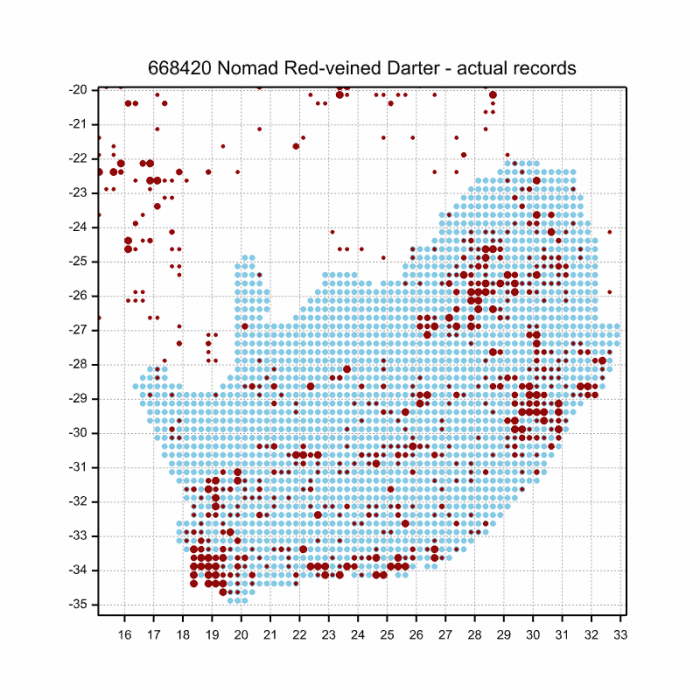
The next map below is an imputed map, produced by an interpolation algorithm, which attempts to generate a full distribution map from the partial information in the map above. This map will be improved by the submission of records to the OdonataMAP section of the Virtual Museum.
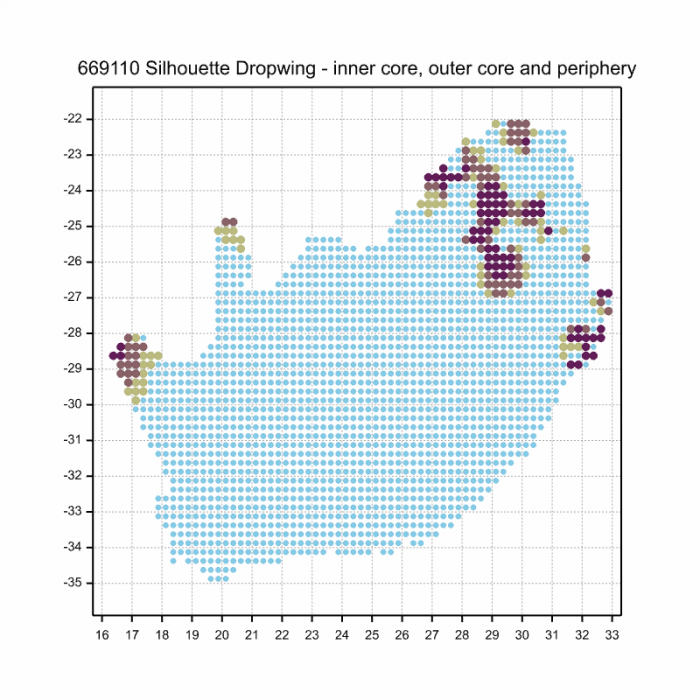
Ultimately, we will produce a series of maps for all the odonata species in the region. The current algorithm is a new algorithm. The objective is mainly to produce “smoothed” maps that could go into a field guide for odonata. This basic version of the algorithm (as mapped above) does not make use of “explanatory variables” (e.g. altitude, terrain roughness, presence of freshwater — we will be producing maps that take these variables into account soon). Currently, it only makes use of the OdonataMAP records for the species being mapped, as well as all the other records of all other species. The basic maps are “optimistic” and will generally show ranges to be larger than what they probably are.

These maps use the data in the OdonataMAP section of the Virtual Museum, and also the database assembled by the previous JRS funded project, which was led by Professor Michael Samways and Dr KD Dijkstra.

Navy Dropwing Trithemis furva – Male
Gamka River, Western Cape
Photo by Ryan Tippett

Further Resources

The use of photographs by Sharon Stanton is acknowledged. All other photographs by Ryan Tippett.

Navy Dropwing Trithemis furva Karsch, 1899

Other common names: Blouvalvlerkie (Afrikaans)

Recommended citation format: Loftie-Eaton M; Navarro R; Tippett RM; Underhill L. 2025. Navy Dropwing Trithemis furva. Biodiversity and Development Institute. Available online at https://thebdi.org/2020/04/28/navy-dropwing-trithemis-furva/

References: Tarboton, M; Tarboton, W. (2019). A Guide to the Dragonflies & Damselflies of South Africa. Struik Nature.

Samways, MJ. (2008). Dragonflies and Damselflies of South Africa. Pensoft

Samways, MJ. (2016). Manual of Freshwater Assessment for South Africa: Dragonfly Biotic Index. Suricata 2. South African National Biodiversity Institute, Pretoria

Martens, A; Suhling, F. (2007). Dragonflies and Damselflies of Namibia. Gamsberg Macmillan.

Navy Dropwing Trithemis furva – Male
Quaggaskloof Dam, Western Cape
Photo by Ryan Tippett

Similar Species

Red-veined Darter (Sympetrum fonscolombii)

Cover photo by Mark Stanton.

Find this species in the FBIS database (Freshwater Biodiversity Information System) here.

Family Libellulidae

Identification

Red-veined Darter Sympetrum fonscolombii – Male
Richards Bay, KwaZulu-Natal
Photo by Diana Russel

Small size

Length up to 40mm; Wingspan attains 66mm.

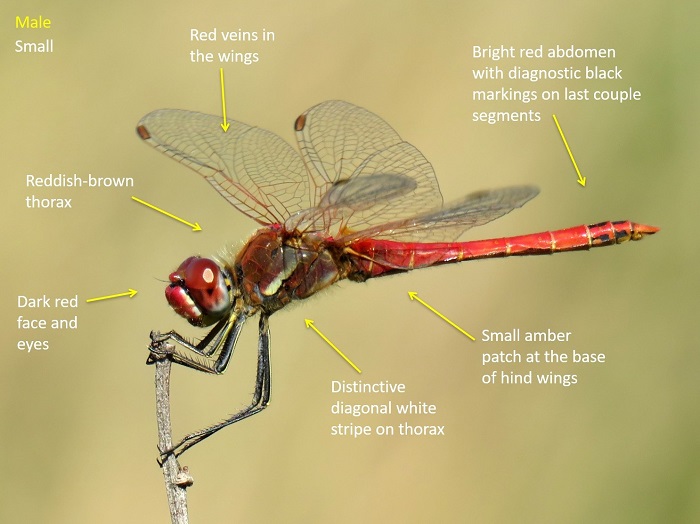
The Red-veined Darter or Nomad is easily mistaken for other smallish red dragonflies such as the Red-veined Dropwing (Trithemis arteriosa), Broad Scarlet (Crocothemis erythraea) or Little Scarlet (Crocothemis sanguinolenta). The Red-veined Darter can, however, be easily identified by the pale diagonal stripe on each side of the thorax. The small black marking on the last abdominal segments and the small number of AX veins in the forewings are additional aids in identification.

Female Red-veined Darters are pale browni to yellowish. They are also readily identified by the two broad, diagonal pale markings on the thorax sides. These pale markings are often thinly outlined in black. Females also show the small black markings on the last few abdominal segments, and the reduced number of AX veins in the forewings.

Click here for more details on identification.

Red-veined Darter Sympetrum fonscolombii – Female
Near Hluhluwe, KwaZulu-Natal
Photo by Ryan Tippett

Habitat

The Red-veined Darter breeds in a wide range of habitats including seasonal and permanent waters. It inhabits pans, marshes, lakes, ponds, dams, and rivers. It is most numerous in ephemeral habitats. In arid regions, it readily occupies livestock drinking troughs and cement water reservoirs. The Red-veined Darter is quickly able to recolonise dry areas after rainfall.

Habitat – Mkuze Game Reserve, KwaZulu-Natal
Photo by Ryan Tippett

Behaviour

The Red-veined Darter hunts from a perch with a fast, direct flight, frequently returning to the same perch. They tend to be somewhat gregarious when present in good numbers, and both sexes occur in the same vicinity. The Red-veined Darter flies year-round in some areas, although it is less numerous in the cold winter months. In many locations, especially those with high species diversity, the Red-veined Darter is an early and/or late season specialist. This is likely an adaptation to avoid competition with other species.

The Red-veined Darter flies year-round in warmer regions, but is mainly an early Summer species (September to January) in more temperate regions.

Red-veined Darter Sympetrum fonscolombii – Male
Near Williston, Northern Cape
Photo by Ryan Tippett

Status and Conservation

The Red-veined Darter is an abundant and widespread species. It is listed as of Least Concern in the IUCN Red List of Threatened Species. The Red-veined Darter is a very adaptable species that readily utilises disturbed and man-made habitats.

Red-veined Darter Sympetrum fonscolombii – Female
Near Vosburg, Northern Cape
Photo by Ryan Tippett

Distribution

Sympetrum fonscolombii is very widely distributed, being found throughout most of Africa, Europe, the Middle East and much of Asia. In Africa, it is most common in the drier regions of northern, eastern and particularly southern Africa where it can be very common. The Red-veined Darter is present throughout southern Africa.

Red-veined Darter Sympetrum fonscolombii – Male
Near Hluhluwe, KwaZulu-Natal
Photo by Ryan Tippett

Below is a map showing the distribution of records for Red-veined Darter in the OdonataMAP database as at February 2020.

Below is a map showing the distribution of records for Red-veined Darter in the OdonataMAP database as of December 2024.

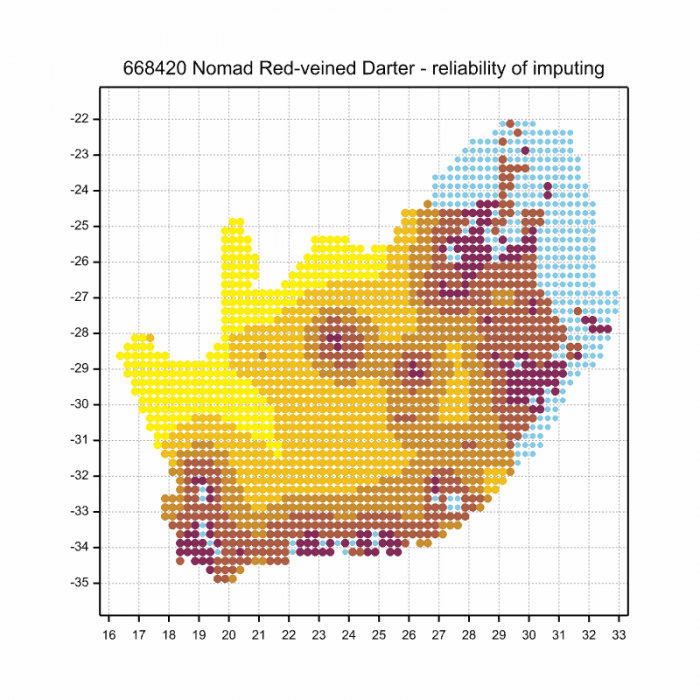
The next map below is an imputed map, produced by an interpolation algorithm, which attempts to generate a full distribution map from the partial information in the map above. This map will be improved by the submission of records to the OdonataMAP section of the Virtual Museum.
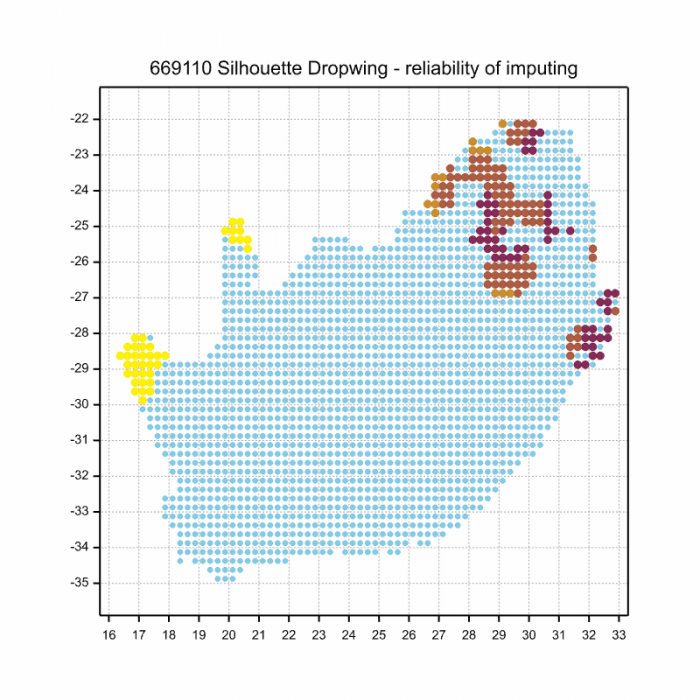
Ultimately, we will produce a series of maps for all the odonata species in the region. The current algorithm is a new algorithm. The objective is mainly to produce “smoothed” maps that could go into a field guide for odonata. This basic version of the algorithm (as mapped above) does not make use of “explanatory variables” (e.g. altitude, terrain roughness, presence of freshwater — we will be producing maps that take these variables into account soon). Currently, it only makes use of the OdonataMAP records for the species being mapped, as well as all the other records of all other species. The basic maps are “optimistic” and will generally show ranges to be larger than what they probably are.

These maps use the data in the OdonataMAP section of the Virtual Museum, and also the database assembled by the previous JRS funded project, which was led by Professor Michael Samways and Dr KD Dijkstra.
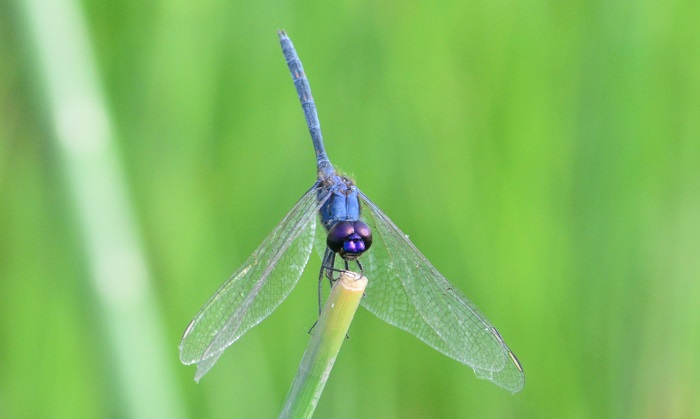
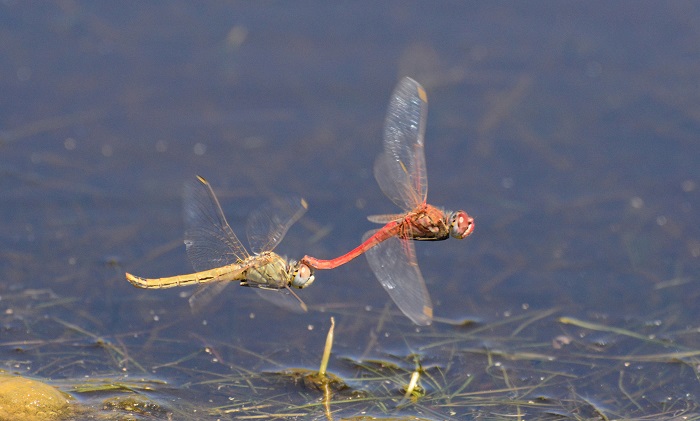
Red-veined Darter Sympetrum fonscolombii – Pair
Near Hluhluwe, KwaZulu-Natal
Photo by Ryan Tippett

Further Resources

The use of photographs by Diana Russell and Mark Stanton is acknowledged. All other photographs by Ryan Tippett.

Red-veined Darter Sympetrum fonscolombi (Selys, 1840)

Other common names: Nomad (Alt. English); Swerwertjie (Afrikaans)

Recommended citation format: Loftie-Eaton M; Navarro R; Tippett RM; Underhill L. 2025. Red-veined Darter Sympetrum fonscolombi. Biodiversity and Development Institute. Available online at https://thebdi.org/2020/04/28/red-veined-darter-sympetrum-fonscolombii/

References: Tarboton, M; Tarboton, W. (2019). A Guide to the Dragonflies & Damselflies of South Africa. Struik Nature.

Samways, MJ. (2008). Dragonflies and Damselflies of South Africa. Pensoft

Samways, MJ. (2016). Manual of Freshwater Assessment for South Africa: Dragonfly Biotic Index. Suricata 2. South African National Biodiversity Institute, Pretoria

Martens, A; Suhling, F. (2007). Dragonflies and Damselflies of Namibia. Gamsberg Macmillan.
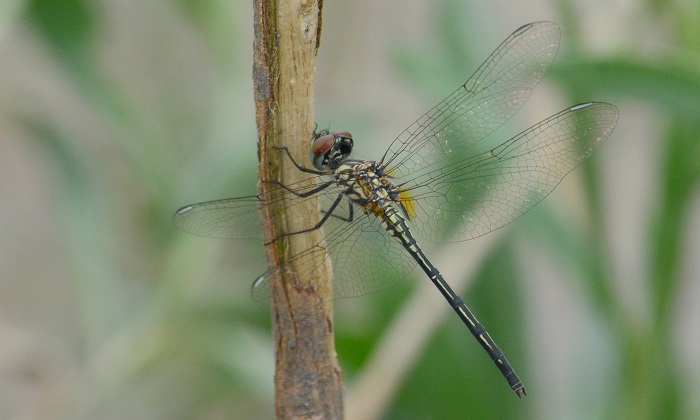
Red-veined Darter Sympetrum fonscolombii – Immature male
Near Hluhluwe, KwaZulu-Natal
Photo by Ryan Tippett

Similar Species

Elegant Dropwing (Trithemis werneri)

Cover photo by Eugene Troskie.

Find the Elegant Dropwing in the FBIS database (Freshwater Biodiversity Information System) here.

Family Libellulidae

Identification

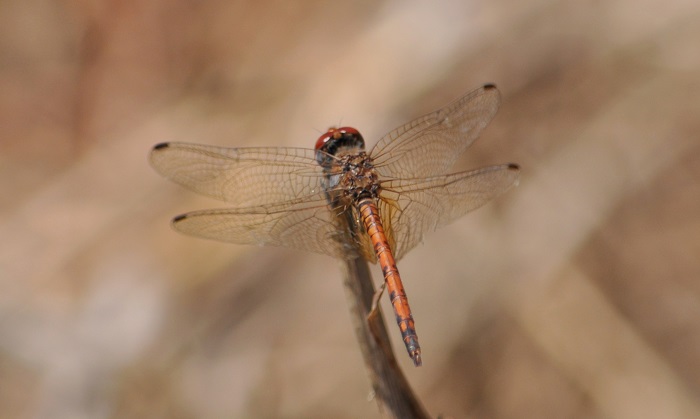
Elegant Dropwing Trithemis werneri – Male
Ndumo Game Reserve, KwaZulu-Natal
Photo by Ryan Tippett

Small size

Length up to 40mm; Wingspan attains 66mm.

Male Elegant Dropwings are readily identified. The orange to mustard-yellow colouration with black markings and large amber hindwing patches are diagnostic.

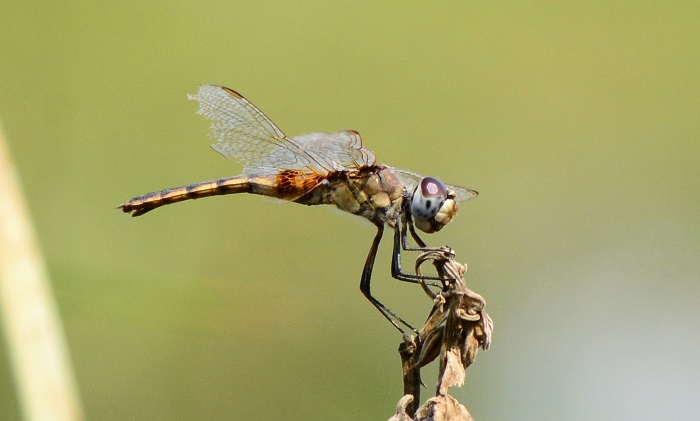
Females are less distinctive and are most similar to Trithemis annulata (Violet Dropwing) and Trithemis pluvialis (Russet Dropwing). They can be identified based on abdomen and thorax patterns, and the amber patches at the base of the hind wings. Some females also have small amber patches in the outer wings.

Click here for more details on identification.

Elegant Dropwing Trithemis werneri – Female
Ndumo Game Reserve, KwaZulu-Natal
Photo by Ryan Tippett

Habitat

Large tropical and subtropical rivers in hot savanna regions are the natural habitat of the Elegant Dropwing. It inhabits well-wooded areas with large trees along the upper banks. The Elegant Dropwing is frequently found along river sections with steep banks.

Habitat – Usutu River, Ndumo Game Reserve, KwaZulu-Natal
Photo by Ryan Tippett

Behaviour

The Elegant Dropwing is most often found perched on trees and large bushes away from water, frequently above the riverbanks. Individuals may be found more than 100m from the river. Both sexes occur in the same vicinity. The Elegant Dropwing typically perches high up in the outer canopy of riverine trees where it is inconspicuous. It is known to ‘skypoint’ from the tips of branches during the heat of the day. The Elegant Dropwing is seldom encountered at the water’s edge.

Elegant Dropwing Trithemis werneri – Male
Ndumo Game Reserve, KwaZulu-Natal
Photo by Ryan Tippett

Status and Conservation

Trithemis werneri is uncommon and very localised in South Africa. This species is only known from undisturbed habitats and is not tolerant of habitat degradation. It is listed as of Least Concern in the IUCN Red List of Threatened Species. The South African population, however, is considered Near Threatened due to its marginal occurrence and dependence on pristine habitats.

Elegant Dropwing Trithemis werneri – Male
Ndumo Game Reserve, KwaZulu-Natal
Photo by Ryan Tippett

Distribution

The Elegant Dropwing is sparsely distributed and is found mostly in eastern and southern Africa. It occurs from southern Sudan down to extreme northern KwaZulu-Natal in South Africa. There are also outlying populations in Angola and north-western Namibia.

Elegant Dropwing Trithemis werneri – Female
Ndumo Game Reserve, KwaZulu-Natal
Photo by Ryan Tippett

Below is a map showing the distribution of records in South Africa for Trithemis werneri. Taken from the OdonataMAP database as at February 2020.

Below is a map showing the distribution of records in South Africa for Trithemis werneri. Taken from the OdonataMAP database as of December 2024.

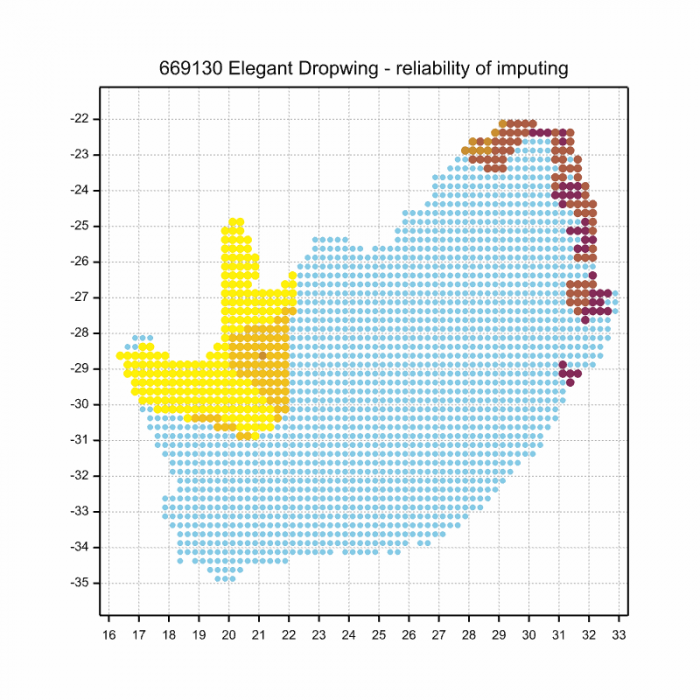
The next map below is an imputed map, produced by an interpolation algorithm, which attempts to generate a full distribution map from the partial information in the map above. This map will be improved by the submission of records to the OdonataMAP section of the Virtual Museum.

Ultimately, we will produce a series of maps for all the odonata species in the region. The current algorithm is a new algorithm. The objective is mainly to produce “smoothed” maps that could go into a field guide for odonata. This basic version of the algorithm (as mapped above) does not make use of “explanatory variables” (e.g. altitude, terrain roughness, presence of freshwater — we will be producing maps that take these variables into account soon). Currently, it only makes use of the OdonataMAP records for the species being mapped, as well as all the other records of all other species. The basic maps are “optimistic” and will generally show ranges to be larger than what they probably are.

These maps use the data in the OdonataMAP section of the Virtual Museum, and also the database assembled by the previous JRS funded project, which was led by Professor Michael Samways and Dr KD Dijkstra.

Elegant Dropwing Trithemis werneri – Male
Ndumo Game Reserve, KwaZulu-Natal
Photo by Ryan Tippett

Further Resources

The use of photographs by Eugene Troskie is acknowledged.

Elegant Dropwing Trithemis werneri Ris, 1912

Other common names: Werner’s Dropwing (Alt. English); Siervalvlerkie (Afrikaans).

Recommended citation format: Loftie-Eaton M; Navarro R; Tippett RM; Underhill L. 2025. Elegant Dropwing Trithemis werneri.  Biodiversity and Development Institute. Available online at https://thebdi.org/2020/04/24/elegant-dropwing-trithemis-werneri/

References: Tarboton, M; Tarboton, W. (2019). A Guide to the Dragonflies & Damselflies of South Africa. Struik Nature.

Samways, MJ. (2008). Dragonflies and Damselflies of South Africa. Pensoft

Samways, MJ. (2016). Manual of Freshwater Assessment for South Africa: Dragonfly Biotic Index.Suricata 2. South African National Biodiversity Institute, Pretoria

Martens, A; Suhling, F. (2007). Dragonflies and Damselflies of Namibia. Gamsberg Macmillan.

Elegant Dropwing Trithemis werneri – Male
Ndumo Game Reserve, KwaZulu-Natal
Photo by Ryan Tippett

Similar Species

Red Basker (Urothemis assignata)

Cover photo by Georg Jacobs.

Find the Red Basker in the FBIS database (Freshwater Biodiversity Information System) here.

Family Libellulidae

Identification

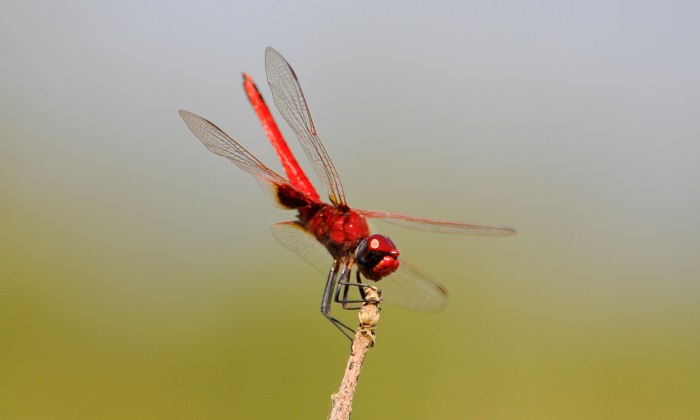
Red Basker Urothemis assignata – Male
Mpempe Pan, KwaZulu-Natal
Photo by Ryan Tippett

Medium sized

Length up to 44mm; Wingspan reaches 75mm.

The Red Basker is deep red species with conspicuous dark patches at the base of the hind wings. Males are easily confused with Urothemis luciana (St. Lucia Basker), but are smaller and less robust. Additionally the Red Basker shows less extensive amber patches at the base of the forewings. This amber is in fact, often absent in U. assignata. Both sexes of Urothemis assignata have 7 Ax veins in the forewing (Urothemis luciana has 8 or 9 Ax veins in the forewing).

Females are dull rufous in colouration. They can be mistaken for the females of Urothemis luciana (St. Lucia Basker) and Urothemis edwardsii (Blue Basker). They can be recognised by the number of Ax-veins in the forewing and by the shape of the dark patches in the hind wings.

Click here for more details on identification of the Red Basker.

Red Basker Urothemis assignata – Female
Muzi Pan, KwaZulu-Natal
Photo by Ryan Tippett

Habitat

The Red Basker’s natural habitats are freshwater lakes, pans, dams, marshes, and slow-flowing sections of rivers. They prefer still-water habitats with abundant plant growth like reeds and sedges. Non-breeding individuals can often be found in open grassy areas away from water.

Habitat – Mkuze Game Reserve, KwaZulu-Natal
Photo by Ryan Tippett

Behaviour

Red Baskers are perch hunters and spend as much time perched as they do darting off to intercept prey, or to chase off a rival. Urothemis assignata has a powerful, swift flight. They like to sit in open, sunny positions, conspicuously perched on top of a reed or bush, etc. During the heat of the day, they can often be seen in the obelisk position, pointing their abdomens at the sun to reduce the amount of direct sunlight on their bodies. Females are most often seen a short distance away from the water.

The Red Basker is on the wing from October to May in South Africa.

Red Basker Urothemis assignata – Male
Kosi Bay, iSimangaliso Wetland Park, KwaZulu-Natal
Photo by Ryan Tippett

Status and Conservation

The Red Basker is a locally common species. It is listed as of Least Concern in the IUCN Red List of Threatened Species. The Red Basker is fairly resistant to habitat degradation and commonly occupies man-made habitats, providing its habitat requirements are met.

Red Basker Urothemis assignata – Male
Carnarvon district, Northern Cape
Photo by Ryan Tippett

Distribution

The Red Basker is widespread throughout much of Sub-Saharan Africa. In South Africa, it is most abundant in the wetter savanna regions of the north and east. However, vagrants are liable to turn up almost anywhere.

Below is a map showing the distribution of records for Red Basker in the OdonataMAP database as at February 2020.

Below is a map showing the distribution of records for Red Basker in the OdonataMAP database as of December 2024.

The next map below is an imputed map, produced by an interpolation algorithm, which attempts to generate a full distribution map from the partial information in the map above. This map will be improved by the submission of records to the OdonataMAP section of the Virtual Museum.

Ultimately, we will produce a series of maps for all the odonata species in the region. The current algorithm is a new algorithm. The objective is mainly to produce “smoothed” maps that could go into a field guide for odonata. This basic version of the algorithm (as mapped above) does not make use of “explanatory variables” (e.g. altitude, terrain roughness, presence of freshwater — we will be producing maps that take these variables into account soon). Currently, it only makes use of the OdonataMAP records for the species being mapped, as well as all the other records of all other species. The basic maps are “optimistic” and will generally show ranges to be larger than what they probably are.

These maps use the data in the OdonataMAP section of the Virtual Museum, and also the database assembled by the previous JRS funded project, which was led by Professor Michael Samways and Dr KD Dijkstra.

Red Basker Urothemis assignata – Male
Kosi Bay, iSimangaliso Wetland Park, KwaZulu-Natal
Photo by Ryan Tippett

Further Resources

The use of photographs by Georg Jacobs is acknowledged. Other photographs by Ryan Tippett.

Red Basker Urothemis assignata (Selys, 1872)

Other common names: Rooisonvangertjie (Afrikaans)

Recommended citation format: Loftie-Eaton M; Navarro R; Tippett RM; Underhill L. 2025. Red Basker Urothemis assignata. Biodiversity and Development Institute. Available online at https://thebdi.org/2020/04/24/red-basker-urothemis-assignata/

References: Tarboton, M; Tarboton, W. (2019). A Guide to the Dragonflies & Damselflies of South Africa. Struik Nature.

Samways, MJ. (2008). Dragonflies and Damselflies of South Africa. Pensoft

Samways, MJ. (2016). Manual of Freshwater Assessment for South Africa: Dragonfly Biotic Index. Suricata 2. South African National Biodiversity Institute, Pretoria

Martens, A; Suhling, F. (2007). Dragonflies and Damselflies of Namibia. Gamsberg Macmillan.

Red Basker Urothemis assignata – Male
Mpempe Pan, KwaZulu-Natal
Photo by Ryan Tippett

Similar Species

Rock Malachite (Ecchlorolestes peringueyi)

Cover photo by Felicity Grundlingh.

Find the Rock Malachite in the FBIS database (Freshwater Biodiversity Information System) here.

Family Synlestidae

Identification

Rock Malachite Ecchlorolestes peringueyi – Male
Jonkershoek Nature Reserve, Western Cape
Photo by Desire Darling

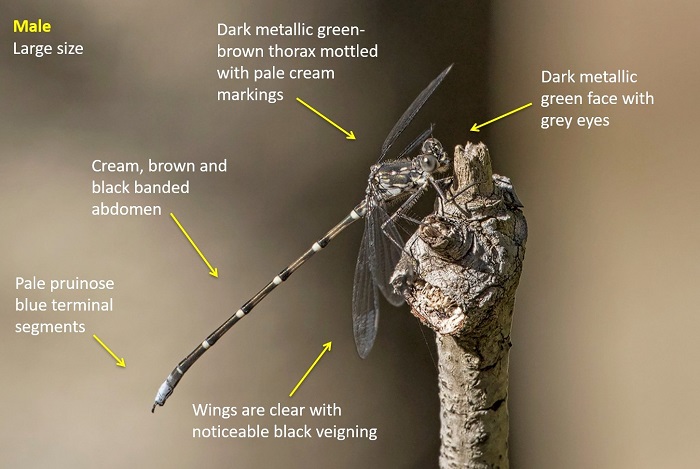
Large size

Length up to 52mm; Wingspan attains 65mm.

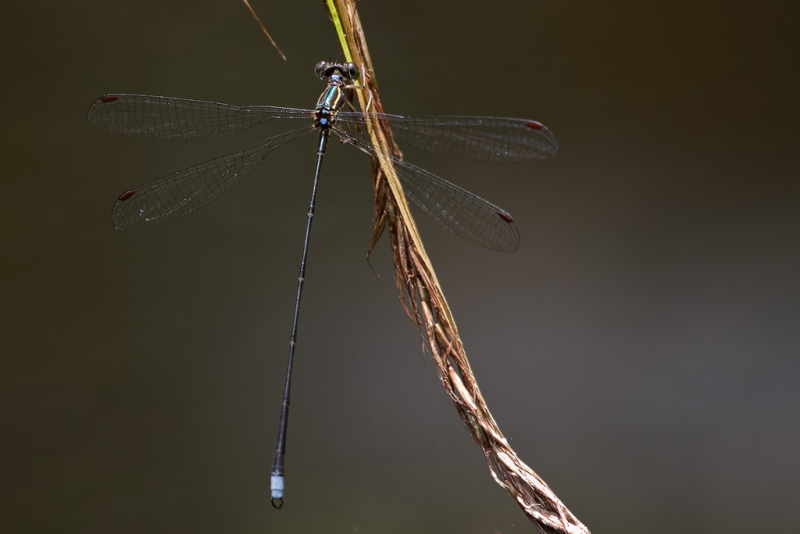
The Rock Malachite is a distinctive and unmistakable species. It is more robust than other malachites. This combined with its cryptic, mottled colouration and specialised habitat render the Rock Malachite easy to identify.

It is closely related to Ecchlorolestes nylephtha (Queen Malachite), but the two species are not known to co-occur.

The sexes are closely similar but males tend to be more slender than females.

Click here for more details on identification.

Habitat

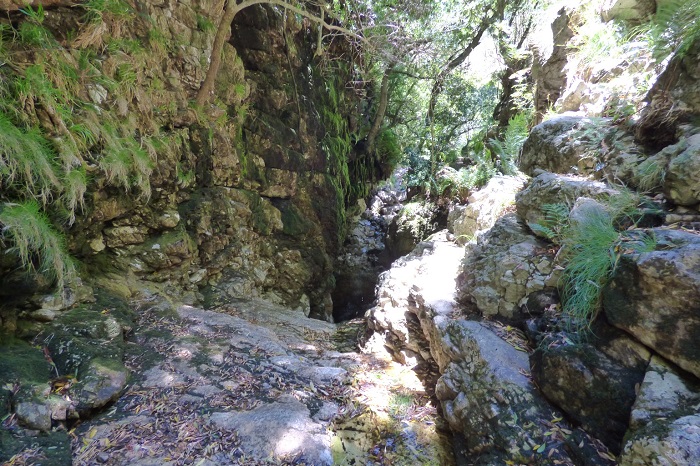
The Rock Malachite is restricted to headwater streams and rivers in mountainous terrain. It requires clear, running water with pools and large boulders or exposed rock-faces, festooned with lichen on which to perch.

Habitat – Jonkershoek Nature Reserve, Western Cape
Photo by Corne Rautenbach

Behaviour

The Rock Malachite is well camouflaged and easily overlooked, as it sits against a rock surface adjacent to streams. It occasionally perches on twigs over the water. The Rock Malachite is fairly reluctant to fly as it relies on cryptic colouration to avoid detection.

On the wing primarily from February to May (See Phenology below).

Status and Conservation

The Rock Malachite is uncommon and very localised. It is listed as Near Threatened in the IUCN Red List of Threatened Species. The Rock Malachite is not tolerant of damage to its habitat and only occurs at pristine sites.

Distribution

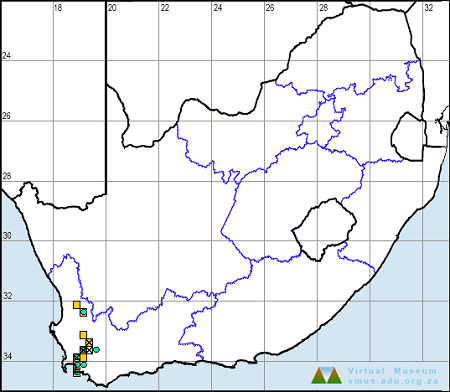
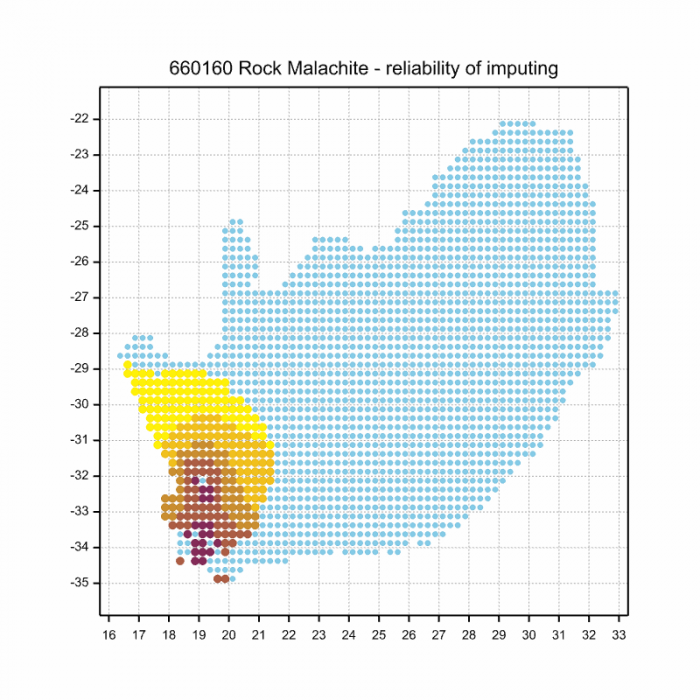
The Rock Malachite is endemic to the Western Cape province of South Africa, where it occurs from Kogelberg in the South to the Cedarberg in the North.

Below is a map showing the distribution of records for Rock Malachite in the OdonataMAP database as at February 2020.

Below is a map showing the distribution of records for Rock Malachite in the OdonataMAP database as of December 2024.

The next map below is an imputed map, produced by an interpolation algorithm, which attempts to generate a full distribution map from the partial information in the map above. This map will be improved by the submission of records to the OdonataMAP section of the Virtual Museum.

Ultimately, we will produce a series of maps for all the odonata species in the region. The current algorithm is a new algorithm. The objective is mainly to produce “smoothed” maps that could go into a field guide for odonata. This basic version of the algorithm (as mapped above) does not make use of “explanatory variables” (e.g. altitude, terrain roughness, presence of freshwater — we will be producing maps that take these variables into account soon). Currently, it only makes use of the OdonataMAP records for the species being mapped, as well as all the other records of all other species. The basic maps are “optimistic” and will generally show ranges to be larger than what they probably are.

These maps use the data in the OdonataMAP section of the Virtual Museum, and also the database assembled by the previous JRS funded project, which was led by Professor Michael Samways and Dr KD Dijkstra.

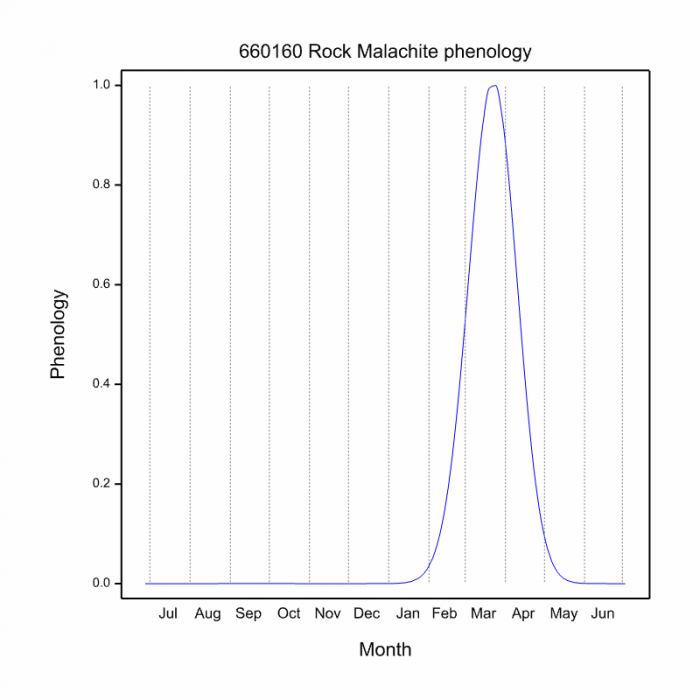
The next two graphs shows how the occurrence of Rock Malachites varies within the year, i.e. the phenology. There are only 28 records in the database for this species, so these results need to be treated as tentative. The first plot shows the number of records in each pentade, five-day periods, which start on 1 July and end on 30 June the following year. The maximum number of records in a pentade is five, in mid-March. The blue line is generated by a smoother, an algorithm which aims to separate the “signal” from the “noise”, and shows the pattern of seasonality for this species. The second plot shows only the blue line, and it is scaled to lie between zero and one, for easy comparison between species.

Phenology

Tentatively (because the sample size is only 28), this phenology plot shows that the Rock Malachite is in flight for a relatively short period in late-summer, from February to April. The peak of the flight period appears to be in March. The peak appears to be quite sharp, but this might be a consequence of the small sample size.

To improve the quality of the phenology, a lot more records of this species are needed.

Further Resources

The use of photographs by Corne Rautenbach, Desire DarlingFelicity Grundlingh is acknowledged.

Rock Malachite Ecchlorolestes peringueyi (Ris, 1921)

Other Common Names: Marbled Malachite (Alt. English); Rotsmalagiet (Afrikaans).

Recommended citation format: Loftie-Eaton M; Navarro R; Tippett RM; Underhill L. 2025. Rock Malachite Ecchlorolestes peringueyi. Biodiversity and Development Institute. Available online at https://thebdi.org/2020/04/23/rock-malachite-ecchlorolestes-peringueyi/

References: Tarboton, M; Tarboton, W. (2019). A Guide to the Dragonflies & Damselflies of South Africa. Struik Nature.

Samways, MJ. (2008). Dragonflies and Damselflies of South Africa. Pensoft

Samways, MJ. (2016). Manual of Freshwater Assessment for South Africa: Dragonfly Biotic Index. Suricata 2. South African National Biodiversity Institute, Pretoria

Similar Species

Queen Malachite (Ecchlorolestes nylephtha)

Cover photo by Desire Darling.

Find the Queen Malachite in the FBIS database (Freshwater Biodiversity Information System) here.

Family Synlestidae

Identification

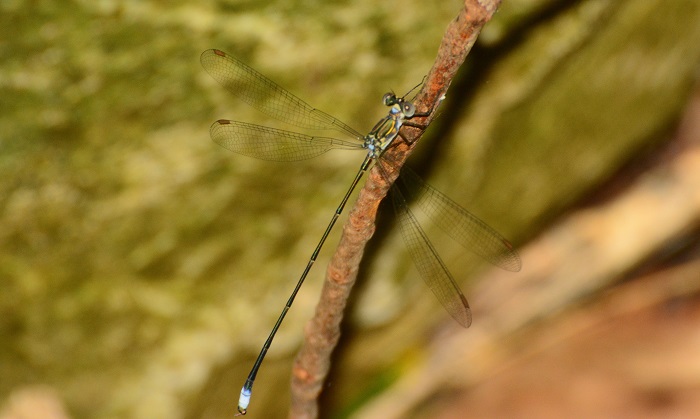
Queen Malachite Ecchlorolestes nylephtha – Male
Storms River, Eastern Cape
Photo by Gregg Darling

Large size

Length up to 55mm; Wingspan attains 61mm.

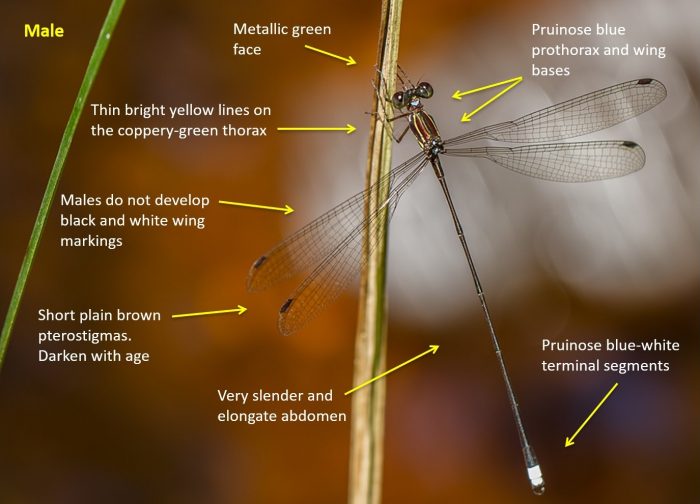
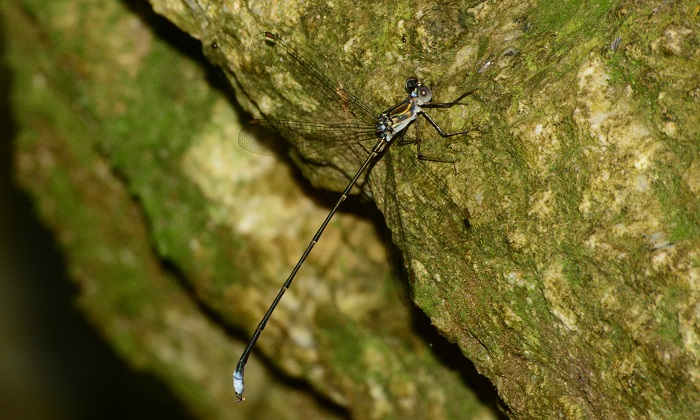
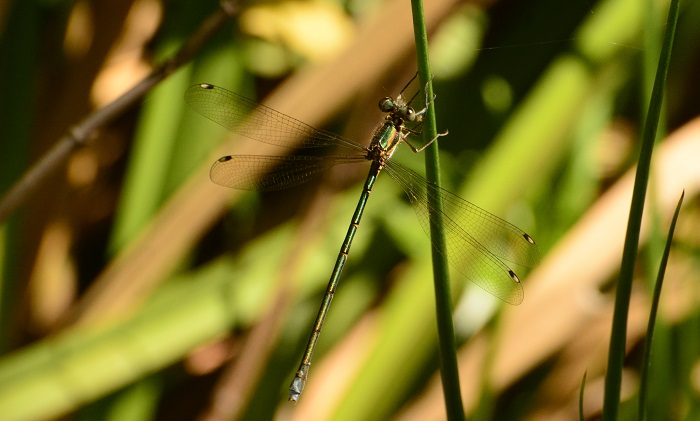
The sexes are similar. Adults are dull metallic green when young turning slightly bronzy with age. They have a distinct pale blue-grey pruinescent ‘collar’ on the neck and two blue-grey spots between the wings. The face is dark metallic green with yellow markings. The thorax is dull metallic green becoming bronze-brown with age. The abdomen is dark brownish-green with a pale, narrow ring at the start of each segment. Females are duller and lack the dark metallic green face of the males. Females also have a broader abdomen and are not as elongated in appearance.

Queen Malachite Ecchlorolestes nylephtha Female
Marloth Nature Reserve, Western Cape
Photo by Ryan Tippett

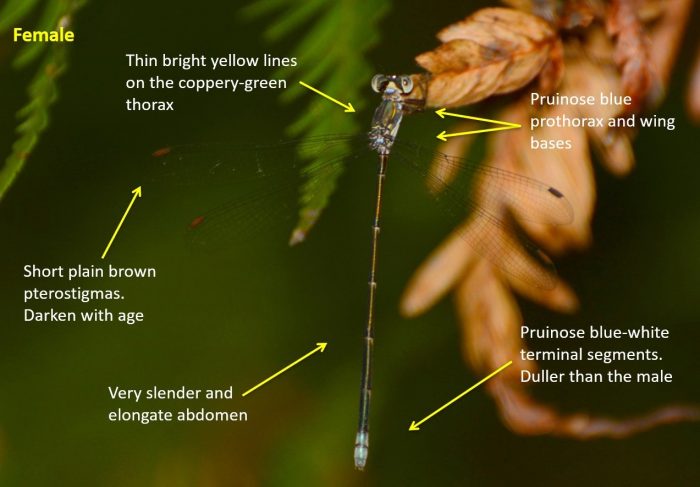
Within its restricted habitat and distribution, the Queen Malachite is only likely to be mistaken for an un-banded male Forest Malachite (Chlorolestes tessellatus) or non-pruinose White Malachite (Chlorolestes umbratus). The Queen Malachite is similar in size to Chlorolestes tessellatus but is more slender in appearance. The Queen Malachite can be further differentiated by having short, plain pterostigmas (not bi-coloured), and a pruinose blue collar (prothorax) and wing bases. Readily differentiated from male Chlorolestes umbratus, as that species is noticeably smaller and lacks the pruinose blue prothorax and wing bases.

The Queen Malachite is not known to co-occur with the closely related Rock Malachite (Ecchlorolestes peringueyi).

Click here fore more details on identification.

Habitat

Habitat – Milwood Creek, Western Cape
Photo by Sharon Stanton

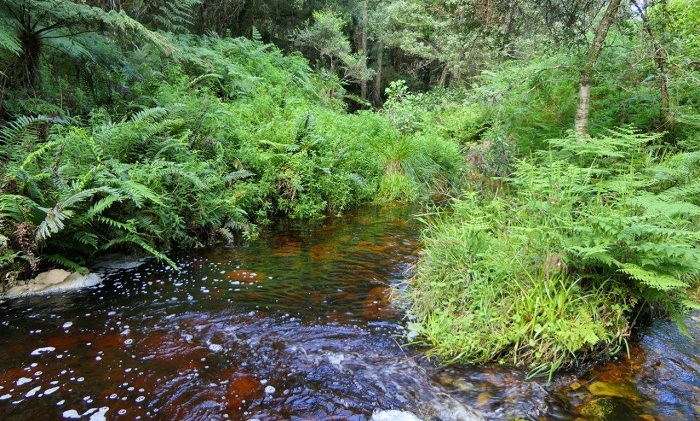
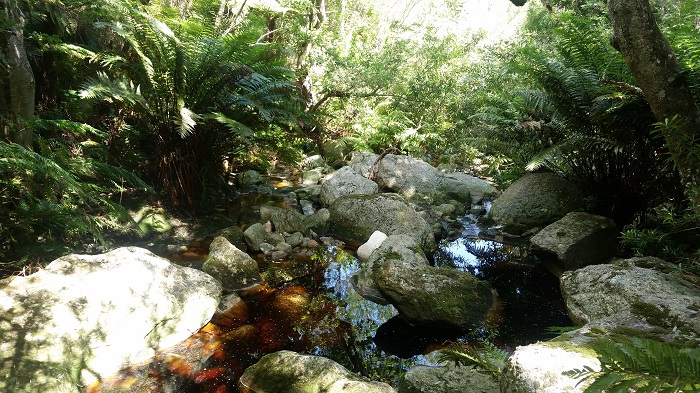
The Queen Malachite has rather specific habitat needs. It inhabits closed-canopy indigenous forests, where it is found along shady, fern-lined streams. Requires clear, flowing water with pools and a rich growth of stream-side plants. The Queen Malachite is often found where there are large, moss-covered rocks and boulders. It is found from sea level up to altitudes of around 500m.

Habitat – Marloth Nature Reserve, Swellendam
Photo by Ryan Tippett

Behaviour

Ecchlorolestes nylephtha is a shade-loving species. It is unobtrusive and easily overlooked, spending long periods at rest. The Queen Malachite is most often seen hanging vertically from a perch over the water with wings outstretched. They also frequently perch on the side of large streamside boulders. Both sexes occur in the same area but females are even less conspicuous.

Queen Malachites are most active from November to May (see Phenology below).

Queen Malachite Ecchlorolestes nylephtha Male
Marloth Nature Reserve, Western Cape
Photo by Ryan Tippett

Status and Conservation

The Queen Malachite is a common but highly localised endemic. Listed as Near Threatened in the IUCN Red List of Threatened Species. The loss of its natural forest habitat is a potential threat to the species, but populations are currently thought to be stable. The Queen Malachite is only known from pristine habitats and is unlikely to tolerate habitat degradation.

Queen Malachite Ecchlorolestes nylephtha Freshly emerged teneral.
Marloth Nature Reserve, Western Cape
Photo by Ryan Tippett

Distribution

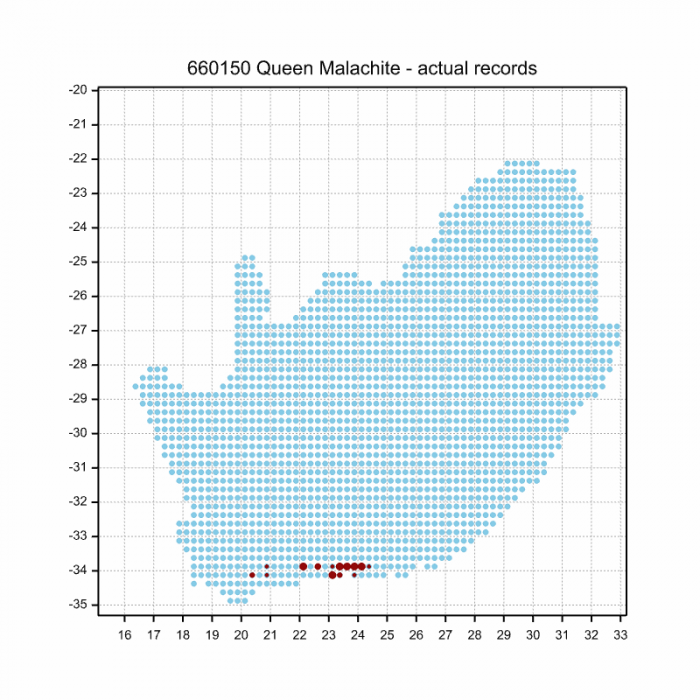
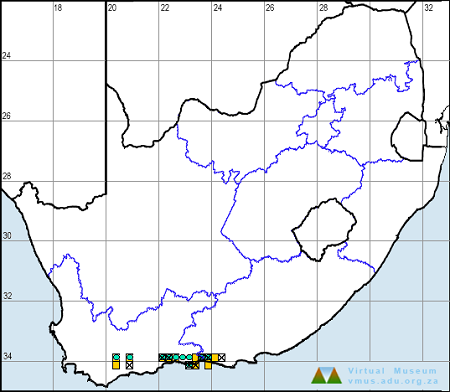
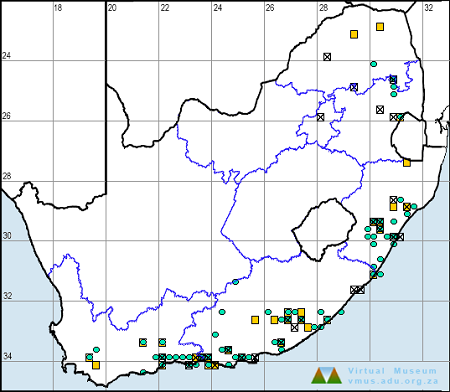
The Queen Malachite is endemic to South Africa, where it is known only from the Eastern and Western Cape provinces. Its distribution extends from near Swellendam in the west to near Kareedouw at the easternmost point in its range.

Below is a map showing the distribution of records for Queen Malachite in the OdonataMAP database as at February 2020.

Below is a map showing the distribution of records for Queen Malachite in the OdonataMAP database as at December 2024.

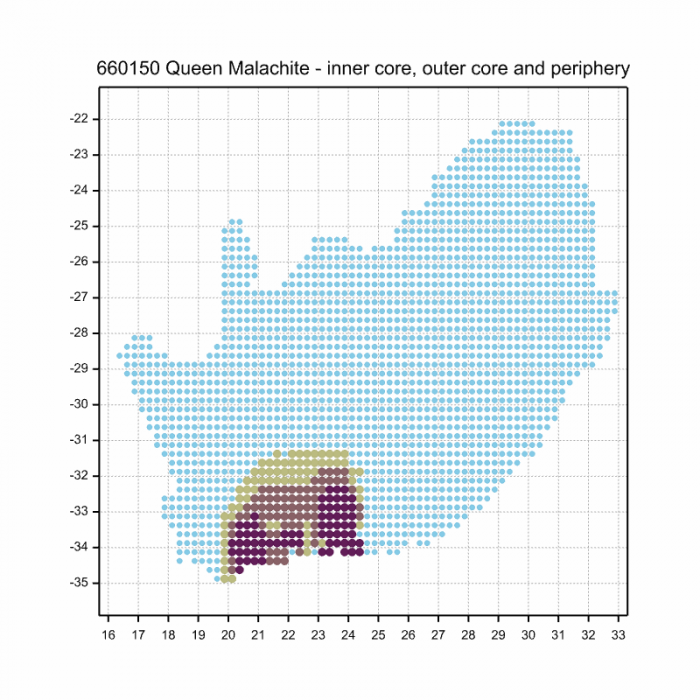
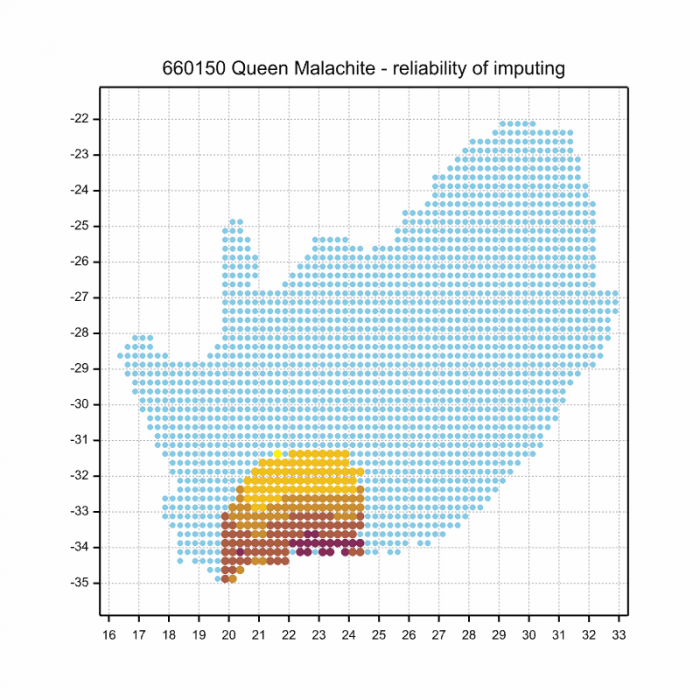
The next map below is an imputed map, produced by an interpolation algorithm, which attempts to generate a full distribution map from the partial information in the map above. This map will be improved by the submission of records to the OdonataMAP section of the Virtual Museum.

Ultimately, we will produce a series of maps for all the odonata species in the region. The current algorithm is a new algorithm. The objective is mainly to produce “smoothed” maps that could go into a field guide for odonata. This basic version of the algorithm (as mapped above) does not make use of “explanatory variables” (e.g. altitude, terrain roughness, presence of freshwater — we will be producing maps that take these variables into account soon). Currently, it only makes use of the OdonataMAP records for the species being mapped, as well as all the other records of all other species. The basic maps are “optimistic” and will generally show ranges to be larger than what they probably are.

These maps use the data in the OdonataMAP section of the Virtual Museum, and also the database assembled by the previous JRS funded project, which was led by Professor Michael Samways and Dr KD Dijkstra.

Phenology

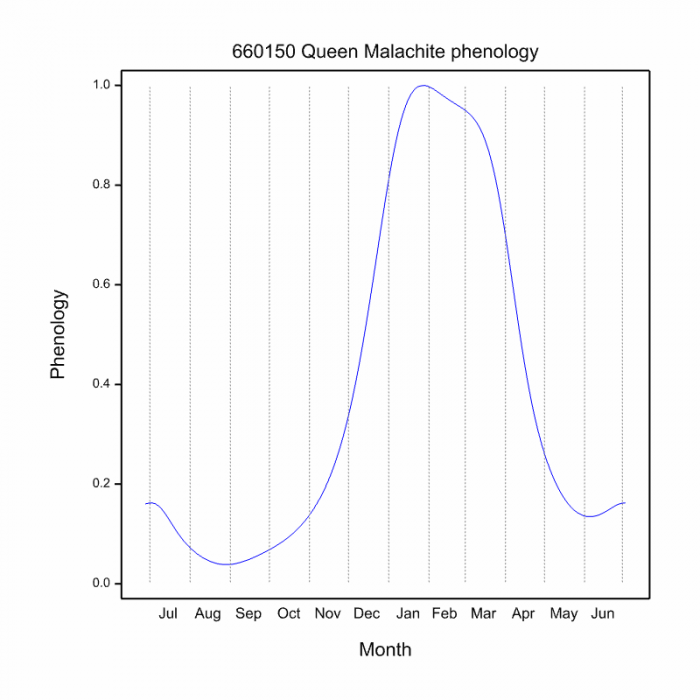
The next two graphs shows how the occurrence of the Queen Malachite varies within the year, i.e. the phenology. There are 79 records in the database for this species, so these results ought to be starting to be fairly reliable. The first plot shows the number of records in each pentade, five-day periods, which start on 1 July and end on 30 June of the following year. Two pentades have the maximum number of records, six; they are in January and April. There are records in every month of the year, except August and September. The blue line is generated by a smoother, an algorithm which aims to separate the “signal” from the “noise”, and shows the pattern of seasonality for this species. The second plot shows only the blue line, and it is scaled to lie between zero and one, for easy comparison between species.

The phenology plot shows a long flight period for the Queen Malachite, with a peak in observations From January to March. There seems to be a steady increase in abundance from October to November, and relatively rapid decline in April.

The quality of the phenology can be improved by actively searching for this species throughout the year. The August-September gap needs to be confirmed by getting lots more records in other months of the year. Although 78 records seem to provide a plausible phenology plot, additional records of Queen Malachites are needed in OdonataMAP to make it really reliable. If you have access to a locality where it occurs, the ideal would be to make a record in OdonataMAP for each five-day period in which they are seen and photographed.

Queen Malachite Ecchlorolestes nylephtha Male
Marloth Nature Reserve, Western Cape
Photo by Ryan Tippett

Further Resources

The use of photographs by Desire Darling, Gregg Darling, and Sharon Stanton is acknowledged.

Queen Malachite Ecchlorolestes nylephtha (Tillyard, 1917)

Other common names: Koninginmalagiet (Afrikaans).

Recommended citation format: Loftie-Eaton M; Navarro R; Tippett RM; Underhill L. 2025. Queen Malachite Ecchlorolestes nylephtha.  Biodiversity and Development Institute. Available online at https://thebdi.org/2020/04/23/queen-malachite-ecchlorolestes-nylephtha/

References: Tarboton, M; Tarboton, W. (2019). A Guide to the Dragonflies & Damselflies of South Africa. Struik Nature.

Samways, MJ. (2008). Dragonflies and Damselflies of South Africa. Pensoft

Samways, MJ. (2016). Manual of Freshwater Assessment for South Africa: Dragonfly Biotic Index.Suricata 2. South African National Biodiversity Institute, Pretoria

Similar Species

Forest Malachite (Chlorolestes tessellatus)

Cover photo by Jean Hirons.

Find the Forest Malachite in the FBIS database (Freshwater Biodiversity Information System) here.

Family Synlestidae

Identification

Forest Malachite Chlorolestes tessellatus – Male banded form
Hogsback, Eastern Cape
Photo by Alan Manson

Large. Note that this species can be quite variable in size.

Length up to 57mm; Wingspan attains 72mm.

Males occur in two colour forms. There is a form with conspicuous black and white banding in the wings and a form without the wing bands. Both forms co-occur.

Most likely to be confused with other green malachites that also develop the black and white wing bands. Closest to Chlorolestes fasciatus (Mountain Malachite), from which it differs by having a broad, yellow-brown humeral stripe on the thorax. The Mountain Malachite shows a far thinner, and brighter yellow humeral stripe. The Mountain Malachite is also slightly smaller and generally occurs in more open habitats than the Forest Malachite.

The Forest Malachite is also similar to the Elegant Malachite (Chlorolestes elegans). The Elegant Malachite is larger and the two differ in the patterning of the pale lateral stripes on the thorax.

Click here for more details on identification.

Habitat

The Forest Malachite is a shade-loving species found primarily at seeps and streams in forests. It is also known to inhabit wooded valleys in otherwise dry regions, such as the Swartberg Mountain range in the Western Cape.

Habitat – Ngome Forest, KwaZulu-Natal
Photo by Ryan Tippett

Behaviour

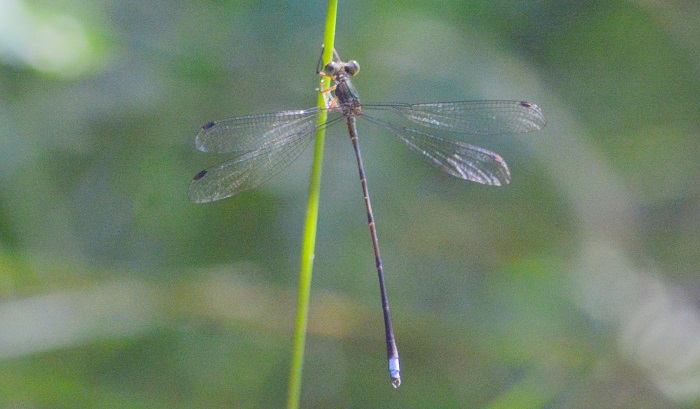
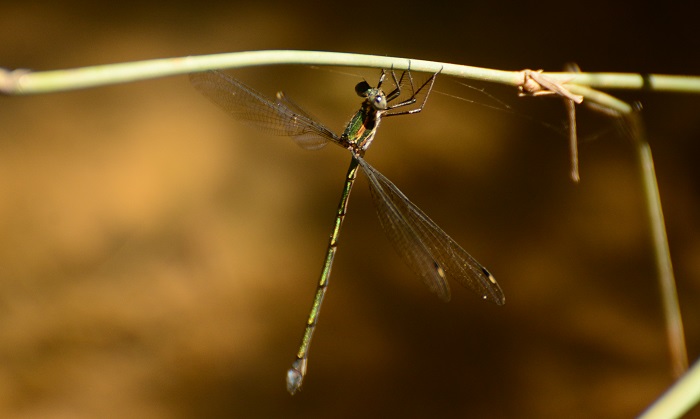
The Forest Malachite is an attractive, eye-catching species. It is mostly seen hanging from plants over the water with wings outstretched. Mature males with banded wings are conspicuous in the dappled forest light. The Forest Malachite is seldom seen away from water. Females are found in the same vicinity as the males, but are far more cryptic in their behaviour.

The Forest Malachite is mostly active from October to May (See Phenology below).

Forest Malachite Chlorolestes tessellatus – Female
Seweweekspoort, Western Cape
Photo by Ryan Tippett

Status and Distribution

The Forest Malachite is generally scarce and localised but can be common in parts of the Eastern Cape. It is listed as of Least Concern in the IUCN Red List of Threatened Species. The Forest Malachite is moderately sensitive to habitat damage.

Forest Malachite Chlorolestes tessellatus – Teneral female
iXopo district, KwaZulu-Natal
Photo by Ryan Tippett

Distribution

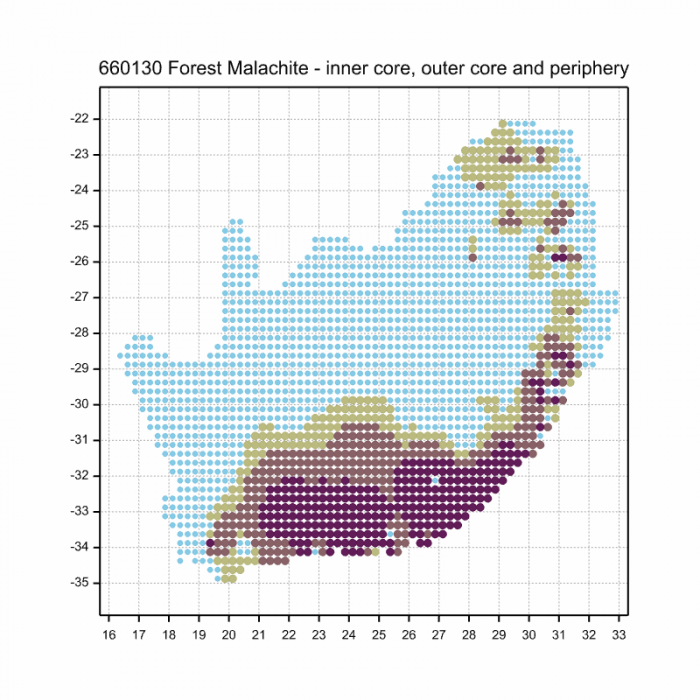
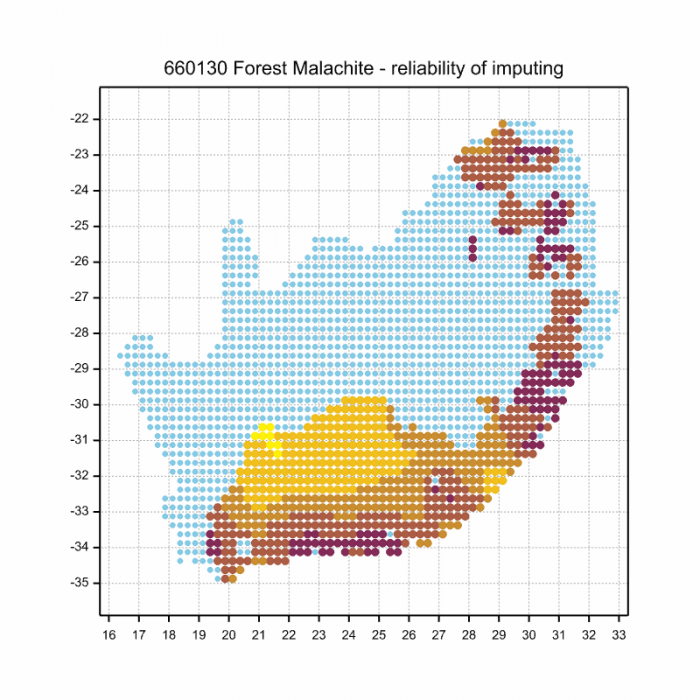
Chlorolestes tessellatus is endemic to South Africa. Its range closely follows the Afromontane forest belt that runs below the escarpment. It is distributed from the Riviersonderend Mountains in the Western Cape to the Soutpansberg in Limpopo.

Below is a map showing the distribution of records for Forest Malachite in the OdonataMAP database as at February 2020.

Below is a map showing the distribution of records for Forest Malachite in the OdonataMAP database as of December 2024.

The next map below is an imputed map, produced by an interpolation algorithm, which attempts to generate a full distribution map from the partial information in the map above. This map will be improved by the submission of records to the OdonataMAP section of the Virtual Museum.

Ultimately, we will produce a series of maps for all the odonata species in the region. The current algorithm is a new algorithm. The objective is mainly to produce “smoothed” maps that could go into a field guide for odonata. This basic version of the algorithm (as mapped above) does not make use of “explanatory variables” (e.g. altitude, terrain roughness, presence of freshwater — we will be producing maps that take these variables into account soon). Currently, it only makes use of the OdonataMAP records for the species being mapped, as well as all the other records of all other species. The basic maps are “optimistic” and will generally show ranges to be larger than what they probably are.

These maps use the data in the OdonataMAP section of the Virtual Museum, and also the database assembled by the previous JRS funded project, which was led by Professor Michael Samways and Dr KD Dijkstra.

Forest Malachite Chlorolestes tessellatus – Male un-banded form
iXopo district, KwaZulu-Natal
Photo by Ryan Tippett

Phenology

The next two graphs shows how the occurrence of Forest Malachites varies within the year, i.e. the phenology. There are 268 records in the database for this species, so these results ought to be reliable. The first plot shows the number of records in each pentade, five-day periods, which start on 1 July and end on 30 June the following year. The maximum number of records is in a pentade in March, with 16 records. The blue line is generated by a smoother, an algorithm which aims to separate the “signal” from the “noise”, and shows the pattern of seasonality for this species. The second plot shows only the blue line, and it is scaled to lie between zero and one, for easy comparison between species.

This phenology plot shows that the Forest Malachite has a long flight period, and that it can be encountered throughout the year. However, the main flight period is from December to April. There seems to be a steady build up of numbers mainly in October and November, and rapid decrease in May. The plot is quite strongly bimodal, with two peaks: a main one in early January, and a smaller peak in mid-March.

Lots more records of Forest Malachites in OdonataMAP would confirm whether the bimodality is genuine, or whether it is merely an artefact, attributable to the large number of records in a single pentade in March. If you live anywhere within its large range, please be alert to this species throughout the year, and submit records to OdonataMAP.

Forest Malachite Chlorolestes tessellatus – Female
Seweweekspoort, Western Cape
Photo by Ryan Tippett

Further Resources

The use of photographs by Alan Manson and Jean Hirons is acknowledged. Other Photographs by Ryan Tippett.

Forest Malachite Chlorolestes tessellatus Burmeister, 1839

Other common names: Woudmalagiet (Afrikaans).

Recommended citation format: Loftie-Eaton M; Navarro R; Tippett RM; Underhill L. 2025. Forest Malachite Chlorolestes tessellatus. Biodiversity and Development Institute. Available online at https://thebdi.org/2020/04/23/forest-malachite-chlorolestes-tessellatus/

References: Tarboton, M; Tarboton, W. (2019). A Guide to the Dragonflies & Damselflies of South Africa. Struik Nature.

Samways, MJ. (2008). Dragonflies and Damselflies of South Africa. Pensoft

Samways, MJ. (2016). Manual of Freshwater Assessment for South Africa: Dragonfly Biotic Index.Suricata 2. South African National Biodiversity Institute, Pretoria

Forest Malachite Chlorolestes tessellatus – Male un-banded form
Seweweekspoort, Western Cape
Photo by Ryan Tippett

Similar Species

Mountain Malachite (Chlorolestes fasciatus)

Cover photo by Gerhard Diedericks.

Find the Mountain Malachite in the FBIS database (Freshwater Biodiversity Information System) here.

Family Synlestidae

Identification

Mountain Malachite Chlorolestes fasciatus – Male banded form
Sani Pass, KwaZulu-Natal
Photo by Ryan Tippett

Medium to Large size

Length up to 54mm; Wingspan attains 64mm.

Male Mountain Malachites occur in two colour forms. About 70% of males develop striking black and white bands in the wings. The other 30% or so of males do not develop these wing markings.

Mountain Malachite Chlorolestes fasciatus – Unbanded Male
Near Underberg, KwaZulu-Natal
Photo by Ryan Tippett

The Mountain Malachite is easily confused with a handful of other green malachite species, especially the ones that also develop the black and white wing bands. The Mountain Malachite is closest to the Forest Malachite (Chlorolestes tessellatus), from which it differs by having a thin, yellow humeral stripe on the thorax. This stripe peters out before the wing bases. The Forest Malachite shows a broad, yellow humeral stripe that reaches the wing bases. The Mountain Malachite is also slightly smaller and generally occurs in more open habitats than the Forest Malachite.

The Mountain Malachite is also similar to the Elegant Malachite (Chlorolestes elegans). The Elegant Malachite is distinctly longer, and the two differ in the pattern of the pale lateral stripes on the sides of the thorax.

Click here for more details on identification.

Mountain Malachite Chlorolestes fasciatus – Female
Royal Natal National Park, KwaZulu-Natal
Photo by Ryan Tippett

Habitat

The Mountain Malachite frequents grassland streams and rivers in hilly or mountainous areas. It favours running streams with pools, and with fringing reeds, bushes, tall grasses and rocks. The Mountain Malachite is usually found in open, sunny environs. However, along the coast and in the northern parts of its range the Mountain Malachite also occurs in forested habitats.

The Mountain Malachite can be found from sea level up to 2400m above sea level.

Habitat – Golden Gate Highlands National Park, Free State
Photo by Ryan Tippett

Behaviour

The Mountain Malachite is mostly seen as it sits on a grass stem or branch over the water and often spends long periods at rest. When perched it hangs vertically with its wings outstretched. Banded form males are very striking and conspicuous, and are dominant over un-banded males.

The Mountain Malachite is most active from October to May (See Phenology below).

Mountain Malachite Chlorolestes fasciatus – Banded males perched over a stream.
Royal Natal National Park, KwaZulu-Natal
Photo by Ryan Tippett

Status and Conservation

The Mountain Malachite is a common species where it occurs. It is listed as of Least Concern in the IUCN Red List of Threatened Species. The Mountain Malachite is a fairly hardy species that sometimes inhabits slightly degraded streams and occasionally frequents farm dams adjoining its usual habitat.

Mountain Malachite Chlorolestes fasciatus – Unbanded Male
Golden Gate Highlands National Park, Free State
Photo by Ryan Tippett

Distribution

The Mountain Malachite is endemic to South Africa, Lesotho and Swaziland.

Its distribution ranges along the length of the escarpment from the Soutpansberg in Limpopo, down through Mpumalanga and KwaZulu-Natal through to the Eastern and Western Cape provinces. The Mountain Malachite also inhabits the mountainous areas of Gauteng and the eastern Free State. This species is considered rare in the Western Cape.

Below is a map showing the distribution of records for Mountain Malachite in the OdonataMAP database as at February 2020.

Below is a map showing the distribution of records for Mountain Malachite in the OdonataMAP database as of December 2024.

The next map below is an imputed map, produced by an interpolation algorithm, which attempts to generate a full distribution map from the partial information in the map above. This map will be improved by the submission of records to the OdonataMAP section of the Virtual Museum.

Ultimately, we will produce a series of maps for all the odonata species in the region. The current algorithm is a new algorithm. The objective is mainly to produce “smoothed” maps that could go into a field guide for odonata. This basic version of the algorithm (as mapped above) does not make use of “explanatory variables” (e.g. altitude, terrain roughness, presence of freshwater — we will be producing maps that take these variables into account soon). Currently, it only makes use of the OdonataMAP records for the species being mapped, as well as all the other records of all other species. The basic maps are “optimistic” and will generally show ranges to be larger than what they probably are.

These maps use the data in the OdonataMAP section of the Virtual Museum, and also the database assembled by the previous JRS funded project, which was led by Professor Michael Samways and Dr KD Dijkstra.

Mountain Malachite Chlorolestes fasciatus – Banded male
Royal Natal National Park, KwaZulu-Natal
Photo by Ryan Tippett

Phenology

The next two graphs shows how the occurrence of Mountain Malachites varies within the year, i.e. the phenology. There are only 425 records in the database for this species, so these results ought to be definitive. The first plot shows the number of records in each pentade, five-day periods, which start on 1 July and end on 30 June the following year. The maximum number of records in a pentade is 25, in mid-February. The blue line is generated by a smoother, an algorithm which aims to separate the “signal” from the “noise”, and shows the pattern of seasonality for this species. The second plot shows only the blue line, and it is scaled to lie between zero and one, for easy comparison between species.

The phenology plot shows that, over the range of the Mountain Malachite, this damselfly is in flight from November to April, with December to March being the months of most frequent occurrence. The peak abundance is in February. There seems to be a long, six-month build up to this peak, starting in September. The decrease in abundance is steeper, from March to mid-June. Between late-June and the end of August, the cold winter months, there are only two records for this species.

This might well be a species for which two altitude classes could be defined, with phenology plots for each altitude. To do this reliably, larger sample sizes would be helpful.

Mountain Malachite Chlorolestes fasciatus – Unbanded male
Royal Natal National Park, KwaZulu-Natal
Photo by Ryan Tippett

Further Resources

The use of photographs by Gerhard Diedericks is acknowledged. All other Photographs by Ryan Tippett.

Mountain Malachite Chlorolestes fasciatus Burmeister, 1839

Other common names: Bergmalagiet (Afrikaans).

Recommended citation format: Loftie-Eaton M; Navarro R; Tippett RM; Underhill L. 2025. Mountain Malachite Chlorolestes fasciatus. Biodiversity and Development Institute. Available online at https://thebdi.org/2020/04/23/moutain-malachite-chlorolestes-fasciatus/

References: Tarboton, M; Tarboton, W. (2019). A Guide to the Dragonflies & Damselflies of South Africa. Struik Nature.

Samways, MJ. (2008). Dragonflies and Damselflies of South Africa. Pensoft

Samways, MJ. (2016). Manual of Freshwater Assessment for South Africa: Dragonfly Biotic Index.Suricata 2. South African National Biodiversity Institute, Pretoria

Mountain Malachite Chlorolestes fasciatus – Male banded form
Sani Pass, KwaZulu-Natal
Photo by Ryan Tippett

Similar Species

Gracious Wisp (Agriocnemis gratiosa)

Cover photo by Rob Dickinson.

Find the Gracious Wisp in the FBIS database (Freshwater Biodiversity Information System) here.

Family Coenagrionidae

Identification

Gracious Wisp Agriocnemis gratiosa – Male
Okavango Delta, Botswana
Photo by Ryan Tippett

Very small size

Length up to 26mm; Wingspan attains 28mm.

The Gracious Wisp is most similar to Agriocnemis falcifera (White-masked Wisp). The Gracious Wisp can be told apart by its round postocular spots that are not joined by a thin line. Additionally, the male Gracious Wisp lacks the white moustache of the White-masked Wisp. These two species are the largest Southern African wisps, which helps to separate them from the other smaller species.

Click here for more details on identification.

Habitat

The Gracious Wisp is associated with the fringes and clearings of riverine, coastal, swamp, and dune forests. It occupies damp, grassy areas linked to slow-moving streams, pools, pans, and marshes. The Gracious Wisp favours sites with a rich growth of tall grasses, ferns, and other herbaceous plants. It is often found in shady areas with dappled light.

Habitat – Near Kosi Bay, KwaZulu-Natal
Photo by Ryan Tippett
Behaviour

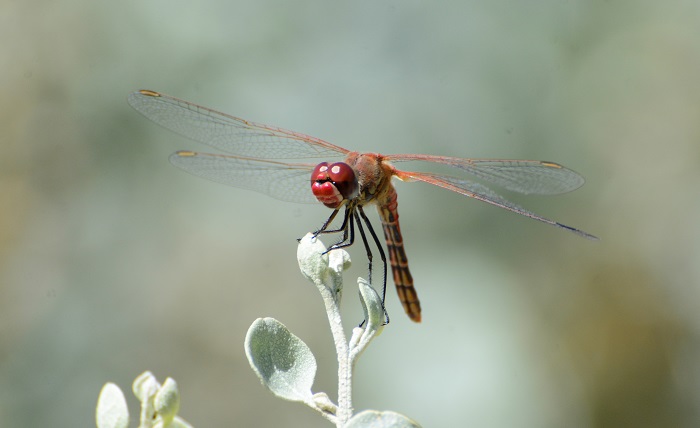
Due to its small size, the Gracious Wisp is an unobtrusive species that hides low down among rank vegetation.

It is most active from October to April (See Phenology below).

Status and Conservation

The Gracious Wisp is scarce and very localised in South Africa. It is listed in the IUCN Red List of Threatened Species as Vulnerable in South Africa, but of Least Concern overall.

Gracious Wisp Agriocnemis gratiosa – Female
Kosi Bay, iSimangaliso Wetland Park, KwaZulu-Natal
Photo by Ryan Tippett
Distribution

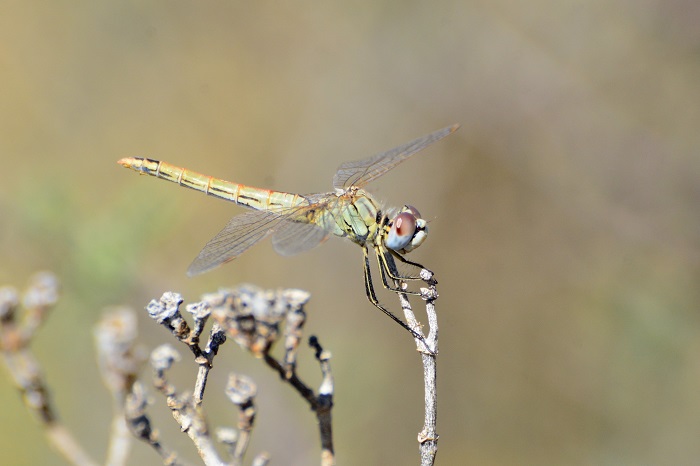
The Gracious Wisp is a species of East and Southern Africa. It has been recorded in Botswana, the Democratic Republic of the Congo, Kenya, Madagascar, Malawi, Mozambique, Namibia, South Africa, Sudan, Tanzania, Uganda, Zambia, and possibly Burundi.

In South Africa, the Gracious Wisp is restricted to the coastal region of north-eastern KwaZulu-Natal, reaching as far south as Amanzimtoti. It is also found locally at a few scattered sites in the Lowveld of Mpumalanga and Limpopo.

Below is a map showing the distribution of records for Gracious Wisp in the OdonataMAP database as at February 2020.

Below is a map showing the distribution of records for Gracious Wisp in the OdonataMAP database as of Decewmber 2024.

The next map below is an imputed map, produced by an interpolation algorithm, which attempts to generate a full distribution map from the partial information in the map above. This map will be improved by the submission of records to the OdonataMAP section of the Virtual Museum.

Ultimately, we will produce a series of maps for all the odonata species in the region. The current algorithm is a new algorithm. The objective is mainly to produce “smoothed” maps that could go into a field guide for odonata. This basic version of the algorithm (as mapped above) does not make use of “explanatory variables” (e.g. altitude, terrain roughness, presence of freshwater — we will be producing maps that take these variables into account soon). Currently, it only makes use of the OdonataMAP records for the species being mapped, as well as all the other records of all other species. The basic maps are “optimistic” and will generally show ranges to be larger than what they probably are.

These maps use the data in the OdonataMAP section of the Virtual Museum, and also the database assembled by the previous JRS funded project, which was led by Professor Michael Samways and Dr KD Dijkstra.

Phenology

Further Resources

The use of photographs by Rob Dickinson is acknowledged. Other photographs by Ryan Tippett.

Gracious Wisp Agriocnemis gratiosa Gerstäcker, 1891

Other common names: Grasieuse Soetjie (Afrikaans)

Recommended citation format: Loftie-Eaton M; Navarro R; Tippett RM; Underhill L. 2025. Gracious Wisp Agriocnemis gratiosa. Biodiversity and Development Institute. Available online at https://thebdi.org/2020/04/22/gracious-wisp-agriocnemis-gratiosa/

References: Tarboton, M; Tarboton, W. (2019). A Guide to the Dragonflies & Damselflies of South Africa. Struik Nature.

Samways, MJ. (2008). Dragonflies and Damselflies of South Africa. Pensoft.

Samways, MJ. (2016). Manual of Freshwater Assessment for South Africa: Dragonfly Biotic Index. Suricata 2. South African National Biodiversity Institute, Pretoria.

Martens, A; Suhling, F. (2007). Dragonflies and Damselflies of Namibia. Gamsberg Macmillan.

Similar Species

White-masked Wisp (Agriocnemis falcifera)

Cover photo by John Wilkinson.

Find the White-masked Wisp in the FBIS database (Freshwater Biodiversity Information System) here.

Family Coenagrionidae

Identification

White-masked Wisp Agriocnemis falcifera – Young Male
Kromme River, Eastern Cape
Photo by Gregg Darling

Very small size

Length up to 25mm; Wingspan attains 30mm.

There are two subspecies of the White-masked Wisp in southern Africa, Agriocnemis falcifera falcifera and Agriocnemis falcifera transvaalica.

When immature, White-masked Wisp males are initially all orange-red. Later stages are orange-red on the terminal segments of the abdomen only. When mature, only the terminal segments are orange-red. In old males the green colouration on the thorax and head turns pruinose white.

The forehead has a whitish band or ‘mask’ that runs from eye to eye and this is a diagnostic feature. The shape of the small green post-ocular spots are also diagnostic. They are tapered along the inner edge and connected across the back of the head in subspecies falcifera. In subspecies transvaalica the postocular spots are not connected.

Females are highly variable and range from all red or orange to green and black.

The White-masked Wisp is most similar to Agriocnemis gratiosa (Gracious Wisp). The White-masked Wisp can be told apart by its tapered and joined postocular spots and the white moustache stripe in the males. These two species are the largest Southern African wisps which helps to separate them from the other smaller species.

Click here for more details on identification.

White-masked Wisp Agriocnemis falcifera – Female
iXopo district, KwaZulu-Natal
Photo by Ryan Tippett
Habitat

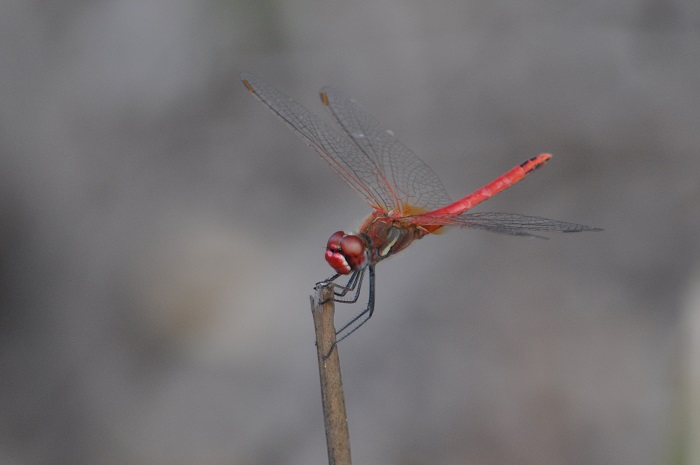
This tiny damselfly is found along the fringes of ponds, lakes, pools, and dams. The White-masked Wisp favours marshy sites with thick stands of grasses, sedges, and reeds. It can also be found on occasion along suitable, slow-moving sections of rivers.

Habitat – Middelburg, Mpumalanga
Photo by Andries De Vries

Behaviour

The White-masked Wisp is inconspicuous due to its tiny size and its habit of sitting low down among the grass stems, where it is well hidden. It is often gregarious, and males and females occur in the same vicinity.

The White-masked Wisp is on the wing from September to April (See Phenology below).

White-masked Wisp Agriocnemis falcifera – Male
iXopo district, KwaZulu-Natal
Photo by Ryan Tippett
Status and Conservation

The White-masked Wisp is locally common. It is listed as of Least Concern in the IUCN Red List of Threatened Species. The White Masked Wisp has adapted to the marshy fringes of dams and other man-made habitats.

Distribution

The White-masked Wisp is endemic to South Africa. The subspecies Agriocnemis falcifera falcifera occurs in a broad strip along the east coast from northern KwaZulu-Natal to the Western Cape. Agriocnemis falcifera transvaalica occurs inland in parts of Mpumalanga, Gauteng, and Limpopo.

White-masked Wisp Agriocnemis falcifera – Female
iXopo district, KwaZulu-Natal
Photo by Ryan Tippett
Below is a map showing the distribution of records for White-masked Wisp in the OdonataMAP database as at February 2020.

Below is a map showing the distribution of records for White-masked Wisp in the OdonataMAP database as of December 2024.

The next map below is an imputed map, produced by an interpolation algorithm, which attempts to generate a full distribution map from the partial information in the map above. This map will be improved by the submission of records to the OdonataMAP section of the Virtual Museum.

Ultimately, we will produce a series of maps for all the odonata species in the region. The current algorithm is a new algorithm. The objective is mainly to produce “smoothed” maps that could go into a field guide for odonata. This basic version of the algorithm (as mapped above) does not make use of “explanatory variables” (e.g. altitude, terrain roughness, presence of freshwater — we will be producing maps that take these variables into account soon). Currently, it only makes use of the OdonataMAP records for the species being mapped, as well as all the other records of all other species. The basic maps are “optimistic” and will generally show ranges to be larger than what they probably are.

These maps use the data in the OdonataMAP section of the Virtual Museum, and also the database assembled by the previous JRS funded project, which was led by Professor Michael Samways and Dr KD Dijkstra.

Phenology

White-masked Wisp Agriocnemis falcifera – Female
iXopo district, KwaZulu-Natal
Photo by Ryan Tippett

Further Resources

The use of photographs by Andries De Vries, Gregg Darling, and John Wilkinson is acknowledged. Other photographs by Ryan Tippett.

White-masked Wisp Agriocnemis falcifera Pinhey, 1959

Other common names: Witmaskersoetjie (Afrikaans)

Recommended citation format: Loftie-Eaton M; Navarro R; Tippett RM; Underhill L. 2025. White-masked Wisp Agriocnemis falcifera. Biodiversity and Development Institute. Available online at https://thebdi.org/2020/04/22/white-masked-wisp-agriocnemis-falcifera/
References: Tarboton, M; Tarboton, W. (2019). A Guide to the Dragonflies & Damselflies of South Africa. Struik Nature.

Samways, MJ. (2008). Dragonflies and Damselflies of South Africa. Pensoft

Samways, MJ. (2016). Manual of Freshwater Assessment for South Africa: Dragonfly Biotic Index. Suricata 2. South African National Biodiversity Institute, Pretoria

Similar Species