The Little Egret Egretta garzetta belongs to a large family of birds called the Ardeidae, the herons, the egrets and the bitterns. The herons are, on average, larger than the egrets, but the two names are used confusingly. The “Little” Egret is not the smallest member of the family!
Identification
The yellow feet are the diagnostic.
All photographic credits at end
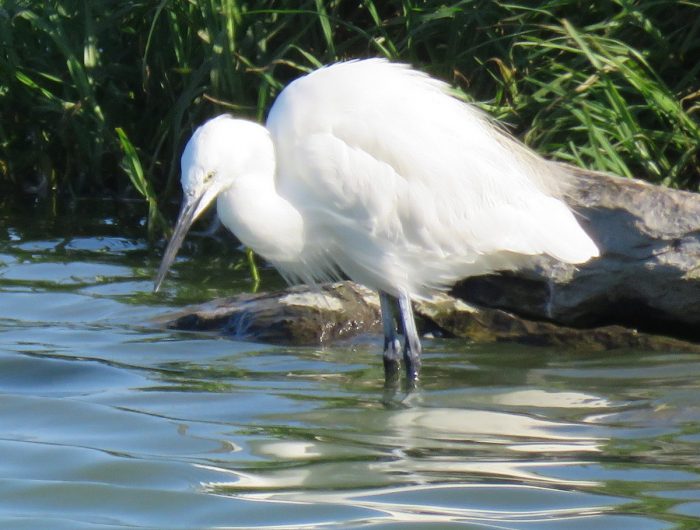
The only problem arises is when the feet are underwater, like this:
Usually, if you wait a little while and watch, it will start to move. It usually walks with a crazy gait, and lifts its feet out of the water with each step, so you get a quick yellow flash which confirms the identification. With a little experience, then even without seeing the yellow feet, you will get to know that this is a Little Egret, from the relative size and shape of its bill, body and neck.
Young birds look essentially the same as adults, but they don’t have plumes, and the yellow of their feet is a bit muted.
These photos give a feel for the kinds of places where you can anticipate encountering a Little Egret.
Distribution
This is the SABAP2 distribution map for Little Egret. In the interior of southern Africa, this map is essentially tracking the places where there are wetlands with shallow edges. These wetlands can be natural, such as rivers, estuaries, pans (like the ones in the Free State) or artificial, such as sewage works, large reservoirs and small farm dams. Along the open coastline, it prefers sheltered rocky shores with rockpools at low tide.
SABAP2 distribution map for Little Egret, download 12/06/2021. Details of map interpretation are here
Little Egrets occur in most of Africa, southern Eurasia and Australia. It is steadily expanding its range northwards in western Europe. They have established a tiny breeding population on the west coast of North America.
Gallery
This is all you need to see to be 100% certain that it is a Little Egret:
The yellow feet are the key diagnostic feature. This is not universal truth, if you travel to the Americas or to Australia there are other species of white egret with yellow feet!
Birding is not without humour. This Little Egret is pretending to be a new species, the Extra-long-legged Egret!
More common names: Kleinwitreier (Afrikaans), Aigrette garzette (French), Seidenreiher (German), Garça-branca-pequena (Portuguese), Garceta común (Spanish).
Photographic acknowledgements: Most of the photographs in this identification guide are in the BDI/FitzPatrick Institute Virtual Museum. They are used here with permission of the photographers, who continue to own the copyright on these images. Top image: Jorrie Jordaan, BirdPix 34978. First identification image: Les Underhill, BirdPix 2267. Second identification image: Johan and Estelle van Rooyen, BirdPix 115991; First habitat image: Les Underhill, BirdPix 48966. Second habitat image, Itxaso Quintana, BirdPix 116367. Third habitat image, Dave Kennedy BirdPix 11964. Fourth habitat image, Salome Willemse, BirdPix 105973. First gallery image, Les Underhill. Second gallery image: Dawie de Swardt, BirdPix 52412.
List of bird species in this format is available here.
Recommended citation format: Underhill LG 2021. Little Egret Egretta garzetta. Biodiversity and Development Institute. Available online at http://thebdi.org/2021/06/12/little-egret-egretta-garzetta/
The focus here is on learning the really common birds which you can expect to see on the coastline in the Western Cape. These are the species you are most likely to encounter on the beach, or along a section of rocky shore.
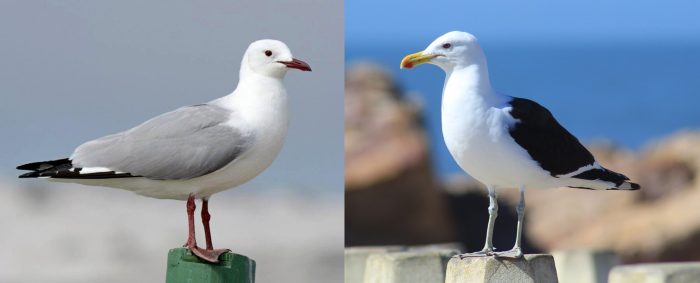
GULLS: Perhaps the birds which first come to mind when you say “seashore” are the gulls. 99.9% of the gulls of the Western Cape are either Hartlaub’s Gulls or Kelp Gulls. Adults are easy to tell apart. Kelp Gulls are much bigger than Hartlaub’s Gulls. When they are sitting, Kelp Gulls have black backs, and Hartlaub’s Gulls have grey backs.
The Hartlaub’s Gull is on the left, and the Kelp Gull on the right. It would be nice if it were that simple. You need to go the blog posts for each species to discover the complications caused by the age of the bird, i.e. the juvenile plumages. This is true for all the species presented here.
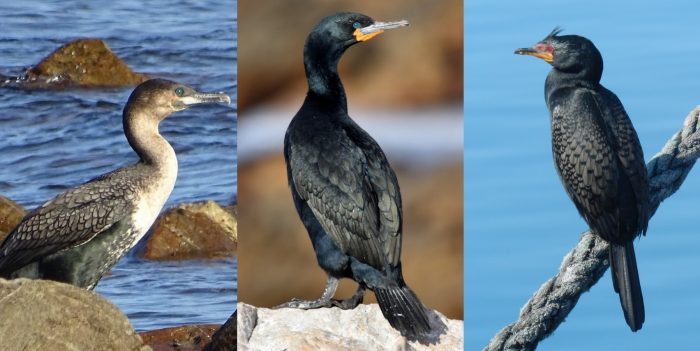
CORMORANTS: Next up are the cormorants (duikers in Afrikaans). There are four species, but one of these (the Bank Cormorant) is so rare that it is classified as Critically Endangered. That leaves three feasible species: White-breasted Cormorant (left), Cape Cormorant (middle) and Crowned Cormorant (right):
These three birds are dry, so you can see the intricate patterning of the feathers of their folded wings. When they are wet, they look black. The White-breasted Cormorant on the left is the largest, and has a blue eye. But so does the Cape Cormorant in the middle. The Crowned Cormorant on the right has a red eye. The Cape Cormorant has a notably short tail; the Crowned Cormorant has a long tail. If you see the crest feathers sticking up or you see the red eye, then it can only be Crowned Cormorant. The White-breasted Cormorant has a patch of yellow skin at the base of the bill. The other two species have orange, but in different patterns. These three cormorants are not that simple to distinguish. This is especially true when you add young birds into the mix. You need to look at the full texts for each species.
TERNS: Not every piece of shoreline has terns. Where they occur, they are often in large flocks. The tern species in the Western Cape all have grey wings, the same shade of grey as Hartlaub’s Gull. Essentially the terns look like sporty versions of the gulls. The terns are sleek and aerodynamic compared to the gulls. Most of the terns on the shoreline of the Western Cape belong to one of three species: Swift Tern (yellow bill), Sandwich Tern (black bill tipped yellow) and Common Tern (plain back bill). In reality it is not that simple. When you encounter a flock of terns, it may consist of one, or two or all three of these species. Often the flock of terns might have merged with a flock of gulls.
Except for rare vagrants, the Swift Tern is the only tern in the Western Cape with a yellow bill. The yellow-tipped black bill is globally unique to the Sandwich Tern (although there are a few species with black-tipped yellow bills). The legs and head of the Common Tern can vary between red and black, and all shades in-between. For all the species the head pattern is variable; it is not a useful identification feature. Size is useful. The photo below shows the Common Tern above in context:
The Common Tern is much smaller than the Swift Tern. The strange bird on the right is a young Swift Tern. The Sandwich Tern is intermediate in size between Common Tern and Swift Tern. Size is only useful if you are looking at a flock of terns.
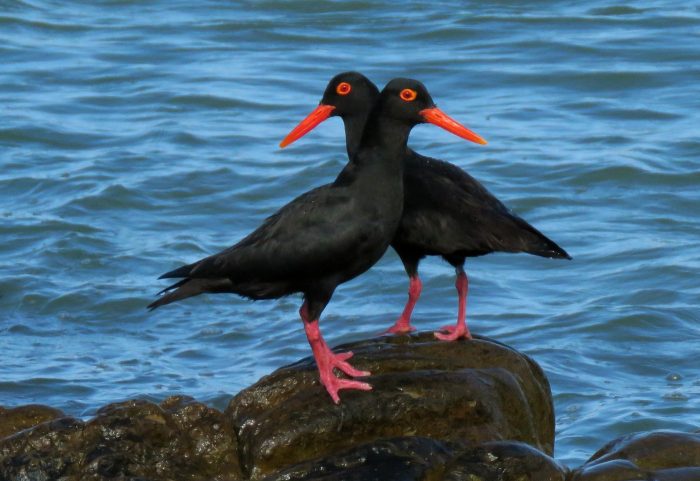
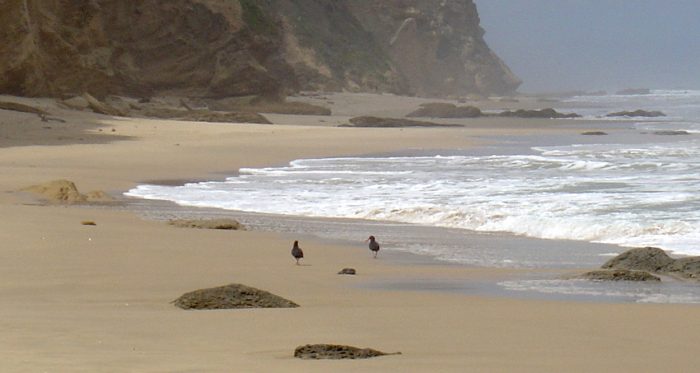
OYSTERCATCHER: A plump black bird with a red dagger for a bill is African Oystercatcher.
Oystercatchers breed during summer, when they have to share the shore with holiday makers. If you are angling or picnicking on the shore, and a pair of oystercatchers is persistently making a lot of noise, they are trying to communicate with you: “Please move along a 50 m or so; we are not comfortable having you so close to our nest.”
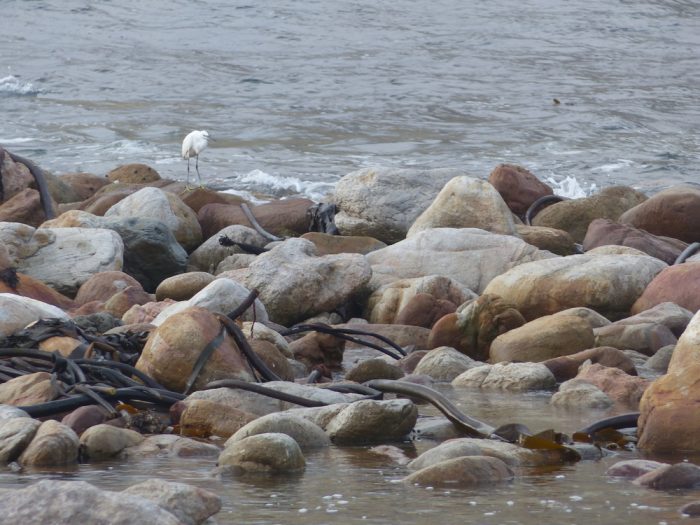
EGRET: A white bird with blackish legs which looks like it walked through spilt paint and got yellow feet is Little Egret. They are most conspicuous on the shore at low tide, when they feed in the rock pools.
There are other species in this family, the egrets and the herons, which are quite often on the coastline; Little Egret is the one that is most frequently encountered. Grey Heron comes second. Apart from the cormorants, these are the only birds on the shore that you would really consider taking a photograph of in portrait, rather than landscape, mode. They are all much taller than they are wide!
DUCKS & GEESE: One “duck-type” bird has added the coastline to its set of preferred habitats: Egyptian Goose:
If this blog had been written two decades ago, the Egyptian Goose would not have featured. Traditionally, they are birds of freshwater. Somehow, they discovered that the green sea lettuce (scientific name Ulva) was edible. (In the photo above for the Little Egret, the bird is hiding its right foot in sea lettuce.)
IBISES: There are two ibises on the shore. The noisy Hadeda Ibis (brown) and the silent African Sacred Ibis (white with black head).
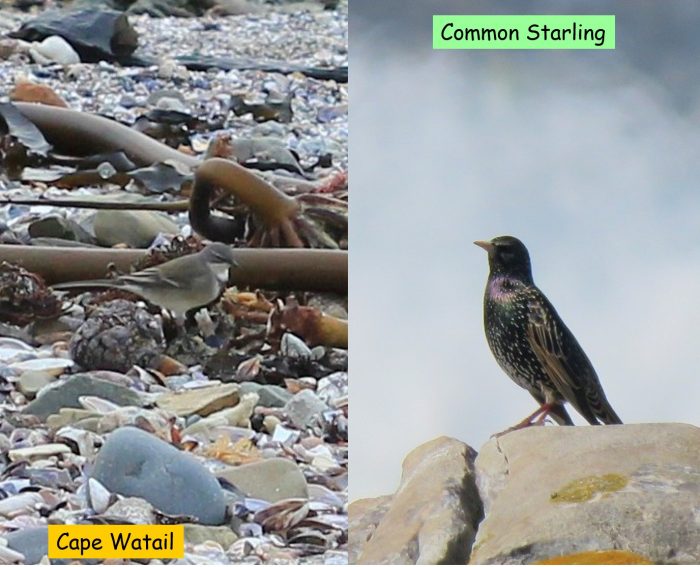
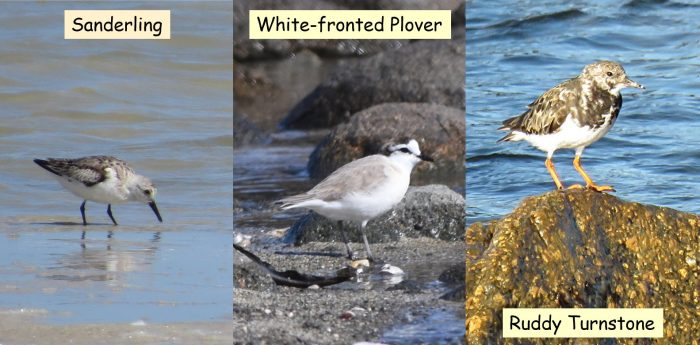
SMALL BIRDS – WAGTAIL, STARLING, WADERS : As soon as you get into the vegetation behind the coastline, whether it is natural, alien or gardens, there are a lot of bird species which you can encounter. But there are only five small species that you are likely to encounter on the beach or in the rock pools of the inter-tidal zone: Cape Wagtail (grey and white with black bib), Common Starling (black), White-fronted Plover (mostly white and cream), Ruddy Turnstone (black, white and brown) and Sanderling (white and grey).
Cape Wagtails (left) and Common Starlings (right) are two landbirds that feed in the intertidal zone right down to the edge of the sea:
Sanderlings (left) are mostly found on sheltered sandy beaches, feeding at the edge of the waves, running at speed to keep pace with the waves. White-fronted Plovers (centre) occur on both sandy and rocky shores, feeding from the edge of the sea to the back of the beach. Ruddy Turnstones (right) are mostly on rocky shores, or feeding on piles of kelp washed up on sandy shores.
Sanderlings and Ruddy Turnstones breed in Siberia, and migrate to the Western Cape for the local summer (about September to April). White-fronted Plovers are residents, and breed on the shore just above the high tide level.
Of course, there are lots of other species of birds on the coastline. For example, if you go to the Boulders or Stony Point, you will certainly see African Penguins. If you visit Bird Island at Lambert’s Bay, you will see Cape Gannets in their thousands.
If you manage to take a photograph of any bird listed above, please submit it to the Virtual Museum. You can include your own identification, even if it is a bit tentative. The expert panel will confirm whether you have got it right. If you see a bird which is not listed above, do try to take a photograph and submit it to the Virtual Museum. You can leave the species field blank, and a member of the expert panel will do the identification. Every record is valuable as evidence that a species still occurs at a locality.
Recommended citation format: Underhill LG 2021. Birds on the coastline of the Western Cape. Biodiversity and Development Institute. Available online at http://thebdi.org/2021/06/11/birds-on-the-coastline-of-the-western-cape/
The Virtual Museum (populatrly known as the VM) provides the platform for citizen scientists to contribute to biodiversity research and mapping projects. This innovative concept was originally developed by the Animal Demography Unit at the University of Cape Town (UCT) in 2005. It is now managed by the Biodiversity and Development Institute (an independent non-profit company) and the FitzPatrick Institute of African Ornithology (UCT).
What is the Virtual Museum?
For many people, the word “museum” conjures up images of a place to see stuffed animals on display. But this museum is not like this. Every real museum does not only have displays; there is always a door labelled “Private: Staff Only.” Go through that door, and you get into the scientific part of the museum. If it is a biological museum, it consists of large collections of specimens. Frequently there are large numbers of specimens of the same species from different parts of the range. They are all carefully preserved and labelled with the date and place where they were collected, the name of the collector, and the associated number of the record in a catalogue, which until recently was on paper. This is a real museum below!
This is a real museum; those are real snakes inside the bottles. Specimens carefully preserved in alcohol in bottles, everyone neatly labelled with collector, species and date. (Photo by Mike Bates, taken in the Natural History Museum, Paris)
The Virtual Museum is just like this part of the Real Museum, except that instead of specimens on shelves or in bottles, we have digital photographs in a database. The details of collector, date and place are also in the database. For example, there are 3,488 photographs of Painted Ladies Vanessa cardui in LepiMAP, and here are a handful of them:
Virtual Museum records of Painted Ladies. The real butterflies flew away, and continued with their lives. So this is a “virtual museum” in contrast to a “real museum”. One advantage of the “Virtual Museum” is that the specimens don’t lose their colour with time. The disadvantages are that you cannot handle the specimens, all you have (as Ringo Starr would say) is a photograph. And you can’t take a DNA sample from a photo!
One important use of all these photographs of the Painted Lady is to plot the locations where each record was observed, and to make distribution maps. One standard way of making maps is to put a grid over the region of interest, and to shade the grid cells in which the species has been recorded. In South Africa, Lesotho and Eswatini we often use a coarse grid, with lines at quarter degree intervals, about 27 km apart. When you realise that this coarse system generates 2,000 quarter degree grid cells for these three countries, then 3,488 records is not so impressive. If we go to a one minute grid (about 1.6 km), which would be nice, the three countries have 450,000 grid cells, nearly half a million!
A second use of all these Painted Lady records is to use them to work out the period of the year when the species is flying. This is called the “phenology”. When people talk about climate change, the first thought is that the future will be warmer. Another component of climate change is that the timing of the seasons will change. There is a real interest in seeing how biodiversity adapts to these changes. The statistical methods used to produce phenology plots need mountains of data. 3,488 Painted Ladies is not enough! And if we are going to be able to detect changes in phenology, we need vast numbers of new photos of Painted Ladies, made in 2021, 2022, 2023, …. and for ever. We will never have enough Painted Ladies. It is just as well this museum is “virtual” rather than “real”!
Members of the public are encouraged to submit digital photographs for the various sections of the Virtual Museum. Together with the photograph goes the same information as on the label of the specimen. Species identifications can be done by the observers, and these are confirmed by a panel of experts. If there is no identification, then these are done by the expert panel.
Currently the VM hosts 17 biodiversity projects: BirdPix (bird pictures archive); BOP (odd plumages of birds). PHOWN (photos of weaver nests), and 14 atlases: DungBeetleMAP (dung beetles, Coleoptera: Scarabaeidae). EchinoMAP (African Echinoderms: sea stars, sea urchins and brittle stars), FishMAP (freshwater fish in southern and eastern Africa), FrogMAP (African frogs), LacewingMAP (African Neuroptera and Megaloptera), MushroomMAP (South African mushrooms), OdonataMAP (African Odonata), OrchidMAP (African orchids), LepiMAP (African Lepidoptera), ReptileMAP (African reptiles), ScorpionMAP (African scorpions), SpiderMAP (African spiders), MammalMAP (African mammals), and TreeMAP (South African trees).
The databases in the Virtual Museum are used for multiple purposes. The most common use is to collate all the places where a species has been photographed, and to generate distribution maps for the species. These are available online and serve as conservation and education tools. These maps include Virtual Museum records and sometimes also other distributional records which are contained within the Virtual Museum database.
Virtual Museum records help expand the distribution databases for these taxa; they not only confirm the presence of a species at a particular point in time, but they also provide new distribution records for species and sometimes lead to extensions of the known range of a species. We try hard to “refresh” old records, so the maps are kept up to date.
Although the Virtual Museum database contains the exact localities of records, the only information made publicly available is the quarter-degree grid cell in which the record occurs. These are roughly square, with sides 27 km, about 700 square km. This is the scale at which information is published in atlases. For species that are subjected to poaching (e.g. rhinos, but a substantial list of other species as well), the records in the database appear to disappear as soon as they are identified. This is an unfortunate and important security feature of the Virtual Museum.
Your photos can make a difference for biodiversity conservation and information systems!
The African Oystercatcher Haematopus moquini is one of the iconic bird species of the coastline of the southwestern Africa. There is only one oystercatcher that breeds exclusively in Africa. So the “black” in African Black Oystercatcher is redundant, and is in the process of being dropped, in favour of the shorter name!
Identification
African Oystercatchers, especially the adults, are one of the easiest bird species to identify. It is the only species along the African coast with a black body and a bright red bill. They are noisy birds; listen to them here.
David Kennedy, Kei Mouth, Eastern Cape. 29 September 2017. BirdPix 47729Keir Lynch, Gansbaai, Western Cape. 27 February 2020. BirdPix 105606
Young African Oystercatchers are duller than adults. The most conspicuous differences are the bill colour, the lack of an eye ring, and the leg colour. The plumage is a dull brownish black, rather than plain black!
Habitat
African Oystercatchers are essentially confined to the shoreline. They occur on both rocky and sandy shores. They tend to be most abundant on shorelines which are sheltered, they are rarer on exposed shores, and absent from sections of coastlines where the ocean’s waves pound directly onto the bases of cliffs. On rocky shores, their daily cycles are driven by the tide. They feed in the intertidal zone at low tide, and loaf on rocks at high tide, often getting together in roosting groups. They feed at low tides during the night as well as during the day.
African Oystercatcher habitat on a rocky shore at Betty’s Bay, Western Cape, South Africa. What makes this especially attractive to oystercatchers is the width of the rocky area exposed at low tide. There are lots of places to feed in this intertidal zone! Les Underhill, 31 December 2017. BirdPix 48719
Typical habitat for oystercatchers on a sandy beach. The beach has a fairly flat profile, and there are lots of mussels buried in it for food. Oystercatchers avoid steeply sloping high-energy beaches where the sand is continously scoured, and mussels are unable to settle. This is near Sedgefield, Western Cape, South Africa. David Kennedy, 23 September 2008. BirdPix 3041
Distribution
This is the SABAP2 distribution map for the African Oystercatcher. It occurs only along the coastline. In reality, the width of the distribution is even narrower than that shown on the map. In most places the strip of coastline in which you can find oystercatchers is about 50 m wide, from the lowest level of spring low tide, to a few metres above the spring high tide level. It is steadily expanding its breeding range northeastwards across KwaZulu-Natal. Vagrants have been recorded along the Angolan coast in the west, and in Mozambique in the east.
SABAP2 distribution map for African Oystercatcher, download 06/06/2021. Details of map interpretation are here
Behaviour
African Oystercatchers are strongly territorial, and once they settle in a territory, they remain on it and defend it for the rest of the lives, up to 15 to 20 years. They are noisy birds, with lots of social interactions with their partners and their neighbours. Pairs do lots of ritualized ceremonies, as shown in the photo below.
Len de Beer, Gansbaai, Western Cape, 18 July 2005. BirdPix 8112
Breeding
The breeding season of African Oystercatchers coincides with the midsummer holiday period; most eggs are laid from November to February in South Africa, and about two months later in Namibia. The nests are just above the spring high tide level; the incubation period is about 30 days, so nests need to be high enough up the shore to avoid being washed away by two sets of spring tides. The nests cannot be made too far up the shore, because this would place them in the vegetation, and make the incubating bird vulnerable to predation by, for example, a mongoose.
Whether they are breeding on a rocky shore or a sandy beach, oystercatchers don’t go to lot of trouble building nests. They have a minimalist approach to nest architecture! It is best described as a scrape, and is sometimes lined with some seashells. Here are three examples.
The next nest, on a sandy beach, is in the dead centre of the photo, and contains two eggs:
The nest has been placed in a bend in the kelp. There are small round stones scattered around, which look quite egg-like.
This “nest” illustrates the minimalist approach:
The parents take turns incubating the eggs. It is hard to believe how difficult it is to spot a black bird with a red dagger for a bill sitting on its eggs on a white sandy beach:
… if you need a clue, the bird is near the right edge of the photo, and it is looking at the camera! Here it is close up:
Ultimately, two spring tides later, the eggs hatch, and a fluffball emerges. The second egg is pipped and the chick will emerge soon. The fluffball has dried off since it hatched. It’s a bit of packaging miracle how it could have squashed into an egg an hour or two earlier:
The chicks leave the nest within about 24 hours. They move up and down the shore with their parents, in rhythm with the tides. They are fed small pieces of mussels and limpets. They start to fly at about 40 days, when they reach 2/3rds of the adult mass. They hang around with their parents until they are about 100 days old. It is only then that their bills are strong to be able to prize shellfish off the rocks and feed themselves. It is a big commitment being an oystercatcher parent.
African Oystercatchers: Fledgling on left and adult on right. Robben Island, 19 April 2023. BirdPix record 251640
This juvenile was newly fledged, and was still learning to fly. The bill has some growing to do to reach adult size! The adult has a ring, and was probably ringed on this same territory on Robben Island in 2021 or 2022. African Oystercatchers, once they acquired a breeding territory, live a long time.
African Oystercatcher gallery
A pair of African Oystercatchers on Robben Island had newly hatched chicks on 11 November 2025:
They are not really chicks, they are fluffballs!
One of the parents did the “rodent run”, illustrated in the next four photos. The adult flutters around, pretending to be injured, and attempts to draw you away from the chicks.
This performance deserved an Oscar!
Occasionally, and this happens in most bird species, the colouring goes completely haywire, and you have no idea what you are looking at. Like the bird on the left, gosh!
Mark Booysen, Swartkops River estuary, Eastern Cape. 10 July 2013. Curated in both BirdPix 10392 and Birds with Odd Plumage BOP 180
Luckily, in this case, the aberrant bird is standing alongside an African Oystercatcher, so it is pretty obvious what it actually is. This bird did not produce normal amounts of melanin, the pigment that turns feathers black. So it ended up a motley brown. This condition is called leucism. (There is a section of the Virtual Museum that curates photographic records of Birds with Odd Plumage, BOP.)
If you are amazingly lucky you might encounter a flock of oystercatchers and have one that sticks out like a sore thumb. It clearly an oystercatcher, slightly smaller than the African Oystercatchers, but is white as well as black. It is clearly not a plumage aberration, it is too neatly patterned for that!
Les Underhill, Walvis Bay. 3 March 2007. BirdPix 1415
If you are in southern Africa, awesomely well done, you have found a vagrant, the Eurasian Oystercatcher Haematopus ostralegus. (If you are in Africa north of the equator, this is the only oystercatcher you will encounter.)
Further resources: A selection of papers and a video:
Conservation Status of Oystercatchers Around the World (2014). Assessment of the Conservation Status of African Black Oystercatcher. Chapter in book published by the International Wader Study Group
More common names: Swarttobie (Afrikaans), Huîtrier de Moquin (French), Kapausternfischer (German), Ostraceiro-preto (Portuguese), Ostrero Negro Africano (Spanish)
A list of bird species in this format is available here.
Recommended citation format: Underhill LG 2021. African Oystercatcher Haematopus moquini. Biodiversity and Development Institute. Available online at https://thebdi.org/2021/06/07/african-black-oystercatcher-haematopus-moquini/
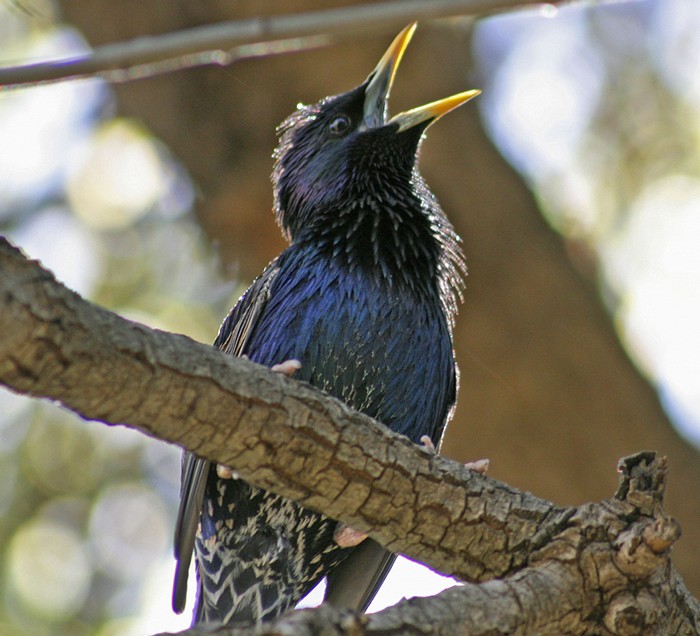
This is the third and final blog in this series on the impacts of Rhodes on biodiversity. The first blog talked about the Eastern Grey Squirrel. The second covered four of the five bird species that Cecil John Rhodes introduced so that his residence in Cape Town would have familiar English birds in the garden; of these four only the Common Chaffinch didn’t quickly go extinct. The fifth bird species he introduced was his big success story. Rhodes’s vision of building a railway line northwards from Cape Town through Africa to Cairo failed; but his starling has made a promising start in covering the distance!
Rhodes’s starlings were captured on his behalf by another rogue of the era, Colonel Richard J. Meinertzhagen (1878-1967). He was a soldier; in any squadron of soldiers he would have been regarded as the nastiest. When he wasn’t shooting people he was shooting birds for museum collections. But he couldn’t get enough birds of his own, so he stole skins of birds from museums, and then put his own labels on them, with completely different places and dates. Here’s a link to a paper in the journal Ibis called “Richard Meinertzhagen—a case of fraud examined“. It goes so far as to say: “Given the readiness with which Meinertzhagen falsified data on stolen specimens, one must question the authenticity of data on specimens he collected himself.” That is not what you expect to read in a scientific journal! There are endless stories of the harm this man has done to ornithology. The most horrid is the story of the Forest Owlet Athene blewetti in India. For decades this tiny owl was known to science from only six specimens, collected in India between 1873 and 1883. In 1961 (when he was in his eighties), Meinertzhagen all of a sudden claimed that he had collected a specimen in 1914 (when he would have been 36 years old) from another locality in India. He deposited this specimen in the British Museum. For decades after the 1960s, expeditions visited this part of India which apparently had the most recent sighting of the Foret Owlet. They searched for the owlet, without success, and it was declared extinct. Then Dr Pamela Rasmussen did some forensic ornithology. She discovered that one of the six earlier specimens was missing from the museum collection. It had been stolen by Meinertzhagen and he had put a new label on it, with falsified date and place. His diary demonstrated that he had not been in that part of India on that date! She went in search of the owlet in the area where the other specimens came from; on 25 November 1997, she rediscovered it in a degraded woodland. For a fuller version of this sleazy story, see this article in the Pune Mirror. Anyhow, that is a long detour to describe the kind of company that Cecil John Rhodes associated himself with!
Meinertzhagen supplied Rhodes with 18 Common Starlings. He says (and can we trust him?) that he caught them in Britain in winter, which means that they are likely to have been migrants from continental Europe. There is a massive influx of starlings into Britain in late autumn, especially from northwestern Europe where it gets bitterly cold in winter. Britain is only cold.
The precise year that Rhodes set the starlings free at Groote Schuur is not certain, but it is most likely to have been 1897. They took off, both literally and figuratively. But it was not until 1954 that an attempt was made to put on record how it spread. There is a paper in Ostrich, unfortunately not open access, by Jack Winterbottom and Richard Liversidge, called “The European Starling in the south west Cape” (Ostrich 25: 89-96). Their detective work, to trace its spread, consisted of interviewing lots of people. They neatly summarized their findings in this awesome map:
From Winterbottom & Liversidge (1954) The European Starling in the south west Cape. Ostrich 25: 89-96
It was in the suburbs of Cape Town around Groote Schuur within a few years. It colonized Robben Island by 1907. It spread to the far side of the Cape Flats by 1910. The big mountains proved a barrier for a few years, but it got to the far side, to towns like Worcester and Elgin in the 1920s. Along the south coast, the map traces its eastwards spread, taking about three decades to cover the 450 km from Elgin to Plettenberg Bay. It moved northwards along the West Coast more slowly, reaching Clanwillian in 1950. This map effectively shows the distribution of the Common Starling in 1954.
The next snapshot of the distribution of the starling was made by the Southern African Bird Atlas Project (SABAP1), which collected records mainly from the second half of the 1980s. Here is the map:
The Atlas of Southern African Birds, Volume 2, page 453
It had expanded far to the east, just into KwaZulu-Natal, and not quite as far to the north, reaching Namibia at the town of Oranjemund. Between the time that fieldwork ended and the atlas was published, it had snuck into Lesotho, and by the early 1990s was getting common in Maseru. The SABAP1 species text for the “European Starling” (as it was then known) is here.
The first bird atlas was followed up the the second bird atlas (SABAP2). This project started in July 2007, and the map below produced in June 2021, so it is a 14-year time exposure!
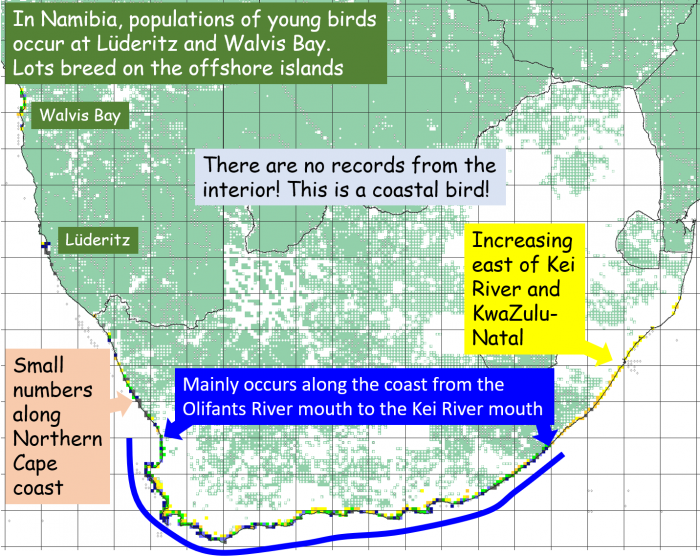
Distribution of the Common Starling, SABAP2 data, July 2007 to June 2021. The interpretation of this map is described here
Common Starlings have continued their march northeastwards. In the gridcells shaded yellow, they are far less frequently encountered than in those shaded dark blue. But they have clearly established themselves across KwaZulu-Natal, the Free State and Gauteng. There is still a long way to go to reach Cairo.
The Virtual Museum has 501 photographic record of Common Starlings. Below is a collection of thumb-nails of some of them! In the future, say in 50 years time, the photographs which are going to be the most valuable are going to be the ones in which the bird is quite small, and which show the habitat in which it occurred!
You’ll find lots more interesting information about the Common Starling here.
Impacts of Rhodes on biodiversity 1 and 2
The first and second blogs in this series deal with two other species which Rhodes introduced: the Eastern Grey Squirrel, which has not expanded far, and the Common Chaffinch, which has neither gone extinct nor taken off.
Recommended citation format: Underhill LG 2021. Impacts of Rhodes on Biodiversity 3 : Common Starling. Biodiversity and Development Institute. Available online at http://thebdi.org/2021/06/02/impacts-of-rhodes-on-biodiversity-3-common-starling/
Winter is around the corner here on the southern tip of Africa, in some areas winter has already arrived with a cold bang! We have some great BDI news to warm you up….
The online guide to the Neuroptera of southern Africa
We have been working on something very exciting over the past little while, the online guide to the Neuroptera (lacewings and antlions) of southern Africa. The insect order Neuroptera, or net-winged insects, includes the lacewings, mantidflies, antlions, and their relatives. The order consists of some 6,000 described species worldwide!
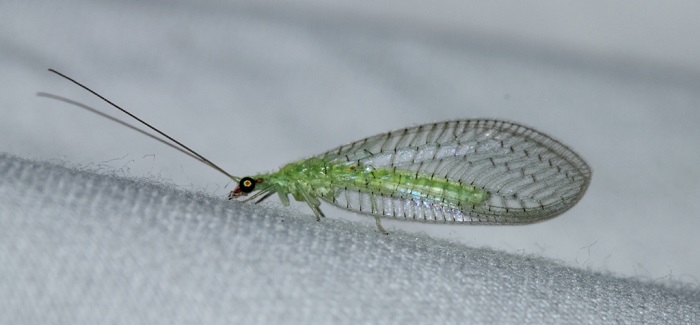
Neuroptera, and within this group especially the family Chrysopidae, are of interest to a large group of entomologists because of their role as predators of pest arthropods (aphids and spidermites) on agricultural plants.
Chrysemosa jeanneli – Family Chrysopidae – LacewingMAP Record by Johan Heyns
Citizen Scientist Hours
We had some incredible talks during the month of May. If you missed out on any of the Citizen Scientist Hours (CSH), don’t despair, you can catch up on our YouTube Channel.
One of the many excellent talks during our CSH events was by Katy Williams. Katy is a researcher and the Conservation Director of the Cape Leopard Trust in South Africa. Katy will talked about the Leopards in the Western Cape of South Africa. Despite extensive habitat loss, direct persecution, and reduction in prey numbers, leopards have managed to persist in the greater Western Cape region, and now fill the role of apex predator in this ecosystem. Watch the talk to learn more about these survivors, the challenges they face, and the Cape Leopard Trust’s work to ensure their future…..
Virtual Museum
10,442 records have already been added to species distribution maps in May. Some of the records report the first occurrence of a species in a grid cell. Many of the records “refresh” old records, providing evidence that the species still persists in the grid cell. Asking which class of records is more important is like asking the question: “Is the left wing of the plane more important than the right wing?” We need both types. We only have one day in May left to push the RED dot (see the graph below) for May up to new and dizzying heights!!
Thank you for your support of the Virtual Museum!
In other news…..
The Cape kelp forests have been named one of the Seven Wonders of the World! Described as a shallow underwater jungle more than twice as wide as the Grand Canyon — and a home to millions of creatures, this wonderland beneath the waves lies approximately 17 km south of Cape Town.
You can also watch the following talk on the amazing biodiversity to be found off the coast of Cape Town. Itxaso gives an awesome presentation on her marine biobash adventure, with records from the coast and under the water….
Myrmeleontidae is the largest lacewing family. There are currently 50 recognised genera and at least 180 described species in South Africa. Additionally there are many species that await description.
Fifty genera are known from South Africa: Annulares; Bankisus; Banyutus; Brachyplectron; Capophanes; Centroclisis; Crambomorphus; Creoleon; Cueta; Cymothales; Distoleon; Exaetoleon; Furgella; Fadrina; Golafrus; Hagenomyia; Jaya; Lachlathetes; Macroleon; Macronemurus; Maula; Myrmeleon; Nadus; Nannoleon; Nemoleon; Nesoleon; Neuroleon; Obus; Palparellus; Palpares; Palparidius; Pamares; Pamexis; Syngenes; Tomatares; Tricholeon.
Identification
Medium to very large sized (Wingspan 26-160 mm)
All have prominent but fairly short antennae. The compound eyes are fairly large and widely spaced.
Adults have two pairs of wings that are roughly equal in size. Their abdomens are long and slender and consist of ten segments.
Adult antlions superficially resemble dragonflies and damselflies. Antlions can be differentiated by having prominent antennae, smaller, widely spaced compound eyes and very intricately veined wings. Antlions also rest with their wings closed down the length of the body.
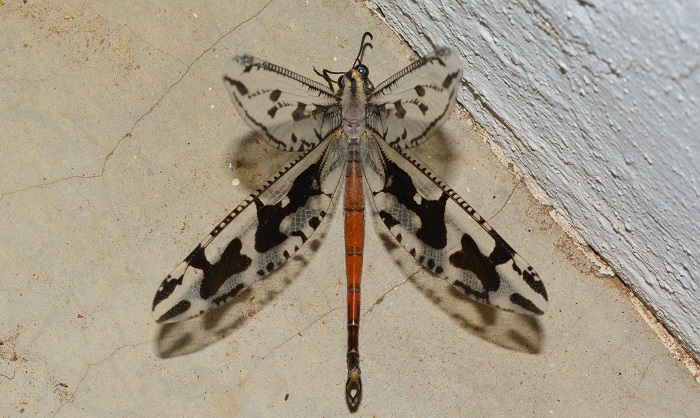
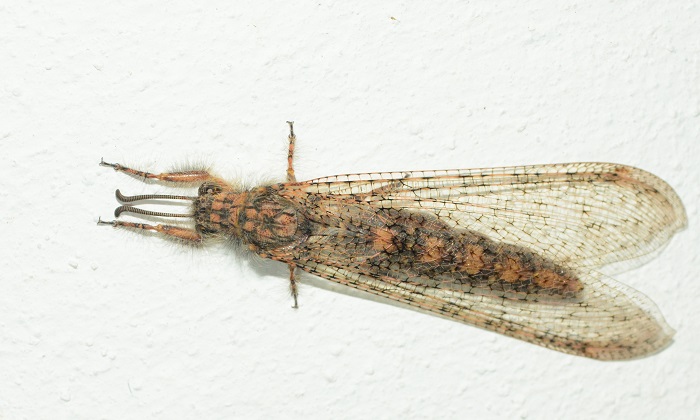
Palpares immensus – This magnificent species is one of the largest in the order. The wingspan can attain 160mm. Near Carnarvon, Northern Cape Photo by Ryan TippettCentroclisis maligna in typical antlion resting position, with wings folded along the length of the body. Near Carnarvon, Northern Cape Photo by Ryan Tippett
Food & Feeding
Adults and larvae are predatory and feed on other insects.
Adults mostly capture smaller flying insects in flight using their bristly legs. Prey is then taken to a perch before being consumed.
The larvae are all ambush hunters. They conceal themselves below the sand surface and grab unsuspecting prey that passes close by. The larvae of some genera are pit-fall trap builders (see Larvae below).
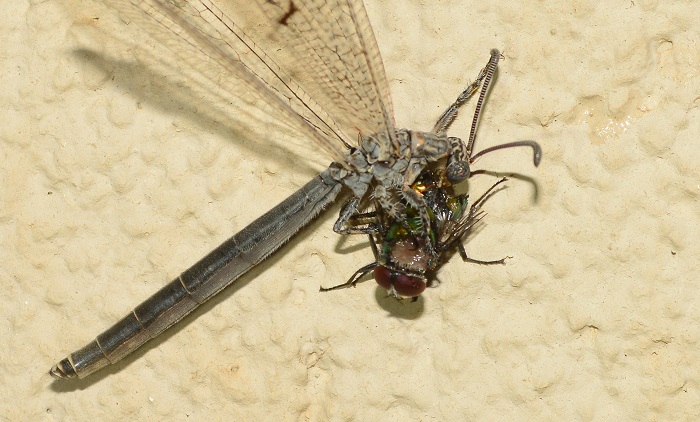
Creoleon mortifer feeding on a Blowfly (Calliphoridae) Near Carnarvon, Northern Cape Photo by Ryan Tippett
Behaviour
Most adults are nocturnal and are readily attracted to lights. Adults are well camouflaged among vegetation during the day.
Larvae
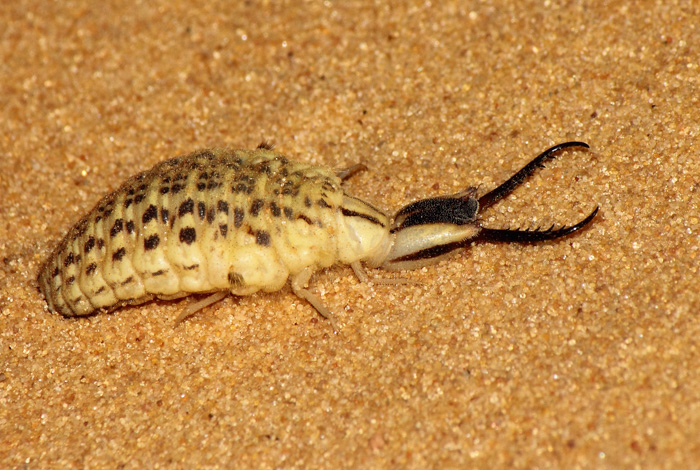
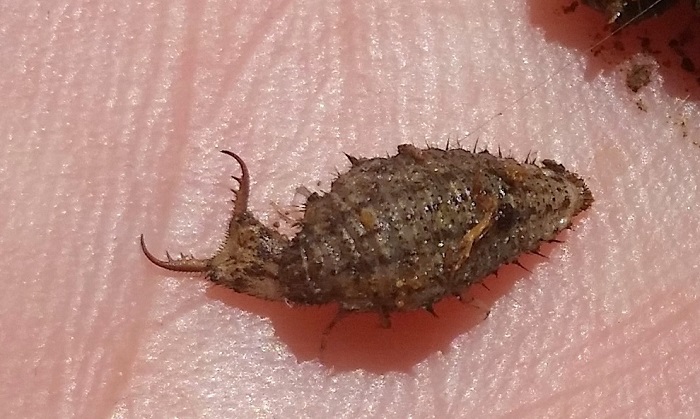
Most species have free-living larvae that live in loose sand. A handful of genera demonstrate the famous ‘pit-building’ technique where the larvae capture their prey in conical pits dug into the sand.
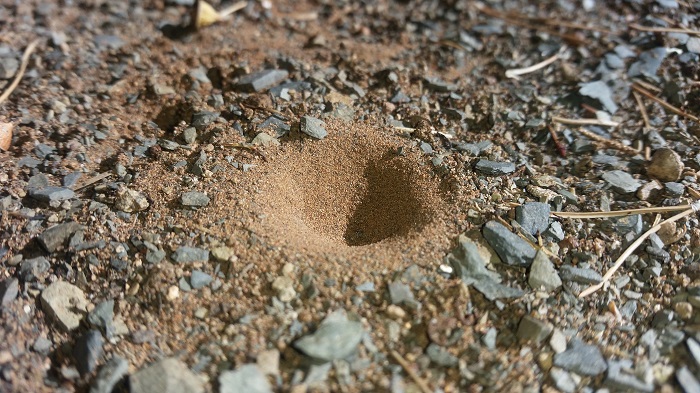
Golafrus oneili – Photo by Vaughan JessnitzNeuroleon sp. – Near Carnarvon, Northern Cape Photo by Ryan TippettTypical antlion pit, possibly made by a species of Cueta or Myrmeleon. Near Carnarvon, Northern Cape Photo by Ryan Tippett
Distribution
Antlions occur throughout South Africa and in all terrestrial habitats.
The above photo by Handre Basson is of Palmipenna aeoleoptera (Rock Spoonwing). This is a rare species and is confined to Namaqualand. This record can be found in the LacewingMAP database here.
15 genera are found the region: Concroce; Laurhervasia; Thysanocroce; Tjederia; Barbibucca; Derhynchia; Halterina; Knersvlaktia; Nemeura; Nemia; Nemopistha; Nemopterella; Palmipenna; Semirhynchia; Sicyoptera
At least 60 species occur in South Africa.
Identification
Small to large (Wingspan 25-100mm)
Adults have elongate beak-like mouthparts for feeding on pollen and nectar
The forewings are clear and iridescent in most species. A handful of species have brown or black pigmented forewings, often with white tips.
The hindwings are variously modified. Often elongate with streamer, thread, ribbon, flag, spoon or paddle-like tips. Hindwings are usually coloured in white, brown or black.
Nemopterella sp. showing the beautiful iridescent fore-wings and the modified ‘streamer’ hind wings. Near Carnarvon, Northern Cape Photo by Ryan TippettNemia karooa – Note the beak-like mouthparts for feeding on pollen and nectar. Near Carnarvon, Northern Cape Photo by Ryan Tippett
Behaviour
Adults of most species fly during spring or early summer. A few such as Laurhervasia setacea emerge predominantly during late summer.
Some species are diurnal, whilst the majority are nocturnal and may appear at lights in large numbers.
Habitat
Largely confined to arid and semi-arid environments, with low scrub vegetation. Often in open, rocky or sandy areas.
Larvae
All species have predatory larvae that actively chase down their prey.
The larvae of the thread-wing types have an elongated prothorax, giving them a distinctive long-necked appearance. In some the larvae are squat and rounded with short, curved and very strong jaws. However, the larvae of many in the family are poorly known.
The larvae live in fine, dry sand, often under rock overhangs or in caves.
Tjederia namaquensis – The long-necked appearance is due to the elongate prothorax. Cederberg, Western Cape Photo by Handre Basson
Distribution
The majority of the worlds species occur in the arid regions of the Western Cape, Northern Cape and Namibia. A few species occur in the drier parts of the North-West, Gauteng and Limpopo provinces and also Botswana.
A number of species have very restricted distributions.
An undescribed species of Palmipenna. Near Luderitz, Namibia Photo by Jessica Kemper