PHunting season is here. No critter is safe. Citizen scientists are out and about, armed with their cameras, ready to Photo Hunt! (Featured image above by Gregg Darling)
Well done to each and every one of you that went out there camera-slinging for biodiversity conservation! The need for up-to-date species distribution maps is now more critical than ever in light of climate change and global environmental challenges. The future of nature conservation and healthy ecosystems are in our hands. We are all in this together. Citizen science can and does make a major difference for species conservation and to spread awareness of conservation and environmental issues. Engagement with nature is important not just for our well-being, but for our very survival.
Round Two of PHunting Season kicked off on Saturday, 13 November 2021, and ended on midnight of the following Sunday, 21 November 2021. In total, 76 biomappers were scouring their local parks, gardens, towns, and streets for all things crawling, flying, swimming, running, and perching. An amazing total of 2,986 phunting trophies were uploaded to the Virtual Museum. Below is a table summarizing the numbers of records received, per project, in the Virtual Museum for PHunting Round Two. The table is organized by most to least number of records received.
VM Project
RecordsTotals
BirdPix
1472
OdonataMAP
635
LepiMAP
501
SpiderMAP
85
ReptileMAP
84
MammalMAP
68
OrchidMAP
34
FrogMAP
23
TreeMAP
19
ScorpionMAP
18
DungBeetleMAP
14
PHOWN
12
LacewingMAP
7
MushroomMAP
7
FishMAP
4
BOP
3
EchinoMAP
0
For BirdPix, the bulk of the records came from South Africa (1163 records), followed by Uganda (119) and Kenya (87). We also received records from Mali, Namibia, Nigeria, Zambia and Zimbabwe.
The bird species most recorded? The Egyptian Geese Alopochen aegyptiacus took first place with 22 records, Pied Crow Corvus albus and Hadeda Ibis Bostrychia hagedash tied for second place with 18 records each. All in all 425 different bird species were phunted! This number reflects only the records that have been identified by the expert panel thus far, but our experts make quick work of getting identifications verified.
Egyptian Goose Alopochen aegyptiacus – BirdPixxed by Lia Steen
Nine observers submitted more than 100 records on African biodiversity. The Top Ten PHunters for Round Two are listed in the table below:
Observer Name
Records Total
1
Rick Nuttall
352
2
Pieter Cronje
275
3
Corrie du Toit
170
4
Andre & Bets Kok
166
5
Hesmarie Els
138
6
Marius Meiring
121
7
PR Kleiman
105
8
Lia Steen
101
9
Zenobia van Dyk
101
10
Christopher Small
91
OdonataMAP, the Atlas of African Dragonflies and Damselflies, received records from Mali, Kenya, Uganda, Nigeria, South Africa, and Zambia. From the records that have been identified to date, 94 different species were recorded.
The Palmiet Sprite Pseudagrion furcigerum was most frequently recorded during this second round of phunting with 50 records, followed by Cape Skimmer Orthetrum capicola (37) and Broad Scarlet Crocothemis erythraea (36). Corrie du Toit was the top OdonataMAPper, managing to submit 125 records in total for PHunting Round Two. Hesmarie Els was close on her heels with 119 records, followed by Diana Russell on 58. Well done!
Palmiet Sprite Pseudagrion furcigerum – OdonataMAPped by Sharon Stanton
LepiMAPpers made a special effort during the second round of photo hunting, snapping and mapping a total of 501 butterflies and moths. Phunting trophies from all over Africa were uploaded to the LepiMAP section of the Virtual Museum. For South Africa, most of the records came from KwaZulu-Natal Province (113 records), followed by the Western Cape (77) and Eastern Cape on 41 records.
From the 501 records submitted, the expert panel has identified 197 different species thus far! The little African Grass Blue Zizeeria knysna knysna was photo hunted most frequently with 13 records. Followed by the Citrus Swallowtail Papilio demodocus demodocus on 10 records and the Painted Lady Vanessa cardui (9 records).
A beautiful Citrus Swallowtail Papilio demodocus demodocus LepiMAPped by Lance Robinson
There are many other sections of the Virtual Museum and we encourage you to keep an eye out for these critters too. We are mapping everything from scorpions to frogs to mammals. So what are you waiting for? Grab your camera (or cell phone) and get snapping and mapping!
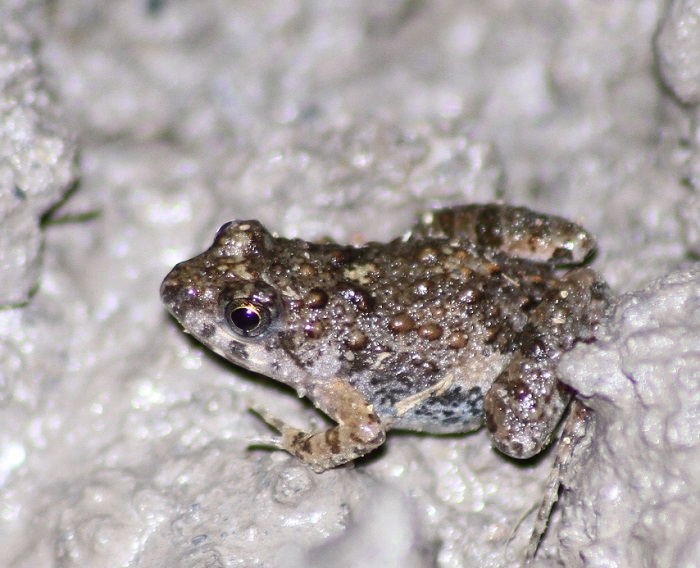
View the above photo record (by John Wilkinson) in FrogMAPhere.
Find the Dwarf Puddle Frog in the FBIS database (Freshwater Biodiversity Information System) here.
Family Phrynobatrachidae
DWARF PUDDLE FROG – Phrynobatrachus mababiensis
FitzSimons, 1932
Identification
Habitat
P. mababiensis inhabits open to wooded savanna and, less frequently, grassland, where summer rainfall is 500–1000 mm p.a. It breeds in shallow stagnant water amongst emergent vegetation on the edges of grassy pans, vleis, marshes, small dams and ponds, and in the backwaters of slow-flowing streams. The species is also found in disturbed habitats near villages and other developments.
Behaviour
Dry periods are spent in aestivation. During the dry winter at Shipudza (2230DB) in Kruger National Park, adult P. mababiensis were found sheltering under stones (H. Braack pers. comm.).
This species has an extended breeding season that begins after the first spring rains. Males call from the water’s edge, well concealed by vegetation. Choruses are usually strongest at dusk, diminishing after nightfall. In overcast or rainy weather, calling continues throughout the day and night. Aggression between males occurs frequently (Wager 1965).
Eggs are laid in a single flat layer c.5 cm in diameter, that floats on the water. Metamorphosis is completed after about five weeks, at which stage the juvenile froglets are only 6 mm long (Wager 1965; Pienaar et al. 1976).
P. mababiensis feeds mainly on small insects such as midges and mosquitoes (Wager 1965). These frogs occur in large numbers and probably play a significant role in the ecology of their wetland habitat. Stewart (1967) regarded this species as “probably the most abundant amphibian in eastern and central Africa”.
Predators have been recorded in East Africa (Loveridge 1953a) and Zimbabwe (Broadley 1974). These include various snakes such as the Herald Snake Crotaphopeltis hotamboeia and Swamp Viper Atheris nitschei. Other predators include the Cattle Egret Bubulcus ibis.
Status and Conservation
This successful and widespread species is not in need of special conservation measures.
Distribution
Several small Phrynobatrachus species were described from central, eastern and southern Africa, but the taxonomy of this group is still unsettled (Poynton and Broadley 1985b; Lambiris 1989a).
P. mababiensis occurs from the Sahel of East Africa to the Eastern Cape Province, South Africa, west to Namibia and southern Angola (Frost 2000). In the atlas region, it is found along the coastal plain from about Qolora Mouth (3228CB) in Eastern Cape Province, northward through KwaZulu-Natal, Swaziland, Kruger National Park and surrounding lowlands, from sea level to 1500 m. Earlier records from the western parts of Limpopo Province indicate that this species may be expected to occur across the province via the Limpopo valley.
The colouration and markings of this species vary considerably, but its small size and characteristic insect-like call make identification relatively easy. The call may at times be confused with that of Hemisus marmoratus, which has a similar pulse rate and emphasized frequency. However, the latter lacks the sporadic clicks that are interspersed in the trill of P. mababiensis.
The atlas data are accurate and reasonably complete
Further Resources
Virtual Museum (FrogMAP > Search VM > By Scientific or Common Name)
More common names: Dwergmodderpadda (Afrikaans)
Recommended citation format for this species text:
Channing A, Tippett RM. Dwarf Puddle Frog Phrynobatrachus mababiensis. BDI, Cape Town. Available online at http://thebdi.org/2021/12/20/dwarf-puddle-frog-phrynobatrachus-mababiensis/
Recommended citation format:
This species text has been updated and expanded from the text in the 2004 frog atlas. The reference to the text and the book are as follows:
Channing A 2004 Phrynobatrachus mababiensis Dwarf Puddle Frog. In Minter LR et al 2004.
Minter LR, Burger M, Harrison JA, Braack HH, Bishop PJ, Kloepfer D (eds) 2004. Atlas and Red Data Book of the Frogs of South Africa, Lesotho and Swaziland. Smithsonian Institution, Washington, and Avian Demography Unit, Cape Town.
Find the Cape Ghost Frog in the FBIS database (Freshwater Biodiversity Information System) here.
Family Heleophrynidae
Identification
Cape Ghost FrogHeleophryne purcelli Paarl, Western Cape Photo by Luke Kemp
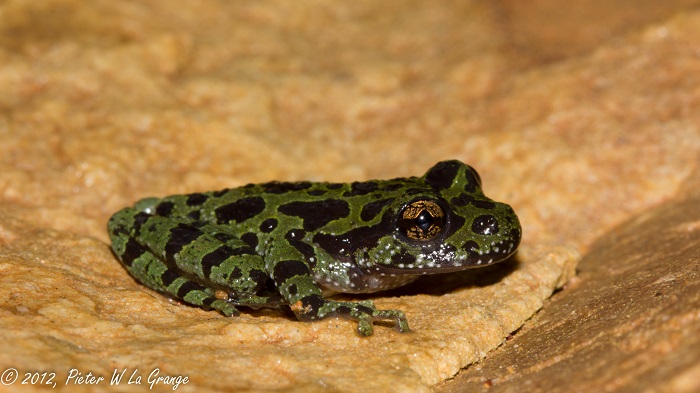
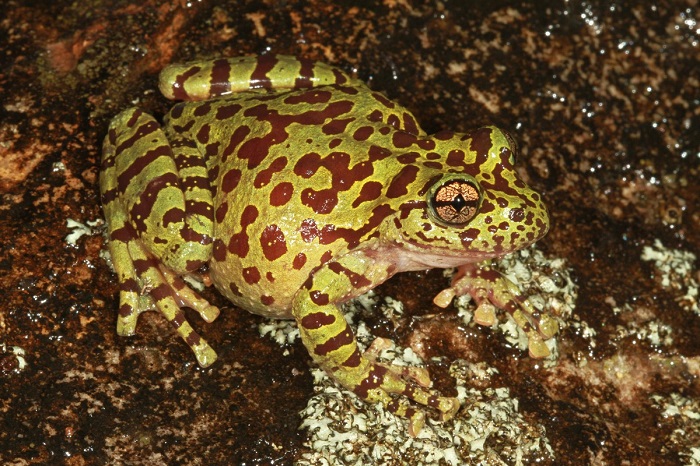
The female Cape Ghost Frog attains 56mm in length whilst males are a little smaller, reaching 47mm in length. The dorsal colour varies from yellowish-brown to bright green with reddish-brown blotching.
Habitat
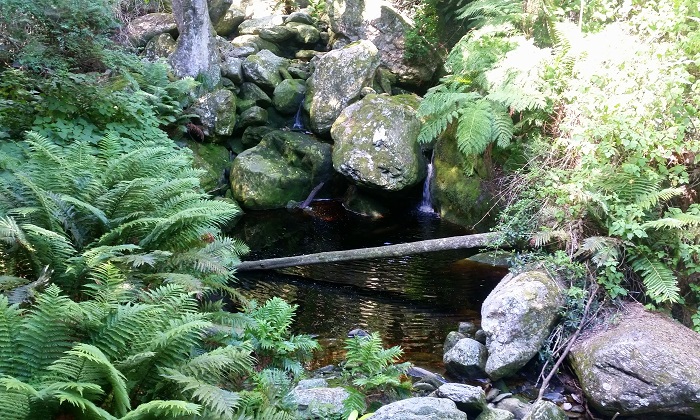
The Cape Ghost Frog is restricted to Mountain Fynbos environments in the winter-rainfall region where annual rainfall is 600–3000 mm (Boycott 1982). It inhabits clear, swift-flowing, perennial mountain streams. The Cape Ghost Frog is often found in wooded or forested ravines and gorges where streams receive direct sunlight at midday.
Habitat in a forested ravine. Marloth Nature Reserve, Western Cape Photo by Ryan Tippett
Adults have been found under submerged rocks in streams, on wet rock faces, under mats of spongy moss and watergrass, in rock cracks, and in caves (Visser 1990). On one occasion, a frog was found clinging to the wall of the old Du Toit’s Kloof road tunnel (G. McLachlan pers. comm.). During the day adults sometimes sit in clear view at the bottom of pools. The tadpoles are found beneath submerged and partly submerged rocks in streams and rocky pools.
Cape Ghost FrogHeleophryne purcelli Drakenstein Mountains, Western Cape Photo by Pieter la Grange
Behaviour
During the winter non-breeding period, juvenile and adult frogs have been found sheltering under rocks a considerable distance (500 m) from the nearest river or stream. It appears that some individuals remain in the vicinity of breeding habitat while others disperse into surrounding habitats for part of the year. In August, in rainy conditions, numerous adult males and females were observed moving across tarred roads in the Franschhoek and Bain’s Kloof mountain passes, in many cases far from the nearest suitable breeding habitat. From these observations it appears that widely dispersed individuals will use wet, cool conditions towards the end of winter to return to their breeding habitat.
Cape Ghost FrogHeleophryne purcelli Bainskloof Pass, Western Cape Photo by Felicity Grundlingh
The Cape Ghost Frog breeds in early to mid-summer (October–January) when stream flow is reduced. Most calling takes place during the day, particularly in the late afternoon and at dusk, becoming sporadic after dark (Channing 2001; A. Turner pers. comm.). Males call mostly from rock cracks and crevices adjacent to waterfalls and cascades, but also from rocks on the riverbank or protruding from the stream, usually near small cascades and rapids.
During courtship, a male was observed to move in and out of the water calling rapidly all the while. When under the water, the calls were muffled but still audible from about 3 m away. The female approached in a zig-zag fashion extending her forelimbs to touch the male, who responded by touching the female. Male and female frogs extended their arms and rubbed each other on the dorsal and ventral surfaces of the head and touched each other’s forearms. In this species, the arms and head are covered in asperities. This behaviour has been witnessed on two occasions and it appears that touch may serve as an important recognition factor that leads to amplexus and egg laying. Before amplexus could be observed, the pair moved out of sight under a large boulder (Boycott 1988b; Visser 1990).
Cape Ghost FrogHeleophryne purcelli Bainskloof Pass, Western Cape Photo by Felicity Grundlingh
The eggs of the Cape Ghost Frog are large-yolked and yellow with a stiff jelly capsule. They are laid singly and may be scattered over a larger surface area than if they were clumped together. Clutches of 50–208 eggs are laid in exposed positions in small, quiet, shady pools adjacent to the main stream. In such situations there is usually a gentle flow of water into the pool from the main stream (Boycott 1972; Visser 1990). Channing (2001) noted that the eggs may also be laid out of the water in seepage zones, as in the Eastern Ghost Frog H. orientalis.
Tadpoles conceal themselves beneath stones on sandy substrates and, when disturbed, attempt to wriggle into the sand. They are eaten by the common Brown Water Snake Lycodonomorphus rufulus. Metamorphs leave the water during March and April (Boycott 1982).
Cape Ghost FrogHeleophryne purcelli Hottentots Holland Nature Reserve, Western Cape Photo by Walter Neser
Status and Conservation
The Cape Ghost Frog is not threatened. The species is widely distributed in the Western Cape mountains where most of its habitat enjoys some degree of protection. It occurs in several private and public protected areas.
Cape Ghost FrogHeleophryne purcelli Hottentots Holland Nature Reserve, Western Cape Photo by Eloise Costandius
Distribution
The Cape Ghost Frog is endemic to the Western Cape Province of South Africa, occurring throughout the inland mountain ranges from the Cederberg in the north (3218BB, 3219AA), southward to the Hex River, Du Toit’s Kloof, Hottentots Holland and Klein River mountains (3419AD), and eastward along the Riviersonderend and Langeberg mountains to the vicinity of Ashton and Montagu (3320CC). The recorded altitudinal range is 60–1770 m.
Distribution of the Cape Ghost FrogHeleophryne purcelli. Taken from the FrogMAP database, April 2022.
The atlas records are reliable, with the caveat that a number of records are based solely on tadpoles. In the vicinity of Ashton and Montagu, the eastern limits of H.purcelli and the western limits of H. orientalis are yet to be determined.
Further Resources
The use of photographs by Eloise Costandius, Felicity Grundlingh, Luke Kemp, Pieter La Grange, and Walter Neser is acknowledged. Other images by Ryan Tippett.
Cape Ghost FrogHeleophryne purcelliSclater, 1898
Other Common Names: Purcell’s Ghost Frog (Alt. English); Kaapse Spookpadda (Afrikaans).
Recommended citation format: Boycott, RC; Tippett, RM. (2025). Cape Ghost Frog Heleophryne purcelli. Biodiversity and Development Institute, Cape Town. Available online at https://thebdi.org/2021/12/20/cape-ghost-frog-heleophryne-purcelli/
This species text has been updated and expanded from the text in the 2004 frog atlas: Booysen, RC. (2004). Cape Ghost Frog Heleophryne purcelli. In Minter LR et al 2004.
References:
Minter, LR; Burger, M; Harrison, JA; Braack, HH; Bishop, PJ; Kloepfer, D. (Editors). (2004). Atlas and Red Data Book of the Frogs of South Africa, Lesotho and Swaziland. Smithsonian Institution, Washington, and Avian Demography Unit, Cape Town.
Carruthers, V; du Preez, L. (2017). Frogs of southern Africa: A Complete Guide. Struik Nature, Cape Town.
Channing, A. (2001) Amphibians of Central and Southern Africa. Protea Book House, Pretoria
Claus, B; Claus, R. (2002). Common Amphibians and Reptiles of Botswana. Gamsberg Macmillan, Windhoek.
View the above photo record (by Tyrone Ping) in FrogMAPhere.
Find the Natal Cascade Frog in the FBIS database (Freshwater Biodiversity Information System) here.
Family Heleophrynidae
NATAL CASCADE FROG – Hadromophryne natalensis
Hewitt, 1913
Habitat
H. natalensis inhabits clear, swift-flowing streams in mountainous terrain; these waters flow through wooded and forested habitat and have headwaters in montane grassland. Annual rainfall in these habitats is 800–2700 mm. Adults often frequent waterfalls and cascades, where they may be found beneath submerged rocks, in rock cracks, in caves, or sometimes in exposed positions on wet rock faces. Tadpoles live on rocky substrates in swift-flowing streams; when disturbed they take cover beneath rocks or in cracks (Boycott in prep.).
This species occupies both Forest and Grassland biomes. Vegetation types include Afromontane Forest, Wet Cold Highveld Grassland, Moist Upland Grassland, North-eastern Mountain Grassland, Afro Mountain Grassland and Short Mistbelt Grassland.
Behaviour
Young frogs have been collected under stones and on moss covered boulders in shallow headwater streams in May and August in the Woodbush Forest and the Wonderwoud. Three adult female specimens were found in a wet rocky recess at the base of a waterfall in October in Malolotja Nature Reserve, Swaziland. These observations indicate that at least some individuals in the population remain in the vicinity of the breeding habitat after the presumed breeding period has passed. In the KwaZulu-Natal Drakensberg, adults were found in a soil pit and in a hole in a road cutting in grassland, some distance from the nearest streams and forests (Bourquin and Channing 1980; Channing 2001).
Breeding usually takes place in late summer (March–May) when stream flow is reduced, and before winter temperatures become severe (pers. obs.). Males usually call from hidden sites beneath clusters of boulders in stream beds, under the roots of large trees growing in streams, amongst boulders that have created a cascade of rushing water, in rock cracks and crevices in waterfalls, and on cliff faces and rocks located close to waterfalls and cascades. The species has not been heard calling while submerged and males do not call in close proximity to one another, even during peak breeding periods (Boycott in prep.).
The eggs and oviposition sites of H. natalensis have not been described, but it is unlikely that its breeding biology differs greatly from that of the related Heleophryne species.
The forested ravines and high altitude montane grasslands, which are the natural habitat of H. natalensis, are mostly protected within remote wilderness areas. However, afforestation with exotic trees, particularly in Mpumalanga and Limpopo provinces, has substantially reduced the non-breeding habitat and caused perennial streams to dry up, effectively eliminating entire breeding populations in the process (L.R. Minter pers. obs.). Additional threats to certain isolated populations comprise the damming of mountain rivers as has occurred in the Lesotho Highlands Project, water extraction and the introduction of alien fish species into the habitat. Nonetheless, owing to the wide distribution of this species, it is not considered to be a conservation priority. It occurs in several private and public protected areas, including Ukahlamba-Drakensberg Park, a World Heritage Site.
H. natalensis is endemic to the atlas region. It occurs throughout the Drakensberg and Maluti mountains and along the great escarpment of South Africa, Swaziland and Lesotho. The recorded altitudinal range is 580–2675 m (Boycott in prep.).
The atlas records are reliable but incomplete, especially for most of Lesotho. This species should be easy to detect since the tadpoles are easily identified and are present in streams throughout the year. Channing (2001) expressed the opinion that this taxon contains a number of cryptic species and that field and laboratory investigations should be undertaken to explore this possibility.
Distribution of Hadromophryne natalensis. Taken from the FrogMAP database, April 2022.
Further Resources
Virtual Museum (FrogMAP > Search VM > By Scientific or Common Name)
More common names: Natal Ghost Frog (Alternative English Name); Natalse Snelstroompadda (Afrikaans)
Recommended citation format for this species text:
Boycott RC, Tippett RM. Natal Cascade Frog Hadromophryne natalensis. BDI, Cape Town. Available online at http://thebdi.org/2021/12/20/natal-cascade-frog-hadromophryne-natalensis/
Recommended citation format:
This species text has been updated and expanded from the text in the 2004 frog atlas. The reference to the text and the book are as follows:
Boycott RC 2004 Hadromophryne natalensis Natal Cascade Frog. In Minter LR et al 2004.
Minter LR, Burger M, Harrison JA, Braack HH, Bishop PJ, Kloepfer D (eds) 2004. Atlas and Red Data Book of the Frogs of South Africa, Lesotho and Swaziland. Smithsonian Institution, Washington, and Avian Demography Unit, Cape Town.
Find the Rose’s MountainToadlet in the FBIS database (Freshwater Biodiversity Information System) here.
Family Bufonidae
Identification
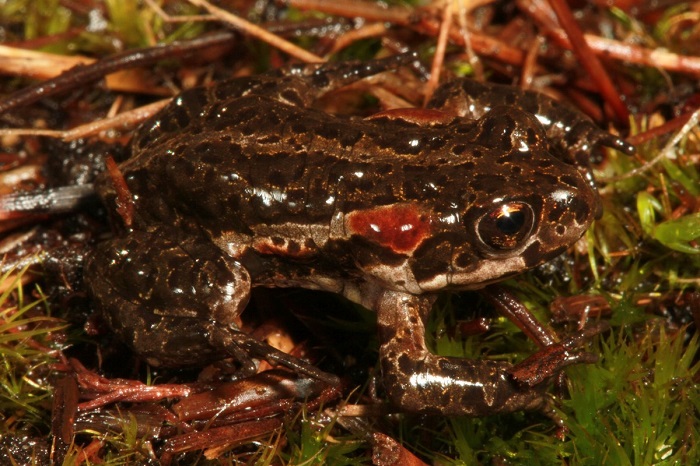
Rose’s Mountain Toadlet is a small Bufonid with an elongated body that reaches a length of c.28 mm in males and 39 mm in females (Channing 2001). The dorsum is smooth and soft with scattered blister-like ridges and warts on the back and sides, while the posterior region of the ventrum has heavily granulated skin (Passmore and Carruthers 1995). The pupil is horizontally elliptical. Interestingly, this species lacks external or middle-ear structures (Grandison 1980) and apparently has no advertisement call. The parotid glands are distinct and have an inverted pear shape (when viewed from the rear). There is no webbing between the toes, and the hind limbs are relatively short and better adapted for walking and running than for jumping (Poynton 1964; Wager 1965).
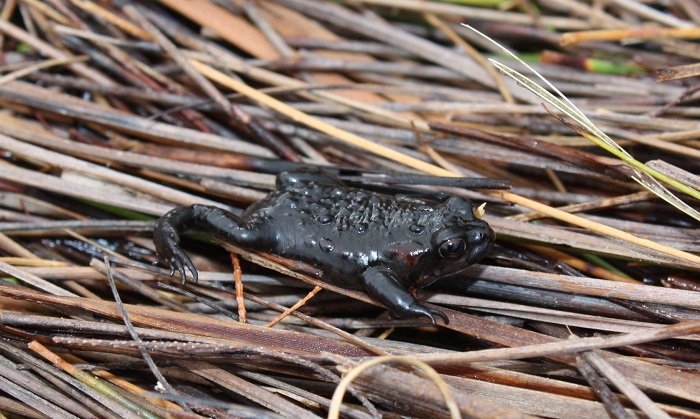
The upper body surface is variably shaded in grey to brown, interspersed with darker spots and blotches. A light vertebral stripe or band and a pair of light dorsolateral bands are usually present. The parotid glands are generally orange to red and markings of the same colour may be present elsewhere on the upper body surface. The underside is white with variable grey shading and some darker markings may be present. These frogs often take on a uniformly blackish appearance when in dark surroundings.
Rose’s Mountain Toadlet most resembles C. magistratus and C. selenophos as these species also lack a tympanum and external or middle-ear structures. Two other Capensibufo species, namely, C. deceptus and C. tradouwi are also similar, but they posess a tympanum and produce advertisement calls (See ‘Similar Species’ below).
Rose’s Mountain Toadlet Capensibufo rosei Silvermine, Western Cape Photo by Luke Kemp
Habitat
Rose’s Mountain Toadlet is restricted to mountains where it occurs in undisturbed Mountain Fynbos. Although it is usually associated with the generally flatter topography on mountain tops, C. rosei has also been recorded from low-lying plateaus on the southern Cape Peninsula.
Breeding takes place in small, shallow, temporary pools of standing water that form during the winter rainy season. The pools can vary in size from c.20 × 20 × 2 cm deep to 250 × 150 × 6 cm deep. The vegetation surrounding breeding pools is usually dominated by restios. Pool substrates generally consist of a dark humic (peaty) or mossy layer on a sandy or rocky base and vary from light grey to almost black depending on the humic content. A breeding site can consist of one or more small pools in a seepage area of, for example, 100 m2. The species is not known to breed in pools of moving water associated with mountain streams.
Behaviour
Rose’s Mountain Toadlet has been seen in all four seasons of the year, but breeds only in late winter and spring. The commencement of breeding is dependent on rainfall and the formation of small, shallow pools of water. There are relatively few published records of C. rosei breeding activity. Spawn has been found in late July to early October.
An unusual characteristic of Capensibufo rosei is the absence of middle-ear elements (Grandison 1980), and it along with C. magistratus and C. selenophos appear to be the only southern African amphibians that lack a voice. Large, dense breeding aggregations and repeated use of the same site may facilitate meeting of the sexes. For example, at least 150–200 adults (and spawn) were observed in a partially divided breeding pool with overall dimensions of 250 × 150 cm and up to 6 cm deep (pers. obs.). (A similar observation was made by Power and Rose, who also described the eggs, tadpoles and metamorphosis of C. rosei (Rose 1962). During the breeding season, a bright pink, oval patch appears below the vent in both sexes (Power and Rose 1929), and a distinct swelling develops in the cloacal region in breeding males. The functions of these structures are not known.
These toads appear to be particular in their choice of breeding site. They have been found to use the same site on a few occasions during a breeding season, despite the presence of other similar small pools in the general vicinity (pers. obs.; southern Cape Peninsula).
The large, pigmented eggs are laid in a single transparent jelly tube that resembles a string of beads in that there is a distinct narrowing of the tube between the egg capsules (Power and Rose 1929). The clutch size is reported to be <100 eggs (Grandison 1980) but the typically dense breeding aggregations can lead to the deposition of thousands of eggs in a single pool. Adults in the breeding pool sometimes hide under the egg masses when disturbed.
The embryos take up to 12 days to leave the egg capsules. The tadpoles are dark in colour and attain a length of about 21 mm, of which more than half comprises the tail. They are benthic in habit, and have been observed feeding on egg capsules, decaying eggs and dead adults. Metamorphosis takes about six weeks, depending on temperature and the availability of food and water. The tiny toads are about 6.25 mm in length when they leave the water.
The predators and prey of this species have not been recorded.
Rose’s Mountain Toadlet Capensibufo rosei Silvermine, Western Cape Photo by Felicity Grundlingh
Status and Conservation
Status
C. rosei was previously listed as Restricted (Branch 1988) and is presently listed as Vulnerable (Harrison et al. 2001; this publication). It is legally protected by Nature Conservation Ordinance 19 of 1974, but is not listed by CITES.
Rose’s Mountain Toadlethas a restricted and fragmented distribution comprising about six subpopulations (sensu IUCN criteria). While most C. rosei habitat is situated in pristine mountain areas, habitat degradation has led to <20% habitat loss over the last 30 years. However, in some areas, the quality of C. rosei habitat is likely to have improved with systematic alien vegetation control programmes. For example, the previously degraded habitat of C. rosei in the Silvermine area on the Cape Peninsula (Boycott 1988e) now falls within Cape Peninsula National Park, and the pine plantations and dense stands of alien vegetation have been removed.
C. rosei is known to occur in the following protected areas: Cape Peninsula National Park (including the former Silvermine Nature Reserve and Cape of Good Hope Nature Reserve), Hottentots Holland, Kogelberg, Fernkloof, Maanschynkop, Vogelgat, Limietberg and Riviersonderend nature reserves.
Threats
In some places, one or more of the following factors have led to degradation or loss of habitat, or are a potential threat to populations of C. rosei. These include invasive alien vegetation, plantations, wildflower farming, alteration of drainage patterns, too frequent fires, building developments such as roads and dams, and urban development on the southern Cape Peninsula. The most pressing of these threats is probably the spread of invasive alien vegetation that eliminates fynbos vegetation and reduces water resources.
The tendency of C. rosei to form dense breeding aggregations at specific sites increases its vulnerability, since the destruction or degradation of a breeding site seriously threatens the continued existence of that local population.
Amphibian declines in some parts of the world have taken place in pristine, high-altitude areas, and this has led to speculation supported by some scientific evidence that global environmental factors are responsible (Beebee 1997). In particular, climatic and atmospheric changes brought about by widespread atmospheric pollution, increased ultraviolet radiation and global warming appear to be the prime causes. These factors may also lower amphibians’ resistance to disease. There is no evidence, at present, that global factors have caused declines in southern African amphibian populations, but such threats may be significant.
Recommended conservation actions
The distribution and conservation status of C. rosei is monitored by the Western Cape Nature Conservation Board (De Villiers 1997a) as part of a threatened species monitoring programme. This helps ensure that appropriate recommendations can be made to promote the conservation and wise management of this species and its habitat. Management of C. rosei habitat is included in the management plans of the respective protected areas and mainly concerns the control of invasive alien vegetation.
Research is underway to investigate the genetic relationships between the various geographically fragmented subpopulations of C. rosei. Life history studies of this species are also in progress. A captive breeding programme for C. rosei is not recommended.
Distribution
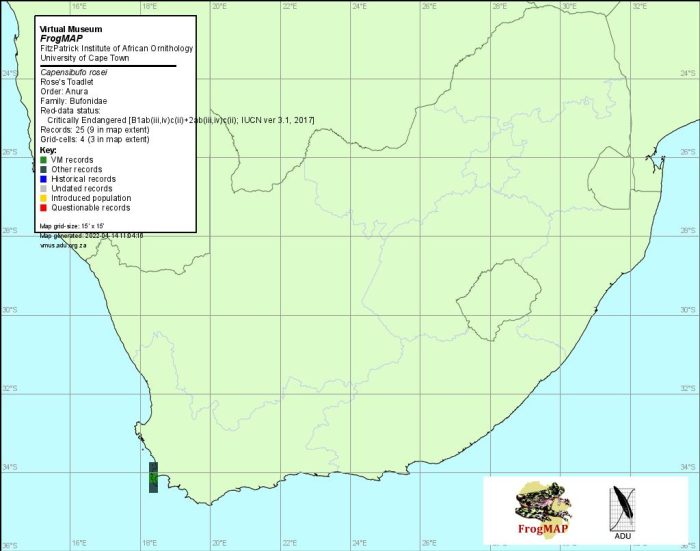
Rose’s Mountain Toadlet is endemic to the winter-rainfall region of the Western Cape Province. It has a limited and patchy distribution. Its populations are restricted to the Cape Peninsula and mountains southwest of the Breede River valley, which extends from the Tulbagh/Worcester valley south-eastward to Witsand on the south coast, and the Nuwekloof gap that separates the Bain’s Kloof Mountains from the mountains to the north (Grandison 1980). Recorded localities vary in altitude from 60 m on the southern Cape Peninsula to 1600 m, although >80% of localities are above 400 m. The areas in which this species occurs receive 600–>3000 mm of rain per annum.
Distribution of Capensibufo rosei. Taken from the FrogMap database, April 2022.
The Rose’s Mountain Toadlet was discovered on the Cape Peninsula (Hewitt 1926a), where it is known from the following localities: Table Mountain (3318CD), Muizenberg Mountain (type locality), Kalk Bay Mountain, Silvermine Valley, Chapman’s Peak and Kommetjie area (all in 3418AB), and Cape of Good Hope area (3418AD). However, the main part of its distribution range lies elsewhere, and includes the following localities: Bailey’s Peak in Limietberge Mountains (a.k.a. Bain’s Kloof Mountains) and Hawekwa Mountains (3319CA), Riviersonderend Mountains (3419BB) including Jonaskop (3319CD) and Kanonberg (3419BA), Klein River Mountains (3419AD), Jakkals River catchment area, Nuweberg Mountain near Viljoen’s Pass, Groenlandberge Mountains, Landdroskop in the Hottentots Holland Mountains (all in 3419AA), Elgin Forest Reserve, and Kogelberg State Forest (3418BB).
Capensibufo rosei has a geographically fragmented distribution pattern that, based on current knowledge, appears to comprise six populations: Table Mountain, southern Cape Peninsula, Hottentots Holland/Kogelberg mountain complex, Dutoitsberge/Limietberge mountain complex, Riviersonderend Mountains, and Klein River Mountains.
In summary, C. rosei has been found in a total of 10 quarter-degree grid cells, all of which were recorded for the first time before 1990. However, since 1996 the species has been recorded in only five of these cells: 3418AB, 3418AD, 3319CA, 3419AA and 3419AD. Most of the latter records were obtained in 2000 during a threatened frog monitoring programme (De Villiers 1997a).
This small, cryptic toad is difficult to find in its remote montane habitat. However, the distribution data are accurate and it is unlikely that the limits of the species’ range will be extended by further surveys.
Further Resources
The use of photographs by Felicity Grundlingh, Luke Kemp, and Megan Loftie Eaton is acknowledged.
Other Common Names: Gestreepte Skurwepadda (Afrikaans)
Recommended citation format: de Villiers, AL; Tippett, RM. (2025). Rose’s Mountain ToadletCapensibufo rosei. Biodiversity and Development Institute, Cape Town. Available online at https://thebdi.org/2021/12/20/roses-mountain-toadlet-capensibufo-rosei/
This species text has been updated and expanded from the text in the 2004 frog atlas: de Villiers, AL. (2004). Rose’s Mountain Toadlet Capensibufo rosei. In Minter LR et al 2004.
References:
Minter, LR; Burger, M; Harrison, JA; Braack, HH; Bishop, PJ; Kloepfer, D. (Editors). (2004). Atlas and Red Data Book of the Frogs of South Africa, Lesotho and Swaziland. Smithsonian Institution, Washington, and Avian Demography Unit, Cape Town.
Carruthers, V; du Preez, L. (2017). Frogs of southern Africa: A Complete Guide. Struik Nature, Cape Town.
Channing, A. (2001) Amphibians of Central and Southern Africa. Protea Book House, Pretoria
Find the Tradouw MountainToadlet in the FBIS database (Freshwater Biodiversity Information System) here.
Family Bufonidae
Identification
The Tradouw Mountain Toadlet is a small Bufonid that attains a maximum size of 48mm. It has a toad-like appearance, but unlike true toads, it has smooth skin with blister-like ridges and warts, and the body is somewhat elongated.
The dorsal surface colouration varies from dark reddish-brown to black, with shades of grey and with scattered dark blotches. A pale vertebral stripe is often, but not always, present. The parotid glands are prominent and orange to red in colour. A row of orange-red warts is found along the flanks. The tympanum is visible and is smaller than the eye. The underside is white with variable dark grey mottling.
Tradouw MountainToadletCapensibufo tradouwi Wolfberg Arch, Western Cape Photo by Paul Bester
Habitat
The Tradouw Mountain Toadlet occurs at high altitudes in mountainous terrain where it inhabits Mountain Fynbos and Grassy Fynbos. Most of its range lies within the western winter-rainfall region, but in the east extends into the zone of transition to summer rainfall.
Breeding takes place on mountain slopes and valley bottoms in shallow pools in seepage areas, moist depressions, vleis and slow streams. A breeding site on the slopes of Matroosberg in the Hex River Mountains consisted of rock pools varying in depth from a few to several centimetres, in a large expanse of exposed bedrock above a waterfall. Clumps of reeds and grass growing in the cracks provided limited shade to the pools that, in most cases, were on the bedrock and exposed to direct sunlight (pers obs).
Behaviour
During the day, adults shelter under rocks but may also be found in the open near seepage areas. Diurnal activity is especially common during the breeding season, June–September, when males are often found walking about at the breeding site. A number of tadpoles, found in rock pools at Matroosberg toward the end of October 1982, had hindlimbs, indicating that spawning had taken place in September, assuming that C. tradouwi has a developmental period similar to C. rosei, that is, 25–30 days (pers. obs.).
At the end of October, Tradouw MountainToadlets were common at the Matroosberg locality, with >20 specimens seen over a two-day period. They were found under stones lying on bedrock in seepage areas, and even on the high, dry slopes. A somewhat later breeding period was recorded at the eastern-most locality in the Tsitsikamma Mountains. Here, males were observed calling in late November 1993, in close proximity to small pools containing tadpoles (M. Burger pers. comm.).
Tradouw MountainToadletCapensibufo tradouwi Op de Berg, Western Cape Photo by Nick Helme
The males call from the edge of shallow pools, often from concealed positions (Channing 2001). Amplexus is axillary. The eggs are unusual in that they are laid singly; in most bufonids, including C. rosei, they are laid in strings. The clutch size is c.60 eggs which are 2 mm in diameter and black at one pole (Channing 2001).
The tadpoles are dark, with unusually long undulating tails, and are benthic in habit (Passmore and Carruthers 1995). At the Matroosberg site, small black tadpoles were densely packed in the pools in plain sight. In some of the larger pools in the bedrock, as many as 100 tadpoles were found, while in the smallest pools, several tadpoles were present. Tadpoles were also found sheltering under small rocks that were lying in some of the pools.
Status and Conservation
The Tradouw MountainToadlet has a wide distribution in the southwestern and southern parts of the Western Cape Province, in remote mountainous areas. It occurs in a number of protected areas, including Cederberg Wilderness Area, Grootvadersbosch Nature Reserve and Formosa Conservation Area, and does not appear to be threatened. Nevertheless, there have been few recent observations of C. tradouwi, and it is recommended that surveys be undertaken to confirm its current status.
Distribution
The Tradouw MountainToadlet is endemic to the Cape fold mountains in the southwest and south of the Western Cape Province (Grandison 1980), with the most easterly locality marginally entering Eastern Cape Province at Misgund (3323CD) in the Tsitsikamma Mountains. The species occurs north and east of the Berg and Breede river valleys, from the Matsikammaberg (3118DD) near Vanrhynsdorp in the north, southward to the Hex River Mountains, and eastward along the Langeberg mountain range to the Outeniqua, Swartberg and Kammanassie ranges. The species is recorded at altitudes of 1000–1600 m.
The atlas data are accurate but incomplete.
Distribution of Capensibufo tradouwi. Taken from the FrogMap database, April 2022.
Further Resources
The use of photographs by Nick Helme and Paul Bester is acknowledged.
Other Common Names: Tradouw-bergskurwepadda (Afrikaans)
Recommended citation format: Boycott, RC; Tippett, RM. (2025). Tradouw MountainToadletCapensibufo tradouwi. Biodiversity and Development Institute, Cape Town. Available online at https://thebdi.org/2021/12/20/tradouw-mountain-toadlet-capensibufo-tradouwi/
This species text has been updated and expanded from the text in the 2004 frog atlas: Boycott, RC. (2004). Tradouw MountainToadletCapensibufo tradouwi. In Minter LR et al 2004.
References:
Minter, LR; Burger, M; Harrison, JA; Braack, HH; Bishop, PJ; Kloepfer, D. (Editors). (2004). Atlas and Red Data Book of the Frogs of South Africa, Lesotho and Swaziland. Smithsonian Institution, Washington, and Avian Demography Unit, Cape Town.
Carruthers, V; du Preez, L. (2017). Frogs of southern Africa: A Complete Guide. Struik Nature, Cape Town.
Channing, A. (2001) Amphibians of Central and Southern Africa. Protea Book House, Pretoria
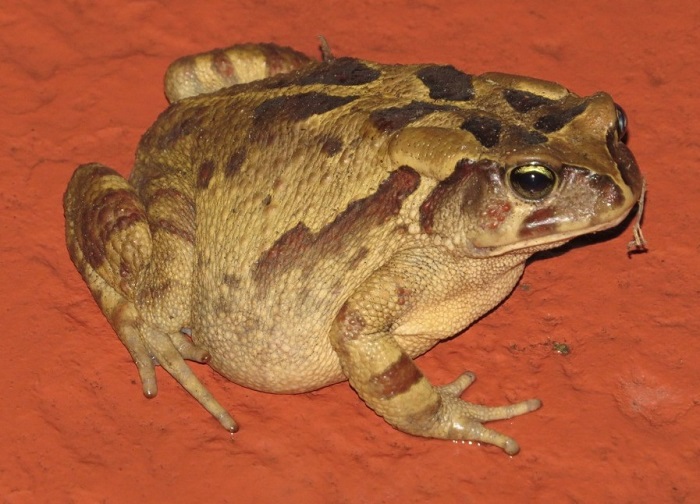
View the above photo record (by Gregg Darling) in FrogMAPhere.
Find the Eastern Leopard Toad in the FBIS database (Freshwater Biodiversity Information System) here.
Family Bufonidae
EASTERN LEOPARD TOAD – Sclerophrys pardalis
(Hewitt, 1935)
Habitat
S. pardalis inhabits grassy or open bushveld areas, parks and gardens in the Thicket, Grassland and Savanna biomes, and uses large, permanent water bodies for breeding (Lambiris 1989a). It appears to prefer ecotonal habitat with moist cover. Records from Stutterheim and Woody Cape are close to patches of Afromontane Forest and Coastal Forest, respectively. The south coast populations may occur, to a limited extent, in fynbos vegetation types.
Behaviour
Like its western counterpart, S. pardalis is a late-winter or spring breeder. Choruses are typically heard from August to September, but calling is also recorded from November through to January (Burger 1997). Channing (2001) also noted calling in November. Calling behaviour was studied by Passmore (1977b) who confirmed earlier reports that this large toad usually calls while floating in the water in a manner similar to Schismaderma carens. Lambiris (1989a) noted that in Grahamstown, males call in water deeper than 80 cm while grasping emergent vegetation with one hand.
This is the largest southern African bufonid attaining a snout–vent length of 147 mm and a mass of 410.7 g (Branch 1995). Captive specimens feed readily on crickets, grasshoppers, small mice (pers. obs.) and lizards (Channing 2001). It is presumed that they feed on a variety of arthropods in the wild.
Status and Conservation
This species has been recorded from Addo Elephant National Park (Branch and Braack 1987), Groendal Wilderness Area, Thomas Baines Nature Reserve and Woody Cape Nature Reserve, and is likely to occur in several other protected areas. S. pardalis is assigned to the category Least Concern (Harrison et al. 2001; this publication).
Although it may still be common at some localities, the impact of agricultural and urban development has led to fragmentation and degradation of this species’ habitat, a reduction in population numbers and possibly even local extinctions. During the breeding season, large numbers are killed by motor vehicles on roads situated near wetlands: for example, 113 S. pardalis were killed in one night along an 8-km stretch of road near Port Elizabeth (Branch 1980). The conservation actions recommended for S. pantherinus would also be appropriate for S. pardalis, especially in built-up areas.
Until recently, S. pardalis was regarded as having a disjunct distribution, with one population restricted to the southwestern coastal areas of Western Cape Province and the other confined, mainly, to Eastern Cape Province (see map in Passmore and Carruthers 1995). However, the western population was raised to the status of a full species, Sclerophrys pantherinus, by Poynton and Lambiris (1998) on the basis of morphological differences, a decision supported by Eick et al. (2001; see S. pantherinus species account for further discussion).
S. pardalis is nearly endemic to the Eastern Cape Province with only a few records in the Western Cape and KwaZulu-Natal. The isolated record from Albert Falls (2930AD) in KwaZulu-Natal (Lambiris 1989a, 1994) requires confirmation by acoustic or genetic studies.
This toad is most common along the coast from Port Elizabeth northwards to East London. Inland records include Grahamstown, Kei Road (the type locality) and Stutterheim. Branch (1990) also recorded it from the Amatola Mountains and Katberg area. A recent record from Umtata (3128DB) represents another interesting, apparently isolated, population. Similarly, the recent Karatara (3322DD) and Knysna (3423AA) records are interesting in that they confirms the southwestern limit of the species’ range in the vicinity of Wilderness (Branch and Braack 1987). The atlas data are accurate but incomplete.
Distribution of Sclerophrys pardalis. Taken from the FrogMAP database, April 2022
Further Resources
Virtual Museum (FrogMAP > Search VM > By Scientific or Common Name)
More common names: Oostelike LuiperdSkurwepadda (Afrikaans)
Recommended citation format for this species text:
Burger M, Tippett RM. Eastern Leopard Toad Sclerophrys pardalis. BDI, Cape Town. Available online at http://thebdi.org/2021/12/20/eastern-leopard-toad-sclerophrys-pardalis/
Recommended citation format:
This species text has been updated and expanded from the text in the 2004 frog atlas. The reference to the text and the book are as follows:
Burger M 2004 Sclerophrys pardalis Eastern Leopard Toad. In Minter LR et al 2004.
Minter LR, Burger M, Harrison JA, Braack HH, Bishop PJ, Kloepfer D (eds) 2004. Atlas and Red Data Book of the Frogs of South Africa, Lesotho and Swaziland. Smithsonian Institution, Washington, and Avian Demography Unit, Cape Town.
View the above photo record (by Christopher Willis) in FrogMAPhere.
Find the Flat-backed Toad in the FBIS database (Freshwater Biodiversity Information System) here.
Family Bufonidae
FLAT-BACKED TOAD – Sclerophrys pusilla
Hallowell, 1854
Habitat
In the atlas region, this species inhabits various vegetation types within the Savanna and Grassland biomes, on the Zululand coastal plain (Lambiris 1989a), in the Swaziland lowveld and middleveld (Boycott 1992), and in the lowveld and bushveld of northeastern South Africa (Jacobsen 1989). It is usually associated with riverine habitats: in Swaziland the species is almost always associated with medium and large rivers and is seldom found at pans, borrow pits or dams. In Ivory Coast, the species occurs in both forest and savanna habitats.
Breeding habitat is riverine. During the dry season in Ivory Coast, the species breeds alongside rivers in small, shallow inlets and puddles created by rising and falling water, as well as in rock-pools, while in the wet season it moves away from rivers to forage in gallery forest or forms new choruses in savanna, usually in periodic brooks (Rödel 2000).
At Pafuri, in the north of Kruger National Park, adults and juveniles have been found sheltering under rocks, logs, piles of dead leaves and branches, and building debris (H. Braack pers. comm.).
Behaviour
Breeding takes place from September to January in Kruger National Park (H. Braack pers. comm.), while in Ivory Coast it occurs throughout the year (Rödel 2000). Some authors recorded an increase in breeding activity during dry periods (Channing 1989; Rödel 2000).
In Swaziland, and elsewhere in the atlas region, the species calls from well-concealed positions amongst reeds, grass or rocks, next to or in rivers and streams where there is fast-flowing water (Jacobsen 1989; pers obs.). In Zimbabwe, calling from exposed sites has been observed (Lambiris 1989b). Calling takes place at night and during the day.
The calls are often antiphonal, with individuals calling at slightly different pitches so that alternate calls are readily distinguishable (Pienaar et al. 1976; Lambiris 1989a). Females approach calling males and make contact prior to amplexus (Channing 2001). Amplexus is axillary. Wager (1986) recorded eggs 1.2 mm in diameter in a single jelly tube 3 mm thick, while Tandy and Keith (1972) asserted that all African Sclerophrys species produce two egg strings. In Ivory Coast, Sclerophrys pusilla produces two egg strings simultaneously from the cloaca, containing 2000–8000 eggs, 1.5 mm in diameter (Rödel 2000). The egg strings are deposited at the bottom of a pool or wound around stones or twigs. Tadpoles reach metamorphosis within six weeks in captivity and in as little as two weeks in the wild (Rödel 2000).
Sandflies are known to feed on the blood of Sclerophrys pusilla (Braack et al. 1981), while juveniles and adults are preyed on by the Common Night Adder Caususrhombeatus (Pienaar et al. 1976). In Ivory Coast, the Spotted Night Adder Causus maculatus and a scorpion Pandinus imperator were recorded as predators (Rödel 2000). In savanna pools in Ivory Coast, tadpoles of the Crowned Bullfrog Hoplobatrachus occipitalis feed on the tadpoles of Sclerophrys pusilla (Rödel 2000), while in the atlas region they are sometimes taken by Mozambique Tilapia Oreochromis mossambicus (H. Braack pers. comm.). Adults feed mainly on ants, but also on beetles and alate termites (Rödel 2000).
Sclerophrys pusilla is widespread and common, occurring in several national parks and other protected areas in South Africa and Swaziland (Jacobsen 1989; Lambiris 1989a; Boycott 1992). Much of its habitat is well protected in cattle and game farming areas; consequently the species is not threatened.
Sclerophrys pusilla is widespread, occurring in East Africa and southern Africa. The species is found in northeastern South Africa, reaching its southern limits in Swaziland and northern KwaZulu-Natal. In Swaziland it occurs at altitudes of 90–790 m, and in South Africa, from 40–1700 m (Jacobsen 1989). These toads occur quite far inland in Swaziland and adjacent South Africa, where their distribution range extends up the larger river valleys, including the Nkomati, Mlumati, Elands, Olifants and Limpopo rivers.
This species is easily identified by its call. The atlas data are accurate but incomplete.
Distribution of Sclerophrys pusilla. Taken from the FrogMAP database, April 2022.
Further Resources
Virtual Museum (FrogMAP > Search VM > By Scientific or Common Name)
More common names: Gestreepte Skurwepadda (Afrikaans)
Recommended citation format for this species text:
Boycott RC, Tippett RM. Flat-backed Toad Sclerophrys pusilla. BDI, Cape Town. Available online at http://thebdi.org/2021/12/18/flat-backed-toad-sclerophrys-pusilla/
Recommended citation format:
This species text has been updated and expanded from the text in the 2004 frog atlas. The reference to the text and the book are as follows:
Boycott RC 2004 Sclerophrys pusilla Flat-backed Toad. In Minter LR et al 2004.
Minter LR, Burger M, Harrison JA, Braack HH, Bishop PJ, Kloepfer D (eds) 2004. Atlas and Red Data Book of the Frogs of South Africa, Lesotho and Swaziland. Smithsonian Institution, Washington, and Avian Demography Unit, Cape Town.
Find the Namaqua Rain Frog in the FBIS database (Freshwater Biodiversity Information System) here.
Family Brevicipitidae
Identification
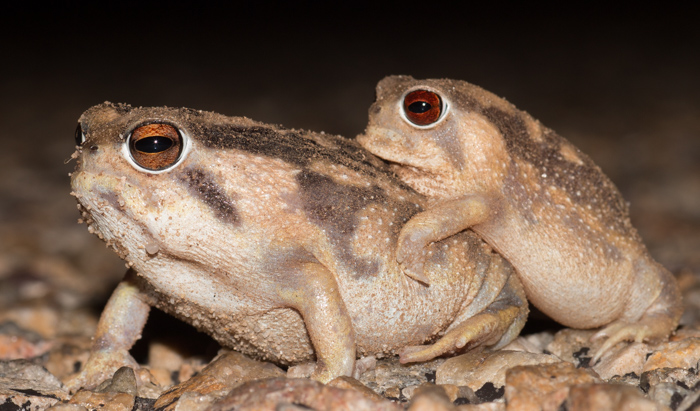
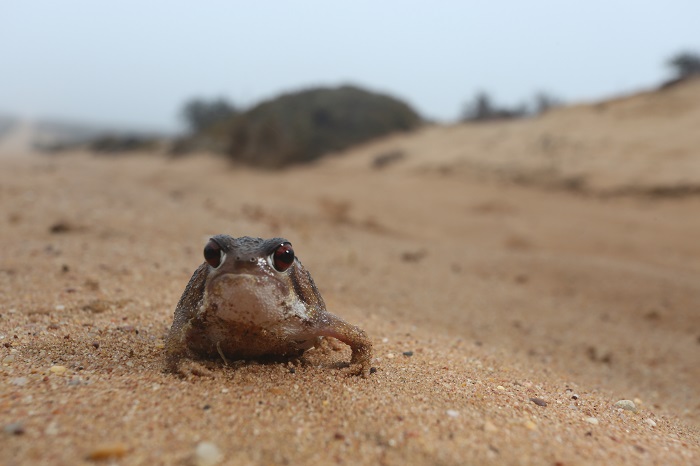
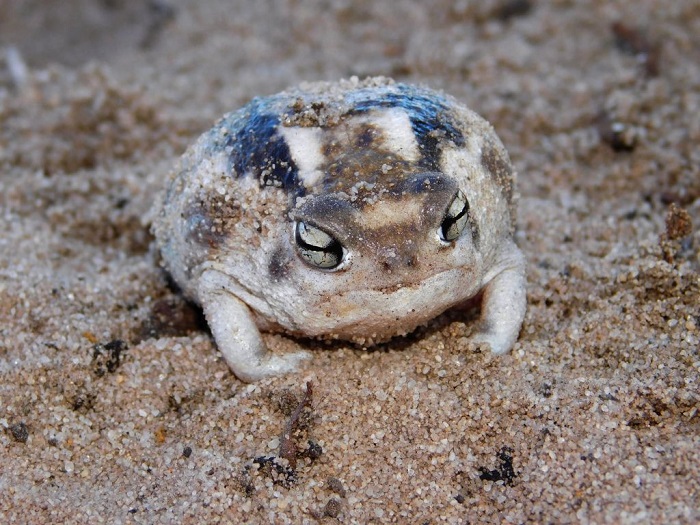
The Namaqua Rain Frog female reaches a length of 45mm; males are smaller. The dorsal surface is dark brown with lighter sides, and the underside is white and smooth. The eyes are relatively large. Namaqua Rain Frogs have well-developed double tubercles beneath the toes.
Namaqua Rain FrogBreviceps namaquensis West Coast National Park, Western Cape Photo by Trevor Hardaker
Habitat
The Namaqua Rain Frog appears to favour deep, scrub-covered red sands in the Succulent Karoo Biome. Specifically in the Strandveld and Lowland Succulent Karoo vegetation types. The harsh, brackish soils of the Knersvlakte are avoided. Unlike B. macrops, this species is not confined to coastal dunes and substantial populations were encountered in the interior.
Behaviour
Little is known about the life history of the Namaqua Rain Frog. It is presumably similar to that of other members of the genus.
Namaqua Rain FrogBreviceps namaquensis North of Papendorp, Western Cape Photo by Erlo Brown
Calling takes place mainly in winter and spring, during and following good rain. Sporadic calling has also been noted in early summer and autumn in the western Richtersveld and during periods of heavy mist following recent rain (pers. obs.). Males call from concealed positions beneath vegetation, in scrub-covered sandy areas (pers. obs.; Channing 2001).
Advertisement calls of B. namaquensis, recorded by A. de Villiers at Rocherpan Nature Reserve, had an emphasized frequency of 1600 Hz rising to 2000 Hz. The calls were 160–165 ms in duration and were repeated at a rate of about one call per second (L.R. Minter pers. comm.). The calls of this species are higher pitched and much shorter than the calls of B. macrops (see species account). It makes a squeaky distress call; listen to it here.
Status and Conservation
The Namaqua Rain Frog is protected by ordinances of the Northern Cape and Western Cape provincial nature conservation agencies. The species occurs in the Corridor West (2917AA, CA) area of the Richtersveld National Park and in the Rocher Pan Nature Reserve (A. de Villiers pers. comm.).
In the southern half of its range, certain parts of its habitat have been exploited for agriculture and development, but in general this species is not under threat.
Namaqua Rain FrogBreviceps namaquensis Soutkloof farm, Western Cape Photo by Paul Bester
Because so little is known about the Namaqua Rain Frog, it is recommended that further studies on its distribution and general biology be undertaken. Regular monitoring of protected populations is advisable and would certainly yield new and useful information.
Distribution
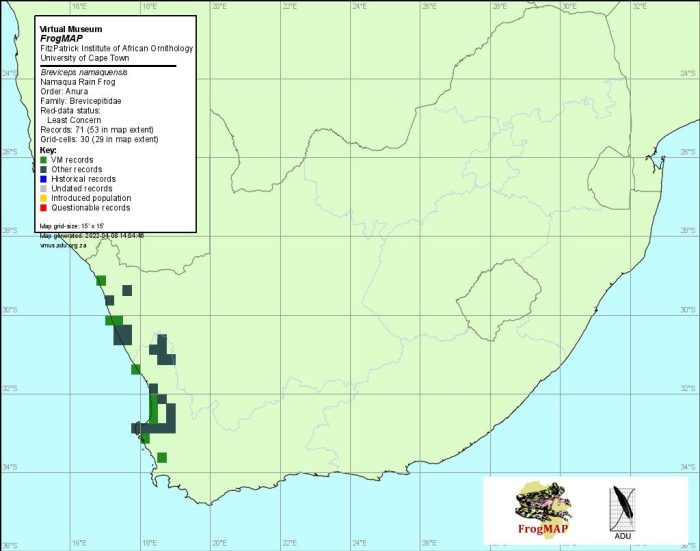
The Namaqua Rain Frog is endemic to the atlas region. It occurs in the predominantly winter-rainfall Namaqualand region of the Northern Cape and Western Cape provinces, from near the Gariep (Orange) River in the north (2816DA) to the Melkbos district (3318CB, DA) in the south. V.C. Carruthers (unpubl. data) recorded a specimen of B.namaquensis disgorged by a snake near Elands Bay (3218AD). The escarpment and the Namaqualand and Richtersveld mountains form the eastern limit of this species’ distribution.
Distribution of Breviceps namaquensis. Taken from the FrogMAP database, April 2022.
In the northern part of its range in Port Nolloth (2917AC), Holgat River (2816DD), Alexander Bay (2816CB) and surrounding districts, B.namaquensis occurs in sympatry with B. macrops. It is sympatric with B. rosei in the southern reaches of its range. Morphological and call differences between the three species easily separate them, and the atlas data are reliable. Gaps in the recorded distribution of this frog probably indicate inadequate surveying rather than a real absence of the species.
Further Resources
The use of photographs by Erlo Brown, Paul Bester, Trevor Hardaker, and Vaughan Jessnitz is acknowledged.
Recommended citation format: Braack, HH; Tippett, RM. (2025). Namaqua Rain Frog Breviceps namaquensis. Biodiversity and Development Institute, Cape Town. Available online at https://thebdi.org/2021/12/17/namaqua-rain-frog-breviceps-namaquensis/
This species text has been updated and expanded from the text in the 2004 frog atlas: Braack, HH. (2004). Namaqua Rain Frog Breviceps namaquensis. In Minter LR et al 2004.
References:
Minter, LR; Burger, M; Harrison, JA; Braack, HH; Bishop, PJ; Kloepfer, D. (Editors). (2004). Atlas and Red Data Book of the Frogs of South Africa, Lesotho and Swaziland. Smithsonian Institution, Washington, and Avian Demography Unit, Cape Town.
Carruthers, V; du Preez, L. (2017). Frogs of southern Africa: A Complete Guide. Struik Nature, Cape Town.
Channing, A. (2001) Amphibians of Central and Southern Africa. Protea Book House, Pretoria
Claus, B; Claus, R. (2002). Common Amphibians and Reptiles of Botswana. Gamsberg Macmillan, Windhoek.
Find the Mozambique Rain Frog in the FBIS database (Freshwater Biodiversity Information System) here.
Family Brevicepitidae
Identification
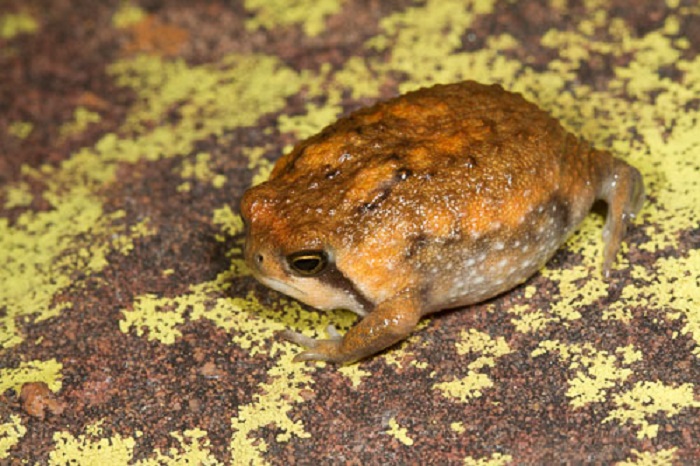
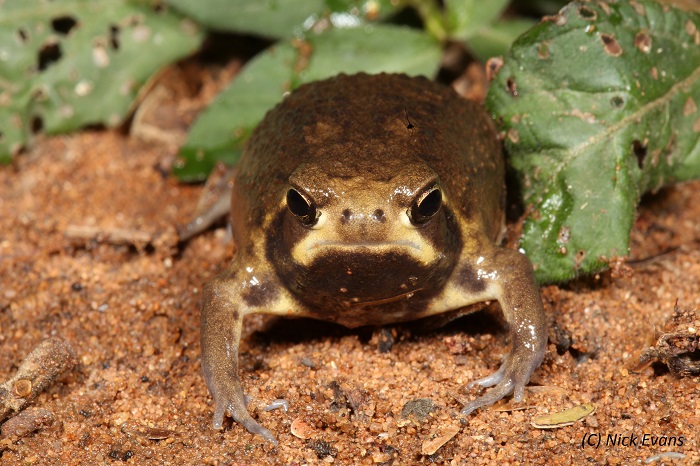
The Mozambique Rain Frog attains a maximum length of 52mm. Females are larger than males. The body is rotund with short legs and small eyes.
In the atlas region, the Mozambique Rain Frog exhibits considerable intra- and inter-population variation in colour and markings. Most individuals have light paravertebral and dorsolateral patches (see illustrations in Passmore and Carruthers 1995) differing, in this respect, from the northern Mozambique populations of the species. Due to the presence of similar markings in B.sopranus, B. bagginsi and B. adspersus, this character is of little diagnostic value. This weakens the assertion, based mainly on the presence, absence or extent of dorsal markings (Poynton 1964; Poynton and Broadley 1985a; Lambiris 1989a), that mossambicus and adspersus hybridise extensively in sympatry. In addition, a study of advertisement call structure found little evidence of hybridisation between these species (Minter 1998). At present, these species are morphologically indistinguishable, and identification should be based on advertisement call structure.
Mozambique Rain Frog Breviceps mossambicus Marakele National Park, Limpopo Photo by A. Coetzer
Habitat
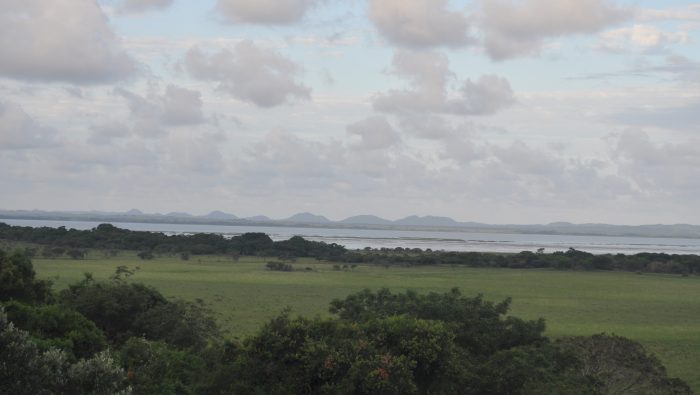
The Mozambique Rain Frog inhabits parts of the Savanna and Grassland biomes where the annual rainfall exceeds 700 mm per year. Coastal populations of B. mossambicus in KwaZulu-Natal and the Eastern Cape inhabit well-drained, sandy soils in Coastal Bushveld-Grassland, Coast-Hinterland Bushveld and Natal Lowveld Bushveld. At higher altitudes, this species occurs along the crest and slopes of the escarpment; vegetation types include Moist Sandy Highveld Grassland, Moist Upland Grassland, Short Mistbelt Grassland, and North-eastern Mountain Grassland. The soil is usually shallow, well drained, humus-rich, and often rocky.
Habitat in Coastal Grassland on well-drained, sandy soil. Western Shores, iSimangaliso Wetland Park, KwaZulu-Natal. Photo by Ryan Tippett
Behaviour
The Mozambique Rain Frog breeds mostly in spring or early summer after soaking rains, although strong choruses sometimes form after rain at other times of the year (pers. obs.). Dry periods are spent below the surface, often under rocks or next to the foundations of walls, where soil moisture levels are higher (Minter 1997). In overcast or misty conditions, calling may continue unchecked for several days and nights (Minter 1998). Calling activity is also influenced by temperature: the chorus intensity usually drops in the early hours of the morning when temperatures are low, but increases again after sunrise, and persists until mid-morning, even on clear, hot days (pers. obs.). During the day, calling usually takes place from well-concealed, shallow depressions, but at night males often move about on the surface, calling from one location for a while before moving to another (Minter 1997, 1998).
Mozambique Rain FrogBreviceps mossambicus Near Hluhluwe, KwaZulu-Natal Photo by Nick Evans
Amplexus is by adhesion and oviposition takes place in a chamber below the soil surface. Nests excavated near Wakkerstroom were located below loose rocks on the hill slopes or under old, dry tree trunks. Females remained in the vicinity of the nests, which contained 20–25 eggs; metamorphosis was completed after 6–8 weeks (FitzSimons and Van Dam 1929; Swanepoel 1970).
After good rains, adults often emerge in large numbers from their places of concealment, to feed on alate termites (pers. obs.). At such times, many are killed on the roads.
Status and Conservation
The Mozambique Rain Frog is widely distributed in a variety of habitats and does not appear to be at risk. It occurs in a number of provincial nature reserves and national parks.
Distribution
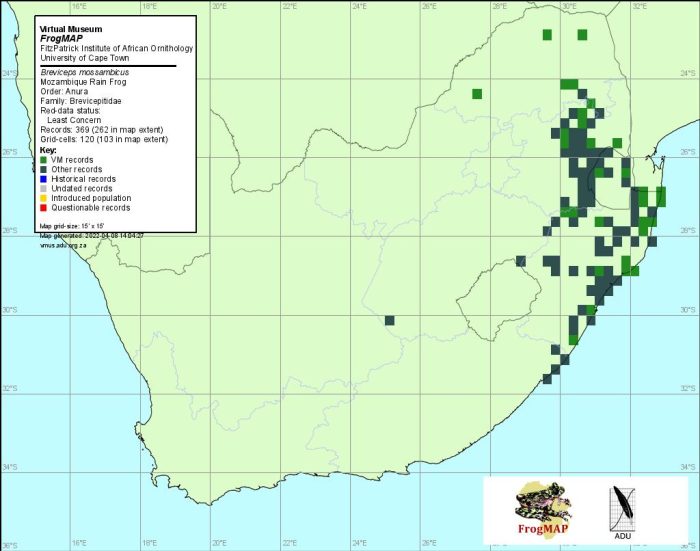
The extralimital distribution of B. mossambicus includes southern Tanzania, Malawi, Mozambique, Zambia, Zimbabwe, and eastern Botswana (Poynton and Broadley 1985a). In the atlas region, the Mozambique Rain Frog occurs on the coastal plain of KwaZulu-Natal, extending southward as far as Mkambati (3129DA) in Eastern Cape Province. In the interior it is found in the foothills and along the crest of the Lebombo Mountains and the Great Escarpment of KwaZulu-Natal, Swaziland, Mpumalanga and Limpopo Province, extending northward as far as Haenertsburg (2329DD). The populations along the escarpment, for example, those near Wakkerstroom (2730AD), referred to B.adspersus pentheri by Poynton (1964), were assigned to B. mossambicus on the basis of advertisement call structure (Minter 1998).
Distribution of Breviceps mossambicus. Taken from the FrogMAP database, April 2022.
The atlas data are based largely on advertisement calls and associated specimens and are considered to be reliable (Minter 1998).
Further Resources
The use of photographs by A. Coetzer, Heather Hodgson, and Nick Evans is acknowledged
Other Common Names: Mosambiekse Reënpadda (Afrikaans)
Recommended citation format: Minter, LR; Tippett, RM. (2025). Mozambique Rain FrogBreviceps mossambicus. Biodiversity and Development Institute, Cape Town. Available online at https://thebdi.org/2021/12/16/mozambique-rain-frog-breviceps-mossambicus/
This species text has been updated and expanded from the text in the 2004 frog atlas: Minter, LR. (2004). Mozambique Rain FrogBreviceps mossambicus. In Minter LR et al 2004.
References:
Minter, LR; Burger, M; Harrison, JA; Braack, HH; Bishop, PJ; Kloepfer, D. (Editors). (2004). Atlas and Red Data Book of the Frogs of South Africa, Lesotho and Swaziland. Smithsonian Institution, Washington, and Avian Demography Unit, Cape Town.
Carruthers, V; du Preez, L. (2017). Frogs of southern Africa: A Complete Guide. Struik Nature, Cape Town.
Channing, A. (2001) Amphibians of Central and Southern Africa. Protea Book House, Pretoria
Claus, B; Claus, R. (2002). Common Amphibians and Reptiles of Botswana. Gamsberg Macmillan, Windhoek.