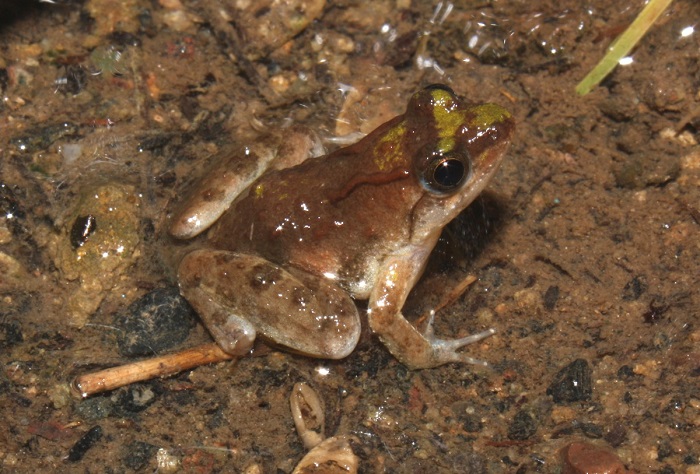
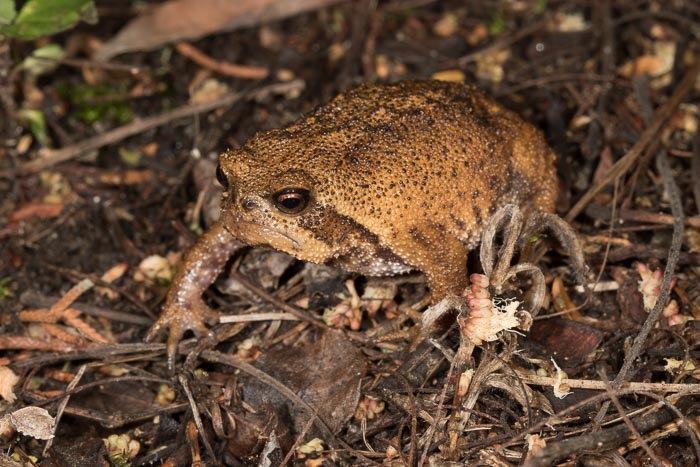
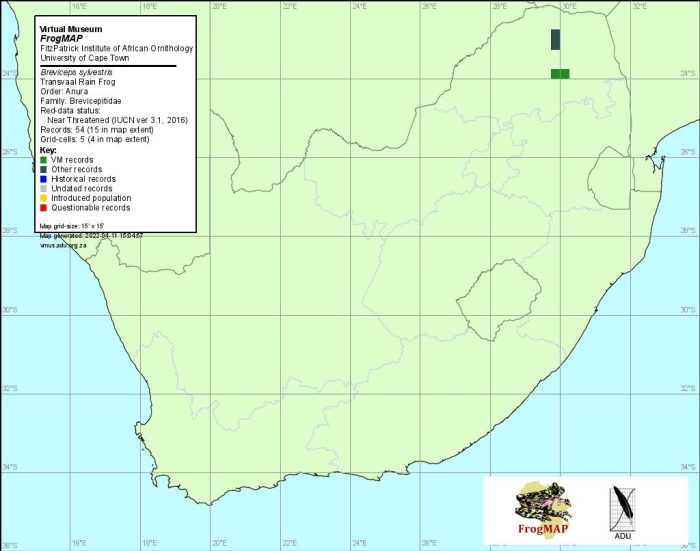
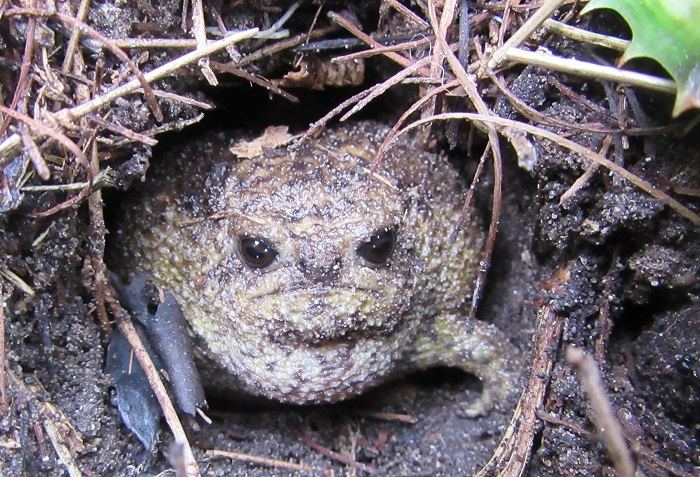
View the above photo record (by Ryan van Huysteen) in FrogMAPhere.
Find the Plain Grass Frog in the FBIS database (Freshwater Biodiversity Information System) here.
Family Ptychadenidae
PLAIN GRASS FROG – Ptychadena anchietae
(Bocage, 1867)
Habitat
P. anchietae is a widespread inhabitant of the savanna biome in the northeastern part of the atlas region, between 20 and 1450 m a.s.l. It occurs in relatively moist, coastal bushveld vegetation types with a minimum annual rainfall in excess of 600 mm, as well as in more arid habitats such as Mixed Bushveld, which experiences a minimum annual rainfall of 350 mm (Low and Rebelo 1996). Individuals are often found sheltering amongst grass and plant debris on the edges of their breeding sites, which include temporary pans, shallow pools in riverbeds, borrow pits, waterholes, as well as more permanent vleis and dams (Stewart 1967; Jacobsen 1989).
Behaviour
These frogs are active on the surface throughout the year in areas where standing water is present or the soil is damp. They are able to survive lengthy periods of hot, dry weather by taking shelter to avoid desiccation.
In late winter to early spring, adults begin to congregate around permanent water bodies. At this time, vocalization is restricted to infrequent, quiet, low trills, which differ from the advertisement call (L.R.M. pers. obs.). Breeding choruses develop after the first spring rains, through to late summer or autumn (October–February at Hans Merensky Nature Reserve: L.R.M. pers. obs.). In wet weather, sporadic calling may be heard during the day, but normally commences in the early evening, peaking between 21:00 and 02:00 (Passmore 1978).
Males call from bare or sparsely vegetated areas of the shoreline, usually within 20 cm of the water’s edge. The average distance between calling males is about 80 cm; a distance of less than 20 cm usually elicits a territorial call that results in one of the males moving away from the other (Passmore 1978).
Eggs are laid in shallow water in floating clumps of up to 300, which adhere to vegetation or sink if disturbed. The tadpoles break out of the jelly capsule after 24 hours and develop rapidly (Stewart 1967), undergoing metamorphosis and leaving the water three weeks later (L.R.M. unpubl. data).
The diet includes grasshoppers, crickets, beetles and other insects (Barbour and Loveridge 1928).
Status and Conservation
P. anchietae does not appear to be at risk as much of its habitat is used for game and cattle farming and is relatively undisturbed. The species occurs in a number of provincial nature reserves and national parks.
Distribution
P. anchietae occurs in savanna habitat in all sub-Saharan countries from Angola to Ethiopia in the north, southward to eastern Namibia (Caprivi), eastern Botswana, Zimbabwe and Mozambique (Poynton and Broadley 1985b). In the atlas region, it occurs in the eastern half of North West Province, northern Gauteng, throughout Limpopo Province, northern and eastern Mpumalanga, central and eastern Swaziland and northern and eastern KwaZulu-Natal. It has been recorded as far west as Barberspan (2625DA) and as far south as Gingindlovo (2931BA). There is one atlas record in the northern Free State (2726AD).
This common species has an extended breeding period and is easily detected by its call. The atlas data are relatively complete and reliable.
Distribution of Ptychadena anchietae. Taken from the FrogMAP database as at January 2022.
Further Resources
Virtual Museum (FrogMAP > Search VM > By Scientific or Common Name)
More common names: Anchieta’s Ridged Frog (Alternative English Name); Rooirug-graspadda (Afrikaans)
Recommended citation format for this species text:
Minter LR, Passmore NI, Tippett RM. Plain Grass Frog Ptychadena anchietae. BDI, Cape Town. Available online at http://thebdi.org/2022/02/07/plain-grass-frog-ptychadena-anchietae/
Recommended citation format:
This species text has been updated and expanded from the text in the 2004 frog atlas. The reference to the text and the book are as follows:
Minter LR, Passmore NI 2004 Ptychadena anchietae Plain Grass Frog. In Minter LR et al 2004.
Minter LR, Burger M, Harrison JA, Braack HH, Bishop PJ, Kloepfer D (eds) 2004. Atlas and Red Data Book of the Frogs of South Africa, Lesotho and Swaziland. Smithsonian Institution, Washington, and Avian Demography Unit, Cape Town.
View the above photo record (by Luke Verburgt) in FrogMAPhere.
Find the East African Puddle Frog in the FBIS database (Freshwater Biodiversity Information System) here.
Family Phrynobatrachidae
EAST AFRICAN PUDDLE FROG – Phrynobatrachus acridoides
(Cope, 1867)
Habitat
P. acridoides inhabits forest and wooded savanna, breeding in pans, ditches and flooded grassy depressions, often in sandy areas (Stewart 1967). It has been found at altitudes below 200 m on the northern coastal plain of KwaZulu-Natal. This area receives annual rainfall of 750–1000 mm.
Behaviour
Little is known of the life history of this frog. Breeding takes place in summer (January–May in Malawi). The males call from shallow water or damp mud, often concealed under vegetation. The eggs are small and dark and form a small mat just below the surface of the water (Channing 2001).
In East Africa, beetles form an important part of this species’ diet (Barbour and Loveridge 1928), while predators include the sand snake Psammophis s. sibilans and Oates’ Savanna Vine Snake Thelotornis capensis oatesii (Loveridge 1953a).
Status and Conservation
Although rare in the atlas region, this species is widespread further north and in no need of any special conservation action. However, because of the importance of protecting the full spectrum of biodiversity in our region, additional surveys should be undertaken in the northeast to determine the actual status and distribution of this frog within the atlas region.
Distribution
P. acridoides is widespread in eastern and southern Africa, ranging from southern Ethiopia and Somalia southward through eastern Kenya, Tanzania, Zambia, Malawi, Mozambique and eastern Zimbabwe, just reaching the northeastern parts of South Africa. Within the atlas region, there are several historical records from the coastal plain of KwaZulu-Natal near the Mozambique border. The call of this species is similar to that of P. natalensis, and recordings should be made for sonagraphic analysis to confirm identifications based on vocalizations.
No confirmed records were obtained during the atlas period. A record from Tzaneen (2330CC) requires confirmation and is not shown on the distribution map. Although pre-atlas data plotted on the map are reliable, the true extent of this species’ distribution in the atlas region is not known.
Distribution of Phrynobatrachus acridoides. Taken from the FrogMAP database as at January 2022.
Further Resources
Virtual Museum (FrogMAP > Search VM > By Scientific or Common Name)
More common names: Oostelike Modderpadda (Afrikaans)
Recommended citation format for this species text:
Channing A, Tippett RM. East African Puddle Frog Phrynobatrachus acridoides. BDI, Cape Town. Available online at http://thebdi.org/2022/02/05/east-african-puddle-frog-phrynobatrachus-acridoides/
Recommended citation format:
This species text has been updated and expanded from the text in the 2004 frog atlas. The reference to the text and the book are as follows:
Channing A 2004 Phrynobatrachus acridoides East African Puddle Frog. In Minter LR et al 2004.
Minter LR, Burger M, Harrison JA, Braack HH, Bishop PJ, Kloepfer D (eds) 2004. Atlas and Red Data Book of the Frogs of South Africa, Lesotho and Swaziland. Smithsonian Institution, Washington, and Avian Demography Unit, Cape Town.
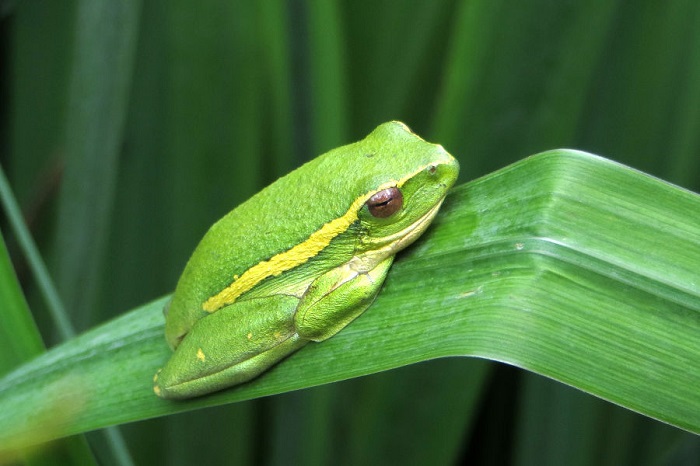
View the above photo record (by Geoff Prosser) in FrogMAPhere.
Find the Yellow-striped Reed Frog in the FBIS database (Freshwater Biodiversity Information System) here.
Family Hyperoliidae
YELLOW-STRIPED REED FROG – Hyperolius semidiscus
Hewitt, 1927
Habitat
H. semidiscus inhabits a variety of vegetation types in the Savanna Biome, usually in low-lying areas. It breeds in moderately deep rivers, pans and dams that are surrounded by dense reed beds and other emergent vegetation (Lambiris 1989a; Alexander 1990; Channing 2001).
During the non-breeding season (winter), these frogs can be found several kilometres away from their breeding sites. The breeding season extends through spring and summer, starting after the first substantial spring rains. In Durban (2931CC), males call during December and January from reeds over water, or from floating vegetation (Alexander 1987). In water bodies infested with Water Hyacinth Eichhornia crassipes, males use these plants as both call sites and as retreats while inactive; in some cases, the presence of Water Hyacinth appears to facilitate larger choruses. In dams surrounded by exotic trees, males have been seen calling in pine trees at a height >2 m (P.J. Bishop pers. comm.).
About 200 eggs are laid in clusters of c.30, loosely attached to vegetation just below the surface of the water (Wager 1986).
Although H. semidiscus is found in several established conservation areas, its restricted distribution makes it vulnerable to environmental change and it may require additional conservation measures for long-term survival. Because of the paucity of existing information, monitoring of selected populations along with a detailed study of the distribution and life history of this species, are recommended.
H. semisdiscus is endemic to the atlas region, although its distribution suggests that it may also occur in southern Mozambique, and it should be looked for there. It is distributed along the coast of Eastern Cape Province from Port Elizabeth (3325DC, DD) northward through KwaZulu-Natal to northeastern Swaziland (2632AA), and inland as far as Nelspruit (2530BD). The Baviaanskloof record (3324CB) is based on a photo (L. Creig) and further surveying is required to assess populations in that area.
H. semidiscus and H. argus are morphologically similar, although slight differences in snout width and markings have been noted (Poynton 1964; Passmore and Carruthers 1995). The two species may be easily distinguished, however, by clear differences in their advertisement calls (Passmore and Carruthers 1995). The atlas data are reasonably reliable but incomplete; the gaps in the mapped distribution probably reflect inadequate sampling rather than actual discontinuities.
Distribution of Hyperolius semidiscus. Taken from the FrogMAP database. April 2022.
Further Resources
Virtual Museum (FrogMAP > Search VM > By Scientific or Common Name)
More common names: Geelstreep-rietpadda (Afrikaans)
Recommended citation format for this species text:
Alexander GJ, Tippett RM. Yellow-striped Reed Frog Hyperolius semidiscus. BDI, Cape Town. Available online at http://thebdi.org/2022/02/04/yellow-striped-reed-frog-hyperolius-semidiscus/
Recommended citation format:
This species text has been updated and expanded from the text in the 2004 frog atlas. The reference to the text and the book are as follows:
Alexander GJ 2004 Hyperolius semidiscus Yellow-striped Reed Frog. In Minter LR et al 2004.
Minter LR, Burger M, Harrison JA, Braack HH, Bishop PJ, Kloepfer D (eds) 2004. Atlas and Red Data Book of the Frogs of South Africa, Lesotho and Swaziland. Smithsonian Institution, Washington, and Avian Demography Unit, Cape Town.
View the above photo record (by John Wilkinson) in FrogMAPhere.
Find the Argus Reed Frog in the FBIS database (Freshwater Biodiversity Information System) here.
Family Hyperoliidae
ARGUS REED FROG – Hyperolius argus
Peters, 1854
Habitat
Within the atlas region, this lowland species occurs in Coastal Bushveld-Grassland, a mosaic of vegetation types found from sea level to an altitude of 300 m, along the coast of northern KwaZulu-Natal. It breeds in shallow, often temporary, pans, vleis and marshes, where floating and emergent peripheral plants such as Phragmites spp., Nymphea spp., Cyperus papyrus and Typha latifolia provide call sites for males (Lambiris 1989a; Passmore and Carruthers 1995; Channing 2001; pers. obs.).
Habitat – Kosi Bay, KwaZulu-Natal Photo by Ryan Tippett
Behaviour
Nothing appears to be known of the non-breeding habits and habitat of this species. Breeding begins after the first rains have fallen in spring, and continues throughout summer. During the day, frogs may be found hiding amongst vegetation at the breeding site, especially in Pistia stratiotes and Nymphea spp., and occasionally under logs or stones in the vicinity. At night, males form fairly large choruses and call from slightly elevated positions on emergent or floating vegetation. Amplexus is axillary, and c.200 eggs are laid in clusters of c.30, attached to submerged or emergent vegetation (Channing 2001; pers. obs.).
Hyperolius argus – Durban, KwaZulu-Natal Photo by Trevor Hardaker
Predators include various fish, birds, snakes, terrapins, spiders and other frogs, while prey consists mainly of insects.
Status and Conservation
A major threat to H. argus is habitat loss through urbanization, water drainage and afforestation (Lambiris 1989a; pers. obs.). In several parts of KwaZulu-Natal, plantings of exotic Eucalyptus have lowered the water table to such a degree that many pans within the coastal dune forest have completely disappeared (pers. obs.). At the southernmost limits of the species’ distribution, populations are threatened by rapid urban expansion, resulting in range contractions. An additional threat is the introduction of exotic predatory fish, such as the bass Micropterus salmoides, which are avid predators of both tadpoles and adult frogs.
In areas not affected by human activities, H. argus is locally abundant and populations often consist of hundreds of individuals. The species occurs in several private and provincial nature reserves in KwaZulu-Natal and therefore does not appear to warrant additional conservation action at present.
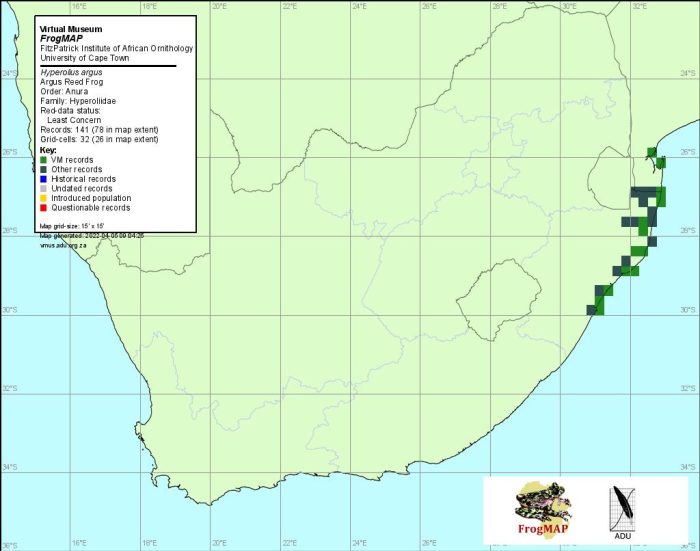
H. argus is distributed from the coastal lowlands of southern Somalia, southward through Kenya, Tanzania, Malawi, eastern Zimbabwe and Mozambique (Poynton and Broadley 1987). In the atlas region it is restricted to the coastal plain of KwaZulu-Natal, occurring as far south as Durban (2930DD). Earlier records in southern Africa were incorrectly referred to H. puncticulatus (Poynton 1964; Wager 1965) owing to the close morphological similarity of the two species. However, the species are ecologically separated, with H. puncticulatus occurring only in forest habitat in Malawi and on the coast of Tanzania and Kenya (Poynton 1986; Poynton and Broadley 1987).
The atlas records are reliable but incomplete; more thorough sampling will undoubtedly fill many of the present gaps in the known range of this species.
Distribution of Hyperolius argus. Taken from the FrogMAP database, April 2022.
Further Resources
Virtual Museum (FrogMAP > Search VM > By Scientific or Common Name)
More common names: Argus Sedge Frog, Yellow Spotted Reed Frog, Golden Sedge Frog (Alternative English Names); Argusrietpadda (Afrikaans)
Recommended citation format for this species text:
Bishop PJ, Tippett RM. Argus Reed Frog Hyperolius argus. BDI, Cape Town. Available online at http://thebdi.org/2022/02/04/argus-reed-frog-hyperolius-argus/
Recommended citation format:
This species text has been updated and expanded from the text in the 2004 frog atlas. The reference to the text and the book are as follows:
Bishop PJ 2004 Hyperolius argus Argus Reed Frog. In Minter LR et al 2004.
Minter LR, Burger M, Harrison JA, Braack HH, Bishop PJ, Kloepfer D (eds) 2004. Atlas and Red Data Book of the Frogs of South Africa, Lesotho and Swaziland. Smithsonian Institution, Washington, and Avian Demography Unit, Cape Town.
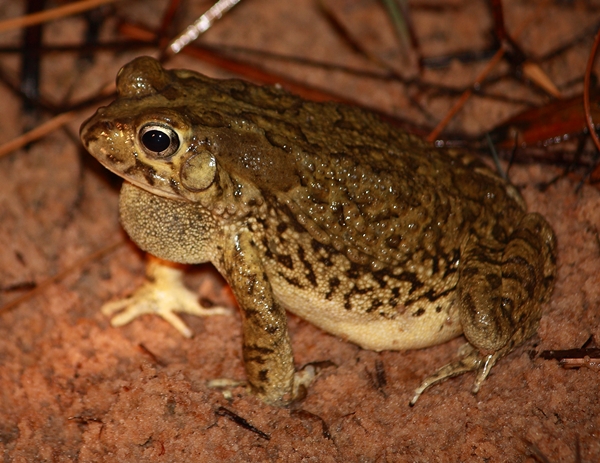
View the above photo record (by Vaughah Jessnitz) in FrogMAPhere.
Find the Western Olive Toad in the FBIS database (Freshwater Biodiversity Information System) here.
Family Bufonidae
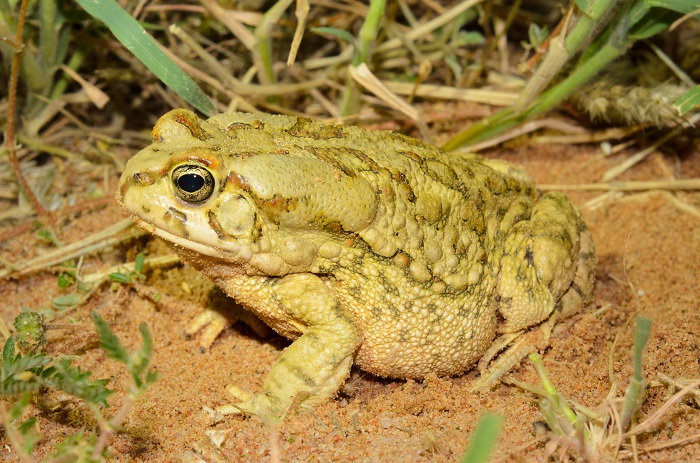
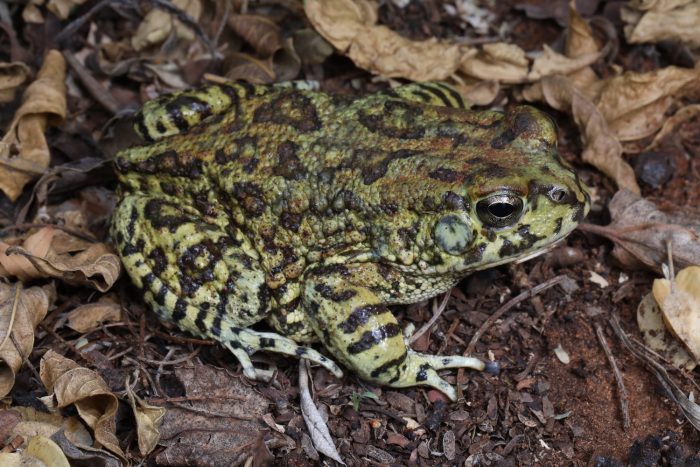
WESTERN OLIVE TOAD – Sclerophrys poweri
(Hewitt, 1935)
Habitat
This species inhabits thornveld and open savanna in lower-rainfall areas of the Savanna Biome, including river valleys on Kalahari sand. Activity patterns and movements require further study, but these toads are probably inactive for substantial periods, especially in drier areas, as they take shelter under logs, grass tussocks or in rock crannies, and emerge opportunistically after rain or on humid nights. Like most toads, foraging individuals probably roam widely and are often encountered on roads. Juvenile S. poweri have been recorded sheltering in termitaria (Channing 2001).
Breeding occurs in pans, dams and marshes.
Behaviour
Breeding begins early in the season, usually in mid-September, following the first spring rains, but this varies among years and locations. Choruses of calling males form on mud banks and in open, shallow water. Around 23 000 eggs are laid in double strands that are attached to submerged and floating vegetation (Channing 2001). Eggs hatch within 24 hours. Aspects of the life history such as larval period and age distribution of breeding adults, are unknown and require study.
Predators are unrecorded. Prey includes beetles (Channing 2001).
Sclerophrys poweri– Tswalu Kalahari Reserve, Northern Cape Photo by Kyle Finn
Status and Conservation
S. poweri is common and often locally abundant, and has been recorded from a number of statutory conservation areas including Augrabies Falls, Vaalbos and Pilanesberg national parks, Kgalagadi Transfrontier Park, and Sandveld and Botsalano nature reserves. Much of its habitat occurs in cattle- and game-farming regions, and is well protected.
Further research is needed to investigate the taxonomic status of the species and its relationship to S.garmani. This research should include genetic, morphological and call analyses, based on extensive field work around the transition area, and should identify locations where distinct eastern and western forms co-occur and potentially interbreed (Channing 1991; Cunningham and Cherry 2000).
At present, S. poweri is a poorly defined species that, in the view of some authors, represents nothing more than a geographical variant of S. garmani (Poynton 1995; Cunningham and Cherry 2000). Nevertheless, populations from arid southwestern Africa, including Namibia, Botswana, western Zimbabwe and western South Africa have been assigned to S. poweri (Tandy 1972; Poynton and Broadley 1988; Passmore and Carruthers 1995; Channing 1991, 2001), while populations in the eastern parts of the atlas region are currently assigned to S. garmani.
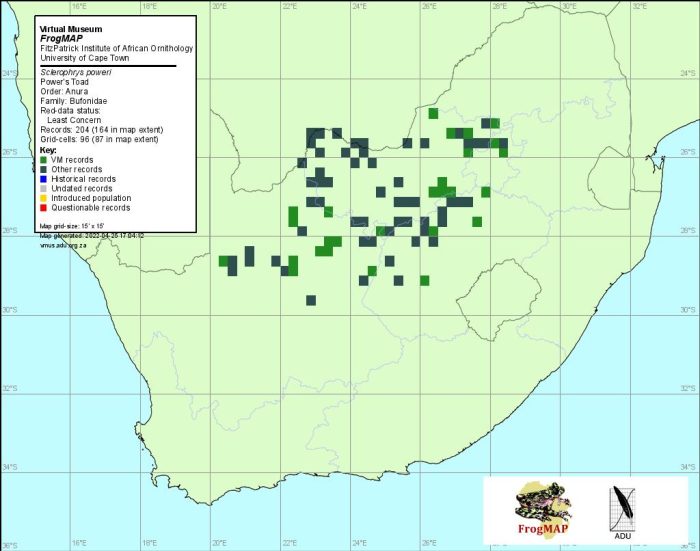
The type locality of S. poweri is Kimberley. Within the atlas region, the species has been recorded north of 30°S in the Northern Cape Province, and in adjoining areas in the western and northwestern Free State, localities throughout North West Province and the area west of 29°E in Gauteng and Limpopo provinces. The most easterly record of S. poweri in the atlas region is from Naboomspruit (Passmore 1972). However, the extent to which the ranges of the western (poweri) and eastern (garmani) forms overlap is unclear (Channing 1991; Passmore and Carruthers 1995).
It is difficult to distinguish S. poweri from the morphologically similar S. garmani, and identifications based on calls require sonagraphic analysis (see S.garmani account). More intensive distribution surveys, based on recorded calls, are required to determine the limits of distribution of these species.
Distribution of Sclerophrys poweri. Taken from the FrogMAP database, April 2022.
Further Resources
Virtual Museum (FrogMAP > Search VM > By Scientific or Common Name)
More common names: Power’s Toad (Alternative English Name); Power se Skurwepadda (Afrikaans)
Recommended citation format for this species text:
du Preez LH, Cunningham M, Turner A, Tippett RM. Power’s Toad Sclerophrys poweri. BDI, Cape Town. Available online at http://thebdi.org/2022/02/03/powers-toad-sclerophrys-poweri/
Recommended citation format:
This species text has been updated and expanded from the text in the 2004 frog atlas. The reference to the text and the book are as follows:
du Preez LH, Cunningham M, Turner A 2004 Sclerophrys poweri Power’s Toad. In Minter LR et al 2004.
Minter LR, Burger M, Harrison JA, Braack HH, Bishop PJ, Kloepfer D (eds) 2004. Atlas and Red Data Book of the Frogs of South Africa, Lesotho and Swaziland. Smithsonian Institution, Washington, and Avian Demography Unit, Cape Town.
Find the Northern Forest Rain Frog in the FBIS database (Freshwater Biodiversity Information System) here.
Family Brevicepitidae
Identification
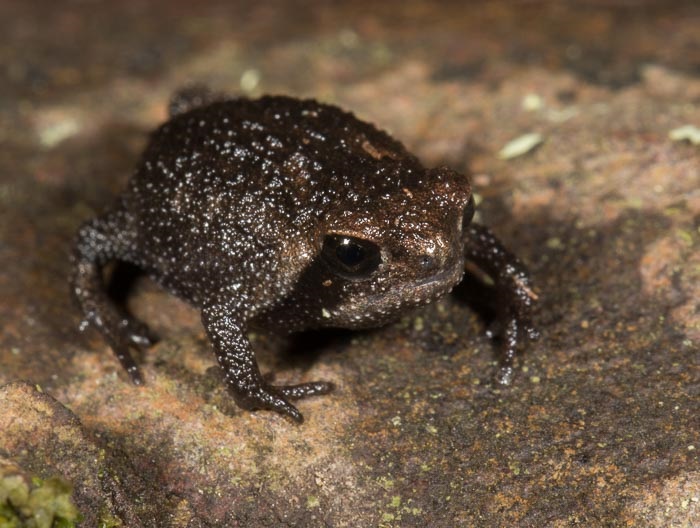
Northern Forest Rain FrogBreviceps sylvestris Near Tzaneen, Limpopo Photo by Gerhardt Diedericks
The Northern Forest Rain Frog occurs in parapatry with the Bushveld Rain Frog (Breviceps adspersus) throughout its range. The subspecies B. s. sylvestris occurs in sympatry with the Mozambique Rain Frog (Breviceps mossambicus), which occupies montane grassland adjacent to forest patches along the escarpment. There is also a possibility that B. s. sylvestris occurs in sympatry with the Plaintive Rain Frog (Breviceps verrucosus) between Legalameetse and Mariepskop.
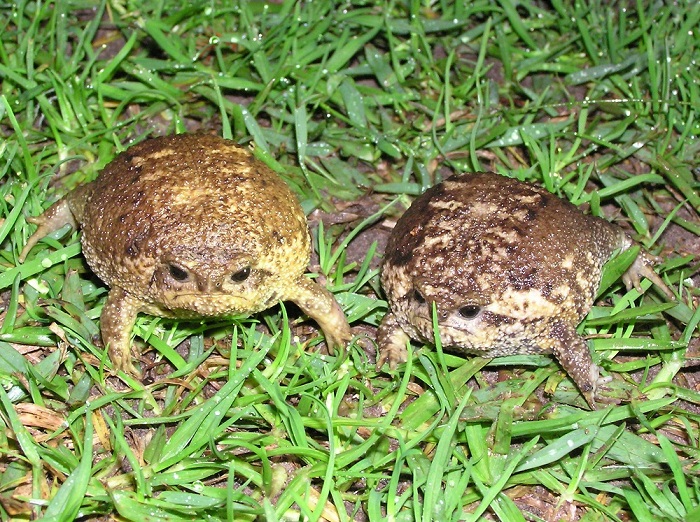
The granular texture and mottled markings on the skin of the abdomen, and the presence of a pair of longitudinal glandular ridges on the dorsum, distinguish both B. sylvestris and B. verrucosus from B. adspersus and B. mossambicus, which have a smooth, immaculate abdomen and lack dorsal skin ridges. The advertisement calls of B. sylvestris and B. verrucosus consist of a series of long, evenly spaced, pulsed whistles, averaging 0.36 and 0.61 s in duration, respectively. In Comparison, those of B.adspersus and B. mossambicus are much shorter (0.08 and 0.2 s in duration, respectively) and often emitted in groups of two, three, or more calls within a bout of calling (Minter 1998).
In the Northern Forest Rain Frog, the tympanum is indistinct and, in most cases, cannot be distinguished from the surrounding granular skin. In B. verrucosus it is usually smooth and fairly obvious. B. sylvestris is further characterized by a broad, light margin to its down-turned mouth, giving its face a clown-like appearance. The advertisement calls of B. sylvestris and B. verrucosus are very similar, differing only in duration (see above) and call rate: 69 and 22 calls per minute, respectively (Minter 1998).
Habitat
The habitat of the Northern Forest Rain Frog is Afromontane Forest and the adjacent North-eastern Mountain Grassland. In the breeding season, males call from closed-canopy forest, forest fringe, and adjacent open grassland in mountainous terrain. Calling males have also been encountered in disturbed habitats such as wooded parks and gardens, and in pine plantations on the edge of indigenous forests. In winter, specimens have been found under rocks and logs in indigenous forest (Minter 1998).
Behaviour
The Northern Forest Rain Frog constructs an extensive network of shallow, horizontal tunnels and chambers below the soil surface and under rocks and logs (pers. obs.). The dry winter months are spent underground, but rain at this time of year may result in surface activity and some calling. Aestivation, involving the production of a cocoon, has not been observed.
Most breeding takes place after rain in early spring, that is, September to October, but continues into early December (Minter 1998). In wet, misty weather, large choruses develop and continue, unchecked, for several consecutive days and nights.
Northern Forest Rain FrogBreviceps sylvestris Near Haenertsburg, Limpopo Photo by A. Coetzer
At night, during rain or heavy mist, males call while moving about on the surface, sometimes climbing to an elevated position on a grass tuft or herbaceous plant. During the day, in wet weather, they call from well-concealed, shallow depressions beneath leaf litter (Minter 1998). Amplexus is adhesive and nests are constructed below the surface, at the base of a rock, log, or amongst tree roots. Thompson (in Wager 1965) recorded a mass of 56 eggs covered by a layer of infertile eggs; the female remained in a tunnel adjoining the egg chamber until the young were fully developed, and removed soil that fell onto the egg-mass. Jacobsen (1989) found a female with an egg-mass in November.
Prey items have not been documented but probably include various invertebrates characteristic of the forest floor.
Status and Conservation
Status
The Northern Forest Rain Frog was not listed in earlier South African Red Data books (McLachlan 1978; Branch 1988) but was listed as Near Threatened by Harrison et al. (2001). Reassessment for this publication has placed it in the Vulnerable category based on the species’ severely fragmented and restricted distribution (area of occupancy: 501–2000 km), rate of habitat loss (>20% in the last 50 years), and predicted population decline (>20% in the next 30 years).
The Northern Forest Rain Frog occurs in the following provincial nature reserves: Blouberg, Blouberg-Maleboch, Happy Rest, Thabina, Lekgalameetse; state forests: Entabeni, Hanglip, Woodbush, and Black Forest; and the Wolkberg Wilderness Area. It is protected by the Limpopo Province Department of Environmental Affairs and Tourism Conservation Ordinance 12 of 1973, and the National Forests Act 19408 of 1998, Section 7. Outside of the relevant areas, it is unprotected except for collecting and export control.
Threats
The major threats to the Northern Forest Rain Frog are habitat loss and fragmentation due to afforestation and other agricultural practices. These activities also impact negatively on the quality of the remaining habitat by reducing the quantity of surface and soil water and altering natural fire regimes in adjacent areas. Water and fire are key limiting factors that influence the distribution and extent of Afromontane Forest patches (Low and Rebelo 1996). The networks of roads developed to sustain these agricultural activities also fragment previously continuous areas of suitable habitat. Road kills during the breeding season are believed to contribute significantly to population declines.
Recommended conservation actions
A detailed survey should be carried out to identify the location and size of all the remaining populations of this endemic, restricted-range species. A study of the extent to which the two subspecies of B. sylvestris have diverged genetically, and a similar comparison between B.sylvestris and B. verrucosus, would further clarify the conservation status of this species.
Management recommendations include habitat and limiting factor management and the establishment of a monitoring programme, both inside and outside reserves. In view of the restricted distribution of B.sylvestris, priority should be given to the conservation and management of the remaining indigenous forests and grasslands, the breeding habitats of this, the only frog species endemic to Limpopo Province.
Northern Forest Rain FrogBreviceps sylvestris Near Haenertsburg, Limpopo Photo by A. Coetzer
Distribution
The Northern Forest Rain Frog is endemic to Limpopo Province, where it occurs on the slopes and crests of the Blouberg, Soutpansberg, Wolkberg, and Drakensberg ranges. It is locally abundant, but its distribution is restricted to isolated fragments of its natural habitat that have not yet been subjected to afforestation or other forms of agriculture. The subspecies B. s. sylvestris is recorded from Haenertsburg (2329DD), eastward to Tzaneen (2330CC), and southward along the eastern escarpment as far as Legalameetse Nature Reserve (2430AB), while B. s.taeniatus occurs in the Soutpansberg Mountains from Blouberg (2328BB) eastward to Thoyandou (2230CD). The two subspecies are geographically isolated by about 80 km of unsuitable habitat.
Distribution of Breviceps sylvestris. Taken from the FrogMAP database, April 2022.
Legalameetse, with the southernmost recorded population of B. sylvestris, is separated by a distance of about 70 km from the northernmost recorded population of B.verrucosus, at Mariepskop (2430DB). The area separating these species is rugged and rather inaccessible and was not sampled during the atlas project. However, it contains suitable breeding habitat and should be surveyed to determine whether the two species occur in sympatry.
The existing atlas data are reliable, as the Northern Forest Rain Frog is easily identified by its appearance and its call. However, further sampling is required in areas of suitable habitat within the limits of its known range.
Further Resources
The use of photographs by A. Coetzer and Gerhardt Diedericks is acknowledged.
Other Common Names: Transvaal Rain Frog, Forest Rain Frog (Alternative English Names); Transvaal Woudblaasoppadda (Afrikaans)
Recommended citation format: Minter, LR; Tippett, RM. (2025). Northern Forest Rain FrogBreviceps sylvestris. Biodiversity and Development Institute, Cape Town. Available online at https://thebdi.org/2022/02/03/northern-forest-rain-frog-breviceps-sylvestris/
This species text has been updated and expanded from the text in the 2004 frog atlas: Minter, LR. (2004). Northern Forest Rain Frog Breviceps sylvestris. In Minter LR et al 2004.
References:
Minter, LR; Burger, M; Harrison, JA; Braack, HH; Bishop, PJ; Kloepfer, D. (Editors). (2004). Atlas and Red Data Book of the Frogs of South Africa, Lesotho and Swaziland. Smithsonian Institution, Washington, and Avian Demography Unit, Cape Town.
Carruthers, V; du Preez, L. (2017). Frogs of southern Africa: A Complete Guide. Struik Nature, Cape Town.
Channing, A. (2001) Amphibians of Central and Southern Africa. Protea Book House, Pretoria
Claus, B; Claus, R. (2002). Common Amphibians and Reptiles of Botswana. Gamsberg Macmillan, Windhoek.
Find the Sand Rain Frog in the FBIS database (Freshwater Biodiversity Information System) here.
Family Brevicepitidae
Identification
The Sand Rain Frog
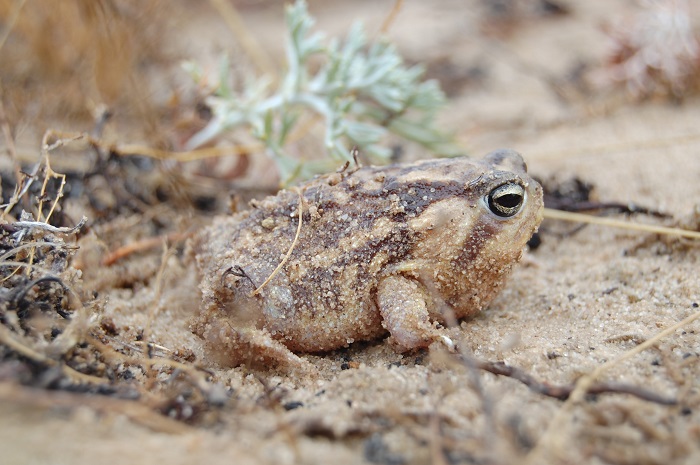
Sand Rain FrogBreviceps rosei West Coast National Park, Western Cape Photo by JK. Boyce
Habitat
The Sand Rain Frog occurs in coastal lowlands and lower slopes in the Fynbos and Thicket biomes; it does not extend into the Succulent Karoo Biome to the north. It inhabits sandy substrates in Dune Thicket and probably in Limestone Fynbos and Sand Plain Fynbos, although occurrence in the latter two veld types, sensu stricto, requires confirmation. This species occurs in well-vegetated areas and is not recorded from unstable dunes, or places where a coastal plain is absent and Mountain Fynbos descends to the coast. The sandy substrate along the Breede River serves as a passage along which B. rosei occurs at least as far inland as Bontebok National Park (3420AB), where it is found in riverine thicket along the banks of the river (H. Braack pers. obs.).
Behaviour
Little is known of the biology of the Sand Rain Frog. Aestivation probably takes place during the dry season. This species also produces a cocoon to protect itself against dessication (Channing 2001).
Calling occurs both at night and during the day, mainly during and after rain showers in winter and spring (June–November). Dense mist may be sufficient to trigger calling (pers. obs.). Males have been observed to call from elevated positions in bushes and sedges, up to a meter above the ground (FitzSimons 1946; Channing 2001; pers. obs.). When disturbed, these individuals will sometimes drop to the ground and lie still (FitzSimons 1946; H. Braack pers. comm.).
Sand Rain FrogBreviceps rosei Blaauwberg Conservation Area, Western Cape Photo by Trevor Hardaker
Adhesive amplexus lasts for four or five days and the male assists the female in burrowing into the sand with movements of his feet (Channing 2001). Other details of breeding are not known.
Status and Conservation
The Sand Rain Frog is not threatened at present. However, much of its habitat has been, and continues to be, destroyed by coastal and agricultural development and by the spread of invasive alien vegetation, especially Rooikrans Acaciacyclops. The species does use alien thickets, especially on Robben Island (Crawford and Dyer 2000), but it is not known how the population densities of frogs in indigenous and alien vegetation compare.
Given the species’ narrow distribution range, it is clear that its populations are vulnerable to fragmentation and local extinction. In view of the current lack of clarity regarding the status of B. r. rosei and B. r. vansoni, they should be considered separately in assessments of conservation needs. Adequate protection could be afforded by a series of coastal reserves. In the west, the Sand Rain Frog is known from the West Coast and Cape Peninsula national parks and the Rocher Pan Nature Reserve, and in the south from the De Hoop and De Mond nature reserves, and Bontebok National Park.
Distribution
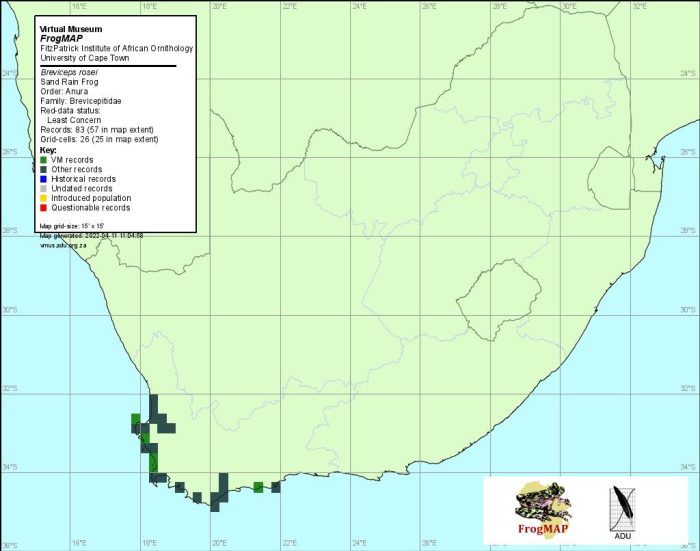
The Sand Rain Frog has a coastal distribution; nowhere does the species occur more than 45 km inland. The distribution extends from Lambert’s Bay (3218AB) on the west coast, to Gouritsmond (3421BD) on the south coast. An aural record from Wilderness (3422BB) requires confirmation (H. Braack pers. comm.). The species is common on Robben Island (3318CD; Crawford and Dyer 2000).
Distribution of Breviceps rosei. Taken from the FrogMAP database. April 2022.
Some authors follow Poynton (1964) in recognizing two subspecies, that is, B. r. rosei northwest of False Bay, and B. r. vansoni east of False Bay, on the basis of differences in colour pattern, but these differences do not appear to be consistent (Passmore and Carruthers 1995). Field and molecular studies are required to clarify the status of these taxa.
The atlas data for this species is incomplete along the south coast.
Further Resources
The use of photographs by JK. Boyce, Ryan van Huysteen, and Trevor Hardaker is acknowledged.
Sand Rain FrogBreviceps roseiPower, 1926
Other Common Names: Rose’s Rain Frog; Rose’s Short-headed Frog (Alt. English); Rose se Blaasoppadda (Afrikaans)
Recommended citation format: Harrison, JA; Tippett, RM. (2025). Sand Rain Frog Breviceps rosei. Biodiversity and Development Institute, Cape Town. Available online at https://thebdi.org/2022/02/02/sand-rain-frog-breviceps-rosei/
This species text has been updated and expanded from the text in the 2004 frog atlas: Harrison, JA. (2004). Sand Rain Frog Breviceps rosei. In Minter LR et al 2004.
References:
Minter, LR; Burger, M; Harrison, JA; Braack, HH; Bishop, PJ; Kloepfer, D. (Editors). (2004). Atlas and Red Data Book of the Frogs of South Africa, Lesotho and Swaziland. Smithsonian Institution, Washington, and Avian Demography Unit, Cape Town.
Carruthers, V; du Preez, L. (2017). Frogs of southern Africa: A Complete Guide. Struik Nature, Cape Town.
Channing, A. (2001) Amphibians of Central and Southern Africa. Protea Book House, Pretoria
Claus, B; Claus, R. (2002). Common Amphibians and Reptiles of Botswana. Gamsberg Macmillan, Windhoek.
Find the Cape Mountain Rain Frog in the FBIS database (Freshwater Biodiversity Information System) here.
Family Brevicepitidae
Identification
Like all Breviceps species, the Cape Mountain Rain Frog has a stout, rounded body and short legs. The eyes are small to medium-sized, and the tympanum is not visible. The dorsal surface is dark with large, pale paravertebral patches fused into a band with dark, wavy edges. The undersides are white with dark markings concentrated around the throat. The Cape Mountain Rain Frog has a prominent dark facial mask that runs from the eye to the base of the arm.
Cape Mountain Rain FrogBreviceps montanus Bushmanskloof, Western Cape Photo by Zenobia van Dyk
Habitat
The Cape Mountain Rain Frog is restricted to the Fynbos Biome, and usually occurs in Mountain Fynbos vegetation. However, it is also known from altered habitats such as pine plantations. It is usually found on coarse, acidic, sandy soils, but it is also known from heavier, shale-derived soils. It generally occurs at high altitudes but is also found at sea level in areas where mountains reach the coast (e.g. Betty’s Bay 3418BD). In such coastal situations it appears to be restricted to fynbos vegetation and is not found in coastal thicket (cf. B. rosei).
Behaviour
Despite a relatively extensive distribution in the Western Cape, little is known about the biology of the Cape Mountain Rain Frog. Calling occurs both at night and during the day, usually during and after rain showers in winter and spring (June–November). Dense mist may also be sufficient to stimulate calling. Channing (2001) collected a female with large eggs in October, and recorded calling activity in January. Males have been found calling from vegetation above ground level (Visser 1979d) or while moving about on the surface (L.R. Minter pers. obs.). The breeding biology is assumed to be similar to that of other members of the genus.
Cape Mountain Rain FrogBreviceps montanus Fernkloof, Western Cape Photo by Keir Lynch
Status and Conservation
The Cape Mountain Rain Frog occurs in relatively undisturbed montane habitat and is found within several protected areas. The Cape Mountain Rain Frog is not threatened and is probably secure for the foreseeable future.
Distribution
Distribution of Breviceps montanus. Taken from the FrogMAP database, April 2022.
This diminutive species occurs widely in the Cape fold mountains of the Western Cape Province, from northeast of Clanwilliam (3118DD), to the Outeniqua Mountains in the southeast (3323CC). On the Cape Peninsula it occurs with B. gibbosus in some localities, and to the east its range coincides, in part, with that of B. acutirostris and B. fuscus.
The Cape Mountain Rain Frog probably occurs in several relatively inaccessible mountainous areas not surveyed during the atlas period. The eastern limits of its distribution, in particular, are not yet certain.
Further Resources
The use of photographs by Eloise Costandius, Keir Lynch, and Zenobia van Dyk is acknowledged.
Other Common Names: Mountain Rain Frog (Alt. English); Kaapse Bergblaasoppadda (Afrikaans)
Recommended citation format: Harrison, JA; Tippett, RM. (2025). Cape Mountain Rain FrogBreviceps montanus. Biodiversity and Development Institute, Cape Town. Available online at https://thebdi.org/2022/02/01/cape-mountain-rain-frog-breviceps-montanus/
This species text has been updated and expanded from the text in the 2004 frog atlas: Harrison, JA. (2004). Cape Mountain Rain FrogBreviceps montanus. In Minter LR et al 2004.
References:
Minter, LR; Burger, M; Harrison, JA; Braack, HH; Bishop, PJ; Kloepfer, D. (Editors). (2004). Atlas and Red Data Book of the Frogs of South Africa, Lesotho and Swaziland. Smithsonian Institution, Washington, and Avian Demography Unit, Cape Town.
Carruthers, V; du Preez, L. (2017). Frogs of southern Africa: A Complete Guide. Struik Nature, Cape Town.
Channing, A. (2001) Amphibians of Central and Southern Africa. Protea Book House, Pretoria
Claus, B; Claus, R. (2002). Common Amphibians and Reptiles of Botswana. Gamsberg Macmillan, Windhoek.
Find the Desert Rain Frog in the FBIS database (Freshwater Biodiversity Information System) here.
Family Brevicepitidae
Identification
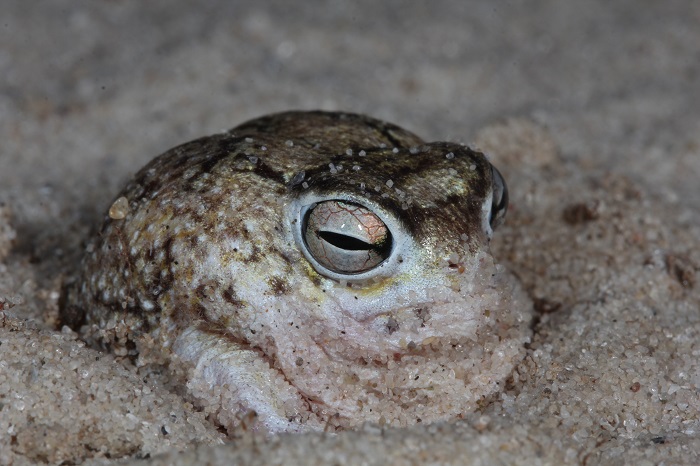
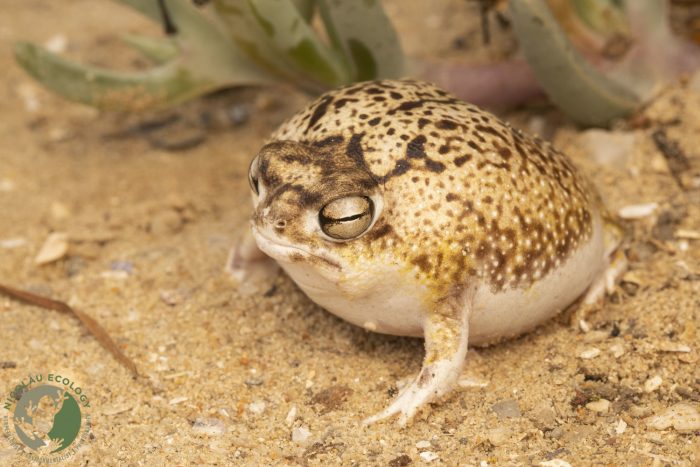
The Desert Rain Frog is a squat, rotund frog with short limbs and large, prominent eyes. The interorbital distance is about half the horizontal diameter of the eye (Poynton 1964). A sample of 10 specimens excavated from dunes at Port Nolloth had a mean snout–vent length of 34.5 mm (unpubl. data); Poynton (1964) recorded a maximum body length of 48.5 mm. Fleshy webbing is present between the fingers and toes, and sub-articular tubercles on the fingers are absent or weakly developed (if present, they are single, not double, cf. B. namaquensis).
The dorsum is light yellowish-brown, variably marked with fine, dark brown speckles or larger vermiculations that sometimes form a border around a pair of large, light patches in the scapular region. The ventrum is white with a large, central, unpigmented area through which the abdominal muscles, blood vessels and other internal organs can be seen.
Desert Rain FrogBreviceps macrops Near Alexander Bay, Northern Cape Photo by Alison Sharp
The advertisement call is a single, long, low-pitched whistle. Calls recorded at Port Nolloth had an emphasized frequency of 1200 Hz rising slightly to 1300 Hz. They varied between 1.2 and 2.5 seconds in duration (cf. Channing 2001) and were repeated at relatively long intervals (10 seconds to 15 minutes), depending on the chorus intensity (unpubl. data). The calls were lower in emphasized frequency and much longer than those of B. namaquensis (see species account).
Habitat
The Desert Rain Frog is restricted to Strandveld Succulent Karoo, in the Succulent Karoo Biome. It inhabits sand dunes vegetated by low, succulent shrubs and other xerophytes. These plants usually cover the crests of the dunes, which are separated by open areas of bare sand. The dunes are mostly formed by white, calcareous sand, but reddish dunes occur at some localities where the species is known to occur, for example, alongside the Holgat River (De Villiers 1988c). Annual precipitation is less than 50 mm at Alexander Bay (Low and Rebelo 1996), and 43–146 mm at Kleinsee (Channing and Van Wyk 1987). Coastal fog is common in this region.
Behaviour
Calling and/or surface activity has been recorded in almost all months of the year, usually during and following fog (Channing and Van Wyk 1987; De Villiers 1988c; Passmore and Carruthers 1995; S. Hanrahan pers. comm.; pers. obs.). Males call from the surface, sometimes excavating a slight depression in the sand, or moving from one call site to another while foraging (unpubl. data). The distance between calling males may be as little as 1 m, and choruses are apparently organized (Channing 2001). Calling is inhibited by dry, warm weather, but not by low temperatures (S. Hanrahan pers. comm.; pers. obs.). Amplexus, oviposition and development have not been recorded.
When not active on the surface, Desert Rain Frogs burrow downwards into the sand up to 27cm below the surface. L.R.M. (unpubl. data) excavated 10 specimens at depths of 12.5–27 cm below the surface. In all cases the “burrows” were located in low, unvegetated areas between dunes, and the frogs were found in a layer of sand that was moist enough to form a ball when compressed by hand. This moist layer was both covered and underlain by dry sand and appears to be a reservoir of water, maintained by rain and fog. The frogs were found 2–4 cm below the upper boundary of the moist layer. The temperature drops rapidly below the surface (e.g. at midday the surface temperature was 38.3°C, but decreased to 20.5°C at 10 cm below the surface). The temperature of the sand surrounding the frogs ranged from 17.6–20.7°C.
Desert Rain FrogBreviceps macrops McDougalls Bay, Northern Cape Photo by Gary Kyle Nicolau
Analysis of scats revealed that prey items include beetles and ants (Channing and Van Wyk 1987). While tracking frogs on the surface, Carruthers and Passmore (1978) found signs of activity around dung and suggested that the frogs were feeding on insects attracted to the dung. An adder, Bitis schneideri, was recorded as a predator at Lüderitz (Haacke 1975).
Status and Conservation
Status
The Desert Rain Frog was previously listed as Restricted (Branch 1988), Vulnerable (IUCN 2000) and Near Threatened (Harrison et al. 2001). Reassessment for this publication determined a status of Vulnerable, based on a restricted distribution (area of occupancy: 501–2000 km²), extensive loss of habitat to strip mining (present and projected), and a predicted population decline (>50% in the next 30 years).
The Desert Rain Frog does not occur within any protected areas. However, a process is currently under way to proclaim the Orange River mouth at Alexander Bay a protected area. The species is protected in terms of the Cape Nature Conservation Ordinance 19 of 1974.
Threats
The major threat to the Desert Rain Frog is habitat loss and fragmentation due to strip mining. The development of roads, increasing pressure from human populations and changing land use (e.g., increasing grazing, recreational use of dunes by off-road vehicles, e.g., at McDougall’s Bay) pose additional threats.
Recommended conservation actions
A detailed survey to identify the location and size of the remaining populations of B. macrops and the extent to which its habitat has been fragmented, is essential. Possible recolonization of mined-out and/or rehabilitated areas should be investigated. A study of the reproductive biology of the species is necessary to determine its fecundity and longevity, and limiting-factor research will facilitate effective management.
Management recommendations include the establishment of a long-term monitoring programme inside and outside the mining concessions, and limiting factor management. In view of the restricted distribution of B.macrops, priority should be given to the establishment of conservation areas within the range of this species. Such reserves are also needed to protect the unique ecology, fauna and flora of this area.
Distribution
Beyond the atlas region, the Desert Rain Frog occurs in the southern coastal dunes of Namibia, from Lüderitz southward to Oranjemund.
Distribution of Breviceps macrops. Taken from the FrogMAP database, April 2022.
In the atlas region, B. macrops occupies a narrow coastal strip along the northwestern Namaqualand coast, from Alexander Bay (2816CB) southward as far as the farm Skulpfontein north of Koingnaas (3017AB). It ranges from close to the high-water mark (Channing and Van Wyk 1987), to 10 km from the coast (S. Hanrahan pers. comm.). Distribution data for this species are scarce, as much of the area it occupies lies within diamond-mining concessions and is not easily accessible.
The atlas data are reliable, but are restricted mainly to areas lying outside the mining concessions, and are therefore incomplete.
Further Resources
The use of photographs by Alison Sharp, Dave Maguire, and Gary Kyle Nicolau is acknowledged.
Desert Rain FrogBreviceps macropsBoulenger, 1907
Other Common Names: Melkpadda, Woestyn-blaasoppadda (Afrikaans)
Recommended citation format: Minter, LR; Tippett, RM. (2025). Desert Rain Frog Breviceps macrops. Biodiversity and Development Institute, Cape Town. Available online at https://thebdi.org/2022/01/28/desert-rain-frog-breviceps-macrops/
This species text has been updated and expanded from the text in the 2004 frog atlas: Minter, LR. (2004). Desert Rain Frog Breviceps macrops. In Minter LR et al 2004.
References:
Minter, LR; Burger, M; Harrison, JA; Braack, HH; Bishop, PJ; Kloepfer, D. (Editors). (2004). Atlas and Red Data Book of the Frogs of South Africa, Lesotho and Swaziland. Smithsonian Institution, Washington, and Avian Demography Unit, Cape Town.
Carruthers, V; du Preez, L. (2017). Frogs of southern Africa: A Complete Guide. Struik Nature, Cape Town.
Channing, A. (2001) Amphibians of Central and Southern Africa. Protea Book House, Pretoria
Claus, B; Claus, R. (2002). Common Amphibians and Reptiles of Botswana. Gamsberg Macmillan, Windhoek.
Find the Cape Rain Frog in the FBIS database (Freshwater Biodiversity Information System) here.
Family Brevicepitidae
Identification
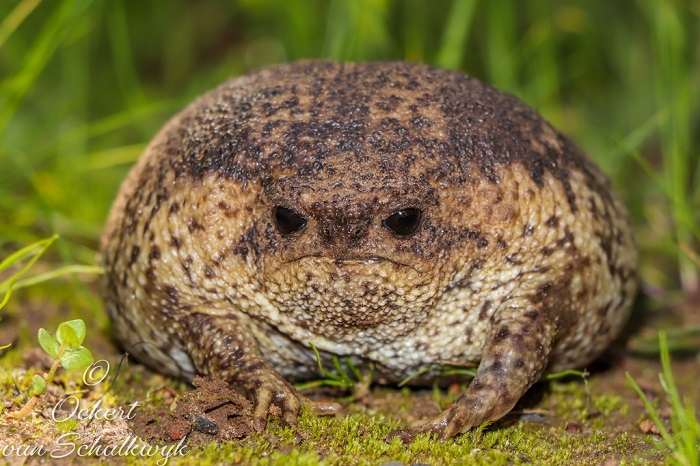
The Cape Rain Frog is the largest Breviceps species in South Africa. Females are noticeably larger than males and can attain 80mm in length. Like all rain frogs, the body is rotund with short legs. The head is also short with a flat face and small, dark eyes. The dorsal surface is dark brown with a pale paravertebral band, or a row of pale paravertebral patches. The facial mask is fairly indistinct and runs from the eye to about half way to the front leg. The underside is strongly mottled in brown and cream. Both the upper and undersides are very granular and readily help to identify this species.
Cape Rain FrogBreviceps gibbosus Durbanville Nature Reserve, Western Cape Photo by Felicity Grundlingh
Habitat
Most localities where the Cape Rain Frog occurs have fine-grained, heavy substrates (loamy soils and clays) derived from shales or granites, which is the substrate associated with West Coast Renosterveld. This veld type occurs in winter-rainfall areas with annual precipitation of 300–600 mm. Less than 3% of the original extent of this veld type still exists, mainly as a consequence of crop agriculture, principally wheat (Low and Rebelo 1996). The remaining renosterveld is now severely fragmented, with the largest fragments being located on hills and mountain slopes, where B. gibbosus is usually found. However, this species is not recorded from all renosterveld fragments, of which many have not yet been surveyed for the species. It is therefore difficult to make a definitive statement about the link between B.gibbosus and this particular vegetation type. It may be that this species was always more common in well-drained upland situations, or possibly in more wooded situations where ground temperatures are moderated. The Cape Rain Frog also occurs in disturbed and altered habitats, such as pine plantations and suburban gardens. It is virtually absent from the sandy areas of the Cape Flats (De Villiers 1988b), but in gardens it has been found in sandy substrates where it appears able to flourish (J.A.H. pers. obs.). Its occurrence in some of these suburban situations is probably the result of the transportation of topsoil for use in gardens.
Behaviour
The Cape Rain Frog survives the long, dry summers by aestivation underground. Individuals produce a thin cocoon around themselves, with nostrils plugged and body inflated (Channing 2001). Calling commences with the first winter rains (late April) and continues through to November. Calling occurs day and night in wet weather. Calling peaks at the beginning of winter and in spring, from late August to October (A.L. de Villiers pers. comm.), suggesting that warmer temperatures stimulate calling. Although calling usually occurs during and after rain showers, it sometimes precedes the rain by a few hours (J.A.H. pers. obs.; R. Boycott pers. comm.), suggesting that this species may be able to detect the drop in barometric pressure that occurs in advance of a frontal weather system. Poynton and Pritchard (1976) noted a similar apparent connection between barometric pressure and surface activity in B. adspersus and B. verrucosus.
Cape Rain FrogBreviceps gibbosus Constantia, Western Cape Photo by Felicity Ellmore
Male Cape Rain Frogs call from the surface, that is, they have never been observed calling from elevated perches as in some other Breviceps species. Calling males are usually well hidden under vegetation, in shallow depressions in the substrate (L.R.M. pers. obs.). As in other Breviceps species, adhesive amplexus is employed when mating (Gow, in Wager, 1965). In dense choruses, males will attempt to clasp any moving object in the vicinity, including other males. On one occasion, a compact mass comprising six males clinging to one another, was seen rolling slowly down a slope (L.R. Minter pers. comm.). Rose (1962) was given a B. gibbosus pair and egg-cluster of about 30 eggs taken from “a cavity five inches across by three inches high, ten inches below the surface”, while Gow (in Wager, 1965) unearthed a pair with 19 young, in May. McLachlan (1978) recorded nests that contained 13 and 22 young. An adult pair, placed in an outdoor enclosure in early October, produced a nest of 18 froglets (12–13 mm in length) that were discovered emerging on 6 May the following year (A.L. de Villiers unpubl. data).
Status and Conservation
Status
The Cape Rain Frog was previously listed as Vulnerable (McLachlan 1978; Branch 1988) and Near Threatened (Harrison et al. 2001). Reassessment for this publication has placed it in the Vulnerable category, based on a restricted extent of occurrence and area of occupancy, an inferred drastic reduction and fragmentation of its range by urban and agricultural development (mainly 50–100 years ago), and ongoing pressure on local populations by increasing density of suburban development and the possibility that some of its renosterveld habitat may yet be put under the plough. Note that this assessment is made despite the fact that its range is now more extensive than previously known: the localities north of Piketberg were discovered only during the atlas period. The Cape Rain Frog occurs in the Cape Peninsula National Park, Tygerberg, Paarl Mountain and Voëlvlei nature reserves, and Elandsberg Private Nature Reserve (near Hermon). The species is legally protected by Nature Conservation Ordinance 19 of 1974. At present, B.gibbosus is not listed by CITES.
Threats
The primary threat to the Cape Rain Frog is the further destruction of both its habitat and local populations by agricultural and urban development. Fragmentation of its habitat by urban development has resulted in numerous relatively isolated populations in parks and gardens, and these are generally not protected. The long-term viability of these urban fragments is, at best, uncertain. Many individuals attempting to cross roads are killed, thus limiting inter-population gene flow. It is not known to what extent agricultural chemicals, such as pesticides and herbicides, have affected local populations, but the apparent absence of animals from most renosterveld fragments in the Swartland, north of Cape Town, suggests that this may have been an important negative factor in the past.
Recommended conservation actions: The remaining populations of Cape Rain Frogs on the Cape Peninsula and in other urban centres, such as Stellenbosch and Paarl, should be documented in detail and afforded as much protection as is feasible. The long-term viability of fragmented urban populations should be assessed through monitoring of selected populations. Public education programmes could be a useful approach for protecting such an interesting and charismatic species. Where land developments threaten local populations, the potential for translocations of animals should be investigated. Populations that still exist in relatively undisturbed renosterveld habitat should be given special protection together with the habitat, especially as so little virgin renosterveld remains. The potential for reintroducing the species into conserved renosterveld fragments, especially those incorporating uplands, should be investigated. The Cape Rain Frog is one of the species included in the Western Cape Nature Conservation Board’s threatened species monitoring programme (De Villiers 1997a).
Distribution
Distribution of Breviceps gibbosus. Taken from the FrogMAP database, April 2022.
The Cape Rain Frog is a Western Cape endemic and occurs from the central Cape Peninsula in the south, to west of Citrusdal in the north. Its range does not extend into the mountain ranges to the east of the Cape Flats and the Swartland, but it does occur patchily on the slopes of Table Mountain, Devil’s Peak and Wynberg Hill on the Cape Peninsula (3318CD, 3418AB), the inselbergs of Paarlberg (3318DB, DD) in the Boland, Perdeberg (3318DB) and Piketberg (3218DC) in the Swartland, and in the Olifants River Mountains (3218DB). Surprisingly, several other likely upland localities, such as the Kasteelberg (3318BD), have not yet yielded records.The atlas data are reliable and reasonably complete at the level of the quarter-degree grid cell. Some of the renosterveld-covered hills in the wheat-farming area of the Swartland north of Cape Town, contain suitable habitat for this species but have not yet been adequately surveyed.
Further Resources
The use of photographs by Felicity Ellmore, Felicity Grundlingh, and Ockert van Schalkwyk is acknowledged.
Cape Rain FrogBreviceps gibbosus(Linnaeus, 1758)
Other Common Names: Giant Rain Frog (Alternative English Name); Kaapse Reënpadda, Aartappelpadda, Kaapse Janblom (Afrikaans)
Recommended citation format: Harrison, JA; Minter, LR; Tippett, RM. (2025). Cape Rain Frog Breviceps gibbosus. Biodiversity and Development Institute, Cape Town. Available online at https://thebdi.org/2022/01/28/cape-rain-frog-breviceps-gibbosus/
This species text has been updated and expanded from the text in the 2004 frog atlas: Harrison, JA; Minter, LR. (2004). Cape Rain Frog Breviceps gibbosus. In Minter LR et al 2004.
References:
Minter, LR; Burger, M; Harrison, JA; Braack, HH; Bishop, PJ; Kloepfer, D. (Editors). (2004). Atlas and Red Data Book of the Frogs of South Africa, Lesotho and Swaziland. Smithsonian Institution, Washington, and Avian Demography Unit, Cape Town.
Carruthers, V; du Preez, L. (2017). Frogs of southern Africa: A Complete Guide. Struik Nature, Cape Town.
Channing, A. (2001) Amphibians of Central and Southern Africa. Protea Book House, Pretoria
Claus, B; Claus, R. (2002). Common Amphibians and Reptiles of Botswana. Gamsberg Macmillan, Windhoek.