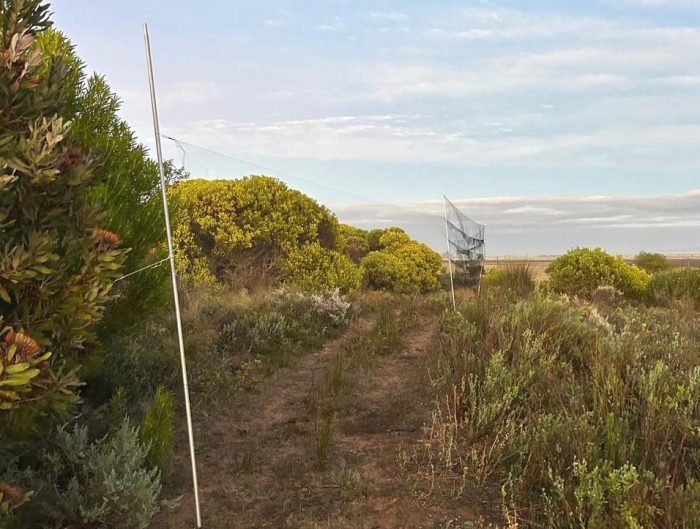
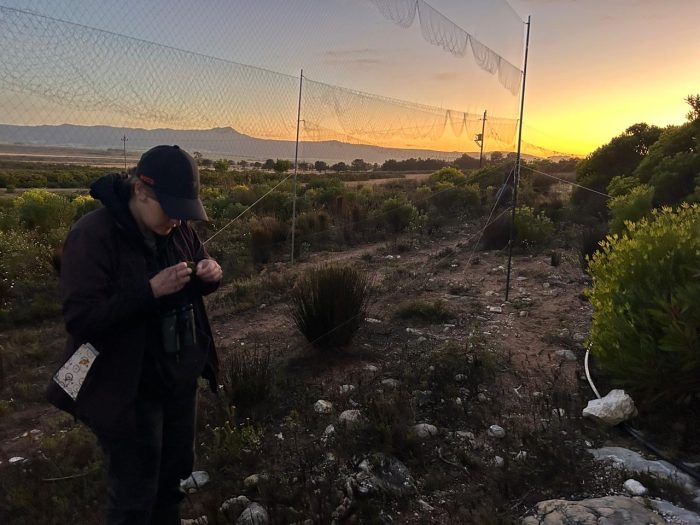
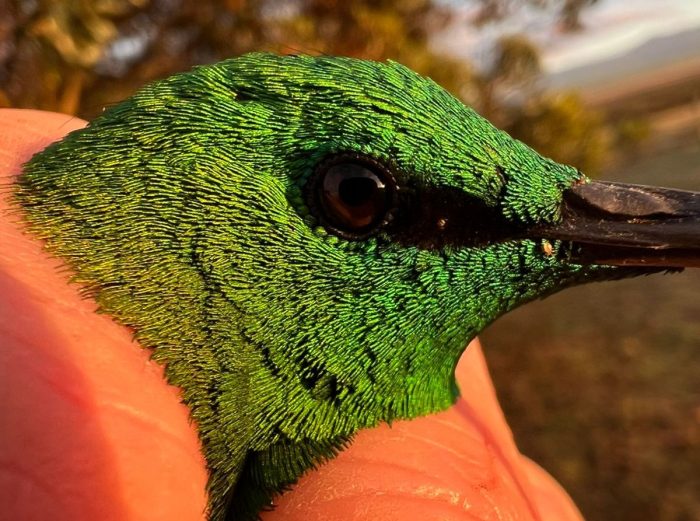
The BDI is holding an Open Day for bird ringing at Grotto Bay on Saturday, 29 November 2025 15 November 2025. We will be hosted by the local community at Grotto Bay Private Nature Reserve. The reserve has an area of 385 ha, and the vegetation consists of Strandveld and Sandveld. It is about 60 km north of Cape Town, turning off the R27. We meet at the Conservation Centre within the reserve.
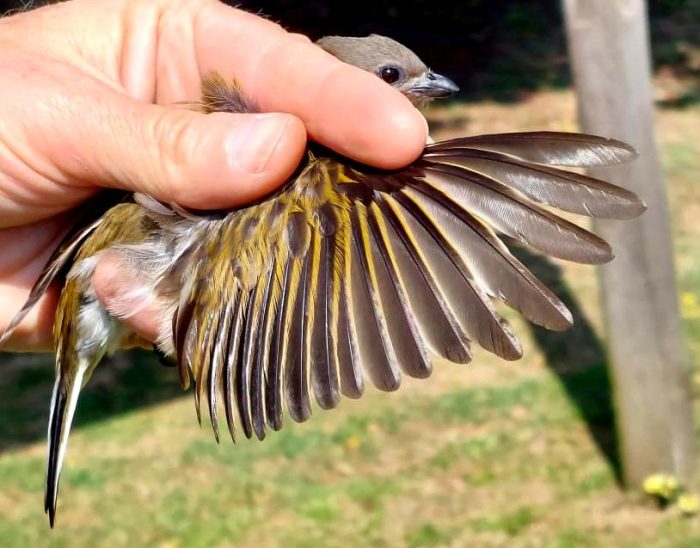
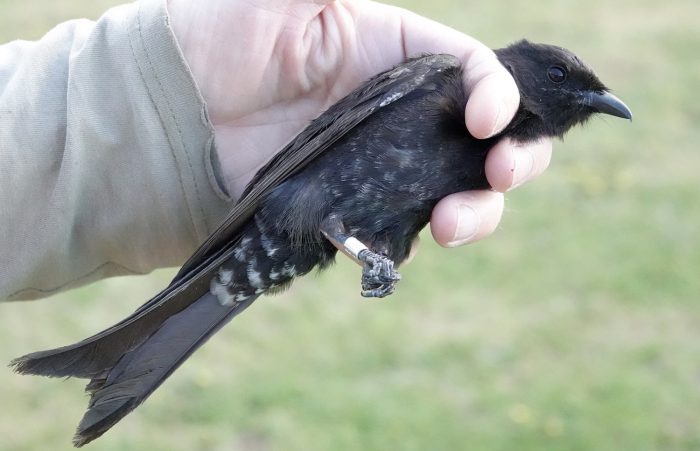
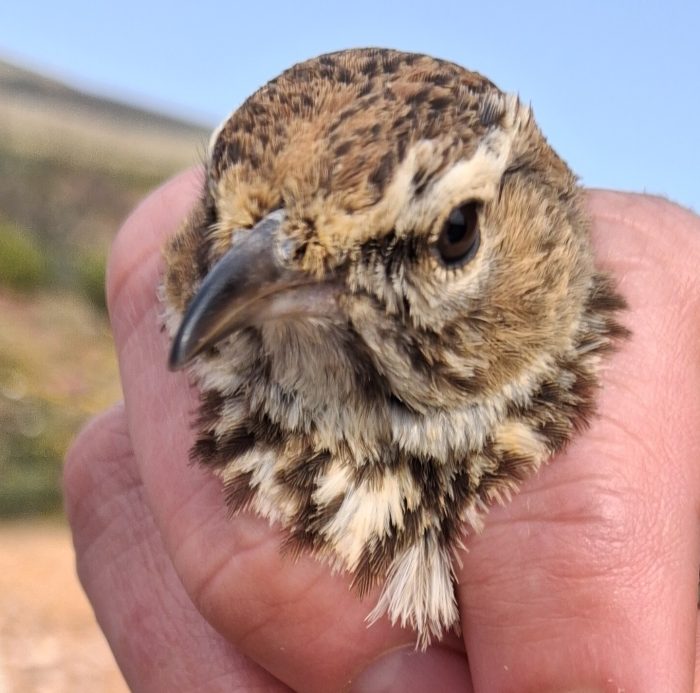
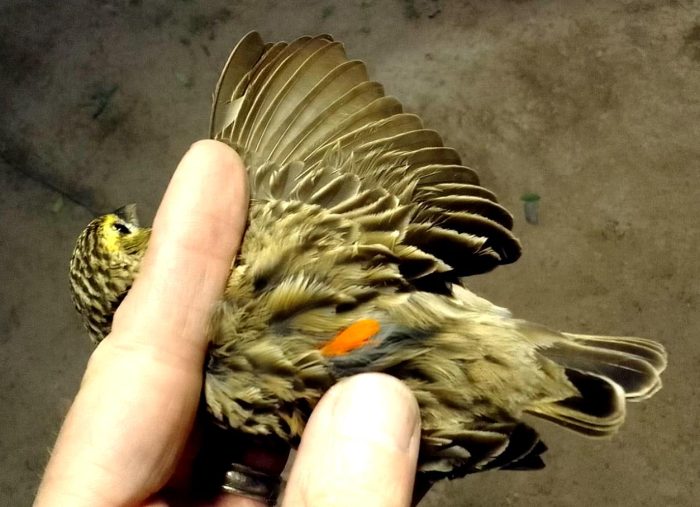
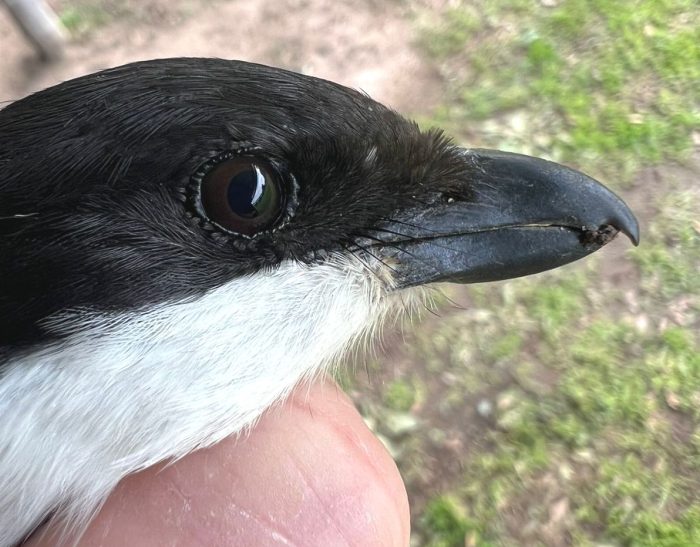
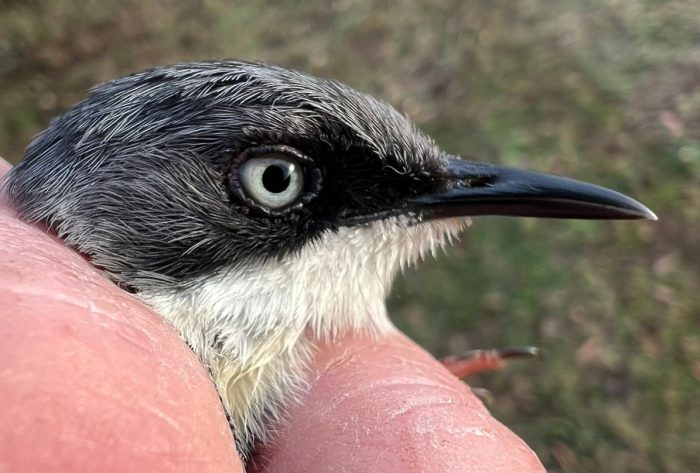
Two of our previous bird ringing visits to Grotto Bay have blogs describing the events: they were on 27 May 2023 and 31 August 2024. The privilege of being a ringer is the opportunity to see birds like this Long-billed Crombec up close, and to see the detailed structure of the feathers. There is a description of the value of bird ringing here.
Long-billed Crombec, ringed at the Open Day for bird ringing at Grotto Bay Private Nature Reserveon 31 August 2024.The Long-billed Crombec has a remarkably short tail. It is only when you see this bird in the hand that you can actually see the size of the tail feathers. Photo : Suzette Vorster
There is lots of space, so ringers are welcome to bring their own nets and ringing equipment. Afterwards we will make a total list of all birds ringed, and produce a blog for the event.
The reserve is not open to the public, so you will not just be able to arrive on the morning of the event! You will gently be turned away with 100% certainty! If you plan to attend, please send an email to me at les@thebdi.org before Tuesday 25 November 11 November. In the email, please include the registration of the vehicle you will travel in, plus ID number and cell phone number. That information is used to pre-arrange entrance at the gate. Information and a code of conduct for visitors to the Grotto Bay Private Nature Reserve is here.
Sunrise on 29 November 15 November is at 05h28 05h35. So the best time to arrive if you are planning to put up mist nets is around 05h00. Otherwise come anytime early in the morning; 07h30 to 08h00 is probably about optimal! We will probably have left by 12h00.
One of the most important components of being trainied as a bird ringer is to learn the skill of being able to extract birds from mistnets safely. This Cape Robin-chat was ringed on 31 August 2024. We might well retrap this bird on 15 December 2025. Photo : Suzette Vorster
There is a list of all the upcoming BDI events here. After Grotto Bay, the next Open Day for bird ringing will be on 20 December 2025, at Zandvlei. This will be ringing followed by brunch.
Links to reports of previous events are here, and there is a blog about the value of bird ringing to research and conservation here.
This was the first bird ringing visit to the Nuwejaars Wetlands SMA (Special Management Area). Our objective was to start the process of finding good ringing sites. We had several failures and a few successes!
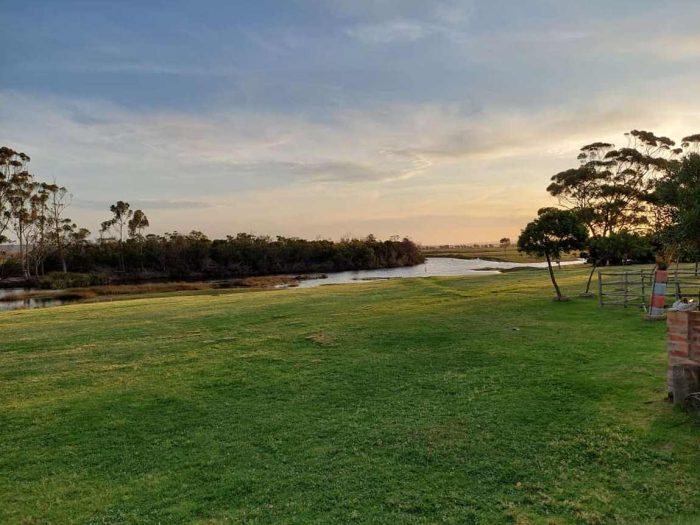
One of the biggest successes was the discovery of the accommodation on the farm Hazevlakte. This is the view of the Nuwejaars River looking upstream …
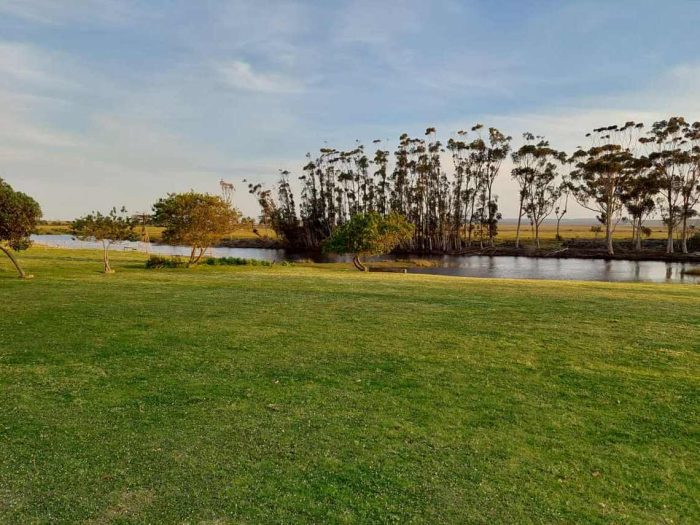
… and below is the view looking downstream …
The eucalypts on the opposite bank are alien. Their redeeming feature is that they are used by African Fish-eagles, cormorants, etc.
The werf at Hazevlakte provides a variety of habitats for mist netting. We found that the species diversity extends beyond weavers, bishops, starlings and sparrows to include Blacksmith Lapwing. Southern Fiscal, Fiscal Flycatcher, Olive Thrush, Malachite Sundird and Cape Robin-chat.
Here’s a … thanks, Ryan
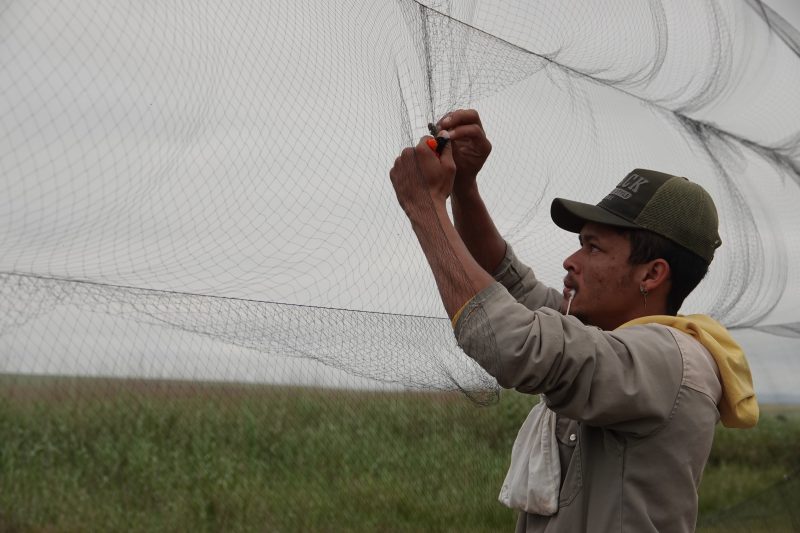
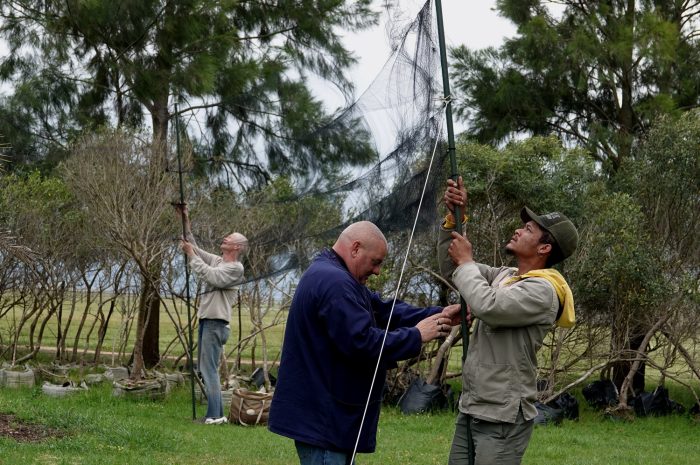
mist net being set up in a patch of grass on the tree-lined edge of the werf at Hazevlakte on a misty morning. There are little grove of trees to the left of the photograph. Weavers, starlings and sparrows were nesting in these trees, and flying out to the irrigated fields in the background to feed.
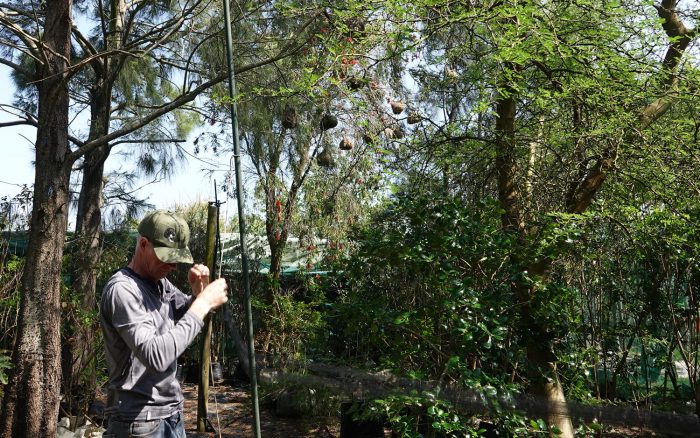
More mist nets being set up in the werf. Weaver nests in the background.
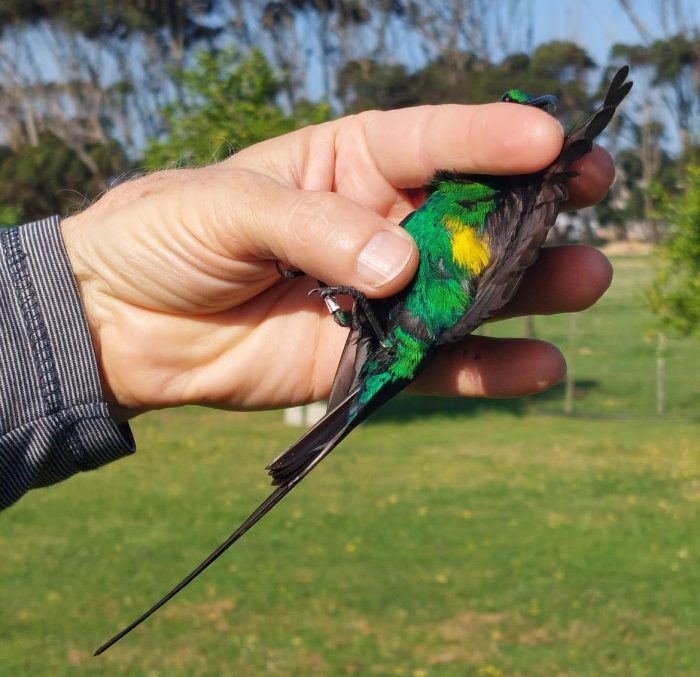
Male Malachite Sunbird, displaying one of his bright yellow pectoral patches.
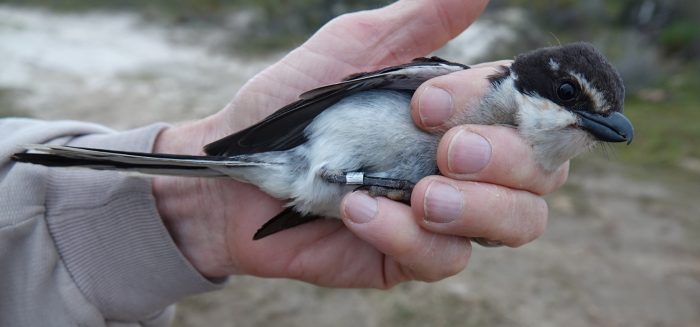
Southern Fiscal, a male because of the absence of a brown patch on his flanks/
This Lesser Honeyguide was not in primary moult. Not surprising, because moult starts after the spring breeding season. Lesser Honeyguide is one of a tiny number of South African species with modelled estimates of the timing of moult, based on data collected during bird ringing. The mean starting date is estimated to be 8 January, and the duration is 140 days, so that 28 May is the mean completion date. There is a lot of individual variation. 140 days to replace primaries! That is four-and-a-half months. That is a pretty slow growth rate.
So the werf at Nuwejaars was declared a Potentially Important Ringing Site.
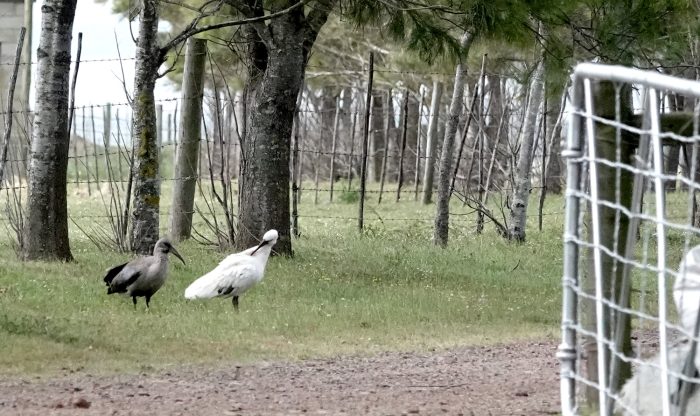
The werf at Hazevlakte has this negative bird that makes you wonder if your eyesight is going wonky. Unfortunately, we didn’t catch it, or any other Hadeda! [**Update : this leucistic Hadeda Ibis has been seen on almost all of our subsequent visit to Hazevlakte, and most recently on 22 September 2025**]
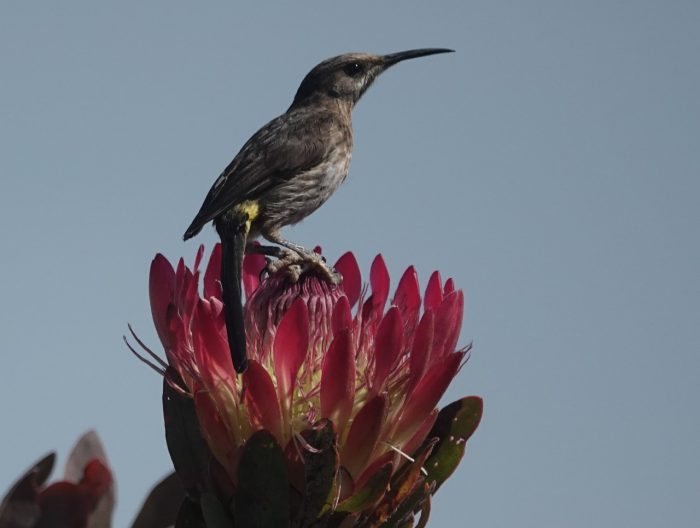
We did an exploratory trip one afternoon to a protea patch on the farm Zandvlakte. We caught four Cape Sugarbirds. These are quite likely the southernmost sugarbirds ever to be ringed! This locality was added to the list of discovered sites to be revisited on future trips, a second Potentially Important Ringing Site.
We tried several other sites, but none of them reached the threshold to become Potentially Important Ringing Sites.
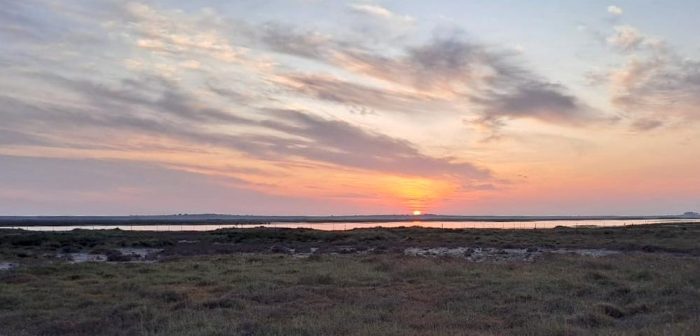
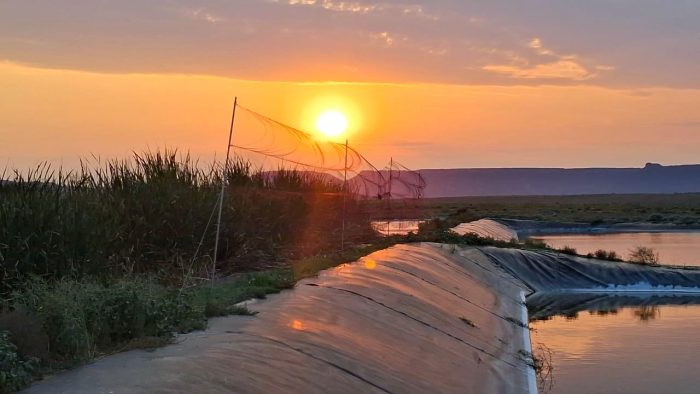
There were days when we caught the sunrise, and little else!
The table gives the total number of birds of each species handled.
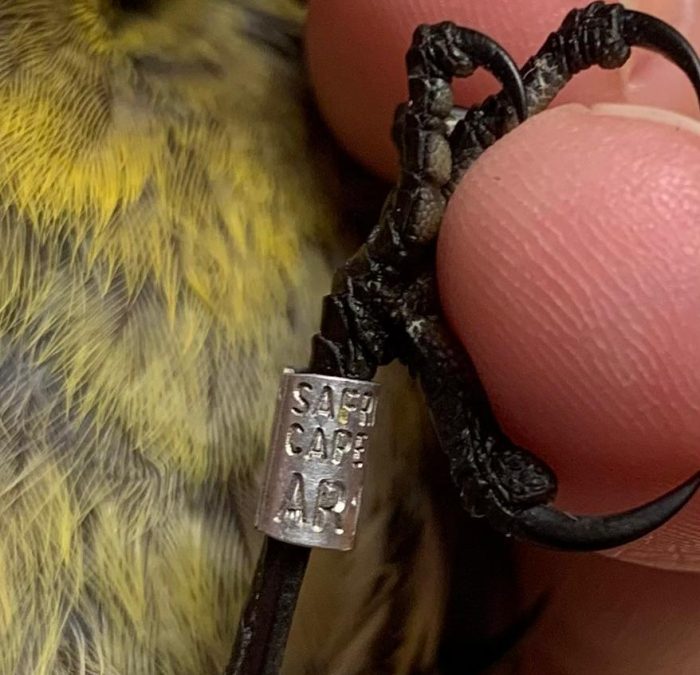
One of the six Malachite Sunbirds we ringed was a nestling at one of the less profitable sites! The date was 11 October 2024. This bird was found in a garden of a house near the southern tip of Africa, in L’Agulhas, 22 km from where it had been ringed. It was caught by a domestic cat, but not killed outright, but did not survive. Even though the story is tragic, it is an interesting example of juvenile dispersal.
Damselfly discovery
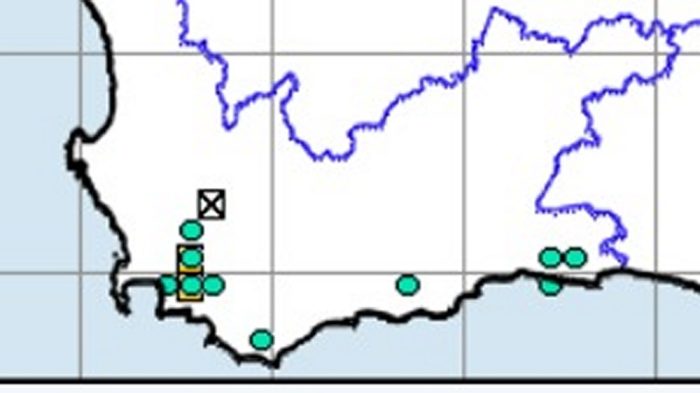
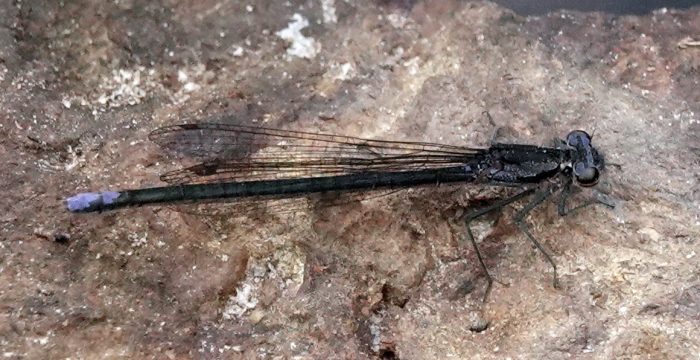
We did a ringing expedition to a site which turned out to be the poorest a site could possibly be. We had zero birds to ring. But we did have a damselfly to photograph. To everyone’s astonishment, the damselfly was identified as Spesbona. This species is classified as Endangered; it is extremely rare and localized. Before looking at the damselfly, look at the distribution map for the species …
The new record is the southernmost, and a long way from the others, which are along the mountain chain between Knysna and Somerset West.
This is the Spesbona seen at Hazevlakte on the Nuwejaars Wetlands. In relation to most other species of dragonfly and damselfly, this is a species that is in flight relatively early, with a mid-October peak. You can read up about Spesbona in the Online Atlas of Dragonflies and Damselflies of South Africa, with the species text here.
Thanks
Erica Brink, Nuwejaars Wetlands Special Management Area, organized our accommodation with Karen Neethling at Hazevlakte. It turned out to be an inspired arrangement. Eugene Hahndiek helped us find ringing sites, and arranged access to them.
We are reporting on our eighth bird ringing expedition to the Nuwejaars Wetlands. We were here from Friday 19 to Tuesday 23 September 2025, four nights. As with the previous visits here we are still exploring new sites and new options. Some are winners, and some are less successful. But it is all part of the learning process.
Saturday morning was spent at the northern side of the Nuwejaars River floodplain at Moddervlei. We didn’t get the mistnets in good places and a stiff breeze started early. We could have done better here. On Sunday morning we put the mistnets up near the hide on the African Marsh Harrier Trail. This is now our best site in the area! On Monday morning we ringed around the werf at Hazevlakte, around our accommodation, and that yielded a steady stream of birds, lots of them retraps. On Monday afternoon we reccied a spot with easy access to the Nuwejaars River close to the farm Heuningrug. Definitely worth a bigger exploration. On Tuesday morning we operated near the protea patch at Zandvlakte. This is a regular spot, and the place where we hope to get samples of sunbirds and sugarbirds.
As the days pass by around the spring equinox, the rate of change of sunrise is fastest. and in the wrong direction! So, for the next couple of months, the ringing day starts a minute of two earlier every day.
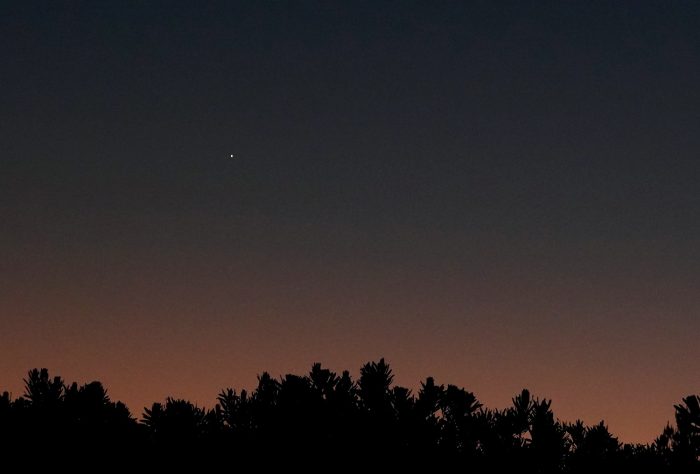
06h02 in the Zandvlakte protea patch. Time to get the mist nets up, watched by the “morning star”, in this case, Venus.
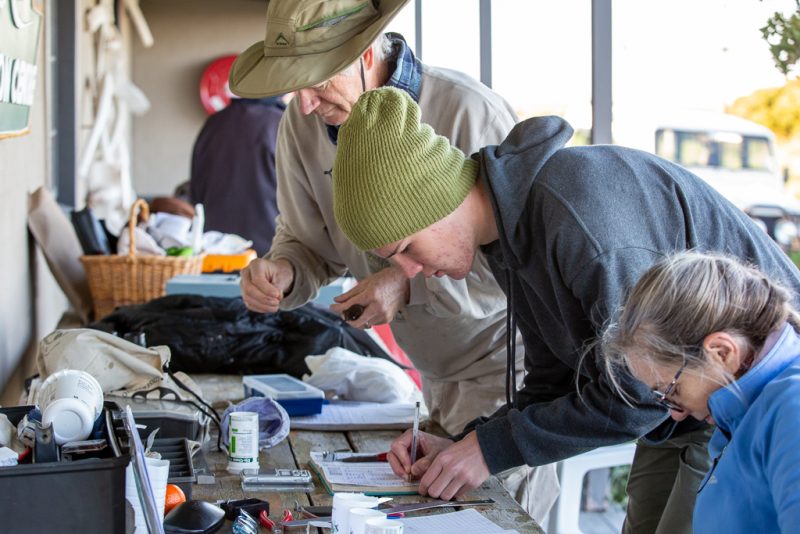
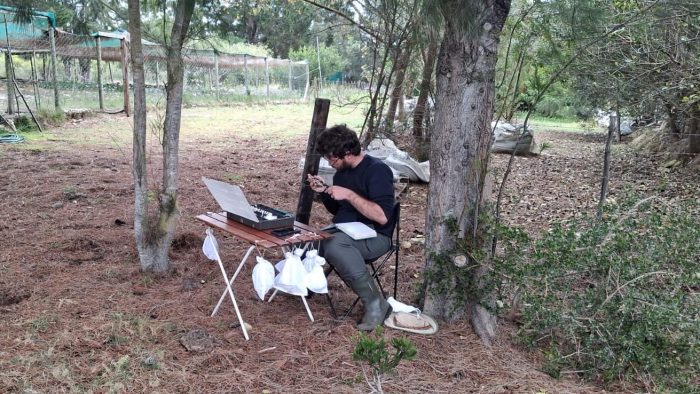
Central to every bird ringing day is the table where the ringing gets done. It’s chosen to be out of the sun if possible (otherwise we need to take the lapa for shade). It mustn’t be too far from the mist nets, and it must not be too close either. The global bird ringing standard is to keep birds in bags from capture to processing. And we keep the bags in order so it is a FIFO system. FIFO = First In, First Out. Most of the time the designated ringer doesn’t know what is in the next bag until he takes the bird out.
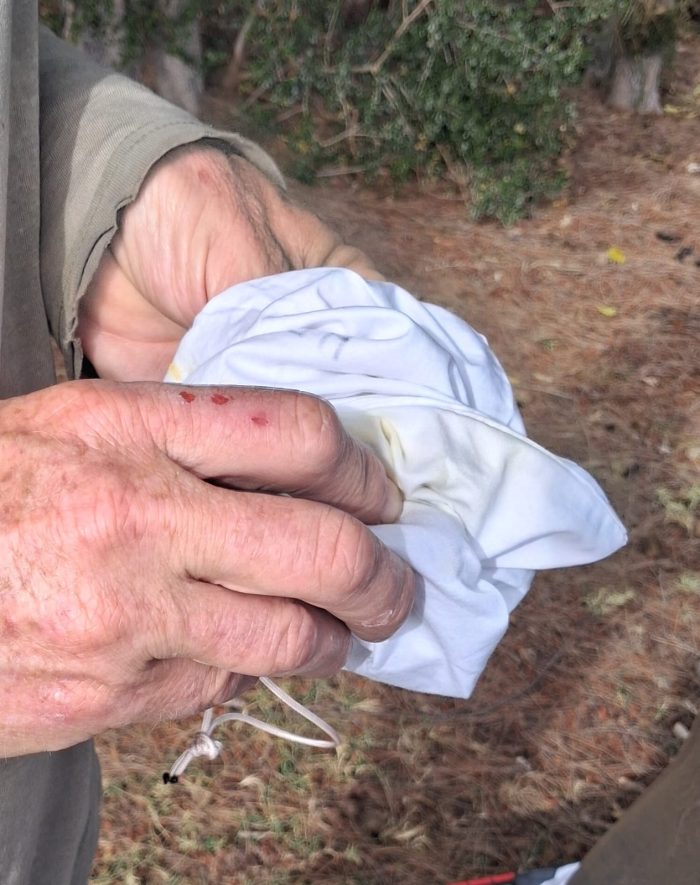
Bag 1
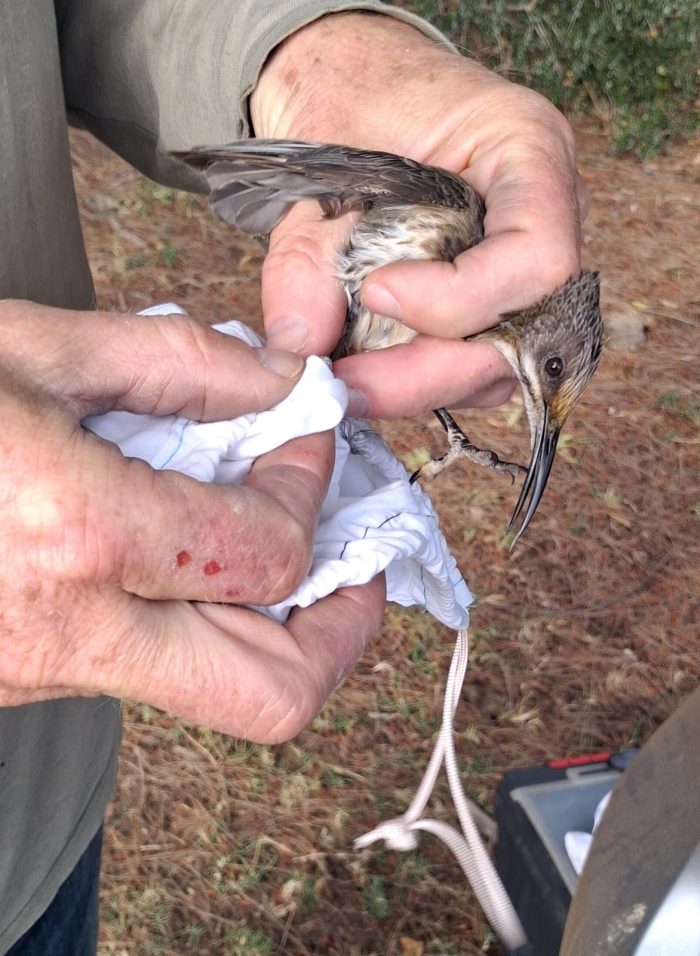
What’s in the bag? It’s a …
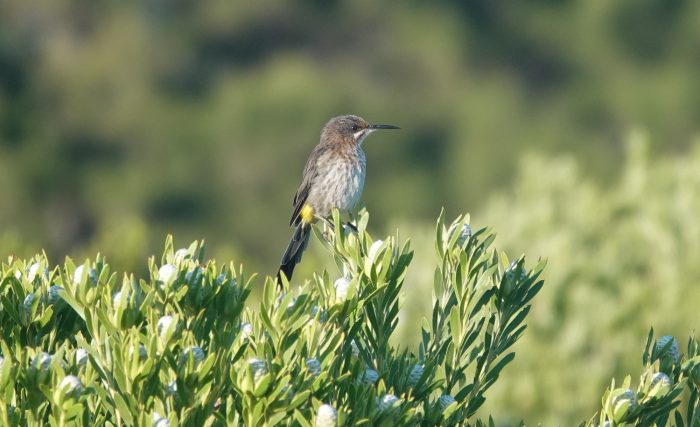
… Cape Sugarbird. The first of seven that we ringed at Zandvlakte, in the protea patch. That brings the total number of sugarbirds ringed at Zandvlakte to 14.
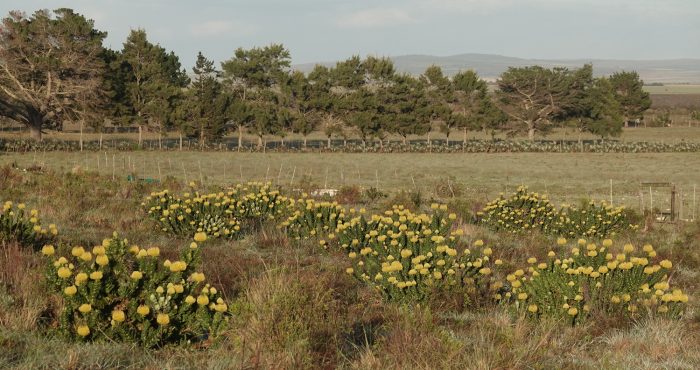
Part of the Zandvlakte protea patch. These are cultivated proteas, planted in rows, but clearly many (in reality, most) of the plants didn’t survive.
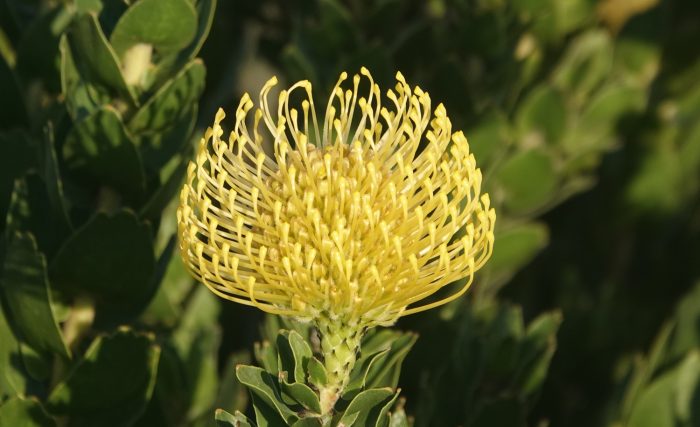
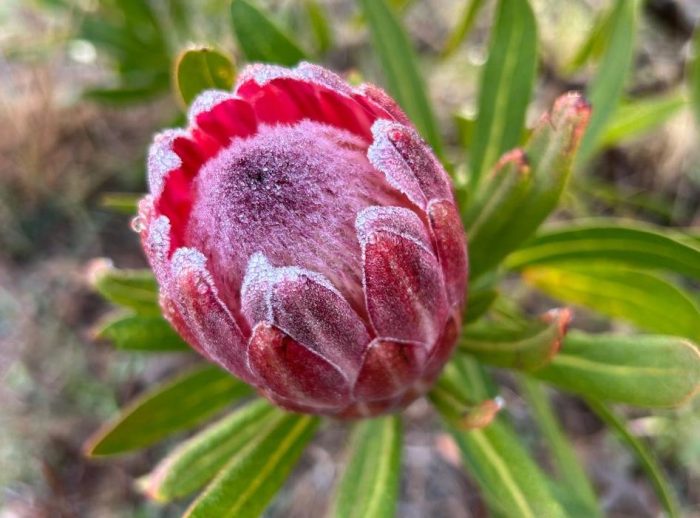
Even though it is a cultivar, a horticultural variety of pincushion protea …
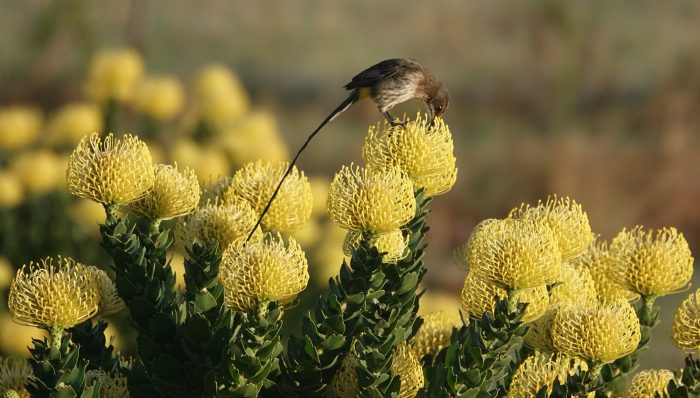
… it still produces nectar for the sugarbirds.
The sugarbirds make excursions into the cultivated patch of proteas from the neighbouring hillside, which is covered by a remnant of natural fynbos.
Bag 2
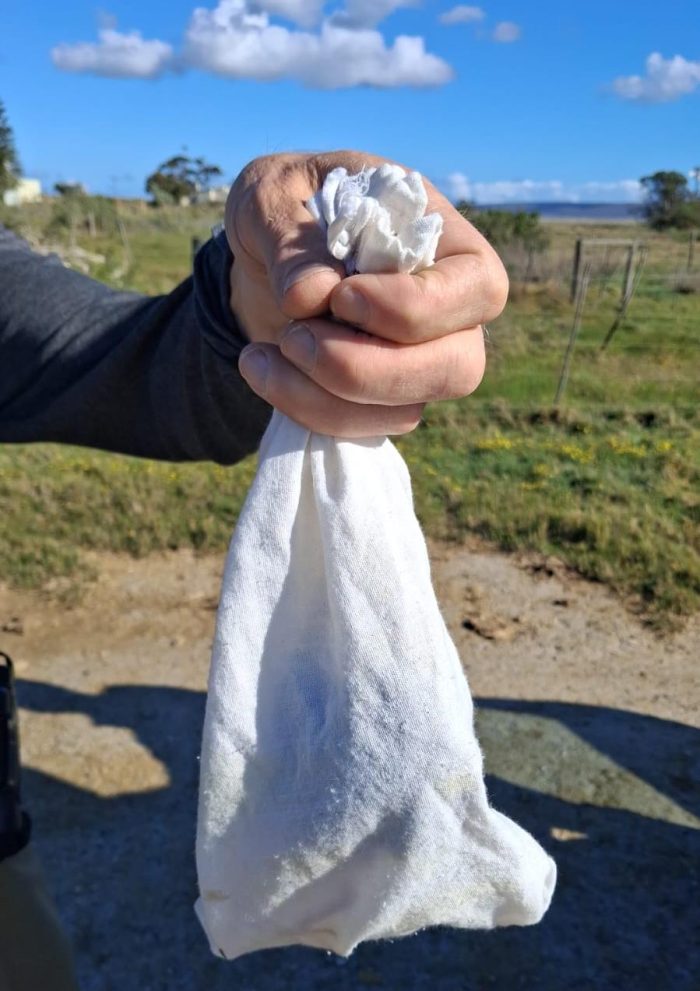
Here is another bag with a bird in it …
This bag comes from the recce trip to the Nuwejaars River on Monday afternoon …
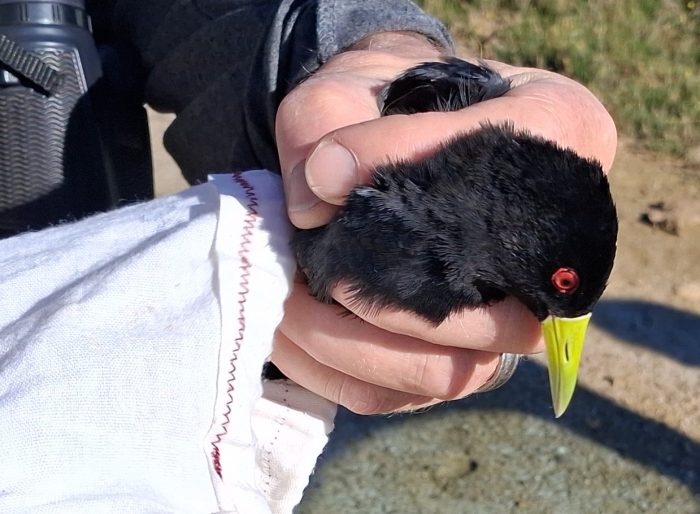
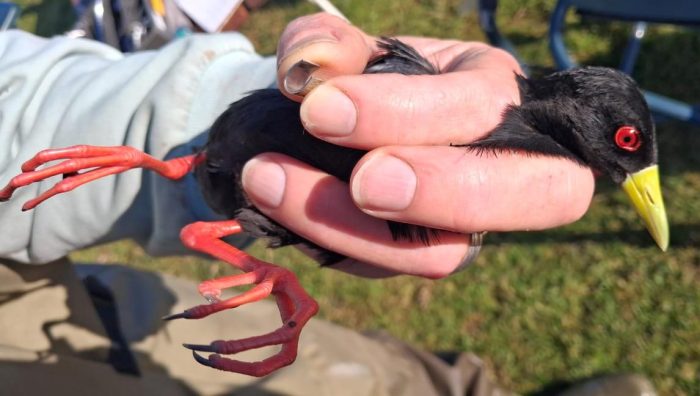
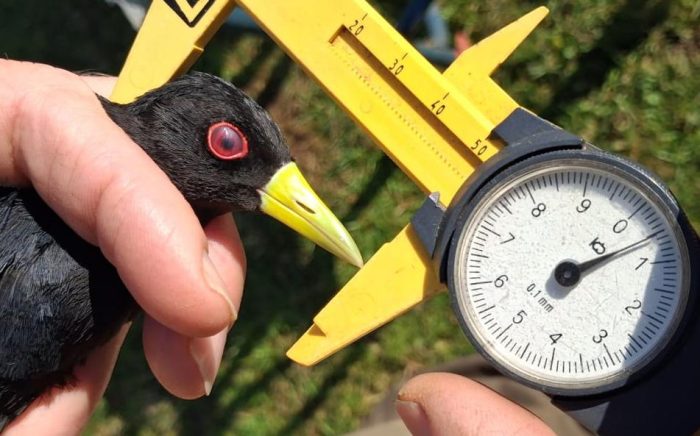
… and the bird in the bag is a Black Crake, our third for the trip! The floodplain of the Nuwejaars River has a large population …
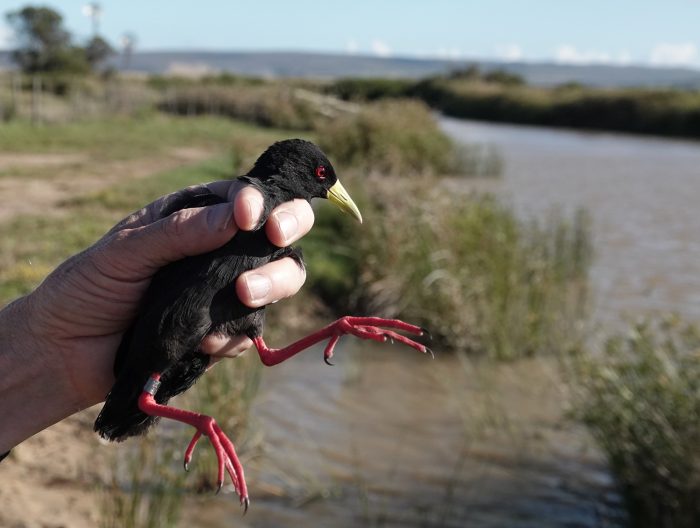
… and here, just before release here is the crake with its habitat in the background. To see the colours of the eyes, bill and legs with the bird-in-the-hand is an awesome privilege.
More privileges …
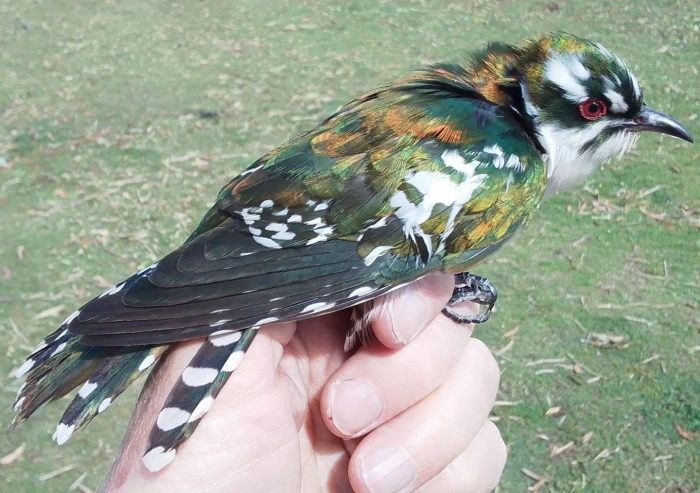
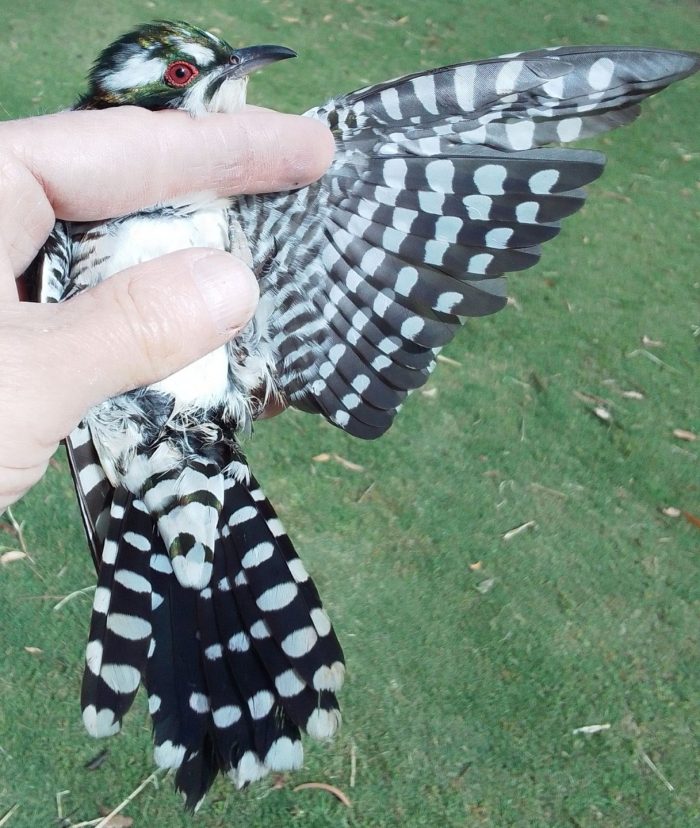
This is the southernmost Diederik Cuckoo ever ringed …
It’s a male, diagnosed by the red eye-ring
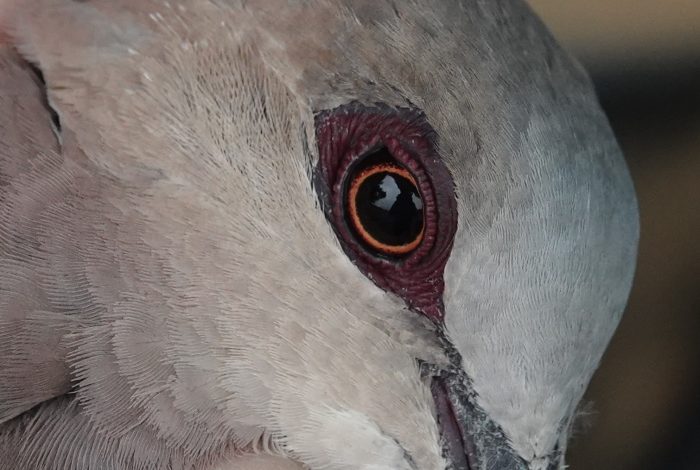
It is only ringers who really get to see birds close-up!
Here is the eye of the Red-eyed Dove.
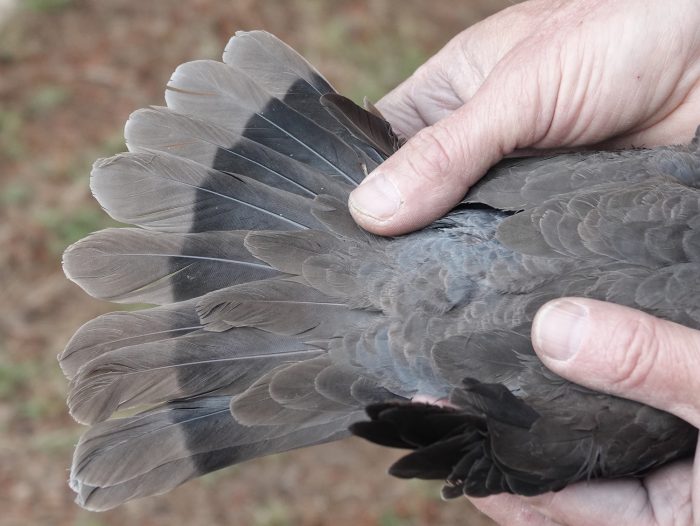
This is the tail pattern, which you can compare with the tail pattern of the Ring-necked Dove ….
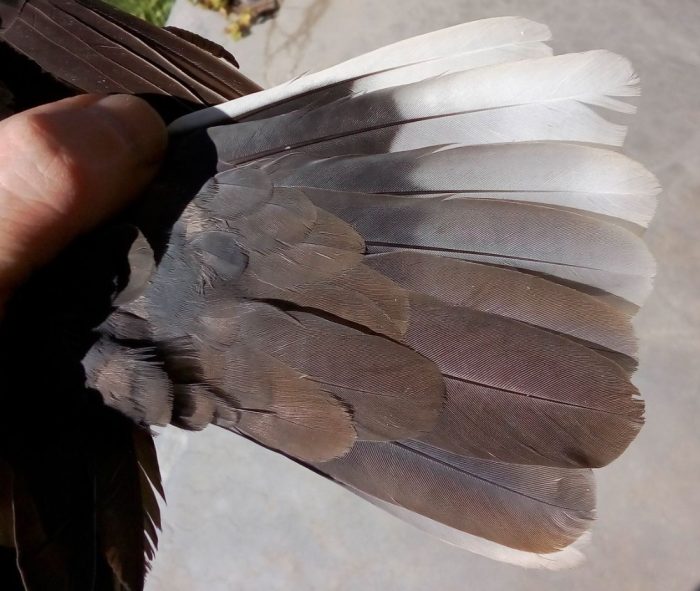
… in which the outer three tail feathers are white, but which can be hidden away when the tail is in the natural position.
… this is a young Fork-tailed Drongo. The white pattern of the underparts, and the dark eye (red in adults) are diagnostic of this being a juvenile.
Summary table
Dieter Oschadleus produced this summary of the bird ringing at Nuwejaars Wetlands in September 2025.
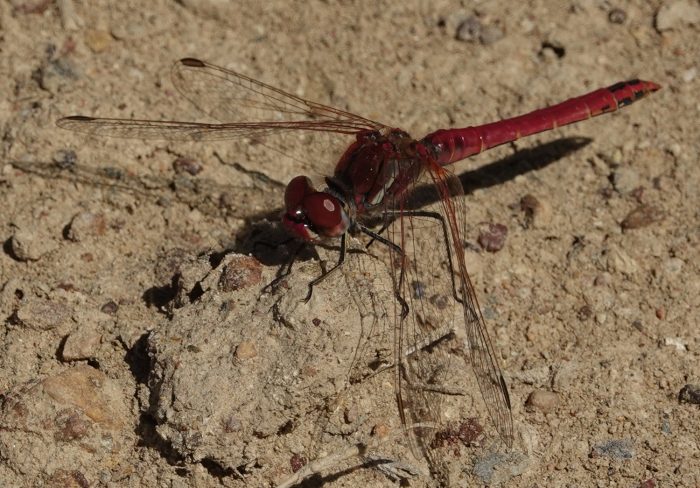
It is still a bit early in spring for dragonflies. This is the commonest species in the Agulhas Plain, the Red-veined Darter. This is often one of the first species to be on the wing in summer. Its range covers almost all of Africa, southern Europe, and on into Asia.
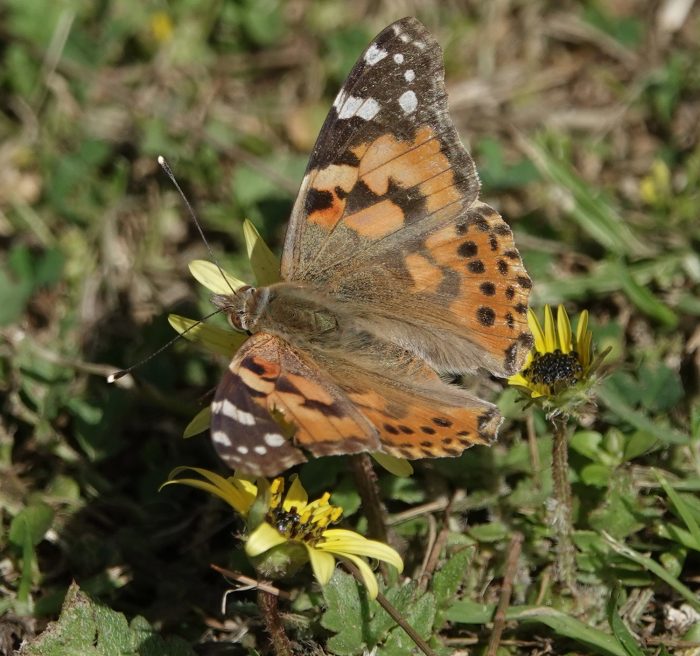
The Painted Lady has the largest distribution of any species of butterfly. Here is the evidence that it extends to the southern tip of Africa. It some parts of the world it is a migrant, for example from Africa to Europe.
Thank you
We are grateful for the support of the team at the Nuwejaars Wetlands Special Management Area, Ross Kettles and Erica Brink. Thanks to Karen and Con Neethling for the warm welcome, once again, to the accommodation on the farm Hazevlakte. Thanks to Con, Liohan Giliomee, Dirkie Swart and Diko Swart for permission to ring on their farms.
Annual report: Nuwejaars Wetlands Special Management Area
To understand what we are involed with, you can study the 2024/25 annual report of the Nuwejaars Wetlands SMA is available. Read it here.
… and finally …
… even if we were at the Nuwejaars Wetlands for with the sole purpose of being outdoors, it would be valuable therapy for mind and body!
A paper on the migration of Barn Swallows has been published Open Access in the journal Birds. Publication date was 9 September 2025. The authors, title and journal reference are
Underhill LG,Remisiewicz M 2025. Arrival and peak abundance of Barn Swallows Hirundo rustica in three regions of South Africa in relation to climate indices, deduced from bird atlas data. Birds 6: 48. https://doi.org/10.3390/birds6030048
You can find the paper here or if you would like to go directly to the pdf version, it is here.
In the paper we discuss the way in which the arrival and peak abundance of Barn Swallows in South Africa are influenced by large-scale climate indices in the areas in which they breed, the areas in which they prepare for migration and in areas along the migration flyways.
We, in this case, are Magda Remisiewicz and myself. Magda was a post-doctoral research fellow in UCT’s Animal Demography Unit from 2008 to 2010. She now heads the Bird Migration Research Station at the University of Gdańsk in Poland and has recently been appointed professor at this university. Part of the formalities in being appointed a professor at a Polish university is to be congratulated by the national president:
President Andrzej Duda congratulates Professor Magda Remisiewicz on her appointment as Professor, 24 June 2025
The data analysis for the paper uses Barn Swallow records on SABAP2 checklists collected at the three main centres where the most atlas data has been collected: the area around Cape Town, called Greater Cape Town in the paper; the area around Johannesburg and Pretoria, Greater Gauteng; the area around Durban, Greater Durban. For each of these regions there are lots of checklists for every one of the 17 years between 2007, when SABAP2 started, and 2023; we stopped then because we did the analyses for the paper in 2024. In this blog, we focus on the results for Greater Durban.
Calculating how early or late the Barn Swallows are each year …
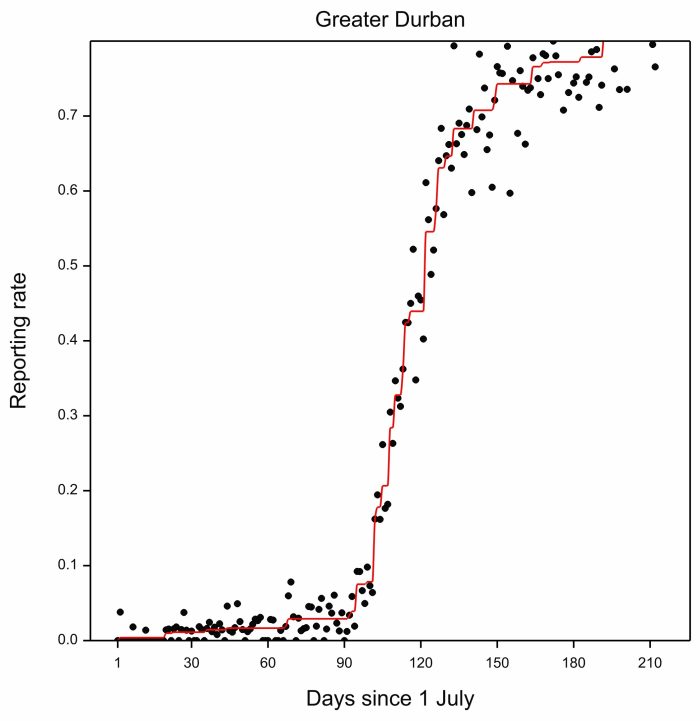
We started the analysis by combining the data for all 17 years for each region, and produced a curve which showed how reporting rates increased on average during the arrival periods in each region. Here is the plot for Greater Durban:
The black dots are the daily reporting rates in the Greater Durban area from 1 July. So the dot for 1 July would use the SABAP2 checklists made on 1 July in all 17 years (2007 to 2023). It is clear that the period of the most rapid increase in reporting rates runs from about Day 100 (i.e. 100 July) to around Day 130 (i.e. 130 July, known to most people as between 8 October and 7 November). The rate of increase of reporting rate then slows down, and flattens out by about Day 190 (i.e. 190 July = 6 January).
It is encouraging to see how well-behaved the pattern of daily reporting rates is. At the end of the day, that is a huge accolade to the quality of the atlasers.
The red line in the plot above is constructed using a technique called monotonic regression, which hugs the reporting rates as closely as possible, while always moving upwards. The red line defines the average timing of migration over the 17 years. For each year we want to find the anomaly of migration timing, ie quantify how early or how late migration was in relation to the long term average. And we want to do this over the whole arrival period. For Greater Durban we used the period between Day 104 and Day 192 as the arrival period (12 October to 8 January)
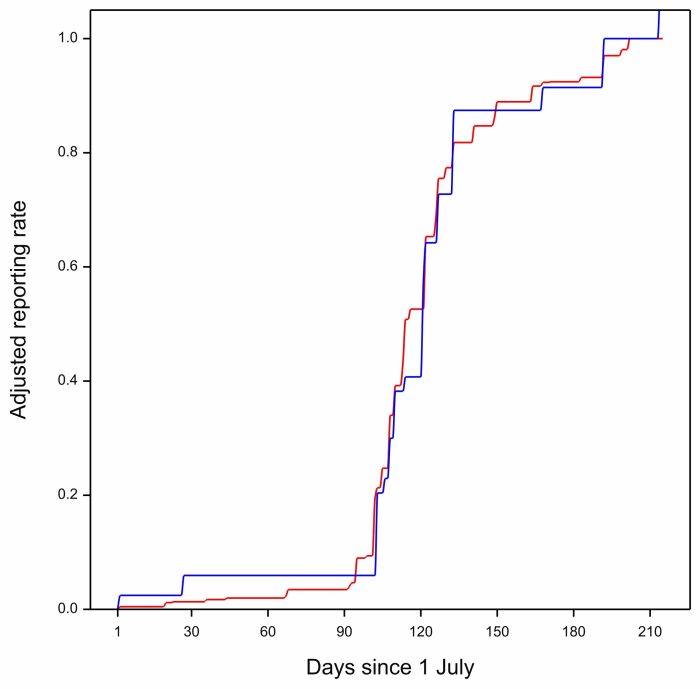
To calculate the anomaly for a particular year, we calculated the daily reporting rates for that year. Then we fitted the monotonic regression for the year. So for Greater Durban in 2016, the blue line is the line for the year, and the red line is the line for all the years, copied from the image above.
We adjusted the reporting rate curves for the individual years, (and for the multi-year curve) so that they ended at 1.0 in every year. This was done because the maximum reporting rate reached at the end of migration differed between years. In the curve above, for 2016, the red line (the multi-year curve), and the blue line (the 2016 curve) are very similar. The areas of the pieces of the blue curve which are above the red curve more or less balance with the ares of the blue curve below the red curve. In other words, arrival of Barn Swallows in 2016 had a very similar pattern to the overall arrival pattern, and the arrival anomaly for 2016 is small.
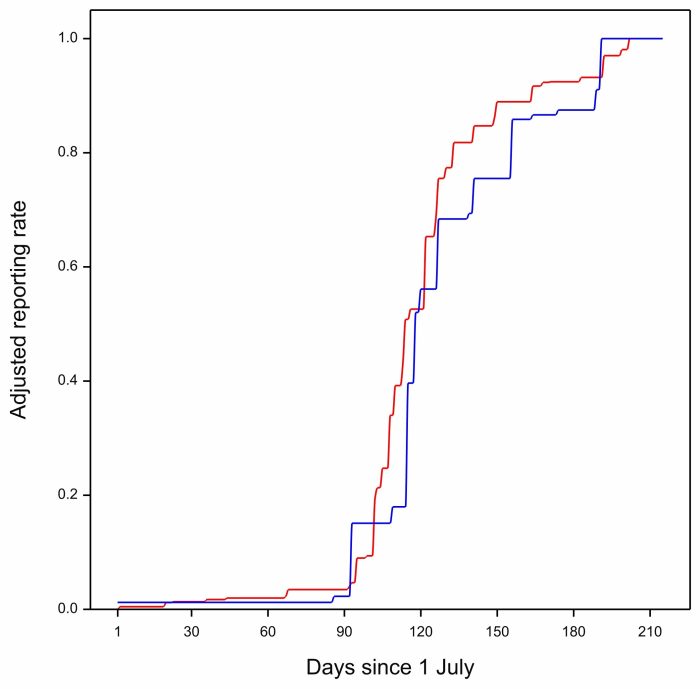
… next, have a look at this, the two curves for 2008:
The blue curve for 2008 is mostly to the right of the red multi-year curve. The Barn Swallows are late, and the anomaly is positive. In all of these plots the red curve is identical. It is the blue curve that represents arrival in a particular year and is different in each plot.
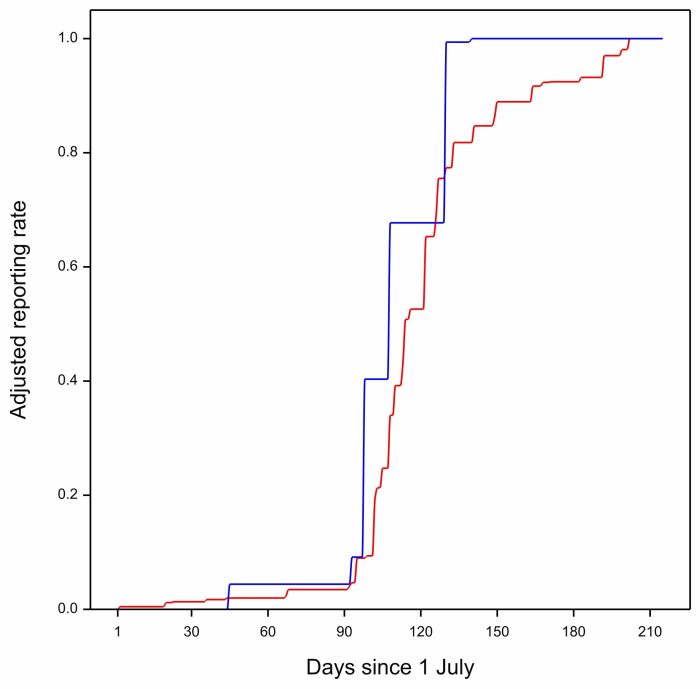
… and here is the curve for 2021:
The blue curve for 2021 is mostly to the left of the multiyear curve. Arrival is early. The anomaly for 2021 is negative.
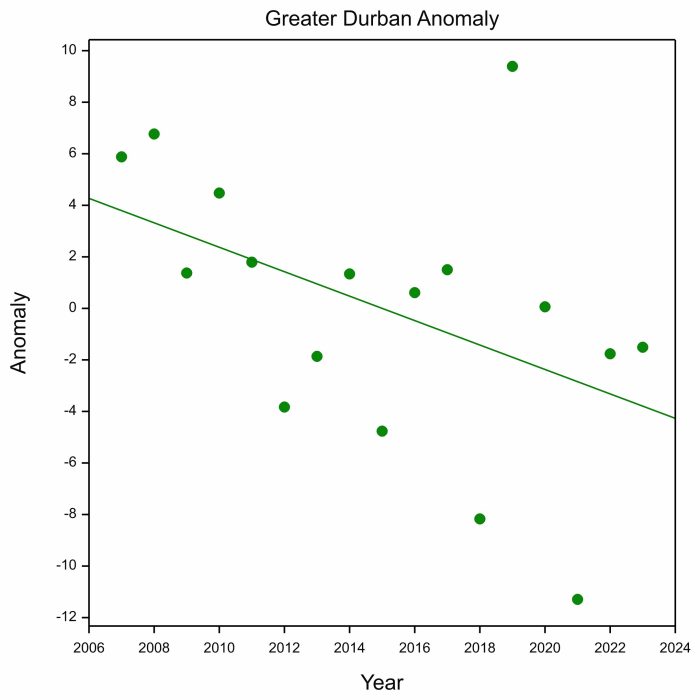
When you calculate the anomalies for Greater Durban for every year, and produce a plot with year on the x-axis and with annual anomaly on the y-axis, it looks like this:
The astonishing thing is that the scatter of points is not random, they point downwards. In the early years of SABAP2, the annual anomalies were mostly positive, and towards the end they were mostly negative. When the anomaly is positive, arrival is late, and when it is negative, it is early. So the downward trend in the plot above is saying that the arrival of Barn Swallows has trended earlier in KwaZulu-Natal during the SABAP2 period, 2007 to 2023.
The next result was even more surprising. These annual anomalies were positively correlated with a climate index called the Scandinavian Pattern. We used the average value of the Scandinavian Pattern during the breeding season of the Barn Swallows, the period May to August. Positive values for the Scandinavian Pattern are related to warm and dry conditions in northeastern Europe and western Asia, the breeding area of a large proportion of the Barn Swallows migrating to the Greater Durban region (we know this from ring recoveries). Favourable breeding conditions probably increase the breeding success of Barn Swallows, which can raise two broods. The adults with second broods, and the juveniles from them, will tend to migrate later than in years when conditions are cold and wet when the Scandinavian Pattern is negative. So the positive correlation between the timing of arrival on migration and the Scandinavian Pattern during the previous breeding season is eminently plausible.
Peak annual reporting rates …
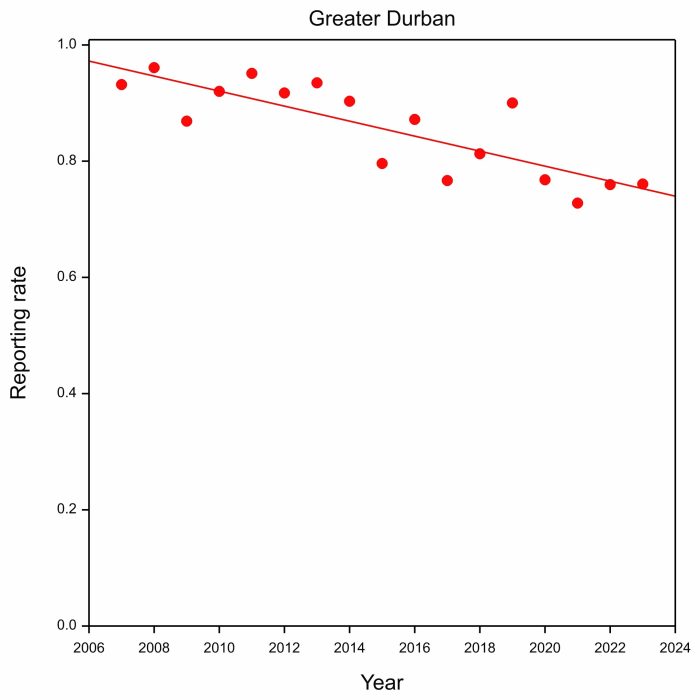
One of the things we discovered was that the reporting rates climbed to different values after each arrival year. So we computed the annual peak reporting rates for Barn Swallows for a given year as the median of the reporting rates during the midsummer period between 11 and 31 January of the following year. So the peak reporting rate for 2007 is based on the reporting rates for the three-week period between 11 and 31 January. We chose this period because reporting rates had stopped increasing by 11 January, and had not started decreasing by 31 January. So the plot below shows peak annual reporting rates for Greater Durban:
The results are alarming. They show a steady decrease in reporting rates from above 90% in the early years of SABAP2, to below 80% in recent years.
What are the take home messages?
The paper is packed full of results like this, relating to the arrival and peak abundance of Barn Swallows. Its main message is that the southward migration of Barn Swallows and the timing of their arrival at their southernmost non-breeding destinations are influenced by the big climate indices, and by temperature and precipitation across the breeding range and along the migration routes. The climate variables that show correlations make sense in relation to the known breeding areas and migration routes to the three destination regions.
The paper demonstrates the potential of the Second Southern African Bird Atlas Project (SABAP2) as a long-term annual monitoring project for birds. The particular strengths are its strong protocol, which enables the analysis undertaken here, and the fact that, unlike most monitoring projects, it enables monitoring to be done both in space and time. We recommend the indefinite continuation of the SABAP2 project, which with time, will provide more insight into changes in birds’ distribution and timing and their response to climate change not only in South Africa, but also on the breeding grounds and along migration routes. This might be the first paper to use SABAP2 data on an annual basis.
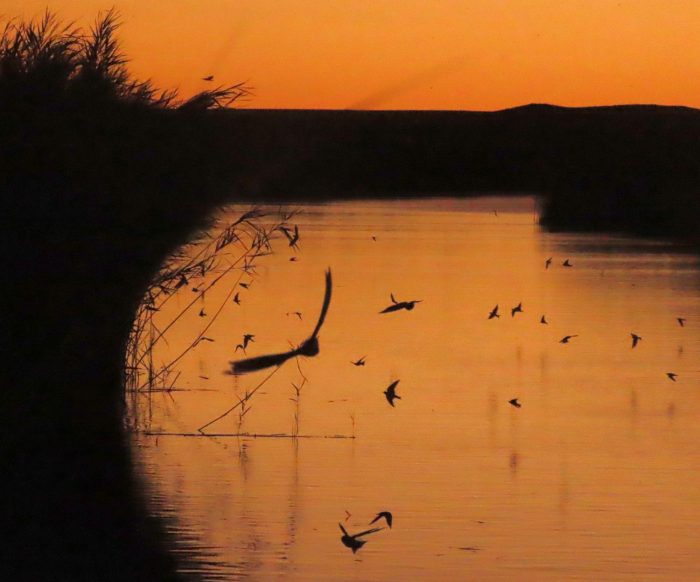
Barn Swallows arriving after sunset at an overnight roost in South Africa
Sister papers
This new paper has four “sister” publications, based on bird ringing done at the bird observatory at Bukowo, on the Baltic Sea coast in Poland. All of them are Open Access, Click on the journal reference to get the paper.
Remisiewicz M, Underhill LG 2020. Climatic variation in Africa and Europe has combined effects on timing of spring migration in a long-distance migrant Willow Warbler Phylloscopus trochilus. PeerJ 8: e8770. This paper has a blog.
Remisiewicz M, Underhill LG 2022a. Large-scale climatic patterns have stronger carry-over effects than local temperatures on spring phenology of long-distance passerine migrants between Europe and Africa. Animals 12: 1732.
Remisiewicz M, Underhill LG 2022b. Climate in Africa sequentially shapes within-season spring passage of Willow Warbler Phylloscopus trochilus through the Baltic Coast. PeerJ 10:e12964.
Remisiewicz M, Underhill LG 2025. Climate in Europe and Africa sequentially shapes spring passage of long-distance migrants at the Baltic coast in Europe. Diversity 17: 528.
These four papers deal with northward migration. The new paper deals with southward migration.
There is a full list of all publications with BDI authors here
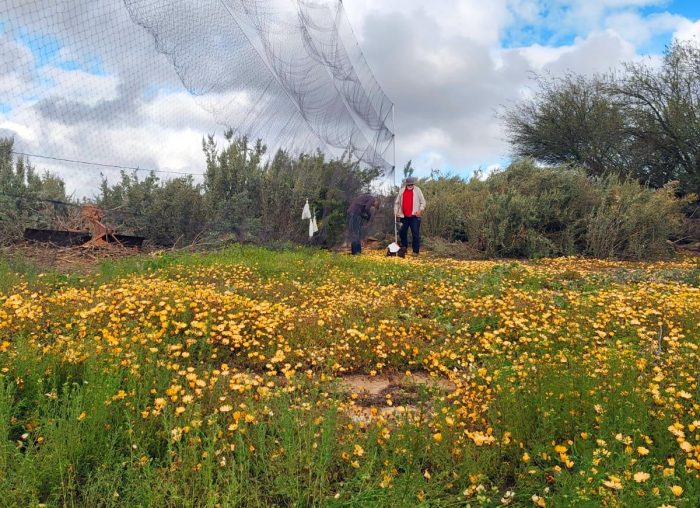
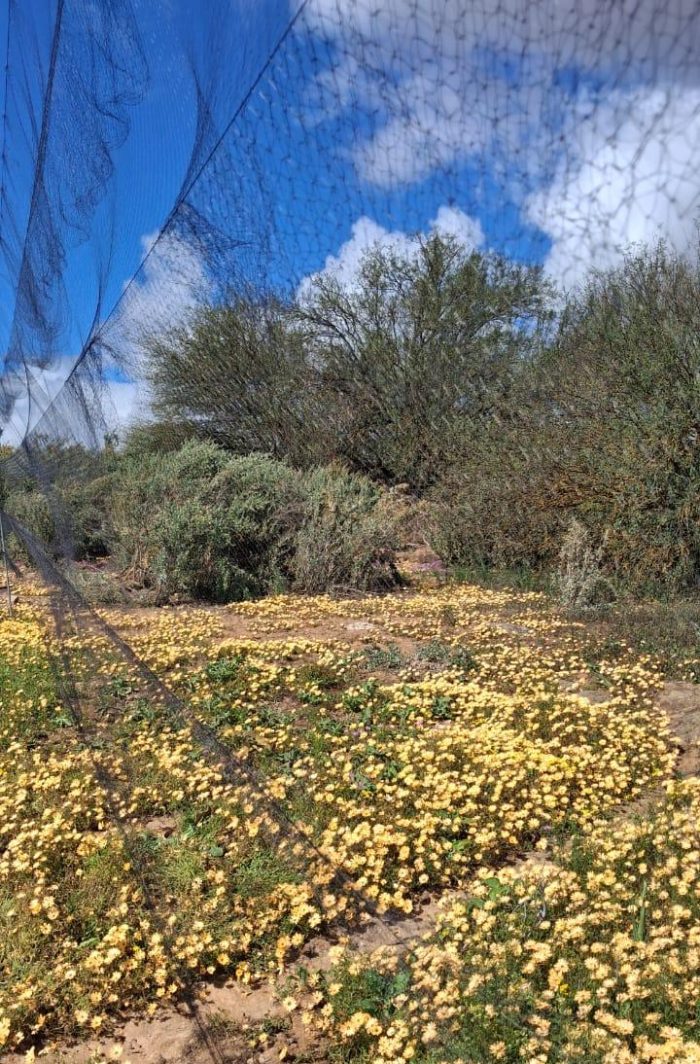
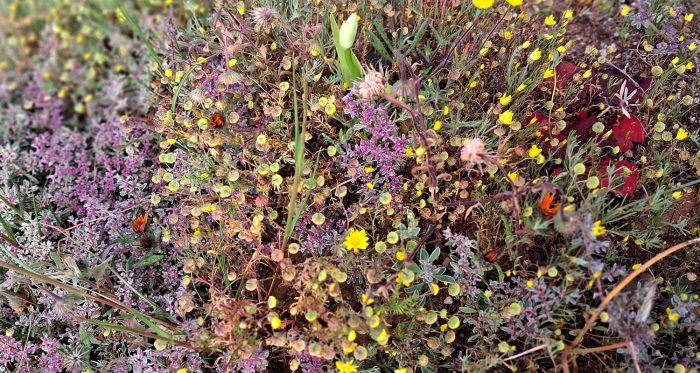
We were bird ringing at Botuin, Vanrhynsdorp, at the peak of the spring wildflower season. We didn’t do any dedicated trips to the special touristy flower spectacles. But we were surrounded by flowers during our daily bird ringing sessions.
Over the five days, we didn’t quite make 200 birds handled. The total here shows 192 birds, of 28 species.
We had a few hours to ring after we arrived. We set up mist nets at Botuin. Lots of daisies!
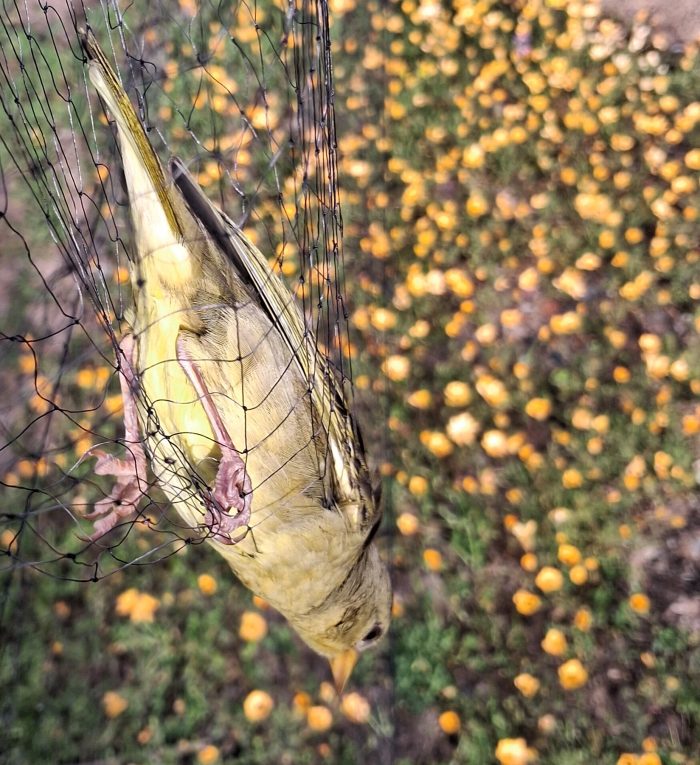
Cape Weaver, gently held above the daisies by the mist net,
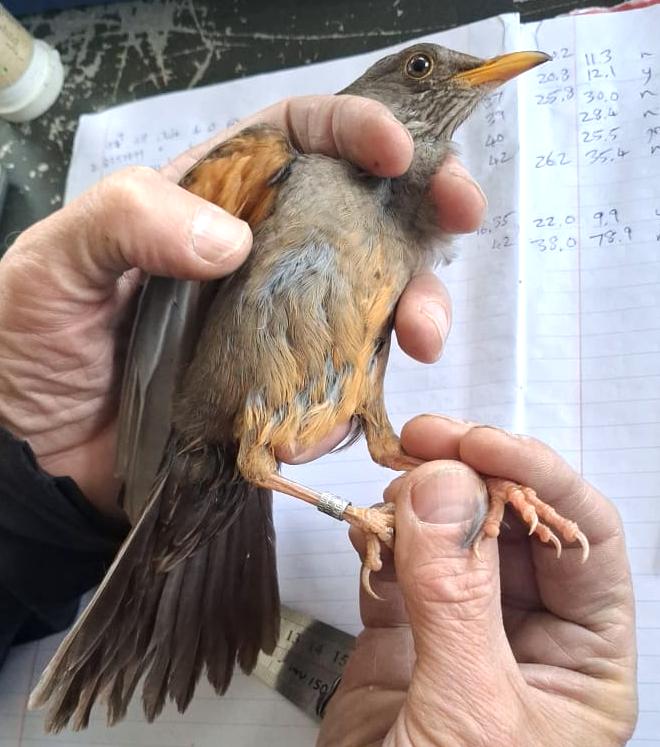
The grey flanks and the yellow eye-ring point to this being a Karoo Thrush rather than Olive Thrush. By the time you get as far north from Cape Town as Vanrhynsdorp, the vast majority of thrushes are Karoo Thrushes.
During the late afternoon ringing session on Saturday and on Sunday morning, we caught 61 birds of 14 species in the Botuin gardens. Cape Sparrow was the most numerous, with 18 birds.
Monday, 25 August
This looks like an early start, but by ringing standards it was quite late. Sunrise was a little after seven o’clock, so we got almost two hours more sleep than we would get in midsummer.
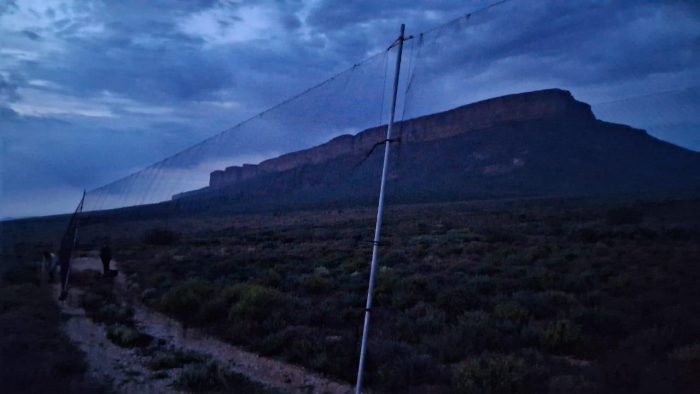
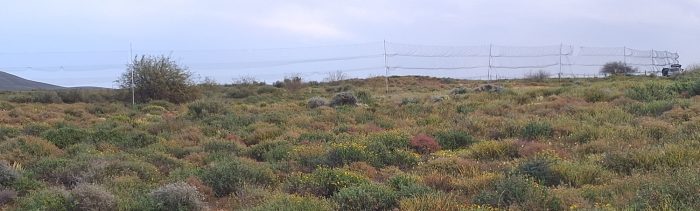
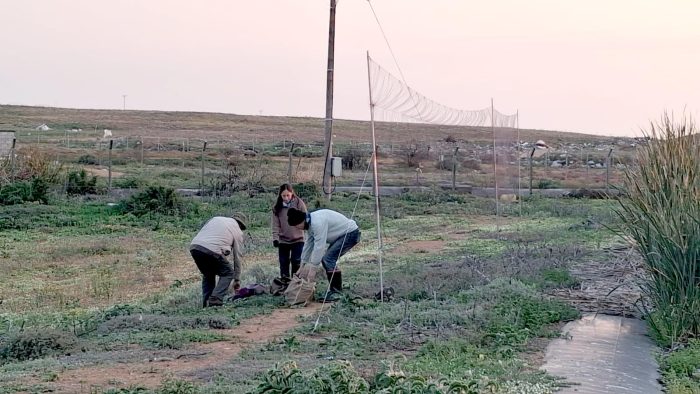
We created a curved line of nine long mist nets, completely out in the open …
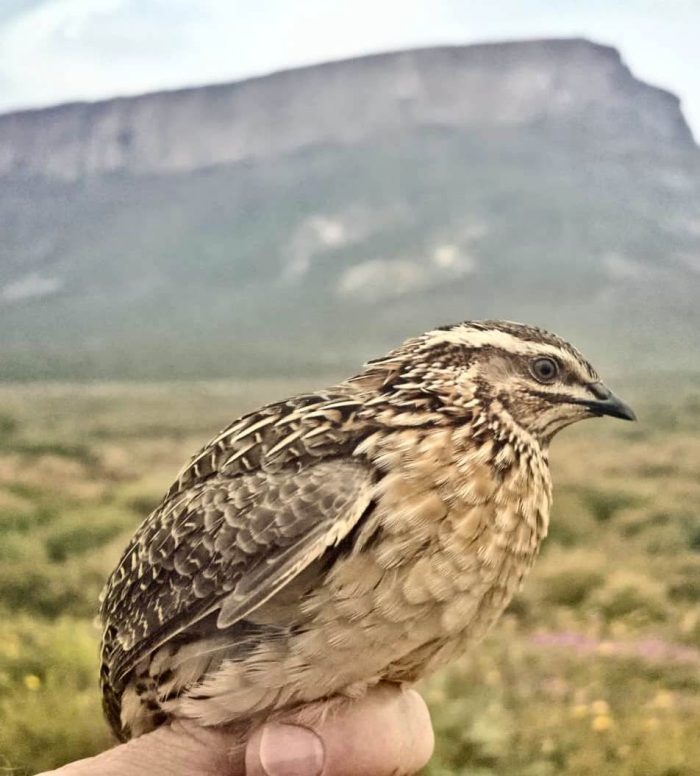
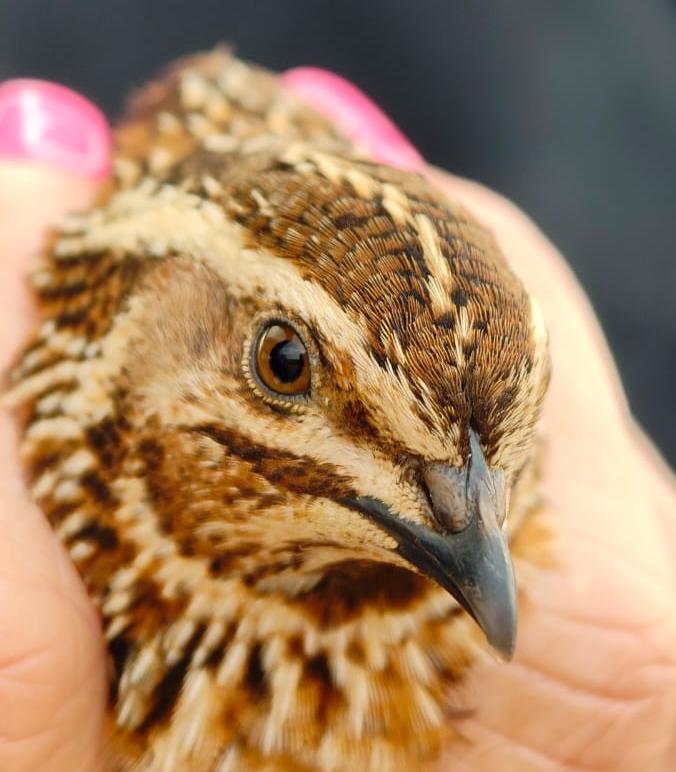
At the Lark Site, we are happy if our total number of birds handled reaches double figures. We exceeded the target by 10%, with 11 birds, of nine species. Is this worth the effort? The answer is an emphatic yes. Dieter Oschadleus has ringed 420 species. He added two ringing lifers during the morning: Common Quail and Black-headed Canary.
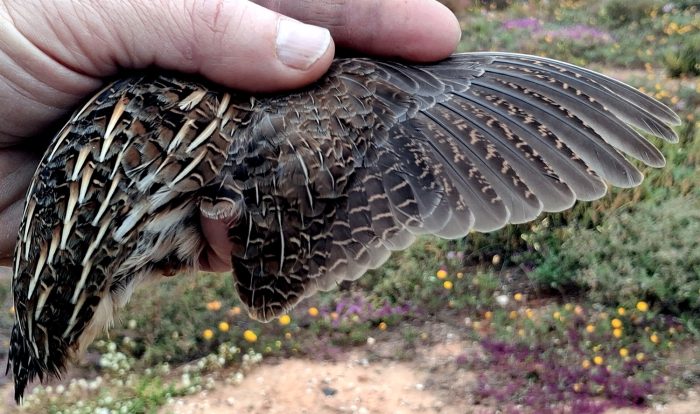
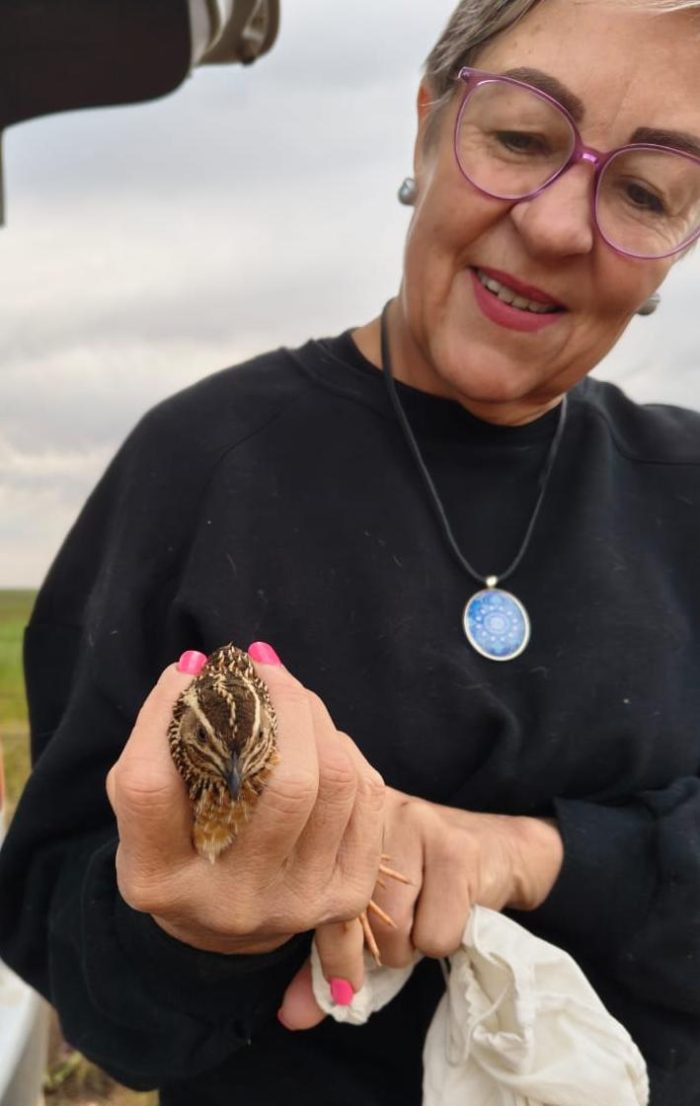
Here is a set of Common Quail photographs!
Salome Willemse, citizen scientist and bird ringer, and our host at Botuin, timed it perfectly to bring breakfast at exactly the moment we caught the Common Quail.
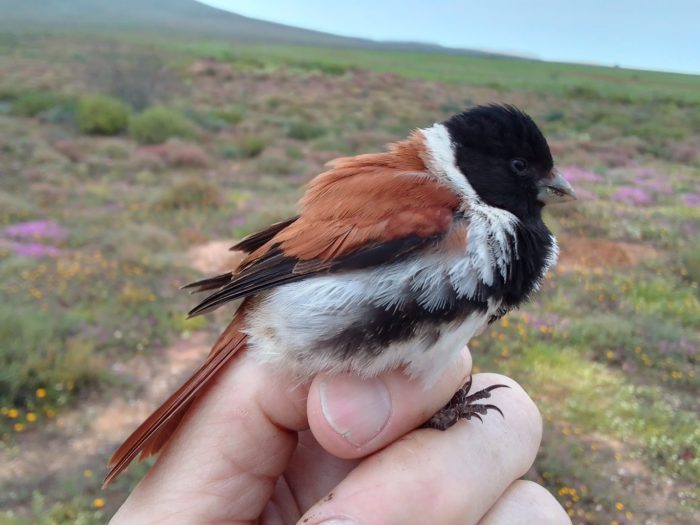
The Black-headed Canary didn’t get as many photographs as the Common Quail.
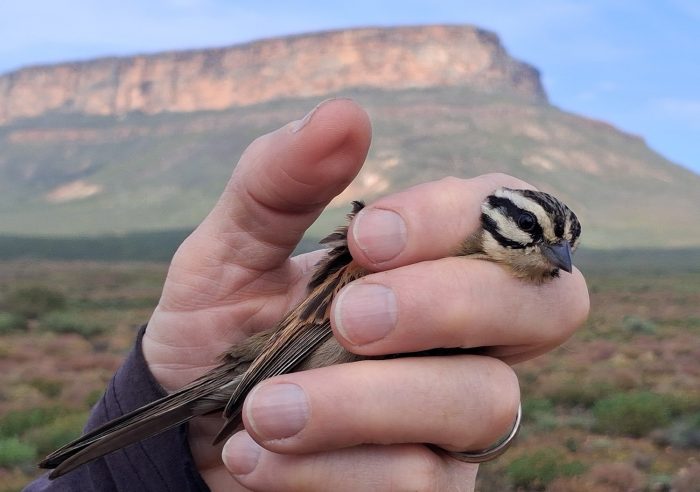
This Cape Bunting was a retrap. It had been ringed on 5 February 2024, 17 months ago.
Even though we call this the Lark Site, it is mainly a place where we hope to catch larks, rather than catch them with regularity. Fortunately we got a lark. This is Karoo Lark. It is a poorly known species, with remarkably little published about any aspect of its biology, apart from taxonomy!
The flowers at the Lark Site were impressive.
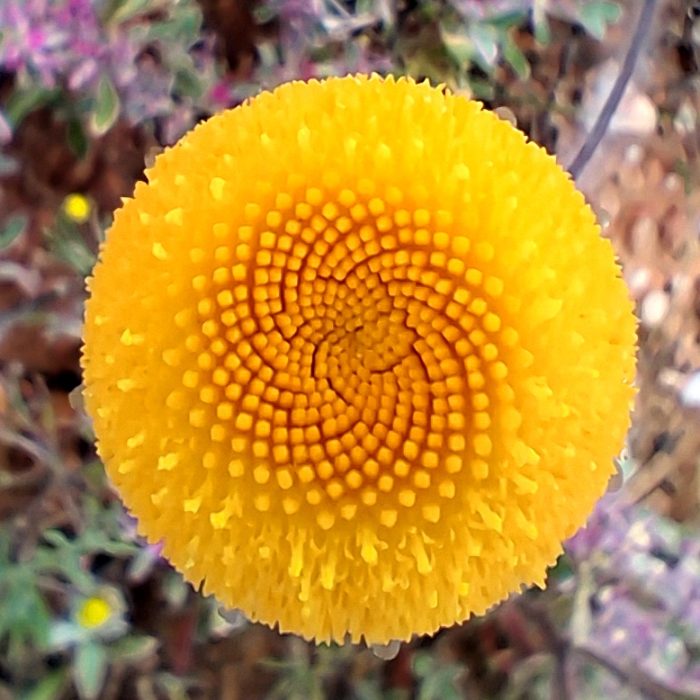
This is Gansogie [= goose eye] Cotula barbata. It’s an annual herb that flowers in August and September.
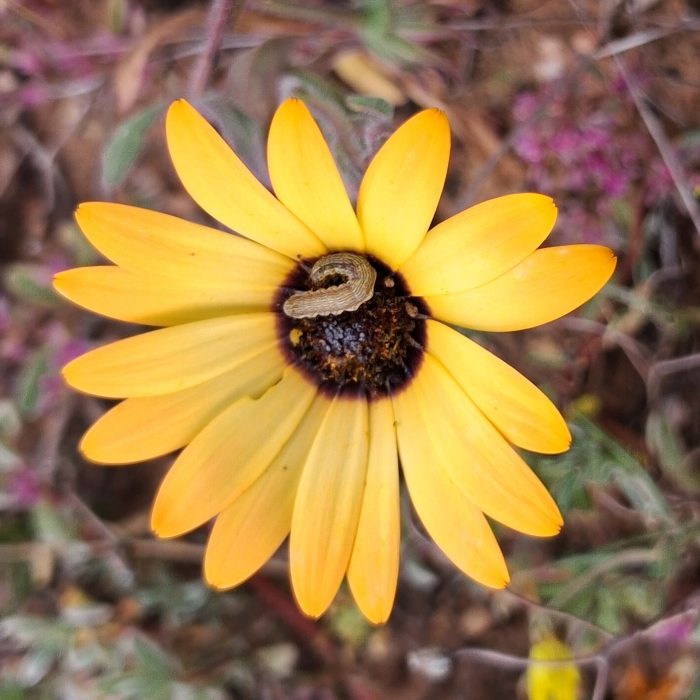
This is the classic Namaqua Daisy Dimorphotheca sinuata. The Afrikaans name is Jakkalsblom. The caterpillar has not yet had a nibble of the petals.
This plant is carnivorous. It is one of the many species of Sundew. The scientific name is Drosera trinervia. In Afrikaans, it is both Sonnedou, the direct translation of sundew, and Snotrosie [=’little snot rose’]
It is hard to know where to walk when the carpet underfoot looks like this!
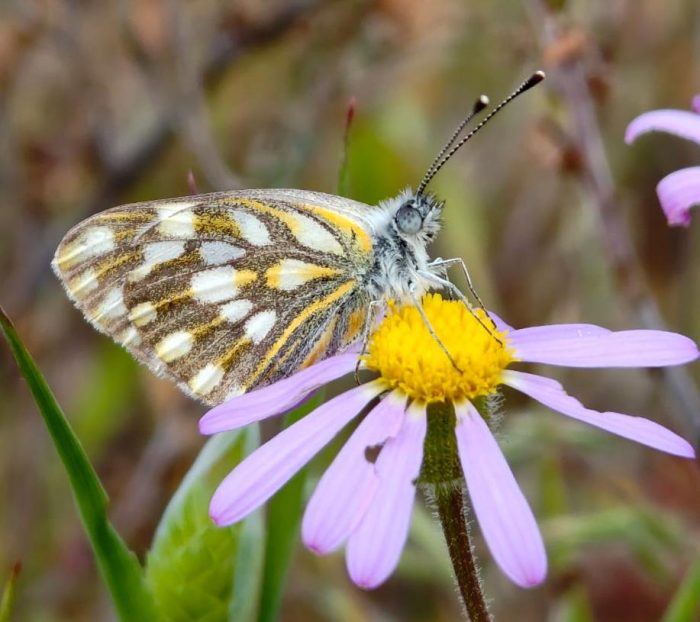
Southern Meadow Whites Pontia helice were actively visiting flowers. This flower is Felicia australis, Sambreeltjie [= little umbrella].
Tuesday, 26 August
At the Vanryhynsdorp Sewage Works, the target is 100 birds in a day. That is a bit optimistic, but do-able.
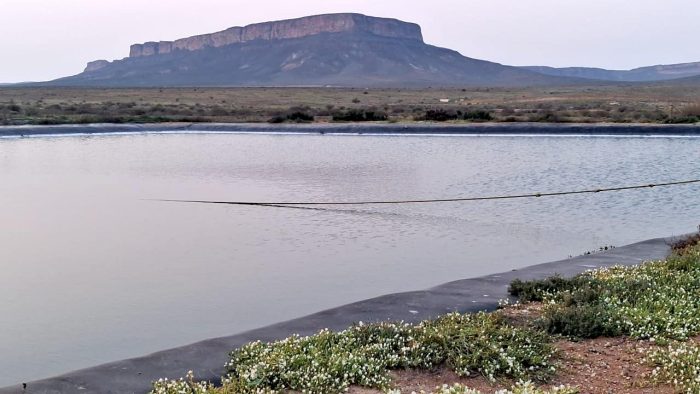
Each pond at the Vanrhynsdorp Sewage Works has a rope across it. If you fall in (and the plastic that lines the edges is notoriously slippery), you swim to the rope, and pull yourself out. There is a cold shower handy!
Mist nets up by dawn. The focus is on birds arriving and leaving the reed beds in this section of one of the ponds.
Most of the male Southern Red Bishops were in full, or almost full, breeding plumage.
Given that the incubation period is 15 days, and the fledging period is 18 days, the egg out of which this newly fledged Southern Fiscal hatched must have been laid early in July.
This was our only Red-winged Starling. It is a male because the head is black. What is unusual about Red-winged Starlings is that the juveniles look like males, whereas in most species juveniles look like females. Vanrhynsdorp is near the northern edge of the range on the western side of South Africa.
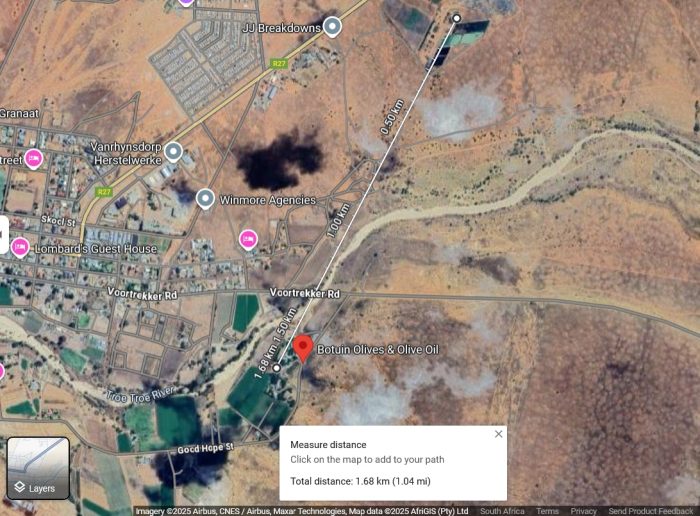
Our total for the morning at the sewage works was 87, so we scored a credible 87%. There were four retraps. All had been ringed in 2023, and three of the four had been ringed at Botuin, which is 1.7 km away (see map below).
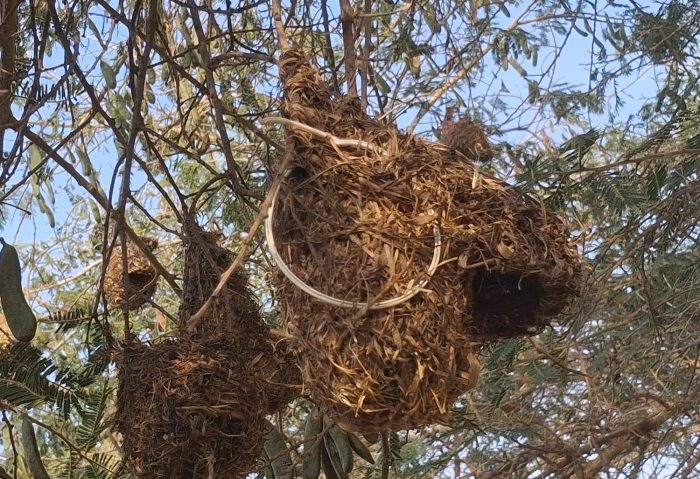
This is a Cape Weaver nest from a year ago. It was so well made that it has survived the buffeting of a year’s weather. There are new nest close by. This nest is directly above the spot at the sewage works where we usually set up our ringing station. Bird rings come as strings on thin plastic tubes. When the end of the tube gets annoyingly far from the next ring to be used, the plastic gets cut. This piece of plastic woven into the nest looks suspiciously like ringers’ litter. But closer inspection shows that, whatever its purpose was, this is not the designs used for strings of rings.
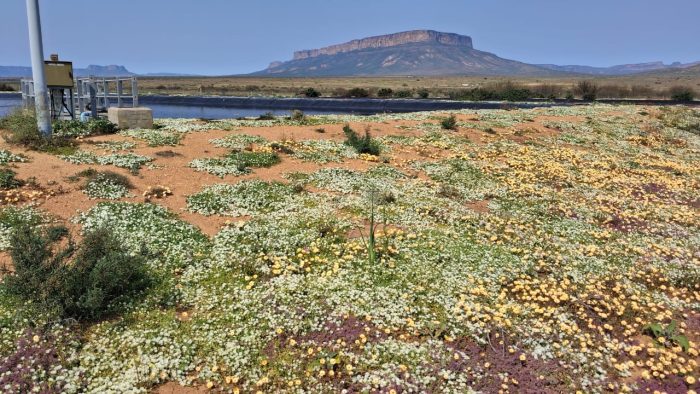
Even at the sewage works the flowers were excellent!
The drive from Botuin to the Vanrhynsdorp Sewage Works starts by traveling back into the town, and then out on the R27. But the Google map shows that the direct distance is 1.68 km.
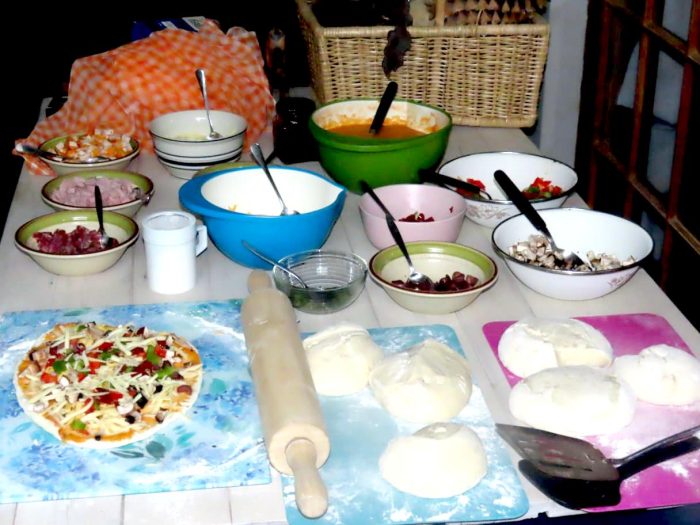
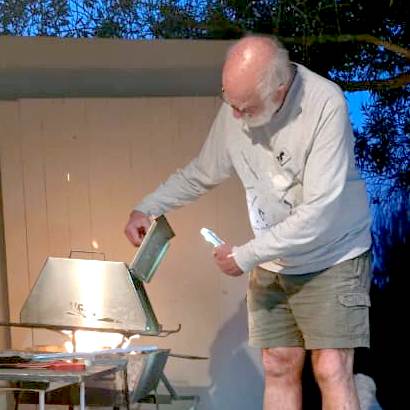
We celebrated a successful expedition with homemade pizzas!
Assemble your own pizza!
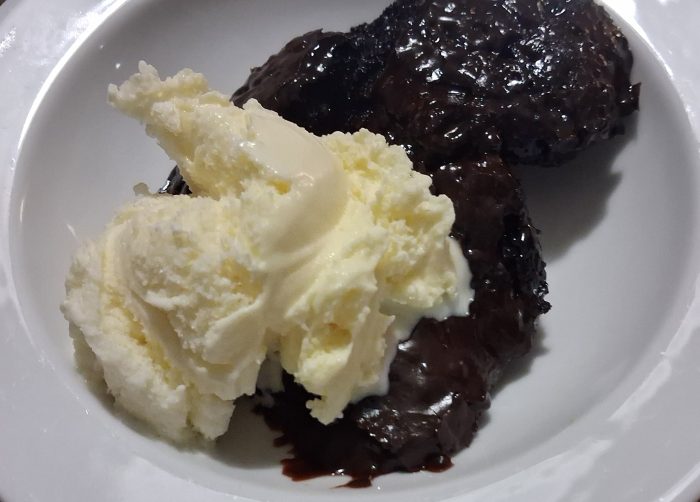
We only made one decadent chocolate and marshmallow pizza, and that was for dessert!
Thanks …
Botuin Cottages provided a superb base for the trip. We deeply appreciated Salome Willemse’s outstanding hospitality, from breakfasts brought to us in the field to delicious dinners .Skipper Boks and the staff at the Vanryhnsdorp Sewage Works were extremely helpful.
A list of trips with reports like this one can be found here. If you would like to join us, here is the list of upcoming events. There is an article about the value of bird ringing to conservation and research here.
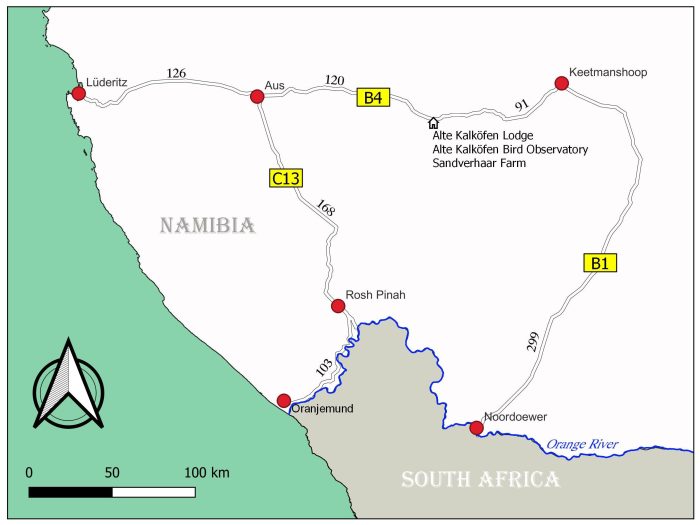
The Alte Kalköfen Bird Observatory is in southern Namibia, along the B4, the main road between Keetmanshoop, via Aus, to Lüderitz. From South Africa there are two sensible routes, both about 400 km from the border. You either enter Namibia at Noordoever, north along the N7 from Cape Town, with the road becoming the B1 in Namibia. Turn west onto the B4 at Keetmanshoop. Or you cross at Oranjemund, take the C13 via Rosh Pinah to Aus, and turn east on the B4. All these roads are tar and in excellent condition. The bird observatory is at the Alte Kalköfen Lodge, and it is about 2 km south of the B4.
The Alte Kalköfen Lodge is outstanding. Frikkie and Hilde Mouton are exceptional hosts, the accommodation is comfortable, and the meals superb.
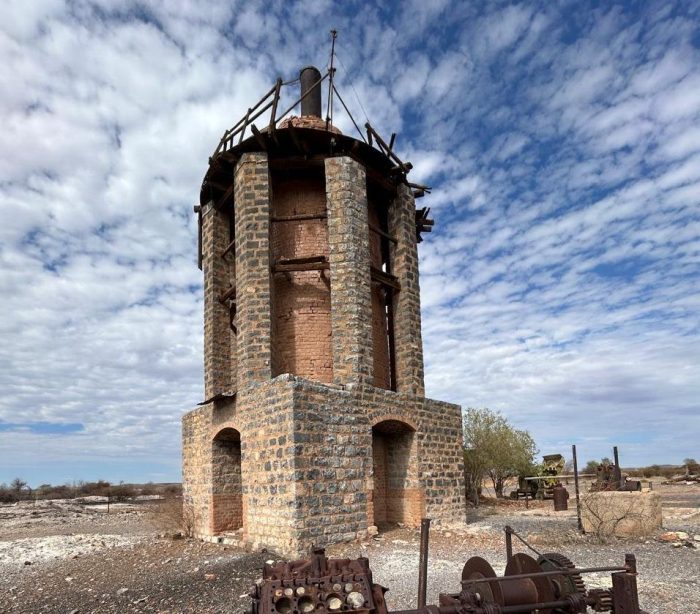
This is the Alte Kalköfen, the old lime kiln. This is the structure that gives the lodge, and the bird observatory, its name.
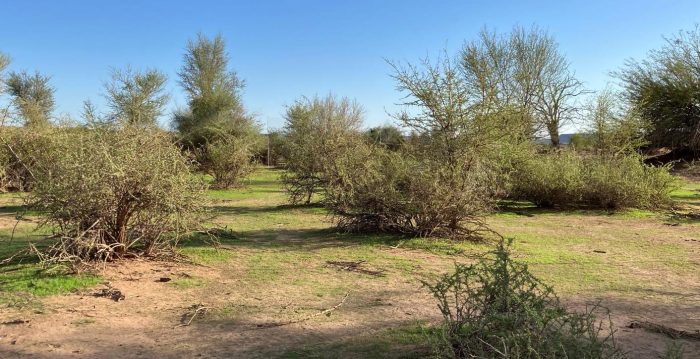
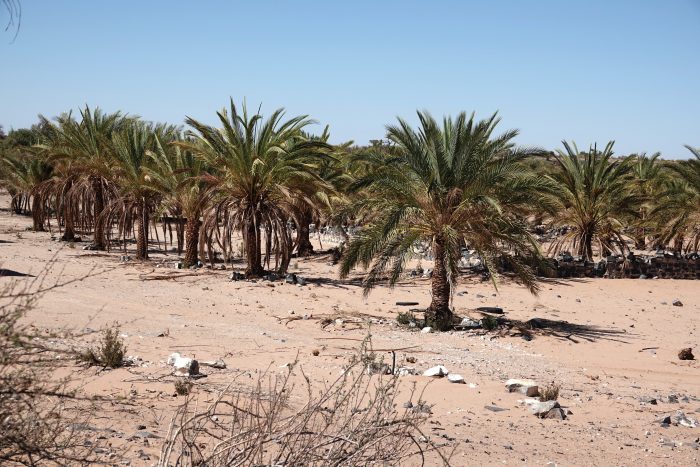
This is classified as river, known as the Gurib River. In its normal state, it is dry. But when there is a big thunderstorm anywhere in the catchment, it flows impressively for anything between a few days to a week. There has been a few millimetres of rain here, and within days there is this flush of green. Unless the initial rain is followed up by more within a week, it shrivels and dies.
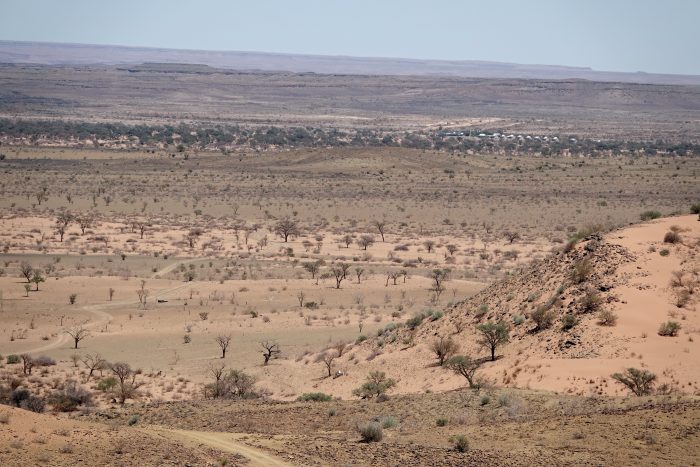
The Gurib River lies within the band of trees in the distance. The Alte Kalköfen Lodge consists of the row of chalets just beyond the river. The area lies in the ecotone known as Dwarf Shrub Savanna, between the Namib Desert to the west and Kalahari Savanna to the east. There is a variety of natural habitats: sand dunes, sandy grass veld, karoo scrub and dry thorn veld, and the “forest” of camel thorn trees along river. The area around the lodge has gardens, and water. There is a grove of palm trees (below). In the years when they bear fruit, they attract lots of birds!
What species did we ring?
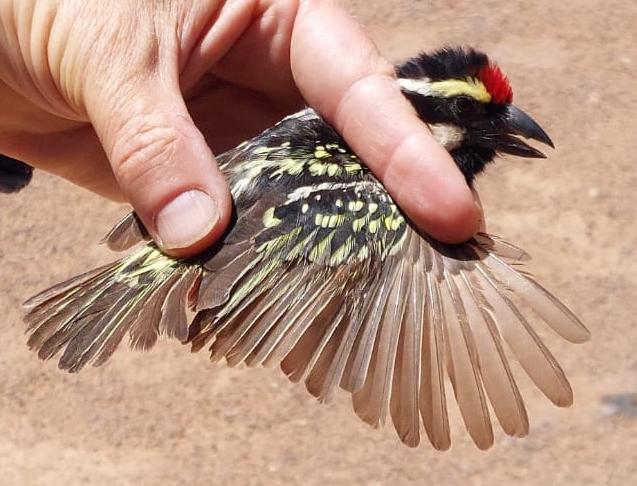
Acacia Pied Barbet. Counting from the outside, there are seven old primary feathers, Then one that is three-quarters grown. Inside that are two new primaries. So the bird ringer would score the primary moult as 55400 00000; scores of 5 for the two new primaries, score of 4 for the growing primary, and seven 0s for the old primaries.The moult score is recorded in the order that the feathers grow, from the inside to the outside.
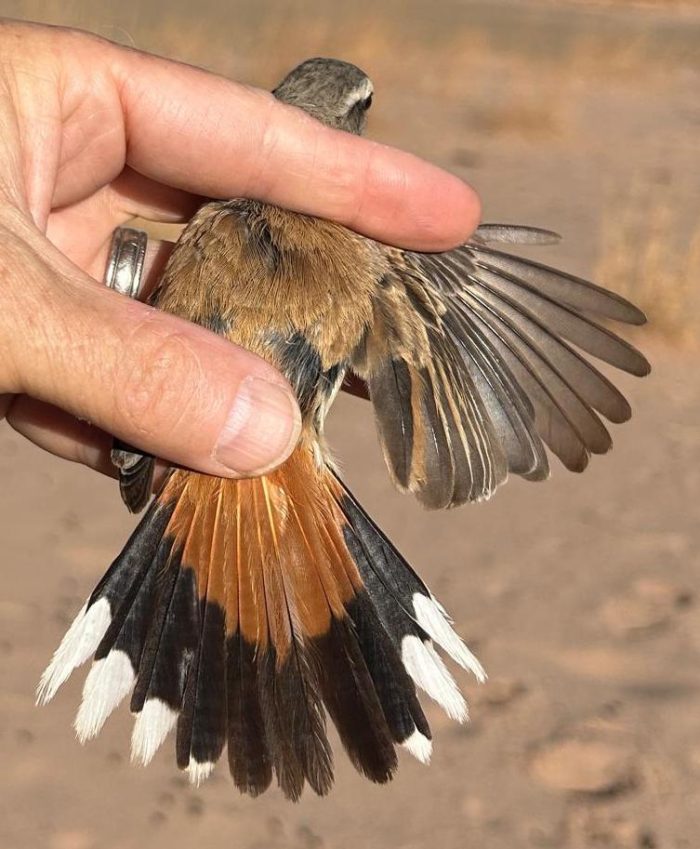
The distinctive tail pattern of the Kalahari Scrub-robin
This Cape Sparrow is making a heavy investment in moult!
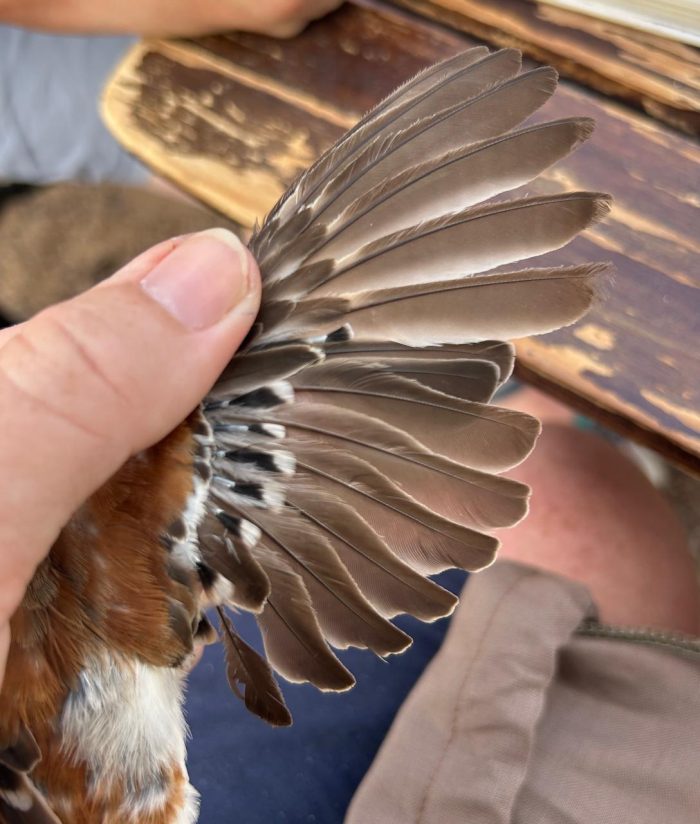
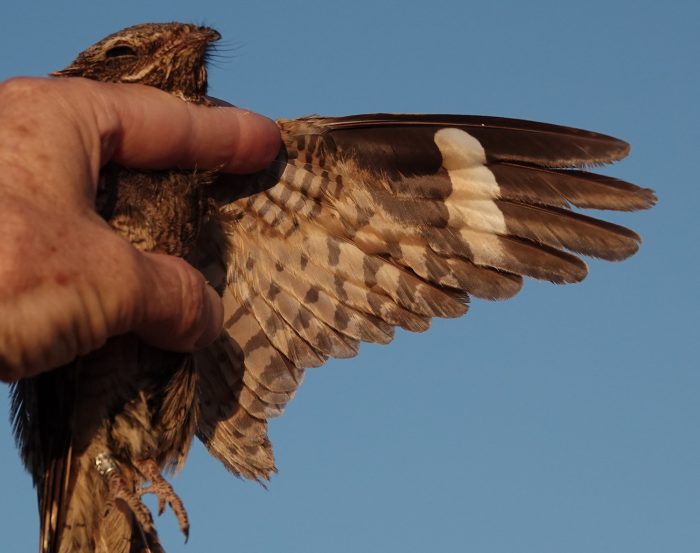
The wing of a Rufous-cheeked Nightjar.
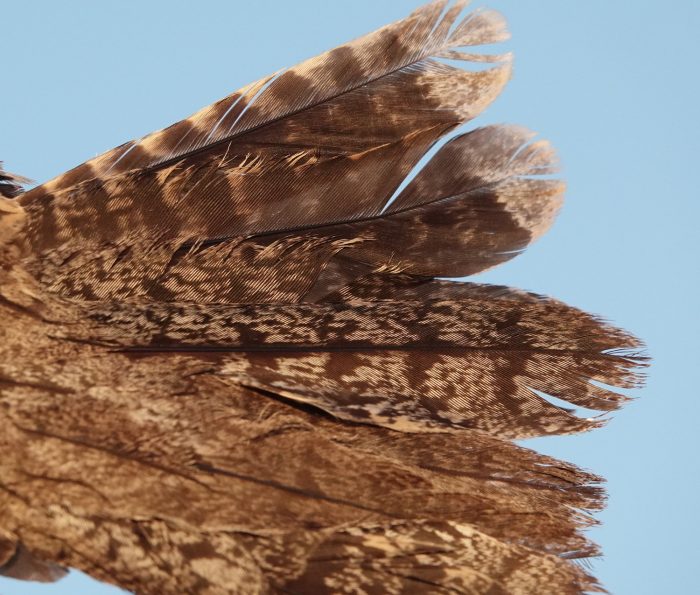
Details of the tail of the Rufous-cheeked Nightjar. Only bird ringers have the privilege of seeing this component of bird biology.
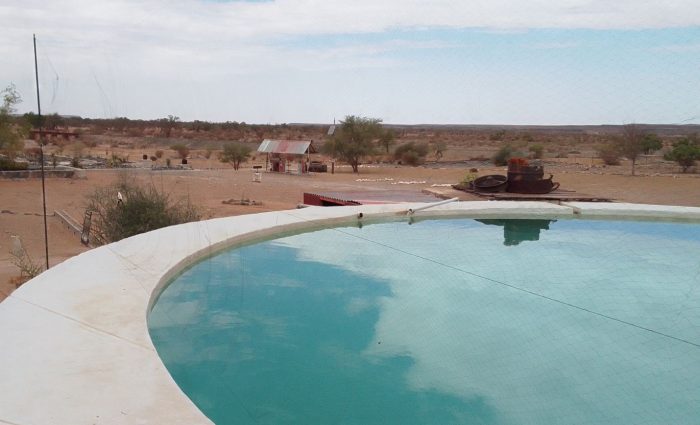
We put a mist net over the swimming pool. You need to do visual work to see it. The target species was Little Swift. We caught 22 here!
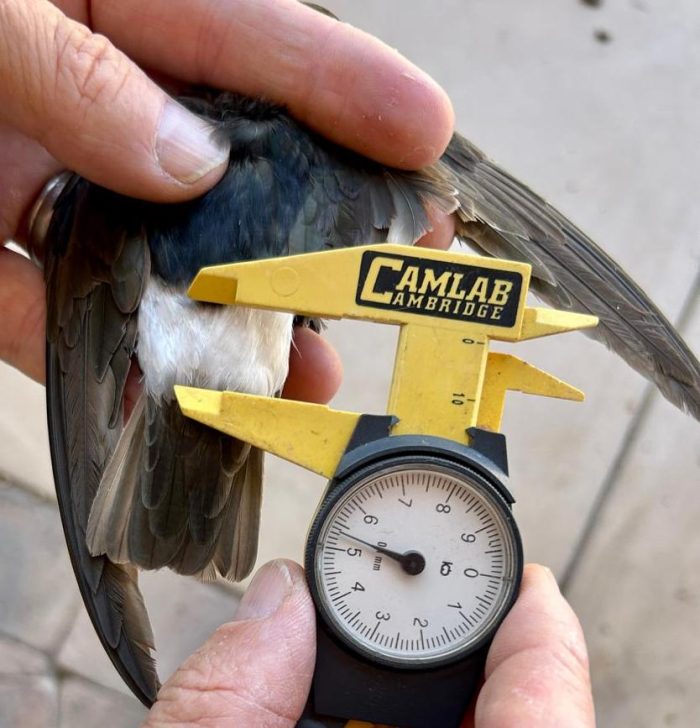
The width of the white rump of this Little Swift is 15.4 mm.
These are the species we handled while we were at the Alte Kalköfen Bird Observatory. The species in red have links to structured species texts on the website of the Biodiversity and Development Institute. The full list of species with these structured texts is here.
The most important contribution that the Alte Kalköfen Bird Observatory aims to make is in the study of nomadic bird species. Broadly speaking these have been neglected, largely because they are difficult to study. The Alte Kalköfen Bird Observatory will tackle this challenge.
Are there some photographs from the opening ceremony for the Alte Kalköfen Bird Observatory?
Here is a sample!
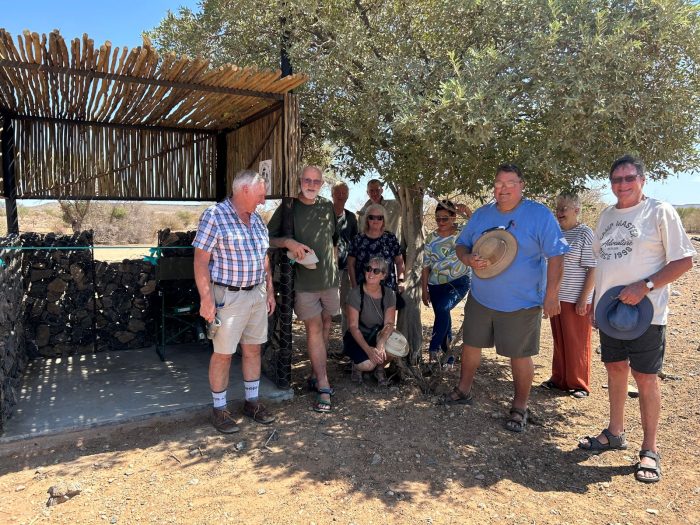
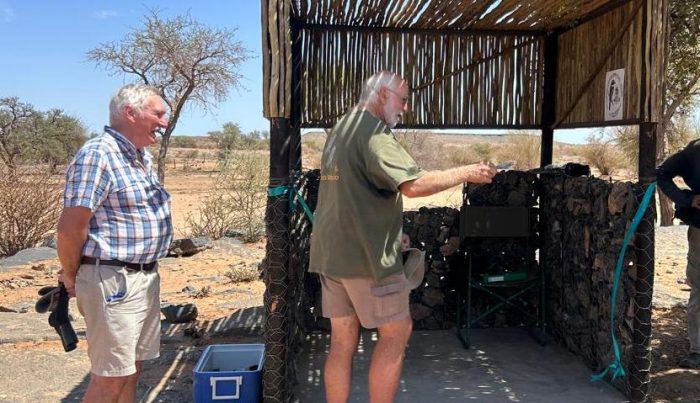
Even though it was not a big event, it was an important one. We gathered outside one of the hides at the Alte Kalköfen Lodge; there is a thin blue ribbon blocking the entrance! We made speeches appropriate to the occasion, cut the ribbon …
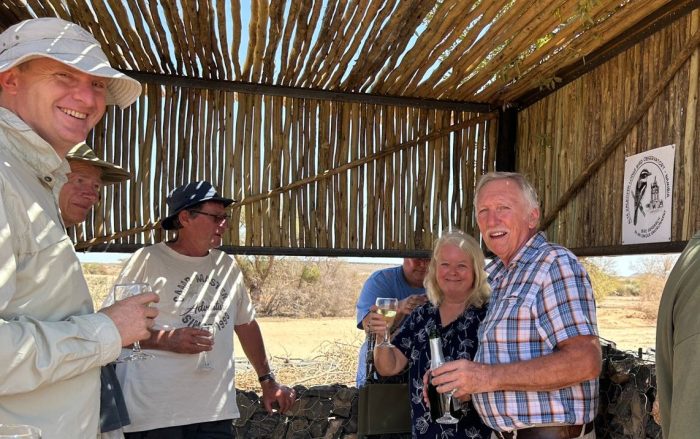
… and had a party …
Here is the logo of the Alte Kalköfen Bird Observatory, which is also attached inside the hide in the photographs above!
Were we blind to all the other animals, except birds?
There is an amazing array of biodiversity at the Alte Kalköfen Bird Observatory …
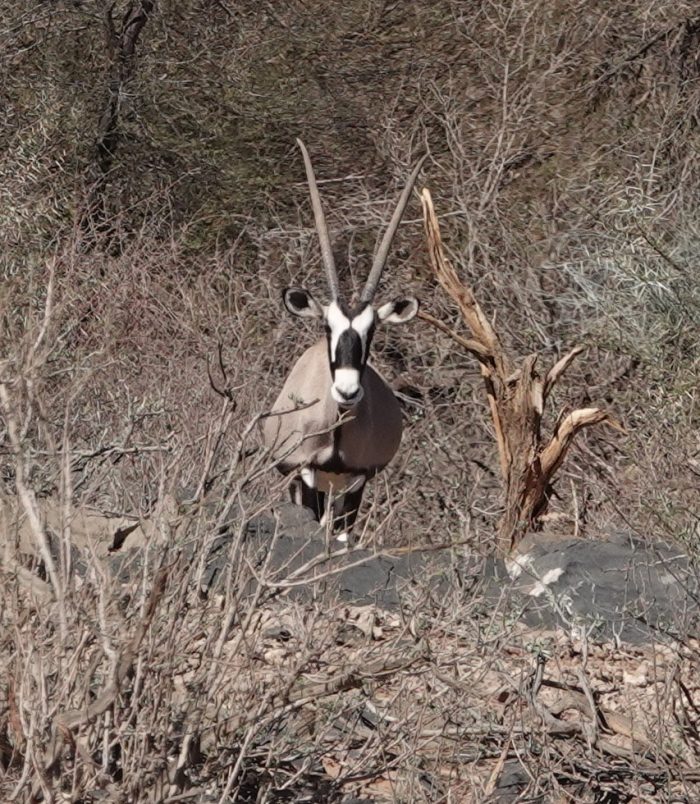
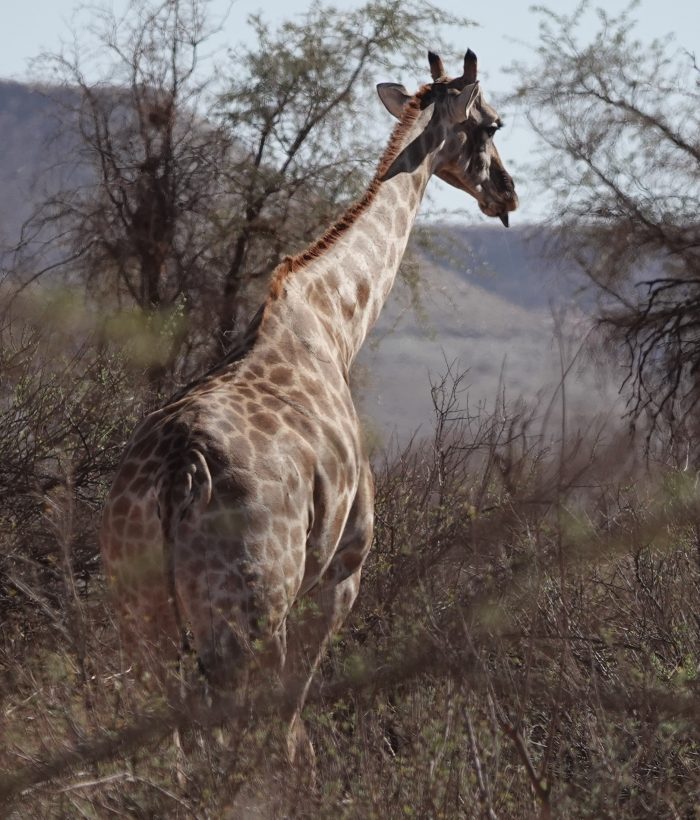
The Alte Kalköfen Lodge has an area of 20,500 ha (more easily visualized as 22 km east to west and between 10 km and 15 km north to south). The large mammals on the property include Gemsbok and Giraffe. They regularly walk past the lodge in the bed of the Gurib River.
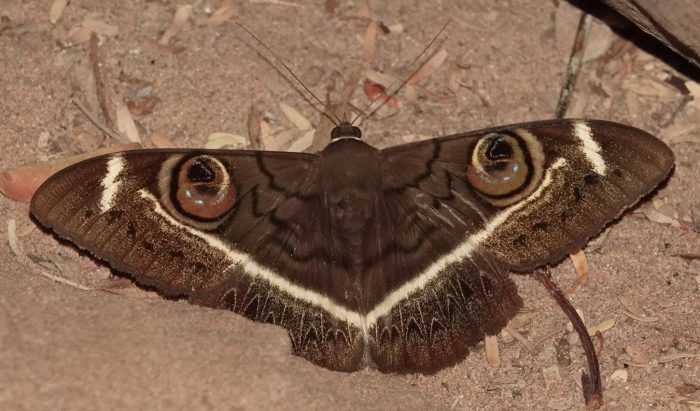
This moth is a Cream-striped Owl Cyligramma latona. This one was about 7 cm across.
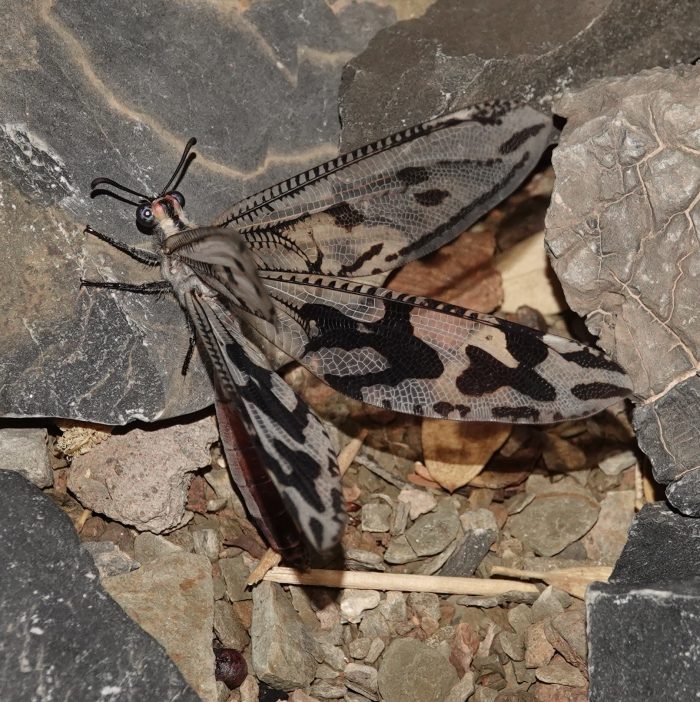
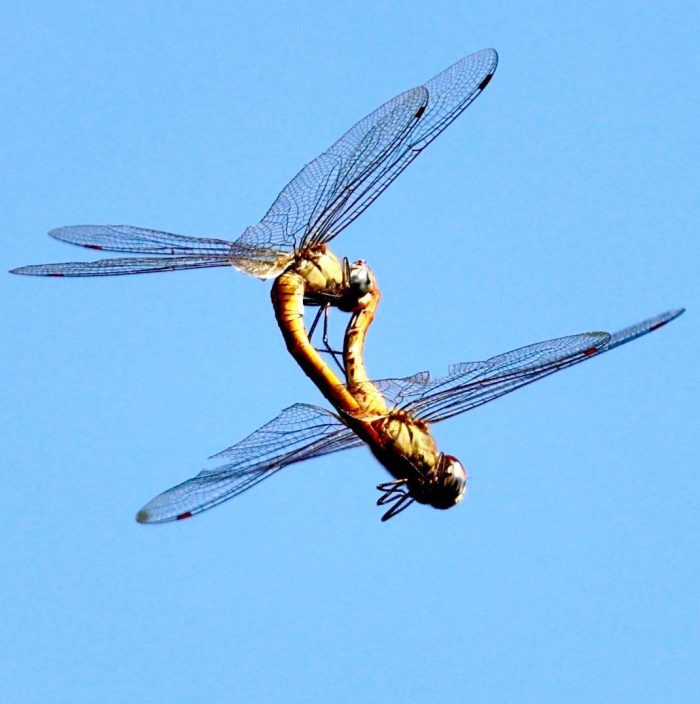
On the left is a Giant Antlion Palpares immensus. It is is one of the largest antlion species in the world, a species of dry habitats. It is widespread in Namibia, and its range extends northwards into southern Angola, and southwards into the dry western parts of South Africa, mainly the Northern Cape. It has a structured species text on the BDI website. On the right is Pantala Pantala flavescens, also known as the Wandering Glider. This is one of the world’s most fascinating dragonflies. The only way to explain its patterns of occurrence in India and Africa is to include a multigenerational migration across the northwestern Indian Ocean in its annual cycle! This Open Access paper in the Journal of Tropical Biology describes how this works: Do dragonflies migrate across the western Indian Ocean?
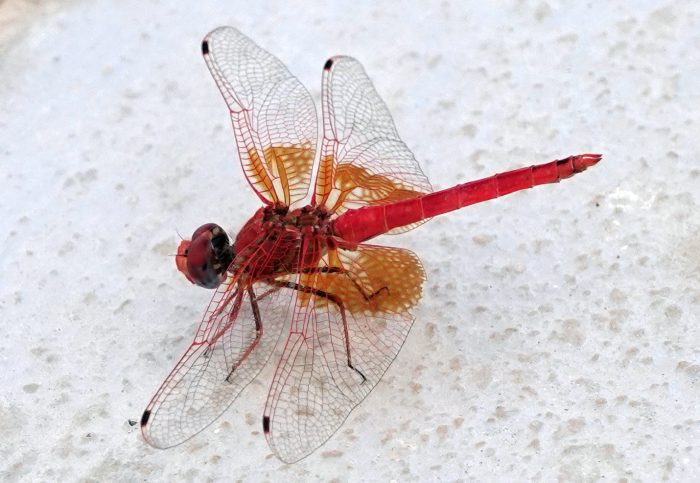
The swimming pool hosted a good collection of Orange-winged Dropwings Trithemis kirbyi. This is probably the commonest dragonfly of the arid west of southern Africa.
When are we going back to Alte Kalköfen Bird Observatory?
The plan is to return in January-February 2026. Our thinking is to support Roy Earlé, the coordinator of the bird observatory, by having a small group of ringers (and trainee ringers) there continuously for a period of several weeks. We envisage that people will be leaving and arriving in a staggered pattern, so it doesn’t happen that one group of ringers is replaced totally by the next. Duration of stay is optional, from a few days to a few weeks!
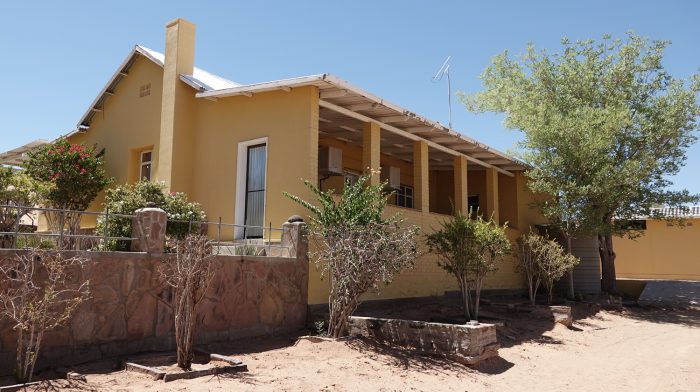
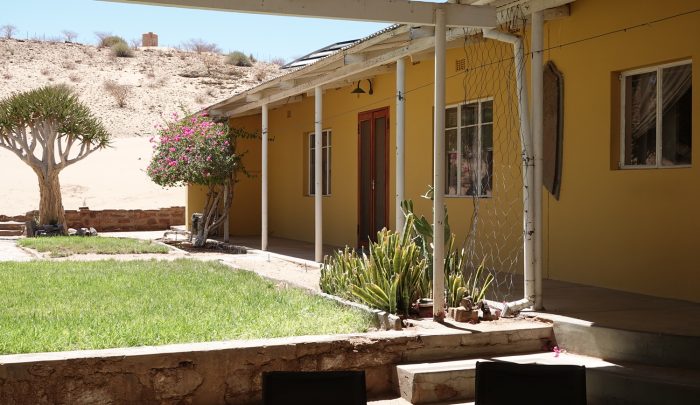
On our next visit, we are hoping to be able to stay in the Sandverhaar farmhouse, photographs below …
What happens when the rain comes?
Rainfall in this region is erratic. The daily “wetness index” can be visualized as a line through time that has occasional upward steps, and then long periods during which it fades gently downwards as the sun slowly sucks the moisture out of everything. Ultimately the downward curve bottoms out and becomes almost flat. Then we have drought conditions, which can last for a bunch of years!
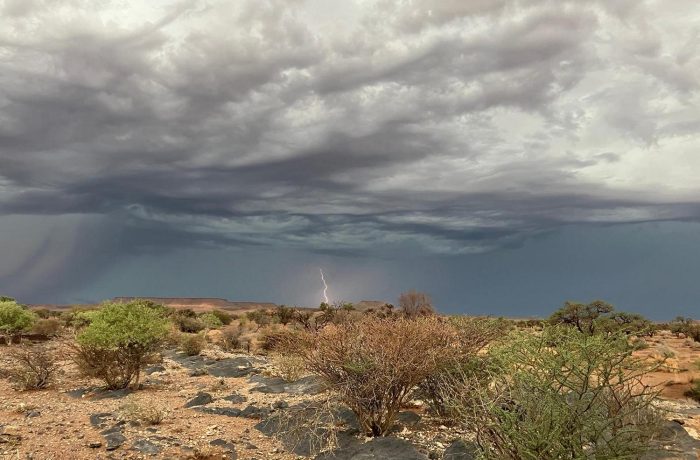
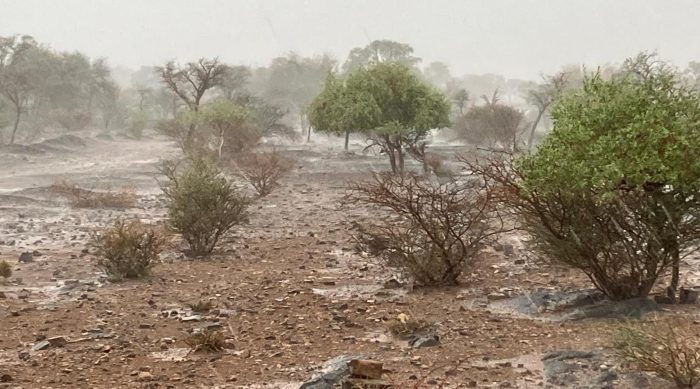
We had a few good showers during our visit, but really good rains arrived soon afterwards. There are two photographs and two videos below …
Lightning
Real rain
,,, and the Gurib River becomes a river! And then it becomes a river flowing with enthusiasm …
… this time, it flowed for seven days. That;s the record for the past decade; previously it has flowed for two or three days. Most of this water hit the ground many kilometres away in the mountains to the north.. Ultimately, its destination is the Atlantic Ocean at Oranjemund, but it gets there via the Fish River Canyon and the Orange River.
Before the B4 national road was built (about 2 km upstream from here) there was just the one bridge (shown in the video) over the Gurib River, The old main road from Keetmanshoop to the coast at Lüderitz, and the railway line, shared this bridge!
There is a list of blogs for BDI ringing events here.
Future BDI events are listed here. Keep an eye on this to find details of our next visit to the Alte Kalköfen Bird Observatory.
This is a report on our seventh bird ringing expedition to the Nuwejaars Wetlands. We were here from Saturday 9 to Thursday 14 August 2025, five nights. This seems to have become a standard length for these trips!
On Saturday afternoon, and Sunday morning, we ringed around the werf at our accommodation at Hazevlakte. The weather was not kind, with occasional squalls of rain and and regular blusters of wind. It was “clearing showers”, and by Sunday afternoon the wind had faded and the sun emerged.
There are spots in and around the werf where mist nets are sheltered from the wind, and they did pretty well, considering the conditions.
Although it still felt like winter, spring must be in the air ….
… because this red feather on this male Southern Red Bishop is the start of breeding plumage. When spring finally arrives properly, this bird will be among the first to be ready to show off his bold black and red plumage to the females.
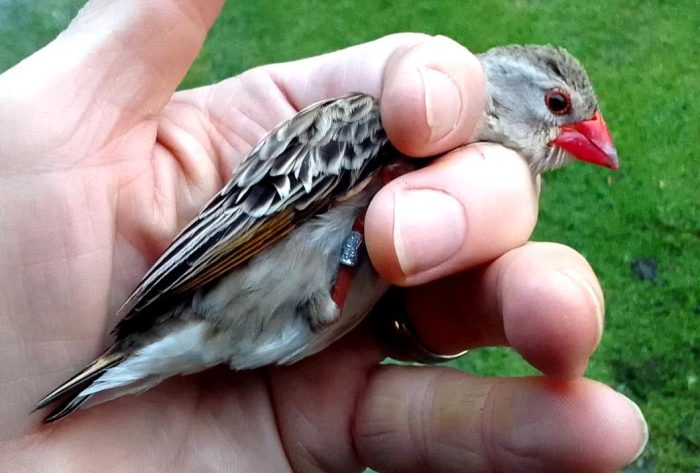
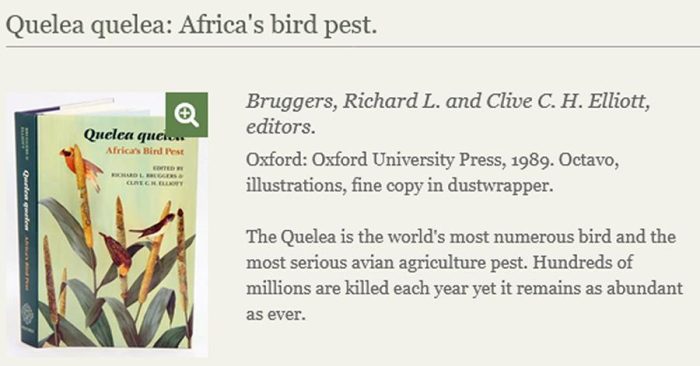
This Red-billed Quelea, mistnetted on the werf at Nuwejaars, is the first we have ringed on our seven ringing trips to the Nuwejaars Wetlands SMA over the past year. It is a vagrant to the Agulhas Plain, with only a handful of previous sightings, the first on a SABAP2 checklist in 2011. It is a species to keep an eye on. Sir Clive Elliott, the first ringing coordinator employed at SAFRING, went on to co-edit an authoritative book about the quelea, called Africa’s Bird Pest …
We don’t need quelea populations to reach pest proportions in a region which produces wheat and other grain crops.
This Southern Fiscal was a retrap. It was ringed on our first visit here on 7 October last year. It was also retrapped here on 20 March this year. A resident!
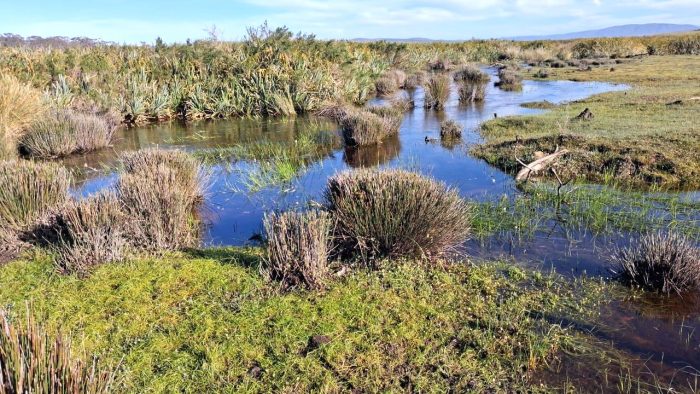
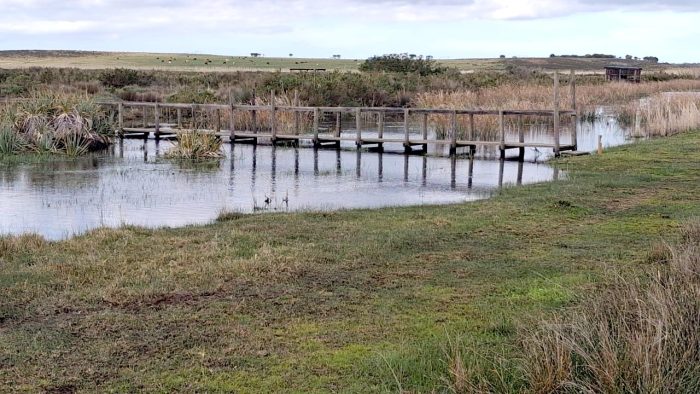
On Monday morning we ringed on the northern edge of the flood plain of the Nuwejaars River. At dawn it looked like this…
… and in the bright winter sun, a rich texture is added to the mosaic of flood plain habitats …
… we need to remind ourselves that a few years ago this was a tangle of alien vegetation, and has been rehabilitated by the dedicated team of staff of the Nuwejaars Wetlands SMA.
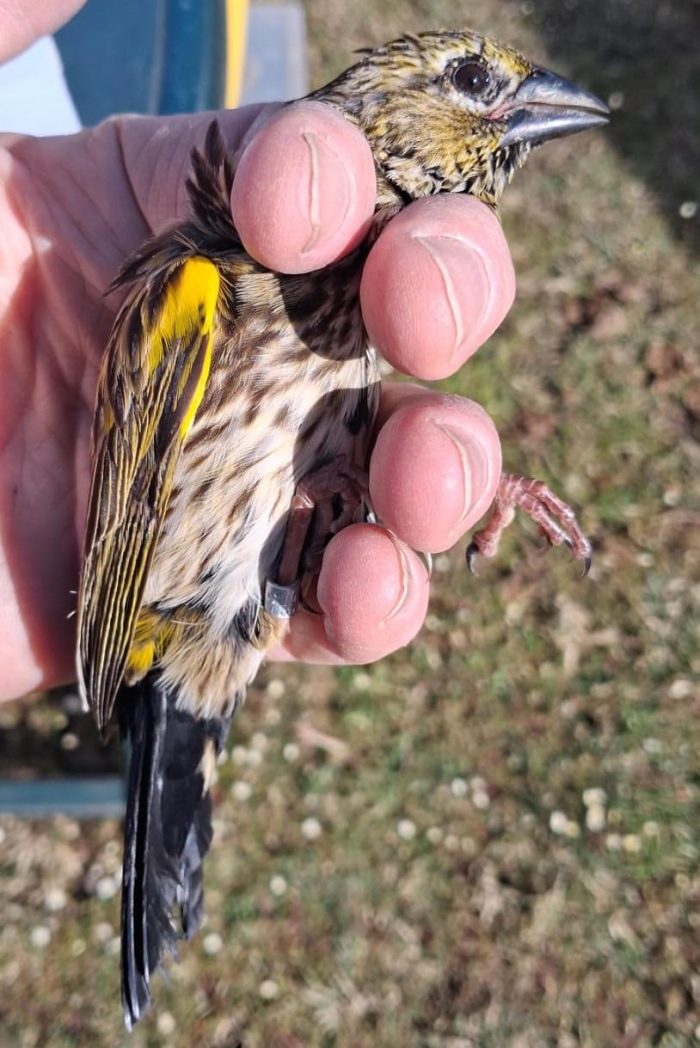
This male Yellow Bishop is also feeling the impact of spring on the horizon, and is starting to get his breeding plumage. The head is looking untidy as the black feathers start to grow.
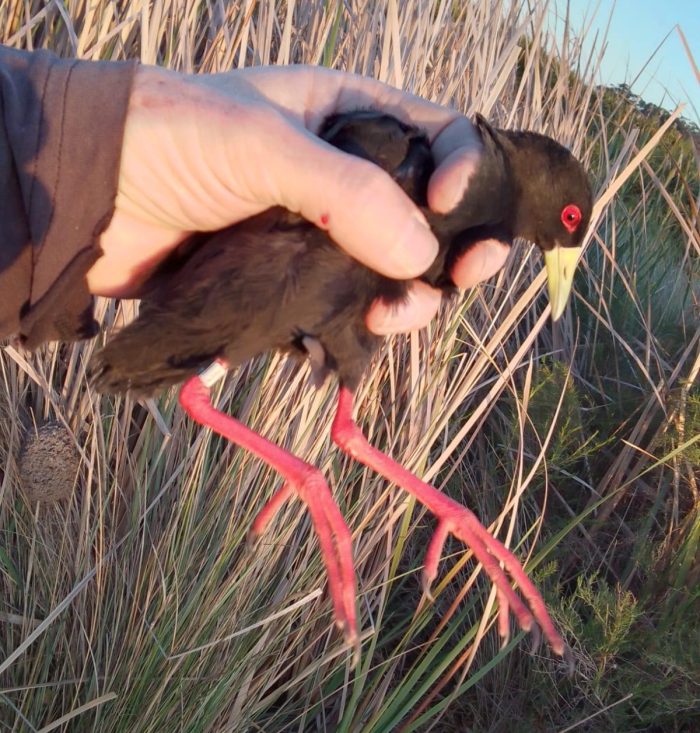
The first of three Black Crakes which we ringed during the expedition.
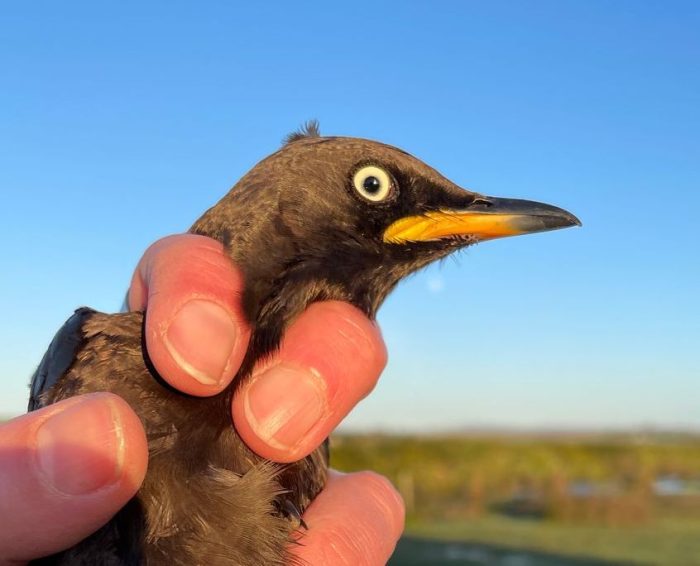
Although they are not particularly wetland birds, this African Pied Starling was mistnetted while commuting across the flood plain. Close up, the fleshy yellow structure of the gape is clear, and the creamy white eye.
Late on Monday afternoon, we set up nets at a patch of planted proteas and adjacent fynbos.
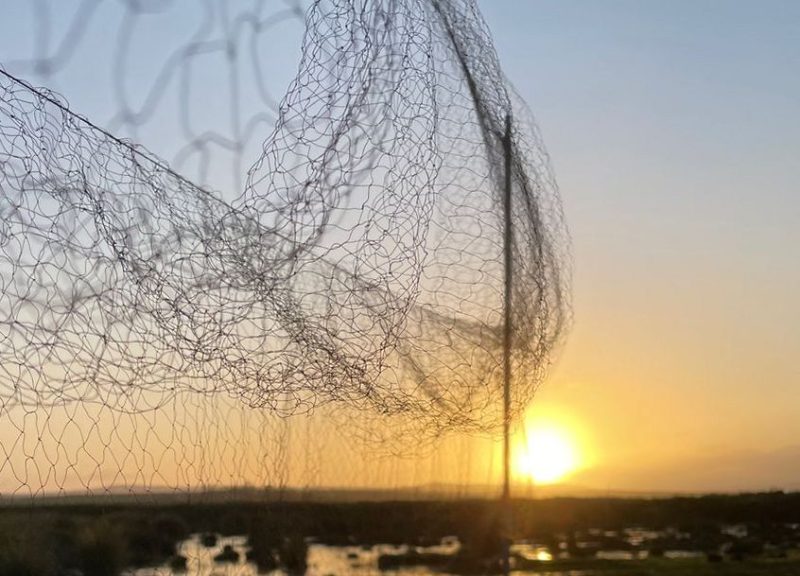
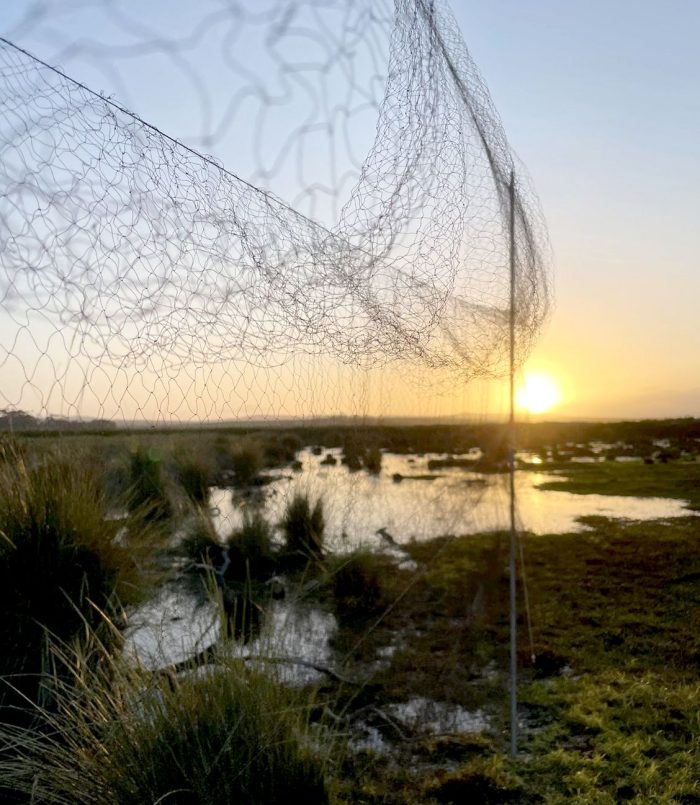
The photo above illustrates why mist nets work. At this angle, the net between the first and second poles is almost invisible. The net between the second and third poles is conspicuous because we are looking at it almost end on. The nets are “furled” overnight. This makes it impossible for them to catch bats, owls, nightjars and anything else that flies in the night.
We were back early on Tuesday morning, and opened the nets, and did not have long to wait …
… in the fynbos habitat, Malachite Sunbird was one of the species we anticipated. We caught five.
Another white-eyed bird, Bar-throated Apalis.
There were only a handful of open flowers in the protea stand, so we did not mist net any Cape Sugarbirds. There were only a handful still present.
On Wednesday morning ringed at the section of floodplain on the farm Moddervlei. We had put up mist nets (and furled them) the evening before …
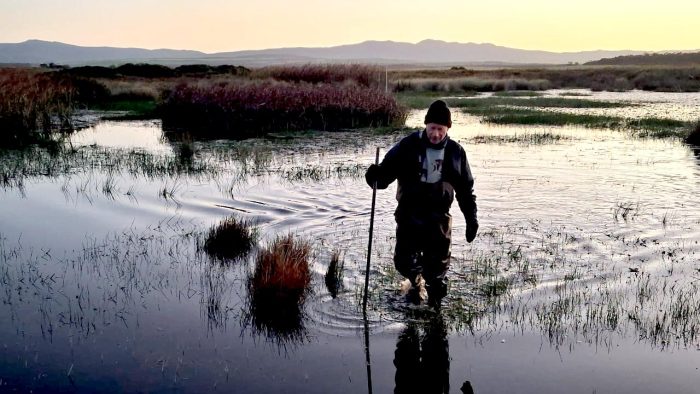
… and here is Dieter Oschadleus returning from opening one of the mist nets over quite deep water. The poles are just visible over his right shoulder.
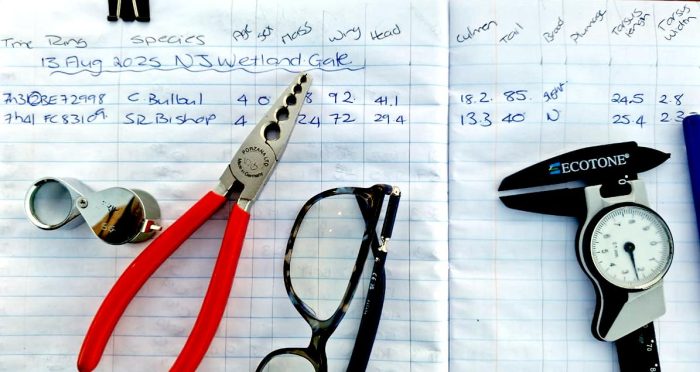
Tools of the ringing trade!
Black Crake number two, of three that we ringed!
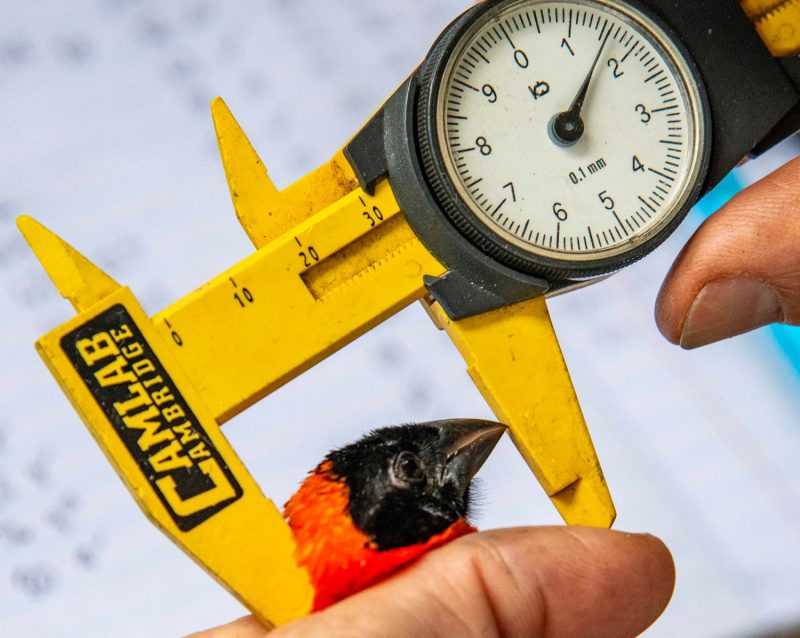
This measurement, known as “total head length”, is 50.6 mm on the dial callipers. Total head length is a more repeatable measurement than “bill length”.
The crakes were appropriately celebrated with a slab of chocolate!
Two of the objectives of this expedition were to get a feel for how our existing ringing sites worked in the depths of winter, and also to explore new potential sites. On Wednesday afternoon we had a good recce at this site, along the African Marsh Harrier Trail of the Nuwejaars Wetlands Special Management Area. We found excellent habitat and great ringing sites. This was where the snipes had moved to! We will set up mist nets in this area on our next visit, which is 19 to 24 September 2025.
After a short ringing session at the Hazevlakte werf, we travelled back to Cape Town on Thursday morning.
There were 28 retraps of birds ringed on previous ringing visits here. Amazingly, there were 11 retraps from our first visit here in early October last year. Nine of the 11 were Cape Weavers, one was a Cape Sparrow and one was the Southern Fiscal featured above.
Only two of the previous six trips to Nuwejaars Wetlands have blogs! They are the trips from 7 to 11 April 2025, and from 30 May to 4 June 2025. There is a list of all earlier trips with blogs here.
We are grateful for the support of the team at the Nuwejaars Wetlands Special Management Area, Ross Kettles and Erica Brink. Thanks to Karen and Con Neethling for the warm welcome, once again, to the accommodation on the farm Hazevlakte. Thanks to Con and Liohan Giliomee for permission to ring on their farms.
On Saturday 21 December 2024, we invited all the bird ringers in Cape Town to celebrate a year of enjoying birds. It was an special opportunity for the bird ringers to meet and chat informally, and share experiences. The format was bird ringing followed by brunch!
We set up mist nets from 05h00 onwards, at Frogmore Estate, on the western side of Zandvlei. Sunrise is early in the middle of summer.
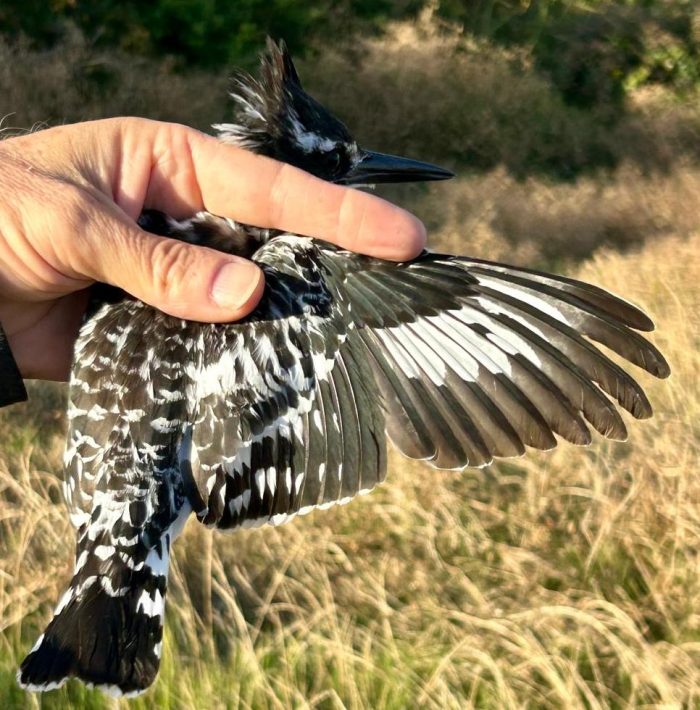
Unfortunately, we chose a windy day for the event, with a tough southeaster howling. In spite of that, we mist netted some interesting birds. Pride of place probably went to a Pied Kingfisher. Three warbler species in the hand on one windy morning followed close behind.
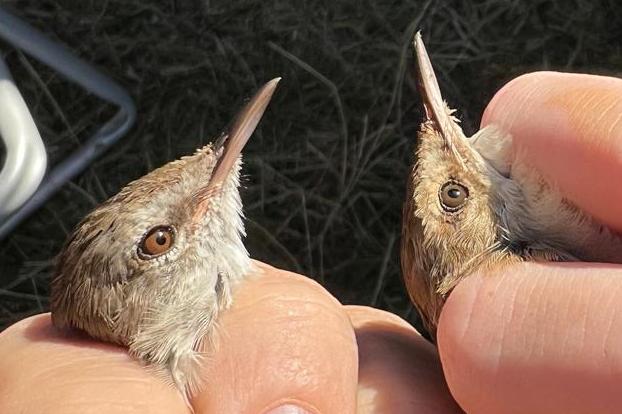
Among the warblers were both an adult and a young Lesser Swamp Warbler. The adult, on the left, has a more saturated brown eye colour than the young bird, on the right. A subtle difference!
Two of the four Lesser Swamp Warblers were retraps. Both had been ringed at this site, one on 30 April 2016 (8.5 years previously, and the other on 23 March 2019 (5.5 years previously). We also retrapped a Little Rush Warbler, ringed here on 9 October 2021, just over three years previously. These retraps make a contribution to survival rate estimates. Neither of the African Reed Warblers were retraps!
The Pied Kingfisher.
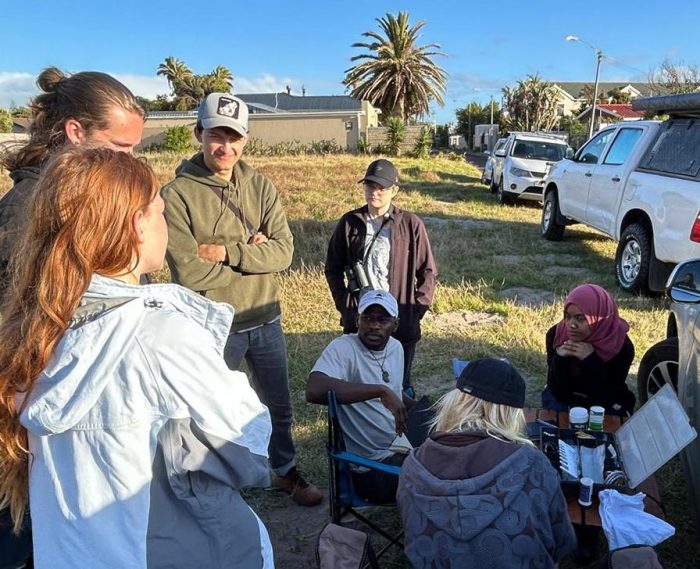
There was lots of time to try to get behind the shelter of the car, and do what was actually the most important activity of the day, talk to each other!
In spite of the adverse conditions, we mistnetted some interesting birds:
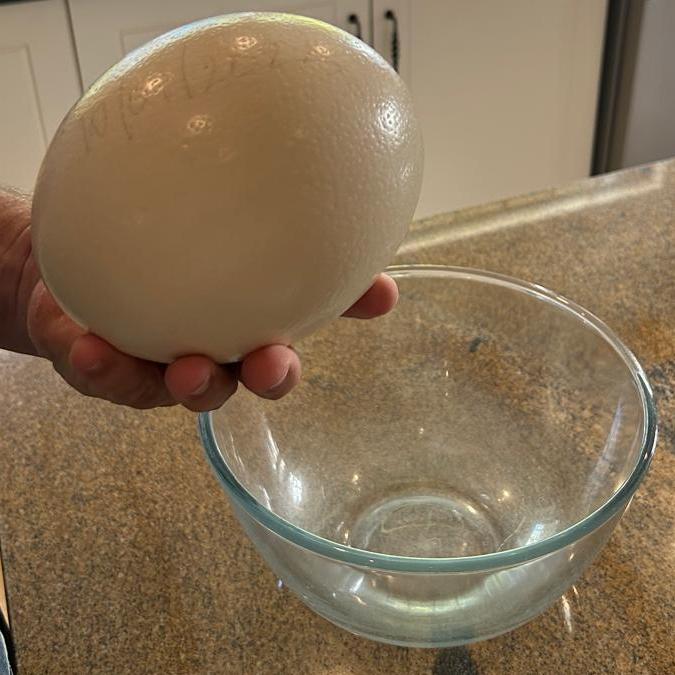
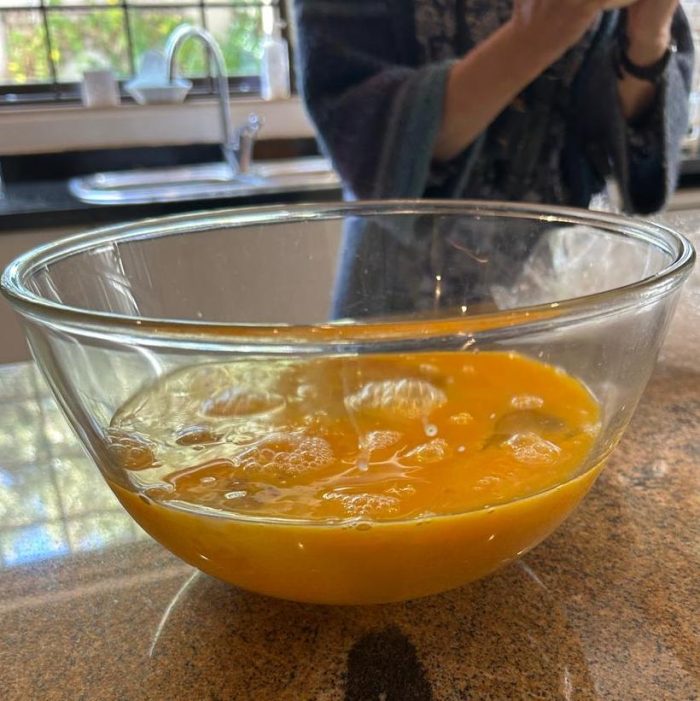
After the ringing, we headed to Richard and Sue Gie’s home on the eastern side of Zandvlei, at Marina da Gama. Richard scrambled an ostrich egg. The group of people was not small, but we all got a decent helping!
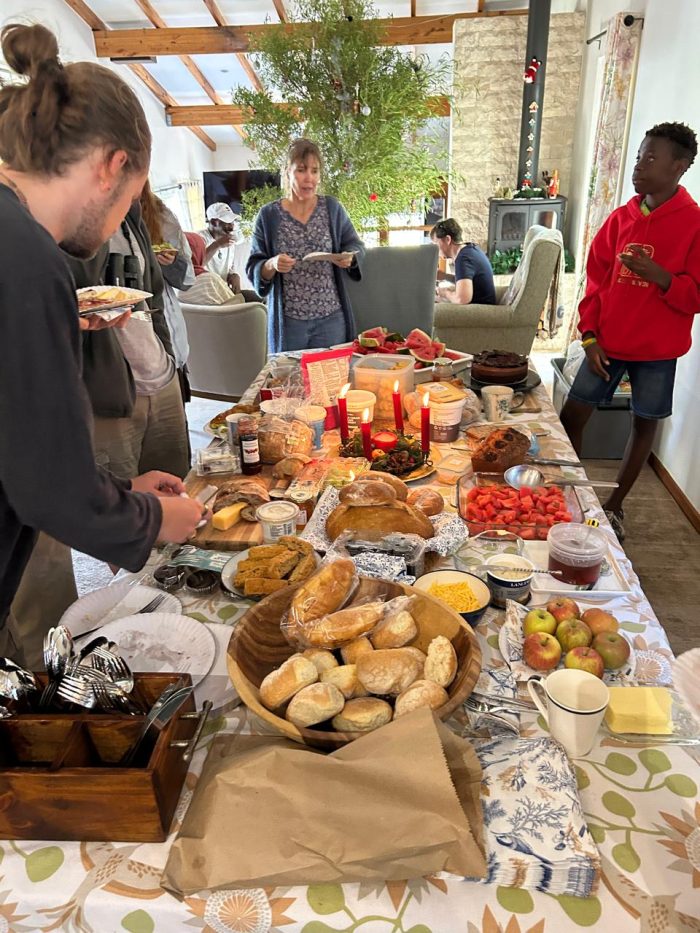
Besides the scrambled ostrich egg, it was a bring and share event. There were enough people to make a serious dent in the spread below:
The consensus was that we need to do this kind of gathering more frequently!
Colin Jackson, visiting from A Rocha Kenya, echoed everyone feelings when he wrote in the WhatsApp group set up to coordinate the event: “THANK you to those who organised yesterday’s event. It was great seeing old friends again and meeting new ones. The awesome brunch spread was one to remember.”
Thank you, Sue and Richard Gie, for your very special hospitality. Bird ringing and brunch at Zandvlei met all its objectives, and needs repetition!
We had neglected our Vanrhynsdorp ringing sites since November last year, so this visit was overdue! You can read the report on that trip here. This blog summarizes the bird ringing at Botuin, Vanrhynsdorp, March-April 2025. Vanryhnsdorp is on the N7 national road, about half way between Cape Town and Namibia.
Busy time for ringing. The stoep at Botuin makes an excellent base for ringing at the many sites tucked away in a diversity of habitats on the 5-ha property: flower garden, vegetable garden, olive orchard, drinking places, lucerne field, trees for weavers to nest in, etc.
The table below shows that we handled 399 birds of 53 species. If you click on any of the species in red, you get taken to the structured text for the species on the BDI website. Try a few species, and see how these texts are structured, with the most important information about the species first. We are slowly expanding the number of species for which there are structured texts.
We handled lots of sparrows, weavers, bishops and doves. This is a good thing, because it is for these species that we will get lots of retraps, and be able to estimate high quality survival rates. The data we collect from the bird-in-the-hand is especially valuable; these include age, sex, weight, measurements and moult. We also take lots of photographs. These are valuable for the production of visual ageing guides.
The remainder of this blog consists of photos of two of the ringing sites, and then a selection of head and shoulders of birds-in-the-hand.
Ringing places1 : Gifberg Larksite
For most ringers, the favourite place in the district is the “Larksite”. This is in spite of the fact that if the ringing total reaches double figures we are ecstatic! We keep going back to this site for two reasons. It is the only place where we get to see a number of species in-the-hand. Secondly, it is so harshly beautiful, and every time we go it is different.
The “Larksite” starts where the disturbance ends, right up against the base of the Gifberg. There, the agricultural impact stops, and vegetation starts to become natural.
During this visit, we had an impressive thunderstorm. We got caught out in the rain in the late afternoon putting the mistnets up for the next morning.
Arriving at the Larksite before dawn
Looking northwest towards the town of Vanrhysndorp, there is still rain hanging in the air.
In spite of the heavy downpour, the reality is that the preceding six months have been hot and dry, and the landscape is pretty parched.
This table gives numbers of birds handled at the Gifberg Larksite. 72 birds of 25 species. The number of ringing trips there is getting close to 10! The 18 species in bold are rarely, if ever, caught at our other ringing sites in the district. That is why we keep going back to this “unproductive” site. Unproductive in terms of quantity, not of quality!
Species
Number
Namaqua Dove
3
White-backed Mousebird
1
Karoo Lark
3
Large-billed Lark
6
Spike-heeled Lark
2
Grey-backed Sparrow-lark
6
Red-capped Lark
2
Red-eyed Bulbul
1
Karoo Chat
2
Capped Wheatear
1
Familiar Chat
2
Sickle-winged Chat
3
Karoo Scrub Robin
5
Yellow-bellied Eremomela
1
Rufous-eared Warbler
4
Grey-backed Cisticola
1
Southern Double-collared Sunbird
1
Cape Weaver
1
Red-billed Quelea
2
Southern Red Bishop
3
White-throated Canary
9
Yellow Canary
3
Lark-like Bunting
2
Cape Bunting
5
Karoo Prinia
3
Total: 25 species (18 in bold)
72
Ringing places 2 : Vanrhynsdorp Sewage Works
There is only one photo of our second favourite ringing site in the vicinity of Botuin!
Birders, ringers included, are sewage works enthusiasts. There are probably people who keep life lists of the sewage works at which they have birded. This photograph shows the high-energy, business part of the sewage works at Vanryhnsdorp. At this spot, the impact on eyes and nose is not good. But most of the real work of the sewage works is done quietly, efficiently and unobstrusively out on the pans, by sun and by microbes, and the water is rehabilitated. Out on the pans, the waterbirds make a negative contribution to the sole objective of the sewage works from the perspective of management, but, from the perspective of ringers, make a positive contribution.
Some birds
Yellow-billed Duck, ringed at the Vanryhnsdorp Sewage Works. We also caught Red-billed Teal on this visit.
This is how the white in the wing of the Ant-eating Chat actually works. Larksite
Cape Bunting. Larksite
Bokmakieire. Larksite
Cape Siskin, with its white-tipped tail. Larksite
Large-billed Lark. The yellow base to the bill is diagnostic. Now you can see how it works. Larksite
Rufous-eared Warbler. Larksite
Rock Kestrel
These are the two mousebirds in the area: White-backed Mousebird and Red-faced Mousebird.
Cape Robin-chat. In the garden at Botuin
Southern Fiscal at Botuin. That beak is a dangerous weapon.
Wrap
There is a set of reports about previous BDI ringing events on this website. There is a list of upcoming BDI events here.
There is a discussion on the value of bird ringing to research and conservation here.
The team of ringers for this trip consisted of Dieter Oschadleus, Dembo Jatta, Jade Wilding, Oliver Fox, Roger Walsh and myself. Jade, Oliver and Roger were visiting ringers from the UK. They are intensely involved in the Kartong Bird Observatory in The Gambia and transferred to us lots of skills gained in The Gambia and the UK. Dembo is also from The Gambia, and had just completed an MSc in Conservation Biology at the FitzPatrick Institute.
We are hugely grateful to Salome Willemse for hosting us at Botuin. It is an amazing place.
Imagine. You are a new postgraduate student on Robben Island. You know you have lots of predecessors, and that you need to read up on all the research has already been done. We have news for you. You can easily download electronic copies of all the publications.of these researchers onto your computer! You are in researcher heaven.
You can download the Excel spreadsheet of all these papers here. It lists more than 200 publications. The total size is a shade under 4GB. It includes papers, theses, honours projects, reports, etc. The focus is mainly on birds, because most of the research has related to seabirds. But we have tried to be as comprehensive as possible. Once you have the spreadsheet downloaded, it empowers you to do sorts on the fields that interest you.
Unfortunately, because many of the publications are not Open Access, we are not able to simply upload the publications to a website from which you can download them. There are complete sets of the pdfs of the publications at the University of the Western Cape-Robben Island Museum Mayibuye Archives and at the Niven Library, Fitzpatrick Institute, University of Cape Town. Currently, the contact people are André Mohammed and Janine Dunlop, respectively. There are also a complete set of the pdfs with the seabird researchers at the Branch: Oceans and Coasts of the Department of Forestry, Fisheries and the Environment, Cape Town (contact Makhudu Masotla). There is set at the Centre for Ecology and Conservation, University of Exeter, Penryn Campus, Cornwall, UK (contact Richard Sherley). I can also send you a set of papers using WeTransfer (contact les<at>thebdi.org).
We will endeavor to keep the spreadsheet up-to-date, so that whenever you download it, you get a current version. Likewise, we will try to make sure that the sets of pdfs remain up-to-date. It will help if you alert me to new papers, and send me a pdf. If you find glitches in the spreadsheet, please also let me know.
The blog is written in conjunction with a paper in the journal Biodiversity Observations. The paper provides more background to this exercise, and is available here.
This photo was taken on 22 June 2000, two days after the iron-ore carrier, called the Treasure, sank. Oil drifted in the direction of Robben Island, and African Penguins were covered in oil as they returned to the colony. They were transported to SANCCOB, stabilized (they are suffering from petrochemical poisoning) cleaned, held in captivity while their waterproofing is restored, and released. The banner photo to this blog was taken from the spotter plane that flew daily to check the position of the oil spill in the ocean. A lot of the publications in this collection relate, in one way or another, to this event.