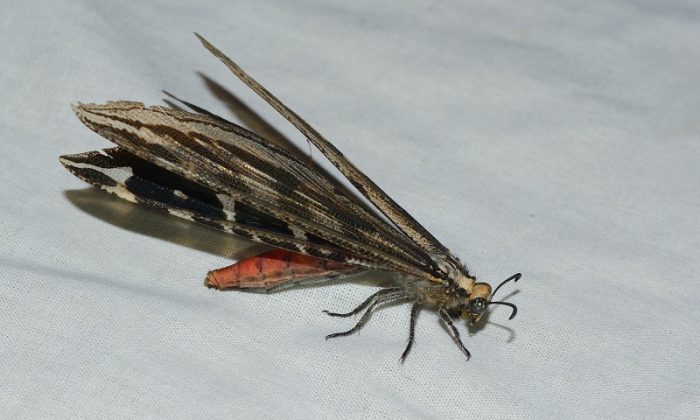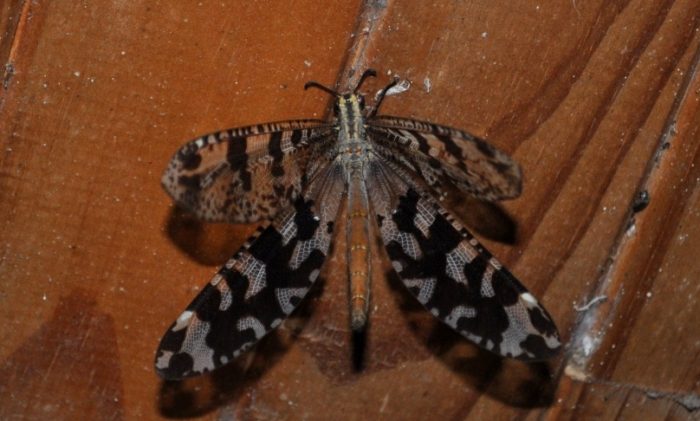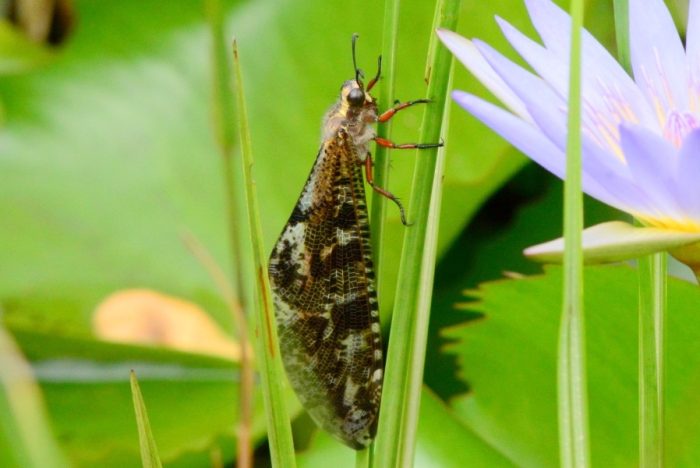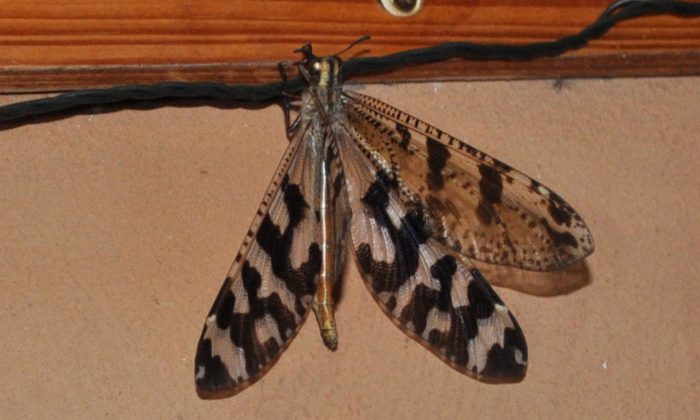
Palparellus festivus

View the above photo record (by Daniel Engelbrecht) in LacewingMAP here.

Palparellus festivus

(Esben-Petersen, 1922)

Identification

Size: Medium-Large

This is a …….. species hence the name “festivus”, meaning ………

Larvae: The larvae are unknown.

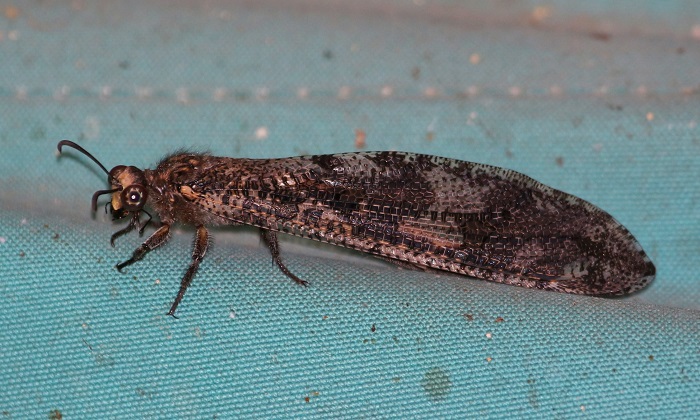
Palparellus festivus – Near Near Hoedspruit, Limpopo
Photo by Ashwell Glasson.
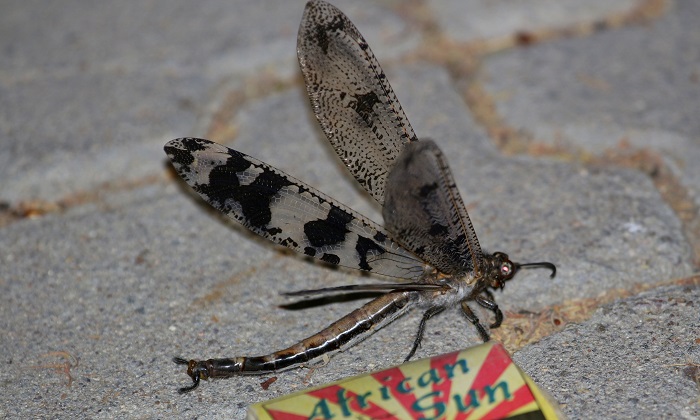
Palparellus festivus – Near Near Hoedspruit, Limpopo
Photo by Ashwell Glasson.

Habitat

P. festivus inhabits savanna woodlands in hot, low-lying areas.

Behaviour

Palparellus festivus is sometimes attracted to lights. Adults are nocturnal and often rest in a hanging position amidst long grass.

Adults are active during the summer months and have been recorded from October to February.

Nothing is known about the larvae of this species.

Palparellus festivus – Near Hoedspruit, Mpumalanga
Photo by Daniel Engelbrecht

Status and Distribution

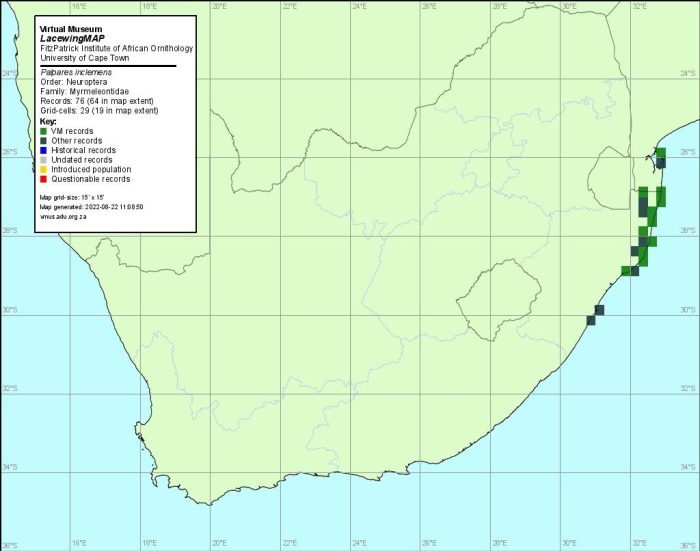
Palparellus festivus is fairly common but is not often encountered. It is known mostly from Limpopo, Mpumalanga and northern KwaZulu-Natal, with one record from Gauteng..

Distribution of Palparellus festivus. Taken from the LacewingMAP database, July 2022.

Taxonomy

Order: Neuroptera Family: Myrmeleontidae Subfamily: Palparinae Tribe: Palparini Genus: Palparellus Species: festivus

Palparellus festivus – Near Kwamhlanga, Mpumalanga
Photo by Christopher Willis

Further Resources

Virtual Museum (LacewingMAP > Search VM > By Scientific or Common Name)

Acknowledgements:

The use of photographs byAshwell Glasson, Daniel Engelbrecht and Christopher Willis is acknowledged. This species text has benefited enormously from comments made by Mervyn Mansell on records he has identified in LacewingMAP. We acknowledge his important contribution.

Recommended citation format for this species text:

Tippett RM 2022. Palparellus festivus. Biodiversity and Development Institute, Cape Town.
Available online at http://thebdi.org/2022/09/15/palparellus-festivus/

Palparellus festivus – Near Kwamhlanga, Mpumalanga
Photo by Christopher Willis

First BDI Bird Ringing Course: 1 to 7 September 2022

The first bird ringing course run by the BDI has been completed at the KhoiSan Karoo Conservancy. Eight attendees plus leader Dieter had an exciting week of ringing new species, going on night drives, and enjoying excellent meals!

Double-banded Courser - First bird ringing course
Double-banded Courser [photo Eric Liebgold]

Attendees included ringers and trainees from the USA, UK, Namibia and South Africa.

Catching techniques were mostly mist-netting and spring traps baited with bacon. In addition to ringing most of the time, there were opportunities to discuss various aspects of ringing, and trainees had practice at putting up nets on their own.

First bird ringing course
Ringing outdoors [photo Eric Liebgold]

The total number of birds caught was 246 birds of an amazing 31 species. The top species caught was the Cape Sparrow (52), followed by Southern Masked-Weaver (45) and Southern Red Bishop (41). Starlings featured well with Pied Starling (26) and Wattled Starling (15). Wader nets on the shore line produced a few Kittlitz’s Plover and Little Stint, and also unexpected birds like Capped Wheatear. Ringing in the Karoo shrub gave the best species like Rufous-eared Warbler, Grey-backed Cisticola, Black-chested Prinia, Karoo Scrub-Robin, Long-billed Crombec, African Pipit and Lark-like Bunting. A highlight for me was spot-lighting and catching a Double-banded Courser (after an unsuccessful attempt!).

To join a BDI bird ringing course, see dates and contact person here.

Previous blogs:
11-12/11/2019  Test ringing weekend – 86 birds
16/03-21/04/2022 Students ringing (includes ring summary and catching types)
01-06/09/2022 BDI ringing course – 246 birds (this course)     


Thanks to all the staff at New Holme for hosting us so well!

Where was the First bird ringing course held?
Very easy to find New Holme farm! [map created by Carynn Underhill]

Table of ringing totals, Karoo Gariep NR, 1 to 7 September 2022

Sp no.SpeciesTotal caught
237Kittlitz’s Plover3
245Blacksmith Lapwing1
253Little Stint2
278Double-banded Courser1
314Red-eyed Dove1
390White-backed Mousebird7
495White-throated Swallow2
568Capped Wheatear1
619Rufous-eared Warbler2
638Grey-backed Cisticola1
650Black-chested Prinia1
583Karoo Scrub-Robin4
604Lesser Swamp Warbler1
606African Reed-Warbler2
621Long-billed Crombec1
686Cape Wagtail4
692African Pipit1
707Common Fiscal5
722Bokmakierie2
735Wattled Starling15
746Pied Starling26
784House Sparrow1
786Cape Sparrow52
803Southern Masked-Weaver45
805Red-billed Quelea9
808Southern Red Bishop41
820Red-headed Finch2
871Lark-like Bunting1
1104Karoo Thrush9
1172Cape White-eye2
4139Karoo Prinia1
 TOTALS246

Below is a selection of some of the wonderful birds caught in the mist nets during the course:

Red-headed Finch
Red-headed Finch [photo Eric Liebgold]
Rufous-eared Warbler - First bird ringing course
Rufous-eared Warbler [photo Eric Liebgold]
Long-billed Crombec
Long-billed Crombec [photo Eric Liebgold]
Lark-like Bunting - First bird ringing course
Lark-like Bunting [photo Eric Liebgold]
Blacksmith Lapwing chick
Blacksmith Lapwing juvenile, caught by hand [photo Eric Liebgold]

Palparellus nyassanus

View the above photo record (by Ingmar Van der Brugge) in LacewingMAP here.

Palparellus nyassanus

(Navás, 1911)

Identification

Size: Medium-Large

A very striking and attractive species.

Larvae: The larvae are unknown.

Palparellus nyassanus – Dinokeng, Gauteng
Photo by Marita Beneke
Palparellus nyassanus Boshoek, Gauteng
Photo by Ingmar Van der Brugge

Habitat

Palparellus nyassanus is a tropical savanna species. Adults inhabit long grass, usually among rocks and boulders.

Behaviour

Palparellus nyassanus is sometimes attracted to lights. Adults are nocturnal and often rest in a hanging position among tall grass.

Adults are active during early to mid-summer and are been recorded from August to January.

Nothing is known about the larvae of this species.

Palparellus nyassanus – Near Tshipise, Limpopo
Photo by John Wilkinson

Status and Distribution

Palparellus nyassanus is known from Limpopo, Gauteng, Mpumalanga and North West provinces. It extends beyond South Africa into Botswana and northwards to Zimbabwe and Malawi. It is an uncommon species.

Distribution of Palparellus nyassanus. Taken from the LacewingMAP database, July 2022.

Taxonomy

Order: Neuroptera Family: Myrmeleontidae Subfamily: Palparinae Tribe: Palparini Genus: Palparellus Species: nyassanus

Palparellus nyassanus Venetia Nature Reserve, Limpopo
Photo by Vaughan Jessnitz

Further Resources

Virtual Museum (LacewingMAP > Search VM > By Scientific or Common Name)

Acknowledgements:

The use of photographs by Ingmar Van der Brugge, Marita Beneke and Vaughan Jessnitz is acknowledged. This species text has benefited enormously from comments made by Mervyn Mansell on records he has identified in LacewingMAP. We acknowledge his important contribution.

Recommended citation format for this species text:

Tippett RM 2022. Palparellus nyassanus. Biodiversity and Development Institute, Cape Town.
Available online at http://thebdi.org/2022/08/30/palparellus-nyassanus/

Palparellus nyassanus Near Tshipise, Limpopo
Photo by John Wilkinson

Palparellus pulchellus

View the above photo record (by Zenobia van Dyk) in LacewingMAP here.

Palparellus pulchellus

(Esben-Petersen, 1922)

Identification

Size: Medium-Large

This is a beautiful species hence the name “pulchellus”, meaning beautiful.

Larvae: The larvae are unknown.

Palparellus pulchellus – Near Carnarvon, Northern Cape
Photo by Ryan Tippett
Palparellus pulchellus Near Carnarvon, Northern Cape
Photo by Ryan Tippett

Habitat

P. elegantulus inhabits the open, arid shrublands of the Nama Karoo, often on sandy, red soils.

Habitat – Near Carnarvon, Northern Cape
Photo by Ryan Tippett

Behaviour

Palparellus pulchellus is sometimes attracted to lights. Adults are nocturnal and often rest in a hanging position among the protective branches of Karoo bushes. They are highly cryptic when at rest and blend specifically with the karroid-type vegetation of the Nama Karoo.

Adults are active during late summer and have been recorded from October to March.

Nothing is known about the larvae of this species.

Palparellus pulchellus Near Carnarvon, Northern Cape
Photo by Ryan Tippett

Status and Distribution

Palparellus pulchellus is uncommon and not often encountered. This species is confined to South Africa and is a Karoo endemic. It is known mostly from the Northern Cape of South Africa, with one record from the Western Cape.

Distribution of Palparellus pulchellus. Taken from the LacewingMAP database, July 2022.

Taxonomy

Order: Neuroptera Family: Myrmeleontidae Subfamily: Palparinae Tribe: Palparini Genus: Palparellus Species: pulchellus

Further Resources

Virtual Museum (LacewingMAP > Search VM > By Scientific or Common Name)

Acknowledgements:

The use of photographs by Zenobia van Dyk is acknowledged. This species text has benefited enormously from comments made by Mervyn Mansell on records he has identified in LacewingMAP. We acknowledge his important contribution.

Recommended citation format for this species text:

Tippett RM 2022. Palparellus pulchellus. Biodiversity and Development Institute, Cape Town.
Available online at http://thebdi.org/2022/08/30/palparellus-pulchellus/

Palparellus pulchellus Near Carnarvon, Northern Cape
Photo by Ryan Tippett

Palparellus dubiosus

View the above photo record (by Ryan Tippett) in LacewingMAP here.

Palparellus dubiosus

(Peringuey, 1910)

Identification

Size: Large (Wingspan around 100mm)

It could be confused with Palpares speciosus, but the characteristic thoracic patterns and male terminalia easily distinguish it from P. speciosus and P. caffer.

Larvae: The larvae are unknown.

Palparellus dubiosus – Near Carnarvon, Northern Cape
Photo by Ryan Tippett
Palparellus dubiosus Near Carnarvon, Northern Cape
Photo by Ryan Tippett

Habitat

P. elegantulus inhabits the open, arid shrublands of the Nama Karoo in flat or hilly terrain.

Habitat – Near Carnarvon, Northern Cape
Photo by Ryan Tippett

Behaviour

Palparellus dubiosus is regularly attracted to lights. Adults are nocturnal and often rest in a hanging position among the protective branches of Karoo bushes.

Adults are active during late summer and have been recorded from January to April.

Nothing is known about the larvae of this species.

Palparellus dubiosus – Near Hanover, Northern Cape
Photo by Rick Nuttall

Status and Distribution

This species is confined to South Africa, Botswana and Namibia. In South Africa, it occurs in the drier western regions of the country. Palparellus dubiosus seems to be common and widespread in the Karoo regions of South Africa.

Distribution of Palparellus dubiosus. Taken from the LacewingMAP database, July 2022.

Taxonomy

Order: Neuroptera Family: Myrmeleontidae Subfamily: Palparinae Tribe: Palparini Genus: Palparellus Species: dubiosus

Palparellus dubiosus – Near Hanover, Northern Cape
Photo by Ryan Tippett

Further Resources

Virtual Museum (LacewingMAP > Search VM > By Scientific or Common Name)

Acknowledgements:

The use of photographs by Rick Nuttall is acknowledged. This species text has benefited enormously from comments made by Mervyn Mansell on records he has identified in LacewingMAP. We acknowledge his important contribution.

Recommended citation format for this species text:

Tippett RM 2022. Palparellus dubiosus. Biodiversity and Development Institute, Cape Town.
Available online at http://thebdi.org/2022/08/30/palparellus-dubiosus/

Palparellus dubiosus Near Carnarvon, Northern Cape
Photo by Ryan Tippett

Crambomorphus karrooanus

View the above photo record (by Ryan Tippett) in LacewingMAP here.

Crambomorphus karrooanus

(Péringuey, 1910)

Identification

Size: Large (Wingspan 110mm)

This is one of South Africa’s most attractive antlions.

Larvae: Nothing is known about the larvae of this species.

This species was formerly known as Palpares karrooanus, but has since been transferred to the genus Crambomorphus.

Crambomorphus karrooanus – Near Carnarvon, Northern Cape
Photo by Ryan Tippett
Crambomorphus karrooanus – Near Carnarvon, Northern Cape
Photo by Ryan Tippett

Habitat

Crambomorphus karrooanus Inhabits the open, arid shrublands of the Karoo. A species of the Nama-Karoo biome.

Habitat – Near Carnarvon, Northern Cape
Photo by Ryan Tippett

Behaviour

Crambomorphus karrooanusNear Merriman, Northern Cape
Photo by Zenobia van Dyk

Adults are nocturnal and spend the day resting among tall grass. They are occasionally attracted to light.

Adults are on the wing from December to March.

Nothing is known about the larvae of this species.

Crambomorphus karrooanusNear Carnarvon, Northern Cape
Photo by Ryan Tippett

Status and Distribution

This species is uncommon and is seldom encountered. C. karrooanus is restricted to the Northern and Western Cape provinces of South Africa. It is also found in southern Namibia and Botswana.

Distribution of Crambomorphus karrooanus. Taken from the LacewingMAP database, July 2022.

Taxonomy:

Order: Neuroptera Family: Myrmeleontidae Subfamily: Palparinae Tribe: Palparini Genus: Crambomorphus Species:  karrooanus

Crambomorphus karrooanusAggeneys, Northern Cape
Photo by Luke Kemp

Further Resources

Virtual Museum (LacewingMAP > Search VM > By Scientific or Common Name)

Acknowledgements:

The use of photographs by Luke Kemp and Zenobia van Dyk is acknowledged. This species text has benefited enormously from comments made by Mervyn Mansell on records he has identified in LacewingMAP. We acknowledge his important contribution.

Recommended citation format for this species text:

Tippett RM 2022. Crambomorphus karrooanus. Biodiversity and Development Institute, Cape Town.
Available online at http://thebdi.org/2022/08/25/crambomorphus-karrooanus/

Crambomorphus karrooanusAggeneys, Northern Cape
Photo by Luke Kemp

Palpares cataractae

View the above photo record (by John Wilkinson) in LacewingMAP here.

Palpares cataractae

Péringuey, 1910

Identification

Size: Very Large

Palpares cataractae is a very large and robust antlion. 

Originally described from Victoria Falls – hence the name cataractae.

Larvae: The larvae of this species are unknown.

Palpares cataractae – Makalali Game Reserve, Limpopo
Photo by Ross Hawkins
Palpares cataractae Makalali Game Reserve, Limpopo
Photo by Ross Hawkins

Habitat

Palpares cataractae is a species of hot savanna regions in the north of South Africa.

Behaviour

Palpares cataractae is occasionally attracted to light.

Nothing is known about the larvae of this species.

Adults are recorded during the early summer months and are on the wing from September to January.

Palpares cataractae– Tsanakona, Botswana
Photo by Gert Myburgh

Status and Distribution

Palpares cataractae is uncommon in South Africa where it occurrs to the north of the country in the Limpopo province. Ranges further north into Botswana, Malawi, Namibia, Zambia, Mozambique and Zimbabwe.

Distribution of Palpares cataractae. Taken from the LacewingMAP database, July 2022.

Taxonomy

Order: Neuroptera Family: Myrmeleontidae Subfamily: Palparinae Tribe: Palparini Genus: Palpares Species: cataractae

Palpares cataractaeTsanakona, Botswana
Photo by Gert Myburgh

Further Resources

Virtual Museum (LacewingMAP > Search VM > By Scientific or Common Name)

Acknowledgements:

The use of photographs by Gert Myburgh, John Wilkinson and Ross Hawkins is acknowledged. This species text has benefited enormously from comments made by Mervyn Mansell on records he has identified in LacewingMAP. We acknowledge his important contribution.

Recommended citation format for this species text:

Tippett RM 2022. Palpares cataractae. Biodiversity and Development Institute, Cape Town.
Available online at http://thebdi.org/2022/08/24/palpares-cataractae/

Palpares cataractaeTsanakona, Botswana
Photo by Gert Myburgh

Palpares aemulus

View the above photo record (by Alan Manson) in LacewingMAP here.

Palpares aemulus

Péringuey, 1911

Identification

Size: Large (Wingspan information unknown)

A striking yellow and black antlion. Palpares aemulus is rather similar to Palpares sobrinus. They can be distinguished from other Palpares by the dense, evenly spaced black speckling on all four wings.

Larvae: The larvae of this species are unknown.

Palpares aemulus – Near Ingwavuma, KwaZulu-Natal
Photo by Alan Manson

Habitat

Palpares aemulus is a savanna species. The one LacewingMAP record of this species came from tall grass along the Ngwavuma River floodplain.

Behaviour

P. aemulus is likely to be attracted to light.

Nothing is known about the larvae of this species.

The only LacewingMAP record of this species is from March.

Palpares aemulus Near Ingwavuma, KwaZulu-Natal
Photo by Alan Manson

Status and Distribution

Palpares aemulus is rare and has only been recorded from northern KwaZulu-Natal.

Distribution of Palpares aemulus. Taken from the LacewingMAP database, July 2022.

Taxonomy

Order: Neuroptera Family: Myrmeleontidae Subfamily: Palparinae Tribe: Palparini Genus: Palpares Species: aemulus

Further Resources

Virtual Museum (LacewingMAP > Search VM > By Scientific or Common Name)

Acknowledgements:

The use of photographs by Alan Manson is acknowledged. This species text has benefited enormously from comments made by Mervyn Mansell on records he has identified in LacewingMAP. We acknowledge his important contribution.

Recommended citation format for this species text:

Tippett RM 2022. Palpares aemulus. Biodiversity and Development Institute, Cape Town.
Available online at http://thebdi.org/2022/08/22/palpares-aemulus/

Palpares inclemens

View the above photo record (by Douglas Cook) in LacewingMAP here.

Palpares inclemens

(Walker, 1853)

Identification

Size: Very large (Wingspan up to 160mm)

Palpares inclemens is one of the world’s largest antlion species. Closely resembles Palpares lentus, however that species is decidedly smaller.

Larvae: The larvae of this species are very large and coloured in muted shades of red, green and black bands.

Palpares inclemens – Near Hluhluwe, KwaZulu-Natal
Photo by Ryan Tippett
Palpares inclemensNdumo Game Reserve, KwaZulu-Natal
Photo by Luke Kemp

Habitat

This species occurs in coastal areas where it inhabits forests and woodlands on sandy soils. Adults are often encountered in rank vegetation in the forest/wetland mosaic of north-eastern KwaZulu-Natal.

Behaviour

P. inclemens is readily attracted to light.

The large red, green and black banded larvae live freely in sand.

They have been recorded from October to April, however most records are from December to April. Adults are most active during the late summer months.

Palpares inclemensNear Kosi Bay, KwaZulu-Natal
Photo by Ryan Tippett

Status and Distribution

Palpares inclemens is primarily a coastal species, extending down the east coast as far south as Durban. Away from South Africa it ranges northwards to coastal Kenya

Distribution of Palpares inclemens. Taken from the LacewingMAP database, July 2022.

Taxonomy

Order: Neuroptera Family: Myrmeleontidae Subfamily: Palparinae Tribe: Palparini Genus: Palpares Species: inclemens

Palpares inclemens – Near Chizavane, Mozambique
Photo by Kate Braun

Further Resources

Virtual Museum (LacewingMAP > Search VM > By Scientific or Common Name)

Acknowledgements:

The use of photographs by Douglas Cook, Kate Braun and Luke Kemp is acknowledged. This species text has benefited enormously from comments made by Mervyn Mansell on records he has identified in LacewingMAP. We acknowledge his important contribution.

Recommended citation format for this species text:

Tippett RM 2022. Palpares inclemens. Biodiversity and Development Institute, Cape Town.
Available online at http://thebdi.org/2022/08/18/palpares-inclemens/

Palpares inclemensNear Hluhluwe, KwaZulu-Natal
Photo by Ryan Tippett

Palpares lentus

View the above photo record (by Douglas Cook) in LacewingMAP here.

Palpares lentus

Navás, 1912

Identification

Size: Large (Wingspan around 100mm)

It strongly resembles Palpares inclemens, (a strictly coastal species), but is smaller.

Larvae: The larvae of this species are unknown.

Palpares lentus – Swebe-Swebe, Limpopo
Photo by Joseph Heymans
Palpares lentus – Nylsvlei Nature Reserve, Limpopo
Photo by Christopher Willis

Habitat

This species inhabits savanna woodlands in the northern parts of South Africa.

Behaviour

P. lentus is readily attracted to light.

Nothing is known about the larvae of this species.

Adults are active early during the early summer months and are on the wing from October to February. Most records come from November. This is in contrast to other Palpares species who mostly emerge during mid to late summer.

Palpares lentus Makalali Game Reserve, Limpopo
Photo by Vaughan Jessnitz

Status and Distribution

Palpares lentus appears to be largely confined to northern and north-western South Africa, with a few records from Botswana and Zimbabwe.

Distribution of Palpares lentus. Taken from the LacewingMAP database, July 2022.

Taxonomy

Order: Neuroptera Family: Myrmeleontidae Subfamily: Palparinae Tribe: Palparini Genus: Palpares Species: lentus

Palpares lentus – Near Vaalwater, Limpopo
Photo by Marita Beneke

Further Resources

Virtual Museum (LacewingMAP > Search VM > By Scientific or Common Name)

Acknowledgements:

The use of photographs by Alice Altenroxel, Cornelia Rautenbach, John Wilkinson, Joseph Heymans, Marita Beneke and Vaughan Jessnitz is acknowledged. This species text has benefited enormously from comments made by Mervyn Mansell on records he has identified in LacewingMAP. We acknowledge his important contribution.

Recommended citation format for this species text:

Tippett RM 2022. Palpares lentus. Biodiversity and Development Institute, Cape Town.
Available online at http://thebdi.org/2022/08/18/palpares-lentus/

Palpares lentus – Swebe-Swebe, Limpopo
Photo by Joseph Heymans