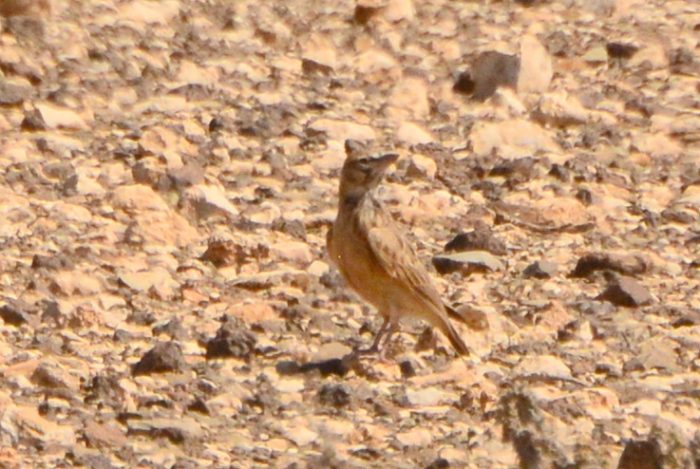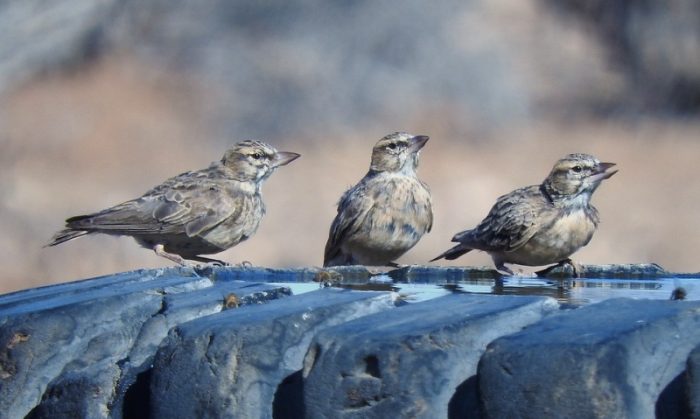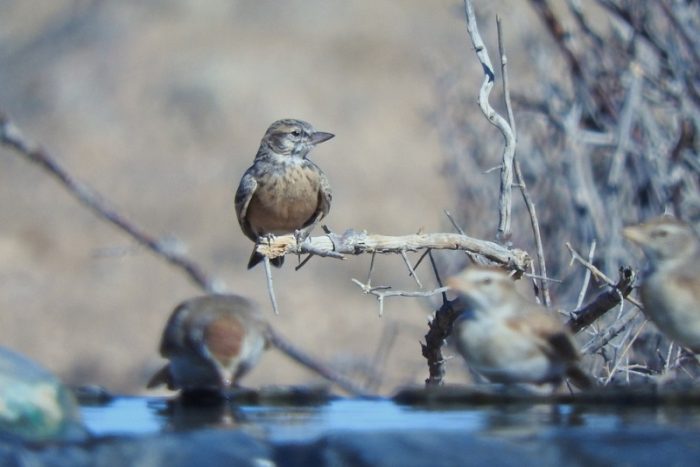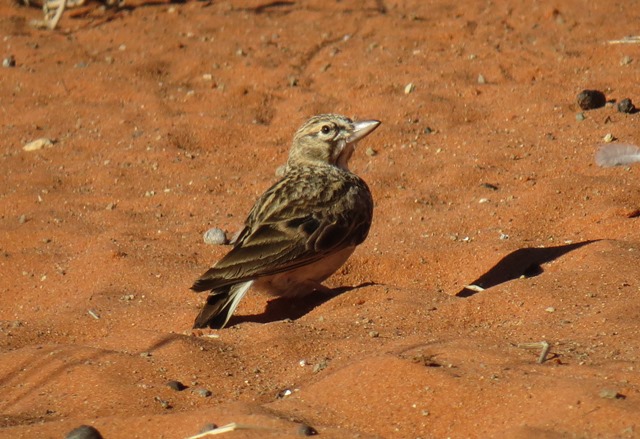
Karoo Korhaan (Eupodotis vigorsii)

Cover image by Johan and Estelle van Rooyen – Near Witsand, Western Cape – BirdPix No. 113724 Karoo Korhaan

Identification

The Karoo Korhaan is relatively inconspicuous and is well camouflaged against the dry landscapes of its preferred habitat.
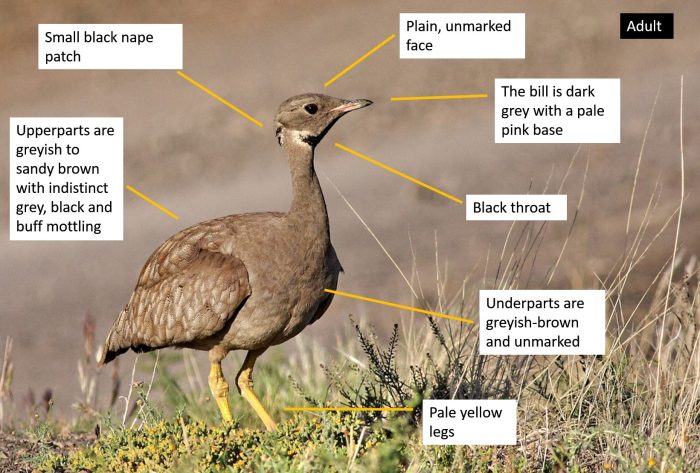
Identification guide to Karoo Korhaan
Karoo Korhaan (Eupodotis vigorsii) – Karoo National Park, Western Cape
Photo by JC van Rensburg

Overall colouration is sandy grey-brown. The underparts are uniform grey-brown. The mantle, scapulars and wing coverts are indistinctly mottled with diffuse grey, buff and black blotches.

The head and neck carry the most distinctive markings. There is a small black patch on the nape and a more prominent black patch on the throat. The face is plain grey-brown and unmarked. The bill is dark greyish with a pale pink base.

The sexes are similar but males are slightly larger and have more extensive black on the throat, extending onto the fore-neck.

Juveniles resemble the adults but have scattered whitish blotches on the body, head and neck. The undersides are paler with some indistinct darker barring.

Karoo Korhaan in flight
The Karoo Korhaan (Eupodotis vigorsii) shows contrasting black and buff wing markings. 
Karoo-Gariep Nature Reserve, Northern Cape
Photo by Jon Blanco

Distribution

The Karoo Korhaan varies from common to uncommon, depending on location. It is endemic to Southern Africa and is confined to western South Africa and Southern Namibia.

The Karoo Korhaan is not considered threatened. It is thought that this species has increased in abundance in the Karoo owing to livestock grazing practices, as it favours disturbed conditions. The South African population has been estimated at hundreds of thousands of individuals.

SABAP2 distributiom map for Karoo Korhaan
SABAP2 distribution map for Karoo Korhaan (Eupodotis vigorsii) – March 2023. Details for map interpretation can be found here.

Habitat

The Karoo Korhaan occurs in dwarf shrublands on the open plains of the semi-arid Karoo. It favours stony ground in flat to undulating terrain. Within this region it is most common throughout the Nama Karoo. It is also common in the Grassy Karoo ecotone between the grassland and Karoo biomes. It is less common in, and is absent from large areas of, the winter-rainfall Succulent Karoo. It has also colonised the planted pastures and cereal croplands along the southern coast of the Western Cape in the fynbos biome. This is the only region where it is found outside karroid vegetation.

Eupodotis vigorsii in habitat
Karoo Korhaan (Eupodotis vigorsii) – Melk Houte Bosch, Western Cape
Photo by Keir Lynch

Behaviour

Usually encountered in pairs, occasionally in groups of three to five birds, and very rarely solitarily. the Karoo Korhaan is easily overlooked due to its cryptic plumage. This is compensated for by its loud and frequent vocalizations, which are somewhat frog-like.

It is a sedentary resident. Karoo Korhaans are more conspicuous during the winter months due to increased activity and sparser vegetation at this time. Breeding birds become very secretive during the summer months.

Forages by walking and pecking on or close to the ground. Consumes a range of invertebrates (mainly insects and arachnids), small reptiles and a much vegetable matter (seeds, pods, fruits, flowers, leaves and bulbs).

Koroo Korhaan in the karoo
Karoo Korhaan (Eupodotis vigorsii) – Carnarvon district, Northern Cape
Photo by Sybrand Venter

Drinks in the mornings and evenings when water is available.

The Karoo Korhaan is monogamous, breeding in pairs. The occasional presence of extended family groups may indicate some cooperative breeding. They are territorial and groups defend their territories throughout the year. Territorial males actively fight by flapping their wings and kicking each other.

Eupodotis vigorsii pair
Karoo Korhaan (Eupodotis vigorsii) – Karoo National Park, Western Cape
Photo by Desire Darling

Breeding has been recorded from July to April but mostly takes place between October and March during the summer months.

A single egg is laid per clutch. No true nest is constructed and the egg is laid in a shallow scrape directly on the ground. The site is sometimes lined with a ring of stones or pebbles.

Incubation duties are performed entirely by the female, although the male remains nearby. The chick is highly precocial and the female and chick join up with the male shortly after hatching.

Further Resources

This species text is adapted from the first Southern African Bird Atlas Project (SABAP1), 1997.

The use of photographs by Alan Collett, Desire Darling, Johan and Estelle van Rooyen, Rick Nuttall and Tino Herselman is acknowledged.

Virtual Museum (BirdPix > Search VM > By Scientific or Common Name).

Other common names: Vaalkorhaan (Afrikaans); Zwartkintrap (Dutch); Outarde de Vigors (French); Namatrappe (German); Abetarda do Karoo (Portuguese).

A list of bird species in this format is available here.

Recommended citation format: Tippett RM 2023. Karoo Korhaan (Eupodotis vigorsii). Biodiversity and Development Institute. Available online at http://thebdi.org/2023/03/07/karoo-korhaan-eupodotis-vigorsii/

Bird identificationbirding

Eupodotis vigorsii Karoo Korhaan
Karoo Korhaan (Eupodotis vigorsii) – Karoo National Park, Western Cape
Photo by Desire Darling

Ludwig’s Bustard (Neotis ludwigii)

Cover image of Ludwig’s Bustard by Rick Nuttall – Murraysburg district, Western Cape – BirdPix No. 192436

Identification

The Ludwig’s Bustard is a relatively large and fairly conspicuous species, especially in flight and when the males are calling and displaying.

In males, the crown, face and fore-neck are dark sooty brown. The folded wings are intricately patterned in various shades of brown. The wing coverts are brown and white. The hind-neck is bright orange-brown and the sides of the neck and the entire belly are white.

Ludwig’s Bustard (Neotis ludwigii) Male – Mountain Zebra National Park, Eastern Cape
Photo by Desire Darling

Females are similar but slightly smaller. They have paler heads and fore-necks with white mottling. The orange-brown hind-neck is also duller.

Ludwig’s Bustard (Neotis ludwigii) Female
Karoo-Gariep Nature Reserve, Northern Cape
Photo by Tino Herselman

This species is often confused with Denham’s Bustard (Neotis denhami). Denham’s Bustard is larger, has a pale grey fore-neck, a darker, more chestnut hind-neck and a black and white-striped crown and face.

In flight Ludwig’s Bustard shows white inner primaries and minimal white on the coverts. In Denham’s Bustard the coverts are mostly white.

Ludwig’s Bustard (Neotis ludwigii) 
In flight shows white inner primaries and minimal white on the coverts.
Near Petrusburg , Free State
Photo by Rick Nuttall

Carl Ferdinand Heinrich von Ludwig, in whose honour this species was named, was a citizen scientist. He was born in Germany in 1784, trained as a pharmacist, and came to a post in Cape Town in 1805. By 1807, he was one of nine official pharmacists in Cape Town. He did lots of activities two centuries ago which today would be described as citizen science initiatives. You can read more about him here. He died in Cape Town in 1847.

Distribution

Ludwig’s Bustard is scarce to locally common and is near-endemic to southern Africa. Its range extends marginally into south-western Angola. It occurs in southern and western Namibia, extreme south-western Botswana, and widely in central and western South Africa. It is a marginal, non-breeding visitor to Lesotho. In the Western Cape, it is largely confined to the Karoo and Namaqualand, south to the West Coast National Park. It penetrates beyond the Karoo into the fynbos biome mainly during dry winters.

Ludwig’s Bustard is currently listed as Vulnerable. They are highly prone to collisions with overhead transmission lines and often get tangled up in jackal-proof fencing. Hatching success is also low. Despite this there is no evidence of any major range changes. Its distribution overlaps slightly with Denham’s Bustard in the Western and Eastern Cape.

SABAP2 distribution map for Ludwig's Bustard
SABAP2 distribution map for Ludwig’s BustardNeotis ludwigii – February 2023. Details for map interpretation can be found here.

Habitat

Ludwig’s Bustard inhabits dry open plains, from grassland to desert.

It is most numerous in the arid and semi-arid dwarf shrublands of Namibia and the Karoo. It also frequents the drier western grasslands in South Africa and arid woodlands of the southern Kalahari. It also makes occasional use of agricultural areas in the fynbos biome of the Western Cape.

Often frequents bare open areas within these habitats such as gravel plains and dry watercourses, especially on calcrete. May gather in numbers to forage at dry pans and dams especially when there is a flush of short, green vegetation after the water dries.

Ludwig’s Bustard (Neotis ludwigii) – Khorixas, Namibia
Photo by Johan and Estelle van Rooyen

Behaviour

Usually found singly or in groups. Small groups of three or four birds are normal but larger groupings of up to 36 birds are regular. The largest recorded group size is 270 birds but this is exceptional. Larger groups are not cohesive but rather loose aggregations at a concentrated food source such as locust swarms or termite alates. They are partially migratory and probably nomadic. Their movements are largely influenced by rainfall.

Occasionally forages alongside Kori Bustard and has been known to join groups of Denham’s Bustard in areas of overlap. Spends most of its time foraging by walking slowly and pecking at the ground but will run after large insects. Ludwig’s Bustard is omnivorous and the diet consists of arthropods and vertebrates as well as a range of plant material. Arthropod prey includes locusts, beetles, ants, termites, flies, centipedes, spiders, scorpions etc. Vertebrates taken include rodents and reptiles and they consume a fair amount of vegetable matter such as seeds, berries, leaves and bulbs.

They seldom drink water, because they obtain most of their moisture requirement from the food they eat.

Ludwig’s Bustards are polygynous whereby males mate with multiple females during the breeding season. Males establish regularly used lek sites where they display competitively in order to entice females for mating. Leks are mostly situated in prominent positions such as on a rocky ridge. Each lek site holds from one to three males, each of whom defends his immediate vicinity from rivals through complex posturing. Displaying males are normally spaced about 300 m apart.

A male during balloon display
Ludwig’s Bustard (Neotis ludwigii) – Graaff Reinet district, Eastern Cape
Photo by Alan Collett

Displaying starts at or before first light and continues for two to three hours. Males perform what is known as a ‘balloon’ display. To begin, the male stands tall with wings drooped and the tail held level. He then erects his neck and breast feathers and inflates the neck with air. After a pause the air is then forcibly expelled from the inflated oesophagus. The ‘balloon’ serves to resonate and amplify the booming call over a great distance. This display also serves a visual function and is conspicuous from a good distance. The display is usually also accompanied by foot stamping. Displaying often resumes in the late afternoon and may continue up to 30 minutes after dark.

Ludwig’s Bustard (Neotis ludwigii)
The lek site is typically situated on a raised, rocky ridge.
Carnarvon district, Northern Cape
Photo by Ryan Tippett

Attracted females fly or walk to display sites, either singly or in groups of up to three birds. Displaying lasts around six weeks following spring rains.

Breeding mostly takes place between August and December in South Africa and during March in Namibia.

One or two eggs are laid per clutch and no nest is constructed. The eggs are well camouflaged and are laid in the open on bare ground, or in a shallow scrape, often among stones. All incubation and parental care is performed by the female. The incubation and fledging periods are unrecorded and the chicks are highly precocial.

Further Resources

This species text is adapted from the first Southern African Bird Atlas Project (SABAP1), 1997.

The use of photographs by Alan Collett, Desire Darling, Johan and Estelle van Rooyen, Rick Nuttall and Tino Herselman is acknowledged.

Virtual Museum (BirdPix > Search VM > By Scientific or Common Name).

Other common names: Ludwigse pou (Afrikaans); Iseme (Xhosa); Khupa (South Sotho); Ludwig-trap (Dutch); Outarde de Ludwig (French); Ludwigstrappe (German); Abetarda de Ludwig (Portuguese).

Recommended citation format: Tippett RM 2023. Ludwig’s Bustard (Neotis ludwigii). Biodiversity and Development Institute. Available Online at http://thebdi.org/2023/02/28/ludwigs-bustard-neotis-ludwigii/

List of bird species in this format is available here.

Bird identificationbirding

Ludwig’s Bustard (Neotis ludwigii)
Middelburg district, Eastern Cape
Photo by Tino Herselman

Karoo Lark (Calendulauda albescens)

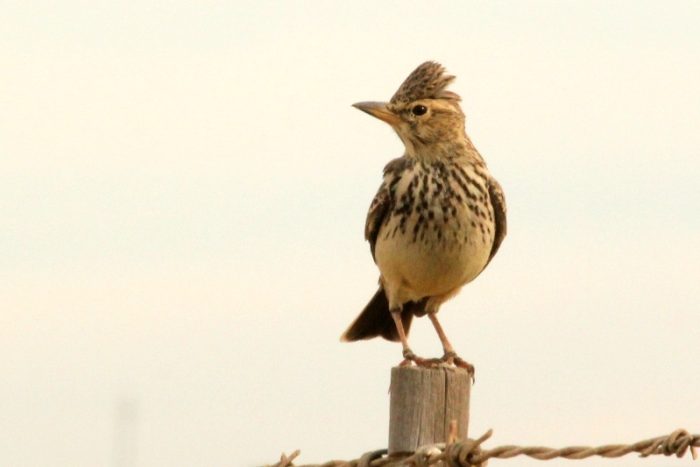
Cover image: Karoo Lark by Gerald Wingate – Ceres district, Western Cape – BirdPix No. 217927

Identification

The Karoo Lark is a small, attractive species with a less robust and more delicate build than other similar larks. The bill is relatively slender and somewhat decurved.

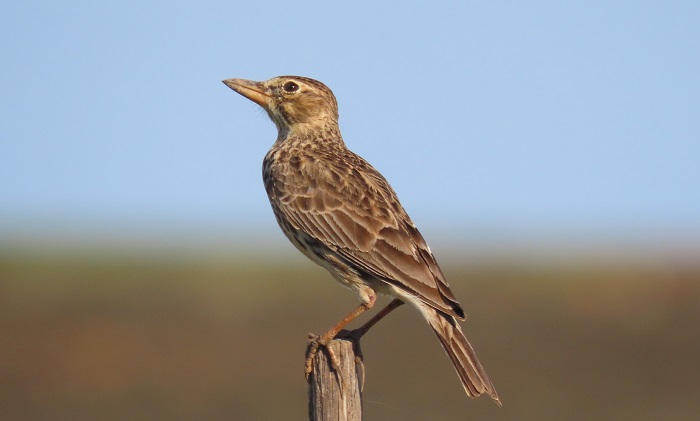
Identifcation of Karoo Lark
Karoo Lark (Calendulauda albescens) – Montagu district, Western Cape
Photo by Ryan Tippett

The facial markings are well defined. The supercilium and the line under the eye form a broad white eye-ring with a black stripe through the middle. Black malar and moustachial stripes are prominent and the ear coverts are dark rufous to brown.

Upperpart colouration is highly variable, ranging from pale sandy brown to dark brown, to rich brick red, and with several shades in-between. Despite this variability, the upperparts are normally well streaked. The underparts are white and are strongly marked. The Karoo Lark has streaked flanks which distinguish it from the similar Red Lark and Barlow’s Lark, both of which normally have unmarked flanks.

Males are larger than females but are otherwise alike.

Juveniles have white tips to the feathers on the upperparts, giving them a spotted appearance.

Karoo Lark
Karoo Lark (Calendulauda albescens) – Doringbos, Northern Cape
Photo by Karis Daniel

Status and Distribution

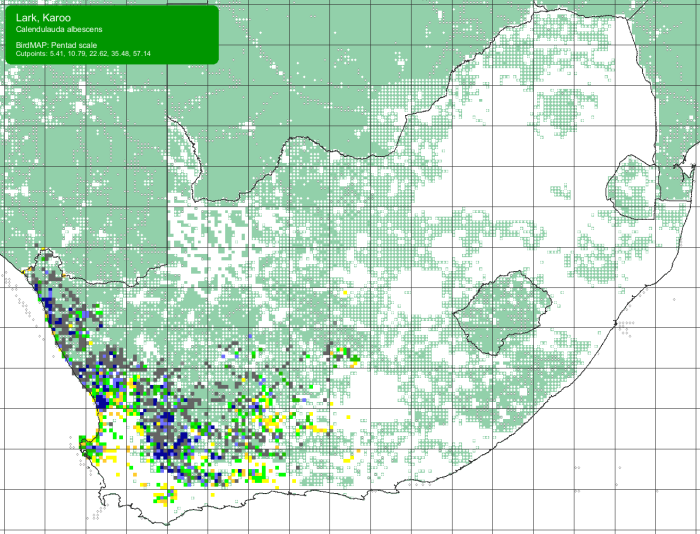
The Karoo Lark is a South African endemic. It is restricted to parts of the Northern, Western and Eastern Cape provinces. It is fairly common in the southern and western Karoo as well as in strandveld along the west coast. It is less common in the colder, high elevation shrublands of the central Karoo.

Calendulauda albescens
Karoo Lark (Calendulauda albescens) – Clanwilliam district, Western Cape
Photo by Zenobia van Dyk

The range of the Karoo Lark has contracted locally in the southern parts of the Western Cape owing to agriculture. The transformation of renosterveld into wheat lands has undoubtedly removed much of its habitat. Karoo Lark populations may be growing in the northeast of its range, due to local increases in shrubs as a result of overgrazing. It is not adequately protected in existing nature reserves and should be a candidate for conservation attention. Despite this the Karoo Lark is not considered to be threatened.

SABAP2 distribution map of Karoo Lark
SABAP2 distribution map for Karoo Lark (Calendulauda albescens) – February 2023.
Details for map interpretation can be found here.

Habitat

The Karoo Lark prefers relatively tall, open shrublands on sandy soils. This includes dry coastal fynbos, strandveld and Karroid dwarf-shrublands. It occurs in both the Winter and Summer rainfall regions of the Karoo. In stony regions of the Karoo it is largely restricted to dry watercourses where the substrate is sandier and the vegetation may be taller. The Karoo lark also occurs in sparsely vegetated fallow fields but avoids land being actively farmed. It is less common in short shrublands, for example where heavy grazing has trampled the veld.

Habitat of Karoo Lark
Habitat – Near Carnarvon, Northern Cape.
Note the sandy soil and presence of taller bushes and shrubs.
Photo by Ryan Tippett

Behaviour

The Karoo Lark may be solitary or found in pairs. It forages on the ground and walks slowly with a hunched posture. Frequently digs with its bill, especially around the base of shrubs. Feeds primarily on seeds, insects and berries. Runs between shrubs in a mouse-like fashion when disturbed, or flies up to perch on a bush.

Calendulauda albescens
Karoo Lark (Calendulauda albescens) – Near Springbok, Northern Cape
Photo by J. Terblanche

During display the male sings from the top of a bush or in flight. In display flight the male rises on rapidly beating wings to around 20 m above the ground. The flight is laboured, with slow, deep wing-beats and the tail pointed downwards while calling repeatedly.

The Karoo Lark has an extended breeding season from August to March. It breeds seasonally (August to December) in the Winter rainfall parts of its range and more opportunistically in the central Karoo, which receives erratic Summer rainfall.

The Karoo lark is monogamous and is a territorial, solitary nester. The nest is a cup composed of grass fibres with a domed roof. It is set into a scrape at the base of a plant and is built by both sexes. Clutch size ranges from 2 to 3 eggs but the incubation, nestling and fledging period is unrecorded.

Karoo Lark
Karoo Lark (Calendulauda albescens) – Near Springbok, Northern Cape
Photo by Maans Booysen

Further Resources

Species text adapted from the first Southern African Bird Atlas Project (SABAP1), 1997.

The use of photographs by Gerald Wingate, J. Terblanche, Karis Daniel, Maans Booysen, Marna Buys and Zenobia van Dyk is acknowledged.

Virtual Museum (BirdPix > Search VM > By Scientific or Common Name).

Other common names: Mirafra albescens; Certhilauda albescens (Alternative Scientific Names); Karoolewerik (Afrikaans); Alouette du Karroo (French); Karrulerche (German); Cotovia do Karoo (Portuguese)

A list of bird species in this format is available here.

Recommended citation format: Tippett RM 2023. Karoo Lark (Calendulauda albescens) Biodiversity and Development Institute. Available online at http://thebdi.org/2023/02/23/karoo-lark-calendulauda-albescens/

Bird identificationbirding

Calendulauda albescens
Karoo Lark (Calendulauda albescens) – West Coast National Park, Western Cape
Photo by Marna Buys

Large-billed Lark (Galerida magnirostris)

Cover image by Kevin Lavery – Near Phillipstown, Northern Cape – BirdPix No. 228942 Large-billed Lark

Identification

The Large-billed Lark is a large, stocky lark with a heavy, yellow-based bill (diagnostic). The upperparts are buff brown with heavy, dark mottling. The facial markings are bold with a broad, buff-coloured supercilium. The malar stripe is bold and dark and there are dark lines passing through and under the eye. The undersides range from whitish to buff-brown and the breast is heavily marked with dark blotches. The overall appearance often has a yellowish hue. The wedge-shaped crest is usually held flat, but may be raised in alarm or when the bird is singing.

Identification guide to Large-billed Lark
Large-billed Lark (Galerida magnirostris) – Near Vanrhynsdorp, Western Cape
Photo by Karis Daniel

The sexes are alike, although the male is larger than the female. Juveniles have whitish feather tips on the crown, wings and back and fainter breast markings.

It is easily confused with the ‘thick-billed’ race of the Sabota Lark Mirafra sabota, which also inhabits karoo veld. The Sabota Lark has an overall whiter colouration, is less heavily marked on the breast and lacks the crest of the Large-billed Lark.

Status and Distribution

The Large-billed Lark is a locally common resident and is virtually endemic to South Africa and Lesotho. It also occurs in the extreme south of Namibia along the Orange River. It is widespread in the western parts of South Africa, occurring throughout the Western Cape, much of the Northern Cape (mostly south of the Orange River), and the drier western parts of the Eastern Cape. Its range extends through the western and southern Free State and across Lesotho.

Large-billed Lark in Western Cape
Large-billed Lark (Galerida magnirostris) – Near Klipheuwel, Western Cape
Photo by Les Underhill

This lark is not considered threatened and has probably increased in abundance as a result of agriculture in the Western Cape. There is no evidence that there have been changes in the remainder of its distribution.

SABAP2 distribution map for Large-billed Lark
SABAP2 distribution map for Large-billed Lark (Galerida magnirostris) – February 2023.
Details for map interpretation can be found here.

Habitat

Large-billed Lark habitat
Typical habitat in the Karoo where it favours sites with taller bushes and grass, often near drainage lines.
Carnarvon district, Northern Cape
Photo by Ryan Tippett

The Large-billed Lark is most abundant in the succulent Karoo, followed by the Nama Karoo and the Grassy Karoo. It is also common in Alpine Grasslands on the Lesotho Highlands and in dry coastal Fynbos and agricultural fields of the Western Cape.

Large-billed Lark has adapted to agriculture
Large-billed Lark (Galerida magnirostris) has adapted to agricultural areas in the Western Cape.
Near Witsand, Western Cape
Photo by Johan and Estelle van Rooyen

Behaviour

The Large-billed Lark is found either solitarily or in pairs. It has a distinctive call and is conspicuous when calling, usually from atop a fence, rock, termite mound or bush. Forages while walking about on flexed legs and collects food primarily off the ground. Feeds on various invertebrates, seeds and bulbs which it digs up with its bill. Drinks water regularly.

Galerida magnirostris
Large-billed Lark (Galerida magnirostris) – Agulhas National Park, Western Cape
Photo by Jon Blanco

Breeding takes place during Spring and Summer and peaks from September through November. Males display at the start of the breeding season. In display the male rises 15 to 50m above the ground. He then circles in a fluttering, dipping arc while singing.

The nest is a cup made from grass and other fine plant fibres. It is built on a foundation of small sticks and placed at the base of a grass tussock or bush. 2 or 3 eggs are laid per clutch and are incubated by both sexes. The incubation period last around 16 days. The chicks are fed by both parents, however, the nestling and fledging periods have not been recorded.

Large-billed Lark
Large-billed Lark (Galerida magnirostris) – Near Carnarvon, Northern Cape
Photo by Sybrand Venter

Further Resources

Species text adapted from the first Southern African Bird Atlas Project (SABAP1), 1997.

The use of photographs by Alan Collett, J Terblanche, John Cox, Phillip Nieuwoudt, Johan and Estelle van Rooyen and Zenobia van Dyk is acknowledged.

Virtual Museum (BirdPix > Search VM > By Scientific or Common Name).

Other common names: Thick-billed Lark (Alternative English Name); Dikbeklewerik (Afrikaans); Cochevis à gros bec (French); Dickschnabellerche (German); Cotovia-de-bico-grosso (Portuguese); Grootsnavelleeuwerik (Dutch).

A list of bird species in this format is available here.

Recommended citation format: Tippett RM 2023. Large-billed Lark (Galerida magnirostris). Biodiversity and Development Institute. Available online at http://thebdi.org/2023/02/20/large-billed-lark-galerida-magnirostris/

Bird identificationbirding

Galerida magnirostris near Koringberg, Western Cape
Large-billed Lark (Galerida magnirostris) – Near Koringberg, Western Cape
Photo by Les Underhill

Bird ringing at Ouberg Private Nature Reserve: 14 to 17 February 2023

A “BDI – Birds4Africa” bird ringing visit was held from 14 to 17 February 2023 at the Ouberg Private Nature Reserve in the Little Karoo near Montagu. This was a relaxed few days of bird ringing at Ouberg with several attendees spending time working, birding and ringing as each person wanted to.

This is the house where we stayed while bird ringing at Ouberg
This house was the base for bird ringing at Ouberg Private Nature Reserve


The first afternoon was hot, but thereafter we had mostly overcast weather, and the forecast heavy rain came just after everyone had left.

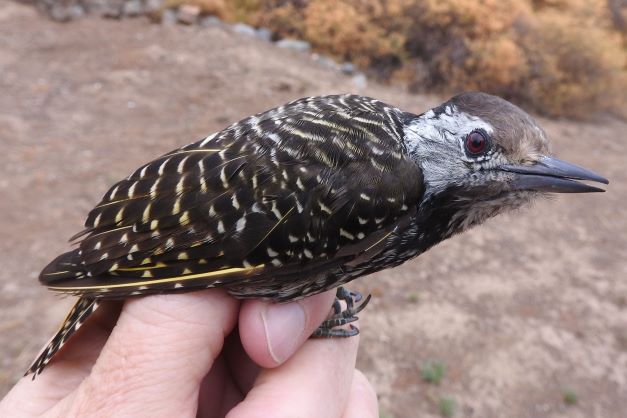
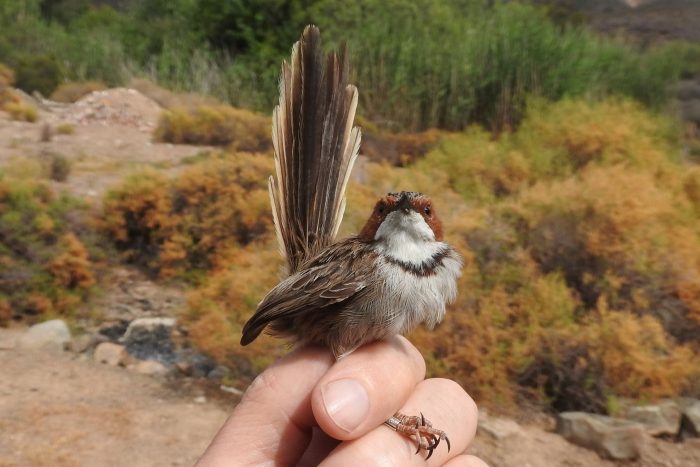
133 birds were caught of 24 species, with top species being Southern Masked Weaver (29), Cape White-eye (16), Cape Bulbul (14) and Cape Weaver (14). Special species were a female Cardinal Woodpecker, a Pearl-breasted Swallow, four Sombre Greenbuls and two Fairy Flycatchers. We had quite a few other Karoo species in the hand: Karoo Scrub Robin, Rufous-eared Warbler, Long-billed Crombec, Bar-throated Apalis, and Chestnut-vented Tit-babbler.

Rufuos-eared Warbler at Ouberg Private Nature Reserve
Rufous-eared Warbler


Most birds were moulting primaries, although some had not started yet and others had completed moult.

There were 13 recaptures, some from earlier days of this trip, and others from previous visits to the farm – there were four retraps that were were ringed in October 2020 and five from October 2022. The 2020 trip was on 21-25 October 2020 when 164 birds were ringed of 35 species (more nets were used on this trip). The ringer for the 2022 trip was Felicity Ellmore.

Thanks to Richard and Sue Gie for hosting us! Here is Sue doing a talk about the Ouberg Private Nature Reserve.

Table – Result of bird ring at Ouberg. Numbers of birds caught, 14-17 February 2023

Sp. No.SpeciesCaught
390Speckled Mousebird2
391White-backed Mousebird6
432Acacia Pied Barbet3
450Cardinal Woodpecker1
498Pearl-breasted Swallow1
543Cape Bulbul14
551Sombre Bulbul4
581Cape Robin-chat4
583Karoo Scrub Robin4
606African Reed Warbler1
609Little Rush Warbler5
619Rufous-eared Warbler1
621Long-billed Crombec2
622Bar-throated Apalis3
658Chestnut-vented Warbler5
665Fiscal Flycatcher5
678Fairy Flycatcher2
786Cape Sparrow4
799Cape Weaver14
803Southern Masked Weaver29
873Cape Bunting1
1105Olive Thrush3
1172Cape White-eye16
4139Karoo Prinia3
Totals133


Ringing into the evening after a late afternoon catch

Red Lark (Certhilauda burra)

Cover image: Red Lark by Phillip Nieuwoudt – Near Aggeneys, Northern Cape – BirdPix No. 73871

Identification

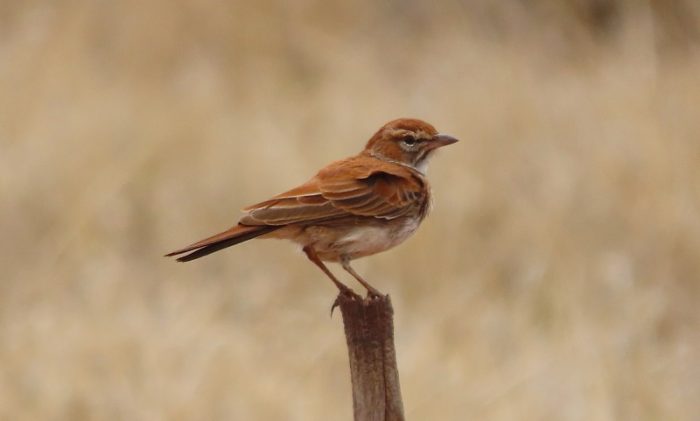
The Red Lark is a large, handsome species with a more robust build than other similar larks. The beak is relatively short but stout. The facial markings are bold. The supercilium and the line under the eye form a broad white eye-ring with a black stripe through the middle. The black malar stripe is broad and conspicuous. Upperpart colouration is variable and ranges from brick red to orange-red to dull brown with darker streaks. Populations are known to intergrade but typically birds from dune habitats carry the red colour while those from the plains are brown above. The underparts are white and the breast is heavily streaked in black. The flanks are usually un-marked and the tail is relatively long and heavy.

Identification of Red Lark
Red Lark (Certhilauda burra) – Near Springbok, Northern Cape
Photo by J. Terblanche

The sexes differ in that the male is larger and has a heavier, more robust beak.

Juveniles show more brightly coloured upperparts and the feathers on the back, mantle and crown have pale tips.

The red Lark is similar to the closely related Karoo Lark (Certhilauda albescens) but is larger, has a heavier beak and normally has un-streaked flanks. The two species also have minimal range overlap and favour different habitats.

Red Lark
Red Lark (Certhilauda burra) Brown plains form – Near Carnarvon, Northern Cape
Photo by Ryan Tippett

Status and Distribution

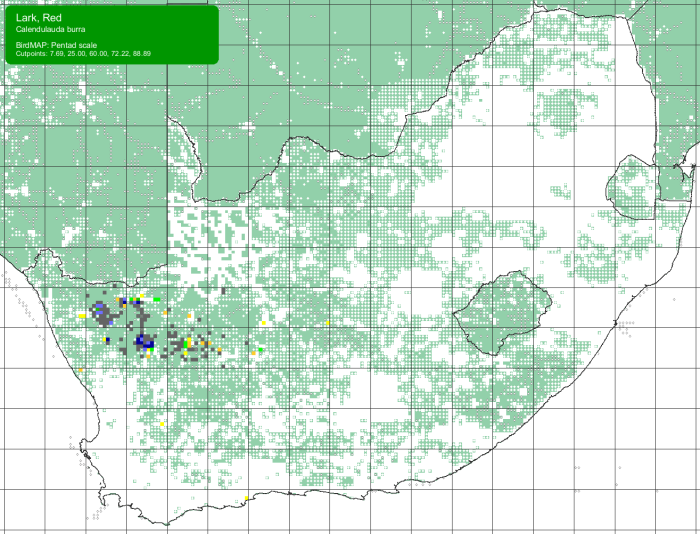
The Red lark is considered uncommon and is endemic to South Africa. Its distribution is confined to the Northern Cape Province, largely within the region known as Bushmanland. It is found from between Carnarvon and Vanwyksvlei in the east to the Koa river valley near Steinkopf in the west. The Red Lark is localised within its distribution due to its specific habitat requirements.

Certhilauda burra
Red Lark (Certhilauda burra) – Near Poffadder, Northern Cape
Photo by Zenobia van Dyk

It is believed that the distribution and numbers may have been reduced, but atlas records, particularly in the eastern parts of its range, suggest that it could be more common and widespread than previously thought.

SABAP2 distribution map for Red Lark
SABAP2 distribution map for Red Lark (Certhilauda burra) – February 2023.
Details for map interpretation can be found here.

Habitat

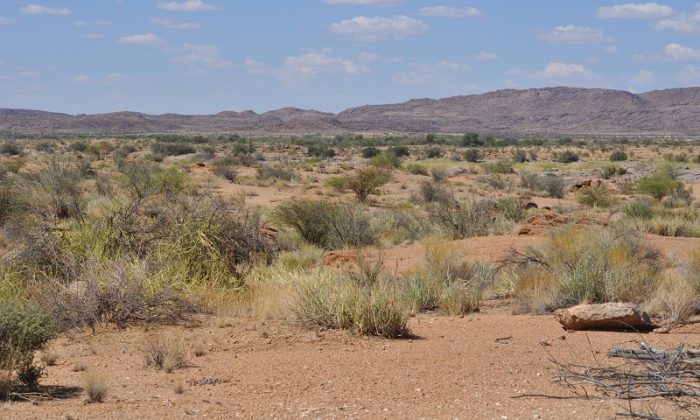
The Red Lark inhabits rolling, red sand dunes and sandy flats with an abundance of tussocked grass and scattered taller shrubs to perch on. An important requirement of its habitat is large-seeded grasses such as Brachiaria glomerata for food, and perrenial grasses with plumed awns, such as Stipagrostis ciliata for nest material and nest sites. It favours places with bare substrate between grass tussocks or shrubs and avoids spots with dense grass cover. Brown plains form birds are found between the dune systems on sands, shales or clay flats, provided large seeded grasses are present.

Habitat for Red Lark
Typical habitat.
Vanwyksvlei district , Northern Cape
Photo by Ryan Tippett

Behaviour

Not much is known about the ecology of the Red Lark. It is a sedentary, resident species but may move locally according to environmental conditions.

They are found either solitarily or in pairs. When flushed they fly to the next dune or shrub patch and avoid landing in dense grass. They often run some distance from where they landed. Frequently perches on shrubs or trees, especially on dune crests. Often perches horizontally with legs extended and the tail pointing to the ground at an angle. Seeks shelter under shrubs during the midday heat.

Certhilauda burra
Red Lark (Certhilauda burra) in characteristic horizontal posture.
Near Aggeneys, Northern Cape
Photo by John Cox

Forages on the ground at the base of plants . They feed primarily on large grass seeds but also seeds and berries from various forbs and shrubs. The diet additionally includes a wide range of invertebrates including beetles, ants, termites, mantids, spiders and ticks etc.

Males display at the start of the breeding season. Red Larks breed opportunistically during favourable conditions anytime between August and May, but most breeding happens during October. In display, the male flies up from a perch to around 20m, fluttering and hovering against the wind. The tail is usually fanned and held downwards. He then circles with slow wing-beats, singing, then descends in a dipping dive to land on a perch or on the ground. He may continue to call from a perch with the tail fanned.

The Red lark is monogamous and is a territorial, solitary nester. The nest is a domed cup of coarse grass, built into a scrape between grass tussocks. 2 or 3 eggs are laid per clutch, however, the incubation, nestling and fledging period is unrecorded. The young are known to be fed by both sexes.

Red Lark
Red Lark (Certhilauda burra) Red dune form – Near Aggeneys, Northern Cape
Photo by Phillip Nieuwoudt

Further Resources

Species text adapted from the first Southern African Bird Atlas Project (SABAP1), 1997.

The use of photographs by Alan Collett, J Terblanche, John Cox, Phillip Nieuwoudt and Zenobia van Dyk is acknowledged.

Virtual Museum (BirdPix > Search VM > By Scientific or Common Name).

Other common names: Calendulauda burra (Alternative Scientific Name); Rooilewerik (Afrikaans); Alouette ferrugineuse (French); Oranjelerchee (German); Cotovia-vermelha (Portuguese)

A list of bird species in this format is available here.

Recommended citation format: Tippett RM 2023. Red Lark (Certhilauda burra) Biodiversity and Development Institute. Available online at http://thebdi.org/2023/02/16/red-lark-certhilauda-burra/

Bird identificationbirding

Certhilauda burra
Red Lark (Certhilauda burra) – Near Loeriesfontein, Northern Cape
Photo by Alan Collett

Stark’s Lark (Eremalauda starki)

Cover image: Stark’s Lark by Zenobia van Dyk – Near Poffadder, Northern Cape – BirdPix No. 245207 Stark’s Lark

Identification

Stark’s Lark is a small species with a more elongate and slender build than other small larks. It is very pale and appears white from a distance. The legs are fairly long and spindly and the head appears large due to its crest and stout beak.

Stark's Lark identification features
Stark’s Lark (Eremalauda starki) – Karabib, Namibia
Photo by Alan Collett

Stark’s Larks is sandy, grey-brown above with dark streaks. It is almost completely white below with indistinct streaks on the breast. The throat is white and the face is pale and relatively unmarked. The crown is streaked and can be raised into a long, shaggy crest. The tail is relatively long and has a dark middle with white outer tail feathers.

The beak is pinkish-grey and is stout and heavy with a curved upper mandible.

The sexes are alike.

Juveniles have whitish tips to the feathers on the crown, back and wings.

Juvenile Stark's Lark in typical habitat
Stark’s Lark (Eremalauda starki) – Erongo, Namibia
Photo by Katharina Reddig

Status and Distribution

Stark’s lark is near-endemic to southern Africa. It is distributed from the Northern Cape in South Africa, up through Namibia and into south-western Angola. It can be locally common but is highly nomadic and its abundance and range is largely determined by rainfall.

SABAP2 distribution map for Stark's Lark
SABAP2 distribution map for Stark’s Lark (Eremalauda starki) – February 2023.
Details for map interpretation can be found here.

Habitat

Typical habitat for Stark's Lark
Typical habitat.
Augrabies Falls National Park, Northern Cape
Photo by Ryan Tippett

Stark’s Lark is a species of arid and semi-arid open plains, with sparse perennial grasses and Karoo shrubs on sands. It favours sites where there are patches of calcrete or scattered pale quartz or calcrete pebbles. It also occurs in open, arid savanna in the Southern Kalahari and on the edge of the Namib Desert where it is found on sparsely vegetated gravel plains.

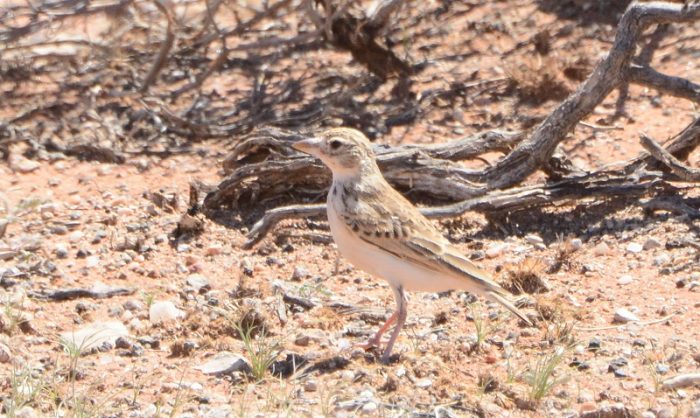
Eremalauda starki Stark's Lark in habitat
Stark’s Lark (Eremalauda starki) is well camouflaged among the sand and pale pebbles of its favoured habitat.
Kenhardt District, Northern Cape
Photo by Ryan Tippett

Behaviour

Stark’s Larks are found in pairs when breeding. When not breeding they occur in flocks of several individuals up to a few hundred or even thousands of birds, which congregate in areas of fresh green grass after rains. They often occur alongside Grey-backed Sparrow-Larks and Lark-like Buntings. They appear able to survive without drinking water but they will drink regularly during the dry season if water is available. Drinks less often after rains have greened vegetation and increased insect availability. They fly to waterpoints in flocks. Avoids heat stress during the mid-day heat by crouching in shade. Occasionally perches on a low shrub or rock, facing into the breeze while holding its wings away from the body to cool down.

Forages by walking slowly on flexed legs, with its body close to ground, pecking items from off the floor. Feeds primarily on seeds from various grasses and shrubs. Arthropods also form an important part of the diet and include Harvester Termites, ants, beetles, bugs, flies, spiders etc. Also feeds on green plant material, especially the fresh base of grass stems.

Eremalauda starki feeding on termites
Stark’s Lark (Eremalauda starki)  feeding on termites – Near Windhoek, Namibia
Photo by J. Terblanche

Males start singing and displaying after rainfall has stimulated breeding activity. It sings from the ground, from a low shrub or in flight display. During display the male rises between 50 m to 200 m above the ground while hovering or flying in slow circles, calling constantly.

Stark’s Lark is a monogamous, solitary nester, often in loose colonies. This species breeds opportunistically after rain and breeding may take place whenever sufficient rain has fallen. There is however a breeding peak from March to May after late summer rains.

The nest is a neat cup composed of fine strips of grass, built into a slight depression in the soil. It is usually placed at the base of a plant or stone but sometimes also in exposed positions. The nest normally faces south or south-east for shade on hot days.

Clutches consist of two or three eggs and incubation takes 11 to 13 days. The eggs are incubated by both sexes. The nestling period lasts for around 10 days during which time the chicks are fed by both parents.

Stark's Lark in Namibia
Stark’s Lark (Eremalauda starki) – Near Maltahohe, Namibia
Photo by Michael Houlden

Further Resources

Species text adapted from the first Southern African Bird Atlas Project (SABAP1), 1997.

The use of photographs by Alan Collett, Gregg Darling, J Terblanche, Katharina Reddig, Michael Houlden and Zenobia van Dyk is acknowledged.

Virtual Museum (BirdPix > Search VM > By Scientific or Common Name).

Other common names: Spizocorys starki (Alternative Scientific Name); Woestynlewerik (Afrikaans); Alouette de Stark (French); Starks Kurzhaubenlerche (German); Cotovia de Stark (Portuguese)

A list of bird species in this format is available here.

Recommended citation format: Tippett RM 2023. Stark’s Lark (Eremalauda starki) Biodiversity and Development Institute. Available online at http://thebdi.org/2023/02/13/starks-lark-eremalauda-starki/

Bird identificationbirding

Eremalauda starki in Namibia
Stark’s Lark (Eremalauda starki) – Spitzkoppe, Namibia
Photo by Gregg Darling

Bird Ringing Course at Botuin : 1 to 7 February 2023

A “BDI – Birds4Africa” bird ringing course was held from 1-7 February 2023, with a base at Botuin Cottages & Olive Farm on the outskirts of the Karoo town of Vanrhynsdorp. Botuin is a 5 ha farm with 400 olive trees, a lucerne field and a wide variety of fruit trees. Consequently, there is an impressive range of bird species present. Seven attendees enjoyed the week of daily ringing, with most ringing being in the garden of Botuin. Two morning sessions were held at the local sewage works and two short morning sessions on a quiet road on nearby Gifberg farm. The other mornings, and all afternoons of the course, we ringed at Botuin. Our final analysis is that this was just the first of many bird ringing courses at Botuin.

The habitat diversity meant that the number of species handled was higher than usual for a one week ringing course. We caught 29 species in the garden and 21 species at the sewage works. Top species were Cape Sparrow (69), Cape White-eye (58) and Southern Red Bishop (31).

Few birds were caught at Gifberg, but some exciting species were caught including Large-billed Lark, Spike-heeled Lark, Red-capped Lark and Rufous-eared Warbler.

Spike-heeled Lark
Spike-heeled Lark
Rufous-eared Warbler

At the sewage works we had some exciting water birds in the hand including Cape Teal, Moorhen, Three-banded Plover, Blacksmith Lapwing and Little Stint.

Bird ringing at the Vanrhynsdorp sewage works
Ringing at the Vanrhynsdorp sewage works.
Cape Teal Anas capensis
Cape Teal Anas capensis in hand!

Overall there were 43 recaptures, some from earlier days of the course, and others from previous visits over the last three years. Trainees were also given time to practice putting up and taking down nets, setting spring traps, doing data entry and other aspects of ringing.

Thanks to Salome Willemse for hosting us so well at Botuin! We are looking forward to the next bird ringing course at Botuin.

Numbers of birds caught (ringed and retrapped) during the bird ringing course at Botuin, 1-7 February 2023. Species with links have texts on the BDI website.

Sp noEnglishBotuinGifbergSewage worksTotal
98Cape Teal11
210Common Moorhen11
238Three-banded Plover33
245Blacksmith Lapwing33
253Little Stint11
317Laughing Dove10414
318Namaqua Dove314
391White-backed Mousebird66
392Red-faced Mousebird77
463Large-billed Lark11
474Spike-heeled Lark22
488Red-capped Lark11
495White-throated Swallow44
498Pearl-breasted Swallow22
525Southern Grey Tit11
544African Red-eyed Bulbul44
576African Stonechat11
581Cape Robin-chat11
583Karoo Scrub Robin22
604Lesser Swamp Warbler44
606African Reed Warbler314
619Rufous-eared Warbler11
646Levaillant’s Cisticola22
653Namaqua Warbler33
658Chestnut-vented Warbler33
665Fiscal Flycatcher55
678Fairy Flycatcher33
686Cape Wagtail44
707Southern Fiscal11
733Common Starling11
745Red-winged Starling11
760Southern Double-collared Sunbird11
784House Sparrow12122
786Cape Sparrow383169
799Cape Weaver14620
803Southern Masked Weaver141630
805Red-billed Quelea11
808Southern Red Bishop62531
820Red-headed Finch112
843Common Waxbill44
865White-throated Canary358
866Yellow Canary22
873Cape Bunting224
1172Cape White-eye5858
4139Karoo Prinia55
4142Southern Grey-headed Sparrow 33
 
Totals20514132351
Species2972146


Sclater’s Lark (Spizocorys sclateri)

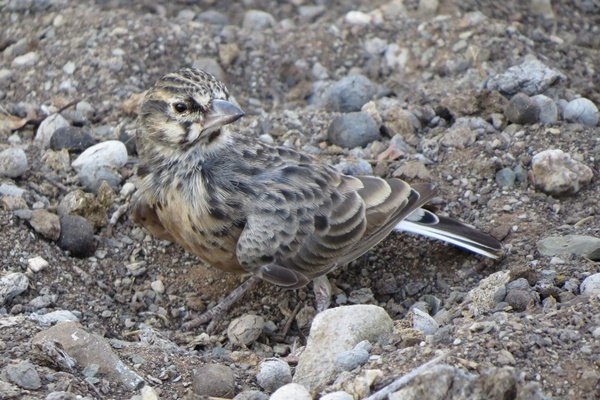
Cover image. Sclater’s Lark by Alan Collett – Carnarvon District, Northern Cape – BirdPix No. 142244

Identification

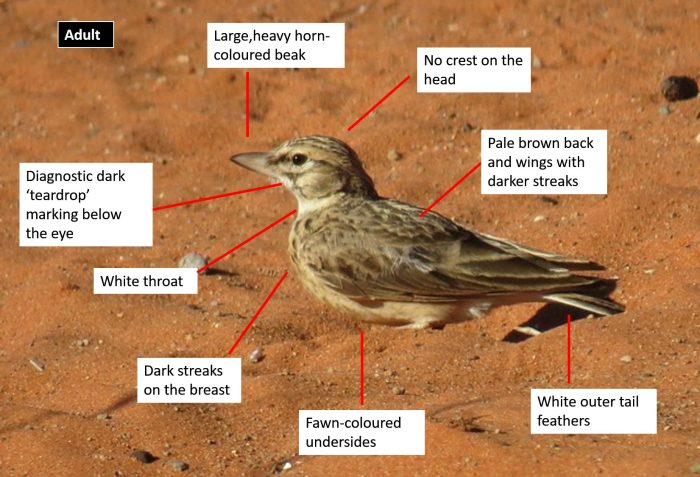
Sclater’s Lark is a small species with a stocky build and a large, horn-coloured beak.

Identification adult Sclater's Lark
Sclater’s Lark (Spizocorys sclateri) – Near Uppington, Northern Cape
Photo by Pamela Ruth Kleiman

These birds have an overall buff-brown colouration. Its most distinctive feature, apart from the beak, is the diagnostic dark ‘tear-drop’ marking below the eye.

The upperparts are buffy grey-brown with dark streaks. The throat is white and gives way to buff-coloured underparts. The breast and belly have a warmer tone than the rest of the body. There are variable bold black streaks on the breast.

In flight the tail appears fairly short and dark above with broad white outer tail feathers.

The sexes are alike.

Juveniles resemble the adults but they have less distinct facial patterning.

Sclater's Lark
Sclater’s Lark (Spizocorys sclateri) – Williston District, Northern Cape
Photo by Zenobia van Dyk

Status and Distribution

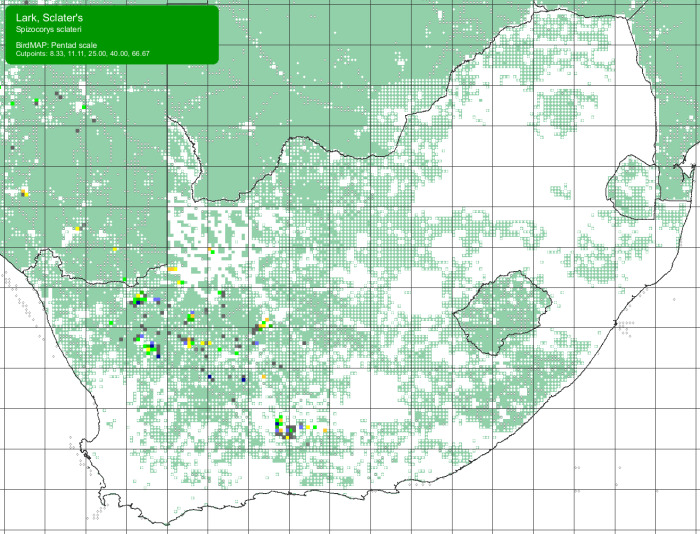
The Sclater’s lark is endemic to Southern Africa, its distribution is entirely confined to the Nama Karoo. The majority of records are from the Northern Cape province, with scattered records from Southern Namibia. It is most abundant on the stony plains of Bushmanland in the Northern Cape with outlying records from near Mariental, (central Namibia), Beaufort West (Western Cape) and Aberdeen (Eastern Cape).

It is both uncommon and local in occurence, especially in Namibia. It is currently listed as Near-threatened.

SABAP2 distribution map Sclater's Lark
SABAP2 distribution map for Sclater’s Lark (Spizocorys sclateri)– February 2023.
Details for map interpretation can be found here.

Habitat

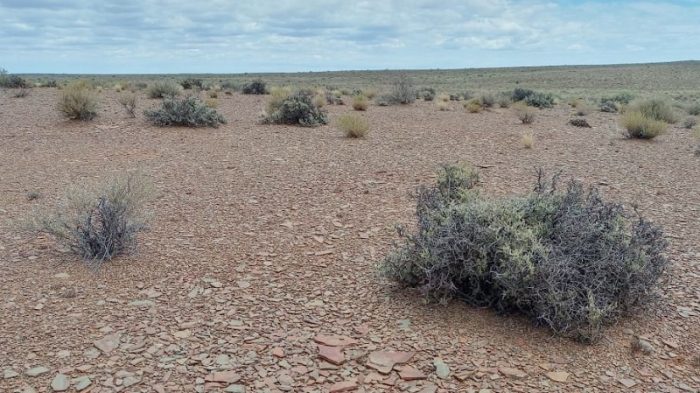
Habitat Sclater's Lark
Typical shale gravel habitat in the upper Karoo.
Carnarvon District, Northern Cape
Photo by Ryan Tippett

Sclater’s Lark inhabits arid to semi-arid plains with low, sparse shrubs, grasses and extensive bare patches of gravel and stones. It is most closely associated with open areas of quartz pebbles or shale gravel.

Spizocorys sclateri
Sclater’s Lark (Spizocorys sclateri) in gravel plains habitat – Near Vanwyksvlei, Northern Cape
Photo by Ryan Tippett

Behaviour

Sclater’s Lark is an opportunistic and highly nomadic species, moving into areas after rain before nesting and then moving on. They are found in pairs when breeding and usually in small, dispersed flocks of up to 25 birds when not breeding.

Forages by walking with a slow, plodding gait on bare, open plains where there are few other birds. They are known to turn over small flat stones while foraging. Sclater’s Larks feed mostly on Harvester Ants (Messor spp.) and Harvester Termites (Hodotermes spp.) as well as a range of seeds picked off the ground.

Drinks frequently, particularly when breeding. They often drink with the eyes partially closed. Typically flies to water in small groups and the flight is fast and dipping, accompanied by intermittent calling.

Sclater’s Larks are well camouflaged and are often only seen when flushed. They usually fly quite far before settling. Roosts in a shallow depression in open gravel plains.

Sclater's Lark
Sclater’s Lark (Spizocorys sclateri) travels to water in small groups – Williston District, Northern Cape
Photo by Etienne Marais

Sclater’s Larks are Monogamous, solitary nesters, but some nests may only be several meters apart.

The nest is a tidy cup composed of fine, grass leaves, stems and awns. The nest is built inside a hollow in the substrate which is excavated by both sexes using their feet. The nest sits flush with the edge of the hollow and small stones are often placed around it. The stones presumably help to disguise the nest from predators. Most nests are situated in completely exposed situations in bare stony patches, far from shrubs or grass tufts. The nest is always within 1km of a water source.

Nesting in the open conceals the nest from predators which mostly forage around the base of vegetation. However, nesting in the open can expose the eggs or chicks to intense heat, something to which the Sclater’s Lark is well adapted. The incubating parent will stand over the nest to shade it, normally facing into the breeze or towards the sun. The incubating bird may pant continuously and raise its feathers and half close the eyes to aid in cooling. The dense nest lining may also help to insulate eggs and small chicks from high ground temperatures.

Egg laying takes place mainly from August to November and breeding takes place during the driest time of the year. Very high ground temperatures from December to March likely prevent breeding during this period. Just one egg is laid per clutch and is incubated by both sexes.

Spizocorys sclateri
Sclater’s Lark (Spizocorys sclateri) travels to water in small groups – Williston District, Northern Cape
Photo by Ettienne Marais

Further Resources

Species text adapted from the first Southern African Bird Atlas Project (SABAP1), 1997.

The use of photographs by Alan Collett, Etienne Marais, Pamela Ruth Kleiman and Zenobia van Dyk is acknowledged.

Virtual Museum (BirdPix > Search VM > By Scientific or Common Name).

Other common names: Namakwalewerik (Afrikaans); Alouette de Sclater (French); Sclaters Kurzhaubenlerche (German); Namagua-leeuwerik (Dutch); Cotovia de Sclater (Portuguese)

A list of bird species in this format is available here.

Recommended citation format: Tippett RM 2023. Sclater’s Lark (Spizocorys sclateri) Biodiversity and Development Institute. Available online at http://thebdi.org/2023/02/10/sclaters-lark-spizocorys-sclateri/

Bird identificationbirding

Sclater's Lark
Sclater’s Lark (Spizocorys sclateri) – Near Uppington, Northern Cape
Photo by Pamela Ruth Kleiman

Black-eared Sparrow-lark (Eremopterix australis)

Cover image: Black-eared Sparrow-lark by Alan Collett – Carnarvon District, Northern Cape – BirdPix No. 70664

Identification

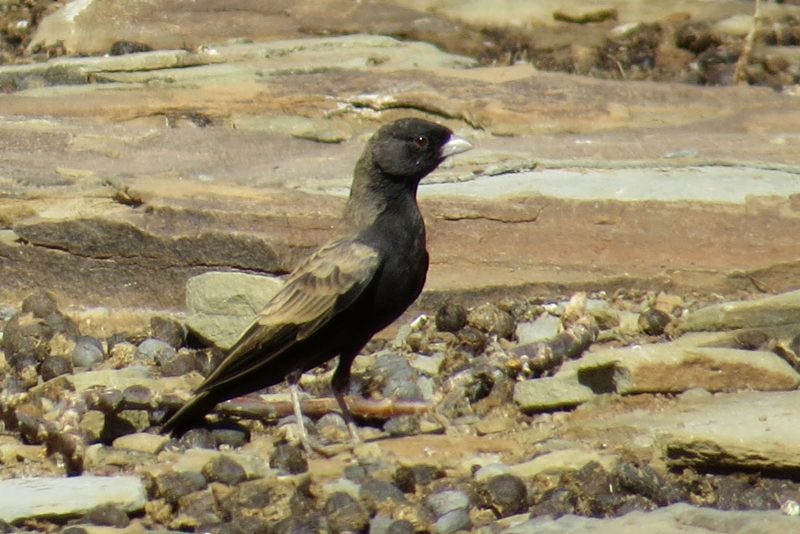
The Black-eared Sparrow-lark is a small, compact lark with a conical grey-white beak. The species shows marked sexual dimorphism.

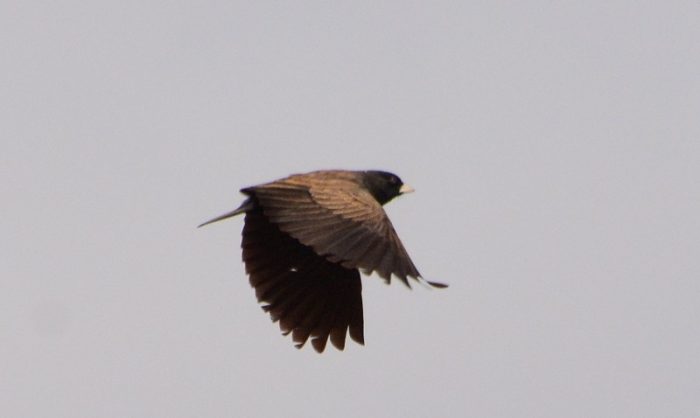
Adult males are unmistakable, being entirely black save for chestnut brown feathers on the back, wings and upper-tail. Pitch-black underwings render males very conspicuous in flight.

Identification male Black-eared Sparrow-lark
Black-eared Sparrow-lark (Eremopterix australis) – Carnarvon District, Northern Cape
Photo by Ryan Tippett

Females are pale brown above on the back and wings. The undersides are cream-coloured, with heavy but variable black streaks. The streaks are predominantly on the chest but may extend onto the belly. Lacks the dark belly patch of other sparrow-lark females. In flight shows distinctive black secondaries.

Immature birds resemble the females but are variably buff and white spotted above.

Identification female Black-eared Sparrow-lark
Black-eared Sparrow-lark (Eremopterix australis) Immature female – Calvinia District, Northern Cape
Photo by Tino Herselman

Status and Distribution

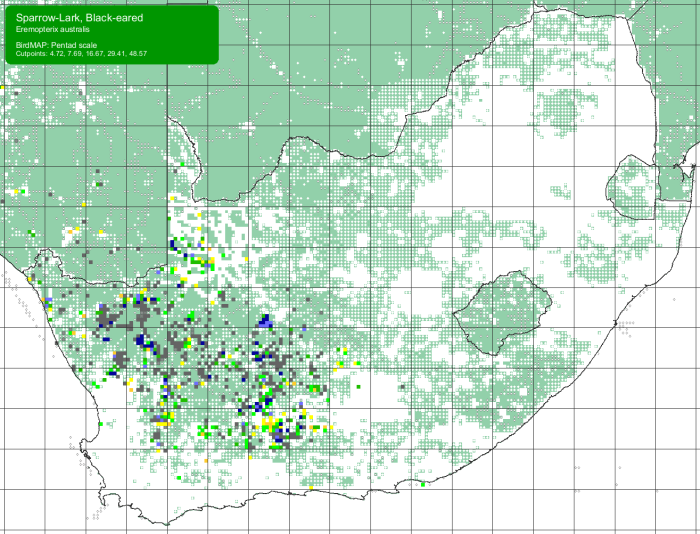
The Black-eared Sparrow-lark is endemic to Southern Africa. It occurs mainly in southern Namibia and the Northern Cape in South Africa. It is marginal in the Western Cape, Eastern Cape and Free State and its its presence in these provinces can be erratic.

It is most numerous in the central and upper Karoo of the Northern Cape.

SABAP2 distribution map Black-eared Sparrow-lark
SABAP2 distribution map for Black-eared Sparrow-lark (Eremopterix australis) – February 2023.
Details for map interpretation can be found here.

Habitat

Occurs in arid, sparse shrublands and grassland, particularly on red soils. Favours sandy soil but is also found on poorly drained clays and stony substrates in the Karoo. The Black-eared Sparrow-lark is also present in the southern Kalahari.

Habitat Black-eared Sparrow-lark
Typical habitat in the upper Karoo. Note the red sandy soil. 
Carnarvon District, Northern Cape
Photo by Ryan Tippett

Behaviour

Gregarious at all times, even when breeding and flocks usually number 5 to 10 birds. Flock sizes swell after breeding and can range from 50 to several hundred birds. Aggregates in large numbers in areas receiving good rainfall.

Forages in open places among shrubs and stones. Flies readily when disturbed, in typically bouncing erratic flight. Males perform a circular, butterfly-like display flight with exaggerated wingbeats and sometimes with dangling legs.
Eremopterix australis
Males are conspicuous in flight.
Black-eared Sparrow-lark (Eremopterix australis) – Carnarvon District, Northern Cape
Photo by Ryan Tippett

Collects food items off the ground or from the base of plants. The diet consists of various insects and a wide range of seeds. Favours grass seeds but also consumes the seeds of forbs and shrubs. Insect prey is known to include termites, beetles, ants and leaf-hoppers. Very seldom drinks and gets almost all its moisture requirement from the food it eats (Metabolic water).

Black-eared Sparrow-lark
Black-eared Sparrow-lark (Eremopterix australis) with its leaf-hopper prey – Namaqualand National Park, Northern Cape
Photo by Vaughan Jessnitz

The Black-eared Sparrow-lark is a monogamous, territorial and solitary nester, even though nests may only be a few meters apart. Breeding may take place at any time of the year and is linked to rainfall. They require at least 40 to 50mm of rainfall to stimulate widespread breeding.

The nest is a cup composed of fine grass leaves, panicles, feathery awns and rootlets. The nest is placed in an excavated hollow, usually in sandy substrate. The nest rim is normally slightly raised and decorated with the soil encrusted webs of Buckspoor Spiders (Seothyra spp.). The nest is usually situated at the base of a shrub or grass tuft and facing south or east for shade. The nest is built entirely by the female.

1 to 4 (normally 2 or 3) eggs are laid per clutch. Clutches are largest after heavy or follow-up rainfall. The eggs are white and finely speckled with pinkish-brown markings. The markings are often concentrated at the obtuse end. Incubation begins after all the eggs have been laid and is shared equally between the sexes.

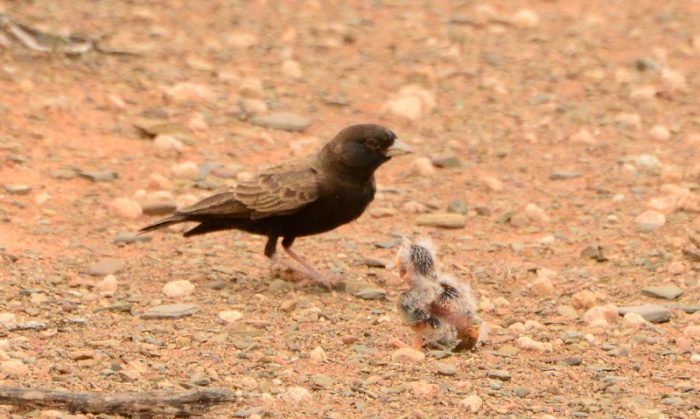
The nestling period lasts just 7 to 10 days and parental duties are shared by both sexes. The young are fed exclusively on arthropods, particularly Harvester Termites, caterpillars and grasshoppers. The adults perform distraction displays when the eggs or young are threatened. The male will hover over the nest while alarm calling. Both sexes perform an injury-feigning display by flying towards an intruder with loud wing-beats, before dropping to the ground and fluttering away while giving distress calls.

Eremopterix australis
Black-eared Sparrow-lark (Eremopterix australis) – Carnarvon District, Northern Cape
Photo by Ryan Tippett

Further Resources

Species text adapted from the first Southern African Bird Atlas Project (SABAP1), 1997.

The use of photographs by Alan Collett, Gerald Wingate, Tino Herselman and Vaughan Jessnitz is acknowledged.

Virtual Museum (BirdPix > Search VM > By Scientific or Common Name).

Other common names: Swartoorlewerik (Afrikaans); Moinelette à oreillons noirs (French); Schwarzwangenlerche (German); Cotovia-pardal-preta (Portuguese)

Recommended citation format: Tippett RM 2023. Black-eared Sparrow-lark (Eremopterix australis) Biodiversity and Development Institute. Available Online at http://thebdi.org/2023/02/04/black-eared-sparrow-lark-eremopterix-australis/

Bird identificationbirding

Black-eared Sparrow-lark
Black-eared Sparrow-lark (Eremopterix australis) – Verlorenvlei, Western Cape, South Africa
Photo by Gerald Wingate