
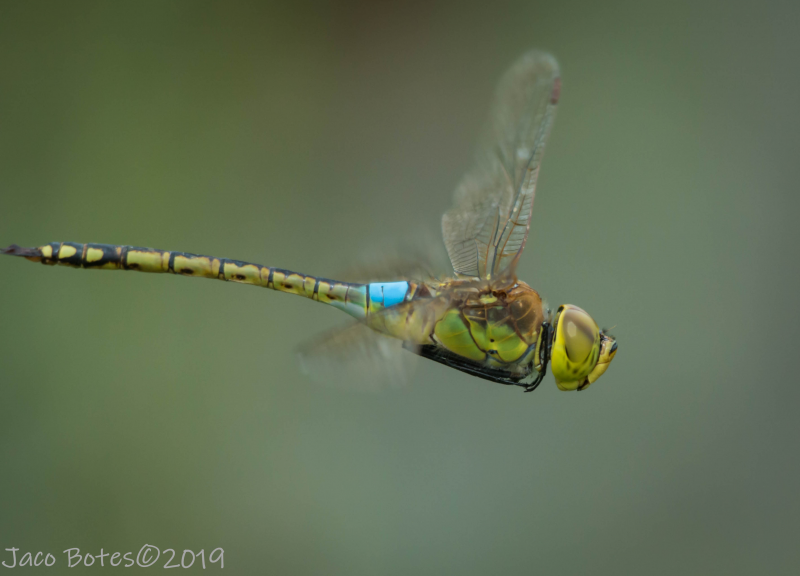
Cover photo by Jaco Botes.
Find the Vagrant Emperor in the FBIS database (Freshwater Biodiversity Information System) here.
Family Aeshnidae
Identification

Near Hluhluwe, KwaZulu-Natal
Photo by Ryan Tippett
Large size
Length up to 67mm; Wingspan attains 110mm.
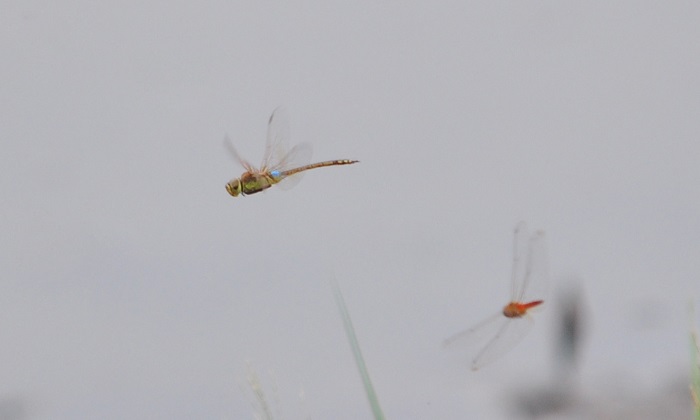
The Vagrant Emperor is unlike any other species in Southern Africa. The yellow brown colouration and bright blue saddle of the males render them unmistakable.
Females in flight may be mistaken for Pantala flavescens (Wandering Glider), the two species often occur side by side. The wandering glider is smaller, often orange to red in colour and has a distinctive, tapered body shape.
Click here for more details on identification.
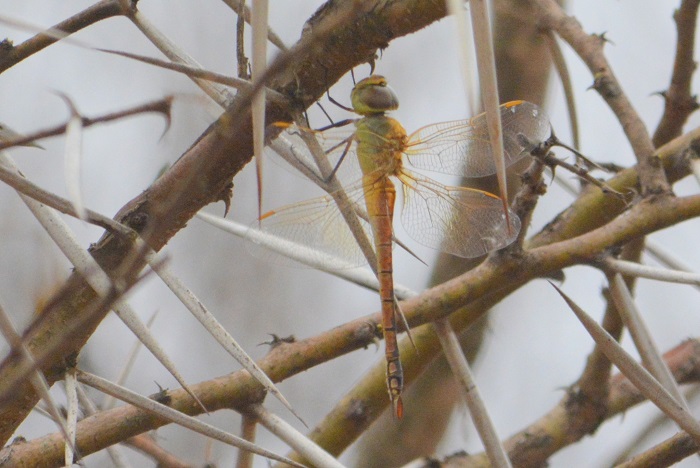
Amakhosi Game Reserve, KwaZulu-Natal
Photo by Ryan Tippett
Habitat
The favoured breeding habitat of the Vagrant Emperor is seasonal pools, pans and dams which it rapidly colonises after rain. This species is liable to turn up almost anywhere after rain.

Photo by Ryan Tippett
Behaviour
The Vagrant Emperor is a highly nomadic and opportunistic species. It typically appears in an area shortly before or after rain, where it may breed if conditions are favourable, before moving on.
The Vagrant Emperor is highly aerial and spends long periods on the wing. It often forms or joins mixed species hunting swarms at dusk. The Vagrant Emperor is often seen singly but is also frequently gregarious. As with other Anax species, the Vagrant Emperor rests by hanging vertically from a perch.
Most active from September to May (see Phenology below).
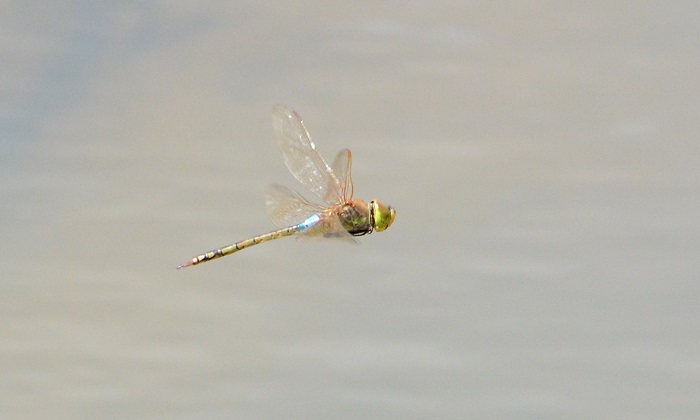
Mkuze River, KwaZulu-Natal
Photo by Ryan Tippett
Status and Conservation
The Vagrant Emperor is common to abundant when present. It often inhabits degraded and ephemeral habitats and is therefore listed as of Least Concern in the IUCN Red List of Threatened Species.
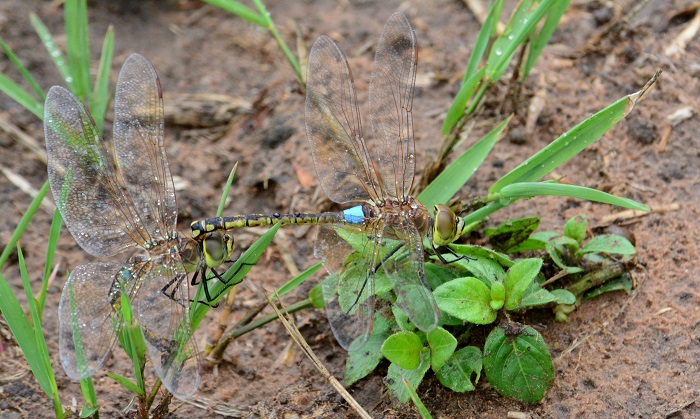
Near Hluhluwe, KwaZulu-Natal
Photo by Ryan Tippett
Distribution
The Vagrant Emperor is distributed widely across Africa, Europe, and central and southern Asia. It also occurs on many of the Indian Ocean islands.
The South African range is centered around the wetter northern and eastern regions, although vagrants can turn up almost anywhere.
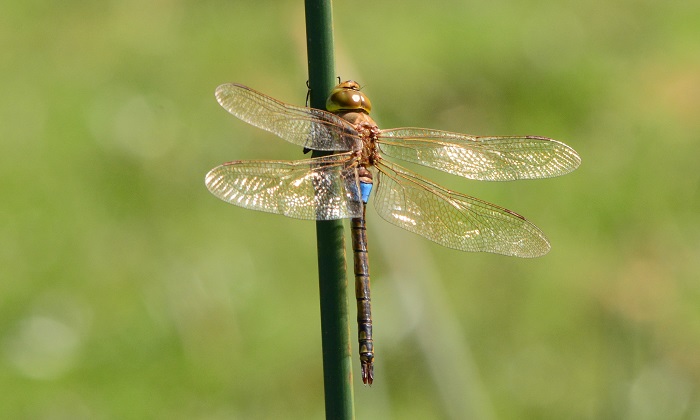
Muzi Pan, KwaZulu-Natal
Photo by Ryan Tippett
Below is a map showing the distribution of records for Vagrant Emperor in the OdonataMAP database as at February 2020.

Below is a map showing the distribution of records for Vagrant Emperor in the OdonataMAP database as of December 2024.
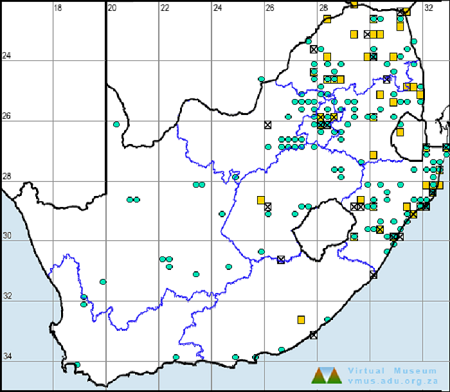
The next map below is an imputed map, produced by an interpolation algorithm, which attempts to generate a full distribution map from the partial information in the map above. This map will be improved by the submission of records to the OdonataMAP section of the Virtual Museum.


Ultimately, we will produce a series of maps for all the odonata species in the region. The current algorithm is a new algorithm. The objective is mainly to produce “smoothed” maps that could go into a field guide for odonata. This basic version of the algorithm (as mapped above) does not make use of “explanatory variables” (e.g. altitude, terrain roughness, presence of freshwater — we will be producing maps that take these variables into account soon). Currently, it only makes use of the OdonataMAP records for the species being mapped, as well as all the other records of all other species. The basic maps are “optimistic” and will generally show ranges to be larger than what they probably are.
These maps use the data in the OdonataMAP section of the Virtual Museum, and also the database assembled by the previous JRS funded project, which was led by Professor Michael Samways and Dr KD Dijkstra.
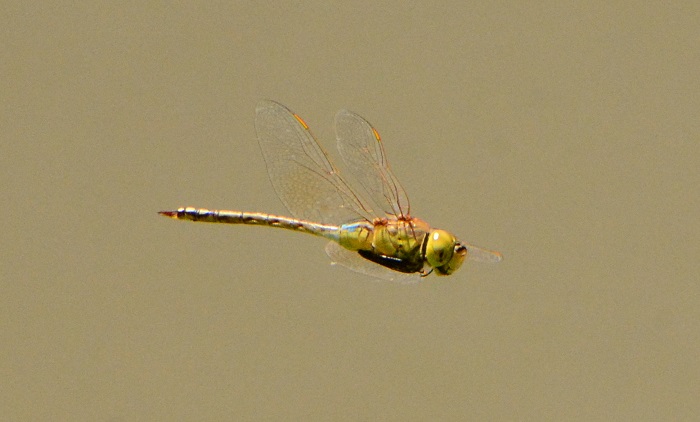
Carnarvon district, Northern Cape
Photo by Ryan Tippett
Phenology


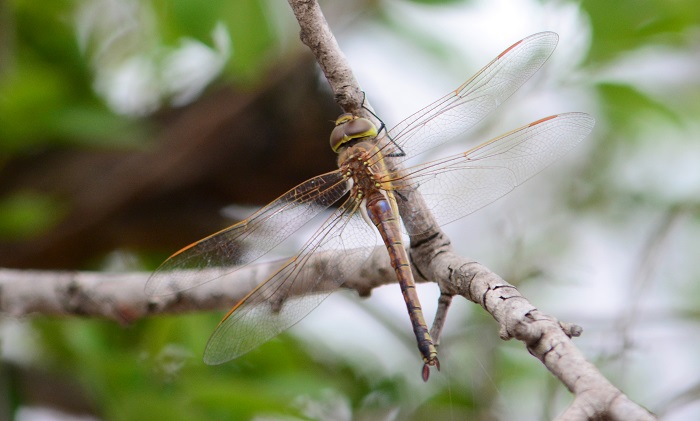
False Bay, iSimangaliso Wetland Park, KwaZulu-Natal
Photo by Ryan Tippett
Further Resources
The use of photographs by Jaco Botes is acknowledged. All other photographs by Ryan Tippett.
Vagrant Emperor Anax ephippiger (Burmeister, 1839)
Other common names: Blourugkeiser (Afrikaans)
Recommended citation format: Loftie-Eaton M; Navarro R; Tippett RM; Underhill L. 2025. Vagrant Emperor Anax ephippiger. Biodiversity and Development Institute. Available online at https://thebdi.org/2020/05/08/vagrant-emperor-anax-ephippiger/
References: Tarboton, M; Tarboton, W. (2019). A Guide to the Dragonflies & Damselflies of South Africa. Struik Nature.
Samways, MJ. (2008). Dragonflies and Damselflies of South Africa. Pensoft
Samways, MJ. (2016). Manual of Freshwater Assessment for South Africa: Dragonfly Biotic Index. Suricata 2. South African National Biodiversity Institute, Pretoria
Martens, A; Suhling, F. (2007). Dragonflies and Damselflies of Namibia. Gamsberg Macmillan.
Near Hluhluwe, KwaZulu-Natal
Photo by Ryan Tippett