

Cover photo by Mark Stanton.
Find this species in the FBIS database (Freshwater Biodiversity Information System) here.
Family Libellulidae
Identification
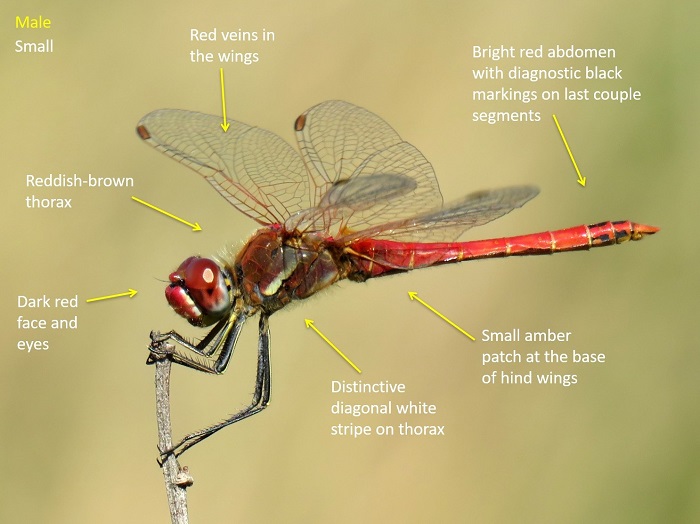
Richards Bay, KwaZulu-Natal
Photo by Diana Russel
Small size
Length up to 40mm; Wingspan attains 66mm.
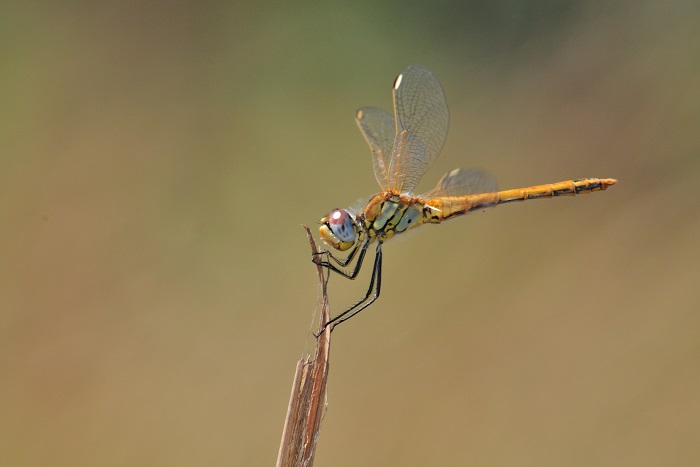
The Red-veined Darter or Nomad is easily mistaken for other smallish red dragonflies such as the Red-veined Dropwing (Trithemis arteriosa), Broad Scarlet (Crocothemis erythraea) or Little Scarlet (Crocothemis sanguinolenta). The Red-veined Darter can, however, be easily identified by the pale diagonal stripe on each side of the thorax. The small black marking on the last abdominal segments and the small number of AX veins in the forewings are additional aids in identification.
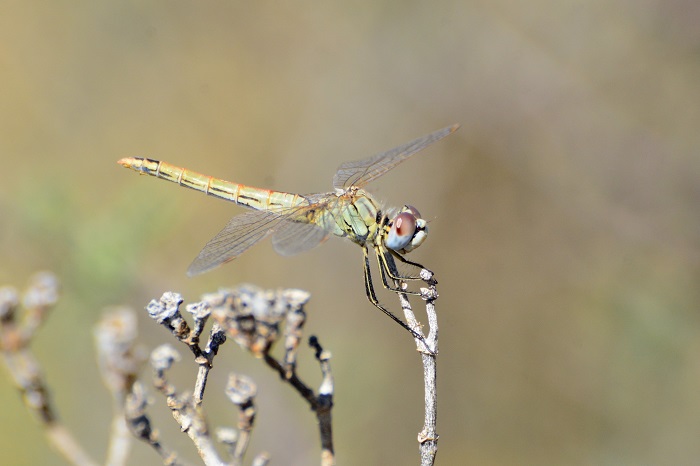
Female Red-veined Darters are pale browni to yellowish. They are also readily identified by the two broad, diagonal pale markings on the thorax sides. These pale markings are often thinly outlined in black. Females also show the small black markings on the last few abdominal segments, and the reduced number of AX veins in the forewings.
Click here for more details on identification.

Near Hluhluwe, KwaZulu-Natal
Photo by Ryan Tippett
Habitat
The Red-veined Darter breeds in a wide range of habitats including seasonal and permanent waters. It inhabits pans, marshes, lakes, ponds, dams, and rivers. It is most numerous in ephemeral habitats. In arid regions, it readily occupies livestock drinking troughs and cement water reservoirs. The Red-veined Darter is quickly able to recolonise dry areas after rainfall.

Photo by Ryan Tippett
Behaviour
The Red-veined Darter hunts from a perch with a fast, direct flight, frequently returning to the same perch. They tend to be somewhat gregarious when present in good numbers, and both sexes occur in the same vicinity. The Red-veined Darter flies year-round in some areas, although it is less numerous in the cold winter months. In many locations, especially those with high species diversity, the Red-veined Darter is an early and/or late season specialist. This is likely an adaptation to avoid competition with other species.
The Red-veined Darter flies year-round in warmer regions, but is mainly an early Summer species (September to January) in more temperate regions.
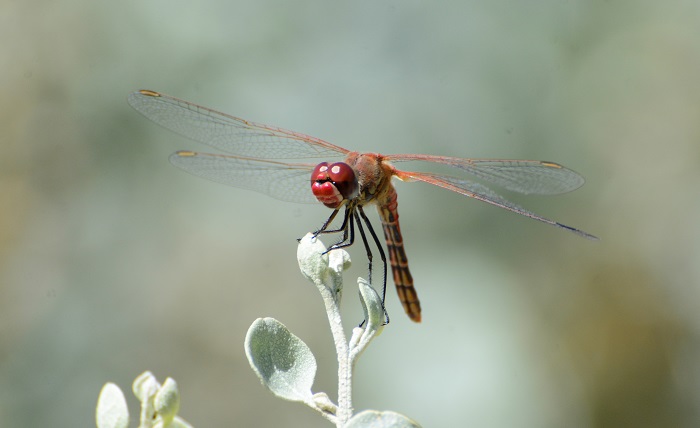
Near Williston, Northern Cape
Photo by Ryan Tippett
Status and Conservation
The Red-veined Darter is an abundant and widespread species. It is listed as of Least Concern in the IUCN Red List of Threatened Species. The Red-veined Darter is a very adaptable species that readily utilises disturbed and man-made habitats.
Near Vosburg, Northern Cape
Photo by Ryan Tippett
Distribution
Sympetrum fonscolombii is very widely distributed, being found throughout most of Africa, Europe, the Middle East and much of Asia. In Africa, it is most common in the drier regions of northern, eastern and particularly southern Africa where it can be very common. The Red-veined Darter is present throughout southern Africa.
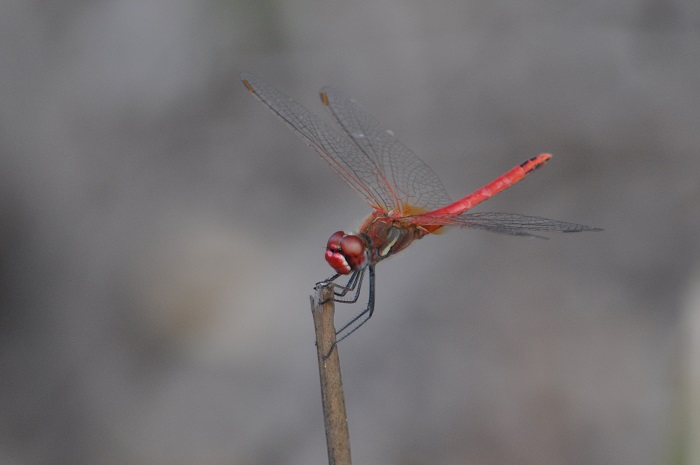
Near Hluhluwe, KwaZulu-Natal
Photo by Ryan Tippett
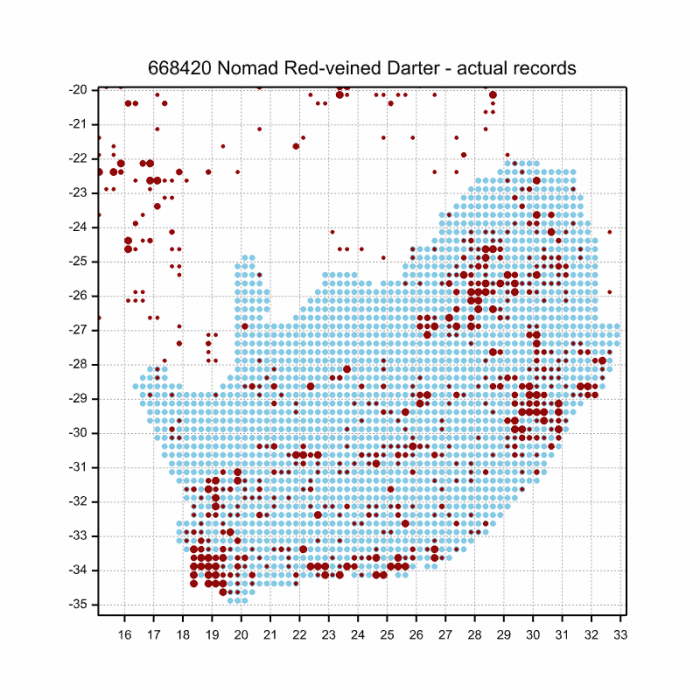
Below is a map showing the distribution of records for Red-veined Darter in the OdonataMAP database as at February 2020.
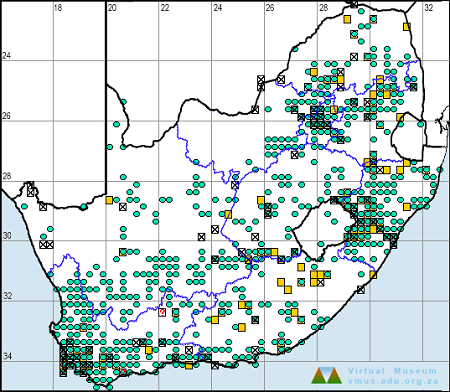
Below is a map showing the distribution of records for Red-veined Darter in the OdonataMAP database as of December 2024.
The next map below is an imputed map, produced by an interpolation algorithm, which attempts to generate a full distribution map from the partial information in the map above. This map will be improved by the submission of records to the OdonataMAP section of the Virtual Museum.

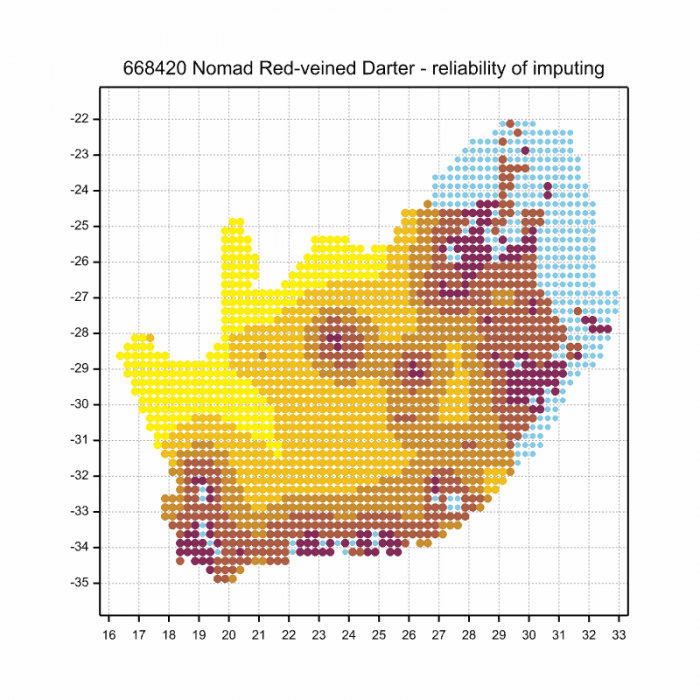
Ultimately, we will produce a series of maps for all the odonata species in the region. The current algorithm is a new algorithm. The objective is mainly to produce “smoothed” maps that could go into a field guide for odonata. This basic version of the algorithm (as mapped above) does not make use of “explanatory variables” (e.g. altitude, terrain roughness, presence of freshwater — we will be producing maps that take these variables into account soon). Currently, it only makes use of the OdonataMAP records for the species being mapped, as well as all the other records of all other species. The basic maps are “optimistic” and will generally show ranges to be larger than what they probably are.
These maps use the data in the OdonataMAP section of the Virtual Museum, and also the database assembled by the previous JRS funded project, which was led by Professor Michael Samways and Dr KD Dijkstra.
Near Hluhluwe, KwaZulu-Natal
Photo by Ryan Tippett
Further Resources
The use of photographs by Diana Russell and Mark Stanton is acknowledged. All other photographs by Ryan Tippett.
Red-veined Darter Sympetrum fonscolombi (Selys, 1840)
Other common names: Nomad (Alt. English); Swerwertjie (Afrikaans)
Recommended citation format: Loftie-Eaton M; Navarro R; Tippett RM; Underhill L. 2025. Red-veined Darter Sympetrum fonscolombi. Biodiversity and Development Institute. Available online at https://thebdi.org/2020/04/28/red-veined-darter-sympetrum-fonscolombii/
References: Tarboton, M; Tarboton, W. (2019). A Guide to the Dragonflies & Damselflies of South Africa. Struik Nature.
Samways, MJ. (2008). Dragonflies and Damselflies of South Africa. Pensoft
Samways, MJ. (2016). Manual of Freshwater Assessment for South Africa: Dragonfly Biotic Index. Suricata 2. South African National Biodiversity Institute, Pretoria
Martens, A; Suhling, F. (2007). Dragonflies and Damselflies of Namibia. Gamsberg Macmillan.
Near Hluhluwe, KwaZulu-Natal
Photo by Ryan Tippett