
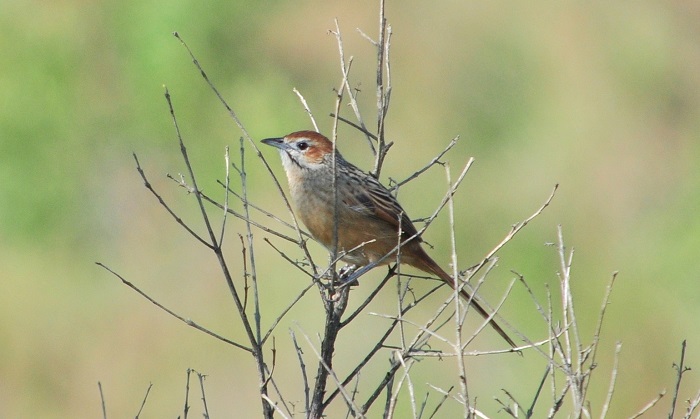
Cover image of Cape Grassbird by Ryan Tippett – Ithala Game Reserve, KwaZulu-Natal
The Cape Grassbird belongs to the Family MACROSPHENIDAE (African Warblers). This is a recently recognised collection of species from the once vast family Sylviidae. The family is confined to sub-Saharan Africa. Macrosphenidae comprises 18 species from 6 genera.
Identification
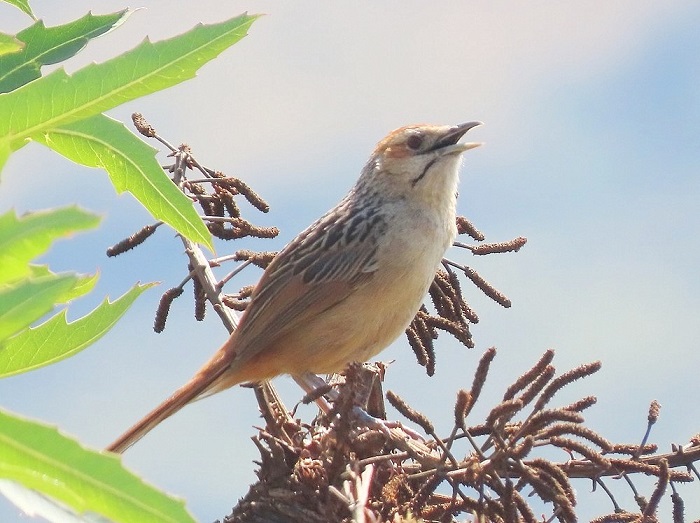
Near Impendle, KwaZulu-Natal
Photo by Colin Summersgill
The Cape Grassbird is not sexually dimorphic (the sexes are alike).
In adults, the forehead, crown and nape are bright, rusty red with black streaks on the hind crown and nape. The lores and the short supercilium are buffy-white, and the ear coverts are rufous. They have a pair of narrow black moustachial and malar stripes on the face and throat, separated by a broader white sub-moustachial stripe. The rest of the chin and throat are white. The rest of the underparts are off-white and the breast is mottled blackish brown. The flanks and undertail coverts carry broad, blackish streaks.
The back, mantle and sides of the neck are mottled black and buff. The rump and upper tail coverts are tawny, and the rump is sometimes streaked black. The tail is rusty red, long and strongly graduated with a pointed tip. The bill is grey-black, and the legs and feet vary from brown to grey. The eyes are brown with a buffy-white eye ring and an indistinct black outer ring.
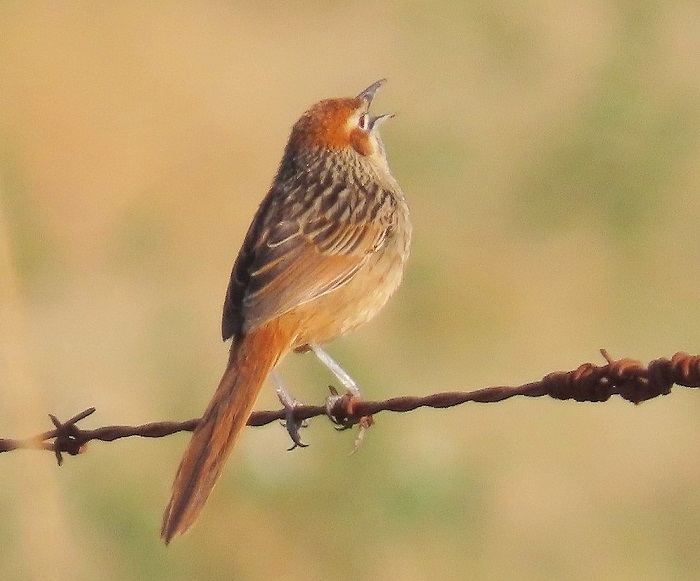
Near Fort Nottingham, KwaZulu-Natal
Photo by Colin Summersgill
Juveniles are like the adults but are duller, with black streaks on the crown. The head, mantle and underparts are also paler and the flanks are lightly streaked.
The Cape Grassbird resembles the similarly sized Moustached Grass Warbler (Melocichla mentalis). The Cape Grassbird has streaked (not plain) upper parts and a narrow, rufous (not broad, olive-brown) tail with a pointed (not rounded) tail tip.
Status and Distribution
The Cape Grassbird is a locally common endemic. It occurs along the escarpment and at higher altitudes in the North West and Limpopo Provinces, Gauteng, Mpumalanga, eSwatini (Swaziland), Lesotho, and KwaZulu-Natal, west through the Eastern Cape to the Western Cape. There is also an isolated population in the highlands of eastern Zimbabwe and adjacent Mozambique. The Cape Grassbird is absent from drier regions such as the central Karoo, Namibia, and Botswana.
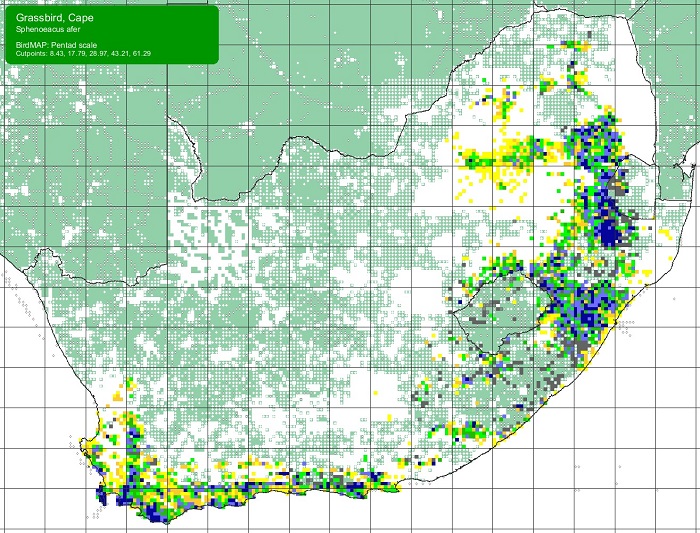
Details for map interpretation can be found here.
The range of the Cape Grassbird is not known to have altered historically, although its abundance in certain regions is likely to have declined. It is not threatened, but has been negatively affected in the Western Cape by the invasion of fynbos by alien Acacia spp. The Cape Grassbird does not adapt to alien vegetation and abandons areas that become heavily infested. Its range in the Eastern Cape has also been impacted by poor veld management practices that have reduced the cover of rank grasses. In a number of areas, urban development, agriculture, and forestry have further reduced available habitat.
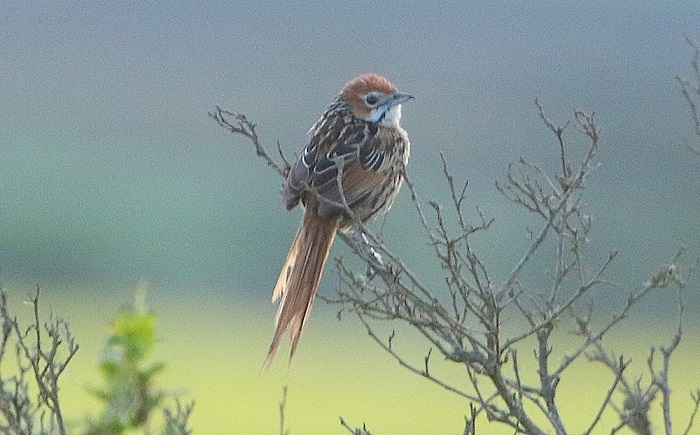
Near Swellendam, Western Cape
Photo by Attie van Aarde
Habitat
The Cape Grassbird favours rank vegetation with long grasses, restios or ferns, and tangled scrub. It also lives in hilly grasslands with scattered bushes and boulders, and in rank vegetation along streams and at the edges of montane forest. In the Fynbos biome, it inhabits low-to medium-height fynbos dominated by restios. The Cape Grassbird avoids areas in which the woody component of the vegetation becomes too high or too dense. It occurs up to altitudes of 2300 m above sea level.
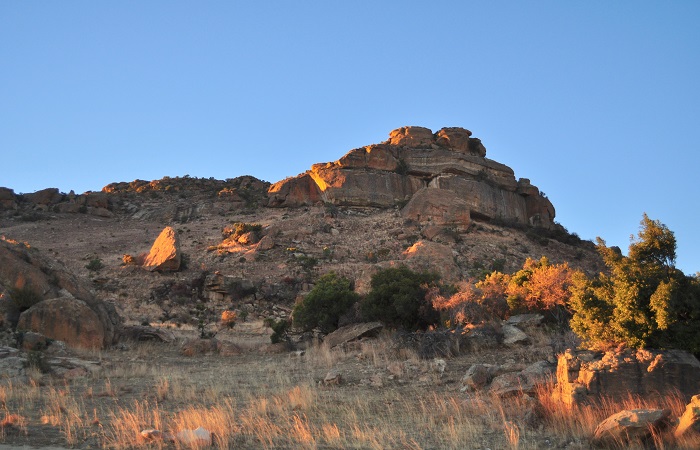
Photo by Ryan Tippett
Behaviour
The Cape Grassbird is resident and sedentary and is not known to undertake seasonal or altitudinal migrations. Seasonal differences in reporting rates are attributed to increased conspicuousness when singing during the breeding season.
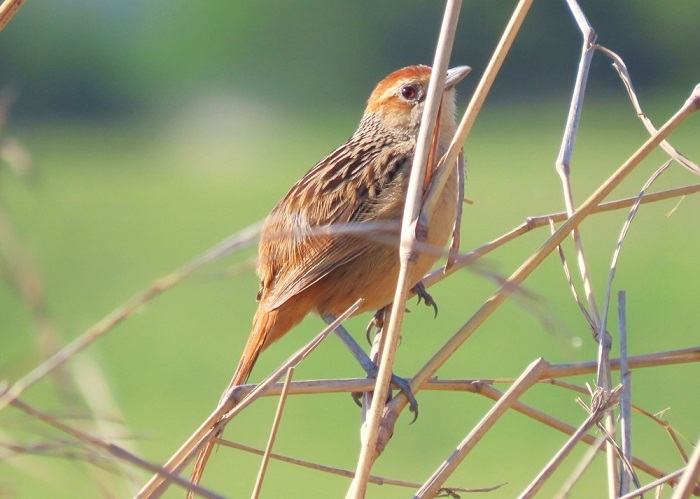
Near Boston, KwaZulu-Natal
Photo by Malcolm Robinson
The Cape Grassbird tends to skulk in dense vegetation, but its habit of sunbathing or singing loudly and distinctively from an exposed perch in the morning and late afternoon makes it unlikely to be overlooked or misidentified. It is unobtrusive when not singing. The flight appears laboured and clumsy, but is nevertheless fast and direct. The Cape Grassbird seldom flies far before dropping into vegetation.
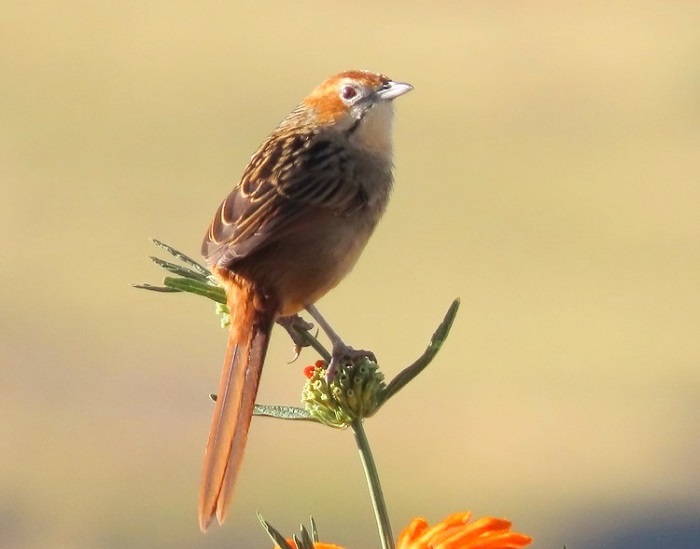
Near Estcourt, KwaZulu-Natal
Photo by Colin Summersgill
The Cape Grassbird searches for food on the ground, usually beneath vegetation. It is primarily an insectivore that consumes a variety of small insects, including beetles, grasshoppers, and caterpillars. It is also recorded feeding on small seeds and fruits.
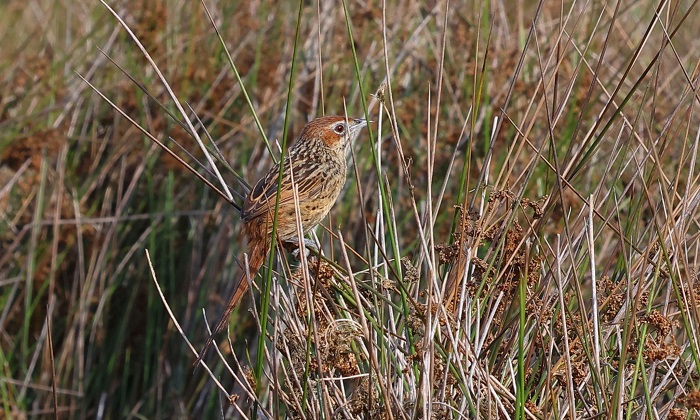
Near Suurbraak, Western Cape
Photo by Alan Manson
The Cape Grassbird breeds in early spring through to summer (July to December) in the Western Cape, and in summer (September to March) across the rest of its range. It is is a monogamous, solitary nester, and pairs are territorial.
The nest is a well-concealed cup of leaves, twigs and grass blades, lined with finer grass stems and other plant material. It is built entirely by the female. Nests are placed up to 400 mm above the ground in a tuft of grass or hidden in tangled growth. 2 to 3 eggs are laid per clutch at 1 day intervals. The eggs are white or pale grey, with slate-coloured dots. The incubation period takes up to 18 days and is done entirely by the female. The nestling period lasts further 14 to 16 days and the young are fed and cared for by both parents. Cape Grassbirds are sometimes double-brooded.
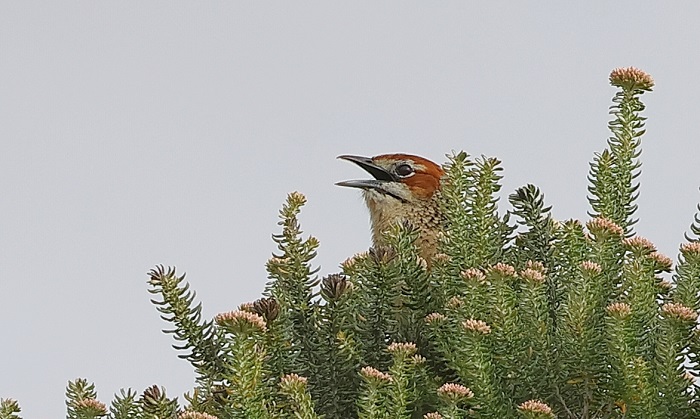
L’Agulhas, Western Cape
Photo by Alan Manson
Further Resources
This species text is adapted from the first Southern African Bird Atlas Project (SABAP1), 1997.
The use of photographs by Alan Manson, Attie van Aarde, Colin Summersgill, Malcolm Robinson, and Ryan Tippett is acknowledged.
Other common names: Grassbird, Cape Grass-Warbler (Alt. English); Grasvoël (Afrikaans); Itshitshi, Udwetya (Xhosa); Sphénoèque du Cap (French); Kaapse Grasvogel (Dutch); Kap-Grassänger (German); Felosa do Cabo (Portuguese).
Recommended citation format: Tippett RM 2026. Cape Grassbird Sphenoeacus afer. Biodiversity and Development Institute. Available online at https://thebdi.org/2026/07/08/cape-grassbird-sphenoeacus-afer/
List of bird species in this format is available here.
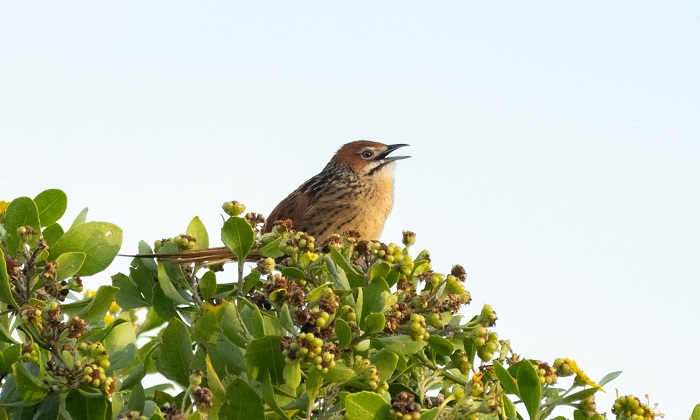
Nuwejaars Wetland Special Management Area, Western Cape
Photo by Achot
