
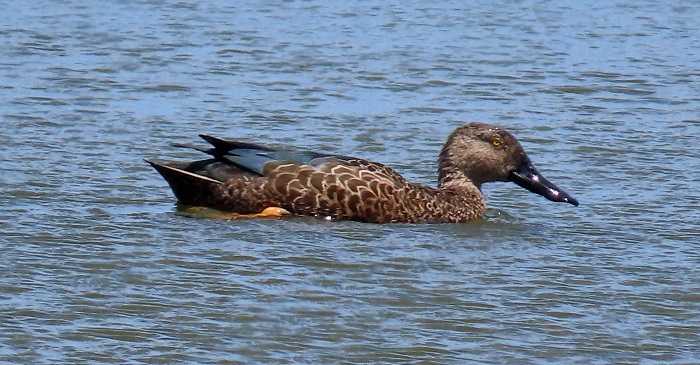
Cover image of Cape Shoveler by Cobus Elstadt – Near Jeffreys Bay, Eastern Cape
The Cape Shoveler, being a type of duck, belongs to the Family ANATIDAE (Ducks, Geese, Swans, and Waterfowl). The family has a cosmopolitan distribution, occurring on all the world’s continents except Antarctica. These birds are adapted for swimming, floating on the water surface, and sometimes diving. They range from medium to very large and have robust, broad, and elongated bodies. They generally have broad and flattened bills with a curved nail at the tip of the upper mandible and most have lamellae inside their bills for filter feeding. Their necks are moderately to very long, and the wings are short and pointed, supported by strong wing muscles. The short, strong legs are set far back on the body, and the feet are webbed. The family contains around 174 species in 53 genera. 20 species have been recorded from southern Africa.
Identification
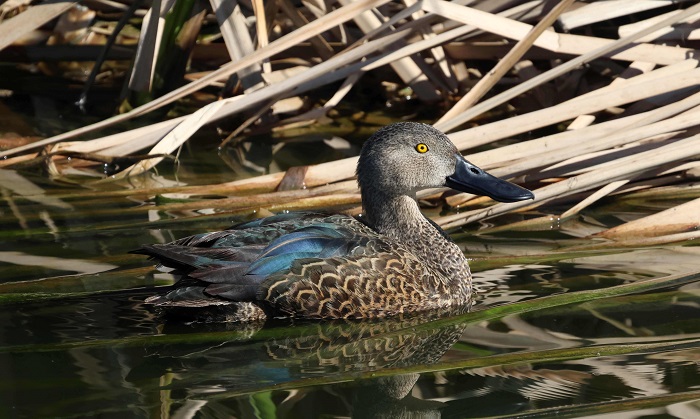
The Cape Shoveler is a medium-sized duck with a distinctive, long spatulate bill. The sexes differ slightly in plumage variation.
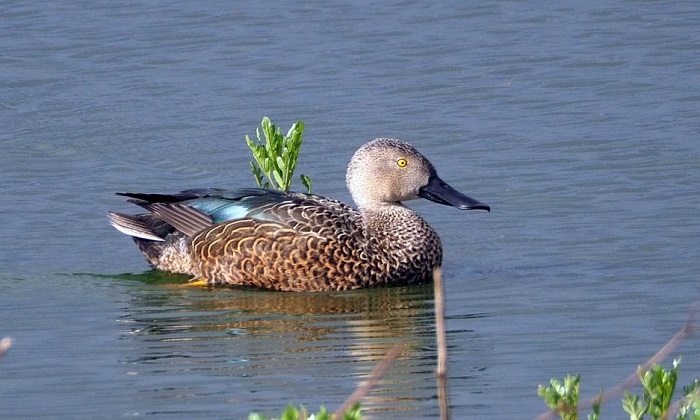
Strandfontein Sewage Works, Western Cape
Photo by Rene Navarro
The adult male has a pale greyish head with small, faint, dark streaks. The rest of the body varies from greyish-brown to dark brown with blackish mottling. The rump and upper tail coverts have a blue-green sheen. The tail is blackish-brown, with cinnamon outer tail feathers. In flight, it shows a pale blue forewing that is separated from the green speculum by a white wing bar (diagnostic). The bill is black, and the eyes are yellow. The legs and feet are also yellow but turn to orange when breeding.
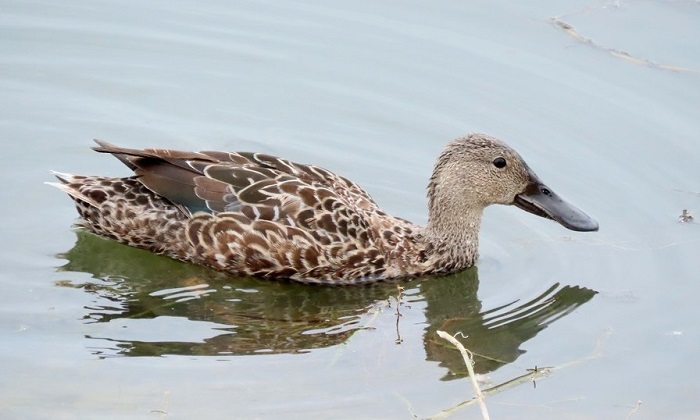
Stilbaai, Western Cape
Photo by Johan van Rooyen
Females resemble the males but are paler and greyer overall. They also have darker heads, and the rump and tail coverts lack the glossy sheen. Females have duller blue forewings and a smaller, duller green speculum. Their bills are dark grey (not black) and they have dark brown (not yellow)eyes. The legs and feet are brownish. Juveniles are similar to the adult female but are duller.
The Cape Shoveler is not easily mistaken for other southern African duck species. It is however similar to the female Northern Shoveler (Anas clypeata) but the latter occors only as a rare vagrant in southern Africa. The female Northern Shoveler is paler and more rufous in colour. It has a larger bill with yellowish-brown to orange sides.
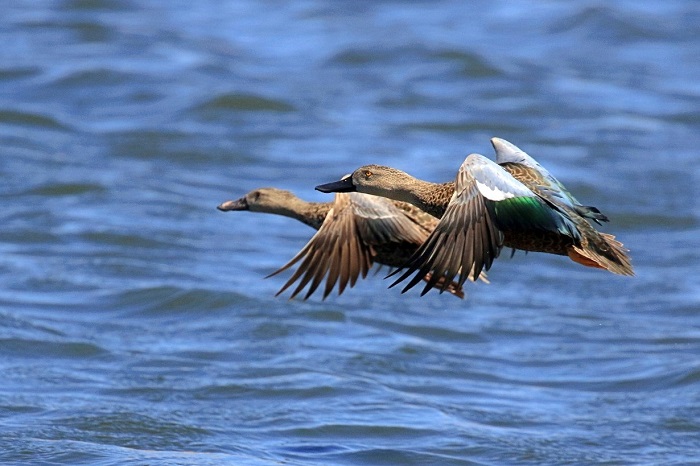
Strandfontein Sewage Works, Western Cape
Photo by Daryl de Beer
Status and Distribution
The Cape Shoveler is near-endemic to southern Africa where its status varies from rare to locally abundant. Its population is concentrated in South Africa. In South Africa, it is most abundant in the lowlands of the Western Cape, and in the highveld of the Free State, Mpumalanga, Gauteng and North West Provinces. Its population is otherwise scattered from the west coast through the Nama Karoo, Eastern Cape, and the coastal belt of KwaZulu-Natal. The Cape Shoveler is patchy or absent elsewhere.
It is an uncommon, occasional visitor to Lesotho, eSwatini (Swaziland). The Cape Shoveler is probably an irregular visitor to southern Mozambique and it is sparsely scattered throughout Namibia. It is locally common in south-eastern Botswana, but its range is scattered in northern Botswana, where it is absent from most of the Okavango Delta, but is common on the Makgadikgadi pan system in high rainfall years. The Cape Shoveler is irregular and scarce in western Zimbabwe and across the central plateau, mostly during the rainy season. Its range extends marginally beyond the region into southern Angola.
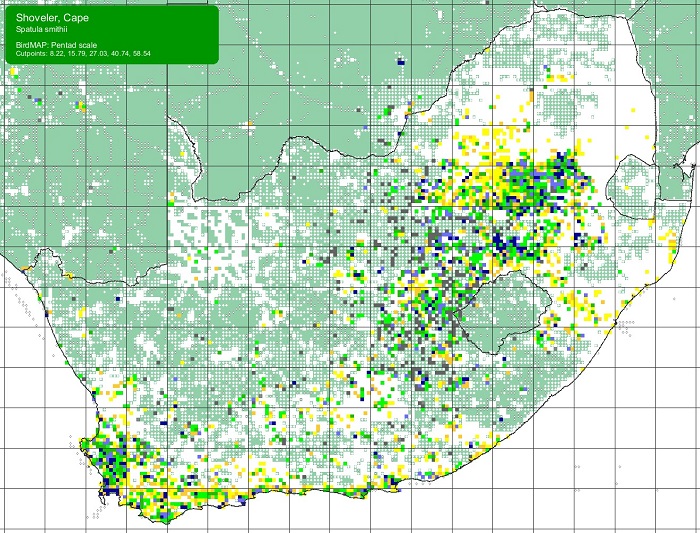
The Cape Shoveler is not threatened. It appears to have extended its range and increased in numbers in the last 30 years. This is largely due to its fondness for artificial water bodies like dams and sewage ponds. It Additionally, it is not popular as a gamebird, nor is it favoured by aviculturalists. Hybridisation with introduced Mallards (Anas platyrhynchos) is a potential threat.
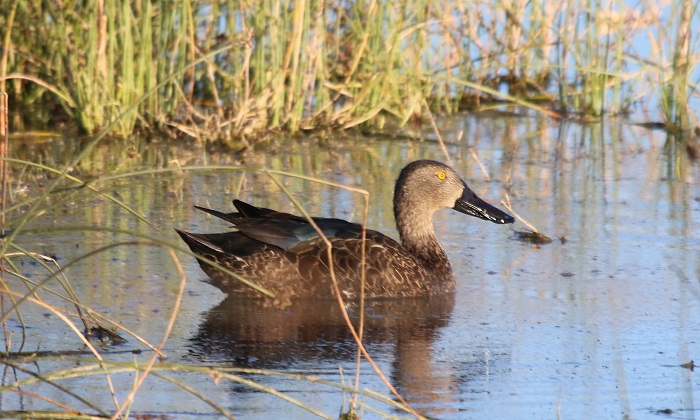
Carnarvon district, Northern Cape
Photo by Sybrand Venter
.
Habitat
The Cape Shoveler frequents a range of aquatic habitats but prefers shallow saline pans, seasonal marshes, tidal estuaries, sewage ponds, and shallow dams. It is also found at shallow bays and the upper reaches of large dams, as well as floodplains and subtropical pans. The Cape Shoveler favours highly alkaline and brackish waters. It avoids rivers, streams and acidic water bodies, such as occur in fynbos habitats of the Western Cape Province.
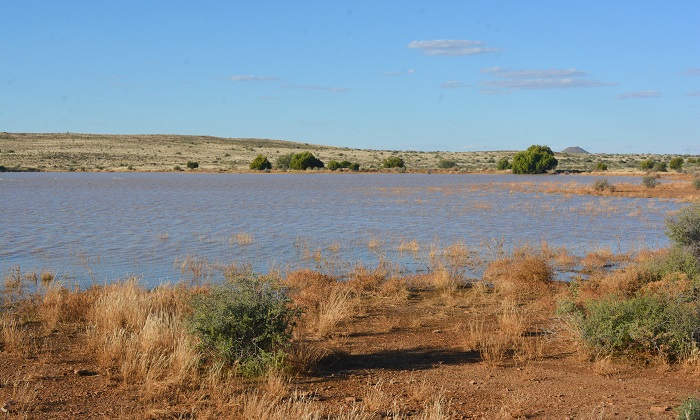
Carnarvon district, Northern Cape
Photo by Ryan Tippett
Behaviour
The Cape Shoveler is most often encountered in pairs or small groups but may occasionally be found in flocks of up to 600 birds. In general, the Cape Shoveler keeps to itself but does sometimes form mixed flocks with other species. It is most likely to occur alongside the Cape Teal, which has similar habitat preferences.
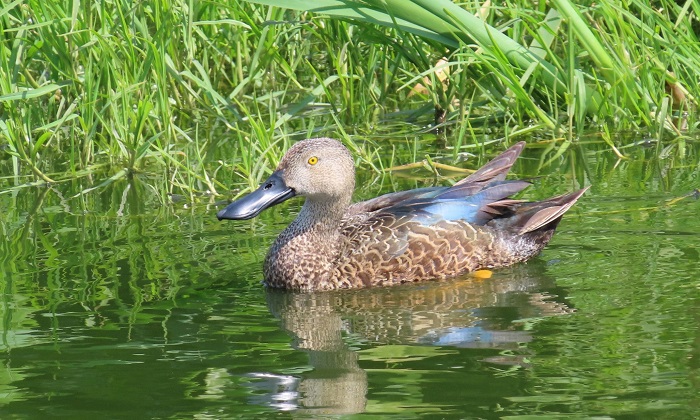
Strandfontein Sewage Works, Western Cape
Photo by Felicity Ellmore
The movements of the Cape Shoveler are not well understood. Across their range birds may be migratory, nomadic or resident. Movements are known to occur between the winter and summer-rainfall regions. Nomadic movements are likely in response to food availability.
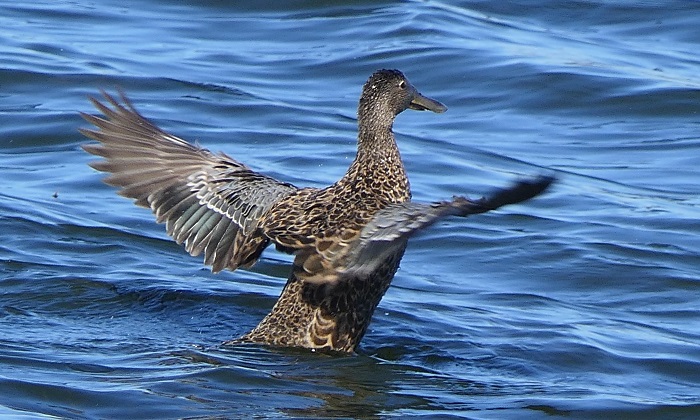
Rietvlei, Western Cape
Photo by Sharon Stanton
When taking flight, the Cape Shoveler rises steeply with noisy wing-beats, reaching speeds up to 90 km/hr. In flight, the wings make a distinctive ‘whooping’ sound. The Cape Shoveler is secretive when in flightless moult. When disturbed they swim off low with only the head showing above the surface. The Cape Shoveler walks awkwardly on land. Groups spend much time loafing along the shoreline where they preen, rest or sleep, usually while standing in shallow water.
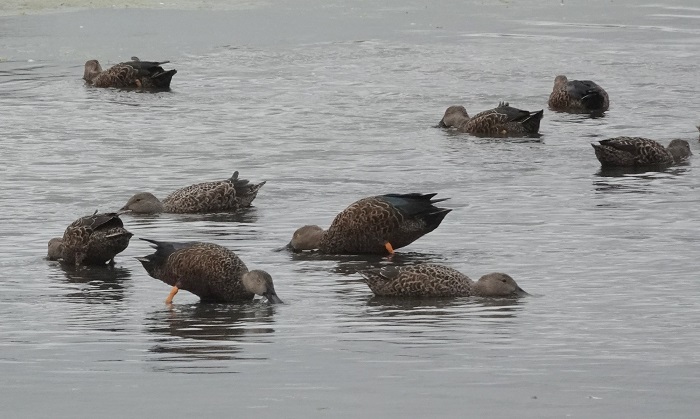
Nuwejaars Wetland Special Management Area, Western Cape
Photo by Les Underhill
The Cape Shoveler feeds day or night and usually forages in shallow, open, nutrient-rich waters. They are primarily filter feeders, and most often forage by surface dabbling or with the head and neck submerged. They forage less often by upending or dabbling while walking. Cape Shovelers are also recorded to find food by ‘circle-swimming’ whereby a group of birds swim around in a circle, head to tail, filtering water stirred up by the bird ahead. The bulk of the Cape Shoveler’s diet comprises animal matter, including snails, insects, crustaceans, planktonic invertebrates, and tadpoles. Only around 30% of its diet consists of plant matter.
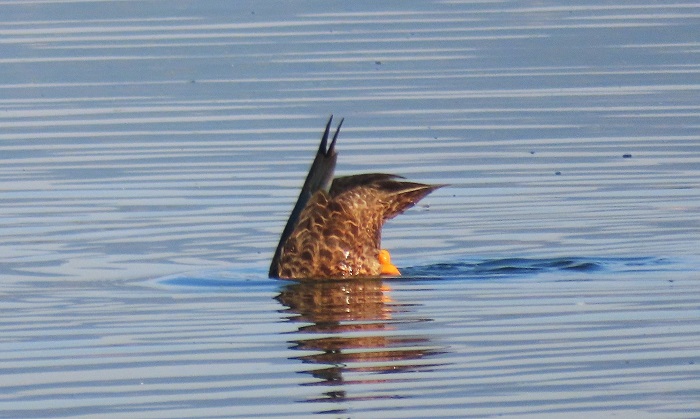
Pietermaritzburg, KwaZulu-Natal
Photo by Malcolm Robinson
In the summer rainfall parts of its range, the Cape Shoveler breeds throughout the year with a small spring peak from July to September. Breeding in the winter rainfall Western Cape is more seasonal with a marked December peak and only a few breeding records in other months. The Cape Shoveler is a monogamous, solitary nester. Pair bonds are mostly seasonal, but may last for more than 1 season.
The nest is a grass-lined hollow in the ground ringed with down feathers. Nests are typically placed in dense vegetation, usually within 20m of the water. 5 to 12 cream coloured eggs are laid per clutch. Incubation is by the female only and takes 27 to 28 days. The young are precocial and are fully fledged by 8 weeks of age. The young are attended solely by the female.
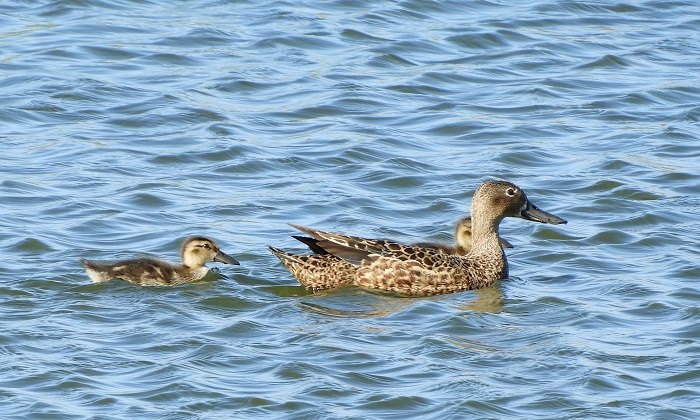
Jongensfontein, Western Cape
Photo by Gerald Gaigher
Further Resources
Species text adapted from the first Southern African Bird Atlas Project (SABAP1), 1997.
The use of photographs by Cobus Elstadt, Daryl de Beer, Felicity Ellmore, Gerald Gaigher, Gerald Wingate, Johan van Rooyen, Les Underhill, Malcolm Robinson, Rene Navarro, Ryan Tippett, Sharon Stanton, and Sybrand Venter is acknowledged.
Other common names: Kaapse slopeend (Afrikaans); iDada (Zulu); Canard de Smith (French); Kaplöffelente (German); Pato-trombeteiro do Cabo (Portuguese); Kaapse Slobeend (Dutch).
A list of bird species in this format is available here.
Recommended citation format: Tippett RM. 2026. Cape Shoveler Anas smithii. Biodiversity and Development Institute. Available online at https://thebdi.org/2026/05/21/cape-shoveler-anas-smithii/
Strandfontein Sewage Works, Western Cape
Photo by Gerald Wingate
