
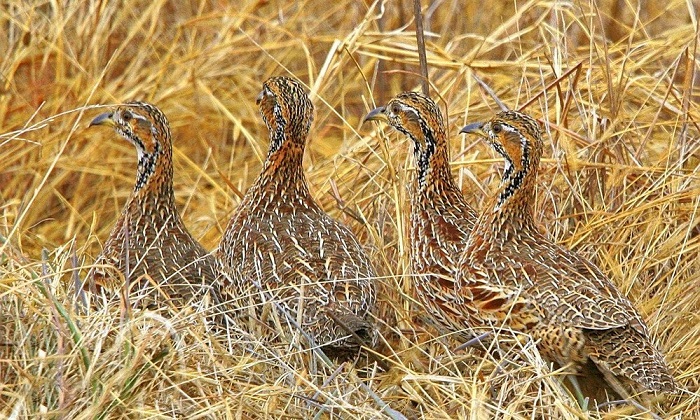
Cover image of Orange River Francolin by Lia Steen – Near Devon, Gauteng
Francolins belong to the Family: PHASIANIDAE (Pheasants, Grouse, and allies). Other southern African representatives of this family include Spurfowls and Quails. They are generally plump, heavy-bodied gamebirds, with broad, relatively short wings and powerful legs. Many have a spur on each leg, while some, have reduced spurs or none at all. The bill is short and compact. Phasianids inhabit almost all terrestrial habitats, from Arctic and alpine tundra to grasslands, deserts, and savannas, to humid tropical rainforest. Most African species are cryptically patterned but many Asian and Australasian species are among the most spectacularly plumaged of all birds. The Phasianidae comprise 187 species from 54 Genera. 15 species are native to southern Africa.
Identification
The Orange River Francolin is cryptically coloured with intricately patterned plumage. The sexes are alike in plumage coloration, but males are larger than females.
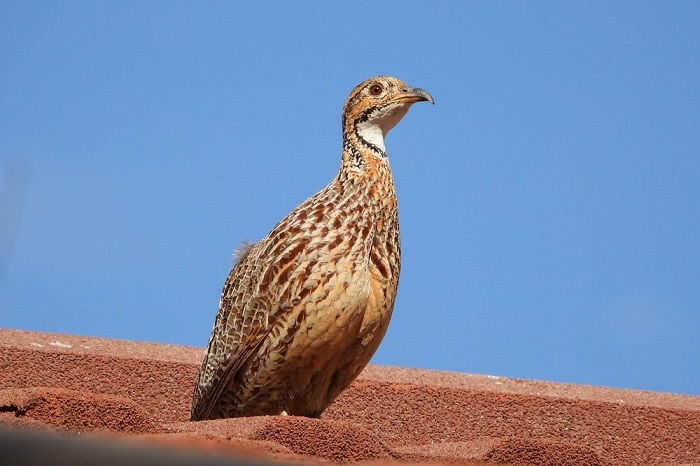
Sasolburg, Free State
Photo by Dawie Kleynhans
Adults are overall greyish-brown on the upper parts with white feather shafts, and pale buff central stripes and transverse bars. A narrow black-and-white band runs down the sides of the neck from behind eye. It ends on the sides of the lower neck and does not form a necklace. A black moustachial stripe extends as a second black-and-white band that does join as a necklace around white throat. The upper breast and flank feathers are buff-coloured, with large red-brown blotches. The belly feathers are also buff-coloured, with indistinct black-and-white barring that varies between races. In flight, the outer secondaries, primaries, and primary coverts are extensively rufous. The bill is strong, decurved, and grey, with a yellow base to the lower mandible. The eyes are brown, and the legs and feet are yellow. Male are equipped with sharp tarsal spurs.
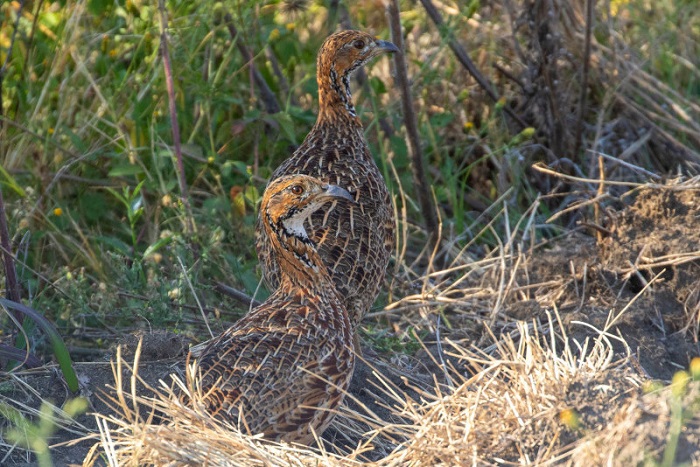
Near Balfour, Mpumalanga
Photo by William Price
Immature and juvenile birds resemble the adults, but the black-and-white bands on the head and neck are less well defined, and their underparts are irregularly barred black and buff.
The Orange River Francolin is genetically closely allied to the Grey-winged Francolin (Scleroptila afra), Red-winged Francolin (Scleroptila levaillantii), and Shelley’s Francolin (Scleroptila shelleyi), and it replaces these species in arid grasslands. It is most likely to be confused with Shelley’s Francolin and Red-winged Francolin. The face pattern is most similar to that of Shelley’s Francolin, but in the latter, both dark facial stripes meet on the foreneck. The Orange River Francolin also lacks the black belly markings of Shelley’s Francolin and has a faster and higher-pitched call. The Red-winged Francolin lacks the black-and-white stripe behind the eye of the Orange River Francolin.
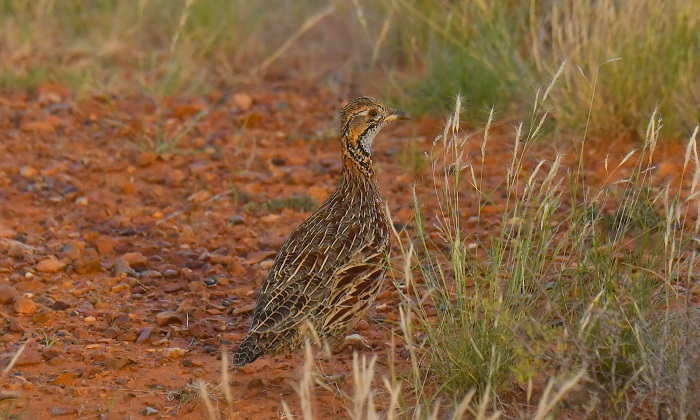
Olienhout Game Reserve, Northern Cape
Photo by Ryan Tippett
Status and Distribution
The Orange River Francolin is locally common in southern Africa. It has a curious and discontinuous distribution in north-east and southern Africa with several disjunct populations between Ethiopia, northern Kenya, and Uganda. It also has an anomalous southern African range, extending from the dry grasslands of central South Africa diagonally north-west through the sparse woodlands of the central Kalahari in Botswana, to northern Namibia and beyond into south-western Angola. In South Africa, the Orange River Francolin occurs in the north-eastern parts of the Northern Cape, much of the North West Province and Free State, and the extreme north-eastern parts of the Eastern Cape and across to the highveld of Gauteng and western Mpumalanga.
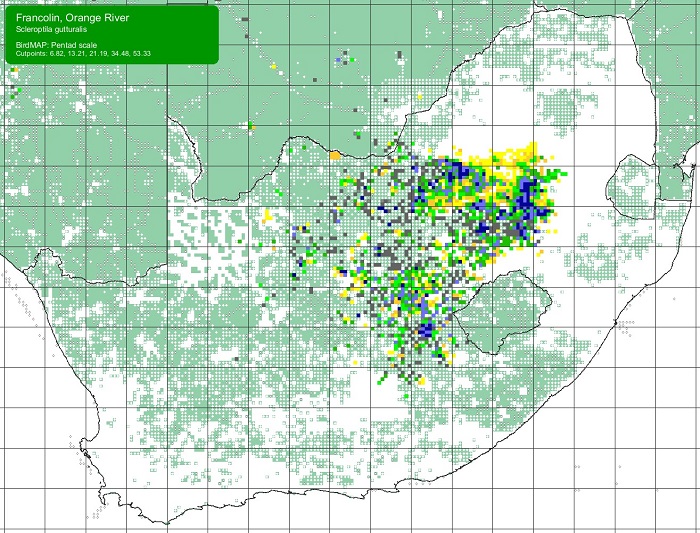
Overall, the Orange River Francolin is not threatened. However, it was apparently previously abundant and widespread throughout the Northern Cape. Since the 1930s, the Orange River Francolin has all but disappeared west of 22°E. The evidence and reasoning for this, though, are unclear. 2957 wild-shot birds were sold at the Kimberley market in 1906, but it is thought unlikely that this hunting pressure is the cause of consistently low numbers.
Reports from the early 1900s indicate that populations in South Africa were limited by annual grass burning just before the breeding season and again during the breeding season, by burning of any previously unburned patches. The Orange River Francolin is susceptible to habitat manipulation, particularly where poorly managed grazing results in degraded grasslands. Possible reasons for population decrease include the loss of habitat to agriculture and overgrazing. A few consecutive years of overgrazing, even on well-managed nature reserves, can lead to local extinctions.
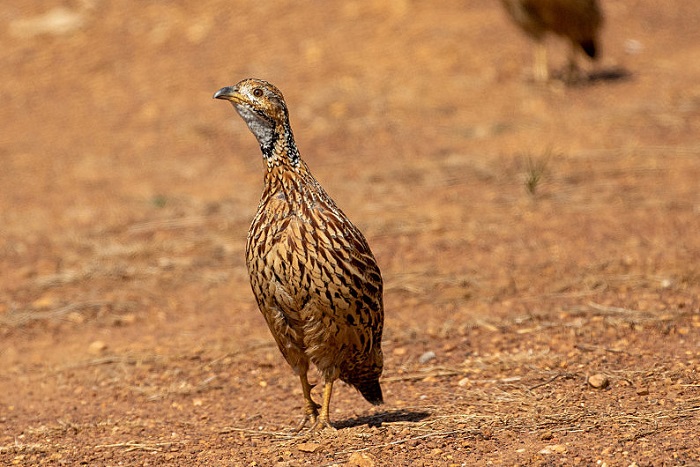
Suikerbosrand Nature Reserve, Gauteng
Photo by William Price
.
Habitat
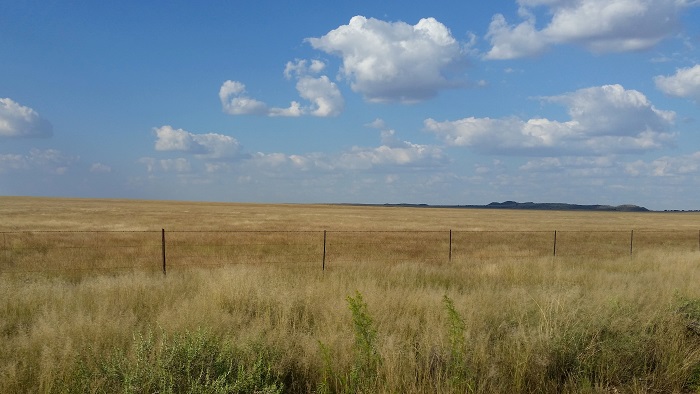
Near Petrusville, Northern Cape
Photo by Ryan Tippett
The Orange River Francolin inhabits relatively arid grassland in either open or lightly wooded regions, typically on sandy or gravelly soils. In South Africa, it inhabits open grassland in the eastern and southern parts of its range, and wooded and bushy grasslands in the north and west. The Orange River Francolin prefers relatively flat or rolling terrain in South Africa, but favours hilly and mountainous terrain in Namibia. In Botswana, it typically prefers fossil river valleys. The Orange River Francolin is partial to short, sparse grasslands dominated by Themeda, Digitaria, Aristida, and Eragrostis species. It also forages at the edges of cultivated lands and fallow fields adjacent to its natural habitat.
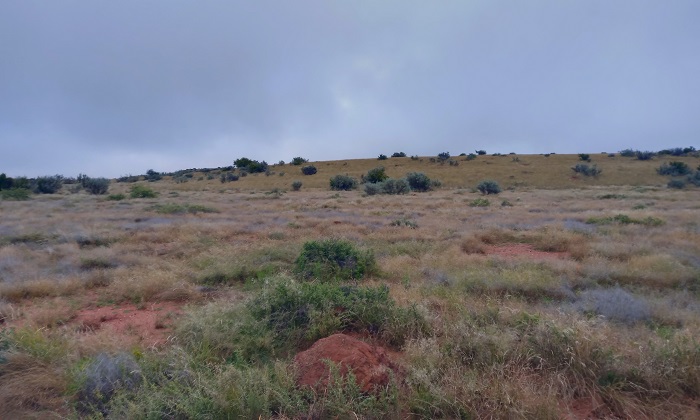
Olienhout Game Reserve, Northern Cape
Photo by Ryan Tippett
Behaviour
The Orange River Francolin is resident with no evidence of seasonal migration. However, they undertake considerable local movements during droughts and in response to habitat deterioration.
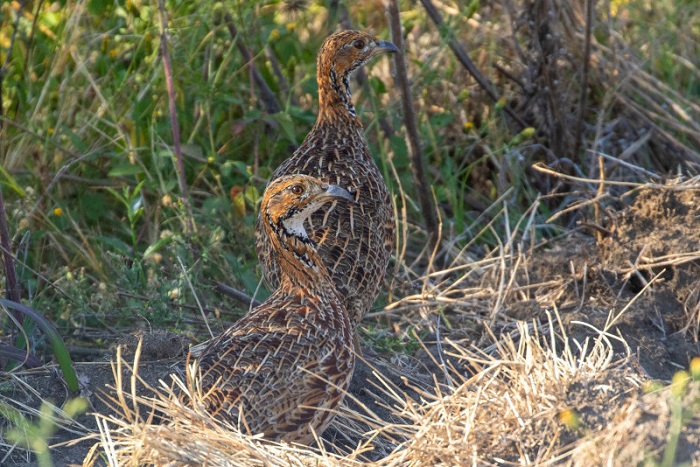
Near Balfour, Mpumalanga
Photo by William Price
The Orange River Francolin is usually found in pairs or small coveys of 3 to 5 birds, and occasionally in groups of up to 8. When approached, they tend to sit tight before scuttling away into thicker cover. If flushed, they gain considerable height before peeling off over trees, often increasing speed by flying downwind. They spend most of the day foraging or resting, and are constantly alert. Coveys regularly dustbathe around midday. Roost sites are invariably located in flat, open patches and are seldom used for more than two nights in a row.
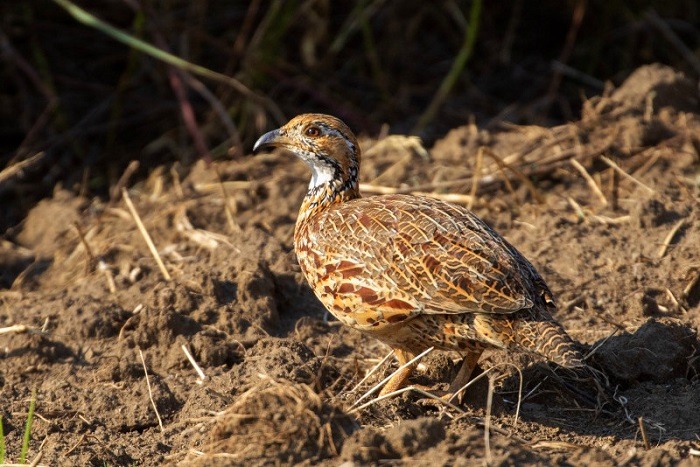
Near Balfour, Mpumalanga
Photo by William Price
The Orange River Francolin forages by digging up underground food using its bill. Their diet comprises corms, bulbs (including Oxalis and Moraea spp), berries, seeds, flowers, fallen grain and some green shoots. They also consume a variety of insects, including bugs, beetles, ants, termites, grasshoppers and locust nymphs. Their diet is more plant-based in winter and supplemented with insects in summer.
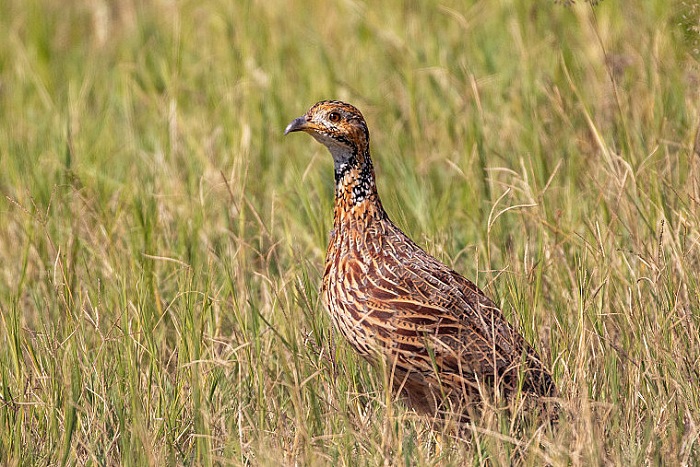
Suikerbosrand Nature Reserve, Gauteng
Photo by William Price
The Orange River Francolin is recorded breeding during all months but mainly after early and late summer rains. It is a monogamous breeder and pairs nest solitarily. They are likely to be territorial. The nest is built entirely by the female. It is a simple scrape in the ground, usually hidden in dense grass, and lined with dry grass. Nearby vegetation is sometimes pulled over the nest to form a canopy.
Laying dates are variable, according to rainfall. 3 to 8 eggs are laid per clutch. The eggs range in colour from pale brownish to yellowish, sometimes with light brown speckles. Incubation starts after clutch completion and eggs hatch synchronously. The incubation period lasts up to 21 days and all incubating is done by the female. Newly hatched young are precocial and the young are cared for by both parents. They are brooded by the female at night until they are around 40 days old.
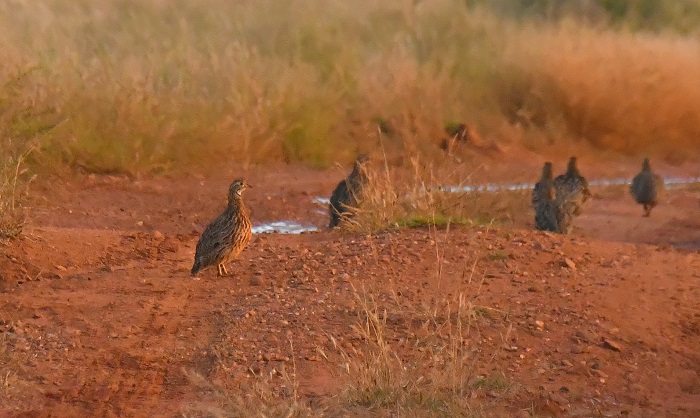
Olienhout Game Reserve, Northern Cape
Photo by Ryan Tippett
Further Resources
Species text adapted from the first Southern African Bird Atlas Project (SABAP1), 1997.
The use of photographs by Dawie Kleynhans, Lia Steen, Ryan Tippett, and William Price is acknowledged.
Other common names: Kalaharipatrys (Afrikaans); Francolin d’Archer (French); Rebhuhnfrankolin (German); Francolim-dourado (Portuguese); Archer-frankolijn (Dutch).
A list of bird species in this format is available here.
Recommended citation format: Tippett RM. 2026. Orange River Francolin Scleroptila gutturalis. Biodiversity and Development Institute. Available online at https://thebdi.org/2026/04/30/orange-river-francolin-scleroptila-gutturalis/
