
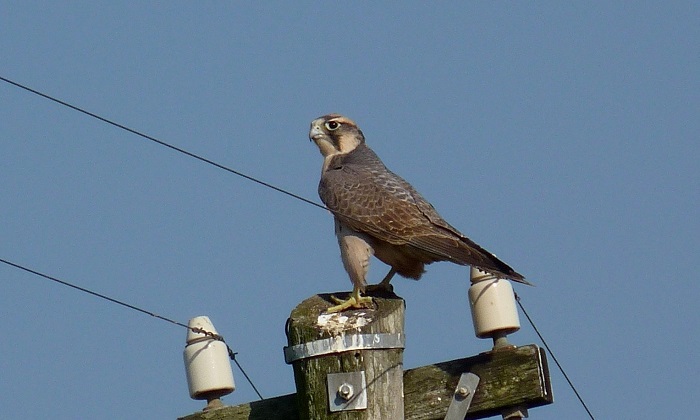
Cover image of Lanner Falcon by Ryan Tippett – Carnarvon district, Northern Cape
The Lanner Falcon belongs to the family FALCONIDAE (Falcons, Kestrels & Caracaras). Falconidae has traditionally been grouped with the family Accipitridae; however, morphological and DNA analyses suggest the two families are not closely related. Members of this family are small to medium-sized birds of prey. They have strongly hooked bills, sharply curved talons, and excellent eyesight. They can be found in most terrestrial habitats around the world, but the greatest diversity is found in South America and Africa. All are capable hunters that can take a variety of prey, including insects, birds, mammals, reptiles, and carrion. Most are solitary and territorial, though a few species are colonial or semi-colonial. There are 65 species in the family from 10 genera. 16 species are known from southern Africa.
Identification
The Lanner is a fairly large falcon and is the largest falcon species in southern Africa.
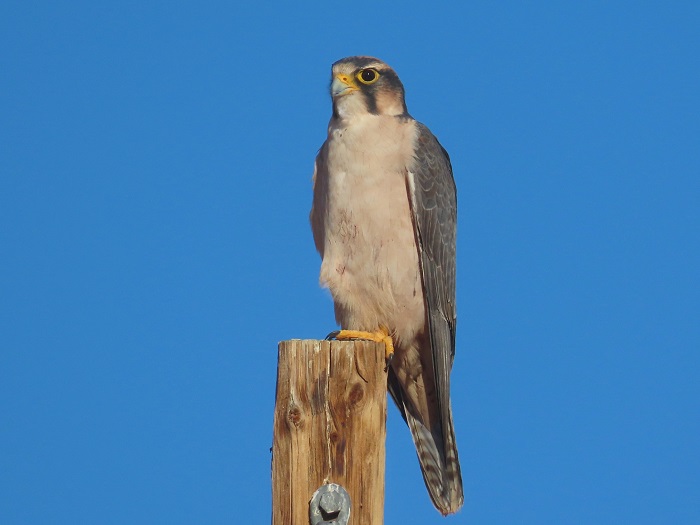
Near Pofadder, Northern Cape
Photo by Cobus Elstadt
It has bluish-grey or brownish-grey upperparts and pale underparts varying from mostly unmarked whitish to whitish with a pink or buff-coloured wash. There are usually fine dark spots on the breast and belly, and dark bars and spots on the flanks and thighs. The forehead is pale buff, and the forecrown is dark greyish blue. The crown and nape are rufous to light buff. The underside of the tail has 8–12 narrow dark bars. The sexes are alike, but the female is often darker than the male and is significantly larger (20%). The bill is grey, with a blackish tip The eye ring, cere, legs and feet are dark yellow. The eyes are dark brown.
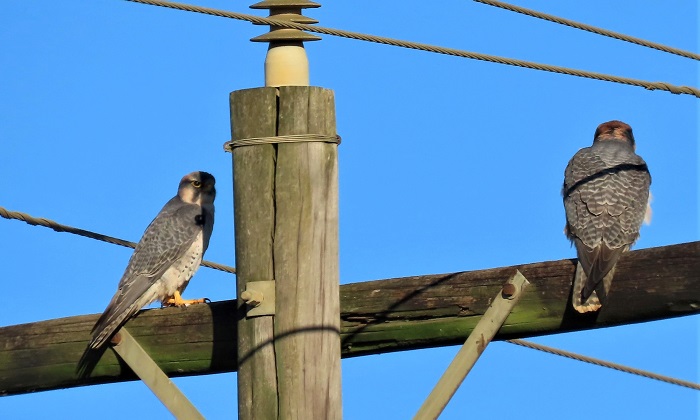
Near Richmond, KwaZulu-Natal
Photo by Malcolm Robinson
In juveniles, the upper parts are predominantly greyish-brown and the crown and nape are whitish to pale rufous. Underparts are buff coloured with heavy, smudged brown streaks. The flight feathers have whitish edges. The cere, eye ring, legs, and feet are greyish-blue. Young birds between the ages of 6 to 18 months show plumage features that are intermediate between juveniles and adults.
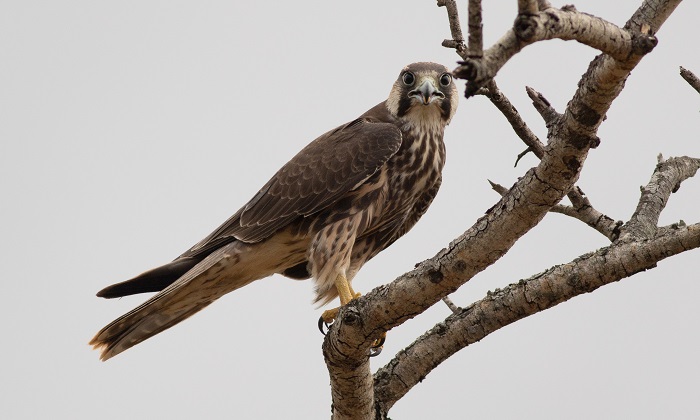
Kruger National Park, Limpopo
Photo by Lance Robinson
The Lanner Falcon is most often mistaken for the Peregrine Falcon (Falco peregrinus). The Peregrine is more compact and, although smaller, is more heavily built than the Lanner. The Peregrine also has more pointed wings and a shorter tail. Adult Peregrines have dark blackish (not rufous) crowns, broader malar stripes, and darker grey upper parts. Their underparts are densely barred and spotted black. Juvenile Peregrine Falcons have a dark brownish crown and finer, less bold streaking on the undersides.
Status and Distribution
The Lanner Falcon is fairly common in southern Africa. It has a wide distribution across Africa, the Middle East, and southern Europe. It occurs throughout most of Africa, avoiding only the equatorial rainforests, and is patchily distributed in the Sahara and North Africa. The Lanner Falcon ranges throughout southern Africa, with a stronghold in Lesotho and south-eastern South Africa.
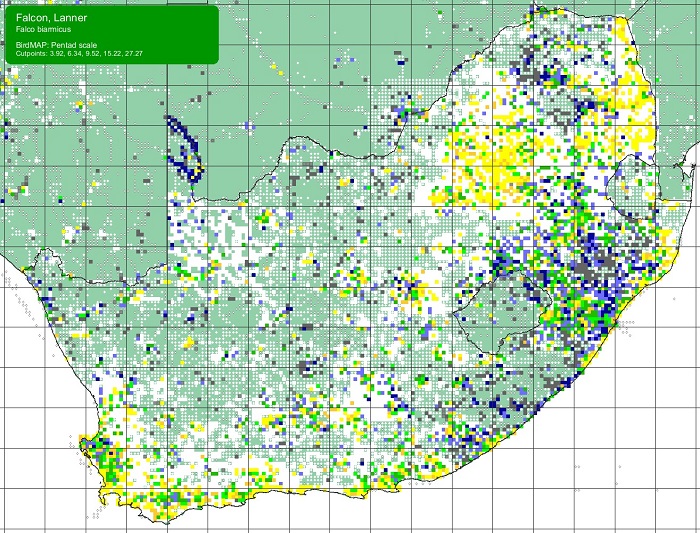
Due to its wide distribution, the Lanner Falcon is not globally threatened (least concern). However, it is listed as Near-threatened in South Africa. Despite this, the species has experienced a drastic decline in Europe and parts of the Middle East. Local declines are also known in parts of North and sub-Saharan Africa. In South Africa, evidence of decreasing numbers from the central areas of the grassland biome suggests the Lanner Falcon is prone to pesticide contamination. The localised application of poisons to control locusts and Red-billed Queleas (Quelea quelea) may cause direct mortalities.
Fortunately, in South Africa, the Lanner Falcon has probably increased in numbers and extended its range into treeless areas by breeding on crow nests on utility pylons and poles. In many parts of southern Africa, the Lanner Falcon has benefited from preying on abundant free-range domestic chickens. It has also benefited from the clearing of savannas, creating more favourable open habitat.
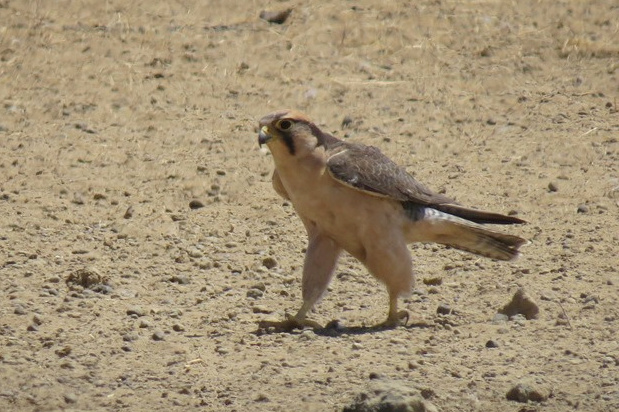
Kgalagadi Transfrontier Park, Northern Cape
Photo by Pamela Kleiman
Habitat
The Lanner Falcon is generally a cliff-nester, and its breeding distribution is closely associated with habitats where cliffs are available. However, they are also able to breed on lower rock-faces, trees, electricity pylons, buildings, and often in the old nests of other birds, especially crows.
For hunting, the Lanner Falcon prefers open habitats, including grassland, arid woodland, Karoo shrublands, and agricultural areas. However, the Lanner Falcon is known to exploit a very wide range of habitats, including well-wooded and forested areas where cliffs occur. It essentially hunts in any terrestrial habitat in southern Africa, except forest interiors. The Lanner Falcon is recorded from all biomes in southern Africa.
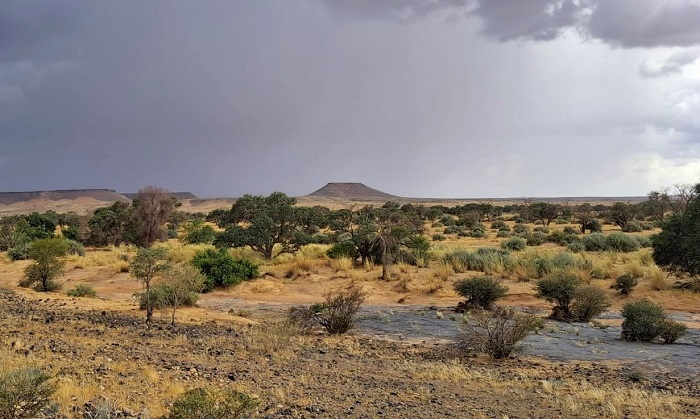
Between Aus and Keetmanshoop, Namibia
Photo by Les Underhill
Behaviour
Lanners often perch conspicuously on a cliff, dead tree, telephone pole, or fence post. They also soar for prolonged periods. The flight is buoyant, with fairly deep wing-beats.
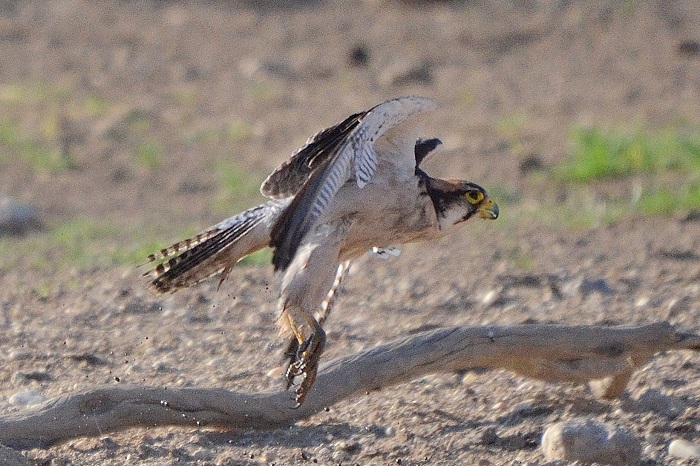
Kgalagadi Transfrontier Park, Northern Cape
Photo by John Todd
The Lanner Falcon is usually encountered singly or in pairs. Aggregations can occur, especially in the drier western areas, and are mostly composed of juveniles with the occasional adult. The Lanner Falcon is a facultative migrant, meaning they choose to migrate or stay based on immediate environmental conditions. Immature birds are more mobile than adults, and the extent of migration varies depending on rainfall patterns and their effects on prey abundance. Much of these annual movements are from breeding areas on the eastern escarpment to flatter, drier regions in the west and south-west, especially the Karoo, Kalahari, and Western Cape.
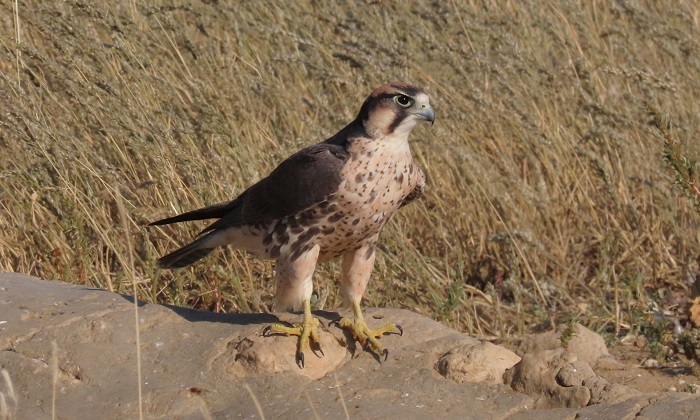
Kgalagadi Transfrontier Park, Northern Cape
Photo by Johan van Rooyen
The Lanner Falcon hunts from a prominent perch or from the air. They primarily use speed to surprise and capture prey, and are known to use obstructive cover to hide their approach. They may attack directly in a spectacular stoop dive or in level, fast flight, low over the ground, striking at prey as it flushes. Lanners may also dive from a perch onto ground-dwelling prey and have even been seen to catch insects while walking on the ground. Prey is seized both in mid-air and close to or on the ground. Pairs often hunt as a cooperative unit, particularly in strikes at large or evasive prey. The Lanner Falcon is opportunistic and often hunts at water holes, where prey congregates to drink, and sometimes also attacks birds flushed by vehicles or injured by hunters.
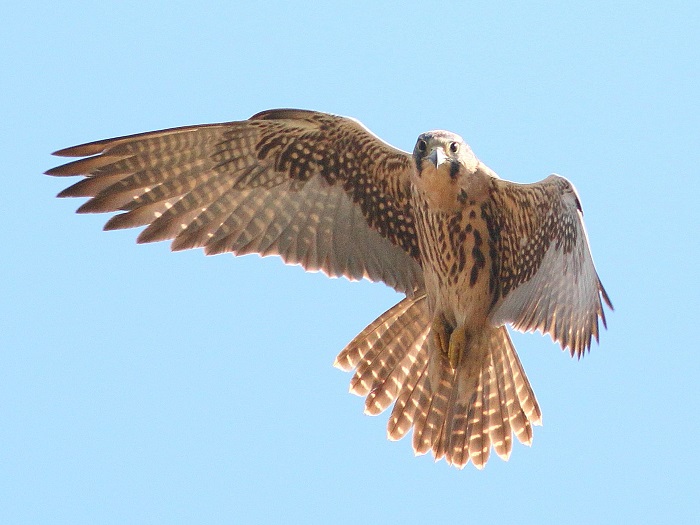
Near Brits, North West
Photo by Andrew Keys
The Lanner Falcon feeds mostly on small to medium-sized birds, but can take prey up to the size of guineafowl. Important bird prey includes pigeons, doves, francolins, sandgrouse, plovers, mousebirds, small granivores, and domestic chickens. Poultry makes up to 40% of its diet in some areas. Also eats small mammals (including bats), reptiles, and insects. The Lanner Falcon occasionally also feeds on carrion.
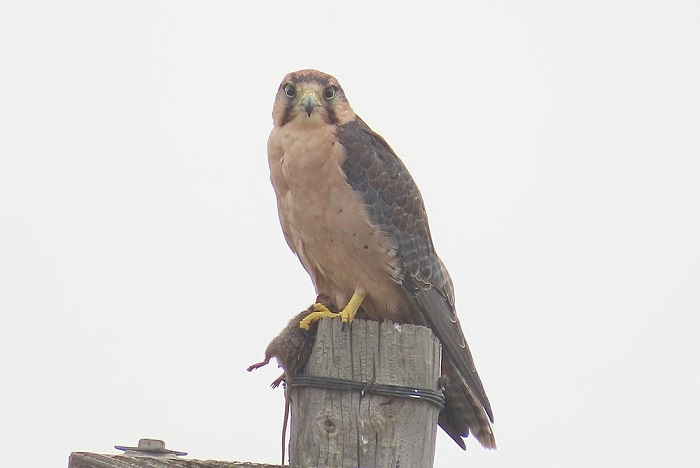
Near Near Oudtshoorn, Western Cape
Photo by Cobus Elstadt
Lanner Falcons are monogamous and form long-term pair bonds. They are solitary nesters and strongly territorial. Lanners do not construct true nests of their own, but rather use a simple scrape on a cliff ledge or tall building. They also readily use the old platform nests of crows, ravens, herons, or other raptors, either on a cliff, in a tree, or on a power pylon. They may, on occasion, also usurp active nests of birds as large as Verreaux’s Eagle (Aquila verreauxii).
The Lanner Falcon breeds from July to December in southern Africa, with breeding starting later in the south of its range. 1 to 5 eggs are laid per clutch, and eggs are laid at 2 or 3-day intervals. Incubation usually starts after the last egg is laid, and most of the incubation is done by the female. Hatching is generally synchronous. The female generally remains at the nest while the male does most of the hunting. The fully fledged young remain dependent on their parents for food for up to 3 months.
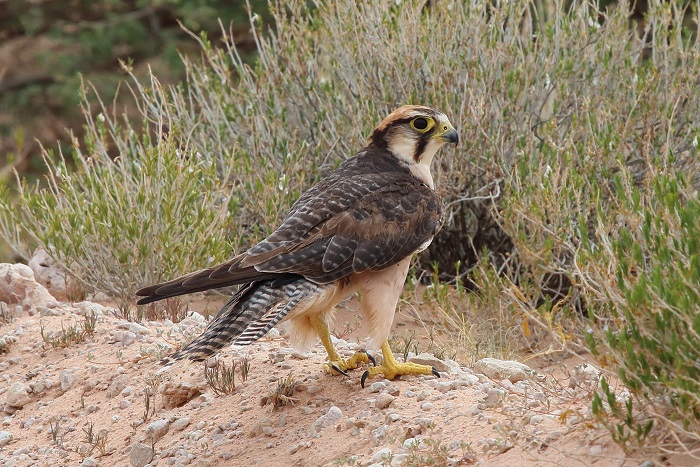
Kgalagadi Transfrontier Park, Northern Cape
Photo by Phillip Nieuwoudt
Further Resources
Species text adapted from the first Southern African Bird Atlas Project (SABAP1), 1997.
The use of photographs by Andrew Keys, Cobus Elstadt, Craig Peter, Johan van Rooyen, John Todd, Lance Robinson, Les Underhill, Malcolm Robinson, Norman Barrett, Pamela Kleiman, Phillip Nieuwoudt, and Ryan Tippett is acknowledged.
Other common names: Edelvalk (Afrikaans); uHeshe (Zulu); Ukhetshe (Xhosa); Faucon lanier (French); Lannerfalke (German); Lannervalk (Dutch); Falcão-alfaneque (Portuguese)
Recommended citation format: Tippett RM. 2026. Lanner Falcon Falco biarmicus. Biodiversity and Development Institute. Available online at https://thebdi.org/2026/03/14/lanner-falcon-falco-biarmicus/
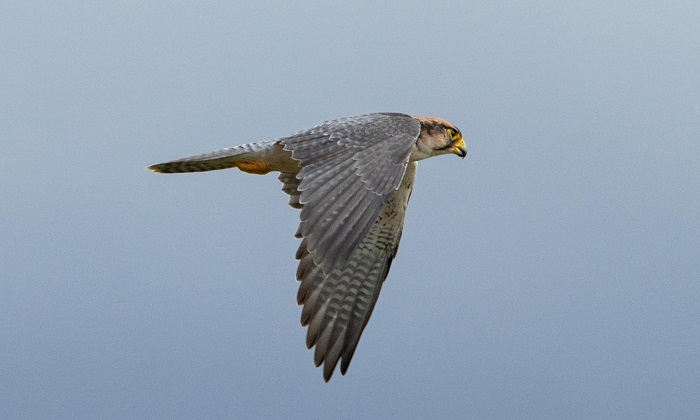
Lower Zambezi, Zambia
Photo by Norman Barrett
