
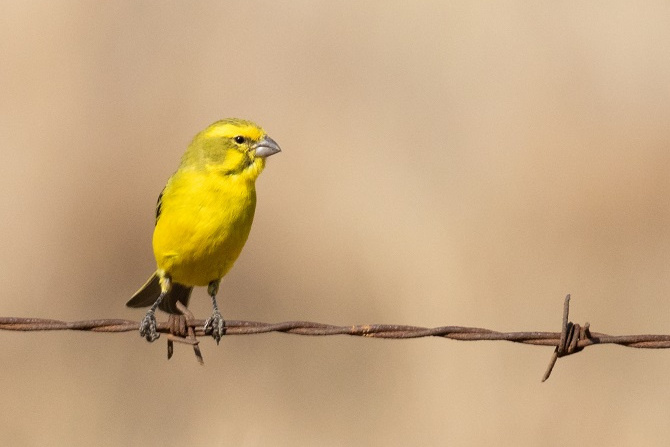
Cover image of Yellow Canary by Lance Robinson – Near Frankfort, Free State
Canaries belong to the Family FRINGILLIDAE (True Finches). Other members of Fringillidae include the Siskins, Seedeaters, Redpolls, Serins, Grosbeaks, and Euphonias, as well as the morphologically divergent Hawaiian Honeycreepers. Birds in this family are small to medium-sized passerines. They generally have stout conical bills adapted for eating seeds and nuts, and often have colourful plumage. They occupy a great range of habitats where they are usually resident and do not migrate. They have a worldwide native distribution except for Australia and the polar regions. The family Fringillidae contains around 236 species from 50 genera.
Identification
In the Yellow Canary, the sexes differ in plumage colouration.
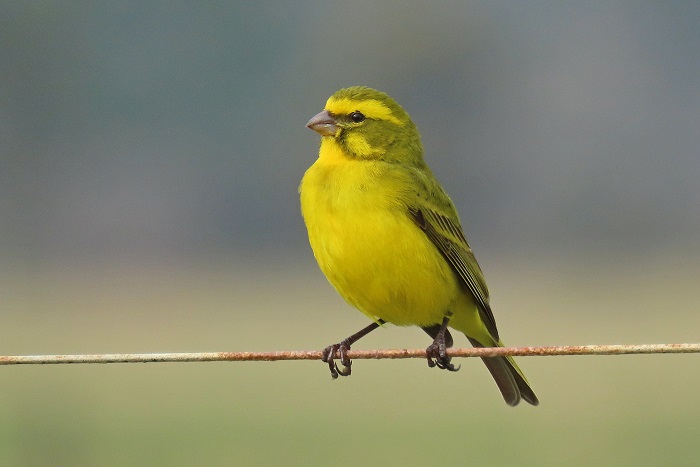
Heidelberg district, Western Cape
Photo by Johan van Rooyen
Adult males are olive green above with fine brown streaking. Birds from the central to northern parts of its range tend to be brighter and yellower above. The undersides are rich yellow in the north and yellow with a greenish wash in the south. The forehead, supercilium, and cheeks are rich yellow. An olive-green band runs through the eye and widens over the ear coverts and onto the sides of the neck and nape. A narrow olive-green malar stripe extends below the yellow cheek and connects with the olive-green sides of the neck. The bill is horn-coloured and the eyes are brown. The legs and feet are pinkish brown.
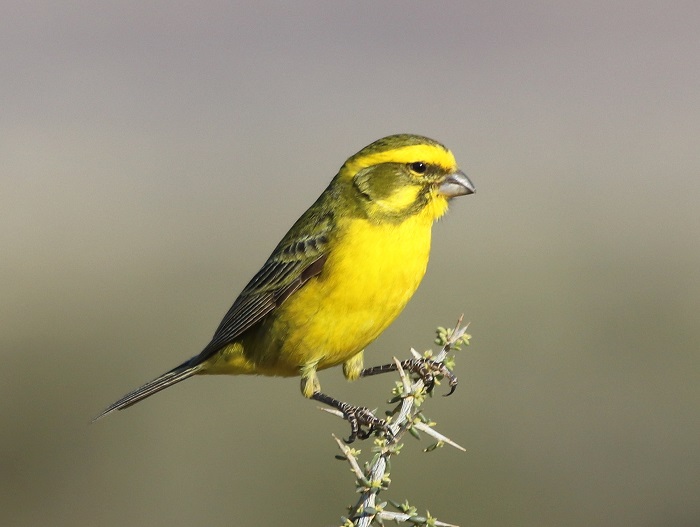
Near Carnarvon, Northern Cape
Photo by Sybrand Venter
Females are drab in comparison. They are dull olive-grey above, heavily streaked with dusky brown. The lores, ear coverts, and malar stripe are greyish olive, contrasting with a buffy-white supercilium and lower cheeks. The rump and upper tail coverts are yellowish-green. The underparts are buffy white, heavily marked with dusky brown and buffier on the belly, with fewer markings.
Juveniles are similar to adult females but are more heavily streaked above and below.
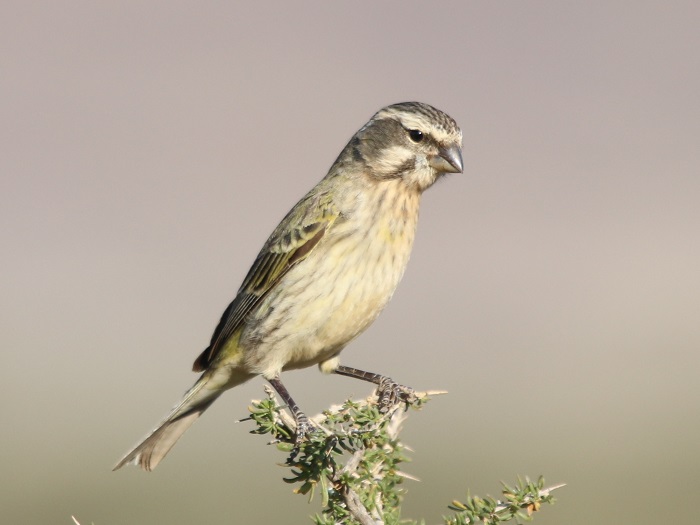
Carnarvon district, Northern Cape
Photo by Sybrand Venter
Status and Distribution
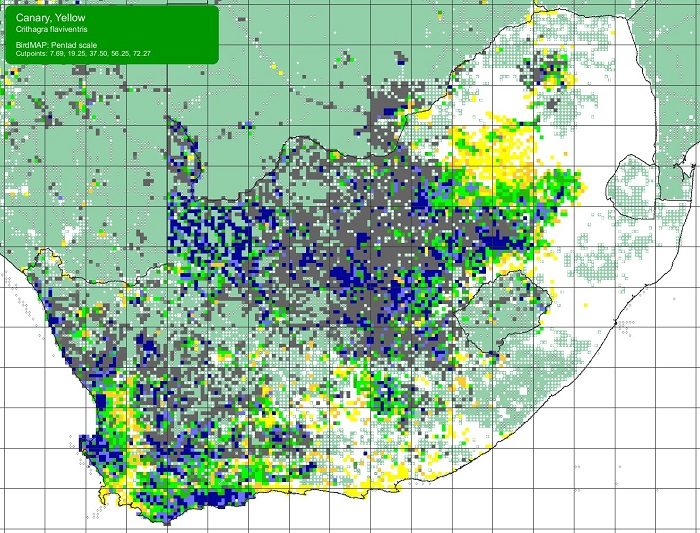
Details for map interpretation can be found here.
The Yellow Canary is a common near-endemic to southern Africa. Its range extends beyond the region only into south-western Angola. The Yellow Canary is widespread in the south-western, central, and north-western parts of the subregion.
There is no evidence of any recent change in the distribution of the Yellow Canary. The species is not considered threatened. The population sometimes irrupts east of its usual range during drought years.
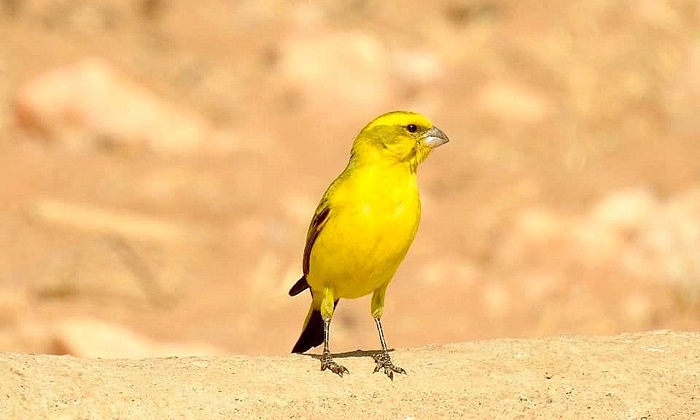
Khomas, Namibia
Photo by Norman Barrett
Habitat
The Yellow Canary is a species of relatively dry and open environments. It inhabits a relatively wide variety of habitats. These include arid and semi-arid Karoo shrublands, arid savanna, alpine shrublands, dry grasslands, dry fynbos, renosterveld, and strandveld, as well as dune vegetation. It also occurs along weedy road verges and in gardens. In the Karoo, the Yellow Canary favours small drainage lines with taller shrubs and rocky hillsides with scattered bushes. In the south-western Cape, it is most abundant in strandveld, renosterveld, and dune fynbos, and avoids mountain fynbos.
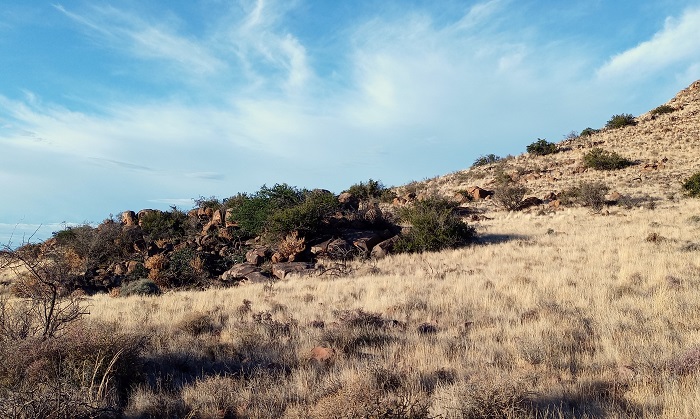
Carnarvon district, Northern Cape
Photo by Ryan Tippett
Behaviour
The Yellow Canary is resident in moister parts of its range, and nomadic or possibly a partial migrant in drier regions.
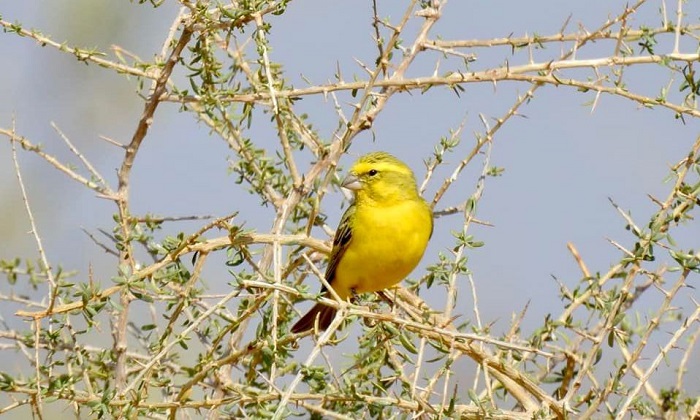
Khomas, Namibia
Photo by Norman Barrett
The Yellow Canary is a conspicuous species. It occurs in pairs when breeding but is found in small to large flocks during the non-breeding season. It frequently forms mixed flocks with Cape Sparrows, White-throated Canaries, Black-headed Canaries, and non-breeding weavers and bishops. The Yellow Canary drinks regularly and often congregates at waterholes, dams, and drinking troughs.
It forages on the ground and at the tops of shrubs. The diet of the Yellow Canary mostly consists of seeds and small fruits, but they will also consume flowers, nectar, and small insects.
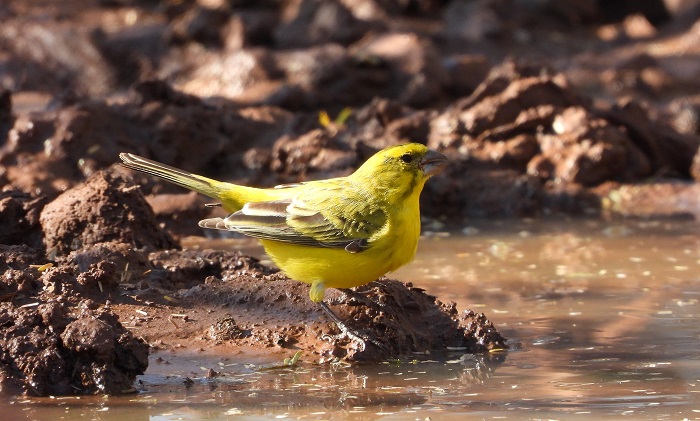
Marico River, Limpopo
Photo by Ansie Dee Reis
The Yellow Canary breeds from August to April. Breeding peaks earlier in the winter rainfall region (August), and later between September and October in the north of its range. In arid areas, the Yellow Canary breeds opportunistically after rains at almost any time of the year.
The nest is a shallow cup composed of grass stems, rootlets, dry stalks, etc. The bowl is lined with soft plant down. Nests are most often placed in the fork of a shrub or small tree, usually around 50cm above the ground. It is built entirely by the female in as little as 3 days.
2 to 4 white eggs are laid per clutch. The eggs are sometimes pale blue or green, occasionally with sparse purple-brown spots. The incubation period lasts for 12 to 14 days and is performed only by the female. The nestling period takes up to 19 days and the young are fed by both parents.
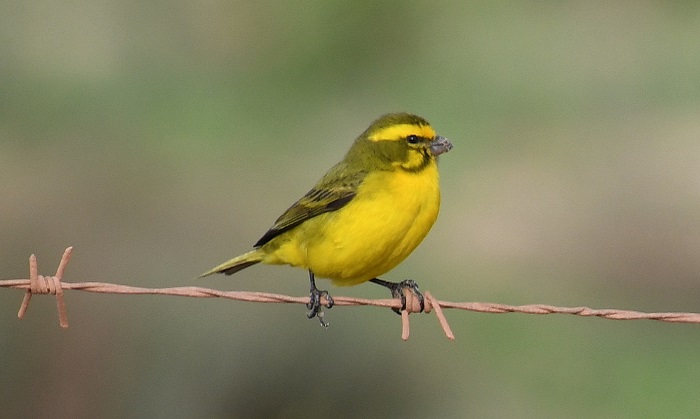
Near Lamberts Bay, Western Cape
Photo by Karis Daniel
Further Resources
This species text is adapted from the first Southern African Bird Atlas Project (SABAP1), 1997.
The use of photographs by Ansie Dee Reis, Johan van Rooyen, Karis Daniel, Lance Robinson, Norman Barrett, and Sybrand Venter is acknowledged. Additional photographs by Ryan Tippett.
Other names: Serinus flaviventris (Alt. Scientific); Geelkanarie (Afrikaans); Serin de Sainte-Hélène (French); Geelbuiksijs, Geelbuikkanarie (Dutch); Gelbbauchgirlitz (German); Canário-de-barriga-amarela (Portuguese).
Recommended citation format: Tippett RM. 2026. Yellow Canary Crithagra flaviventris. Biodiversity and Development Institute. Available online at https://thebdi.org/2026/02/26/yellow-canary-crithagra-flaviventris/
List of bird species in this format is available here.
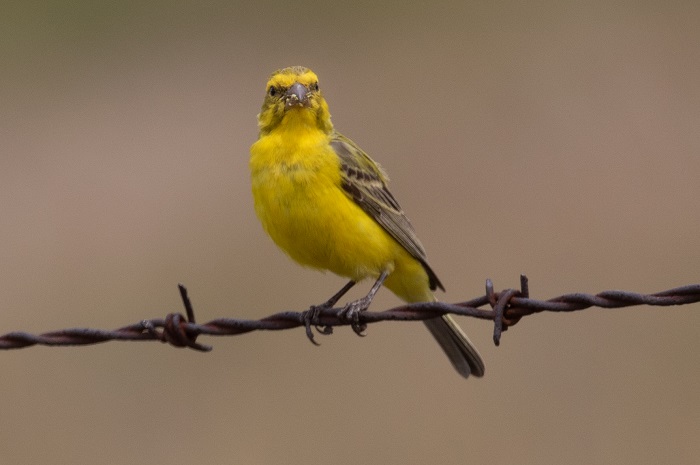
Near Smithfield, Free State
Photo by Lance Robinson
