
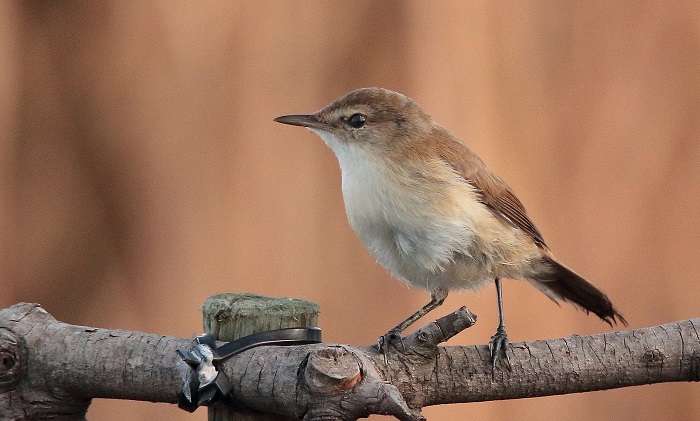
Cover image of Lesser Swamp Warbler by Johan Heyns – Marievale Bird Sanctuary, Gauteng
The Lesser Swamp Warbler belongs to the Family ACROCEPHALIDAE (Reed Warblers and allies). The species in this family are small, insectivorous passerine birds. Most are drab olive-brown above and cream to yellow or beige below. They are usually found in reedbeds, but also in open woodland or tall grass. The family is found primarily across Europe, Asia, and Africa, but also ranges far into the Pacific. They are members of a complex group that was formerly included with the Old World warblers but have since been reclassified based on genetic data. The family is made up of 60 species from 7 genera.
Identification
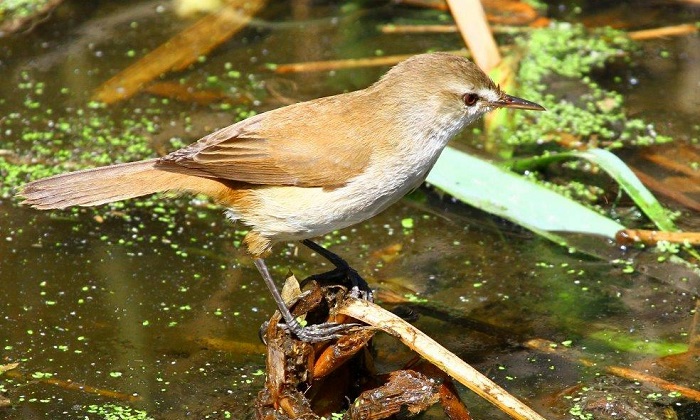
Intaka Island, Western Cape
Photo by Mark Stanton
The Lesser Swamp Warbler is fairly large for a reed warbler and has a rather robust build. The upperparts are warm brown with a grey wash on the head and neck. It has a fairly conspicuous white eyebrow. The underparts are whiteish-buff with diagnostic, lightly rufous flanks. The legs are dark brown, unlike the paler brown legs of most Acrocephalus warblers. The sexes are alike, but males are larger than females. Juveniles resemble the adults but have darker underparts and less distinct eyebrows.
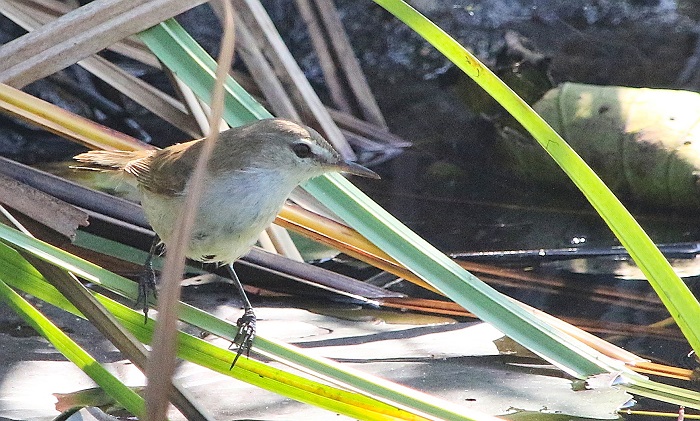
Port Edward, KwaZulu-Natal
Photo by Lia Steen
The Lesser Swamp Warbler can be mistaken for several other warbler species. It is larger than the African Reed Warbler (Acrocephalus baeticatus) and darker above with a more distinct eyebrow. It can be told from the Little Rush Warbler (Bradypterus baboecala) by the complete lack of streaking on the throat or breast, and by its dark (not pinkish) legs. Additionally, the Lesser Swamp Warbler can be told from all other species by its rich, melodious, and distinctive song.
Status and Distribution
The Lesser Swamp Warbler is a common resident. It is widely distributed in sub-Saharan Africa from southern Sudan and Ethiopia to South Africa, with isolated populations in west-central Africa. It is found almost throughout southern Africa, except the Kalahari Basin and most of the arid and semi-arid parts of Namibia.
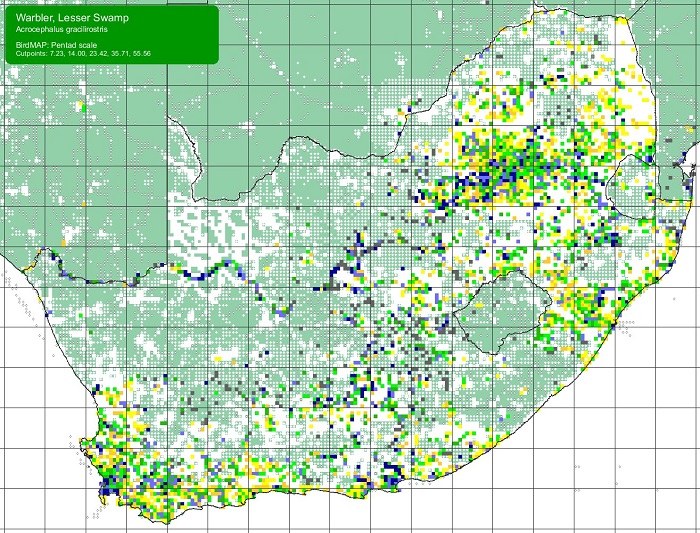
Details for map interpretation can be found here.
The Lesser Swamp Warbler is not threatened. There is no evidence to suggest that the present-day distribution differs from the historical range. The widespread loss of natural wetland habitats has been offset by the construction of dams and sewage ponds, especially in drier areas, which has most likely helped to extend its range. Additionally, the silting up of rivers has provided further suitable habitat by promoting the growth of reeds and other aquatic plants.
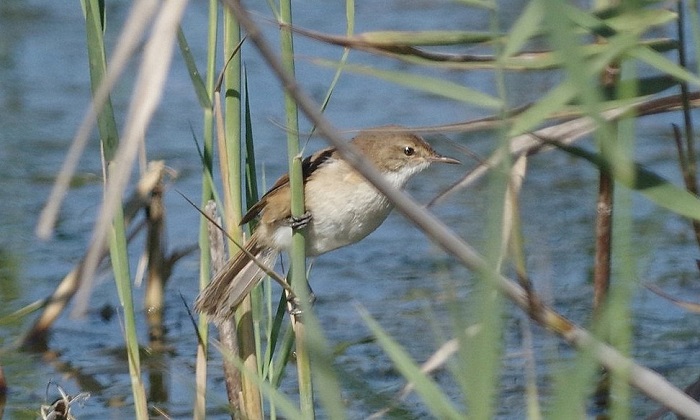
Near Hanover, Northern Cape
Photo by Ryan Tippett
Habitat
The Lesser Swamp Warbler inhabits reedbeds (Phragmites spp) and bulrushes (Typha capensis) in standing or slow-moving water, including estuaries, rivers, dams, pans, marshes, floodplains, and lakes. It occurs in most biomes, wherever suitable habitat exists.
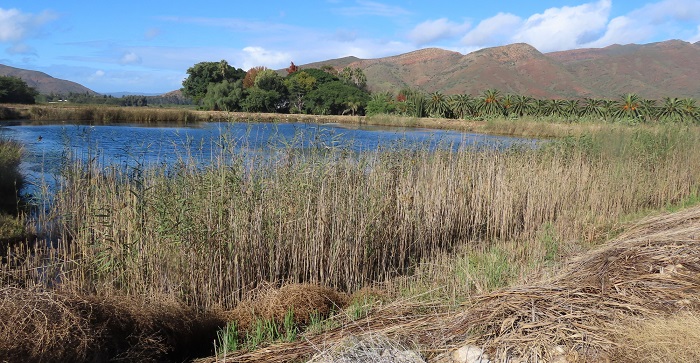
Near Worcester, Western Cape
Photo by Les Underhill
Behaviour
The Lesser Swamp Warbler is encountered singly or in pairs. It is sedentary and territorial year-round. It is highly vocal in summer, but less so during the rest of the year. Nevertheless, the Lesser Swamp Warbler seldom shows itself from thick cover and is frequently overlooked unless calling. It is inquisitive and responds well to spishing, but is not easily seen in its dense reedbed habitat.
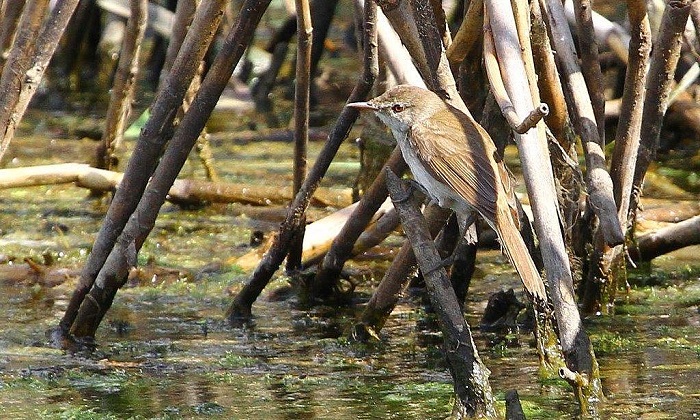
West Rand, Gauteng
Photo by Mark Stanton
The Lesser Swamp Warbler forages low down in reeds and among other aquatic plants, often just above the water. It moves nimbly up and down vertical stems to glean food items. It may also forage in leaf litter on the ground, and among the foliage of trees adjacent to reedbeds.
The Lesser Swamp Warbler feeds primarily on invertebrates like insects and spiders, and possibly also small frogs.
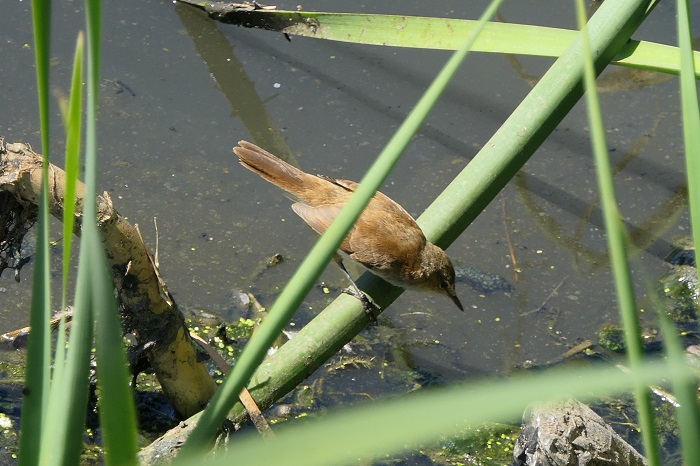
Bellville, Western Cape
Photo by Sharon Stanton
The Lesser Swamp Warbler breeds from September to December in the Western Cape, and slightly later (October to January) in the northern parts of South Africa. Records show that it breeds almost throughout the year in Zimbabwe.
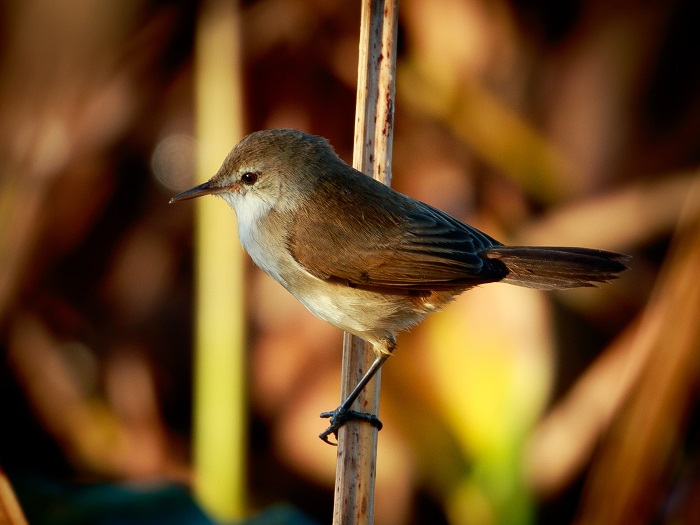
Illovo, KwaZulu-Natal
Photo by Georg Jacobs
The nest is a tidy cone-shaped cup built from grass and reed blades. It is lined with fine strips of grass with a few feathers and securely bound to a vertical reed stem. The nest is usually placed 20 to 120cm above the water. 2 to 3 eggs are laid per clutch. The eggs are white to greenish or pale blue-white with heavy black, brown, and grey spots. The incubation period takes up to 14 days and is done by both sexes. Details regarding the nestling period are unrecorded; however, the young are known to be fed by both parents.
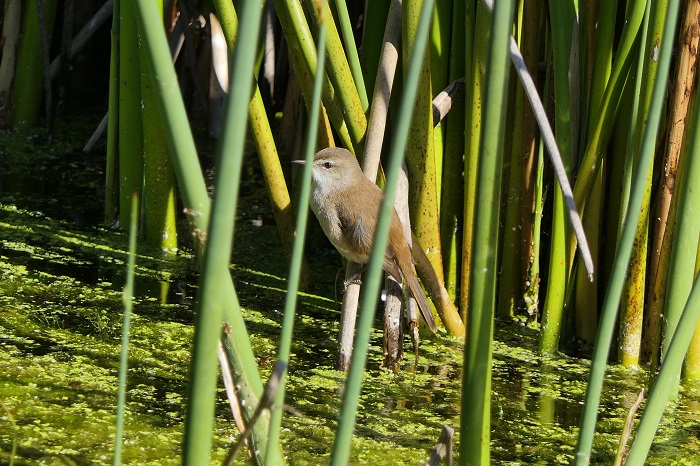
Intaka Island, Western Cape
Photo by Sharon Stanton
Further Resources
This species text is adapted from the first Southern African Bird Atlas Project (SABAP1), 1997.
The use of photographs by Georg Jacobs, Johan Heyns, Jon Blanco, Les Underhill, Lia Steen, Mark Stanton, and Sharon Stanton is acknowledged. Additional photographs by Ryan Tippett.
Other common names: Cape Reed Warbler (Alt. English); Kaapse rietsanger (Afrikaans); Rousserolle à bec fin (French); Kaapse Rietzanger (Dutch); Kaprohrsänger (German); Rouxinol-pequeno-dos-pântanos (Portuguese).
Recommended citation format: Tippett RM. 2026. Lesser Swamp Warbler Acrocephalus gracilirostris. Biodiversity and Development Institute. Available online at https://thebdi.org/2026/02/23/lesser-swamp-warbler-acrocephalus-gracilirostris/
List of bird species in this format is available here.
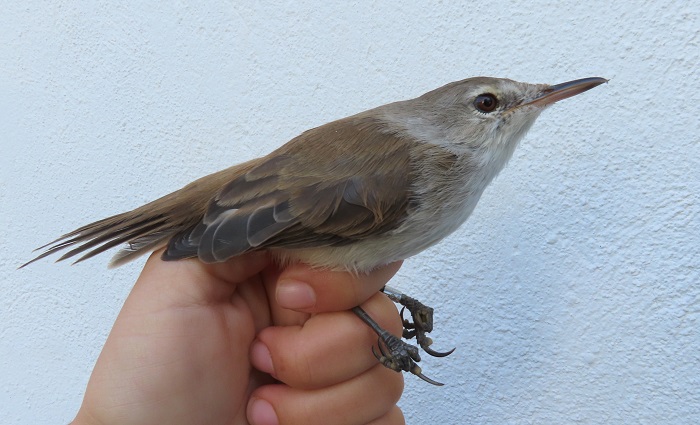
Karoo-Gariep Nature Reserve, Northern Cape
Photo by Jon Blanco
