
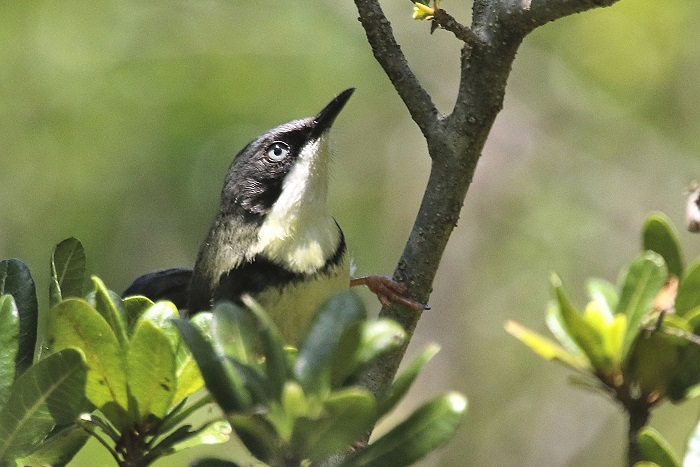
Cover image: Bar-throated Apalis by Lia Steen – Port Edward, KwaZulu-Natal
Apalises belong to the Family CISTICOLIDAE. This is a group of small passerine birds found mainly in warmer southern regions of the Old World and contains around 168 species divided into 26 genera. This family is thought to have originated in Africa, which is home to the majority of species, but members of the family can also be found in Europe, tropical Asia, and Australasia. They were formerly included within the Old World warbler family Sylviidae.
Identification
The Bar-throated Apalis is a very small, slender species. It shows considerable plumage variation due to the presence of 13 recognised subspecies in southern Africa.
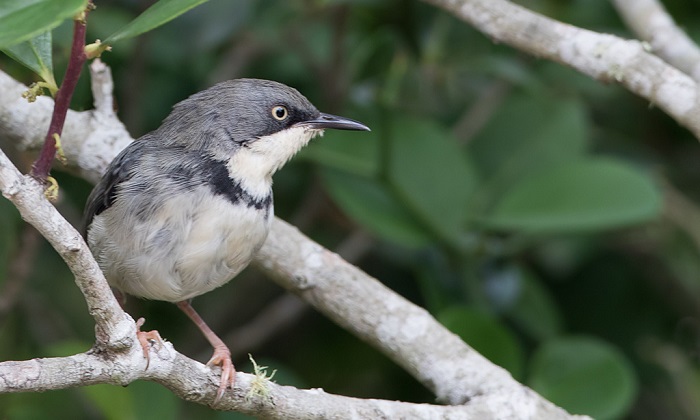
Cape St. Francis, Eastern Cape
Photo by Gregg Darling
In adult birds, the upperparts (head, nape, back, and wings) are greyish, often with a tinge of green. The green tinge varies, with northern populations being much greener than birds from the south of their range. The tail is dark grey with white outer tail feathers. The throat is white, bordered below by a black band or collar. The rest of the underparts vary from creamy white to yellow. Birds from the south of their range are whiter below, becoming increasingly yellow further north. The eyes are white, the bill is blackish, and the legs and feet are pinkish. The Bar-throated Apalis is the only apalis in the region with whitish eyes. The sexes are alike.
Juveniles resemble adults, but the breast band is indistinct.
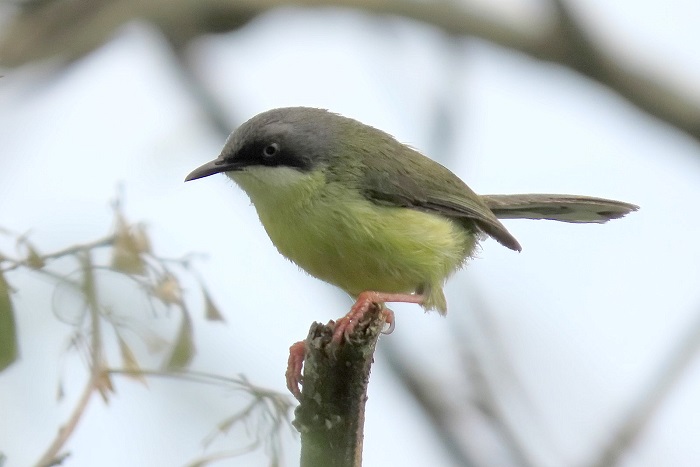
Albert Falls Nature Reserve, KwaZulu-Natal
Photo by Colin Summersgill
The Bar-throated Apalis could be mistaken for the Rudd’s Apalis (Apalis ruddi), but the latter lacks white in the outer tail and has dark brown (not white) eyes. The Yellow-breasted Apalis (Apalis flavida) has an incomplete or absent breast band and eyes reddish-brown (not white) eyes.
Status and Distribution
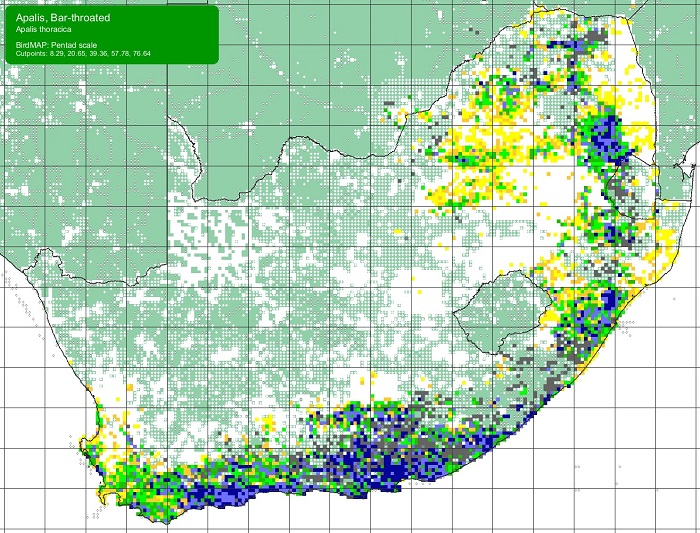
Details for map interpretation can be found here.
The Bar-throated Apalis is common and occurs over much of Africa south of the equator in many distinct subspecies.
It is found discontinuously from south-east Kenya south through East Africa as far west as central Zambia, to South Africa. In southern Africa, it is found in eastern Botswana, central and eastern Zimbabwe and adjacent Mozambique. In South Africa, it is widespread in the wetter northern, eastern, and southern regions.
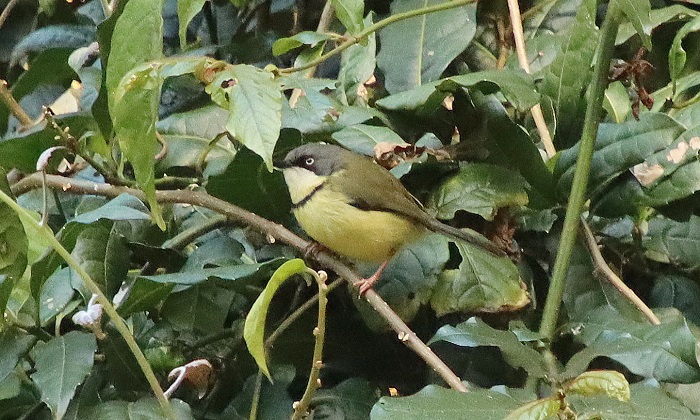
Magoebaskloof, Limpopo
Photo by Marius Meiring
There is no evidence to suggest that the historical distribution of the Bar-throated Apalis has changed. However, the spread of alien trees has allowed their expansion into some previously treeless regions. The Bar-throated Apalis is common throughout much of its range and does not appear to be under any particular threat.
Habitat

Ngoye Forest Reserve, KwaZulu-Natal
Photo by Ryan Tippett
The Bar-throated Apalis is adaptable and inhabits a range of wooded habitats. It is equally at home in the interior of evergreen or semi-evergreen forests, forest fringes, a variety of woodlands, as well as drainage lines in Karoo scrub and grassland. The Bar-throated Apalis also inhabits wooded gardens, alien plantations and areas with exotic trees.

Near Montagu, Western Cape
Photo by Karis Daniel
Behaviour
The Bar-throated Apalis is mostly a sedentary resident. However, some winter movement to lower altitudes is suspected in some areas. It is usually found in pairs, but may also be encountered singly or in small family groups of 4 to 6 birds. Pairs frequently join mixed bird parties.
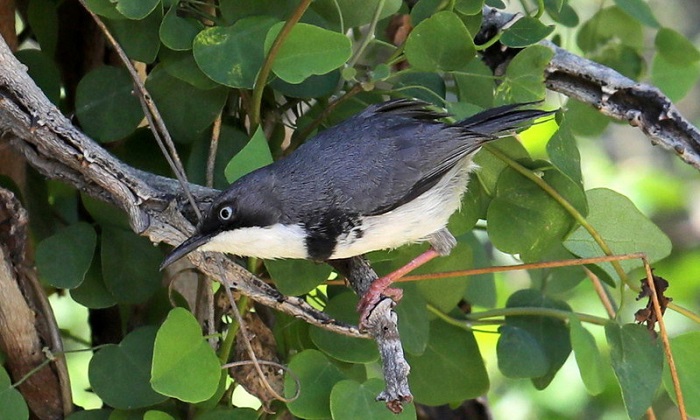
Bontebok National Park, Western Cape
Photo by Corrie du Toit
The Bar-throated Apalis forages restlessly in dense vegetation at all heights, favouring lower to middle levels. It often hops from branch to branch, calling frequently. It is not usually shy and is rather inquisitive and fairly tame.
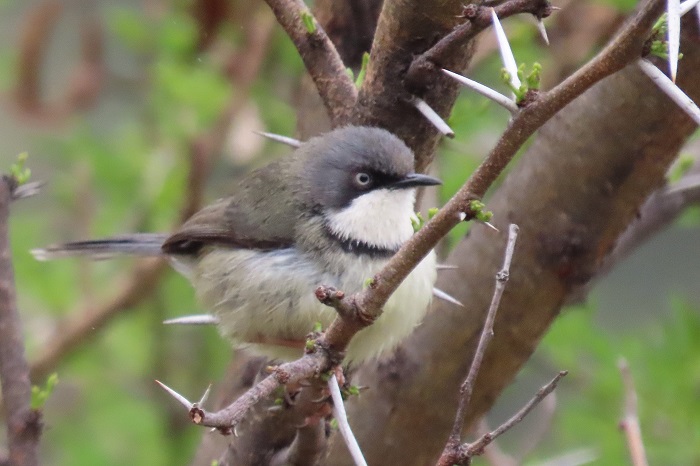
Cradock district, Eastern Cape
Photo by Zenobia van Dyk
Food is found mostly by gleaning from twigs, leaves, flowers, tree trunks and sometimes from lichen-covered rocks. It will also occasionally forage on the ground and may also hover to snatch insects or hawk small insects in flight. The Bar-throated Apalis consumes a range of small invertebrates and their larvae, including caterpillars, flies, small grasshoppers, beetles, bugs, insect eggs, and spiders. It is also known to eat small quantities of fruit.
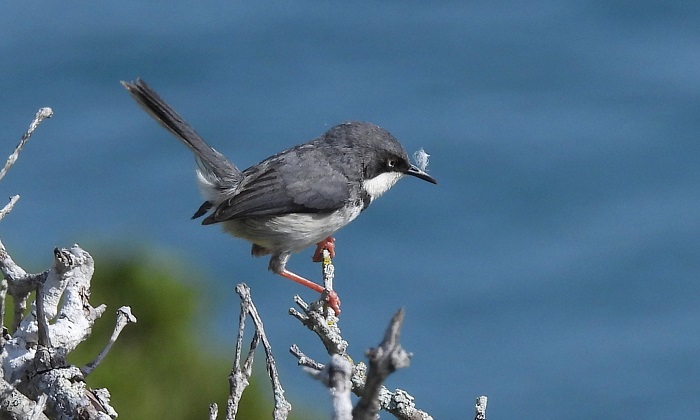
Robberg Nature Reserve, Western Cape
Photo by Richard Johnstone
The Bar-throated Apalis breeds mainly from October to February. Breeding in the south of its range begins earlier in the season than in the north. It is a monogomous, solitary nester, and pairs are territorial.
The nest is a small oval-shaped ball with a side-top entrance. It is loosely constructed out of green moss, fine plant fibres and spider web and variably lined with plant down. The nest is typically hidden in the thick foliage of a shrub, sapling, or creeper. Nests are most often located 1 to 2m above the ground.
2 to 4 eggs are laid per clutch and eggs are laid at daily intervals. They are pale greenish blue or pinkish white, variably marked with reddish-brown and grey spots.
The incubation period takes 14 to 17 days, and incubation duties are shared by both sexes. The newly hatched young are altricial and entirely dependent on their parents for survival. The nestling period lasts for 13 to 18 days. The young are fed by both parents.
The Bar-throated Apalis is often double-brooded. Bar-throated Apalis broods are sometimes parasitised by the Red-chested Cuckoo (Cuculus solitarius) and Klaas’s Cuckoo (Chrysococcyx klaas).
Further Resources
This species text is adapted from the first Southern African Bird Atlas Project (SABAP1), 1997.
The use of photographs by Colin Summersgill, Corrie du Toit, Gregg Darling, Karis Daniel, Lia Steen, Marius Meiring, Richard Johnstone, and Zenobia van Dyk is acknowledged. Additional photographs by Ryan Tippett.
Other common names: Bandkeelkleinjantjie (Afrikaans); uMabhelwane (Zulu); Ugxakhweni (Xhosa); Apalis à collier (French); Halsbandapalis (Dutch); Halsband-Feinsänger (German); Apalis-de-coleira(Portuguese).
Recommended citation format: Tippett RM. 2026. Bar-throated Apalis Apalis thoracica. Biodiversity and Development Institute. Available online at https://thebdi.org/2026/02/12/bar-throated-apalis-apalis-thoracica/
List of bird species in this format is available here.
