
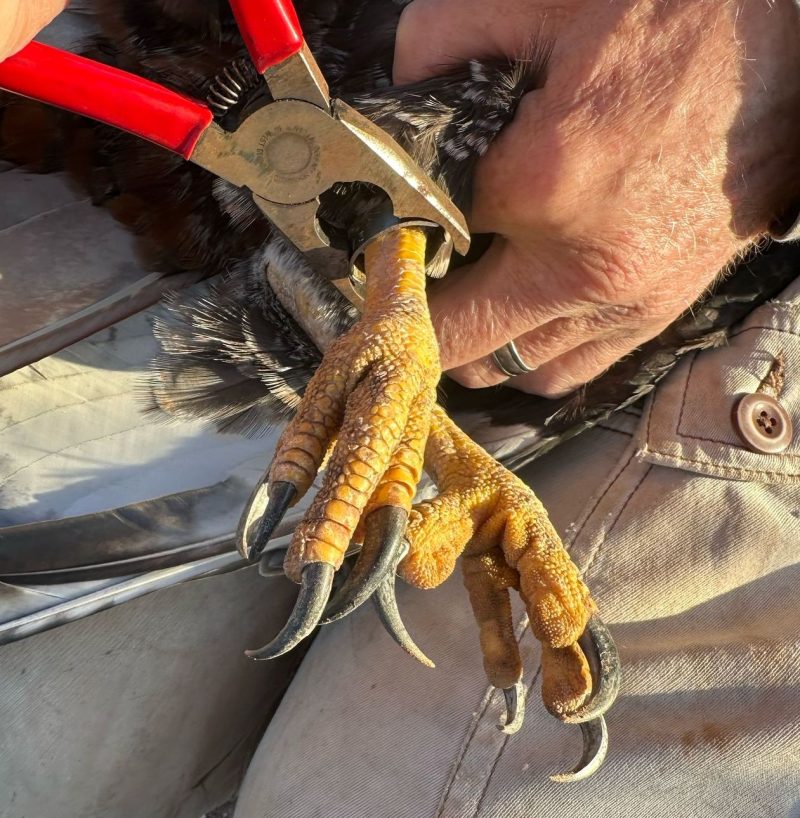
Expedition number five to the Nuwejaars Wetlands SMA. Our accommodation was in the delightful units at Hazevlakte.
We arrived Monday 7 April, put up nets in the Hazevlakte werf and handled 53 birds before nightfall. We spent the morning of Tuesday 8 April at the floodplain of the Nuwejaars River, on the farm Moddervlei and caught 39 birds of 16 species. On Wednesday morning we ringed around the dam on the farm Kossierskraal. Between some bouts of light drizzle, we handled a total of 20 birds of 10 species. On Wednesday afternoon we caught 58 birds of 11 species in and around the protea patch on the farm Zandvlakte. We furled the nets tightly closed for the night, and went back there early on Thursday morning to handle 104 birds of 18 species. In the afternoon we went to the farm Vlooikraal, and caught 11 birds of six species! The nets were furled overnight, and a few hours at Vlooikraal on Friday 11 April, departure day, yielded 23 birds of 13 species.
This table shows the numbers handled of each species, with retraps included in this total. These were all from our previous expeditions and were retrapped at the same places where they were ringed. Species underlined and in red have structured species texts on the BDI website; click on the species, and you are linked to the species text.
| Species | Number |
| **Jackal Buzzard | 1 |
| **African Marsh Harrier | 1 |
| **African Rail | 2 |
| **Black Crake | 2 |
| **Three-banded Plover | 1 |
| Crowned Lapwing | 1 |
| Blacksmith Lapwing | 5 |
| **African Snipe | 5 |
| Red-eyed Dove | 3 |
| Ring-necked Dove | 4 |
| **Fierynecked Nightjar | 2 |
| **Speckled Mousebird | 10 |
| **Giant Kingfisher | 2 |
| Malachite Kingfisher | 1 |
| **Brown-hooded Kingfisher | 1 |
| Fork-tailed Drongo | 4 |
| **Cape Bulbul | 23 |
| Sombre Greenbul | 3 |
| Cape Robin-chat | 9 |
| Lesser Swamp Warbler | 7 |
| Little Rush Warbler | 5 |
| Cape Grassbird | 1 |
| Bar-throated Apalis | 6 |
| Levaillant’s Cisticola | 4 |
| Fiscal Flycatcher | 8 |
| **Cape Batis | 5 |
| Cape Wagtail | 5 |
| Southern Fiscal | 4 |
| Southern Boubou | 4 |
| **Bokmakierie | 1 |
| Common Starling | 2 |
| Cape Sugarbird | 2 |
| Malachite Sunbird | 14 |
| Southern Double-collared Sunbird | 8 |
| **Amethyst Sunbird | 4 |
| House Sparrow | 1 |
| Cape Sparrow | 8 |
| Cape Weaver | 48 |
| Southern Masked Weaver | 5 |
| **Common Waxbill | 7 |
| Cape Canary | 4 |
| **Streaky-headed Canary | 1 |
| Cape Bunting | 2 |
| Olive Thrush | 2 |
| Cape White-eye | 63 |
| Karoo Prinia | 2 |
| Southern Grey-headed Sparrow | 7 |
| Total (47 species) | 310 |
The rest of this blog consists mostly of photos of a selection of these 47 species! The photos are in the same order as in the table. The species in the table with a double asterisk in front of them are the ones with photos!
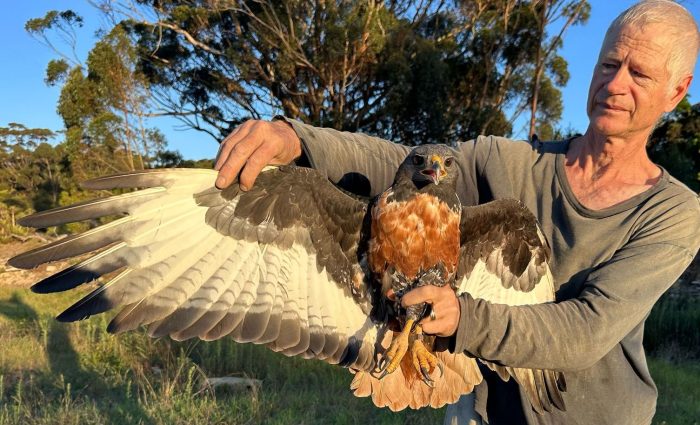
Dieter Oschadleus is holding this Jackal Buzzard which was caught using a Balchatri trap along the gravel road southwest of the farm Vlooikraal. If you travel along that road, please inspect the Jackal Buzzards to confirm that this one is alive and well!
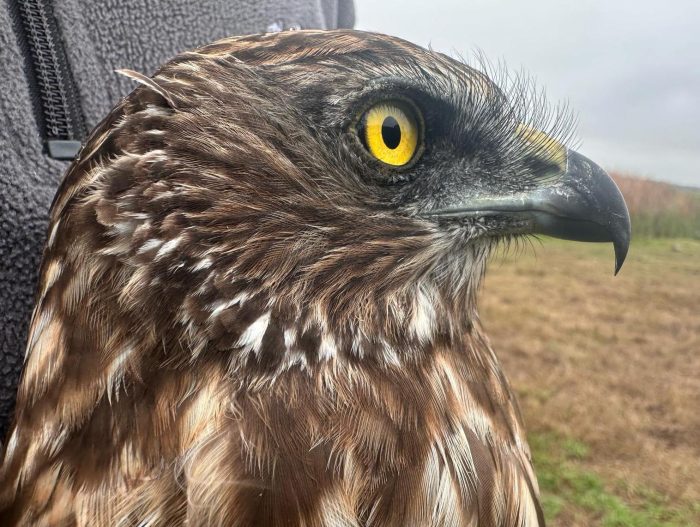
This African Marsh Harrier was caught in a large-mesh mistnet in the floodplain at Moddervlei. This is a species that demands high-quality habitat and lots of it, which the recently restored wetlands provide.
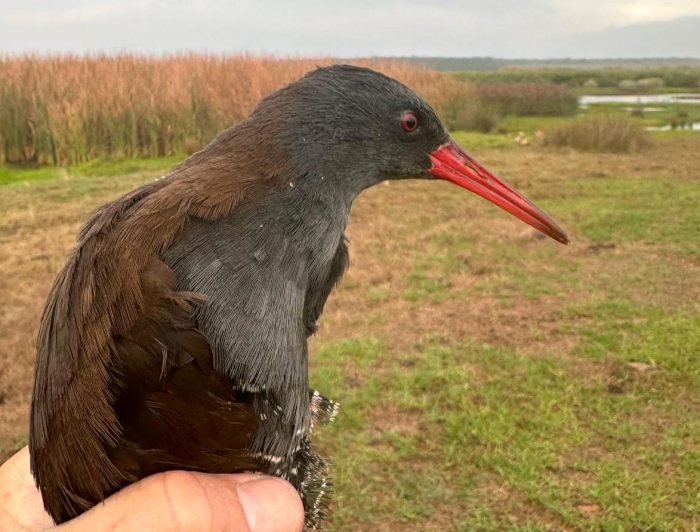
The African Rail is another species that is only present in high-quality habitats. It is not a species which is easy to observe or detect in a wetland. The fact that we caught, not one, but two, birds of this species is greatly encouraging to everyone who was involved in the wetlands restoration project.
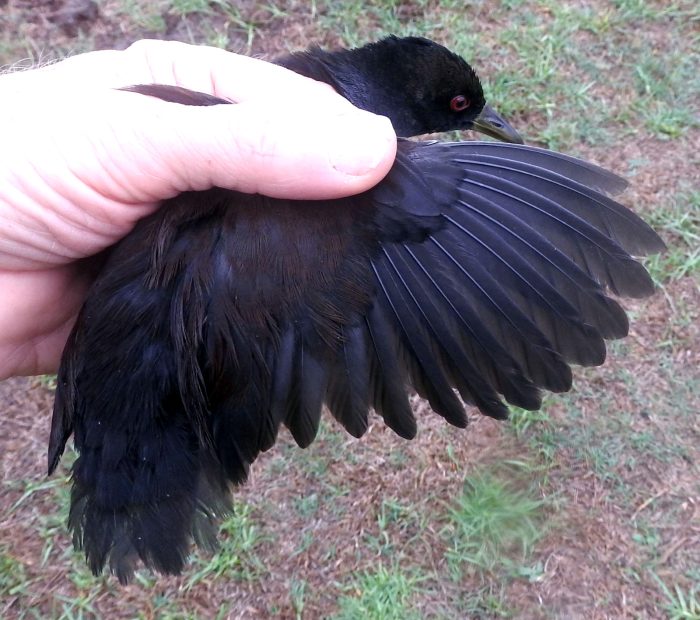
This is a juvenile Black Crake. The bill is just starting to think about turning yellow!
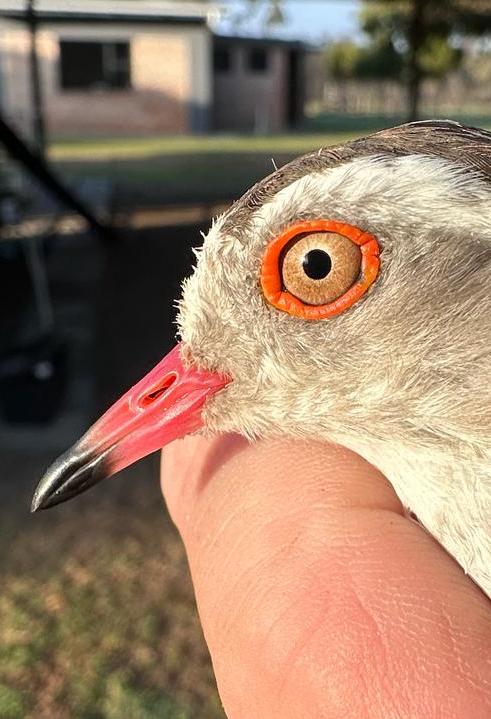
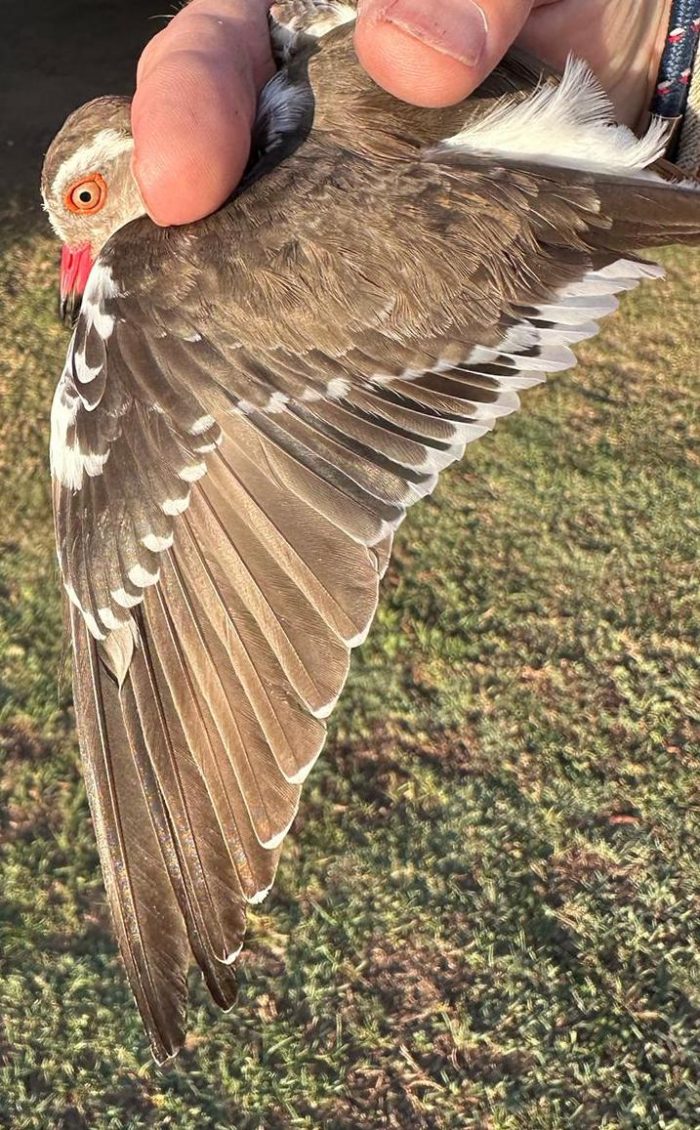
It is the privilege of being a ringer to see what the eye and eye-ring of a Three-banded Plover really look like. Careful inspection of the photo on the right reveals that this is a young bird. The photo was taken in April 2025, and this bird would have hatched in the spring 2024 breeding season. So at a guess it is somewhere between about five and eight months old. Much of the juvenile plumage has been replaced, but many of the coverts on the back have narrow white fringes; that is a give-away for a young wader! Looking at the main flight feathers in the wing, the primaries, the outermost few feathers are a darker shade of brown to the six inner primaries. It seems that this bird has moulted the outer three primaries, and replaced them. The inner primaries belong to its original set, grown in a rush in the first weeks of life, and therefore likely to be of low quality. It is the outer primaries that do the heavy lifting. So replacing them early in life is a great survival strategy.
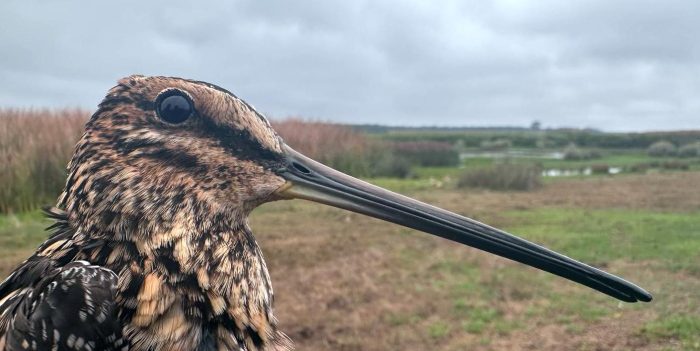
If you look up and down at the birds featured in this blog, most of them have bills which are shorter even much shorter, than their heads. The bill of this African Snipe is about two-and-a-half times as long as its head.
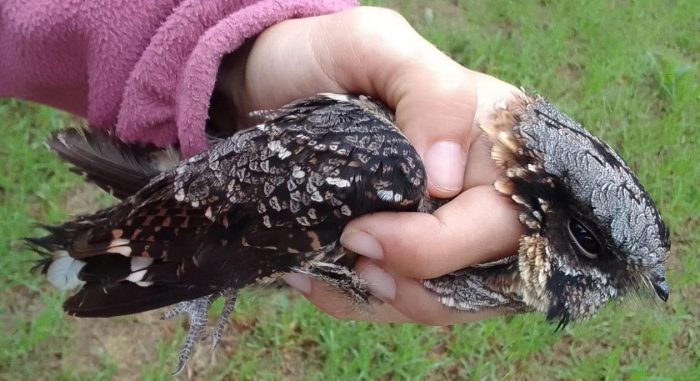
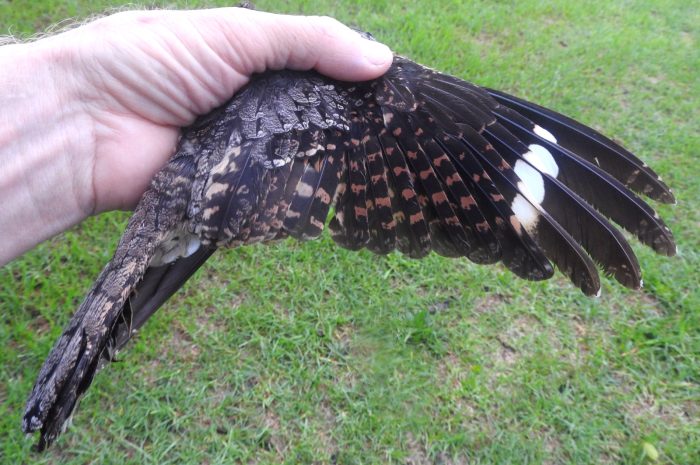
The detail of the patterns of the Fiery-necked Nightjar in the two photos above is impressive. In most species of birds the relative sizes of the primaries form a fairly sensible curve, often a parabola. Not the nightjars! The endpoints of the inner six primaries form a more or less straight line. Primary seven is much longer than number six, a serious discontinuity! Primaries eight and nine are slightly longer than primary seven. and primary ten is a bit shorter.
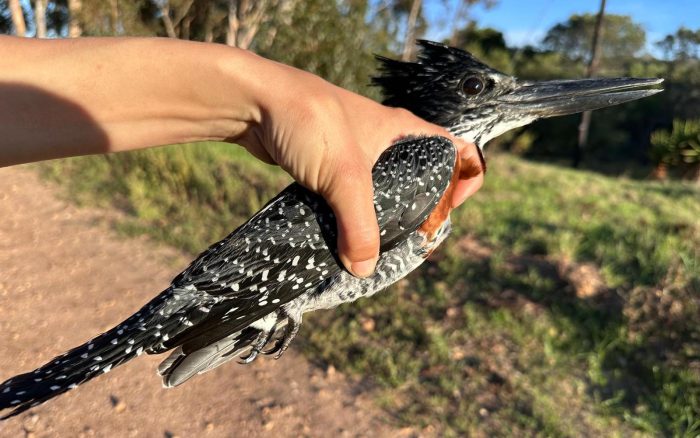
The Giant Kingfisher is a large bird. This is a male with the top of the front brown and the bottom white; in the female the colours are the other way round.
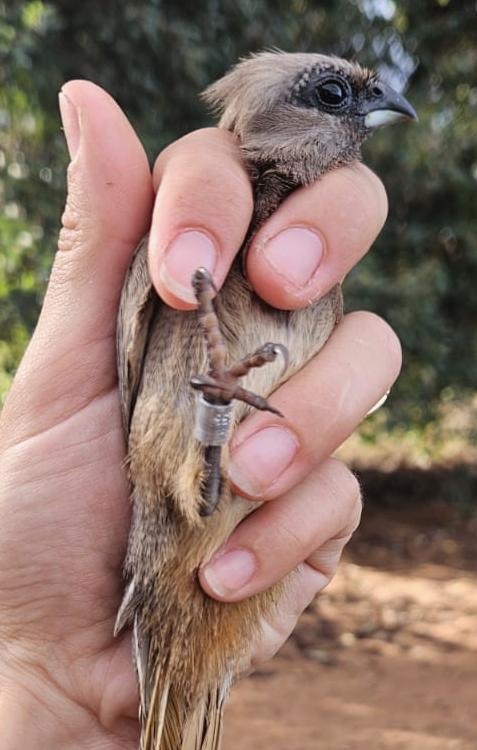
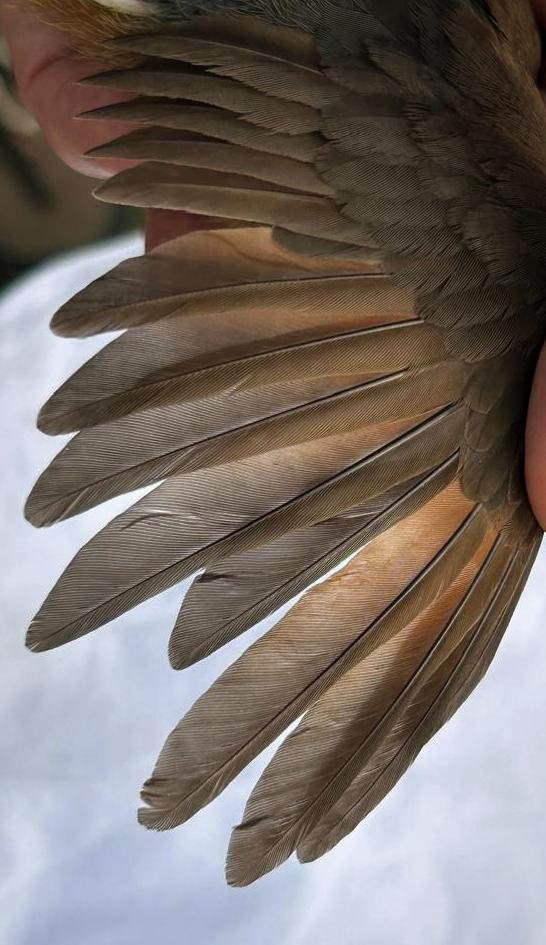
Close up, like this you can see the pattern of markings that give the Speckled Mousebird its name. It is not a useful identification feature.
The mousebird on the right is moulting its primaries. Mousebirds have 10 primaries, but only eight are easily visible against the white background. The inner four are slightly darker than the outer primaries, so are newly grown. Primary five is actively growing. The scene of growth action is at the base of the primary, where it emerges through the skin. The feather production organ here has been activated, and has a rich supply of blood. Ringers know to be careful when handling birds in moult, and to avoid making contact with these feather factories. Once the feather is fully grown, and the outer tip of the feather has lined up with the other primaries, blood supply ceases, and the feather growth organ atrophies until it is needed again, in a year’s time. The three visible outer primaries are old, and look a bit thin and fragile compared to the new ones. The 10th primary is about half size; and in the photograph it is lying on top of the ninth. That makes nine primaries so far. The missing primary has to be primary six, just outside the primary which is growing! So, in summary, primaries one to four are new, primary five is actively growing, the old primary six has been discarded, and the new feather is not yet visible, and the four outer primaries, seven to ten, are a year old, and are waiting their turn for replacement. If all the primaries were replaced at the same time, the bird would not be able to fly.
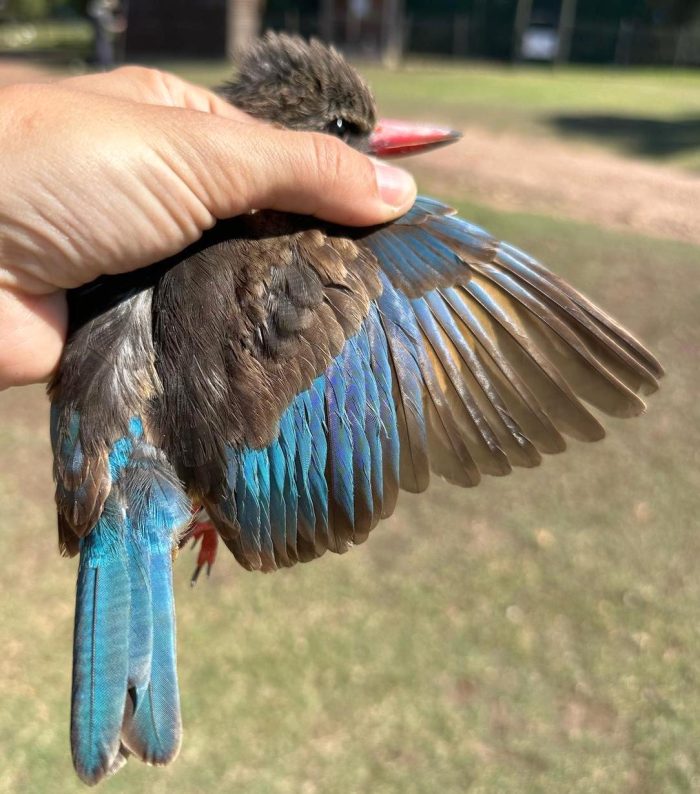
Brown-hooded Kingfisher.
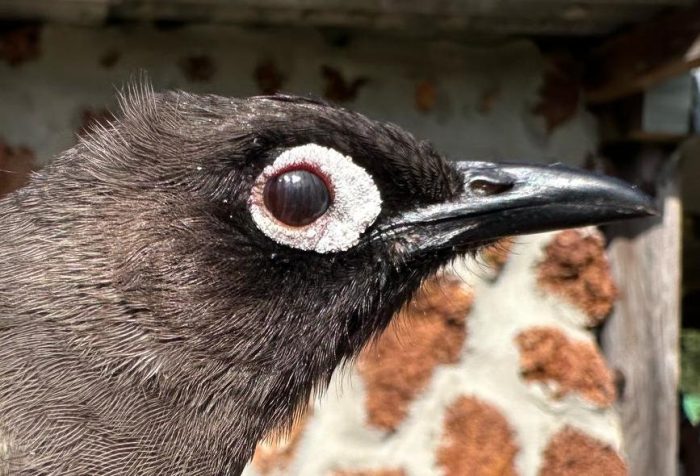
The white cere surrounding the eye of the Cape Bulbul is elliptical, not circular, and the eye is towards the back end of the oval. For the African Red-eyed Bulbul, the cere is red and circular, and the eye is in the middle of the circle. According to the field guides, the Cape Bulbul is the only species that ought to occur in the Overberg, and on the Agulhas Plain, all bulbuls really should be Cape. But there are two nearby records of African Red-eyed Bulbul: one at Stanford and one at Struisbaai, Cape Agulhas (have a look at this paper in Biodiversity Observations; and be aware that the African Red-eyed Bulbul is expanding its range southward! Read this paper, entitled Range expansion of African Red-eyed Bulbul Pycnonotus nigricans in western South Africa, OpenAccess in Ostrich). On this particular expedition, we ringed 23 Cape Bulbuls, and zero African Red-eyed Bulbuls, but we are always alert to the possibility!
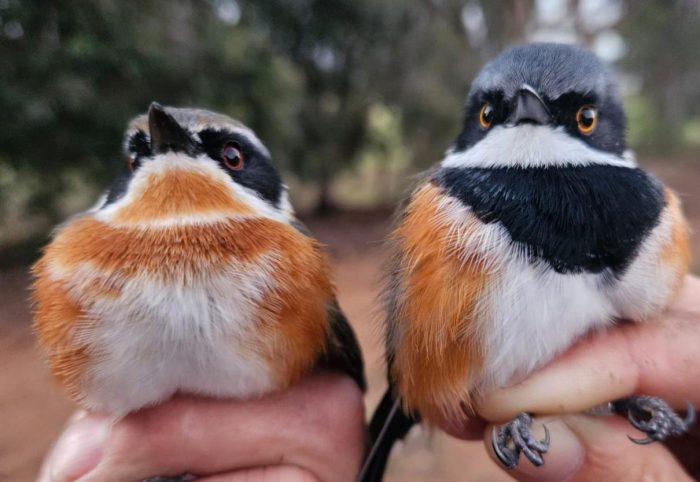
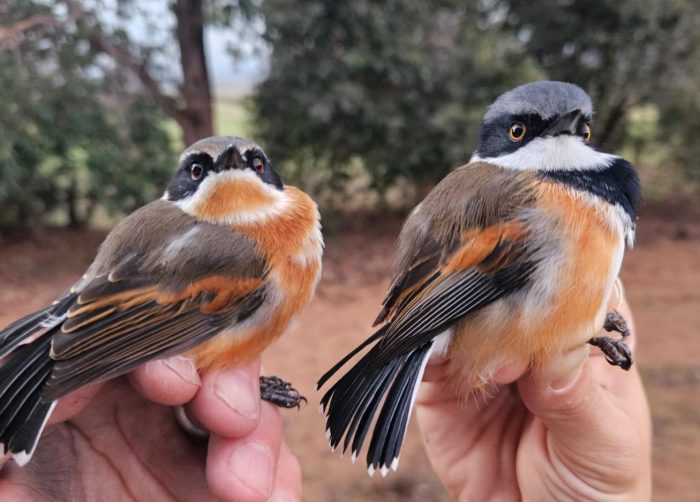
It is rare to have the opportunity to take a photograph of a female (left) and male Cape Batis side-by-side. Here they are again!
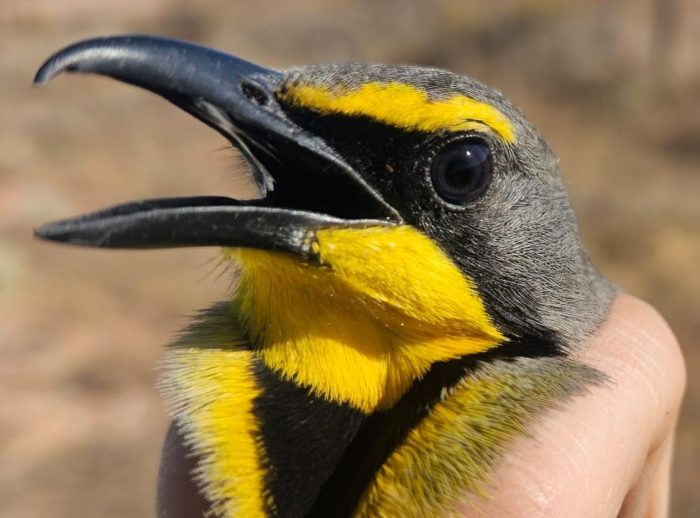
The bill of the Bokmakierie is a formidable weapon. It will turn a caterpillar instantly to mincemeat, and even a beetle with a tough exoskeleton doesn’t stand a chance.
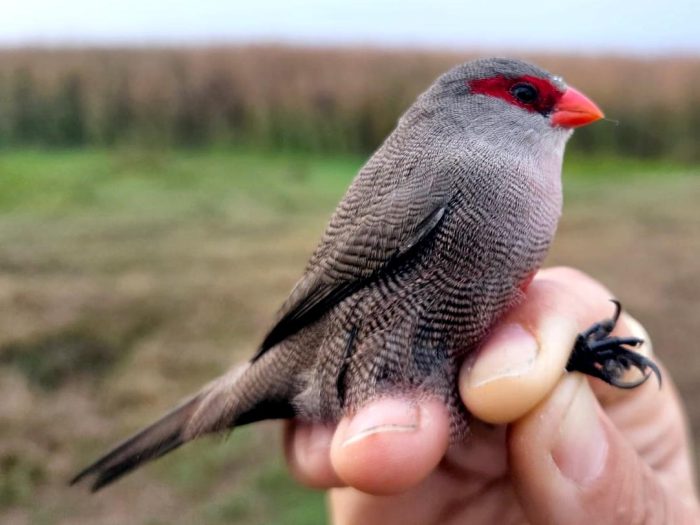
From the close-up view of the bird ringer, the Common Waxbill has the same zebra pattern all over. Simple, delicate stripes.
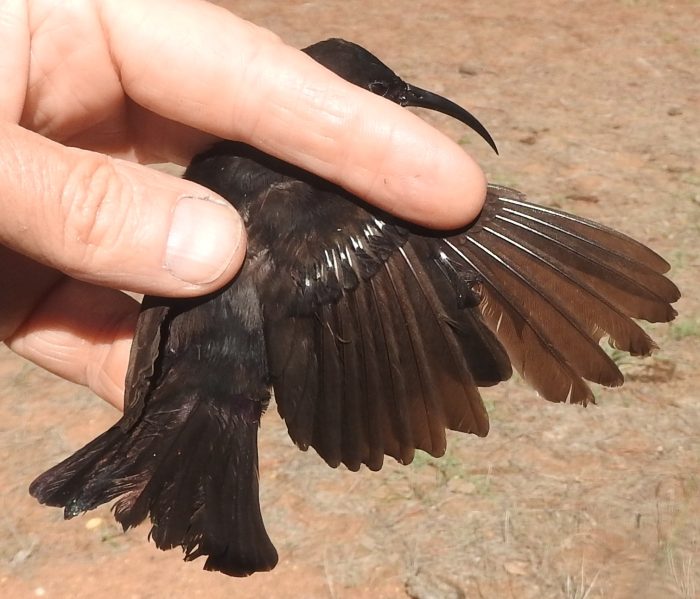
The Amethyst Sunbird is steadily extending its range westward. But it is still a relatively unusual species on the Agulhas Plain. From this angle, it is easy to grasp why its English common name was Black Sunbird.
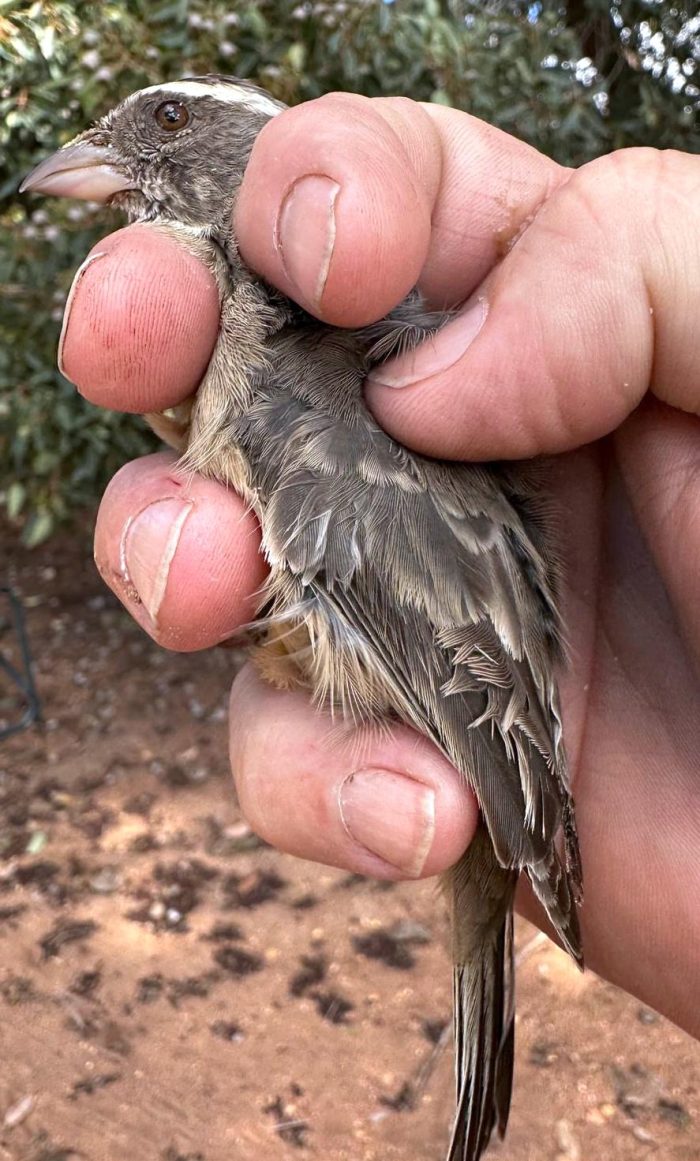
The Streaky-headed Canary has the typical bill of a seedeater: short, stubby and roughly cone-shaped. The beak is powerful, and is used for dehusking seeds.
The team of ringers for this trip consisted of Dieter Oschadleus, Jade Wilding, Oliver Fox, Roger Walsh and myself. Jade, Oliver and Roger were visiting ringers from the UK. They are intensely involved in the Kartong Bird Observatory in The Gambia and transferred to us lots of skills gained in The Gambia and the UK.
Thanks
We are grateful to Con and Karen Neethling for enabling us to use the units at Hazevlakte as our base. Con Neethling, Liohan Giliomee and Mick D’Alton gave us permission to ring on their farms. Eugene Hahndiek, Erica Brink and Ross Kettles in the offices of the Nuwejaars Wetlands SMA helped in lots of ways.
… and …
… you can read about future ringing events here. There is a list of reports like this here. The value and importance of bird ringing to research and conservation is described here.