

Cover image of Barn Swallow by Andries de Vries – Middelburg district, Mpumalanga – BirdPix No. 266068
The Barn Swallow belongs to the family HIRUNDINIDAE, a group that includes Swallows, Martins, and Saw-wings. They are small to medium-sized passerine birds, noted for their streamlined bodies, long, pointed wings, and square or forked tails, often with very long outer rectrices. Their bills are small and flattened with a wide gape, and their legs are very short and weak. All are highly adapted to aerial feeding, and most are gregarious, at least when not breeding. This family has a global distribution and comprises around 90 species, with the greatest diversity being found in Africa. 21 species have been recorded from southern Africa.
Identification

Dinokeng, Gauteng
Photo by Philip Nieuwoudt
The Barn Swallow is medium-sized in comparison to other swallows. In adults, the upperparts are dark glossy blue. The forehead, chin and throat are rufous coloured, and the lores are black. The throat is bordered below by a blue-black band. In some races, the rufous throat extends into the collar, sometimes even replacing it.
The rest of the undersides are creamy white to buff coloured, often with a pinkish wash in fresh plumage. The flanks occasionally carry some chestnut feathers.

Near Ashburton, KwaZulu-Natal
Photo by Malcolm Robinson
The tail is glossy blueish-black with oval-shaped white patches on the inner webs of all but the central pair of tail feathers. The outermost rectrices are elongated into streamers.
The underwing coverts are white to off-white. The small, slender bill is black. The legs and feet are also black, and the eyes are dark brown. The sexes are very similar; however, males have longer tail streamers and larger white windows on the tail.

Kruger National Park, Limpopo
Photo by Lappies Labuschagne
Immature birds have brownish upperparts with variable blue-black patches depending on age. The forehead and throat are off-white to buff with a broad black collar on the upper breast. The lower breast and belly are buff or off-white.

Near Gouritzmond, Western Cape
Photo by Johan Van Rooyen
In southern Africa, the adult Barn Swallow is conspicuous and is not likely to be confused with any other swallow, except perhaps the Angolan Swallow Hirundo angolensis, which is similar but only occurs as a rare vagrant to the extreme northern parts of Namibia. Immature birds most resemble immature White-throated Swallow Hirundo albigularis but have a much broader collar.
Habitat
The Barn Swallow is found over all habitats in southern Africa, particularly in the moister east, favouring open grassland, pastures, cultivation, marshes and open water. The Barn Swallow is most abundant in the higher rainfall eastern half of the subcontinent. It is scarce in semi-arid and desert habitats, but can sometimes be locally common in the eastern Karoo and Kalahari.

Isimangaliso Wetland Park, KwaZulu-Natal
Photo by Ryan Tippett
It is generally uncommon at high altitude, including the Drakensberg. In South Africa, the Barn Swallow is most prevalent in the Grassland, Savanna, and Fynbos Biomes
Behaviour
Barn Swallows breed throughout the Palaearctic and Nearctic and spend the non-breeding season in South America, Africa, southern Asia, and Australasia. The total number of Barn Swallows from western Europe entering Africa each year has been estimated at 22-44 million, and possibly twice that many come from eastern Europe and Asia.
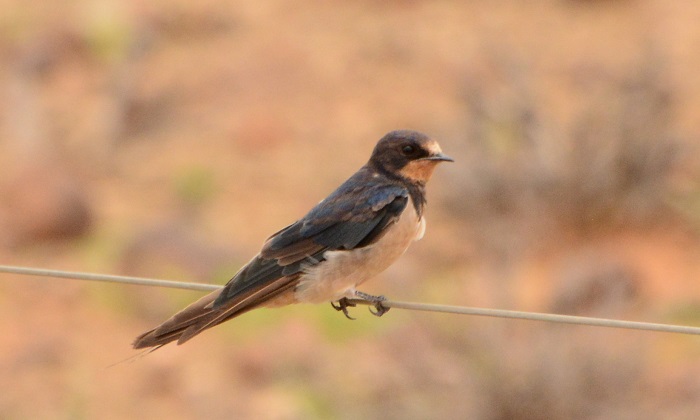
Carnarvon district, Northern Cape
Photo by Ryan Tippett
Barn Swallows first arrive in South Africa during September, although most arrive in October or early November. Arrivals in the most southerly parts of their range are a little later than further north. Departure dates for all areas are from mid-March to early April, with small numbers of birds still recorded in May.
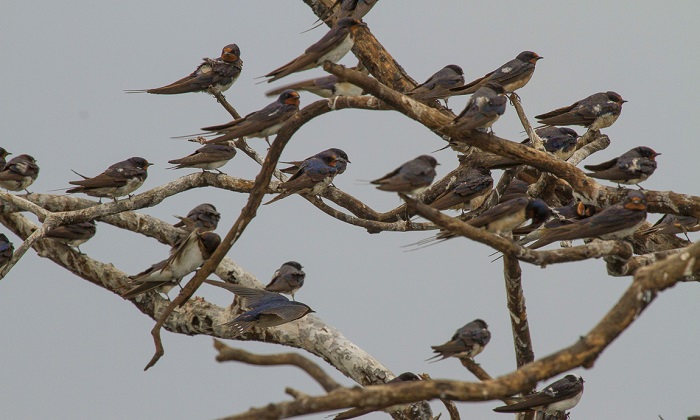
Chobe National Park, Botswana
Photo by Derek Solomon
Before their northward departure, Barn Swallows congregate in their hundreds or thousands. Perching on trees or utility lines, they excitedly gather themselves for their northward migration, where they may travel around 12000 km in just 34 days or so. Overwintering has been recorded in South Africa, but it is rare and most prevalent in the southwestern Cape Province.
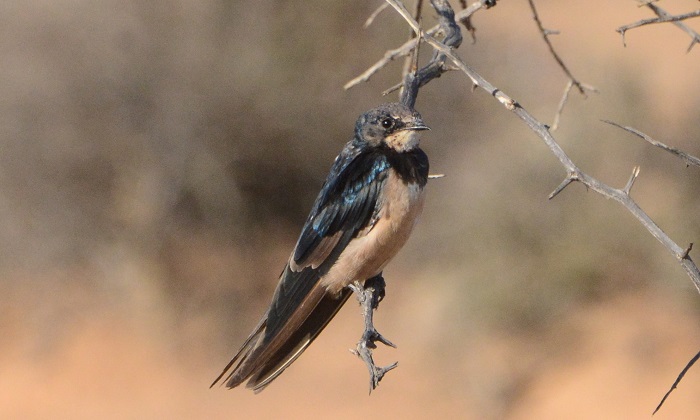
Carnarvon district, Northern Cape
Photo by Ryan Tippett
Barn Swallows are highly gregarious in southern Africa. At some roost sites, which have been in use for at least 50 years, flocks have been estimated to contain up to 3 million birds. Flocks sometimes also roost in trees or in maize fields. Flocks typically break up into smaller groups and scatter widely by day.

Darvill, KwaZulu-Natal
Photo by Malcolm Robinson
Barn Swallows may forage singly or in loose groups of up to several hundred birds. They feed aerially at all heights, often in the company of other swallows or swifts. The flight is quick and agile, often swooping low over the ground.

Near Malmesbury, Western Cape
Photo by Gerald Wingate
Barn Swallows feed predominantly on flying insects that they capture in aerial pursuit. They will also take other arthropods that they seize from vegetation, from off the ground, or by skimming the water surface, all whilst in flight. Recorded prey items include flies, midges, mosquitoes, moths, ants, caterpillars, termite alates, spiders, and amphipods, amongst others. They are also known to feed on the fleshy arils of alien Rooikrans (Acacia cyclops) seeds. They drink regularly by skimming the water surface in flight.

Witsieshoek Mountain Lodge, Free State
Photo by Mark Stanton
Flocks of Barn Swallows are sometimes attracted to grazing cattle, buffaloes and other large animals to feed on disturbed insects. They will also loosely follow vehicles and ploughs for the same reason.
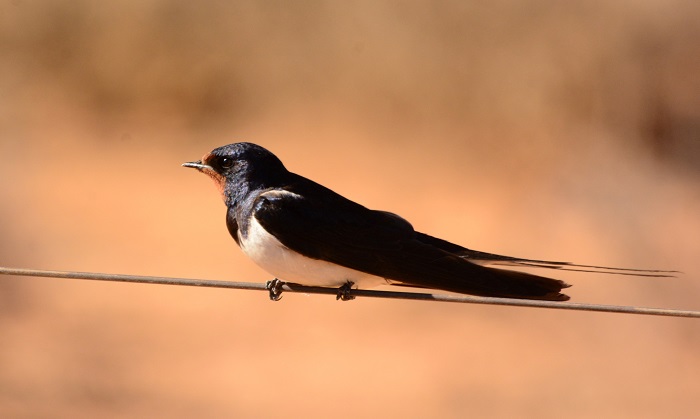
Carnarvon district, Northern Cape
Photo by Ryan Tippett
Groups or individuals rest periodically by perching on trees, fence lines or any other suitable perch. During inclement weather, they frequently perch low or sit on the ground.

Carnarvon district, Northern Cape
Photo by Ryan Tippett
Status and Distribution
The Barn Swallow occurs throughout southern Africa and is an abundant non-breeding Palearctic migrant. It is the most widespread swallow species globally, occurring on every continent except Antarctica.

Details for map interpretation can be found here.
In southern Africa, large-scale communal roosting in reedbeds means the Barn Swallow is vulnerable to accidental poisoning due to avicide spraying for the control of queleas and other pest seedeaters. The burning of reedbeds, which is particularly prevalent in dry years, may raise local mortalities.
The Barn Swallow is undergoing a slow, steady decline in many European countries. However, the population in North America has seen an increase during the 20th century. Overall, the Barn Swallow remains abundant and is not globally threatened.

Kanonberg, Western Cape
Photo by Marius Meiring
Further Resources
Species text adapted from the first Southern African Bird Atlas Project (SABAP1), 1997. That text can be found here.
The use of photographs by Andries de Vries, Deon van der Hoven, Derek Solomon, Gerald Wingate, Johan Van Rooyen, Malcolm Robinson, Marius Meiring, Mark Stanton, and Philip Nieuwoudt is acknowledged. Additional photos by Ryan Tippett.
Virtual Museum (BirdPix > Search VM > By Scientific or Common Name).
Other common names: European Swallow, Eurasian Swallow (Alt. English); Europese swael (Afrikaans); Mbawulwana (Tswana); iNkoniane (Zulu); Inkonjane (Xhosa); Hirondelle rustique (French); Rauchschwalbe (German); Andorinha-das-chaminés (Portuguese); Boerenzwaluw (Dutch).
A list of bird species in this format is available here.
Recommended citation format: Tippett RM 2024. Barn Swallow Hirundo rustica. Biodiversity and Development Institute. Available online at https://thebdi.org/2024/05/16/barn-swallow-hirundo-rustica/

Rietvleidam, Gauteng
Photo by Deon van der Hoven
