

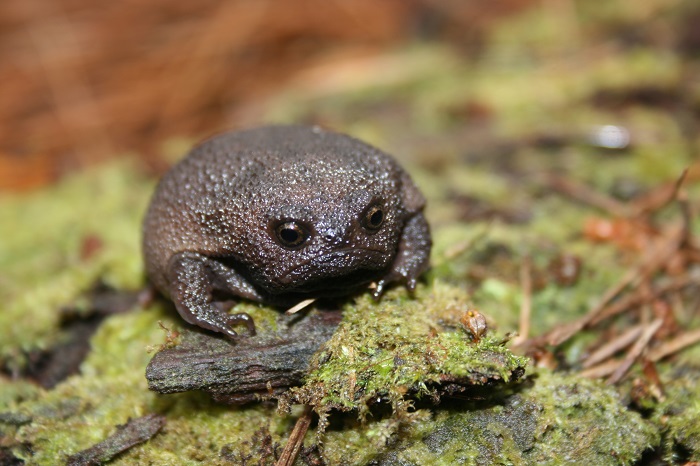
View the above photo record (by Faansie Peacock) in FrogMAP here.
Find the Plain Rain Frog in the FBIS database (Freshwater Biodiversity Information System) here.
Family Brevicepitidae
Identification
The Plain Rain Frog is a stout species with short legs and small, dark eyes. Females can attain 51mm in length and are larger than the males. The upper sides are dark brown to black and devoid of markings. The underside is smooth and dark, sometimes with indistinct light spots.
Habitat
The Plain Rain Frog inhabits Afromontane Forest and Mountain Fynbos along the southern coastal belt (Burger 1992; D. McDonald pers. comm.). It occurs at a range of altitudes to well in excess of 1000 m above sea level. The Plain Rain Frog also occurs down to sea level, where mountains reach the coast. The Grootvadersbosch area is transitional between winter and all-year rainfall, with an average annual rainfall of 1050 mm. Relatively dry periods are May–July and December–January. The forests at Grootvadersbosch are situated on clay soils derived from Bokkeveld shales, while the fynbos occurs on sandy soils derived from Table Mountain Sandstone.
Behaviour

Garden Route Botanical Garden, Western Cape
Photo by Christiaan Steenkamp
The Plain Rain Frog often occurs at high densities in suitable habitats. In forest these frogs may be found in short, vertical tunnels under logs (pers. obs.). When disturbed, they inflate their bodies to such an extent that they are difficult to remove from the tunnels – probably an adaptive strategy to escape predation. The vertical tunnels are connected to a network of shallow horizontal tunnels leading away in all directions, from which they emerge to feed (L.R. Minter pers. obs.).
The Plain Rain Frog is a summer breeder that starts to call in September (H. Braack pers. comm.), forming large choruses that may continue for several days in rainy weather. Males may call from vegetation up to 1 m above the surface, (pers. obs.; D. McDonald pers. comm.) and sometimes from within their shallow burrows.
Adhesive amplexus occurs (Visser et al. 1982). The eggs are 5 mm in diameter, within 8 mm capsules, and yellow in colour. The egg chambers are c.30–40 mm below the surface and the known clutch sizes are 42 and 43 eggs, each topped with a layer of 25–30 empty egg cases (Channing 2001).
Predation by the Bush Pig Potamochoerus larvatus has been recorded, with 18 B. fuscus specimens found in the stomach of one pig (Palmer 1982).
Status and Conservation
Although the Plain Rain Frog has a relatively restricted distribution range, it appears not to be of conservation concern. Overutilisation of indigenous forests and the creation of exotic timber plantations during the past century or more undoubtedly impacted some populations, but the species is still abundant at several localities. It is known from the following protected areas: Tsitsikamma National Park (Carruthers and Robinson 1977; Branch and Hanekom 1987), Outeniqua Conservation Area, Grootvadersbosch Nature Reserve, and Marloth Nature Reserve.
Saasveld, Western Cape
Photo by Damian van Aswegen
Distribution
The Plain Rain Frog is endemic to the southern Cape Fold Mountains in the Western and Eastern Cape provinces of South Africa. It occupies a narrow, linear strip along the south-facing slopes of the mountain ranges that run parallel to the coast, from the Langeberg Mountains near Swellendam (3320CD) in the west, to Dieprivier Forest near Kareedouw Pass (3324DC) in the east.

An aural record from Zuurberg (3325BC; H.H. Braack pers. comm.) is not shown on the map and requires confirmation. B. fuscus is sympatric with B. acutirostris at Grootvadersbosch Nature Reserve (3320DD) and adjacent grid cells, and with B. montanus over most of its range. The distribution pattern of this species is, for the most part, continuous except for a break between the Langeberg and Outeniqua mountains. Speculation that B. fuscus might occur at Joubertina, Niekerksberg, and Prince Alfred Pass (Burger 1992) has not been confirmed. Calls heard at Joubertina were subsequently attributed to B. adspersus pentheri (pers. obs.), and the other records require verification.
Further Resources
The use of photographs by Christiaan Steenkamp, Damian van Aswegen, and Faansie Peacock is acknowledged.
Plain Rain Frog Breviceps fuscus Hewitt, 1925
Other Common Names: Black Rain Frog Frog (Alt. English); Gewone Janblom (Afrikaans)
Recommended citation format: Burger, M; Tippett, RM. (2025). Plain Rain Frog Breviceps fuscus. Biodiversity and Development Institute, Cape Town. Available online at https://thebdi.org/2022/01/25/plain-rain-frog-breviceps-fuscus/
This species text has been updated and expanded from the text in the
2004 frog atlas: Burger, M. (2004). Plain Rain Frog Breviceps fuscus. In Minter LR et al 2004.
References:
Minter, LR; Burger, M; Harrison, JA; Braack, HH; Bishop, PJ; Kloepfer, D. (Editors). (2004). Atlas and Red Data Book of the Frogs of South Africa, Lesotho and Swaziland. Smithsonian Institution, Washington, and Avian Demography
Unit, Cape Town.
Carruthers, V; du Preez, L. (2017). Frogs of southern Africa: A Complete Guide. Struik Nature, Cape Town.
Channing, A. (2001) Amphibians of Central and Southern Africa. Protea Book House, Pretoria
Claus, B; Claus, R. (2002). Common Amphibians and Reptiles of Botswana. Gamsberg Macmillan, Windhoek.
