
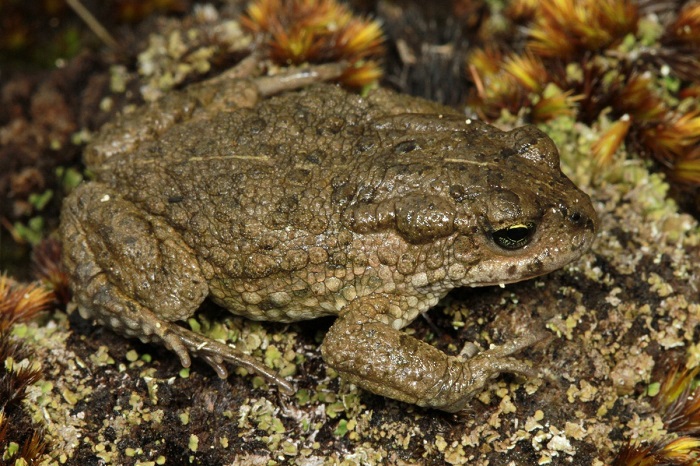
View the above photo record (by Luke Kemp) in FrogMAP here.
Find the Amatola Toad in the FBIS database (Freshwater Biodiversity Information System) here.
Family Bufonidae
AMATOLA TOAD – Vandijkophrynus amatolicus
Hewitt, 1925
Identification
Vandijkophrynus amatolicus is a small toad, with females reaching a maximum snout–vent length of 37 mm. The dorsum is usually uniform dark grey or olive-brown with a distinct, pale, vertebral stripe. Well developed parotoid glands and numerous small, flattened warts are present on the dorsal surface. This species was originally described as a subspecies of V. angusticeps, which is restricted to the Western Cape, but the latter is larger, reaching 58 mm in body length, and has dark, irregular dorsal patches on either side of a thin vertebral line (Boycott 1988d). Also, a fringe of webbing around the fingers and toes of V. angusticeps is absent in V. amatolicus. Differences in advertisement call structure distinguish V. amatolicus from B. angusticeps (Passmore and Carruthers 1995; Channing 2001). Both species possess a pupillary umbraculum, a structure absent in V. gariepensis.

Photo by Jeanne Tarrant
Habitat
This species inhabits high-altitude Moist Upland Grassland, but is absent from adjacent indigenous forest and plantation areas. Specimens may be found sheltering under rocks and logs in grassland and also in areas where forest has been cleared, such as the settlement of Hobbiton-on-Hogsback and at Hogsback Inn (Boycott 1988d).
The breeding habitat is shallow temporary pools, and seeps on mountain slopes.
Behaviour
Breeding has been recorded from October to December (Channing 2001). After heavy rains, the males congregate in large numbers at breeding sites, where they call from concealed positions under grass. The advertisement call is a brief nasal squawk, with long intervals between calls (Passmore and Carruthers 1995).
Single strings of eggs are deposited in shallow water, with single clutches estimated to contain several hundred eggs. These may be difficult to spot against the background of vegetation or muddy substrate (Wager 1986; Channing 2001). The tadpoles are brown in colour and benthic in habit.
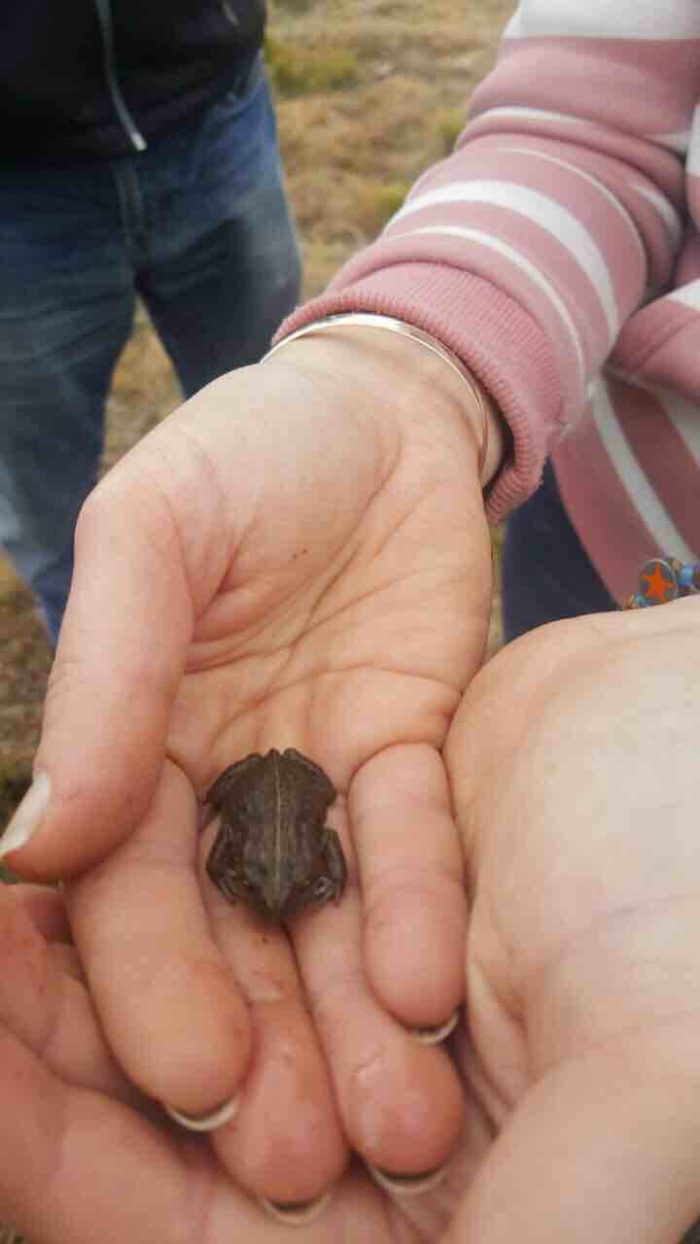
Photo by Jeanne Tarrant
Status and Conservation
Status
Despite its limited range, V. amatolicus is locally abundant, and congregates in large numbers to breed (Wager 1986; Boycott 1988d; Channing 2001). It is known from the following protected areas: State Forests between Keiskammahoek and Hogsback, SAFCOL Forestry areas, Kubisi Indigenous Forest, and the Hogsback Indigenous Forest. It is a protected species in terms of the Cape Nature Conservation Ordinance (Ordinance 19 of 1974, as amended for the Eastern Cape Province), and the National Forests Act 19408 of 1998, section 7.
V. amatolicus was previously listed as Restricted (Branch 1988), Vulnerable (IUCN 2000) and Near Threatened (Harrison et al. 2001). Reassessment for this publication found this species to be Endangered in view of its restricted extent of occurrence and area of occupancy, fragmented range, and ongoing threats to populations.
Threats
The grassland habitat of V. amatolicus is threatened by overgrazing (cattle), silviculture, and the associated altered fire regimes and depletion of available surface water. Silviculture poses the single greatest threat as it results in a totally altered vegetation structure and causes fragmentation of the grassland habitat. It is estimated that some 20% of the habitat of Vandijkophrynus amatolicus has been lost in this way over the past 20 years (Harrison et al. 2001).
Recommended conservation actions
None of the protected areas in which V. amatolicus occurs (listed above) has statutory status. It is recommended that at least one population of V. amatolicus be given formal protection by the proclamation of a statutory provincial nature reserve, and that this population be monitored by the relevant authority. Within this reserve, limiting factor (e.g., encroachment of alien vegetation) management, as well as population monitoring and life history research, should be undertaken. As can be seen from the brief description of its life history, little is known about this species.
The taxonomic and genetic status of a small Vandijkophrynus species that occurs on the Kammanasie Mountains, and closely resembles V. amatolicus, requires clarification (see V. angusticeps account).
Hogsback and its surrounds are a well-known tourist destination. Education of the public regarding this frog and its habitat should arouse interest and may result in greater protection.
Distribution
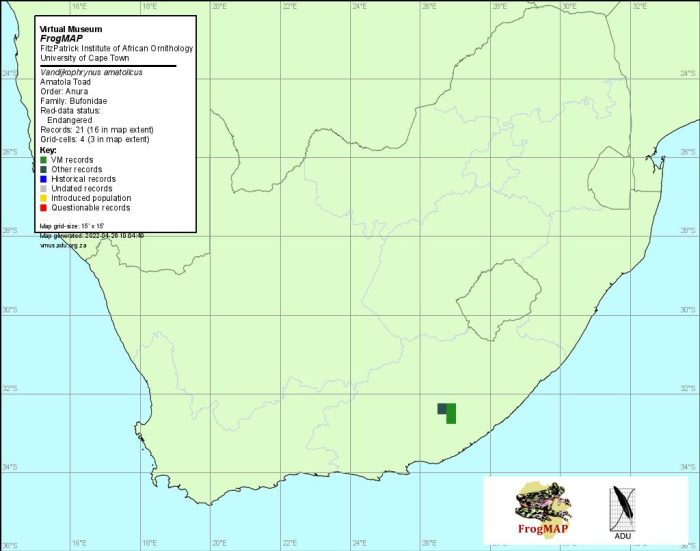
V. amatolicus is endemic to the Eastern Cape Province, where it has a restricted range in the Winterberg and Amatola mountains, between Katberg and Keiskammahoek (Boycott 1988d). Recorded altitudes for the species are 1400–1800 m.
V. amatolicus was originally recorded from a single grid cell near Hogsback (Poynton 1964) and later from six localities (Katberg, Katberg Pass, Gaika’s Kop, Hogsback Mountain, Hogsback settlement and Keiskammahoek), in four grid cells (Boycott 1988d). During the atlas project the species was recorded from only one grid cell, namely 3226DB.
The atlas data are reliable but incomplete. Further surveys in optimum breeding conditions may reveal additional populations.
Further Resources
Virtual Museum (FrogMAP > Search VM > By Scientific or Common Name)
More common names: Amatola-skurwepadda (Afrikaans)
Recommended citation format for this species text:
Boycott RC, Tippett RM. Amatola Toad Vandijkophrynus amatolicus. BDI, Cape Town.
Available online at http://thebdi.org/2021/11/17/amatola-toad-vandijkophrynus-amatolicus/
Recommended citation format:
This species text has been updated and expanded from the text in the
2004 frog atlas. The reference to the text and the book are as follows:
Boycott RC 2004 Vandijkophrynus amatolicus Amatola Toad. In Minter LR
et al 2004.
Minter LR, Burger M, Harrison JA, Braack HH, Bishop PJ, Kloepfer D (eds)
2004. Atlas and Red Data Book of the Frogs of South Africa, Lesotho and
Swaziland. Smithsonian Institution, Washington, and Avian Demography
Unit, Cape Town.
