SAFRING Ringing Report for 2017

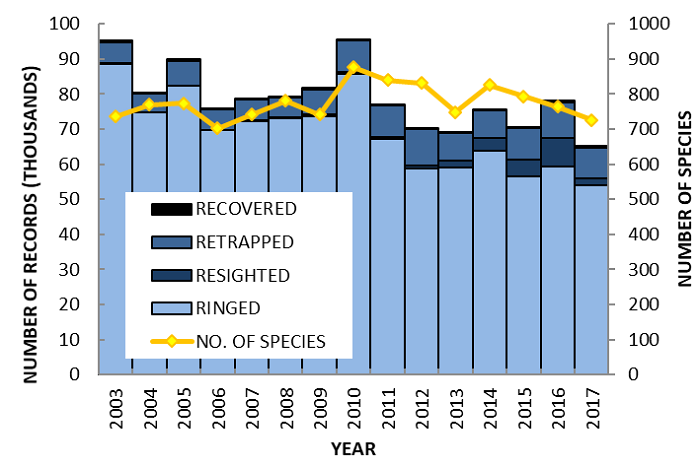
Figure 1: Trend in ringing effort over fifteen years from 2003 to 2017

Paijmans DM, Rose S, Oschadleus HD, and Thomson RL. 2019. SAFRING Ringing Report for 2017. Biodiversity Observations 10.11:1-11

Biodiversity Observations is an open access electronic journal published by the Animal Demography Unit at the University of Cape Town. This HTML version of this manuscript is hosted by the Biodiversity and Development Institute. Further details for this manuscript can be found at the journal page, and the manuscript page, along with the original PDF.


SAFRING Ringing Report for 2017

Dane M. Paijmans

FitzPatrick Institute of African Ornithology, DST-NRF Centre of Excellence, University of Cape Town, Rondebosch, 7701, South Africa

Sanjo Rose

FitzPatrick Institute of African Ornithology, DST-NRF Centre of Excellence, University of Cape Town, Rondebosch, 7701, South Africa

H. Dieter Oschadleus

School of Life Sciences, University of KwaZulu-Natal, P/Bag X01, Pietermaritzburg, South Africa

Robert L. Thomson

FitzPatrick Institute of African Ornithology, DST-NRF Centre of Excellence, University of Cape Town, Rondebosch, 7701, South Africa

Following on from the 2016 SAFRING ringing summary (Paijmans et al. 2017), the SAFRING database has grown to 2,677,367 ringing records (initial, retrap, resightings and recoveries). This number is increased to 2,698,821 records when foreign scheme records stored in the database are included.

Ringing effort

In 2017 (1 January 2017 to 31 December 2017) SAFRING received 65,196 ringing records (54,018 birds ringed; 8,652 recaptured; 1,973 resighted; 553 recoveries) relating to 726 species (Figure 1). There was a notable decrease in record totals since 2016, with the greatest change being seen in the resighting count (colour ringed/tagged birds sighted in the field). As some records are still outstanding these values may differ in future summaries.

Figure 1: Trend in ringing effort over fifteen years from 2003 to 2017


During 2017, 253 active ringers submitted records to SAFRING and thirty-one new ringers qualified (Figure 2). 103 ringers ringed over 100 birds, with 12 of these ringing more than 1,000 birds (Table 1). Most ringers ringed a variety of species distributed across southern Africa (Figure 3). The top ringer, Dr Ursula Franke-Bryson (ringer: 1240), ringed 3,761 birds and produced a total of 3,875 records. Dirk Heinrich (ringer: 573) had the greatest overall record count (4,375 records) and produced the most retraps (799 retraps) of any of the individual ringers. Dr Ursula Franke-Bryson ringed the most species during 2017 (215 species) followed by James Rawdon (ringer: 1607, 190 species) (Table 1).

Figure 2: Number of active and new registered SAFRING ringers over fifteen years from 2003 to 2017


Figure 3:  Distribution of ringing effort across southern Africa per quarter degree grid cell for the 2017 ringing period. The colour coding of the grid cell indicates numbers of birds ringed in it
Figure 3: Distribution of ringing effort across southern Africa per quarter degree grid cell for the 2017 ringing period. The colour coding of the grid cell indicates numbers of birds ringed in it


Table 1: Top 20 ringers/groups over the 2017 ringing year: Most bird records (ringed/ retrapped and recovered). Code 1 = ringed birds, 2 = retraps, 4 = resightings, X = dead birds. DEA=Dept. of Environmental Affairs

Name 1 2&4 X Species Total
U Franke-Bryson (1240) 3761 112 2 215 3875
D Heinrich (573) 3562 799 14 116 4375
M Brown (1089) 1892 396 22 117 2310
J. Rawdon (1607) 1871 200 0 190 2071
DEA (870) 1603 0 0 2 1603
J Mulvaney (1622) 1487 22 0 75 1509
HD Oschadleus (32) 1431 197 0 109 1628
K Nelson (1540) 1400 186 2 151 1588
K Dixon (1278) 1087 134 2 71 1223
ML Marais (740) 1074 52 0 53 1126
M Pienaar (14997) 1054 228 1 115 1283
N Thomson (1476) 1045 498 1 51 1544
M Remisiewicz (1454) 996 302 23 105 1321
M McCall (266) 959 100 0 41 1059
H Bantjes (180) 766 56 2 91 824
C du Plooy (1120) 745 59 0 99 804
J Raijmakers (162) 741 50 0 118 791
D Engelbrecht (1245) 703 27 0 115 730
C Williams (1340) 619 34 0 105 653
R Covas (1007) 604 592 227 1 1423

The ringing effort has been well distributed across southern Africa (Figure 3), with most records (initial, retrap, resighting, recovery) originating from South African provinces and Namibia (Table 2). The South African province to produce the most ring records was Gauteng (9,850 records; Table 2), while KwaZulu-Natal had the most species records (279 species; Table 3).

Table 2: Regional ringing effort (number of records) in the 2017 ringing year (all regions with over 100 SAFRING records)

Region No. of initial records No. of retrap/resight records No. of recovery records Total records Percentage of total records
South Africa (total) 36178 4784 454 41416 65.4
– Gauteng 8593 1212 45 9850 15.6
– Western Cape 7981 1025 95 9101 14.4
– KwaZulu-Natal 5852 919 21 6792 10.7
– Limpopo 3461 200 8 3669 5.8
– Eastern Cape 3121 215 15 3351 5.3
– North West 2951 400 11 3362 5.3
– Mpumalanga 2227 115 23 2365 3.7
– Northern Cape 1141 653 231 2025 3.2
– Free State 851 45 5 901 1.4
Namibia 8780 2397 38 11215 17.7
Seychelles 1380 296 5 1681 2.7
Zambia 835 12 2 849 1.3
Oceanic Islands 500 1848 13 2361 3.7
Botswana 265 39 0 304 0.5
Cameroon 194 21 0 215 0.3

Table 3: Regional ringing effort in the 2017 ringing year (all regions with over 100 SAFRING records). Percentages of the total number of species do not not total 100 due to representation of certain species in multiple regions.

Region No. of ringers No. of species Avg. no. of species per ringer Avg. no. of birds per ringer Percentage of total species
South Africa (total) 185 504 31 195.6 68
– Gauteng 63 204 24 136.4 28
– Western Cape 76 214 33 105.0 29
– KwaZulu-Natal 54 279 21 108.4 38
– Limpopo 50 253 23 69.2 35
– Eastern Cape 23 156 14 135.7 21
– North West 32 161 13 92.2 22
– Mpumalanga 46 232 18 48.4 32
– Northern Cape 22 56 4 51.9 8
– Free State 22 96 10 38.7 13
Namibia 33 190 14 266.0 26
Seychelles 12 20 7 115.0 3
Zambia 3 118 43 278.3 16
Oceanic Islands 6 11 4 83.3 2
Botswana 4 69 21 66.3 10
Cameroon 2 39 20 97.0 5

Of the 54,018 initial records for 2017, most (97.7 %) had age categories assigned. 46,142 (87.4 %) of these were reported as adults and immatures with the remainder, 6,630 (12.6 %), being reported as pullus (chicks) and juveniles. This difference is a result of most ringers favouring trapping (mist nets, snap traps etc) over ringing nestlings.

Several ongoing targeted research projects were undertaken in 2017, for example: sociable weavers (Philetairus socius) – Sociable Weaver Research Project, Cape gannets (Morus capensis)- Department of Environmental Affairs Republic of South Africa, albatross species – various island projects (Anonymous 2019), and vulture species – Vulpro. These inflated numbers were still surpassed by common species caught by Citizen Scientist ringers (Table 4).

Table 4: The most frequently ringed species over the 2017 ringing year. Code 1 = ringed birds, 2 = retraps, 4 = resightings, X = dead birds

Species 1 2&4 X Total
Terrestrial
southern masked-Weaver (Ploceus velatus) 4586 406 20 5012
red-billed quelea (Quelea quelea) 3112 14 0 3126
red-headed finch (Amadina erythrocephala) 2474 604 6 3084
Cape white-eye (Zosterops virens) 2211 210 9 2430
southern red bishop (Euplectes orix) 1993 235 4 2232
laughing dove (Spilopelia senegalensis) 1319 523 18 1860
Cape weaver (Ploceus capensis) 1223 118 5 1346
dark-capped bulbul (Pycnonotus tricolor) 1171 101 4 1276
blue waxbill (Uraeginthus angolensis) 830 133 1 964
Cape sparrow (Passer melanurus) 734 48 0 782
sociable weaver (Philetairus socius) 632 596 227 1455
Cape robin-chat (Cossypha caffra) 626 214 9 849
violet-eared waxbill (Uraeginthus granatinus) 601 18 0 619
village weaver (Ploceus cucullatus) 580 33 2 615
African reed-warbler (Acrocephalus baeticatus) 559 74 2 635
Marine
Cape gannet (Morus capensis) 1614 2 24 1640
Hartlaub’s gull (Chroicocephalus hartlaubii) 380 3 0 383
kelp gull (Larus dominicanus) 347 34 21 402
wedge-tailed shearwater (Ardenna pacifica) 273 65 0 338
Atlantic yellow-nosed albatross (Thalassarche chlororhynchos) 151 851 3 1005
white-tailed tropicbird (Phaethon lepturus) 142 41 2 185
sooty tern (Onychoprion fuscatus) 79 0 0 79
Kittlitz’s plover (Charadrius pecuarius) 72 12 0 84
sandwich tern (Thalasseus sandvicensis) 70 525 2 597
southern giant-petrel (Macronectes giganteus) 66 553 1 620
Raptor
barn owl (Tyto alba) 316 33 8 357
southern pale chanting goshawk (Melierax canorus) 310 19 1 330
white-backed vulture (Gyps africanus) 267 56 0 323
jackal buzzard (Buteo rufofuscus) 134 9 3 146
spotted eagle-owl (Bubo africanus) 124 48 4 176

Retrap/Resighting/Recovery Effort

Resightings of colour ringed birds increased the overall subsequent (retrap/resighting) numbers (Table 5). Foreign ringed birds sighted in southern Africa were predominantly common terns (Sterna hirundo) (27 reports) and Sandwich terns (Thalasseus sandvicensis) (61 reports), with several other interesting migrants being resighted in South Africa (Table 6). Most of the foreign tern sightings were reported by Mark Boorman (ringer: 572) in Namibia (Figure 4).

Table 5: Conditions of retrap/resighting for the 2017 ringing year

Condition Total
No other information 9069
Sighting: from camera trap 642
Sighting: of colour ringed bird 576
Sighting: of patagial tags 240
Sighting: ring number read in field 43
Incubating egg(s) 20
Controlled: and released 11
Caught: and released 7
Sick or injured: Taken to rehabilitation centre 6
Sick or Injured: no other information 5
Alive: found hanging from wire by thread around leg 2
Caught: flew into shop/house, released 2
Sick or injured: wing broken 1
Sick or injured: subsequent fate unknown 1
Collision: with a building 1
Caught: flew into building 1
Controlled: tracking device fitted, bird released 1
Exhausted: taken to rehabilitation centre 1
Exhausted: kept in captivity 1
Exhausted: bird released 1
Alive: bird found in possession of uninformed persons 1

Table 6: Foreign recoveries, retraps and resightings from South Africa during the 2017 ringing year. Values marked as unknown have not been received from relevant schemes. BTO: British Trust for Ornithology

Ring no. Species Sex Ring/Resight Date Location Stage Entity
1428322 sandwich tern Unknown Ringing 2012-06-19 5148N0404E Nestling/Pulli Arnhem Scheme, Netherlands
(Sterna sandvicensis) Resighting 2017-02-09 3407S1820E Unknown Mr A Tree, Western Cape
1442246 sandwich tern Unknown Ringing 2013-06-27 5148N0404E Nestling/Pulli Arnhem Scheme, Netherlands
(Sterna sandvicensis) Resighting 2017-03-12 3417S1849E Adult Mr M Boorman, Western Cape
1442662 sandwich tern Unknown Ringing 2012-06-19 5148N0404E Nestling/Pulli Arnhem Scheme, Netherlands
(Sterna sandvicensis) Resighting 2017-11-27 3435S1920E Adult Mr M Boorman, Western Cape
1585280 sandwich tern Unknown Ringing 2014-06-20 5147N0408E Nestling/Pulli Arnhem Scheme, Netherlands
(Sterna sandvicensis) Resighting 2017-03-14 3407S1850E Adult Mr M Boorman, Western Cape
1585453 sandwich tern Unknown Ringing 2015-05-26 5148N0404E Adult Arnhem Scheme, Netherlands
(Sterna sandvicensis) Resighting 2017-10-12 3435S1920E Adult Member of the public, Western Cape
1585463 sandwich tern Unknown Ringing 2015-05-26 5148N0404E Adult Arnhem Scheme, Netherlands
(Sterna sandvicensis) Resighting 2017-03-07 3435S1920E Adult Member of the public, Western Cape
1588140 sandwich tern Unknown Ringing 2015-06-27 5307N0453E Nestling/Pulli Arnhem Scheme, Netherlands
(Sterna sandvicensis) Resighting 2017-10-30 3407S1850E Adult Member of the public, Western Cape
1589465 sandwich tern Unknown Ringing 2016-06-25 5307N0453E Nestling/Pulli Arnhem Scheme, Netherlands
(Sterna sandvicensis) Resighting 2017-09-25 3407S1850E Adult Mr M Boorman, Western Cape
1590542 sandwich tern Unknown Ringing 2016-06-23 5148N0357E Nestling/Pulli Arnhem Scheme, Netherlands
(Sterna sandvicensis) Resighting 2017-12-04 3435S1920E 1 to 2 year Mr M Boorman, Western Cape
4592983 common tern Unknown Ringing unknown unknown unknown Unknown
(Sterna hirundo) Recovery 2017-10-16 3248S1753E Adult Member of the public, Western Cape
6A3484 sandwich tern Unknown Ringing unknown unknown unknown Unknown
(Sterna sandvicensis) Resighting 2017-11-13 3434S1920E Adult Member of the public, Western Cape
9933315 European storm-petrel Unknown Ringing unknown unknown unknown Unknown
(Hydrobates pelagicus) Recovery 2017-12-08 3404S2454E Adult SANCCOB, Eastern Cape
99Z29736 common tern Unknown Ringing unknown unknown unknown Unknown
(Sterna hirundo) Recovery 2017-12-07 3425S1908E Adult Bruxelles Scheme, Western Cape
A16170 osprey Unknown Ringing 2016-07-13 5826N2714E Nestling/Pulli Estonian Bird Ringing, Estonia
(Pandion haliaetus) Recovery 2017-01-27 2857S3146E Unknown ADU non ringer, KwaZulu-Natal
AT217135 common tern Unknown Ringing 2008-06-28 6035N2144E Unknown Helsinki Museum, Finland
(Sterna hirundo) Recovery 2017-02-02 3205S1818E Unknown Mr Y. Chesselet, Western Cape
DB93011 Caspian tern Unknown Ringing 2000-06-20 5720N0159W Nestling/Pulli Member of the public, United Kingdom
(Sterna caspia) Resighting 2017-02-12 3406S1849E Adult Prof D Cyrus, Western Cape
DD44529 Caspian tern Unknown Ringing 2010-08-30 5720N0159W Adult plumage Member of the public, United Kingdom
(Sterna caspia) Resighting 2017-02-12 3407S1849E Adult plumage Prof D Cyrus, Western Cape
DD44558 sandwich tern Unknown Ringing 2010-08-30 5719N0159W Adult plumage BTO, United Kingdom
(Sterna sandvicensis) Resighting 2017-02-17 3407S1850E Adult plumage Prof D Cyrus, Western Cape
DD78255 sandwich tern Unknown Ringing unknown unknown unknown Unknown
(Sterna sandvicensis) Resighting 2017-09-22 2849S3204E Nestling/Pulli Member of the public, KwaZulu-Natal
DD92438 sandwich tern Unknown Ringing 2013-07-17 5537N0138W Unknown BTO, United Kingdom
(Sterna sandvicensis) Resighting 2017-02-01 3434S1921E Unknown Mr A Tree, Western Cape
DE23529 sandwich tern Unknown Ringing unknown unknown unknown Unknown
(Sterna sandvicensis) Recovery 2017-03-30 3407S1849E Unknown BTO, Western Cape
DE52988 sandwich tern Unknown Ringing 2014-05-09 5719N0159W Adult plumage BTO, United Kingdom
(Sterna sandvicensis) Resighting 2017-12-16 3407S1850E Adult plumage Member of the public, Western Cape
DN56796 sandwich tern Unknown Ringing unknown unknown unknown Unknown
(Sterna sandvicensis) Recovery 2017-12-19 3421S1904E Adult plumage Member of the public, Western Cape
DT02729 sandwich tern Unknown Ringing 2014-06-13 5719N0159W Unknown BTO, United Kingdom
(Sterna sandvicensis) Resighting 2017-02-01 3439S1929E Unknown Mr A Tree, Western Cape
FT67249 elegant tern Male Ringing 2003-07-03 4434N0114W Adult plumage Paris Scheme, France
(Thalasseus elegans) Resighting 2017-03-05 3419S1827E Adult plumage Member of the public, Western Cape
HN53498 common tern Unknown Ringing unknown unknown unknown Unknown
(Sterna hirundo) Retrap 2017-01-27 3373S1843E Juvenile SANCCOB, Western Cape
K6P7778 barn swallow Male Ringing 2014-09-14 5232N1913E Adult plumage Gdansk/Varsovia, Poland
(Hirundo rustica) Retrap 2017-02-21 2825S3218E Adult plumage Member of the public, KwaZulu-Natal
NL1672 sandwich tern Unknown Ringing 2013-06-25 5148N0357E Nestling/Pulli Arnhem Scheme, Netherlands
(Sterna sandvicensis) Resighting 2017-12-25 3435S1920E Adult plumage Mr M Boorman, Western Cape
PL00806 sandwich tern Unknown Ringing unknown unknown unknown Unknown
(Sterna sandvicensis) Resighting 2017-12-08 3433S1921E Adult plumage Member of the public, Western Cape
RE3685 barn swallow Unknown Ringing 2016-09-24 4033N0315W Adult plumage Bird Ringing Office Spain ICONA, Spain
(Hirundo rustica) Retrap 2017-03-26 2541S2903E Juvenile Dr M Remisiewicz, Mpumalanga
TA12113 white stork Unknown Ringing 2016-06-17 4540N1824E Nestling/Pulli Zagreb Scheme, Croatia
(Ciconia ciconia) Resighting 2017-01-05 3357S2205E Adult plumage Member of the public, Western Cape
VN8213 white stork Unknown Ringing unknown unknown unknown Unknown
(Ciconia ciconia) Recovery 2017-01-21 2742S2959E Nestling/Pulli Member of the public, KwaZulu-Natal
YE41RE41 osprey Unknown Ringing 2015-07-11 6057N3554E Juvenile St. Petersburg, Russia
(Pandion haliaetus) Resighting 2017-04-30 3420S1905E Adult plumage Member of the public, Western Cape
Figure 4: Positions/directions at which birds with SAFRING and FOREIGN rings were initially ringed and retrapped/recovered /resighted, for the 2017 ringing year.


Of the 553 recovery records received; the most commonly recovered species were sociable weaver, kelp gull (Larus dominicanus), Cape gannet and laughing dove (Spilopelia senegalensis) (Table 4). Most recoveries did not have a known cause of death, with many being reported after washing up on beaches and others being found around residential areas (Table 7).

Table 7: Causes of bird mortality over the 2017 ringing year

Finding Condition Total
Died: cause of death unknown 426
Carcass: found beached, cause of death unknown 20
Carcass: dead less than one week 15
Collision: with motor vehicle (or found next to road) 9
Collision: with a window 8
Killed or attacked by: domestic cat 7
Died: of natural Cause 7
Sick or injured: Euthanised 6
Sick or injured: subsequently died 6
Carcass: ring found with just part of carcass or skeleton 6
Died: drowned 5
Died: on long line from fishing vessel, drowned 4
Ring found: no sign of carcass or skeleton 4
Died: electrocuted 3
Died: of avian cholera or other disease 3
Killed or attacked by: wild mammal 3
Died: in, or near nest 3
Died: as a result of ringing activities 2
Killed or attacked by: domestic dog 2
Carcass: partly eaten by scavengers 2
Shot: no reason given 1
Shot: for sport 1
Poisoned: unintentionally, bait intended for other animal 1
Killed: by predator while in mistnet or ringing 1
Sick or Injured: leg broken 1
Sick or injured: subsequent fate unknown 1
Ring number reported, no further details 1
Killed or attacked by: domestic animal 1
Collision: with a building 1
Victim of weather: due to wind (or storm) 1
Victim of weather: due to cold 1
Died: at rehab centre, recovery site unknown 1

Ringing papers

Fifteen peer-reviewed research articles were published during 2017, either using stored SAFRING data directly, or producing ringing data of their own and using SAFRING’s services (Table 8). In addition to these publications four PhD theses were completed in 2017 assisted by SAFRING-related ringing data. AFRING News (published in Biodiversity Observations) published 8 new bird ringing related articles. In addition to these publications, many other popular articles featuring bird ringing, were published in birding newsletters, magazines, and online.

Table 8: Scientific (peer-reviewed) publications produced utilising records (either self-produced or archived) within the SAFRING database for the year 2017. Note: This list may not contain all publications. *Reports that only produced their own SAFRING records

Author(s) Title Journal/Institution
Peer-Reviewed Papers
Paijmans DM, Catto S, Oschadleus HD SAFRING longevity and movement records for southern African vultures (subfamilies Aegypiinae and Gypaetinae) Ostrich 88(2), 163-166
*McPherson SC, Brown M, Downs CT Gender-related morphometric differences in mature and nestling Crowned Eagles, with comments on ringing of eagle nestlings in KwaZulu-Natal, South Africa Ostrich 88(3), 195-200
*Turner WC, Küsters M, Versfeld W, Horak IG Ixodid tick diversity on wild mammals, birds and reptiles in and around Etosha National Park, Namibia African Journal of Ecology 55(4), 714-721
Tatayah V, Brown R, Le Corre M, Nicoll M, Jones CJ Body mass and pectoral muscle size changes in African waterfowl during moult. South African Journal of Wildlife Research 47(1), 24-31
*Hirschauer MT, Wolter K, Neser W Natal philopatry in young Cape Vultures Gyps coprotheres Ostrich 88(1), 79-82
*Pfeiffer MB, Venter JA, Downs CT Observations of microtrash ingestion in Cape Vultures in the Eastern Cape, South Africa African Zoology 52(1), 65-67
Thompson LJ, Downs CT Altitudinal variation in metabolic parameters of a small Afrotropical bird. Comparative Biochemistry and Physiology Part A: Molecular & Integrative Physiology 212, 88-96)
*Maphalala MI, Monadjem A White-backed Vulture Gyps africanus parental care and chick growth rates assessed by camera traps and morphometric measurements Ostrich (88(2), 123-129
*Ball AD, van Dijk RE, Lloyd P, Pogány Á, Dawson DA, Dorus S, Székely T Levels of extra-pair paternity are associated with parental care in Penduline Tits (Remizidae) Ibis 159(2), 449-455
*van Eeden R, Whitfield DP, Botha A, Amar A Ranging behaviour and habitat preferences of the Martial Eagle: Implications for the conservation of a declining apex predator PloS one 12(3), e0173956
Walther B, Pirsig L Determining conservation priority areas for Palearctic passerine migrant birds in sub-Saharan Africa Avian Conservation and Ecology 12(1)
Tate G, Sumasgutner P, Koeslag A, Amar A Pair complementarity influences reproductive output in the polymorphic Black Sparrowhawk Accipiter melanoleucus. Journal of Avian Biology 48(3), 387-398
*Rose S, Sumasgutner P, Koeslag A, Amar A Does Seasonal Decline in Breeding Performance Differ for an African Raptor across an Urbanization Gradient? Frontiers in Ecology and Evolution 5, 47
*Mackay B, Lee ATK, Barnard P, Møller AP, Brown M Urbanization, climate and ecological stress indicators in an endemic nectarivore, the Cape Sugarbird Journal of Ornithology 158(4), 1013-1024
*Lloyd P, Frauenknecht BD, du Plessis MA, Martin TE Comparative life history of the south temperate Cape Penduline Tit (Anthoscopus minutus) and north temperate Remizidae species. Journal of Ornithology 158(2), 569-577
Kalle R, Combrink L, Ramesh T, Downs CT Niche models reliably predict suitable habitats for the reintroduction of red-billed oxpeckers. Ecology and evolution 7(6), 1974-1983
*van Velden JL, Koeslag A, Curtis O, Gous T, Amar, A Negative effect of mite (Knemidokoptes) infection on reproductive output in an African raptor The Auk 134(3), 498-508
*Remisiewicz M, Tree AJ, Underhill, LG, Burman MS Age-specific variation in relationship between moult and pre-migratory fuelling in Wood Sandpipers Tringa glareola in southern Africa Ibis 159(1), 91-102
Rose S, Oschadleus HD Longevity summary from 69 years of Estrildidae ringing data in southern Africa African Zoology 53(1), 41-46
Kopij G Migratory connectivity of South African Cattle Egrets (Bubulcus ibis, Ciconiiformes, Ardeidae) Zoological Journal 96, 418-428
Lowney A, Green K, Ngomane PB, Thomson RL Mortal combat: Intraspecific killing by an African pygmy-falcon (Polihierax semitorquatus) to acquire new mate and territory Journal of Raptor Research 51(1), 89-91
Academic Theses
Musitelli F Aves remores: responses of migratory birds to climate change and habitat alteration PhD Thesis, University of Milano-Bicocca, Milan, Italy
*Munshi N Genetic diversity and interspecies hybridization in cossypha robin-chats PhD Thesis, University of the Witwatersrand, Johannesburg, South Africa
*Van Eeden R Understanding the decline of Martial Eagles Polemaetus bellicosus in the Kruger National Park, South Africa PhD Thesis, University of Cape Town, Cape Town, South Africa
*Van de Ven TM Implications of climate change on the reproductive success of the Southern Yellow-billed Hornbill, Tockus leucomelas PhD Thesis, University of Cape Town, Cape Town, South Africa

Acknowledgements

We at SAFRING really appreciate all the effort of ringers and the general public (the latter for reporting recoveries) and would like to thank everyone that has taken part in ringing and resighting in southern Africa. During 2017, SAFRING was housed by the Animal Demography Unit and funded by the South African National Biodiversity Institute, and the Namibian Ministry of Wildlife and Tourism during 2017.

References

Anonymous. 2019. Conserving Southern Ocean seabirds, viewed 25/01/2019, http://www.fitzpatrick.uct.ac.za/fitz/research/programmes/maintaining_species_level/southern_ocean_seabirds.

Paijmans DM, Catto S, Oschadleus HD. 2017. SAFRING ringing report for 2016. Biodiversity Observations, 8 (36): 1-8. Available online at https://journals.uct.ac.za/index.php/BO/article/view/458

Fynbos Estate bird ringing expedition : 3 to 12 December 2019

Cape Sugarbird

Following a successful 10 day BDI bird ringing expedition earlier this year, another was held at Fynbos Estate in December. It was hot and windy but the days were long, and the birds plentiful!

Marc, Danielle, Salome and Dieter were the main team, joined by Joel for two days. On Saturday we were joined by Loutjie and Leon, and Les with Karis, Taylyn and Itxaso for ringing and a communal braai.

Ringing table
Ringing team at work

Top species – weavers

The top species was Cape Weaver, followed by Southern Red Bishop and Southern Masked Weaver. The large numbers caught were due to large numbers of juveniles foraging in flocks. These were usually caught in small flocks of 20-30 birds at a time. Most of the weavers had completed breeding, but for the Southern Masked Weaver two nests were found with chicks large enough to ring.

The adult weavers had started primary moult, and males were moulting into non-breeding plumage. Recent juveniles had not started moult, while some older juveniles were starting their post-juvenile moult.

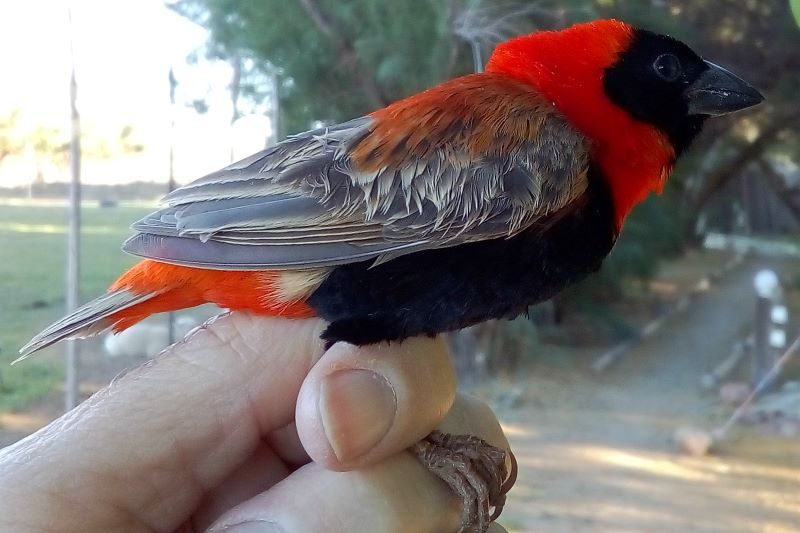
Southern Red Bishop
Southern Red Bishop, male moulting (photo by Marc Baumann)

Special birds

A Bokmakierie was ringed – the first for Fynbos. This species was very vocal on previous trips, but avoided the nets! A Cape Sugarbird was ringed – a few were present daily in the beautiful protea garden – on previous trips, this species was rarely seen, and instead Malachite Sunbirds were regular (and ringed). All three mousebird species were ringed, with the Red-faced being the most common. Some African Stonechats and African Paradise Flycatchers were also ringed. A Cardinal Woodpecker was ringed – two nets were put high in the dead tree that at least 4 woodpeckers frequented, but without success!

Cape Sugarbird
Cape Sugarbird
African Paradise Flycatcher

Sonop Farm

One trip was made to Sonop Farm, on the south-east side of the Paardeberg, where ringer Loutjie regularly rings birds at the farm dam. Special birds caught here were a Malachite Kingfisher (recapture), a Namaqua Dove, and a Grey-backed Cisticola. (Previous ringing trip to Sonop). Four juvenile Fiscal Flycatchers were ringed, possibly from the same brood.

Fiscal Flycatcher
Fiscal Flycatcher, juvenile (photo by Marc Baumann)

Recapture rates

Recapture rates were 7% at Fynbos – this low rate is due to the large number of juvenile weavers present, which had fledged since the previous expedition in June. Excluding all the weavers gives a Recapture rate of 15% on this trip. At Sonop there has been more recent ringing resulting in a high recapture rate of 28%. At Fynbos some birds were recaptured from each of the previous trips.

Ringing studies

Ringing large numbers of birds at Fynbos Estate and other sites on the Paardeberg over the next few years will provide baseline data on moult patterns, diversity of birds, longevities, and other aspects of bird biology.

Number of birds ringed and recaptured on two farms on the Paardeberg Mountain, 3 to 12 December 2019

 Sp no Species Fynbos ring Fynbos retrap Sonop ring Sonop retrap Total
  316 Ring-necked Dove 2    2
  318 Namaqua Dove   1  1
  390 Speckled Mousebird 2  3  5
  391 White-backed Mousebird 3 1   4
  392 Red-faced Mousebird 6  3  9
  397 Malachite Kingfisher    1 1
  442 Lesser Honeyguide 1    1
  450 Cardinal Woodpecker 1    1
  502 Greater Striped Swallow 1    1
  543 Cape Bulbul 5  4 1 10
  576 African Stonechat 3    3
  581 Cape Robin-Chat 7 3 4 1 15
  606 African Reed-Warbler 11 3 1 6 21
  622 Bar-throated Apalis   1  1
  638 Grey-backed Cisticola   1  1
  646 Levaillant’s Cisticola 12 3   15
  665 Fiscal Flycatcher 1  4  5
  682 African Paradise Flycatcher 3    3
  707 Southern Fiscal 2 1   3
  722 Bokmakierie 1  1  2
  749 Cape Sugarbird 1    1
  786 Cape Sparrow 6 1 1  8
  799 Cape Weaver 324 19 7 1 351
  803 Southern Masked Weaver 34 4 5  43
  805 Red-billed Quelea 5    5
  808 Southern Red Bishop 190 2   192
  810 Yellow Bishop 31 7  1 39
  857 Cape Canary 1  1  2
  863 Brimstone Canary 27 2 2  31
  867 Streaky-headed Seedeater   1  1
  1104 Karoo Thrush 1    1
  1105 Olive Thrush  1 1 1 3
  1172 Cape White-eye 8 1 7  16
  4139 Karoo Prinia 4 2 2 2 10
       
  Total 693 50 50 14 807

Congratulations

Well done to Joel for handling over 500 birds!

500th bird
500th bird, a juvenile Cape Weaver!

List of expeditions to Fynbos Estate, with links to trip reports

Trial expedition, 25-27 May 2018
First expedition, 18-28 February 2019 (ring totals), the place, and the birds
Student expedition, 17-21 June 2019
Second expedition, 2-12 December 2019 (this blog)

Sunset
Sunset over Fynbos Estate – view from Dragonridge

Blogs about the bird ringing expeditions and courses of the BDI are listed here. Planned events are listed here, and you are welcome to make contact with us and get involved.

The Armoured Tail-Eater

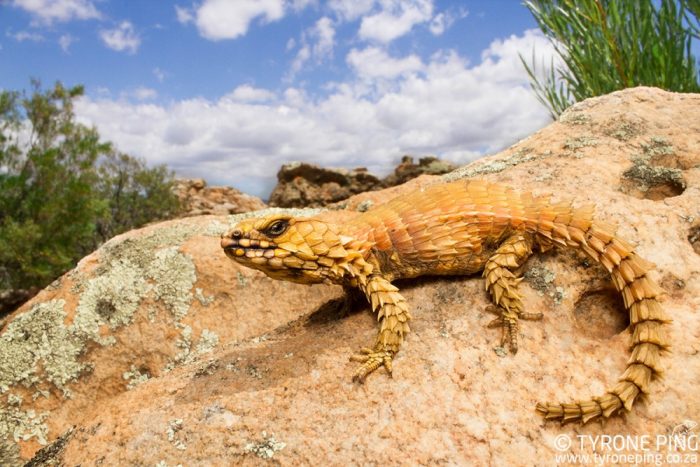
South Africa has an amazing diversity of reptile species and today we feature the awesome spiky critter known as the Armadillo Girdled Lizard Ouroborus cataphractus. Its scientific name means ‘armoured tail-eater’, but more about that later.  In Afrikaans we call it a ‘Blinkogie’ (little bright-eye).  They do have quite large and prominent eyes as far as lizards go. Most conspicuous of course are its ‘girdles’.  Its scales are modified into plates ending in sharp spines that are arranged in rings around its body and tail.

This feature is one it shares with other girdled lizards, once forming the genus Cordylus, which occurs mostly in South Africa. The genus has recently been split, with the Armadillo Girdled Lizard grouped in a genus of its own. They are part of the Armoured Lizard superfamily, the Cordyloidea, which includes several other genera in sub-Saharan Africa and Madagascar.

The Armadillo Girdled Lizard occurs in the Northern and Western Cape Provinces of South Africa. It inhabits rocky habitats where it uses narrow crevices for shelter. It ranges from the Richtersveld southward to Piketberg and eastward to the Tankwa Karoo. In general, this is a very dry region that can get extremely hot during summer months. It is the spikiest member of its family; the spikes offer excellent protection in more ways than one.  They protect its skin against bruises and cuts in the harsh rocky environment.  If a predator comes across one in a crevice, the lizard will expand its body; the spikes will then wedge against the walls of the crevice making it almost impossible to extricate.  But if it is caught off guard, it has another strategy – it rolls itself into a ball, grabbing its tail in its mouth like a real-world counterpart of the Ouroboros. The Ouroboros is an ancient symbol depicting a serpent or dragon eating its own tail. Originating in ancient Egyptian iconography, the Ouroboros entered western tradition via Greek magical tradition and was adopted as a symbol in Gnosticism, Hermeticism and most notably in alchemy. It is a potent symbol: the dragon consumes but simultaneously reproduces itself.  It is unlikely that the Egyptians, Greeks or medieval Europeans ever saw the Armadillo Girdled Lizard; the resemblance may be said to be a coincidence, although such a powerful symbolic image was somehow bound to occur somewhere amidst the richness of nature!

Early alchemical ouroboros illustration with the words ἓν τὸ πᾶν (“The All is One”) from the work of Cleopatra the Alchemist in MS Marciana gr. Z. 299. (10th Century)

But short of constituting an alchemist symbol, the lizard rolling itself in a ball like this performs an excellent defensive measure. The spikes on its back all jut outward, making it a hard ‘pill’ to swallow. This posture inspired its common name, armadillos, of course, also roll themselves into a ball for protection – but their armour is not as spiky!  Birds of prey, however, with their strong bills and talons, are not always daunted by these spiky lizard-balls.
Luckily this lizard has yet another defense: biting. If a predator should still persist in trying to eat it, it will release its tail and bite its assailant instead. Its jaw muscles are so strong that it has been recorded breaking its own jaw bones while biting. And finally, like many other lizards it can shed its tail. The twitching tail could distract the predator while the lizard makes its getaway. It probably is not a very satisfactory consolation prize for the predator, with the tail being so spiny. The girdled lizard can regenerate its tail, but as with most tail-shedders, the new tail will be a somewhat poor copy of the original. Because its tail is quite important to it, it will only shed it as a last resort.

Armadillo Girdled Lizards are medium-sized, 16 to 21 cm in length, with sturdy bodies. They eat insects – mainly termites – and other invertebrates, as well as a small amount of plant material.  Their habitat, though arid and sparsely vegetated, is rich in flowering plant species, many being succulents. The rains in this region usually occur during winter when temperatures are milder.  Consequently, these lizards are more active during winter months, eating and putting on fat.  In the extremely hot and dry summer, they are far less active, hiding in the shade and shelter of the crevices for most of the day.

Photo by Tyrone Ping

They are unusual among reptiles in that they are social, living in groups of up to 60 animals, but usually fewer. These groups are often relatives, for instance an adult pair along with their offspring. There is a lot of interaction between different groups. Dominant males stake out and defend territories in which they will allow, under their rule, females and subordinate males or youngsters. Displays used for territorial defense and impressing females include bobbing the head, flicking the tongue and wagging the tail. The lizards also alert each other to the presence of predators.

Another unusual feature of these tiny dragons is that the female does not lay eggs, but instead gives birth to a single baby (very rarely two). In truth the baby hatches from an egg, but inside the female, so it’s not quite the same as live birth in mammals.  The gestation period is very long: six to eight months. The baby is quite large relative to its mother and born at the start of the rainy season. The parents do give some care to their offspring, protecting them and even bringing them food. Living in a group is beneficial to all members where foraging and safety is concerned.

Sadly, because of their striking appearance, these lizards are often kept as pets. There is significant stress on wild populations due to people collecting them for the exotic pet trade. Because of their social nature, their way of life cannot easily be replicated in captivity; consequently most, if not all, individuals that are sold as pets were probably collected illegally from the wild. There are laws and initiatives in South Africa to try and combat the illegal trade. Captive breeding projects, however, are a different matter; if done responsibly this species can certainly benefit from a number of breeding populations being maintained outside of its small native range. In captivity Armadillo Girdled Lizards can live for up to 25 years.

BDInsight – November 2019

November has been a busy month! We have exciting news all the way from Liberia to the southern most tip of Africa. Read on to find out more….

Upcoming event: BDI Citizen Science Conference February 2020

Come and join the Biodiversity and Development Institute at New Holme Guest Farm (Karoo Gariep Nature Reserve) for our Citizen Science Conference. The core period is Friday evening, 14 February, to lunch time on Sunday, 16 February 2020. We encourage you to stay a few nights extra before and/or after the event too. The extra nights will also be at a discount rate. The theme for the conference is “Citizen Scientists: Ambassadors for Awareness”

For more information see: https://www.facebook.com/events/597102901097235/

PanGoPod goes to the Expo!

Yip, we are very excited to announce that the BDI will be attending the Cape OutdoorX expo this weekend (7 and 8 December 2019) at the Meerendal Wine Estate, Vissershok Road, Durbanville. Expo times: Saturday 09:00 – 20:00 and Sunday 09:00 – 18:00.

OdonataMAP – The Atlas of African Dragonflies and Damselflies

For the November Shoot The Dragons Week, OdonataMAPpers managed to snap and map 909 dragonflies and damselflies from 5 African countries (Chad, Democratic Republic of Congo, Namibia, South Africa and Zambia). Most of the South African records came from KwaZulu-Natal Province.  The recent good rains in the province definitely benefited these amazing little freshwater dragons.

Corrie du Toit took top honours as Dragon Queen once again with an amazing total 210 records submitted for the Week! Well done Corrie, you are a star. Diana Russell did very well too, with 137 records submitted, followed by Andries de Vries on 123. A massive thank you goes to each and every one of you that took the time to snap and map odonata during the Shoot The Dragons Week. Each record is valuable and contributes to our understanding of odonata distributions in Africa. Keep your eyes peeled for the next event, but remember that you can upload records to the Virtual Museum at any time of the year, day or night.

The African Bird Atlas Project is launched in Liberia

The team of atlasers at the launch if the Liberian Bird AtlasThe first question that gets asked when you need to take decisions about the conservation of a species is this: “Where does it occur now?” So it is awesome news that Liberia has launched their own bird atlas. They are working towards answering the critical species conservation question, at least for birds. They are not starting from a blank map. Already, 31 of the 1114 pentads in Liberia have full protocol checklists. That is 3.1% . The first 10% of coverage is the hardest to achieve. After that, people see that the project is feasible, and start to believe in it. Liberia already has 88 checklists and 2,780 records of bird distribution. That is a great platform on which to launch. Awesomely well done! This is great news for birds in Africa.

Clara Cassell led a BirdLasser workshop for atlasers in Liberia

… and after the workshop there was an opportunity to do some fieldwork for the Liberian Bird Atlas

So the African Bird Atlas is now live in Liberia! Following in the successful footsteps of the bird atlas projects in Nigeria and Kenya, it is great to welcome Team Liberia. The Liberian Bird Atlas is being led by Clara Cassell, with support from SNCL (Society for Nature Conservation Liberia), the BirdLife partner there, and Flora and Fauna International.

LepiMAP – The Atlas of African Butterflies and Moths

Why do we celebrate Black Friday? Here’s another colour event that we ought not to be celebrating: White Cabbage. It is now 25 years since the first Cabbage Whites Pieris brassicae were spotted in South Africa, at Sea Point, Cape Town, August 1994. This is South Africa’s only invasive butterfly.

Until the end of 1999, it had been recorded in eight quarter degree grid cells, all close to Cape Town, with green bars in the distribution map (see map above). Between 2000 and 2009, it was recorded in 24 grid cells (shaded with orange bars), and from 2010 up to now it was recorded in 38 grid cells (red bars). There are now records from the Northern Cape and Eastern Cape. How far has it really expanded its range? You can help us answer this  important question.

Cabbage White Pieris brassicae – LepiMAP record submitted by Basil Boer

Please upload all your photos of butterflies (and moths) to the LepiMAP section of the Virtual Museum. This is a long-term database, and there are long term patterns of range-changes emerging – http://vmus.adu.org.za/ – The instructions on how to upload records to the VM are here: http://thebdi.org/2019/01/30/how-to-biomap/

Monitoring the breeding of the African Black Oystercatchers on Robben Island

Intensive monitoring of the African Black Oystercatchers on Robben Island started in the breeding season of 2001/02 and has continued in most years. Each year the objective has been to find all the nests. Bukola Braimoh has done the fieldwork for the past three summers as her PhD research project. She is busy writing up, and the data are starting to show long-term changes in the timing of breeding. Not long to wait to learn about her results; she is planning to submit in February.

This year Rio Button is leading the monitoring. Here she is at the first nest of the summer:

Nest N001 contains three eggs! Can you spot them?

Here is Rio in her office for the summer. The office is about 10 metres wide, just above the spring high tide mark, and 10 kilometres long, and roughly circular.

This was the 10th of the 11 nests found on 28 November 2019. The anticipated total for the summer is around 150 nests!


Karoo ringing : 10 to 12 November 2019

Southern Red Bishop

Farm houses in the Karoo can be oases for birds, allowing relatively many birds to be ringed.

farmstead
New Holme farmstead, a green oasis in the vast Karoo

Les, Karis and I visited New Holme guest farm (Karoo Gariep Nature Reserve) from 10-12 November 2019 to test out ringing there, and take Virtual Museum photos en route. The farm lies halfway between Cape Town and Johannesburg. The first BDI visit to New Holme was in May (read here), with Virtual Museum records collected en route (see here).

Pied Starling
Pied Starling – note the striking eye and bill colours

We put a few nets around the farm house on Monday, and also before breakfast on Tuesday, and caught 87 birds (see the table at the bottom of this blog). Top of the list was Cape Sparrow with 42 birds ringed (30 males, 12 females). Second was Southern Masked Weaver, partly due to a large colony in some reeds – there were many green nests, and at least 8 males in the colony – 1 juvenile, 15 males in full breeding plumage, and 8 females (two with brood patches) – it seemed as if breeding only started recently. Six Pied Starlings were caught, but there is potential to catch hundreds!

Southern Masked Weaver - Karoo ringing
Southern Masked Weaver colony in dry reedpatch
Southern Red Bishop - Karoo ringing
A colourful Southern Red Bishop (male) – several were displaying in the reeds

Cape Sparrow weights vary by region, as shown in the figure below. These birds are lighter in arid regions as represented by Namibia (Nam) and the Northern Cape (NC) compared to other regions in South Africa. The dots show the average and the vertical lines show the extreme ranges. A better analysis would be to separate males from females, but this shows the value of ringing very common species.

Cape Sparrow mass
Cape Sparrow weight by province

Although the ringing was relatively limited, there is great potential. In addition to ringing around the farm house, other nearby habitats provide interesting species. The river is within walking distance from the farm houses, and hosted many Three-banded Plovers. The surrounding karoo veld hosts the usual larks, chats, flycatchers, starlings, buntings  and other specials – night spot-lighting could be used effectively to catch and ring these.

Spike-heeled Lark - Karoo ringing
Spike-heeled Lark

Greater Striped and White-throated Swallows breed (nests and juveniles seen), and could be targeted for ringing. Flocks of Barn Swallows forage over the karoo veld.

White-throated Swallow - Karoo ringing
White-throated Swallow juveniles, waiting to be fed

Table – total number of birds ringed at New Holme, 10-12 November 2019

  Species  Scientific Ringed
  African Reed Warbler  Acrocephalus baeticatus 4
  Southern Fiscal  Lanius collaris 1
  Pied Starling  Lamprotornis bicolor 6
  Cape Sparrow  Passer melanurus 42
  Southern Masked Weaver  Ploceus velatus 25
  Red-billed Quelea  Quelea quelea 3
  Southern Red Bishop  Euplectes orix 5
  Karoo Prinia  Prinia maculosa 1

Thanks to PC and Mariska Ferreira and their staff for hosting us incredibly well! Thanks to Karis and Rozaan for help with the ringing!

BDInsight – October 2019

October has been hot hot hot, and so too is our BDI Newsletter. We have lots of exciting news and upcoming events to share with you.

Upcoming Events

  • Shoot The Dragons Week: 16-24 November 2019. Data drive for OdonataMAP in the Virtual Museum
  • BDI Citizen Science Conference: 14-16 February 2020 at the Karoo Gariep Nature Reserve, (half way between Cape Town and Johannesburg) on the N1 between Colesberg and Hanover. Details to follow soon. 14-16 February 2020 are the core dates. It will be possible to extend a couple of days earlier or later at special rates. Accommodation options will range from luxury to camping. Watch this space.

Boegoebergdam BioBash

The Northern Cape, with the exception of a few places, has a grave shortage of biodiversity data coverage, both for the bird atlas and for all the sections of the Virtual Museum. A team of eight citizen scientists turned the Boegoeberg Dam district into a knowledge hotspot over a week end-September to early-October.

Boegoeberg Dam

Citizen scientist extraordinaire Altha Liebenberg got the blessing from the owners of the Boegoeberg Dam Holiday Resort for us to use their camp site as our base for the week. Altha and Salome Willemse recruited a team of citizen scientists and coordinated the event. Salome has a great track record of organizing BioBashes, including two in Calvinia: in November last year, and in May this year. Tino Herselman, who would have loved to have been part of the team, prepared the maps that helped plan the activities for every day.

The Boegoeberg Dam was built on the Orange River in the early 1930s, the “depression years.” It provided irrigation water along 130 km of the river, all the way to the Augrabies Falls. It transformed the lives of the people living along the river. Over this entire length, there is a ribbon of green running through the desert, up to a kilometer wide in places. Lots of crops are grown, but mostly grapes and lucerne. It is a bizarre luxury to farm with an abundance of water without having any rain.

The impact of the irrigation system on biodiversity must have been massive. Superficially, it is a positive change. There are lots more birds, butterflies, dragonflies inside the irrigated areas than outside them. It was built so long ago that we have no idea of what we lost.

The bottom line is that the Boegoeberg Dam Holiday Resort provide an excellent platform for the BioBash. We would return in a flash, and fill the gaps in coverage! MSc student Karis Daniel has written a great blog on the expedition. You can read it here.

PanGoPods in the news!

PanGoPods are set to roll out across South Africa. The Tiny House movement has been spreading across the world in recent years. People have been drawn to the ‘less is more’ concept, and are downsizing their homes to embrace the philosophy and freedom a smaller space provides. This month the BDI’s PanGoPods are featured in Popular Mechanics and CapeTownEtc, follow the links to read more about our awesome eco-friendly off-grid tiny homes.

Keep an eye out for us at the Cape OutdoorX expo 7 and 8 December 2019 at Meerendal Wine Estate, Durbanville

LepiMAP – The Atlas of African Butterflies and Moths

We have some LEPI-TASTIC news! Citizen scientist Neil Thomson LepiMAPped an incredible butterfly record in Namibia while he was out bird atlasing. Neil writes: “I was actually birdmapping for SABAP2, but I kept an eye out for anything else I could find for the Virtual Museum. A butterfly landed on the ground next to my parked vehicle and I photographed it. When I looked at the photos I realized that it was a species I had never seen before but I did not anticipate that it would turn out to be a rarity!”

Linda’s Hairtail or Kalahari Kortstertjie Anthene lindae — photo by Vaughan Jessnitz

This awesome little butterfly is a Linda’s Hairtail or Kalahari Kortstertjie Anthene lindae. Neil photographed it south of Windhoek in Namibia. The only other records of Linda’s Hairtail are recorded 750 km away (as the crow flies) in the Kalahari region of South Africa. Reinier Terblanche, butterfly expert and LepSoc member, writes: “Anthene lindae, though small, is distinct and cannot be confused with anything else. On all accounts this is a spectacular record submitted by Neil. Some of these near-endemic butterflies of the Kalahari regions could be widespread but still rare and habitat specific, even it they use widespread host-plants. I would really like to get more information on these records. I have, for example, worked in areas where there are thousands of Camel Thorn Vachellia erioloba trees but still only recorded Anthene lindae in very specific places. Also, some years they appear absent, but this might be because there are not enough people looking for them in any one year”

Map showing where Neil photographed Linda’s Hairtail in Namibia in relation to the only other known records in South Africa

Nigerian Bird Atlas reaches 2000 pentads atlased!

Accurate and up-to-date knowledge of bird distributions is critical to their conservation. Therefore it is fabulous news that bird atlas coverage of Nigeria reached 2000 pentads on 15 October. Study the map (below) carefully, and see how the caterpillars are growing. The north-south caterpillar in the southeast, near the border with Cameroon, is brand new. It is 500 km long. East-west caterpillars are also nearing completion. It won’t be long before it will be possible to travel from Cameroon to Benin along atlased pentads. Awesomely well done, Team Nigeria!

OdonataMAP – The Atlas of African Dragonflies and Damselflies

The second Shoot The Dragons Week for the 2019/20 season kicked off on Saturday, 19 October 2019. OdonataMAPpers managed to snap and map a total 805 dragonfly and damselfly species from 5 African countries (Botswana, Nigeria, South Africa, Swaziland, Tanzania). Awesomely well done everyone. Thank you for your efforts.

Blue Basker Urothemis edwardsii

Corrie du Toit took the top spot for the Week with 129 records submitted, followed by Pieter la Grange with 124, and Phillip Nieuwoudt on 105 OdonataMAP records. Amazing stuff. Diana Russell OdonataMAPped the species in the featured photo (above), a Blue Basker Urothemis edwardsii.

The dragonfly species that was encountered most frequently during the Week was the Red-veined Dropwing Trithemis arteriosa, with 55 records uploaded to OdonataMAP in the Virtual Museum.

Virtual Museum reaches a great milestone

On 27 October 2019, the Virtual Museum reached the fantastic milestone of 500,000 records on African biodiversity submitted through the website portal at http://vmus.adu.org.za/. This brings the total number of records in the database to almost 2 million. This is absolutely amazing and it is all due to the efforts put in by citizen scientists! Well done BioMAPpers, and thank you. Every record submitted to the Virtual Museum is a vote for biodiversity conservation.
 

Industrial Biodiversity 2 : Black River in Paarden Eiland : novel ecosystem

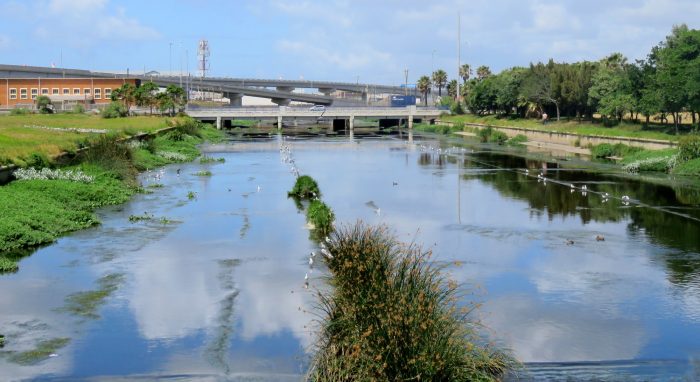
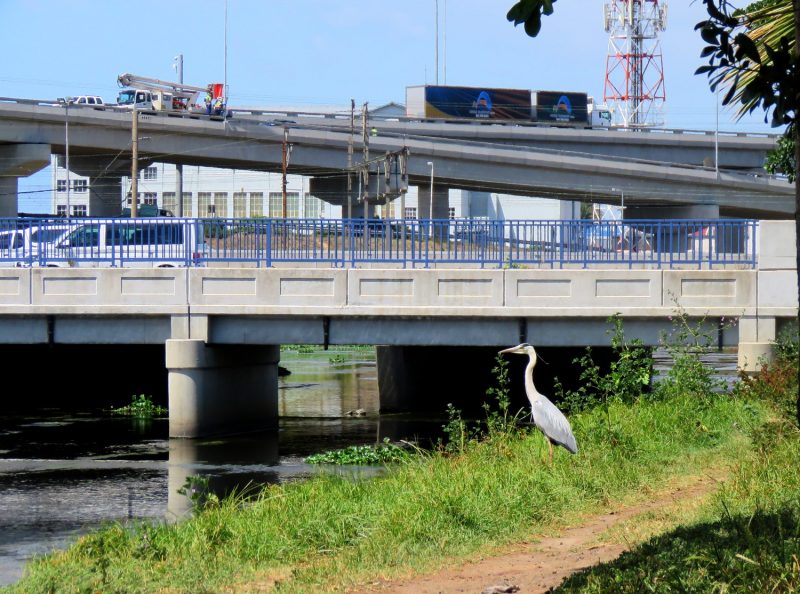
These pictures show a type of place which is known, in the trade, as a novel ecosystem. The original waterway, whatever it looked like, has been totally destroyed. No amount of  money can restore it. Whatever this place looked like in pristine condition, it is gone, gone forever. The original habitat that was here is extinct. It was replaced by concrete, which is biodiversity-hostile.

Black River, Paarden Eiland, Cape Town. Industrial biodiversity. Novel ecosystem

This is the Black River in Paarden Eiland, Cape Town. The photo is taken from the Section Street bridge. The bridge in the distance is about 200 m away and takes the N1 over the river.

How do we respond to this destruction? There are two alternatives: (1) Pessimism: Give up in despair; (2) Optimism: Try and get some biodiversity to flourish in this novel ecosystem. The second alternative is a massive compromise. But in places which are already irrevocably lost, it is forced upon us. The biodiversity of the novel ecosystem is likely to be controversially different to the pristine biodiversity. But, in the face of the biodiversity crisis, we might have to take the view that any (or almost any) biodiversity is better than concrete. Usually, we can do better than this, and that is what this blog is all about.

I visited this piece of the Black River because we were in Shoot The Dragons Week, and it was possible that there would be a few dragonflies here to photograph for OdonataMAP. But it was a bit cold, and I saw none.

Yellow-billed Duck family, Black River, Paarden Eiland

But then a Yellowbilled Duck emerged from the cover of the vegetation along the bank, followed  by seven ducklings. The family swam confidently downstream under the Section Street bridge. “Something is going on here.”

Levailliant's Cisticola, Black River, Paarden Eiland

 This Levailliant’s Cisticola perched on the top of some restios, faecal sac in bill. It must have removed this from a nest. So it is breeding here!

Pied Kingfisher, Black River, Paarden Eiland

A Pied Kingfisher flashed by with a fish in its bill. There must be fish in this river!

Cape Shoveler, Black River, Paarden Eiland

This Cape Shoveler was feeding in the submerged vegetation.

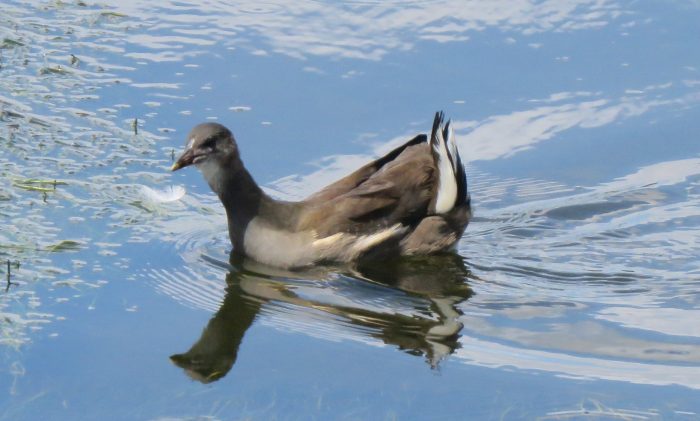
juvenile Common Moorhen, Black River, Paarden Eiland

This Common Moorhen is a juvenile, probably just a few months old. It does not have the red and yellow bill of an adult. It probably hatched somewhere close by.

Red-eyed Dove
Red-eyed Dove: BirdPix record 95470

The Red-eyed Dove pretended it was a wader, and had a good drink. The water is effluent from the Athlone Wastewater Treatment Plant, about 4 km upstream.

Grey Heron, N1-M5 intersection in background, Paarden Eiland. Industrial biodiversity. Novel ecosystem

This Grey Heron was ignoring the traffic flashing by on the N1 – this is the Koeberg Road Interchange between the N1 and M5 – it’s a statue until a grasshopper emerges from the weeds to become a snack.

There were lots of other bird species, too. These made it into the BirdPix section of the Virtual Museum: Cape Wagtail, Hartlaub’s Gull, Kelp Gull, Hadeda Ibis, Southern Masked Weaver, Cape Canary, Common Starling, Karoo Prinia, Blacksmith Lapwing and Red-knobbed Coot. I missed getting photographs of White-throated Swallow, presumably breeding under the Section Street bridge, and a Little Egret flew past, in transit.

Whether this is a novel ecosystem by design or by neglect, it is a remarkable 200-m section of the Black River. Judging by the number of species breeding and feeding, a small but significant component of biodiversity is thriving here. You don’t anticipate seeing a kingfisher flashing by. Nor a brood of ducklings. What makes this place so good?

Novel ecosystem, Black River, Paarden Eiland

It’s so good because it is so untidy. An assortment of plants, some alien and some indigenous, has conquered the concrete. The walls that imprison the river are still there, but at least they are partially out of sight. It also has the advantage that the Black River provides a biodiversity corridor, linking an assortment of small wetlands to each other.

Whether it was planned or an accident, this novel ecosystem is a biodiversity hotspot. It is situated right on the edge of a rather miserable industrial area. This is where the people who work in all these factories, showrooms and workshops should come and eat their lunch. Somehow it is the exposure to nature and to biodiversity that encourages people to care about these things. Right now, if the City came along and cleared this waterway and mowed the grass with the blades set to 5 cm, no one would notice. Many would applaud the restoration of “neatness”. In reality, there should be an outcry. There should be oodles of protesting locals: “I love this place.  It restores my sanity every weekday. Don’t you dare put your big machines in it!”

I am grateful to Peta Brom for introducing me to the concept of novel ecosystems. You can read up about them on page 10 of her MSc thesis. It’s section 1.5.3!

So, if you live in Cape Town, this is the place to go for your next biodiversity outing. I’ll be back when it is warmer, and I am sure I will find some dragonflies. Here’s the map!

Aerial view, Black River, Paarden Eiland, Novel ecosystem

Section Street is at the top and the N1 at the bottom. The coordinates are -33.916526 18.478211. The Black River is translated to Swartrivier. The Koeberg Interchange, between the N1 and M5, is in the lower right.

This blog is second in a series on “industrial biodiversity”. Industrial Biodiversity 1 covered another bleak area of Cape Town, Epping Industria.

There is a follow-up blog to this one, published in July 2024, called Industrial biodiversity 2 continued : Black River in Paarden Island : stormwater drain.

Boegoeberg Dam BioBash: Where Kalahari Meets Karoo

The interface of Kalahari and Karoo is a study in contrasts: red sands and blue skies; dry earth and flowing river; bustling weaver colonies and deserted towns. My first week of October was spent participating in a BioBash in this dynamic region of the world, collecting Virtual Museum (VM) records alongside a team led by Altha Liebenberg and Salome Willemse. (If you are unfamiliar with the concept of a BioBash, this blog post explains our previous trip to the Northern Cape.) Apart from our fearless leaders, the team was comprised of myself, Hardy and Joey Herbst, Alan Lee, Stefan Theron, and Les Underhill.

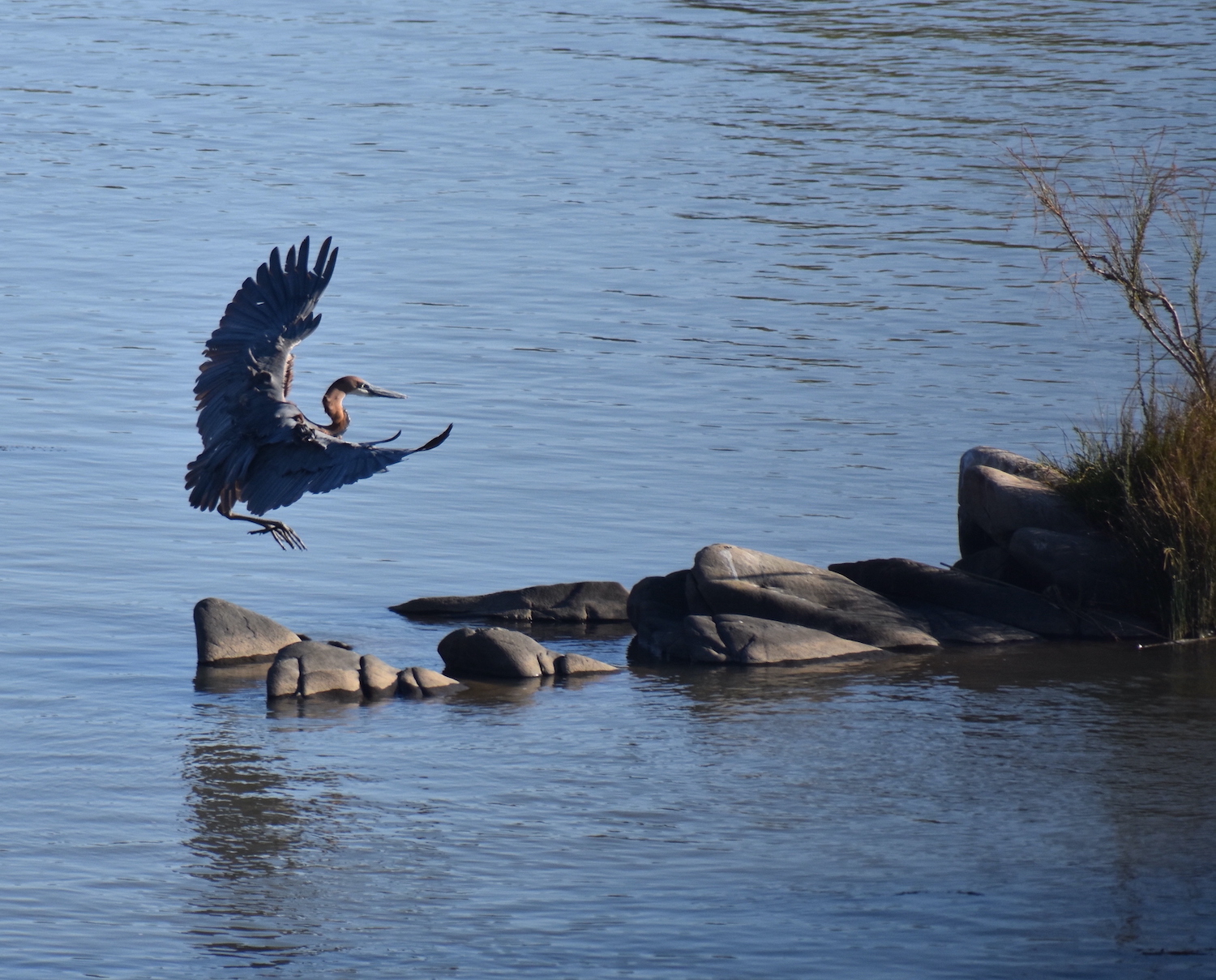
In April 2019, citizen scientist Altha Liebenberg hatched a plan for a BioBash at Boegoeberg dam, a campsite-turned-resort alongside the Orange River in the Northern Cape. Tucked away on a gravel road between Groblershoop to the North and Prieska to the South, Boegoeberg occupies a unique biological niche. A variety of ecosystems meet and merge here: Kalahari Scrub-robin, towards the southern reaches of its range, forage alongside Karoo Scrub-robin, near the northern end of its range, and riparian species such as Goliath Heron glide along the river.

Goliath Heron on the Orange River. Record curated at http://vmus.adu.org.za/?vm=BirdPix-94118

The convergence of these three worlds creates a fascinating and complex playground of exploration for the curious biologist…and explore we did! Over the course of four days, Salome and I worked through seven quarter-degree grid cells (QDGCs) as well as our “home” grid cell.

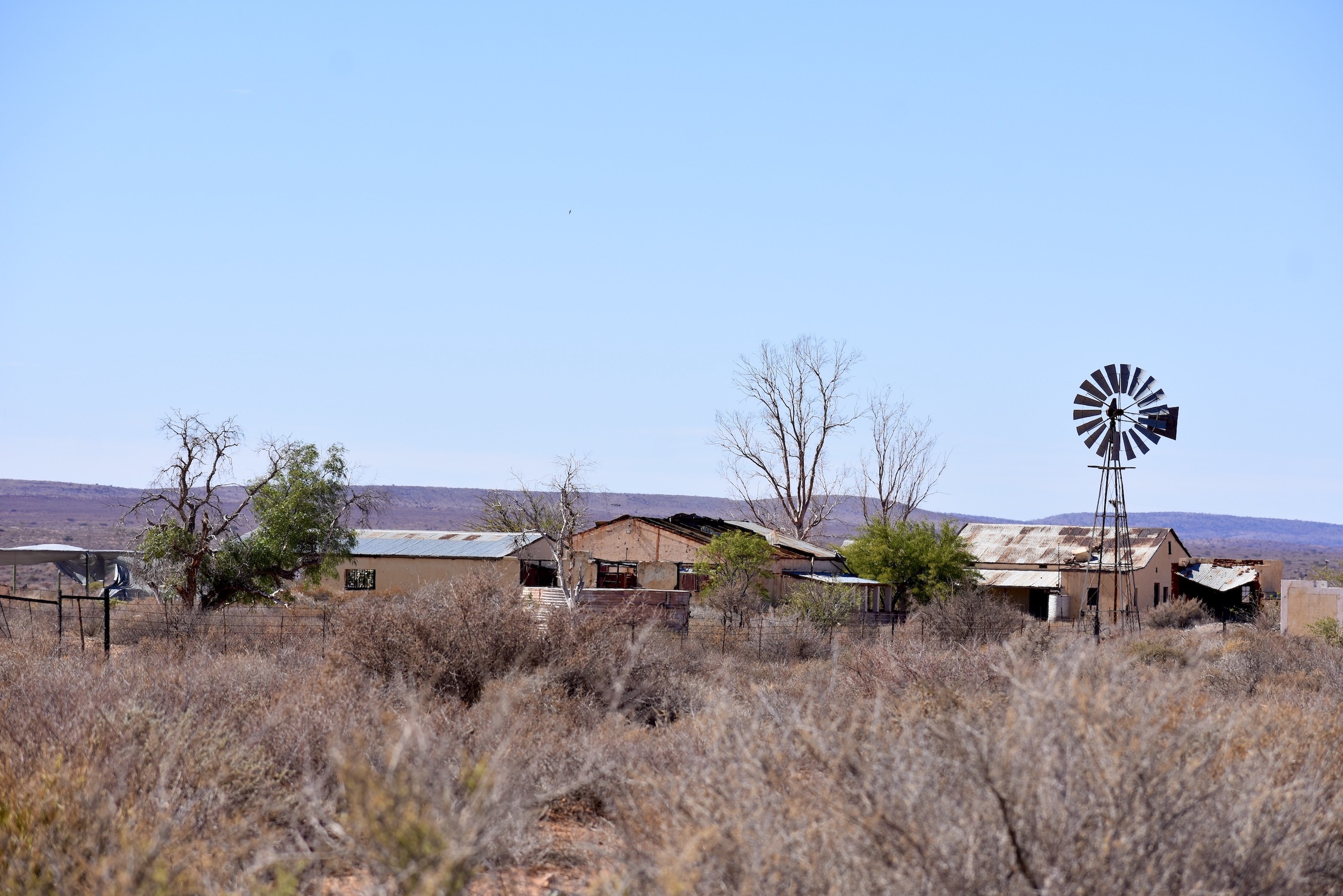
A personal highlight for me occurred on our second full day, Oct. 2, when we stumbled upon Putsonderwater, an abandoned settlement 65 km southwest of Boegoeberg. Situated along a railway line between De Aar and Upington, the station-town formed in the 1800’s and enjoyed a brief but bustling history. Today, however, the settlement is devoid of life, eerie and beautiful.

Broken door in Putsonderwater.

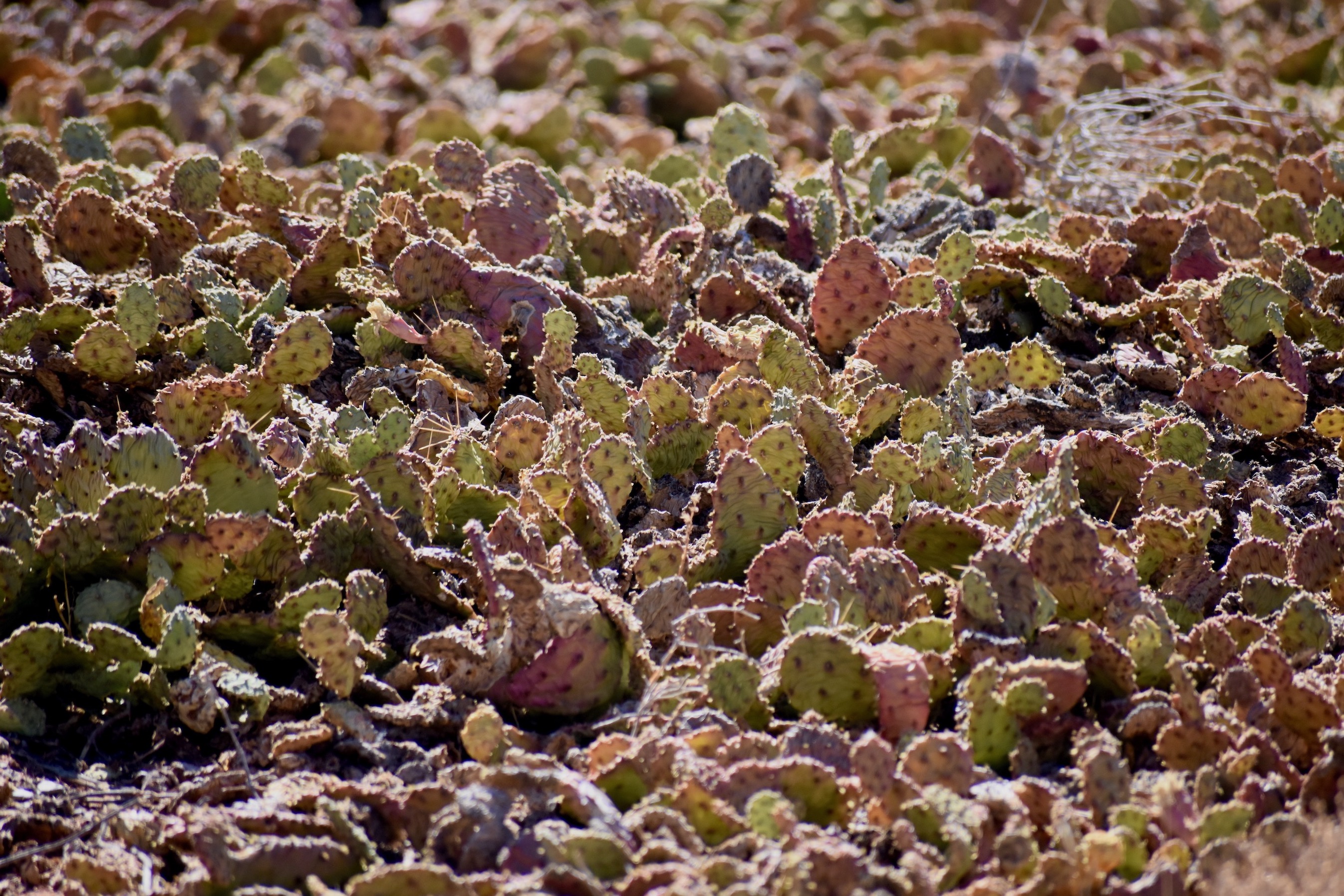
Tentative trees poke branches through broken floorboards, and hallways display windblown carpets of red sand. It is deafeningly quiet; only a dusty wind, and the occasional rustle of feathers as a Rock Martin swoops past. Colourful cacti creep across the barren ground.

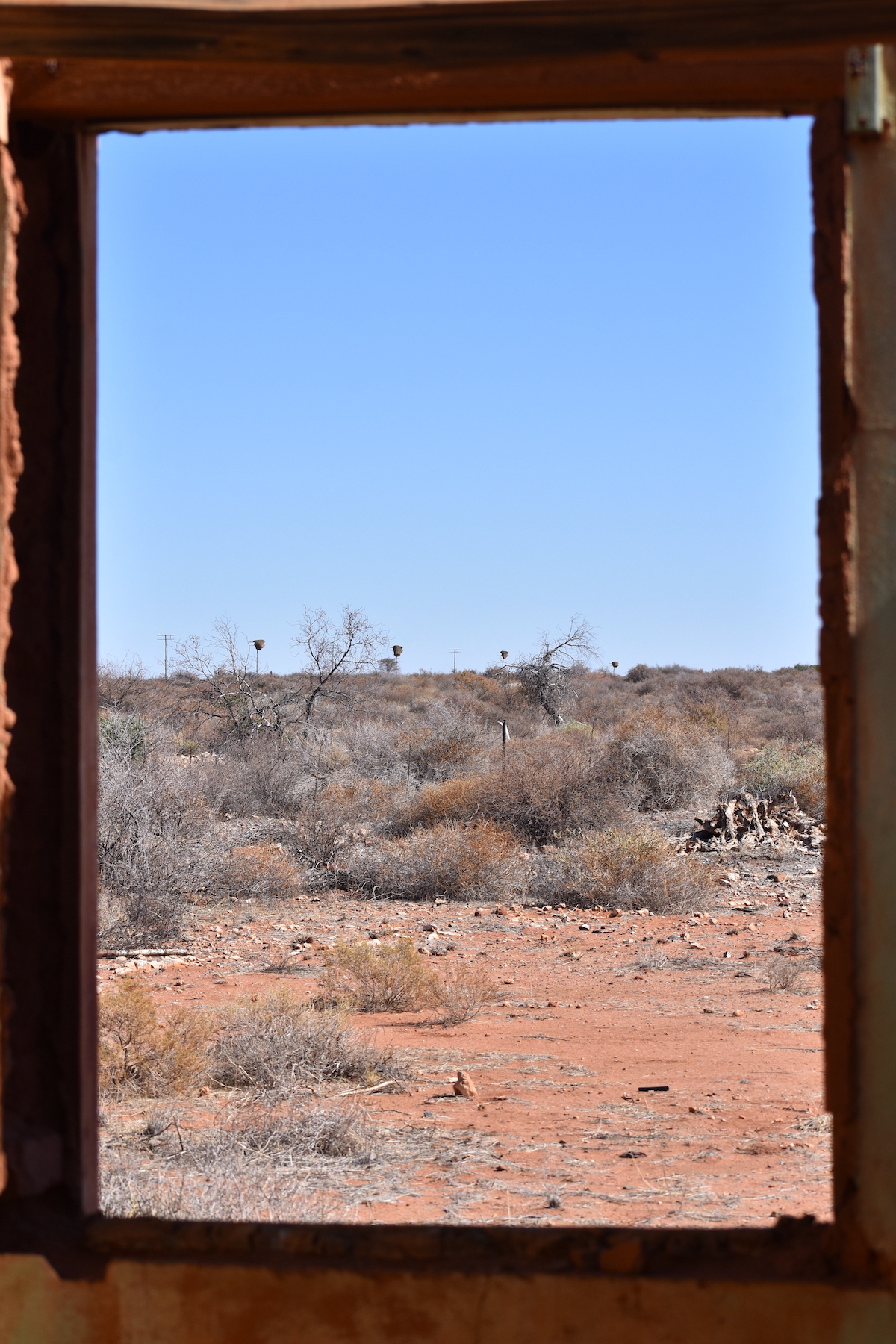
View through an old window in Putsonderwater.
Cacti surrounding Putsonderwater.

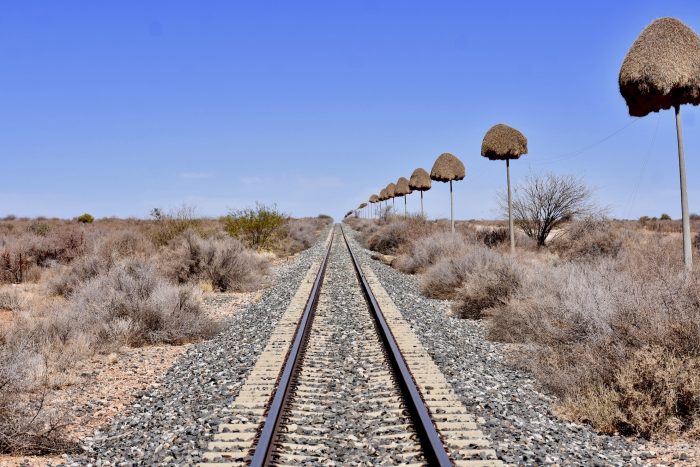
On the edges of the settlement, long-discontinued telephone poles wear heavy straw hats: massive nests, masterfully crafted by resident Sociable Weaver colonies. These remarkable birds are endemic to southern Africa and build the largest nests of any avian species. Their handiwork quickly became a familiar sight, whether draped over old trees or topping endless lines of poles.

Sociable Weaver nests top poles along the railway line.

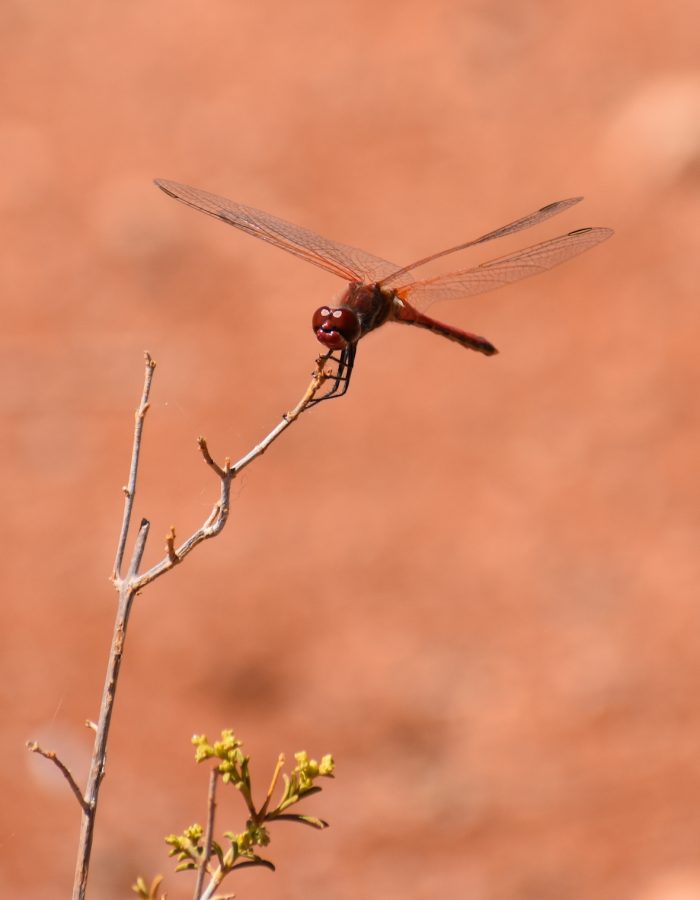
After half an hour spent peering through windowless frames and wandering unroofed halls, we chose to explore a few of the surrounding buildings in search of more life. Our efforts yielded unexpected findings: a pair of Spotted Eagle-Owls peering down from a pine, and Red-veined Darters hovering above bone-dry perches. This Red-veined Darter was the first photographic record for the entire quarter-degree grid cell, 2921BD—for any VM project!

Red-veined Darter (Nomad). Record curated at http://vmus.adu.org.za/?vm=OdonataMAP-76607

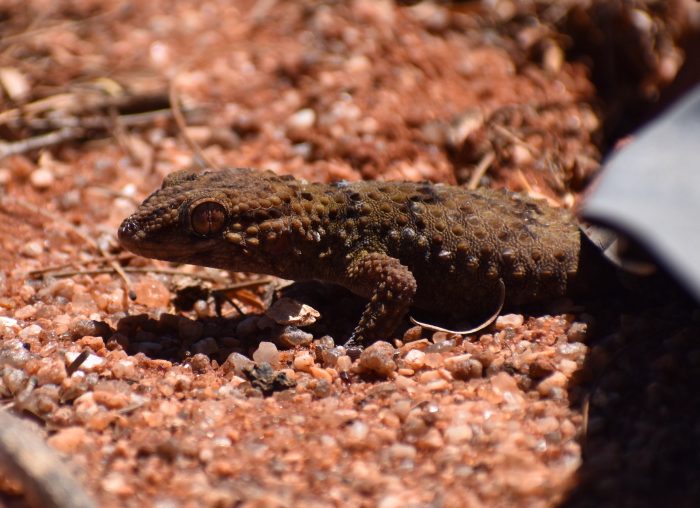
The surprises continued, as rusty sheets of metal and old bricks revealed Bibron’s Thick-toed Gecko and Spotted Sand Lizard.

Bibron’s Thick-toed Gecko. Record Curated at http://vmus.adu.org.za/?vm=ReptileMAP-172311

Our afternoon in Putsonderwater ultimately concluded with fifteen species added to BirdPix, two for ReptileMAP, a Brown-Veined White for LepiMAP, and a new Steenbok record for MammalMAP–and we claimed the added satisfaction of acquainting ourselves with the mystery that is Putsonderwater.

Steenbok outside of Putsonderwater. Record curated at http://vmus.adu.org.za/?vm=MammalMAP-29755
Putsonderwater

Though most days were spent working in the pentads and grid cells surrounding Boegoeberg, we did take time to explore our “home” grid cell as well. In addition to camping facilities, Boegoeberg Dam also offers canoes and kayaks for use on the dam. Early Thursday morning, Salome and I hoped to take a canoe out onto the water to search for a few more riparian species…blissfully unaware that Thursday had other plans. Before dawn, we awoke to the unique sensation of wind violently shaking our tent—wind strong enough, we surmised, to deposit us in Marydale, the next town along the Orange River! Needless to say, we avoided canoes for the day, instead lacing up our hiking boots and tackling two trails running alongside the dam. In spite of the wind, these trails were bursting with life.

Our birdwatching spot beside the river.

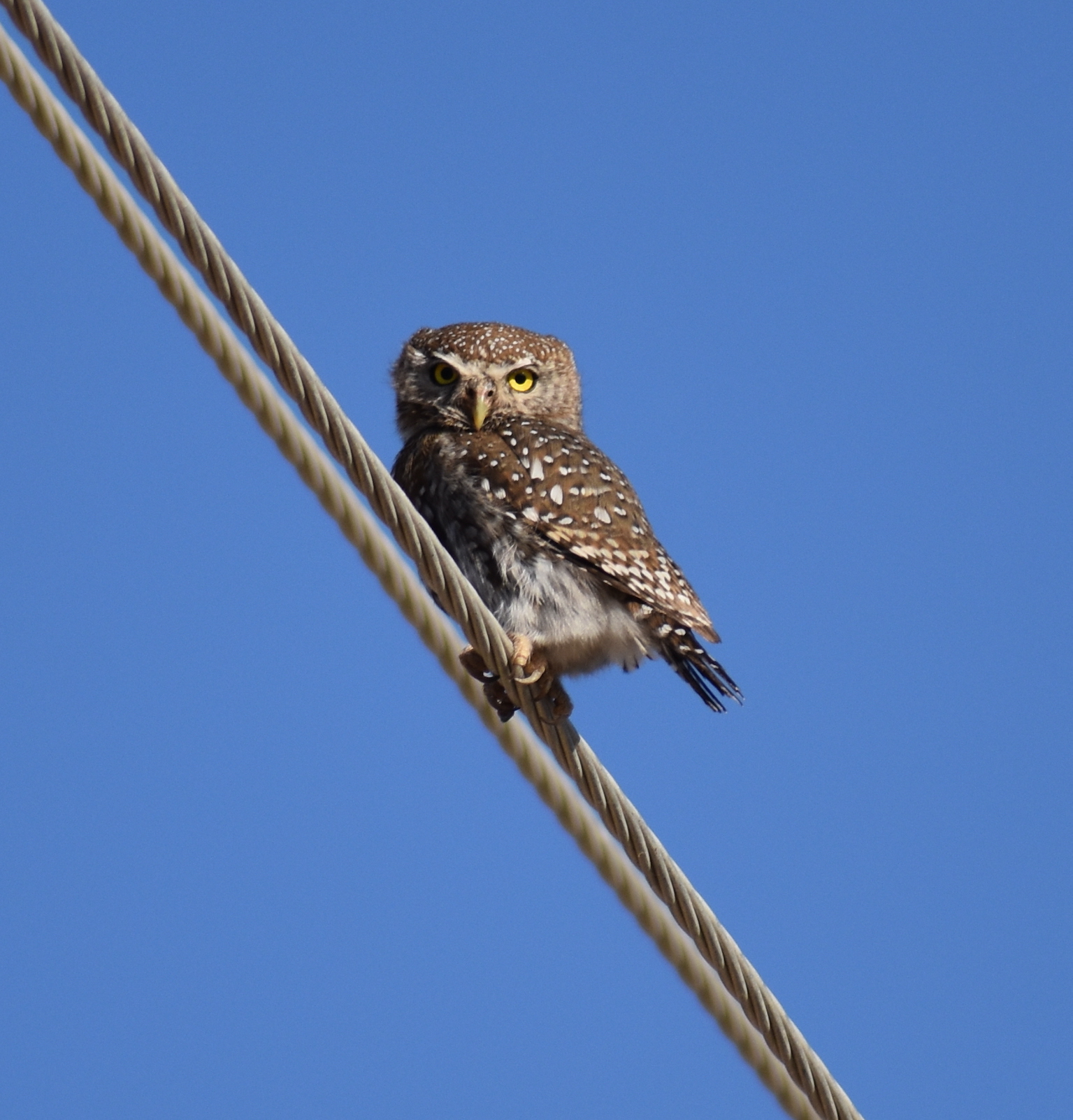
A short scramble and walk led us to a large patch of reeds beside the river. Along the route, we were treated to a beautiful sighting of this Pearl-spotted Owlet, whose mournful song carried across our campsite each night.

Pearl-spotted Owlet. Record curated at http://vmus.adu.org.za/?vm=BirdPix-94009

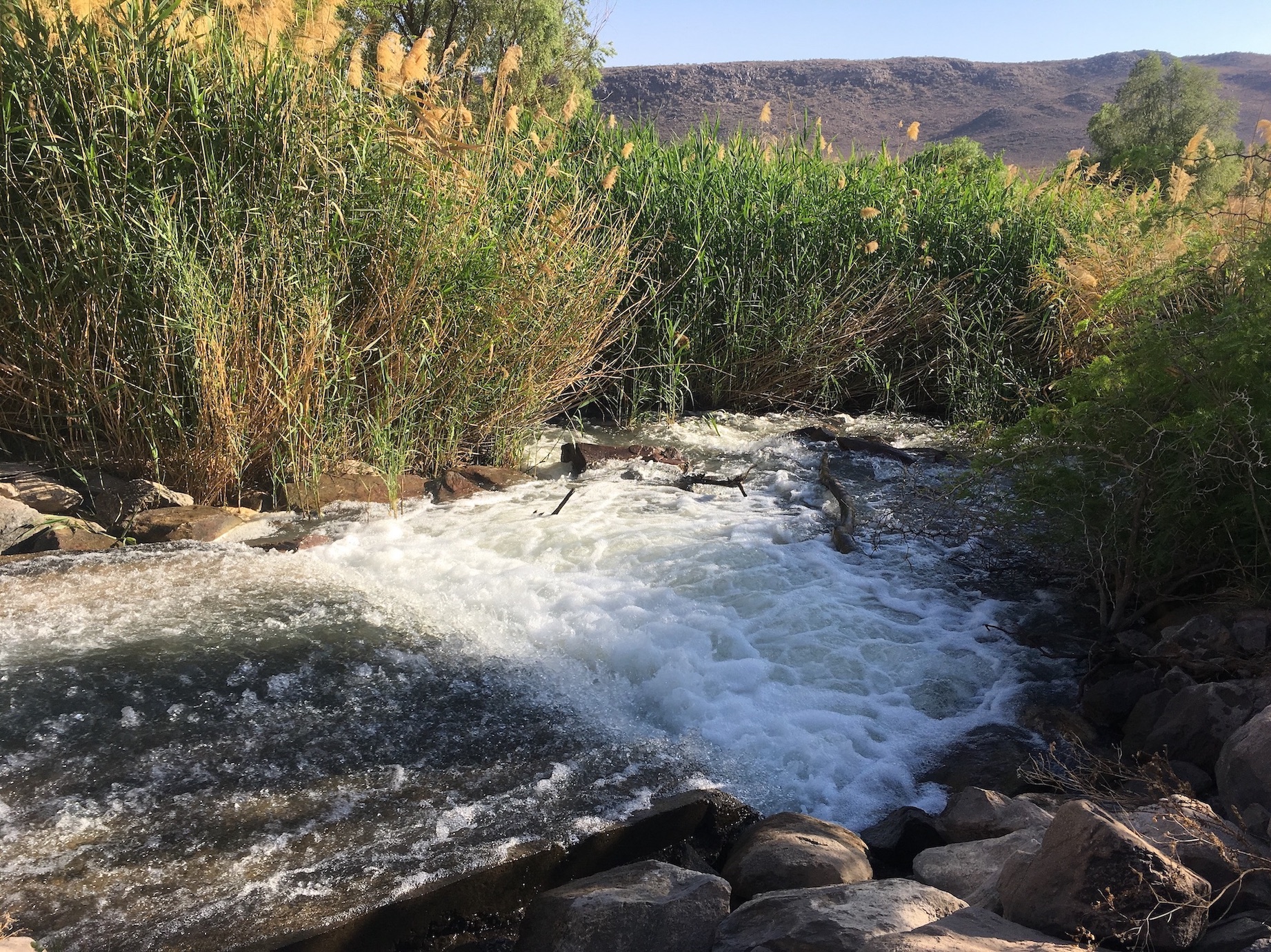
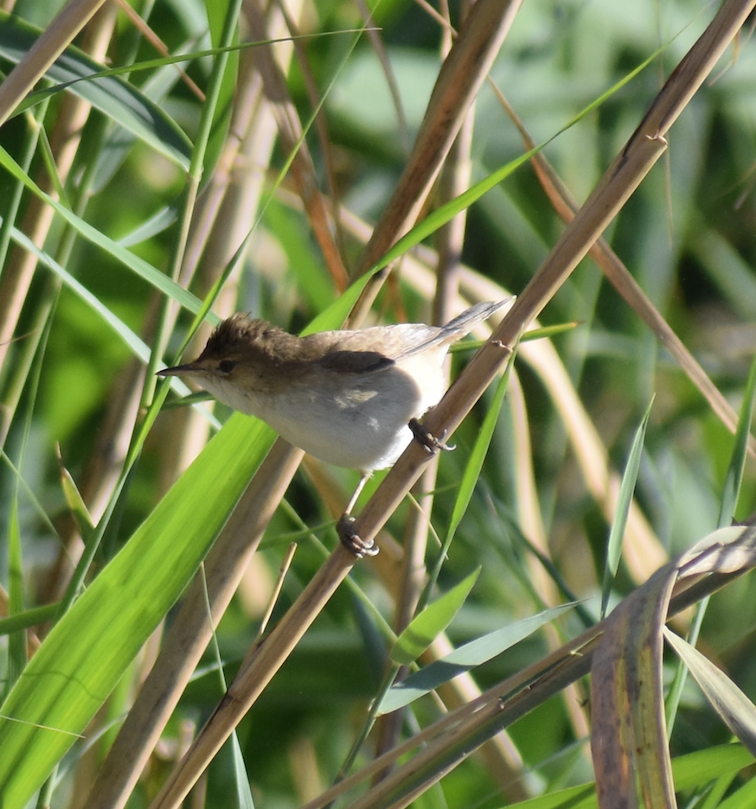
Once we reached the river, it was difficult to hear anything over the noisy gurgle of water pouring in from the canal to our left. Still, as is so often the case when in nature, a few minutes of patience paid off. We were soon rewarded with sightings of African Reed Warbler, White-rumped Swift, White-throated Swallow, Southern Masked-weaver, Reed Cormorant, White-breasted Cormorant, and Orange River White-eye.

African Reed Warbler. Record curated at http://vmus.adu.org.za/?vm=BirdPix-94022

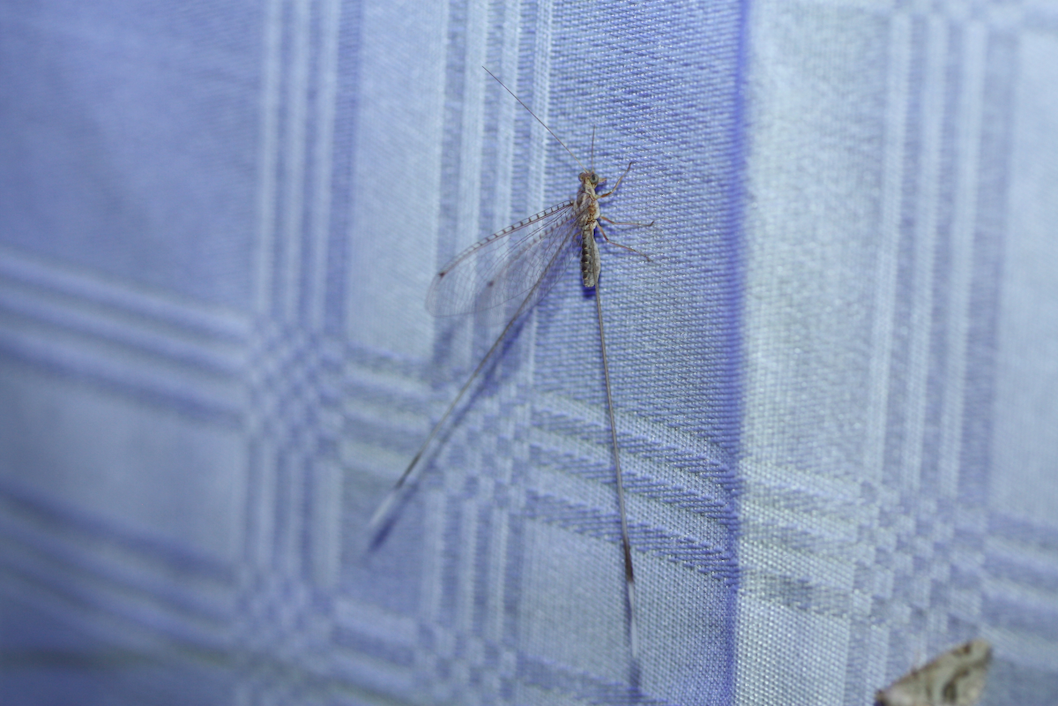
We found treasures closer to the campsite, as well—as darkness settled over the tents, Altha set up a blacklight to attract moths and lacewings. This is one of her three resulting submissions to LacewingMAP, a beautiful female Nemopterella species.

A female Nemopterella species, photograph courtesy of Altha Liebenberg. Record curated at http://vmus.adu.org.za/?vm=LacewingMAP-16224

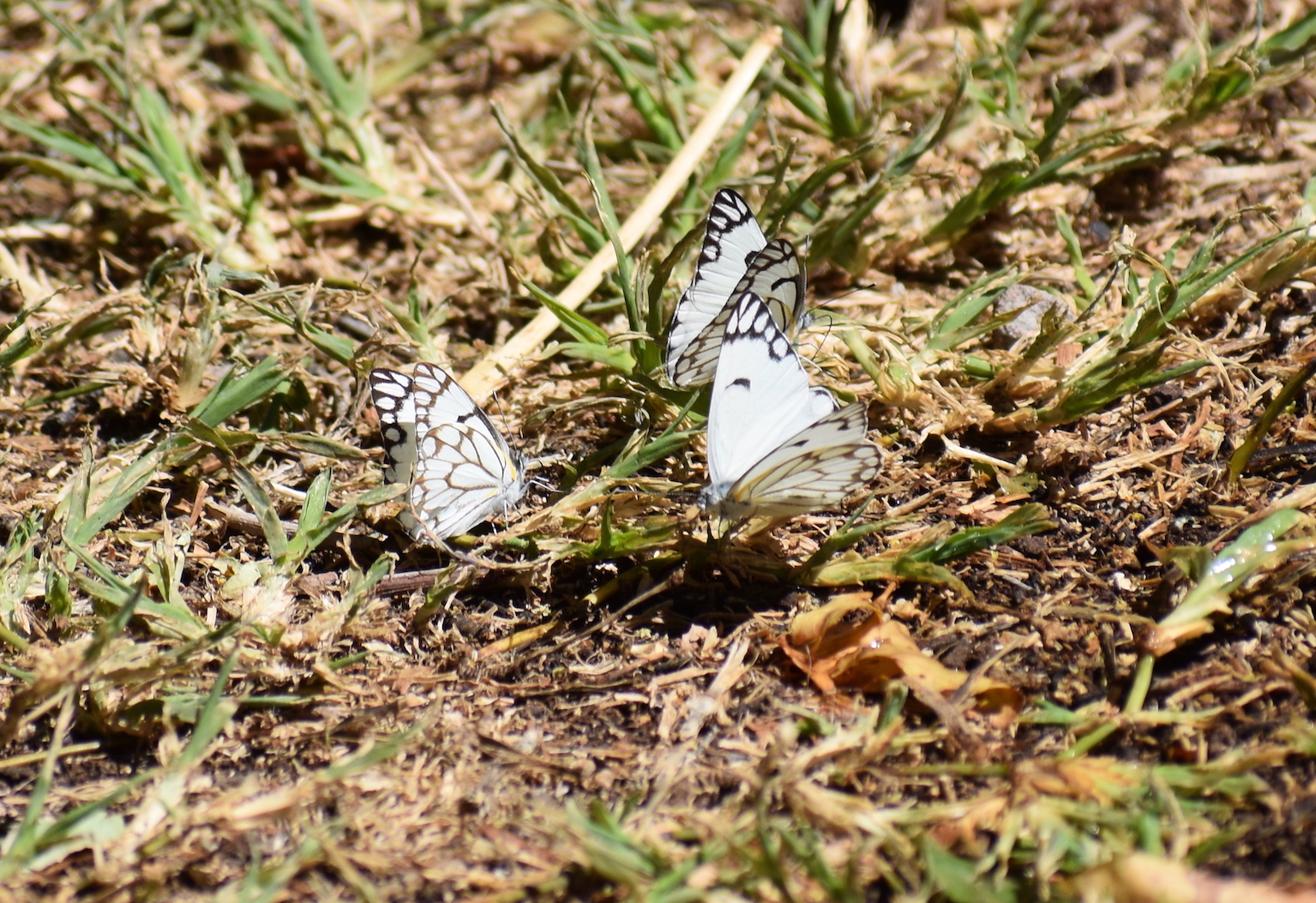
During the day, dozens of Brown-veined Whites danced through the sunlight-speckled shade alongside the dam, clustering together to drink from shallow pools of water.

Brown-veined White. Record curated at http://vmus.adu.org.za/?vm=LepiMAP-694072

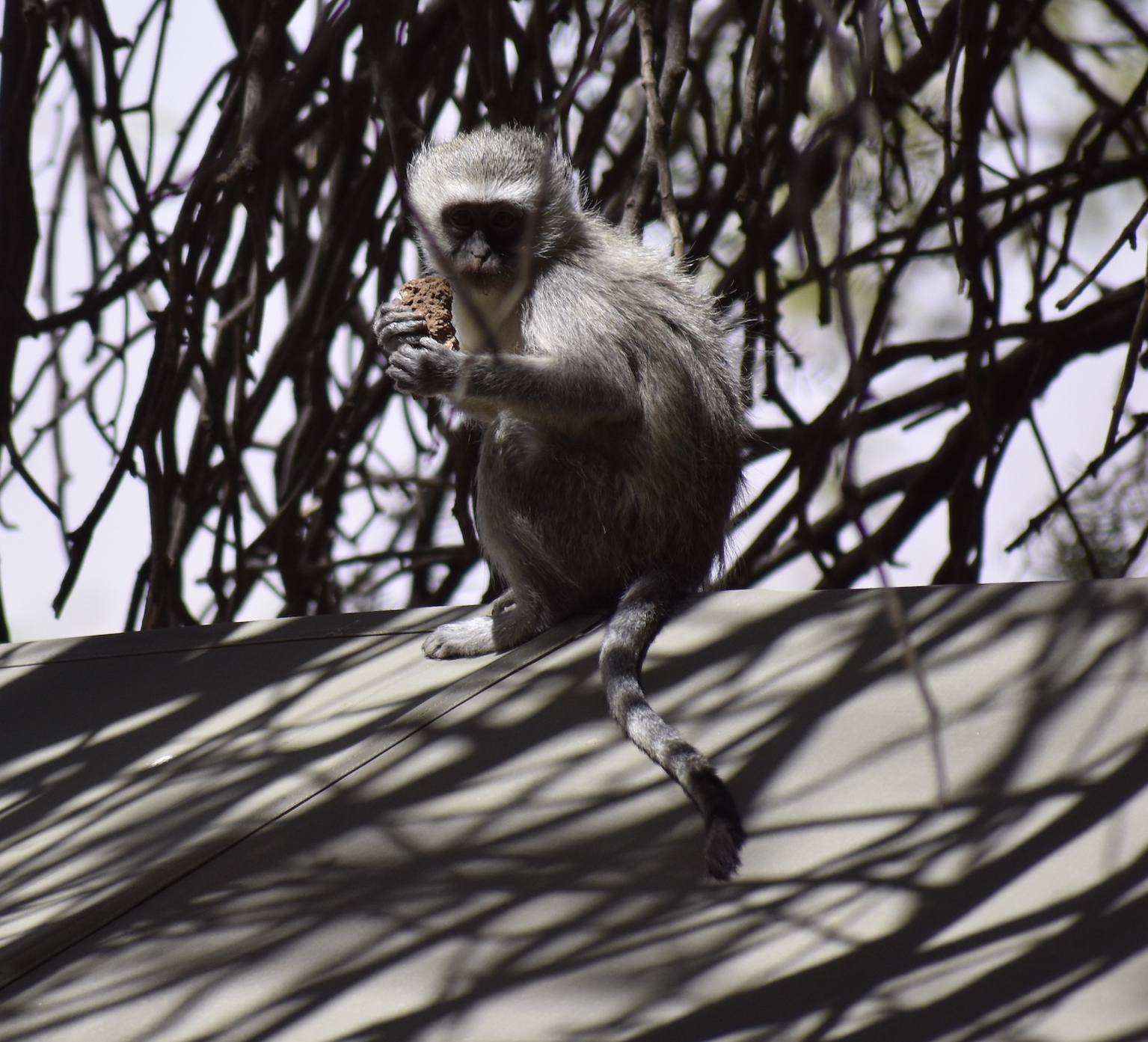
It was the mammals, though, which undoubtedly left the strongest impression; in particular, the resident population of vervet monkeys. Endlessly curious and ever-resourceful, these clever critters ventured into our tents not once, but twice! This especially cheeky individual made off with a rusk, and perched atop one of our tents whilst polishing it off.

Vervet Monkey enjoying a stolen snack.

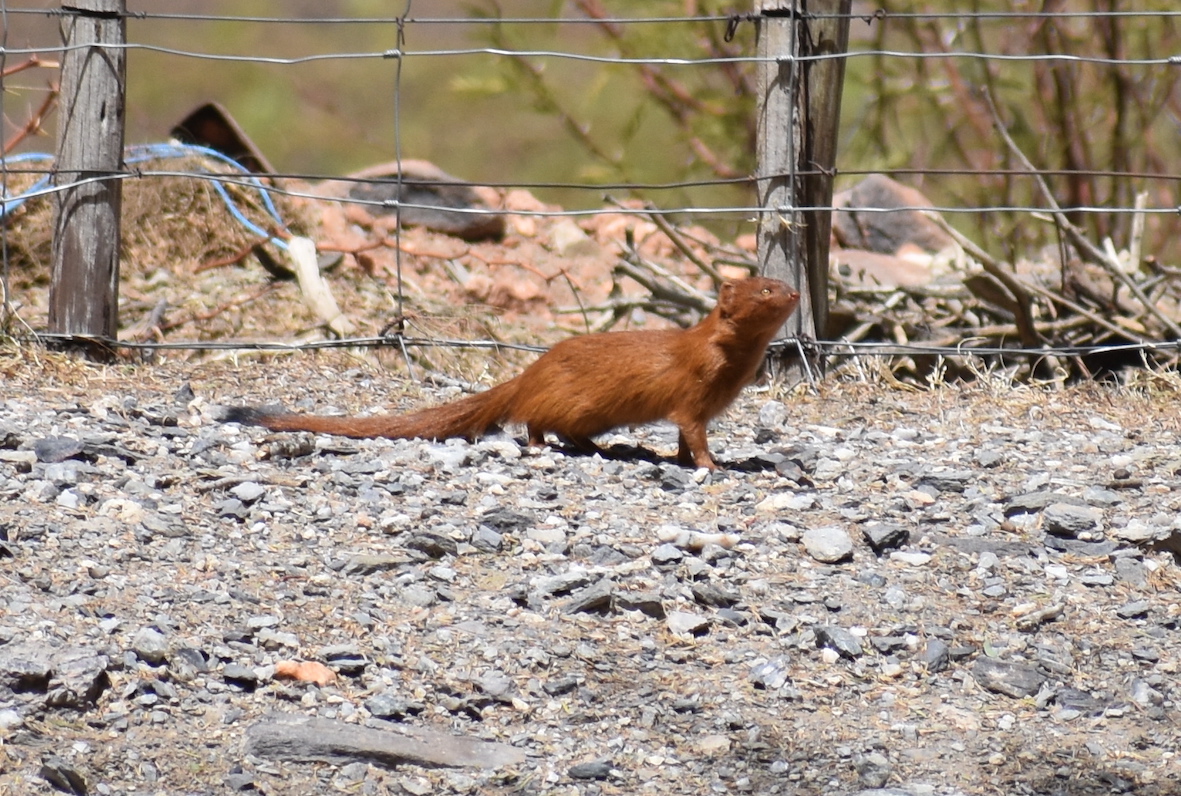
With the exception of the vervet monkeys, other mammals kept a wary distance. Slender mongoose and South African ground squirrel scurried across pathways, and though we spotted baboons a few times (and certainly heard them in the morning), they stayed clear of the campsite.

Slender Mongoose. Record curated at http://vmus.adu.org.za/?vm=MammalMAP-29738

This trip is, in my mind, accompanied by an overwhelming sense of gratitude; my story is only one among many. Whether by foot, bike, canoe, or bakkie, Alan and Stefan worked as a team, tackling difficult pentads for the South African Bird Atlas Project (SABAP2). Though their quest for birds (and penchant for 50 species per pentad) led them across some unusual terrain, it also saw them welcomed into homes for meals and conversation. Altha, Hardy, and Joey focussed their energies on Boegoeberg dam, taking route recommendations from Magda, the dynamic driving force behind much of the campsite’s restoration. Together, these three scoured walking and driving routes along the water’s edge and the canal in search of birds, butterflies, reptiles, and more to build the species list for the grid cell. Les visited some of the furthest locations from the campsite, following the river and adding valuable riparian species records to the grid cells.

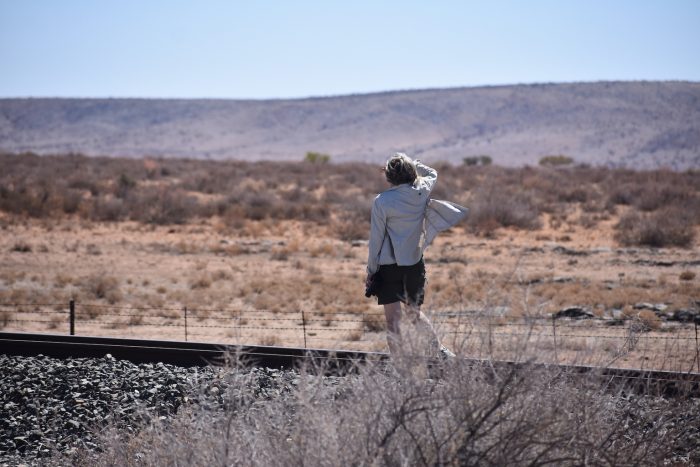
Salome Willemse searches for birds along the railway line.

Beyond those of us immediately involved in data collection, the trip itself was made possible by dozens of generous sponsors in Danielskuil. Our sponsors supplied fresh fruit, cool drinks, and gear to fuel our journeys, and Boegoeberg Dam itself generously provided our tents and sleeping cots. And, of course, what BioBash would be complete without a large-scale “battle plan” map? Though unable to attend in person, Tino Herselman created beautiful, detailed maps of the region for each participant to use during the week.

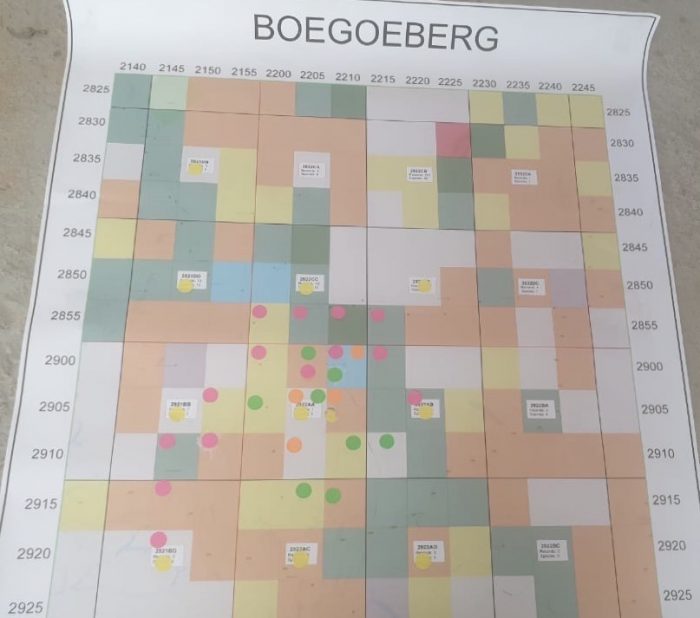
Boegoeberg “battle plan” map, created by Tino Herselman. Pink, green, and orange dots represent pentads atlassed for SABAP2, and yellow dots represent QDGCs which received VM records. Photo courtesy of Salome Willemse.

Each individual contribution made our BioBash not only possible, but successful. We added Virtual Museum records to 10 QDGCs, and covered 23 pentads for SABAP2. Though ID’s for many of the Lepidopteran species and a few reptiles are still pending, one look at the BirdPix data speaks volumes.

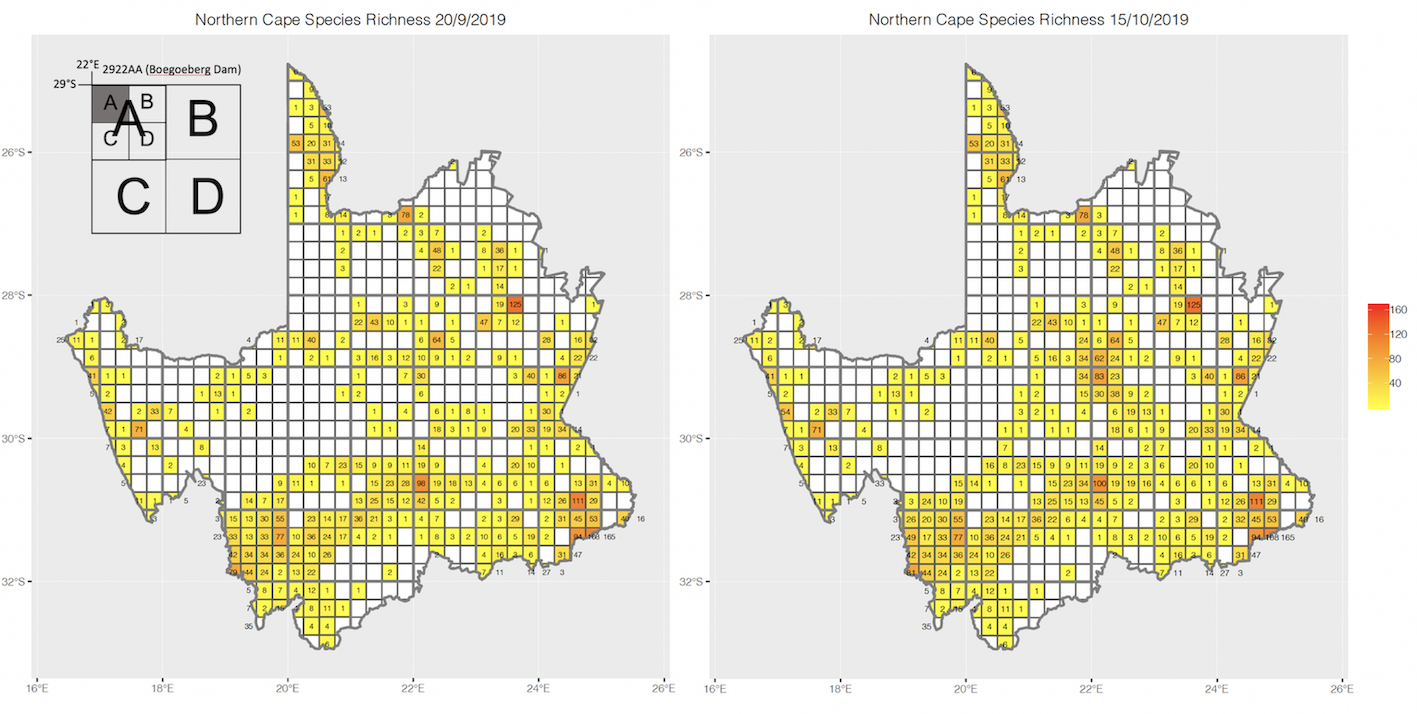
Northern Cape BirdPix coverage maps from September 2019 (left) and October 2019 (right), before and after the Boegoeberg BioBash.

The map on the left shows BirdPix coverage in the Northern Cape prior to our trip, in number of species recorded per QDGC. Boegoeberg Dam is located at 2922AA, and contains 30 species. The map on the right was created on October 15th, and the increase in that grid cell alone is astounding—83 species records! The surrounding cells also show significant improvements.

Once again, I am amazed at the difference a few dedicated individuals can make within such a short period of time. Thank you to all of the sponsors, participants, and contributors who made Boegoeberg BioBash 2019 possible—we are so thankful to have you on our team! To readers and citizen scientists who may not have ventured into this part of the Northern Cape, I encourage considering a visit to Boegoeberg. There are few facilities in this region which offer accommodation alongside such a unique diversity of wildlife, and your stay will be made all the more memorable by the warm welcome you receive. I hope that you are able to experience Boegoeberg for yourselves, and find your own adventures in this remarkable part of the world.

Further reading for the curious mind. An interesting write-up on the history of Putsonderwater can be found here: https://mg.co.za/article/2009-08-05-putsonderwater-a-well-without-people

Keep exploring!

Ant-Eating Chat. Record Curated at http://vmus.adu.org.za/?vm=BirdPix-93835

Valuable, Vulnerable Vultures

There are two groups of vultures in the world.  The Old World vultures, with 16 species occurring in Africa, Europe and Asia; and the New World vultures with seven extant species, occurring in the Americas. Old World vultures are more closely related to eagles and hawks than to New World vultures; the similarities between them are due largely to convergent evolution. Convergent evolution is the process whereby species that are not closely related, independently evolve similar traits as a result of having to adapt to similar environmental conditions or ecological niches. Among the Old World vultures, the Bearded Gypaetus barbatus, Egyptian Neophron percnopterus and Palm-nut Vultures Gypohierax angolensis are more closely related to each other than to other vultures. Strangely, no vultures occur in Australia, but several species of crow and raven fulfill the role of scavengers there.

White-headed Vulture (left) and Egyptian Vulture (right)

Vultures are often wrongly considered ugly and stinky, and given villainous roles in stories, movies and books. The thought of these birds feeding on dead and rotting things might not be a pleasant one, but, without them we would be in big trouble! Vultures are nature’s clean-up crew. They consume the remains of large mammals.  Some of these killed by lions or other large predators; some die of disease, old age, starvation or other reasons.  In all cases, vultures are the ones who end up cleaning the carcasses down to the bare bones – the Bearded Vulture or Lammergeyer Gypaetus barbatus consumes the bones too.  If vultures weren’t around, rotting carcasses would pile up.  Over days or weeks these piles of stinking, festering carrion will be wonderful incubators for all kinds of diseases and pollute water resources.  The carcasses will still get scavenged, but at a much slower rate, by animals like jackals, rats, stray dogs, and flies.  Some of these species are not always desirable to have around, and may, instead of limiting, contribute to the further spread of diseases, including to humans and domestic animals.

A study led by Anil Markandya looked at the impacts of the disappearance of vultures in India. Vultures die offs occurred because of a veterinary drug called diclofenac, used as a painkiller and anti-inflammatory for cattle. While it helped the cattle, it harmed the vultures.  Cattle in India are mostly considered sacred; they are not eaten, but when they die, are left for the vultures to consume. The vultures consumed many carcasses that had diclofenac in their systems; and only a small amount of it in a vulture’s system is enough to give it kidney failure. Vulture populations declined catastrophically!

White-backed Vultures coming in to scavenge in Bangweulu Wetlands, Zambia – photo by Megan Loftie-Eaton

What was the effect of the vultures vanishing?  The researchers concluded that the decline in vultures, which meant more and more carcasses, led to an increase in the stray dog population by as many as seven million individuals! As a result, there was a big increase in dog bites – Markandya and his team estimated an additional 40 million dog bites over a 14 year period. This meant an additional 40,000 human deaths due to rabies, India being particularly hard hit by this disease. Researchers estimated the cost to the Indian government and health services at 34 billion dollars!

The principle of this study illustrates is that the disappearance of vultures is something that costs us humans money. And this study looked at only one factor, namely, rabies. There are likely many other impacts, diseases that may affect humans as well as animals, that may increase if the amazing feathery “clean-up crew” are not there to do their job.

We humans tend to value money above all, it would seem, and sadly many people in power are hesitant to act on anything if it does not affect their bank account. But, there are many things on our wonderful planet that go beyond monetary value, many things that are priceless. It is not really possible to estimate the full value of something like vultures in terms of money.  Yes, they help limit diseases in various ways. There certainly would be many more indirect ways in which vultures are protecting us and saving us money. But, they are just one part of the amazing web of nature, where millions of species are all interacting with each other and with the environment to form a stable, whole, harmonious, living system or biosphere. For our own comfort, and survival, it is vital that the whole of this ecological web on Earth should be protected. Any species we lose leaves a ‘gap’ in the network. While one species may step up to take over a role left behind by another species that has vanished, there is certainly a limit to the knocks that any ecosystem can take.  And the same goes for the ecology of the Earth as a whole. We humans are dependent on the healthy functioning of the living Earth, the Earth is not dependent upon us. We need the Earth for our survival, but the Earth does not need us.

Beyond their value, there is the sheer wonder of vultures. They have amazing physiological adaptations suited to their role, some of which we have discovered only recently. They have very acidic gastric juices, helping to rapidly kill harmful bacteria in the meat they eat. Other bacteria they tolerate, these flourishing in their guts and even helping them digest their food.  They have very powerful immune systems, with copious anti-bodies in their blood. It is ironic that they can consume vast amounts of contaminated carrion with no ill effect, but are so vulnerable to the veterinary medications used to treat livestock.

Lappet-faced Vulture (left) and Hooded Vulture (right)

New World vultures have an extremely keen sense of smell, by which they find dead animals; Old World vultures rely mostly on their superlative sense of sight. Vultures, with long and broad wings, are perfectly adapted to soaring, using thermals and updrafts over hills and mountains to lift them high into the sky with almost no effort.  From up there, they can keep an eye out for carcasses. Once one vulture spots potential food, other vultures watching it will see it going down and follow, and so no carcass gets left alone for too long.

At a carcass, different vulture species fulfill different roles. In Africa, the powerful Lappet-faced Vulture Torgos tracheliotos with its strong, hooked bill is able to tear through tough hides and open up intact carcasses so that it and other vultures can feed on the flesh and entrails inside. It also performs the final clean-up acts of eating the hides and sinews after the other vultures have consumed the softer bits. The Bearded Vulture specializes in eating bones, which it can swallow whole or, if too large, drop from a great height onto rocks to shatter.  Most other vultures prefer to feed on softer tissues. They rapidly gorge themselves, extending their crops, sometimes eating so much that they have to wait around for some time before they are able to fly off. If they suddenly have to fly, if, for instance a hungry hyena turns up, they will quickly vomit up some of their meal. A few vulture species have somewhat wider feeding strategies, including catching live prey, as the Lappet-faced Vulture does, or feeding on ostrich eggs, which the Egyptian Vulture does using rocks as a tool to crack their shells. The Palm-nut Vulture, while eating carrion occasionally, actually specializes in eating the oily fruit of raffia and oil palm trees.

Vultures are among the largest and most spectacular birds.  The Andean Vultur gryphus and Californian Gymnogyps californianus Condors, and several Old World vultures like the Lappet-faced Vulture, can reach body weights of more than 12 kg, and wingspans approaching or exceeding 3 m. The King Vulture Sarcoramphus papa of South America has one of the gaudiest faces in the bird kingdom, with colourful wattles and patches of bare skin. The Rüppell’s Vulture Gyps rueppelli has been recorded soaring at altitudes of 11,277 m, higher than any other bird. It would be interesting to know how they are able to tolerate both the extreme cold and lack of oxygen at that altitude.

King Vulture – photo by Olaf Oliviero Riemer

Andean Condor – photo by Michael Gäbler

In some parts of the world, vultures are seen in a very positive light.  In the East, cultures such as the Parsi see vultures as performing a vital spiritual cleansing function; the dead are left on platforms called ‘towers of silence’ for the vultures to consume. In Ancient Egypt, the Egyptian Vulture was sometimes portrayed in hieroglyphics; the Mayans of Central America did the same with the King and Black Vulture.

VULTURES IN TROUBLE

Vultures, with the amazing ecosystem services they provide, are in deep trouble worldwide.  The threats take different forms. The Californian Condor, almost went extinct because of eating the carcasses of animals that humans had shot; the lead bullets and shotgun pellets poisoned them. They were only saved by an intensive captive breeding effort. In India, the big threat is the drug diclofenac introduced to treat livestock.  In Africa, vultures are hit particularly hard.  They are poisoned, sometimes through poisoned carcasses left out by livestock farmers that want to kill jackals and other predators. Elephant and rhinos poachers worry that vultures circling and seeking out their kills, will draw anti-poaching units’ attention; so they poison the carcasses to intentionally kill vultures. In a recent incident, over 500 vultures comprising five different species died from scavenging poisoned elephant carcasses in Botswana.

In Africa, vultures are also considered to have medicinal value. Because of their keen eyesight, they are thought to be clairvoyant (able to predict the future), and vulture parts can sell for considerable prices at muti markets. Their carcasses also turn up at bush meat markets throughout Africa.

Cape Vulture Gyps coprotheres – Blouberg Nature Reserve, Limpopo Province – photo by Megan Loftie-Eaton

Many vultures suffer fatal accidents in collisions with human-made structures.  They are prone to collisions with electricity pylons, and more recently, with the blades of wind turbines. The latter phenomenon is worrying. Wind farms kill not just vultures but also other species of birds, as well as bats. While wind power is often considered a ‘clean’ source of energy, it also has its own serious ecological repercussions. Furthermore, vultures face destruction of their habitats and food sources by humans. It is likely that several species of New World vultures went extinct when most of the megafauna (large mammals) such as mammoths, horses, camels and ground sloths were exterminated by humans entering these continents.  In Africa and Asia, natural habitats are threatened by the ever increasing expansion of human settlements and agriculture, and the numbers of large, wild mammals continue to dwindle too.

What makes vultures especially vulnerable is that they are long-lived, slow-reproducing birds. Even under the best conditions, they take a long time to recover from population losses. At present, more than half of the Old World vulture species are considered endangered in some way! The New World vultures seem to be somewhat safer, but not entirely out of danger.

HOW WE CAN HELP

To protect vultures, they need protected habitat and large animals to feed on. It is important that we eliminate chemicals such as diclofenac that poison them. There are veterinary drugs that do the same job without harming vultures. In Africa, we need ongoing efforts to combat elephant and rhino poaching, as well as the poisoning of other predators that lead to unwanted vulture deaths. One solution is the provision of safe livestock carcasses at ‘vulture restaurants’, which can serve a double role, first of all feeding the vultures, but secondly also attracting bird watchers and tourists. Most vulture restaurants have bird hides where people can sit and watch the vultures as they feed. This also helps to spread vulture awareness. In South Africa and Asia, there are now many such vulture restaurants. We certainly need to continue with our efforts to conserve these precious, feathered eco-hygienists. Fore more information see: http://www.vulpro.com/ and https://www.ewt.org.za/what-we-do/what-we-do-species/vultures-for-africa/

Bearded Vulture


BDInsight – September 2019

September flew by! Where is the year going? We hope you are all enjoying the Spring weather and getting ready for a great Summer of biodiversity explorations and mapping.

The Return of The Dragons

The Return of The Dragons saw OdonataMAPpers snap and map 646 dragonflies and damselflies from five African countries (Botswana, Namibia, Nigeria, South Africa and Zambia). Of the records submitted, 86% have been identified already, thanks to the amazing OdonataMAP expert panel.

The three species seen most often during the shoot the dragons week were Red-veined Darters Sympetrum fonscolombii (54 records), Tropical Bluetails Ischnura senegalensis (46) and Broad Scarlets Crocothemis erythraea (38). In the photo above we have a stunning Black-splashed Elf Tetrathemis polleni, mapped by Toby Esplin in St Lucia, KwaZulu-Natal.

Diana Russell took top honours for the week with 73 dragons OdonataMAPped. Followed by Toby Esplin (68) and Jean Hirons on 42 records. Well done. You are absolute stars! A big thank you goes to each and everyone of you that uploaded records to OdonataMAP during the Return of The Dragons Week – http://vmus.adu.org.za/ – please keep an eye out for any and all odonata this season.

News from the field

Les Underhill, Karis Daniel, Altha Liebenberg, Salome Wilemse, and a group of keen BioMAPpers were out in the boondocks on the Boegoeberg BioBASH collecting valuable biodiversity data. Les sent this wonderful photo (below) of the Boegoeberg Dam. The Boegoeberg Dam, completed in 1933, is the third largest dam in the Orange River. It is located near Groblershoop and Prieska in the Northern Cape, South Africa.

We look forward to hearing all about their trip. Watch this space!

Student Research Projects

A major expansion of the BDI website was undertaken in August. The information about the Research Projects for students is now live. Please go and have a look at http://thebdi.org/research-training/students-research-themes/

Our main research project themes are ecology, environmental sociology, ecological economics, and historical ecology. These themes overlap to a large degree, and our research projects often involve cross-disciplinary research involving several themes.

Although applications from anyone, anywhere in the world, will be considered, we anticipate most of our students will be from universities in Europe. Many universities encourage their students to undertake a project abroad, and the academic year in which this opportunity is permitted varies a lot. The duration of the project also varies, between weeks and months. The role of the BDI is to provide accommodation and supervision. We are geared up to undertake the formal contractual obligations needed by the sending university.

Field research in action – camera trapping