Progress with BirdPix in the Free State during 2020

We will slowly work out way through projects and provinces! We have done BirdPix in the Western Cape.

This map shows the number of bird species recorded for BirdPix in each quarter degree grid cell of the Free State at the end of 2020.
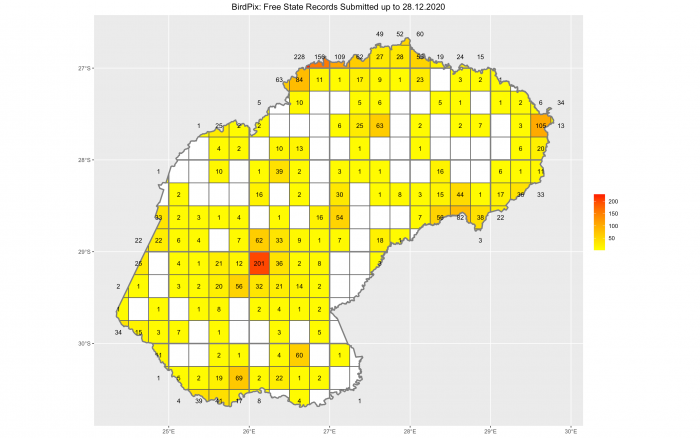
BirdPix in the Free State, 2020. The number in each grid cell is the total number of bird species recorded in the grid cell up to 28 December 2020

And this what this same map looked like a year ago, on 31 December 2019.
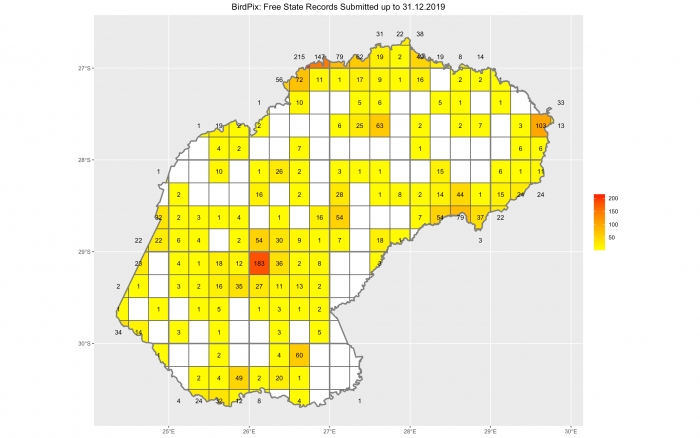
BirdPix in the Free State, 2019. The number in each grid cell is the total number of bird species recorded in the grid cell up to 31 December 2019

You have to work a little bit to see the advances. The number of bird species for Bloemfontein grid cell (2926AA near the centre of the map) increased by 18 from 183 to 201, and there have been lots of other increases. Seven grid cells got their first BirdPix records during 2020. The maps below provides a measure of BirdPix activity in the Free State during 2020.
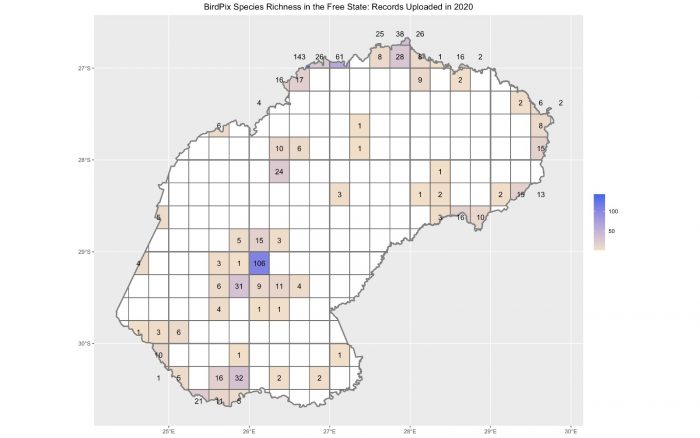
BirdPix in the Free State in 2020. The number in each grid cell is the total number of bird species recorded in the grid cell, considering only records uploaded to BirdPix between January and December 2020

So although the number of species in the Bloemfontein grid cell increased by 18, records were submitted for 106 species. That is precisely what we are looking for. The remaining 88 species were “refreshed“, in the sense that they now have records from 2020, confirming that they still occur in the grid cell.

It is this blue map which highlights the main focus of the Virtual Museum nowadays. The emphasis has shifted from “species per grid cell, irrespective of when the records were made”, to keeping the database “refreshed” and up-to-date.

Measuring “up-to-dateness” …

Here is another (and fairly subtle) approach to measuring “up-to-dateness” in the Free State overall! For each grid cell, we find the date of the last record for each species. If species are “refreshed” regularly, this date will be recent. We next sort all the “last recorded” dates for all the species in a grid cell from oldest to most recent. Calculate the date in the middle. Half the species were last seen before this date, and half have been seen subsequently. We  want to keep this middle date as recent as possible. (Statisticians call this “middle date” the median, and there is a blog about this concept.)

Next, we take all the grid cells in a region (e.g. a province like the Free State) and we compute the middle dates (the medians) for all of them. We hope, on average, that these middle dates are pretty recent. To measure how recent they are overall, we calculate the middle date of all the middle dates in the region. We are happiest if this date is recent. We prefer this date to be recent, because if this median of medians is not too far in the past, it means that, overall, the species lists for the grid cells in the region are pretty up-to-date.

At the end of 2020, for BirdPix in the Free State, the median of the medians was 8 August 2016. In other words, half the grid cells had their own medians before this date, and half of them had medians after this date. August 2018 is four years and five months ago, or 53 months. So we can make the statement: at the end of 2020, BirdPix was, on average, 53 months behind the clock. We can repeat this arithmetic, pretending we are have turned the clock back to December 2019, a year ago. The median of the medians then would have been 9 September 2015, 52 months prior to December 2019. So, in terms of up-to-dateness, BirdPix in the Free State slipped by one month during 2020. Considering the difficulties of 2020, this is a satisfactory outcome.

As citizen scientists, we should aim to improve the up-to-dateness during 2021. We can achieve this by adopting the New Year’s resolution for Team Virtual Museum. “Starting in my home grid cell on 1 January 2021, I will upload records to the Virtual Museum of as many species as possible (and I will be especially careful not to neglect the common species). Wherever I travel in 2021, I will do my best to keep the distribution maps up-to-date for as many species as possible.” We should aim to do this wherever we are, and for all the projects of the Virtual Museum.

… more summary numbers …

At the end of 2020, there were 6,523 records in BirdPix which had been identified to species level. These included 425 bird species. The records were for 163 quarter degree grid cells. There are 153 grid cells which are entirely within the Free State, and another 85 which have overlaps between the Free State and other provinces or with Lesotho. That is a total of 238. So there are records for 163 of the 238 quarter degree grid cells in Lesotho. In the top map, the number of species recorded to date in each grid cell at the end of 2020 is given. If you add these numbers up, the total is 3,189 “species-grid cells”.

At the end of 2019, these figures were 5,524 records, for 418 species. So we added 999 records, and seven species in the year. During 2020, the number of grid cells with records increased by seven, from 156 to 163. The number of “species-grid cells” increased from 2,871 to 3,189, an increase 318. In other words, 318 species were recorded in grid cells from which they had not been recorded at the start of 2020.

Refreshment dip into Yzerfontein during lockdown

Kitch garden bird

At the beginning of May 2019, the quarter degree grid cell for Yzerfontein had 15 BirdPix records for 12 species. An expedition on 5 May 2019 changed that to 67 records of 39 species. There is a blog about this! During the remainder of 2019 and during the pandemic-dominated 2020, citizen scientists slowly improved these figures to 96 records of 45 species. At the start of 2021, South Africa was back in lockdown, a 6 am curfew meant that early morning starts were not feasible, and the beaches were closed. So on 9 January, it was time for a dip back into Yzerfontein to try to refresh as many species as feasible. It was time to honour the New Year’s resolution for Team Virtual Museum for citizen scientists …

… “Starting in my home grid cell on 1 January 2021, I will upload records to the Virtual Museum of as many species as possible (and I will be especially careful not to neglect the common species). Wherever I travel in 2021, I will do my best to keep the distribution maps up-to-date for as many species as possible” …

The edge of quarter degree grid cell 3318AC Yzerfontein is an hour from home. So with a 6 am start, I was at the intersection of the R27 and the R315 to this summer holiday resort by 7 am. See the map below …

Yzerfontein QDGC 3318AC

Underneath this map on the Virtual Museum website is the list of 45 species recorded so far. When I started, the bottom part of this list looked like this:

The end of the species list for the Yzerfontein QDGC before 9 January 2021

Here are species 34 to 45 on the list. The column that has 96 at the bottom tells us the number of BirdPix records for each species (and if you click on “Records” over on the right you get to see their details). The second last column gives the date of the most recent record for each species. So there are four records of Cape Sparrows, the most recent of which is on 12 December 2019.

Understanding the dates at the bottom of the column provides real insight into the up-to-dateness of the data for this grid cell. It is unusual for both the dates to be the same! This is how to calculate the top date of the two. Take the 45 “most recent” dates, and sort them. Pick the date in the middle: 5 May 2019. Half of the 45 species have been seen since this date and half before this date. For the bottom date, do the same process but with all 96 records. Half the records were made before 5 May 2019, and half of them since. This way of calculating the “date in the middle” produces a value called the “median” by statisticians. There is a blog about this!

After I got home, I submitted 50 records to BirdPix. Overnight, the members of the BirdPix expert panel have confirmed the IDs of all them. They are an awesome and dedicated group of people, and this is an important opportunity for us to express our thanks to them. The number of records for the grid cell has increased by 50 from 96 to 146. The number of species has grown by eight from from 45 to 53. Here is the list from House Sparrow to the end:

The end of the species list for the Yzerfontein QDGC after 9 January 2021

House Sparrow has shifted from being number 34 in the previous list to 39 now. In this part of the list, the new species are Southern Masked Weaver (47), African Sacred Ibis (51) and African Hoopoe (52). But the important thing to look at is how the median dates have changed. The median of the “last recorded dates” is now yesterday, 9 January 2021. That is because, when you sort these 53 dates, more than half the species were recorded on 9 January 2021! The bottom date has advanced from 5 May 2019 to 11 December 2019. Half of the 146 records were made before 11 December 2019, and half of them since. And that is of no concern!

The important thing is not the eight new species, but the fact that the median of the “last recorded dates” is right up-to-date. More than half the species were “refreshed“. The big challenge for 2021 is going to be to get this date into 2021 for as many grid cells as possible for as many projects as possible. Yzerfontein was easy; it only had 45 species.

Here are a few of the records from 9 January 2021:

African Hoopoe
In the Virtual Museum, this hoopoe is curated at http://vmus.adu.org.za/?vm=BirdPix-151655. This is the first record of the species in the grid cell for BirdPix

The hoopoe was on a lawn, in the dark shade under a tree. Considerately, it flew up onto a balcony and posed there. A chick is destined to receive a juicy worm.

Birds in flight are a challenge …

Black-shouldered Kite in flight
This Black-shouldered Kite can be found in the Virtual Museum at http://vmus.adu.org.za/?vm=BirdPix-151653

… but this Black-shouldered Kite hovered obligingly.

You will be pleased to know that this photo did not find its way into the Virtual Museum

Kitch garden ornament

… the Hartlaub’s Gull and the Cape Spurfowl seem oblivious to the kitsch garden ornament.

Law enforcement was prominently parked in the beach parking area, and no one was defying the lockdown regulations. There were lots of gulls on the beach, but the White-fronted Plovers had clearly not discovered that the beaches were deserted of humans, and they had congregated on the salt pan near the Strandkombuis.

White-fronted Plover on saltpan at Yzerfontein
Now you can see why it is called a White-fronted Plover! It was far away, and it was a dull morning. Look at the other photos curated at http://vmus.adu.org.za/?vm=BirdPix-151665!

You can find the complete BirdPix list of species for the Yzerfontein grid cell (and the map) by going to the link http://vmus.adu.org.za/vm_locus_map.php?vm=birdpix&locus=3318AC. (You can find the lists for other projects by changing “vm=birdpix” to other projects, eg “vm=reptilemap”, and you can change the code for the quarter degree grid cell).

So Yzerfontein is nicely refreshed for the birds. The dragonflies do however need attention (see http://vmus.adu.org.za/vm_locus_map.php?vm=odonatamap&locus=3318AC; the median date s in 2011!); there MUST be some freshwater somewhere in the grid cell. For LepiMAP, the median last record date is 1 February 2015 (see http://vmus.adu.org.za/vm_locus_map.php?vm=lepimap&locus=3318AC). But for ReptileMAP it is way back in 25 August 1983. Gosh, that is nearly four decades ago. Once the data starts to be this old on average, it ceases to be really valuable as current evidence of species distributions. That is the ultimate challenge.

This leads us back to our Virtual Museum resolution for 2021: “Keep the distribution maps up-to-date”. It is the commonest species in well-covered grid cells that are easy to neglect. And, at the same time, they are the easiest to keep up-to-date.

There are positives to having to leave after sunrise. Under normal circumstances, it would not have been light when I passed the huge Vissershok Landfill Site. A decade or so ago, this dump was well-known for hosting a some quite exotic storks: Marabou and Open-billed, and here is an amazing BirdPix record from 2009 of White Storks at the dump. Yesterday, when it was still too early for a self-respecting, and presumably well-fed, White Stork to be up and about, the lamp posts at the nearby weighbridge where heavy trucks get examined were each occupied:

Grubby White Stork at Vissershok dump
Curated at http://vmus.adu.org.za/?vm=BirdPix-151593. This is only the third record of White Stork in the Bellville quarter degree grid cell 3318DC; to see the full list of bird species in BirdPix for this grid cell, go to http://vmus.adu.org.za/vm_locus_map.php?vm=birdpix&locus=3318DC

The moral of this story is that birds with white feathers should not feed in rubbish dumps.

But the moral of the blog is simple. Our anthem for 2021 is “refresh, refresh, refresh!”

BDInsight – Festive Season 2020/21

A very Happy New Year to each and everyone of you. It is hard to believe that 2020 is behind us and 2021 has started. The world is still in the grips of Covid-19, but we have become accustomed to this “new” way of living. With these challenges great opportunities also arise and innovation happens. It has been a year of growth and the opening of new doors.

The BDI Citizen Science community has grown stronger. Biodiversity mapping has been a great way to keep sane throughout 2020. We held several Citizen Scientist Hours which opened up a whole new world to all of us. To catch up on the various awesome talks, visit our YouTube Channel.

Virtual Museum

New Year’s resolution for Team Virtual Museum: “Starting in my home grid cell on 1 January 2021, I will upload to the Virtual Museum records of as many species as possible (and I will be especially careful not to neglect the common species). Wherever I travel in 2021, I will do my best to keep the distribution maps up-to-date for as many species as possible.”

In spite of all the challenges, 2020 was BestYearEver for the Virtual Museum, by a margin of 24%. That is an awesome achievement, Team Virtual Museum. 2020 is now history. Even the colour of its line on this plot has changed from red to blue. The current year is always RED, and in the bottom left hand corner you can see that the first records for the year have already been submitted.2021 needs to be the year of “refreshment” of old records. Let’s pretend that we are starting again from scratch. This is the strategy for keeping the distribution maps up-to-date. This is the primary need of biodiversity conservation planning and priority setting. Without up-to-date maps (and historical maps to show how distributions are changing), conservation planning for species is as effective as winking in the dark! Strength and peace to all citizen scientists in 2021.

Fundamentals of Citizen Science – BDI Course

Rick Nuttall revealed the new BDI course, to be called Fundamentals of Citizen Science in one of our recent BDI Citizen Scientist Hour events. We plan to repeat the course at least three times in 2021. The planned dates and places are:

  • 21-28 February at the Karoo Gariep Nature Reserve (New Holme Guest Farm), Hanover, Northern Cape
  • 11-18 April at Louisvale Farm, north of Carnarvon, Northern Cape
  • 6-13 August at Botuin, Vanrhynsdorp, Western Cape.
  • The provisional cost is R11,900 per person for the course including food and accommodation. Please send emails expressing interest to megan@thebdi.org

You can read more about what the courses involver here.

OdonataMAP

There are now more than one hundred thousand (100,000) photographic records in OdonataMAP. That is a huge. For the purpose of producing distribution maps for the dragonflies and damselflies of Africa, the OdonataMAP data is supported by the 121,000 records of ADDO data, mostly the historical data in museum collections. Within the next year, we should aim to get the OdonataMAP database larger than 121,000. 100,000 photographic records. That is a stunning achievement! Thank you, OdonataMAPpers, and well done!

Progress with BirdPix in the Western Cape during 2020

Southern Double-collared Sunbird

This is planned to be the first of many similar blogs. We are starting with an easy project, BirdPix, in my home province, Western Cape. It is still a bit experimental!

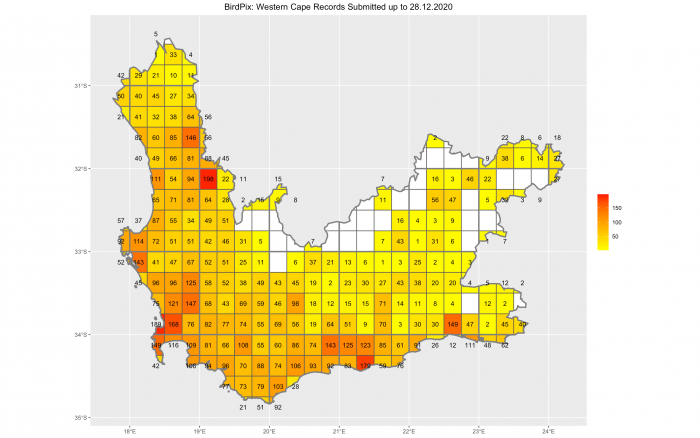
This map shows the number of bird species recorded for BirdPix in each quarter degree grid cell of the Western Cape on 28 December this year, very close to the end of 2020.
BirdPix in the Western Cape, 2020. The number in each grid cell is the total number of bird species recorded in the grid cell up to 28 December 2020
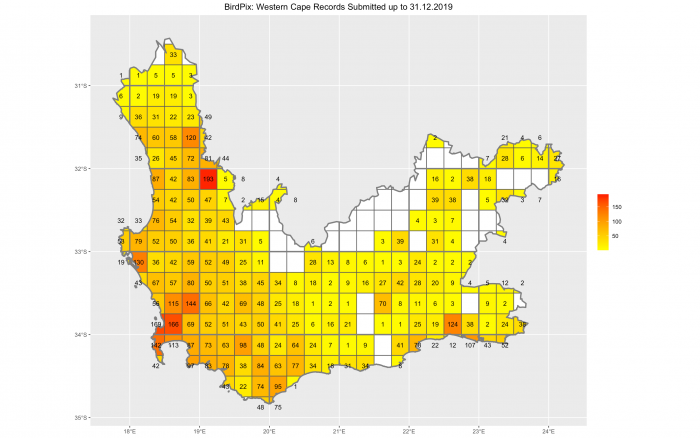
And this what this same map looked like a year ago, on 31 December 2019.

BirdPix in the Western Cape, 2019. The number in each grid cell is the total number of bird species recorded in the grid cell up to 28 December 2019

These two maps show impressive progress during 2020 for the total number of species in many grid cells.  And you have to work quite hard to find the grid cells where the year-end totals are the same!

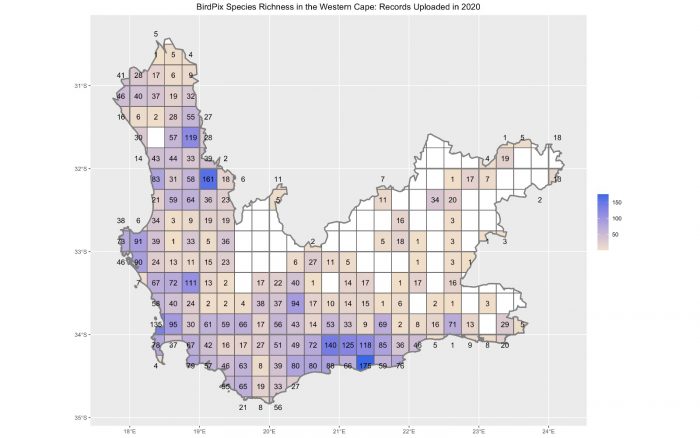
But the emphasis in the Virtual Museum has shifted from “species per grid cell, irrespective of when the records were made”, to keeping the database “refreshed”. The map below provides a quick measure of freshness. It shows the number of species per grid cell, for records uploaded in the year 2020.
BirdPix in the Western Cape in 2020 only. The number in each grid cell is the total number of bird species recorded in the grid cell, considering records uploaded to BirdPix between 1 January 2020 up to 28 December 2020 only

The logic here is that the more species uploaded for a grid cell in 2020, the more up-to-date the species list for that grid cell must be. We don’t know yet what this map will look like for other projects and for other provinces. But this has to be impressive! Some grid cells, those in darker shades of blue, had lots of species in 2020. Those with beige shades had only a few. But an awful lot of grid cells in the Western Cape were visited during the year.

The Cape Town grid cell had 169 species at the end of 2019 (second map). This had grown by 20 species to 189 at the end of 2020 (first map). But the total number of species submitted during 2020 was 135 (third map). This means that 20 of the 135 species were new to the grid cell, and that the remaining 115 species were used to do a 2020 refreshment of species last recorded in earlier years! This concept of “refreshing” old records is one that we are going to talk about more and more. There is a blog about this.

And here is a fairly subtle approach to measuring “up-to-dateness” in the Western Cape overall! For each grid cell, we find the date of the last record for each species. If species are “refreshed” regularly, this date will be recent. We next sort all the “last recorded” dates for all the species in a grid cell from oldest to most recent. Calculate the date in the middle. Half the species were last seen before this date, and half have been seen subsequently. We  want to keep this middle date as recent as possible. (Statisticians call this “middle date” the median, and there is a blog about this concept.)

Next, we take all the grid cells in a region (e.g. a province like the Western Cape) and we compute the middle dates (the medians) for all of them. We hope, on average, that these middle dates are pretty recent. To measure how recent they are overall, we calculate the middle date of all the middle dates in the region. We are happiest if this date is recent. We prefer this date to be recent, because if this median of medians is not too far in the past, it means that, overall, the species lists for the grid cells in the region are pretty up-to-date.

At the end of 2020, for BirdPix in the Western Cape, the median of the medians is 24 October 2018. In other words,  half the grid cells have their own medians before this date, and half of them have medians after this date. October 2018 is 26 months ago. So we can make the statement: BirdPix is, on average, 26 months behind the clock. Before we decide whether this is good or bad, we will need to do these calculations for lots of other projects and provinces. It will probably turn out to be awesomely excellent.

We can repeat this arithmetic, pretending we are have turned the clock back to December 2019, a year ago. The median of the medians was 14 December 2015. Gosh, this is 48 months previous to December 2019. In other words, at the end of 2019, BirdPix was 48 months behind the clock in the Western Cape. What this means is that, during 2020, BirdPix in the Western Cape “improved” from being 48 months behind the clock to being 26 months behind the clock. That is a 22-month improvement. That sounds pretty impressive.

New Year’s resolution for Team Virtual Museum

“Starting in my home grid cell on 1 January 2021, I will upload records to the Virtual Museum of as many species as possible (and I will be especially careful not to neglect the common species). Wherever I travel in 2021, I will do my best to keep the distribution maps up-to-date for as many species as possible.”

Southern Double-collared Sunbird
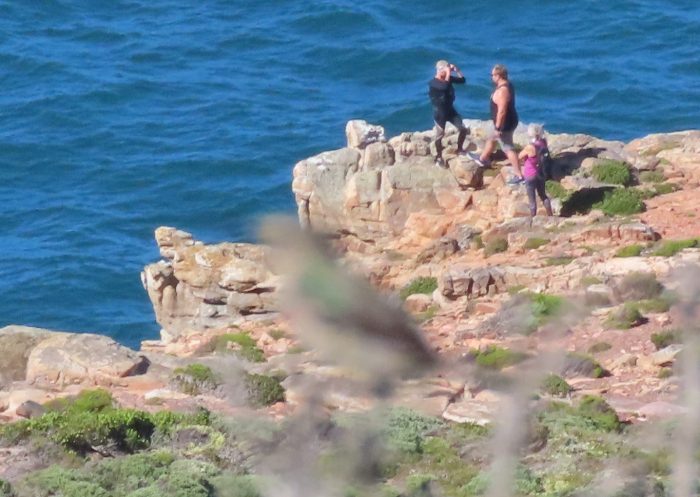
This photo illustrates the point that photos for the Virtual Museum do not have to be works of art. So long as the species in the photo is identifiable, it qualifies! But this Southern Double-collared Sunbird is pushing the patience of the expert panel to the limits. Here it is in BirdPix: http://vmus.adu.org.za/?vm=BirdPix-150313. It was the first record of this species in quarter degree grid cell 3418AD, at Cape Point, so it was a bit of a priority

Postscript: Finding the ruddy quarter degree grid cells

The frustrating thing about all these maps is this problem: “How do I find a particular grid cell on the ground?” Doing this is harder than it needs to be, because the clown who designed the system of codes for quarter degree grid cells ought to have been allowed to design only one more thing: his tombstone! It is a messy and unnecessarily complicated system. But we are stuck with it, so we have no choice but to get to grips with it. If you pick a grid cell in one of these maps, and want to work out its six character code, here is the recipe.

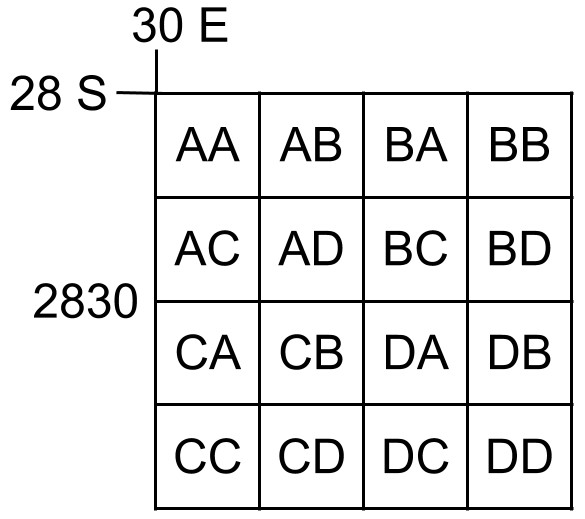
(1) Find the four digits for the one degree grid cell. To do this, first go up to the next thick line above your grid cell, and follow this line to the degrees number on the left edge of the map. In South Africa, there are always two digits. 33 is an example. They are the first two digits you need. Then go left from your chosen grid cell to the next thick line. The degrees number is on the bottom edge of the map. Also, two digits; numbers like 21. Run the four digits together. For the example above, the one degree grid cell is known as 3321.

(2) There are 16 quarter degree grid cells in the one degree grid cell. They are arranged in four rows and four columns, and each quarter degree grid cell has a code consisting of two letters (see the pattern below). Which row and which column is your grid cell in? Suppose it is in the third row and the second column. Use this pattern guide to find the two letter code for the grid cell in this position. Third row, second column is position CB. Add these letters onto the four digits for the one degree grid cell. So the code for the grid cell you are looking for is 3321CB. Gosh, that is not easy.

To find a list of the bird species that have been submitted to BirdPix for grid cell 3321CB, go to http://vmus.adu.org.za/vm_locus_map.php?vm=birdpix&locus=3321CB. You will discover that it needs a visit!

You can put any grid cell you need as the locus (ie adjust locus=3321CB to whatever you need). You can also change projects; eg replace vm=birdpix by vm=reptilemap to get a list of reptiles for any quarter degree grid cell.

Fundamentals of Citizen Science, a BDI course

Is it Citizen Science, or Citizen Science or Citizen Science? Where you place the emphasis matters. In Citizen Science, the value of an observer is only based on the scientific data they collect. Effectively, they are eyes on matchsticks. Citizen Science drifts towards the realm of social media, with a biodiversity theme, but the data tends to get lost. The BDI places equal emphasis on the value of the data, and of the people who collect it. We aim to do Citizen Science. Where the science and the citizens are of equal importance. The Fundamentals of Citizen Science is a course that will reflect these values: the importance of good data collection to science, and the impact of good data collectors on society.

Why Citizen Science?

We believe that citizen scientists can make a significant contribution towards healing the massive biodiversity issues of our generation. On one hand, citizen scientists enable up-to-date distribution maps for species to be made. On the other hand, citizen scientists generate civic awareness for biodiversity in their communities, becoming “ambassadors for biodiversity.”

How can I get involved?

You can be a part of this by attending the BDI’s week-long Fundamentals of Citizen Science course. We plan to run the course multiple times in 2021, at different venues. Provisionally (but with accommodation booked at the three places), these dates have been selected: 21–28 February at Karoo Gariep Nature Reserve, Hanover; 11–18 April at Karoo Plains, Carnarvon; 6–13 August at Botuin, Vanrhynsdorp. More details below!

What will I do?

The course has both theoretical and practical components. As much time as possible will be spent taking the theoretical knowledge outdoors, and putting it into practice in the field.

What will I learn?

The syllabus covers some major groups of species: reptiles, birds, dragonflies, scorpions, spiders, lacewings, dungbeetles, frogs, etc. These taxa are all used as indicators of the quality of our environment. All are included in the Virtual Museum. You will learn basic biology for each taxon, especially those aspects which are important to actually finding the animals in the field. You will explore techniques for photographing animals in order to maximise the chance of identification to species level. You will also learn practical “hacks” for finding and photographing species in safe and ethical ways.

We also aim to help people improve their skills at being ambassadors for biodiversity. Many people are biodiversity blind. They are astonished to hear that there are, say, more than 20 bird species in their neighbourhood. They don’t grasp that their day-to-day survival; depends on services provided to us for free by biodiversity. Citizen scientists can make an active and informed contribution to conservation by implementing strategies for communicating with biodiversity-blind people.

Ryan Tippett and Rick Nuttall will do the bulk of the formal teaching. They will be helped, especially for the fieldwork, by one or two assistants. Both Rick and Ryan are Research Associates of the BDI. Rick has done a presentation about the Fundamentals of Citizen Science course. Ryan has talked during a Citizen Scientist Hour about aspects of the biodiversity at Karoo Plains, one of the three sites where the course will be held, north of Carnarvon in the Northern Cape.

What will a typical day look like?

The standard daily programme, adapted to fit each day’s content, will begin with an early morning in the field, followed by breakfast. Theoretical components will be done in the middle part of the day. Late afternoons will contain free time, followed by discussions after supper. This schedule will be adapted based on the focus group of species for the day. For instance, if the topic is scorpions, the practical session will occur in the evening.

What is special about the three venues?

KAROO GARIEP NATURE RESERVE (KHOISAN KAROO CONSERVANCY)

The Karoo Gariep Nature Reserve is a very special place. It is a working sheep farm. You can arrive late in the afternoon, and before your head on the pillow that evening, you will probably have seen most of aardvark, aardwolf, porcupine, black-footed cat, springhare and hippo. PC Ferreira, our host, calls the first five species the “shy five”, and will take us on night drives on the farm after dinner. The farm is just north of Hanover, Northern Cape, on the N1, exactly half way between Cape Town and Johannesburg. We will stay at the New Holme Nature Lodge.

Karoo Gariep Nature Reserve (KhoiSan Karoo Conservancy)

KAROO PLAINS

Karoo Plains is on farm called Louievale, 50 km north of Carnarvon, Northern Cape. It is also a working sheep farm. This is unique part of Karoo. It is on a transition zone between the Upper Karoo and Bushmanland. The farm has an impressive mosaic of habitats, and consequently the biodiversity is rich. The southernmost red dunes for Red Larks are here and likewise gravel plains for Sclater’s Lark. Listen to Ryan Tippett’s presentation at a recent Citizen Scientist Hour.

Steenbok – Karoo Plains – photo by Karis Daniel

BOTUIN

Vanrhynsdorp about half way between Cape Town and the Namibian border on the N7. This is where the countryside starts to look like desert! It is a town which most people simply by-pass. Botuin is a remarkable and comfortable oasis on the outskirts of the town. Salome Willemse, our hostess, is a champion citizen scientist. The BDI has used Botuin for many events over the years; for example, in January 2020 we did a small bird-ringing course here. The countryside around Vanrhynsdorp might appear to be desert, but it is incredibly diverse from a biodiversity perspective. The dates which we have chosen in August for the Fundamentals of Citizen Science course at Botuin are right at the start of the flower season. If we are a bit lucky with the winter rainfall in this northwestern corner of the Western Cape, we will get to be among the first to see the spectacular displays of wild flowers before the crowds arrive.

How are we handling Health and Safety?

We are committed to the health and safety of everyone involved in these courses. COVID-19 is probably going to remain a deep concern during 2021, and we are very aware of that. In addition, the Karoo Gariep Nature Reserve has its own measures in place. This is the first, and largest, of the places we will visit.

How much does it cost?

At the first presentation of the course, in February at the Karoo Gariep Nature Reserve, the cost per person of the seven day course is R11,900. This includes the course itself, accommodation and meals. At the Karoo Gariep Nature Reserve, this includes night drives to see the Shy Five. At the other venues, the cost may vary a bit.

How do I apply?

Start by sending an email to Megan Loftie-Eaton (megan@thebdi.org).

BDInsight – October 2020

October has been a busy month full of awesome BDI Citizen Scientist Hour talks and a great BioBashing trip to the Klein Karoo! Here in the lowveld region of South Africa we have had our first rains for the summer and the veld is alive with dungbeetles, reptiles, frogs and all sorts of amazing critters. October was a record month for the Virtual Museum!! An amazing total of 14,501 records were uploaded to the various biodiversity mapping projects in the VM.

October BDI Citizen Scientist Hours

We had some marvelous talks during October with topics ranging from rearing caterpillars to adventures in the Tundra in Russia! You can access the entire playlist for October on our YouTube Channel.

Craig Peter, Associate Professor in the Botany Department at Rhodes University, gave a fascinating talk on butterfly pollination in South Africa. Craig has been using LepiMAP data to better understand butterfly pollination and butterfly-plant interactions. You can view his talk below:

Dembo Jatta and Oliver Fox gave an amazing presentation on bird migration research, conservation and education in at Kartong Bird Observatory in The Gambia. And Aisha S. Magaji shared the awesome biodiversity from Wasai Reservoir in north-western Nigeria with us.

Ouberg BioBash

Ouberg Private Nature Reserve, owned by Richard and Sue Gie, is situated 20 km from Montagu, in the Western Cape Province of South Africa, on the Ouberg Pass road. Ouberg PNR is located at the confluence of three of South Africa’s Biomes: Succulent Karoo, Fynbos and Albany Thicket. The diverse combination of soils, topography, vegetation types and the climate, means that Ouberg is home to an incredible diversity of flora and fauna. A team of BDI BioMAPpers set off to go and explore Ouberg. Activities for the BioBash included: bird ringing, bird atlasing, and biomapping. We asked some of the BioBash members to share their thoughts on their experience at Ouberg.

A beautiful Olive Thrush, ringed and ready for release

Susan Gie: It was such a privilege to be able to share our small patch of the Little Karoo with people who share my love of biodiversity and the outdoors.  The week began quietly and once everyone had arrived, there was permanent action, excited yelps, quiet stalking to get a photo of a flitty creature, discussion, questions, some up with the sparrows (or the hungry red-winged starling chicks nesting on the stoep) to head out to BirdPix and Atlas in the surrounding pentads, rummaging through books to ID fauna and flora, and sharing stories and laughs while cooking and enjoying supper. I was blown away by the Lepidoptera found on Ouberg.  I had two lifers – Lesser Honeyguide and Grey-winged Francolin on OPNR.  Our fauna species list has grown significantly thanks to the enthusiasm and keen eyes of fellow scientists and citizen scientists.  All this will go towards getting our farm becoming a recognized protected area – we wish to apply for stewardship through Cape Nature and WWF.  Thank you everyone.

Karis in bird ringing mode – Ouberg Nature Reserve

Karis Daniel: At the beginning of the week, Sue shared that even after ten years on the farm, Ouberg still manages to surprise her. There is something so special about experiencing familiar places with new eyes, and learning to see life that is typically overlooked. For me, Ouberg was exactly that: a chance to step into someone else’s “happy place” and see the natural world through their eyes. This was a week of rock-flipping, bird-ringing, star-gazing overall biodiversity magnificence–the excitement was both tangible and abundant. I learned a great deal from this BioBash, but especially the value of a diverse, multi-talented team. The collective knowledge of the group was staggering, and between all of us, we managed to find and identify species ranging from stick insects to succulents. We laughed loads, learned more, and leaned into rich and captivating community. Leaving more full than when I arrived, and hungry for so much more!

In full bloom – Ouberg Nature Reserve

Salome Willemse writes: I enjoyed the tranquility and serenity of Ouberg – full of rich biodiversity! To me the highlight was most certainly ringing very special birds such as Lesser Honeyguide and Cardinal Woodpecker.

Joshua Olszewski kept a great list of all the butterflies found and photographed during the Ouberg BioBash. Butterflies seen on the farm:

Karoo Widow Tarsocera fulvina
Western Hillside Brown Stygionympha vigilans
Cape Dull Brown Cassionympha detecta
Painted Lady Vanessa cardui
Little Rocksitter Durbaniella clarki
Cape Black-Eye Leptomyrina lara
Large Silver-Spotted Copper Trimenia argyroplaga
Karoo Silver-Spotted Copper Trimenia mcmasteri
Plain Russet Aloeides
Black-Bordered Russet Aloeides juana
Karoo Opal Chrysoritis turneri
Lysander Opal Chrysoritis pan lysander
Eastern Sorrel Copper Lycaena clarki
Dickson’s Geraniun Bronze Cacyreus dicksoni
Dwarf Blue Oraidium barberae
Southern Meadow White Pontia helice

Lysander Opal Chrysoritis pan lysander – LepiMAP record by Ryan Tippett

Other butterflies seen during the biobash:

African Plain Tiger Danaus chrysippus
Table Mountain Beauty Aeropetes tulbaghia
Rainforest Dull Brown Cassionympha cassius
Yellow Pansy Junonia hierta
Bowker’s Marbled Sapphire Stugeta bowkeri
Burnished Opal Chrysoritis chrysaor
Steel-blue Ciliate Blue Anthene definita
Cupreous Ash Blue Eicochrysops messapus
Citrus Swallowtail Papilio demodocus
Smoky Orange Tip Colotis equippe omphale

Cape black-eye – Kaapse Swartogie – Leptomyrina lara – LepiMAPped on Ouberg Nature Reserve by Ryan Tippett

November BDI Citizen Scientist Hours

Our November dates for BDI Citizen Scientist Hours are: 4, 10, 16 and 26 November 2020. We have some great talks lined up for the month, so don’t miss out! You can connect with us via Zoom and join in on the discussions or follow along on the livestreams broadcasted via the BDI Citizen Science Facebook page.
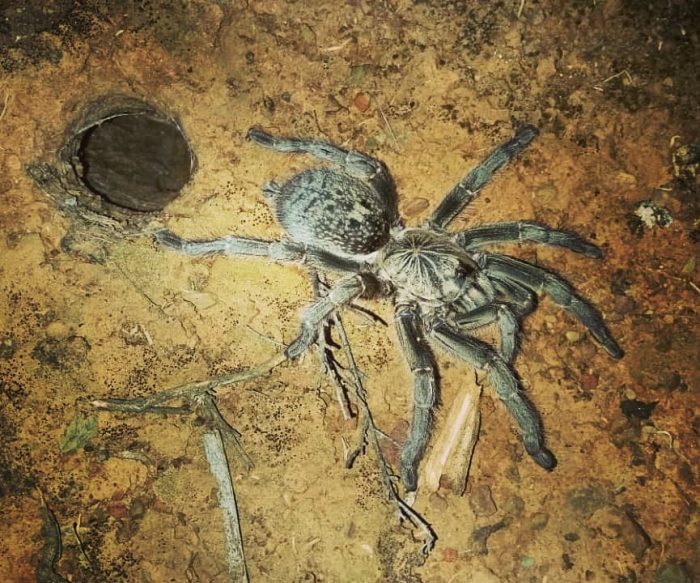
Harpactira dictator – SpiderMAPped at Ouberg Nature Reserve by Ryan Tippett

If a river could talk…

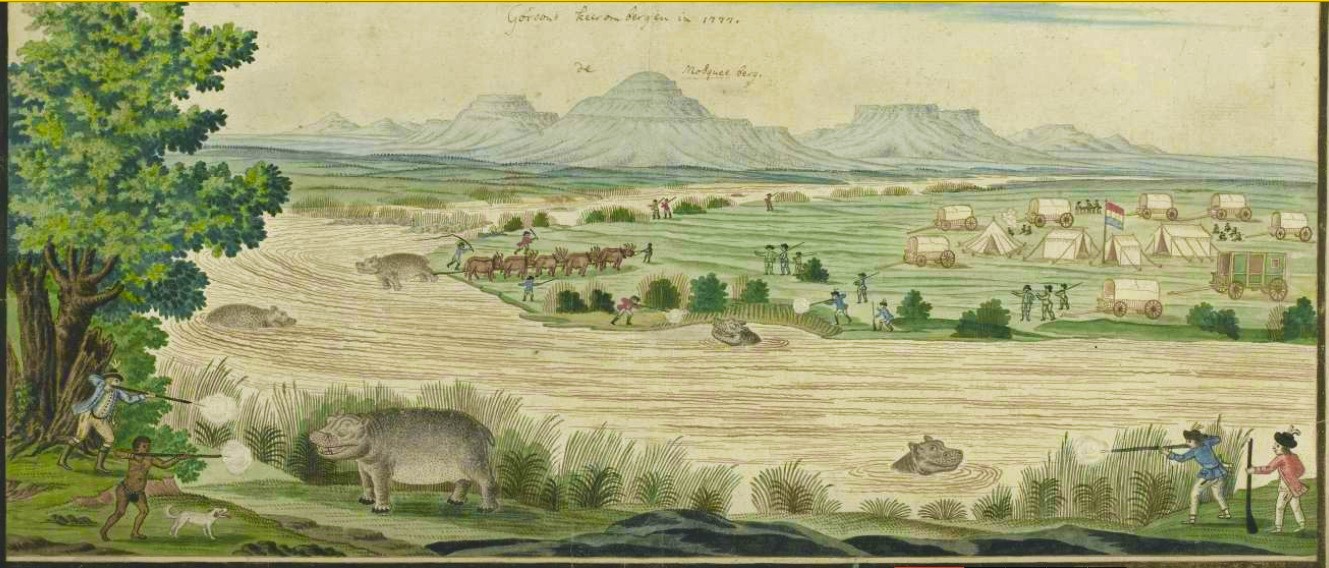
Looking out over the peaceful Seekoei River, the reeds swaying in the breeze, I find it hard to fathom the horrible atrocities that happened here almost 250 years ago. On 23 September 1775, colonial explorers Robert Jacob Gordon and Baron Joachim Ammena van Plettenberg from Netherlands shot and killed as many as 26 hippo in one day on the Seekoei River (meaning Hippo River) that runs through the semi desert Karoo region of the Northern Cape of South Africa. A 1777 painting by RJ Gordon portrays one such hunting party in full flagrant sway. French explorer François le Vaillant writes at the end of the 18th century about how he fashioned a plate from the foot of a hapless hippo. 

Hippopotamus hunt at the Seekoei River, Robert Jacob Gordon, 1778

About 230 years later, PC Ferreira, a passionate sheep farmer and the heart behind the KhoiSan Karoo Conservancy, realized the immense loss to the environment and conservation, suffered generations ago, when the last Seekoei River hippos were shot and killed in the late 1700’s. These were the last remaining hippos in the Karoo and the Northern Cape. PC decided to take action and initiated a hippo reintroduction project in 2000. It would eventually take 6 years for this project to bear fruit, but in 2006 a small breeding group of hippos were released on the then recently established Karoo Gariep Conservancy (est. 2005). Now known as KhoiSan Karoo Conservancy, which includes the formally proclaimed Karoo Gariep Nature Reserve (est 2015) and Hanover Aardvark Nature Reserve. 

Hippopotamus amphibius capensis (Hippopotamus), Robert Jacob Gordon, c. 1777
A happy hippo in his namesake river, the Seekoei River. Photo by Steve Moseley, Hirsh Aronowitz and Keith Titley, CountryLife

For his contribution to conservation PC was awarded the SANParks Kudu Award in 2008. We are raising funds to introduce three hippo cows and re-establish a healthy hippo family in the Seekoei River in the Karoo Gariep Nature Reserve. This hippo family will be the only hippo family in the Northern Cape. In time our goal is to establish a viable wild hippo population all along the Seekoei River, which is 300 km in length and can accommodate at least 80 hippos. Our goal is to restore the Seekoei River valley to its pristine, wild and natural state so that wildlife and humans can thrive together and prosper. You can help us by donating to this worthy conservation cause.

The Big Dream

The Karoo Wildlife Conservation Project vision came about after the success of the wildlife re-introduction program and proclamation of the Karoo Gariep Nature reserve. PC figured, why stop there, why not have the entire Seekoei River as a conservation area? This ambitious initiative will encompass an area of 450,000 hectares, from Kompasberg (near Nieu Bethesda) in the south all along the Seekoei River to the Doornkloof Nature Reserve where the river flows into the Vanderkloof Dam. This initiative is in partnership with the Northern Cape Department of Environment and Conservation (DENC), and the first phase of the project, consisting of five private landowners working together (representing 35 000 hectares) is well under way towards formal proclamation!

The beautiful Seekoei River

Biodiversity is in trouble globally. We need to do everything we can to rewild areas that were once wildlife havens. The Karoo Wildlife Conservation Project is one such opportunity. Nature provides so much for us on a daily basis, we cannot survive without nature and healthy functioning ecosystems. You can help us rewild the Karoo and give back to nature by contributing to the Karoo Wildlife Conservation Project.

BDI YouTube Channel: three months of growth!

The BDI launched its YouTube channel on 2 July. Three months later, the channel contained 61 videos and these videos had had more than 3,000 views.

Up to now the videos have had three themes: BDI Citizen Scientist Hours, BDI Virtual BioBases, and a “How to” series. We are planning to add more categories soon. The focus is very much on the Citizen Science Department of the BDI.

BDI Citizen Scientist Hours

In July, August and September we held nine Citizen Scientist Hours. These are Zoom events, and usually have three presenters each. We record the talks and upload them to the YouTube channel. We highlight here the top three Citizen Science Hour presentations.. The most-viewed of all of these is by Sidney Shema, who is coordinator of the bird atlas project in Kenya, KenyaBirdMap. Sidney’s presentation on The Avifauna of Kenya has had 182 views in just weeks: here it is:

Sidney gave a great overview of birds and birding in Kenya. He is also the presenter of the third most viewed presentation, with 146 views. This was about the project he leads, KenyaBirdMap, and you can view it here:

The video in second place was presented by Clara Cassell. She gave a fascinating presentation on the initiation of the bird atlas project in Liberia. She described the challenges being faced in getting the atlas started in this West African country. This is an project that really needs support:

Explore these and all the other Citizen Scientist Hour videos in the BDI YouTube Channel.

BDI Virtual BioBash

The next group of videos relates to the Virtual BioBashes. These generally are in support of the Virtual Museum. These also aim to be an hour long, but often go into injury time. The citizen scientists who present these are volunteers, and the general pattern is to start with a few photos that show the area in which they worked. We have experienced amazing virtual tours of some remote parts of Africa. Next up are a bunch of photos which have (or are about to be) uploaded to the website of the Virtual Museum. These are the species that the observers have been most excited about.

The most viewed contribution to a Virtual BioBash was by Osman Gedow who gave a fascinating presentation on his BioMAPping activities in Somalia. It has been viewed 101 times:

Here is a video that was presented and uploaded only four days ago, but which has already had 41 views. This is the first marine biobash, and it is both coastal and underwater! View it here:

“How to”

Megan Loftie-Eaton has produced four important “How to” videos. How to photograph butterfies and moths, how to photograph dragonflies, how to set up a camera trap and how to create a species distribution map in the Virtual Museum. Here are short cuts to these four videos:

Endnote

We have been delighted at the response to the Zoom events and to the resulting videos on the BDI YouTube channel. Please explore all the videos in the channel, and not only the ones highlighted here.

If you have ideas and suggestions for presentations, please contact Megan Loftie-Eaton, Itxaso Quintana or me. Please contact us also if you would like to “attend” events.

BDInsight – September 2020

Spring has sprung and biomapping has begun! Here in the southern hemisphere we welcome back the arrival of several migrant bird species. Have you seen any of late? Please remember to upload your photos to BirdPix in the Virtual Museum.

BDI Citizen Scientist Hours

Lockdown, although not the best experience, has certainly brought the citizen science community closer in several ways. Over the past few months we have held regular virtual meetings, on Zoom, and connected the citizen science family from all over Africa. It is often while in the midst of a ‘disaster’ that wonderful opportunities arise. The BDI Citizen Scientist Hours have been a great way to connect scientists and citizens across the African continent.

During these hour events we have three speakers, each giving a 15 minute talk. The topics are always varied and informative and roughly fall within the categories of ecology, wildlife conservation, environmental studies, biology, social science, urban ecology, wildlife management, statistics, taxonomy, nature appreciation and environmental education. We are always looking for volunteers, so if you are keen to give a talk during a BDI Citizen Scientist Hour, please don’t hesitate to contact us.

You can catch up on all our previous Citizen Scientist Hours by visiting our YouTube Channel

September Citizen Science Week

Our first Citizen Science Week for the 2020/21 season was held from 19 to 27 September 2020. Below is a table showing a record breakdown per Virtual Museum project. In total, citizen scientists snapped and mapped 4604 records on African biodiversity during the Week. Well done!

VM ProjectRecords
BirdPix1853
BOP1
DungBeetleMAP19
EchinoMAP0
FishMAP6
FrogMAP55
LacewingMAP46
LepiMAP1123
MammalMAP264
MushroomMAP257
OdonataMAP318
OrchidMAP62
PHOWN22
ReptileMAP157
ScorpionMAP59
SpiderMAP329
TreeMAP23
VultureMAP10
TOTAL4604

During one of our BDI Virtual BioBASHES, Les Underhill took us through some of the interesting stats of the September Citizen Science Week. You can view his talk below:

We have Citizen Science Weeks planned for every month of the 2020/21 season! So don’t miss out. Keep an eye on our Facebook page for the event dates and details.

BestSeptember for the Virtual Museum

Team Virtual Museum added 9,495 records to species distribution maps in September. That is a fantastically large number in comparison with the previous BestSeptember of 6,972 records. We exceeded the target, set in 2018, by an inflation-beating 36%. That is a huge achievement, BioMAPpers, well done.

At the end of September, the total number of records for 2020 so far is already ahead of where it was at the end of October last year. So far, there are 84,458 records for 2020. At the end of October last year there were 83,812. We are a whole month ahead!

We are aiming to achieve two goals. Continuously “refresh” old records with new ones. This provides evidence that the species still persists in a grid cell. And secondly, we are aiming to make the species lists for every grid cell more comprehensive.

The target for BestOctober was set in 2017. It is 7,438 records. (In both October 2018 and October 2019, it was very dry. Submissions, especially to LepiMAP and OdonataMAP were small as a result. That is why we go all the way back to 2017 for BestOctober.)

Citizen Science Week #1 from 19 to 27 September 2020: LepiMAP in South Africa, eSwatini and Lesotho

LepiMAP is the Atlas of African Lepidoptera. LepiMAP is one of the sections of the Virtual Museum. From September 2020, the project has been hosted jointly by the FitzPatrick Institute and the Biodiversity and Development Institute (BDI). Project funding is via the BDI.

207,000 records were uploaded through the Virtual Museum website in the decade between 1 July 2010 and 30 June 2020. Of these 144,000 (70%) were uploaded in the five-year period 1 July 2015 and 30 June 2020. That is nearly 30,000 records per year over the five year period. 26 countries have 50 or more LepiMAP records.

The total size of the LepiMAP database is 558,000 records; this includes the database of mainly specimen records compiled for the SABCA project (Southern African Butterfly Conservation Assessment), Virtual Museum records prior to July 2010, and few bulk uploads that go directly into the database. This is one of the largest databases of its kind, globally. Identifications are done by experts, not by democracy.

The first Citizen Science Week of the 2020/2021 season started on Saturday 19 September 2020, and runs to the end of the following weekend, Sunday 27 September. It’s a nine-day week! The objective of the Citizen Science Weeks is to improve the quality of the distribution maps for all the species covered by the Virtual Museum, throughout Africa. There will be a Citizen Science Week every month.

This blog shows the “state of play” with LepiMAP on 22 September 2020. This month, the focus is on South Africa, eSwatini and Lesotho

LepiMAP gives everyone in Africa the opportunity to contribute to the Atlas of African Lepidoptera. In order to participate all you need to do to contribute is to take photos of butterflies and moths. Here is guidance on how to take photographs of butterflies and moths. Upload the photos to the LepiMAP section of the Virtual Museum. Here is guidance on how to upload photos to the Virtual Museum. Members of the expert panel will do their best to identify the butterfly or moth in the photo. The moths are really difficult!

Below are the LepiMAP species richness maps for each of the provinces of South Africa. The number in each quarter degree grid cell is the number of species recorded in that grid cell so far. The grid cells with at least one species are shaded. The yellower the grid cell, the fewer species recorded in it. The aim is to first of all turn the grid cell from white to yellow, and then to shift it along the yellow-red axis until it turns bright red. Please make a special effort to submit records to the Virtual Museum during the remainder of the First Citizen Science Week, and may the momentum gained carry you through until the next Citizen Science Week in October.

We will work through the provinces of South Africa in alphabetical order, starting with the Eastern Cape and ending with the Western Cape. There is a single map for Gauteng and Mpumalanga, presented after the map for Limpopo. The last two maps are for eSwatini and Lesotho.

LepiMAP coverage in the Eastern Cape on 22 September 2020.
LepiMAP coverage in the Free State on 22 September 2020.
LepiMAP coverage in KwaZulu-Natal on 22 September 2020.
LepiMAP coverage in Limpopo on 22 September 2020.
LepiMAP coverage in Gauteng and Mpumalonga on 22 September 2020.
LepiMAP coverage in the Northern Cape on 22 September 2020.
LepiMAP coverage in North-West Province on 22 September 2020.
LepiMAP coverage in the Western Cape on 22 September 2020.

LepiMAP on YouTube

Since July, the BDI has been holding Citizen Scientist Hours. LepiMap has featured prominently in several of them. The presentations at these Zoom events become videos on the BDI YouTube channel, and you can watch any that you have missed. On Wednesday 9 September 2020, the seventh Citizen Scientist Hour was entirely devoted to butterflies and LepiMAP. The three presentations can be viewed on the YouTube channel:

  •  Oskar Brattström: Butterflies – Africa’s most exciting animals

  •  Fanie Rautenbach: The great LepiMAP challenge

Fanie’s talk needs to be looked at in conjunction with the blog called Fanie Ratenbach’s Great LepiMAP Challenge 2020/21. In a nutshell, 112 species butterfly recorded in South Africa, Lesotho and eSwatini don’t have photos in LepiMAP at all, and 56 species don’t have LepiMAP records in the past five years.

  •  Steve Woodhall: Looking for butterflies