The Yellow Bishop is a medium-sized, brightly coloured bird. Males are black and yellow in breeding plumage, and keep the bright yellow wing and rump patches in non breeding plumage, best seen in flight. Females are dull coloured with olive patches on wing shoulder and rump, although these may not always be visible. It is the only Euplectes species with a coloured rump in adults all year round. The tail is of medium length.
Yellow Bishop, photos by Cobus Elstadt (28664), Gregg Darling (16984) and Gerald Wingate (187468)
The breeding male is black on the head, underparts and upperparts other than the bright golden-yellow rump patch. The lesser and median upperwing-coverts are yellow, forming a prominent epaulet; the rest of the wing feathers and scapulars are dark brown. The bill is black, eyes are brown, and legs and feet brown to fleshy pink.
The adult female has typical female-like streaky plumage, but with a uniform olive-yellow rump and yellow-washed wing shoulders. The head and upperparts are heavily streaked brownish-buff. The underparts pale buffish-brown, streaked dark brown on breast and flanks. The bill is horn coloured.
The non-breeding male is like the female but keeps the bright yellow rump and shoulders.
Juveniles are brownish and very similar to Southern Red Bishops, the tail of the Yellow Bishop is relatively longer, however, providing a good way to confirm identification in the hand.
Note: the coloured patches are not always visible, and are best seen in flight.
Yellow Bishop, male display flight, photo by Gerald Wingate (Birdpix 128997)
Habitat
The Yellow Bishop occurs in a wide range of habitats, including fynbos, cultivated areas, grasslands, rank vegetation near streams, and scrubby fringes of forest. It occurs from sealevel to high altitudes, sometimes well over 3000 m.
Grassland habitat, photo by David Kennedy (Birdpix 2609)
Distribution
The Yellow Bishop is found in southern, central and eastern Africa.
In South Africa it ranges from Namaqualand on the west coast, southwards through the Cape fold mountains and the coastal belt, and eastwards broadly along the line of the escarpment through the eastern Cape Province, Transkei, Lesotho, KwaZulu-Natal, Swaziland and the Transvaal. It is absent from the more arid regions, like the Northern Cape and most of the Free State.
Distribution map of Yellow Bishop from SABAP2, downloaded April 2023. Details for map interpretation can be found here.
It is widespread in Zimbabwe, but does not occur in Namibia or in Botswana, except perhaps occasionally on the border with Zimbabwe. In Mozambique it occurs mainly in the higher areas adjacent to Zimbabwe.
To the north of southern Africa it is found in the Angolan highlands, in southern DRC and Zambia through East Africa to the highlands of Ethiopia. It also occurs in Cameroon and SE Nigeria.
Behaviour
The Yellow Bishop is less social than most bishops and widows. It is usually found in small groups, but rarely larger flocks. When not breeding they may join mixed-species foraging flocks.They may roost with other weaver species in reeds.
The Yellow Bishop feeds on seeds, mainly grass seeds, and also on cultivated maize, rice and millet. It also feeds on insects like caterpillars, bugs, termite alates and ants. In the Western Cape they may feed on the nectar of Proteas and the seeds of restios.
They enjoy drinking water and bathing.
Yellow Bishop bathing, photo by Dieter Oschadleus (Birdpix 24803)
Breeding
The Yellow Bishop is polygynous, with three or four females per male. It is solitary or found in small breeding groups. The male displays to females entering his territory, with yellow rump feathers puffed up and tail depressed, and flying on a zigzag course. The nest is domed with a side entrance, and well hidden in grass or in a small shrub. The nest frame is woven by the male from grass strips, and living grass may be woven into the structure. It is lined by the female with grass seedheads, which may project from the entrance to form a porch. The male nips off the tops of the herbs around the nest.
The clutch is 2-4 eggs, and the eggs are very variable in colour. The female incubates the eggs and feeds the chicks, mainly by regurgitation. Many nests are lost to predation. The maximum recorded longevity is more than 11 years (see Weaver longevities).
Old nests of the Yellow Bishop may be used by Karoo Prinias Prinia maculosa or Orange-breasted Waxbills Amandava subflava.
The Yellow Bishop has been ringed throughout its range in southern Africa, but most ringing of this species has been in the greater Cape Town area. It has a remarkable high national recapture rate, at 12%, suggesting that the small family groups are highly site faithful. The high recapture rate has also resulted in an impressive longevity record of 13y 8m.
The duration of primary moult has been estimated at 103.4 ± 3.0 days (nearly 4 months), lasting on average from 4 December to 17 March.
Yellow Bishop male starting primary moult
You can help ring and study Yellow Bishops and other fascinating birds! See ringing events.
Further resources
First Southern African Bird Atlas Project (SABAP1), 1997 text.
Birds4Africa: Weaver News (includes how this species was first discovered).
Photographic acknowledgements: The photographs in this identification guide are from the BDI Virtual Museum. The photographers continue to own the copyright on these images.
Virtual Museum (BirdPix > Search VM > By Scientific or Common Name).
Other common names: The Yellow Bishop was previously known as Yellow-rumped Widow, a more accurate name as it is more closely related to the widow birds than bishop birds.
Recommended citation format: Oschadleus HD. 2023. Yellow Bishop Euplectes capensis. Biodiversity and Development Institute. Available online at http://thebdi.org/2023/04/24/yellow-bishop-euplectes-capensis/
List of bird species in this format is available here.
Cover image of Greater Striped Swallow by Cobus Elstadt – Near Uniondale, Western Cape – BirdPix No. 256513
Identification
The Greater Striped Swallow is a large and attractive species. It has a glossy dark blue-black upperparts which can appear all black in poor light. The forehead, crown and nape are orange-brown. The ear-coverts are off-white with fine, dark streaks. The throat, breast and belly are also off-white and carry narrow, dark streaks. The streaking on the throat is fine and small, becoming progressively larger down onto the breast and belly. The streaking on the underparts appear somewhat faded. The rump and lower back is pale rufous/chestnut and very noticeable in flight. The tail is deeply forked with elongate outer tail-streamers. The flight feathers are slate-black.
The sexes are alike. Juveniles have a red/brown crown, more heavily streaked underparts and reduced tail streamers. The juveniles are also duller in colour.
Adult Greater Striped Swallows are most likely to be mistaken for the Lesser Striped Swallow Cecropis abyssinica but that species is noticeably smaller and has orange ear coverts and has heavy black streaking on the underparts.
A common intra-African breeding migrant. The Greater Striped Swallow is not threatened and has benefited from its ability to nest on man-made structures and has probably increased in abundance as a result. This is most apparent in open habitats where suitable nest sites were previously unavailable. A local decrease in the Cape Town area has been claimed. This is due to urbanization which has led to a lack of moist clay for nest building and a possible reduction in food supply.
SABAP2 distribution map for Greater Striped Swallow Cecropis cucullata – April 2023. Details for map interpretation can be found here.Greater Striped Swallow (Cecropis cucullata) Near Bulwer, KwaZulu-Natal Photo by Malcolm Robinson
Habitat
This species is found in a wide variety of habitats. It favours more open landscapes, ranging from semi-arid Karoo, Fynbos, grassland and lightly wooded savanna to cultivated areas. It is often found near water and is common in suburban habitat and around farm houses.
Typical habitat. Near Wakkerstroom, Mpumalanga Photo by Ryan Tippett
Behaviour
The Greater Striped Swallow is an intra-African breeding migrant. The first arrivals reach northern South Africa by mid-July and the southern parts of the country by mid-August. Most birds depart for their non-breeding grounds by early to mid-May. This species breeds almost exclusively within southern Africa, with a small breeding population in Angola.
It is a conspicuous and often confiding swallow that is frequently found around human habitation. It is most often encountered singly, in pairs, or family groups, sometimes in flocks of more than 30 birds. It also regularly joins loose flocks of other swallows and swifts. The flight is slow, with relaxed gliding between short bursts of flapping but is capable of rapid flight. It can often be seen perched on fences, overhead lines and bushes and will often rest on the ground, especially during windy conditions.
The Greater Striped Swallow feeds on aerial insects, such as flies, wasps, beetles, moths and termite alates.
Breeding takes place mainly from September to May. In nature, nests are placed on the underside of rock overhangs and sloping rocks or boulders. Nests are frequently built on man-made structures such as under bridges, under the eaves of houses, in road culverts, old mine entrances and abandoned machinery. The nest is an enclosed bowl equipped with a long, horizontal entrance tunnel. It is composed of mud pellets, and lined with fine grass, plant fibres, hair and feathers. The nest is built by both sexes and takes around 16 days to completion.
Three to five eggs are produced per clutch and incubation starts once all the eggs have been laid. The female is solely responsible for incubation, although the male sleeps in the nest with her at night. Incubation takes 14 to 21 days. Young chicks take around 26 days to fledge and are fed by both parents during this time.
Greater Striped Swallows are double or multiple brooded, meaning they often breed more than once in a season. Their nests are sometimes usurped by White-rumped Swifts (Apus caffer), thus forcing the swallows to build another nest.
Species text adapted from the first Southern African Bird Atlas Project (SABAP1), 1997. That text can be found here.
The use of photographs by Cobus Elstadt, Dewald du Plessis, Gerald Wingate, Lia Steen and Malcolm Robinson is acknowledged.
Virtual Museum (BirdPix > Search VM > By Scientific or Common Name).
Other common names: Grootstreepswael (Afrikaans); Mbawulwana (Tswana); iNkoniane (Zulu); Inkonjane (Xhosa); Hirondelle à tête rousse (French); Große Streifenschwalbe (German); Andorinha-estriada-grande (Portuguese); Kaapse Zwaluw (Dutch).
List of bird species in this format is available here.
Recommended citation format: Tippett RM 2023. Greater Striped Swallow Cecropis cucullata. Biodiversity and Development Institute. Available online at http://thebdi.org/2023/04/22/greater-striped-swallow-cecropis-cucullata/
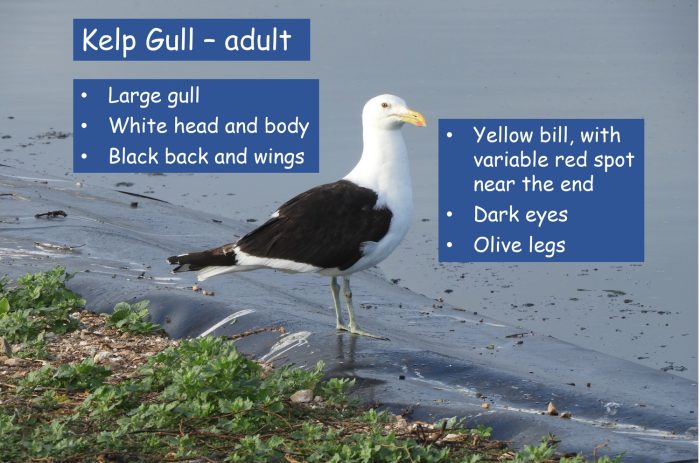
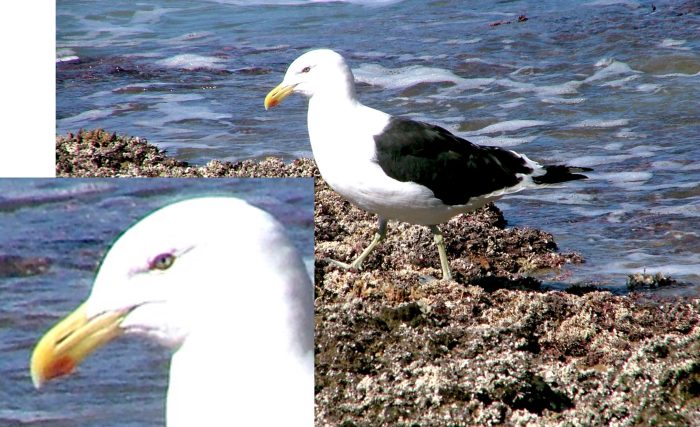
Deciding that the bird you are looking at is an adult Kelp Gull is one of the easiest identification challenges: white head and body, black back and wings are the key features to look for. There are some caveats, mentioned below!
Identification guide to adult Kelp Gull.
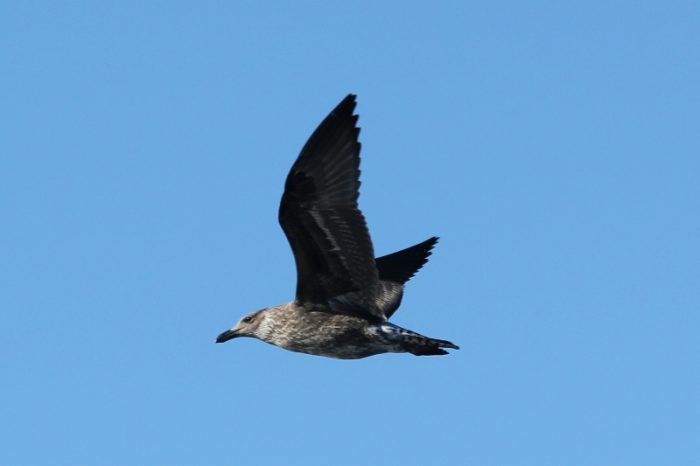
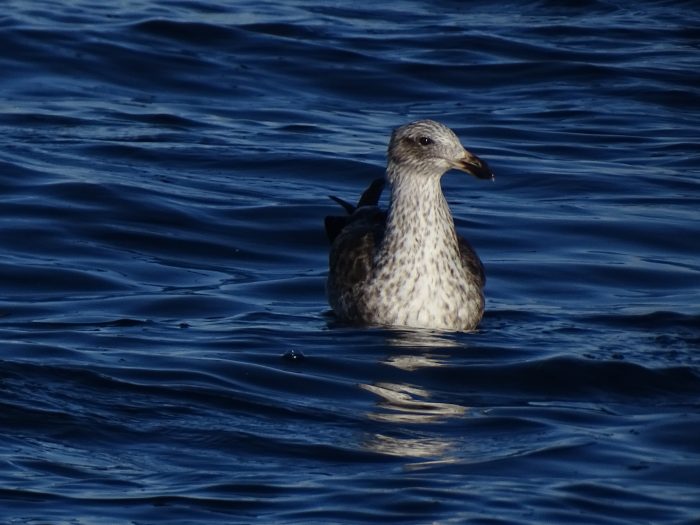
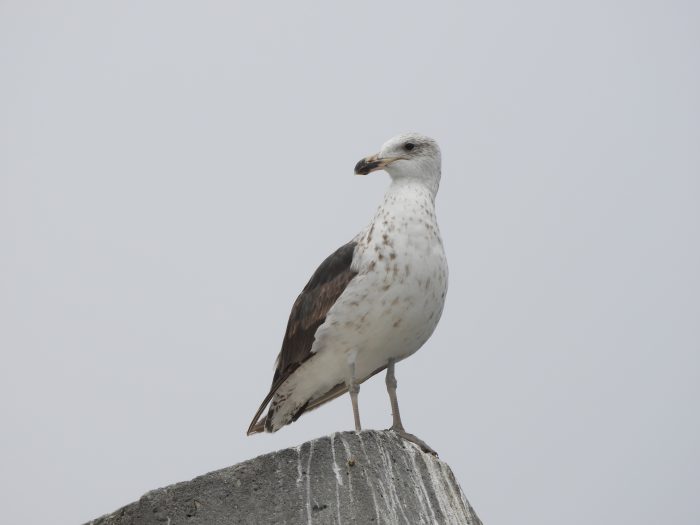
But when the bird in front of you is a a young Kelp Gull, you can be forgiven for thinking you are looking at a completely different species! The path to adult dress takes about four years. Along the route, there are various patterns of mottled brown feathers.
Here are some of the stages on the path to adult plumage of the Kelp Gull. Top left is a newly fledged gull flying from Robben Island to the mainland (Les Underhill, BirdPix record 1363). Top right is a juvenile seen on a pelagic trip south of Cape Point (Josu Meléndez Arteaga, BirdPix record 221322) Bottom left is a juvenile on a sandspit in Richards Bay Harbour (Diana Russell BirdPix record 224801). Bottom right is a juvenile at Bird Island, Lamberts Bay (Gerald Gaigher, BirdPix Record 245824)
If you are in the interior of South Africa, and you see a large gull that looks like a Kelp Gull, it is most probably a Lesser Black-backed Gull! In the northern part of KwaZulu-Natal, especially as you get close to the border with Mozambique in summer, it is a good idea to look at the “black-backed gulls” carefully (see the distribution map below for the reason). It is worth studying the identification guide to Lesser Black-backed Gull, so you can tell the difference between this and the Kelp Gull.
The subspecies of the Kelp Gull that breeds in South Africa, Namibia and southern Angola is Larus dominicanus vetula. There are four other subspecies that breed in New Zealand, South America, southern Madagascar, the islands of the Southern Ocean, and as far south as Antarctica. These have whitish eyes as adults (like the Lesser Black-backed Gull), and occur as vagrants in southern Africa. The photo below is possibly a vagrant of the race judithae, which breeds on “nearby” the islands of the Southern Ocean, such as Marion and Prince Edward Island, Crozet Archipelago and Kerguelen Islands.
This is clearly a Kelp Gull, but it has a white eye. The photo was taken by Dave Kennedy on 20 March 2011 at Swartvlei Beach near Sedgefield in the Western Cape.
Habitat of the Kelp Gull
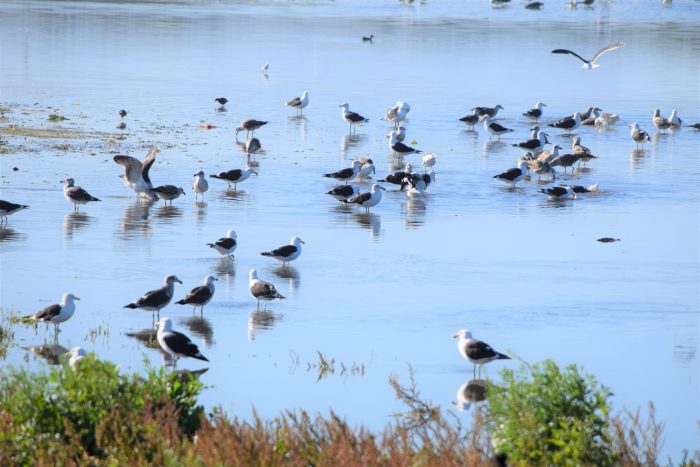
Kelp Gulls occur, mostly on or near the coastline, in a large variety of seawater and freshwater habitats. These photos show a small sample of the variety of habitats.
Distribution
Kelps Gull occur along the entire coastline of South Africa. Where the map below has shades of blue they are in the core of their range: the shore of the Northern Cape, Western Cape and most of the Eastern Cape. They progressively become less abundant from East London eastwards, and steadily fade out along the KwaZulu-Natal coast, and become rare along the Mozambique coastline (where, as described above, a “black-backed gull” needs to be checked carefully for being a Lesser Black-blacked Gull.
They are also often encountered at wetlands (and rubbish dumps) along the coastal plain, especially in the Western Cape and the Eastern Cape.
SABAP2 distribution map for Kelp Gull, downloaded 1 April 2023. Details for map interpretation can be found here.
For example, the BirdPix section of the Virtual Museum has records at Theewaterskloof Dam, Voelvlei Dam and Clanwilliam Dam, all more than 50 km from the coastline. The rubbish tip at Malmesbury is a spot to take photographs of Kelp Gulls with unusual backgrounds:
Kelp Gulls at the rubbish dump near Malmesbury, on 3 December 2020. BirdPix record 28733Kelp Gull, fynbos in the background, flying over Theewaterskloof Dam, Villiersdorp, Western Cape, 3 February 2021. BirdPix record 15509, Karis Daniel
There can be no doubt that the occurrence of Kelp Gulls far inland is attributable to human activities.
Behaviour of the Kelp Gull
Kelp Gulls are gregarious, spending most of their time in flocks, small or large. Mostly, they find their own food, either dead (i.e. they scavenge) or alive (they hunt). They are also expert kleptoparasites, stealing food from other birds …
Kelp Gull chasing a Western Osprey carrying a fish. Stilbaai, Western Cape. 12 November 2015. Photo by Johan and Estelle van Rooyen. BirdPix record 120024
… This Western Osprey is holding a fish that it has caught; the Kelp Gull is chasing it in the hope that the osprey will drop its catch. Kelp Gull also kleptoparasitise terns carrying fish, and other species with food, and harass birds so that they regurgitate their last meal.
Breeding
Kelp Gulls breed colonially, but isolated single nests occur occasionally.
The breeding colony on Robben Island is the largest, with several thousand nests.
A Kelp Gull nest at the sewage works at Jongensfontein, Western Cape. Photo Gerald Gaigher. BirdPix record 150261
This nest above is typical, a hollow lined with grass. The clutch typically has two or three eggs. Both parents incubate the eggs, they take almost four weeks to hatch.
Fluffballs, newly hatched Kelp Gull chicks, on Robben Island, 3 December 2021. Photo Itxaso Quintana. BirdPix record 195448
The chicks are semi-precocial. That means that get up and walk away from the nest within a few hours of hatching, but that they do not feed themselves (like precocial species do). Both parents feed the chicks. The period from hatching to flying is about seven weeks.
Kelp Gulls: newly fledged juveniles and adults on the short section of sandy beach on Robben Island. 3 January 2020. BirdPix record 101602
More common names: Kelpmeeu (Afrikaans), Goéland dominicain (French), Dominikanermöwe (German), Gaivota-dominicana (Portuguese), Kelpmeeuw (Dutch).
Photographic acknowledgements: The photographs in this identification guide are from the BDI Virtual Museum. The photographers continue to own the copyright on these images.
List of bird species in this format is available here.
Recommended citation format: Underhill LG 2023. Kelp Gull Larus dominicanus. Biodiversity and Development Institute. Available online at https://thebdi.org/2023/03/12/hartlaubs-gull-chroicocephalus-hartlaubii/.
Kelp Gulls in Table Bay. BirdPix record 219037, Itxaso Qunitana
Cover image by Andre Kok – Karoo National Park, Western Cape.
Identification
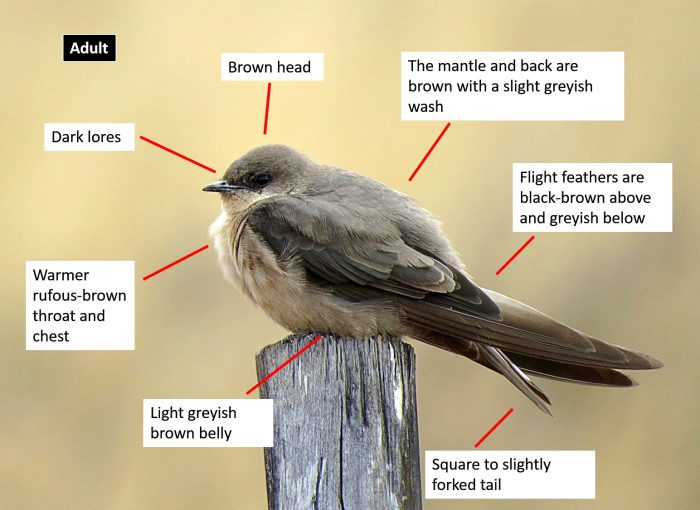
The Rock Martin is an all brown and rather drab coloured swallow.
The head is dark brown and the lores (between the eyes and the bill) are dark in colour. The rest of the upperparts are also dark brown but with a slight greyish wash to the plumage on the back and the mantle.
Rock Martin (Ptyonoprogne fuligula) – Middelburg, Eastern Cape Photo by Tino Herselman
The undersides are paler, but warmer in colour. The throat and chest is a light rufous, often with a hint of orange. the belly is plain greyish-brown. The tail is square or sometimes slightly notched. There are eight creamy-white spots near the tip of the tail which can be clearly seen in flight (diagnostic). The flight feathers dark blackish-brown above and paler greyish-brown below.
The 8 white tail spots are clearly visible in flight. Rock Martin (Ptyonoprogne fuligula) – Vleesbaai, Western Cape Photo by P. La Grange
The sexes are alike. Juveniles resemble the adults but have pale buffy tips to the feathers on the upperparts and wings.
The Rock Martin is only likely to be mistaken for the scarce all-brown form of the Brown-throated Martin (Riparia paludicola). That species is smaller and has a more forked tail and lacks the eight white spots near the tail tip.
Status and Distribution
A locally common breeding resident throughout much of South Africa and Namibia, with a more scattered distribution across Zimbabwe. It is absent from north-eastern Namibia and much of Botswana, except in the east and a few rocky outcrops in the north.
SABAP2 distribution map for Rock Martin (Ptyonoprogne fuligula) – April 2023. Details for map interpretation can be found here.
The Rock Martin is not threatened in Southern Africa. It has expanded in numbers and range because it has successfully adapted to using man-made structures for breeding and roosting on. This has almost certainly allowed it to colonise or increase in areas that previously lacked or were poor in suitable nest sites. Breeding pairs now occur at farm buildings in otherwise completely level terrain in some regions such as parts of the Karoo and the Kalahari.
Habitat
Habitat – Naude’s Nek pass, Eastern Cape Photo by Ryan Tippett
The Rock Martin occurs in most habitat types within the region. The vegetation types in which the Rock Martin has the highest reporting rates are those in which rock formations are most frequent, especially in hilly or mountainous terrain. It has adapted to breeding on man-made structures in many urban and farming areas. Rock Martins are less dependent on water than most other swallows and seldom occur far from rocky terrain.
Rock Martin (Ptyonoprogne fuligula) – Near Clanwilliam, Western Cape Photo by Zenobia van Dyk
Behaviour
Rock Martins sometimes roost gregariously on buildings or rock-faces during the non-breeding season. They drink rarely, swooping low over still water. The flight is slow, stable, often gliding, but sometimes reaches speeds of 80 km/hr. They often glide back and forth close to rock face or building. Rock Martins regularly perch on rocks and window ledges.
Typical Rock Martin (Ptyonoprogne fuligula) nest – Cederberg, Western Cape Photo by John Todd
They are usually seen singly or in pairs. Hawks insects aerially over land or water and even over beaches at low tide. Attracted to fires and ploughing to feed on flushed insects. Also attends termite emergences. Sometimes forages at night around neon lights. Feeds on a variety of small aerial insects.
The Rock Martin is usually a monogamous, solitary nester but sometimes breeds in loose colonies. The nest is a cup, composed of mud pellets, sticks and plant fibres and lined with feathers or soft plant material. The nest is built by both sexes and is attached to a rock-face or building such as houses, dam walls and bridges. The nest is frequently reused, up to four times in a single season and also in successive seasons.
Rock Martin (Ptyonoprogne fuligula) collecting mud for its nest – Near Still Bay, Western Cape Photo by Johan and Estelle van Rooyen
Two to three cream coloured eggs with brown speckles are laid per clutch. The average incubation period is around 20 days and the incubation duties are shared between the sexes. The pair will aggressively defend the nest from Little and White-rumped Swifts , as well as humans and other potential nest intruders.
Further Resources:
Species text adapted from the first Southern African Bird Atlas Project (SABAP1), 1997.
The use of photographs by Anthony Paton, Colin Summersgill, Lappies Labuschagne, Lia Steen, Marc Van Goethem, Johan and Estelle van Rooyen and Robbie Aspeling is acknowledged.
Virtual Museum (BirdPix > Search VM > By Scientific or Common Name).
Other common names: Large Rock Martin, Southern Crag-martin (Alt. English); Kransswael (Afrikaans); Mbawulwana (Tswana); iNhlolamvula (Zulu); Inkonjane (Xhosa); Hirondelle isabelline (French); Steinschwalbe (German); Andorinha-das-rochas-africana (Portuguese); Kaapse Rotszwaluw (Dutch).
A list of bird species in this format is available here.
Recommended citation format: Tippett RM 2023. Rock Martin Ptyonoprogne fuligula. Biodiversity and Development Institute. Available online at http://thebdi.org/2023/04/19/rock-martin-ptyonoprogne-fuligula/
A BDI team visited Vondeling Wine Farm to do some exploratory ringing and bird monitoring from Thursday 13 April to Sunday 16 April 2023. Besides the ringing, we did repeat counts of waterbirds on four farm dams, and made a special effort to get as many photographic records as feasible for the BirdPix section of the Virtual Museum.
Friday morning was very windy, the ringing was slow, and we caught few birds – there were many birds in a fynbos patch next to a small dam on the slopes, but we could only place nets around (and not in) the patch.
Cape Robin-chat and Brimstone Canary
On Saturday we ringed at a nearby farm, Schoon – it was still windy but we had a good catch, with many recaptures from previous ringing sessions here. We caught 16 species, with top numbers being eight Southern Masked Weavers. Interesting species included Cape Turtle Dove, Malachite Kingfisher, Brimstone Canary and Streaky-headed Canary.
Nets at Schoon farm
On Sunday we ringed at a weaver roost at a dam at Vondeling – there were a few hundred weavers, of which we caught 27 Cape Weavers, 13 Southern Masked Weavers and one Southern Red Bishop. The highlight was catching a male and four female Swee Waxbills.
Female Swee Waxbill
Most of the birds we handled had completed primary moult, and some were near the end of moult. A few young weavers had started their first moult (post-juvenile moult). A few of the Swee Waxbills had new and old primaries – none had growing feathers. Little is known about the moult of this species, so hopefully we will catch many more of this species here in the future.
The bottom line was that Vondeling proved an excellent venue for bird ringing, and we are planning to have a bird ringing course here sometime soon. Visit this website to check for upcoming dates for courses and other BDI events! Our next bird ringing course is happening 10 – 16 May 2023 at Ouberg Private Nature Reserve near Montagu in the Western Cape. Contact Megan at megan[at]thebdi.org for details.
Southern Masked Weaver – moulting out of breeding plumage, outer primary feather still growing
Birds caught at Vondeling and Schoon farms, 14-16 April 2023
The species with links have descriptive texts of the BDI website.
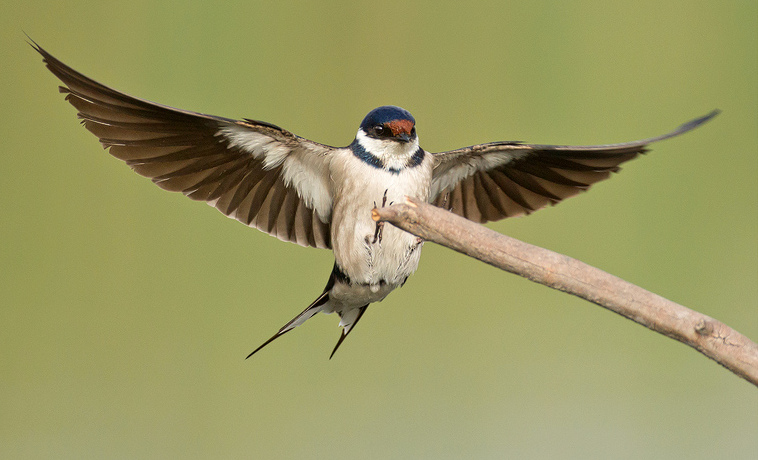
The White-throated Swallow is a fairly large and handsome species. It has glossy dark blue upperparts which can appear black in poor light. The frons is red-brown or chestnut and is confined to the forehead. The most distinguishing feature is a broad, glossy dark blue breast band, which is narrowest at the centre. The breast band can sometimes be incomplete. The throat is pure white and the undersides are dull white to pale greyish in colour. The eyes are dark brown and the bill, legs and feet are black. The tail is forked and has comparatively short and broad tail streamers.
Adult White-throated Swallows are most likely to be mistaken for the Wire-tailed Swallow (Hirundo smithii) but that species is distinctly smaller and has an entirely chestnut crown. The Wire-tailed Swallow also lacks the broad breast band, showing only a partial breast at the shoulders. The Wire-tailed Swallow also has a black vent band (conspicuous in flight) and the tail streamers are long and thin.
Juveniles are duller than adults and the breast band and upperparts are brownish, but may show hints of the adults blue colouration. Juveniles also lack the red-brown forehead patch.
Juveniles can be confused with the Banded Martin (Riparia cincta) but that species has a square tail and a small white supercilium.
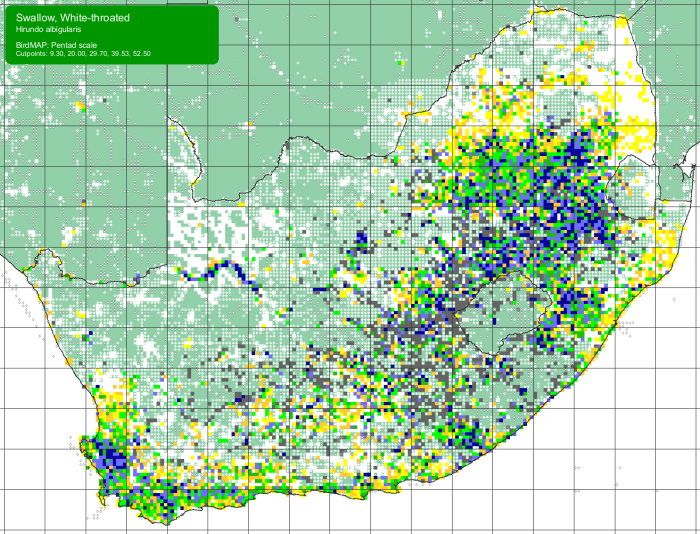
A locally common intra-African breeding migrant. The White-throated Swallow is restricted to Africa south of the equator. It is distributed virtually throughout Southern Africa. It is common in the wetter parts of South Africa but its distribution is more patchy across the rest of the subcontinent where it is far less common.
SABAP2 distribution map for White-throated Swallow (Hirundo albigularis) – April 2023. Details for map interpretation can be found here.
The White-throated Swallow is not threatened in Southern Africa. It has expanded in numbers and range owing to the construction of artificial impoundments and the numerous man-made structures which have become available as nesting sites.
This swallow is usually found in the vicinity of wetlands, especially rivers, dams and other expanses of open water, where suitable nesting sites are available. It is most common in open habitats, especially in grassland and fynbos. It is less numerous in wooded environs.
Typical habitat. Orange River near Keimoes, Northern Cape Photo by Ryan Tippett
Behaviour
As already mentioned, the White-throated Swallow is an intra-African breeding migrant. They first arrive during August in South Africa, and most depart by mid April but some remain until May. Some birds overwinter in Southern Africa, particularly in Zimbabwe. Birds that breed in Southern Africa are believed to migrate to Angola, Zambia and the Democratic Republic of Congo.
They are usually seen singly or in pairs. Often perches on wires, posts or stumps, especially over or near water. The flight is swift and agile. Prey items are caught in low, skimming flight over the ground, water or grassland and will sometimes hawk insects from a perch. Consumes aerial insects, such as flies, wasps, beetles and termite alates.
Breeding takes place soon after arrival in South Africa and has been recorded from August to April. Breeding peaks during October and multiple broods are raised. The nest is a robust cup composed of mud pellets, lined with fine grass, plant fibres, hair and feathers.
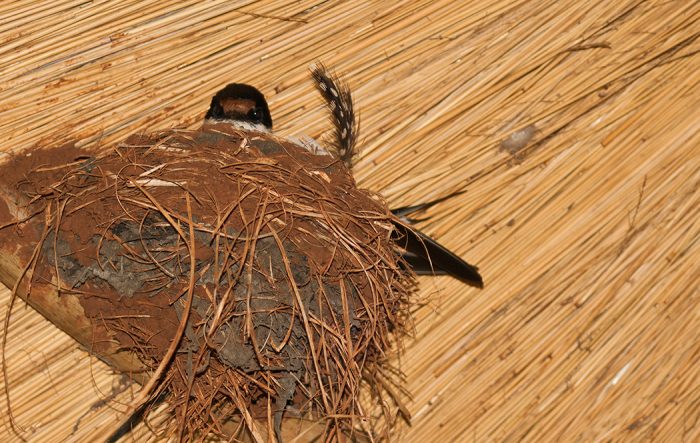
The nest may be attached to a vertical rock face but is usually placed under an overhang such as under bridges, culverts, water tanks, dam walls and under the eaves of buildings, mostly over or near water. In the Western Cape nests are sometimes built on structures over the sea.
Anywhere from 1 to 5 eggs (usually 3 eggs) are laid and incubation starts once all the eggs have been laid. Incubation takes about 17 days and all incubation duties are performed by the female. Young chicks take around 22 days to fledge and are fed by both parents during this time.
White-throated Swallows are double or multiple brooded, meaning they often breed more than once in a season.
Species text adapted from the first Southern African Bird Atlas Project (SABAP1), 1997. That text is here.
The use of photographs by Anthony Paton, Colin Summersgill, Lappies Labuschagne, Lia Steen, Marc Van Goethem and Robbie Aspeling is acknowledged.
Virtual Museum (BirdPix > Search VM > By Scientific or Common Name).
Other common names: Witkeelswael (Afrikaans); Mbawulwana (Tswana); iNkoniane (Zulu); Inkonjane (Xhosa); Hirondelle à gorge blanche (French); Weißkehlschwalbe (German); Andorinha-de-garganta-branca (Portuguese); Witkeelzwaluw (Dutch).
List of bird species in this format is available here.
Recommended citation format: Tippett RM 2023. White-throated Swallow Hirundo albigularis. Biodiversity and Development Institute. Available online at http://thebdi.org/2023/04/13/white-throated-swallow-hirundo-albigularis/
Cover image by Ryan Tippett – Carnarvon District, Northern Cape – BirdPix No. 97078 Cinnamon-breasted Warbler
Identification
The Cinnamon-breasted Warbler is a small dark brown, rock loving warbler. At close range its chestnut breast band, rump and forehead are diagnostic. The crown, mantle and wings are rufous brown. The supercilium, throat and breast are grey with indistinct dark barring. The flanks are rich rufous and lower belly is dark grey. The tail is black and is moderately long. The legs are relatively long and blackish grey.
The sexes are alike and the juveniles are a more uniform rusty-brown in colour.
The Cinnamon-breasted Warbler is generally uncommon and very localised in occurrence. It is endemic to Southern Africa. It occurs principally in the Karoo biome. In South Africa it is found locally in parts of the Northern and Western Cape, mostly in the interior. It is also found sparsely in Southern Namibia.
SABAP2 distribution map for Cinnamon-breasted Warbler (Euryptila subcinnamomea) – March 2023. Details for map interpretation can be found here.
Habitat
Typical habitat near Carnarvon, Northern Cape Photo by Ryan Tippett
The Cinnamon-breasted Warbler is closely linked to rugged boulder-strewn hillsides, koppies, rocky mountainsides, cliffs and ravines with scattered karroid shrubs and grasses, and always in arid and semi-arid regions. It occurs most commonly in the Nama and Succulent Karoo biomes.
This is an active yet secretive species that is easily overlooked. However, at times it can be rather inquisitive. It is usually found singly, in pairs or small family groups. They forage at ground level or amongst boulders and bushes. They feed predominantly on small insects such as grasshoppers, termites, ants, caterpillars and bugs.
It may be seen at close quarters, before disappearing from view and then reappearing many metres away. It is quite mouse-like in its movements as it creeps about between boulders and on rock faces at any angle. It is usually detected by its loud song, which may be heard through the summer months.
This is a resident species but it is known to move about locally in response to environmental conditions.
Breeding takes place from July to October in winter rainfall regions and during December in the summer rainfall parts of its range. The nest is a fairly large oval ball composed of grass and other plant materials, bound together with cobwebs. The nest entrance is near the top of the most exposed side of the nest. The nest walls are thick and the interior is generously lined with the soft, white seed fibres of the Kapokbos Eriocephalus africanusas well as sheep’s wool and cobwebs. The nest is built into a suitable space within the branches of the supporting plant.
Two to four speckled white eggs are laid but further details of breeding are unrecorded.
Species text adapted from the first Southern African Bird Atlas Project (SABAP1), 1997.
The use of photographs by Gerald Wingate, John Fincham and Maans Booysen is acknowledged.
Virtual Museum (BirdPix > Search VM > By Scientific or Common Name).
Other common names: Kaneelborssanger (Afrikaans); Camaroptère cannelle (French); Kopjeszanger (Dutch); Zimtbrustsänger (German); Felosa-de-peito-canela (Portuguese).
A list of bird species in this format is available here.
Recommended citation format: Tippett RM 2023. Cinnamon-breasted Warbler Euryptila subcinnamomea. Biodiversity and Development Institute. Available online at http://thebdi.org/2023/04/11/cinnamon-breasted-warbler-euryptila-subcinnamomea/
In the interior of South Africa, almost any gull which at first glance looks like a Kelp Gull (white head and body, black back and wings) is most likely a Lesser Black-backed Gull!
Adults have pale yellow eyes and yellow legs, but Kelp Gulls have dark eyes and dull greenish grey legs. There are also subtle differences in bill shape; the Kelp Gull has a rather stubby bill.
When standing, the wings of the Lesser Black-backed Gull project further beyond the end of tail than in Kelp Gull. Overall, this helps give it a sleeker appearance than Kelp Gull.
Here is a photograph with both species, an adult Lesser Black-backed Gull in the middle, and a nearly adult Kelp Gull on the right:
The bird in the centre is a Lesser Black-backed Gull, and the one of the right is a Kelp Gull, not quite in full adult plumage. The Lesser Black-backed Gull has distinctly yellow legs; less distinct in this photograph is that the folded wing projects well beyond the end of the tail. This photograph was taken at Cape Recife, Algoa Bay, by Brian Groom on 1 March 2014. BirdPix record 9979
However, most of the Lesser Black-backed Gulls in South Africa are sub-adults, and are quite tricky to separate from sub-adult Kelp Gulls.
Here is a selection of records of subadult Lesser Black-backed Gulls from the Virtual Museum. (BirdPix record 10391, Mark Booysen, and BirdPix record 138072, Alan Collett)
First-year Lesser Black-backed Gulls have a dark eye; it becomes yellowish by the second year. Full adult plumage takes about four years to develop.
Habitat
Inland, Lesser Black-backed Gulls occur mainly on large wetlands, such as pans, flood plains and large dams.
Lesser Black-backed Gull in a freshwater habitat. This photograph was taken on the Mongu Kalabo River Plain adjacent to the Zambezi River in Zambia by Jonah Gula on 22 June 2022. BirdPix record 226341
On the coastline, they are mostly on (or near) large intertidal wetlands.
Lesser Black-backed Gull in a saltwater habitat. This photograph was taken on one of the big mudflats in Durban Harbour by Dave Rimmer on 13 June 2018. BirdPix record 55281
Distribution
The distribution map shows that this gull is a vagrant. There are only handfuls of bird atlas records, and it took 16 years from 2007 to 2023 make them! You need to focus to find them on the map, and you need to be lucky to find them while you are birding!
SABAP2 distribution map for Lesser Black-backed Gull, downloaded 5 April 2023. Details for map interpretation here.
This is a rare species in South Africa, so the pentads in which it occurs are mostly shaded yellow. They are scattered across the interior (at large wetlands), and along the coastline of KwaZulu-Natal (e.g. St Lucia, Durban) and the Eastern Cape (e.g. Algoa Bay, Kromme River Estuary).
There were 18 records of Lesser Black-backed Gull in the BirdPix section of the Virtual Museum on 5 April 2023. Please help increase this number by uploading your photographs of this species to the Virtual MuseumBirdPix records for Lesser Black-backed Gull in the Virtual Museum
The 18 BirdPix records for Lesser Black-backed Gull in the Virtual Museum are from the Sudan (on the Nile River at Khartoum, Zambia, large freshwater wetlands in the interior of South Africa, and at large intertidal wetlands along the coastline of KwaZulu-Natal and the Eastern Cape.
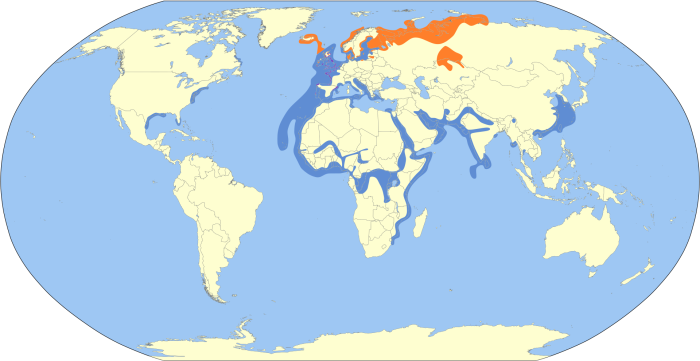
On this map of the global distribution, the breeding area is shaded orange, and the main non-breeding areas are shaded blue. It breeds in northern Eurasia and migrates southwards after breeding. Most birds stay in the northern hemisphere, and only small numbers move as far south as southern Africa. This map suggests that the southernmost part of the regular non-breeding distribution is along the east coast of Africa. North of about Durban, the distribution of Kelp Gulls starts to fade out, with the northernmost records ending at Maputo Bay in southern Mozambique. Any large gull in northern KwaZulu-Natal needs to be examined carefully!
Most sightings are between October and March, but some birds stay here throughout the year. Records are sporadic in both space and time.
This species was not included in the first two editions of Roberts Birds of Southern Africa, published in 1940 and 1957. It was admitted for the first time in the third edition in 1970! Even then it said: “Recorded from the Zambesi River and the Caprivi”. The fourth edition in 1978 says the same, and here is the distribution map for the Kelp Gull in the 1978 edition of Roberts:
Kelp Gull distribution map from the 1978 edition of Roberts Birds of Southern Africa
It is quite a surprise that it took so long to grasp that all the arrows to wetlands in the interior were actually not Kelp Gulls at all. In 1952, 26 years earlier, there is an extraordinarily politely worded paper in the journal Ostrich (25: 123–124) which asks the question: “Does the European Lesser Black-backed Gull migrate to South Africa?” It gently points out that sight records, claimed to be Kelp Gulls, on the highveld at Springs (Gauteng) in 1947 and at Barberspan (North West Province) in 1951 and 1952, were “a surprise”. “It seems,” says RM Harwin, “that some sorting-out of these records is necessary.” He showed, on balance of probabilities, that a Kelp Gull reaching the highveld from the coast was less likely than a Lesser Black-backed Gull reaching this area from the north. It took a long time to do that re-assessment. It was finally conceded in Roberts 5 in 1985 that RM Harwin had been right all along, and that the “Kelp Gulls” in the interior had been misidentified!
What is clear is that the frequency of records of the migrant gull in the interior has increased. This is most likely not only because there are more birders, but is also genuinely attributable to the proliferation of large dams and other artificial wetlands across the interior of southern Africa.
More common names: Kleinswartrugmeeuw (Afrikaans), Goéland brun (French), Heringsmöwe (German), Gaivota-d’asa-escura (Portuguese), Gaviota (Spanish), Kleine mantelmeeuw, Baltische mantelmeeuw (Dutch)
Photographic acknowledgements: The photographs in this identification guide are from the BDI Virtual Museum. The photographers continue to own the copyright on these images.
List of bird species in this format is available here.
Recommended citation format: Underhill LG 2023. Lesser Black-backed Gull Larus fuscus. Biodiversity and Development Institute. Available online at https://thebdi.org/2023/04/06/lesser-black-backed-gull-larus-fuscus/
What do we learn from bird ringing? The first, quick and obvious answer is that ringing helps us understand movement patterns of birds. The more subtle answer is that it provides estimates of survival rates; these are estimated by statistical methods and are important because they help us understand the balance between births and deaths. The third answer lies in the data we collect off the bird while we are handling it. Fourthly, when bird ringing is conducted for many years at a single site, we discover trends; for example, we learn how the timing of migration through Europe is changing in response to climate change. The value of bird ringing is awesome.
What do we learn about bird movements from ringing?
Until quite recently, bird ringing was the only way to discover the secrets of migration. Where does a Barn Swallow that breeds in Denmark go to escape the northern winter? This is an important question for Danish conservation biologists because, if they want to maintain the breeding population in their country, they need to know what part of the non-breeding range they should motivate for conservation resources to be invested in order to protect “their” swallows. This question applies in the opposite direction too. If we are going to maintain populations of Barn Swallows in KwaZulu-Natal, we need to know where they breed, so we can motivate for their protection. Even though these questions of linkages between breeding, staging and non-breeding areas are also answered by satellite tracking and geolocators, bird ringing remains an important source of movement information. Compared to other methods, ringing is inexpensive and relatively non-intrusive.
There are so many examples of movements of Barn Swallows between Europe and Africa that when you use lines to join the places where the bird was ringed and where the ring was “recovered” (ie the bird was retrapped or found dead), the map is a total mess. So we use the Red Knot Calidris canutus to illustrate the patterns that emerge. Most ringing of Knots in South Africa was done at Langebaan Lagoon, West Coast National Park, Western Cape. The lines join the places of ringing and recovery, and do not imply that the bird flew along this route!
What is striking about this map is that there are no recoveries of Red Knots in the Middle East or around the Black Sea. The map suggests that they are migrating along the west coasts of Africa and Europe and then heading east via Scandinavia. The breeding area that they are heading for is in Siberia, which has extremely few people so it is not unexpected that there are no “recoveries” during the breeding season. The results emerging from the ringing of other waders (e.g. Curlew Sandpipers Calidris ferruginea and Little Stint Calidris minuta) shows that they migrate to Siberia through the Middle East.
So we know a huge amount about bird migration between Eurasia and Africa. By comparison, we know rather little about the movement patterns of species such as White-throated SwallowHirundo albigullaris. This swallow arrives in southern Africa in August and September, breeds mostly from October to December, and then heads off north in March and April. We know they go to “central Africa”, but that is really vague. There are no recoveries of ringed birds, even though large numbers have been ringed in southern Africa.
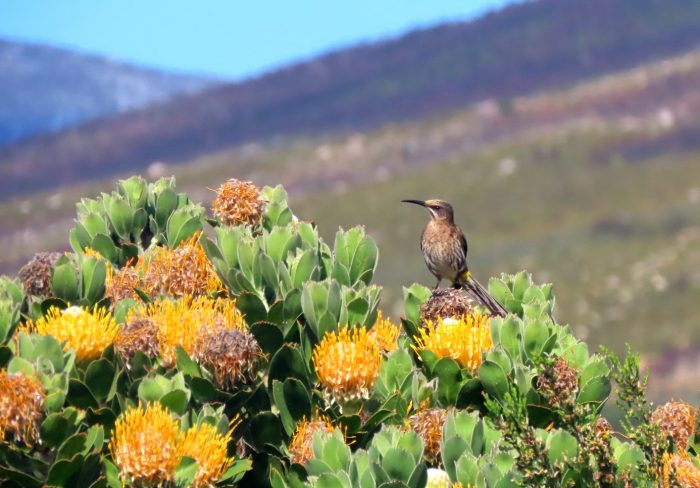
Cape SugarbirdsPromerops cafer are endemic to the Fynbos Biome of the Western Cape, South Africa. This is a habitat which is dependent on fire; if Fynbos doesn’t burn, it becomes moribund after about 15 years. Fire resets the Fynbos clock, with the first years after the fire being the most productive. Almost wherever and whenever a patch of proteas is in flower in the Fynbos, there are sugarbirds present. When the flowering period is over, the sugarbirds move off. But we have no idea where they go. And we have no idea of the patterns of movement that get them from one flowering patch to the next over a year. One possibility is that there is a collection of say six or more patches where proteas are flowering in succession through the year, with the sugarbirds moving from patch to patch in an annual rotation. But what happens when there is the inevitable fire, and the grove of yellow pincushions that they have come to rely on in October and November gets burnt? How do they adapt to this disruption? Knowing how they do this is an important conservation concern for sugarbirds. It is remarkable that we know the details of bird movements between the continents, but remarkably little about movements at small scales!
Once this yellow pincushion stops flowering this male Cape Sugarbird will need to find nectar food somewhere else. We don’t yet understand their patterns of movement! Kleinmond, Western Cape, 24 December 2022
How does bird ringing help us estimate survival rates?
Professor George Seber at the University of Auckland in New Zealand did the complicated mathematical statistics to show how numbers of retraps of ringed birds over a period of years could be used to make estimates of the annual survival rates. Subsequently, an academic industry has been developed, making improvements and refinements to the original method. For example, an early extension enabled us to obtain separate survival estimates for young birds, which are almost invariably considerably less than adults. Another extension modified the statistics so that survival estimates were available for each calendar year, so it became possible to discover the impact of a drought (in Africa) or a particularly cold winter (in Europe) on survival. These statistical methods produce better answers if the number of birds ringed is large (and consistent between years), and if the ringing operation is kept going for many years.
The importance of having survival rates is that it enables conservation biologists to investigate whether the production of fledglings is sufficient to balance mortality, and to work out whether the population of a species is increasing or decreasing. For example, Phil Hockey estimated that every breeding pair of African Oystercatchers needs to produce, on average, 0.35 young per year in order to maintain a stable population. In practice, this means that a pair of oystercatchers needs to raise one chick every three years! The African Oystercatcher is one of a tiny number of species for which this really valuable statistic has been worked out.
The annual survival rate for adult African Oystercatchers is 96%. We are still, in 2023, seeing oystercatchers on Robben Island which we know were ringed in 2002, 21 years ago. Is this a surprise? The proportion of oystercatchers which survive 21 years is estimated by multiplying the survival rate (expressed as a proportion, i.e. 0.96) by itself 21 times: 0.96 x 0.96 x … x 0.96 = 0.42. So an annual survival of 96% is equivalent to a 21 year survival of 42%. This means that 42% of the African Oystercatchers which were breeding 21 years ago are still breeding. Because the survival rate is so large, they have (on average) lots of breeding seasons, and don’t need to be very successful at breeding to keep the population stable.
The ring was put onto this African Oystercatcher in 2001. It was still on the same territory on Robben Island on 21 January 2023. (Oystercatchers are ringed above the “knee” because, if the ring is placed on the tarsus between the “knee” and the “foot”, the ring numbers wear away as a result of abrasion with the rocky shore! This happens even with stainless steel rings.)
In contrast, the adult survival rate for African Penguins is about 80%. This means that if you have 1000 penguins in January 2002, you can expect 800 to still be alive in January 2003. A year later, January 2003, there’ll be 640. Only nine of these 1000 birds would still be expected to be alive in January 2023. A survival rate of 80% is alarmingly small for a bird as large as an African Penguin, and it is this low survival rate which is at the heart of the conservation problems of this species. Breeding productivity is not matching the mortality rate.
Why is important to know the age at which birds of a species start breeding?
Age at first breeding is one of the really critical bits of information for the conservation of a species. Suppose the survival rate of breeding adults of a bird species is 90%. If you have 1000 adult birds of a species at the start of the year, 900 survive, and 100 die. How many fledglings need to be produced each year so that when they reach breeding age, there are 100 recruits into the adult population? This is what is needed to maintain a stable population. Suppose 400 fledglings are produced in a year. Suppose survival to age one year is 25%. There will be 100 left after the year. If these birds are recruited into the adult breeding population, we will have replaced the birds that have died. But if they breed for the first time after two years, or three years, then there will be fewer than 100 birds to recruit into the breeding population, and overall numbers will steadily decrease. So age at first breeding is an important piece of information. The easiest way to find this out is by ringing young birds and doing the hard follow-up work to check when they enter the breeding population. Even though it is the “easiest” way, it requires dedicated fieldwork by ringers to discover this nugget of information.
What information can we obtain while we have the bird “in the hand”?
This information is on p 640 of Roberts 7. It provides the measurements and mass of Leach’s Storm Petrel Oceanodroma leucorhoa:
Where does this information come from? There was a period in the late 1990s when Leach’s Storm Petrels were discovered breeding for a few years on Dassen Island and Dyer Island. We made a special effort to ring these birds, and the results were published in a paper in a journal callde the Transactions of the Royal Society of South Africa; you can download it. This table, which summarizes the measurements made during ringing, comes out of the paper:
The information in this table was carried over into Roberts7 (with the appropriate acknowledgements!). Ultimately, most of the measurement data in ornithological handbooks globally is summarized from data collected by bird ringers.
One of the standard measurements collected by ringers is mass. We assembled all the masses collected by members of the Western Cape Wader Study Group from Red Knots Calidris canutus while they were being ringed, and plotted them:
Masses of adult Red Knots Calidris canutus in South Africa
The Red Knots that visit South Africa breed on the Siberian tundra, about 13,000 km from Langebaan Lagoon, in the West Coast National Park, where most of these birds were caught. They are long distance migrants. The line in this plot is a statistical “smoother”, designed to lead the eye through the “message” that the plot conveys. From the time they arrive until around the end of February, the average mass hovers around 130 g. Then, quite suddenly, they start increasing in mass. This is mostly fat, fuel for the arduous journey to the Siberian tundra that lies ahead of them.
A Red Knot, in full breeding plumage, on its nest on the Siberian tundra. Lake Pronchishcheva, Taimyr Peninsula, Russia, July 1991
Moult
Feathers are light and strong, but they are steadily degraded by exposure to sunlight and by flight. For most bird species they are replaced on an annual basis, a process called moult. Part of the training to become a bird ringer is to learn how to record moult, and how to score the progress of moult of the primaries, the feathers on the outsides of the wings, the ones that are most important for flight. Most species have either 9 or 10 conspicuous primaries. Those that are old are scored a 0, and those that are new are scored 5. Scores of 1 to 4 are given to growing primaries, so the moult score of a bird near the start of moult might look like 55410 00000; the first two primaries are new, the next two are growing, and the rest are old. For a species like the Red Knot, the outer primaries are much larger than the inner primaries, so we did the arithmetic to convert the moult score into “percent feather mass grown”, and we came up with a plot that looks like this:
Primary moult of Red Knots in South Africa
Each dot represents the progress with moult for a bird ringed on a date. The Underhill-Zucchini moult model then estimates the average starting date for the primary moult of Red Knots in South Africa as 25 October, the duration as 95 days, with an average end date of 28 January. The dotted lines ought to enclose about 95% of the moult scores. Comparing this plot with the one above for mass, it is clear that the average Red Knot migrating to South Africa has about a month of “holiday” between the end of primary moult and start to fuel for migration. This information all contributes to our understanding of the conservation requirements of this species … and all of it comes from bird ringing.
Lots more paragraphs could follow here! Sometimes there is a need for samples to be collected for genetic studies. Ringers are excellently placed to help! Two citizen scientist bird ringers, Felicity Ellmore and Ursula Bryson, were recruited by an international team of researchers to collect tiny feather samples from “African Reed Warblers” for South Africa and Namibia respectively. The upshot of this project was the decision to merge the “African Reed Warbler” and the “European Reed Warbler” into a single species, the Common Reed Warbler Acrocephalus scirpaceus. Here is the link to the paper.
What is the value of having a long-term ringing station?
Bird ringers in Europe (and bird banders in North America) are familiar with the concept of a “bird observatory”. The concept even has an article in Wikipedia; no bird observatories in Africa are listed. Most bird observatories are also ringing stations.
In September 1960, an undergraduate student at the University of Warsaw, named Przemysław Busse, initiated standardized bird ringing to study southward migration along the coast of the Baltic Sea, Poland. A year later it was called Operation Baltic. The project grew and expanded to study both spring and autumn migration at three ringing stations along the Polish coast. The young student graduated through the academic hierarchy to become Professor Busse, Head of the Bird Migration Research Station (BMRS), in the Faculty of Biology, University of Gdańsk, Poland. When he retired, Dr Magda Remisiewicz, who had been a PhD student of Professor Busse’s and then a post-doc at the University of Cape Town, took over as Head of the BMRS. One of her first initiatives was to turn the early paper records into files on computers! It is a rich database.
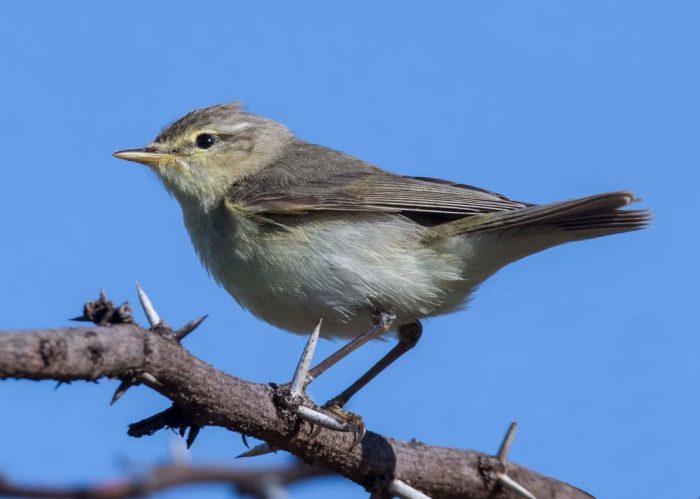
In the non-breeding season, Willow Warblers Phylloscupus trochilus spread out over much of Africa south of the Sahara Desert. This photo was taken by Tony Archer in November 2017 in Klerksdorp, North-West Province, South Africa. It is BirdPix record 46564
It is well known that northwards migration through Europe to the breeding grounds of the small warblers, for example, is getting earlier. All this is true at the ringing stations in Poland as well. But Magda spotted that there is also a huge amount of annual variation in the timing of migration. Magda wanted to understand this. We developed an index of earlyness/lateness in the migration each year for the Willow Warbler Phylloscopus trochilus, and then tried to relate this to the large scale climate indices which the warblers had experienced during their travels in the previous 12 months. We used things like the South Oscillation Index, which drives El Nino/La Nina, and which plays a key role in how much rain falls in southern Africa. We quickly hit the jackpot, and found a statistical model that “explained” two-thirds of the annual variation in the timing of the passage of Willow Warblers through Poland. There is more detail in this blog. The paper itself is open access, and so are a second and third of the same theme. These papers make a valuable contribution to understanding the impact of climate change on bird migration.
What made these papers possible was systematic and consistent bird ringing over a period of decades at a bird ringing station. This is what we need to emulate!
The value of bird ringing
Ultimately, the fundamental question runs like this: “Does bird ringing make an important contribution to bird research and conservation? Or is it simply a kind of hobby for a select group of bird watchers?” The problem is with the word “OR”. The answer to both questions is YES. Bird ringing makes a vital contribution to the study of the population dynamics and movements of birds, and how these things are changing as a result of development and climate change. A lot of the data for this research is collected by a carefully-trained group of citizen scientists, whose passion is working with birds for the ultimate objective of conservation. They consider working with birds to be a privilege and a responsibility.
Bird ringers are mostly citizen scientists who make a huge contribution to research and conservation through pooling their data. For long-distance migrants, this information needs to be shared internationally
Bird ringing courses
The Biodiversity and Development Institute coordinates bird ringing events in South Africa, and also helps at the Alte Kalköfen Bird Observatory in Namibia. Many of these events have reports, and you can find them here. There is a list of future events here.
Underhill LG 2023. The value of bird ringing to research and conservation. Biodiversity and Development Institute. Available online at http://thebdi.org/2023/03/31/the-value-of-bird-ringing-to-research-and-conservation/
Cover image: Orange River White-eye by Sybrand Venter – Carnarvon District, Northern Cape – BirdPix No. 229235
Identification
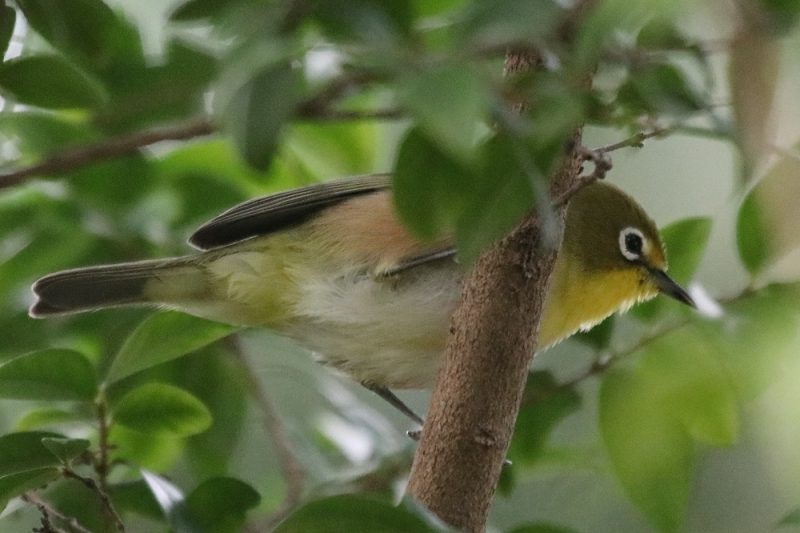
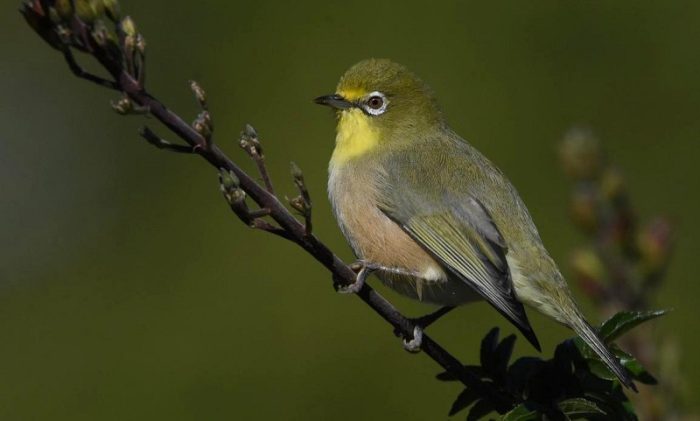
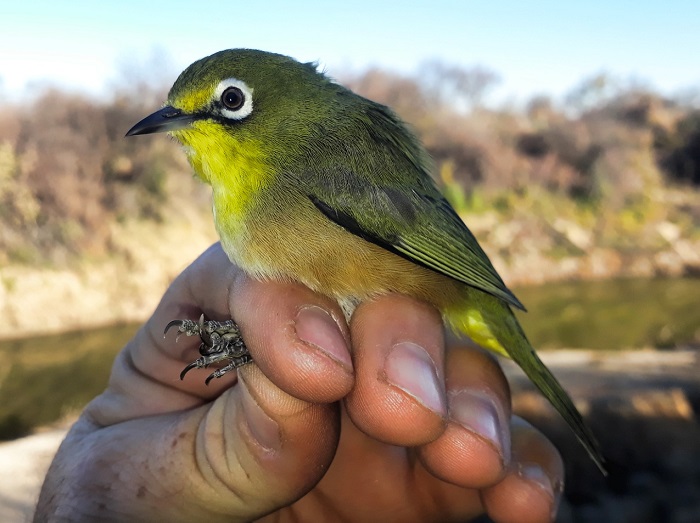
The Orange River White-eye is the most distinctively marked white-eye in the region. Its most distinguishing feature is the peach-coloured flanks, which are diagnostic. The upperparts are dull olive green. The throat is bright yellow, while the vent is a duller shade of yellow. The broad, white eye-ring is broken by a small black line extending from the base of the beak to the eye. There is a conspicuous yellow supra-loral stripe in front of the eye.
The sexes are alike and the juveniles are similar but with duller plumage.
It is most similar to the Cape White-eye Zosterops virens and the two were once considered conspecific. to be a single species. The Cape White-eye differs in lacking the peach-coloured flanks. It instead has grey to green undersides which contrast with the yellow throat.
The Orange River White-eye is common to very common and is endemic to Southern Africa. It occurs in a broad swathe from northern to southern Namibia. In South Africa, it is found in the Western Cape, throughout much of the Northern Cape, most of the Free State and parts of North West Province. It is closely linked to the Orange and Vaal River catchments. In the Northern Cape it occurs mainly along the Orange River and its tributaries but has adapted to towns, gardens and farmyards in the semi-arid Karoo.
SABAP2 distribution map for Orange River White-eye (Zosterops pallidus) – February 2023. Details for map interpretation can be found here.
Habitat
The Orange River White-eye is commonly associated with wooded watercourses and drainage lines, where it inhabits thickets with trees and thorny scrub. It is frequent in wooded gardens, parks and towns, favouring poplar (Populus spp) groves, Eucalyptus plantations and rose gardens.
The Orange River White-eye is restless and elusive, moving in small flocks through the foliage. When one area has been gleaned of food, the leader flits to another tree and the remaining flock members follow in ones and twos. Probes in crevices and under bark, and peers under leaves, twigs and branches. Sometimes hangs upside down from a branch to reach food. Most insects are gleaned from leaf surfaces. It is reported to mingle with parties of Cape White-eye at some sites. It frequently allopreens.
The diet consists mainly of invertebrates and fruit. It frequently eats hard, dry currant (Searsia spp) berries; these plants are well represented in riverine vegetation throughout its range.
Little is known about the breeding habits of this species. It is likely to be monogamous and a solitary nester. It is known to breed during the summer months. Egg laying has been recorded from October to March. A typical clutch consists of three unmarked blue eggs; however, the incubation, nestling and fledging periods are unrecorded. Nesting data are probably similar to those of the Cape White-eye (Zosterops virens).
Species text adapted from the first Southern African Bird Atlas Project (SABAP1), 1997.
The use of photographs by Doug Harebottle, Janet du Plooy, Marius Meiring, Rick Nuttall, Sybrand Venter and Toby Esplin is acknowledged.
Virtual Museum (BirdPix > Search VM > By Scientific or Common Name).
Other common names: Gariepglasogie (Afrikaans); Manqiti (Tswana); Zostérops du fleuve Orange (French); Kaapse Brilvogel (Dutch).
List of bird species in this format is available here.
Recommended citation format: Tippett RM 2023. Orange River White-Eye Zosterops pallidus. Biodiversity and Development Institute. Available online at http://thebdi.org/2023/03/20/orange-river-white-eye-zosterops-pallidus/