Cape Eagle-Owl (Bubo capensis)

Cover image: Cape Eagle-Owl by Jorrie Jordaan – Rhodes Quarry, Grahamstown, Eastern Cape – BirdPix No. 86047

Identification

The Cape Eagle-Owl is a large, heavily marked eagle-owl with conspicuous ‘eartufts’ and an overall brown and rufous-buff appearance.

Identification guide: Cape Eagle Owl
Cape Eagle-Owl (Bubo capensis)
Grahamstown, Eastern Cape
Photo by Maans Booysen

Adults have dark brown upper parts with tawny blotches, particularly on the hind neck. The under parts, from the upper breast to the flanks, are heavily blotched with dark brown on a pale background. This blotching is larger and more concentrated on the breast and has been likened to a ‘breast plate’. The belly is whiteish with bold, dark brown barring. The throat is white and conspicuous when calling.

Bubo capensis
Cape Eagle-Owl (Bubo capensis) with Cape Turtle Dove prey.
Carnarvon, Northern Cape
Photo by Liezl De Klerk

The tail is dark brown with broad tawny-coloured barring. The Cape Eagle Owl has large, powerful feet which are off-white and fully feathered on the upper sides. The eyes are deep orange (not yellow) and the bill and cere are black. Sexes are alike in plumage coloration. Juveniles resemble the adults but are paler and their ear tufts are either absent or reduced.

Bubo capensis in flight
Cape Eagle-Owl (Bubo capensis)
Carnarvon district, KwaZulu-Natal
Photo by Ryan Tippett

The Cape Eagle-Owl can easily be mistaken for the slightly smaller Spotted Eagle-Owl (Bubo africanus), particularly the rare rufous morph of that species which has orange-yellow eyes. The typical colour-form of the Spotted Eagle-Owl is generally greyer and less heavily marked, especially on the breast. They also have yellow (not orange) eyes and less powerful feet.

Cape Eagle-owl
Cape Eagle-Owl (Bubo capensis)
Sehlabathebe National Park, Lesotho
Photo by Pamela Kleiman

Status and Distribution

The Cape Eagle Owl is an uncommon to rare resident. It is easily overlooked and is likely to be more numerous than records suggest, notably in Namibia and the Northern Cape.

It has a highly fragmented distribution, occurring from the Ethiopian highlands, to Kenya, Uganda and Tanzania. It is more widespread in southern Africa from Zimbabwe and extreme western Mozambique to South Africa, Lesotho and Namibia. It marginally reaches into southern Angola and possibly also western Eswatini (Swaziland). The Cape Eagle-Owl has not yet been recorded from Botswana.

SABAP2 distribution map for Cape Eagle-owl
SABAP2 distribution map for Cape Eagle-Owl (Bubo capensis) – April 2024. Details for map interpretation can be found here.

The Cape-Eagle-Owl is not considered threatened and populations may have increased in some areas due to birds moving into quarries and even cities to roost on buildings. Southern African populations are unlikely to be facing any immediate threats. The Cape Eagle-Owl is potentially impacted by fires, overgrazing, afforestation, and they are occasionally killed on roads at night.

Habitat

The Cape Eagle-Owl occurs in a range of biomes from Desert, Succulent Karoo, Nama Karoo and Fynbos to Grassland and Savanna. Despite this, the Cape Eagle-Owl is very habitat specific, favouring rocky outcrops, cliffs and gorges in a variety of surrounding habitats. The Cape Eagle-Owl sometimes roosts and hunts in towns and cities adjacent to its preferred rocky habitat.

Habitat for Cape Eagle Owl
Typical Habitat in the Karoo
Carnarvon district, Northern Cape
Photo by Ryan Tippett

It occurs from sea level in the Western Cape to above 3 000 m in the Drakensberg. The Cape Eagle-Owl is most numerous in the Alpine grasslands of Lesotho and the Drakensberg of KwaZulu-Natal and the Eastern Cape.

Habitat for Cape Eagle-owl
High mountainous habitat
Sani Pass, KwaZulu-Natal
Photo by Ryan Tippett

Behaviour

The Cape Eagle-Owl is usually solitary but may roost in pairs or with dependant fledglings. Roosts by day in a cave or on a ledge, but also in the shade of a rock or bush. They usually roost on the ground, and less often in trees. When roosting, they are very reluctant to fly, flushing only at the last moment. Once flushed they will often perch in the open, where where they may be mobbed by raptors and ravens. The Cape Eagle-Owl typically flies to a prominent perch at dusk, but they occasionally emerge at sunset and may also sunbathe in the early morning sunshine. Roost and nest sites can be recognised by thick accumulations of white droppings, large pellets and prey remains.

Bubo capensis
Cape Eagle-Owl (Bubo capensis)
Rhodes Quarry, Grahamstown, Eastern Cape
Photo by Alan Collett

The Cape Eagle-Owl hunts from a perch, swooping swiftly and silently onto prey, which is captured with the powerful feet. Smaller prey is swallowed whole while larger prey is torn into pieces with the bill. Cape Eagle-Owls feed mostly on small to medium-sized mammals, but the diet includes a wide range of other vertebrate and invertebrate species.

Cape Eagle Owl
Cape Eagle-Owl (Bubo capensis)
Near Winterton, KwaZulu-Natal
Photo by Kevin Lavery

Mammals taken range in size from Cane Rats and young Rock Hyrax down to small rodents and shrews. Red Rock Hares (Pronolagus spp.) form an important part of the diet in some areas. Other mammals recorded in the diet include Springhares, Genets, Mongooses, Sengis (Elephant Shrews) and the lambs of Klipspringer (Oreotragus oreotragus) and Common Duiker (Sylvicapra grimmea). The Cape Eagle-Owl also feeds on bats which they catch in flight as the bats leave their roosts.

Bubo capensis
Cape Eagle-Owl (Bubo capensis) with Cape Turtle Dove prey.
Carnarvon, Northern Cape
Photo by Liezl De Klerk

Typical bird prey includes Doves, Pigeons, Helmeted Guineafowl, Francolins, Starlings, Robin-Chats etc. The Cape Eagle-Owl is also known to eat other owls, Hamerkop, Lanner Falcon and Rock Kestrel, amongst others. Domestic chickens are taken on rare occasions. Small lizards, and invertebrates, are readily consumed, including crabs, scorpions, solifuges, spiders, beetles and grasshoppers.

Bubo capensis
Cape Eagle-Owl (Bubo capensis)
Biervlei, Eastern Cape
Photo by Pamela Kleiman

Courtship displays involve much hooting and take place at dusk prior to breeding. The pair sit facing each other, the female sitting upright as the male bows at her with each hoot. Their white throats become conspicuous as they are puffed out while calling.

The Cape Eagle-Owl is monogamous and is a territorial, solitary nester. The nest is a simple, unlined scrape on bare ground beneath a boulder, on a rock ledge or in a cave. Nests are often well screened by vegetation and are regularly situated near a drainage line. The nest site is used repeatedly, but not necessarily every year. The breeding season in Southern Africa varies depending on the region. In Zimbabwe and north-eastern South Africa breeding takes place from May to July and from June to September in the south-western Cape.

Cape Eagle-owl
Cape Eagle-Owl (Bubo capensis)
Rhodes Quarry, Grahamstown, Eastern Cape
Photo by Craig Peter

One to three (usually two) white eggs are laid per clutch and eggs are laid two to four days apart. Incubation starts once the first egg has been laid. Incubation lasts up to 38 days and is performed mainly by the female. The male feeds the female at or near nest and he may take over incubation while the female feeds. Young chicks are brooded and fed by the female on food brought in by the male. As the nestlings get older, the female assists the male in supplying food. Fledglings are dependent on their parents for at least the first 2 or 3 months after fledging.

Older chicks leave the nest for surrounding cover at around 45 days old, but can only fly after 75 days or so. Cape Eagle-Owls are probably single-brooded, breeding on average every second year.

Bubo capensis
Cape Eagle-Owl (Bubo capensis)
Grahamstown, Eastern Cape
Photo by Maans Booysen

Further Resources

This species text for Cape Eagle Owl in the first Southern African Bird Atlas Project (SABAP1), 1997.

The use of photographs by Alan Collett, Craig Peter, Jorrie Jordaan, Kevin Lavery, Liezl De Klerk, Maans Booysen and Pamela Kleiman is acknowledged.

Virtual Museum (BirdPix > Search VM > By Scientific or Common Name).

Other common names: Kaapse ooruil (Afrikaans); isiKhovampondo (Zulu); Khuhunu, Phikuphiku (Tswana); Kaapse Oehoe (Dutch); Grand-duc du Cap (French); Kapuhu (German); Bufo do Cabo (Portuguese).

List of species available in this format.

Recommended citation format: Tippett RM 2024. Cape Eagle-Owl Bubo capensis. Biodiversity and Development Institute. Available online at https://thebdi.org/2024/04/27/cape-eagle-owl-bubo-capensis/

Bird identificationbirding

Bubo capensis
Cape Eagle-Owl (Bubo capensis)
Grahamstown, Eastern Cape
Photo by Maans Booysen
African Fish Eagle (Haliaeetus vocifer)

Cover image: African Fish Eagle by Malcolm Robinson – Albert Falls Nature Reserve, KwaZulu-Natal – BirdPix No. 140988

Identification

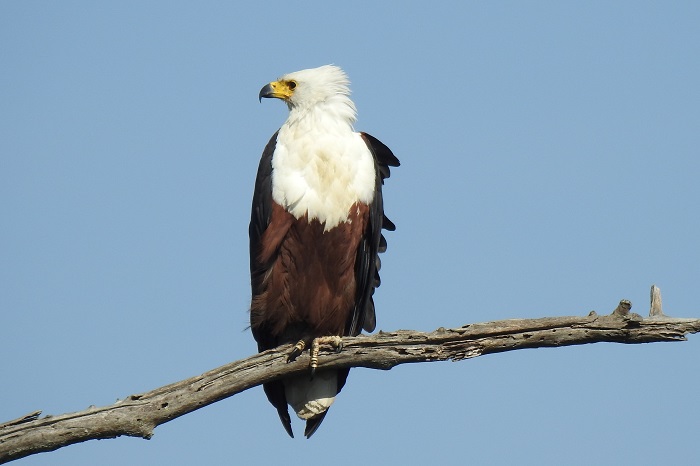
The African Fish Eagle with its distinctive plumage and characteristic call, is one of Africa’s most iconic bird species. It is a large and robust eagle. Females are 10-15% larger than males and can attain 3.6 kg and a wingspan up to 1.91 m. Males are weigh up to 2.5 kg.

African Fish Eagle (Haliaeetus vocifer)
Kruger National Park, Mpumalanga
Photo by Neels Putter

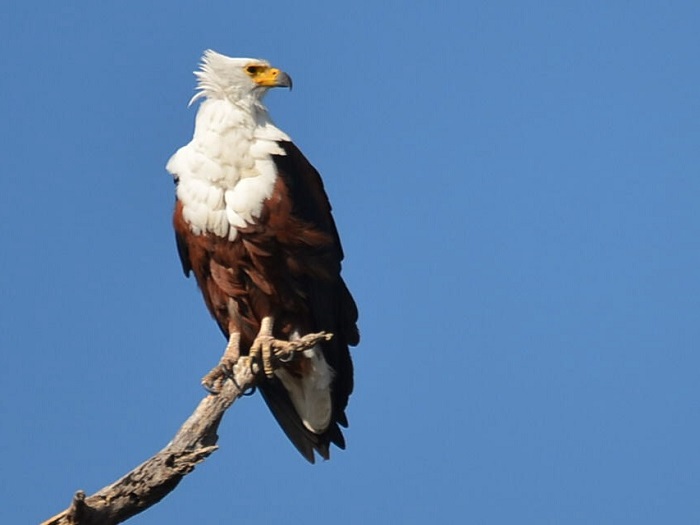
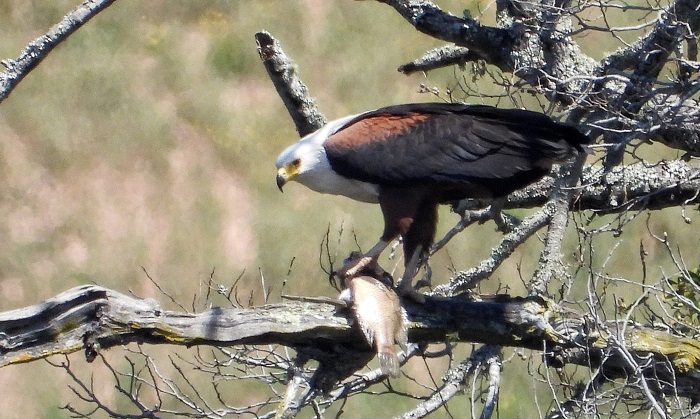
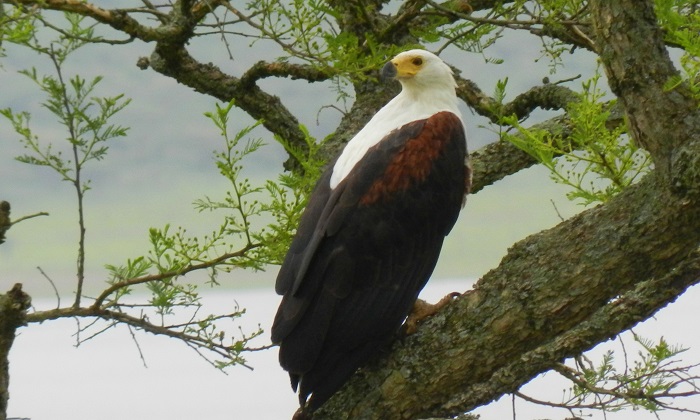
Adult African Fish Eagles are unmistakeable. The all-white head, breast and tail contrast with the black and chestnut wings, back and underparts. The sexes are very similar in terms of plumage but females have more extensive white on the breast.

African Fish Eagle (Haliaeetus vocifer)
Lake Mzingazi Nature Reserve, KwaZulu-Natal
Photo by Richard Johnstone

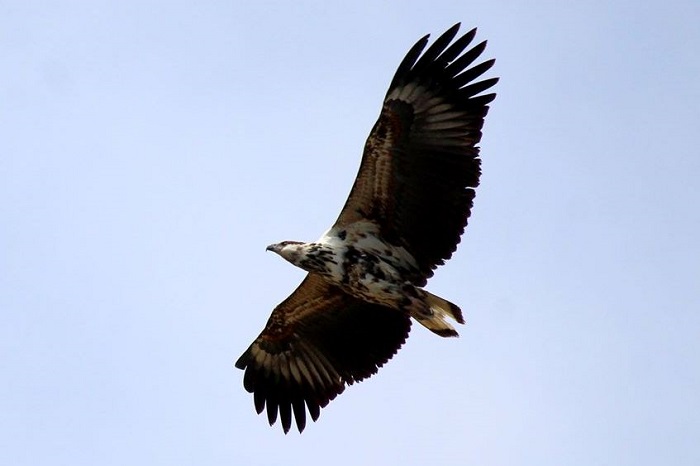
Juvenile and immature birds have patchy brown and white plumage and are often scruffy looking. They attain full adult plumage at 4 to 5 years of age and the transition into adult plumage varies individually. Each successive moult leads to a gradual ‘neatening’ of the plumage. White areas become cleaner, and dark areas more uniform. In young birds the crown is largely brown, with a blackish eyebrow. The face, neck, mantle and upper rump are whitish, sometimes with dark streaking. The breast is heavily streaked dark brown, and the belly is mostly blackish. The remainder of the upper parts are mottled in brown and white. The tail is white with a dark tip becoming shorter as the bird nears adult plumage. The cere and bare facial skin is pinkish and the legs are pale greyish-yellow.

African Fish Eagle (Haliaeetus vocifer)
Riversdale district, Western Cape
Photo by Johan and Estelle van Rooyen

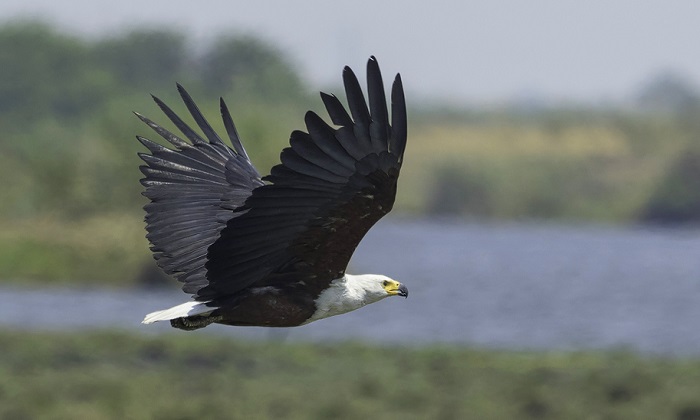
In flight, adult African Fish Eagles are seen to have broad wings with black flight feathers and chestnut underwing coverts that contrast strongly with the white head and tail. Juveniles and immatures have mostly white underwing coverts and dark flight feathers with large white windows on the primaries. They also have an off-white tail with a broad, dark terminal band.

African Fish Eagle (Haliaeetus vocifer)
Finfoot Lake Reserve, North West
Photo by Andrew Keys

Adults are distinctive and are not easily mistaken for any other species. They most resemble the Palm-nut Vulture (Gypohierax angolensis) but that species is slightly smaller, with white (not chestnut) underparts. Palm-nut Vultures also have more rounded wings and a black tail with a white tip. The bare facial skin is pink as opposed to the yellow of the African Fish Eagle.

African Fish Eagle (Haliaeetus vocifer)
Pilanesberg National Park, North West
Photo by Andre Harmse

Juvenile and immature African Fish Eagles are more problematic to identify and perhaps most resemble the Western Osprey (Pandion haliaetus). The Western Osprey is much smaller, with a pale crown, blackish eye stripe and mask, and yellow eyes. In flight the Western Osprey shows narrower wings with a distinctive bend at the carpal joint. The inner underwing coverts are mostly white (not brown) with a dark brown central bar that extends from the wing base to the wrist. The flight feathers are faintly barred and the tail is considerably longer.

Status and Distribution

The African Fish Eagle is a locally common resident. It is an Afrotropical species and occurrs throughout most of sub-Saharan Africa.

SABAP2 distribution map for African Fish Eagle (Haliaeetus vocifer) – April 2024. Details for map interpretation can be found here.

In southern Africa it is fairly widespread in the higher rainfall eastern and southern parts. However, its occurrence is patchy owing to the nature of its habitat. It is sparsely distributed in the arid to semi-arid central and western parts where it is mainly associated with larger dams, but occurs along the entire length of the Orange River.

The African Fish Eagle is most numerous in the Okavango Delta and along the Chobe and Zambezi Rivers. It is also common in the lowveld and along the east coast littoral from Maputo in Mozambique to the Olifants River in the Western Cape. The African Fish Eagle is surprisingly scarce along much of southern Mozambique coast.

African Fish Eagle (Haliaeetus vocifer)
Chobe National Park, Botswana
Photo by Desire Darling

Overall, the current range is thought to reflect the historical distribution. The African Fish Eagle is not threatened globally, but is Vulnerable in Namibia due to its small population. In South Africa, some populations have been negatively impacted by disturbance, development and wetland degradation. However, artificial impoundments have provided much additional habitat. There is no evidence of a decreases in numbers despite high pesticide levels in at least some eggs.

Habitat

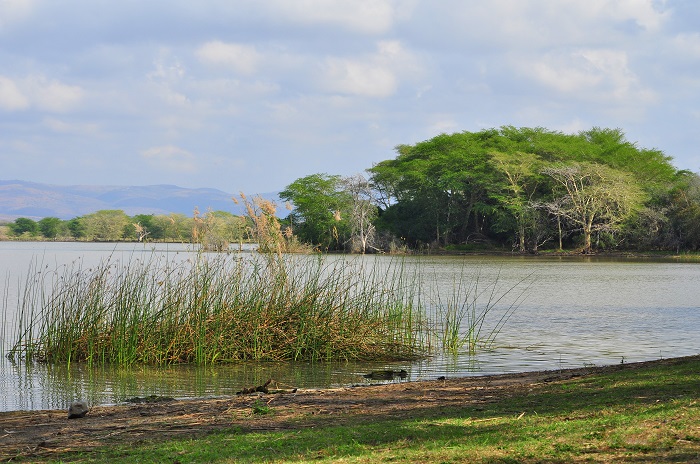
The African Fish Eagle is associated with aquatic habitats across all biomes of southern Africa. The African Fish Eagle favours estuaries, coastal and inland lakes, larger rivers and pans, floodplains and artificial impoundments. Sometimes also hunts in marine habitats along the coastline. The African Fish Eagle can occasionally be found far from water where they prey on birds or feed on carcasses.

It avoids high mountainous regions, including Lesotho and much of the Drakensberg.

Typical Habitat
Mkhuze Game Reserve, KwaZulu-Natal
Photo by Ryan Tippett

Behaviour

African Fish Eagles are generally encountered solitarily or in pairs, but can occur at high densities under suitable conditions where occasional flocks of up to 75 birds have been recorded.

African Fish Eagle (Haliaeetus vocifer)
Lake Mzingazi Nature Reserve, KwaZulu-Natal
Photo by Richard Johnstone

The African Fish Eagle spends the majority of its time perched in trees overlooking the water, either scanning for prey or watching out for territorial neighbours. The African Fish Eagle soars well and pairs frequently soar together, often while calling. They are most vocal at dawn.

Roosts near water, in tall trees or on cliffs.

African Fish Eagle (Haliaeetus vocifer)
Chobe National Park, Botswana
Photo by Neels Putter

Pairs spend most of the day within sight of each other. African Fish Eagles are strongly territorial year-round and pairs don’t hesitate to defend their territories from conspecifics. The larger females are more aggressive than the males. Rival birds that wander into the territory are either chased off or attacked. Fighting birds sometimes engage in cartwheeling flight, where two birds (often females), catch each other by feet and cartwheel down, sometimes plummeting more than 100 m. They usually separate just before hitting the ground or water, but sometimes crash-land into vegetation while still interlocked. Some attacks can end in death. Contrary to popular belief, this behaviour is intense territoriality and not a form of courtship display.

African Fish Eagle (Haliaeetus vocifer)
Vaalkop Dam Nature Reserve, North West
Photo by Lance Robinson

African Fish Eagles only spend 2 to 3 hours of the day hunting, usually from a waterside perch or, less often, from circling flight.

Most fish are caught 150-300 mm below the water surface in a graceful dive, with the feet thrust forward. They most often capture fish weighing from 1 to 3kg but are capable of catching fish up to 3.7 kg. Fish larger than this are usually scavenged. fish weighing more than 2.5kgs are not carried in flight but rather dragged to shore, using the wings as paddles.

The African Fish Eagle feeds primarily on fish but they are not limited to fish and will take a range of other prey from birds to mammals, reptiles, carrion, amphibians and termite alates. They are extremely agile and are able to take birds in flight.

The most frequent prey are surface-swimming fish such as tilapia (Cichlidae), catfish (Clarias spp) and mullet (Mugilidae).

African Fish Eagle (Haliaeetus vocifer)
Kruger National Park, Limpopo
Photo by Ansie Dee Reis

Waterfowl and other birds up to the size of flamingos are commonly taken, especially young birds. African Fish Eagles are also known to feed on Red-billed Queleas at their breeding colonies, and they will raid breeding colonies of water birds like egrets, herons and cormorants, taking the eggs and nestlings.

Reptiles and mammals are less commonly captured. Reptile prey includes monitor lizards (Varanus spp), small Nile Crocodiles (Crocodylus niloticus) and terrapins. Mammalian prey includes hyraxes (Procavia spp), Vervet Monkey (Cercopithecus aethiops) and rodents.

African Fish Eagle (Haliaeetus vocifer)
Ruigtevlei, Western Cape
Photo by Neels Putter

The African Fish Eagle regularly feeds on carrion and can, on occasion, even be seen feeding at carcasses alongside vultures. They frequently resort to piracy and will steal a wide variety of prey from other birds such as kingfishers, pelicans, herons, storks, African Marsh Harrier, Western Osprey, Martial Eagle and Bateleurs.

Unlike most raptors, the African Fish Eagle is not known to cache its prey.

African Fish Eagle (Haliaeetus vocifer)
Chobe National Park, Botswana
Photo by Dave Rimmer

The African Fish Eagle breeds mainly from May to February in southern Africa. The African Fish Eagle is a monogamous, solitary nester. Mate fidelity is strong with pairs remaining together for many years or even decades. Courtship prior to breeding involves much duetting, with the pair flying over their territory together. The male may dive at the female who turns over to present her talons, but this does not involve territorial cartwheeling.

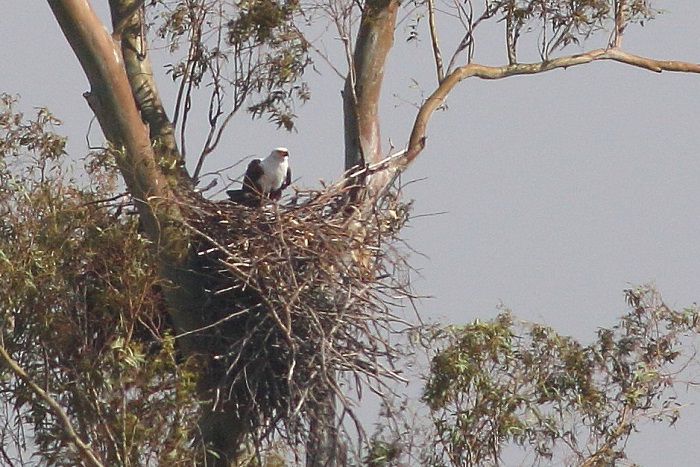
The nest is a large platform of sticks and is lined with grass, papyrus heads, other aquatic plants and, occasionally even weaver nests. Nests can measure up to 2m in diameter and reach over 2m high. Nests are usually constructed in a tall tree or on a cliff ledge, usually 12 to 15 m above the ground. Nests are generally situated less than 100m from water, but up to 2 km away when large trees are scarce. Nests may be used continuously for up to 24 years, but Pairs can often have 2 to 5 nests that they use in rotation.

African Fish Eagle (Haliaeetus vocifer)
Roodekoppies Dam, North West
Photo by Andrew Keys

From 1 to 4 (usually 2) white eggs are laid per clutch and eggs are laid at 2 or 3 day intervals. Incubation starts once the first egg has been laid, this results in the eggs hatching 2 or 3 days apart. The incubation period takes up to 45 days and is performed mainly by the female. Males will also incubate for short periods to allow the female to hunt.

Cainism (siblicide) is prevalent in the African Fish Eagle, even when food is abundant. The adults normally completely ignore sibling aggression. Despite this 2 or 3 young may sometimes survive to fledging. The nestling period lasts a further 70 to 75 days during which time the young are fed mostly by the female on food brought by the male. Fledged young are dependant on their parents for up to 60 days after their first flight.

African Fish Eagle (Haliaeetus vocifer)
Lochinvar Ranch, Zambia
Photo by Salim Lee

Further Resources

This species text is adapted from the first Southern African Bird Atlas Project (SABAP1), 1997.

The use of photographs by Andre Harmse, Andrew Keys, Ansie Dee Reis, Anthony Paton, Dave Rimmer, Desire Darling, Johan and Estelle van Rooyen, Lance Robinson, Malcolm Robinson, Neels Putter, Richard Johnstone and Salim Lee is acknowledged.

Virtual Museum (BirdPix > Search VM > By Scientific or Common Name).

Other common names: Visarend (Afrikaans); iNkwazi (Zulu); Ingqolane, Unomakhwezana (Xhosa); Afrikaanse Zeearend (Dutch); Pygargue vocifère (French); Schreiseeadler (German); Águia-pesqueira-africana (Portuguese).

List of species available in this format.

Recommended citation format: Tippett RM 2024. African Fish Eagle Haliaeetus vocifer. Biodiversity and Development Institute. Available online at https://thebdi.org/2024/04/23/african-fish-eagle-haliaeetus-vocifer/

Bird identificationbirding

African Fish Eagle (Haliaeetus vocifer)
Kruger National Park, Limpopo
Photo by Anthony Paton

Verreaux’s Eagle (Aquila verreauxii)

Cover image: Verreaux’s Eagle by Maans Booysen – Prieska district, Northern Cape – BirdPix No. 197991

Identification

The Verreaux’s Eagle is one of the worlds most distinctive raptor species. It is a very large and powerfully built black and white eagle. Females can attain 5.8kg and a wingspan up to 2.5m. Males are smaller, weighing up to 3.7kg.

Verreaux’s Eagle (Aquila verreauxii)
Mapungubwe National Park, Limpopo
Photo by Neels Putter

In adults, the entire head, body and tail is black except for the lower back and rump, which are white. There is also a narrow white ‘V’ extending from the upper back to the mantle. The legs are black and shaggy and are fully feathered to the feet.

Verreaux’s Eagle (Aquila verreauxii)
Meyersdal Eco Estate, Gauteng
Photo by Kevin Lavery

The bill is dark, horn-grey. The cere, gape, lores and eye-ring are rich yellow and conspicuous, even from a distance. The feet are dull yellow, robust and powerfully built with long, sharp talons. The eyes are dark brown.

In flight the under wings of the Verreaux’s Eagle are mainly black with pale panels in the outer wing. The flight feathers are barred in whiteish-grey and black. The wings have a distinctive shape and are characteristically narrow at the base, with broad tips.

Verreaux’s Eagle (Aquila verreauxii)
Near Alberton, Gauteng
Photo by Lance Robinson

The sexes are similar in plumage colouration, but females have a more extensive area of white on the back. Females are also noticeably larger and have broader wings.

Juvenile and immature birds are patchily mottled overall, in brown and black. The crown is rich rufous and the cheeks are black. The underparts are brown with a black chest. Full adult plumage is attained at 2 years of age.

An immature Verreaux’s Eagle (Aquila verreauxii) showing the patchy black and brown plumage.
Carnarvon district, Northern Cape
Photo by Ryan Tippett

Adults are distinctive and are not easily mistaken for any other species. Juveniles may be confused with other large brown eagles such as the Tawny Eagle (Aquila rapax). The large size, characteristic wing shape and habitat of the Verreaux’s Eagle help to identify it, as well as the juveniles patchy black and brown plumage.

Status and Distribution

The Verreaux’s Eagle is a locally common resident. Its distribution closely follows that of Hyraxes/Dassies (Procavia and Heterohyrax spp). It is patchily distributed from Israel and Jordan, the Sinai Peninsula, the southern Arabian Peninsula, eastern Chad and western Sudan. The Verreaux’s Eagle is more continuously distributed from Eritrea and Ethiopia to eastern and southern Africa.

SABAP2 distribution map for Verreaux’s Eagle Aquila verreauxii – April 2024. Details for map interpretation can be found here.

It occurs throughout most of southern Africa, mainly where annual rainfall is below 750 mm. The Verreaux’s Eagle is absent from the Kalahari sands of north-eastern Namibia, Botswana and the Northern Cape, and from the plains of southern Mozambique and north-eastern KwaZulu-Natal. Also largely absent from mountainous areas of Lesotho and the eastern part of the Eastern Cape.

Verreaux’s Eagle (Aquila verreauxii)
Dasklip Pass, Western Cape
Photo by Cornelia Rautenbach

The mountains and hills inhabited by the Verreaux’s Eagle are possibly the least altered habitat in southern Africa. It is still persecuted in some regions, especially in small-stock farming areas. However, most farmers now realise the beneficial role of the Verreaux’s Eagle in controlling hyrax populations. The Verreaux’s Eagle is rarely attracted to carcasses baited with poison, and consequently it is still common and widespread. Unlike many other large raptors its distribution has probably not changed much, and its conservation status appears to be healthy.

Verreaux’s Eagle (Aquila verreauxii)
Carnarvon district, Northern Cape
Photo by Ryan Tippett

Habitat

The Verreauxs’ Eagle inhabits mountains, rocky hills and gorges, usually with cliffs and populations of hyraxes, its main prey. It is largely absent from flat and non-rocky areas.

High mountainous habitat
Sani Pass, KwaZulu-Natal
Photo by Ryan Tippett

It is most numerous in relatively arid regions such as the Karoo and the Namibian escarpment. The species is least numerous in wetter woodland and grassland vegetation types. The Motobo Hills in Zimbabwe are a marked exception to this as the Verreaux’s Eagle reaches its highest population densities in this area.

In the Karoo, where Hyraxes are abundant, they sometimes hunt away from larger mountains and hills in flatter areas around koppies and rock outcrops .

Typical habitat
Gifberg, Western Cape
Photo by Les Underhill

Behaviour

Verreauxs’ Eagle is invariably encountered in pairs or as a pair with a juvenile. Pairs remain close together for most of the day. Adults are resident and territorial year-round, but immatures are known to wander widely.

Verreaux’s Eagle (Aquila verreauxii)
Near Komaggas, Northern Cape
Photo by Kevin Murray

They are usually seen soaring, sometimes to great heights or gliding swiftly along rock faces. The Verreaux’s Eagle is most active in the morning and late afternoon. They often spend many hours perched on a shady ledge during the midday heat. Roosts on cliffs or ledges and only sometimes in trees, often close to the nest site.

An immature Verreaux’s Eagle (Aquila verreauxii).
Carnarvon district, Northern Cape
Photo by Ryan Tippett

Hunts aerially, or from a perch. Most hunting is done by surprise, attacking prey as it swoops around a corner, and less often from a stoop dive. The Verreaux’s Eagle often hunts co-operatively in pairs, with the lead bird in plain view, drawing the attention of the prey or flushing it for the second bird following close behind. They are also known to knock prey over cliff ledges before retrieving it below. Pairs frequently share their prey.

Verreaux’s Eagle (Aquila verreauxii)
Middelburg, Eastern Cape
Photo by Tino Herselman

The Verreaux’s Eagle feeds almost exclusively on mammals. Hyraxes form the vast majority of the diet with some variation from region to region. In more arid places such as the Karoo, Hyraxes form at least 90% of the diet but become less important in moister habitats like grassland, savanna and fynbos, making up around 50 to 60% of the diet.

Other recorded mammalian prey includes Monkeys, Baboons, Canerats, Bushbabies, Squirrels, Hares and small antelope like Duikers, Klipspringer and Springbok. The calves of larger antelope like Kudu are sometimes also taken. Birds are hunted on occasion too, mostly guineafowl, francolins, Korhaans, doves etc. Occasionally captures reptiles like snakes, monitor lizards and tortoises, which are broken open by dropping them in flight onto rocks.

Verreaux’s Eagle (Aquila verreauxii)
Walter Sisulu Botanical Gardens, Gauteng
Photo by Lia Steen

The Verreaux’s Eagle rarely kills domestic stock like lambs, goats and chickens. This usually only happens when Hyraxes are scarce and in short supply.

Before breeding begins pairs perform spectacular courtship display flights where they rise high into the air followed by a long, steep dive, falling hundreds of meters before repeating the process multiple times. Males frequently drop a stick at the top of the flight before stoop-diving after it and turning upside town to catch it with his feet.

Verreaux’s Eagle (Aquila verreauxii)
Near Tarkastad, Eastern Cape
Photo by Zenobia van Dyk

Breeding takes place from April to June or even August. The Verreaux’s Eagle is monogamous and pair bonds can last for many years. Most territories contain up to 5 alternative nest sites, although 1 is usually favoured over the rest. The nest is a large platform of sticks, usually around 1.5 to 2m across, and lined with green leaves. Nests are frequently reused over decades and may become huge and tower-like, reaching up to 4m high! The nest is usually situated on a cliff ledge and very rarely in a tree or electricity pylon, and even more rarely on the ground. In arid areas they sometimes nest on top of Sociable Weaver nests.

Verreaux’s Eagle (Aquila verreauxii)
Piketberg, Western Cape
Photo by John Fincham

1 or two eggs are usually laid per clutch. The incubation period lasts from 43 to 48 days and most of the incubation is done by the female. The eggs are laid 3 to 4 days apart and incubation begins once the first egg has been laid. This results in them hatching at different times (asynchronous hatching). Only 1 chick survives, the younger chick is killed by the older sibling within the first 3 days. This is called Cainism and is common among larger birds of prey.

Verreaux’s Eagle (Aquila verreauxii)
Graaff-Reinet district, Eastern Cape
Photo by Alan Collett

The chick is fed mostly by the female on food brought to her by the male. Chicks become fully fledged and able to fly after 90 to 98 days. Fledglings are dependant on their parents for a further 120 days or so after which they are chased away from the parents territory.

Verreaux’s Eagle (Aquila verreauxii)
Graaff- Reinet district, Eastern Cape
Photo by Alan Collett

Further Resources

This species text is adapted from the first Southern African Bird Atlas Project (SABAP1), 1997.

The use of photographs by Alan Collett, Cobus Elstadt, Cornelia Rautenbach, John Fincham, Kevin Lavery, Kevin Murray, Lance Robinson, Lia Steen, Les Underhill, Maans Booysen, Neels Putter, Tino Herselman and Zenobia van Dyk is acknowledged.

Virtual Museum (BirdPix > Search VM > By Scientific or Common Name).

Other common names: Black Eagle (Alt. English); Witkruisarend (Afrikaans); uKhozi (Zulu); Ukhozi ,Untsho(Xhosa); Zwarte Arend (Dutch); Aigle de Verreaux (French); Felsenadler, Kaffernadler (German); Águia-preta (Portuguese).

List of species available in this format.

Recommended citation format: Tippett RM 2024. Verreaux’s Eagle Aquila verreauxii. Biodiversity and Development Institute. Available online at https://thebdi.org/2024/04/13/verreauxs-eagle-aquila-verreauxii/

Bird identificationbirding

Verreaux’s Eagle (Aquila verreauxii)
Near Copperton, Northern Cape
Photo by Cobus Elstadt

Blue Crane (Grus paradisea)

Cover image: Blue Crane by Attie Van Aarde – Albertinia district, Western Cape – BirdPix No. 268829

By Act of Parliament, this is the national bird of South Africa.

Identification

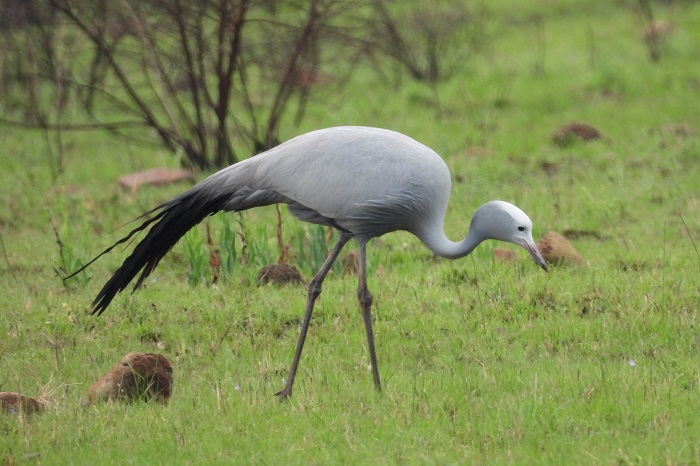
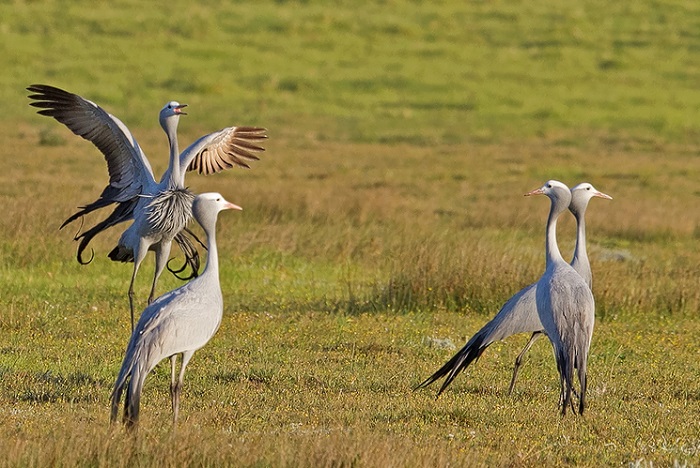
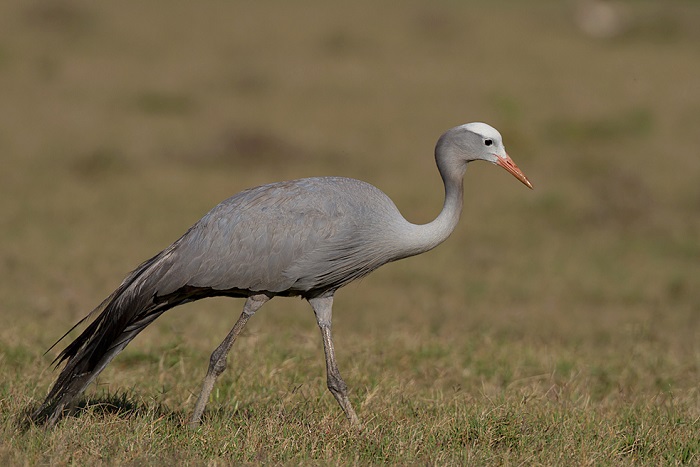
The Blue Crane is a large and striking species. It is conspicuous and unmistakable. The entire body, except for the head, is blueish-grey, and darkest on the nape, upper neck and wing coverts. It has a rounded, almost bulbous head shape and the forehead and crown are white, with this colour extending onto the lores and cheeks. The feathers on the cheeks, ear coverts and nape are elongated and loose and are raised during display.

Identification guide Blue Crane
Blue Crane (Grus paradisea)
Soutvlei, Eastern Cape
Photo by Gregg Darling

The feathers of the lower fore-neck too are elongated and used in display. The long ‘tail’ feathers that hang almost to the ground are in fact inner wing feathers (tertials). The bill is dull pinkish-orange and the eyes are dark brown. Legs and feet are dark grey to black. The sexes are alike in plumage coloration.

In flight Blue Cranes show plain grey underwings that differ from the contrasting flight feathers and coverts of the Wattled Crane (Grus caranculata) and Grey Crowned Crane (Balearica regulorum).

Blue Crane in flight
Blue Crane (Grus paradisea)
St. Francis Bay district, Eastern Cape
Photo by Desire Darling

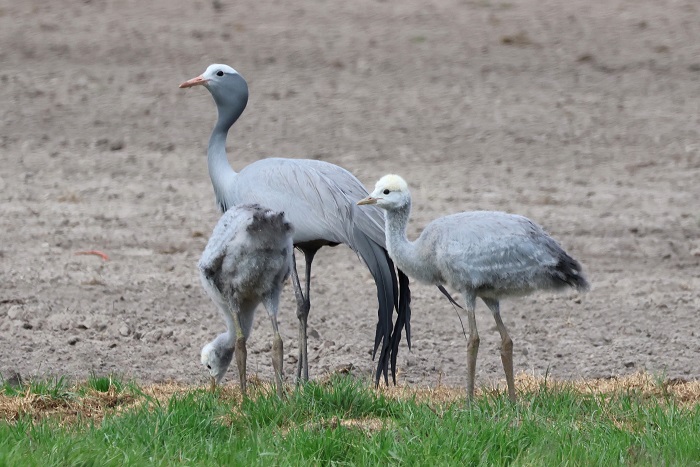
Juveniles are paler overall than the adults, especially on the head and they have some buffy feathers on the wing coverts, flanks, belly and thighs. Juveniles lack the bulbous head-shape and elongated tertials of the adults. Juveniles also have black bills with a reddish base and dull brownish-red legs. The wing coverts and flight feathers are brownish-black.

Grus paradisea
Blue Crane (Grus paradisea)
Darling district, Western Cape
Photo by Trevor Hardaker

Status and Distribution

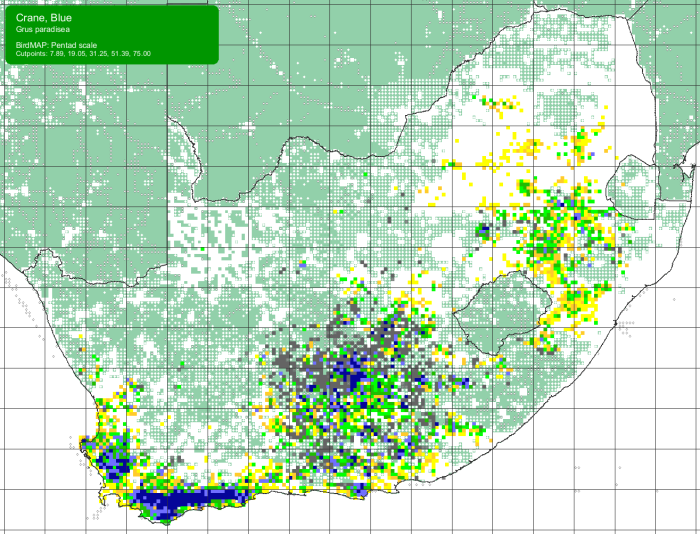
The Blue Crane is locally common and is endemic to southern Africa. It is the world’s most range-restricted crane species. Most of its distribution falls within South Africa from the southern parts of the Western Cape, north-east to the southern Limpopo Province. There is an isolated breeding population in Namibia, centred on Etosha Pan and a small breeding population in north-western Eswatini (Swaziland). Elsewhere it occurs as a non-breeding visitor to extreme south-eastern Botswana.

SABAP2 distribution map for Blue Crane
SABAP2 distribution map for Blue Crane Grus paradisea – April 2024.
Details for map interpretation can be found here.

The Blue Crane is listed in the global Red Data Book as Vulnerable. Its conservation status in South Africa varies between the 3 main biomes it inhabits (Nama Karoo, Grassland and Fynbos). Its distribution and abundance appear not to have changed in the Nama Karoo. The Grassland biome was probably the ancestral stronghold, but it has decreased dramatically in this region. This species was originally absent from the Fynbos biome but has expanded its range into the agricultural regions where it is now remarkably common.

The main threats to the species are from poisoning, collisions with overhead powerlines and loss of habitat to afforestation and urban expansion.

Grus paradisea
Blue Crane (Grus paradisea)
Ithala Game Reserve, KwaZulu-Natal
Photo by Richard Johnstone

Habitat

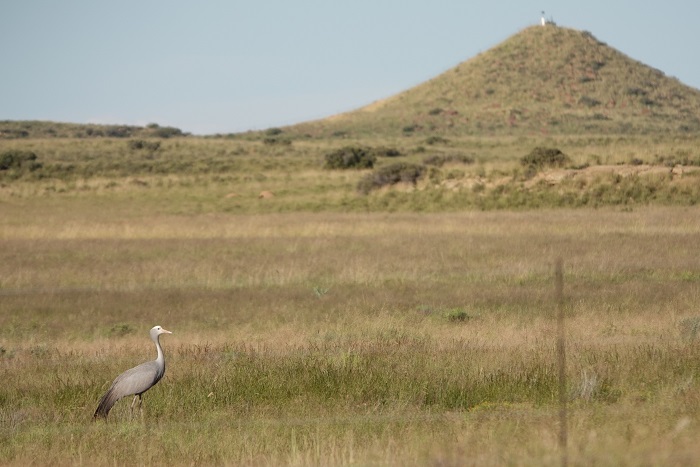
The Blue Crane favours open grassland and the grassy Karoo shrublands. It also occurs commonly in the fynbos biome. However, it avoids natural fynbos, instead inhabiting cereal croplands and agricultural pastures. In the Nama Karoo, it is largely restricted to the east where summer rainfall exceeds 300 mm per year.

Blue Crane
Blue Crane (Grus paradisea) in typical open habitat.
Hanover district, Northern Cape
Photo by Itxaso Quintana

It is frequently found in agricultural fields and croplands across its range, and also inhabits the fringes of wetlands in open areas and is tolerant of intensively grazed and burnt grassland. It extends marginally into light savanna and areas cleared of woodland.

Behaviour

The movements of the Blue Crane are not fully understood. Birds in the Western Cape and the Karoo are largely resident, but those inhabiting the grassland regions, and particularly at higher altitude are known to move to lower lying areas in winter.

Grus paradisea
Blue Crane (Grus paradisea)
Steytlerville district, Eastern Cape
Photo by Gregg Darling

When breeding the Blue Crane is mostly encountered in pairs or family groups. The Blue Crane is highly gregarious outside of the breeding season when it is usually found in flocks numbering anywhere from 30 to 300 birds or more. Flocks of up to 1000 have been observed in the Karoo. They are wary when breeding but are otherwise fairly tame.

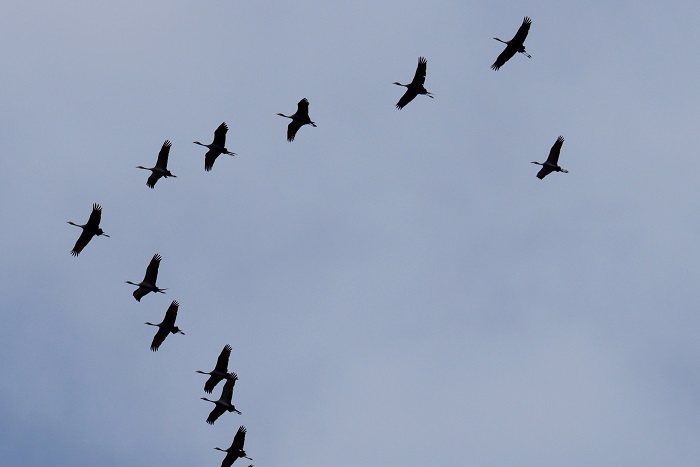
Roosts communally at night in shallow water or on the ground. They are highly vocal when arriving and departing from roost sites. It flies strongly and soars well, often to great heights, and frequently in ‘V’ formation.

Blue Crane flock in flight
Blue Crane (Grus paradisea)
Ouberg Private Nature Reserve, Western Cape
Photo by Sue Gie

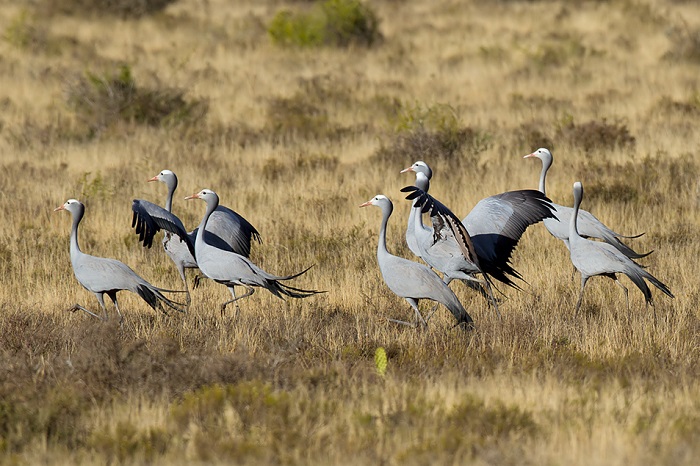
Food is detected by sight and the Blue Crane feeds mostly by pecking, but also digs with the bill. They are omnivorous but the bulk of the diet is vegetarian. They eat small bulbs, green shoots, leaves, seeds and grain, roots, insects, worms, crabs, fish, frogs, reptiles and small mammals. They consume a variety of agricultural pests like bollworm caterpillars, locusts and their eggs and Harvester Termites Hodotermes mossambicus. Commonly feeds at small-stock feedlots, especially in winter.

Grus paradisea
Blue Crane (Grus paradisea). Notice the long inner wing feathers (tertials) of the bird on the far left.
Near Paradise Beach, Eastern Cape
Photo by Desire Darling

Leading up to the breeding season pairs engage in spectacular courtship dances involving much calling, wing flapping, jumping and pirouetting.

Breeding takes place from October to February. It is a monogamous, solitary nester. Blue Cranes are strongly territorial and pairs will aggressively defend nesting areas from predators and conspecifics.

The nest is a scrape on the substrate and is lined with a pad of vegetation on damp ground, or in dry places with small stones, mammal dung and pieces of dry vegetation. Nests are frequently situated in damp locations with clear, all-round visibility. Often reuses the same general nesting area over several years.

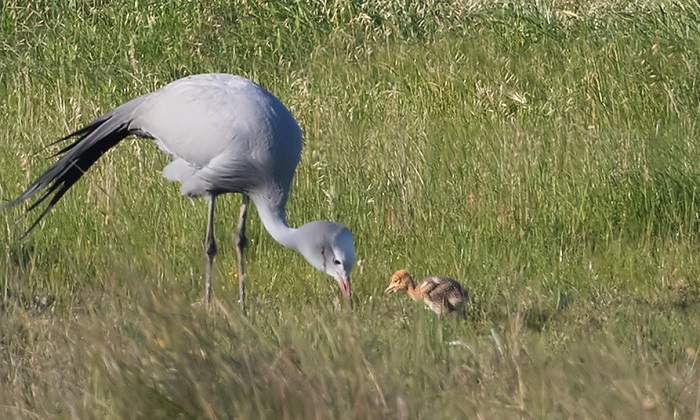
Blue Crane and chick
Blue Crane (Grus paradisea)
St. Francis Bay district, Eastern Cape
Photo by Gregg Darling

Normally one or two eggs are laid per clutch at two or three day intervals. The eggs are greyish-brown to brownish-yellow overlaid with darker streaks and blotches. The eggs have hard shells and are fairly well camouflaged.

Birds move away from nest if threatened, but will defend the nest aggressively if needed. They confront threats (including humans) with wings outstretched and the bill pointed at the intruder, ready to kick and peck.

Grus paradisea
Blue Crane (Grus paradisea)
Near Stellenbosch, Western Cape
Photo by Sharon Stanton

Incubation begins with the first-laid egg and the incubation period lasts for 29 to 30 days. Incubation duties are shared by both sexes. The young are precocial but stay on the nest for the first 12 hours or so after hatching. They grow quickly and attain adult height after just 10 weeks. Strong sibling aggression may result in brood-splitting, where each parent looks after a chick separately to avoid siblicide. Blue cranes only attempt to breed once per season (single brooded).

Blue Crane
Blue Crane (Grus paradisea)
Addo Elephant National Park, Eastern Cape
Photo by Gregg Darling

Further Resources for the Blue Crane

Species text adapted from the first Southern African Bird Atlas Project (SABAP1), 1997.

The use of photographs by Attie Van Aarde, Desire Darling, Gregg Darling, Itxaso Quintana, Richard Johnstone, Sharon Stanton, Sue Gie and Trevor Hardaker is acknowledged.

Virtual Museum (BirdPix > Search VM > By Scientific or Common Name).

Other common names: Anthropoides paradiseus (Alt. Scientific); Bloukraanvoël (Afrikaans); iNdwa (Zulu); Indwe (Xhosa); Mohololi (South Sotho); Mogolodi (Tswana); Paradijskraanvogel (Dutch); Grue de paradis (French); Paradieskranich (German); Grou-do-paraíso (Portuguese)

Recommended citation format: Tippett RM 2024. Blue Crane Grus paradisea. Biodiversity and Development Institute. Available online at https://thebdi.org/2024/04/08/blue-crane-grus-paradisea/

List of bird species in this format is available here.

Bird identificationbirding

Grus paradisea
Blue Crane (Grus paradisea)
Humansdorp District, Eastern Cape
Photo by Gregg Darling

Ruddy Turnstone (Arenaria interpres)

Turnstones

Cover image: Ruddy Turnstone by John and Anne Todd, 9 April, at St Helena Bay in the Western Cape, South Africa. Most of the turnstones in this photograph are almost in complete breeding plumage and will leave soon on migration to Siberia (BirdPix 164625). The two birds at the left hand end of the group are juveniles, and will remain behind. See the text below for details!

Identification

Most of the waders/shorebirds are tricky to identify. The Ruddy Turnstone is an exception. Firstly, as we will see from the distribution map below, it is almost exclusively found on the coastline. Although it does sometimes occur inland, most birders will never see one at a freshwater wetland! Secondly, it has an unusual size and shape, and it is conspicuously marked.

Identification of Ruddy Turnstone
Ruddy Turnstone, near St Helena Bay on the South African West Coast. Photo by Dave Kennedy BirdPix 62972

In flight, Ruddy Turnstones have a distinct pattern of dark-brown and white. This makes them easy to identify.

Ruddy Turnstones in flight
Ruddy Turnstones in flight with their unique pattern. Photographs Gary and Fiona Brown BirdPix 13435 and Greg and Des Darling Birdpix 184704

Even though Ruddy Turnstones are distinct from all other species, their plumage is variable, depending on their age and whether they are getting into or out of breeding plumage. The series of photographs below indicate some of the range (and take a special look at the last image in this section).

Adult turnstone in September
This photograph of a Ruddy Turnstone was taken on 11 September. The black and white pattern on the head represent breeding plumage, so this is an adult which must fairly recently have completed its return migration from, probably, Siberia. Diana Russell BirdPix 235376
Juvenile Turnstone in December
This photography was taken on 27 December. This is a young turnstone, maybe five months old. The giveaways are the legs, which are dull orange rather than bright orange, and the feathers of the neck and the top of back have light brown fringes and are ragged. In a few months’ time, the adults will moult into their brightly coloured breeding plumage, but the first-year turnstones will not, and will remain behind in their dull plumage when the adults depart on migration. It is pointless (and risky) flying all the way to the tundra and back if you are too young to breed. Mark Booysen BirdPix 198474
Adult Arenaria interpres in December
Adult Ruddy Turnstone in midsummer, on 20 December. Legs are real orange. Well developed breast-band. The feathers on the back have neat ends, and they are not ragged like the feathers in the first-year bird just above. Tino Herselman BirdPix 80653
Adult turnstone getting breeding plumage and getting fat
On 19 March, this Ruddy Turnstone is not only acquiring breeding plumage it is also getting a bit plump! The bulge in front is fat, being stored as fuel for the long migration northwards. Departure will take place within a few weeks. The fuel is estimated to be enough for about a third of the journey to the tundra. Total travel time is around two months. Time in the air is about two weeks, and the remainder of the time is spent refueling.
overwintering Arenaria interpres
This is a photograph taken on 26 June. From the perspective of the Southern Hemisphere, this turnstone, about a year old, is “overwintering“. When the adults return to the tundra to breed in April, the juveniles remain behind. Dave Rimmer BirdPix 55764

lots of turnstones
As a species, Ruddy Turnstone is distinct, but there is quite a lot variability between birds. 8 January. Can you pick out a few first-year birds? Rene Navarro BirdPix 169384
Ruddy Turnstone, far northern Norway, photo Ron Summers
… and finally, this is what a Ruddy Turnstone really looks like. This is a male in full breeding plumage at Sletnes, near Gamvik, in the tundra in the far north of northern Norway. Photograph: Ron Summers

The image below comes from a paper published in the journal Auk. The paper is called “Individual differences in the head and neck plumage of Ruddy Turnstones (Arenaria interpres) during the breeding season” and you can download it here.

Ruddy Turnstone heads. Auk (1978) Volume 95, pages 753-755.

The take home message is that not only do Ruddy Turnstones have a breeding plumage and non-breeding plumage, individual birds, both female and male, have distinct black and white patterns on their heads and necks during the breeding season.The paper was written by Peter Ferns, and is based on observations made in northeastern Greenland during an expedition in 1974. I am grateful to Harry Green for telling me about this paper.

Distribution

The distribution of the Ruddy Turnstone is almost exclusively coastal:

SABAP2 distribution map for Ruddy Tunstone
SABAP2 distribution map for Ruddy Turnstone Arenaria interpres – December 2023. Details for map interpretation can be found here.

There are scattered records across the interior. You need to search quite hard in the distribution map to see the yellow-shaded pentads where they have been recorded. The yellow indicates that the reporting rates in these pentads are small; in other words, Ruddy Turnstones are rarely recorded in them. These inland records are mostly young birds on their first southwards migration, and are mostly made in September, October and November, having left the breeding grounds on the tundra mostly in August.

Juvenile Ruddy Turnstone in Zambia
Ruddy Turnstone, 17 October 2020, when it would have been a about three months since it hatched. By plumage, this Ruddy Turnstone is a first-year bird. Compared with all the other photos in this blog, this bird is obviously not in the “correct” habitat! (See the section below.) This photo was taken at Lochinvar in Zambia on 17 October, which is inside the period during which we would anticipate finding “lost” young turnstones far from the coast. Hopefully it found enough wetlands at which to feed until it reached appropriate coastal habitat.Photograph by Salim Lee in Zambia BirdPix 173835

Migration of Ruddy Turnstones

Ring recoveries of Ruddy Turnstone

In this map, the lines join the place where the bird was ringed (circle) with the place where the bird was recovered. The birds did not fly along the lines! The map is contained in a report which summarized recoveries of all species of waterbirds which had been ringed with SAFRING rings (Underhill LG, Tree AJ, Oschadleus HD, Parker V 1999. Review of ring recoveries of waterbirds in southern Africa. Cape Town: Avian Demography Unit: 1–119). You can download the report.

The longest recovery on the map is an exceptional record of a Ruddy Turnstone colour-ringed on Ellesmere Island, Canada, which was observed for eight successive years on the same beach in Namibia. You can read the full story of this bird here. In a nutshell, a turnstone with four colour rings was spotted at a beach north of Swakopmund in March 1999. Detective work by SAFRING revealed that the bird had been ringed at Alert on Ellesmere Island in 1996. This bird was seen again at the same beach in each successive summer up to 2005. The turnstones which breed in this part of Canada mostly migrate to West Africa, and many make a stop-over in Iceland en route.

The table below presents 13 of the most interesting recoveries in the SAFRING database up to 1999.

Table of ring recoveries of Arenaria interpres

Number 1 is a recovery from Mauritius (country code Mu) to India (In). Number 12 also involves Mauritius. An adult ringed in Mauritius in February would have migrated to breed on the Siberian tundra. It was recorded back in Mauritius in September, seven months later, having navigated back to a small island in the Indian Ocean. The longest elapsed time is 16 years for Number 5; it was ringed as a first year bird in January 1977 near Swakopmund, Namibia, and was found in February 1993, 11 km from its ringing site. The straight line distance from Swakopmund to the breeding grounds in Siberia is about 12,500 km. It would have covered about 400,000 km in migration flights alone, which is a bit more than the distance from the Earth to the Moon! The records in the table are interesting, and repay careful study!

In broad brush terms, we understand that the Ruddy Turnstones that migrate to southern Africa breed in the Siberian tundra.

Breeding

Turnstones are circumpolar breeders. That means they breed in suitable habitat, mainly Arctic tundra, in both North America, and Eurasia, without any big gaps in distribution. The photographs here were made during an expedition to the Taimyr Peninsula in Siberia in 1991.

Nest of Ruddy Turnstone

This nest was placed in the centre of some frost-heaved tundra, a patch of mud about 40 cm wide. The nest lining is critical, because it insulates the eggs from the freezing cold surface below; it is only a handful of centimetres down to the permafrost. This nest has a lining consisting of tiny dry leaves and a lichen of the genus Thamnolia; these are popularly called “whiteworm lichens”. Beyond the mud, is moss. There are almost always four eggs; that is the standard clutch size for most of the waders that breed on the tundra.

This is the kind of landscape in which to search for the nests of Ruddy Turnstones (and most of the other waders which breed in Arctic tundra).

Breeding habitat for Arenaria interpres at Lake Pronchshcheva, Siberia

The foreground consists mainly of the mud of frost-heaved tundra, and some moss. In the middle distance is Lake Pronchishcheva (75.3N, 112.5E), still frozen, except along the edges, and in the distance, to the north, are the Byrranga mountains of the interior of the Taimyr Peninsula.

Breeding adult Ruddy Turnstone being examined by Evgeny Syroechkovskiy (1968-2022)
Breeding adult trapped for ringing at its nest in the Siberian tundra

Finally, and on a personal and sad note … This Ruddy Turnstone is being examined by Dr Evgeny Syroechkovskiy (1968-2022). Zhenya, as we all knew him, was leader of our International Arctic Expedition to Lake Pronchishcheva in 1991; it is hard to believe that he was only 23 years old when he took on this massive responsibility. He went on to accomplish a wide variety of achievements in ornithology and bird conservation. At the time of his passing in February 2022, he was chair of the Spoon-billed Sandpiper Task Force. Their News Bulletin 26 of March 2022 is dedicated in its entirety to Zhenya, with many people paying tribute; download it here. This trip to the tundra in 1991 was pivotal in giving a new direction to my life, and I have extremely good memories of Zhenya’s outstanding leadership of that expedition.

Further resources for the Ruddy Turnstone

Species text in the First Southern African Bird Atlas Project

List of bird species in this format is available here.

Recommended citation format: Underhill LG 2024. Ruddy Turnstone Arenaria interpres. Biodiversity and Development Institute. Available online at https://thebdi.org/2024/04/04/ruddy-turnstone-arenaria-interpres/

White-throated Canary (Crithagra albogularis)

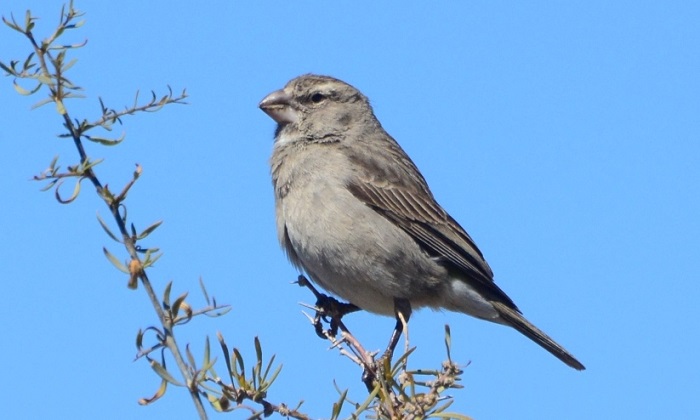
Cover image of White-throated Canary by Ryan Tippett – Carnarvon district, Northern Cape – BirdPix No. 60667

Identification

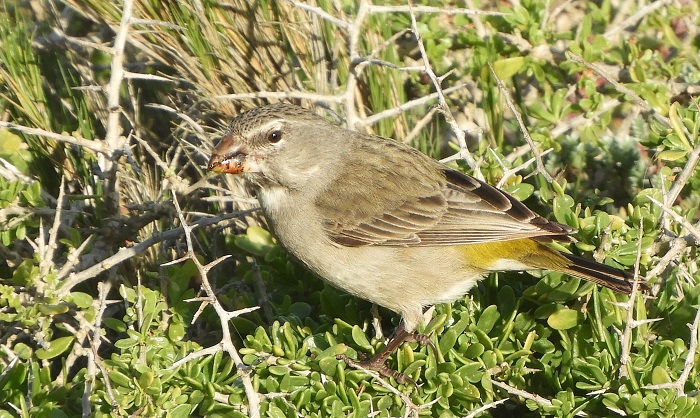
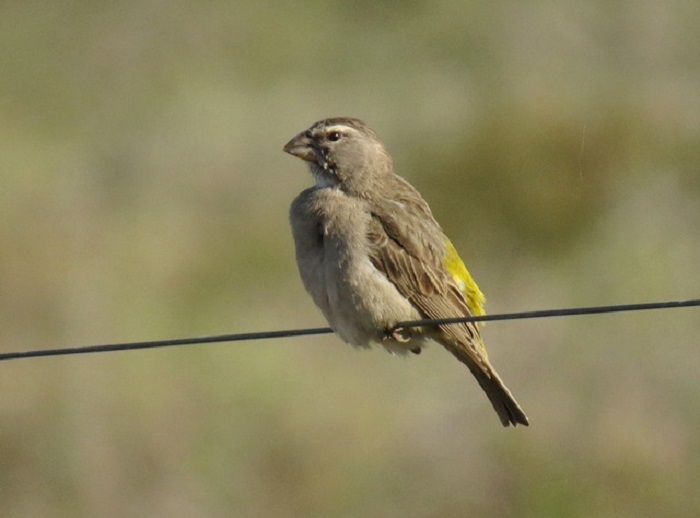
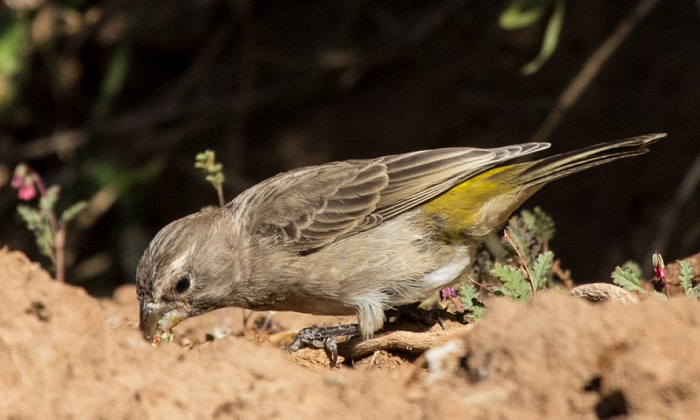
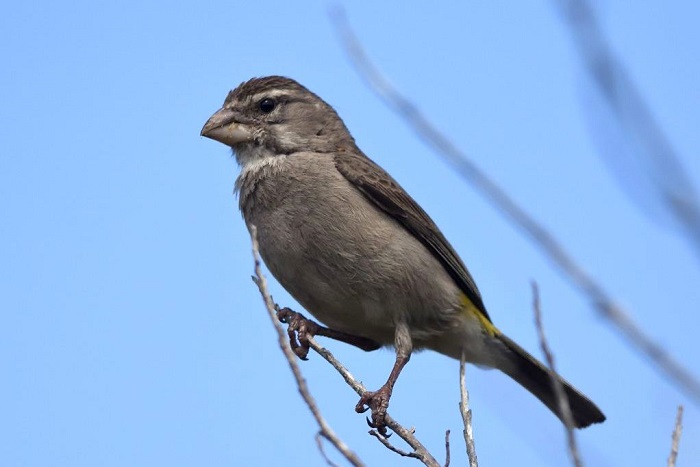
The White-throated Canary is a large, robust, greyish-brown canary with a heavy bill. The Sexes are similar, but females have slightly duller plumage. The most distinctive features are the yellow-green rump, white throat and heavy bill.

White-throated Canary (Crithagra albogularis)
Matjiesrivier Nature Reserve, Western Cape
Photo by Andrew Hodgson

The head is greyish brown with olive-brown streaks, especially on the crown. It has a distinct white supercilium and a white throat and chin. The upper parts are greyish-brown with dusky streaks. The rump is bright yellow-green and is conspicuous in flight. The breast is pale grey shading to pinkish-buff on the belly. The under-tail is white. The heavy, conical bill is horn-coloured and the lower mandible is lighter in colour than the upper mandible.

Juveniles are similar to the adults but have a duller olive-yellow rump.

White-throated Canary (Crithagra albogularis)
Stilbaai, Western Cape
Photo by Gerald Gaigher

The White-throated Canary is most likely to be mistaken for the Protea Canary (Crithagra leucoptera). The Protea Canary has a distinctive black chin, a pale pinkish-grey bill and indistinct white wing bars. It lacks the conspicuous supercilium and yellow-green rump of the White-throated Canary.

The Streaky-headed Seedeater (Crithagra gularis) is also similar but is smaller, with a more slender bill and a more prominent white supercilium. The Streaky-headed Seedeater also lacks the yellow-green rump of the White-throated Canary.

White-throated Canary (Crithagra albogularis)
Steytlerville district, Eastern Cape
Photo by Pamela Kleiman

Status and Distribution

The White-throated Canary is a common resident and local nomad. It is near-endemic to southern Africa, extending marginally into Angola where it occurs on the coastal plain as far north as Benguela. it is mainly found in Namibia and the Northern, Western and Eastern Cape provinces. There are also scattered records from the western and central Free State, North West Province and Lesotho.

SABAP2 distribution map for White-throated Canary
SABAP2 distribution map for White-throated Canary (Crithagra albogularis) – March 2024.
Details for map interpretation can be found here.

There is no evidence of major changes to the range of the White-throated Canary, although it has been suggested that habitat has been lost to alien vegetation in the southern parts of the Western Cape. This species is not threatened.

White-throated Canary (Crithagra albogularis)
Malgas district, Western Cape
Photo by Johan and Estelle van Rooyen

Habitat

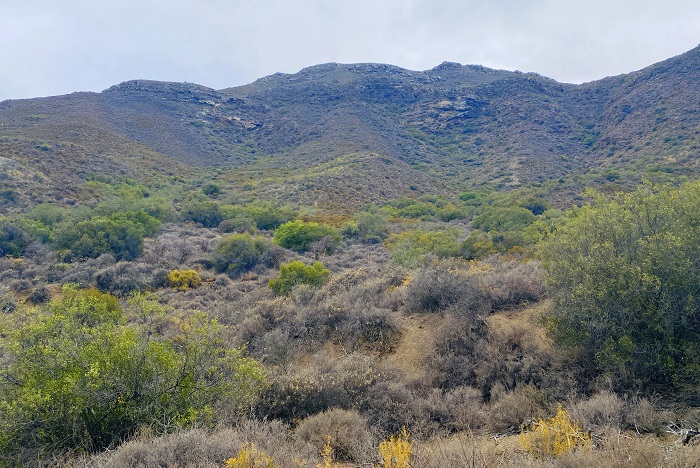
The White-throated Canary inhabits semi-arid and arid shrublands, rocky hillsides with tall shrubs, sparse woodland along seasonal drainage lines, coastal strandveld and gardens in Karoo villages and farms. It also occurs locally in Renosterveld in the Fynbos biome. It needs to drink water regularly which may account for its absence from Bushmanland and parts of Namibia.

Habitat
Near Montagu, Western Cape
Photo by Karis Daniel

Behaviour

The White-throated Canary is normally found in pairs or small family groups of up to 8 birds, but is regularly seen in flocks of up to 30 at drinking sites. Drinks regularly, often flying considerable distances during the heat of day to do so. They are usually fairly quiet, except for their distinctive call-note on take-off.

White-throated Canary (Crithagra albogularis)
Near Schoombee, Eastern Cape
Photo by Derek Solomon

The White-throated Canary Forages on the ground and the tops of shrubs and small trees. They feed on a wide range of seeds and small fruits from grasses, forbs, and shrubs and trees. They also consume flowers and buds, as well as various small insects like termites, grasshoppers and fly larvae. They can crack hard seed capsules with the robust bill to access the seeds within. They first remove the seed capsule from the plant before manipulating it on the ground.

White-throated Canary (Crithagra albogularis)
Addo Elephant National Park, Eastern Cape
Photo by Gregg Darling

The White-throated Canary breeds mainly from August to December in the winter rainfall south-west, but may breed at any time of the year after rain in drier regions. At the onset of the breeding season the males sing from a prominent perch, usually on a small bush or tree.

The nest is a cup of dry plant stems, lined with plant down and bound with fine strips of grass. It is placed from 1 to 3m above the ground in the fork of a bush or small tree. The nest is constructed entirely by the female.

White-throated Canary (Crithagra albogularis)
Calvinia district, Northern Cape
Photo by Tino Herselman

2 to 5 eggs are laid per clutch and the incubation period lasts from 14 to 18 days. The female performs all the incubation and the male supplies her with food while she is on the nest. The newly hatched young are fed by both parents on regurgitated seeds and insects. The nestling period lasts a further 15 to 17 days.

White-throated Canary (Crithagra albogularis)
Albert Falls Nature Reserve, KwaZulu-Natal
Photo by Roelof van der Breggen

Further Resources

Species text adapted from the first Southern African Bird Atlas Project (SABAP1), 1997.

The use of photographs by Andrew Hodgson, Derek Solomon, Gerald Gaigher, Gerald Wingate, Gregg Darling, Johan nd Estelle van Rooyen, Karis Daniel, Pamela Kleiman, Roelof van der Breggen and Tino Herselman is acknowledged.

Virtual Museum (BirdPix > Search VM > By Scientific or Common Name).

Other common names: Witkeelkanarie (Afrikaans); Weißkehlgirlitz (German); Serin à gorge blanche (French); Witkeelkanarie (Dutch); Canário-de-garganta-branca (Portuguese).

Recommended citation format: Tippett RM 2024. White-throated Canary Crithagra albogularis. Biodiversity and Development Institute. Available online at https://thebdi.org/2024/03/28/white-throated-canary-crithagra-albogularis/

List of bird species in this format is available here.

Bird identificationbirding

White-throated Canary (Crithagra albogularis)
Tygerberg Nature Reserve, Western Cape
Photo by Gerald Wingate

Grey-backed Cisticola (Cisticola subruficapilla)

Cover image: Grey-backed Cisticola by Gregg Darling – St. Francis Bay Air Field, Eastern Cape

Cisticolas belong to the Family CISTICOLIDAE. This is a group of small passerine birds found mainly in warmer southern regions of the Old World and contains around 168 species divided into 26 genera. This family is thought to have originated in Africa, which is home to the majority of species, but members of the family can also be found in Europe, tropical Asia, and Australasia. They were formerly included within the Old World warbler family Sylviidae.

Identification

The head of the Grey-backed Cisticola has an indistinct eyebrow and a dark rufous crown, merging to grey on the mantle. The back is grey to brownish grey with dark blackish streaks. The underparts are a paler, plain brownish grey. Southern populations have grey underparts with fine blackish streaking on the breast, belly and flanks. The tail is longish and dusky-brown with buff tips and a black subterminal band.

Identification guide to Grey-backed Cisticola
Grey-backed Cisticola (Cisticola subruficapilla) 
Middelburg district, Eastern Cape
Photo by Tino Herselman

There is considerable variation in plumage with six subspecies in the region. Southern subspecies have grey upperparts streaked blackish, and finely streaked flanks. The northern subspecies are browner on the upperparts, and without streaking on the grey-buff underparts.

Cisticola subruficapilla
Grey-backed Cisticola (Cisticola subruficapilla)
Birds in the Western Cape are grey below with dark streaking on the undersides.
Riversdale district, Western Cape
Photo by Johan and Estelle van Rooyen

There is little seasonal variation in plumage and the sexes are alike. Immatures and juveniles are similar to the adults but are duller overall and with a yellowish wash to the underparts.

Grey-backed Cisticolla
Grey-backed Cisticola (Cisticola subruficapilla). Juvenile showing the yellow wash.
St. Francis Bay Air Field, Eastern Cape
Photo by Desire Darling

The Grey-backed Cisticola is usually the only ‘long-tailed’ cisticola within its range. It can be difficult to distinguish from the wailing cisticola (Cisticola lais) in the Eastern Cape, where the two species overlap slightly. The two species have similar calls, but are distinguished by different habitat requirements, and in the region of overlap, the Grey-backed Cisticola is grey ventrally whereas the Wailing Cisticola is buff-coloured. The Gey-backed Cisticola could also be confused with the Levaillant’s Cisticola (Cisticola tinniens), but that species has a more richly coloured crown and tail, as well as paler and whiter underparts.

Status and Distribution

Cisticola subruficapilla
Grey-backed Cisticola (Cisticola subruficapilla)
St. Francis Bay Air Field, Eastern Cape
Photo by Gregg Darling

The Grey-backed Cisticola is a locally common to very common resident and is near-endemic to southern Africa. It only extends beyond the sub region into southern Angola. It occurs from Namibia southwards to the Cape Peninsula, and eastwards through the Karoo to the south-western Free State and the Eastern Cape province. The northern population in Namibia appears to be well isolated from the southern populations.

SABAP2 distribution map for Grey-backed Cisticola
SABAP2 distribution map for Grey-backed Cisticola (Cisticola subruficapilla) – March 2024.
Details for map interpretation can be found here.

The historical distribution is not known to have differed from its present range. The Grey-backed Cisticola is able to occupy a variety of scrubby habitats and can therefore tolerate some vegetational changes. It is able to persist in a highly fragmented landscape. The Grey-backed Cisticola is not threatened.

Habitat

Habitat for this species
Habitat near Carnarvon, Northern Cape
Photo by Ryan Tippett

The Grey-backed Cisticola occurs in a wide range of habitats where low scrub is present. These include coastal and montane fynbos, shrubby Karoo plains, grass and scrub covered hillsides, ravines in semi-arid areas, grass covered dunes and saline grassland near estuaries.

It is most numerous in the Succulent and Nama Karoo biomes, followed by the Fynbos biome.

Habitat
Habitat near Montagu, Western Cape
Photo by Karis Daniel

Behaviour

Found singly, in pairs or family groups. The Grey-backed Cisticola is a fairly conspicuous species. The male makes distinctive display flights and calls from an exposed perch during the breeding season. It is frequently detected by its call, which can be heard throughout the year, but sings only in the breeding season.

Cisticola subruficapilla
Grey-backed Cisticola (Cisticola subruficapilla)
St. Francis Bay Air Field, Eastern Cape
Photo by Desire Darling

The Grey-backed Cisticola forages low down in shrubs and among grass tufts, but often perches conspicuously on top of vegetation. This is especially so when alarmed or calling. The Grey-backed Cisticola feeds entirely on small insects like termites, beetles, beetle larvae, caterpillars, small grasshoppers, bugs and likely also spiders.

Grey-backed Cisticola
Grey-backed Cisticola (Cisticola subruficapilla)
Lion’s Head, Western Cape
Photo by Itxaso Quintana

Breeding has been recorded between August and December. During courtship the male displays in bouncing flight over the female, while hovering and flicking his tail. The Grey-backed Cisticola is territorial and is a monogamous, solitary nester. The nest is a ball of dry grass and plant down with a side entrance. It is placed on or near the ground in a grass tuft or low shrub, with growing grass incorporated into the roof and sides. The nest is lined with soft plant down.

Cisticola subruficapilla
Grey-backed Cisticola (Cisticola subruficapilla)
Struisbaai district, Western Cape
Photo by Tino Herselman

2 to 4 eggs are laid per clutch. The eggs are laid at 1 day intervals and are whitish to pale greenish blue with reddish-brown and purplish spotting. Incubation begins upon completion of the clutch. Further details regarding incubation and the nestling period are unrecorded.

Grey-backed Cisticola
Grey-backed Cisticola (Cisticola subruficapilla) 
St. Francis Bay Air Field, Eastern Cape
Photo by Gregg Darling

Further Resources

Species text adapted from the first Southern African Bird Atlas Project (SABAP1), 1997.

The use of photographs by Desire Darling, Gregg Darling, Itxaso Quintana, Johan and Estelle van Rooyen, Karis Daniel and Tino Herselman is acknowledged.

Virtual Museum (BirdPix > Search VM > By Scientific or Common Name).

Other common names: Red-headed Cisticola (Alt. English); Grysrugtinktinkie (Afrikaans); Cisticole à dos gris (French); Rotsgraszanger (Dutch); Bergzistensänger (German); Fuinha-de-dorso-cinzento (Portuguese).

Recommended citation format: Tippett RM 2024. Grey-backed Cisticola Cisticola subruficapilla. Biodiversity and Development Institute. Available online at https://thebdi.org/2024/03/26/grey-backed-cisticola-cisticola-subruficapilla/

List of bird species in this format is available here.

Bird identificationbirding

Similar Species

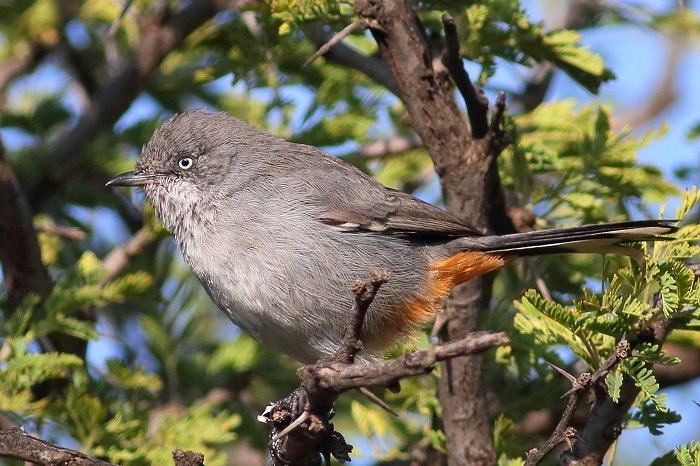
Chestnut-vented Warbler (Sylvia subcaeruleum)

Cover image: Chestnut-vented Warbler by Gerald Wingate – Klipheuwel district, Western Cape –  BirdPix No. 176803

Identification

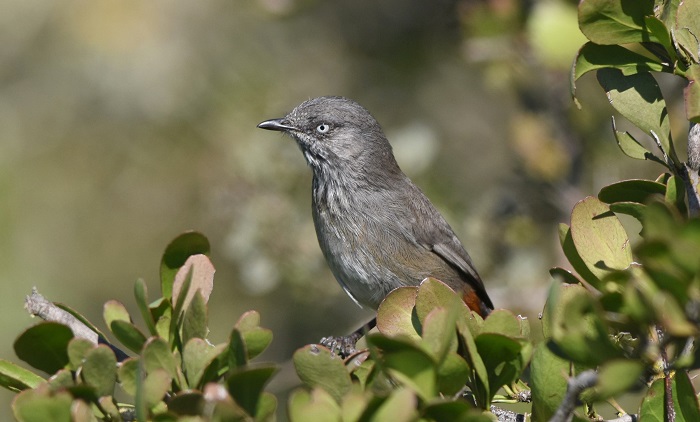
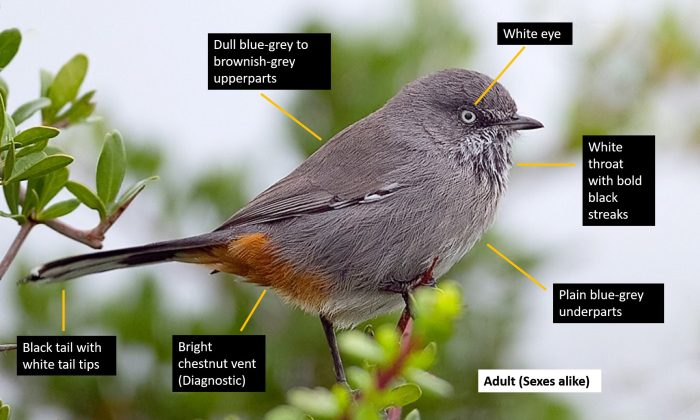
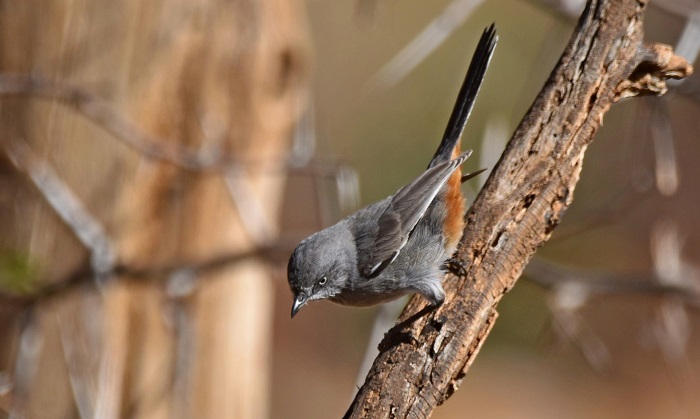
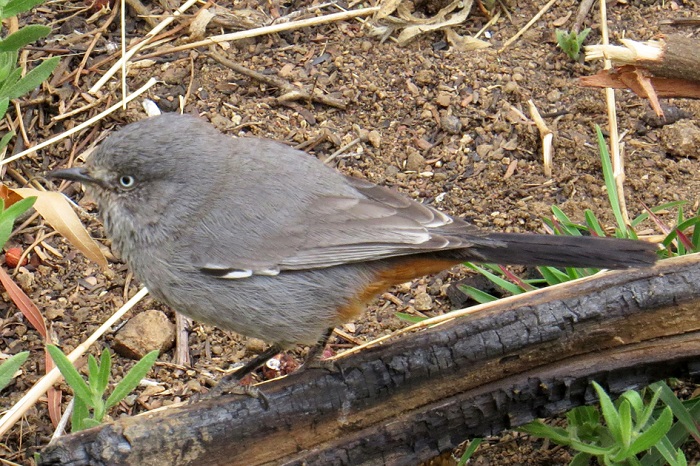
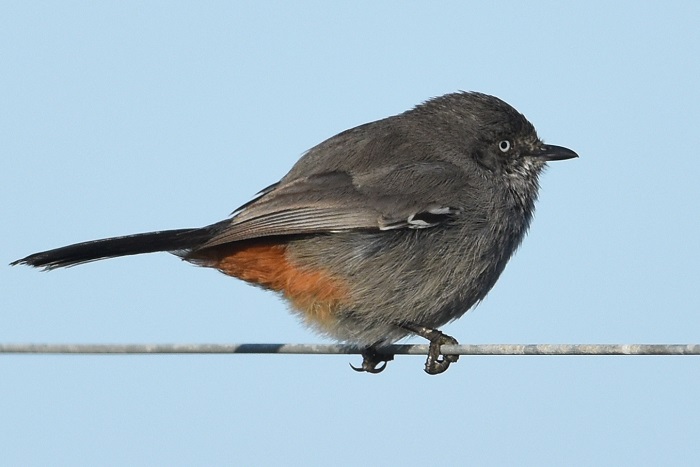
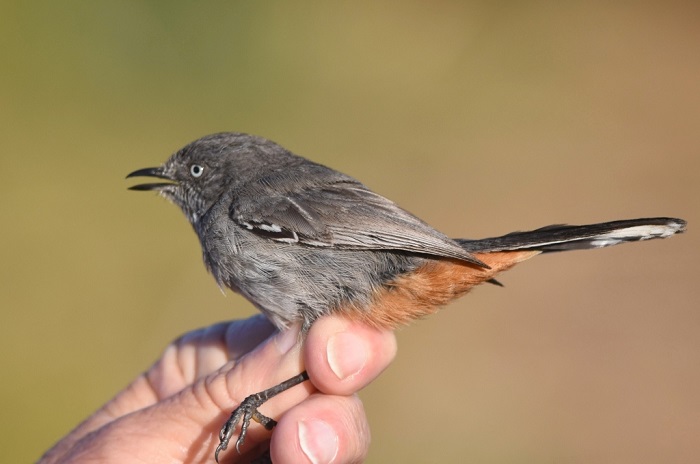
The Chestnut-vented Warbler is easy to identify at all ages due to the distinctive chestnut vent. The crown and the rest of the upper parts are dull blue-grey to brownish grey. The forehead, ear coverts and sides of the neck are brownish grey. The chin and throat are white with bold black streaks. Underparts, including the breast and belly are grey. The vent and undertail coverts are bright chestnut and diagnostic. The tail is black with white tips. The eyes are white or cream coloured and the bill, legs and feet are blackish.

Chestnut-vented Warbler (Sylvia subcaeruleum)
Addo Elephant National Park, Eastern Cape
Photo by Gregg Darling

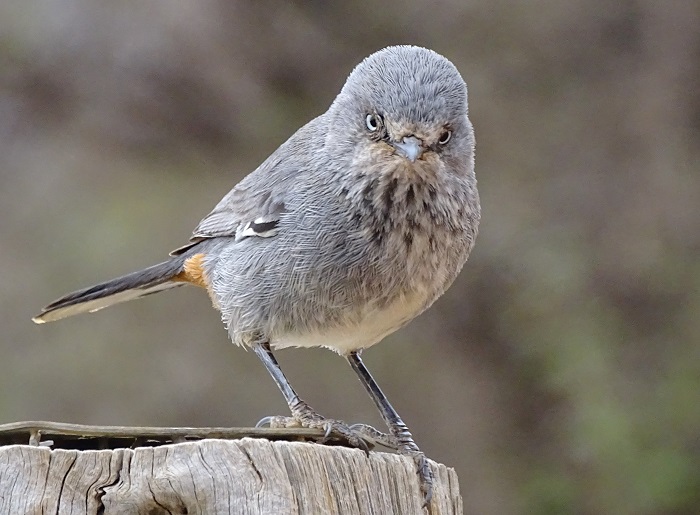
Juveniles resemble the adults but the vent is dull, not bright rufous and they have less distinct streaking on the throat.

The Chestnut-vented Warbler is most similar to the related Layard’s Warbler (Sylvia layardi). The latter is slightly paler, with finer streaking on the throat and a white (not chestnut) vent.

Sylvia subcaeruleum
Chestnut-vented Warbler (Sylvia subcaeruleum) 
Near Hartebeespoort, North West Province
Photo by Andrew Keys

Status and Distribution

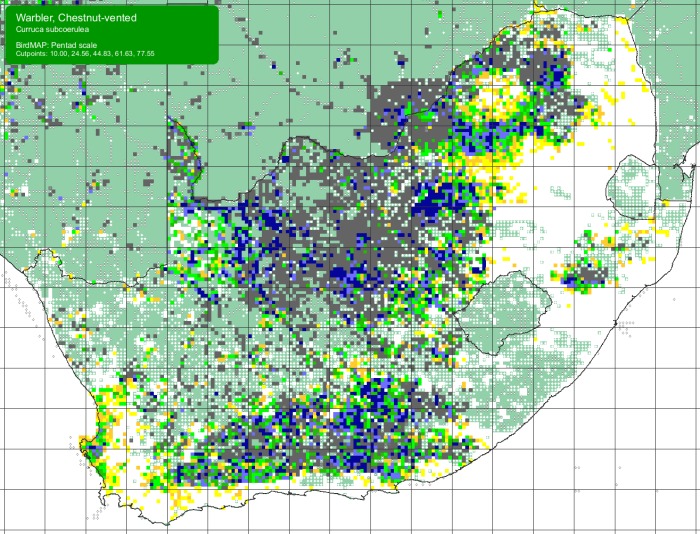
The Chestnut-vented Warbler is near-endemic to southern Africa, occurring elsewhere only in southern Angola and south-western Zambia. It is widespread in the drier western and central parts of southern Africa, but is absent from higher rainfall areas in the east and north-east of southern Africa. It is a common resident and is sedentary across its range.

SABAP2 distribution map for Chestnut-vented Warbler
SABAP2 distribution map for Chestnut-vented Warbler Sylvia subcaeruleum – March 2024.
Details for map interpretation can be found here.

The range of the Chestnut-vented Warbler is not known to have differed from the present, and is unlikely to have changed significantly. Although it is near-endemic, its wide distribution in the arid and semi-arid regions suggests that the species is unlikely to be under threat in the foreseeable future.

Sylvia subcaeruleum
Chestnut-vented Warbler (Sylvia subcaeruleum)
Pilanesberg National Park, North West Province
Photo by Wiekus Moolman

Habitat

The Chestnut-vented Warbler occurs in scrub and thickets, particularly along drainage lines. It has a preference for indigenous Vachellia (Acacia) thickets. In the Karoo it favours areas with taller bushes on plains and in drainage lines. It inhabits a range of vegetation types from thickets in open thornveld and savanna woodlands to bushy hillsides, semi-arid Karoo shrublands, as well as gardens on farms and in rural villages.

Habitat near Carnarvon, Northern Cape
Photo by Ryan Tippett

Behaviour

The Chestnut-vented Warbler is usually encountered solitarily or in pairs. It is a skulking species that is often unwilling to show itself in the open. However, it is not shy and is rather inquisitive.

Sylvia subcaeruleum
Chestnut-vented Warbler (Sylvia subcaeruleum)
Mountain Zebra National Park, Eastern Cape
Photo by Lance Robinson

They fly low from bush to bush and search for food by restlessly moving through the foliage and branches of trees and bushes. Food is gleaned from bare branches and occasionally from leaves. They will sometimes also hawk small insects in flight. The Chestnut-vented Warbler frequently utters its distinctive cheriktiktik call while foraging.

Chestnut-vented Warbler
Chestnut-vented Warbler (Sylvia subcaeruleum)
Camdeboo National Park, Eastern Cape
Photo by Jorrie Jordaan

This species eats mainly invertebrates such as spiders, ticks, moths, mantids, small beetles, caterpillars and termites. Also consumes small berries when available, and nectar, especially of various Aloe species.

The Chestnut-vented Warbler breeds from August to April in southern Africa but varies somewhat from region to region due to rainfall. In drier areas, breeding is probably partly opportunistic after rain. The nest is a cup of dry grass, rootlets and spider web, lined with plant down and fibres. Nests are usually located 1.5 to 3m above the ground amongst the slender outer branches of a bush or tree, and often in a clump of mistletoe.

Sylvia subcaeruleum
Chestnut-vented Warbler (Sylvia subcaeruleum)
Pilanesberg National Park, North-West Province
Photo by Deon Van der Hoven

Two to four white eggs with greenish-brown to blue-grey blotching are laid per clutch. Incubation begins after the second egg has been laid, and incubation duties are shared by both sexes. The incubation period lasts from 13 to 16 days. Newly hatched young are altricial and the nestling period lasts for up to 15 days, during which time they are fed and cared for by both parents.

Broods of the Chestnut-vented Warbler are sometimes parasitised by the Diederik Cuckoo (Chrysococcyx caprius), and less often by the Jacobin Cuckoo (Clamator jacobinus).

Chestnut-vented Warbler
Chestnut-vented Warbler (Sylvia subcaeruleum)
West Coast National Park, Western Cape
Photo by Gerald Wingate

Further Resources

Species text adapted from the first Southern African Bird Atlas Project (SABAP1), 1997.

The use of photographs by Andrew Keys, Deon Van Der Hoven, Gerald Wingate, Gregg Darling, Jorrie Jordaan, Lance Robinson and Wiekus Moolman is acknowledged.

Virtual Museum (BirdPix > Search VM > By Scientific or Common Name).

Other common names: Chestnut-vented Tit-Babbler, Titbabbler, Rufous-vented Warbler (Alt. English); Bosveldtjeriktik (Afrikaans); Parisome grignette (French); Kaapse Meeszanger (Dutch); Meisensänger (German); Felosa-chapim-dos-bosques (Portuguese).

A list of bird species in this format is available here.

Recommended citation format: Tippett RM 2024. Chestnut-vented Warbler Sylvia subcaeruleum. Biodiversity and Development Institute. Available online at https://thebdi.org/2024/03/23/chestnut-vented-warbler-sylvia-subcaeruleum/

Bird identificationbirding

Chestnut-vented Warbler
Chestnut-vented Warbler (Sylvia subcaeruleum) 
Vanschoorsdrif, Western Cape
Photo by Gerald Wingate

Cape Spurfowl (Pternistis capensis)

Cover image of Cape Spurfowl by Terry Terblanche – Near Lutzville, Northern Cape – BirdPix No. 260909

The Cape Spurfowl is a member of the ‘vermiculated group’ of spurfowls and francolins, with the Natal Spurfowl (Pternistis natalensis) as its closest relative. The Cape Spurfowl is the largest spurfowl in southern Africa.

Identification

The sexes are alike in appearance, but males are considerably larger than females and have larger spurs on the legs.

Identification guide to Cape Spurfowl
Cape Spurfowl (Pternistis capensis) 
Kogelberg Nature Reserve, Western Cape
Photo by Desire Darling

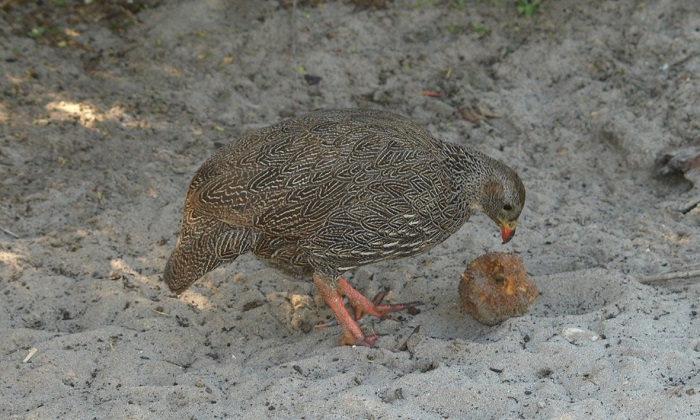
From a distance the Cape Spurfowl appears dark brown overall, and without distinctive facial markings. The upper parts are brown, intricately patterned with off-white chevrons. The crown is distinctly darker, giving a capped appearance. The throat is white with scattered black flecks. The feathers on the underparts, including the neck, upper breast and flanks are brown, intricately patterned with parallel, whitish chevrons. The plumage on the lower breast and belly has additional broad white central streaks. The legs and feet are dull orange-red.

Pternistis capensis
Cape Spurfowl (Pternistis capensis) 
Rietvlei, Western Cape
Photo by Gregg Darling

Juveniles resemble the adults but are duller overall.

The Cape Spurfowl is not likely to be confused with any other spurfowl due to its large size, overall dark colour and lack of red facial skin. It most closely resembles the Natal Spurfowl (Pternistis natalensis) and the Red-billed Spurfowl (Pternistis adspersus), however the range of the Cape Spurfowl does not overlap with these two species.

Cape Spurfowl
Cape Spurfowl (Pternistis capensis) 
Langebaan, Western Cape
Photo by Lance Robinson

Status and Distribution

The Cape Spurfowl is a common to locally abundant resident. It is endemic to southern Africa, occurring mainly as a fynbos endemic, with seemingly isolated populations in Namaqualand and along the Orange River to Prieska. It occurs marginally in extreme southern Namibia along the Orange River.

SABAP2 distribution map for Cape Spurfowl
SABAP2 distribution map for Cape Spurfowl (Pternistis capensis)  – March 2024. Details for map interpretation can be found here.

There is no evidence of range contraction and the Cape Spurfowl is not considered threatened. The species has benefited from habitat transformation because of its ability to colonise alien vegetation and suburban parklands. However, in agricultural lands it is impacted by the severe fragmentation of natural patches of habitat.

Habitat

Habitat for Cape Spurfowl
Typical habitat
Montagu district, Western Cape
Photo by Karis Daniel

The Cape Spurfowl’s preferred habitat is coastal and montane fynbos, especially strandveld and renosterveld. In drier areas in the surrounding Karoo it is found in riverine scrub along drainage lines. It has adapted well to exotic Acacia thickets, as well as farmlands, parks and gardens. Its presence on farms and in suburban areas is dependent on pockets of natural vegetation in which to roost and breed.

Pternistis capensis
Cape Spurfowl (Pternistis capensis). Note the large spurs on this male’s legs.
Kirstenbosch National Botanical Garden, Western Cape
Photo by Neels Jackson

Behaviour

The Cape Spurfowl occurs in pairs or small coveys of up to 20 birds. It is a conspicuous species and its presence is often revealed by its call. They become tame and confiding around people, foraging in the open, and even approaching humans and flying onto picnic tables to scavenge food.

When alarmed, the Cape Spurfowl erects the crown feathers. It flies well but is reluctant, preferring to run into cover when disturbed. Coveys may sometimes perch in trees after they’ve been flushed but are more likely to land on the ground before fleeing into dense cover.

A covey of Cape Spurfowl having a drink
Cape Spurfowl (Pternistis capensis) drinks mostly during the late afternoon. They often drink in covey.
Koringberg, Western Cape
Photo by Les Underhill

The Cape Spurfowl is very noisy during the early morning and late afternoon. They roost at night huddled together on the ground and sometimes in trees or in reedbeds. The Cape Spurfowl regularly dustbathes in fine dust and gravel. Drinks mostly during the late afternoon.

Pternistis capensis
The Cape Spurfowl (Pternistis capensis) readily feeds on fallen fruit.
Langebaan district, Western Cape
Photo by Graham Bull

The Cape Spurfowl forages in the open but is rarely found far from cover. They search for food by scratching in leaf litter and loose soil. Its diet is varied. During summer they feed primarily on invertebrates like insects, small snails, termites and ants. They also readily consume fallen fruit, including grapes, apples and pears. In winter the diet mainly consists of fresh shoots, leaves, bulbs, corms, seeds, berries and fallen grain. It sometimes also scratches through the dung of large herbivores in search of grubs and undigested seeds.

Cape Spurfowl
A Cape Spurfowl (Pternistis capensis) scratching through herbivore dung for grubs and seeds.
Witsand district, Western Cape
Photo by Johan and Estelle van Rooyen

The Cape Spurfowl breeds from August to January. It is a monogamous, solitary nester. The nest is a shallow scrape on the ground, thinly lined with grass stems and occasionally feathers. The nest is well concealed, typically under dense tangles of scrub.

Pternistis capensis
Cape Spurfowl (Pternistis capensis) female on the nest.
Langebaan district, Western Cape
Photo by Graham Bull

Four to eight eggs are laid per clutch. Larger clutches of up to 14 eggs are probably laid by two females. The eggs are brownish cream to pale pink.

nest of Cape Spurfowl
Cape Spurfowl (Pternistis capensis) female on the nest.
Langebaan district, Western Cape
Photo by Graham Bull

Incubation begins once the full clutch has been laid. The incubation period lasts from 22 to 25 days and is performed entirely by the female. Newly hatched young are precocial but chicks are still brooded by both adults, with possible cooperative brood care by related hens.

Cape Spurfowl with chicks
Cape Spurfowl (Pternistis capensis) with young.
Tygerberg Nature Reserve, Western Cape
Photo by Gerald Wingate

Further Resources

Species text from the first Southern African Bird Atlas Project (SABAP1), 1997.

The use of photographs by Desire Darling, Gerald Wingate, Graham Bull, Gregg Darling, Johan and Estelle van Rooyen, Karis Daniel, Lance Robinson, Les Underhill, Neels Jackson and Terry Terblanche is acknowledged.

Virtual Museum (BirdPix > Search VM > By Scientific or Common Name).

Other common names: Cape Francolin (Alt. English); Kaapse fisant (Afrikaans); Kaapse Frankolijn (Dutch); Francolin criard (French); Kapfrankolin (German); Francolim do Cabo (Portuguese)

A list of bird species in this format is available here.

Recommended citation format: Tippett RM 2024. Cape Spurfowl Pternistis capensis. Biodiversity and Development Institute. Available Online at https://thebdi.org/2024/03/20/cape-spurfowl-pternistis-capensis/

Bird identificationbirding

Pternistis capensis
Cape Spurfowl (Pternistis capensis) 
Witsand district, Western Cape
Photo by Johan Van Rooyen

White Stork (Ciconia ciconia)

Cover image: White Stork by Lance Robinson– Biesiesvlei, Free State – BirdPix No. 243136

Identification

The White Stork is a large and striking bird. It is conspicuous and unmistakable. The entire body is white with black flight feathers and a striking bright red bill and legs. The White Stork is unlikely to be confused with any other species. The sexes are alike.

Identification of White Stork
White Stork Ciconia ciconia
Seekoeivlei Reserve, Free State
Photo by Ilse Hulme

Juveniles have black bills with a reddish base and dull brownish-red legs. The wing coverts and flight feathers are brownish-black.

White Stork in flight
White Stork Ciconia ciconia
Kromme River, Eastern Cape
Photo by Gregg Darling

Status and Distribution

The White Stork is, for the most part, a non-breeding Palearctic migrant to southern Africa. Most birds arrive in October and depart by May. A small number of birds breed in the southern parts of the Western Cape, from near Cape Town to Mossel Bay and Calitzdorp. These breeding birds are apparently resident.

SABAP2 distribution map for White Stork
SABAP2 distribution map for White Stork Ciconia ciconia – March 2024.
Details for map interpretation can be found here.

Palearctic birds breed from north Africa, western Europe and Scandinavia east to China. Winters are spent throughout sub-Saharan Africa. In southern Africa it occurs mainly in the eastern and extreme southern regions, with scattered records in the arid west. It generally avoids areas that receive less than 500mm of rain per year, except after periods of good rainfall.

The White Stork is common to abundant in southern Africa. Numbers vary greatly from year to year and are influenced by conditions elsewhere in Africa. Abundance is greatest when conditions are dry further north.

Ciconia ciconia
White Stork Ciconia ciconia
Ixopo District, KwaZulu-Natal
Photo by Malcolm Robinson

With one exception, the current distribution in southern Africa is probably unchanged from historical times. But its presence in the Western Cape is relatively recent, dating back to around the 1960s, after the establishment of agricultural croplands in the Overberg and Swartland regions east and north of Cape Town, respectively. The number of White Storks in the Overberg, east of Cape Town, is far larger than the number in the Swartland, north of Cape Town.

Through the 20th century, until the 1980s, the White Stork suffered a decline in its northern hemisphere breeding range, especially in western Europe. This trend has been reversed, and numbers are still increasing. It has never been considered to be globally threatened. The main threats to the species are from habitat loss, collisions with overhead power lines, pesticide contamination and hunting.

Habitat

White Stork habitat
White Storks Ciconia ciconia in typical open, agricultural habitat.
Wartburg district, KwaZulu-Natal
Photo by Malcolm Robinson

White Storks inhabit a variety of open habitats including grasslands, open woodland, seasonal wetlands, agricultural crop fields and pastures. It is estimated that as much as 86% of birds in South Africa are found on croplands and pastures. Arid and semi-arid vegetation types in the west are generally avoided except in years of above average rainfall. However, the White Stork is common in the grass dominated eastern fringes of the Nama-Karoo. The White Stork drinks regularly and is often found around dams and wetlands but is not dependent on aquatic habitats.

Ciconia ciconia
White Stork Ciconia ciconia
Bakubung, North West
Photo by Pieter Cronje

Behaviour

The White Stork usually occurs in flocks numbering 10 to 50 birds, but sometimes congregates in the thousands or even tens of thousands. They may gather in groups near water around midday. Sometimes rests standing on 1 leg, with its bill buried in the neck feathers. This posture is thought to minimise heat loss. As with other storks they cool themselves down in hot weather by defecating on their legs. White Storks roost gregariously in trees or at shallow wetlands, sometimes alongside Abdim’s Storks. Travels in large flocks, circling on thermals to gain height. Flies with the neck and legs fully extended.

White Storks in flight
White Stork Ciconia ciconia
Hwange National Park, Zimbabwe
Photo by Derek Solomon

White Storks usually forage in well-spaced groups. It is estimated that as many as 20 000 birds can gather at locust irruptions in the Karoo. Walks slowly and steadily, searching for prey. They regularly follow large game animals and domestic cattle in order to capture flushed insects.

Ciconia ciconia
White Stork Ciconia ciconia
Mgeni River, KwaZulu-Natal
Photo by Malcolm Robinson

The White Stork is predatory, and feeds on a wide range of small animal prey. It consumes agricultural pests, including Bollworms (Heliothis armigera), Armyworms (Spodoptera exempta) and Brown Locusts (Locustana pardalina). It also eats mice, small reptiles (snakes and lizards), amphibians, fish, molluscs, various large insects, the young of ground-breeding birds, scorpions, caterpillars and termite alates. Indigestible food material is regurgitated in the form of pellets.

Its breeding behaviour is little known in South Africa, but is probably similar to that in Europe, Asia and north Africa. Breeding has been recorded from September to November in South Africa. In 2024, we are making a determined effort to find out just how many pairs are breeding in South Africa. Read about this initiative here. If you know of a nest, or find one, please let us know (ring@thebdi.org).

Breeding White Storks
White Stork Ciconia ciconia
A nest at the former Tygerberg Zoo, Western Cape
Photo by Les Underhill

White Storks are monogamous. The nest is a large platform of sticks, reeds, clods of earth and grass. The nest is built quickly, by both sexes in as little as 8 days. The majority of nesting material is contributed by the male and nest material is added periodically throughout the breeding cycle. Nests are placed up to 13m above the ground, in a tree or broken chimney etc. Nests are regularly added to and re-used, but not every year, and the nest gradually increases in size over time.

One to six dull white eggs are laid per clutch. Incubation duties are shared by both sexes and incubation lasts for around 30 days. Incubation begins once the first egg has been laid, resulting in the eggs hatching asynchronously. The newly hatched young are covered with sparse creamy-white down, becoming dense, white and woolly as they grow.

The young are brooded, fed and cared for by both parents. Fledged birds remain dependent on their parents for up to 20 days after leaving the nest.

Ciconia ciconia
White Stork Ciconia ciconia
Kgomo-Kgomo flood plain, North West
Photo by Lia Steen
White Stork nest, Marrakesh, Morocco
White Stork on its nest in Marrakesh, Morocco, 14 April 2024. Photograph Jean Ramsay.

Further Resources for the White Stork

Species text in the first Southern African Bird Atlas Project (SABAP1), 1997.

The use of photographs by Garth Aiston, Gerald Wingate, Gregg Darling, Michael Wright, Phillip Nieuwoudt, Tino Herselman and Zenobia van Dyk is acknowledged.

Virtual Museum (BirdPix > Search VM > By Scientific or Common Name).

Other common names: Witooievaar (Afrikaans); uNogolantethe, uNowanga (Zulu); Ingwamza (Xhosa); Gewone Ooievaar (Dutch); Cigogne blanche (French); Weißstorch (German); Cegonha-branca (Portuguese)

List of species available in this format.

Recommended citation format: Tippett RM 2024. White Stork Ciconia ciconia. Biodiversity and Development Institute. Available online at https://thebdi.org/2024/03/14/white-stork-ciconia-ciconia/

Bird identificationbirding

White Storks in field
White Stork Ciconia ciconia 
Wartburg district, KwaZulu-Natal
Photo by Malcolm Robinson