Find the Shovel-footed Squeaker in the FBIS database (Freshwater Biodiversity Information System) here.
Family Arthroleptidae
Identification
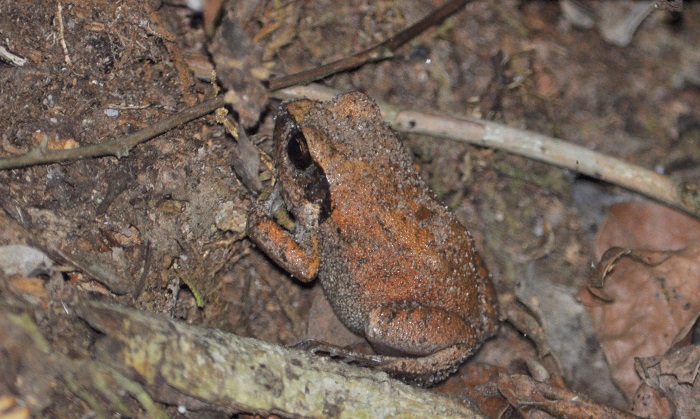
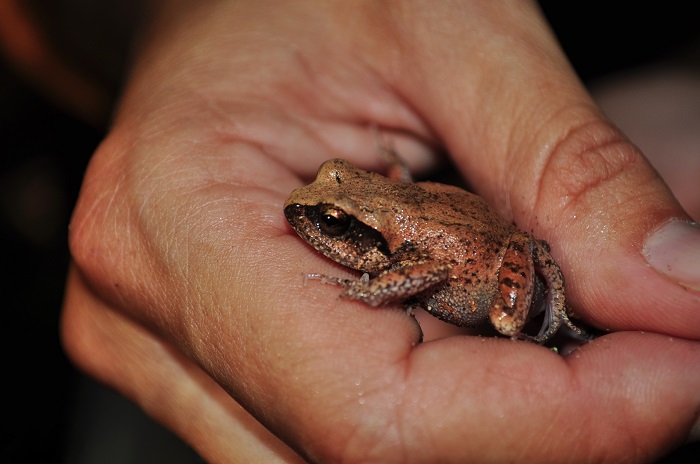
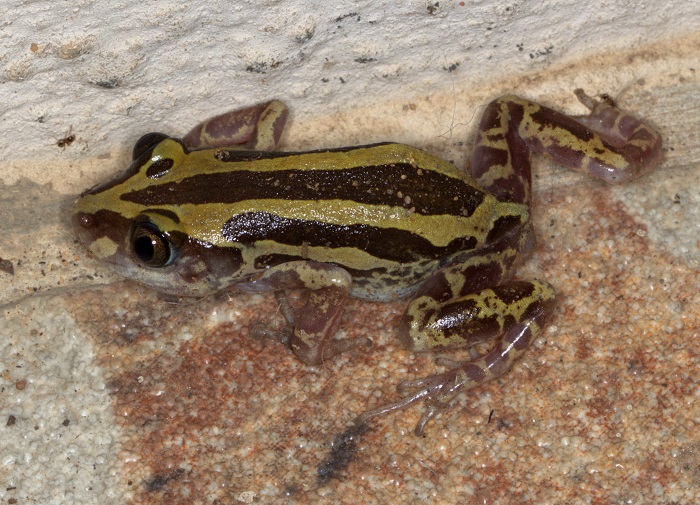
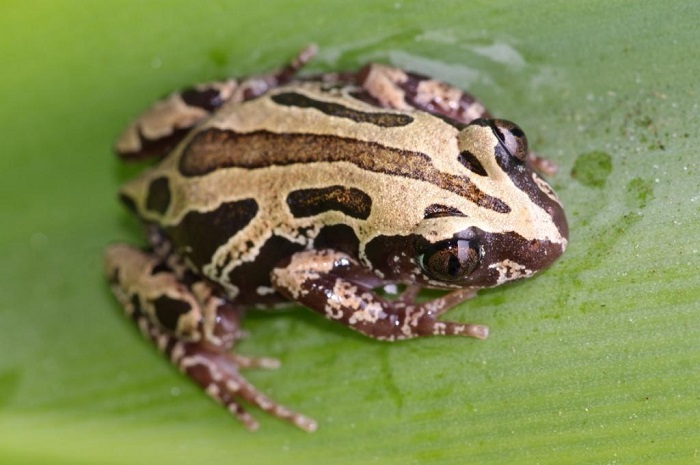
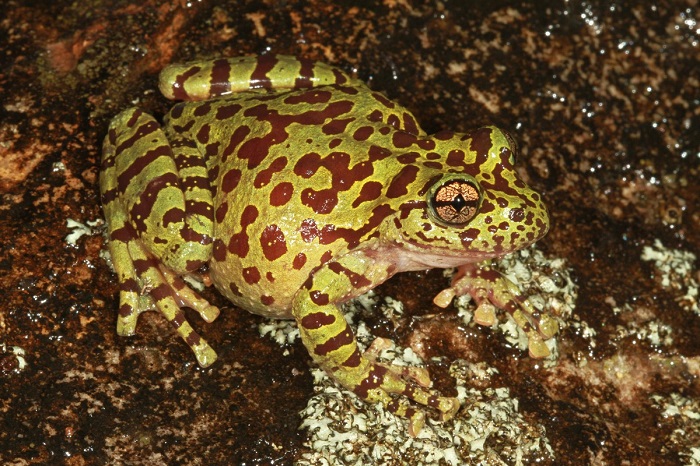
The Shovel-footed Squeaker is a stocky species with a broad, stubby head. It attains a maximum size of 45mm and is larger than others in the genus. The skin above varies from light to dark brown. A dark 3-lobed hourglass pattern is often present on the back. A thin, pale vertebral stripe is sometimes also visible. The Shovel-footed Squeaker has a dark facial mask extending from the tip of the snout, through the eye, to the base of the forearm. The undersides are granular and typically white with grey flecks in the chest region.
Shovel-footed SqueakerArthroleptis stenodactylus Bhanga Nek, iSimangaliso Wetland Park, KwaZulu-Natal Photo by Ryan Tippett
Habitat
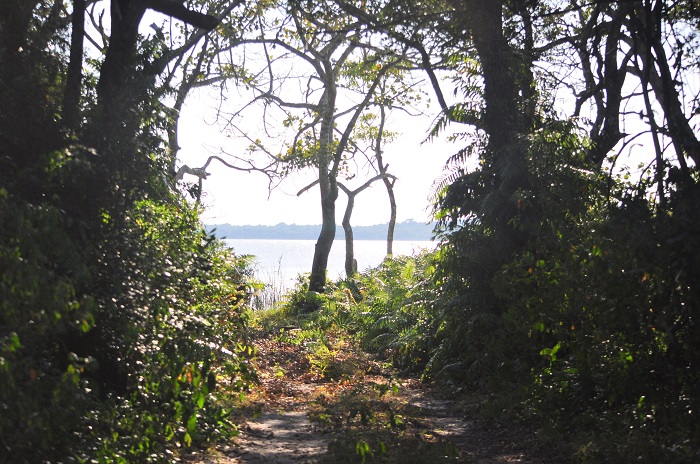
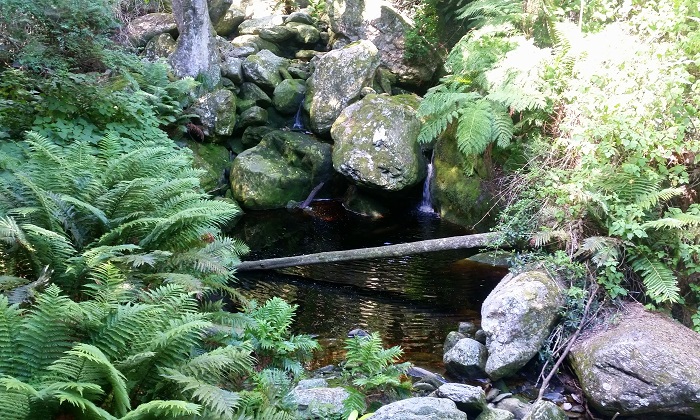
In South Africa, the Shovel-footed Squeaker occurs in wooded areas with abundant leaf litter and sandy soils. Along the coast, it inhabits dune Forest and forest patches in Coastal Bushveld/Grassland. In the northern Kruger National Park, it was found in the leaf litter of riverine woodland (H.H. Braack pers. comm.). Breeding takes place in the same habitat.
Habitat near Kosi Bay, KwaZulu-Natal Photo by Ryan Tippett
Behaviour
The Shovel-footed Squeaker breeds from December to February (Stewart 1967). Males call from the ground among leaf litter. The eggs are laid in hollows or shallow burrows in leaf litter beneath bushes or around the roots of trees. Up to 80 eggs are laid, which develop directly into small froglets (Barbour and Loveridge 1928; Loveridge 1953a).
Shovel-footed SqueakerArthroleptis stenodactylus Kosi Bay, KwaZulu-Natal Photo by Tyrone Ping
During the dry season, the adults take shelter in hollow trees, moss, rotten wood, and soil at the base of trees (Loveridge 1953b,c).
The diet of the Shovel-footed Squeaker includes termites, ants, and a wide range of other small arthropods. More unusual items include snails and frogs (Barbour and Loveridge 1928; Inger and Marx 1961). The Shovel-footed Squeaker is fed upon by various snakes, including Eastern Vine Snake Thelotornis mossambicanus, White-lipped Snake Crotaphopeltis tornieri, Eastern Stripe-bellied Sand Snake Psammophis orientalis, and Green Water Snake Philothamnus hoplogaster (Barbour and Loveridge 1928; Loveridge 1953a; Blake 1965).
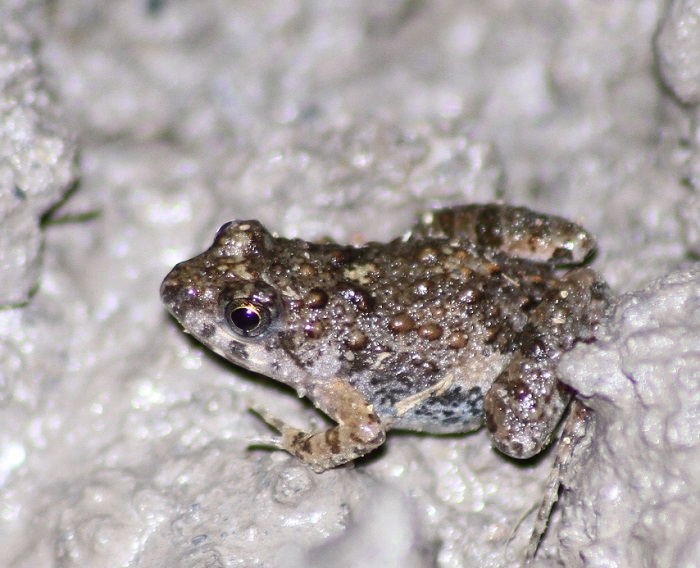
Shovel-footed SqueakerArthroleptis stenodactylus Zimbabwe Photo by Nick Hart
Status and Conservation
The Shovel-footed Squeaker is common and does not require specific conservation action.
Distribution
Distribution of Arthroleptis stenodactylus. Taken from the FrogMAP database, April 2022.
A. stenodactylus is a widespread species that extends from southern and eastern DRC to Kenya, south to Zimbabwe and Mozambique. In the atlas region it has a peripheral distribution, occurring along the coastal plain north of Empangeni (2831DD), and in the Limpopo River valley in the extreme north of Limpopo Province. This species is easily recognized by its call. The atlas data are reliable.
Shovel-footed SqueakerArthroleptis stenodactylus Bhanga Nek, iSimangaliso Wetland Park, KwaZulu-Natal Photo by Ryan Tippett
Further Resources
The use of photographs by Len de Beer, Nick Hart, and Tyrone Ping is acknowledged. Other photographs by Ryan Tippett.
Other Common Names: Dune Squeaker, Common Squeaker (Alt. English); Graafpootkikker (Afrikaans).
Recommended citation format: Channing, A; Tippett, RM. (2025). Shovel-footed Squeaker Arthroleptis stenodactylus. Biodiversity and Development Institute, Cape Town. Available online at https://thebdi.org/2022/01/10/shovel-footed-squeaker-arthroleptis-stenodactylus/
This species text has been updated and expanded from the text in the 2004 frog atlas: Channing, A. (2004). Shovel-footed Squeaker Arthroleptis stenodactylus. In Minter LR et al 2004.
References:
Minter, LR; Burger, M; Harrison, JA; Braack, HH; Bishop, PJ; Kloepfer, D. (Editors). (2004). Atlas and Red Data Book of the Frogs of South Africa, Lesotho and Swaziland. Smithsonian Institution, Washington, and Avian Demography Unit, Cape Town.
Carruthers, V; du Preez, L. (2017). Frogs of southern Africa: A Complete Guide. Struik Nature, Cape Town.
Channing, A. (2001) Amphibians of Central and Southern Africa. Protea Book House, Pretoria
Claus, B; Claus, R. (2002). Common Amphibians and Reptiles of Botswana. Gamsberg Macmillan, Windhoek.
View the above photo record (by Johan Heyns) in FrogMAPhere.
Find the Bubbling Kassina in the FBIS database (Freshwater Biodiversity Information System) here.
Family Hyperoliidae
BUBBLING KASSINA – Kassina senegalensis
(Duméril and Bibron, 1841)
Habitat
K. senegalensis inhabits a wide variety of vegetation types in the Savanna and Grassland biomes (Poynton 1964; Balinsky 1969; Passmore and Carruthers 1995). Breeding habitat comprises both temporary and permanent water bodies, including well-vegetated shallow pans, vleis and marshes, as well as deeper dams (Rödel 2000).
Behaviour
During the dry season, K. senegalensis aestivates under logs and rocks and inside termitaria and burrows of the Giant Girdled Lizard Cordylus giganteus. Individuals were found as far as 1200 m from an ephemeral pan, at the end of the breeding season when the frogs moved away from the water to seek shelter for the winter (Kok et al. 1997).
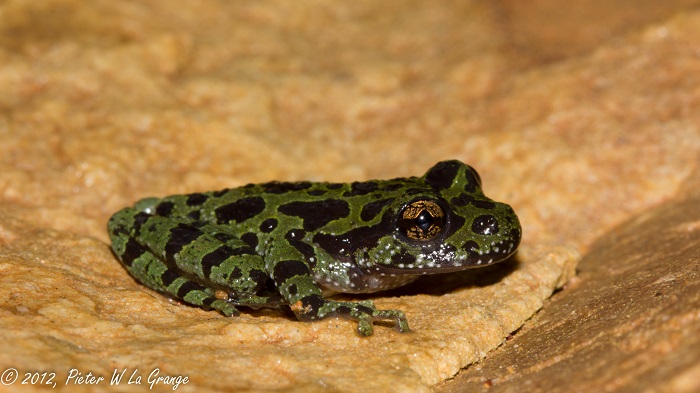
Kassina senegalensis – Royal Natal National Park, KwaZulu-Natal Photo by J.K. Boyce
Breeding takes place from spring to late summer. During the day, adults hide under vegetation or rocks, or in burrows, emerging in the late afternoon to make their way to the breeding site. They begin to call at dusk while some distance from the water, before taking up positions near the water’s edge, well concealed beneath vegetation (Fleischack and Small 1978; Rödel 2000). In wet weather, calling takes place during the day as well as at night. The vocal repertoire includes an advertisement call as well as a longer, pulsed, territorial call (Fleischack and Small 1978).
Amplexus is usually initiated out of the water. Between 100 and 500 eggs are laid singly in shallow water; they are adhesive and may stick to submerged vegetation, rocks or other objects, or sink to the bottom. One amplexed pair dispersed their eggs over a distance of 3 m, depositing 1–15 eggs at a number of sites c.30 cm apart (Fleischack and Small 1978). The eggs are 1.4–1.8 mm in diameter, in 3-mm jelly capsules, and they hatch within 5–6 days. The tadpoles develop slowly and complete their development in 52–90 days (Wager 1965; Balinsky 1969). Rödel (2000) presented a detailed description of the life history of K. senegalensis and a comprehensive review of pertinent literature.
K. senegalensis preys on a variety of arthropods, including termites, caterpillars, ants, flies and spiders (Loveridge 1936; Inger and Marx 1961). The species has been observed to fall prey to the Herald Snake Crotaphopeltis hotamboeia while approaching breeding sites. (C.W. and L.H. du P. pers. obs.).
Status and Conservation
This widely distributed and abundant species does not require conservation attention. The large number of farm dams that have been built in South Africa have created additional breeding habitat for this species. K. senegalensis is recommended as a research subject because of its wide distribution, abundance, and the ease with which it may be kept in captivity (Van Wyk et al. 1992).
K. senegalensis is one of the region’s most widely distributed frog species, occurring throughout almost all of sub-Saharan Africa. It is found in suitable habitats at low and high altitudes, from Senegal in West Africa, eastward to Somalia and southward to South Africa. In the atlas region, this species is common in all provinces except Western Cape Province (apart from one record), the western part of Eastern Cape Province and the central and western parts of Northern Cape Province. It occurs throughout Swaziland, and its apparently sparse distribution in lowland Lesotho reflects inadequate sampling rather than a real absence of the species. It is certainly one of the most common species in the atlas region, within the limits of its range.
The data set is reliable and fairly comprehensive, especially as the characteristic call, an explosive, short “boip”, reveals the presence of the species from great distances and clearly distinguishes it from all other species.
Distribution of Kassina senegalensis. Taken from the FrogMAP database. April 2022.
Further Resources
Virtual Museum (FrogMAP > Search VM > By Scientific or Common Name)
More common names: Borrelvleipadda (Afrikaans)
Recommended citation format for this species text:
Weldon C, du Preez LH, Tippett RM. Bubbling Kassina Kassina senegalensis. BDI, Cape Town. Available online at http://thebdi.org/2022/01/07/bubbling-kassina-kassina-senegalensis/
Recommended citation format:
This species text has been updated and expanded from the text in the 2004 frog atlas. The reference to the text and the book are as follows:
Weldon C, du Preez LH 2004 Kassina senegalensis Bubbling Kassina. In Minter LR et al 2004.
Minter LR, Burger M, Harrison JA, Braack HH, Bishop PJ, Kloepfer D (eds) 2004. Atlas and Red Data Book of the Frogs of South Africa, Lesotho and Swaziland. Smithsonian Institution, Washington, and Avian Demography Unit, Cape Town.
View the above photo record (by Toby Esplin) in FrogMAPhere.
Find the Broad-banded Grass Frog in the FBIS database (Freshwater Biodiversity Information System) here.
Family Ptychadenidae
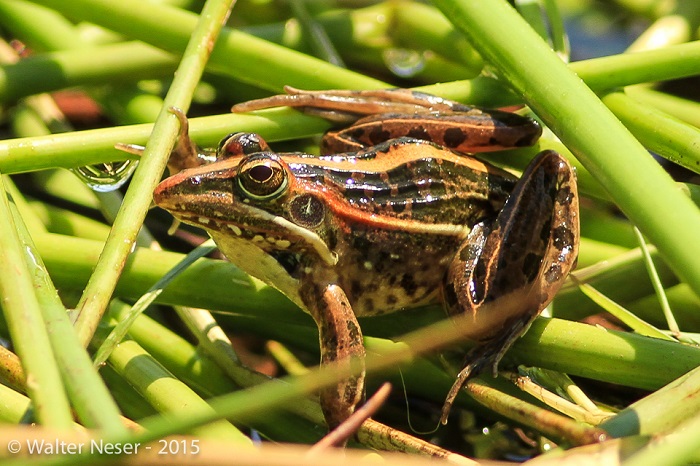
BROAD-BANDED GRASS FROG – Ptychadena mossambica
(Peters, 1854)
Habitat
This savanna species inhabits several bushveld vegetation types in the northeastern parts of the atlas region, at altitudes of 200–1200 m. (Jacobsen 1989). Annual rainfall in these habitats is 350–>1000 mm. P. mossambica and P. anchietae are both savanna species and often occupy the same breeding sites. However, Poynton and Broadley (1985b) cited a record of P. mossambica collected in evergreen forest in Mozambique, while Loveridge (1953a) collected specimens in open grassland, indicating that this species has adapted to a wider range of habitats than P. anchietae.
During summer, adults conceal themselves in grass tussocks near vleis, seepage areas, pans and dams (Jacobsen 1989), floodplains of rivers and inundated grassland (Passmore and Carruthers 1995). When disturbed, they take one long leap into grass, crawl under it, and remain concealed (Stewart 1967).
Behaviour
Comparatively little is known about the life history of P.mossambica. During dry winter months the frogs seek refuge in deep cracks in the dry mud of pans and dams (Pienaar et al. 1976), emerging to breed after the first spring rains.
In flooded grassland or shallow, grassy pans, males call from completely concealed positions within grass tussocks, usually some distance from the shoreline. At breeding sites, where clumps of emergent vegetation are absent, calling takes place from dense vegetation at the water’s edge (Passmore 1978). In more arid areas, such as Hans Merensky Nature Reserve, breeding begins before vegetation has developed around the seasonal pans and dams, and P. mossambica calls from completely exposed positions, alongside P. anchietae (L.R.M. pers. obs). Calling peaks between 20:00 and midnight (Passmore 1978).
Pienaar et al. (1976) recorded a batch of 315 eggs that were laid in shallow water and developed rapidly. They were grey-brown on one side, yellow-white on the other and sank to the bottom when laid.
Diet has not been recorded, but is probably similar to that of P. anchietae.
Status and Conservation
In terms of its global distribution, P. mossambica has a marginal distribution in the atlas region; within this area it is relatively common and does not appear to be at risk. Much of its habitat is used for game and cattle farming and is relatively undisturbed, and it also occurs in a number of provincial nature reserves and national parks.
Distribution
P. mossambica occurs in open savanna from Kenya and Uganda southward through East Africa to Namibia (Caprivi), Botswana, Zimbabwe and Mozambique (Poynton and Broadley 1985b; Channing 2001). In the atlas region it occurs in the northeastern parts of North West Province, Limpopo Province, eastern Mpumalanga, eastern Swaziland and northern KwaZulu-Natal. Its recorded range extends west as far as Gopane (2525BD), and southward to Mtunzini (2831DD). This is a highly variable taxon which requires further taxonomic investigation (Poynton and Broadley 1985b; Channing 2001).
P. mossambica has a loud and distinctive call and breeds over an extended period. The atlas data are reasonably complete and reliable, although the species is probably more widespread in Limpopo Province than is indicated by the map.
Further Resources
Virtual Museum (FrogMAP > Search VM > By Scientific or Common Name)
More common names: Breëband-graspadda (Afrikaans)
Recommended citation format for this species text:
Minter LR, Passmore NI, Tippett RM. Broad-banded Grass Frog Ptychadena mossambica. BDI, Cape Town. Available online at http://thebdi.org/2022/01/07/broad-banded-grass-frog-ptychadena-mossambica/
Recommended citation format:
This species text has been updated and expanded from the text in the 2004 frog atlas. The reference to the text and the book are as follows:
Minter LR, Passmore NI 2004 Ptychadena mossambica Broad-banded Grass Frog. In Minter LR et al 2004.
Minter LR, Burger M, Harrison JA, Braack HH, Bishop PJ, Kloepfer D (eds) 2004. Atlas and Red Data Book of the Frogs of South Africa, Lesotho and Swaziland. Smithsonian Institution, Washington, and Avian Demography Unit, Cape Town.
View the above photo record (by Walter Neser) in FrogMAPhere.
Find the Dwarf Grass Frog in the FBIS database (Freshwater Biodiversity Information System) here.
Family Ptychadenidae
DWARF GRASS FROG – Ptychadena taenioscelis
Laurent, 1954
Habitat
In the northern parts of its range, P. taenioscelis inhabits river-valley savanna (moist woodlands) and open grasslands at medium elevations (Stewart 1967; Poynton and Broadley 1985b). In the atlas region it occupies Coastal Bushveld-Grassland, a mosaic of vegetation types containing lowland swamps, forest patches and patches of secondary woodland in a grassy matrix (Passmore 1978).
Behaviour
Nothing is known of the life history of P. taenioscelis outside of the breeding season. Dense breeding aggregations develop in summer, in shallow, boggy areas of vleis, seepages and inundated grassland (Passmore and Carruthers 1995). Like P. porosissima, this species continues to call during dry periods, though less intensely (Passmore 1978). During the day, adults remain close to the breeding site (Passmore 1978).
Calling begins early in the afternoon, and is characterized by frequent physical interactions between males as they establish a suitable spacing (0.4–1.5 m apart). Calling peaks between 18:30 and 21:00, and ends 3–4 hours after dark. Males call from exposed positions in wet mud or shallow water at the margin of the breeding site, sometimes submerged to the level of the axillae (Passmore 1976, 1978).
Eggs are laid and fertilized in the same way as described for P. oxyrhynchus. They are released two or three at a time, in water 5–10 mm in depth. Eggs sink slowly and accumulate debris on the jelly capsule (Passmore 1978).
Adults feed on a variety of terrestrial arthropods, primarily beetles, bugs, wasps and spiders (Passmore 1978).
Status and Conservation
P. taenioscelis has a peripheral and patchy distribution in the atlas region and few data are available to assess its conservation status. Despite its tendency to form large breeding aggregations, it was never encountered during the seven-year period of the atlas survey; therefore, from a national perspective, the species may be threatened. Population surveys and monitoring in protected areas are strongly recommended. If P. taenioscelis has indeed declined within the atlas region, it is important to try to identify the contributing factors as these may also be affecting endemic species.
Distribution
P. taenioscelis is distributed from Angola, northern Namibia (Caprivi), southeastern Zaire and Tanzania, southward through northern Botswana and Zambia to northern Mozambique. Within this range the distribution is reported to be patchy (Poynton 1964; Stewart 1967; Passmore 1976; Poynton and Broadley 1985b; Rödel 2000; Channing 2001). The taxonomic relationship between P.taenioscelis and the West African P.pumilio has been the subject of some debate in the literature (Perret 1979; Poynton and Broadley 1985b; Passmore and Carruthers 1995; Channing 2001). Advertisement calls recorded in Cameroon appear to be those of P.taenioscelis (N.I.P. unpubl. data), which suggests that this species has a wider distribution than described above.
In the atlas region the species has a peripheral distribution comprising a few scattered populations along the coastal plain of northern KwaZulu-Natal. It has been recorded as far south as Richards Bay (2832CC). Channing (2001) recorded this species in Limpopo Province and North West Province, but no records were obtained from these areas during the extensive survey carried out by Jacobsen (1989), nor during the atlas survey.
The populations entering the atlas region were assigned to a new species, P. smithi, by Guibé (1960), but were later placed in the synonymy of P. taenioscelis by Poynton (1964). Thus, although P. taenioscelis has not yet been collected in southern Mozambique, the Zululand populations are currently regarded as representing the southern periphery of this species.
The atlas map is based entirely on pre-1996 records; this is probably the result of inadequate sampling as well as a relative scarcity of breeding sites.
Further Resources
Virtual Museum (FrogMAP > Search VM > By Scientific or Common Name)
More common names: Kleingraspadda (Afrikaans)
Recommended citation format for this species text:
Minter LR, Passmore NI, Tippett RM. Dwarf Grass Frog Ptychadena taenioscelis. BDI, Cape Town. Available online at http://thebdi.org/2022/01/07/dwarf-grass-frog-ptychadena-taenioscelis/
Recommended citation format:
This species text has been updated and expanded from the text in the 2004 frog atlas. The reference to the text and the book are as follows:
Minter LR, Passmore NI 2004 Ptychadena taenioscelis Dwarf Grass Frog. In Minter LR et al 2004.
Minter LR, Burger M, Harrison JA, Braack HH, Bishop PJ, Kloepfer D (eds) 2004. Atlas and Red Data Book of the Frogs of South Africa, Lesotho and Swaziland. Smithsonian Institution, Washington, and Avian Demography Unit, Cape Town.
The Festive Season is upon us, or is it the Silly Season? All around there is a mad dash in the shops, the queues are long, the smell of fresh hot-cross buns strong. To escape the madness, or perhaps some family members, some individuals have turned to biomapping. Time spent in nature is never wasted and all the more so if you can contribute to biodiversity conservation!
Round Three of Photo Hunting (i.e. PHunting) kicked off on Saturday 11 December 2021 and ran until midnight on Sunday 19 December 2021. Biomappers snapped and mapped the amazing total of 3,979 records! Below is a table summarizing the number of records received, by project, in the Virtual Museum for PHunting Round Three. The table is organized by most to least amount of records received.
VM Project
RecordTotals
BirdPix
1884
OdonataMAP
862
LepiMAP
723
TreeMAP
112
ReptileMAP
104
MammalMAP
67
FrogMAP
56
MushroomMAP
55
SpiderMAP
51
PHOWN
22
OrchidMAP
18
ScorpionMAP
9
LacewingMAP
7
FishMAP
4
DungBeetleMAP
3
BOP
1
EchinoMAP
1
12 Observers submitted more than 100 records on African biodiversity. The Top 15 PHunters for Round Three are listed in the table below:
Observer Name
Total
1
Pieter Cronje
402
2
Mark Liptrot
309
3
Corrie du Toit
279
4
Corne Rautenbach
232
5
Nico Vromant
195
6
M. Booysen
194
7
Christopher Small
185
8
Les Underhill
143
9
Lia Steen
138
10
Lance Robinson
134
11
Crystelle Wilson
123
12
Karis Daniel
120
13
Pieter La Grange
93
14
Diana Russell
93
15
Mary Lindsay
85
For BirdPix, the bulk of the records came from South Africa (1,663 records), followed by Zambia (79) and Uganda (55). We also received records from Angola, Botswana, Ethiopia, Ghana, Kenya, Lesotho, Malawi, Mozambique, Namibia and Zimbabwe.
The bird species most recorded? The Southern Black-Flycatcher Melaenornis pammelaina (24 records) took first place with Egyptian Goose Alopochen aegyptiacus (20 records) and Village Weaver Ploceus cucullatus in third with 19 records. All in all 480 different bird species were phunted! This number reflects only the records that have been identified by the expert panel thus far, but our experts make quick work of getting identifications verified.
Southern Black-Flycatcher Melaenornis pammelaina – BirdPix record by Andre Harmse
Below is a table of the top ten birds recorded during the third round of Phunting.
Scientific Name
Common Name
Records Total
1
Melaenornis pammelaina
Southern Black-Flycatcher
24
2
Alopochen aegyptiacus
Egyptian Goose
20
3
Ploceus cucullatus
Village Weaver
19
4
Columba guinea
Speckled Pigeon
18
5
Passer melanurus
Cape Sparrow
18
6
Bostrychia hagedash
Hadeda Ibis
18
7
Streptopelia senegalensis
Laughing Dove
16
8
Lonchura cucullatus
Bronze Mannikin
15
9
Motacilla capensis
Cape Wagtail
15
10
Pycnonotus tricolor
Dark-capped Bulbul
15
In the OdonataMAP section of the Virtual Museum we received records from five countries: Cameroon, Namibia, South Africa, Uganda, and Zambia. From the records that have been identified to date, 105 different species were recorded.
Russet Dropwing Trithemis pluvialis – OdonataMAP record by Hesmarie Els
The Red-veined Dropwing Trithemis arteriosa was most frequently recorded with 50 records, followed by the Broad Scarlet Crocothemis erythraea (45) and Tropical Bluetail Ischnura senegalensis (39). Corrie du Toit was the top OdonataMAPper, managing to submit 233 dragonfly and damselfly records for PHunting Round Three.
Below is a table of the top ten odonates recorded during the third round of Phunting.
Scientific Name
Common Name
Records Total
1
Trithemis arteriosa
Red-veined Dropwing
50
2
Crocothemis erythraea
Broad Scarlet
45
3
Ischnura senegalensis
Tropical Bluetail
39
4
Ceriagrion glabrum
Common Citril
35
5
Orthetrum capicola
Cape Skimmer
34
6
Nesciothemis farinosa
Eastern Blacktail
26
7
Brachythemis leucosticta
Southern Banded Groundling
24
8
Orthetrum julia
Julia Skimmer
23
9
Sympetrum fonscolombii
Red-veined Darter or Nomad
23
10
Trithemis kirbyi
Orange-winged Dropwing
21
LepiMAPpers were also out in full force for the third round of photo hunting, snapping and mapping a total of 723 butterflies and moths. Phunting trophies from all over Africa were uploaded to the LepiMAP section of the Virtual Museum. For South Africa, most of the records came from KwaZulu-Natal Province (188), followed by the Western Cape (66) and the North West Province on 22 records.
Large Striped Swordtail Graphium antheus – LepiMAP record by Daryl de Beer
From the 723 records submitted, the expert panel has identified 221 different species thus far! The little African Grass Blue Zizeeria knysna knysna ended up being the most photogenic with 30 records. Next in line was the African Veined White Belenois gidica abyssinica (17 records) and tied for third was the White-barred Telchinia Telchinia encedon encedon and Large Striped Swordtail Graphium antheus both with 13 records. See the table below for the LepiMAP top ten for the third round of Phunting.
Scientific Name
Common Name
Records Total
1
Zizeeria knysna knysna
African grass blue
30
2
Belenois gidica abyssinica
African veined white
17
3
Telchinia encedon encedon
White-barred telchinia
13
4
Graphium antheus
Large striped swordtail
13
5
Belenois creona severina
African Caper White
12
6
Azanus moriqua
Black-bordered Babul Blue
11
7
Bicyclus safitza safitza
Black-haired Bush Brown
11
8
Azanus jesous
Topaz Babul Blue
10
9
Lampides boeticus
Pea Blue
10
10
Danaus chrysippus orientis
African Plain Tiger
10
There are many other sections of the Virtual Museum and we encourage you to keep an eye out for these critters too. We are mapping everything from scorpions to frogs to mammals. So what are you waiting for? Grab your camera (or cellphone) and get snapping and mapping!
PHunting Round Four starts on Saturday 08 January 2022 🙂 Starting the New Year off with a biodiversity bang!
PHunting season is here. No critter is safe. Citizen scientists are out and about, armed with their cameras, ready to Photo Hunt! (Featured image above by Gregg Darling)
Well done to each and every one of you that went out there camera-slinging for biodiversity conservation! The need for up-to-date species distribution maps is now more critical than ever in light of climate change and global environmental challenges. The future of nature conservation and healthy ecosystems are in our hands. We are all in this together. Citizen science can and does make a major difference for species conservation and to spread awareness of conservation and environmental issues. Engagement with nature is important not just for our well-being, but for our very survival.
Round Two of PHunting Season kicked off on Saturday, 13 November 2021, and ended on midnight of the following Sunday, 21 November 2021. In total, 76 biomappers were scouring their local parks, gardens, towns, and streets for all things crawling, flying, swimming, running, and perching. An amazing total of 2,986 phunting trophies were uploaded to the Virtual Museum. Below is a table summarizing the numbers of records received, per project, in the Virtual Museum for PHunting Round Two. The table is organized by most to least number of records received.
VM Project
RecordsTotals
BirdPix
1472
OdonataMAP
635
LepiMAP
501
SpiderMAP
85
ReptileMAP
84
MammalMAP
68
OrchidMAP
34
FrogMAP
23
TreeMAP
19
ScorpionMAP
18
DungBeetleMAP
14
PHOWN
12
LacewingMAP
7
MushroomMAP
7
FishMAP
4
BOP
3
EchinoMAP
0
For BirdPix, the bulk of the records came from South Africa (1163 records), followed by Uganda (119) and Kenya (87). We also received records from Mali, Namibia, Nigeria, Zambia and Zimbabwe.
The bird species most recorded? The Egyptian Geese Alopochen aegyptiacus took first place with 22 records, Pied Crow Corvus albus and Hadeda Ibis Bostrychia hagedash tied for second place with 18 records each. All in all 425 different bird species were phunted! This number reflects only the records that have been identified by the expert panel thus far, but our experts make quick work of getting identifications verified.
Egyptian Goose Alopochen aegyptiacus – BirdPixxed by Lia Steen
Nine observers submitted more than 100 records on African biodiversity. The Top Ten PHunters for Round Two are listed in the table below:
Observer Name
Records Total
1
Rick Nuttall
352
2
Pieter Cronje
275
3
Corrie du Toit
170
4
Andre & Bets Kok
166
5
Hesmarie Els
138
6
Marius Meiring
121
7
PR Kleiman
105
8
Lia Steen
101
9
Zenobia van Dyk
101
10
Christopher Small
91
OdonataMAP, the Atlas of African Dragonflies and Damselflies, received records from Mali, Kenya, Uganda, Nigeria, South Africa, and Zambia. From the records that have been identified to date, 94 different species were recorded.
The Palmiet Sprite Pseudagrion furcigerum was most frequently recorded during this second round of phunting with 50 records, followed by Cape Skimmer Orthetrum capicola (37) and Broad Scarlet Crocothemis erythraea (36). Corrie du Toit was the top OdonataMAPper, managing to submit 125 records in total for PHunting Round Two. Hesmarie Els was close on her heels with 119 records, followed by Diana Russell on 58. Well done!
Palmiet Sprite Pseudagrion furcigerum – OdonataMAPped by Sharon Stanton
LepiMAPpers made a special effort during the second round of photo hunting, snapping and mapping a total of 501 butterflies and moths. Phunting trophies from all over Africa were uploaded to the LepiMAP section of the Virtual Museum. For South Africa, most of the records came from KwaZulu-Natal Province (113 records), followed by the Western Cape (77) and Eastern Cape on 41 records.
From the 501 records submitted, the expert panel has identified 197 different species thus far! The little African Grass Blue Zizeeria knysna knysna was photo hunted most frequently with 13 records. Followed by the Citrus Swallowtail Papilio demodocus demodocus on 10 records and the Painted Lady Vanessa cardui (9 records).
A beautiful Citrus Swallowtail Papilio demodocus demodocus LepiMAPped by Lance Robinson
There are many other sections of the Virtual Museum and we encourage you to keep an eye out for these critters too. We are mapping everything from scorpions to frogs to mammals. So what are you waiting for? Grab your camera (or cell phone) and get snapping and mapping!
View the above photo record (by John Wilkinson) in FrogMAPhere.
Find the Dwarf Puddle Frog in the FBIS database (Freshwater Biodiversity Information System) here.
Family Phrynobatrachidae
DWARF PUDDLE FROG – Phrynobatrachus mababiensis
FitzSimons, 1932
Identification
Habitat
P. mababiensis inhabits open to wooded savanna and, less frequently, grassland, where summer rainfall is 500–1000 mm p.a. It breeds in shallow stagnant water amongst emergent vegetation on the edges of grassy pans, vleis, marshes, small dams and ponds, and in the backwaters of slow-flowing streams. The species is also found in disturbed habitats near villages and other developments.
Behaviour
Dry periods are spent in aestivation. During the dry winter at Shipudza (2230DB) in Kruger National Park, adult P. mababiensis were found sheltering under stones (H. Braack pers. comm.).
This species has an extended breeding season that begins after the first spring rains. Males call from the water’s edge, well concealed by vegetation. Choruses are usually strongest at dusk, diminishing after nightfall. In overcast or rainy weather, calling continues throughout the day and night. Aggression between males occurs frequently (Wager 1965).
Eggs are laid in a single flat layer c.5 cm in diameter, that floats on the water. Metamorphosis is completed after about five weeks, at which stage the juvenile froglets are only 6 mm long (Wager 1965; Pienaar et al. 1976).
P. mababiensis feeds mainly on small insects such as midges and mosquitoes (Wager 1965). These frogs occur in large numbers and probably play a significant role in the ecology of their wetland habitat. Stewart (1967) regarded this species as “probably the most abundant amphibian in eastern and central Africa”.
Predators have been recorded in East Africa (Loveridge 1953a) and Zimbabwe (Broadley 1974). These include various snakes such as the Herald Snake Crotaphopeltis hotamboeia and Swamp Viper Atheris nitschei. Other predators include the Cattle Egret Bubulcus ibis.
Status and Conservation
This successful and widespread species is not in need of special conservation measures.
Distribution
Several small Phrynobatrachus species were described from central, eastern and southern Africa, but the taxonomy of this group is still unsettled (Poynton and Broadley 1985b; Lambiris 1989a).
P. mababiensis occurs from the Sahel of East Africa to the Eastern Cape Province, South Africa, west to Namibia and southern Angola (Frost 2000). In the atlas region, it is found along the coastal plain from about Qolora Mouth (3228CB) in Eastern Cape Province, northward through KwaZulu-Natal, Swaziland, Kruger National Park and surrounding lowlands, from sea level to 1500 m. Earlier records from the western parts of Limpopo Province indicate that this species may be expected to occur across the province via the Limpopo valley.
The colouration and markings of this species vary considerably, but its small size and characteristic insect-like call make identification relatively easy. The call may at times be confused with that of Hemisus marmoratus, which has a similar pulse rate and emphasized frequency. However, the latter lacks the sporadic clicks that are interspersed in the trill of P. mababiensis.
The atlas data are accurate and reasonably complete
Further Resources
Virtual Museum (FrogMAP > Search VM > By Scientific or Common Name)
More common names: Dwergmodderpadda (Afrikaans)
Recommended citation format for this species text:
Channing A, Tippett RM. Dwarf Puddle Frog Phrynobatrachus mababiensis. BDI, Cape Town. Available online at http://thebdi.org/2021/12/20/dwarf-puddle-frog-phrynobatrachus-mababiensis/
Recommended citation format:
This species text has been updated and expanded from the text in the 2004 frog atlas. The reference to the text and the book are as follows:
Channing A 2004 Phrynobatrachus mababiensis Dwarf Puddle Frog. In Minter LR et al 2004.
Minter LR, Burger M, Harrison JA, Braack HH, Bishop PJ, Kloepfer D (eds) 2004. Atlas and Red Data Book of the Frogs of South Africa, Lesotho and Swaziland. Smithsonian Institution, Washington, and Avian Demography Unit, Cape Town.
Find the Cape Ghost Frog in the FBIS database (Freshwater Biodiversity Information System) here.
Family Heleophrynidae
Identification
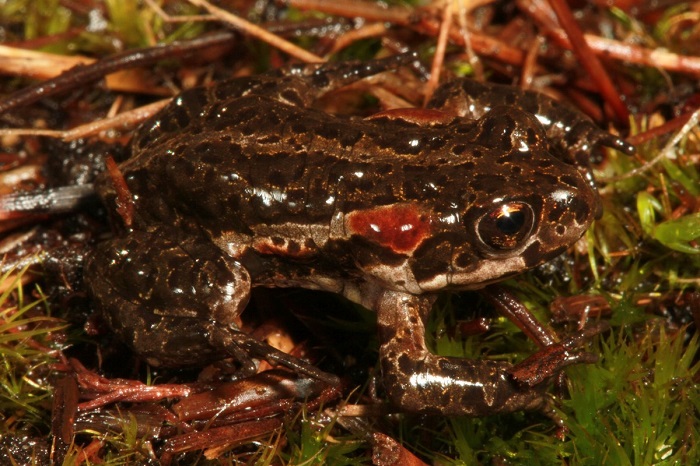
Cape Ghost FrogHeleophryne purcelli Paarl, Western Cape Photo by Luke Kemp
The female Cape Ghost Frog attains 56mm in length whilst males are a little smaller, reaching 47mm in length. The dorsal colour varies from yellowish-brown to bright green with reddish-brown blotching.
Habitat
The Cape Ghost Frog is restricted to Mountain Fynbos environments in the winter-rainfall region where annual rainfall is 600–3000 mm (Boycott 1982). It inhabits clear, swift-flowing, perennial mountain streams. The Cape Ghost Frog is often found in wooded or forested ravines and gorges where streams receive direct sunlight at midday.
Habitat in a forested ravine. Marloth Nature Reserve, Western Cape Photo by Ryan Tippett
Adults have been found under submerged rocks in streams, on wet rock faces, under mats of spongy moss and watergrass, in rock cracks, and in caves (Visser 1990). On one occasion, a frog was found clinging to the wall of the old Du Toit’s Kloof road tunnel (G. McLachlan pers. comm.). During the day adults sometimes sit in clear view at the bottom of pools. The tadpoles are found beneath submerged and partly submerged rocks in streams and rocky pools.
Cape Ghost FrogHeleophryne purcelli Drakenstein Mountains, Western Cape Photo by Pieter la Grange
Behaviour
During the winter non-breeding period, juvenile and adult frogs have been found sheltering under rocks a considerable distance (500 m) from the nearest river or stream. It appears that some individuals remain in the vicinity of breeding habitat while others disperse into surrounding habitats for part of the year. In August, in rainy conditions, numerous adult males and females were observed moving across tarred roads in the Franschhoek and Bain’s Kloof mountain passes, in many cases far from the nearest suitable breeding habitat. From these observations it appears that widely dispersed individuals will use wet, cool conditions towards the end of winter to return to their breeding habitat.
Cape Ghost FrogHeleophryne purcelli Bainskloof Pass, Western Cape Photo by Felicity Grundlingh
The Cape Ghost Frog breeds in early to mid-summer (October–January) when stream flow is reduced. Most calling takes place during the day, particularly in the late afternoon and at dusk, becoming sporadic after dark (Channing 2001; A. Turner pers. comm.). Males call mostly from rock cracks and crevices adjacent to waterfalls and cascades, but also from rocks on the riverbank or protruding from the stream, usually near small cascades and rapids.
During courtship, a male was observed to move in and out of the water calling rapidly all the while. When under the water, the calls were muffled but still audible from about 3 m away. The female approached in a zig-zag fashion extending her forelimbs to touch the male, who responded by touching the female. Male and female frogs extended their arms and rubbed each other on the dorsal and ventral surfaces of the head and touched each other’s forearms. In this species, the arms and head are covered in asperities. This behaviour has been witnessed on two occasions and it appears that touch may serve as an important recognition factor that leads to amplexus and egg laying. Before amplexus could be observed, the pair moved out of sight under a large boulder (Boycott 1988b; Visser 1990).
Cape Ghost FrogHeleophryne purcelli Bainskloof Pass, Western Cape Photo by Felicity Grundlingh
The eggs of the Cape Ghost Frog are large-yolked and yellow with a stiff jelly capsule. They are laid singly and may be scattered over a larger surface area than if they were clumped together. Clutches of 50–208 eggs are laid in exposed positions in small, quiet, shady pools adjacent to the main stream. In such situations there is usually a gentle flow of water into the pool from the main stream (Boycott 1972; Visser 1990). Channing (2001) noted that the eggs may also be laid out of the water in seepage zones, as in the Eastern Ghost Frog H. orientalis.
Tadpoles conceal themselves beneath stones on sandy substrates and, when disturbed, attempt to wriggle into the sand. They are eaten by the common Brown Water Snake Lycodonomorphus rufulus. Metamorphs leave the water during March and April (Boycott 1982).
Cape Ghost FrogHeleophryne purcelli Hottentots Holland Nature Reserve, Western Cape Photo by Walter Neser
Status and Conservation
The Cape Ghost Frog is not threatened. The species is widely distributed in the Western Cape mountains where most of its habitat enjoys some degree of protection. It occurs in several private and public protected areas.
Cape Ghost FrogHeleophryne purcelli Hottentots Holland Nature Reserve, Western Cape Photo by Eloise Costandius
Distribution
The Cape Ghost Frog is endemic to the Western Cape Province of South Africa, occurring throughout the inland mountain ranges from the Cederberg in the north (3218BB, 3219AA), southward to the Hex River, Du Toit’s Kloof, Hottentots Holland and Klein River mountains (3419AD), and eastward along the Riviersonderend and Langeberg mountains to the vicinity of Ashton and Montagu (3320CC). The recorded altitudinal range is 60–1770 m.
Distribution of the Cape Ghost FrogHeleophryne purcelli. Taken from the FrogMAP database, April 2022.
The atlas records are reliable, with the caveat that a number of records are based solely on tadpoles. In the vicinity of Ashton and Montagu, the eastern limits of H.purcelli and the western limits of H. orientalis are yet to be determined.
Further Resources
The use of photographs by Eloise Costandius, Felicity Grundlingh, Luke Kemp, Pieter La Grange, and Walter Neser is acknowledged. Other images by Ryan Tippett.
Cape Ghost FrogHeleophryne purcelliSclater, 1898
Other Common Names: Purcell’s Ghost Frog (Alt. English); Kaapse Spookpadda (Afrikaans).
Recommended citation format: Boycott, RC; Tippett, RM. (2025). Cape Ghost Frog Heleophryne purcelli. Biodiversity and Development Institute, Cape Town. Available online at https://thebdi.org/2021/12/20/cape-ghost-frog-heleophryne-purcelli/
This species text has been updated and expanded from the text in the 2004 frog atlas: Booysen, RC. (2004). Cape Ghost Frog Heleophryne purcelli. In Minter LR et al 2004.
References:
Minter, LR; Burger, M; Harrison, JA; Braack, HH; Bishop, PJ; Kloepfer, D. (Editors). (2004). Atlas and Red Data Book of the Frogs of South Africa, Lesotho and Swaziland. Smithsonian Institution, Washington, and Avian Demography Unit, Cape Town.
Carruthers, V; du Preez, L. (2017). Frogs of southern Africa: A Complete Guide. Struik Nature, Cape Town.
Channing, A. (2001) Amphibians of Central and Southern Africa. Protea Book House, Pretoria
Claus, B; Claus, R. (2002). Common Amphibians and Reptiles of Botswana. Gamsberg Macmillan, Windhoek.
View the above photo record (by Tyrone Ping) in FrogMAPhere.
Find the Natal Cascade Frog in the FBIS database (Freshwater Biodiversity Information System) here.
Family Heleophrynidae
NATAL CASCADE FROG – Hadromophryne natalensis
Hewitt, 1913
Habitat
H. natalensis inhabits clear, swift-flowing streams in mountainous terrain; these waters flow through wooded and forested habitat and have headwaters in montane grassland. Annual rainfall in these habitats is 800–2700 mm. Adults often frequent waterfalls and cascades, where they may be found beneath submerged rocks, in rock cracks, in caves, or sometimes in exposed positions on wet rock faces. Tadpoles live on rocky substrates in swift-flowing streams; when disturbed they take cover beneath rocks or in cracks (Boycott in prep.).
This species occupies both Forest and Grassland biomes. Vegetation types include Afromontane Forest, Wet Cold Highveld Grassland, Moist Upland Grassland, North-eastern Mountain Grassland, Afro Mountain Grassland and Short Mistbelt Grassland.
Behaviour
Young frogs have been collected under stones and on moss covered boulders in shallow headwater streams in May and August in the Woodbush Forest and the Wonderwoud. Three adult female specimens were found in a wet rocky recess at the base of a waterfall in October in Malolotja Nature Reserve, Swaziland. These observations indicate that at least some individuals in the population remain in the vicinity of the breeding habitat after the presumed breeding period has passed. In the KwaZulu-Natal Drakensberg, adults were found in a soil pit and in a hole in a road cutting in grassland, some distance from the nearest streams and forests (Bourquin and Channing 1980; Channing 2001).
Breeding usually takes place in late summer (March–May) when stream flow is reduced, and before winter temperatures become severe (pers. obs.). Males usually call from hidden sites beneath clusters of boulders in stream beds, under the roots of large trees growing in streams, amongst boulders that have created a cascade of rushing water, in rock cracks and crevices in waterfalls, and on cliff faces and rocks located close to waterfalls and cascades. The species has not been heard calling while submerged and males do not call in close proximity to one another, even during peak breeding periods (Boycott in prep.).
The eggs and oviposition sites of H. natalensis have not been described, but it is unlikely that its breeding biology differs greatly from that of the related Heleophryne species.
The forested ravines and high altitude montane grasslands, which are the natural habitat of H. natalensis, are mostly protected within remote wilderness areas. However, afforestation with exotic trees, particularly in Mpumalanga and Limpopo provinces, has substantially reduced the non-breeding habitat and caused perennial streams to dry up, effectively eliminating entire breeding populations in the process (L.R. Minter pers. obs.). Additional threats to certain isolated populations comprise the damming of mountain rivers as has occurred in the Lesotho Highlands Project, water extraction and the introduction of alien fish species into the habitat. Nonetheless, owing to the wide distribution of this species, it is not considered to be a conservation priority. It occurs in several private and public protected areas, including Ukahlamba-Drakensberg Park, a World Heritage Site.
H. natalensis is endemic to the atlas region. It occurs throughout the Drakensberg and Maluti mountains and along the great escarpment of South Africa, Swaziland and Lesotho. The recorded altitudinal range is 580–2675 m (Boycott in prep.).
The atlas records are reliable but incomplete, especially for most of Lesotho. This species should be easy to detect since the tadpoles are easily identified and are present in streams throughout the year. Channing (2001) expressed the opinion that this taxon contains a number of cryptic species and that field and laboratory investigations should be undertaken to explore this possibility.
Distribution of Hadromophryne natalensis. Taken from the FrogMAP database, April 2022.
Further Resources
Virtual Museum (FrogMAP > Search VM > By Scientific or Common Name)
More common names: Natal Ghost Frog (Alternative English Name); Natalse Snelstroompadda (Afrikaans)
Recommended citation format for this species text:
Boycott RC, Tippett RM. Natal Cascade Frog Hadromophryne natalensis. BDI, Cape Town. Available online at http://thebdi.org/2021/12/20/natal-cascade-frog-hadromophryne-natalensis/
Recommended citation format:
This species text has been updated and expanded from the text in the 2004 frog atlas. The reference to the text and the book are as follows:
Boycott RC 2004 Hadromophryne natalensis Natal Cascade Frog. In Minter LR et al 2004.
Minter LR, Burger M, Harrison JA, Braack HH, Bishop PJ, Kloepfer D (eds) 2004. Atlas and Red Data Book of the Frogs of South Africa, Lesotho and Swaziland. Smithsonian Institution, Washington, and Avian Demography Unit, Cape Town.
Find the Rose’s MountainToadlet in the FBIS database (Freshwater Biodiversity Information System) here.
Family Bufonidae
Identification
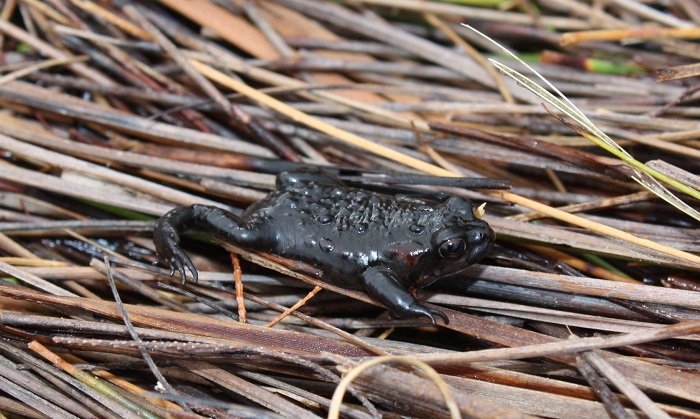
Rose’s Mountain Toadlet is a small Bufonid with an elongated body that reaches a length of c.28 mm in males and 39 mm in females (Channing 2001). The dorsum is smooth and soft with scattered blister-like ridges and warts on the back and sides, while the posterior region of the ventrum has heavily granulated skin (Passmore and Carruthers 1995). The pupil is horizontally elliptical. Interestingly, this species lacks external or middle-ear structures (Grandison 1980) and apparently has no advertisement call. The parotid glands are distinct and have an inverted pear shape (when viewed from the rear). There is no webbing between the toes, and the hind limbs are relatively short and better adapted for walking and running than for jumping (Poynton 1964; Wager 1965).
The upper body surface is variably shaded in grey to brown, interspersed with darker spots and blotches. A light vertebral stripe or band and a pair of light dorsolateral bands are usually present. The parotid glands are generally orange to red and markings of the same colour may be present elsewhere on the upper body surface. The underside is white with variable grey shading and some darker markings may be present. These frogs often take on a uniformly blackish appearance when in dark surroundings.
Rose’s Mountain Toadlet most resembles C. magistratus and C. selenophos as these species also lack a tympanum and external or middle-ear structures. Two other Capensibufo species, namely, C. deceptus and C. tradouwi are also similar, but they posess a tympanum and produce advertisement calls (See ‘Similar Species’ below).
Rose’s Mountain Toadlet Capensibufo rosei Silvermine, Western Cape Photo by Luke Kemp
Habitat
Rose’s Mountain Toadlet is restricted to mountains where it occurs in undisturbed Mountain Fynbos. Although it is usually associated with the generally flatter topography on mountain tops, C. rosei has also been recorded from low-lying plateaus on the southern Cape Peninsula.
Breeding takes place in small, shallow, temporary pools of standing water that form during the winter rainy season. The pools can vary in size from c.20 × 20 × 2 cm deep to 250 × 150 × 6 cm deep. The vegetation surrounding breeding pools is usually dominated by restios. Pool substrates generally consist of a dark humic (peaty) or mossy layer on a sandy or rocky base and vary from light grey to almost black depending on the humic content. A breeding site can consist of one or more small pools in a seepage area of, for example, 100 m2. The species is not known to breed in pools of moving water associated with mountain streams.
Behaviour
Rose’s Mountain Toadlet has been seen in all four seasons of the year, but breeds only in late winter and spring. The commencement of breeding is dependent on rainfall and the formation of small, shallow pools of water. There are relatively few published records of C. rosei breeding activity. Spawn has been found in late July to early October.
An unusual characteristic of Capensibufo rosei is the absence of middle-ear elements (Grandison 1980), and it along with C. magistratus and C. selenophos appear to be the only southern African amphibians that lack a voice. Large, dense breeding aggregations and repeated use of the same site may facilitate meeting of the sexes. For example, at least 150–200 adults (and spawn) were observed in a partially divided breeding pool with overall dimensions of 250 × 150 cm and up to 6 cm deep (pers. obs.). (A similar observation was made by Power and Rose, who also described the eggs, tadpoles and metamorphosis of C. rosei (Rose 1962). During the breeding season, a bright pink, oval patch appears below the vent in both sexes (Power and Rose 1929), and a distinct swelling develops in the cloacal region in breeding males. The functions of these structures are not known.
These toads appear to be particular in their choice of breeding site. They have been found to use the same site on a few occasions during a breeding season, despite the presence of other similar small pools in the general vicinity (pers. obs.; southern Cape Peninsula).
The large, pigmented eggs are laid in a single transparent jelly tube that resembles a string of beads in that there is a distinct narrowing of the tube between the egg capsules (Power and Rose 1929). The clutch size is reported to be <100 eggs (Grandison 1980) but the typically dense breeding aggregations can lead to the deposition of thousands of eggs in a single pool. Adults in the breeding pool sometimes hide under the egg masses when disturbed.
The embryos take up to 12 days to leave the egg capsules. The tadpoles are dark in colour and attain a length of about 21 mm, of which more than half comprises the tail. They are benthic in habit, and have been observed feeding on egg capsules, decaying eggs and dead adults. Metamorphosis takes about six weeks, depending on temperature and the availability of food and water. The tiny toads are about 6.25 mm in length when they leave the water.
The predators and prey of this species have not been recorded.
Rose’s Mountain Toadlet Capensibufo rosei Silvermine, Western Cape Photo by Felicity Grundlingh
Status and Conservation
Status
C. rosei was previously listed as Restricted (Branch 1988) and is presently listed as Vulnerable (Harrison et al. 2001; this publication). It is legally protected by Nature Conservation Ordinance 19 of 1974, but is not listed by CITES.
Rose’s Mountain Toadlethas a restricted and fragmented distribution comprising about six subpopulations (sensu IUCN criteria). While most C. rosei habitat is situated in pristine mountain areas, habitat degradation has led to <20% habitat loss over the last 30 years. However, in some areas, the quality of C. rosei habitat is likely to have improved with systematic alien vegetation control programmes. For example, the previously degraded habitat of C. rosei in the Silvermine area on the Cape Peninsula (Boycott 1988e) now falls within Cape Peninsula National Park, and the pine plantations and dense stands of alien vegetation have been removed.
C. rosei is known to occur in the following protected areas: Cape Peninsula National Park (including the former Silvermine Nature Reserve and Cape of Good Hope Nature Reserve), Hottentots Holland, Kogelberg, Fernkloof, Maanschynkop, Vogelgat, Limietberg and Riviersonderend nature reserves.
Threats
In some places, one or more of the following factors have led to degradation or loss of habitat, or are a potential threat to populations of C. rosei. These include invasive alien vegetation, plantations, wildflower farming, alteration of drainage patterns, too frequent fires, building developments such as roads and dams, and urban development on the southern Cape Peninsula. The most pressing of these threats is probably the spread of invasive alien vegetation that eliminates fynbos vegetation and reduces water resources.
The tendency of C. rosei to form dense breeding aggregations at specific sites increases its vulnerability, since the destruction or degradation of a breeding site seriously threatens the continued existence of that local population.
Amphibian declines in some parts of the world have taken place in pristine, high-altitude areas, and this has led to speculation supported by some scientific evidence that global environmental factors are responsible (Beebee 1997). In particular, climatic and atmospheric changes brought about by widespread atmospheric pollution, increased ultraviolet radiation and global warming appear to be the prime causes. These factors may also lower amphibians’ resistance to disease. There is no evidence, at present, that global factors have caused declines in southern African amphibian populations, but such threats may be significant.
Recommended conservation actions
The distribution and conservation status of C. rosei is monitored by the Western Cape Nature Conservation Board (De Villiers 1997a) as part of a threatened species monitoring programme. This helps ensure that appropriate recommendations can be made to promote the conservation and wise management of this species and its habitat. Management of C. rosei habitat is included in the management plans of the respective protected areas and mainly concerns the control of invasive alien vegetation.
Research is underway to investigate the genetic relationships between the various geographically fragmented subpopulations of C. rosei. Life history studies of this species are also in progress. A captive breeding programme for C. rosei is not recommended.
Distribution
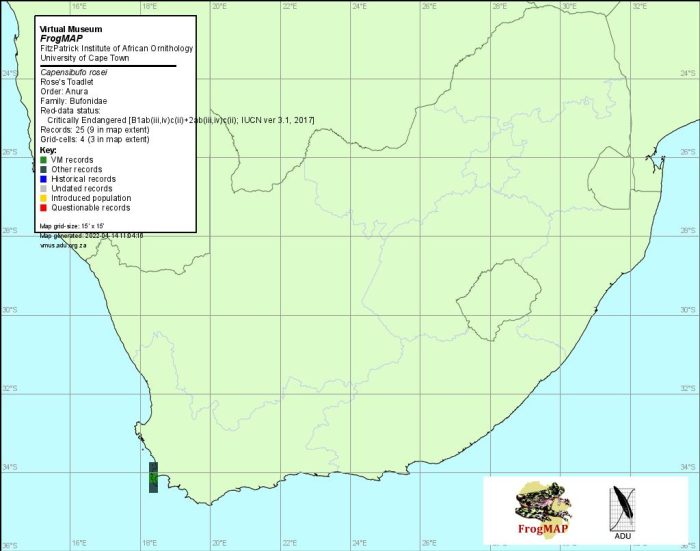
Rose’s Mountain Toadlet is endemic to the winter-rainfall region of the Western Cape Province. It has a limited and patchy distribution. Its populations are restricted to the Cape Peninsula and mountains southwest of the Breede River valley, which extends from the Tulbagh/Worcester valley south-eastward to Witsand on the south coast, and the Nuwekloof gap that separates the Bain’s Kloof Mountains from the mountains to the north (Grandison 1980). Recorded localities vary in altitude from 60 m on the southern Cape Peninsula to 1600 m, although >80% of localities are above 400 m. The areas in which this species occurs receive 600–>3000 mm of rain per annum.
Distribution of Capensibufo rosei. Taken from the FrogMap database, April 2022.
The Rose’s Mountain Toadlet was discovered on the Cape Peninsula (Hewitt 1926a), where it is known from the following localities: Table Mountain (3318CD), Muizenberg Mountain (type locality), Kalk Bay Mountain, Silvermine Valley, Chapman’s Peak and Kommetjie area (all in 3418AB), and Cape of Good Hope area (3418AD). However, the main part of its distribution range lies elsewhere, and includes the following localities: Bailey’s Peak in Limietberge Mountains (a.k.a. Bain’s Kloof Mountains) and Hawekwa Mountains (3319CA), Riviersonderend Mountains (3419BB) including Jonaskop (3319CD) and Kanonberg (3419BA), Klein River Mountains (3419AD), Jakkals River catchment area, Nuweberg Mountain near Viljoen’s Pass, Groenlandberge Mountains, Landdroskop in the Hottentots Holland Mountains (all in 3419AA), Elgin Forest Reserve, and Kogelberg State Forest (3418BB).
Capensibufo rosei has a geographically fragmented distribution pattern that, based on current knowledge, appears to comprise six populations: Table Mountain, southern Cape Peninsula, Hottentots Holland/Kogelberg mountain complex, Dutoitsberge/Limietberge mountain complex, Riviersonderend Mountains, and Klein River Mountains.
In summary, C. rosei has been found in a total of 10 quarter-degree grid cells, all of which were recorded for the first time before 1990. However, since 1996 the species has been recorded in only five of these cells: 3418AB, 3418AD, 3319CA, 3419AA and 3419AD. Most of the latter records were obtained in 2000 during a threatened frog monitoring programme (De Villiers 1997a).
This small, cryptic toad is difficult to find in its remote montane habitat. However, the distribution data are accurate and it is unlikely that the limits of the species’ range will be extended by further surveys.
Further Resources
The use of photographs by Felicity Grundlingh, Luke Kemp, and Megan Loftie Eaton is acknowledged.
Other Common Names: Gestreepte Skurwepadda (Afrikaans)
Recommended citation format: de Villiers, AL; Tippett, RM. (2025). Rose’s Mountain ToadletCapensibufo rosei. Biodiversity and Development Institute, Cape Town. Available online at https://thebdi.org/2021/12/20/roses-mountain-toadlet-capensibufo-rosei/
This species text has been updated and expanded from the text in the 2004 frog atlas: de Villiers, AL. (2004). Rose’s Mountain Toadlet Capensibufo rosei. In Minter LR et al 2004.
References:
Minter, LR; Burger, M; Harrison, JA; Braack, HH; Bishop, PJ; Kloepfer, D. (Editors). (2004). Atlas and Red Data Book of the Frogs of South Africa, Lesotho and Swaziland. Smithsonian Institution, Washington, and Avian Demography Unit, Cape Town.
Carruthers, V; du Preez, L. (2017). Frogs of southern Africa: A Complete Guide. Struik Nature, Cape Town.
Channing, A. (2001) Amphibians of Central and Southern Africa. Protea Book House, Pretoria