

Cover photo by Richard Johnstone.
Find the Little Skimmer in the FBIS database (Freshwater Biodiversity Information System) here.
Family Libellulidae
Identification

Eastern Shores, iSimangaliso Wetland Park – KwaZulu-Natal
Photo by Ryan Tippett
Small size
Length up to 38mm; Wingspan attains 60mm.
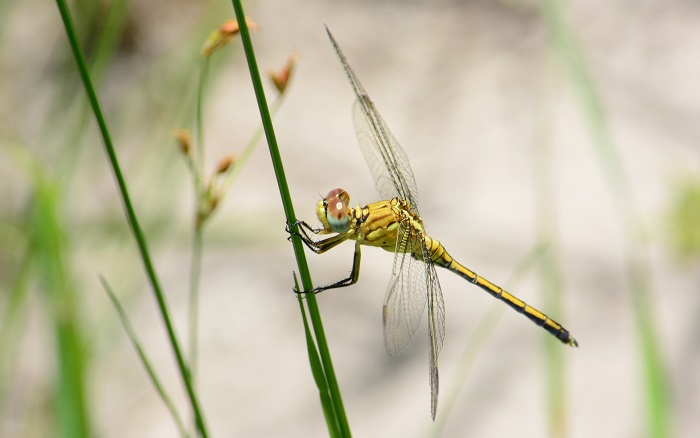
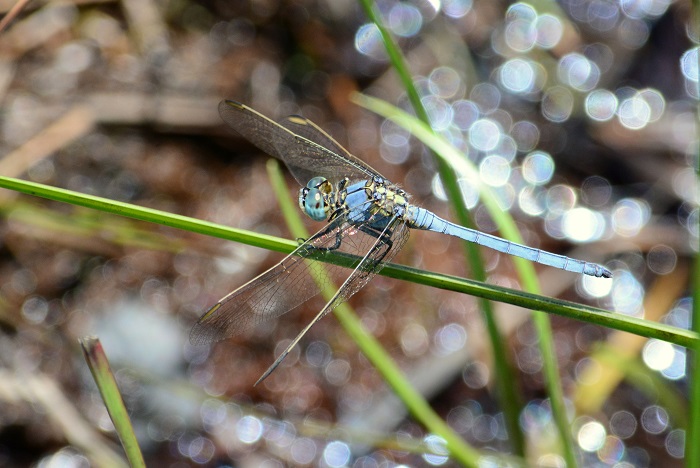
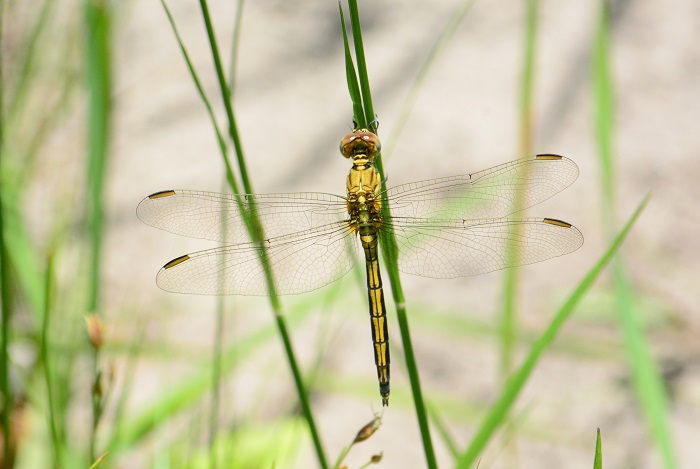
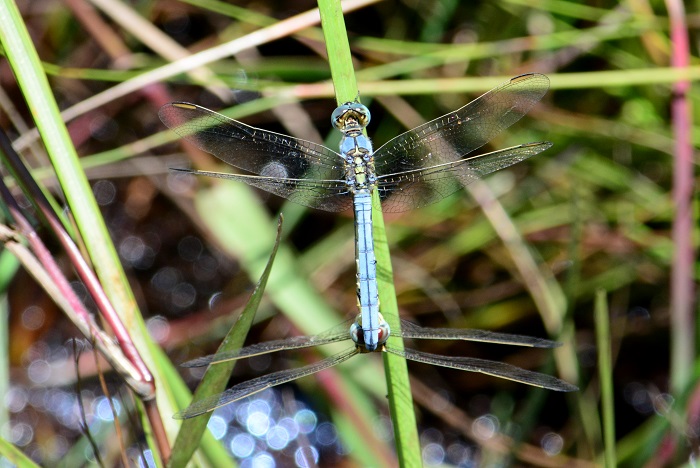
The Little Skimmer is the smallest Orthetrum species in the region. In males the combination of small size, long, yellow pterostigmas, and indistinct ‘spectacles’ on the face is often enough for an identification. However, fully pruinose males are similar to those of several other Orthetrum species. They are best identified by the distinct shape of their secondary genitalia. The Little Skimmer most resembles Orthetrum hintzi (Dark-shouldered Skimmer), which is slightly larger.
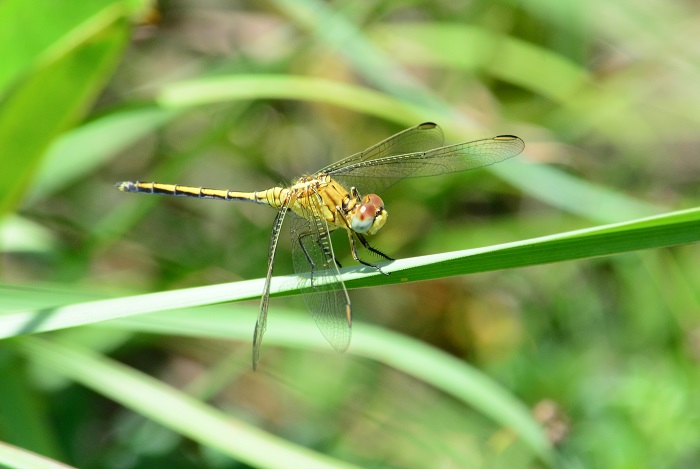
Females and immature males can be recognised by the long, yellow pterostigmas and plain, mostly unmarked thorax sides.
Click here for more details on identification of the Little Skimmer.
Eastern Shores, iSimangaliso Wetland Park – KwaZulu-Natal
Photo by Ryan Tippett
Habitat
The Little Skimmer inhabits boggy ground associated with marshes and seeps. It is also found at marshy pools adjoining streams. The Little Skimmer favours sites that are rich in emergent sedge and grasses. It is mostly found in fairly open grassland habitats. The Little Skimmer occurs from the coast up to 1800m above sea level.

Photo by Ryan Tippett
Behaviour
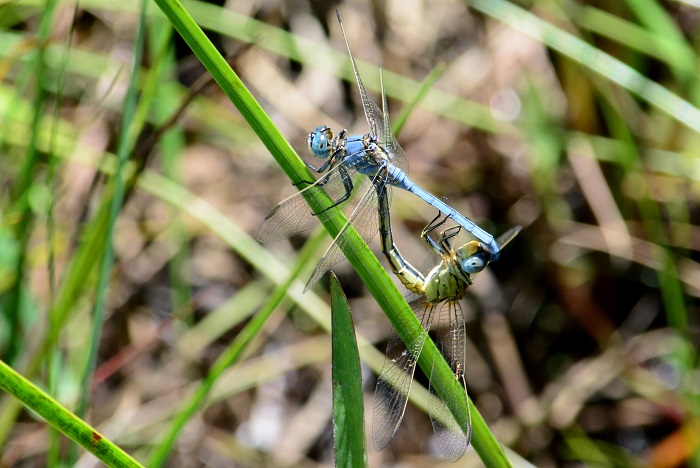
The Little Skimmer hunts from a perch and usually returns to the same grass or sedge stem. The flight is fairly slow and weak. It is usually quite confiding and generally reluctant to fly.
The Little Skimmer flies from November to April.
Eastern Shores, iSimangaliso Wetland Park – KwaZulu-Natal
Photo by Ryan Tippett
Status and Conservation
The Little Skimmer is locally common in South Africa. It is listed as of Least Concern in the IUCN Red List of Threatened Species. It is primarily found in natural habitats.
Eastern Shores, iSimangaliso Wetland Park – KwaZulu-Natal
Photo by Ryan Tippett
Distribution
The Little Skimmer is found throughout most of Sub-Saharan Africa. It also occurs in parts of the Middle-East and on Madagascar.
In South Africa it is found mainly in the Eastern and Central areas with localised populations in parts of the Eastern and Western Cape provinces. It is more common inland than along the coast.
Eastern Shores, iSimangaliso Wetland Park – KwaZulu-Natal
Photo by Ryan Tippett
Below is a map showing the distribution of records for Little Skimmer in the OdonataMAP database as at February 2020.

Below is a map showing the distribution of records for Little Skimmer in the OdonataMAP database as of December 2024.
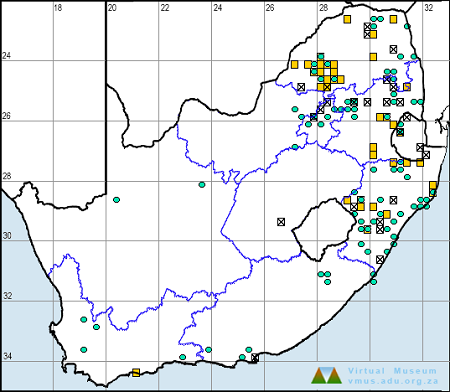
The next map below is an imputed map, produced by an interpolation algorithm, which attempts to generate a full distribution map from the partial information in the map above. This map will be improved by the submission of records to the OdonataMAP section of the Virtual Museum.


Ultimately, we will produce a series of maps for all the odonata species in the region. The current algorithm is a new algorithm. The objective is mainly to produce “smoothed” maps that could go into a field guide for odonata. This basic version of the algorithm (as mapped above) does not make use of “explanatory variables” (e.g. altitude, terrain roughness, presence of freshwater — we will be producing maps that take these variables into account soon). Currently, it only makes use of the OdonataMAP records for the species being mapped, as well as all the other records of all other species. The basic maps are “optimistic” and will generally show ranges to be larger than what they probably are.
These maps use the data in the OdonataMAP section of the Virtual Museum, and also the database assembled by the previous JRS funded project, which was led by Professor Michael Samways and Dr KD Dijkstra.
Eastern Shores, iSimangaliso Wetland Park – KwaZulu-Natal
Photo by Ryan Tippett
Further Resources
The use of photographs by Richard Johnstone is acknowledged. All other photographs by Ryan Tippett.
Little Skimmer Orthetrum abbotti Calvert, 1892
Other common names: Kleinskepper (Afrikaans)
Recommended citation format: Loftie-Eaton M; Navarro R; Tippett RM; Underhill L. 2025. Little Skimmer Orthetrum abbotti. Biodiversity and Development Institute. Available online at https://thebdi.org/2020/06/19/little-skimmer-orthetrum-abbotti/
References: Tarboton, M; Tarboton, W. (2019). A Guide to the Dragonflies & Damselflies of South Africa. Struik Nature.
Samways, MJ. (2008). Dragonflies and Damselflies of South Africa. Pensoft
Samways, MJ. (2016). Manual of Freshwater Assessment for South Africa: Dragonfly Biotic Index. Suricata 2. South African National Biodiversity Institute, Pretoria
Martens, A; Suhling, F. (2007). Dragonflies and Damselflies of Namibia. Gamsberg Macmillan.
Eastern Shores, iSimangaliso Wetland Park – KwaZulu-Natal
Photo by Ryan Tippett