
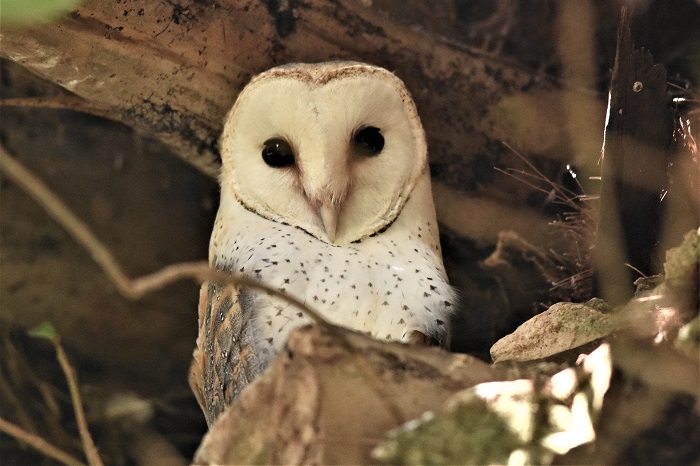
Cover image of Western Barn Owl by Gerald Wingate – Berg River Estuary, Western Cape
The Western Barn Owl belongs to the family TYTONIDAE. This family includes the Barn Owls, Bay Owls, and Grass Owls. Tytonidae is one of the two families of owls, the other being the typical owls, Strigidae. Tytonidae differ from the Strigidae in structural details, particularly relating to the sternum and feet. The Tytonidae are medium to large owls with large heads and characteristic heart-shaped faces. They have long, strong legs with powerful talons. They live in a wide range of habitats from semi-deserts to forests, and from temperate latitudes to the tropics. The family comprises 20 species from 2 genera. 2 species are found in southern Africa.
Identification
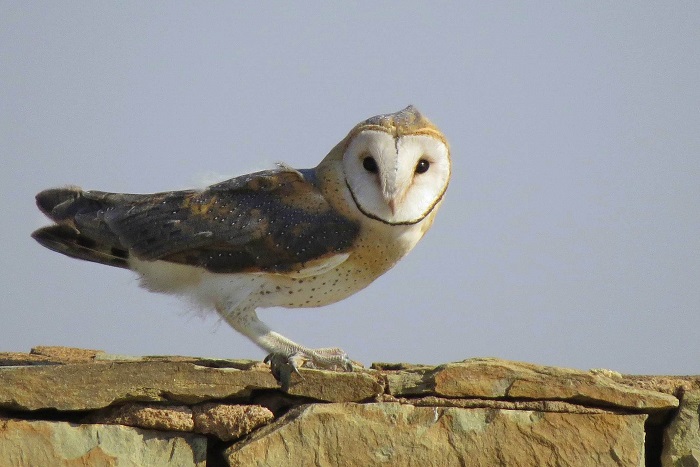
Hanover district, Northern Cape
Photo by Tino Herselman
The Adult Western Barn Owl has a white heart-shaped facial disc and a relatively large head. The upper parts are golden-brown and grey, with fine black-and-white spots. The underparts and upper legs are entirely buff-white with small black spots. The bill is pale pink. The eyes are blackish-brown, appearing somewhat small for an owl. The legs and feet are greyish-brown. In flight, the brown upper parts contrast with the pale underparts, and the tail is noticeably short and obscured from below by the large feet. The sexes are similar in plumage colouration, but females are often slightly darker than males and more spotted below. The Western Barn Owl has a distinctly upright stance, on long, slender legs.
Juveniles resemble adults, but are slightly darker above and more buff-coloured below.
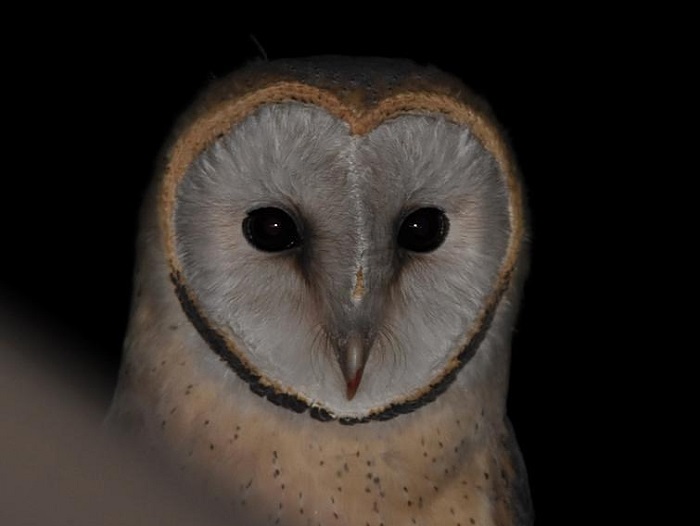
Bloemfontein, Free State
Photo by Rick Nuttall
In some regions, the Western Barn Owl overlaps with the larger and darker African Grass Owl (Tyto capensis). The latter has dark brown upperparts with fine white spots, not golden-brown and grey with black-and-white spots.
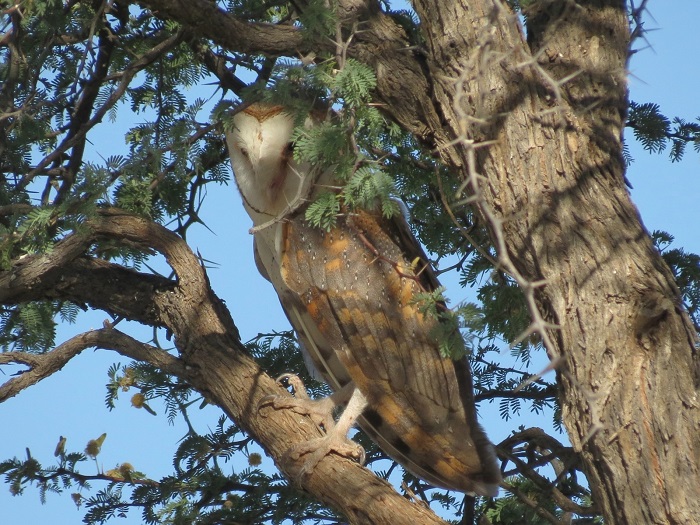
Kgalagadi Transfrontier Park, Northern Cape
Photo by Andre Kok
Status and Distribution
The Western Barn Owl has a cosmopolitan distribution; it occurs on all continents, except Antarctica, and is also found on many of the world’s islands. It is widespread in southern Africa and is found virtually throughout the subregion.
The abundance of the Western Barn Owl has been little studied in southern Africa. It is prone to considerable fluctuations in population size between years due to variable productivity linked to the availability of food.
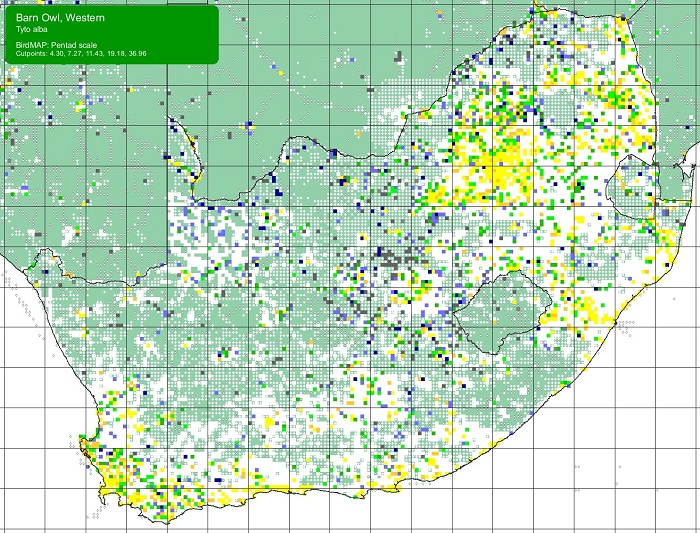
The Western Barn Owl is not threatened. It is mostly common across its large range, from suburbia to large wilderness conservation areas.
Occasional victim of accidental poisoning from eating contaminated rodents.
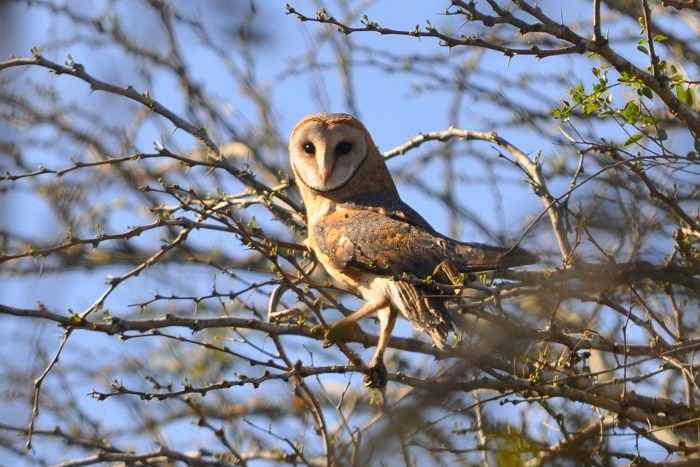
Kuleni Game Park, KwaZulu-Natal
Photo by Ryan Tippett
Habitat
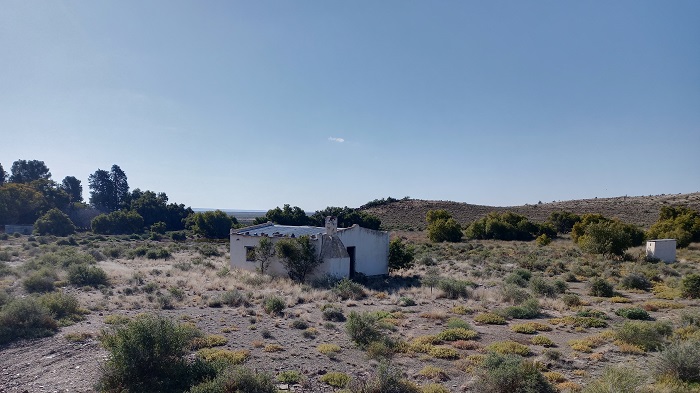
Carnarvon district, Northern Cape
Photo by Ryan Tippett
The Western Barn Owl occupies almost any habitat with abundant food and suitable roosting and nesting sites, from desert to forest fringes. It generally prefers open habitats, including lightly wooded savanna, grasslands, and farmland. Nomadism and annual fluctuations in numbers make assessment of its true habitat preferences difficult.
Frequently in association with humans; urban, suburban and rural.
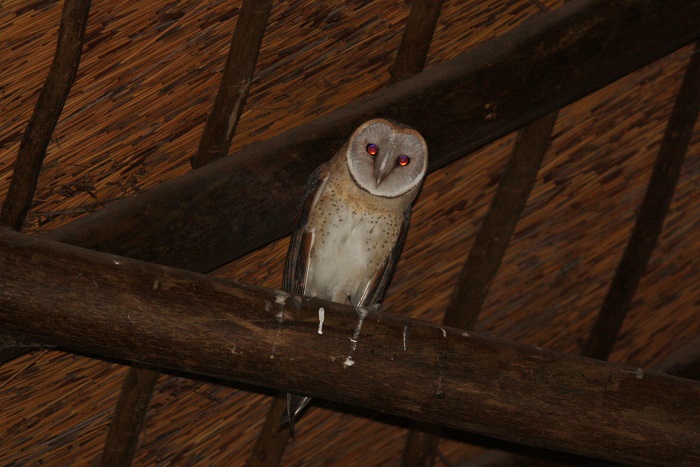
Hazyview, Mpumalanga
Photo by Marius Meiring
Behaviour
In southern Africa, the Western Barn Owl is resident and sedentary when its food supply is stable. Rodents are its main prey, but rodent populations are prone to wide fluctuations in abundance, especially in arid areas. Therefore, in many areas, all or most of the Western Barn Owl population is nomadic. No regular movements are known, but extensive dispersal of juveniles is indicated by ringing returns over at least 579 km, as well as records at sea.
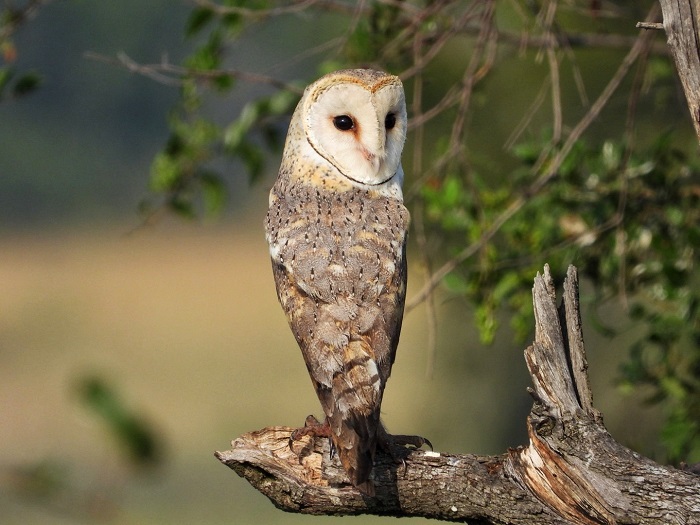
Nylsvlei Nature Reserve, Limpopo
Photo by Joanne Putter
The Western Barn Owl roosts by day, most often in a cavity, or sometimes perched among dense foliage. They occasionally roost solitarily, but pairs usually roost together. It prefers secluded caves, crevices, tree holes, Hamerkop and Sociable Weaver nests, mine shafts, and eroded dumps, or buildings. Roost sites are easily recognisable by the accumulation of regurgitated pellets outside or on the roost floor. If disturbed at the roost, the Western Barn Owl either weaves its head from side to side and hisses, or draws itself erect with eyes narrowed into slits.
Western Barn Owls emerge in darkness, shortly after dusk. They are rarely diurnal. After foraging, they may fly around, giving their distinctive territorial screech, or they might sit at a favourite perch to preen.
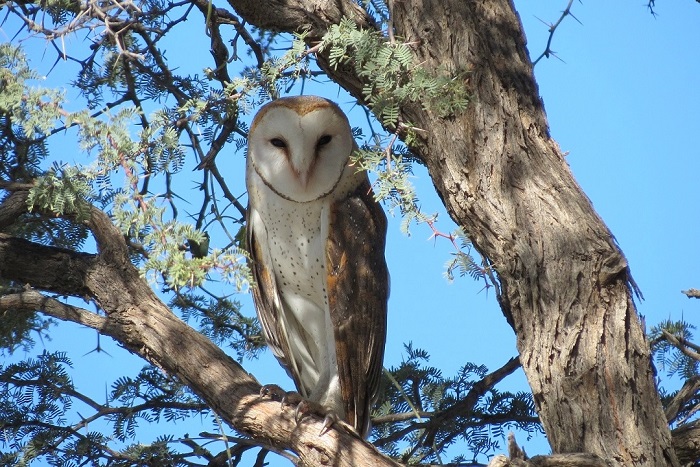
Kgalagadi Transfrontier Park, Northern Cape
Photo by Lance Robinson
The Western Barn Owl hunts most actively as soon as darkness falls, ranging at least 2-16 km from the nest or roost area. It hunts from low perches or, most often, in silent flight, and rarely hunts from the ground. Courses slowly over vegetation, flapping, gliding and occasionally hovering, with face directed downwards to look and listen for prey. Usually drops feet-first onto prey and sometimes pursues birds in flight. The Western Barn Owl is known to snatch sleeping birds from their roosts and also raids nests. Prey is killed with a bite to the hind neck, or by squeezing with the powerful feet.
The diet of the Western Barn Owl has been well studied by analysing the contents of regurgitated pellets.
Prey ranges in size from hares and young francolin down to termites. The Western Barn Owl, however, eats mostly rodents, which constitute up to 97% of its diet. The balance is largely made up of shrews and birds. In urban areas, small birds may dominate the diet, and in deserts, geckos and scorpions. On occasion, they have been known to eat bats, frogs and lizards. The Western Barn Owl eats mostly mammals in winter, supplemented by birds and insects in summer. After eating, indigestible bones and hair are regurgitated as a large, dark pellet.
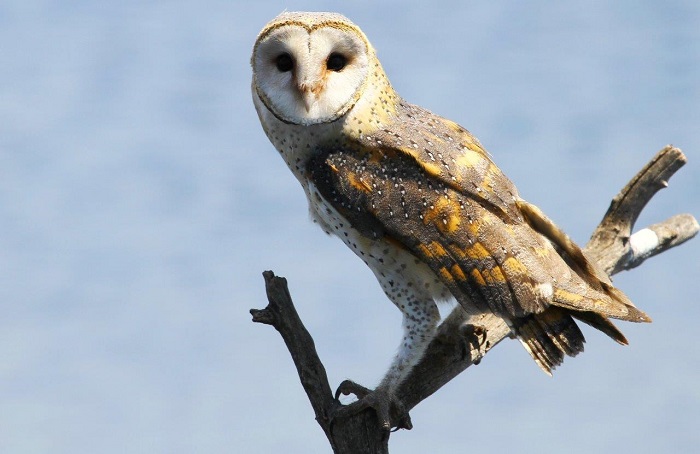
Marievale Bird Sanctuary, Gauteng
Photo by Mark Stanton
The Western Barn Owl is monogamous and territorial. Pairs nest solitarily, but nests can be as close as 50 m apart in ‘boom’ years. Before egg laying, Western Barn Owl pairs become increasingly vocal and territorial, and the frequency of allopreening increases. Documented courtship behaviour includes aerial chases and the male’s courtship feeding of the female.
Western Barn Owls do not build a true nest but rather scrape a shallow depression on the nest cavity floor. They nest in a variety of cavities above or below the ground, among rocks or in tree holes, large nest masses (especially of Hamerkop), mine shafts and dumps, or buildings. The nest site is usually used repeatedly over long periods.
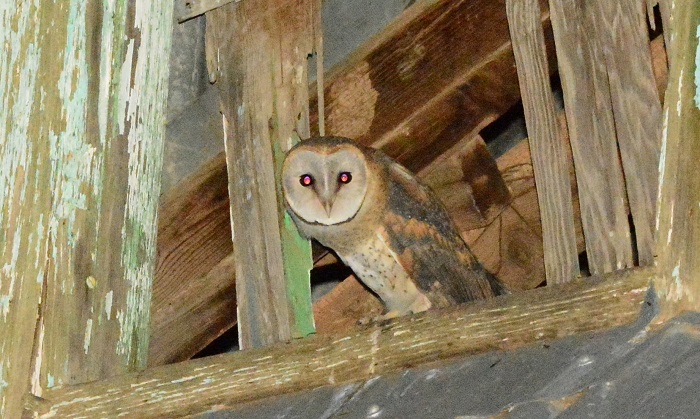
Carnarvon district, Northern Cape
Photo by Ryan Tippett
Eggs are laid year-round, with a peak from February to May across most of southern Africa. However, egg-laying is normally earlier, from August to December in the winter-rainfall region. 2 to 13 eggs are typically laid per clutch, but up to 19 eggs may be laid in ‘boom’ years. Eggs are laid at 1-to-3-day intervals. They are white and rounded-oval in shape.
Incubation starts with the first egg laid and lasts for 29 to 34 days. The female does all the incubation but is fed at the nest by the male, only rarely hunting for herself. In large and successive broods, chicks may inadvertently help in incubation. Eggs hatch asynchronously in the sequence laid. The young are altricial and the eyes first open after 8 to 14 days. They are brooded and fed by the female on food delivered by the male. Occasionally, older nestlings feed their younger siblings, but when food is scarce, older nestlings may kill younger ones. At around 30 days old the hatchlings begin to emit noisy begging calls, and the female starts to assist in prey delivery, leaving the chicks alone in the nest.
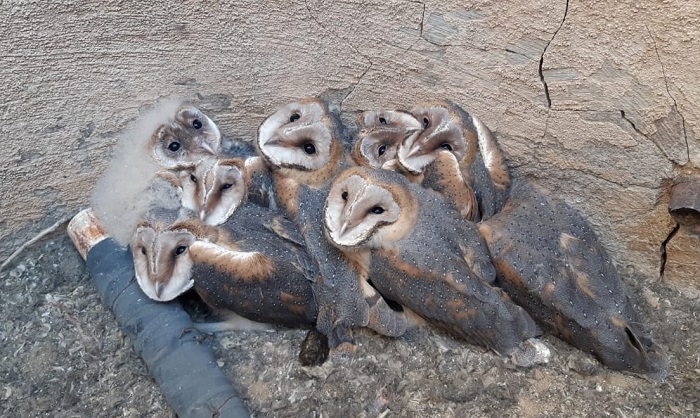
Carnarvon district, Northern Cape
Photo by F.A. Vermeulen
The nestling period lasts up to 55 days, but less if food is abundant. The female and a brood of 4 chicks require about 34 kg of food by the time the chicks fledge. This roughly equates to 1700 rodents! Juveniles often return to the nest for at least the first week after fledging. They learn to catch their own prey within 1 month of fledging.
The breeding success of the Western Barn Owl is highly variable from year to year, even for resident pairs. Broods of 8 to 10 are often raised in good seasons. The owls can achieve very high provisioning rates and productivity during rodent plagues, but many nestlings may starve if the plague ends before breeding is completed.
Further Resources
This page is adapted from the species text in the First Southern African Bird Atlas Project (SABAP1), 1997.
The use of photographs by F.A. Vermeulen, Lance Robinson, Mark Stanton, and Ryan Tippett is acknowledged.
Virtual Museum (BirdPix > Search VM > By Scientific or Common Name).
Other common names: Kleinheuningwyser (Afrikaans); iNhlava (Zulu); Intakobusi (Xhosa); Kleine Honingspeurder (Dutch); Petit Indicateur (French); Kleiner Honiganzeiger (German); Indicador-pequeno (Portuguese).
List of species available in this format.
Recommended citation format: Tippett RM 2026. Western Barn Owl Tyto alba. Biodiversity and Development Institute. Available online at https://thebdi.org/2026/09/07/western-barn-owl-tyto-alba/
