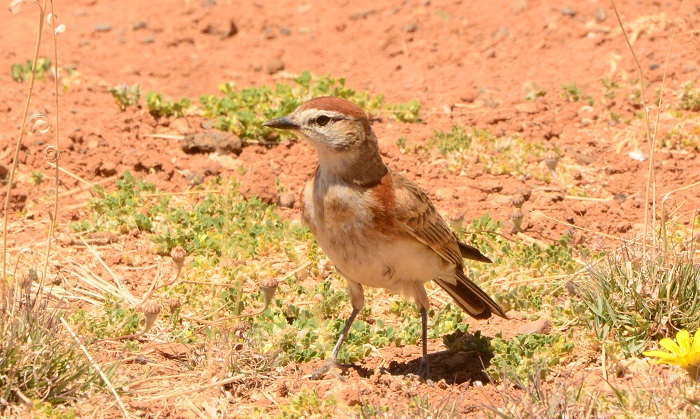
Cover image of Red-capped Lark Lark by Ryan Tippett – Carnarvon district, Northern Cape
Larks are passerine birds of the family ALAUDIDAE. The larks are a group of mostly Old World passerine birds. Most species are found in Africa, followed by Asia and Europe with two species occurring in North America and one species in Australia. Habitats vary, but many are characteristic of open, dry regions. The family contains 21 genera and 100 species.
Identification
The Red-capped Lark is an attractive, slender, medium-sized lark with distinctive plumage, rendering it unlike any other southern African lark species. The sexes are alike, but males are slightly larger than females.
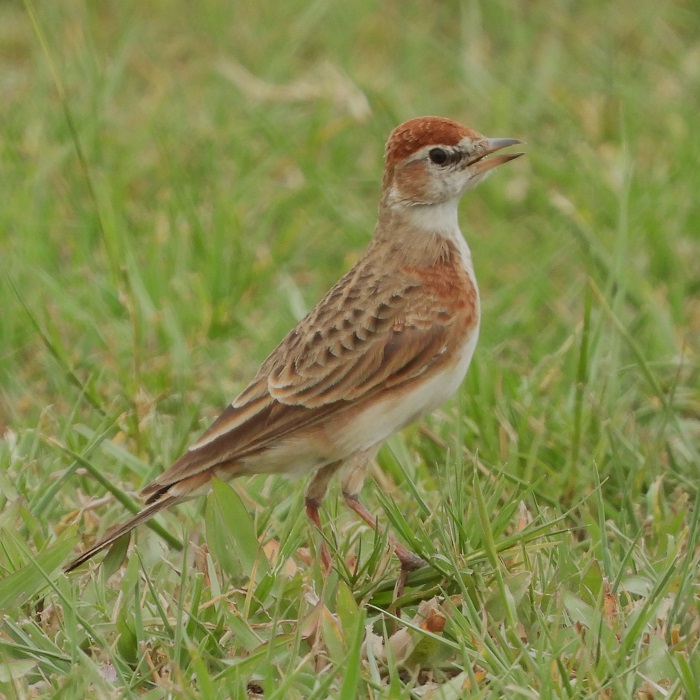
Pienaarsrivier, Limpopo
Photo by Ansie Dee Reis
Adult birds have very distinctive rufous patches on the sides of the chest as well as a rufous crown with a short erectile crest that is normally held flat. The crest is usually only raised when anxious or hot. The underparts are variable but are usually white, sometimes with buffy flanks. The lores and supercilium are white, and the ear coverts are whitish, with fine brown streaks. The nape, sides and back of the neck are brown. The mantle and back are pale to mid-brown; the mantle is finely streaked darker brown, while the back is more heavily marked. The rump is reddish brown with rufous upper tail coverts. The tail is dark brown with white outer tail feathers.
The Red-capped Lark is relatively long-winged, and the flight feathers are dark brown. Flight is pipit-like. The black bill is fairly small and slender. The eyes are brown, and the legs and feet are dark brown to black.
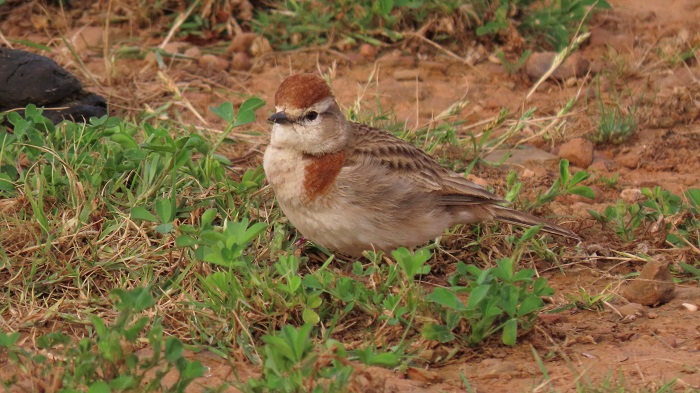
Near Swellendam, Western Cape
Photo by Johan van Rooyen
Juveniles resemble adults but carry darker upper parts with dark brown feather centres and buff margins with whitish tips. Juveniles also show a rufous-buff wash on the breast with some dark brown spots. The belly is creamy-buff (not white).
The Red-capped Lark is not easily mistaken for other species in southern Africa.
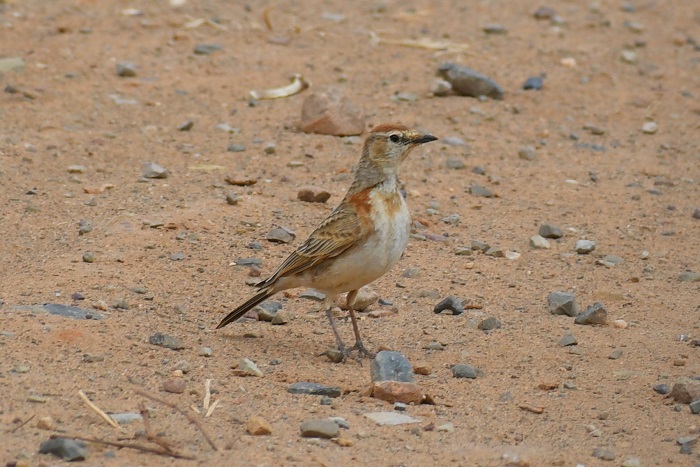
Near Worcester, Western Cape
Photo by Karis Daniel
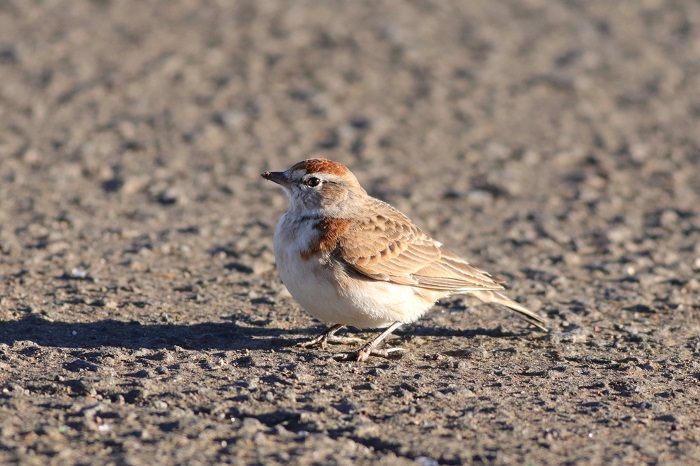
Bloemfontein, Free State
Photo by Dawie de Swardt
Status and Distribution
The Red-capped Lark is common and locally abundant in South Africa but is less common in neighbouring countries.
It ranges from southern Kenya and eastern DRC south to southern Africa, with an isolated population in Nigeria. The Red-capped Lark is widespread in southern Africa, but is thinly distributed in much of Namibia and Botswana, and rare at low altitudes in Zimbabwe and Mozambique.
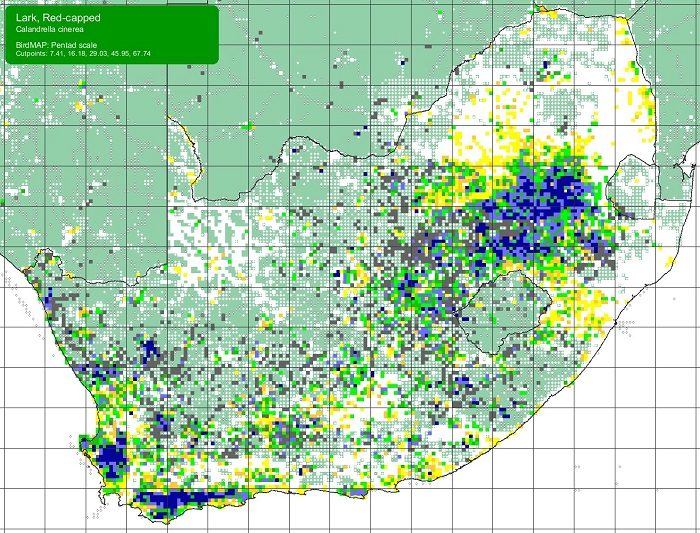
Details for map interpretation can be found here.
The Red-capped Lark is not threatened. It is well represented in protected areas and has adapted well to agricultural landscapes.
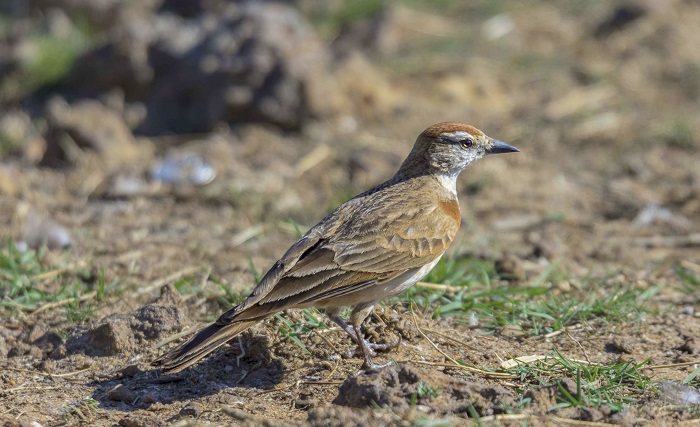
Near Klerksdorp, North West
Photo by Tony Archer
Habitat
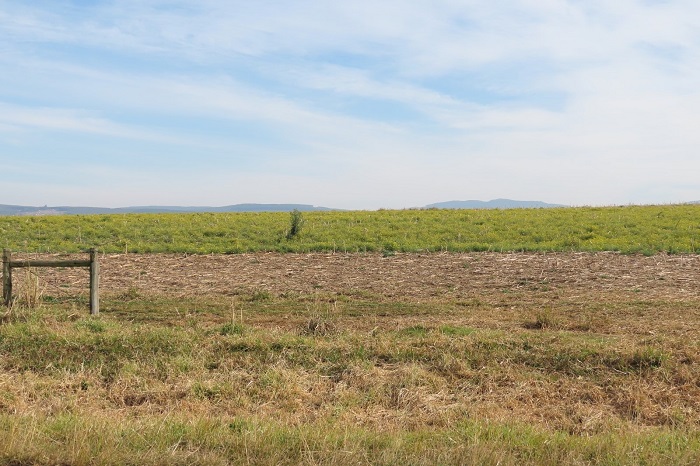
Photo by Colin Summersgill
The Red-capped Lark inhabit open grassland, bare ground in sparsely vegetated dwarf shrubland and the edges of wetlands. It also frequents short salt-marsh vegetation at coastal lagoons. It favours recently harvested or ploughed fields as well as short pastures. In the montane grasslands of eastern South Africa, it favours annually burned fields and heavily grazed grassland. The Red-capped Lark is frequently seen on roads and along road verges, especially after rain.
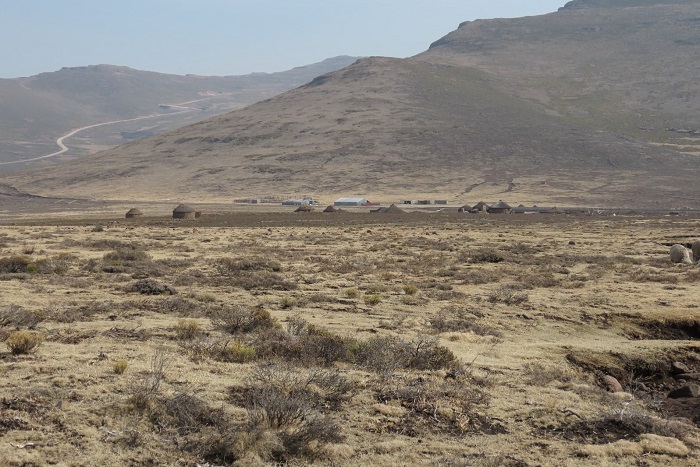
Photo by Colin Summersgill
Behaviour
The Red-capped Lark may be resident, a partial migrant, or nomadic depending on the region and rainfall. Its movements are not well known. The Red-capped Lark is largely sedentary in some areas, but with more or less regular movements into both breeding and non-breeding areas, especially in mesic areas. There is a clear influx into Zimbabwe and eastern South Africa during winter, with birds moving north and west in summer. The Red-capped Lark is nomadic in the drier parts of its range.
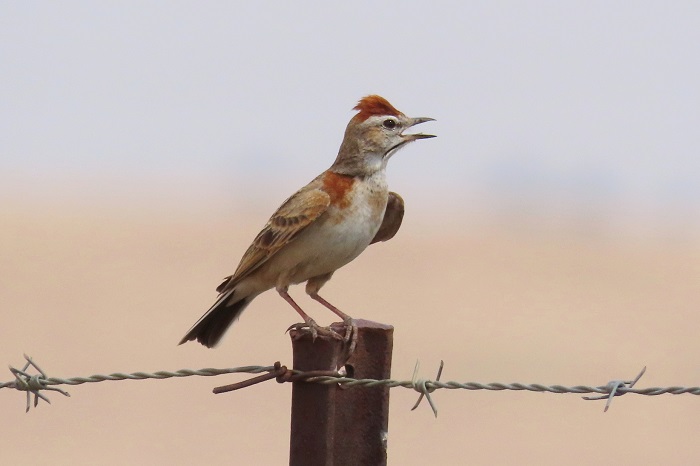
Near Senekal, Free State
Photo by Johan van Rooyen
The Red-capped Lark is usually found in flocks of 5 to 20 birds. Under favourable conditions, flocks can number into the hundreds, or rarely thousands of birds.
Drinks water regularly. At least some birds fly to bare areas after sunset to roost. When disturbed, flies away low, showing white outer tail, then drops to ground and runs, or towers high into air and either circles to land nearby or flies a considerable distance.
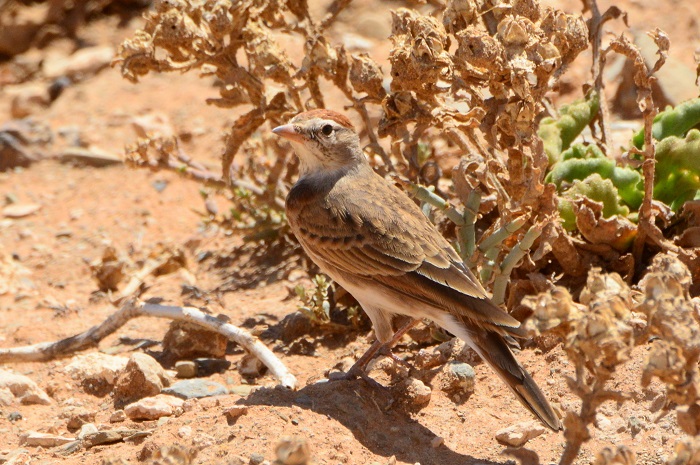
Carnarvon Dam, Northern Cape
Photo by Ryan Tippett
Red-capped Larks forage by walking on the ground, occasionally running, pecking food from the soil surface or gleaning from foliage of grasses or shrubs. Breaks up antelope and sheep droppings with its bill to obtain seeds, and probes in cattle dung for insect larvae. Forages on burnt ground immediately after fire, but keeps away from the flame front.
Feeds on snouted harvester termite (Trinervitermes sp) workers when mounds have been broken open by aardvark.
Occasionally hawks moths or emerging termite alates aerially. Eats invertebrates and seeds. Stomach contents dominated by seeds, apart from scale insects, which feed on roots but emerge after rains; other insects important only when feeding chicks. Seeds incl grasses, sedges, shrubs, and forbs. Insect food incl ants, mantids, termites, ad and larval Lepidoptera, bugs, scale insects, grasshoppers, wasps, weevils and snails. Stomachs often contain grit, apparently to aid digestion.
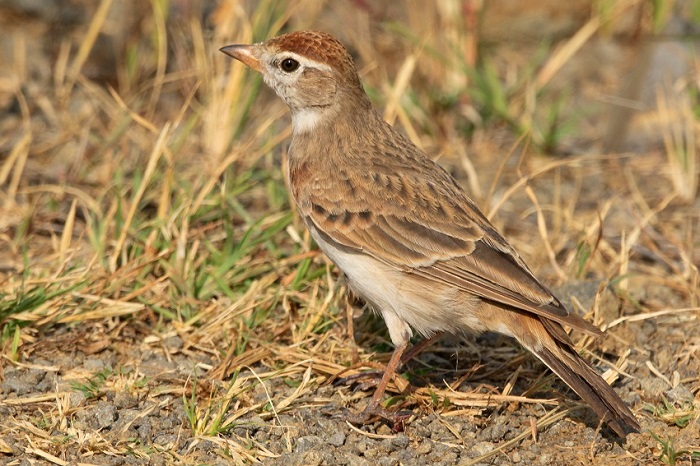
Near Frankfort, Free State
Photo by Lance Robinson
The Red-capped Lark
Monogamous. Solitary nester, but breeding densities in the south of its range up to 2-4 pairs/ha; nests sometimes only 25 m apart. Territorial; in W Cape, territory size ca 1 ha. Occasionally chases other spp from nest site. In pipit-like aerial display, male rises almost vertically into air to ca 50 m, then flies into wind, flapping slowly, rising and dipping while singing; remains in air up to 10 min, gradually descending to 30-40 m, then closes wings and drops, either landing or flying up again to continue display. Males sometimes resort to fights on ground; threat display a crouched posture, with tail fanned and wings raised and quivering.
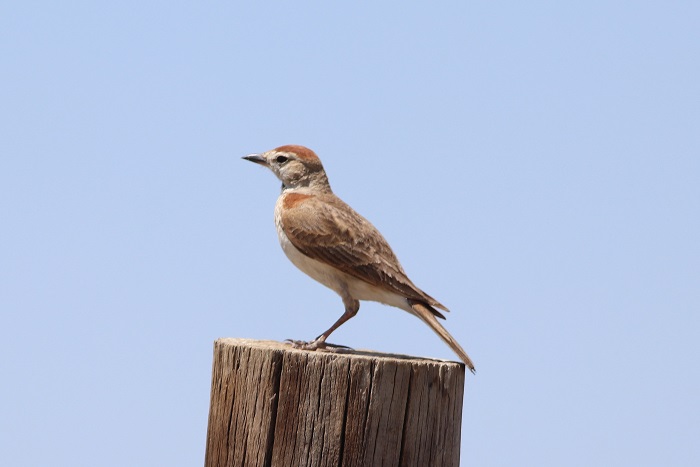
Near Kimberly, Free State
Photo by Dawie de Swardt
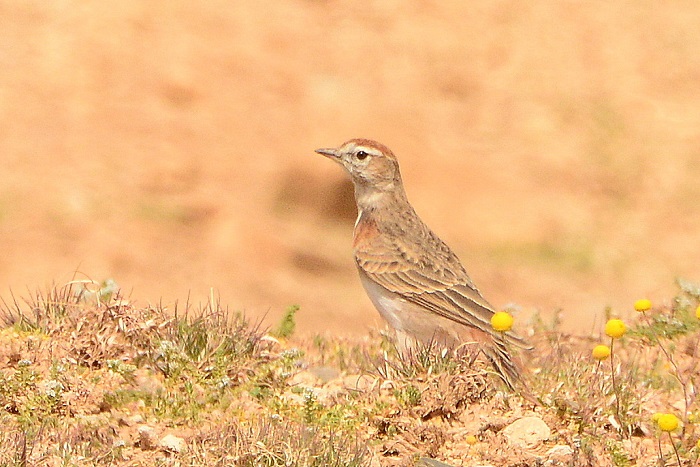
Carnarvon district, Northern Cape
Photo by Ryan Tippett
Further Resources
Species text for Red-capped Lark in the first Southern African Bird Atlas Project (SABAP1), 1997.
The use of photographs by Ansie Dee Reis, Colin Summersgill, Dawie de Swardt, Johan van Rooyen, Karis Daniel, Lance Robinson, Ryan Tippett, Tino Herselman, and Tony Archer is acknowledged.
Virtual Museum (BirdPix > Search VM > By Scientific or Common Name).
Other common names: Rooikoplewerik (Afrikaans); umNtoli (Zulu); Intutyane (Xhosa); Rotscheitellerche (German); Alouette cendrille (French); Roodkapleeuwerik (Dutch); Cotovia-de-barrete-vermelho (Portuguese).
List of bird species in this format is available here.
Recommended citation format: Tippett RM 2026. Red-capped Lark Calandrella cinerea. Biodiversity and Development Institute. Available online at https://thebdi.org/2026/07/15/red-capped-lark-calandrella-cinerea/
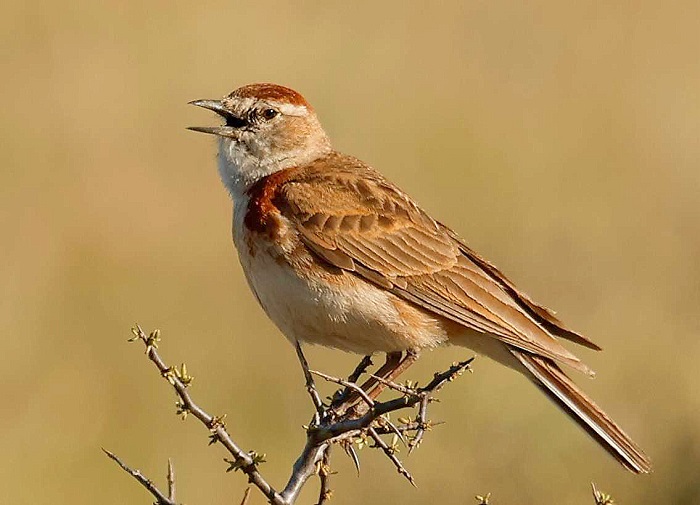
Near Middleburg, Eastern Cape
Photo by Tino Herselman
