
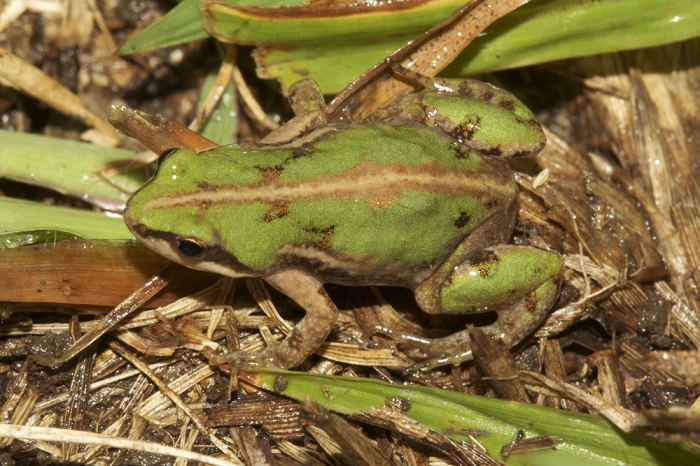
Cover photo by Jean-Paul Brouard.
Find the Common Caco in the FBIS database (Freshwater Biodiversity Information System) here.
Family Pyxicephalidae
Identification
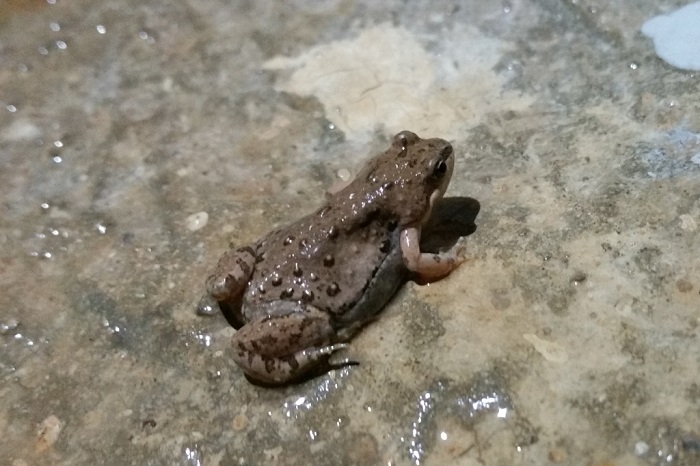
The Common or Boettger’s Caco is a small species that attains 23mm in length. The body is somewhat elongate and widest in the belly region, with a narrow head and a long neck. The dorsal colouration varies from green to light and dark brown or sometimes greyish. Individuals may be spotted, striped or uniform in colour. There is a dark band running from the snout, through the eye, to the base of the forelimbs. Below this there is a pale band along the upper lip from the snout to the base of the forelegs. The undersides are smooth with small grey to black spots. The limbs are relatively long and thin.
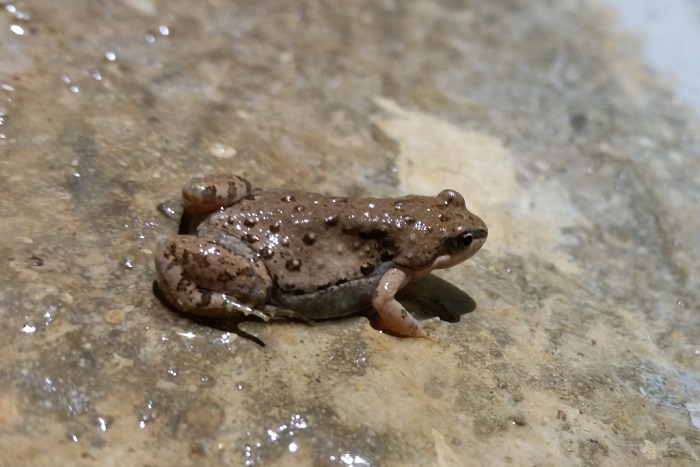
Carnarvon district, Northern Cape
Photo by Ryan Tippett
Habitat
The Common or Boettger’s Caco inhabits a wide variety of vegetation types in the Nama Karoo, Succulent Karoo, Savanna, Grassland, Fynbos and Thicket biomes. This species is usually absent from forests, although it is sometimes found in forest clearings. Within these biomes, it favours open areas with short vegetation and is especially abundant in grassy areas. The Common Caco can tolerate drier habitats than C. nanum, but also occurs in high-rainfall areas (Van Dijk 1977). In the Nama Karoo and Kalahari, C. boettgeri occurs naturally only in pans or along river courses, but can also be found in artificially created water bodies. The Common Caco breeds in any small, temporary water body, such as pools in flooded grasslands, culverts and other rain-filled depressions.

Photo by Ryan Tippett
Behaviour
During the dry season, the Common Caco aestivates in mudbanks, mudcracks, the burrows of other animals, disused termitaria, and under stones.
This species appears to have an extended breeding season. During the rainy season, males usually start calling in the late afternoon and call incessantly after dark, continuing until around midnight. Large choruses are common.
Call bouts are usually initiated by the same individual in the group (Channing 2001). Males normally call from concealed positions under vegetation or other cover, at water level, but have also been observed calling from totally exposed positions. A short territorial call is sometimes uttered by individual males prior to their regular advertisement call. In addition to the advertisement and territorial calls, several other vocalizations are known from the males of C. boettgeri, but their function is not well understood.
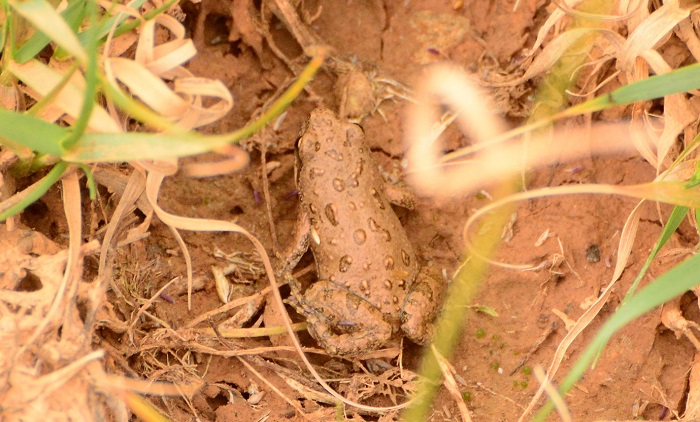
Carnarvon district, Northern Cape
Photo by Ryan Tippett
Clutches of c.250 eggs are attached to vegetation below the surface of the water (Channing 2001). The tadpoles usually hatch two days later, and metamorphosis is completed within approximately two weeks (Pienaar et al. 1976; Wager 1986).
The Common Caco is known to feed on termites (Passmore and Carruthers 1995) but probably takes any small insect. Like its congeners, it is probably a major predator of mosquitoes (Wager 1986). The Intermediate Egret Egretta intermedia, Spotted Skaapsteker Psammophylax rhombeatus (Channing 2001) and Giant Bullfrog Pyxicephalus adspersus (W.R. Branch pers. comm.) are known to prey on this frog.
Status and Conservation
The Common Caco is known from various nature reserves and protected areas throughout its range and is not threatened. The species is a supreme generalist, adapting well to disturbance. It appears to be unaffected by moderate eutrophication of its water through organic pollution such as bovine (or other) excrement and fertilisers. No conservation actions are necessary for this species.
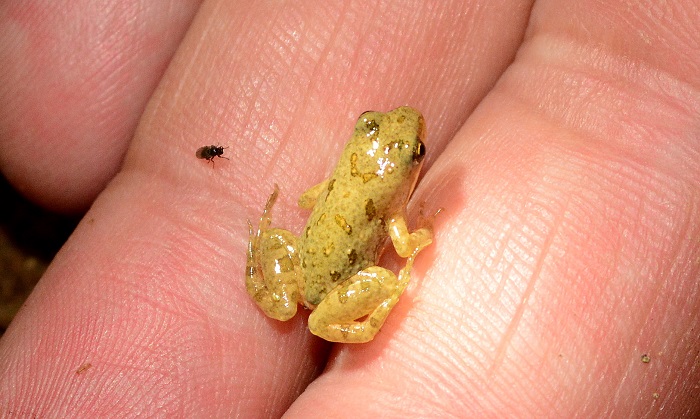
Karoo-Gariep Nature Reserve, Northern Cape
Photo by Ryan Tippett
Distribution
The Common Caco is one of the most widespread and abundant frog species in the atlas region, occurring in most suitable habitats throughout its range at both high and low elevations. The species is absent from Namaqualand, the highlands of Lesotho, the top of the Soutpansberg and along much of the Mpumalanga escarpment.
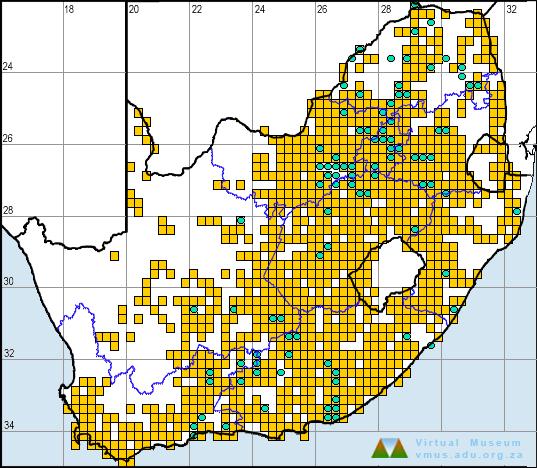
The lack of records from south-eastern KwaZulu-Natal, the Buffalo River and the Lower Tugela River basin may reflect a genuine absence of this species (Lambiris 1989a). Conversely, the paucity of records from the arid Northern Cape Province and parts of Eastern Cape Province is probably the result of inadequate sampling effort.
The range of the Common Caco may have increased in the last century due to human activity, particularly where bush and reeds have been cleared and grass has been introduced (Van Dijk 1971b), along with domestic stock.
Outside of the atlas region, C. boettgeri occurs in the savanna regions of Namibia, eastern Botswana, southern Zambia and the Zimbabwe plateau. The disjunct populations that occur in the grasslands of northern Tanzania, southern Kenya and Ethiopia, previously referred to C. boettgeri (Poynton 1964; Poynton and Broadley 1985b), differ in advertisement call and skeletal and genetic characteristics, and apparently represent an undescribed taxon (E. Scott in prep.).
Similarly, the populations in the winter-rainfall Western Cape, recently referred to C. platys (Channing 2001) but previously synonymised with C. boettgeri (Poynton 1964), display different advertisement calls, in addition to a marked mtDNA sequence divergence, compared to their savanna counterparts (E. Scott in prep.). However, the limits of distribution of the Western Cape form are currently unknown, since it is almost impossible to separate preserved museum material on external morphology alone. The atlas distribution map presented here does not distinguish between C. boettgeri and C. platys because over most of the atlas period, their seperate taxonomic status was not recognised. Reliable diagnostic field characters have not been described.
Carnarvon district, Northern Cape
Photo by Ryan Tippett
Further Resources
The use of photographs by Jean-Paul Brouard is acknowledged. Other images by Ryan Tippett.
Common Caco Cacosternum boettgeri (Boulenger, 1882)
Other Common Names: Boettger’s Caco, Boettger’s Dainty Frog (Alternative English Names); Gewone Blikslanertjie (Afrikaans)
Recommended citation format: Scott, E; Tippett, RM. (2025). Common Caco Cacosternum boettgeri. Biodiversity and Development Institute, Cape Town. Available online at https://thebdi.org/2022/02/15/common-caco-cacosternum-boettgeri/
This species text has been updated and expanded from the text in the
2004 frog atlas: Scott, E. (2004). Common Caco Cacosternum boettgeri. In Minter LR et al 2004.
References:
Minter, LR; Burger, M; Harrison, JA; Braack, HH; Bishop, PJ; Kloepfer, D. (Editors). (2004). Atlas and Red Data Book of the Frogs of South Africa, Lesotho and Swaziland. Smithsonian Institution, Washington, and Avian Demography
Unit, Cape Town.
Carruthers, V; du Preez, L. (2017). Frogs of southern Africa: A Complete Guide. Struik Nature, Cape Town.
Channing, A. (2001) Amphibians of Central and Southern Africa. Protea Book House, Pretoria
