

Cover photo by Wil Leurs.
Find the Corkscrew Hooktail in the FBIS database (Freshwater Biodiversity Information System) here.
Family Gomphidae
Identification

Ndumo Game Reserve, KwaZulu-Natal
Photo by Ryan Tippett
Medium-large size
Length up to 50mm; Wingspan reaches 59mm.
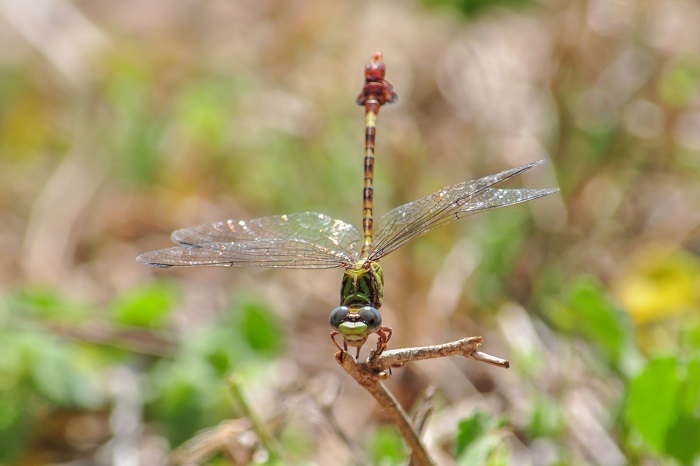
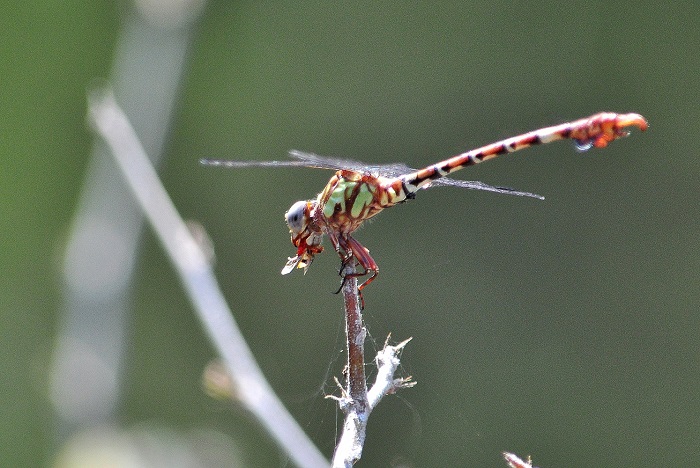
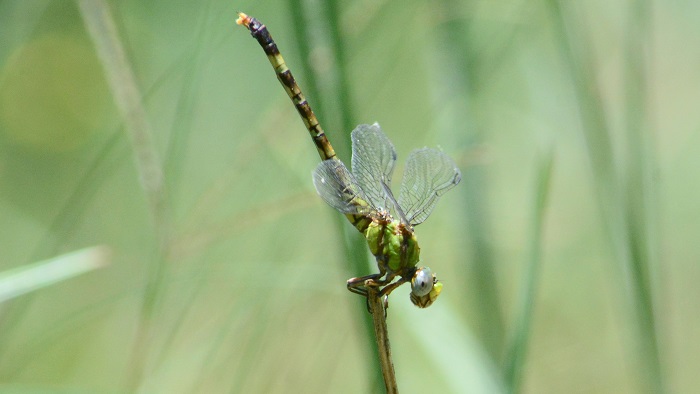
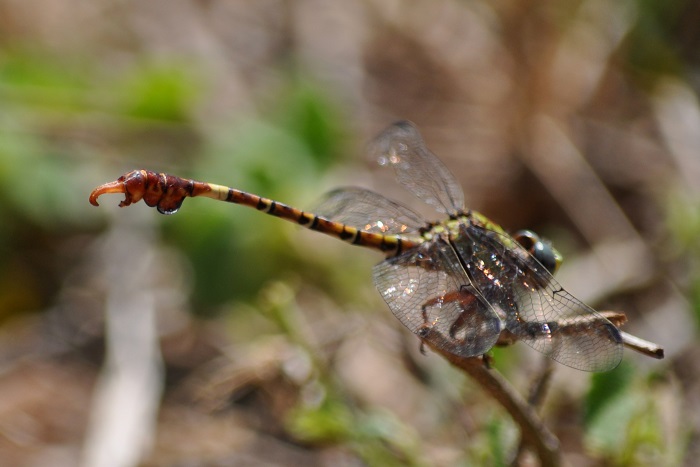
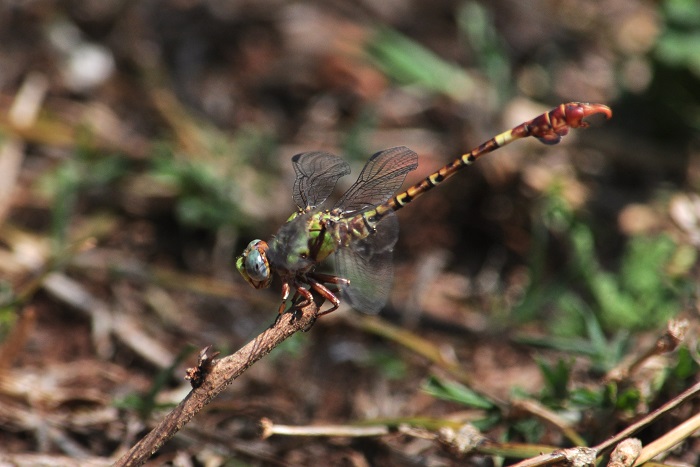
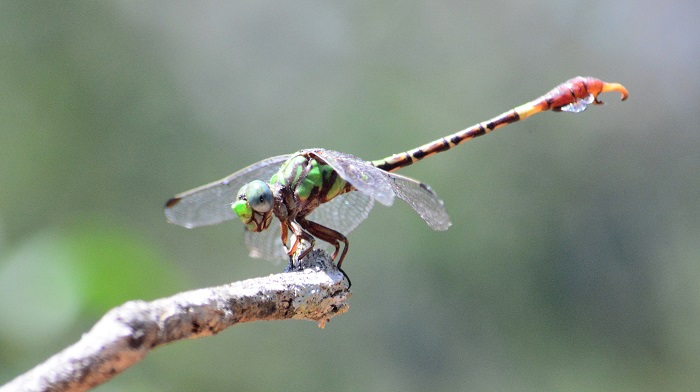
The Corkscrew Hooktail is an attractive, bright green and brown species. The males possess well-developed foliations on the abdomen and strongly hooked claspers.
It is most similar to Paragomphus genei (Common Hooktail). The Corkscrew Hooktail has a brighter green thorax with more distinct brown markings. In addition, the foliations on the lower abdomen of P. elpidius are distinctly larger. The superior appendages are more robust and are strongly hooked. Additionally, the two species differ in the colour of the pterostigmas. Paragomphus elpidius has all dark pterostigmas. Those of Paragomphus genei are pale with dark borders.
Females resemble males but are duller and lack the abdominal foliations and hooked claspers of the males
Click here for more details on identification of the Corkscrew Hooktail.

Ndumo Game Reserve, KwaZulu-Natal
Photo by Ryan Tippett
Habitat
The Corkscrew Hooktail inhabits warm savanna regions, especially in hot, dry valleys. It prefers large, fast-flowing rivers, often where there are wide gravel banks and dense fringing woodland. The Corkscrew Hooktail does not usually frequent still water habitats.

Photo by Ryan Tippett
Behaviour
The Corkscrew Hooktail is a shy and alert species that can be difficult to approach. It usually perches low down on rocks, sticks, and plant stems close to the water. During the heat of the day, they perch among trees and bushes, often above the riverbank. This species hunts from a perch. It makes swift flights to intercept prey, quickly returning to settle.
The Corkscrew Hooktail is on the wing from October to June.
Ndumo Game Reserve, KwaZulu-Natal
Photo by Ryan Tippett
Status and Conservation
The Corkscrew Hooktail is generally localised and uncommon in South Africa. However, it can be fairly common at some sites.
It is listed as of Least Concern in the IUCN Red List of Threatened Species. The Corkscrew Hooktail is fairly sensitive to habitat degradation and prefers undisturbed sites.
Ndumo Game Reserve, KwaZulu-Natal
Photo by Ryan Tippett
Distribution
Paragomphus elpidius is found in Eastern and Southern Africa. It occurs from Uganda and Kenya in the north down to South Africa. In South Africa, the Corkscrew Hooktail is restricted to the hotter north and east.
Ndumo Game Reserve, KwaZulu-Natal
Photo by Ryan Tippett
Below is a map showing the distribution of records for Corkscrew Hooktail in the OdonataMAP database as at February 2020.

Below is a map showing the distribution of records for Corkscrew Hooktail in the OdonataMAP database as of December 2024.

The next map below is an imputed map, produced by an interpolation algorithm, which attempts to generate a full distribution map from the partial information in the map above. This map will be improved by the submission of records to the OdonataMAP section of the Virtual Museum.


Ultimately, we will produce a series of maps for all the odonata species in the region. The current algorithm is a new algorithm. The objective is mainly to produce “smoothed” maps that could go into a field guide for odonata. This basic version of the algorithm (as mapped above) does not make use of “explanatory variables” (e.g. altitude, terrain roughness, presence of freshwater. We will be producing maps that take these variables into account soon. Currently, it only makes use of the OdonataMAP records for the species being mapped, as well as all the other records of all other species. The basic maps are “optimistic” and will generally show ranges to be larger than what they probably are.
These maps use the data in the OdonataMAP section of the Virtual Museum, and also the database assembled by the previous JRS funded project, which was led by Professor Michael Samways and Dr KD Dijkstra.
Ndumo Game Reserve, KwaZulu-Natal
Photo by Ryan Tippett
Phenology


Ndumo Game Reserve, KwaZulu-Natal
Photo by Ryan Tippett
Further Resources
The use of photographs by Wil Leurs is acknowledged. All other photographs by Ryan Tippett.
Corkscrew Hooktail Paragomphus elpidius (Ris, 1921)
Other common names: Slingerhakiestert (Afrikaans)
Recommended citation format: Loftie-Eaton M; Navarro R; Tippett RM; Underhill L. 2025. Corkscrew Hooktail Paragomphus elpidius. Biodiversity and Development Institute. Available online at https://thebdi.org/2020/05/12/corkscrew-hooktail-paragomphus-elpidius/
References: Tarboton, M; Tarboton, W. (2019). A Guide to the Dragonflies & Damselflies of South Africa. Struik Nature.
Samways, MJ. (2008). Dragonflies and Damselflies of South Africa. Pensoft
Samways, MJ. (2016). Manual of Freshwater Assessment for South Africa: Dragonfly Biotic Index. Suricata 2. South African National Biodiversity Institute, Pretoria
Martens, A; Suhling, F. (2007). Dragonflies and Damselflies of Namibia. Gamsberg Macmillan.
Ndumo Game Reserve, KwaZulu-Natal
Photo by Ryan Tippett