

Cover photo by Diana Russell.
Find the Evening Hawker in the FBIS database (Freshwater Biodiversity Information System) here.
Family Aeshnidae
Identification

Enseleni Nature Reserve, KwaZulu-Natal
Photo by Ryan Tippett
Very large size
Length reaches 69mm; Wingspan attains 94mm.
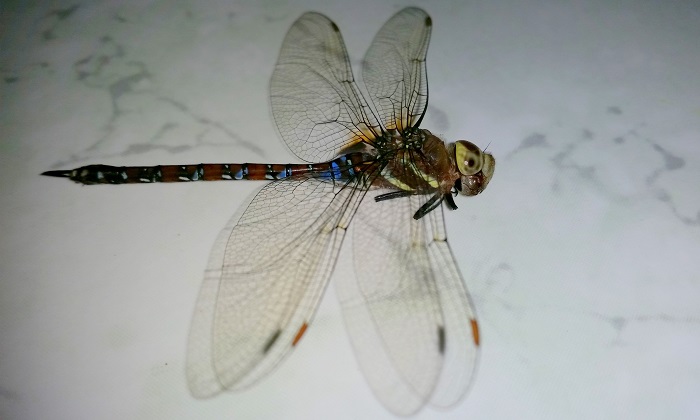
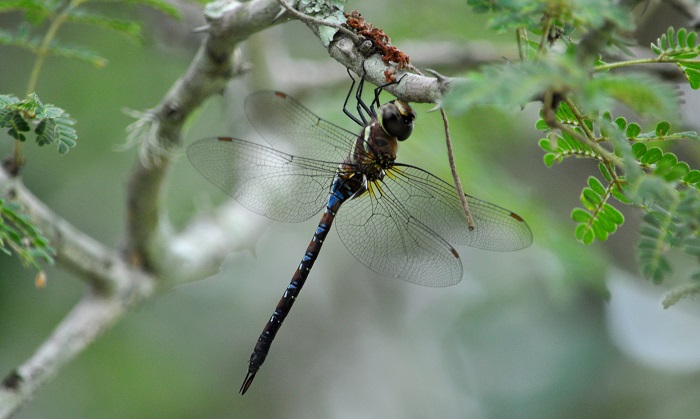
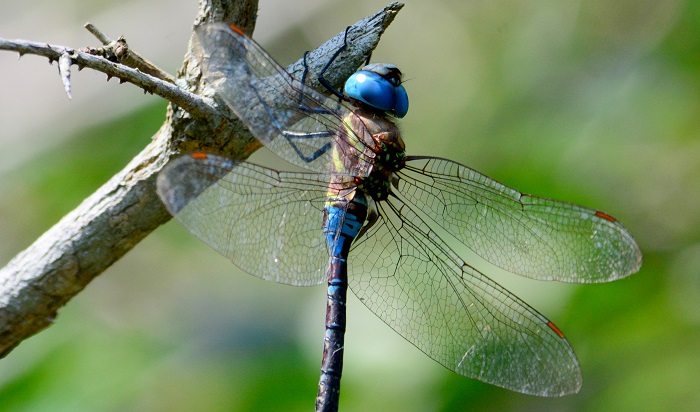
Adult males are unmistakable. The combination of brown thorax with a pair of diagonal lime-green stripes, brilliant blue eyes and large, bright blue saddle are diagnostic.
Female and young male Evening Hawkers with greenish eyes, could be confused with other Hawker species. They are most likely to be mistaken for Pinheyschna subpupillata (Stream Hawker) or Zosteraeschna minuscula (Friendly Hawker). The Evening Hawker can be distinguished by the lack of green patches on the ‘shoulders’ of the thorax and by their diagnostic forehead markings.
Click here for more details on identification of the Evening Hawker.
Near Hluhluwe, KwaZulu-Natal
Photo by Ryan Tippett
Habitat

Photo by Ryan Tippett
The Evening Hawker is associated with forest and dense woodland adjoining wetlands such as lakes, marshes, rivers and pans. It is usually seen hunting over reed beds, marshes, grassy clearings, and around tree canopies at dusk. During the day the Evening Hawker rests away from water in dense, shaded areas.

Photo by Ryan Tippett
Behaviour
The Evening Hawker is crepuscular, and is therefore most active during twilight. It is often gregarious when hunting and frequently joins mixed species feeding swarms at dusk. Evening Hawkers are also quite active on humid days, before and after rain. They spend most of the daylight hours at rest in dense shaded vegetation. The evening Hawker hangs vertically from a perch while resting.
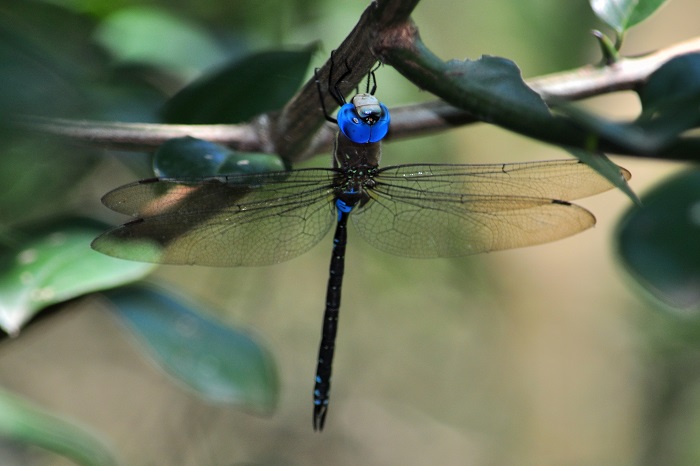
Enseleni Nature Reserve, KwaZulu-Natal
Photo by Ryan Tippett
Status and Conservation
The Evening Hawker is scarce to locally common in South Africa. It is listed as of Least Concern in the IUCN Red List of Threatened Species. Anaciaeschna triangulifera is moderately sensitive to habitat disturbance. It can, however, be found at suitable man-made habitats, and in areas with some alien plants.
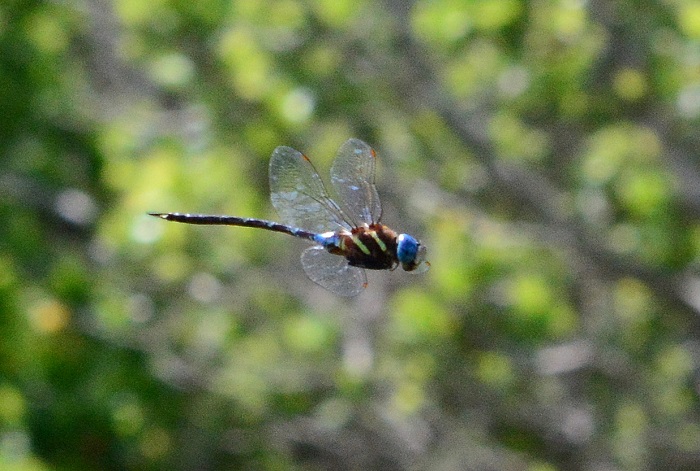
Kosi Bay, iSimangaliso Wetland Park, KwaZulu-Natal
Photo by Ryan Tippett
Distribution
The Evening Hawker is found in sub-Saharan Africa, but mainly in Southern and East Africa, From Ethiopia in the north down to the Western Cape in South Africa. The species also occurs on Madagascar. In South Africa, the Evening Hawker is most widespread along the eastern and southern coastal regions, from northern KwaZulu-Natal down to the Western Cape. It is also present in Gauteng, Limpopo, and Mpumalanga. The Evening Hawker avoids the dry central and western regions of the country.
Below is a map showing the distribution of records for Evening Hawker in the OdonataMAP database as at February 2020.

Below is a map showing the distribution of records for Evening Hawker in the OdonataMAP database as at December 2024.
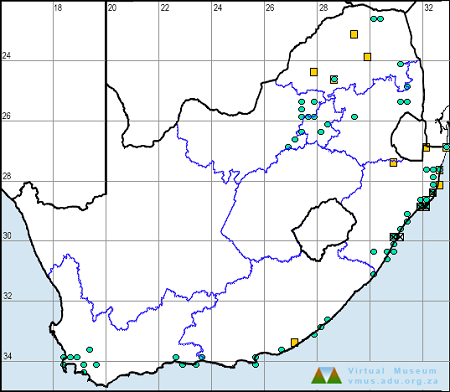
The next map below is an imputed map, produced by an interpolation algorithm, which attempts to generate a full distribution map from the partial information in the map above. This map will be improved by the submission of records to the OdonataMAP section of the Virtual Museum.


Ultimately, we will produce a series of maps for all the odonata species in the region. The current algorithm is a new algorithm. The objective is mainly to produce “smoothed” maps that could go into a field guide for odonata. This basic version of the algorithm (as mapped above) does not make use of “explanatory variables” (e.g. altitude, terrain roughness, presence of freshwater — we will be producing maps that take these variables into account soon). Currently, it only makes use of the OdonataMAP records for the species being mapped, as well as all the other records of all other species. The basic maps are “optimistic” and will generally show ranges to be larger than what they probably are.
These maps use the data in the OdonataMAP section of the Virtual Museum, and also the database assembled by the previous JRS funded project, which was led by Professor Michael Samways and Dr KD Dijkstra.


False Bay, iSimangaliso Wetland Park, KwaZulu-Natal
Photo by Ryan Tippett
Further Resources
The use of photographs by Diana Russell is acknowledged. All other photographs by Ryan Tippett.
Evening Hawker Anaciaeschna triangulifera McLachlan, 1896
Other common names: Nagventer (Afrikaans)
Recommended citation format: Loftie-Eaton M; Navarro R; Tippett RM; Underhill L. 2025. Evening Hawker Anaciaeschna triangulifera. Biodiversity and Development Institute. Available online at https://thebdi.org/2020/04/30/evening-hawker-anaciaeschna-triangulifera/
References: Tarboton, M; Tarboton, W. (2019). A Guide to the Dragonflies & Damselflies of South Africa. Struik Nature.
Samways, MJ. (2008). Dragonflies and Damselflies of South Africa. Pensoft
Samways, MJ. (2016). Manual of Freshwater Assessment for South Africa: Dragonfly Biotic Index. Suricata 2. South African National Biodiversity Institute, Pretoria
Martens, A; Suhling, F. (2007). Dragonflies and Damselflies of Namibia. Gamsberg Macmillan.
Enseleni Nature Reserve, KwaZulu-Natal
Photo by Ryan Tippett