The BDI is holding an Open Day for bird ringing on Saturday, 31 August 2024. We are hosted by the Grotto Bay Private Nature Reserve. The reserve has an area of 385 ha, and the vegetation consists of Strandveld and Sandveld. It is about 60 km north of Cape Town, turning off the R27. We meet at the Conservation Centre within the reserve.
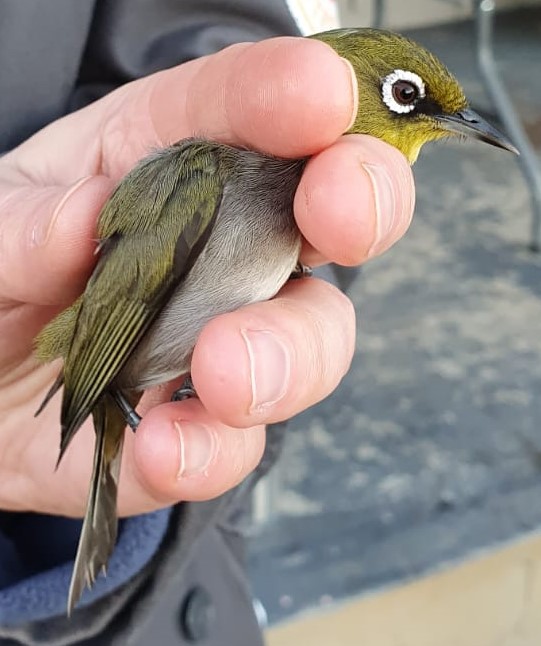
One of our previous bird ringing visits to Grotto Bay has a blog describing the event. This Cape White-eye was ringed then. The privilege of being a ringer is the opportunity to see birds up close, and to see the detailed structure of the white feathers around the eye that give this species its name. There is a description of the value of bird ringing here.
Cape White-eye, ringed at the previous Open Day for bird ringing at Grotto Bay Private Nature Reserve
There is lots of space, so ringers are welcome to bring their own nets and ringing equipment. Afterwards we will make a total list of all birds ringed, and produce a blog for the event, as for the earlier one. If you have ideas for topics talks or other demonstrations, please send an email to les@thebdi.org.
The reserve is not open to the public, so you will not just be able to arrive on the morning of the event! You will gently be turned away with 100% certainty! If you plan to attend, please send an email to les@thebdi.org before Tuesday 27 August.
Please include in the email, the registration of the vehicle you will travel in, plus ID number and cell phone number. Total numbers are limited. We will soon put details here of of the earliest time to arrive if you are planning to put up mistnets.
We originally planned this for Saturday, 24 August. Now (21 August) the weather for this coming Saturday looks unsuitable for bird ringing. But the long term forecast for 31 August is looking far better, not only for that day, but also for the days before and after.
There is a list of all the upcoming BDI events here.
Cover image of Red-billed Quelea by Lia Steen – Shellybeach, KwaZulu-Natal – BirdPix No. 278702
Queleas belong to the Family PLOCEIDAE, alongside related birds like weavers, bishops and widows etc. Ploceids are small and compact seed-eating birds with stout, conical bills. In many species the males are brightly coloured.
Identification
The Red-billed Quelea is a rather variable species.
Breeding males can occur in one of several face mask colour combinations. The most common of which is black, surrounded by a variable straw-coloured or pink band. Some have a white or creamy mask, or the mask may be replaced with pink to purplish feathers.
The upper parts are pale brown, with darker central streaks on the feathers. The wings and tail are dark brown and the flight feathers have yellowish edges. The amount of pink coloration on the throat and breast varies considerably between individuals. The rest of the underparts range from whitish to grey or pale brown. The belly is usually white, often with some darker streaking on the flanks. The legs and feet are pink to orange. The eyes are brown and the Bill and eye ring are bright red.
Non-breeding adult males are similar to breeding males, but less colourful. The head is greyish-brown with a whitish supercilium, chin and throat.
Adult females resemble the non-breeding males but the bill and eye ring are dull yellowish. Juveniles resemble adult females but the feathers on the wings have broad buffy margins and the bill is horn brown.
Red-billed Quelea (Quelea quelea). Note the two females with yellowish bills. Sondela Resort, Warmbaths, Limpopo Photo by Andries de Vries
Non-breeding Red-billed Quelea can be mistaken for several other species. The red or yellow bill and lack of bold striping on the head separate Red-billed Quelea from bishops or whydahs at all times. Female Cardinal Quelea (Quelea cardinalis) and Redheaded Quelea (Quelea erythrops) both have a yellow (not whitish to pink) supercilium. The female Cardinal Quelea also has a yellow (not white) throat.
A very common to locallyabundant nomad across its range. The Red-billed Quelea is the world’s most numerous bird species with an estimated post-breeding population of at least 1.5 billion birds! However, numbers are known to vary greatly across seasons in any given area.
The Red-billed Quelea is distributed throughout sub-Saharan Africa, outside of the tropical forest zone. It occurs virtually everywhere in southern Africa, and is generally only absent from true deserts. It has expanded its range and increased in numbers due to the increased availability of cereal crops. In recent years the Red-billed Quelea has been steadily expanding its range into the Western Cape province.
SABAP2 distribution map for Red-billed Quelea (Quelea quelea) – June 2024. Details for map interpretation can be found here.
Red-billed Quelea numbers frequently reach pest levels and control actions are undertaken, but the killing of up to 180 million birds in the region during recent decades has had no effect on the population other than temporary local relief from crop damage. The Red-billed Quelea is not threatened.
Habitat
The Red-billed Quelea is recorded from most vegetation types. It prefers woodlands and grasslands such as dry thornveld and grassland with scattered bushes. It also inhabits semi-arid Karoo scrub and is abundant in cultivated lands. It is most numerous in semi-arid regions, but occurs irruptively in both very wet and very dry areas. A reliance on surface water limits the range of Red-billed Queleas in arid areas.
Typical grassy savanna habitat. Ithala Game Reserve, KwaZulu-Natal Photo by Ryan Tippett
Despite their presence in a wide variety of habitats, the Red-billed Quelea breeds primarily in thornveld at altitudes below 1000m, particularly in the lowveld of Mpumalanga and Limpopo, parts of north-eastern KwaZulu-Natal, Botswana and Zimbabwe. Breeding is much less regular in other regions, mostly after periods of above average rainfall.
Behaviour
Red-billed Queleas are hugely gregarious at all times. They roost, feed and breed in aggregations numbering into the millions or more. Quelea flocks are densely packed and highly synchronised in flight, looking like a large cloud of smoke from a distance. Large flocks can easily break trees and branches due to the sheer combined weight of birds. Smaller groups are commonly found alongside other granivores, particularly Bishops and Widows (Euplectes spp.)
Red-billed Queleas are highly mobile, commuting considerable distances between roosting sites, feeding grounds and drinking water on a daily basis. Red-billed Queleas need to drink at least twice daily and huge concentrations visit waterholes in dry habitats. They often congregate in large secondary roosts during the heat of the day, often in trees near their feeding areas.
Large-scale movements occur throughout its range, and in some areas regular seasonal migration follows rain fronts. The presence of Queleas is known to depend on rainfall and veld conditions, which is often erratic, especially in semi-arid environments. As a result the Red-billed Quelea is predominantly nomadic within the region.
Red-billed Queleas forage mostly on the ground but also on grass and grain inflorescences. When large flocks feed on the ground, they form spectacular ‘rolling waves’ as birds from the back continuously fly over to land ahead of those already on the floor. They feed primarily on seeds of grasses and cereals, taken directly from plants or from ground. Favours small seeds (1-2 mm in diameter). Red-billed Queleas can cause extensive damage to crops of wheat, sorghum, millet, oats, buckwheat and rice. Insect food includes beetles, caterpillars, butterflies, grasshoppers, crickets, bugs, ants, termite alates and spiders.
They may bathe in wet grass and anting has been observed in both captive and wild birds.
Breeding Red-billed Queleas are monogamous and highly colonial. All activity within the colony is tightly synchronised through co-ordinated social cues or behaviours. This is to improve safety and to reduce mortality rates. Breeding pairs form small territories, confined to the immediate vicinity of the nest. Males sing at the nest, and also give a visual display with raised and fluttered wings. The visual display is important due to the incessant din of noise within the breeding colony.
The nest is a small, thin-walled, oval ball of grass, with a large side-top entrance and a small overhanging roof. The nest is constructed by the male out of thin strips of grass and takes just 2 or 3 days to complete. Little to no lining is added to the nest. Nests are usually placed 1.5 to 6m above the ground in thorn trees, particularly Vachellia (Acacia) spp. Individual trees may hold up to 3 000 nests, and colonies can cover as much as 80 ha! In southern Africa breeding takes place mainly from November to May with a peak during December and January.
1 to 5 pale greenish or bluish-white eggs are laid per clutch. No time is wasted and the first egg is laid as soon as the nest is able to hold it, in many cases before the nest is even completed. The incubation period lasts for 10 to 12 days and incubation is shared by both sexes. When one of the pair returns to the nest, the pair greet each other with quivering, half-spread wings.
Newly hatched young are altricial but their development is rapid and they can fly after just 12 to 14 days. They then leave the nest and are independent after 21 days or so. Nestlings are fed by both parents, mostly on small insects.
The mortality rate of nestlings is high with many nestlings either falling from their nests or preyed upon by predators. Red-billed Queleas and their nestlings are a vital component of the food chain and as such are eagerly devoured by a diverse assemblage of predators. Rapid, synchronised breeding is sometimes successful in overwhelming predators, but predation can have a major impact on breeding colonies and some may be completely destroyed by hungry predators.
Nestlings and fledglings are taken by Egrets, herons, hornbills, owls, kites, vultures, Eagles, hawks, falcons, shrikes and storks amongst others. Non-avian predators recorded at colonies are also varied and range from rodents to genets, monkeys, baboons and even Lions (Panthera leo) and Leopards (P. pardus), various snakes and Monitor lizards (Varanus spp.). Colonies are also sometimes attacked by predatory insects such as Armoured Ground Crickets (Acanthoplus spp.). Humans also raid breeding colonies in many African countries, collecting large numbers of chicks but this has little if any impact on overall populations.
Species text from the first Southern African Bird Atlas Project (SABAP1), 1997.
The use of photographs by Andrew Keys, Andries de Vries, Ansie Dee Reis, Gregg Darling, John Cox, Lia Steen, Malcolm Robinson, Pamela Kleiman, Pauline Fowler and Sybrand Venter is acknowledged.
Virtual Museum (BirdPix > Search VM > By Scientific or Common Name).
Other common names: Rooibekkwelea (Afrikaans); Blutschnabelweber (German); Travailleur à bec rouge (French); Roodbekwever (Dutch); Quelea-de-bico-vermelho (Portuguese).
List of bird species in this format is available here.
Recommended citation format: Tippett RM 2024. Red-billed Quelea Quelea quelea. Biodiversity and Development Institute. Available online at https://thebdi.org/2024/06/24/red-billed-quelea-quelea-quelea/
One of the privileges of being a bird ringer is the opportunity to see birds up close. The opportunity to see the detail of the feathers, the colour of the eye, and the complex patterns in it, and the opportunity to grasp the reality that you don’t want to be an insect when that weapon is on the hunt for food!
Bird ringers have made a vast contribution to understanding bird migration and movements, bird survival, and many other aspects of bird biology. To do bird conservation effectively, we also need to know how these things are changing in the face of global change. We need a new generation of bird ringers to help achieve this. To find out more about all these aspects of bird ringing, read The value of bird ringing to research and conservation.
Your next opportunity to train as a bird ringer is from 9 to 15 September 2024, at the New Holme Nature Lodge, Hanover, Northern Cape.
You’ll find general information, applicable to all the BDI ringing courses here. This gives information about the daily programme, and what you need to bring with you in terms of equipment and clothing.
Links to reports of previous BDI bird ringing events and courses are here. These provide a really good insight into the experience you can anticipate. But no two courses are ever quite the same. That’s what makes them fun to run and lead. There are two reports from last year’s course at New Holme, Part 1 and Part 2. We even wrote a scientific paper out of what we discovered on this course last year; it is Open Access, and you can download it here. The paper is about the Grey-backed Sparrow-lark.
Here are the details that apply to the bird ringing course at New Holme, from Monday 9 September to Sunday 15 September 2024.
Location
New Holme is 8 km northwest of the N1, between Hanover and Colesburg, in the Northern Cape. It is almost exactly halfway between Cape Town and Gauteng, about 700 km from each. See the map:
Arrival and departure
Arrive during the day on Monday 9 September. The first ringing session will be in the late afternoon, but the course proper starts next morning. Departure is after breakfast on Sunday 15 September.
Cost
The cost of the course is R7,200 per person, sharing, and R7,800 per person, single room. The cost of staying in a luxury tent is R5,500 per person, sharing (each tent sleeps three people). The price includes the course fee, the cost of accommodation for six nights including brunch and dinner, and lots of tea and coffee. It also includes a Shy Five Night Drive. It excludes drinks; there is an “honesty bar” at the Lodge.
How to book
To book, or to ask questions and get more information, please contact us at ring@thebdi.org.
Bird ringing course at New Holme from 9 to 15 September 2024. Dieter Oschadleus, who will be trainer at the course, is ringing a Bokmakierie
This Curlew Sandpiper, was ringed on the September 2023 ringing course at New Holme. It has just arrived on migration from the Siberian tundra. The brown on its belly is the remains of breeding plumage; within a few weeks this bird will by a dull grey and white.
Future (and past) bird ringing courses
This is the final BDI bird ringing course for 2024. There will be more courses in 2025. You will be able to find the dates in Upcoming BDI events, on the BDI website. There are blogs about past ringing courses and events, going back to 2019, and they are collated here. Browsing through these will give you a good idea of what to anticipate when you join us for a bird ringing course.
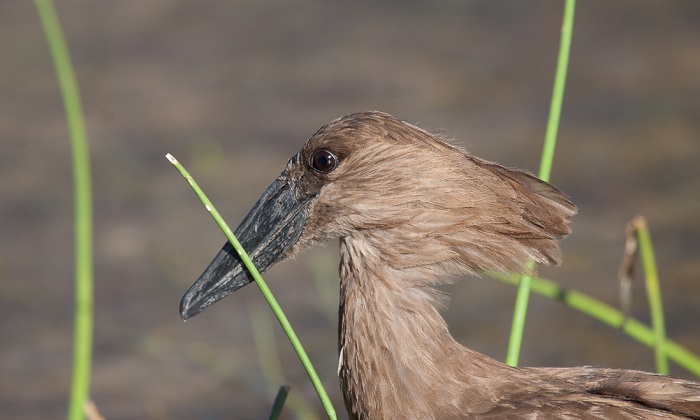
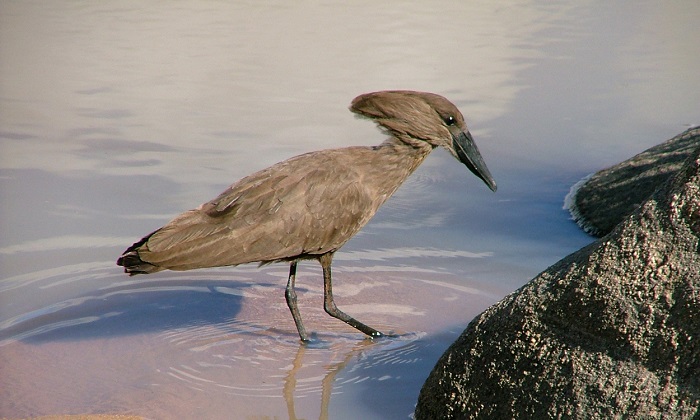
Cover image of Hamerkop by Derek Solomon – Mashatu Game Reserve, Botswana – BirdPix No. 9692
The Hamerkop is the only member of the Family SCOPIDAE. They are thought to be most closely related to storks, herons and ibises. The middle toe of each foot has a pectinate (comb-like) claw that is most likely used for grooming the feathers.
Identification
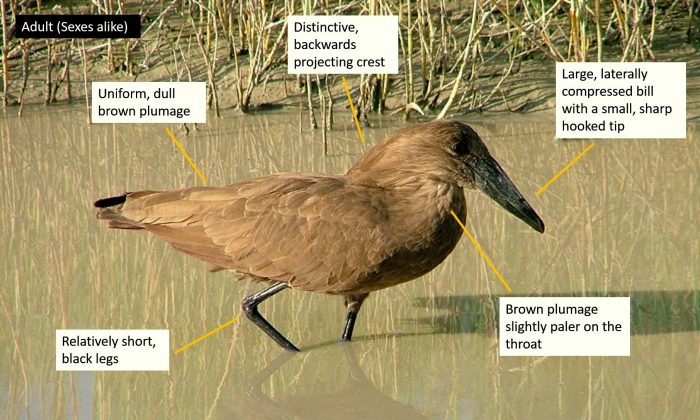
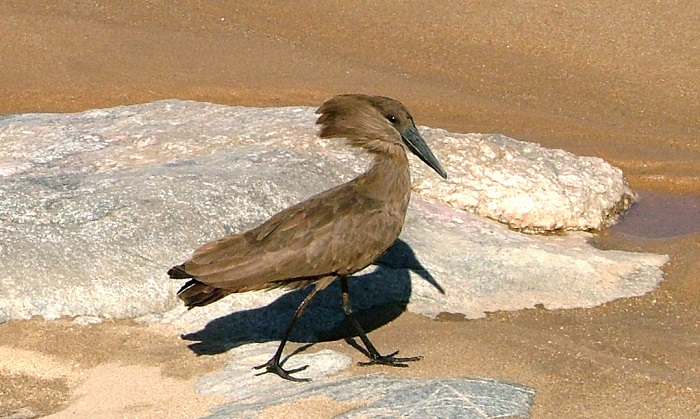
The Hamerkop is a very distinctive and unmistakable species. It is a medium-sized waterbird, similar in stature to a slim domestic chicken.
The sexes are alike in plumage colouration and juvenile birds closely resemble the adults.
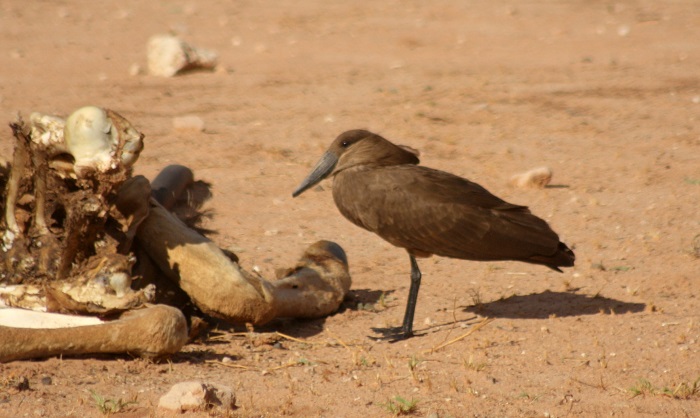
The plumage is entirely dull brown and slightly paler on the throat and underparts. The Hamerkop’s most distinctive features are the backward projecting crest and the large, laterally compressed bill with a hooked tip. The legs are black and relatively short. The eyes are dark brown.
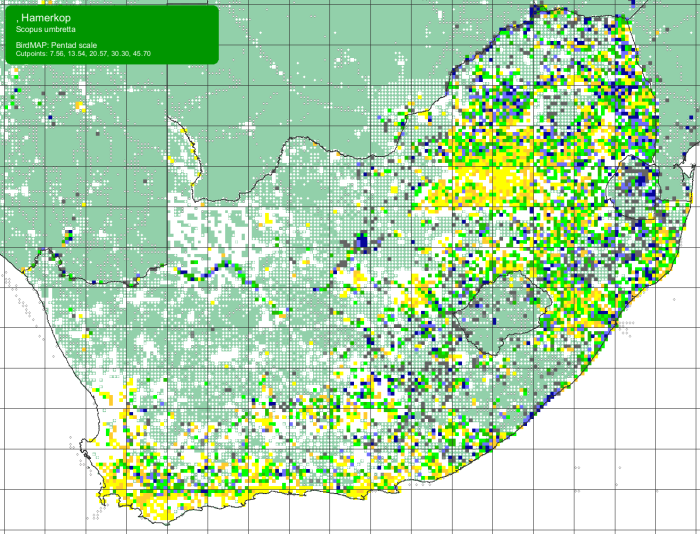
The Hamerkop is distributed throughout sub-Saharan Africa and Madagascar. It is also found in south-western Arabia. The Hamerkop occurs throughout southern Africa and is absent only from very arid areas that lack surface water. It is most numerous in the higher rainfall north and east of the sub-continent.
SABAP2 distribution map for Hamerkop (Scopus umbretta) – June 2024. Details for map interpretation can be found here.
A fairly common resident in southern Africa. The Hamerkop was less widespread historically than it is at present, especially in the arid western regions. Humans have assisted a range expansion into these areas through the development of artificial aquatic habitats like farm dams and irrigation systems.
In some regions the Hamerkop has been negatively impacted by the degradation of wetlands, particularly as a result of cattle trampling. Additionally, the clearing of riparian woodland in places has resulted in the loss of nest sites. It has decreased in numbers in parts of the Western Cape due to its nests regularly being usurped by the Egyptian Goose (Alopochen aegyptiaca). However, on balance, the Hamerkop remains widespread and is currently not of conservation concern.
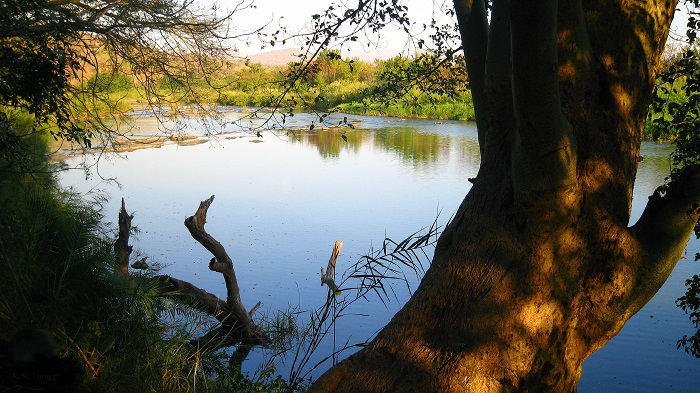
The Hamerkop frequents many aquatic habitats, ranging from lakes, pans and dams, to rivers, streams, marshes and swamps. The Hamerkop also inhabits temporary or ephemeral habitats like seasonally flooded ponds and puddles. The Hamerkop is seldom found at estuaries and rarely forages along open coastlines. Due to its relatively short legs, the Hamerkop requires fairly shallow water in which to forage.
Typical riverine habitat Pongola River, KwaZulu-Natal Photo by Ryan Tippett
Behaviour
The Hamerkop is both diurnal and semi-nocturnal. They are non-territorial and are usually encountered solitarily or in pairs, but sometimes in small groups of 4 or 5 birds. Rarely aggregates in larger groups of up to 50.
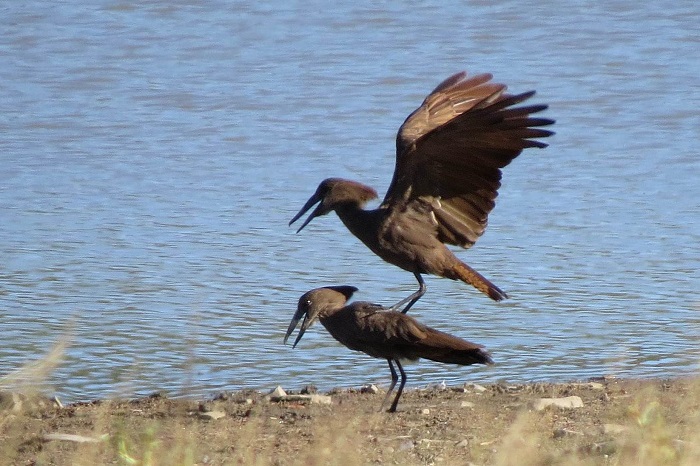
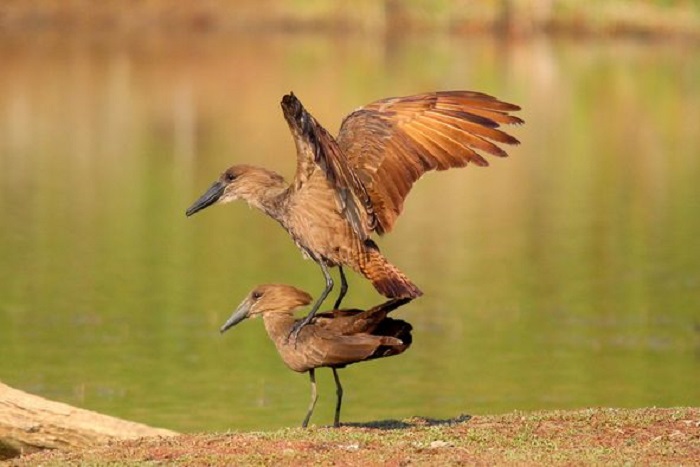
They are known to practice mutual allopreening (Two birds preening each other at the same time), and are well known for some interesting behavioural displays. The most characteristic and bizarre of these displays is called False-mounting. This involves 1 bird standing on the back of another while flapping its wings to maintain balance, often while calling incessantly. This may also take place in groups with different birds alternately false-mounting each other, sometimes even with a third bird atop a false-mounting pair. The true purpose of this unusual behaviour is not known.
Hamerkop (Scopus umbretta). A pair during a ‘false-mounting’ display. Between Middelburg and Hanover, Northern Cape Photo by Tino Herselman
Hamerkops mostly roost in or near the nest, with groups sometimes roosting together in a waterside bush. Single birds may sometimes roost communally with other species like cormorants, egrets and Ibises. Fledglings may roost in or on top of the nest.
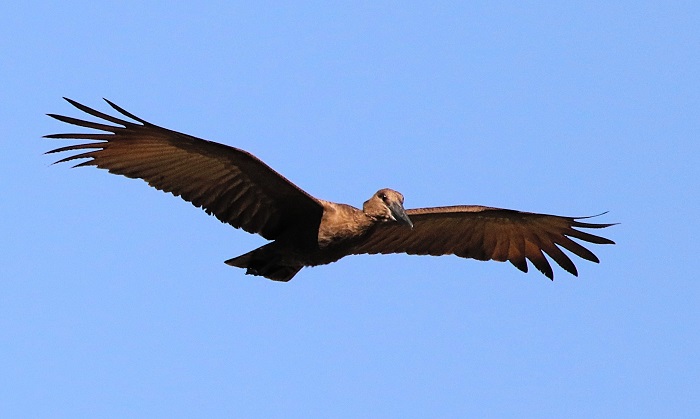
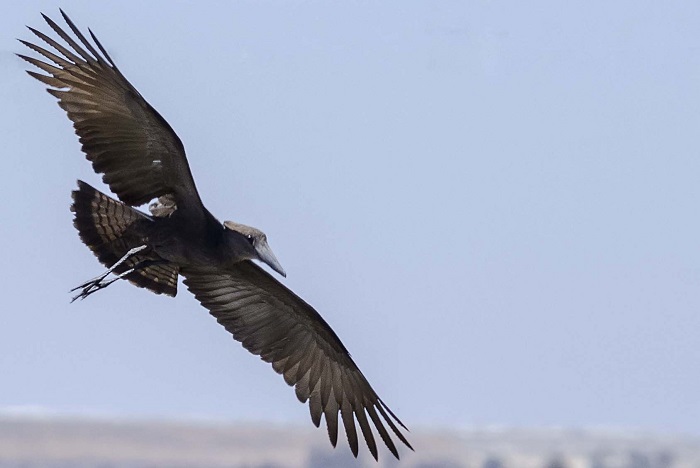
They are swift and agile in flight and can take-off with a single upward leap. In flight, the head is partially retracted into the shoulders, but the neck is held fully extended when soaring or gliding. Hamerkops walk with quick, jerky steps, the head and neck moving back and forth with each step.
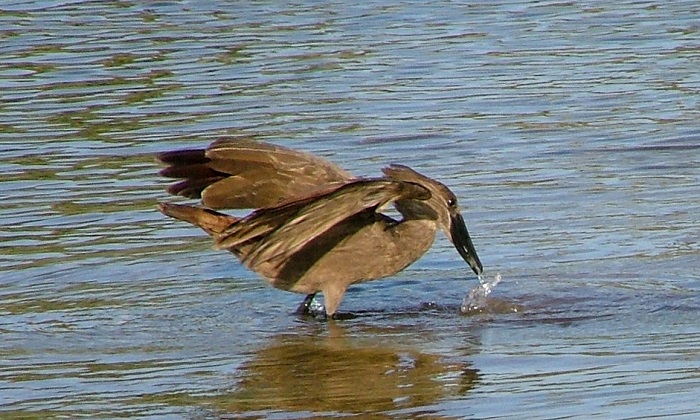
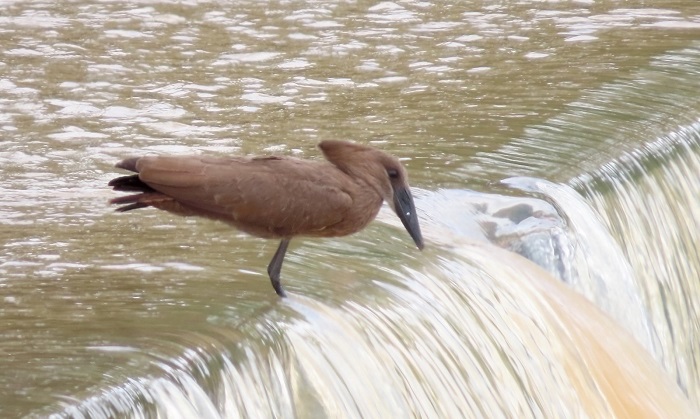
The Hamerkop is known to use several different foraging techniques that demonstrate its intelligence and versatility. The main foraging method involves either standing and waiting patiently at the water’s edge or walking slowly along the shore, ready to snatch prey from the water or land. They may also use subtle ‘foot-trembling’ while wading in order to lure prey, and can be seen to wait strategically at rapids, grabbing food that drifts or swims past. They can also probe into mud with their bills in search of concealed food. Additionally, the Hamerkop can forage aerially in agile flight, low over the water in order to seize prey from the surface.
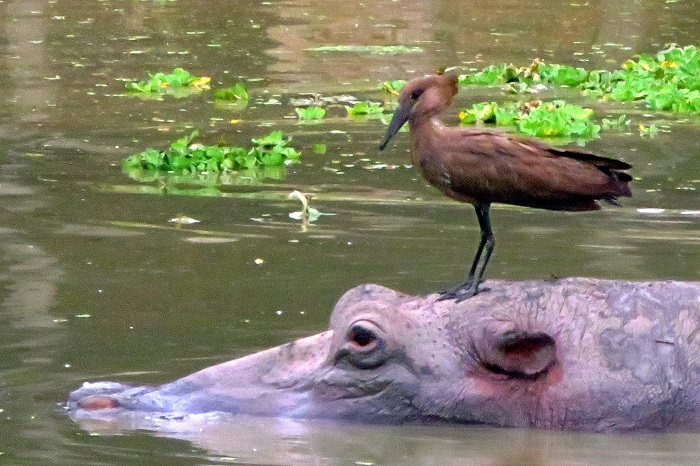
The Hamerkop is also observed to hunt from the back of Hippopotamus (Hippopotamus amphibius), and may attend foraging groups of other animals like Banded Mongoose (Mungos mungo) or grazing cattle and Buffalo, using them as beaters to flush grasshoppers. They are also known to scavenge bits of food from around carcasses and will sometimes consume road killed food items.
The specialised bill is laterally compressed and includes a sharp hook at the tip. The bill structure allows the bird to easily manipulate slippery prey so that it can be beaten against the ground or a rock etc. This is done to stun the prey, making it easier to swallow head first. The same action is used to remove the toxic slime from the skin of Platannas (Xenopus spp), the bird periodically rinsing the frog in water between beatings.
Platannas (Xenopus spp) are the preferred food choice of the Hamerkop. This frog genus has a very similar distribution to the the bird, supporting the theory that Hamerkops are dependent on them as food. They also consume many other frog and toad species, as well as small fish, shrimps and various aquatic and terrestrial invertebrates such as grasshoppers, beetles, termite alates, earthworms and the occasional small mammal.
The Hamerkop breeds throughout the year in southern Africa, with an egg-laying peak during August and September. It is a monogamous, solitary nester.
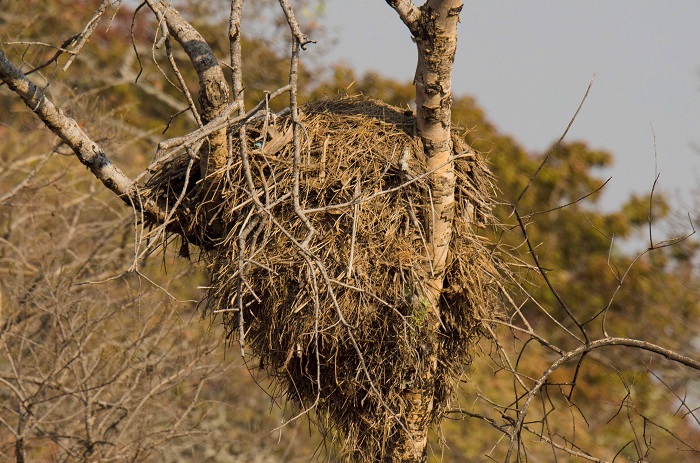
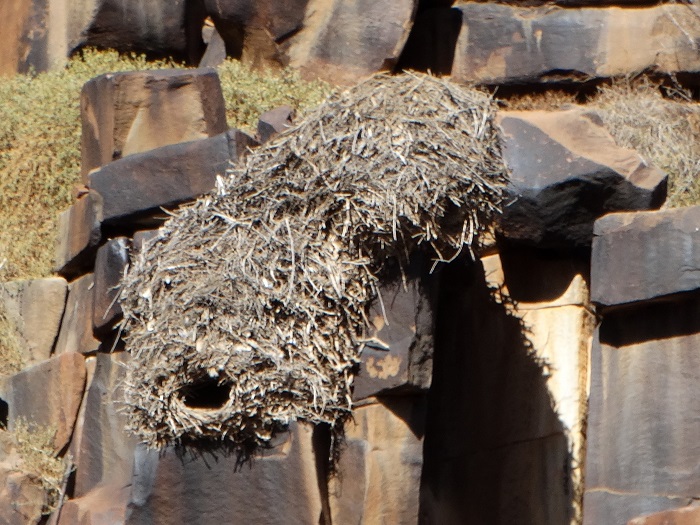
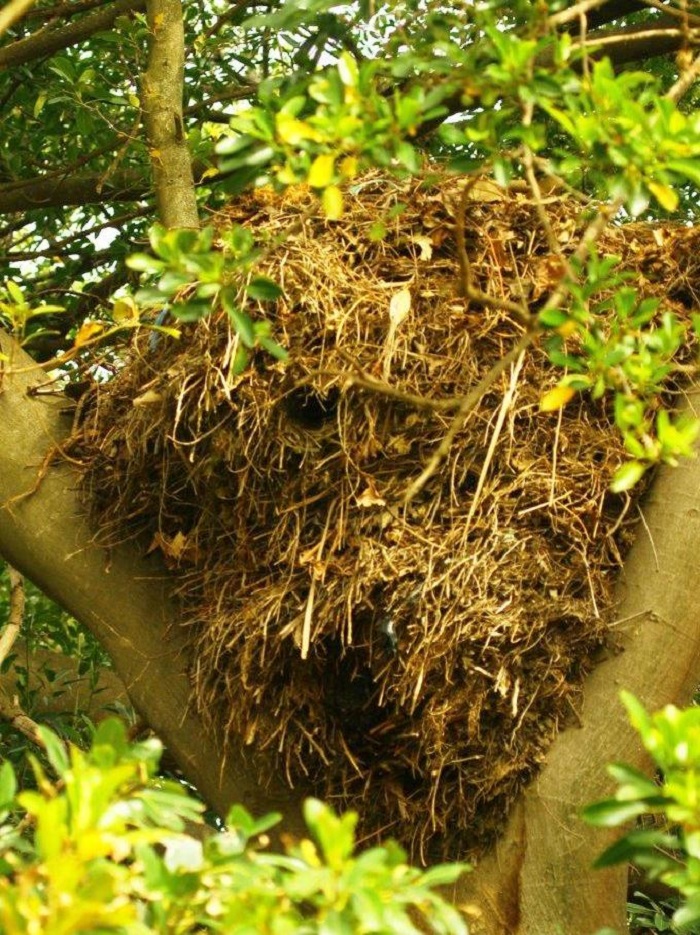
The untidy nest is a huge, oven-shaped, domed mass of sticks, reeds and other bits of debris. It has a central nest chamber with an entrance tunnel situated low down on the most difficult to access side of the nest. The nest is normally built into the sturdy fork of a tree or on a cliff ledge. Nests may measure up to 2m in diameter and with a roof at least 1m thick. The nest chamber is 30 to 50 cm in diameter and is roughly plastered with mud. The steep entrance tunnel, on the other hand, is smoothly plastered to make it difficult for intruders to access the nest chamber.
Nests are constructed equally by both sexes, but may also be built cooperatively by 4 or more birds. Nest construction takes anywhere from 3 weeks to 6 months to complete. The nest begins as a bowl-shape before the sides and roof are added. The wicker-like nest walls and roof are made of carefully interwoven sticks with the pair working together to weave the sticks in place. Completed nests are structurally sound and the roof can withstand the weight of a full-grown person! The central nest chamber is then covered with sticks and other nesting material. The male then brings mud to the female who uses it to line the walls and floor of the chamber, as well as the entrance tunnel.
The completed nest can weigh up to 50kg. The true purpose of such a disproportionately large nest is not fully understood. It has been suggested that the nest provides security and a warm microclimate, enabling Hamerkops to lay larger clutches than other related birds, and to leave nestlings for longer periods while adults forage.
If left undisturbed, Hamerkops may use the same nest for up to 4 years. Nests are sometimes usurped by other birds, most notably by Egyptian Goose (Alopochen aegyptiaca) and Western Barn Owl (Tyto alba), also by bees, mammals and reptiles.
Anywhere from 1 to 7 plain white eggs are laid per clutch. The incubation period lasts for around 30 days and and incubation duties are shared by both sexes. The nestling period then takes a further 45 to 50 days and the young are fed and cared for by both parents. At around 55 days old the fledglings are quite agile and are able leave and return to the nest.
The Hamerkop is a long-lived species with a life expectancy of more than 20 years.
Further Resources
This species text is adapted from the first Southern African Bird Atlas Project (SABAP1), 1997.
The use of photographs by Colin Summersgill, David Kennedy, Derek Solomon, Eukene Rueda, Kyle Finn, Lia Steen, Mark Stanton, Nico Vromant, Salim Lee, Tino Herselman, Tony Archer, Vaughan Jessnitz and Zenobia van Dyk is acknowledged.
Virtual Museum (BirdPix > Search VM > By Scientific or Common Name).
Recommended citation format: Tippett RM 2024. Hamerkop Scopus umbretta Biodiversity and Development Institute. Available Online at https://thebdi.org/2024/06/19/hamerkop-scopus-umbretta/
A list of bird species in this format is available here.
Cover image of Kori Bustard by Neels Putter – Mapungupwe National Park, Limpopo – BirdPix No. 257451
Bustards and Korhaans belong to the Family OTIDIDAE. They are robust, medium to very large ground birds. They have long necks and relatively large heads. The legs are long and the feet are equipped with 3 short, strong toes. The feet lack hind toes.
Identification
The Kori Bustard is a very large and conspicuous species. It is the largest of all bustards and is in fact the world’s heaviest flying bird. Male Kori Bustards are much larger than females. Males weigh 12.4kg on average, but can attain a weight of up to 19kg. The average weight of females is 5.7kg. The sexes differ very slightly in plumage coloration.
In males, the crown is black, with an indistinct grey median stripe. A long crest on the hind-crown gives it a characteristic appearance. The face is grey, with a whitish supercilium that extends behind the eye. The throat is white and the feathers around the entire neck are finely barred grey and white. At the base of the hind neck there is a black collar that extends onto the sides of the breast. The rest of the underparts, from the breast to the vent are white.
The upperparts are greyish-brown with fine dark brown flecks. The wing coverts form a variable black-and-white panel in the folded wing. Flight feathers are greyish-brown, with fine whitish bars. The tail is greyish-brown, with 2 creamy white bars towards the base. The bill is pale horn-coloured and the eyes are yellow. Leg colouration varies from yellow to dark cream.
The far smaller females closely resemble males, but show less black on the crown and have a narrower supercilium and a more finely barred neck. Juveniles are similar to adult females, but have a paler head, a shorter crest and a browner back.
The Kori Bustard can be confused with Denham’s Bustard (Neotis denhami) and the Ludwig’s Bustard (Neotis ludwigii). Both of these species are much smaller and have chestnut (not grey and white) hind necks, and they show striking white wing markings that are visible in flight. Additionally, both lack the dark crest and black collar.
The Kori Bustard has a disjunct African distribution with two populations comprising two subspecies, one in southern Africa and the other in north-east Africa. It is widespread, although patchily distributed, in southern Africa.
SABAP2 distribution map for Kori BustardArdeotis kori – June 2024. Details for map interpretation can be found here.
It occurs mainly in the semi-arid regions in the western half of southern Africa but is largely absent from the extremely arid Namib Desert. The species penetrates to the east along the central plateau of Zimbabwe and the dry Limpopo River Valley into the eastern lowveld of South Africa, just reaching southern Mozambique. There is a partially isolated population south of the escarpment in the southern Nama Karoo between Prince Albert (Western Cape) and Makhanda (Grahamstown) (Eastern Cape). The largest populations occur in Namibia and Botswana.
The Kori Bustard is scarce to locally common in southern Africa and is currently listed as Vulnerable in South Africa. The Kori Bustard has decreased in range and abundance in several regions, including Zimbabwe and Eswatini (Swaziland) where it became extinct prior to 1960. In South Africa it has decreased markedly in Limpopo and Mpumalanga and is now absent from the central savannas of north-eastern South Africa. The species has also declined in the Eastern Cape province. The Kori Bustard is now common only in large protected areas. It is, however, still present in lower numbers in many smaller protected areas. The threats faced by this species are numerous and include habitat destruction, bush encroachment, high human densities, poisoning, deliberate hunting, collisions with overhead transmission lines and stray dogs.
Habitat
The Kori Bustard inhabits fairly dry, open habitats on flat terrain and with rainfall between 100 to 600 mm per year. Typical habitats include dry, open savanna, Nama Karoo dwarf shrublands and arid grasslands. They also frequent dry floodplains and the grassy edges of seasonal pans.
Typical habitat Near Vanwyksvlei, Northern Cape Photo by Ryan Tippett
They are often found close to tree-lined watercourses, which provide cover when disturbed and shade during the heat of the day. The Kori Bustard is usually absent from areas of dense vegetation. They are frequently found on sandy soil, especially Kalahari sands, but also occur on stony ground. They are mainly encountered in natural vegetation, but sometimes aggregates in cleared areas, such as airstrips, fire-breaks, pastures and fields. They are occasionally attracted to burnt ground.
Behaviour
The Kori Bustard is most often found solitarily or in pairs when breeding. They are otherwise somewhat gregarious in groups of up to 40 or more. They spend most of their time walking slowly across open habitats. They walk or run quickly when disturbed but are usually reluctant to fly. The flight is heavy and laboured, yet powerful. Kori Bustards normally take flight after running a short distance but can take-off from a standing position if they need to. In hot weather they usually rest up in shade to avoid the mid-day heat.
They drink regularly when water is available but are not dependant on water. Drinks with a sucking action, usually by lying down on the tarsal joint, allowing the head and neck to be almost level with the water.
Movements of the Kori Bustard are poorly understood and there is no evidence for regular migration. Any movements are more likely to be nomadic in response to the unpredictable rainfall of semi-arid areas.
Kori Bustards roost on bare ground or in very short grass where they remain crouched and immobile the entire night.
Forages by walking and pecking on the ground or in low bushes and trees. Kori Bustards are omnivorous and have a varied diet. They do not have a crop but possess well-developed caeca (secondary fermentation chambers) in the large intestine which indicates that plant material plays an important role in the diet. This allows them to consume green leaves, grass, flowers, roots, bulbs, seeds and berries. They also feed on wild melons and the gum of Vachellia (Acacia) trees, hence its Afrikaans name of ‘Gompou’.
Animal matter in the diet includes invertebrates like grasshoppers, locusts, beetles, termites, caterpillars, solifuges, scorpions and snails. Kori Bustards are especially fond of Dung Beetles and Armoured Ground Crickets. They also eat small vertebrates such as rodents, lizards, chameleons, snakes and birds’ eggs and nestlings. They also sometimes consume carrion. Kori Bustards are attracted to locust and caterpillar outbreaks and will visit recently burnt areas in the hopes of finding prey that may have perished in the flames. They can occasionally be seen foraging alongside Denham’s and Ludwig’s Bustards.
In some regions, notably the Savuti Depression in Botswana, Southern Carmine Bee-eaters (Merops nubicoides) are commonly seen to perch on the backs of Kori Bustards, in order to hawk flushed insects. However, this association is rarely reported elsewhere in southern Africa. There are also records of Fork-tailed Drongo (Dicrurus adsimilis) doing the same.
Kori Bustard (Ardeotis kori) Savuti, Botswana. The bird on the bustard’s back is a Southern Carmine Bee-eater. Photo by Pieter Cronje
Kori Bustards are polygynous, whereby males mate with multiple females through the breeding season. Males establish regularly used lek sites where they display competitively in order to entice females for mating. Leks are mostly situated in prominent positions such as on a rocky ridge. Several males may gather at these sites to display, but usually one male will achieve dominance over his rivals through complex posturing, forcing the others to move away. Evenly matched males may end up fighting which involves them standing chest-to-chest, their tails fanned and erect and their bills locked together. They then engage in ‘pushing’ one another for up to 30 minutes until a victor emerges.
Dominant males perform courtship displays mainly during the early morning and late afternoon. They strut about with their crests erected, tails fanned, winged drooped and necks inflated to 4 times the normal size. The neck feathers are long and loose to allow the neck to expand. They utter a booming, far carrying call when the neck is fully inflated. This sound is created by the air as it gets forcibly expelled from the inflated oesophagus. The inflated neck serves to resonate and amplify the booming call over a great distance. This display also serves a visual function and is conspicuous from some way off. Females choose the dominant males for mating and after copulation males take no further part in in the breeding process.
No true nest is constructed. The nest is merely a shallow, unlined scrape on the ground, often in sandy soil. The nest site is sometimes reused in successive years. Usually 2 (sometimes just 1) eggs are laid per clutch. The eggs are pale olive-brown with darker olive-green and brown streaks and shading. Eggs are laid between July and April but peak laying times vary by region, and is likely linked to rainfall. The incubation period lasts for around 24 days, during which time the female will regularly turn the eggs with her bill. The highly precocial young are cared for by the female and may remain with her for up to 18 months if she does not breed again the following year.
Kori Bustards are long-lived and have been recorded to live up to 26 years.
This species text is adapted from the first Southern African Bird Atlas Project (SABAP1), 1997.
The use of photographs by Ansie Dee Reis, Aron, White, Derek Solomon, Johan Van Rooyen, John Tinkler, Marius Meiring, Neels Putter, Pieter Cronje, Roy Earle and Salome Willemse is acknowledged.
Virtual Museum (BirdPix > Search VM > By Scientific or Common Name).
Other common names: Gompou (Afrikaans); Iseme (Xhosa); Kgôri (Tswana); Koritrap (Dutch); Outarde kori (French); Riesentrappe (German); Abetarda-gigante (Portuguese).
Recommended citation format: Tippett RM 2024. Kori Bustard Ardeotis kori. Biodiversity and Development Institute. Available Online at https://thebdi.org/2024/06/12/kori-bustard-ardeotis-kori/
A list of bird species in this format is available here.
A group of BDI people went bird ringing at Botuin, Vanrhynsdorp, from Sunday 2 June to Wednesday 5 June. The aim was to keep a consistent pattern of ringing going at this site, so we firstly build up the proportion of birds which are ringed, so that retraps become more frequent. With lots of retraps, we can start making estimates of annual survival rates for a few of the commonly ringed species. We do not know the survival rates for almost all the species we handle regularly here. Estimates of survival, and how they are changing through time, are one of the foundational pieces of knowledge needed to implement conservation recommendations.
We had some rain and lots of cold weather, with parts of South Africa experiencing floods and stormy weather. Nevertheless, we caught some great birds including African Hoopoe, Sickle-winged Chat, Yellow-bellied Eremomela (a first for me!), Rufous-eared Warbler, Namaqua Warbler, Fairy Flycatcher and Bokmakierie.
The most caught species was the Laughing Dove (11), followed by Red-faced Mousebird (4) and Cape Weaver (4). For the rest of the species, between one and three individuals were caught. At Botuin, 40% of birds caught were recaptures. This is fantastic in terms of our goal of estimating survival. The oldest birds were the resident pair of Fiscal Flycatchers, first ringed in January 2020. See list of previous ringing events (at Botuin and elsewhere) here. To join a ringing event, see calendar here.
Birds had completed primary moult, except for some doves and mousebirds.
Namaqua Dove with outermost primary completing moult (feather sheath is visible)
Among the doves we caught while bird ringing at Botuin was this red-eyed dove (in lower case!):
… it’s actually a Laughing Dove … look at this!
Laughing Dove with a red-eye ring. It now has ring D97688, and is in the BOP (Birds with Odd Plumage) section of the Virtual Museum as record BOP818
Table. Birds caught at Botuin & Gifberg, 2 to 5 June 2024
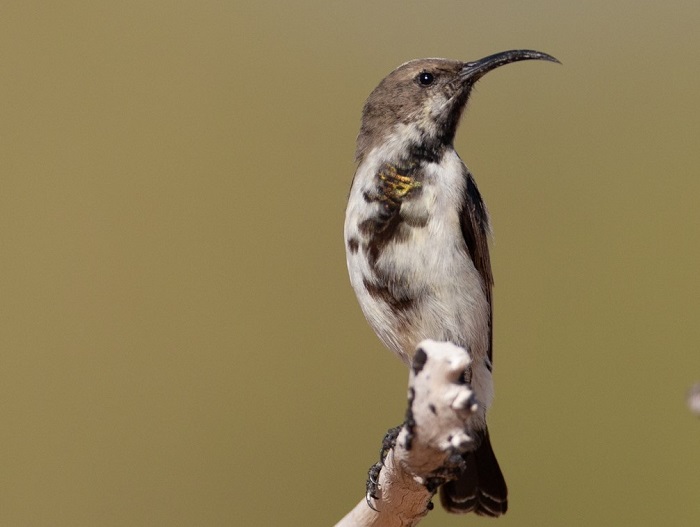
The Dusky Sunbird is a medium sized sunbird This species is sexually dimorphic, the breeding males are more colourful than females.
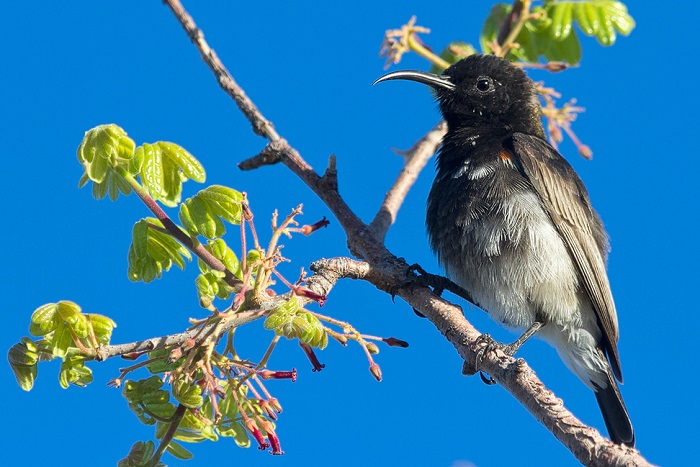
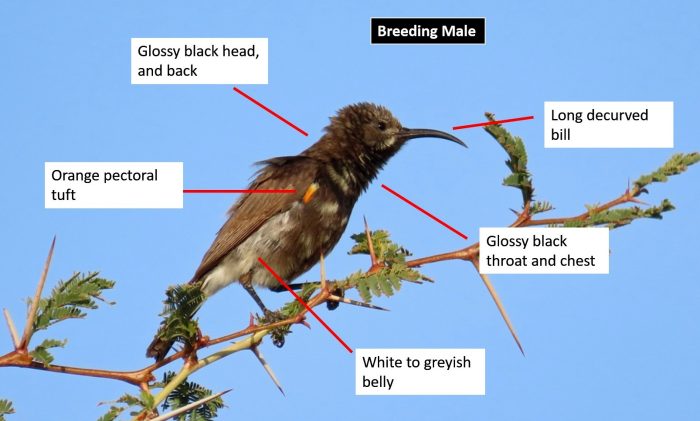
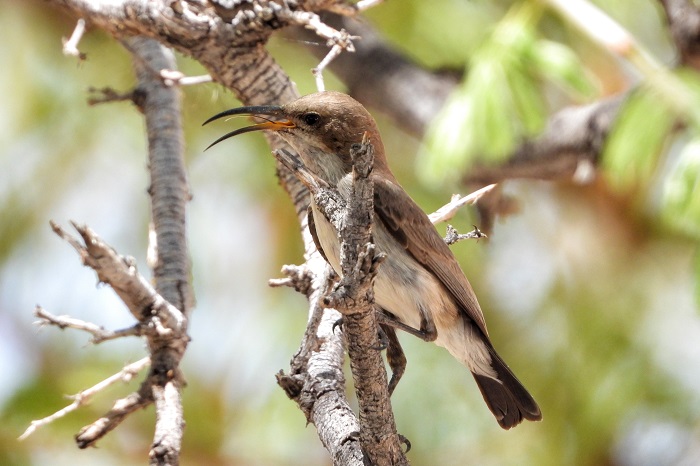
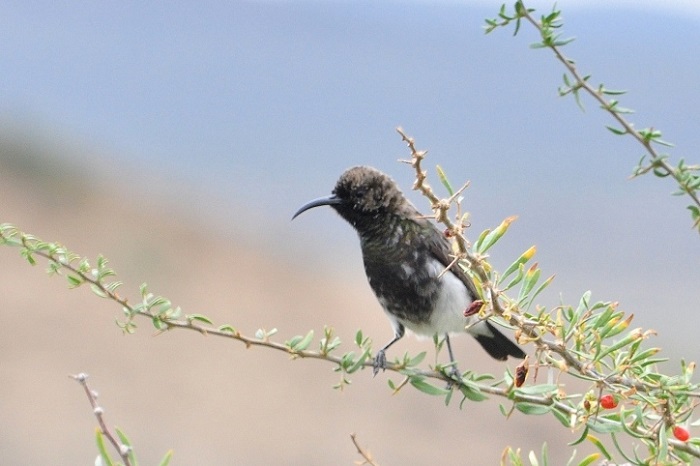
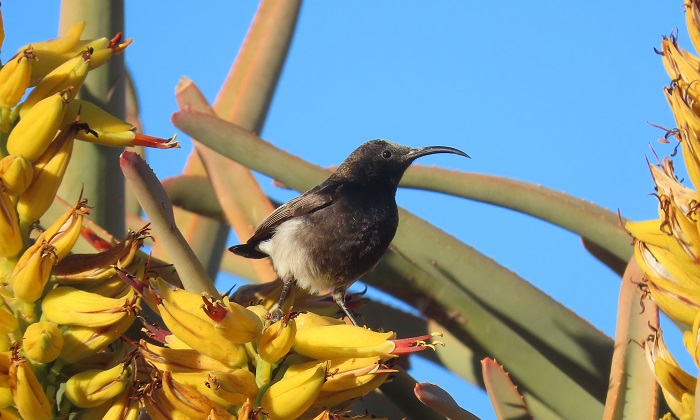
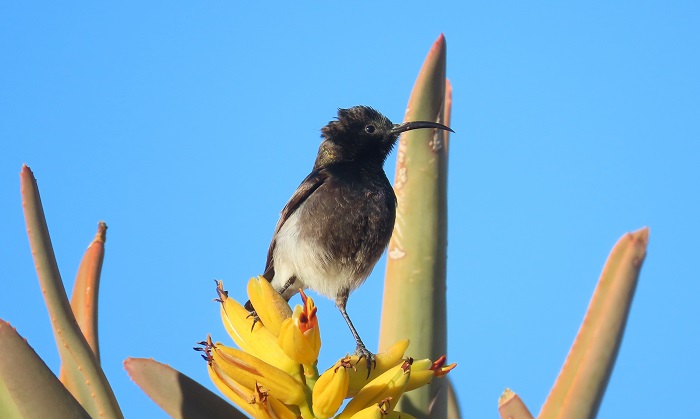
Breeding males are distinctive and easily recognisable. The head, back, throat and chest are glossy black and the belly is white. The tail is blackish, with a slight blue iridescence. Breeding males also have orange pectoral tufts, but these are seldom visible unless the bird is excited or displaying.
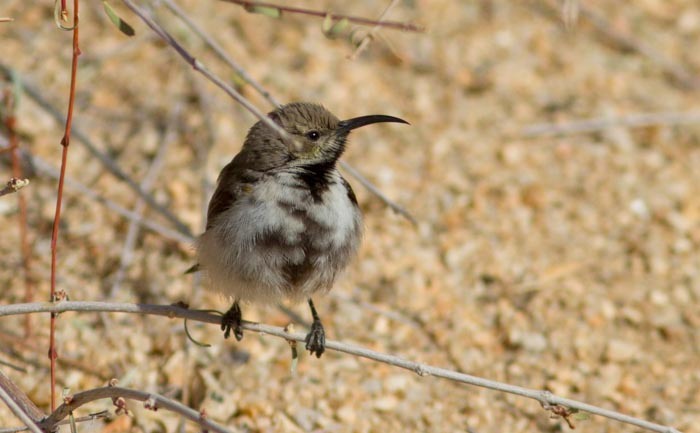
Non-breeding males and males in eclipse plumage resemble females and have grey-brown upperparts. They sometimes show a few blackish iridescent feathers. The undersides are whitish with a variable, glossy black patch or stripe on the throat and breast.
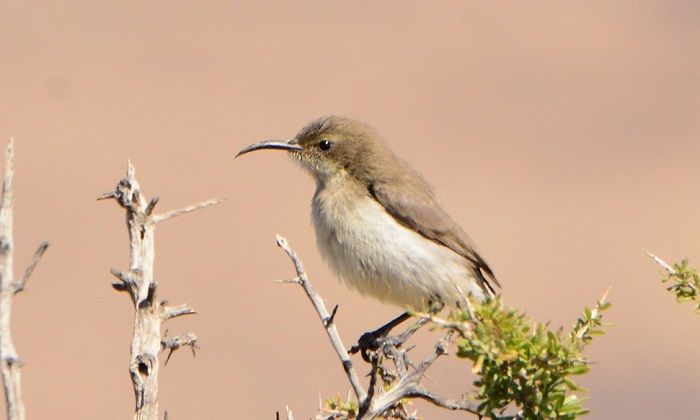
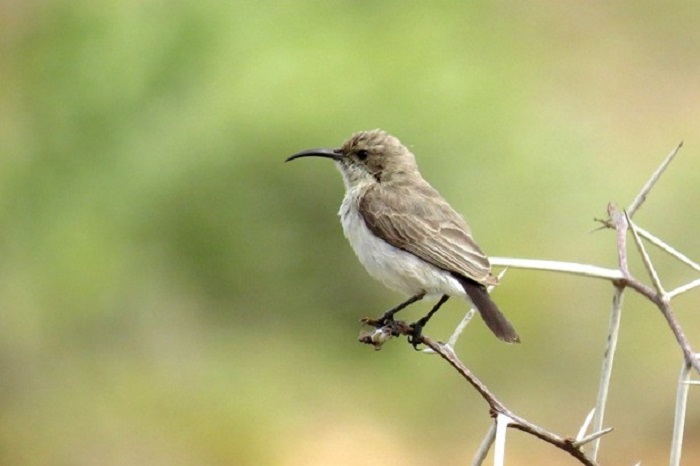
Females have plain greyish-brown heads and upperparts. The underparts, from the chin to the vent are white to off-white. The underparts contrast with the greyish-brown cheeks and upperparts. The tail is blackish.
Juveniles are similar to adult females, but have browner upper parts and their underparts are washed washed yellow. Juvenile males have variable blackish feathering on the throat.
Breeding males are unmistakable, but females are more problematic to identify. They are most likely to confused with the female White-bellied Sunbird (Cinnyris talatala) or the female Southern Double-collared Sunbird (Cinnyris chalybeus). The former has a faintly streaked (not plain) breast, and the latter has a darker grey-brown throat and breast and lacks the contrast between the upper and undersides. Females of these species are best identified by the accompanying male.
Status and Distribution
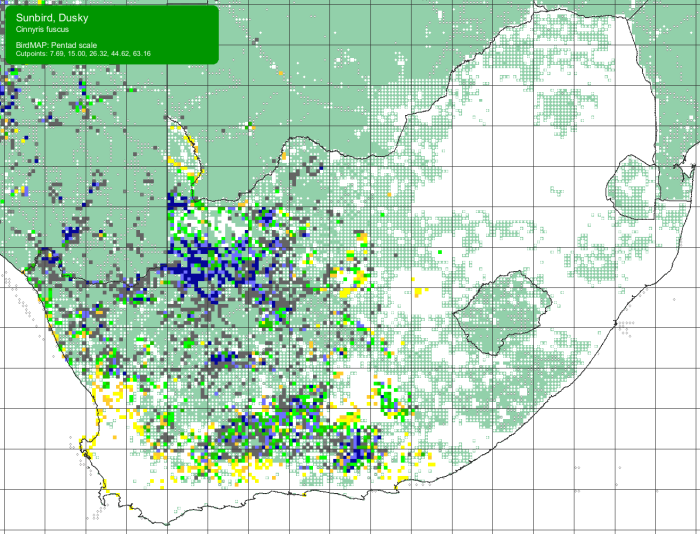
The Dusky Sunbird is Locally common and near-endemicto southern Africa. It occurs throughout the arid and semi-arid arid western parts of South Africa. It ranges north through south-western Botswana (avoiding the central Kalahari), throughout most of Namibia and into Angola along the arid coastal plain.
The Dusky Sunbird is scarce in in southern Kalahari and the Little Karoo, with occasional records south of the Cape Fold Mountains and to the south towards the west coast to Cape Town.
SABAP2 distribution map for Dusky Sunbird (Cinnyris fuscus) – May 2024. Details for map interpretation can be found here.
The Dusky Sunbird is not threatened and its choice of arid habitats makes it relatively safe from human interference.
Habitat
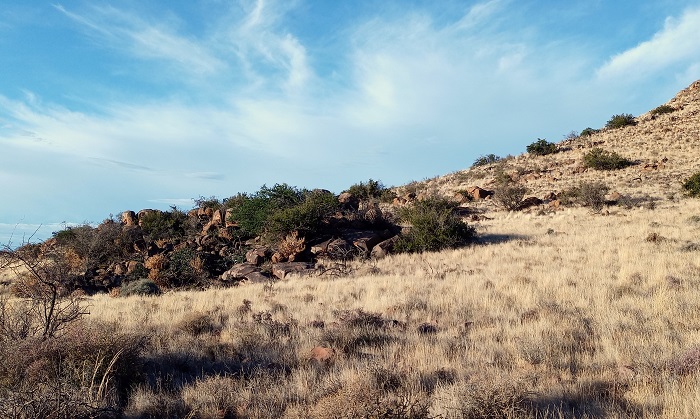
The Dusky Sunbird’s preferred habitat is rocky outcrops with taller vegetation, as well as drainage line scrub or woodland in the succulent and Nama Karoo. It also inhabits semi-arid coastal plains with sand dunes. It favours rocky habitats or broken ground, possibly because flowering succulents such as Aloes and crassulas are more common in such areas.
Areas with rocky outcrops and taller vegetation are a favoured habitat of the Dusky Sunbird. Carnarvon district, Northern Cape Photo by Ryan Tippett
It avoids the ‘sand sea’ of the central Namib Desert, but occurs elsewhere within the Namib Desert, provided there is some tall vegetation. The Dusky Sunbird also readily enters gardens and orchards.
The Dusky Sunbird is mainly a sedentary resident and does not show any regular seasonal movements. As with most birds of arid country, it is nomadic in response to the availability of food, which in turn, is dependant on rainfall. The Dusky Sunbird is capable of moving large distances in search of resources. During drought periods it irrupts into neighbouring, more mesic regions such as the coastal regions of the Western Cape, and into the North West Province.
The Dusky Sunbird is an active, restless species and is usually encountered singly or in pairs. Larger groups may aggregate at major nectar sources where it often associates with other sunbird species like Scarlet-chested Sunbird (Chalcomitra senegalensis), White-bellied Sunbird (Cinnyris talatala) and Southern Double-collared Sunbird (Cinnyris chalybeus). The flight is fast and direct, but not as erratic as in other sunbirds.
The Dusky Sunbird generally probes for nectar while perched but may also hover for brief moments, often to snatch insects out of spider webs. They move quickly from flower to flower. The diet consists mostly of nectar and is supplemented with arthropods, especially spiders and small insects like flies, moths, caterpillars, bugs and beetles. Insect prey is mostly gleaned from flowering plants but they also hawk insects out of the air. Important food plants include Vachelia (Acacia) species, various aloes including Kraal Aloe (Aloe claviflora) and the Quiver-tree (Aloidendron dichotoma), also Leafless Wormbush/Black Storm (Cadaba aphylla), Crassula species, mesembryanthemums, honey-thorns (Lycium spp) and mistletoes (Loranthaceae). Dusky Sunbirds also feed on the nectar of a range of alien and garden plants such as Wild Tobacco (Nicotiana glauca). Drinks water on occasion, mostly on on warm days.
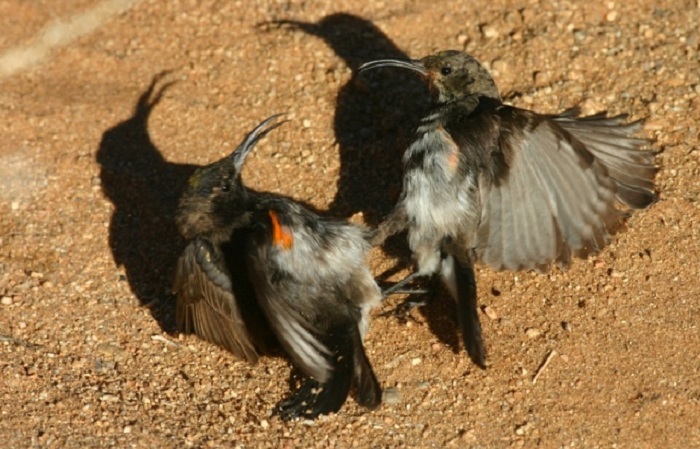
The Dusky Sunbird has a long breeding season from August to March but breeding can take place at any time of the year. This is indicative of opportunistic breeding linked to rainfall. If rains come early, some males will attempt to breed while still in eclipse plumage. Males aggressively defend their territories which, on occasion, may lead to fighting. The nest is built entirely by the female while the male remains nearby to defend his territory.
The nest is oval, with a side-top entrance. It is constructed out of dry grass, plant fibres, bark and dry leaves. The nest is bound together with spider web and it is lined with soft seed fibres or animal hair. The nest is usually placed in a low shrub 40 to 90 cm above the ground. Females sometimes build several preliminary nests before egg laying starts. Some nests can be abandoned before laying if conditions become unfavourable. Two to three eggs are laid per clutch. The incubation period lasts just 13 days and all incubation is performed by the female. Nestlings are fed by both parents but they are brooded by the female only. The nestling period lasts around 13 days.
Dusky Sunbirds are double-brooded in high-rainfall years. This sunbird is sometimes parasitised by Klaas’s Cuckoo (Chrysococcyx klaas).
Further Resources
Species text adapted from the first Southern African Bird Atlas Project (SABAP1), 1997.
The use of photographs by Cobus Elstadt, Desire Darling, Gerald Gaigher, Jason Boyce, Johan Van Rooyen, Lappies Labuschagne, Maans Booysen and Pamela Kleiman is acknowledged.
Virtual Museum (BirdPix > Search VM > By Scientific or Common Name).
Other common names: Namakwasuikerbekkie (Afrikaans); Souimanga fuligineux (French); Roethoningzuiger (Dutch); Rußnektarvogel (German); Beija-flor-sombrio (Portuguese).
A list of bird species in this format is available here.
Recommended citation format: Tippett RM 2024. Dusky Sunbird Cinnyris fuscus. Biodiversity and Development Institute. Available online at https://thebdi.org/2024/06/04/dusky-sunbird-cinnyris-fuscus/
The mountains in the background to this pair of breeding White Storks look like they could easily be in Europe. But these are the mountains behind Paarl in the Western Cape, South Africa, and the nest is at the Tygerberg Zoo!!!BirdPix record 52545
What does this collection of countries in the map below have in common?
They are countries with breeding White Storks! These are the countries in which the 2024 edition of the International White Stork Census is taking place. South Africa is the only country in the southern hemisphere with breeding White Storks. Most people don’t realize that the breeding range extends southwards across the Mediterranean Sea to northern Africa. Here is a nest in Morocco:
Breeding White Storks in Marrakesh, Morocco. Photo by Jean Ramsay
The BDI has been given the task of finding out how many pairs of breeding White Storks there are in South Africa, currently. For now, the focus is on nests, rather than on birds!
The International White Stork Census takes place every 10 years. This year’s is the eighth. The number that South Africa submitted to the seventh census in 2014 was zero. We already know that that was wrong. In 2004, the number of pairs of breeding White Storks was 10.
We need your help to get the number we submit this year as close to the truth as possible!
… a two-paragraph detour!!
You are driving through the Free State. You stop at a bridge to watch the South African Cliff Swallows breeding. There are a few Barn Swallows among them. They are looking distinctly “blue”. They are in breeding plumage. This is the point at which you have to think the unthinkable, and do the craziest thing you have ever done in your life. Look for Barn Swallow nests in the Free State. This is not an outrageous idea, because birders in Argentina discovered Barn Swallows breeding there. They are normally visitors from North America.
Phil Whittington, ornithologist at the East London Museum, was a PhD student doing penguin fieldwork on Dyer Island. He got up one night for a pee, and heard a call he had only ever heard before as a recording. Leach’s Storm Petrel. He tracked down the source of the call; to his amazement, it was coming from inside a dry stone wall. He woke up Bruce Dyer at 02h00: “Bruce, I know this sounds insane, but there is a Leach’s Storm Petrel inside the wall out there, and I think it might be breeding.” Phil convinced Bruce to do the stupidest thing imaginable, and together they searched inside the wall for evidence of breeding. They were successful. There had been several other ornithologists who had had similar opportunities to be first to find Leach’s Storm Petrel, a migrant from the northern hemisphere, breeding in the southern hemisphere. In South Africa, New Zealand and near Antarctica. None had the courage to think the unthinkable!
… and getting back on the White Stork highway
So, on 18 November 1940, Austin Roberts (the first edition of the bird book now named after him in was also published that year) was driving around the Oudtshoorn district, when what he saw a nest made of sticks at the top of a dead eucalypt. He had the courage to believe what he was seeing. Something that left him totally gobsmacked. A White Stork nest with three chicks. He camped there for three nights. The farmer told him the storks were already breeding when he moved to the farm in 1933. The nest was close to the road between Oudtshoorn and Calitzdorp. Austin Roberts was surely not the first knowledgeable person to drive past the nest, but he had the courage to think the unthinkable. The storks bred again in 1941, but the nest had grown larger than the dead tree could support, and the three chicks died in the nest crash. This pair was not recorded breeding again.
The first nest in South Africa of a breeding White Stork, at the top of a dead tree on a farm near Oudtshoorn. Photo taken by G van Son, 18 November 1940. This photograph and the two below were originally published in the August 1941 edition of Ostrich in a paper written by Dr Austin Roberts and titled “The White Stork in South Africa“
Two more photos of the first White Stork nest close to the farmhouse on the farm Welbedacht in the Oudtshoorn district. (Ostrich 1941, see above)
Dr Austin Roberts’s own description of the three photos in his paper in Ostrich in August 1941
It was 21 years before the next White Stork nest was found, on 29 November 1961, on a farm in the area immediately south of Bredasdorp. Quickly, nests came to light on other farms in the neighbourhood. The maximum number of active nests was four. It is this little population that has persisted the longest. We need to find out if there are still nests in this area in 2024.
The next nest was found by a schoolboy travelling by overnight train from Cape Town to Oudtshoorn. He woke up on 1 January 1966 to see a White Stork nest out the window. He reported it, but couldn’t remember where the train was when he saw it. Detective work with the stationmasters between Worcester and Mossel Bay took less than a day. The stationmaster at Riversdale spoke to engine drivers who quickly located the nest on a farm between Mossel Bay and Albertinia. This pair nested until 1976.
It was noted that usually all four or five eggs in the nests in the Bredasdorp district hatched, but that there was only space for three grown chicks at fledging time. The excess chicks were brought to Cape Town where they were hand-raised. The plan was to keep them at the old Tygerberg Zoo for a few years before they were released. Here are a few paragraphs that Professor Gerry Broekhuysen wrote in the May 1975 edition of the Cape Bird Club Newsletter.
“For the past few years White Storks, which were originally taken as young from nests in the Bredasdorp District, have been kept in an enclosed camp at the Tygerberg Zoo. They have been kept there to enable me to study and observe their behaviour and it is also hoped that when they have become adult (this is in Europe after four to five years) some of them would perhaps start to breed.
“Great was our excitement when at the end of last year [1974] some wild storks started to spend time in the zoo and eventually joined the captive ones at times. Two of these eventually took food at feeding times in the afternoon. Then in January two wild storks started to build a nest on top of one of the bird cages only a short distance from the stork enclosure. Before the nest was completed, however, it was blown off by a gale force wind. In the beginning of February the two birds started to build a new nest, this time in the corner and on top of the wire fence of the lion cage. Both birds built and eventually it was a great bulky structure.
“Who would have thought that this would happen?
“The birds are not timid at all and remain on the nest while visitors look at the lions.”
Gerry Broekhuysen was writing near the end of March, and said that these two birds were still at the nest, and had not migrated north with the migrant storks. “Are they going to breed in our spring as the birds in Bredasdorp do?” Sadly, within a month, on 16 April 1975, he passed away, and no information whatsoever about what happened at the zoo over the next few years has been kept for us.
White Stork nest on top of the Patas Monkeys’ cage at the Tygerberg Zoo on 27 October 2012.BirdPix record 309, submitted by Dieter Oschadleus
Apart from the fact that there were at least 18 of them, there is no record of what happened to the captive-reared White Storks at Tygerberg Zoo, but it does seem certain that breeding there was initiated by wild storks.
White Storks at their nest on top of a cage at the Tygerberg Zoo, on 26 July 2003. BirdPix record 52545
In December 2000, ornithologists from the Vogelwarte Radolfzell in Germany attached satellite tracking devices to five White Stork fledglings, four at Tygerberg Zoo and one near Bredasdorp. All five juvenile storks survived the hazardous first few weeks out the nest, and all of them travelled beyond South Africa before they died. Saturn survived the longest, close to a year, and the map below shows the track taken:
Satellite track of a young White Stork called Saturn. This White Stork had grown up in a nest which was in the enclosure at Tygerberg Zoo that housed the giant tortoise. The tracking device had been attached to Saturn on 6 December 2000.
That’s a bit of history!
Now we need to jump back to 2024. Please search diligently for breeding White Storks this year. If you chat to farmers, please ask them if they know of any nests. We need to track them down, so that we can provide reliable information to the 2024 edition of the International White Stork Census. Remember, right now it is nests that we are interested in (not birds or even flocks of birds, at least for now). Please also report any nests known to have been occupied in the last decade or so.
Please contact Les Underhill (les@thebdi.org) with whatever information you find. (Ideally, we hope that the report will contain place, coordinates, contact details of landowner, and a few photos!)
Cover image of White-Necked Raven by Zenobia van Dyk – Nyika National Park, Malawi – BirdPix No. 160639
Ravens belong to the Family CORVIDAE along with crows, Jays, Magpies etc. The family is known for their intelligence and for containing the largest of the passerines. Corvids are also the only passerine birds with the ability to soar.
Identification
The White-necked Raven is a large and distinctive black corvid. It is a conspicuous, aerial and vocal species which is unlikely to be overlooked.
They are easily recognised by the white collar or crescent on the hind neck and the otherwise entirely glossy black plumage. The sexes are alike in plumage but females are slightly larger than males. In flight, the broad wings and short, rounded tail are characteristic. The bill is distinctive, appearing heavy with an arched profile and a pale tip. The black legs are moderately long with large, strong feet.
Juveniles are browner than the adults and have a narrow, whitish breast band. The white feathers on the hind neck are sometimes also flecked with black.
The white necked raven can only be mistaken for the smaller Pied Crow (Corvus albus) and Cape Crow (Corvus capensis). It is easily separated from the Pied crow by the latter’s white (not black) breast. Cape Crows are more slightly built, with slender bills, and are entirely black, lacking the white hind neck.
The White-necked Raven is a locally common resident. It is patchily distributed from Kenya to South Africa. In southern Africa it is confined mainly to the east, south and south-west. The range of this species in southern Africa corresponds closely with the distribution of cliffs. The White-necked Raven is absent from most of southern Mozambique due to a general lack of suitable habitat. They occur in both semi-arid and higher rain fall environments but avoid the most arid parts of the region. This would explain its absence from much of the northern Karoo, Botswana and Namibia.
SABAP2 distribution map for White-necked Raven (Corvus albicollis) – download in May 2024. Details for map interpretation can be found here.
The White-necked Raven is not threatened. The species occurs in good numbers throughout its present southern African range, and is well represented in protected areas. They are sometimes directly persecuted because of a rumoured tendency to molest or even kill young or sick sheep. White-necked Ravens are also vulnerable to poisoning as a non-target scavenger.
Habitat
Semi-arid mountainous habitat. Near Carnarvon, Northern Cape Photo by Ryan Tippett
White-necked Ravens are almost exclusively cliff nesters. As a result they are largely restricted to mountainous and hilly terrain where nest and roost sites are plentiful. They often forage over adjacent open plains and farmlands, especially stock farming rangelands and less often in crop-farming areas. White-necked Ravens may sometimes forage at open areas in and around towns and cities, but not as frequently as other corvids.
High mountainous habitat in the Drakensberg. Sani Pass, Kwazulu-Natal Photo by Ryan Tippett
Behaviour
White-necked Ravens are usually encountered solitarily or in pairs. It is a sedentary, resident species, although some birds may move to lower altitudes in winter. They sometimes congregate in flocks of up to 150 at a good food source during the non-breeding season. They are often seen in the company of other scavengers like crows, kites and vultures. White-necked Ravens are opportunistic and are sometimes attracted to veld fires in the hope of catching prey fleeing from the flames.
Forages most frequently by soaring, but also seeks out food while walking on the ground, especially after fires and at rubbish dumps, livestock pastures and sports fields.
White neck Ravens are omnivorous and eat reptiles, birds, small mammals, bird eggs and insects like locusts and beetles. Also carrion, fruit and cereal grains, including maize, and groundnuts. They sometimes also feed on the nectar of large Aloes. White-necked Ravens scavenge readily and are usually first to arrive at carcasses, they also regularly patrol roads in search of roadkill. Small tortoises are a favourite prey and are carried in the feet or bill, where they are dropped onto flat rocks below to break open the shells. White-necked Ravens have also been recorded feeding on ticks taken from cattle. They are very intelligent and have been recorded caching food items in patches of tall grass.
White-necked Ravens have been recorded breeding from July to December throughout southern Africa. They are monogamous, and territorial when nesting. As they are aggressive birds, they often dispute territorial rights with other cliff nesting species.
The nest is a large bowl of sticks, lined with grass, hair and wool etc. Nests are placed on inaccessible ledges or in potholes on cliffs. Nests are rarely placed in trees. Clutch sizes range from 2 to 5 eggs. As with other corvids, incubation begins once the first egg has been laid. This results in the chicks hatching at different times. The incubation period last for around 21 days and is usually shared by both sexes. Chicks are fed entirely by the female, at first by regurgitation, then solid food is provided for them later. The female keeps the nest clean by swallowing the young chick’s faeces. Once the chicks are a bit older they defecate over the nest sides. The young are fully fledged around 38 days after hatching.
Species text in first Southern African Bird Atlas Project (SABAP1), 1997.
The use of photographs by Andries de Vries, Gary Brown, Gregg Darling, Karis Daniel, Lia Steen, Malcolm Robinson, Pamela Kleiman, Rick Nuttall, Tino Herselman and Zenobia van Dyk is acknowledged.
Virtual Museum (BirdPix > Search VM > By Scientific or Common Name).
Other common names: Withalskraai (Afrikaans); iHubulu, iWabayi (Zulu); lhlungulu, Irhwababa, Umfundisi (Xhosa); Lekhoaba (South Sotho); Corbeau à nuque blanche (French); Geierrabe (German); Witnekraaf (Dutch); Corvo-das-montanhas (Portuguese)
Recommended citation format: Tippett RM 2024. White-necked Raven Corvus albicollis. Biodiversity and Development Institute. Available online at https://thebdi.org/2024/05/24/white-necked-raven-corvus-albicollis/
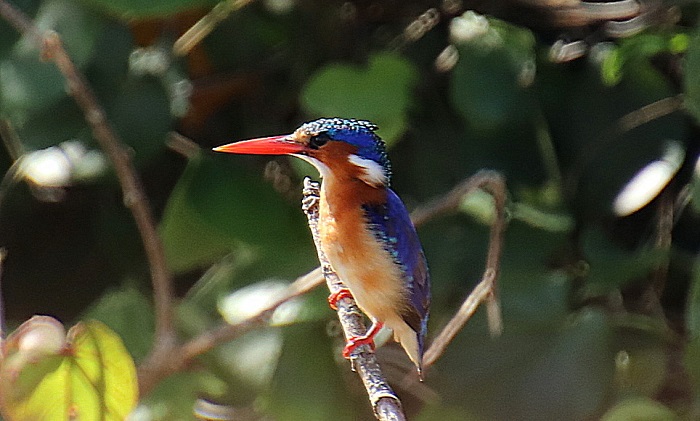
Cover image: Malachite Kingfisher by Dawie de Swardt – Dewetsdorp, Free State – BirdPix No.270818
Kingfishers belong to the family ALCEDINIDAE. They are small to medium-sized, brightly coloured birds in the order Coraciiformes. They have a cosmopolitan distribution, with most species living in the tropical regions of Africa, Asia, and Oceania, with just a handful of species found in Europe and the Americas. The family contains 118 species and is divided into three subfamilies and 19 genera. All kingfishers have large heads, long, sharp, pointed bills, short legs, and stubby tails. Most species have bright plumage with only small differences between the sexes. Most species are tropical in distribution, and a slight majority are found only in forests. Despite the English name ‘Kingfisher’, the majority of species do not feed on fish.
Identification
The jewel-like Malachite Kingfisher is a small, colourful species, and a firm favourite of bird photographers.
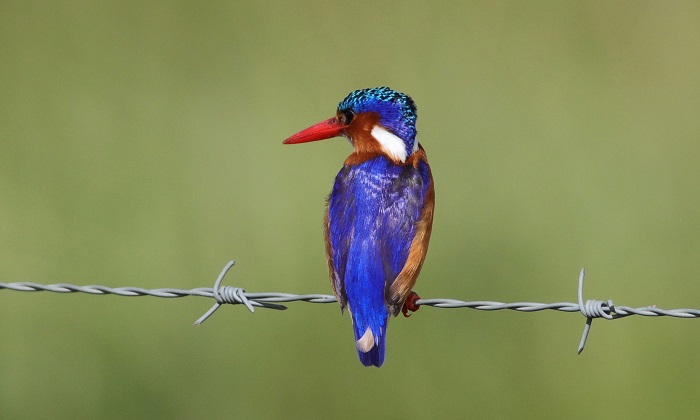
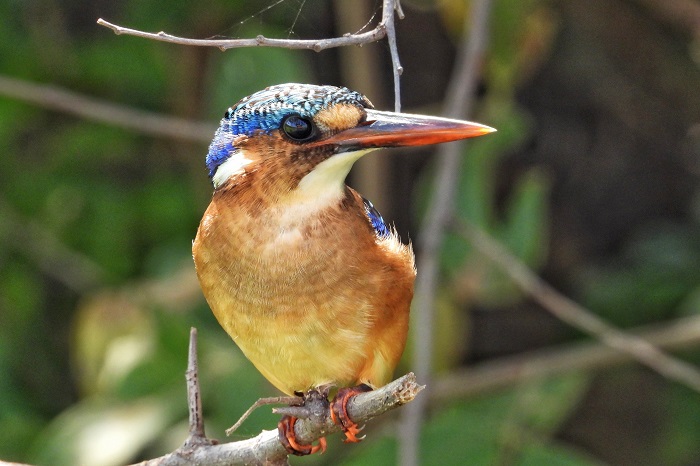
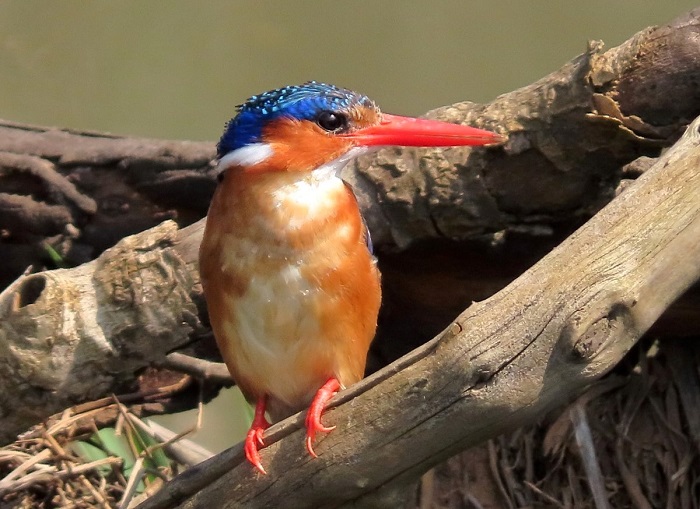
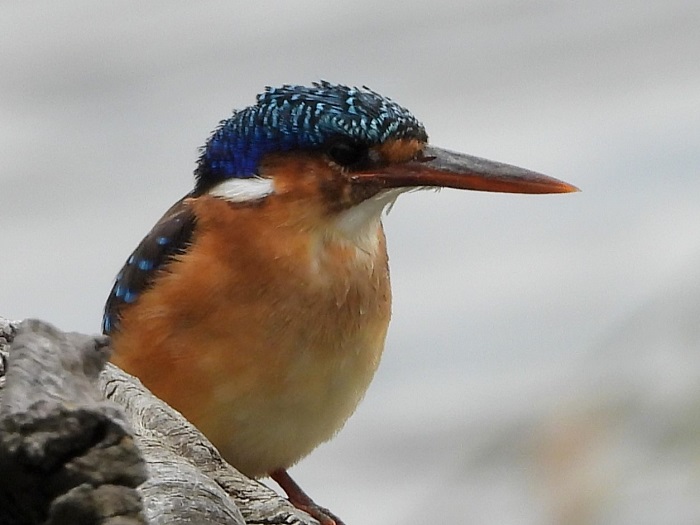
Adult Malachite Kingfishers have deep, yet bright blue upperparts. The blue is slightly paler on the nape and sides of the head, reaching above the eyes to form a blue supercilium. The crown is bright turquoise with black barring. The crown feathers are long and form a crest, especially on the sides, which is not usually raised. The forehead (frons) is orange-chestnut as are the lower sides of the face and neck. The throat is white and there is also an elongate white patch on the side of the neck. The chest and flanks are orange-chestnut and the belly is pale buff or off-white.
The long, straight bill is bright red, as are the legs and feet. The eyes are dark brown. Males and females are alike in plumage colouration.
Juveniles resemble the adults but are duller and darker in colour and the underparts are brownish-orange. They have black bills, legs and feet that slowly change to red after a few months. The cheeks and breast are variably covered in blackish speckles.
In Southern Africa the Malachite Kingfisher is most likely to be mistaken for the African Pygmy Kingfisher (Ispidina picta) and the Half-collared Kingfisher (Alcedo semitorquata).
Adult Malachite Kingfishers are distinguished from the much larger Half-collared Kingfisher by its red bill and orange cheeks. The Malachite Kingfisher more closely resemble the African Pygmy kingfisher but the latter lacks the crest on the crown, and has an orange (not blue) supercilium, pinkish-purple cheeks and more uniformly rufous underparts. African Pygmy Kingfishers are also slightly smaller and inhabit forested or well-wooded habitats, often far from water.
The Malachite Kingfisher is a common resident or local migrant. It can be locally abundant in some regions such as the Okavango Delta in Botswana and the coastal areas of KwaZulu-Natal.
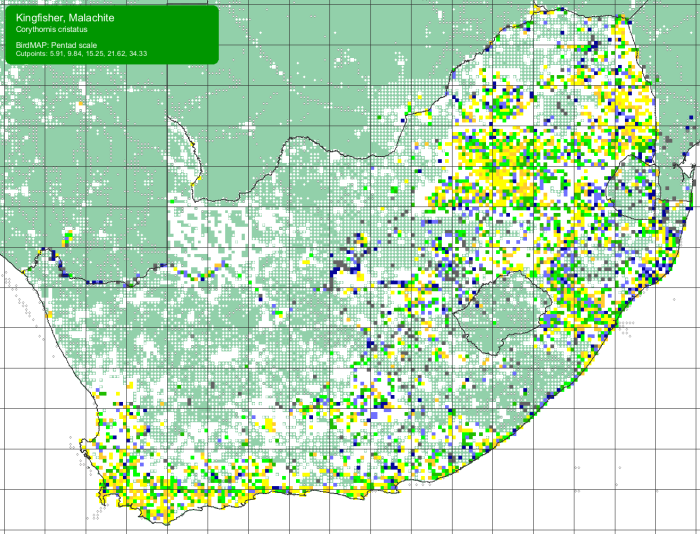
The Malachite Kingfisher is widely distributed across sub-Saharan Africa. It avoids only the driest regions of north-East Africa and the arid areas of southern Africa, including the Kalahari, parts of the Northern Cape and much of Namibia. The Malachite Kingfisher is uncommon in the tropical forest zone, where it is largely replaced by other closely related species.
In southern Africa it is concentrated in the higher rainfall north, east and south of the subcontinent, extending westwards mainly along the Kunene and Orange River systems.
SABAP2 distribution map for Malachite Kingfisher (Alcedo cristata) – May 2024. Details for map interpretation can be found here.
The Malachite Kingfisher is widespread and is not threatened at present. It is locally vulnerable to river pollution, the use of pesticides and habitat destruction.
Habitat
The Malachite Kingfisher is closely associated with aquatic environments. It prefers well vegetated, slow-flowing rivers and streams. The Malachite Kingfisher is also commonly found on dams, marshes, the sheltered shores of large waterbodies, coastal lagoons, tidal estuaries, mangrove swamps, sewage ponds, irrigation canals and ornamental ponds. They also inhabit seasonal streams and ephemeral waters during the wet season. The Malachite Kingfisher sometimes also hunts in coastal rock pools. They avoid habitats with closed tree canopies over the water. Locations with steep banks are required for excavating nest tunnels in the breeding season.
Slow moving sections of rivers and streams are a favoured habitat. Pongola River, KwaZulu-Natal Photo by Ryan Tippett
Behaviour
When not breeding Malachite Kingfishers wander to exploit the availability of food. Young birds disperse widely, often flying at night.
The Malachite Kingfisher is generally a solitary species and is usually encountered along the edges of a waterbody, perching low down on reed or papyrus stems and the exposed branches of bushes and trees. They sometimes also perch on rocks or lengths of wire. It is not particularly shy and, when flushed, flies low over the water, soon to perch again.
Bathes by diving, often repeatedly, before flying off to to perch. They then shake vigorously before preening.
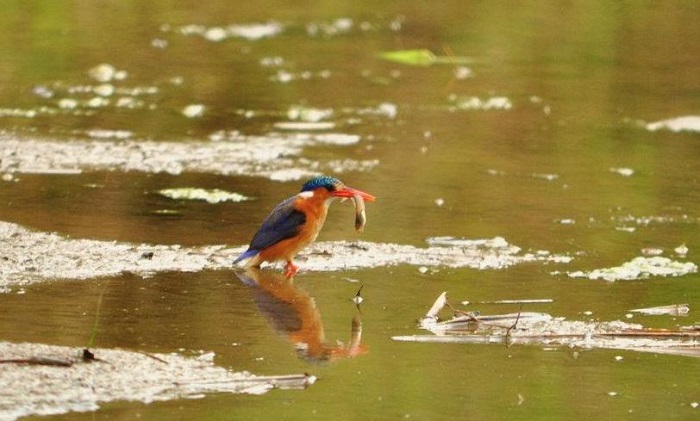
Sits motionless while hunting but occasionally flicks its tail, bobs its head or raises and lowers it crest. Scans the water for signs of prey and once spotted dives at a sharp angle into the water. Most prey is caught within a few centimetres of the surface. If successful, the prey is carried back to a perch in its bill where it is beaten and swallowed whole. Prey may be carried crosswise in the bill, but is always swallowed head first. They may also hawk flying insects from a perch.
Small fish are the preferred prey but the diet of the Malachite Kingfisher is not restricted to fish. They also consume tadpoles, frogs, aquatic insects, dragonflies, terrestrial insects like grasshoppers and beetles, as well as shrimps, crabs and lizards.
Malachite Kingfishers have a long breeding season in southern Africa, varying slightly from region to region. Breeding generally spans from August to May and often coincides with the low-water period to avoid nests getting flooded.
Malachite Kingfishers are monogamous and territorial. The nest is a tunnel excavated by both sexes in a river or stream bank. Nests are also commonly excavated in road cuttings, earth mounds, in soil around the roots of fallen trees, in the inner wall of Aardvark (Orycteropus afer) burrows or some other hole in the ground. The tunnel is usually around 30 to 90cm long, ending in a small nest chamber. The nest chamber is lined with regurgitated fish bones, scales and arthropod exoskeletons.
Anywhere from 3 to 6 glossy white eggs are laid per clutch, and are usually laid at 1 day intervals. Incubation starts once the clutch has been completed and lasts approximately 15 days. Both sexes share in the incubation duties.
The chicks all hatch within 2 days of each other. The nestlings are brooded for warmth mostly by the female and the nestling period lasts around 23 days. Once the young have fledged they start fishing within 1 week of leaving the nest. They remain with the parents for another 15 days or so before the parents chase them away.
Malachite Kingfishers are multi-brooded and are capable of raising 3 or 4 clutches during a single breeding season! New clutches are sometimes completed in an adjacent nest, even before the departure of the previous fledglings.
This species text is adapted from the first Southern African Bird Atlas Project (SABAP1), 1997.
The use of photographs by Ansie Dee Reis, Colin Summersgill, Dawie de Swardt, Dieter Oschadleus, Johan Van Rooyen Lia Steen, Marius Meiring, Neels Putter, Pamela Kleiman, Walter Jubber and Wiekus Moolman is acknowledged.
Virtual Museum (BirdPix > Search VM > By Scientific or Common Name).
Recommended citation format: Tippett RM 2024. Malachite Kingfisher Alcedo cristata. Biodiversity and Development Institute. Available online at https://thebdi.org/2024/05/23/malachite-kingfisher-alcedo-cristata/