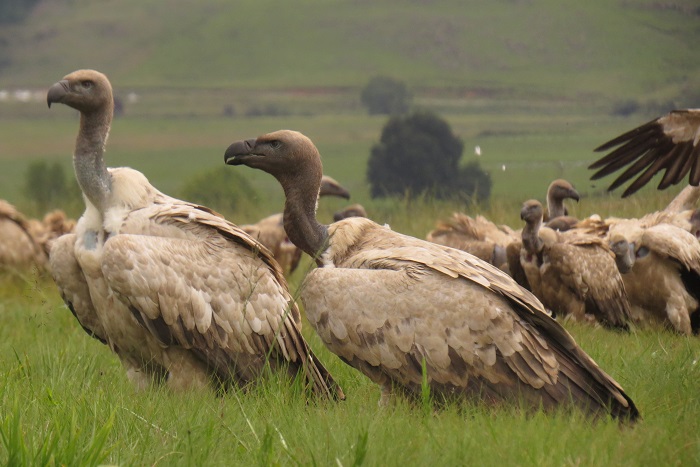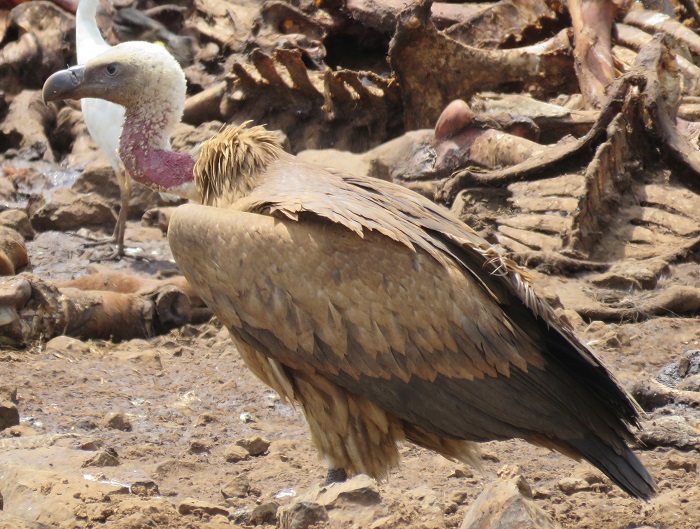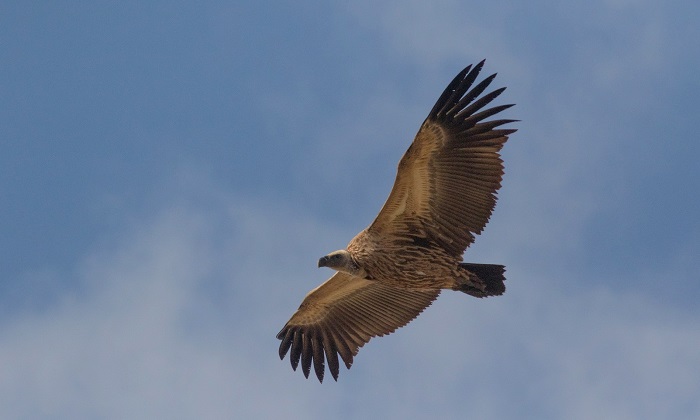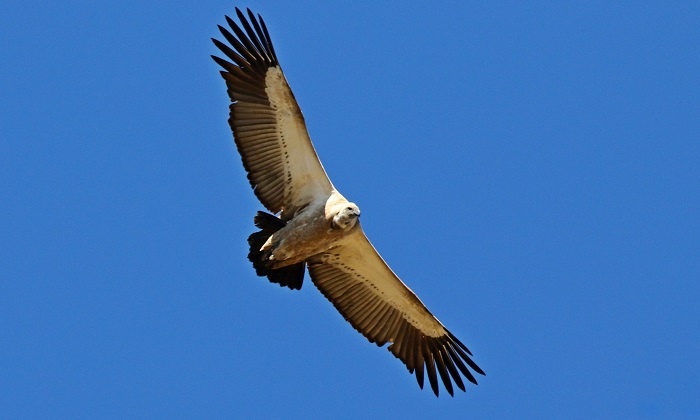
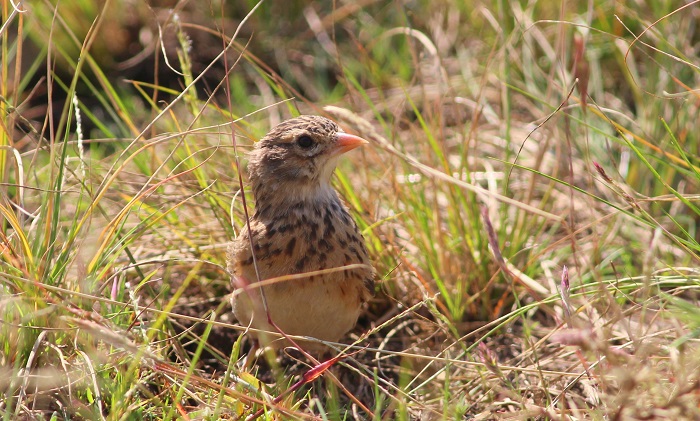
Botha’s Lark (Spizocorys fringillaris)

Cover image of Botha’s Lark by Maans Booysen – Daggakraal, Mpumalanga – BirdPix No. 213508

Larks are passerine birds of the family ALAUDIDAE. The larks are a group of mostly Old World passerine birds. Most species are found in Africa, followed by Asia and Europe with two species occurring in North America and one species in Australia. Habitats vary, but many are characteristic of open, dry regions. The family contains 21 genera and 100 species.

Identification
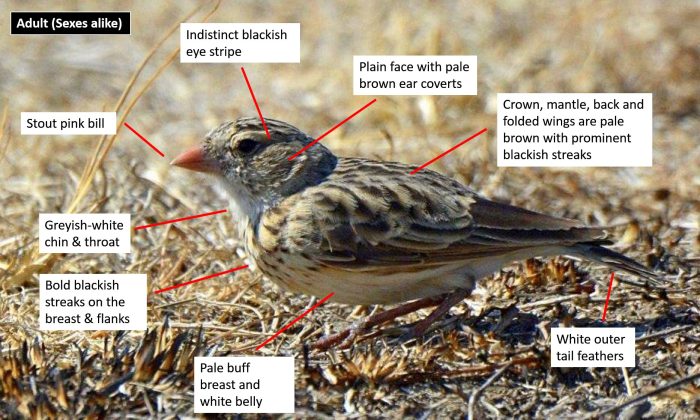
Identification guide to Botha's Lark
Botha’s Lark (Spizocorys fringillaris)
Daggakraal, Mpumalanga
Photo by Dave Rimmer

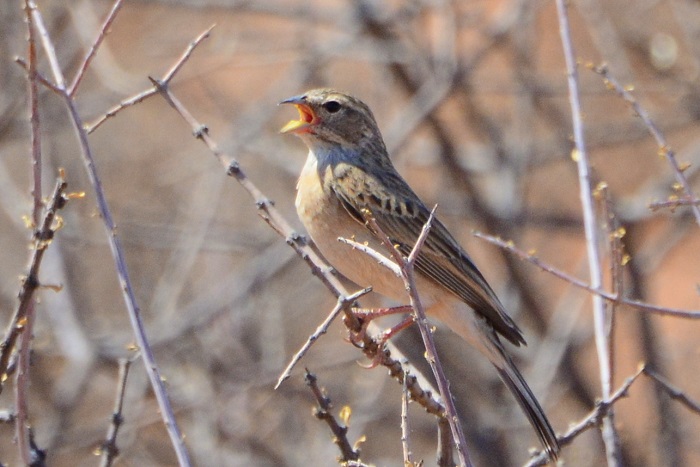
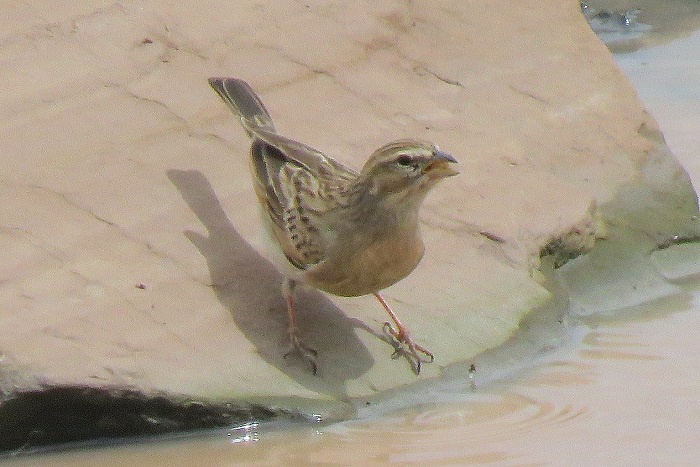
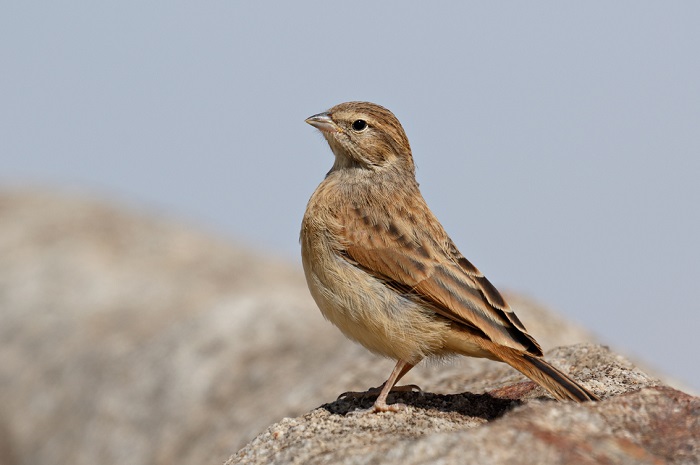
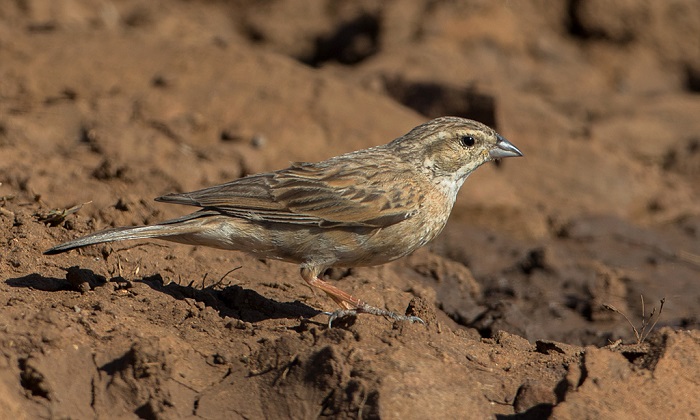
Botha’s Lark is a small species with a short, stout pink bill. The face is relatively plain with pale brown ear coverts. The supercilium is cream or buff-coloured and there is an indistinct blackish eye stripe. The sides of the neck are buffy brown. Upperparts, including the crown, mantle, back and folded wings are brown with prominent blackish streaks. The chin and throat are greyish white and the breast, upper belly and flanks are buff-coloured with a slight rufous wash, heavily streaked in blackish brown. The lower belly and under tail coverts are pale buff to white.

The tail is dusky brown with broad white outer tail feathers. Eyes are brown and the legs and feet are pink. The sexes are alike.
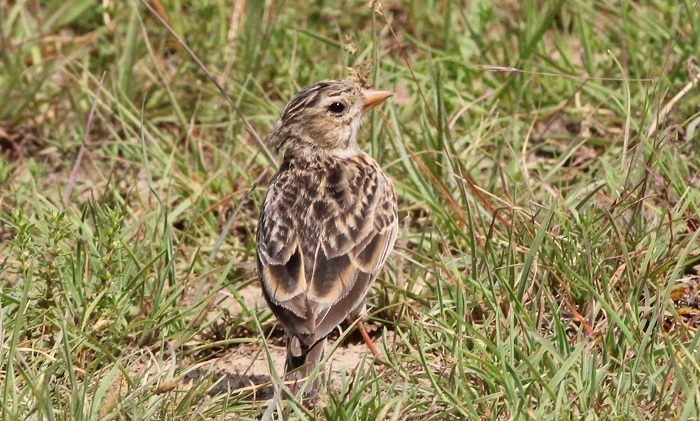
Spizocorys fringillaris
Botha’s Lark (Spizocorys fringillaris)
Daggakraal, Mpumalanga
Photo by Maans Booysen

Juveniles resemble the adults but have irregular whitish spots on the crown and back, with buff-tipped flight and tail feathers. The breast has diffuse, brown streaks, lacking the blackish streaks of the adults. The bill is horn-coloured (not pink).
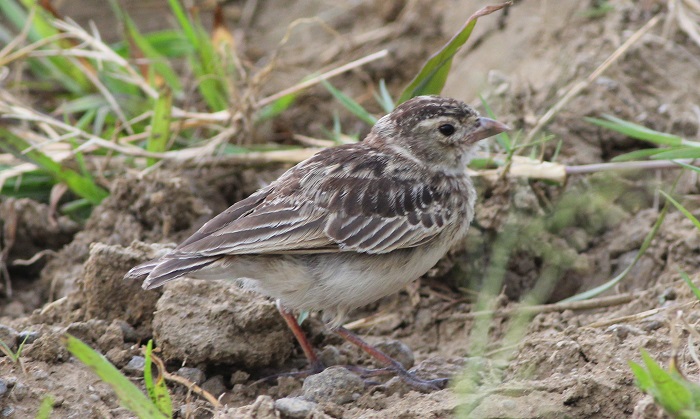
Botha's Lark
Botha’s Lark (Spizocorys fringillaris)
Daggakraal, Mpumalanga
Photo by Maans Booysen

Botha’s Lark is most likely to be mistaken for the Pink-billed Lark (Spizocorys conirostris). The latter has a rufous-buff (not whitish) belly and under tail coverts. It also has less extensive streaking on the breast, a less prominent supercilium, a heavier bill and buffy (not white) outer tail feathers.
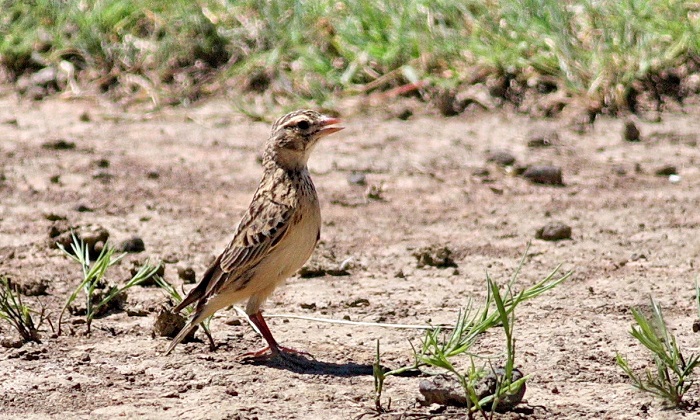
Spizocorys fringillaris
Botha’s Lark (Spizocorys fringillaris)
Near Wakkerstroom, Mpumalanga
Photo by Johan van Rensburg

Status and Distribution

Uncommon to Rare (formerly locally common) resident and local nomad.

Botha’s Lark is endemic to South Africa and is found nowhere else in the world. It has a very small and restricted distribution, mainly in the Vaal River catchment, from north-eastern Free State to western Mpumalanga.

Botha’s Lark is South Africa’s most threatened terrestrial bird species and is currently listed as Endangered. However, it is soon to be re-listed to Critically Endangered. The population of Botha’s Lark was possibly as large as 20 000 birds in the early 1980s but fell to under 2500 by 2015. The latest estimates from 2023 and 2024 indicate as few as 340 individuals may survive in the wild.
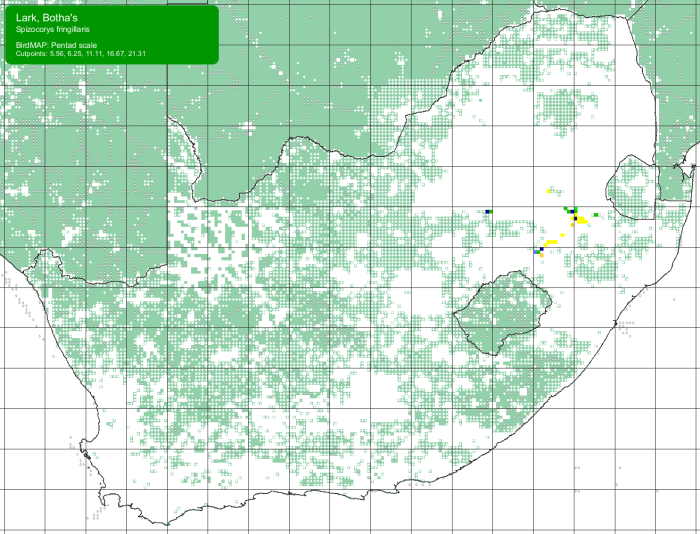
SABAP2 distribution map for Botha's Lark
SABAP2 distribution map for Botha’s Lark (Spizocorys fringillaris) – July 2024.
Details for map interpretation can be found here.

Botha’s Lark is patchily distributed within a small range. It does not occur in any protected area, and no longer occurs at the Type locality. Most of its preferred habitat has been transformed by agriculture, over grazing and forestry.
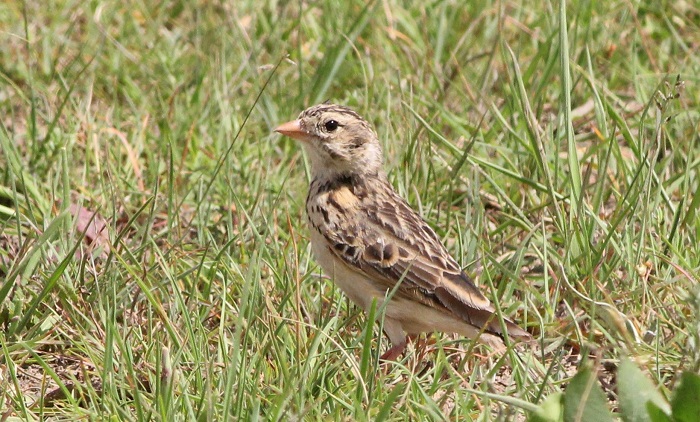
Spizocorys fringillaris
Botha’s Lark (Spizocorys fringillaris)
Daggakraal, Mpumalanga
Photo by Maans Booysen

Habitat

Botha’s Lark inhabits short, heavily-grazed upland grassland and dry floodplains. It favours sour grassveld on clay soils. Botha’s Lark avoids longer grass in valley bottoms, poorly drained areas, planted pastures, croplands and rocky places.
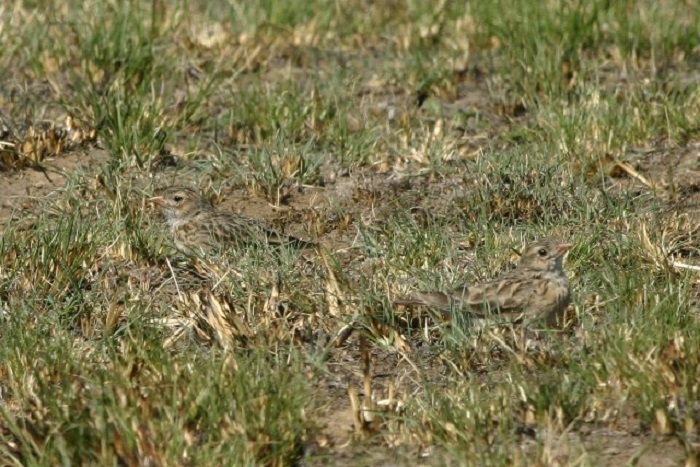
Botha’s Lark (Spizocorys fringillaris) inhabits short, heavily grazed upland grassland.
Near Wakkerstroom, Mpumalanga
Photo by Maans Booytsen

Behaviour

Botha’s Lark is sometimes seen in small groups of up to 10 birds, but is usually solitary or found in pairs. They are generally resident and sedentary but moves locally in response to veld conditions like fire and drought.
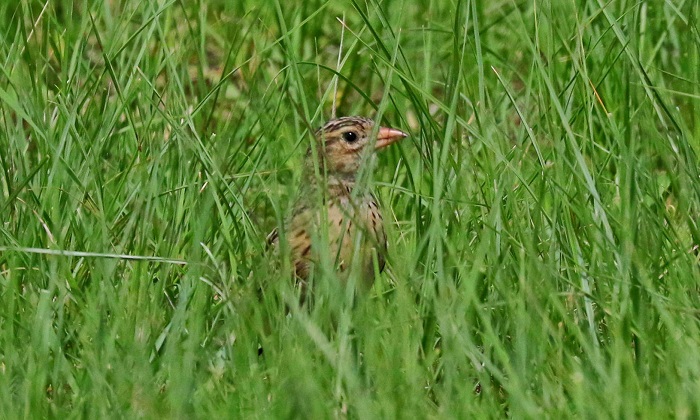
Spizocorys fringillaris
Botha’s Lark (Spizocorys fringillaris)
Near Wakkerstroom, Mpumalanga
Photo by Jorrie Jordaan

Botha’s Lark is inconspicuous and easily overlooked. Unlike most larks, no aerial display has been recorded. They flush readily, fanning the tail on take-off (showing white outer tail feathers), and usually flying in a wide circle whilst calling. The flight is undulating and ends with a vertical dive into grass cover.
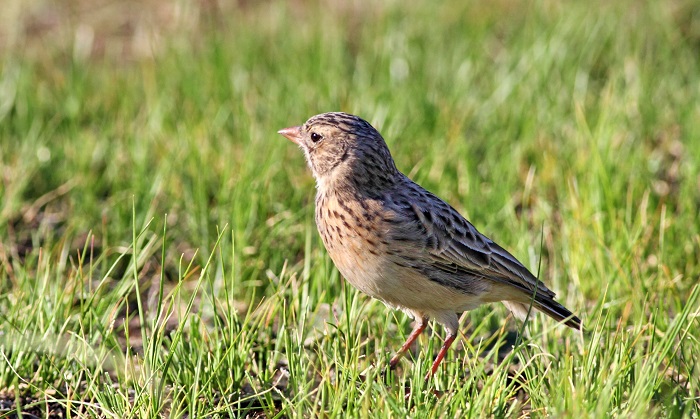
Botha's Lark
Botha’s Lark (Spizocorys fringillaris)
Near Wakkerstroom, Mpumalanga
Photo by Johan van Rensburg

Botha’s Lark forages in the typical lark manner by walking about briskly while watching the ground, pausing now and then to look around. Occasionally darts after prey or jumps into the air to snatch a morsel, and does not dig for food. Botha’s Lark eats invertebrates, including beetles, grasshoppers and moths. They also consume seeds particularly outside of the breeding season.

Botha’s Lark is dependent on surface water and drinks regularly.
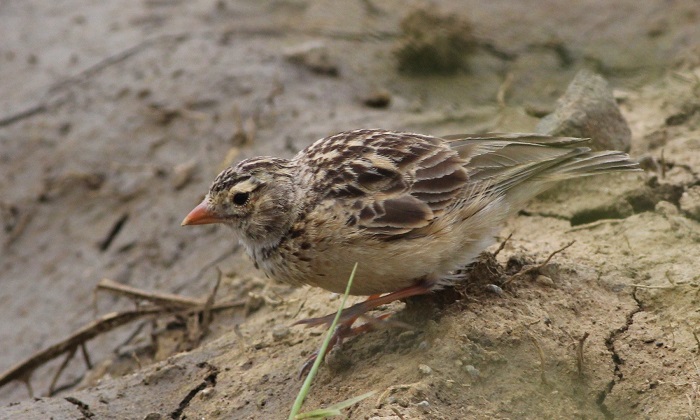
Spizocorys fringillaris
Botha’s Lark (Spizocorys fringillaris)
Daggakraal, Mpumalanga
Photo by Maans Booysen

Botha’s Lark is monogamous and nests solitarily or in loose groups. Neighbouring nests can as little as 20 m apart. There is evidence of synchronous breeding among groups, likely to make the most of good veld conditions.

The nest is a cup of dry grass lined with grass strips and sometimes sheep’s wool or hair. The nest is built into an excavated hollow in the ground between grass tufts or on occasion against a small shrub or among sheep dung. The nest is built in 3 days and egg-laying starts 1 to 3 days after nest completion.

Botha's Lark
Botha’s Lark (Spizocorys fringillaris)
Daggakraal, Mpumalanga
Photo by Karis Daniel

Botha’s Lark breeds from October to January, depending on veld conditions. Two or three eggs are laid per clutch at one day intervals. The eggs are cream-coloured, heavily marked with dark brown and grey-brown speckles. Botha’s Lark is single brooded but has been recorded to re-lay within five days of an early clutch failure. Incubation starts upon clutch completion and the incubation period lasts for 13 days. Incubation duties are shared by both sexes.

Chicks are fed and cared for by both parents and are apparently fed almost exclusively on insects, mainly grasshoppers. Adults typically forage nearby and usually fly overhead calling when an intruder approaches. Chicks are ready to leave the nest after a further 11 to 15 days.

Further Resources

Species text for Botha’s Lark in the first Southern African Bird Atlas Project (SABAP1), 1997.

The use of photographs by Dave Rimmer, Johan van Rensburg, Jorrie Jordaan, Karis Daniel and Maans Booysen is acknowledged.

Virtual Museum (BirdPix > Search VM > By Scientific or Common Name).

Other common names: Vaalrivierlewerik (Afrikaans); Finkenlerche (German); Alouette de Botha (French); Botha-leeuwerik (Dutch); Cotovia de Botha (Portuguese).

List of bird species in this format is available here.

Recommended citation format: Tippett RM 2024. Botha’s Lark Spizocorys fringillaris. Biodiversity and Development Institute. Available online at https://thebdi.org/2024/08/02/bothas-lark-spizocorys-fringillaris/
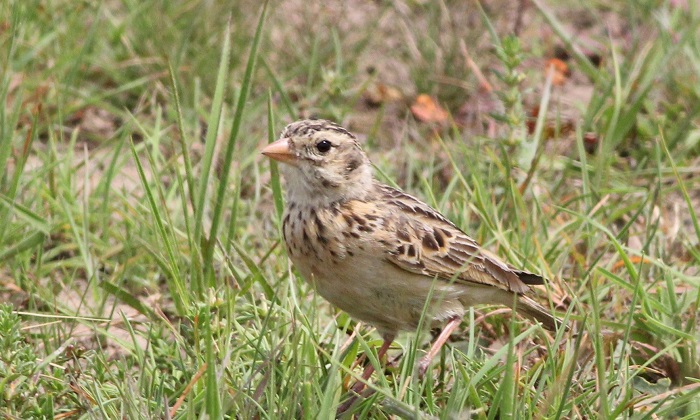
Bird identificationbirding

Spizocorys fringillaris
Botha’s Lark (Spizocorys fringillaris)
Daggakraal, Mpumalanga
Photo by Maans Booysen

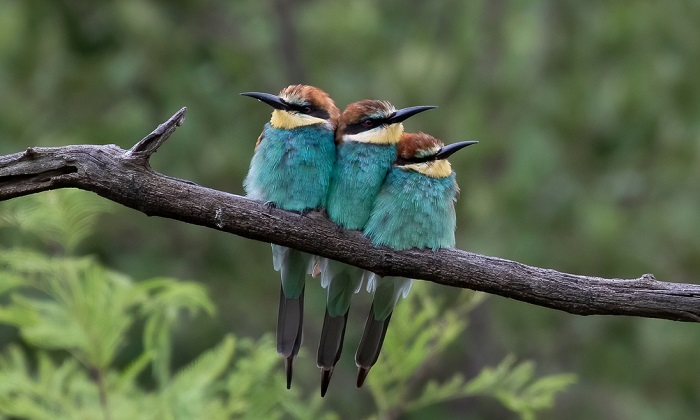
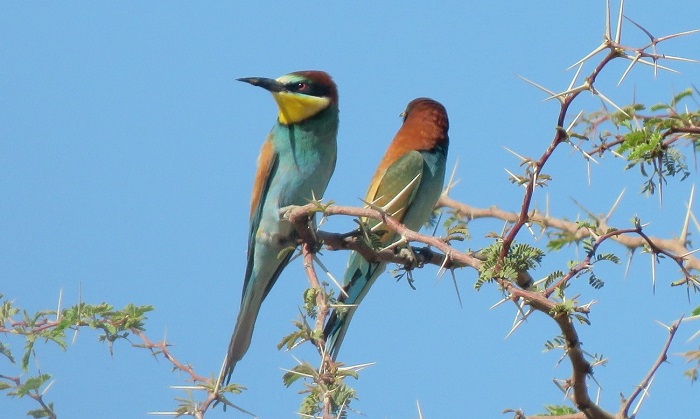
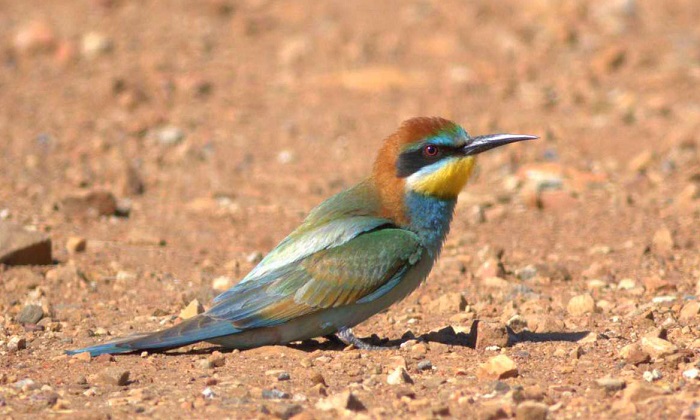
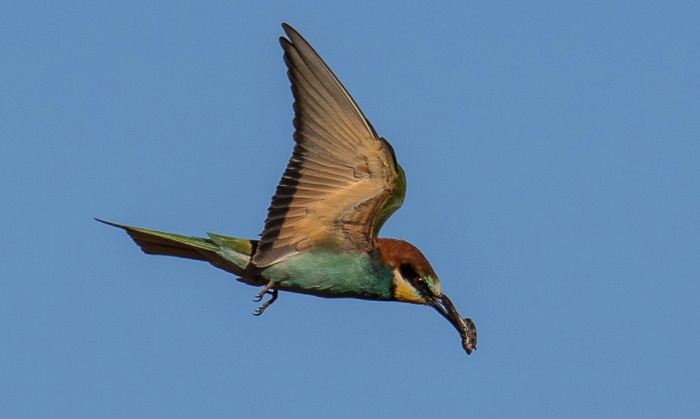
European Bee-eater (Merops apiaster)

Cover image: European Bee-eater by Neels Putter – Thabazimbi district, Limpopo – BirdPix No.153941

Bee-eaters belong to the Family: MEROPIDAE. This family contains three genera and 27 species. Most species are found in Africa and Asia, with a few in southern Europe, Australia, and New Guinea. They are characterised by richly coloured plumage, slender bodies, and usually elongated central tail feathers. All have long decurved bills and medium to long wings, which may be pointed or rounded.

Identification

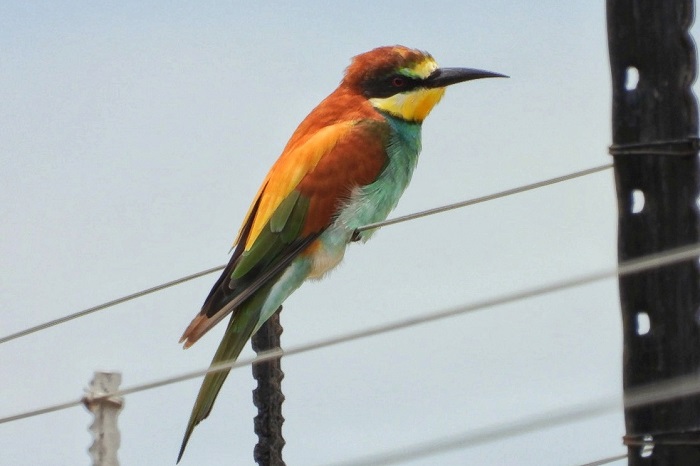
The European Bee-eater is a large, distinctively plumaged bee-eater. The sexes are similar but females are slightly paler and less colourful than males.

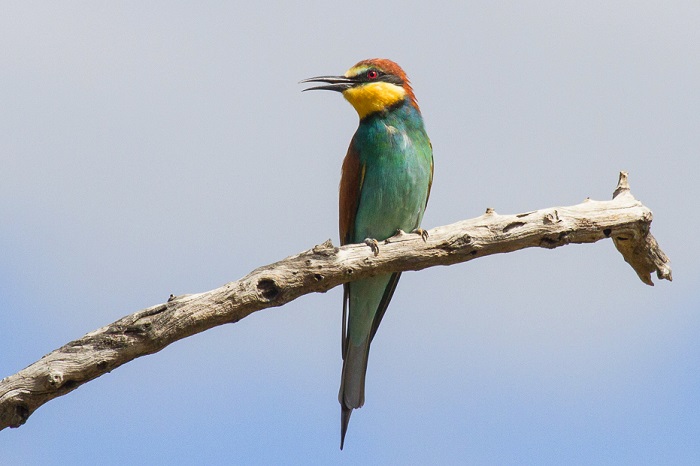
European Bee-eater (Merops apiaster)
Near Kalbaskraal, Western Cape
Photo by Gerald Wingate

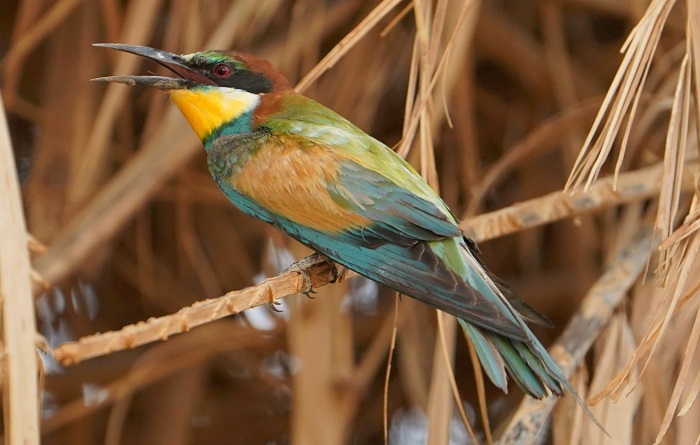
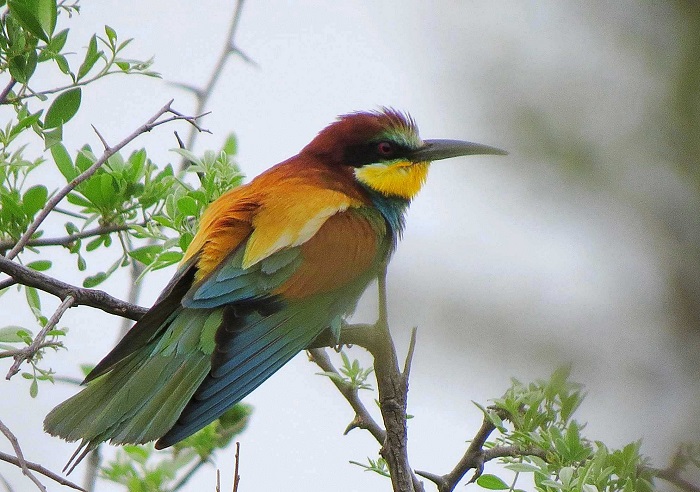
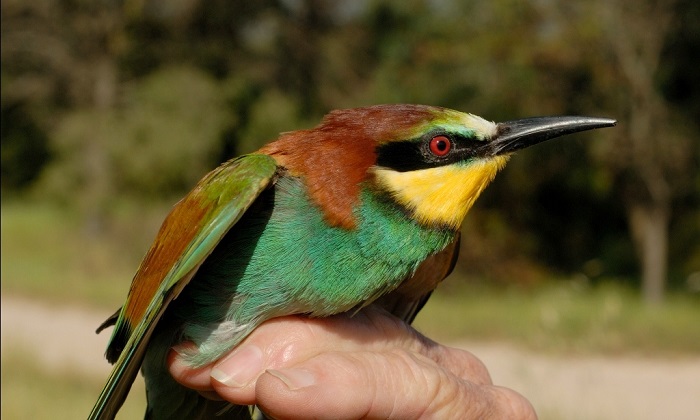
The crown and back are chestnut and the mantle is golden-yellow. The forehead and supercilium are whitish blue, merging into the chestnut crown. The face has a black mask that stretches from the lores to the ear coverts with a narrow, pale blue stripe below. The chin, throat and cheeks are bright yellow. There is a distinct black band on the upper breast that neatly divides the yellow throat from the breast. The breast, belly and vent are entirely rich turquoise blue, fading to whitish-blue on the under tail coverts.

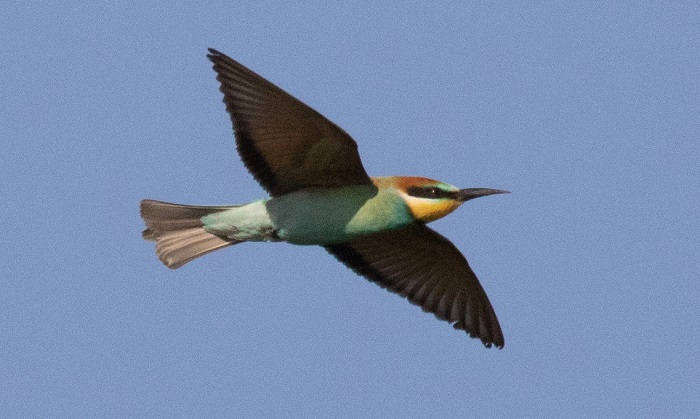
Merops apiaster in flight
European Bee-eater (Merops apiaster)
Chimoyo Game Farm, Limpopo
Photo by Vaughan Jessnitz

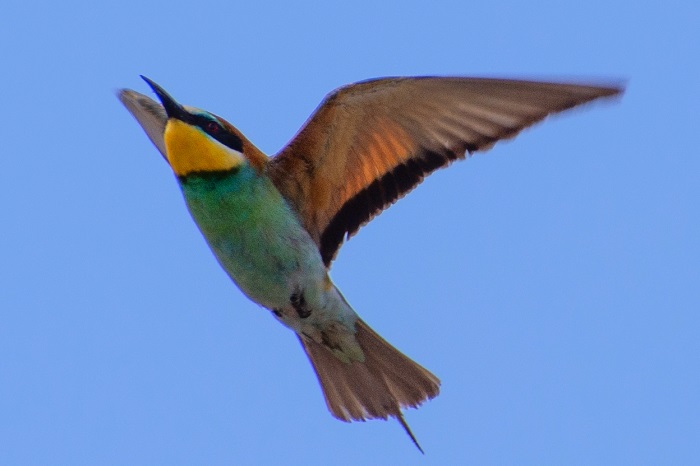
The underwings are pale rufous with the black-tipped flight feathers forming a conspicuous trailing edge on both the lower and upper wing. The upper wings are green to blue-green with rufous wing coverts. The upper tail is mainly blue-green with the dark-tipped central rectrices that project out into points. The bill is black, moderately long and decurved. The eyes are deep red. Legs and feet are purplish brown.
Local breeding birds are more intensely coloured than Palearctic-breeding migrants, but the two are morphologically indistinguishable.

European Bee-eater
Juvenile European Bee-eater (Merops apiaster). Note the indistinct black breast band and lack of tail streamers.
Brits district, North West
Photo by Andrew keys

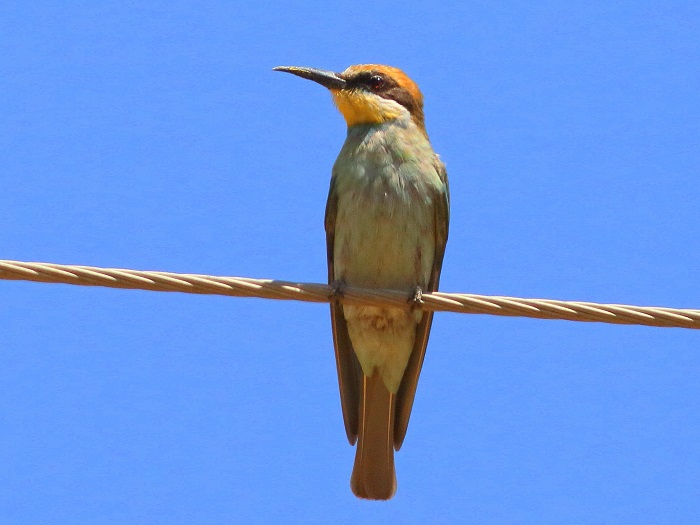
Juveniles are similar to the adult female but are duller and greener. They lack central tail streamers and the black breast band is indistinct.

The European Bee-eater is unlikely to be mistaken for another species due to the combination of its yellow throat and black breast-band. Additionally the turquoise underparts, and brown inner wing contrasting with the blue-green outer wing are diagnostic

Merops apiaster
European Bee-eater (Merops apiaster)
Nile River, Northern State, Sudan
Photo by Mohamed Salah

Status and Distribution

In southern Africa the European Bee-eater is a Common Palearctic breeding migrant and intra-African breeding migrant.

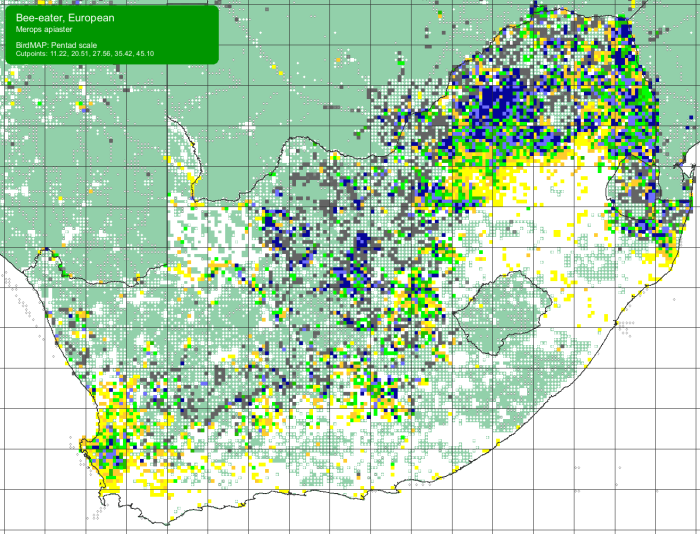
SABAP2 distribution map forEuropean Bee-eater
SABAP2 distribution map for European Bee-eater (Merops apiaster) – July 2024. Details for map interpretation can be found here.

It is the most widespread of all bee-eater species. The European Bee-eater is largely a Palaearctic species breeding across Europe to central Asia as far as northern India and western Mongolia. Birds on migration occur throughout the Middle-East as well as north and east Africa. The non-breeding grounds are found in west, central and southern Africa.

European Bee-eater in flight
European Bee-eater (Merops apiaster)
Vaalkop Dam Nature Reserve, North West
Photo by Lance Robinson

The European Bee-eater is widespread throughout most of southern Africa. It is absent only from the mesic eastern parts of South Africa and the most arid parts of Namibia, Botswana and the Northern Cape. There is an isolated breeding population in southern Africa that breeds in the Western, Eastern and Northern Cape, western Free State and southern Namibia. It is thought that these birds have their non-breeding grounds in tropical Africa.

Merops apiaster
European Bee-eater (Merops apiaster)
Thabazimbi district, Limpopo
Photo by Neels Putter

The Palaearctic-breeding population is not threatened. The population that breeds in southern Africa has been estimated to number around 20 000 birds but the current trends in the size of this population are unknown.

Habitat

Habitat for European Bee-eater
Woodland habitat in north-eastern South Africa
Ithala Game Reserve, KwaZulu-Natal
Photo by Ryan Tippett

The European Bee-eater occurs in a variety of habitats including woodland, savanna, semi-arid Karoo scrub, fynbos and grassland. It often forages over adjoining freshwater habitats like rivers, marshes and dams. It avoids very arid habitats and also regions with high rainfall.

The population that breeds in southern Africa inhabits the Fynbos, Nama-Karoo and Succulent Karoo biomes.

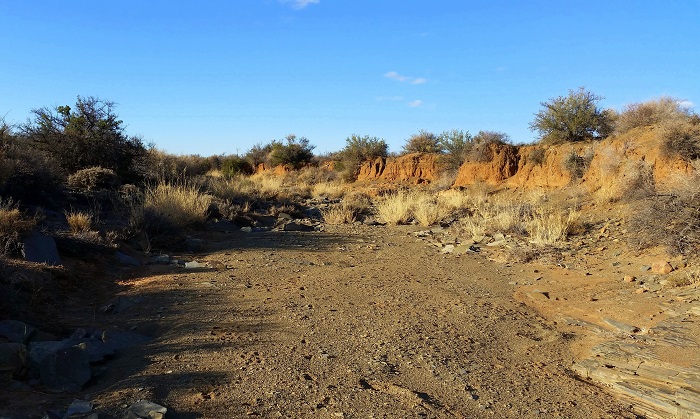
Habitat for Merops apiaster
Breeding habitat in the Northern Cape. A single pair attempted to breed here in 2023.
Carnarvon district, Northern Cape
Photo by Ryan Tippett

Behaviour

The European Bee-eater is highly gregarious at all times and is usually found in loose flocks of 20 to 100 birds. Roosts communally in flocks, usually in leafy trees sleeping shoulder to shoulder.

Merops apiaster
European Bee-eater (Merops apiaster)
Near Pilanesberg National Park, North West
Photo by Andre Harmse

The European Bee-eater departs its Eurasian breeding grounds between mid August and early October. They migrate by day in flocks, high in the upper airspace. The first birds arrive in southern Africa from early September, but most arrive in October. They depart north again during late March and early April. Birds that breed in Southern African arrive from central Africa in late August into September, and also depart during March and April.

European Bee-eater
European Bee-eater (Merops apiaster)
Groblershoop, Northern Cape
Photo by Les Underhill

European Bee-eaters bathe frequently by dipping the head in water whilst flying, before perching to preen vigorously. Drinks by skimming the water surface like a swallow, or by hovering. The European Bee-eater rests for long periods on prominent perches such as dead tree branches or telephone wires. Flocks spend much time sunbathing and dustbathing. Sunbathing is usually performed socially, on a perch, but occasionally also sunbathes on the ground. Sunbathing is interspersed with preening, scratching and stretching.

Merops apiaster
European Bee-eater (Merops apiaster)
Kruger National Park, Limpopo
Photo by Crystelle Wilson

The flight is graceful due to the long wings and tail, allowing for effortless gliding and long swoops broken up by bursts of flapping to maintain momentum. The flight action and speed varies as they dive, twist and turn in pursuit of prey.

European Bee-eaters hunt insects on the wing, either hawking from a perch or in bouts of circling flight, lasting up to 20 minutes or so. Prey is captured up to 150m into the air but sometimes hunts close to the ground, chasing insects disturbed by animals.

European Bee-eater
European Bee-eater (Merops apiaster)
Red Sands Country Lodge, Northern Cape
Photo by Dave West

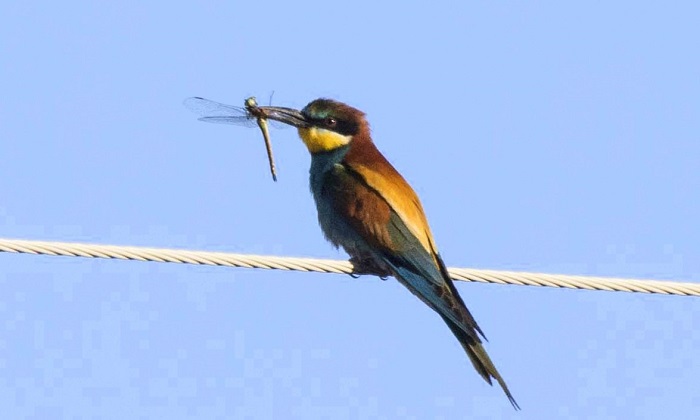
The European Bee-eater consumes a wide array of flying insects including small and large bees and wasps, ant and termite alates, flies, dragonflies, butterflies, moths, bugs, cicadas, water scorpions, mantids, beetles, grasshoppers and locusts.

European Bee-eater with dragonfly
European Bee-eater (Merops apiaster)
Faan Meintjies reserve, North West
Photo by Tony Archer

Small non-venomous insects like swarming ants and termites are eaten in flight. Larger insects and those that sting are carried back to a perch in the tip of the bill. Here they are beaten, and rubbed against the perch to remove the sting and venom. The insect is then tossed into the mouth and swallowed.

Merops apiaster
European Bee-eater (Merops apiaster)
Middelburg district, Eastern Cape
Photo by Tino Herselman

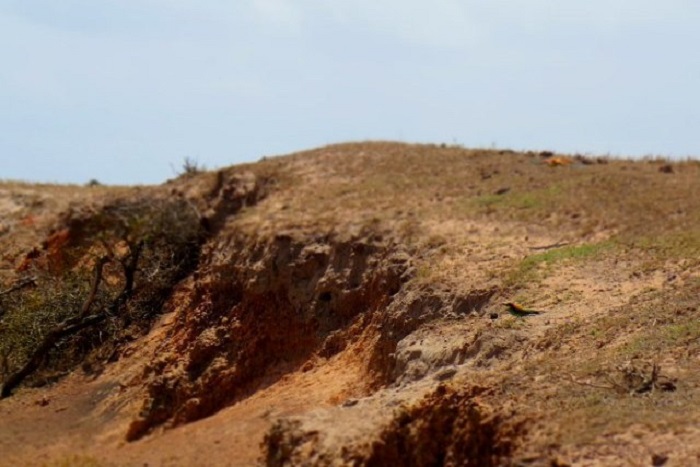
The European Bee-eater breeds from September to January in southern Africa. They are monogamous, with pair bonds lasting for several years and sometimes even for life. The European Bee-eater is mostly a colonial nester but some pairs also nest solitarily. Each year pairs reoccupying the same regularly used breeding sites. Most colonies in southern Africa number from 10 to 30 active nests. Most nesting sites are in vertical banks, either along dry river courses or in trenches, road cuttings, erosion dongas or sand quarries etc.

Breeding site Europpean Bee-eater
European Bee-eater (Merops apiaster)
Modder River, Western Cape
Photo by Ashwell Glasson

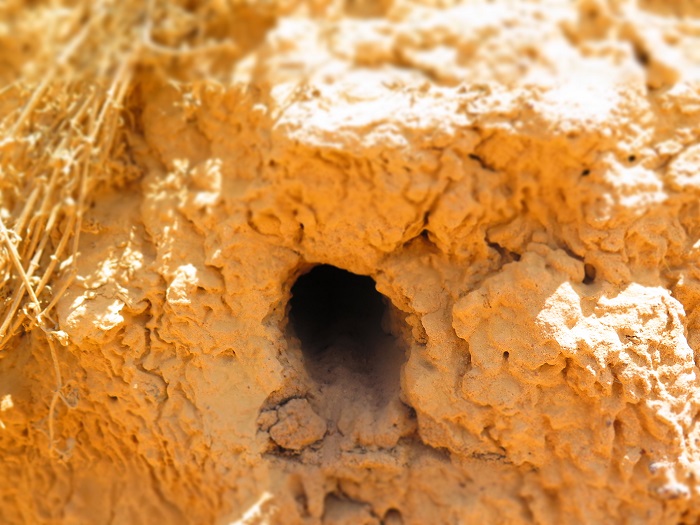
The nest is a tunnel 1.5 to 2m long and is excavated by both sexes. Digging is initially started with the bill, and then later with the feet to clear out excess sand. The tunnel may be horizontal or inclined slightly upwards and ends in an enlarged egg chamber. The eggs are laid on bare soil or on the accumulated remains of insects in tunnels that have been used previously.

Nest hole European Bee-eater
European Bee-eater (Merops apiaster)
Modder River, Western Cape
Photo by Ashwell Glasson

In South Africa clutch size varies from 4 to 6 plain white eggs. European Bee-eaters are single brooded but will replace a clutch in the event of an early failure. They are facultative co-operative breeders with some juveniles or non-breeding adults remaining with the pair as helpers. Further details regarding nesting are a little vague for southern Africa, but can be expected to be similar to data from Europe. The incubation duties are shared by both sexes and lasts for around 20 days. The nestling period lasts for another 31 days and the young are brooded and fed by both sexes or by helpers.

Merops apiaster
European Bee-eater (Merops apiaster)
Raptors View Wildlife Estate, Limpopo
Photo by Derek Solomon

Further Resources

This species text is adapted from the first Southern African Bird Atlas Project (SABAP1), 1997.

The use of photographs by Andre Harmse, Andrew Keys, Ashwell Glasson, Crystelle Wilson, Dave West, Derek Solomon, Gerald Wingate, Lance Robinson, Les Underhill, Mohamed Salah, Neels Putter, Tino Herselman, Tony Archer and Vaughan Jessnitz is acknowledged.

Virtual Museum (BirdPix > Search VM > By Scientific or Common Name).

Other common names: Eurasian Bee-eater (Alt. English);  Europese byvreter (Afrikaans); Morôkapula (Tswana); Bijeneter (Dutch); Guêpier d’Europe (French); Europäischer Bienenfresser (German); Abelharuco-europeu (Portuguese).

List of species available in this format.

Recommended citation format: Tippett RM 2024. European Bee-eater Merops apiaster. Biodiversity and Development Institute. Available online at https://thebdi.org/2024/07/29/european-bee-eater-merops-apiaster/

Bird identificationbirding

European Bee-eater
European Bee-eater (Merops apiaster)
Klipheuwel district, Western Cape
Photo by Gerald Wingate

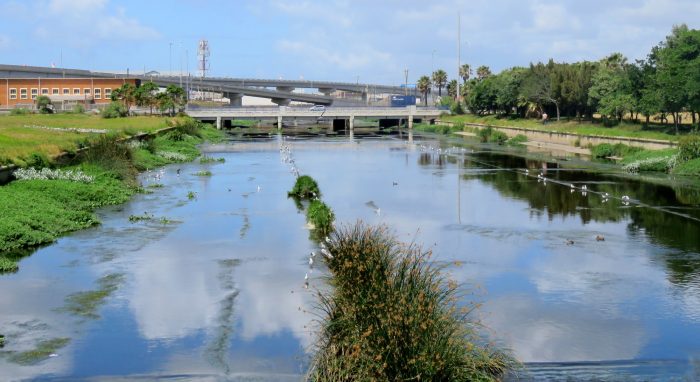
Suburban wetlands 1 : Liesbeek River, Observatory

Having started out in life on the eastern buttress of Table Mountain, the Liesbeek River loses its freedom and is condemned to run most of its course imprisoned in a concrete canal. It is liberated for a kilometre or so as it passes through the Cape Town suburb of Observatory. Biodiversity does its best to flourish in this section. The focus here is mainly on one component of that biodiversity, the birds.

In the mornings, the best place to bird is on the east bank, with the sun behind you. The road on this side runs alongside Valkenberg, and ends at the Wild Fig restaurant. In the afternoons, there is parking opposite the Hartleyvale sportsfields. There are lots of people out walking and jogging, some with dogs and some with binoculars.

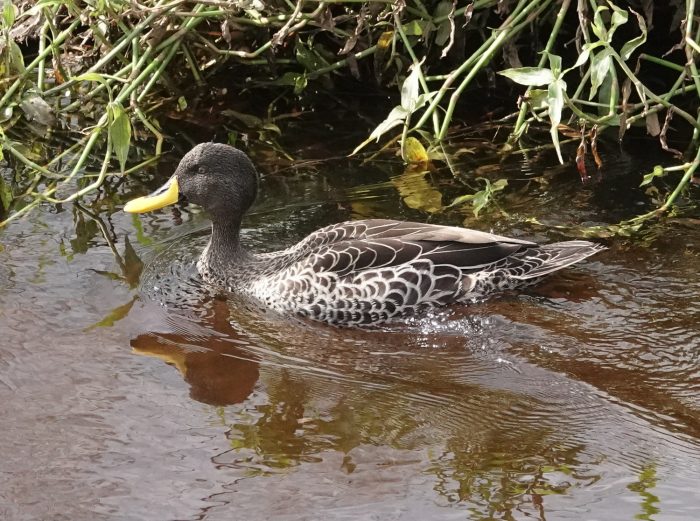
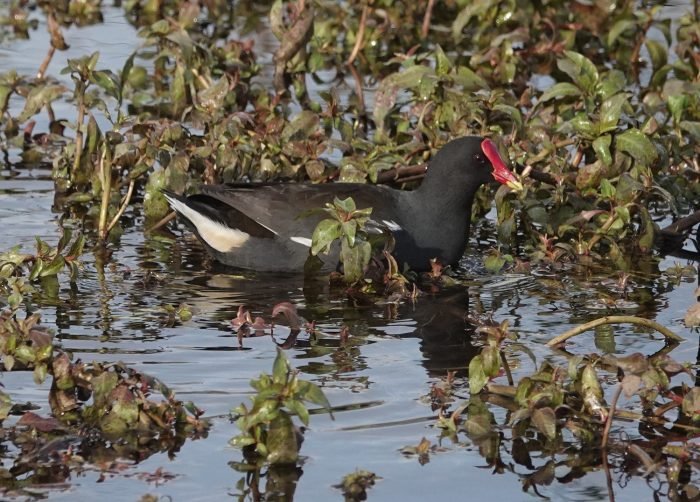
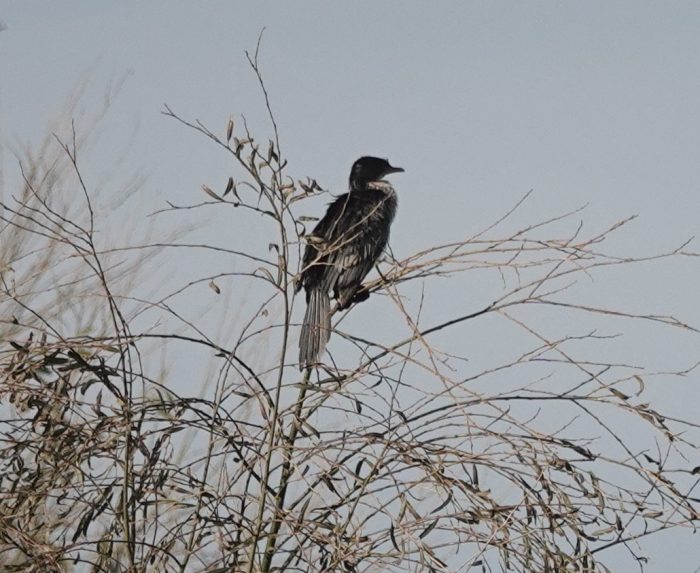
Among the first species you ought to see on the river and in the vegetation along the edges are Yellow-billed Duck, Common Moorhen and Reed Cormorant. Because the river is not wide, and because the birds are, to some extent, habituated to the presence of people, you get to see them close up. This is part of what makes this wetland, insignificant in the grand scheme of things, so good for birding!

Yellow-billed Duck on the Liesbeek River, Observatory
Yellow-billed Duck. BirdPix record 285333 in the Virtual Museum
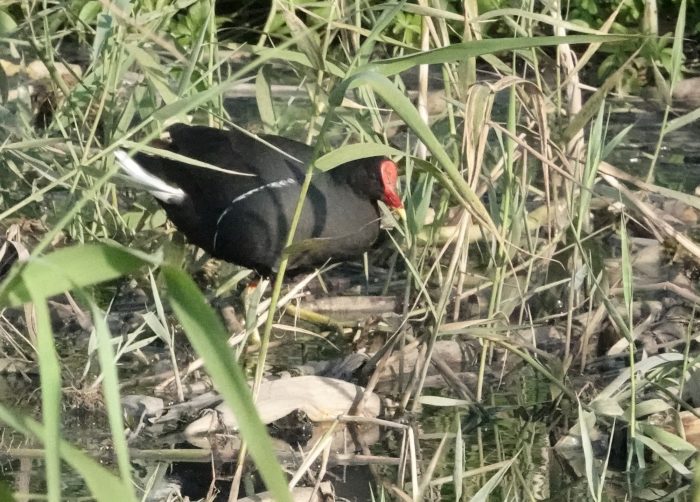
Common Moorhen on the Liesbeek River, Observatory
Common Moorhen. BirdPix record 285332
Reed Cormorant on the Liesbeek River, Observatory
Reed Cormorant. BirdPix record 285330

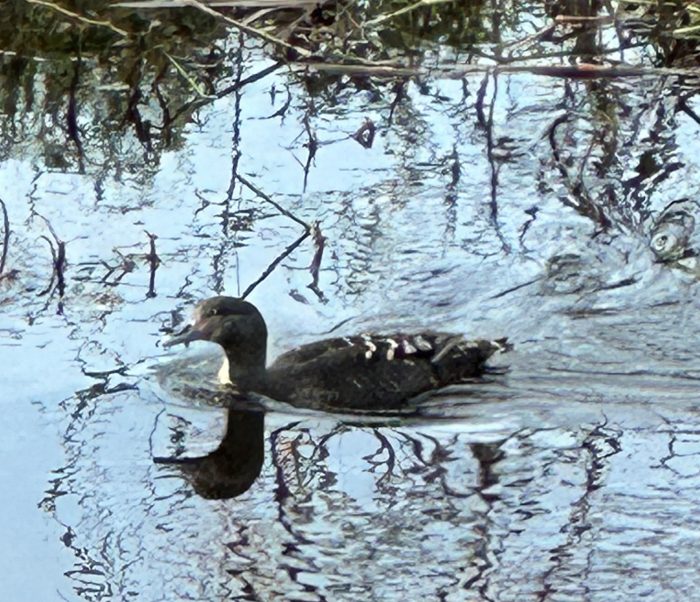
There are lots of species that you cannot expect to see on every visit to this piece of the Liesbeek River. African Black Ducks tend to be shy and swim away. Little Egrets are regular.

African Black Duck
By and large. you expect to see African Black Ducks swimming away from you. Sharon Stanton was lucky to see this one swimming past. BirdPix record 285513
Little Egret on the Liesbeek River, Observatory
Little Egret, hunting with its yellow feet. These birds have two strategies for finding food; they either stand motionless waiting for the next meal to arrive, or they do the moving, and actively search. This bird engaged in foot-trembling; while standing in water up to its “knees”, it vibrated a leg as a ploy to goad a potential prey item to move and reveal itself. BirdPix record 285323
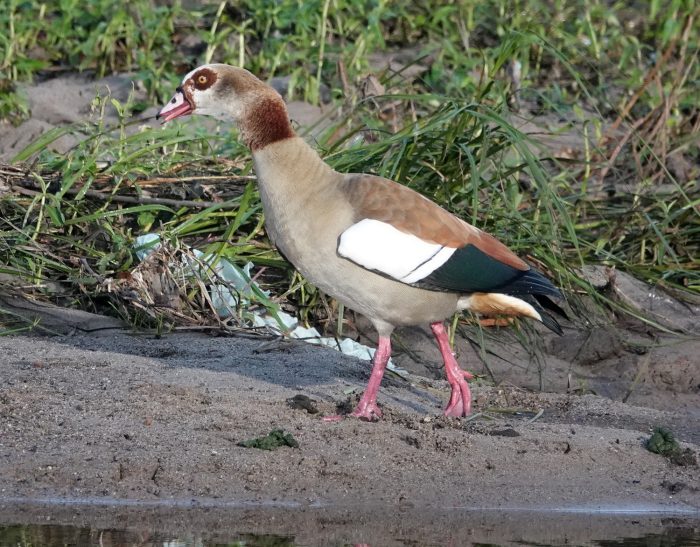
Egyptian Goose on the Liesbeek River, Observatory
Egyptian Goose. BirdPix record 285336

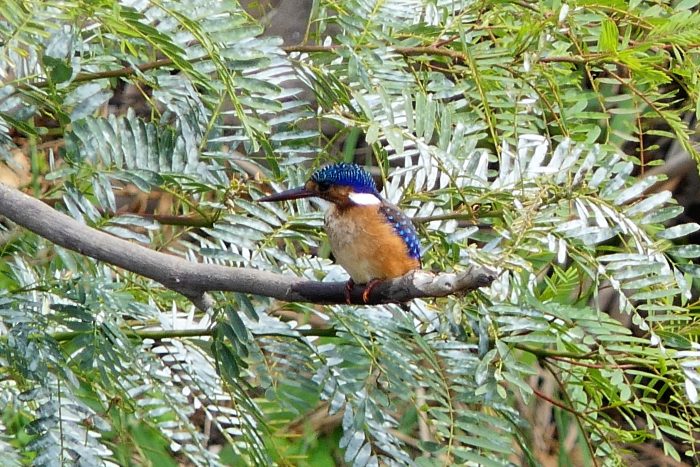
Birding is an activity that does not suffer from the law of diminishing returns. The greatest rewards go to those who spend the extra 10 minutes quietly at a spot waiting for the action. At this spot, you need to be continuously alert for the blue flash, aka the Malachite Kingfisher. If you are lucky, you can follow the flight to where it perches; but it often disappears out of sight.

Malachite Kingfisher, the blue flash
The blue flash has, for once, perched in sight, and enabled Sharon Stanton to get this record of a Malachite Kingfisher. BirdPix record 207320

The birds are not only on the river, but also above it. The airspace over the river is an avian highway, used as a navigational guide. Much of the overhead traffic consists of Hartlaub’s Gulls. Other species that pass by are Hadada Ibises, Pied Crows, and the occasional Kelp Gull.

Hadada Ibis, and Devil's Peak
These Hadada Ibises flew overhead, but landed a couple of hundred metres upstream, on the lawn between the Wild Fig restaurant and the river. BirdPix record 285328

From time to time, inspect the four floodlight towers around the main hockey field. Occasionally, there are used by raptors such as the Lanner Falcon. There are no photos to illustrate this behaviour in BirdPix, and the best we can do right now is this Rock Dove on the floodlights of one of the minor hockey fields.

Rock Dove on floodlights at Hartleyvale
Rock Dove, placeholder for a more exciting record to come! BirdPix record 285331
Southern Fiscal. Protea Hotel
Southern Fiscal perched outside the historic Protea Hotel. BirdPix record 285329
Bronze Mannikin on the Liesbeek River, Observatory
Bronze Mannikins are steadily spreading across the southern suburbs. The original introduction was probably in Newlands, and by 2024 they have worked their way north at least as far as Observatory. BirdPix record 285321

In terms of keeping a watchful eye over the Liesbeek River, the pivotal group is the Friends of the Liesbeek. This volunteer group “aims to create an awareness of the importance of the Liesbeek River as a green corridor in an urban setting and to rehabilitate, enhance, and conserve it and its environs.” The website of the Friends of the Liesbeek has sections on the history of the river and good discussion of the river’s ecology. The general lack of litter in the river is attributable to one of the key initiatives of the Friends, the Liesbeek Maintenance Project.

For a year in 2020/21, the Cape Bird Club undertook bird counts along this lower section of the Liesbeek River, as far as the confluence with the Black River. There is a report on these counts in the club’s magazine, Promerops, in the July 2022 issue (you need to scroll down to page 22 to read the report of the counts).

Bird List

This list of species is based mainly on the photographic records in the BirdPix section of the Virtual Museum. A few species (e.g. Greater Flamingo and Fort-tailed Drongo) have been omitted because they are not species you can realistically expect to encounter here. In an hour’s visit, you can hope to see about half of the 30 species listed here, and most of them you will be able to see within twenty metres! The species with links have BDI descriptions. These species texts have headings such as Identification, Habitat, Distribution, Breeding, in that order.

Cape Canary – reeds and edges
Levaillant’s Cisticola – reedbeds
Red-knobbed Coot – river
Reed Cormorant – feeds in the river, and sits and dries its wings, on the islands in the river and on trees
Pied Crow – mostly flying over
Red-eyed Dove – lawns and trees
Rock Dove – lawns and trees
African Black Duck – river
Yellow-billed Duck – river, and resting on islands
Cattle Egret – lawns and banks
Little Egret – feeds in shallow water
Southern Fiscal – trees
Egyptian Goose – river, and resting on islands and the banks
Helmeted Guineafowl – banks and lawns
Hartlaub’s Gull – flying over, using the river as guideline, feeding in river, resting on islands and banks
Grey Heron – in the river
African Sacred Ibis – flying over, sometimes in the river
Hadada Ibis – flying over, noisily, and feeding on the lawns
Giant Kingfisher – along the river
Malachite Kingfisher – along the river, especially the quiet places
Pied Kingfisher – along the river, often hovering
Blacksmith Lapwing – on the banks and islands
Bronze Mannikin – new arrival, in the vegetation along the banks
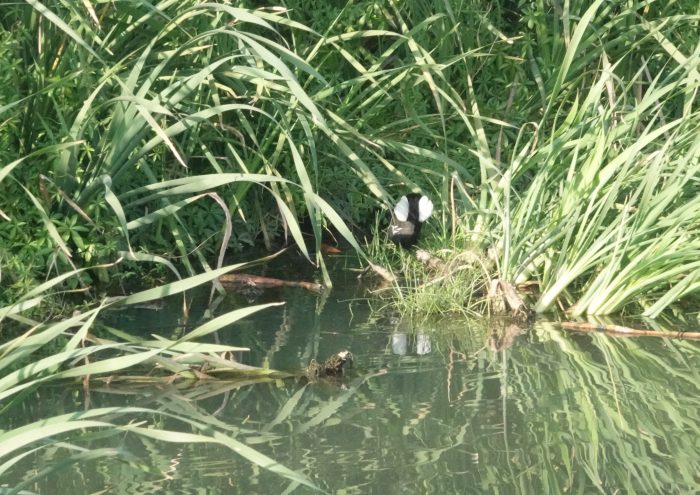
Common Moorhen – in the river, often disappearing into the reeds
Black Sparrowhawk – trees
African Spoonbill – in the river
Common Starling – anywhere
Red-winged Starling – on the lawns and in the trees
Cape Wagtail – muddy edges and lawns
Cape Weaver – nests in the trees and reedbeds

This is not a comprehensive list. There are Cape White-eyes in the trees, and warblers in the reedbeds!

Otters

This remarkable sighting comes from the Facebook group of the Friends of the Liesbeek, posted in 2018!

If you are exceptionally lucky, you can see a Cape Clawless Otter here. Sue Kingma’s text perfectly captures the significance of this awesome observation.

Even though this record was made six years ago, otters do still occur along the river. The challenge is having a camera at the ready!

Dragonflies and damselflies

The OdonataMAP section of the Virtual Museum has 47 records of dragonflies and damselflies from along the Liesbeek River, with six species in this section of the river (Blue Emperor, Red-veined Dropwing, Cape Skimmer, Broad Scarlet (photo below), Mountain Sprite, Tropical Bluetail). That will be a topic for a blog in summer, when these insects are active.

This dragonfly is a Broad Scarlet, photographed in this section of the Liesbeek River on 19 February 2021, by Sharon Stanton and Heleen Louw. It is record 124626 in OdonataMAP.

Thanks

Sharon Stanton, Heleen Louw, Jean Ramsay and Kevin Winter helped in assembling concepts and photographs. Thank you.

Lark-like Bunting (Emberiza impetuani)

Cover image of Lark-like Bunting by Les Underhill – Vanrhynsdorp district, Western Cape – BirdPix No. 274357

Buntings belong to the Family: EMBERIZIDAE. The buntings are a group of Old World passerine birds forming the genus Emberiza, which is the only genus in the family. The family contains 44 species. They are seed-eating birds with stubby, conical bills, comparatively long tails, and short legs. The feet are relatively large for scratching on the ground.

Identification

Identification guide for Lark-like Bunting
Lark-like Bunting (Emberiza impetuani)
Willowmore district, Eastern Cape
Photo by Cobus Elstadt

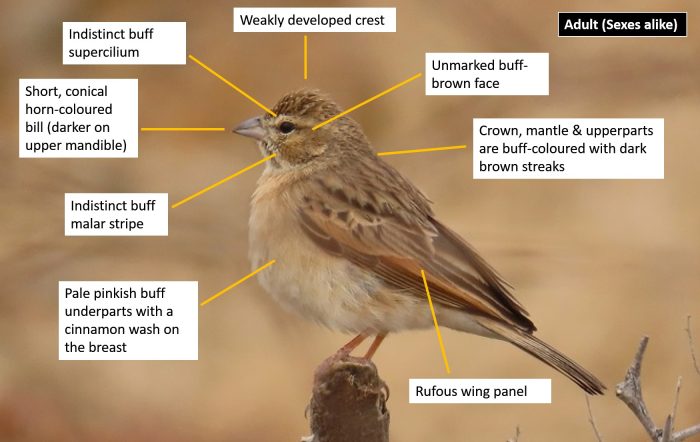
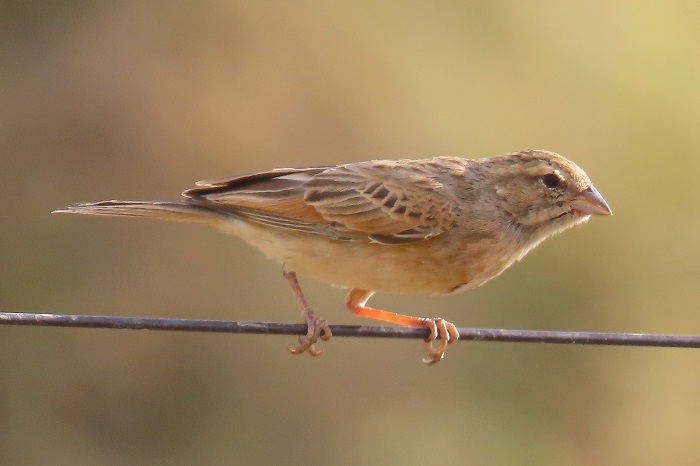
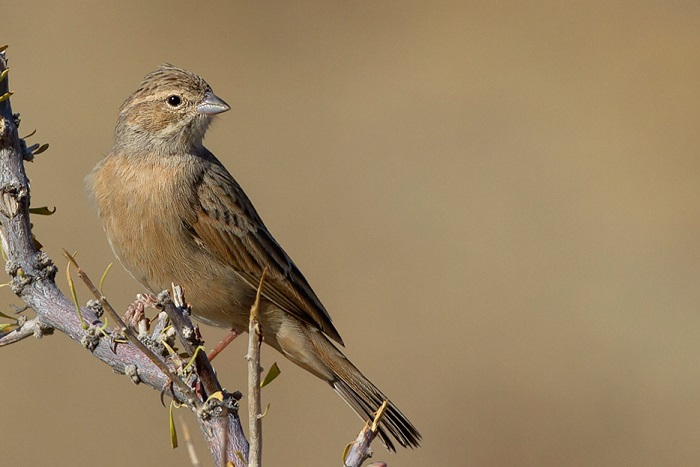
The Lark-like Bunting is a small, drab species. Adults have an overall light buffy brown appearance. The crown and nape are buff-brown with feint olive-brown streaks. The crown is sometimes raised into a weak crest. The face is buff-brown and unmarked. The supercilium and moustachial stripe are pale buff. The remainder of the upperparts are buff-coloured with dark brown streaks, especially on the mantle. The rump is plain buff-brown and the longish tail is dark brown, each tail feather with buff edging. The feathers in the folded wing are brown with buff edges except for the coverts which are pale rufous. The underparts are pale pinkish buff with a cinnamon wash on the breast, fading to pale buff on the lower belly and undertail coverts. The small, conical bill has a dark horn-coloured upper mandible and a paler lower mandible. The eyes are dark brown and the legs and feet are pinkish-brown. The sexes are alike.

Immature birds closely resemble the adults but are paler with a slightly mottled breast.

Emberiza impetuani
Lark-like Bunting (Emberiza impetuani)
Kleinpoort district, Eastern Cape
Photo by Cobus Elstadt

The Lark-like Bunting has a superficial resemblance to larks, hence the common name, but can easily be mistaken for a host of small brownish birds. The Lark-like Bunting is best separated from larks by its short, conical bill, longish tail, short legs and hopping gait.

Buntings generally have shorter legs and longer tails than other similar seed eating birds. The Lark-like Bunting is best identified by its characteristic ‘chut’ call-note, usually given in flight.

Lark-like Bunting
Lark-like Bunting (Emberiza impetuani) showing the weakly developed crest.
Hopetown district, Northern Cape
Photo by Lappies Labuschagne

Status and Distribution

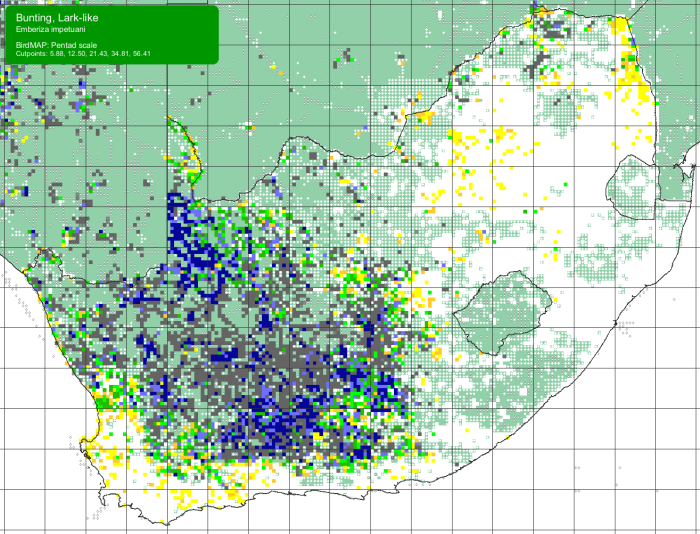
The Lark-like Bunting is a common to very common nomad. It is near-endemic to southern Africa, extending marginally into Angola where it occurs on the coastal plain as far north as Benguela. It is sometimes also recorded as a rare vagrant in Zambia and the Democratic Republic of the Congo.

SABAP2 distribution map for Lark-lilke Bunting
SABAP2 distribution map for Lark-like Bunting (Emberiza impetuani) – July 2024.
Details for map interpretation can be found here.

The Lark-like Bunting is widespread in southern Africa, especially in the arid and semi-arid regions of Namibia, Botswana and western South Africa. It is subject to periodic eruptions into areas where it does not usually occur such as southern Zimbabwe and the eastern lowveld of South Africa, mostly during very dry years. The Lark-like Bunting is a sporadic visitor to the coastal lowlands of the Western Cape, varying in abundance between years.

There is no evidence that the range of the Lark-like Bunting has recently changed. It is not considered threatened and is common in a wide range of habitats.

Emberiza impetuani
Lark-like Bunting (Emberiza impetuani)
Near Mariental, Namibia
Photo by Gregg Darling

Habitat

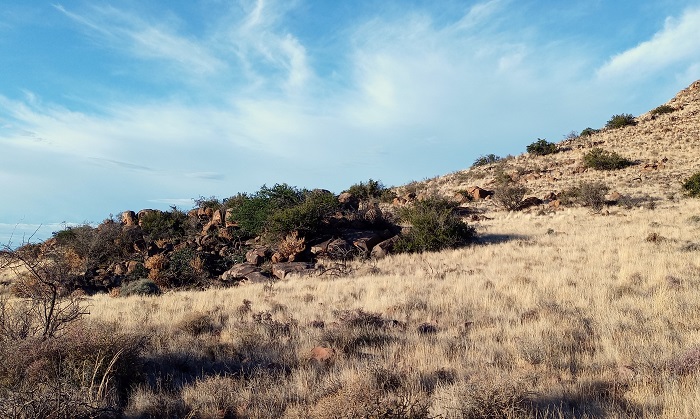
The Lark-like Bunting inhabits Karoo shrublands, desert grassland, arid and semi-arid savanna, sparsely vegetated rocky ridges, dry watercourses and grass covered sand dunes. It also occurs in degraded or overgrazed habitats including erosion gullies, old fields and road verges. Occasionally found in gardens on farms and in Karoo villages. The Lark-like Bunting occurs mostly in strandveld during irruptions into the coastal lowlands of the Western Cape.

Habitat for Lark-like Bunting
Habitat in the Nama Karoo
Carnarvon district, Northern Cape
Photo by Ryan Tippett

Behaviour

Lark-like Buntings are mostly gregarious, in flocks from 6 to many hundreds of birds, especially at water. They are occasionally also seen in pairs when breeding. Regularly associates with sparrowlarks and other seed eaters like canaries. The Lark-like Bunting is often confiding and flushes reluctantly, usually not flying far. The flight is erratic and undulating.

Lark-like Bunting in flight
Lark-like Bunting (Emberiza impetuani)
Carnarvon district, Northern Cape
Photo by Karis Daniel

The Lark-like Bunting is highly nomadic in response to rainfall, often appearing and disappearing overnight. Their arrival after rain corresponds with peak plant growth and seed production.

Emberiza impetuani
Lark-like Bunting (Emberiza impetuani)
Near Kenhardt, Northern Cape
Photo by Ryan Tippett

Forages on bare, stony and sparsely vegetated ground, sometimes jumping up to reach grass seeds. They generally hop but sometimes walk in a lark-like fashion. The Lark-like Bunting feeds on seeds and small insects. They mostly eat grass seeds, also cereals like wheat, as well as the seeds of forbs and small shrubs. Insect prey includes termite alates, small caterpillars and beetles etc.

They need to drink regularly and are usually not found too far from water. They often drink in the company of other small, granivorous birds.

Lark-like Bunting
The Lark-like Bunting (Emberiza impetuani) drinks water frequently.
Near Three Sisters, Western Cape
Photo by Les Underhill

The Lark-like Bunting is an opportunistic and irregular breeder due to the highly variable and erratic rainfall of arid areas. Breeding generally peaks in spring in the winter rainfall areas and in late summer and autumn in summer rainfall regions. The Lark-like Bunting is monogamous and is a solitary nester, although nests are sometimes less than 20m apart. Nests are placed on the ground, often under a shrub or at the base of an overhanging rock or stone. The nest is a shallow cup of grass and roots and is built entirely by the female.

Emberiza impetuani
Lark-like Bunting (Emberiza impetuani)
Erongo, Namibia
Photo by Katharina Reddig

Clutch size varies from two to four eggs. The egg colouration may be white or pale greenish to bluish white, with variable red, brown or grey spots, speckles or blotches. The incubation period takes up to 13 days. The newly hatched young are undescribed and the nestling period lasts for another 12 to 13 days. The predation rate on eggs and nestlings is often very high.

Lark-lie Bunting
The Lark-like Bunting (Emberiza impetuani) usually forages on patches of bare ground.
Near Aggenys, Northern Cape
Photo by Philip Nieuwoudt

Further Resources

Species text in the first Southern African Bird Atlas Project (SABAP1), 1997.

The use of photographs by Cobus Elstadt, Gregg Darling, Karis Daniel, Katharina Reddig, Lappies Labuschagne, Les Underhill and Philip Nieuwoudt is acknowledged.

Virtual Museum (BirdPix > Search VM > By Scientific or Common Name).

Other common names: Vaalstreepkoppie (Afrikaans); Lerchenammer (German); Bruant des rochers (French); Leeuwerikgors (Dutch); Escrevedeira-cotovia (Portuguese).

List of bird species in this format is available here.

Recommended citation format: Tippett RM 2024. Lark-like Bunting Emberiza impetuani. Biodiversity and Development Institute. Available online at https://thebdi.org/2024/07/24/lark-like-bunting-emberiza-impetuani/

Bird identificationbirding

Emberiza impetuani
Lark-like Bunting (Emberiza impetuani)
Mountain Zebra National Park, Eastern Cape
Photo by Gregg Darling

Cape Vulture (Gyps coprotheres)

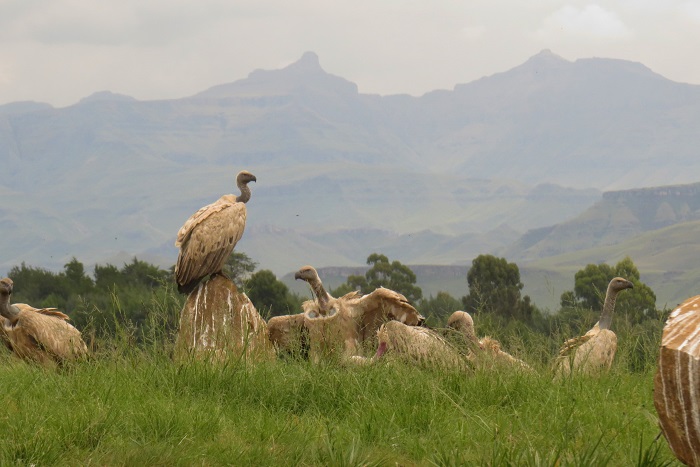
Cover image of Cape Vulture by Pamela Kleiman – Underberg district, KwaZulu-Natal – BirdPix No. 274705

Vultures belong to the Family: ACCIPITRIDAE. This family also includes eagles, hawks, buzzards, kites etc. Members are all carnivorous, and most are medium to very large birds with strongly hooked bills.

Identification

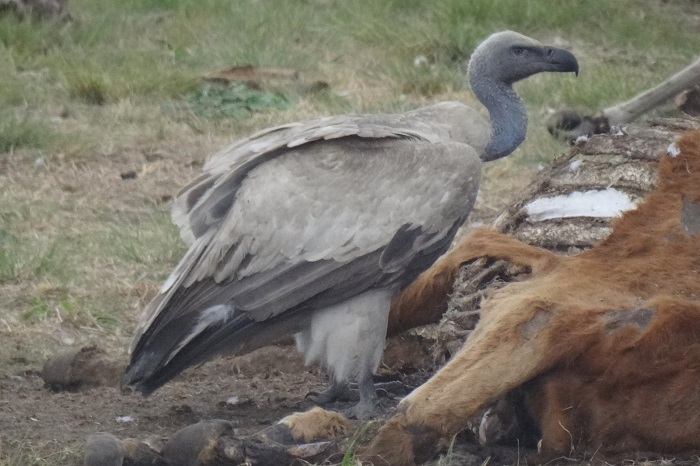
The Cape Vulture is a very large species, weighing up to 10.8 kg and can attain a wingspan up to 2.6 m. The sexes are alike but females are slightly larger.

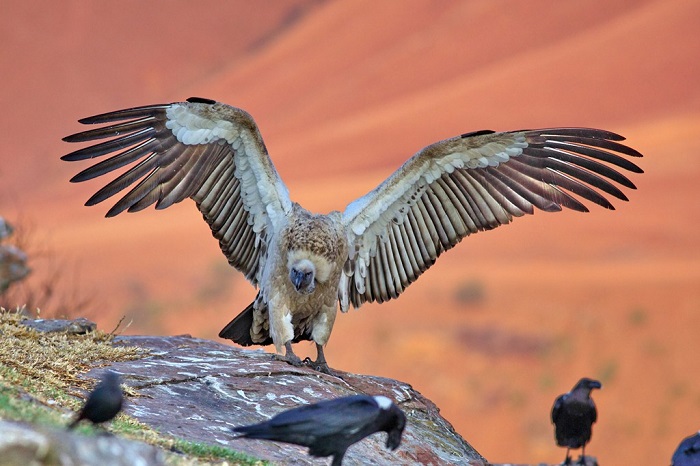
Identification guide to Cape Vulture
Cape Vulture (Gyps coprotheres)
Giant’s Castle, KwaZulu-Natal
Photo by Johan van Rensburg

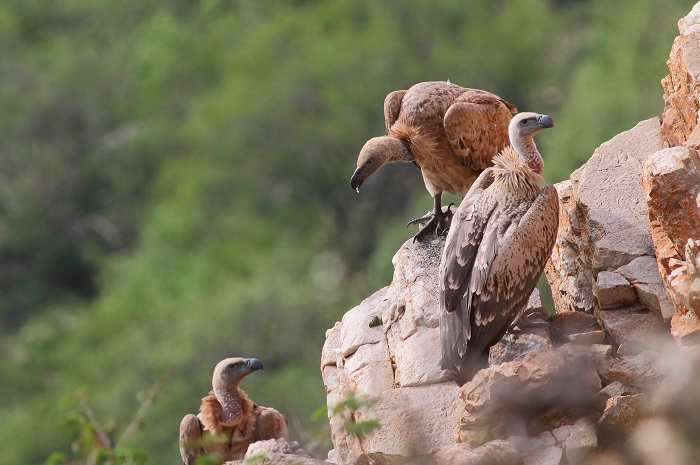
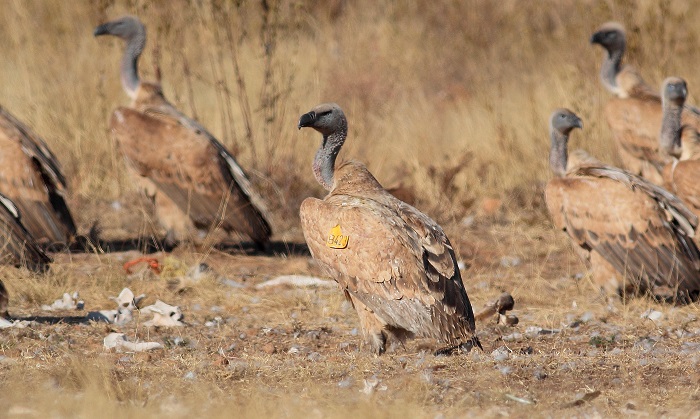
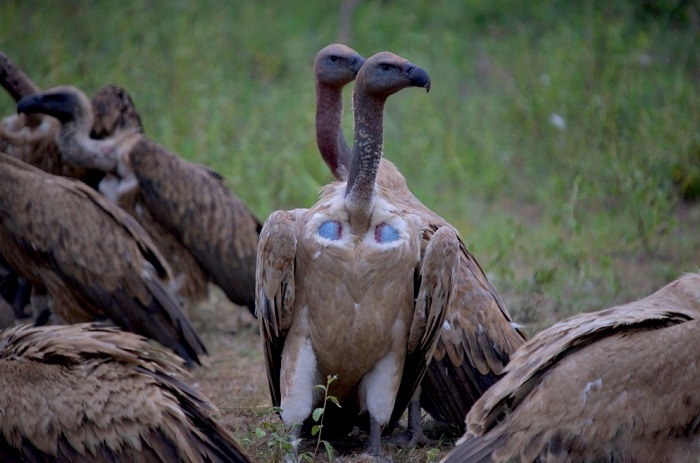
Adult Cape Vultures have bluish-grey heads, covered in short, white, hair-like feathers. The face is bare and can turn reddish when they are excited. The neck is long and bluish-grey, with a collar of fluffy white feathers around the base. A crop patch is present below the neck with short, dark brown feathers. It is flanked by two bare, light blue ‘breast-patches’, but these are not always visible. The overall body colouration varies from creamy off-white to buff-coloured and the back feathers are mottled with broad streaks. Perched birds show a diagnostic row of dark spots on the wing, just above the black flight feathers. The short tail is blackish brown. The bill and cere are black and the eyes are dull yellow. The legs and feet are black.

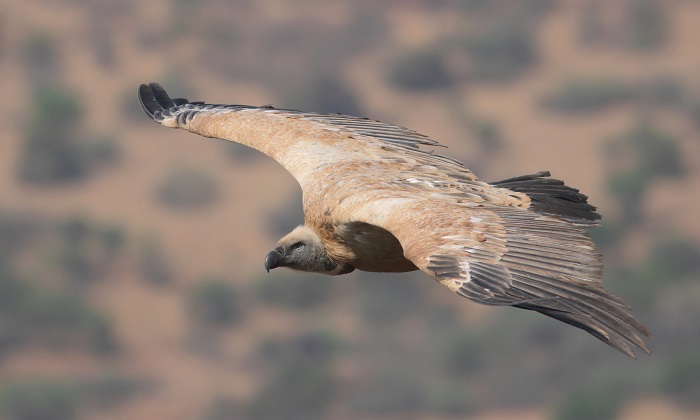
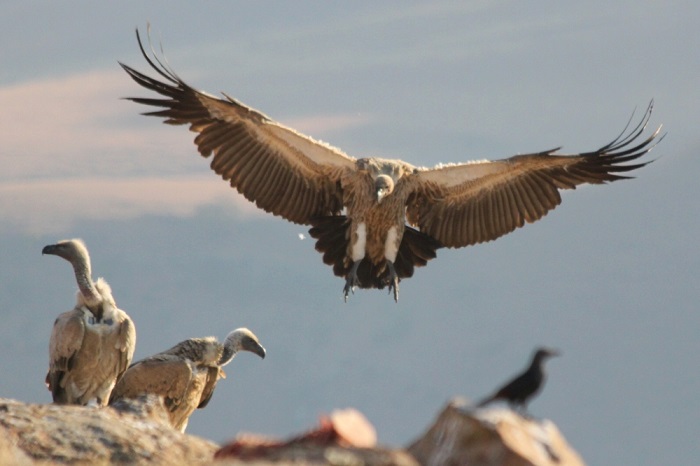
Adults in flight appear pale from below. The primaries are blackish and the secondaries are pale with a distinct, dark terminal bar.

Cape Vulture in flight
Cape Vulture (Gyps coprotheres) Adult
Mabula Game Reserve, Limpopo
Photo by Lance Robinson

Juvenile and immature birds go through a gradual transition into adult plumage that takes several years. Both are darker overall than the adults with dark buff streaks, which are especially noticeable on the underparts. The head is covered with woolly white down and the bare skin on the hind neck has a pinkish tint. The ‘breast-patches’ are reddish. They also have lance-shaped ruff feathers that eventually turn fluffy as they reach adulthood. Young birds slowly become paler as they mature and the streaked undersides are the last juvenile feature to be lost. The eyes are brown, only turning yellow in their fifth or sixth year. The skin on their necks is dark with pink tinges.

Gyps coprotheres
Cape Vulture (Gyps coprotheres)
Vulpro, Gauteng
Photo by Anthony Paton

Juveniles, when seen in flight from below, show blackish primaries and dark secondaries with grey-brown tips. If seen from above, the greater covert tips form a diagnostic narrow white stripe across the wing. Soaring immatures resemble the adults but generally have darker secondaries and show a row of black spots along the coverts near the base of the flight feathers.

Cape Vulture
Cape Vulture (Gyps coprotheres) juvenile
Ingula Nature Reserve, KwaZulu-Natal
Photo by Lance Robinson
Gyps coprotheres
Cape Vulture (Gyps coprotheres) Immature
Naude’s Nek, Eastern Cape
Photo by Jorrie Jordaan

Status and Distribution

The Cape Vulture is essentially endemic to southern Africa, with occasional vagrants reaching southern Zambia. It is a locally common resident in the core of its range but is scarce to rare elsewhere. The Cape Vulture is listed globally as endangered.

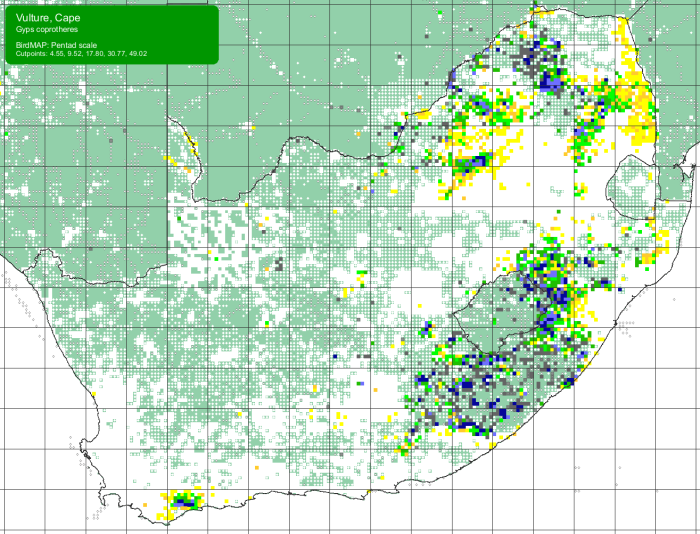
SABAPw2 distribution map Cape Vulture
SABAP2 distribution map for Cape Vulture (Gyps coprotheres) – July 2024. Details for map interpretation can be found here.

It is fairly widely distributed in southern Africa. The Cape Vulture is most widespread in South Africa, particularly in the east and north with a small, isolated population in the south-Western Cape. It also occurs in central and northern Namibia, south-eastern Botswana, western and southern Zimbabwe, south-western Mozambique, and eSwatini (Swaziland). Sadly, both the range and population of the Cape Vulture have decreased significantly over the last 100 years, and the Cape Vulture is now extinct as a breeding species in Namibia, Zimbabwe, eSwatini (Swaziland) and probably also Mozambique.

Gyps coprotheres
Cape Vulture (Gyps coprotheres)
Giant’s Castle, KwaZulu-Natal
Photo by Johan van Rensburg

The remaining breeding colonies are located in two, now mostly disjunct, regions. The first includes colonies in eastern Botswana and the Limpopo, North West and Gauteng provinces. The second is centred around the Drakensberg Mountain range in the Lesotho highlands, western KwaZulu-Natal and the Eastern Cape. Additionally, a remnant and isolated colony persists in the south-Western Cape.

The current distribution of the Cape Vulture shows that it has become greatly reduced or extinct in many areas away from its core range. This is most obvious in commercial, small-stock farming regions in the Karoo, Fynbos and Grassland biomes. The now fragmented range of the Cape Vulture is evident in the latest distribution map (see above).

Cape Vulture in flighjt
Cape Vulture (Gyps coprotheres) 
Near Hekpoort, Gauteng
Photo by Andrew Keys

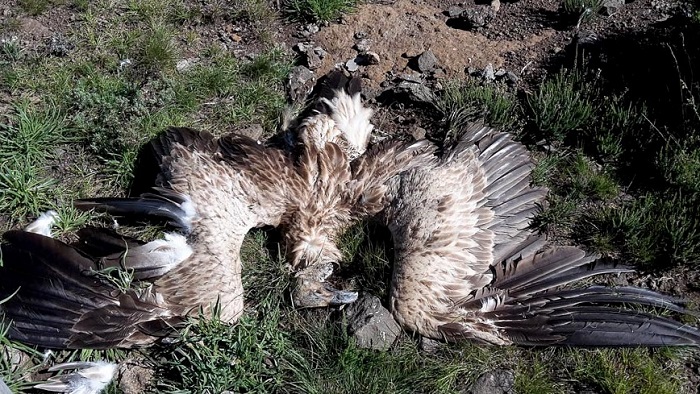
The Cape Vulture faces many threats to its continued survival. The greatest threat is from poisoning, which comes in two forms, either direct or indirect poisoning.

  • Indirect poisoning is largely due to irresponsible farmers who prepare and place poisoned baits to control live-stock predators such as jackals.
  • Direct poisoning occurs when vultures are deliberately poisoned by poachers to prevent the birds from alerting authorities when they circle over recent kills. They are also directly poisoned to harvest and sell their body parts for belief-based use.

Other major threats to the Cape Vulture include:

  • Collisions with energy infrastructures such as wind farms
  • Electrocutions on electricity lines and pylons
  • Reduced availability of food sources
  • Loss of breeding and foraging habitat
  • Human disturbance at breeding colonies
Electrocuted Cape Vulture
This young Cape Vulture (Gyps coprotheres) was electrocuted on overhead powerlines.
Near Elliot, Eastern Cape
Photo by Walter Neser

Habitat

Habitat for Cape Vulture
High mountainous habitat
Sani Pass, KwaZulu-Natal
Photo by Ryan Tippett

The Cape Vulture is reliant on tall cliffs for breeding, but they wander widely into other habitats when searching for food. Cape Vultures forage over a range of open habitats like grassland, scrub and savanna. The Cape Vulture is scarce in dense woodlands. Its current distribution is closely associated with subsistence communal-grazing areas, characterised by high stock losses and low use of poisons. They also scavenge in large conservation areas such as the greater Kruger National Park and game reserves in north-eastern Kwazulu-Natal, but do not breed in these reserves.

Gyps coprotheres
The Cape Vulture (Gyps coprotheres) forages widely in a range of open habitats.
Underberg district, KwaZulu-Natal
Photo by Pamela Kleiman

The Cape Vulture occurs and breeds from near sea level in the Western Cape up to 3100 m above sea level in the Lesotho highlands.

Gyps coprotheres
The Cape Vulture (Gyps coprotheres) is restricted to breeding on cliffs.
Near Hekpoort, Gauteng
Photo by Andrew Keys

Behaviour

The Cape Vulture is usually seen in groups of up to 100, but foraging birds may be seen in twos and threes. Small groups of Cape Vultures roost at night on trees and electricity pylons while larger groups roost on cliffs. They frequently gather at water to bathe and drink. They lie or stand with their wings outstretched after bathing to dry off, followed by preening.

Cape Vulture
Cape Vulture (Gyps coprotheres)
Near Hekpoort, Gauteng
Photo by Andrew Keys

Cape Vultures are generally resident but can be somewhat nomadic when not breeding. Birds have been recorded wandering up to 1200km during the non-breeding season, especially immatures prior to their first nesting attempt.

Gyps coprotheres in flight
Cape Vulture (Gyps coprotheres)
Queenstown district, Eastern Cape
Photo by Craig Peter

They range widely when searching for food. Cape Vultures forage in flight and carrion is identified by sight alone. They mostly search for medium-sized to very large mammal carcasses. Foraging birds soar high above open habitats. They spread out, scanning for signs of food by watching each other, and also the activities of other avian and mammalian scavengers.

Cape Vultures in flight
Cape Vulture (Gyps coprotheres)
Near Hekpoort, Gauteng
Photo by Andrew Keys

Once a carcass has been spotted, Cape Vultures will dive and descend rapidly. They arrive promptly at a carcass, and often in large numbers. At first, they will perch in nearby trees or stand around assessing the surroundings. Once it is deemed safe they will move in to feed. The Cape Vulture dominates most other vultures at a carcass, except adult Lappet-faced Vultures (Torgos tracheliotos), and they will occasionally attempt to steal food from other vulture species. They often have to wait for Lappet-faced Vultures or mammalian scavengers to open large, thick-skinned carcasses.

Gyps coprotheres
Cape Vulture (Gyps coprotheres)
Thornybush Private Game Reserve, Limpopo
Photo by Vaughn Jessnitz

Cape Vultures feed mostly by reaching deep inside a carcass, slicing off flesh with the sharp edges of the upper mandible. They eat rapidly, aided by grooves and serrations on the tongue. The crop can be filled within 5 minutes, which is enough food to sustain them for 3 days! They consume muscle tissue, organs, intestines and bone fragments and mostly avoid tougher material like thick skin and ligaments.

Cape Vulture
Cape Vulture (Gyps coprotheres)
Golden Gate Highlands National Park, Free State
Photo by Erena Neubert

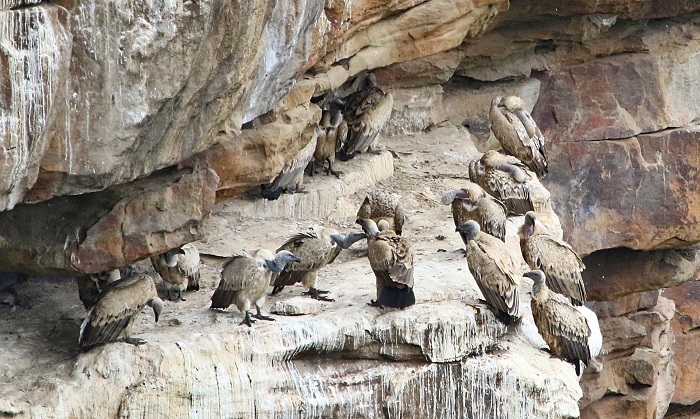
The Cape Vulture is monogamous and probably pairs for life. They nest colonially on tall cliffs. Colonies can number up to 1 000 pairs, but these days few colonies support more than 100 pairs. They are not territorial.

Cape Vulture colony
Cape Vulture (Gyps coprotheres)
Oribi Vulture Hide, KwaZulu-Natal
Photo by Lia Steen

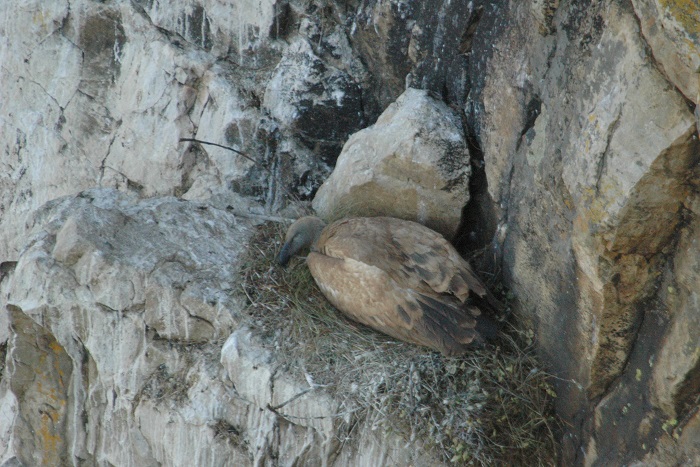
The nest is placed on a cliff ledge and is a fairly sparse, platform of sticks with a shallow bowl, lined with leaves and grass. The outside diameter of the nest can reach 1m across. It is built entirely by the female although the male gathers most of the nesting material. Pairs often re-use the same nest site in subsequent breeding seasons.

Gyps coprotheres
Cape Vulture (Gyps coprotheres)
Magaliesburg, North West
Photo by Rihann Geyser

Cape Vultures breed from March to July. A single off-white egg is laid per clutch. Incubation is shared almost equally by both sexes. The incubating bird’s shift lasts for 1 or 2 days at a time, while its mate is away foraging. The incubation period last for up to 58 days.

Once the egg hatches the young nestling is brooded continuously for up to 72 days. The nestling is fed on regurgitated food by both parents. Calcium rich bone fragments are very important in the nestlings diet. The nestling period lasts for up to 170 days before fledging. Fully fledged juveniles remain dependant on their parents for up to 221 days. The parents will then chase away the the immature bird before the start of the next egg-laying season. Young Cape Vultures take 4 to 6 years to reach sexual maturity.

Gyps coprotheres in flight
Cape Vulture (Gyps coprotheres)
Giant’s Castle, KwaZulu-Natal
Photo by Richard Johnstone

Further Resources

Species text from the first Southern African Bird Atlas Project (SABAP1), 1997.

The use of photographs by Andrew Keys, Anthony Paton, Craig Peter, Erena Neubert, Johan van Rensburg, Jorrie Jordaan, Lance Robinson, Lia Steen, Pamela Kleiman, Richard Johnstone, Vaughan Jessnitz and Walter Neser is acknowledged.

Virtual Museum (BirdPix > Search VM > By Scientific or Common Name).

Other common names: Cape Griffon (Alt. English); Kransaasvoël (Afrikaans); iNqe (Zulu); lxhalanga (Xhosa); Diswaane, Lenông (Tswana); Kaapse Gier (Dutch); Vautour chassefiente (French); Kapgeier (German); Grifo do Cabo (Portuguese)

A list of bird species in this format is available here.

Recommended citation format: Tippett RM 2024. Cape Vulture Gyps coprotheres. Biodiversity and Development Institute. Available online at https://thebdi.org/2024/07/22/cape-vulture-gyps-coprotheres/

Bird identificationbirding

Gyps coprotheres
Cape Vulture (Gyps coprotheres)
Vulpro, Gauteng
Photo by Andrew Keys

Fork-tailed Drongo (Dicrurus adsimilis)

Cover image: Fork-tailed Drongo by Desire Darling – Komdomo, Eastern Cape –  BirdPix No. 28186

Drongos belong to the Family: DICRURIDAE. All drongos are placed in a single genus, Dicrurus with 28 known species. Drongos are mostly black or dark grey, short-legged birds, with an upright stance when perched. They have forked tails and some have elaborate tail decorations. They are widely distributed in the old world tropics from Africa and tropical Asia, to Australasia and the Solomon Islands.

Identification

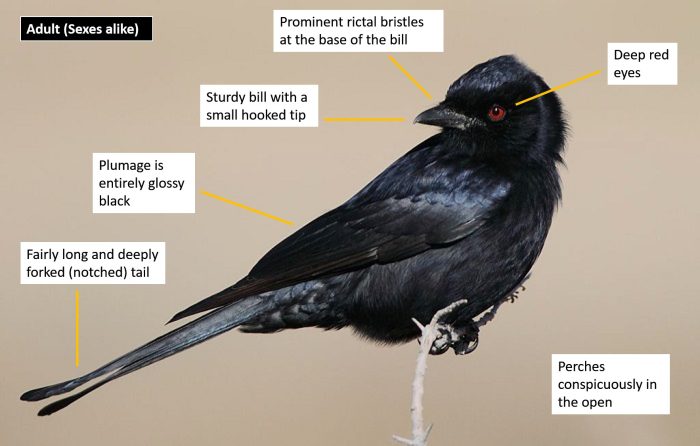
Identification of Fork-tailed Drongo
Fork-tailed Drongo (Dicrurus adsimilis) 
Kgalagadi Transfrontier Park, Northern Cape
Photo by Trevor Hardaker

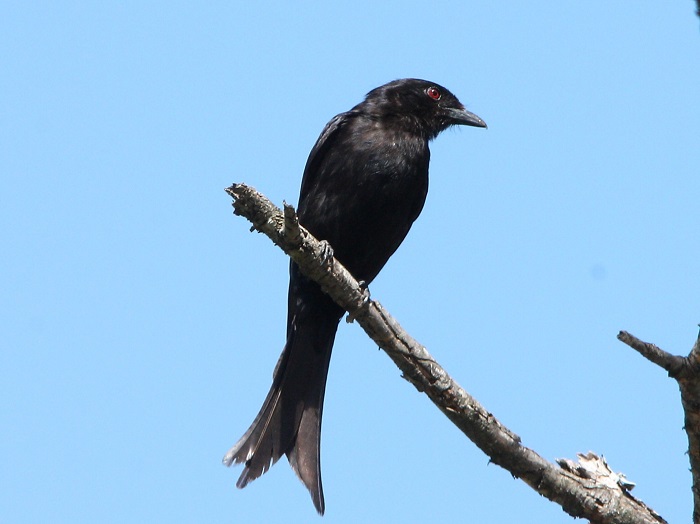
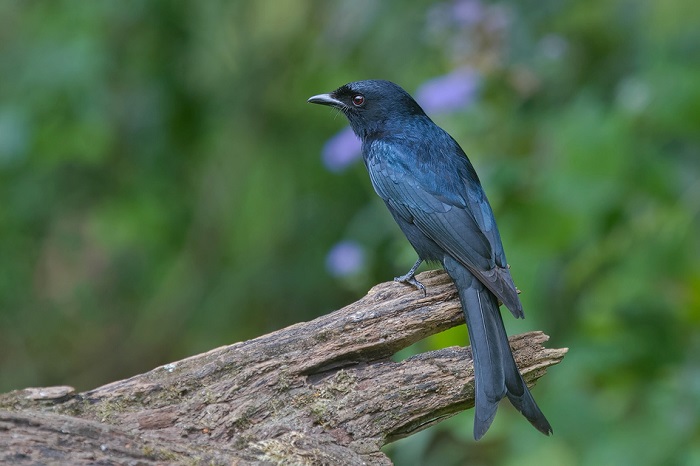
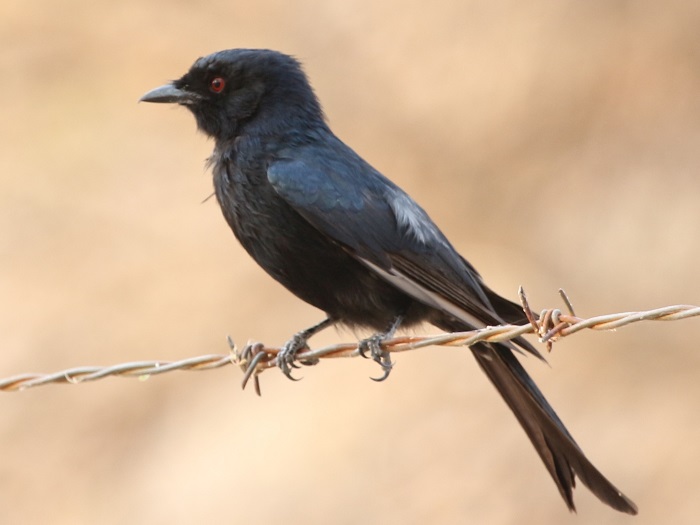
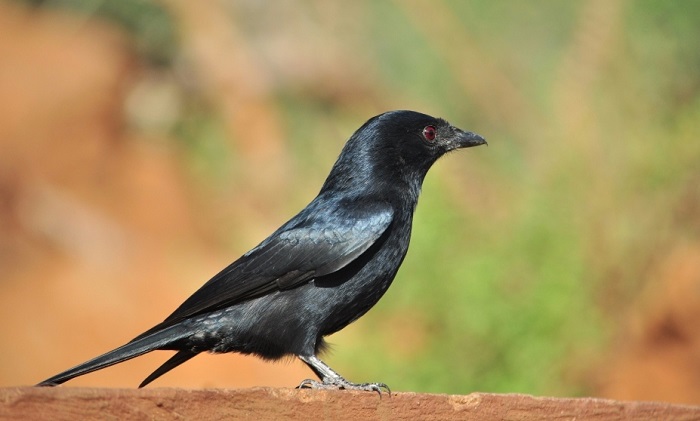
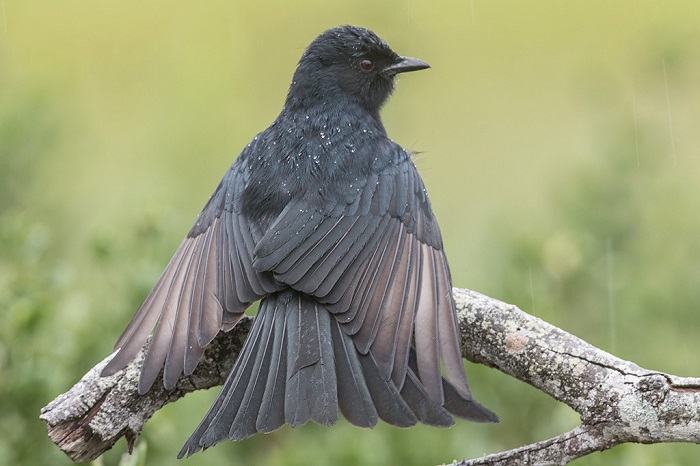
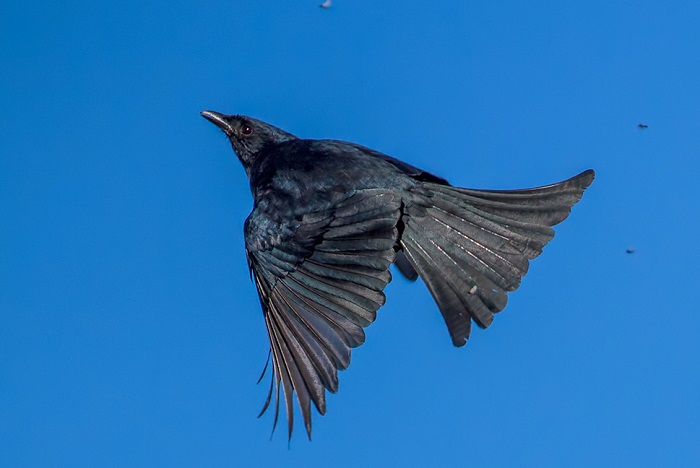
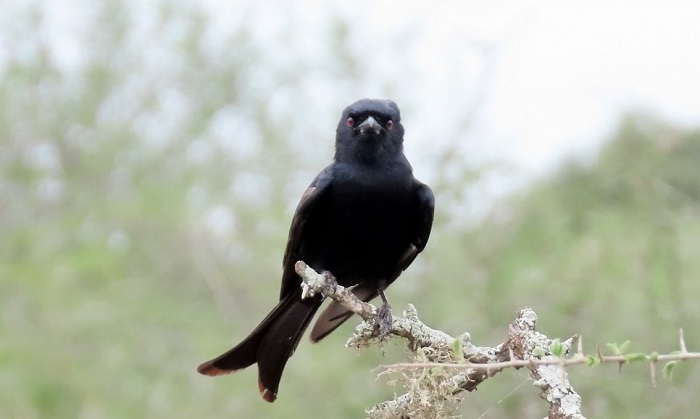
The Fork-tailed Drongo is a bold and conspicuous species. It is entirely black overall with a glossy blue or purplish sheen. It has a longish, deeply forked tail. During moult the tail often has a double fork until the feathers have fully grown out. The eyes are dark red and are an important identification feature. The legs and feet are black. The bill is fairly short and sturdy with a small hooked tip. The Fork-tailed Drongo has prominent rictal bristles at the base of the bill. In flight the wings appear pale to almost translucent. The sexes are very similar but females have less deeply forked tails.

Dicrurus adsimilis
Fork-tailed Drongo (Dicrurus adsimilis
Swartvlei Mouth, Western Cape
Photo by David Kennedy

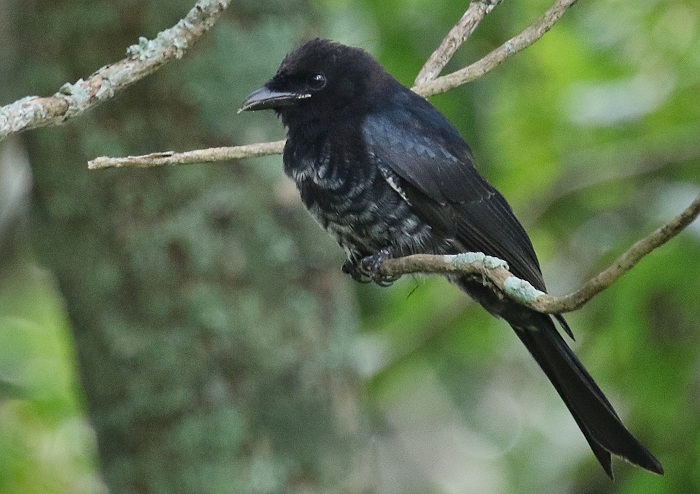
Immatures resemble the adults but are dusky grey below with dense pale grey speckles.

Juvenile Fort-tailed Drongo
An immature Fork-tailed Drongo (Dicrurus adsimilis) 
Shellybeach, KwaZulu-Natal
Photo by Lia Steen

The Fork-tailed Drongo is most likely to be mistaken for the Square-tailed Drongo (Dicrurus ludwigii) and the Southern Black Flycatcher (Melaenornis pammelaina). The Square-tailed Drongo is smaller with a square or slightly notched (not forked) tail. The two species also differ in their choice of habitat with the Square-tailed Drongo inhabiting forests rather than open woodland, ensuring they are largely ecologically separated. However, they can co-occur in certain areas, such as north-eastern KwaZulu-Natal. The Southern Black Flycatcher is also similar but is smaller with a more slender build. It also has a less robust bill that lacks the hooked tip, and blackish (not dark red) eyes.

Dicrurus adsimilis
Fork-tailed Drongo (Dicrurus adsimilis)
Zaagkuilsdrift, Limpopo
Photo by Mike Nyenes

Status and Distribution

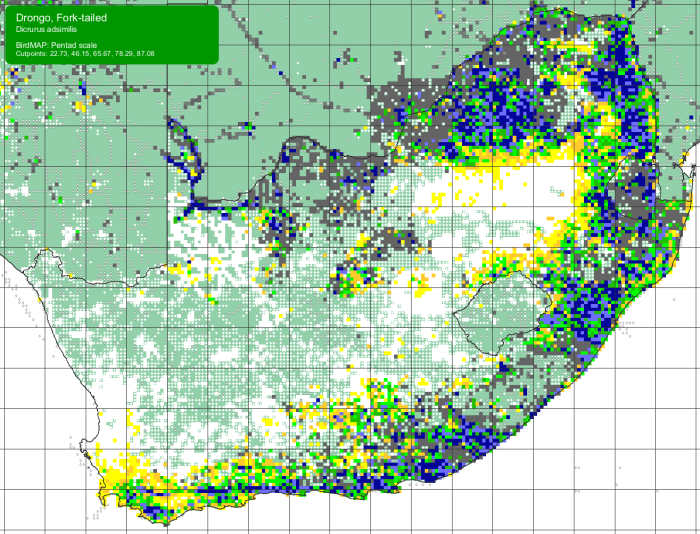
The Fork-tailed Drongo occurs throughout most of sub-Saharan Africa, except for very arid and otherwise treeless regions. In southern Africa it mostly avoids highveld grassland areas, the central and western Karoo, Namaqualand, the west coast lowlands of South Africa and the Namib desert of Namibia.

The Fork-tailed Drongo is a common resident, with some short-distance local movements in winter related to food availability.

SABAP2 distribution map for Fort-tailked Drongo
SABAP2 distribution map for Fork-tailed Drongo (Dicrurus adsimilis) – July 2024.
Details for map interpretation can be found here.

The Fork-tailed Drongo has expanded its range slightly further into the south-western Cape in recent decades and is not considered threatened.

Dicrurus adsimilis
Fork-tailed Drongo (Dicrurus adsimilis)
Wilderness, Western Cape
Photo by Desire Darling

Habitat

Habitat for Fork-tailed Drongo
Typical woodland habitat
Ndumo Game Reserve, KwaZulu-Natal
Photo by Ryan Tippett

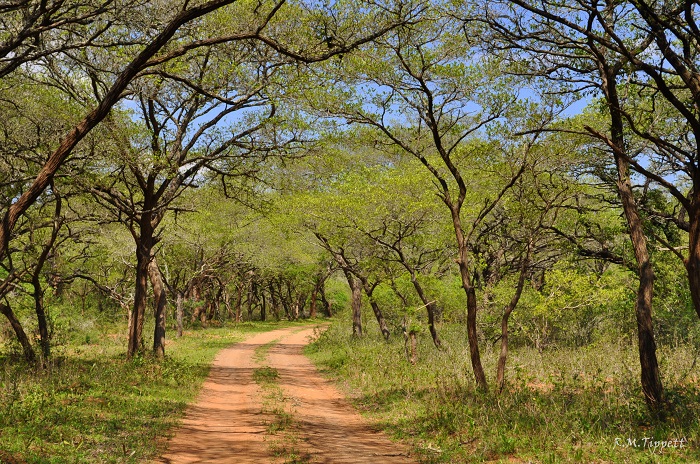
The Fork-tailed Drongo is primarily a woodland species. It inhabits a range of woodland types, including denser, moist woodland and open arid savanna, including the Kalahari. The Fork-tailed Drongo is also found in riverine woodland, exotic plantations, gardens, parks and farmyards. Its presence in grassland is dependant on the availability of perches like copses of alien trees or fence posts and telephone poles. It regularly occurs along forest edges but avoids the forest interior.

Behaviour

Dicrurus adsimilis
Fork-tailed Drongo (Dicrurus adsimilis)
Tsanakona, Botswana
Photo by Gert Myburgh

The Fork-tailed Drongo is conspicuous owing to its bold and aggressive behaviour and harsh, scolding calls. It is usually found solitarily or in pairs, but sometimes also in larger groups where food is abundant such as flowering aloes or termile alate emergences. Typically perches in the open on a branch or post. As it is an aggressive species, the Fork-tailed Drongo will readily mob snakes and larger birds like raptors, owls, hornbills or crows, and also small mammals like the Slender Mongoose. It is particularly aggressive at the nest, and will even attack humans that get too close.

Fork-tailed Drongo
Fork-tailed Drongo (Dicrurus adsimilis)
Zimanga Game Reserve, KwaZulu-Natal
Photo by Ryan Tippett

Bathes by plunge-diving from the air or perch and will also bathe in the rain by spreading its wings and tail, and raising the back feathers. The flight is buoyant, undulating and agile with a swift turn of speed when needed, allowing the Fork-tailed Drongo to evade fast-flying raptors such as goshawks.

Dicrurus adsimilis
Fork-tailed Drongo (Dicrurus adsimilis)
St. Francis Bay Air Field, Eastern Cape
Photo by Gregg Darling

It forages by hawking prey aerially from a perch but also catches prey on the ground. The Fork-tailed Drongo is primarily an insectivore but consumes a wide variety of food. Most insect prey is captured in flight, including dragonflies, butterflies, moths, termite alates and flies. It seems to be especially fond of stinging insects like bees and wasps. The stiff rictal bristles around the base of the bill are thought to help protect its face and eyes from stings and are also likely to provide a sensory function.

Dicrurus adsimilis
Fork-tailed Drongo (Dicrurus adsimilis)
St. Francis Bay Air Field, Eastern Cape
Photo by Gregg Darling

The Fork-tailed Drongo will also snatch prey like caterpillars and spiders from the surface of vegetation. It consumes nestlings and small adult birds like mannikins and canaries and has even been recorded to catch small fish from the the water surface. Larger prey is held down with one foot and eaten. The Fork-tailed Drongo also eats ticks which they remove from cattle and game animals, and they readily consume nectar, especially from large Aloe species.

Fork-tailed Drongo
Fork-tailed Drongo (Dicrurus adsimilis) 
Graaff- Reinet district, Eastern Cape
Photo by Alan Collett

The Fork-tailed Drongo is an intelligent and adaptable species with many interesting behavioural traits and interactions…

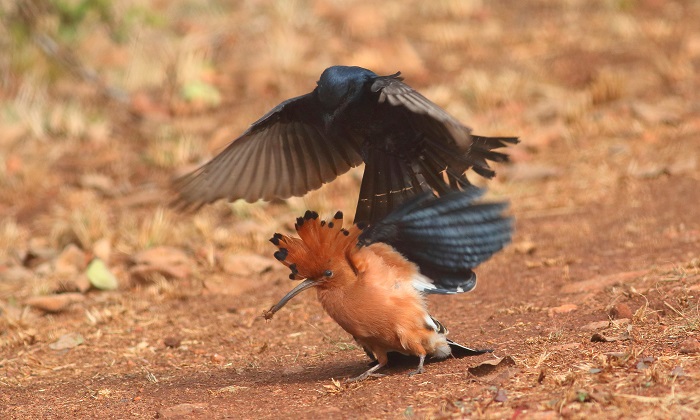
  • It regularly joins mixed-species foraging flocks where it is often kleptoparasitic, stealing food from other birds. If it spots another bird that had found food it may sound a ‘false alarm’ call, causing that bird to drop the morsel and flee towards cover. The drongo then swoops in to grab the dropped food.
  • Similarly, in the Kalahari, the Fork-tailed Drongo, perches above foraging Meerkats/Suricates (Suricata suricatta) and, when a meerkat has found food, swoops down, giving an alarm call. The meerkats then usually scatter, leaving the food, which the drongo then takes.
Fork-tailed Drongo stealing food from African Hoopoe
Fork-tailed Drongo (Dicrurus adsimilis) attempting to steal food from an African Hoopoe (Upupa africana)
Near Hartebeespoort, North West
Photo by Andrew Keys
  • It forages at lights at dusk and dawn, where it feeds on flying insects attracted by the light. There is even a record of feeding in floodlights at a game lodge during the night.
  • The Fork-tailed Drongo is an accomplished voice-mimic and often imitates the calls of predatory birds like the Pearl-spotted Owlet (Glaucidium perlatum) or African Goshawk (Accipiter tachiro). This is thought to deter other birds that may compete with the drongo from entering its territory.
  • It perches on, or close to beehives, hawking bees that leave or return to the hive.
  • It associates with walking humans and and perches on large mammals to catch flushed prey or to glean ticks.
  • It is attracted to veld fires, where it forages downwind from the flames in an attempt to catch fleeing insects.
Dicrurus adsimilis
The Fork-tailed Drongo (Dicrurus adsimilis) frequently perches on large animals to hawk disturbed insects and to glean ticks.
Hwange National Park, Zimbabwe
Photo by Derek Solomon

The Fork-tailed Drongo is recorded to breed virtually throughout the year in southern Africa, with a peak during late spring and summer (September to November). It is a monogamous, solitary nester and is strongly territorial.

The nest is a tightly woven, shallow cup. The floor and sides of the nest are thin and woven out of pliable plant stems, rootlets, tendrils and twigs. The nest is neatly bound with spider web and is usually placed in the horizontal fork of an outermost tree branch. The nest is firmly secured to the branch with additional spider web. Both sexes help to construct the nest which takes around four days to complete.

Fork-tailed Drongo
Fork-tailed Drongo (Dicrurus adsimilis)
Shellybeach, KwaZulu-Natal
Photo by Lia Steen

The clutch size varies from two to five eggs and the egg colouration is highly variable. The base colour may be white, pink or cream, and the eggs may be plain or speckled and blotched with with dark pink, reddish brown or brown markings.

Incubation starts once the full clutch has been laid. The incubation period usually lasts for 16 days and is performed by both sexes. The newly hatched young are altricial and are fed and brooded by both parents. The nestling period lasts for 17 to 18 days. The Fork-tailed Drongo is usually single brooded but pairs may lay a replacement clutch after an early failure.

Dicrurus adsimilis
Fork-tailed Drongo (Dicrurus adsimilis)
Thabazimbi district, Limpopo
Photo by Neels Putter

The Fork-tailed Drongo is the only known host of the African Cuckoo (Cuculus gularis) and is occasionally also parasitised by the Jacobin Cuckoo (Clamator jacobinus).

Dicrurus adsimilis
Fork-tailed Drongo (Dicrurus adsimilis)
Mkhuze Game Reserve, KwaZulu-Natal
Photo by Colin Summersgill

Further Resources

Species text in the first Southern African Bird Atlas Project (SABAP1), 1997.

The use of photographs by Alan Collett, Andrew Keys, Colin Summersgill, David Kennedy, Derek Solomon, Desire Darling, Gert Myburgh, Gregg Darling, Lia Steen, Mike Nyenes, Neels Putter and Trevor Hardaker is acknowledged.

Virtual Museum (BirdPix > Search VM > By Scientific or Common Name).

Other common names: Mikstertbyvanger (Afrikaans); iNtengu (Zulu); Intengu (Xhosa); Kuamosi (Tswana); Drongo brillant (French); Fluweeldrongo (Dutch); Trauerdrongo, Gabelschwanzdrongo (German); Drongo-de-cauda-forcada (Portuguese).

List of bird species in this format is available here.

Recommended citation format: Tippett RM 2024. Fork-tailed Drongo Dicrurus adsimilis. Biodiversity and Development Institute. Available online at https://thebdi.org/2024/07/15/fork-tailed-drongo-dicrurus-adsimilis/

Bird identificationbirding

Fork-tailed Drongo
Fork-tailed Drongo (Dicrurus adsimilis)
Shellybeach, KwaZulu-Natal
Photo by Lia Steen

Spotted Thick-knee (Burhinus capensis)

Cover image of Spotted Thick-Knee by Kevin Lavery – Klipriversberg Nature Reserve, Gauteng – BirdPix No. 220757

Thick-knees belong to the Family: BURHINIDAE. This family also includes Stone-Curlews. They are medium-to large sized, terrestrial waders. They are generally found in semi-arid to arid, open areas and only a few species are associated with water.

Identification

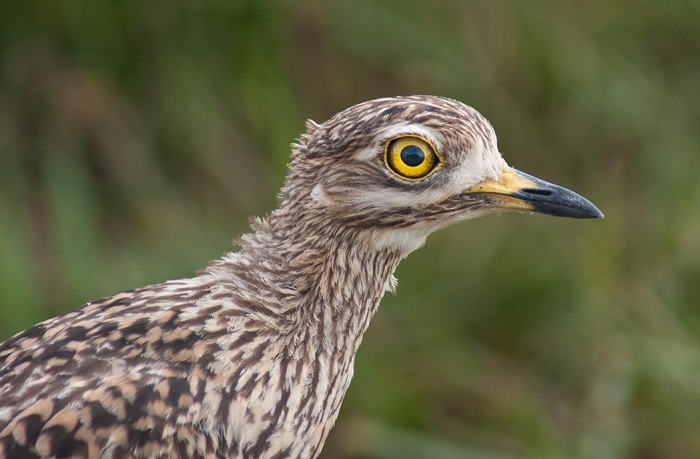
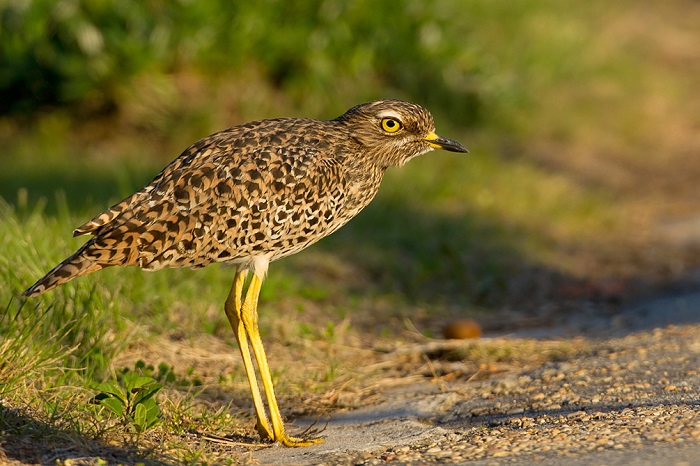
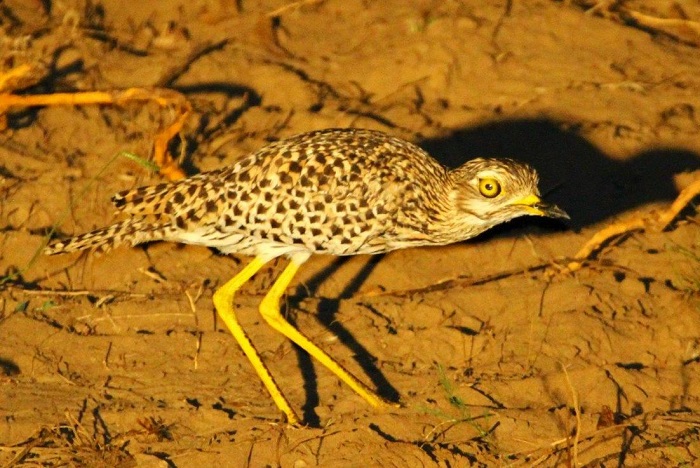
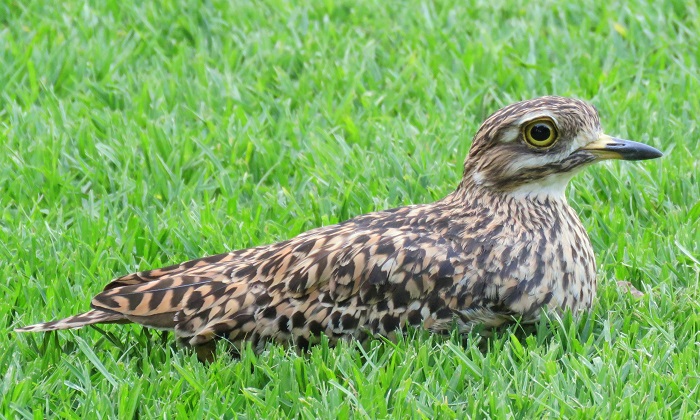
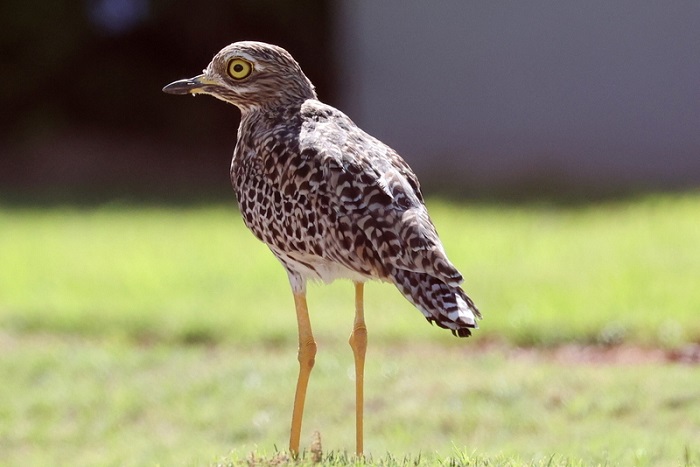
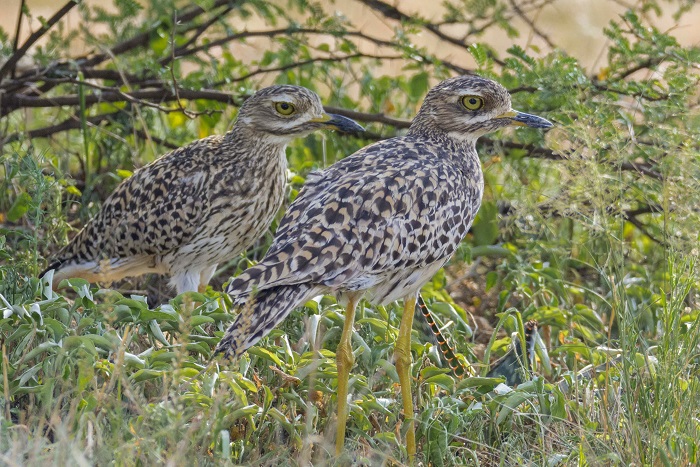
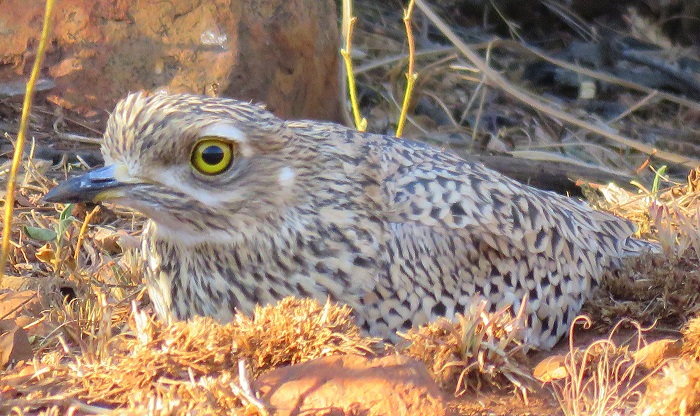
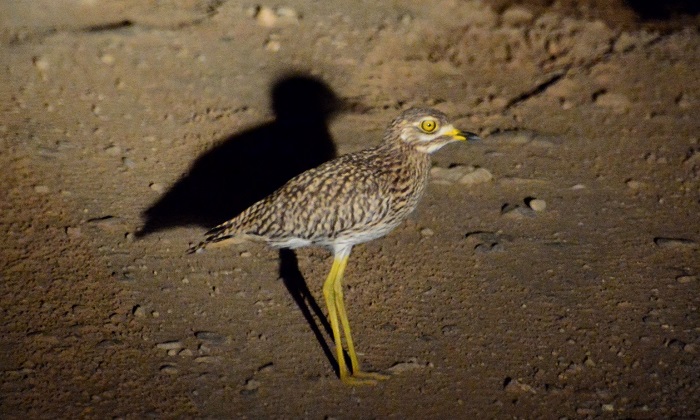
The Spotted Thick-knee is a large, long-legged wader, with strikingly large eyes. The combination of long legs, overall spotted appearance and large yellow eyes is distinctive.

Identification guide to Spotted Thick-knee
Spotted Thick-knee (Burhinus capensis) 
Riversdale district, Western Cape
Photo by Terry Terblanche

The forehead, crown, nape, ear coverts and hind neck are buff-coloured with darker brown streaks. The white supercilium is short and broad. A conspicuous white stripe is present below the eye, reaching from the gape or frons to the cheek.

Spotted Thick-knee
Spotted Thick-knee (Burhinus capensis)
Rietvlei Nature Reserve, Gauteng
Photo by Werner Van Goethem

The upper parts and tail are mostly buff-coloured with bold dark brown to black spots and blotches. The tail is fairly long and extends well beyond the wing tips at rest. The throat is white and the underparts, from the neck to the lower breast are pale buff with fine dark streaks. The belly and under tail coverts are white with scattered dark streaks.

Burhinus capensis
Spotted Thick-knee (Burhinus capensis)
Hanover district, Northern Cape
Photo by Ryan Tippett

In flight the Spotted Thick-knee appears long-winged and long-tailed. The flight feathers are black with white patches at the base of the primaries. The bill is black with a yellow base and the legs and feet are dull yellow. The large eyes are rich yellow. The sexes are alike.

Spotted Thick-knee
Spotted Thick-knee (Burhinus capensis)
St. Francis Bay, Eastern Cape
Photo by Gregg Darling

Juveniles resemble the adults but are more heavily streaked on the upperparts and have a less blotched appearance. They also have finer streaking on the fore-neck and breast.

The Spotted Thick-knee is only likely to be confused with the slightly smaller Water Thick-knee (Burhinus vermiculatus), but lacks that species greyish wing panel and thin white wing bar. The two species frequently co-occur, although their preferred habitats differ.

Burhinus capensis
Spotted Thick-knee (Burhinus capensis)
iSimangaliso Wetlands Park, KwaZulu-Natal
Photo by Mark Stanton

Status and Distribution

The Spotted Thick-knee is generally a fairly common resident with some local movement in the non-breeding season.

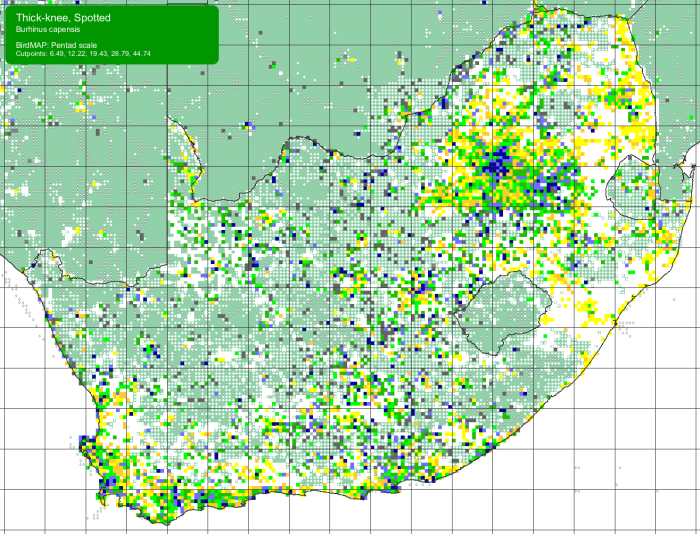
SABAP2 distribution map for Spotted Thick-knee
SABAP2 distribution map for Spotted Thick-knee (Burhinus capensis) – June 2024. Details for map interpretation can be found here.

The Spotted Thick-knee is found across most of sub-Saharan Africa but is absent from the tropical forest zone, and the driest parts of East Africa. There are also isolated populations in the south-west of the Arabian Peninsula. It is widespread throughout southern Africa but avoids the most arid parts of the Namib Desert, the high Drakensberg and the eastern highlands of Zimbabwe.

Burhinus capensis
Spotted Thick-knee (Burhinus capensis)
Klipriviersberg Nature Reserve, Gauteng
Photo by Kevin Lavery

The Spotted Thick-knee is not threatened in southern Africa due to its adaptability to man-modified habitats. As a result its historical range and abundance have probably not changed much.

The clearing of bush and forest has helped the Spotted Thick-knee to extend its range into formerly unsuitable areas. On the other hand, the species is no longer found in Lesotho and the former Transkei in the Eastern Cape. These regions have become uninhabitable to the Spotted Thick-knee due to the constant presence of people and livestock (especially free-range pigs) making breeding virtually impossible. Under less extreme conditions the Spotted Thick-Knee adapts well to habitats modified by human activity.

Spotted Thick-knee
Spotted Thick-knee (Burhinus capensis)
Klerksdorp district, North West
Photo by Tony Archer

The Spotted Thick-knee does face a few threats: It was hunted historically but is no longer regarded as a gamebird. They are sometimes shot at airports due to a risk of collision with aircraft. Additionally, in southern Africa large numbers may be killed on roads at night.

Habitat

Habitat for Spotted Thick-knee
Habitat in semi-arid Karoo scrub with nearby cover and bare patches on which to forage.
Carnarvon district, Northern Cape
Photo by Ryan Tippett

The Spotted Thick-knee prefers open habitats with sparse ground cover and patches of bare soil, especially on stony ground. It inhabits open grassland and savanna, also woodland edges, fynbos, semi-arid Karoo scrub and low stony hills, but avoids true desert. The Spotted Thick-knee requires some nearby cover to rest up in during the day such as bushes, long grass or under low hanging tree branches etc. They are often encountered on gravel roads at night and sometimes occur on beaches, especially in the Eastern Cape.

Burhinus capensis
The Spotted Thick-knee (Burhinus capensis) is commonly found in urban environments in South Africa.
Paarden Eiland, Cape Town, Western Cape
Photo by Les Underhill

The Spotted Thick-knee has adapted well to man-modified habitats like cultivated and overgrazed lands. It commonly occurs and breeds in urban environments in South Africa, even close to city centres. Urban habitats include large lawns, playing fields, gardens, parks and cemeteries. Interestingly, the Spotted Thick-Knee is absent from suburban gardens in Botswana.

Behaviour

The Spotted Thick-knee is normally encountered solitarily or in pairs when breeding, otherwise often gregarious, forming loose daytime roosts of up to 70 birds. The Spotted Thick-knee is most vocal at night and can be rather noisy at times. They also call on overcast days, especially after rain.

Spotted Thick-knee
Spotted Thick-knee (Burhinus capensis)
Northcliff, Johannesburg, Gauteng
Photo by Anthony Paton

The Spotted Thick-knee is largely crepuscular and nocturnal. It roosts by day, standing or crouching in the shade of a bush or tree, often in the cover of grass or weedy growth. Sleeps by crouching with the legs covered by the breast and with the neck and head resting on the ground. On hot days they may lie down with both legs stretched out behind the body to aid in cooling.

Burhinus capensis
Spotted Thick-knee (Burhinus capensis)
Somerset West, Western Cape
Photo by Corrie du Toit

When disturbed the Spotted Thick-knee usually runs off with its head held low and flies strongly with shallow, stiff wing-beats. Birds will often hold their wings out momentarily upon landing and usually crouch or stand still until the perceived danger has passed.

Spotted Thick-knee
Spotted Thick-knee (Burhinus capensis)
Klerksdorp district, North West
Photo by Tony Archer

The Spotted Thick-knee forages in a plover-like manner, running several steps forward before pausing, followed by a quick peck at its prey. Eats mainly arthropods, especially insects. Beetles and termites are preferred but also takes locusts, earwigs, bugs, caterpillars, moths, crickets, bees and ants etc. Also consumes spiders, solifuges, scorpions, snails and worms. On rare occasions may eat small mammals, amphibians and thread snakes. Stomach contents of the Spotted Thick-knee usually contain substantial amounts of grit to aid in digestion.

Burhinus capensis
Spotted Thick-knee (Burhinus capensis)
Alberton, Johannesburg, Gauteng
Photo by Anthony Paton

The Spotted Thick-knee is a monogamous, solitary nester. They are usually territorial, but loosely colonial breeding has been observed. Pairs are believed to maintain long-term bonds.

The nest is simply a shallow scrape on the ground, usually in the open among grass tufts or next to a stone or shrub. The nest is normally placed at a site with good all round visibility. The nest scrape may be lined or ringed with twigs, antelope droppings, leaves or stones but is sometimes left unlined.

Spotted Thick-knee
Spotted Thick-knee (Burhinus capensis) nest and eggs.
Rietvlei Nature Reserve, Gauteng
Photo by Bryan Groom

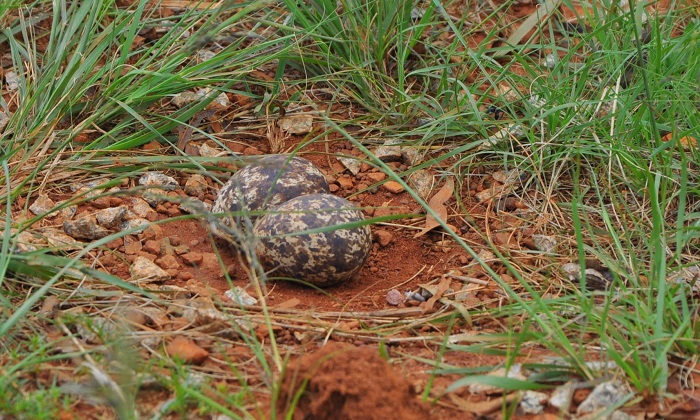
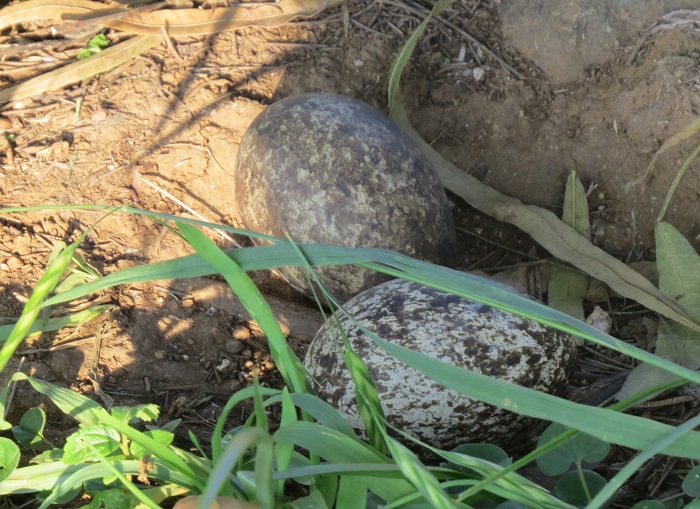
Eggs are mainly laid from September to December in southern Africa. Most pairs lay two eggs per clutch. The egg colour is variable ranging from dull tawny to yellowish grey and heavily blotched in dark yellowish-brown with grey. The Spotted Thick-knee will usually lay a replacement clutch if the eggs are lost, with up to 4 clutches laid per season.

Spotted Thick-knee
Spotted Thick-knee (Burhinus capensis) nest and eggs.
Johannesburg, Gauteng
Photo by Anthony Paton

Incubation begins around 24 hours after the full clutch has been laid. Both sexes share incubation duties, but females spend the most time on the eggs. The incubation period can last for up to 30 days. The non-incubating parent usually remains nearby.

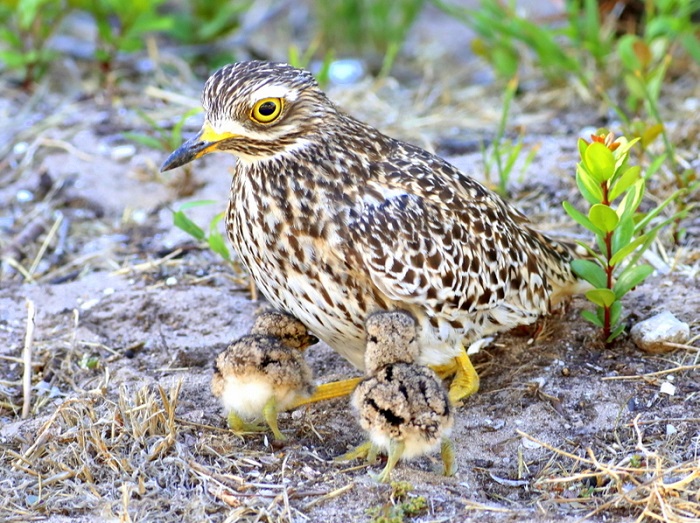
The eggs hatch synchronously and the empty shell fragments are eaten by the adults. Newly hatched young are precocial and are well camouflaged. Chicks leave the nest within a day and are fed by both parents.

Burhinus capensis
Spotted Thick-knee (Burhinus capensis)
Franskraal, Western Cape
Photo by Corrie du Toit

Chicks crouch in response to danger, lying flat with their heads outstretched. Adults are known to use broken-wing, broken-back and broken-leg displays to draw predators away from the eggs and chicks. The fledging period takes up to 8 weeks.

Further Resources

Species text from the first Southern African Bird Atlas Project (SABAP1), 1997.

The use of photographs by Anthony Paton, Bryan Groom, Corrie du Toit, Gregg Darling, Kevin Lavery, Les Underhill, Mark Stanton, Terry Terblanche, Tony Archer and Werner Van Goethem is acknowledged.

Virtual Museum (BirdPix > Search VM > By Scientific or Common Name).

Other common names: Spotted Dikkop (Alt. English); Gewone dikkop (Afrikaans); umBangaqhwa, umJenjana (Zulu); Ingqangqoto (Xhosa); Kgoadirê, Mongwangwa, Tswangtswang (Tswana); Kaapse Griel (Dutch); Oedicnème tachard (French); Kaptriel, Bändertriel (German); Alcaravão do Cabo (Portuguese)

A list of bird species in this format is available here.

Recommended citation format: Tippett RM 2024. Spotted Thick-knee Burhinus capensis. Biodiversity and Development Institute. Available online at https://thebdi.org/2024/07/09/spotted-thick-knee-burhinus-capensis/

Bird identificationbirding

Spotted Thick-knee
The Spotted Thick-knee (Burhinus capensis) is often encountered on gravel roads at night.
Karoo Gariep Nature Reserve, Northern Cape
Photo by Ryan Tippett

Industrial biodiversity 2 continued : Black River in Paarden Island : stormwater drain

In October 2019, the piece of the Black River between the N1 and Section Street in the City of Cape Town looked like this:

Black River in 2019

It was described in a 2019 blog as a novel ecosystem. A place that has been changed out of all recognition, but where biodiversity is doing its best to recover what is feasible. The 2019 blog had photos of a variety of waterbird species breeding, and it listed an interesting diversity of species, including Pied Kingfisher. The old blog is worth a read.

In July 2024, this piece of the river looked like this. Every scrap of vegetation has gone. It is a plantless and sterile habitat. For all practical purposes, it has been transformed into a desert. A wet desert, but nonetheless a desert!

The Black River in 2024

But why? The photo below explains …

... the Black River just after heavy rain in 2024

… the sole purpose of this “river” is now to act as a mega stormwater drain.The area of hard surface (roads, roofs and paving) in the catchment of this river is ever increasing. None of the rain that falls on these surfaces can soak in. All of it instantly becomes reclassified as “stormwater”. It drains off our roofs into our gutters, down the drainpipes, and out into the street where it joins the rain that has fallen on the roads, along the gutters in the streets, down the stormwater drains, and into the underground pipes that discharge the water into the nearest river. It needs to be drained away as fast as possible, otherwise there are floods. It all rapidly ends up in rivers, like this. No impediments to flow can be countenanced! As fast as possible, the stormwater must reach the sea.

The stormwater from a vast part of the suburbs of Cape Town drains to the sea along this section of river. The green line is the boundary of the catchment; the total area is 214 square kilometres. In the northeast, the Elsieskraal River starts in the Tygerberg Hills, drains most of the Northern Suburbs and a large fraction of the Cape Flats, as far east as Cape Town International Airport. All the suburbs on the western edge of Table Mountain (eg Newlands, Rondebosch) drain into the Black River via the Liesbeek River.

The same view at 15h00 on 9 July 2024! There was a cloudburst over the 214-square kilometre catchment for several hours just before this photo was taken! The stormwater drain is being challenged to its limits! The water level is getting close to the N1 bridge, the low bridge for the main highway of the N1 between Cape Town and Paarl. The elevated bridges are for the N1 to M5 interchange,

… and below is the view from the other side of the Section Street bridge towards the ocean, a kilometre away, 15h00, 9 July 2024.

… and on a smaller scale …

This photograph was in the 2019 blog. This was part of the east bank of the river, taken from the Section Street bridge. This “garden” has an abstract beauty of its own, a un-designed kaleidoscope of colours. It was attractive to a pair of Levaillant’s Cisticolas. Spot them on the reeds in the foreground.

Section of the bank of the Black River in 2019

… but the imperatives of getting stormwater to the sea as fast as possible resulted in the transformation below…

... the same section in 2024

Every scrap of vegetation within the river, or hanging over the edge, has gone!

The same view, 15h00 on 9 July 2024. The stormwater drain was just big enough. If any of that vegetation had remained, there would have been a flood!

… but some birds persist, against all the odds …

In spite of the transformation back to concrete, there were a few birds making a living on this section of the Black River.

Hartlaub's Gulls
… some Hartlaub’s Gulls (curated for posterity in the BirdPix section of the Virtual Museum as record 283191)
Cape Wagtail
… this was one of a pair of Cape Wagtails hunting along the water’s edge (BirdPix 283187)
Egyptian Geese
… hard to grasp what these Egyptian Geese were finding below the surface (BirdPix 283192)

Even after the storm of 9 July 2024, there were birds around:

… so …

… so the City’s obligation to prevent floods overrides all other considerations. For a very long time the fundamental orientation of city planners, everywhere, has been to get rid of stormwater as rapidly as possible. What can be done to change this? The trick is to slow the flow. Can we find ways of storing the stormwater for a while, and then letting it drain steadily into the rivers? The total volume of water is the same, but it flows over a longer period, and therefore not so fiercely.

The strategy being used is to build flood detention dams. These come in multiple forms, but the main objective is the same. Hold the water back, and let it leave more slowly then it arrives.

GoogleMap of the section of the Black River between the N1 and Section Street in Paarden Island
The N1 is at the bottom and Section Street is at the top. The photos in this blog were all taken from the Section Street bridge. The road spaghetti, bottom right, is the N1 to M3 interchange. On the left is the eastern edge of Paarden Island. North is towards the top.

Useful background reading

Rivers and wetlands of Cape Town: caring for our rich aquatic heritage.

Salt River hydrological study.

Jackal Buzzard (Buteo rufofuscus)

Cover image of Jackal Buzzard by Gregg Darling – Near St. Francis Bay, Eastern Cape – BirdPix No. 8247

Buzzards belong to the Family ACCIPITRIDAE along with Eagles, Kites, Vultures and Hawks etc. They are mostly medium to very large birds with females usually being larger than males. They have relatively short, strongly hooked bills and powerful legs and feet with strong claws.

Identification

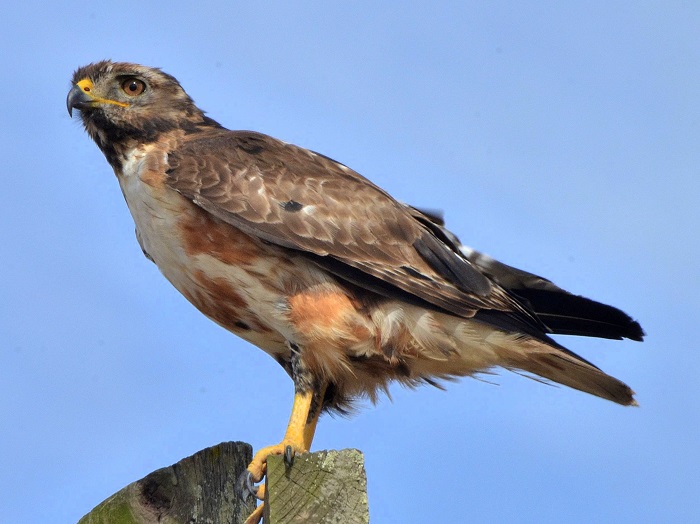
The Jackal Buzzard is a fairly large, stocky and conspicuous raptor. The sexes are alike in terms of plumage coloration but females are distinctly larger than males. Females can weigh up to 1.6 kg with males weighing up to 1.08 kg (average 960g). Jackal Buzzards can attain a wingspan of 1.44 m.

Identification guide for Jackal Buzzard
Jackal Buzzard (Buteo rufofuscus) 
Addo Elephant National Park, Eastern Cape
Photo by Desire Darling

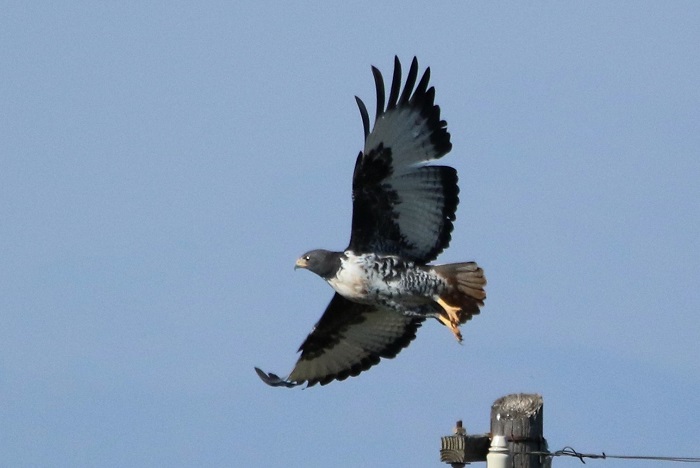
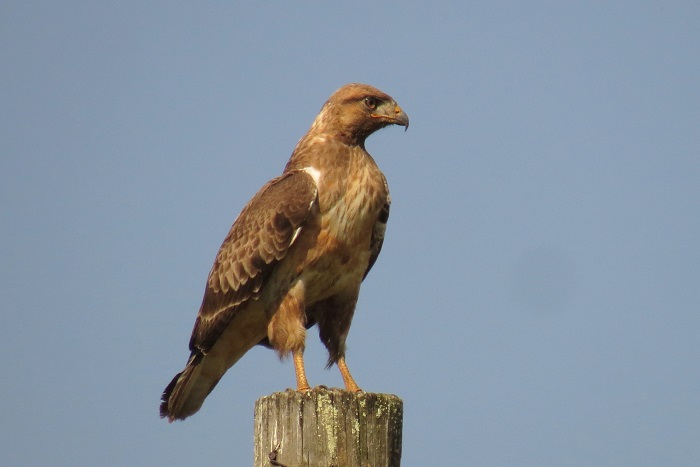
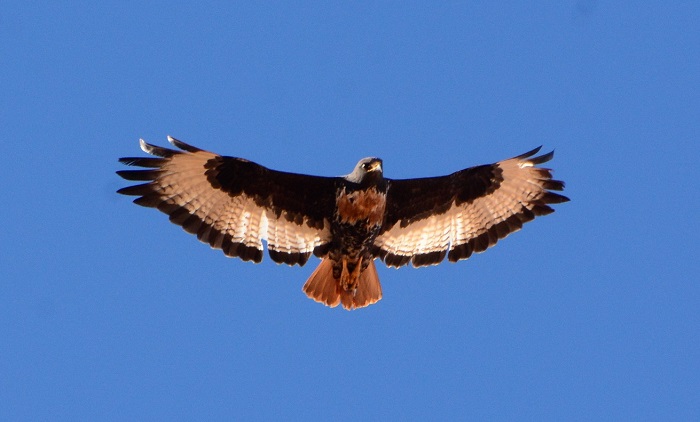
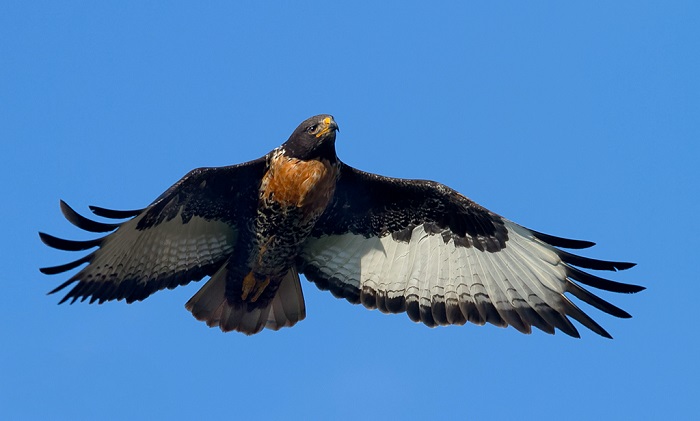
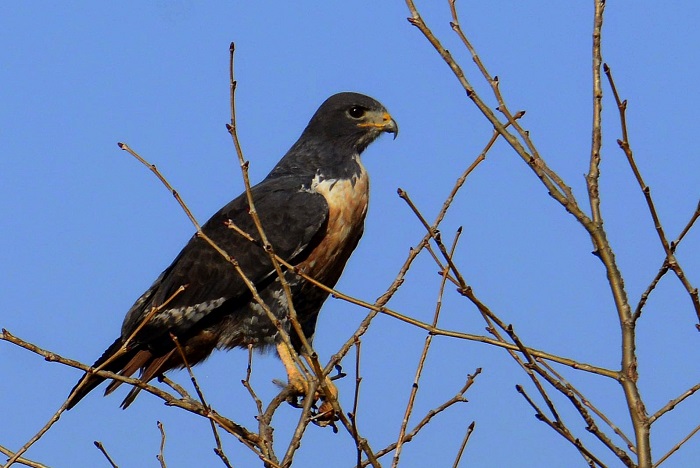
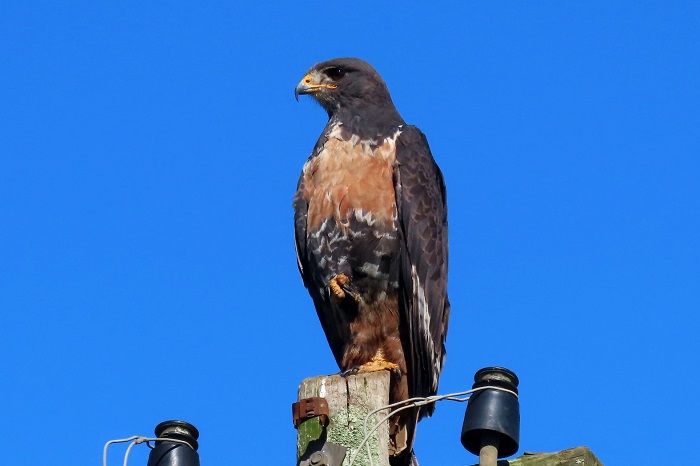
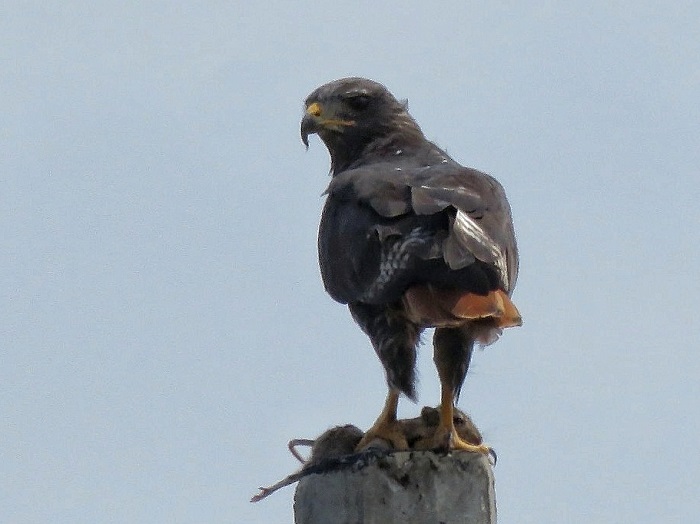
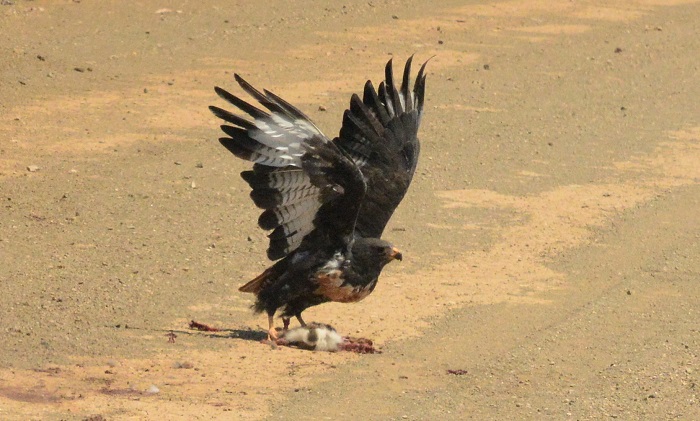
All adult birds have have blackish-grey upperparts and a blackish head with scattered fine, pale streaks. The rump and upper tail coverts are black. The upper tail is rufous, and often (but not always) with a black terminal band.

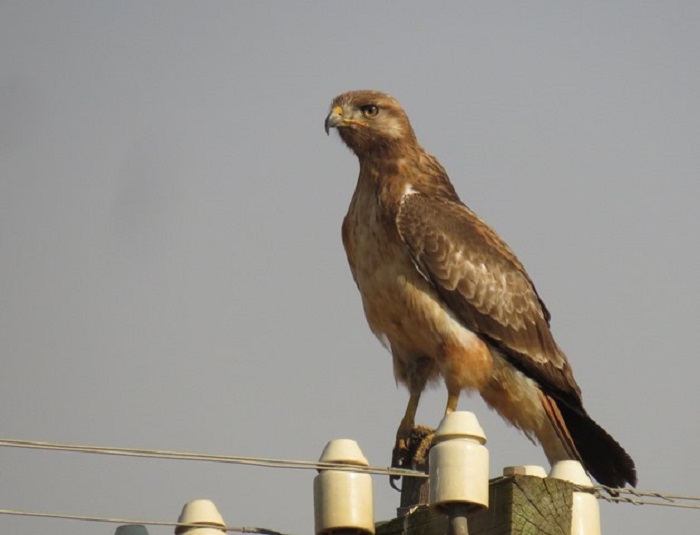
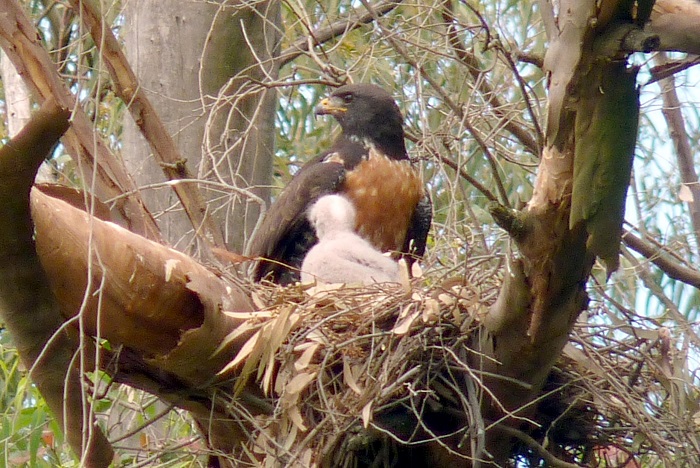
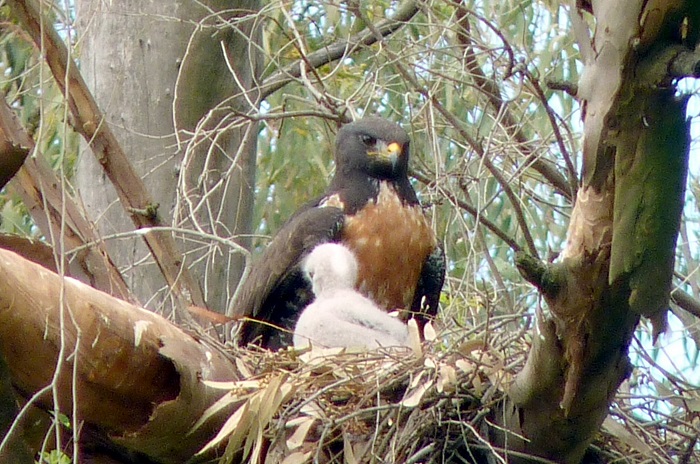
The colour of the underparts is variable with 3 basic colour forms. There is an uncommon white-breasted Morph with a white breast and sometimes also a white belly. A rare dark morph can also be found with almost completely black underparts. The vast majority of individuals have rufous breasts, separated from the blackish head by an untidy white band. The rest of the underparts are dark grey with variable white mottling.

Jackal Buzzard
Jackal Buzzard (Buteo rufofuscus), white-breasted morph.
Oudtshoorn district, Western Cape
Photo by Attie van Aarde

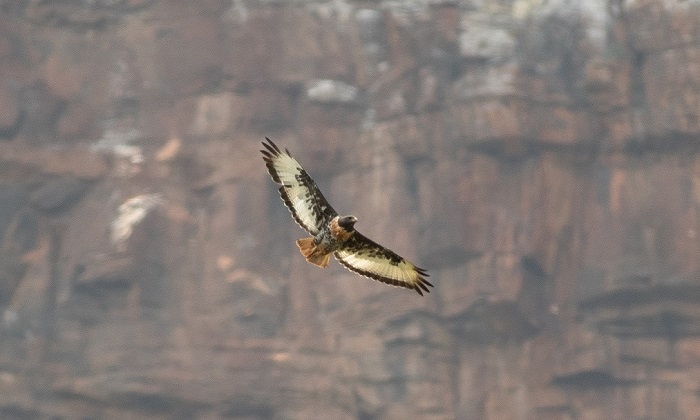
In flight the Jackal Buzzard is characteristically Broad winged. When seen in flight from below, the adult Jackal Buzzard shows white flight feathers with black tips forming a broad black terminal band. The underwing coverts are black. All colour forms have pale rufous under tail feathers. The bill is dark grey, the eyes are brown and the legs, feet and cere are yellow.

Buteo rufofuscus
A juvenile Jackal Buzzard (Buteo rufofuscus)
Underberg district, KwaZulu-Natal
Photo by Pamela Kleiman

Young birds start off in juvenile plumage with rich brown heads and upperparts while the underparts are either plain rufous, buff or whitish, with darker central streaks. Juvenile birds have longer tails than the adults.

Slightly older immature birds show a patchy combination of juvenile and adult plumage. They also have bright rufous central upper tail feathers. Adult plumage is acquired at 2 to 3 years of age.

Buteo rufofuscus
Immature Jackal Buzzard (Buteo rufofuscus) 
St. Helena Bay, Western Cape
Photo by John Todd

Typical form adults are distinctively plumaged and not likely to be mistaken for another species. However, in flight they can be confused with the Bateleur (Terathopius ecaudatus) but that species is much larger and shorter tailed with a distinctive flight profile. White-breasted morph Jackal Buzzards are frequently mistaken for the Augur Buzzard (Buteo augur), which is a closely related species. The Augur Buzzard differs from most white-breasted Jackal Buzzards in having white (not black) underwing coverts, and a white (not dark grey) belly and thighs.

Jackal Buzzard
Jackal Buzzard (Buteo rufofuscus)
Carnarvon district, Northern Cape
Photo by Ryan Tippett

Juvenile Jackal Buzzards are more problematic to identify. They can be mistaken for juvenile Augur Buzzard but that species is usually paler with creamy brown underparts and with more extensive barring on the underwings and tail. Additionally, both adult and juvenile Augur Buzzards show a black carpal comma on the underwing.

Buteo rufofuscus
Jackal Buzzard (Buteo rufofuscus)
Himeville, KwaZulu-Natal
Photo by Pamela Kleiman

Jackal Buzzard juveniles can also be mistaken for Common Buzzard (Buteo buteo), but the latter is smaller and with proportionally longer, narrower wings. The Common Buzzard also has blotched or barred underparts and the underwing coverts are usually streaked or barred dark brown.

Status and Distribution

The Jackal Buzzard is endemic to Southern Africa where it is a fairly common resident. 

SABAP2 distribution map for Jackall Buzzard
SABAP2 distribution map for Jackal Buzzard (Buteo rufofuscus) – June 2024. Details for map interpretation can be found here.

The Jackal Buzzard is widespread across South Africa but is is patchily distributed in the north-central region and absent from most of the north-eastern lowveld and the low-lying plains of the ‘Great Karoo’. The Jackal Buzzard’s main strongholds are in the Eastern Cape Province, Lesotho and the Drakensberg and Midlands regions of KwaZulu-Natal. It is also numerous in the central and north-western Karoo, and along the south-eastern and southern littoral. The Jackal Buzzard is marginal in south-eastern Botswana, Zimbabwe and extreme southern Mozambique.

Buteo rufofuscus
Jackal Buzzard (Buteo rufofuscus) 
Near St. Francis Bay, Eastern Cape
Photo by Gregg Darling

There is no evidence to suggest that either the distribution or overall numbers have changed in historical times. The Jackal Buzzard remains common, even where large scale afforestation has occurred. The Jackal Buzzard is not considered threatened

Habitat

The Jackal Buzzard prefers mountainous and hilly terrain, especially where covered by short vegetation like grassland, Karoo scrub or fynbos. It also occurs in open woodland in hilly areas and arid coastal habitats in Namibia.

Habitat for Jackal Buzzard
Habitat
Golden Gate Highlands National Park, Free State
Photo by Ryan Tippett

Non-breeding birds and juveniles often wander seasonally into flat regions. The majority of nest sites are on cliffs but many birds also nest in trees (especially in alien Eucalypts and Pines) away from cliffs.

This buzzard is found from the coast to over 3 000 m above sea level.

Behaviour

Buteo rufofuscus
Jackal Buzzard (Buteo rufofuscus)
Underberg district, KwaZulu-Natal
Photo by Dave Rimmer

The Jackal Buzzard is most often encountered solitarily or in pairs and rarely in small groups at a rich food source such as termite alate emergences or at carrion. It is not known to undertake any regular seasonal migrations. Any movements are more likely to be nomadic in response to food availability and the dispersal of immature birds.

Jackal Buzzard
Jackal Buzzard (Buteo rufofuscus)
Near Donnybrook, KwaZulu-Natal
Photo by Malcolm Robinson

It often perches prominently on an exposed tree branch, fence post, telephone pole or rock, but is perhaps most often seen in flight. Spends long periods in flight, soaring over valleys and along mountainsides. The Jackal Buzzard often hovers on updrafts in windy conditions, and is able to hang motionless for several minutes. The very broad wings are an adaptation to make specific use of updrafts. In calm conditions, the Jackal Buzzard can hover for short periods while flapping.

Buteo rufofuscus
Jackal Buzzard (Buteo rufofuscus) with rodent prey.
Near Hermanus, Western Cape
Photo by Andries de Vries

Hunts mainly in flight, but also from a prominent perch. Prey is rarely attacked in the air with most prey being captured on the ground after a stoop dive or dropping down from a perch.

The bulk of the diet is made up of small mammals such as rodents, but the Jackal Buzzard is capable of catching larger prey up to the size of hares and young Rock Hyrax. A variety of ground-feeding birds are also taken. Francolins, doves and pigeons are most commonly captured but they can kill birds up to the size of adult korhaans. The Jackal Buzzard also feeds on reptiles like lizards and snakes (including venomous species), and also large insects and spiders.

Buteo rufofuscus
Jackal Buzzard (Buteo rufofuscus)
Williston district, Northern Cape
Photo by Ryan Tippett

They are frequent scavengers at carcasses and often consume roadkill, also scavenges sheep placentae during the lambing season. Jackal Buzzards are also known to pirate food from smaller raptors like the Black-shouldered Kite Elanus caeruleua.

The Jackal Buzzard is territorial year-round. It breeds from late winter to early summer throughout its range with most clutches started during August and September.

It is a solitary nester and is generally monogamous, but the population in Lesotho is frequently polyandrous, perhaps due to high population densities. Polyandry has not been recorded elsewhere within the Jackal Buzzard’s range. In polyandrous groups, two males will copulate with one female. They stay together, helping to build the nest and provide the female with food. They also defend the nest from predators and chase off conspecific rivals.

Jackal Buzzard at nest
Jackal Buzzard (Buteo rufofuscus)
Paarl Bird Sanctuary, Western Cape
Photo by John Fincham

The nest is built or repaired by both sexes and is a bulky platform of sticks up to 2.5 m in diameter. The bowl of the nest is fairly shallow and is mostly lined with leaves, but also with bits of grass and lichen etc. Nests are most often placed on an open cliff ledge and less frequently in trees, and very rarely on man-made structures like pylons or telephone poles. Nests are often used repeatedly for up to five years, or pairs may alternate between different nests, having up to three nests per territory.

Clutches consist of one to three (usually two) eggs. Egg colouration is variable from chalky white and unmarked to heavily blotched, even within a single clutch. The incubation period lasts up to 40 days and is performed by both sexes, but most incubation is done is by the female with the male providing her with food.

Buteo rufofuscus at nest
Jackal Buzzard (Buteo rufofuscus)
Paarl Bird Sanctuary, Western Cape
Photo by John Fincham

The eggs hatch asynchronously, two to three days apart. This results in large size differences between siblings. The youngest chick may be killed by its larger sibling or gets out-competed and usually dies. The young are fully fledged at around 52 days old but remain dependent on their parents for several more weeks. Adults are often aggressive in defence of the nest, especially the female.

Further Resources

The species text from the First Southern African Bird Atlas Project (SABAP1), 1997, is here.

The use of photographs by Andries de Vries, Attie van Aarde, Dave Rimmer, Desire Darling, Gregg Darling, John Fincham, John Todd, Lance Robinson, Malcolm Robinson and Pamela Kleiman is acknowledged.

Virtual Museum (BirdPix > Search VM > By Scientific or Common Name).

Other common names: Rooiborsjakkalsvoël (Afrikaans); iNhlandlokazi, isiKhobotho (Zulu); Indlandlokazi (Xhosa); Jakhalsbuizerd (Dutch); Buse rounoir (French); Felsenbussard (German); Bútio-de-cauda-vermelha (Portuguese).

List of bird species in this format is available here.

Recommended citation format: Tippett RM 2024. Jackal Buzzard (Buteo rufofuscus). Biodiversity and Development Institute. Available online at https://thebdi.org/2024/07/02/jackal-buzzard-buteo-rufofuscus/

Bird identificationbirding

Buteo rufofuscus
Jackal Buzzard (Buteo rufofuscus)
Near Hoedspruit, Mpumalanga
Photo by Lance Robinson

Commercial biodiversity 1 : birds at Northgate Business Park

We tend to be dismissive of the idea that “development” can be any good for “biodiversity”. Northgate Business Park was clearly designed to be an attractive space to work in, with trees and gardens. One corner of the property has a flood retention dam which holds the run-off of stormwater from the roofs and roads when it rains. A by-product of the investment that has been made in the space outside of the buildings is that it attracts a non-trivial variety of biodiversity. Our interest is primarily in birds, and that is where this blog will mainly focus.

Dieter Oschadleus and I spent an hour wandering around this development looking at the birds at Northgate Business Park. Our one-hour midwinter species list on the morning of 29 June 2024 contained 27 species. A summer list would be longer; it would certainly include, for example, a few swallows. The actual list is near the end of this blog

Habitats

There are three main habitats. The stormwater retention dam, the shrubs on the boundaries and the trees along the roads.

Stormwater retention dam

To find the stormwater retention dam, turn left just inside the entrance, and stop near the picnic table. There is a broad grassy path into this wetland.

Stormwater retention dam at Northgate Business Park
The reeds on this bank have recently been cleared so it is easy to see into the water. Look out for Cape Wagtail, Common Moorhen, Southern Red Bishop, Lesser Swamp Warbler, Levaillant’s Cisticola – this is the place to see them. Keep alert for birds flying overhead!
Boundary shrubs

The perimeter of the business park farthest from the entrance consist of these shrub-clad embankments.

Look especially for Cape Bulbul, Cape Robin-chat, Cape White-eye, mousebirds
Tree-lined roads

The third main habitat consists of the trees along the roads. The best roads are the ones opposite the shrubs along the boundaries:

Fever trees at Northgate Business Park
These fever trees are not indigenous to the region. But they are preferred above all others by the weavers and sparrows to construct their nests.

Bird gallery

Here are a few photos of the birds!

At the Northgate Business Park, the Cape Sparrow, top two photos, is far more abundant than the House Sparrow. The photos are evidence of this. There were lots of Cape Sparrow photos to choose from, but there was only one of the House Sparrow, and it was just at the edge of a second-class photo! In most developments of this nature, it is the alien and introduced House Sparrow which is the more common of the two sparrows. These photos are archived in BirdPix, records 283172 and 283173

White-backed Mousebird at Northgate Business Park
This White-backed Mousebird is enjoying the early morning sun. From this angle, the diagnostic feature which makes this a White-backed Mousebird is the white bill with a black tip. It also has legs which are slightly on the pink side of bright red. and the white back is conspicuous when the bird is flying away from you. BirdPix record 283082

Cape Weavers preferentially use the fever trees to build their nests at Northgate Business Park. The top left photo shows that this nest is close to the window of someone’s office! The brightly coloured male top right is excitedly displaying, flapping his wings trying to attract a female to inspect his newly constructed nest. The bottom left photo shows that he had success. That is a female Cape Weaver doing her nest inspection. These photos are curated in the section of the Virtual Museum called PHOWN (PHOtos of Weaver Nests). It is record PHOWN 31397

Bird List

Here is our list of 27 species of birds at Northgate Business Park. It is in alphabetical order. It is certainly not exhaustive; if we had spent more time compiling it, we would have seen more species. But the purpose here is to have a list of the common, more-or-less easy to see species. Most of the species have links which take you to the BDI descriptions of them. These species texts have headings Identification, Habitat, Distribution, Breeding, etc.

Blacksmith Lapwing – at the wetland, we saw one pair
Cape Bulbul – anywhere, on the shrubs
Cape Canary – anywhere
Cape Robin-Chat – anywhere, on the shrubs
Cape Sparrow – anywhere, common
Cape Spurfowl – often near the entrance to the wetland
Cape Wagtail – at the wetland, and in and around the gardens
Cape Weaver – anywhere, nests in the fever trees
Cape White-eye – anywhere, on the shrubs
Common Moorhen – in the wetland, mainly on the edges of vegetation
Common Starling – anywhere
Hadada Ibis – anywhere, often fly over
Hartlaub’s Gull – anywhere. many fly over
House Sparrow – on the buildings, and adjacent trees; far less common then Cape Sparrow
Kelp Gull – many fly over
Laughing Dove – anywhere, but not common
Lesser Swamp Warbler – in the reedbeds at the wetland
Levaillant’s Cisticola – on the edges of vegetation at the wetland
Pied Crow – anywhere, many fly over
Red-eyed Dove anywhere, very common
Red-faced Mousebird – – on the shrubs, not common
Red-winged Starling – on the buildings
Rock Dove – on the buildings, abundant
Southern Double-collared Sunbird – in the gardens, not common
Southern Masked Weaver – anywhere, builds its nest in the fever trees
Southern Red Bishop – in the reedbeds in the wetland; it’ll probably breed in spring
White-backed Mousebird – on the shrubs, not common

Most visitors to this development would probably find it hard to believe that an hour’s birding could unearth 27 species of birds at Northgate Business Park. For serious birders, this is a trivial number. But this is a good place for someone who wants to make a start with birding, and who finds the close-on-1000 species in the bird books intimidating. 27 is a big enough challenge, but not overwhelming.

… a significant wetland!

Here is another view of the reedbed at the stormwater retention dam …

Reedbed at Northgate Business Park
When spring 2024 arrives in the next couple of months, this reedbed will have lots of breeding birds: Southern Red Bishops, Lesser Swamp Warblers and many other wetland species that skulk in this habitat. This might well be the second closest to the centre of Cape Town that many of these species breed. Green Point Park lies to the west of the CBD, but is a little bit closer! It also has a reedbed, and many bird species in common.

The Intaka Island wetland lies 4 km farther away from Cape Town than this one. These small wetlands form a network of stepping stones which enable the birds to move between them.

We found a potential bird ringing site at the stormwater retention dam. Firstly, we will need permission. Secondly, we need to discover if that potential is fulfilled! Thirdly, we anticipate that we will demonstrate bird movements between here and Intaka Island, where bird ringing is undertaken regularly.

… and dragonflies in summer …

We have visited here briefly in summer. We have recorded three species of dragonfly: Blue Emperor, Cape Skimmer, Broad Scarlet. A diligent search will reveal more species!

Blue Emperor Dragonfly at Northgate Business Park
Here is a Blue Emperor, at the Stormwater Retention Dam at Northgate Business Park. It is record 9275 in OdonataMAP, the section of the Virtual Museum for dragonflies and damselflies

There is lots of other biodiversity here: frogs, butterflies, moths, reptiles (there must be skinks and chameleons), spiders, … This blog scratches the surface.

Northgate Business Park is immediately northeast of the spaghetti of roads at the intersection of the N1 and M5 in Cape Town. The stormwater retention dam is the patch of green in the closest corner of the business park.

Tailpiece

There is only one entrance to the development, and the perimeter is a well maintained security fence. It feels like the kind of place where you can get totally focused on the birds without fear of interference.

Among the tenants at Northgate Business Park is Jonssons Workwear where bird ringers buy their gum boots, and Builders where we buy our bird seed. Giniel Jacobs at Music Experience encouraged us to write this blog on the birds at Northgate Business Park.

And well done to the team who maintain the green part of this business park!