Knysna Turaco (Tauraco corythaix)

Cover image: Knysna Turaco by Andre Kok – George, Western Cape – BirdPix No.193795

Turacos, Go-Away-Birds and Plantain Eaters belong to the family MUSOPHAGIDAE. The family name literally means ‘Banana Eaters’ and all species are endemic to sub-Saharan Africa. They are medium-sized arboreal birds with prominent crests, relatively short, rounded wings and long tails. They have semi-zygodactylous feet for clambering around in tree canopies. The turacos are noted for their peculiar and unique pigments namely, turacoverdin (green feathers) and turacin (red feathers).

Identification

Knysna Turaco sexes are alike. They are predominantly olive-green especially on the head, neck, mantle and breast. The lower back, tail, wing coverts, and inner secondaries are dark blueish-green. The belly and flanks are a duller brownish-green and the vent and under tail coverts are greyish-black.

Knysna Turaco (Tauraco corythaix)
Garden Route National Park, Western Cape
Photo by Gregg Darling

The prominent crest is green with a narrow white fringe and an indistinct blackish border between the green and white. The face is distinctively marked with a small black patch below and in front of the eye and with two conspicuous white stripes, one below the eye extending to the ear coverts, and another shorter stripe in front of the eye. The eyes are dark brown and the bare skin surrounding the eye is bright scarlet.

Knysna Turaco (Tauraco corythaix)
Debengeni Waterfall, Magoebaskloof, Limpopo
Photo by Megan Loftie-Eaton

The primaries and outer secondaries are brilliant crimson with broad black edging. The crimson wing patch is conspicuous in flight, but is visible only as a red strip on the lower edge of the folded wing, and is often not visible. The short, almost triangular bill is orange-red with a slightly hooked tip. The legs and feet are black.

Knysna Turaco (Tauraco corythaix) showing the conspicuous, bright crimson flight feathers.
Garden Route National Park, Western Cape
Photo by Alan Collett

Juveniles are similar to adults but have reduced red patches on the wings. Additionally, the bare skin around the eye is blackish (not red) and the bill is brownish in younger juveniles, slowly turning red as they mature.

Knysna Turaco (Tauraco corythaix)
Keurboomsrivier, Western Cape
Photo by Neels Putter

In southern Africa the Knysna Turaco can only be mistaken for two other closely related species. These are Schalow’s Turaco (Tauraco schalowi) and the Livingstone’s Turaco (Tauraco livingstonii). Confusion with Schalow’s Turaco is unlikely as the distributions of the two are widely separated. The range of the Knysna Turaco overlaps very marginally with that of Livingstone’s Turaco in eastern eSwatini (Swaziland). The latter has a longer, more pointed crest, that is narrowly (not broadly) tipped white and has paler blue-green wing coverts and a green (not blueish) wash to the tail.

Knysna Turaco (Tauraco corythaix)
Oribi Gorge Nature Reserve, KwaZulu-Natal
Photo by Lia Steen

Status and Distribution

The Knysna Turaco is a fairly common resident and is endemic to South Africa and eSwatini (Swaziland). It ranges from near Mossel Bay in the Western Cape, northwards along the coast and adjacent interior to central KwaZulu-Natal, where it is largely confined to the Midlands. It also occurs from north-western eSwatini to eastern Mpumalanga and north to the Soutpansberg in the Limpopo Province.

SABAP2 distribution map for Knysna Turaco (Tauraco corythaix) – September 2024. Details for map interpretation can be found here.

The Knysna Turaco is currently listed as Near Threatened on the IUCN Red List. The species is locally impacted by forest destruction, and by the exploitation of forest patches for medicinal plants. Populations in central Kwazulu-Natal were severely affected during the 19th century by the extensive cutting of hardwood trees and the resultant loss of food resources.

Knysna Turaco (Tauraco corythaix)
Ruigtevlei, Western Cape
Photo by Ryan Tippett

Habitat

The Knysna Turaco inhabits Afromontane forest and is considered an indicator species for this forest type. It is found at lower altitudes in the south of its range where it occurs down to sea-level from the Western and Eastern Cape to southern KwaZulu Natal. Further north in central KwaZulu-Natal, Mpumalanga and Limpopo the Knysna Turaco is restricted to mistbelt Afromontane forest at 500-1 500 m above sea-level. This forest type receives a high rainfall and is usually tall and multi-layered, and is dominated by large trees, particularly Yellowwoods (Afrocarpus falcatus, Podocarpus latifolius and Podocarpus henkelii).

Afromontane forest habitat
Oribi Gorge Nature Reserve, KwaZulu-Natal
Photo by Ryan Tippett

The Knysna Turaco also inhabits coastal forest and secondary growth in southern KwaZulu-Natal and the Eastern Cape.

Behaviour

The Knysna Turaco is a sedentary, resident species but wanders locally in response to the availability of fruiting trees. They are usually encountered solitarily, in pairs or in family groups of 3 to 5. Larger numbers of up to 50 or more birds sometimes gather to feed at fruiting trees.

Knysna Turaco (Tauraco corythaix)
River Valley Nature Reserve, KwaZulu-Natal
Photo by Lia Steen

The flight is heavy and laboured with frequent bouts of gliding. They seldom fly far and typically land in the middle canopy of trees. Knysna Turacos are very agile in the tree tops, running and bounding effortlessly along branches and through foliage. The semi-zygodactylous feet have reversable outer toes and are specially adapted for this purpose.

Knysna Turaco (Tauraco corythaix)
Keurboomsrivier, Western Cape
Photo by Marius Meiring

The Knysna Turaco is often vocal, except while nesting, and the call of one bird often elicits a response from another until the whole group is calling together. Their loud ‘barking’ or ‘crowing’ calls are a familiar sound in their dense forest habitat.

The Knysna Turaco (Tauraco corythaix) seldom descends to the ground, except to eat fallen fruit or to bathe in forest streams.
Natures Valley, Western Cape
Photo by Andre Kok

They frequently sunbathe while perched in the canopy, especially in the early morning or late afternoon. The Knysna Turaco drinks regularly from forest streams and bird baths. They drink water like a pigeon, immersing the bill tip and sucking up the water. They also bathe frequently by squatting in shallow water with the tail held up and fanned out, while splashing water over the body with the partially opened wings.

The Knysna Turaco (Tauraco corythaix) bathes frequently.
Island Forest Reserve, Eastern Cape
Photo by Desire Darling

The Knysna Turaco is arboreal and forages in the canopy of fruiting trees, but will occasionally descend to the ground to feed on fallen fruit. The diet consists of a wide variety of wild and cultivated fruits, including Guava (Psidium guajava) and Pawpaw/Papaya (Carica papaya), as well as the fruits of alien trees. The diet is supplemented by invertebrates, including termite alates, particularly during the breeding season. Fruits are preferably swallowed whole and large seeds are regurgitated, but small seeds pass through the gut.

Knysna Turaco (Tauraco corythaix)
Ruigtevlei, Western Cape
Photo by Ryan Tippett

The Knysna Turaco breeds from May to February with a peak from September to November. Pairs are monogamous and nest solitarily. They are only territorial when breeding. The nest is built cooperatively by both sexes in about 5 days. One of the pair collects and delivers nesting material to the site while the other constructs the nest. Nest material is collected directly from the canopy by snapping off brittle twigs with the bill. They are not known to collect fallen twigs from the ground. The pair are often vocal while nest building and frequently call to each other, but once incubation begins they become silent and secretive.

Knysna Turaco (Tauraco corythaix)
Near Hankey, Eastern Cape
Photo by Desire Darling

The nest is composed of interlaced twigs and is a flimsy saucer-shaped platform resembling a large dove nest, 200-300 mm across, with a shallow depression in the centre. The nest is usually placed 3-9 meters above the ground in a dense tangle of creepers or among leafy twigs on the outermost branches of a tree and is always well concealed by foliage.

Knysna Turaco (Tauraco corythaix)
Natures Valley, Western Cape
Photo by Pamela Kleiman

The eggs are plain white and almost spherical. Clutches usually consist of 2, or occasionally 1 egg and they are laid at 1-day intervals. Incubation starts before the clutch is completed resulting in asynchronous hatching. The incubation period takes up to 24 days and duties are shared by both sexes. The eggs are covered continuously and are rarely left unattended.

Knysna Turaco (Tauraco corythaix)
Garden Route National Park, Western Cape
Photo by Jean Hirons

Once the eggs hatch the adults keep the nest clean by eating the eggshells and the chick’s faeces. This also serves to keep smells away from the nest that may draw the attention of hungry predators. The newly hatched young are semi-precocial and hatch in a relatively advanced state with their eyes open and their bodies covered by a dense coat of blackish-grey down. They have a carpal claw on the wing which enables them to clamber from the nest before they are able to fly. Nestlings are fed regurgitated food by both parents. The young leave the nest after 21 days or so. They grow rapidly from this point and are able to fly after about 28 days.

Knysna Turaco (Tauraco corythaix)
Keurboomsrivier, Western Cape
Photo by Neels Putter

Further Resources

This species text is adapted from the first Southern African Bird Atlas Project (SABAP1), 1997.

The use of photographs by Alan Collett, Andre Kok, Desire Darling, Gregg Darling, Jean Hirons, Lia Steen, Marius Meiring, Megan Loftie-Eaton, Neels Putter and Pamela Kleiman is acknowledged.

Virtual Museum (BirdPix > Search VM > By Scientific or Common Name).

Other common names: Knysna Lourie (Alt. English); Knysnaloerie (Afrikaans); iGwalagwala (Zulu); lgolomi (Xhosa); Touraco louri (Dutch); Touraco de Knysna (French); Helmturako (German); Turaco de Knysna (Portuguese).

List of species available in this format.

Recommended citation format: Tippett RM 2024. Knysna Turaco Tauraco corythaix. Biodiversity and Development Institute. Available online at https://thebdi.org/2024/09/16/knysna-turaco-tauraco-corythaix/

Bird identificationbirding

Knysna Turaco (Tauraco corythaix)
Komdomo, Eastern Cape
Photo by Gregg Darling

Bird ringing at Alte Kalköfen Bird Observatory, southern Namibia : January to April 2023

During the early part of 2023 (15 January to 20 April) a total of 3,440 birds of 56 species were ringed at the Alte Kalköfen Bird Observatory in southern Namibia (26°49’S 17°21’E). The majority of the birds were ringed around the complex of buildings that form the Alte Kalköfen Lodge; two other ringing sites on the Sandverhaar farm were also visited: the farm house and the grove of date palms.

Most birds were trapped with mist nets with a few caught using a baited snap trap. All birds were fitted with uniquely numbered SAFRING metal rings.

The most commonly ringed bird species were Cape Sparrows (564 birds ringed), Red-billed Quelea (553), Namaqua Doves (363) and Scaly Feathered Weavers (353).

Other species ringed in large numbers were Ring-necked Doves (104), Lark-like Buntings (77), African Red-eyed Bulbuls (74), White-throated Canaries (70) and Pale-winged Starlings (69).

Acacia Pied Barbet by Janet Snyman
14 Acacia Pied Barbets were ringed during the three-month season. Watercolour : Janet Snyman

There were surprise captures of species which are rare in the area, or which have never been recorded here before: Stark’s Lark (12), Karoo Scrub Robin (3), Sclater’s Lark (2), Chestnut Weaver (2), Green Wood-hoopoe (1), Cape Penduline Tit (1), Southern Grey-headed Sparrow (1) and Lanner Falcon (1).

Black-chested Prinia by Janet Snyman
A total of nine Black-chested Prinias were ringed at the Alte Kalköfen Bird Observatory.
Watercolour : Janet Snyman

Although most species occurred in fairly large numbers during January, February and the first two weeks of March 2023, there was a dramatic drop in bird numbers later in March and by mid-April the majority of the seed-eaters such as the Yellow Canaries, White-throated Canaries, Namaqua Doves, Red-billed Queleas, Lark-like Buntings and Cape Sparrows had left the area. This was presumably in response to the lack of rain and thus food. Fast and strong flying seed-eaters such as Ring-necked Doves and Laughing Doves still occurred in large numbers around the complex because they can fly long distances daily between their food sources and watering points.  It was also noticed that the mean weights of some species decreased. For example, the Cape Sparrows had an average mass of 22.8 g in February, but by mid-April this had decreased to 20.9 g. Similarly, Laughing Doves also seemed to be much leaner in April than they had been in February; only one of nine doves in April weighed more than 95 g while all 21 birds ringed in February were heavier than 95 g.

The species that mainly eat fruit and berries such as the Pale-winged Starlings, African Red-eyed Bulbuls and White-backed Mousebirds were also present in much smaller numbers during late March and April than earlier in the season. Clearly, their food resources dwindled.   

To gauge the effectiveness of the ringing programme, observations were made around the bird bath, close to where Cape Sparrows were mistnetted regularly. Regular watches were kept during which the proportion of sparrows that had been ringed was estimated. By the end of March, the results showed that about 10% to 15% of the local Cape Sparrow population had been ringed.

The recaptures of many of the individuals during the period gave valuable information about the sequence and speed of primary moult. Recapture of individual birds in future will provide information about longevity and local movement of individual birds.

We also set up a colour-ringing project for Familiar Chats. This is described in the section below.

Territoriality in the Familiar Chat

The Familiar Chat is a common resident bird around the Alte Kalköfen Lodge in southern Namibia with some pairs breeding inside buildings. During the study period, 15 Familiar Chats around the lodge were fitted with a combination of colour rings in addition the metal ring to make individual recognition at a distance possible.

Familiar Chat colour-ringing project at Alte Kalköfen Bird Observatory
Familiar Chat with colour rings

Three different colour rings and a metal ring provide more than enough combinations to individually mark the estimated 10 pairs of Familiar Chats around the lodge. The metal rings are always placed on the left together with one colour ring. The right leg has two colour rings, always of different colours.

The aim of the project is:

1 To generate information on the movements and interactions of individual Familiar Chats around the lodge complex.

2 To determine the mate fidelity of the breeding pairs

3 To determine the home ranges and territoriality of this population of Familiar Chats.

4 To gather data on the dispersal of young birds hatched within the study area.

Rosy-faced Lovebirds at Alte Kalköfen Bird Observatory
Rosy-faced Lovebirds are abundant noisy visitors to the waterpoints and 22 were ringed at the Alte Kalköfen Bird Observatory.

Recommended citation format: Earlé RA 2025. Bird ringing at Alte Kalköfen Bird Observatory, southern Namibia : January to April 2023. Biodiversity and Development Institute, Cape Town. Available online at https://thebdi.org/2024/09/12/bird-ringing-at-alte-kalkofen-bird-observatory-january-to-april-2023/

Alte Kalköfen Bird Observatory

The Alte Kalköfen Bird Observatory is located 90 km west of Keetmanshoop in southern Namibia along the B4 main road between Keetmanshoop and Aus, which continues west to Lüderitz. The coordinates are 26°49’S 17°21’E. The surrounding Sandverhaar Farm has an area of 22,000 ha. A report on birds ringed here during 2023 is available here.

The lime kiln at Alte Kalköfen
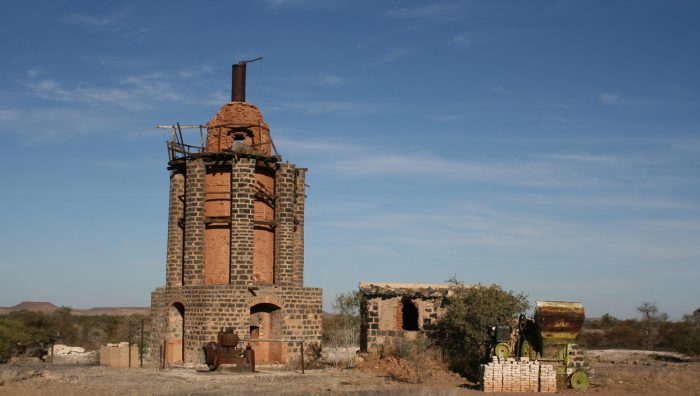
The “Alte Kalköfen” – the Old Lime Kiln – which gives the place its name

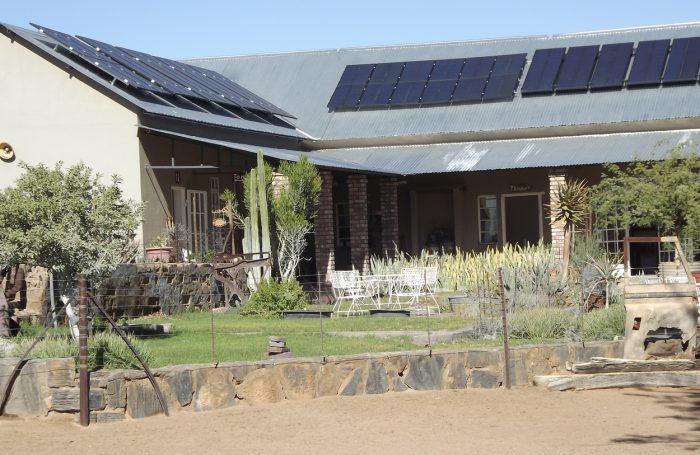
The bird observatory is based at the Alte Kalköfen Lodge. The lodge is worth visiting in its own right. It offers an array of accommodation options: luxurious chalet, self-catering cottage and camping. The restaurant has panoramic views of the surrounding landscape. Namibia’s largest collection of lithops (“flowering stones”) is housed in the “Cole Lithoparium”. The surrounding countryside is spectacular ruggedness, with the Fish River Canyon the jewel in the crown.

Most bird observatories are in the northern hemisphere and conduct long-term monitoring of bird populations, with a primary focus on regular annual migration. Because the Alte Kalköfen Bird Observatory is in semi-desert, most of the bird species that occur here are nomadic. Almost all these bird species are poorly researched. The specific objective of the Alte Kalköfen Bird Observatory is to study the nomadic behaviour of a variety of species; these are priorities for research.

This is done mainly through bird ringing at this unique location. We aim to gain an understanding of the biology and ecology of the birds as part of maintaining and developing biodiverse natural habitats for all animals in the district.

The information collected while ringing birds produces data for guiding conservation and management processes for the birds, other animals and the habitat is a whole. Since this information is to make decisions about the management of the habitat, improving the conservation status of birds and other animals in the environment. 

Habitats and their birds around the Alte Kalköfen Bird Observatory

The Sandverhaar farm in southern Namibia is mostly semi-desert, but with a wide variety of habitats: sand dunes, sandy grass veld, karoo scrub and dry thorn veld, and with camel thorn thickets along the mostly dry river courses. Apart from the maintenance of several water points, the farm needs minimal management to function as a successful game farm. Even this limited availability of surface water in an otherwise arid environment results in many nomadic bird species occurring on passage at Sandverhaar. So the bird observatory is located at a ‘magnet’ in the landscape, and attracts many birds. The number of species recorded by the end of 2023 was more than 100, and this count is growing steadily. There is a paper in Biodiversity Observations that lists five unexpected species recorded at the Alte Kalköfen Bird Observatory; the paper is called Bird species outside of their known distribution ranges in southern Namibia and is available here.

Emerald-spotted Wood Dove at Alte Kalköfen Bird Observatory
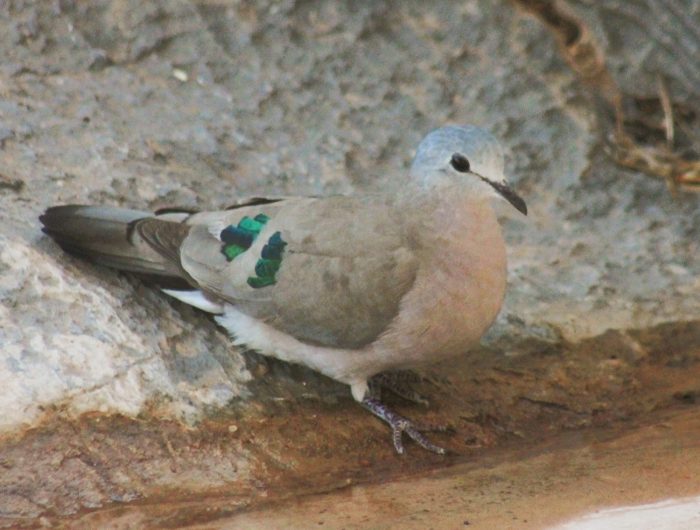
This Emerald-spotted Wood Dove spent a few minutes drinking water at Alte Kalköfen Bird Observatory in March 2024 before flying off. The nearest bird atlas record in SABAP2 is more than 200 km to the north. This is one of the five out-of-range species discussed in the paper in Biodiversity Observations. This observation is curated in the Virtual Museum as BirdPix record 279073

Besides nomadic bird species, both long distance migratory birds to Eurasia and intra-African migrants are also regular at Sandverhaar. This is probably because the farm is located centrally in southern Namibia, and lies along a corridor between the Namib Desert in the west and the arid savanna of the Kalahari to the east. It seems that this corridor is a route taken by migrants because they are regularly observed on passage through the area at specific times of the year. A handful of birds of migratory species spend the southern summer on the farm.

Because of the unique location of the Alte Kalköfen Bird Observatory at Sandverhaar, it is an ideal location for the long-term study of bird populations and movement of the birds in this unique habitat.

We do year-round bird ringing around the Alte Kalköfen Lodge complex itself and at various other locations on the farm, such as at waterholes. Nearby, there are groves of date palms and pomegranates. When the fruit ripens, the birds congregate at these groves, and we do bird ringing here during these periods.

Practicalities

It is possible to visit the bird Oobservatory as a day visitor to the Alte Kalköfen Lodge to do birding and to observe the bird ringing if it is being done close to the complex. However, because the early mornings and the late afternoons are the best times for birding, especially during the hot summer months, it is a good plan to stay over at the lodge for at least one night, and preferably two nights.

There is accommodation available in chalets at the Alte Kalköfen Lodge, and it is also feasible to camp.

Atlasers are encouraged to make checklists for the Namibian Bird Atlas using the standard SABAP2 protocol. 

Ringers are welcome to bring their own bird ringing  gear if they would like to. All bird ringing data will be submitted to SAFRING, the Southern African Bird Ringing Unit at the University of Cape Town. Therefore, only rings from SAFRING can be used. Bird ringing will be done with Namibian bird ringing permits and ringers will need SAFRING authority cards.

The Alte Kalköfen Bird Observatory encourages both professionals ornithologists and citizen scientists to consider the bird observatory as a research site for scientific studies of birds (and other animals) and their environment.

The Alte Kalköfen Bird Observatory is affiliated to the Biodiversity and Development Institute (BDI). The BDI will include ringing events at the bird observatory in its programme. This is available on the BDI website in the list of upcoming BDI events. In addition to this, there are on-going activities at the bird observatory and you can also email to find out what is feasible: birdobservatory@altekalkofenlodge.com.

Opening on 8 February 2025!

Although Roy Earlé has been ringing here since 2022, the formal opening event for the Alte Kalköfen Bird Observatory will be on 8 February 2025. The logistics for this event, in terms of making bookings, are being handled by the BDI. To find more details, email ring@thebdi.org.

Sunset at Alte Kalköfen Bird Observatory
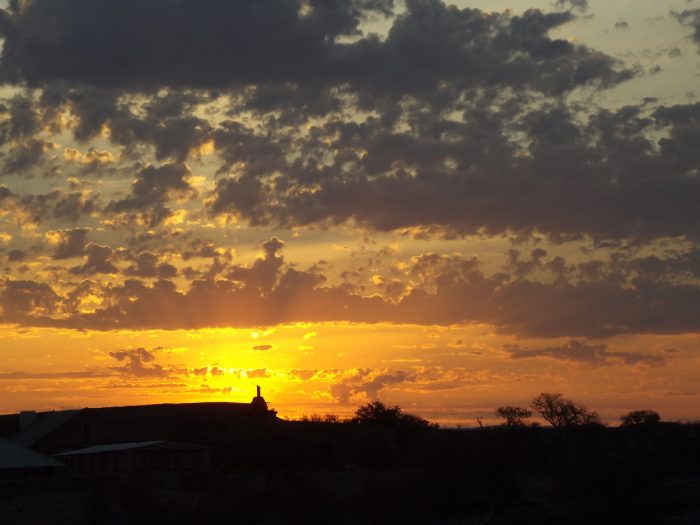
Come and join us, and see the sunset at the Alte Kalköfen Bird Observatory

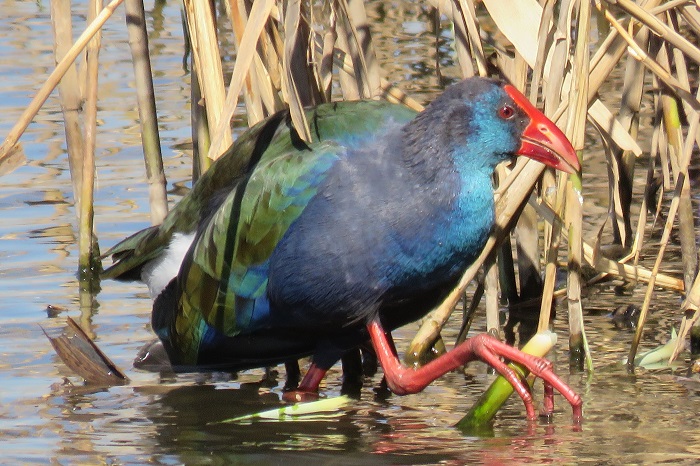
African Swamphen (Porphyrio madagascariensis)

Cover image of African Swamphen by Roelof van der Breggen – Glen Austin Pan, Gauteng – BirdPix No. 289893

Swamphens belong to the Family: RALLIDAE. This family also includes Crakes, Rails, Flufftails, Gallinules, Moorhens and Coots etc. Their physiology is diverse, but most have laterally compressed bodies, short tails, short rounded wings and well developed legs and feet. The bill structure is variable. Most birds in this family inhabit wetlands or forest undergrowth and are usually vocal and highly secretive.

Identification

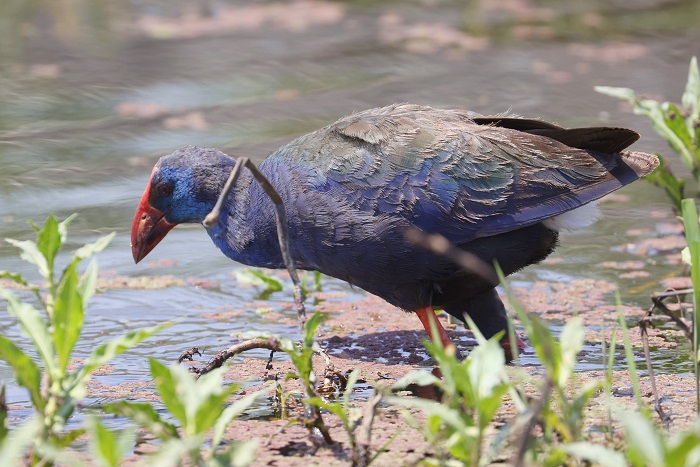
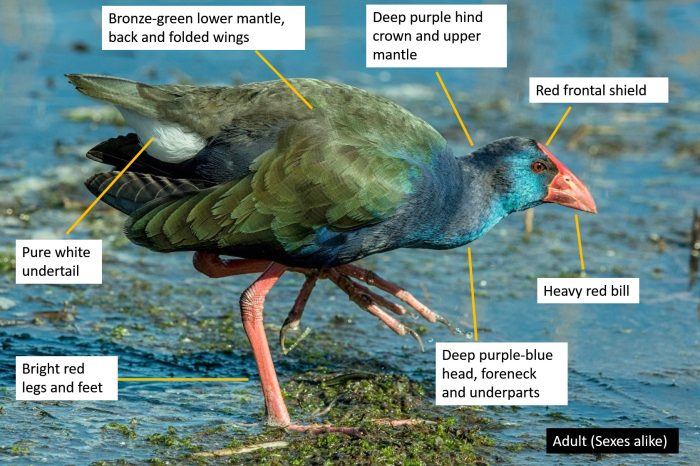
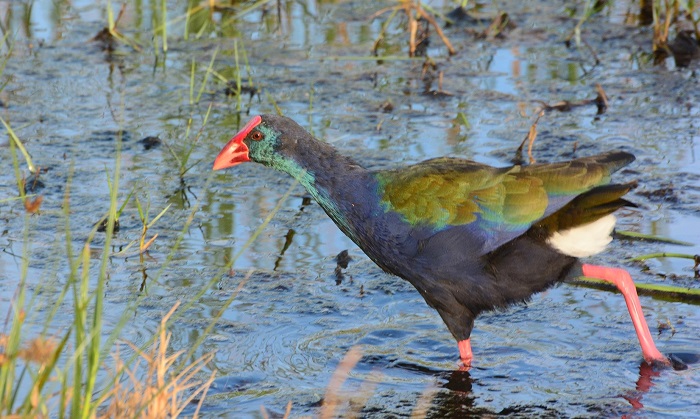
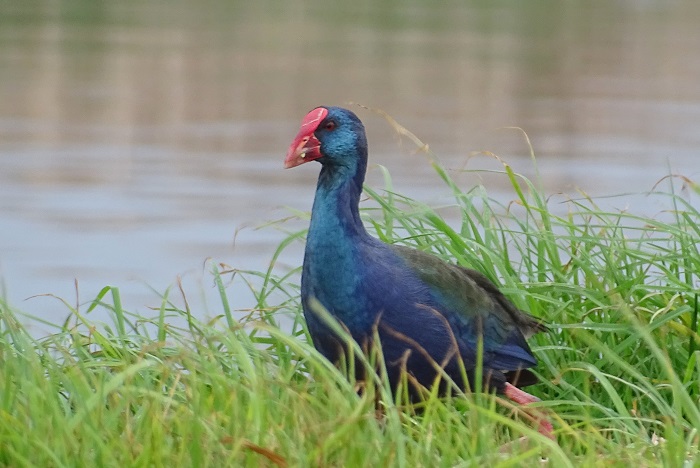
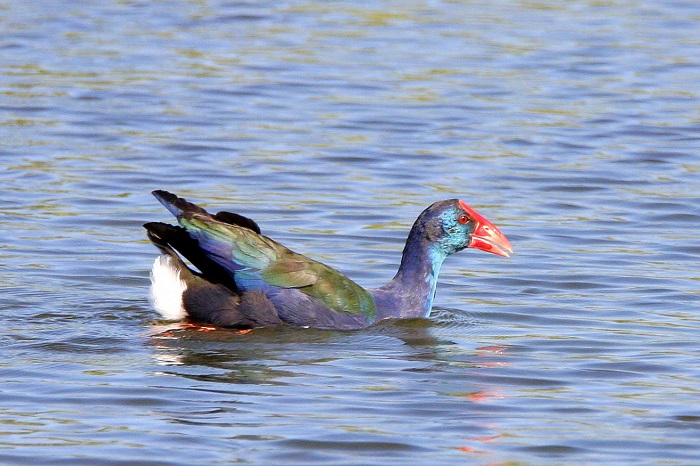
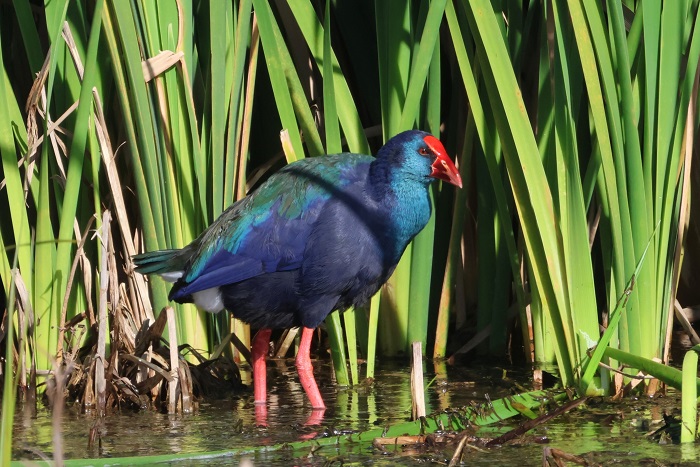
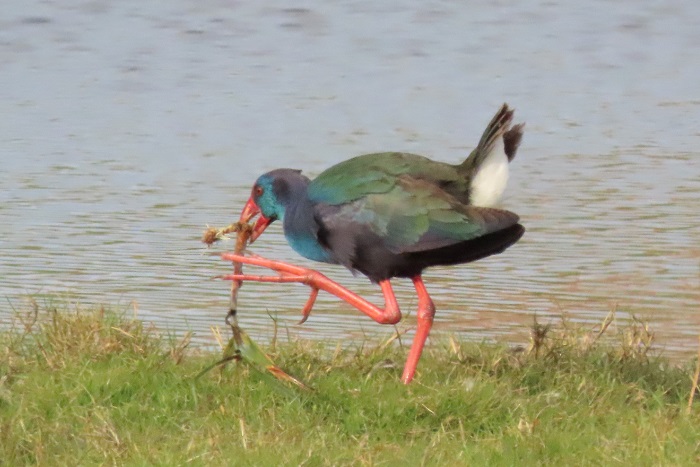
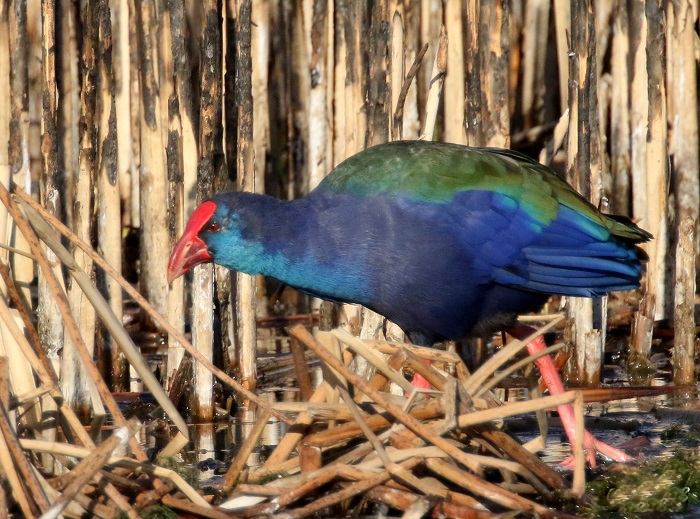
The African Swamphen is a vibrantly coloured, blue, purple and green waterbird. It is easily identified by its heavy red bill, red frontal shield and long red legs. The sexes alike in plumage coloration.

African Swamphen (Porphyrio madagascariensis) 
Garden Route National Park, Western Cape
Photo by Jean Hirons

In adults, the head, foreneck and underparts are deep purplish blue. The face and throat are a paler, brighter blue. The hind crown and upper mantle are dark purple. The lower mantle, back and folded wings are bronze-green. The rump and upper tail are dark olive-green and the undertail is pure white. The bill and frontal shield are bright red while the legs and feet are pinkish-red.

African Swamphen (Porphyrio madagascariensis)
Sedgefield Lagoon, Western Cape
Photo by Ryan Tippett

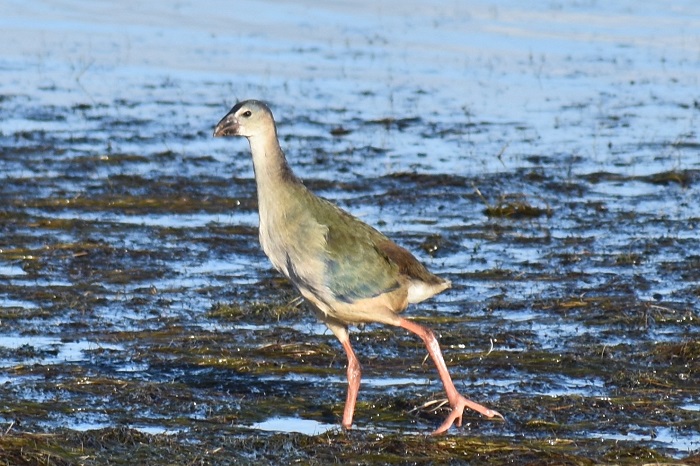
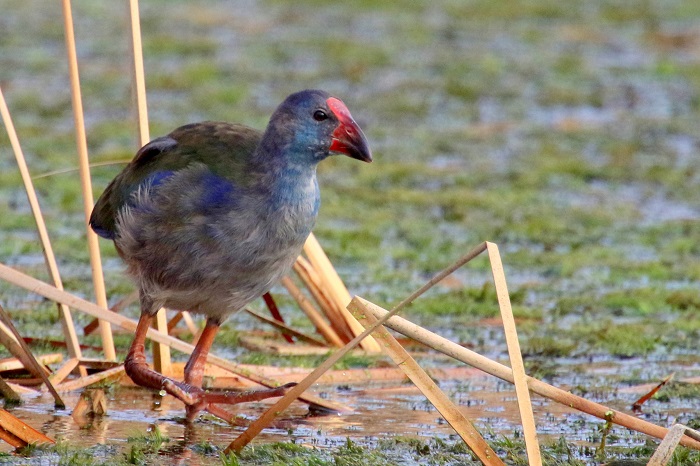
Immature birds resemble the adults but have duller blue upperparts and the underparts, from the breast to the vent are mottled dark grey and white. Juveniles are dull brown above and grey below, often with white mottling on the flanks and belly. The bill and frontal shield are brownish-red and the legs and feet are dull red.

Juvenile African Swamphen (Porphyrio madagascariensis)
Swartvlei, Sedgefield, Western Cape
Photo by Karis Daniel

The African Swamphen is by far the largest gallinule in the region, helping to reduce confusion with the smaller Purple Gallinule (Porphyrio martinicus) and Allen’s Gallinule (Porphyrio alleni). The Purple Gallinule is a very rare vagrant to southern Africa and is smaller, with a yellow bill tip and yellow (not red) legs and feet. Allen’s Gallinule is much smaller, with a bright blue frontal shield.

African Swamphen (Porphyrio madagascariensis)
Rietvlei, Gauteng
Photo by Anthony Paton

Status and Distribution

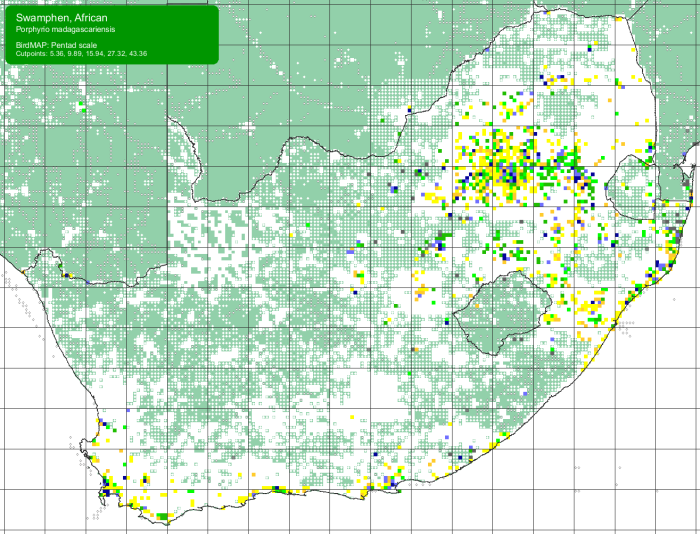
The African Swamphen occurrs in several scattered populations from Senegal east to Ethiopia and with an outlying population in the Nile River valley, Egypt. It also occurs on Madagascar. The African Swamphen is more continuously distributed in East, Central and Southern Africa. It is widespread but patchily distributed in South Africa and is absent from most of the arid Karoo and Kalahari.

SABAP2 distribution map for African Swamphen (Porphyrio madagascariensis) – September 2024. Details for map interpretation can be found here.

The African Swamphen is not threatened. Numbers may have decreased locally because of frequent disturbance, removal of riparian vegetation, and from wetland drainage. Similar decreases have been reported from some other parts of Africa. However, the African Swamphen readily makes use of man-made wetlands like dams and sewage ponds, and may have expanded its distribution as a result.

.

African Swamphen (Porphyrio madagascariensis)
Marievale Bird Sanctuary, Gauteng
Photo by Lia Steen

Habitat

The African Swamphen inhabits lakes, dams, pans, slow flowing rivers, marshes and estuaries. It occurs at large or small waterbodies and prefers permanent habitats, although it does also utilise temporary wetlands. The African Swamphen occupies both fresh and brackish habitats that are sheltered, and with still or slow flowing water fringed or overgrown by reeds (Phragmites spp), Bulrushes (Typha capensis), sedges and Papyrus (Cyperus papyrus) etc.

Typical aquatic habitat.
Wakkerstroom, Mpumalanga
Photo by Ryan Tippett

.

Behaviour

The African Swamphen is mostly a sedentary resident. It is usually encountered solitarily or in pairs but may sometimes be found in groups of 12 or more birds. The African Swamphen does not undertake any regular migrations. It is sometimes locally nomadic in drier areas and undertakes occasional, large-scale seasonal movements in response to changing habitat conditions.

African Swamphen (Porphyrio madagascariensis)
Strandfontein Water Treatment Plant, Western Cape
Photo by Josu Meléndez

The African Swamphen usually remains within dense vegetation, but sometimes ventures out to forage in the open, seldom venturing far from cover. It walks out on water lilies, and runs fast through marshy vegetation. It flicks its tail frequently, which is thought to indicate uneasiness or fear, but is also used in display and to warn off predators.

African Swamphen (Porphyrio madagascariensis)
Marievale Bird Sanctuary, Gauteng
Photo by Lia Steen

The flight is heavy and clumsy. During short flights the legs dangle below the body, but are held out straight in longer flights. The African Swamphen is known to construct platforms on which to stand or roost by taking reed or rush stems in the bill and folding them over before standing on the bent stems to force them in place.

The African Swamphen bathes in shallow water by flapping its wings and submerging the head. Also sunbathes after preening and may climb to the top of a tall plant to do so.

African Swamphen (Porphyrio madagascariensis)
Strandfontein Waste Water Treatment Works, Western Cape
Photo by Gerald Wingate

The African Swamphen is largely vegetarian and consumes a variety of plant matter, including roots, stems, leaves, flowers and seeds. They are especially partial to water lily tubers. The African Swamphen prefers feeding on tender new growth and the soft, pulpy centre of old reed stems. The diet also includes a variety of animal prey including invertebrates like insects, snails, worms, leeches and crabs, as well as vertebrates such as small fish, frogs, and bird nestlings. They also eat frog and fish eggs, bird eggs and carrion.

African Swamphen (Porphyrio madagascariensis) feeds mainly on plant material.
Tableview, Cape Town, Western Cape
Photo by Les Underhill

The African Swamphen forages by clambering around in marshy vegetation. It pulls down plant stems with the bill, holding them with one foot before biting off pieces to eat. May also immerse its whole head and neck to reach soft, under water plant stems. They often climb the stems of reeds and Bulrushes to reach flowers and seed heads. The African Swamphen also digs in damp soil for roots and turns over stones and floating vegetation to reveal prey.

African Swamphen (Porphyrio madagascariensis)
Marievale Bird Sanctuary, Gauteng
Photo by Lia Steen

The African Swamphen is a monogamous, cooperative breeder. They are strongly territorial and territories are aggresively defended, mostly by the males. Territory establishment is accompanied by increased vocalisations.

The nest is built by both sexes. They are sometimes also assisted by helpers (the young of previous broods). The nest is a bulky bowl-shaped structure built from Bulrushes, reeds, grass etc. It is built on top of a pre-prepared platform of flattened vegetation. The bowl is sometimes lined with grass, papyrus flower heads or fern leaves. The stems of adjacent vegetation are often drawn over the nest to form a canopy. The nest is almost always built over water and well concealed in dense vegetation.

Eggs are laid throughout the year, but mainly from October to March in southern Africa. Clutch size varies from 2 to 6 eggs. The eggs are cream-coloured with reddish-brown and grey speckles.

Incubation begins once the full clutch has been laid and takes around 25 days for the eggs to hatch. The female performs most of the incubation with help from the male and helpers if present. The newly hatched young are precocial and leave the nest shortly after hatching. They return to the nest for feeding and to roost. The young are cared for by both sexes and any helpers if present. They are fully fledged after 8 weeks.

Further Resources

Species text from the first Southern African Bird Atlas Project (SABAP1), 1997.

The use of photographs by Anthony Paton, Gerald Wingate, Jean Hirons, Josu Meléndez, Karis Daniel, Les Underhill, Lia Steen and Roelof van der Breggen is acknowledged.

Virtual Museum (BirdPix > Search VM > By Scientific or Common Name).

Other common names: Porphyrio porphyrio (Alt. Scientific); Purple Gallinule, African Purple Swamphen (Alt. English); Grootkoningriethaan (Afrikaans); Purperkoet (Dutch); Talève d’Afrique (French); Purpurhuhn (German); Caimão-comum (Portuguese)

A list of bird species in this format is available here.

Recommended citation format: Tippett RM 2024. African Swamphen Porphyrio madagascariensis. Biodiversity and Development Institute. Available online at https://thebdi.org/2024/09/08/african-swamphen-porphyrio-madagascariensis/

Bird identificationbirding

African Swamphen (Porphyrio madagascariensis) 
Garden Route National Park, Western Cape
Photo by Jean Hirons

Industrial biodiversity 3 : an hour spent replacing tyres in Maitland

Birds succeed in making a living in pretty hard circumstances. This includes the jungles of tar, concrete, wires with assorted purposes strung between poles, with a few palm trees in the mix. Here’s an example of industrial biodiversity in Maitland, a suburb of Cape Town

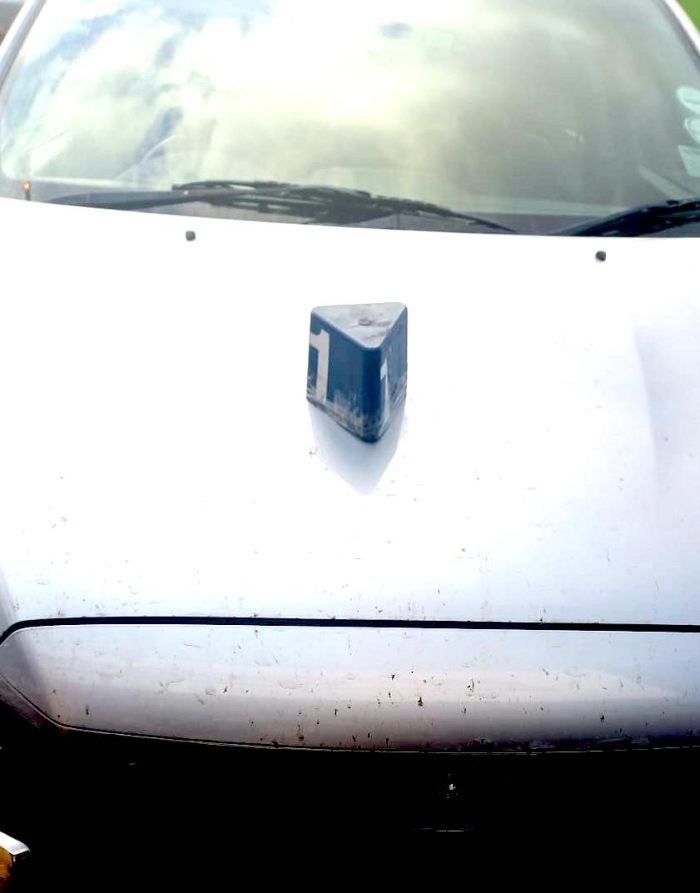
These tyres had given me 50,000 km, and had more than reached the legal limit. With a bird ringing course, 700 km away, looming next week, it was time for decisive action. So, at 08h00 today, the magnetic triangle showing that this vehicle was number one in the queue was put on the bonnet. Replacing four tyres, wheel alignment, etc, takes about an hour. You can use that hour or lose it. I had taken my camera, and in the hope that I could wander around outside, instead of reading old magazines about irrelevant topics in the waiting lounge, however comfortable that is. The hour produced enough of interest to generate this little blog. A camera trap would probably have produced some nightlife, in the form of rats, but the focus here is only on birds.

Number 1

Birds and steel

We seldom look up when we are on pavements and crossing roads. That makes sense, because we should avoid bumping into other pedestrians, and getting knocked over by vehicles. But the birds have endless opportunities to inspect the infrastructure above us.

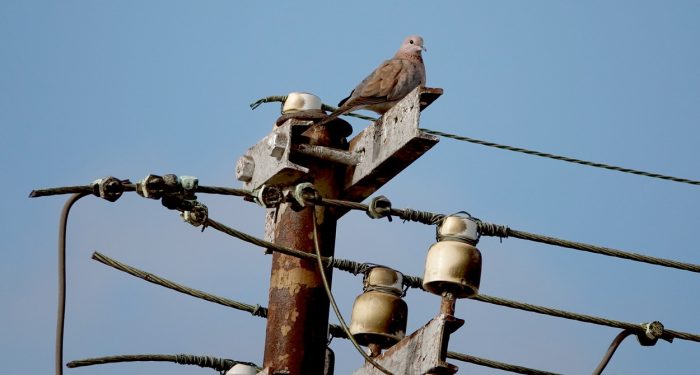
Laughing Dove : Industrial biodiversity in Maitland
The Laughing Dove is amused by the Heath Robinson-ness of the wiring. But it is quite neatly done. One wonders when it was done, probably measured in decades, and how many kilowatts of electricity have flown safely along those wires. The pole is a bit rusty, and could use a coat of paint to prolong its life. BirdPix 291957
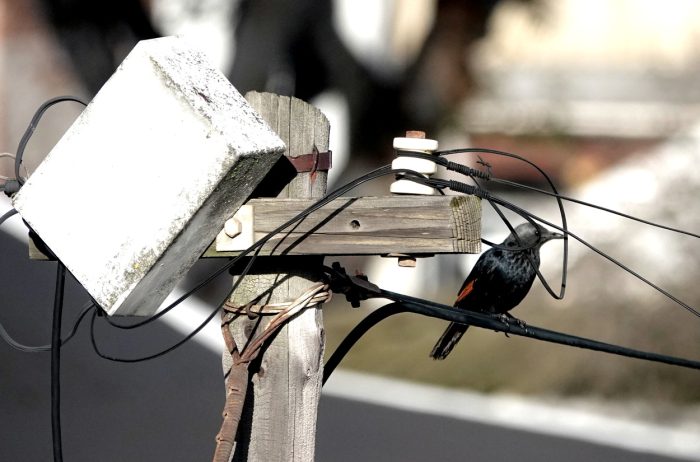
Red-winged Starling : Industrial biodiversity in Maitland
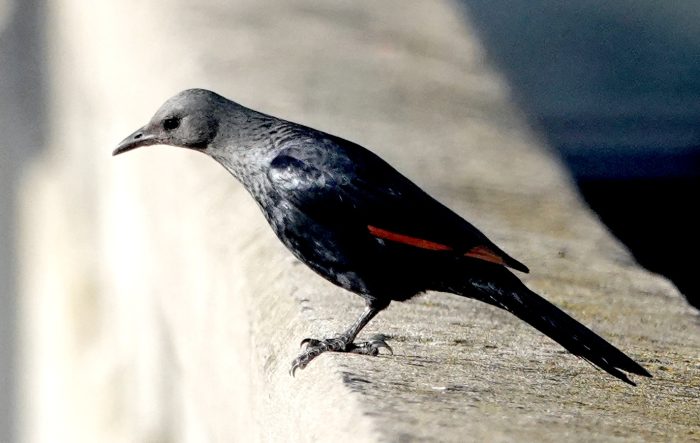
Red-winged Starling gets to keep an eye on the telephone lines. BirdPix 291959
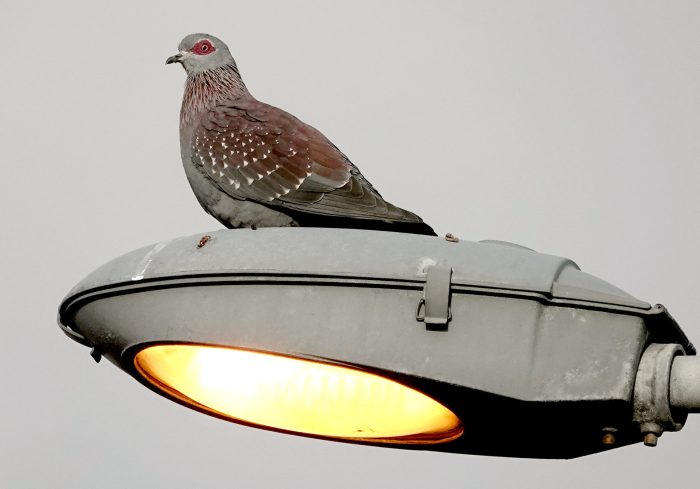
Speckled Pigeon : Industrial biodiversity in Maitland
Speckled Pigeon is oblivious to the street light underneath. Beam me down. BirdPix 291960
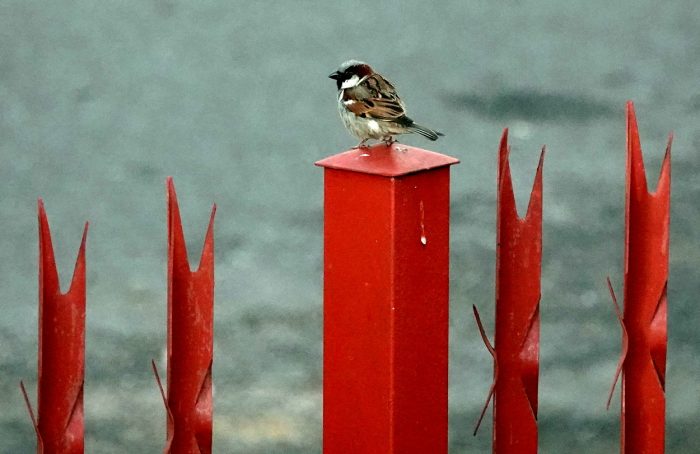
House Sparrow : Industrial biodiversity in Maitland
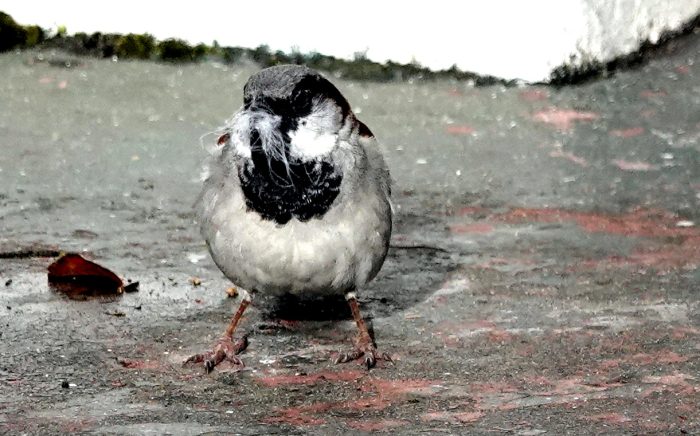
Choose your perch carefully, Mr House Sparrow. BirdPix 291961

Birds and tar and concrete

Rock Dove : Industrial biodiversity in Maitland
The winter storms of 2024 have played havoc with Cape Town’s road, and and water has exploited every little weakness, enlarging cracks and turning them into potholes. The texture provides a modest degree of camouflage for the Rock Doves. BirdPix 291963
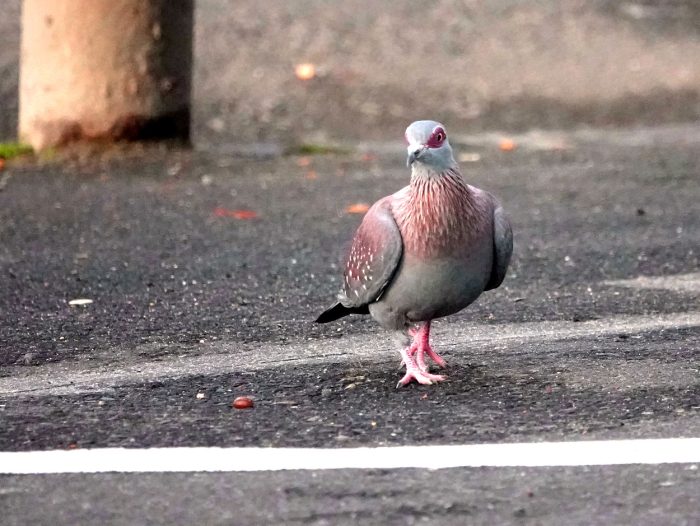
Speckled Pigeon : Industrial biodiversity in Maitland
Speckled Pigeon on a speckled pavement. No camouflage. BirdPix 291960
House Sparrow : Industrial biodiversity in Maitland
It is 5 September, so it is spring and its breeding season for the House Sparrows. This down feather, possibly from a dove, is destined to become lining for a nest. In the meantime it has been manipulated into a scruffy horseshoe moustache which an ancient cowboy would be proud of. BirdPix 291961
Red-winged Starling : Industrial biodiversity in Maitland
The bird books do list concrete as habitat for the Red-winged Starling

Birds and air

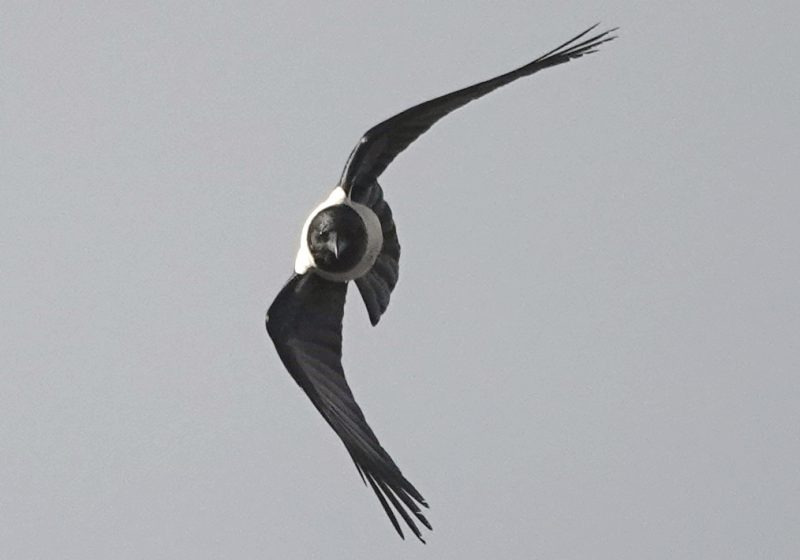
Pied Crow in air
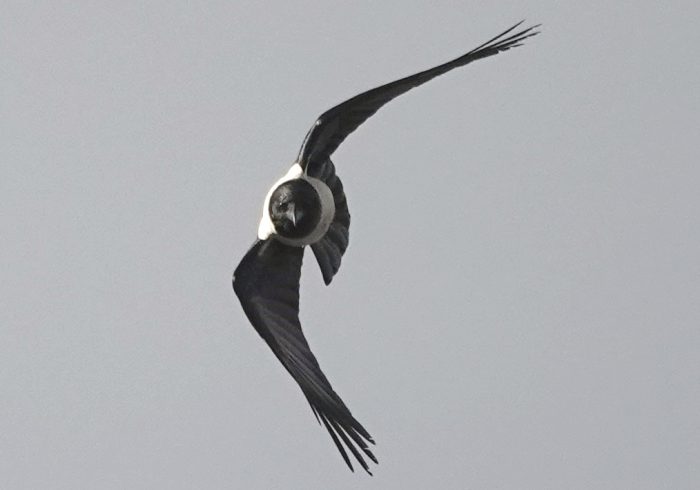
This Pied Crow is doing a sharp banking turn, but the head is on the level. BirdPix 291964
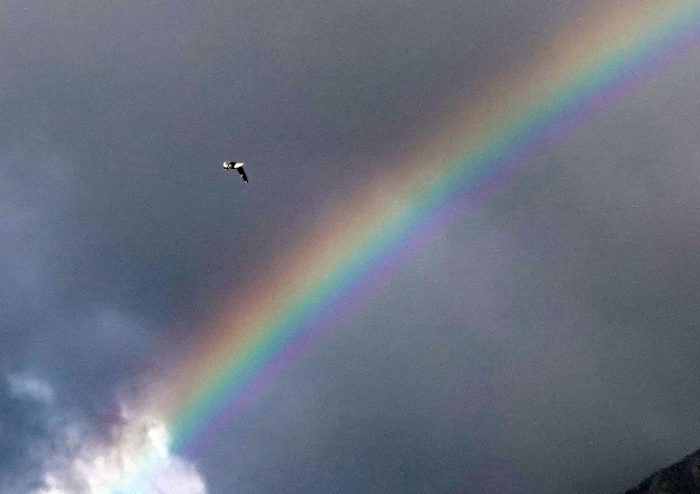
Hartlaub's Gull in air
Fraction late. The aim was to get the Hartlaub’s Gull with the rainbow behind it. BirdPix 291962

Birds and green

This part of Maitland generally lacks much in the way of green …

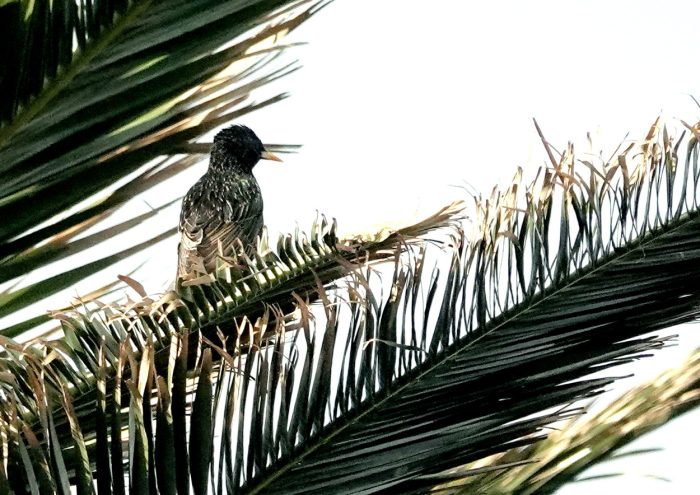
Common Starling
… but this palm tree is precious, not only for the nesting Common Starlings, but especially because it provides a landmark to find the tyre shop, and gives its name to the business …. BirdPix 291958
Palm Tyres

While I was still engrossed in photography, my tyres were fitted and the wheels aligned! Now I feel more comfortable setting off for the bird ringing course at New Holme, starting next Monday.

The industrial biodiversity of Maitland doesn’t have much variety, but the antics of the birds filled an hour with interest and amusement. The BirdPix section of the Virtual Museum benefitted too!

Bird ringing at Grotto Bay : 31 August 2024

On 31 August we held an Open Day for bird ringing at Grotto Bay Private Nature Reserve. We caught 62 birds of 19 species (list at the bottom of this blog), including a few recaptures of birds which had been ringed in the last two years. The most-caught species was Cape Weaver, as these were breeding in the reeds in the pond at the Conservation Centre (see the photo above). This was followed by White-backed Mousebird. In addition to ringing three Chestnut-vented Warblers, it was exciting to catch a Layard’s Warbler, a bird not caught very often. Also exciting for me was a ringing lifer, Cape Penduline Tit.

This was the BDI’s third ringing event at Grotto Bay Private Nature Reserve. There is a report here on the bird ringing here on 27 May last year here. The first trip escaped without a blog! Here is a list of (almost!) all the reports of BDI ringing courses and events which have already taken place. There is a list of future courses here. If you want to find out more about bird ringing, send an email to ring@thebdi.org.

The Long-billed Crombec has a remarkably short tail. It is when you see this bird in the hand that you can actually see the size of the tail feathers. Photo : Suzette Vorster

Thanks to Michelle van Acker, chair of the conservation committee, and the community at Grotto Bay Private Nature Reserve for hosting us! The Tygerberg Bird Club ringers helped with the ringing. Thank you to Suzette Vorster and Sue Gie for photography. We plan to do more Open Days for bird ringing at Grotto Bay in future. Keep looking here.

One of the most important components of a training as a bird ringer is to learn the skill of being able to extract birds from mistnets safely. This is a Cape Robin-chat. Photo : Suzette Vorster

Birds caught at Grotto Bay on 31 August 2024

Sp noSpeciesCount
317Laughing Dove1
391White-backed Mousebird8
531Cape Penduline Tit1
543Cape Bulbul5
581Cape Robin-chat1
583Karoo Scrub Robin1
621Long-billed Crombec1
622Bar-throated Apalis3
658Chestnut-vented Warbler3
659Layard’s Warbler1
686Cape Wagtail1
707Southern Fiscal1
760Southern Double-collared Sunbird2
786Cape Sparrow3
799Cape Weaver21
803Southern Masked Weaver2
866Yellow Canary1
1172Cape White-eye3
4139Karoo Prinia3
Total62
Bird ringing at Grotto Bay
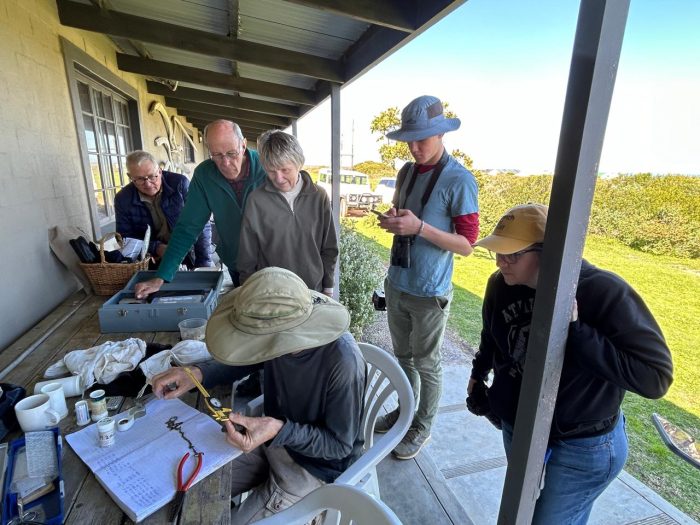
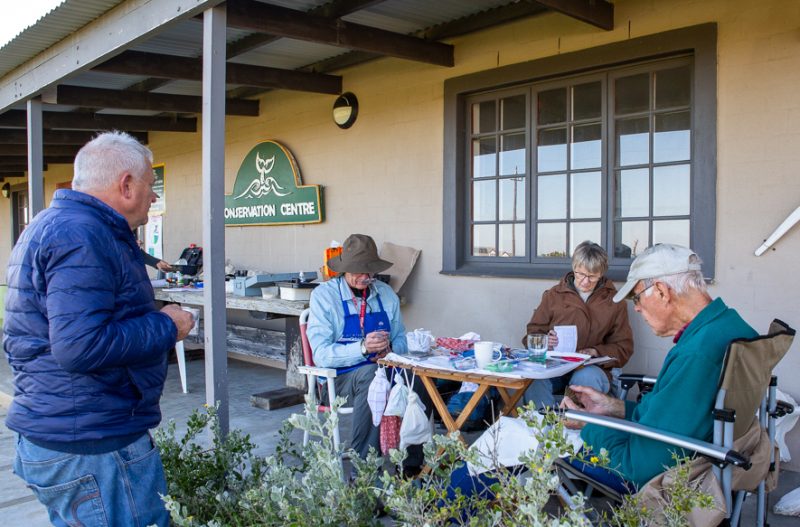
The ringing station at Grotto Bay is on the verandah of the Conservation Centre. It is an excellent venue, and the BDI is grateful that we are privileged to hold these events here. Photo : Sue Gie

Cape Rockjumper (Chaetops frenatus)

Cover image: Cape Rockjumper by Duncan Butchart – Hermanus, Western Cape –  BirdPix No. 86016

Rockjumpers belong to the Family CHAETOPIDAE. The family is endemic to southern Africa and comprises 1 genus and 2 species. Rockjumpers are smallish passerine birds of high mountainous habitats. The genus Chaetops means ‘bristle eye’ which refers to their conspicuous eye lashes. Their taxonomic affinities are uncertain, but research indicates they are most closely related to the Rockfowl (Picatharthidae) of West Africa.

Identification

Cape Rockjumper (Chaetops frenatus)
Rooi-Els, Western Cape
Photo by Gerald Wingate

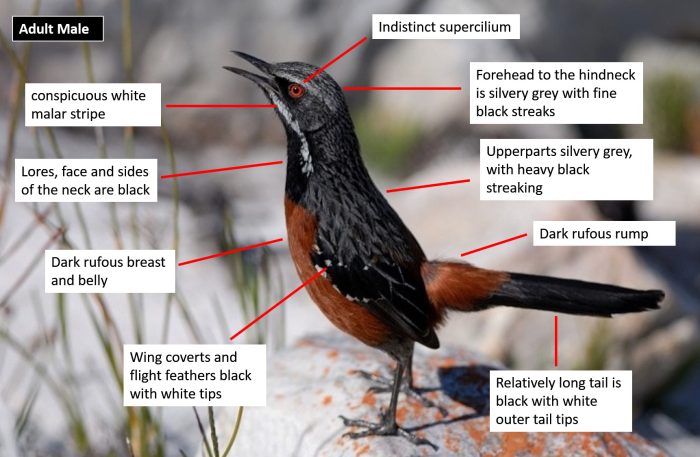
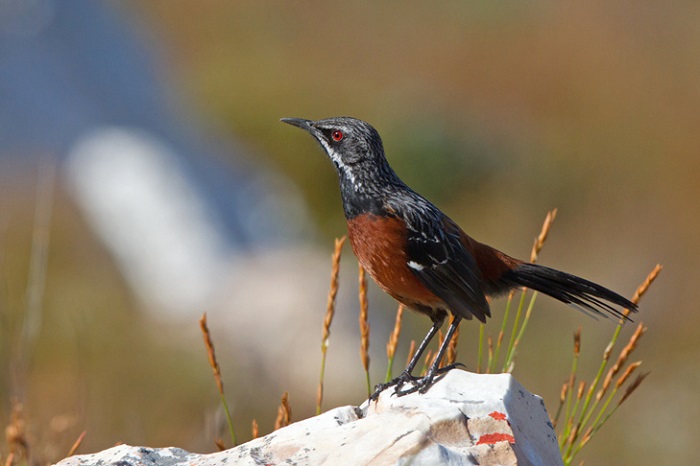
The Cape Rock Jumper is a handsomely plumaged species. In adult males the forehead, crown, ear coverts and hind neck are silvery grey with fine black streaks. The supercilium is silvery-grey and rather indistinct. The lores, face and sides of the neck are black with a conspicuous white malar stripe. The rest of the upper parts, including the mantle, scapulars and back feathers are silvery grey, with heavy black streaking. The rump and upper tail coverts are a rich dark rufous. The relatively long tail is black with white outer tail tips. The chin, throat and upper breast are jet black. The breast and belly are richly coloured in dark rufous, while the vent and thighs are blackish. Under tail coverts black, with whitish tips. The wing coverts and flight feathers are black with white tips. The relatively long legs are an adaptation to bounding around on rocky mountain slopes. The legs and feet are black and the eyes are orange-red.

Cape Rockjumper (Chaetops frenatus)
Rooi-Els, Western Cape
Photo by Johan van Rensburg

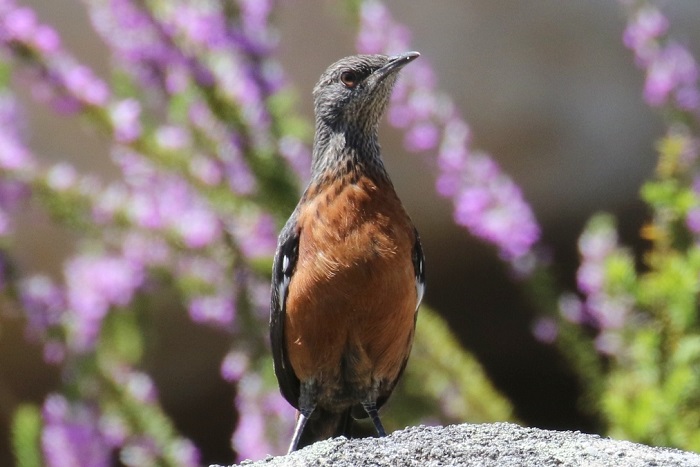
Adult females differ from males in having a grey and buff mottled face and neck with an indistinct buff-grey malar stripe. The upper parts are brownish-grey with dark streaks. The rump and upper tail coverts are dark rufous but paler than in males. The tail and wings are brownish black and the flight feathers carry white tips. The breast and belly are dark rufous but duller and paler than in males and the breast shows fine brown streaks. The eyes are reddish-brown..

Juveniles resemble adult females but are less strongly marked overall.

Cape Rockjumper (Chaetops frenatus) 
Roodeplaat, Eastern Cape
Photo by Maans Booysen

The Cape Rockjumper most resembles the Drakensberg Rockjumper (Chaetops aurantius) but confusion is unlikely as their distributions do not overlap. Females are similar to female and juvenile Cape Rock Thrush (Monticola rupestris) and Sentinel Rock Thrush (Monticola explorator) but those species have rufous (not black) tails and lack the white outer tail tips.

Status and Distribution

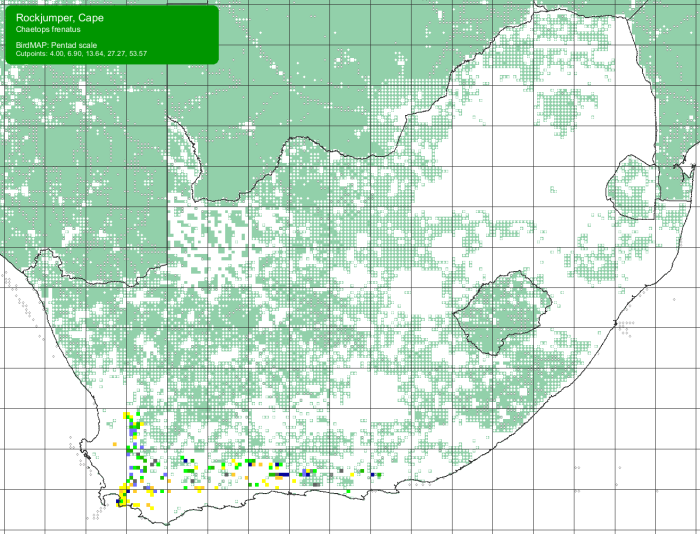
SABAP2 distribution map for Cape Rockjumper (Chaetops frenatus) – August 2024.
Details for map interpretation can be found here.

The Cape Rockjumper is a locally common resident and is endemic to South Africa. The distribution ranges from Piketberg and the Cederberg Mountains, south to Cape Hangklip near the village of Rooi-Els, Western Cape, and east along the Cape Fold Mountains to Uitenhage, Eastern Cape. The range does not overlap with that of the Drakensberg Rockjumper, but is separated by only 100 km or so.

Cape Rockjumper (Chaetops frenatus)
Groot Winterhoek mountains, Eastern Cape
Photo by Pamela Kleiman

The Cape Rockjumper is near threatened and threats include the rampant spread of alien vegetation.

Habitat

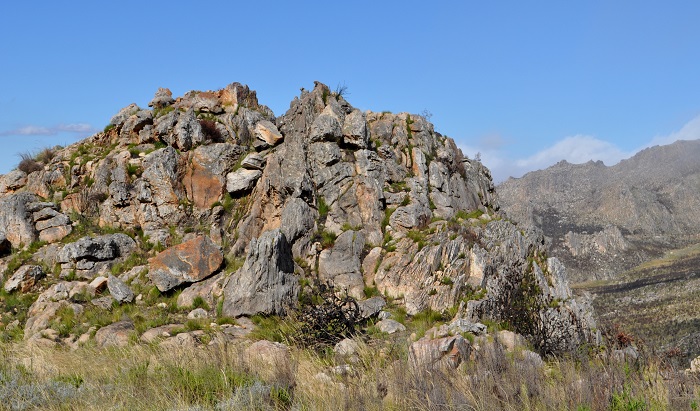
Typical habitat
Swartberg Pass, Western Cape
Photo by Ryan Tippett

The Cape Rockjumper inhabits mountain fynbos on windswept, high rocky slopes or ridges. It also occurs down to sea level in the extreme west of its range at Rooi-Els, Western Cape. The Cape Rockjumper is restricted to higher rainfall parts of the Fynbos Biome.

Cape Rockjumper (Chaetops frenatus)
Near Humansdorp, Eastern Cape
Photo by Pamela Kleiman

Behaviour

The Cape Rockjumper is rather poorly known. It is generally a sedentary, resident species, but sometimes moves to lower altitudes in winter.

Cape Rockjumper (Chaetops frenatus) 
Roodeplaat, Eastern Cape
Photo by Maans Booysen

Cape Rockjumpers are gregarious and normally encountered in pairs or small family groups. They are unobtrusive and typically scuttle about over and between rocks and boulders. Forages by scratching and probing on the ground, searching in sand and at the base of bushes and boulders. The diet consists mostly of arthropods like caterpillars, beetles, bugs, flies, grasshoppers, spiders, scorpions along with the occasional vertebrate such as small lizards or frogs.

Cape Rockjumper (Chaetops frenatus)
Rooiels, Western Cape
Photo by Georg Jacobs

Cape Rockjumpers are territorial and territories are usually maintained year-round. Boundary disputes are usually brief and involve much calling, chasing and posturing with heads held high and tails fanned to expose conspicuous white tips.

Cape Rockjumper (Chaetops frenatus)
Swartbergpass, Western Cape
Photo by Salome Willemse

The Cape Rockjumper is often a facultative cooperative breeder. A group comprises a monogamous breeding pair and sometimes 1 or 2 additional helpers, often the offspring from the previous breeding season. Helpers assist with nest building, incubation and the rearing of chicks.

Cape Rockjumper (Chaetops frenatus) 
Rooi-Els, Western Cape
Photo by Trevor Hardaker

The nest is a bulky open cup, made from dry grass, twigs, moss and lichen. The bowl is lined with fine plant material and bits of fur. The nest is well hidden and is placed on the ground, usually beneath a rock slab, but sometimes also under a grass tuft, rock overhang or bush. The nest site is chosen on the leeward side of a rock to guard against the prevailing south-east winds.

Cape Rockjumper (Chaetops frenatus)
Rooiels, Western Cape
Photo by Georg Jacobs

Eggs are laid from late July to January with a peak between September and October. Clutches consist of 2 plain white eggs, laid on successive days. Incubation duties are shared by both sexes and probably also helpers. The incubation period lasts up to 21 days and the nestling period takes 18 to 21 days. Young birds are unable to fly for at least 5 days after initially leaving the nest but are able to run well over rocky slopes and hide in crevices or dense vegetation if approached. Both adults and helpers feed the young and remove faecal sacs from the nest.

Cape Rockjumpers are multiple brooded and sometimes attempt to breed up to 3 times in one breeding season.

Cape Rockjumper (Chaetops frenatus)
Winterhoek Wilderness Reserve, Western Cape
Photo by Corne Rautenbach

Further Resources

Species text in the first Southern African Bird Atlas Project (SABAP1), 1997.

The use of photographs by Corne Rautenbach, Duncan Butchart, Georg Jacobs, Gerald Wingate, Johan van Rensburg, Maans Booysen, Pamela Kleiman, Salome Willemse and Trevor Hardaker is acknowledged.

Virtual Museum (BirdPix > Search VM > By Scientific or Common Name).

Other common names: Kaapse berglyster (Afrikaans); Sauteur du Cap, Chétopse bridé (French); Kaapse Rotsspringer (Dutch); Kap-Felsenspringer (German); Saxícola-do-Cabo (Portuguese).

List of bird species in this format is available here.

Recommended citation format: Tippett RM 2024. Cape Rockjumper Chaetops frenatus. Biodiversity and Development Institute. Available online at https://thebdi.org/2024/09/01/cape-rockjumper-chaetops-frenatus/

Bird identificationbirding

Cape Rockjumper (Chaetops frenatus)
Swartberg Pass, Western Cape
Photo by Ryan Tippett

Black Crake (Amaurornis flavirostra)

Cover image of Black Crake by Anthony Paton – Kruger National Park, Limpopo – BirdPix No. 41149

Crakes belong to the Family: RALLIDAE. This family also includes Rails, Flufftails, Gallinules, Moorhens and Coots etc. Their physiology is diverse, but most have laterally compressed bodies, short tails, short rounded wings and well developed legs and feet. The bill structure is variable. Most birds in this family inhabit wetlands or forest undergrowth and are usually vocal and highly secretive.

Identification

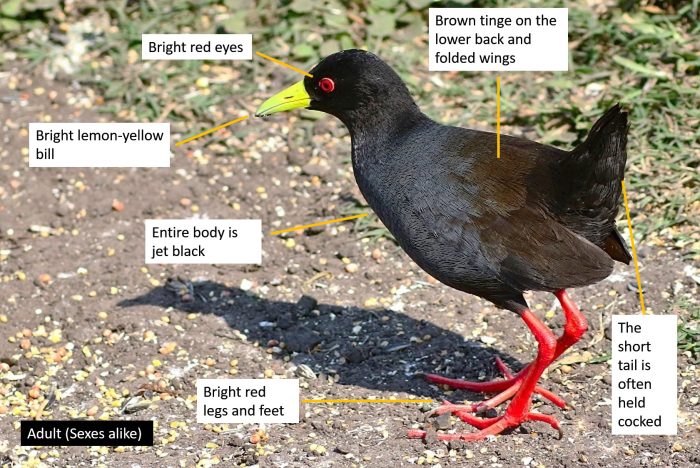
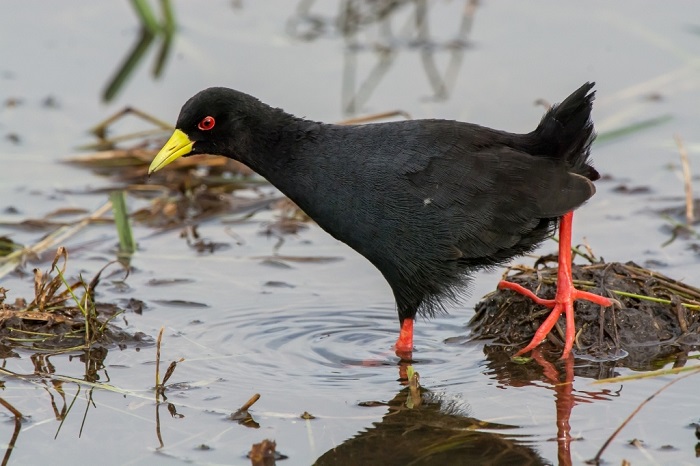
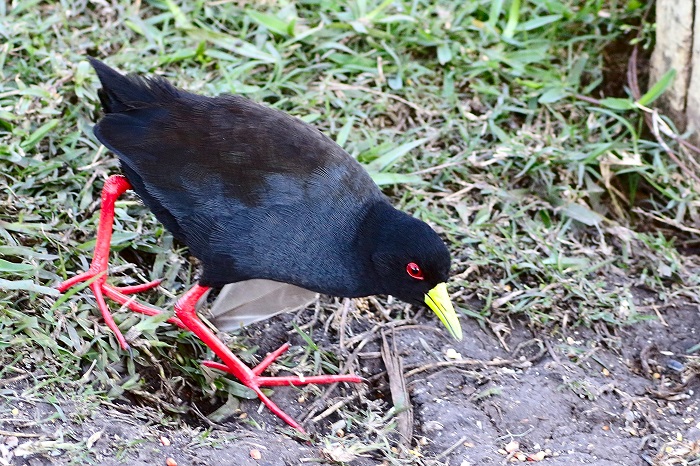
The Black Crake is a smallish and striking, all-black water bird.

Identification guide Black Crake
Black Crake (Amaurornis flavirostra) 
Port Edward, KwaZulu-Natal
Photo by Lia Steen

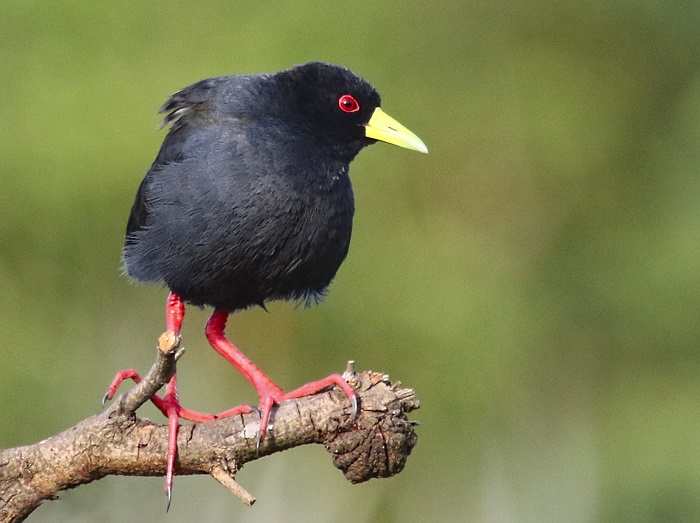
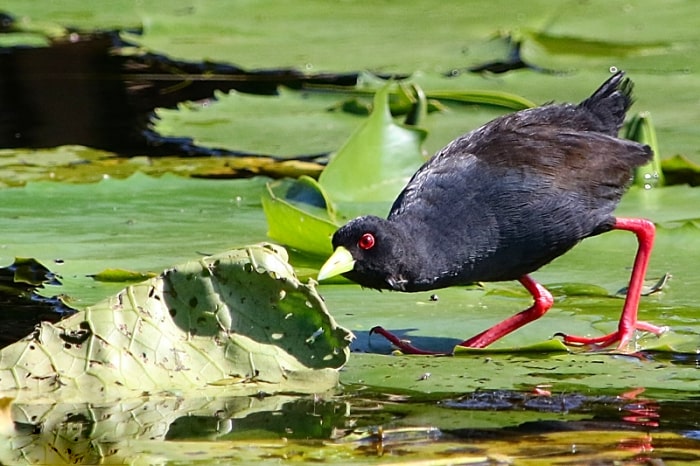
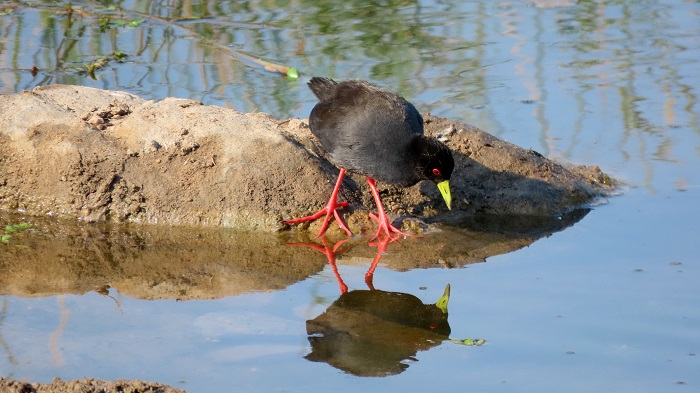
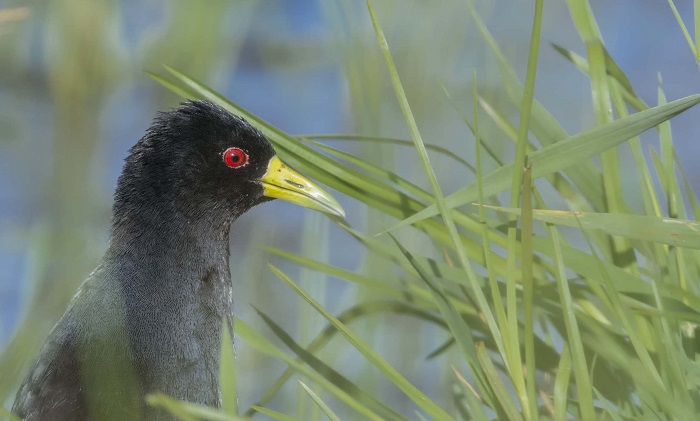
The entire body is jet-black (sometimes with a brownish hue on the folded wings and lower back). The bill is bright greenish-yellow and the eyes are vivid red. The well developed legs and feet are bright red in breeding condition or dull red during the non-breeding season.

Amaurornis flavirostra
Black Crake (Amaurornis flavirostra)
K’Shane Estate, North West
Photo by Felicity Ellmore

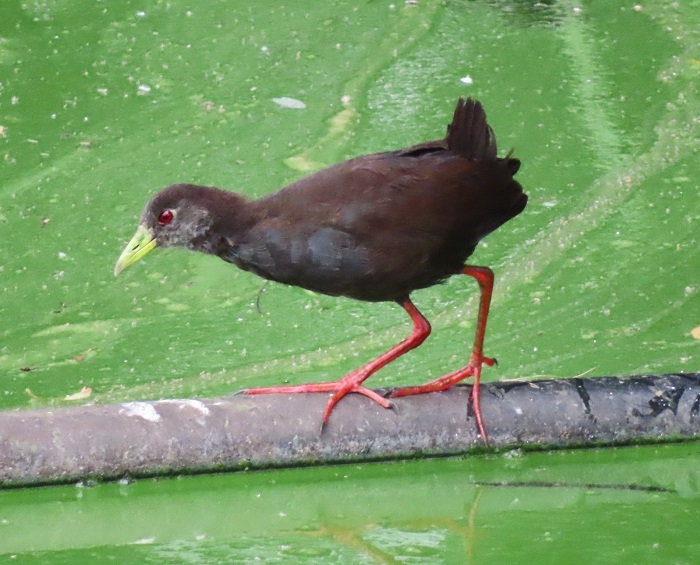
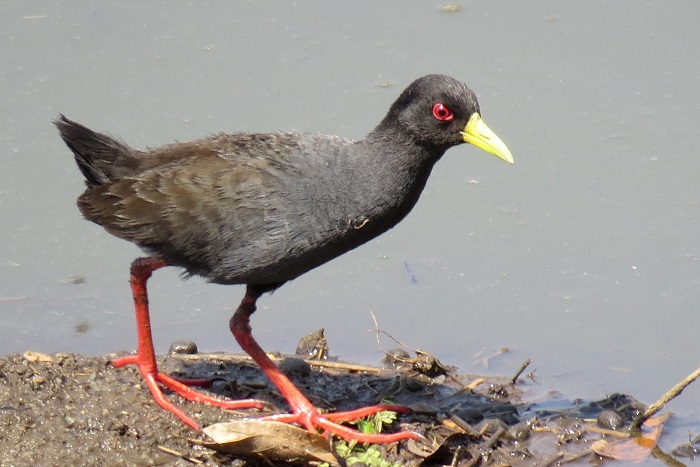
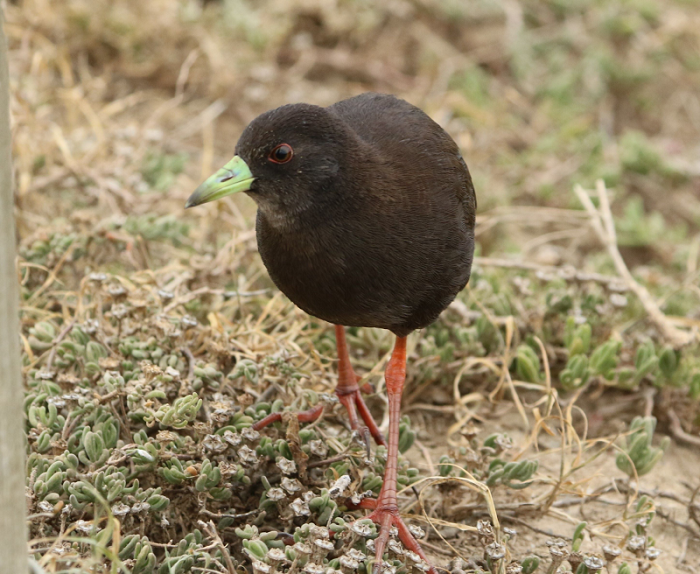
Juveniles have dark olive-brown upper parts, dark grey under parts and a whitish throat. The bill is dull greenish-yellow and the red legs are duller than those of the adults.

Adult Black Crakes are unmistakable and unlike any other African bird.

Black Crake
Black Crake (Amaurornis flavirostra)
Port Edward, KwaZulu-Natal
Photo by Lia Steen

Status and Distribution

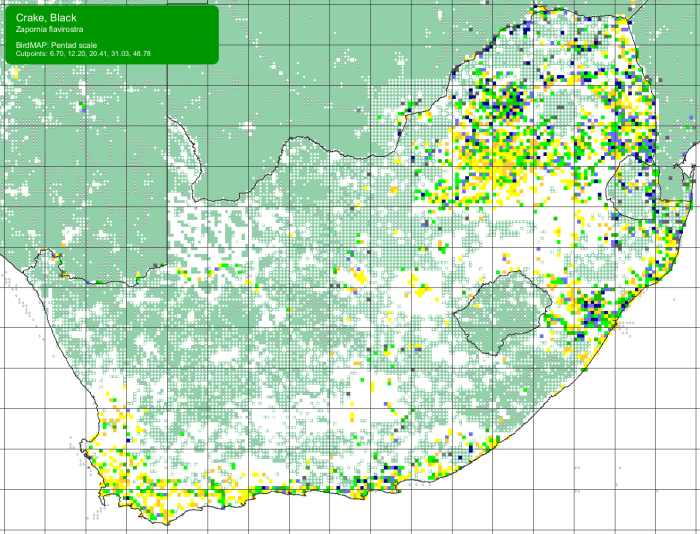
The Black Crake is generally a common resident with some local movements during dry periods. The Black Crake is found throughout sub-Saharan Africa, except for arid regions. It is the commonest and most widespread crake species in Africa.

SABAP2 distribution map for Black Crake
SABAP2 distribution map for Black Crake (Amaurornis flavirostra) – August 2024. Details for map interpretation can be found here.

In southern Africa, the Black Crake occurs in northern Namibia and Botswana, most of Zimbabwe and Mozambique, northern and eastern South Africa and along the eastern littoral to the Western Cape. There are scattered records elsewhere including the semi-arid and arid parts of Namibia and the Karoo where it may be very localised.

Black Crake
Black Crake (Amaurornis flavirostra)
Garden Route National Park, Western Cape
Photo by Jean Hirons

The Black Crake is not threatened. There is no evidence of any range contractions but it has likely been affected by the continual loss of wetland habitats in some areas. Conversely, the Black Crake is often common at a variety of man-made water bodies.

Habitat

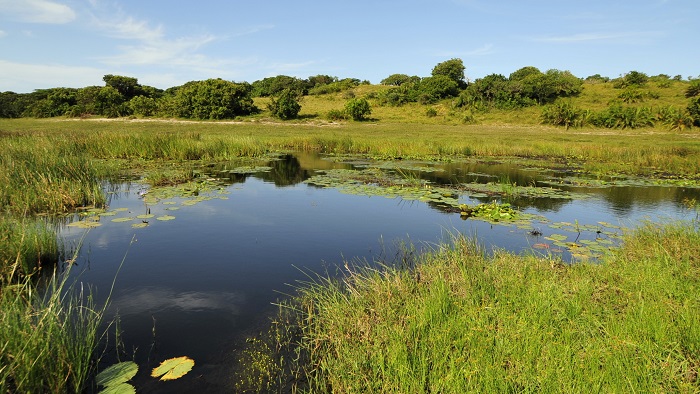
Habitat for Black Crake
Typical aquatic habitat.
Kosi Bay, iSimangaliso Wetland Park, KwaZulu-Natal
Photo by Ryan Tippett

The Black Crake occupies a wide range of fresh and brackish wetland habitats, including marshes, pans, dams, ornamental ponds, rivers, streams, estuaries and sewage ponds. It frequents still and flowing water, and both seasonal and perennial wetlands. The Black Crake prefers dense, tangled vegetation such as reedbeds, sedges, Papyrus (Cyperus papyrus) stands and rank grass. Also inhabits swampy thickets, bushes and other thick growth near water.

Behaviour

The Black Crake is largely sedentary but may be locally nomadic in the drier parts of its range in response to rainfall and water levels. The Black Crake is usually solitary but can also be found in pairs or in small family groups.

Amaurornis flavirostra juvenile
Black Crake (Amaurornis flavirostra)
Mapungubwe National Park, Limpopo
Photo by Terry Terblanche

The Black Crake is most active by day and sometimes also on moonlit nights, becoming very active after rain. The main activity period is during the morning and late afternoon, but forages throughout the day in winter. The Black Crake flies reluctantly but strongly when disturbed. They will usually fly back into cover, but prefer to run away through vegetation and over water plants. The Black Crake swims well, even under water, but usually only when threatened. Adults are known to build platforms in vegetation for resting or preening and pairs, helpers and young frequently engage in allopreening.

Adult Black Crake
Black Crake (Amaurornis flavirostra)
Port Edward, KwaZulu-Natal
Photo by Lia Steen

The Black Crake is less shy than most others in the family, and often forages in the open, especially during the winter months when breeding is over. They can become quite tame and confiding, and are sometimes regular visitors at picnic spots and garden bird feeders when these adjoin wetland habitats. It is regularly seen walking across floating plants or in areas of short grass and along muddy shorelines. Black Crakes often clamber into bushes and low trees, especially over water. Also climbs high up above the water in dense reedbeds or Papyrus stands.

The Black Crake is omnivorous and has a varied diet that includes earthworms, molluscs, crustaceans, insects and their larvae, frogs, tadpoles, small fish, bird eggs and the nestlings of weavers and other bird species. The Black Crake is even known to kill and eat small birds caught in mist nets. Also consumes the seeds, stems and leaves of various water plants, including duckweed (Lemna sp) and the seeds of water lilies (Nymphaea spp). The Black Crake frequently scavenges when the opportunity arises, feeding on dead crabs, frogs, fish, insects and small birds etc.

Amaurornis flavirostra
Black Crake (Amaurornis flavirostra)
Port Edward, KwaZulu-Natal
Photo by Lia Steen

The Black Crake forages by pecking and probing food off of water plants, muddy substrate and from the water surface. They will also climb reeds to snatch insects. Catches small fish, tadpoles and aquatic insects by rapidly immersing the head and neck into shallow water. Meticulously searches under debris and fallen plants and pulls down the leaves of water plants to search for prey. They will also forage in cultivated areas, gardens and dry or burned ground near water.

Additionally, Black Crakes have been observed perching on the backs of Warthogs (Phacochoerus aethiopicus) and Hippopotamus (Hippopotamus amphibius), most likely in the hope of gleaning ectoparasites. The Black Crake is also known to associate with foraging animals near the waters edge such as warthogs in order to catch disturbed prey.

Black Crake
Black Crake (Amaurornis flavirostra)
Kruger National Park, Limpopo
Photo by Johan Van Rooyen

The Black Crake is a monogamous, cooperative breeder. They are strongly territorial and males set up territories at the start of the breeding season. Territory establishment is accompanied by increased vocalisations. They are aggressive when marking out and defending territories and readily chase off conspecifics and other species. Territories are not defended post breeding.

The Black Crake is multiple-brooded, producing more than one clutch during the breeding season. The Offspring of the previous brood often remain as ‘helpers’ during subsequent breeding attempts. The helpers assist with incubation and in rearing the young of the following brood. They often remain with the family group until the end of the breeding season. The breeding season runs from October to April in southern Africa. Under suitable conditions, breeding may occur throughout the year, but in most regions there are seasonal peaks. In southern Africa these peaks occur during November and again between January and March.

Amaurornis flavirostra
Juvenile Black Crake (Amaurornis flavirostra)
Gouritspoort, Western Cape
Photo by Johan van Aarde

The nest is a deep cup made from the leaf-blades and stems of aquatic plants. It is usually well hidden among vegetation and bits of plant stems and other vegetation are sometimes pulled over the nest to form a canopy. The nest is usually placed over water, anywhere from just above the water level to 3 meters up. The nest may occasionally be built on firm ground near water or floating, attached to emergent vegetation.

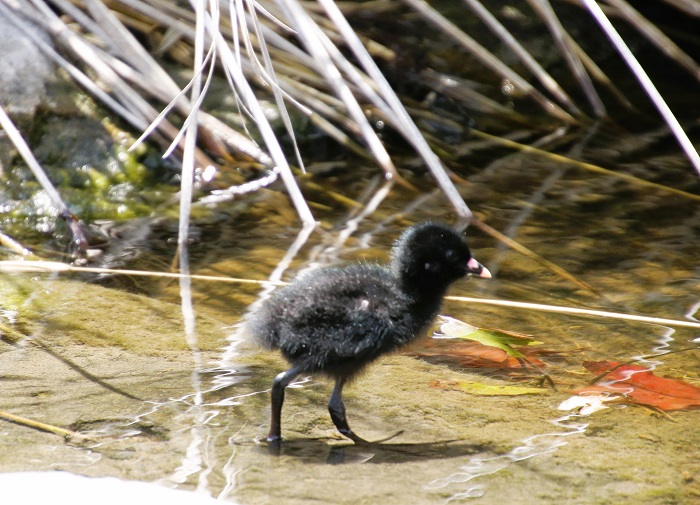
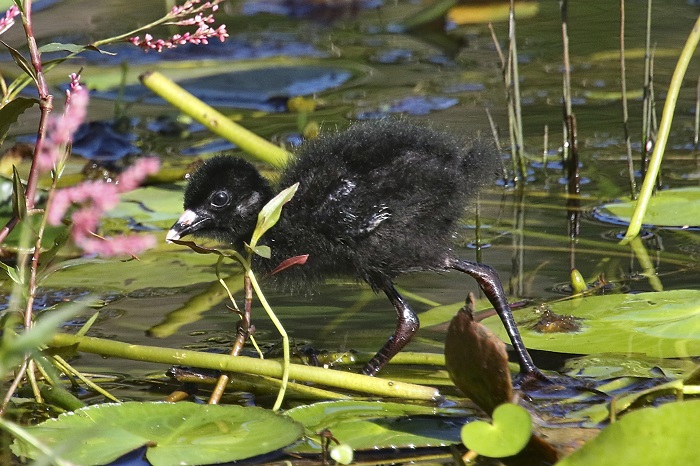
Black Crake chick
Black Crake (Amaurornis flavirostra)
Kruger National Park, Mpumalanga
Photo by Ruth Robinson

Clutch size ranges from 2 to 6 eggs, laid at 1 day intervals. The incubation period lasts for 13 to 19 days and is done by both sexes, sometimes with helpers from the previous brood. Incubation changeovers are often accompanied by raucous duetting. The eggs hatch asynchronously. The newly hatched young have pink and black bills and are covered in black down. Chicks are precocial and are able to move away from the nest within 1 day of hatching. They are fully fledged at 5 weeks old.

Amaurornis flavirostra chick
Black Crake (Amaurornis flavirostra) chicks are covered in black down.
Port Edward, KwaZulu-Natal
Photo by Lia Steen

Further Resources

Species text from the first Southern African Bird Atlas Project (SABAP1), 1997.

The use of photographs by Anthony Paton, Felicity Ellmore, Jean Hirons, Johan van Aarde, Johan Van Rooyen, Lia Steen, Ruth Robinson, Terry Terblanche, Tony Archer is acknowledged.

Virtual Museum (BirdPix > Search VM > By Scientific or Common Name).

Other common names: Swartriethaan (Afrikaans); umJekejeke ,umJengejenge (Zulu); Hukunambu (Tswana); Zwart Poseleinhoen (Dutch); Marouette à bec jaune, Râle à bec jaune (French); Mohrenralle, Negerralle (German); Franga-d’água-preta (Portuguese)

A list of bird species in this format is available here.

Recommended citation format: Tippett RM 2024. Black Crake Amaurornis flavirostra. Biodiversity and Development Institute. Available online at https://thebdi.org/2024/08/20/black-crake-amaurornis-flavirostra/

Bird identificationbirding

Black Crake
Black Crake (Amaurornis flavirostra)
Koekemoer Spruit, North West
Photo by Tony Archer

African Darter (Anhinga rufa)

Cover image of African Darter by Graeme Hatley – Stanford, Western Cape – BirdPix No. 285516

Darters belong to the Family: ANHINGIDAE. Anhingas and darters are large water birds with long, slender necks, short legs, long pointed bills and long tails. Males and females are the same size. Anhingas and darters are typically brown or black in colour. The family comprises a single genus with 4 recognised species. Their closest relatives are gannets, then cormorants and herons.

Identification

The African Darter is a large, conspicuous and distinctive water bird. It is a large, cormorant-like bird, with a dagger-like bill and a very long, slender neck.

Identification photo African Darter
African Darter (Anhinga rufa)
Port Edward, KwaZulu-Natal
Photo by Lia Steen

The sexes differ slightly in breeding plumage coloration. The adult breeding male has a rufous-chestnut fore neck and upper breast. The head is relatively small and has a white stripe that extends from below the eye, across the cheek and down the neck. The chin is cream-coloured and the lower breast and belly is blackish-brown. The upper parts are dusky-brown with elongate white-striped scapulars and wing coverts. The flight feathers and underwings are black. The tail is rounded or wedge-shaped and relatively long. Adult breeding females differ slightly from breeding males, having a paler brown crown and neck. The cheek stripe is cream (not white) and is less well defined.

Anhinga rufa
African Darter (Anhinga rufa)
Hans Merensky Nature Reserve, Limpopo
Photo by Andries de Vries

In both sexes the bill is yellowish horn-grey to greenish horn-grey. The eyes are usually golden yellow, but are sometimes brown or red. The legs and feet are pale to dark brown and the feet are totipalmate (fully webbed).

Non-breeding adults are paler, duller and browner than breeding adults, especially on the neck and mantle. At this time the white cheek stripe is reduced and less conspicuous.

Juveniles resemble the adult female, but have pale buffy brown underparts. The bill is grey-green and the facial skin is dark green.

African Darter juvenile
Juvenile African Darter (Anhinga rufa) 
Garden Route National Park, Western Cape
Photo by Jean Hirons

The African Darter is unlikely to be mistaken for another species. It is most similar to Cormorants and the African Finfoot (Podica senegalensis). Cormorants have shorter, thicker necks and hook-tipped bills. The African Finfoot is easily recognised by its red bill (dark in juveniles), legs and feet.

Anhinga rufa
African Darter (Anhinga rufa)
Manzini District, Swaziland
Photo by Kate Braun

Status and Distribution

The African Darter is generally a locally common resident with some local movement in the non-breeding season.

SABAP2 distribution map for African Darter
SABAP2 distribution map for African Darter (Anhinga rufa) – August 2024. Details for map interpretation can be found here.

It is widely distributed in sub-Saharan Africa, Madagascar and parts of the Middle-East, occurring wherever there is suitable aquatic habitat. The African Darter is widespread in southern Africa but is localised in the arid west, where it is confined to large rivers and dams. It avoids the driest parts of the Northern Cape, Botswana and Namibia where surface water is scarce, and is also largely absent from the Lesotho plateau.

Anhinga rufa
African Darter (Anhinga rufa)
Albert Falls Nature Reserve, KwaZulu-Natal
Photo by Malcolm Robinson

The range of the African Darter has increased across southern Africa due to the construction of dams and their stocking with fish. However, in some areas the African Darter is impacted by the loss and degradation of wetlands and river systems. It is sometimes seen as a pest at fish farms and trout dams where it may be illegally persecuted, but this impact is considered minimal.

Habitat

Habitat for African Darter
Typical freshwater habitat with open water and dead trees on which to perch.
Phongolo Nature Reserve, KwaZulu-Natal
Photo by Ryan Tippett

The African Darter inhabits still and slow-moving freshwater bodies with open water like lakes, dams, rivers and sewage ponds. It is scarce in turbulent water, fast-flowing rivers and in areas with dense floating vegetation. Prefers places with dead trees, rocks or banks where it can rest after feeding. The African Darter also forages in estuaries and coastal lagoons but typically avoids other marine habitats.

Behaviour

Anhinga rufa
African Darter (Anhinga rufa)
Franskraal, Western Cape
Photo by Corrie du Toit

The African Darter can be somewhat gregarious when feeding but may also be encountered solitarily.

Sits very low in the water, typically with only the neck and head protruding, snake-like above the surface, hence the colloquial name of ‘Snakebird’. Rarely sits higher in the water with the upper parts exposed. Dives by thrusting forward like a cormorant and glides smoothly through the water, barely leaving a ripple. Enters the water silently, direct from their perch, but can also land on water, using the feet as brakes.

Anhinga rufa
African Darter (Anhinga rufa)
Northcliff, Johannesburg, Gauteng
Photo by Anthony Paton

The African Darter is well adapted to spending time underwater. The body plumage is very absorbent and its bones are more solid, containing less air than in similar diving birds like cormorants, resulting in reduced buoyancy. The African Darter is neutrally buoyant underwater at a depth of around 3 meters. The feet are fully webbed and the legs are set far back to aid propulsion under water. The flight feathers are waterproof, allowing the African Darter to fly even when completely drenched. However, they prefer to perch on a dead tree or rock after foraging to allow the body feathers to dry off. They typically sit with their wings spread for up to 1.5 hours, raising the body feathers and orienting the body towards the sun. They sometimes beat their wings slowly to accelerate drying or to generate body heat. Several individuals may aggregate at favoured resting sites. They gular-flutter to cool down During hot weather. This is achieved by frequently vibrating the throat membranes, which increases airflow resulting in improved evaporation.

African Darter drying wings
African Darter (Anhinga rufa). Non-breeding adult.
Garden Route National Park, Western Cape
Photo by Jean Hirons

The African Darter roosts communally at night, usually in trees or large reedbeds. They mostly roost close to their feeding areas, but will sometimes commute up to 10 km, either singly or in loose groups. They fly well, with regular flaps and glides, and does not fly in formation like many other water birds. The neck is extended in flight, showing a characteristic kink. The African Darter soars from time to time, somewhat resembling a long-necked raptor.

Anhinga rufa in flight
A juvenile African Darter (Anhinga rufa)
Hanover district, Northern Cape
Photo by Ryan Tippett

The African Darter feeds mostly on fish but also takes frogs, tadpoles and aquatic arthropods. They are non-selective regarding fish prey, consuming a wide range of suitably sized species. In some places where fish are absent, like on farm dams in the Karoo, they feed almost exclusively on frogs and large tadpoles.

Anhinga rufa with fish
African Darter (Anhinga rufa)
Alberton, Johannesburg, Gauteng
Photo by Anthony Paton

The African Darter forages at depths of up to 6 meters, mostly in the mid-water or along the bottom. Dives usually last for 30 to 100 seconds, increasing in duration with water depth. They hunt using stealth, preferring to ambush prey rather than chase it down. As they are neutrally buoyant underwater, they are able to wait motionless while suspended in the midwater, wings half open. Prey is speared by rapidly thrusting the neck forwards. The neck is flexible with a special hinge mechanism between the 8th and 9th vertebrae. Prey is speared with the bill slightly open. Small prey is mostly speared with the upper mandible while larger prey items are impaled with both mandibles.

African Darter with fish
African Darter (Anhinga rufa)
Rietvlei Nature Reserve, Gauteng
Photo by Bryan Groom

Captured prey is brought to the surface where it is tossed in the air and caught in the bill before being swallowed head first. Some small prey may be swallowed underwater. Prey is swallowed head first to prevent sharp fin spines from snagging in the throat. Occasionally catches prey too large to swallow, and after a struggle, is eventually abandoned. After feeding they usually wash their face and bill by wiping them against the feathers on their backs.

.

Anhinga rufa
African Darter (Anhinga rufa)
Somerset West, Western Cape
Photo by Corrie du Toit

The African Darter is monogamous and breeds mainly in the spring and summer months (September to March) in South Africa. They usually breed colonially, often with other water birds like White-breasted and Reed Cormorants, African Spoonbills and herons.

The nest is a fairly large untidy platform of sticks or dead reeds, with a shallow bowl lined with grass. Built in tree fork, often over water or on island; also in large reedbed. Pairs work together to construct the nest. The male collects the nesting material and the female weaves it into the nest. The nest site and nesting material is fiercely guarded against other birds that may attempt to steal nest material. The nest is sometimes completed in as little as 1 day, but the pair will continue to add material during incubation and early chick rearing. The African Darter usually builds a new nest at the start of each breeding season.

African Darter nest
African Darter (Anhinga rufa)
Johannesburg, Gauteng
Photo by Anthony Paton

Eggs are laid throughout the year in north-eastern South Africa, Botswana and Zimbabwe with slight peaks in spring and late summer. Egg laying is mainly from October to December in south-eastern South Africa and between August and October in the Western Cape.

Clutch size ranges from 2 to 7 greenish white eggs. They are laid at irregular intervals and incubation starts with the first-laid egg which leads to asynchronous hatching. The incubation period takes 21 to 27 days to completion and duties are shared by both sexes. The African Darter lacks a brood patch and so incubates with the feet. Incubation shifts are fairly short, with several changeovers per day.

The newly hatched young are altricial and hatch out naked with their eyes closed. White down begins to show on their bodies after 2 days. Chicks are fed by both parents, initially by regurgitation, thereafter the chicks insert their heads into the adult’s throat to take food stored in the adults crop. Adults also bring water to the chicks in hot weather. Young birds leave the nest at 5 to 6 weeks old and are fully fledged at 7 weeks.

The African Darter has a recorded lifespan of at least 12 years.

Anhinga rufa chciks
African Darter (Anhinga rufa)
Franskraal, Western Cape
Photo by Corrie du Toit

Further Resources

Species text from the first Southern African Bird Atlas Project (SABAP1), 1997.

The use of photographs by Anthony Paton, Bryan Groom, Corrie du Toit, Gregg Darling, Kevin Lavery, Les Underhill, Mark Stanton, Terry Terblanche, Tony Archer and Werner Van Goethem is acknowledged.

Virtual Museum (BirdPix > Search VM > By Scientific or Common Name).

Other common names: Darter (Alt. English); Slanghalsvoël (Afrikaans); lvuzi (Xhosa); Afrikaanse Slangenhalsvogel (Dutch); Anhinga roux, Anhinga d’Afrique (French); Schlangenhalsvogel (German); Mergulhão-serpente (Portuguese)

A list of bird species in this format is available here.

Recommended citation format: Tippett RM 2024. African Darter Anhinga rufa. Biodiversity and Development Institute. Available online at https://thebdi.org/2024/08/13/african-darter-anhinga-rufa/

Bird identificationbirding

African Darter
African Darter (Anhinga rufa)
Karoo Gariep Nature Reserve, Northern Cape
Photo by Ryan Tippett

Flowers and feathers: Vanrhynsdorp : 4 to 7 August 2024

Blue Cranes and orange daisies. Flowers and feathers

We visited Botuin Cottages between 4 and 7 August to enjoy the spring flowers and do some birding and ringing. Flowers and feathers. It was also a test run to evaluate whether we should repeat the initiative next year, and on a larger scale! The answer was an unambiguous YES. Read on to understand why this was such an easy decision.

Plants

Namaqualand is famous for its carpets of spring flowers. The flower season averages August and September, but sometimes it is earlier or later, and sometimes it is much shorter than two months; it depends on the rainfall. The period we were there, 4 to 7 August, is usually early in the season, and that proved to be the case this year.

Salome Willemse, our hostess at Botuin, told us that the best displays were at the Maskam Guest Farm, and we ended up going there twice. We went back because it was so good the first time (and also because Dieter found a bird ringing site with real potential – see below).

Daisies, part of flowers and feathers
White daisies stretching back to the Maskam Mountain
flower display
Orange and yellow daisies

It is easy to focus solely on the panoramas of daisies. But there are equally big rewards for zooming in on individual plants. There’s a selection below!

Jakkalsblom - flower part of flowers and feathers

Dimorphotheca sinuata. Known as Namaqualand Daisy in English, and as Jakkalsblom in Afrikaans

Babiana curviscapa. Common names are Perde-uintjie and Bobbejaantjie. Endemic to Namaqualand

Babiana
Beetle Daisy --- flower part of Flowers and Feathers

Gorteria diffusa. The common name is, appropriately, Beetle Daisy

Lapeirosia jaquinni

flower
Mesembryanthemum

Mesembryanthemum spp.

Oxalis purpurea. Syringa purpurea

Oxalis
Flower Namaqualand daisy

Dimorphotheca sinuata. Known as Namaqualand Daisy in English, and as Jakkalsblom in Afrikaans

Birds

Lots of bird species have the southern edges of their ranges near Vanrhynsdorp. The districts straddles a variety of bird habitats; there is a discussion about this here.

On this trip, our focus was not so much on making an overall list of the species we saw, but on getting photographs which were good enough for identification purposes, and uploading these to the BirdPix section of the Virtual Museum. Table 1 has a list of species for which we submitted records to BirdPix. If you can see a species for long enough to get a photograph, it must be a species which has a realistic chance of being seen by other visitors. At the end of Table 1 there are links to websites which give fairly comprehensive species lists for this area.

The Blue Cranes in the photo on top are near the edge of their range. During the first bird atlas project, which ended in 1991, Blue Cranes were rare vagrants this far north of Cape Town. The range has steadily extended northward, and this pair now breeds here.

Salome Willemse’s garden at Botuin is an oasis in the desert, and the birds grasp that. The common birds are here in abundance. The vagrants passing through find this garden a magnet.

Birders are notorious for seeking out the local sewage works, and especially so in arid areas. The Vanrhynsdorp sewage works never fails to be a pleasure for the eyes, and it is only mildly offensive to the nose.

Vanrhynsdorp sewage works : Flowers and feathers
Except for flamingo on the left, perfect balance. Scenic sewage works

Bird ringing

Dieter Oschadleus reports. “Ringing was limited to a few nets and spring traps and one ringer. Ringing was conducted at Botuin, Vanrhynsdorp sewage works and at a new site – Maskam Guest Farm. Only spring traps were used at the sewage works, although nets would have worked well becasue the weavers were breeding – one Cape Weaver nest contained newly hatched chicks (but too small to ring!). Of the 49 birds caught, eight had brood patches – four Cape Robin-chats, one each of Cape Sparrow, Cape Weaver, Southern Fiscal and Karoo Scrub Robin. So the breeding season is underway.

“At Maskam, a net was placed in front of an outbuilding that had a stock of old oats. Cape Weavers were flying in and out through the day, and thus 17 were caught – 14 adult males, two immature males and a breeding female. Mostly adult males were using this food source, so the catch seems representative of those visiting here. There were several colonies in thorny Prosopis trees scattered around a nearby dam.

“Table 2 below has a list of the species handled, and the numbers of each species.”

Cape Weavers in mistnet : flowers and feathers
These Cape Weavers were gently intercepted in the mistnet. Through the door there is an infinite supply of oats, consumed by the birds with the owner’s approval
bird ringing training

Measuring the tail of a Laughing Dove. Botuin in Vanrhynsdorp is one of the locations at which we train bird ringers. For a list of future ringing courses, go to Upcoming BDI Events. Go to Links to Reports to read up about past bird ringing courses.

Botuin is also one of our long-term bird ringing sites. We are reaching the stage at which a fair proportion of the birds we catch are already ringed. These retraps will enable us to estimate survival rates of many species for which this information, crucial for understanding conservation priorities, is not available. We have written a blog on the value of bird ringing.

bird ringing

If you would like to be put on the list of people who will be the first to get news about the dates for the 2025 editions of “Flowers and Feathers” next spring, please send an email to chat@thebdi.org.

Thanks

Dieter Oschadleus wrote the section about bird ringing. Ancarene and Awie van der Westhuizen welcomed us to ring at Maskam Guest Farm. Jean Ramsay took the close up photos of the flowers. Salome Willemse identified the flowers. Thanks especially to Salome for the invitation, and for the amazing hospitality at Botuin Cottages.

Table 1. BirdPixing records for Vanrhynsdorp trip 4 to 7 August 2024

Sp noCommon nameVanrhynsdorp
QDGC (Maskam)
Botuin QDGC
(includes sewage
works)
Piketberg
QDGC
(Winkel-
hoek on N7)
6Little Grebe 
55Black-headed Heron 
81African Sacred IbisY 
84HadadaY  
87Lesser FlamingoY 
89Egyptian Goose 
94Cape Shoveler
96Yellow-billed Duck 
98Cape TealY 
99Blue-billed TealY 
103Maccoa DuckY 
123Rock KestrelY
152Jackal BuzzardY
165Pale Chanting GoshawkY
192Helmeted GuineafowlY
210Common MoorhenY
212Red-knobbed CootY
216Blue CraneY
238Three-banded PloverY
245Blacksmith LapwingY
269Black-winged StiltY
270Pied AvocetY
311Speckled PigeonY
317Laughing DoveY
318 Namaqua DoveY
391White-backed MousebirdY
463Large-billed LarkYY
522Pied CrowYY
524White-necked RavenY
544African Red-eyed BulbulYY
568Capped WheatearYY
572Sickle-winged ChatY
576African StonechatYY
604Lesser Swamp WarblerY
619Rufous-eared WarblerY
665Fiscal FlycatcherY
681Cape WagtailY
707Southern FiscalY
733Common StarlingY
735Wattled StarlingYY
745Red-winged StarlingY
746Pied StarlingY
784House SparrowYY
786Cape SparrowYY
799Cape WeaverYY
803Southern Masked WeaverYYY
808Southern Red BishopY
1104Karoo ThrushYY
4134Southern Black KorhaanY
  Number of species18386

For a list of the species recorded in the quarter degree grid cell into which the Maskam Guest Farm falls, technically called 3118DA, and find the full species list here. and that link contains a map of the area to which it refers. Botuin and the Vanrhynsdorp sewage works fall into grid cell 3118DB, with species list here. On the way to Vanrhynsdorp on 4 August, we stopped to get petrol on the N7 at Winkelhoek, Piketberg. We got photos of six bird species (final column of table above), and added them to the BirdPix section of the Virtual Museum.

Table 2. Ringing totals for Vanrhynsdorp trip 4 to 7 August 2024

Sp noCommon nameBotuin
Cottages
Maskam
Guest Farm
Vanrhynsdorp
Sewage works
TOTALS
317Laughing Dove6  6
544African Red-eyed Bulbul2  2
581Cape Robin-chat22 4
583Karoo Scrub Robin2  2
658Chestnut-vented Warbler1  1
686Cape Wagtail  11
707Southern Fiscal1 23
784House Sparrow2  2
786Cape Sparrow6  6
799Cape Weaver217 19
1104Karoo Thrush21 3
  TOTALS2620349


Reports on previous bird ringing events are listed here, and it is easy to pick out those that refer to Botuin!