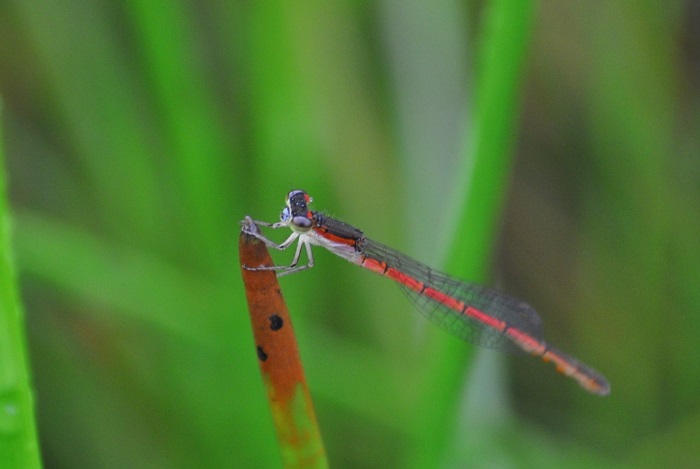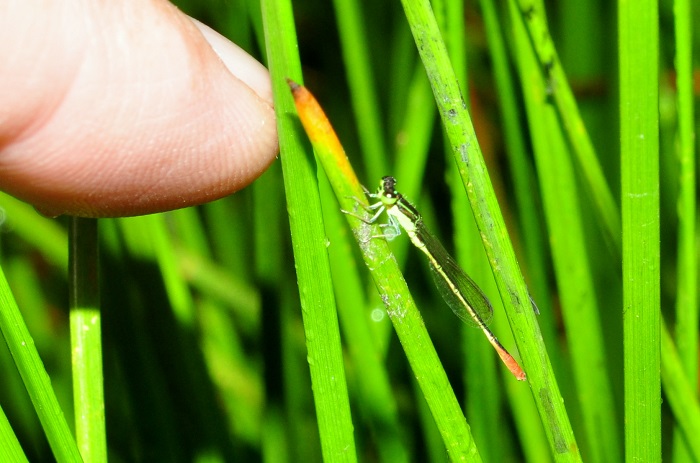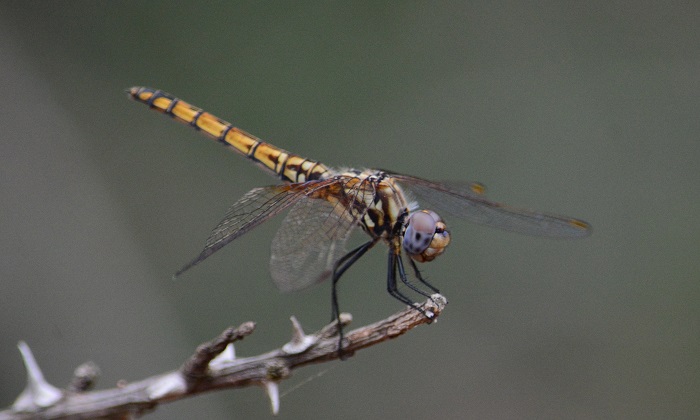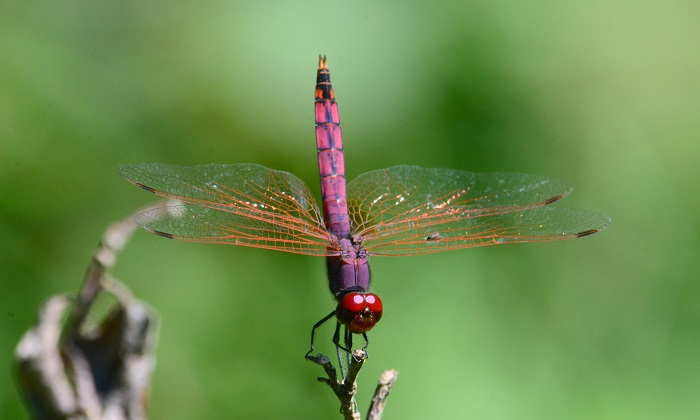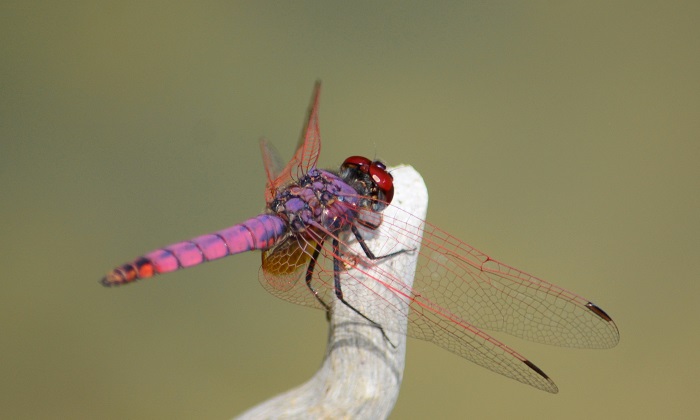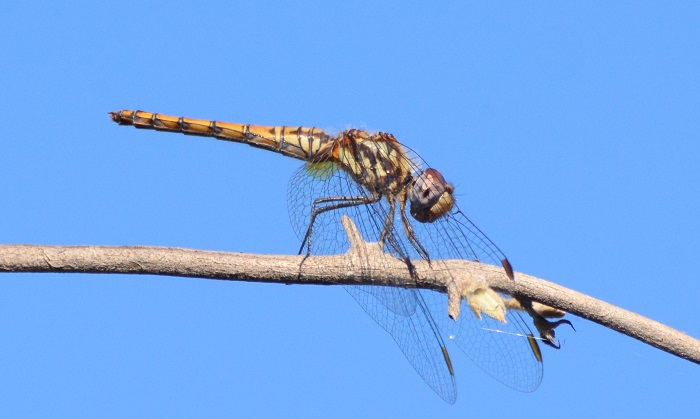
Pinhey’s Wisp (Agriocnemis pinheyi)

Cover photo by Gert Bensch.

Find Pinhey’s Wisp in the FBIS database (Freshwater Biodiversity Information System) here.

Family Coenagrionidae

Identification

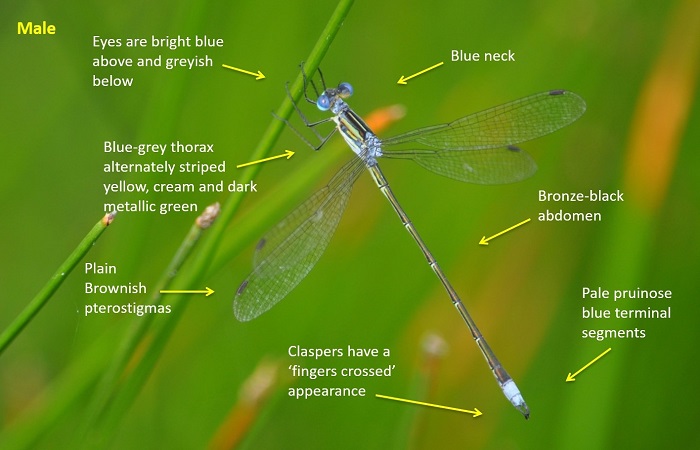
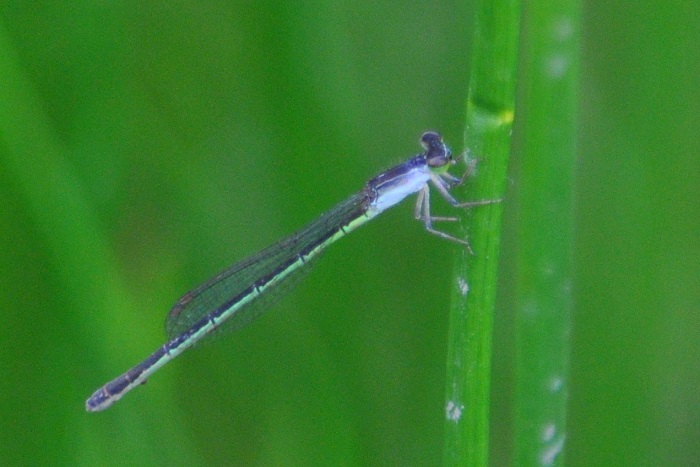
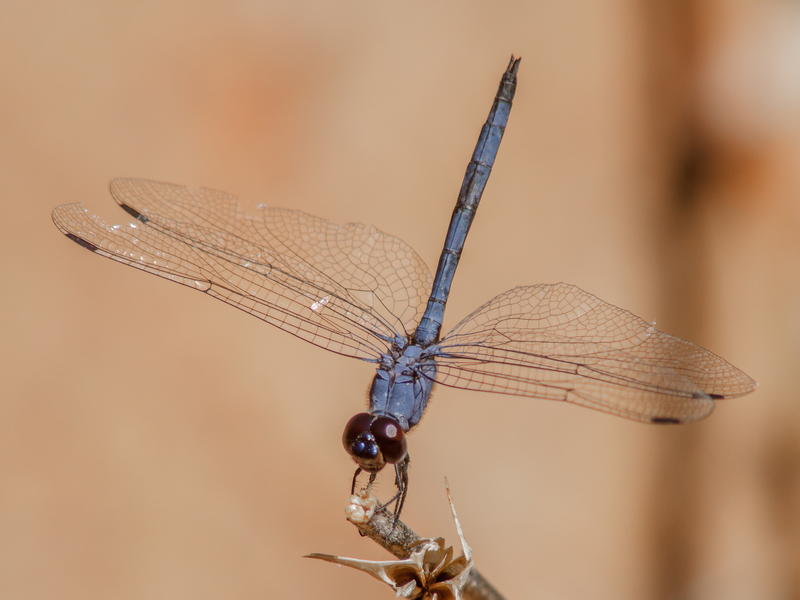
Pinhey’s Wisp Agriocnemis pinheyi – Male
Near Underberg, KwaZulu-Natal
Photo by Ryan Tippett

Very small size

Length up to 21mm; Wingspan attains 26mm.

Pinhey’s Wisp is most like Agriocnemis exilis (Little Wisp). They are similar in size and are, in fact, the two smallest damselflies in the region. Pinhey’s Wisp has an unbroken green line across the face and an incomplete green line across the prothorax. The Little Wisp shows the exact opposite, having a broken green moustache and an unbroken green line on the prothorax.

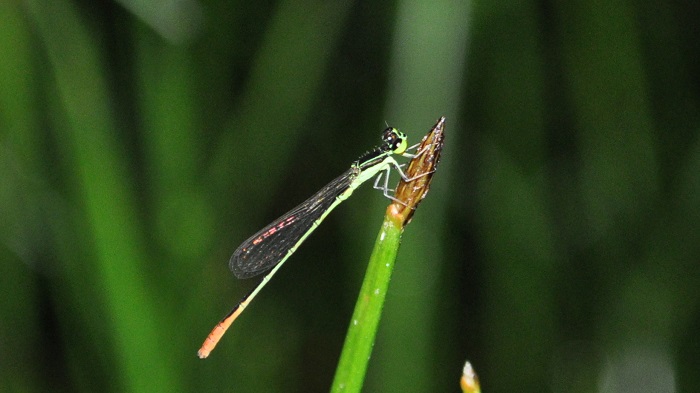
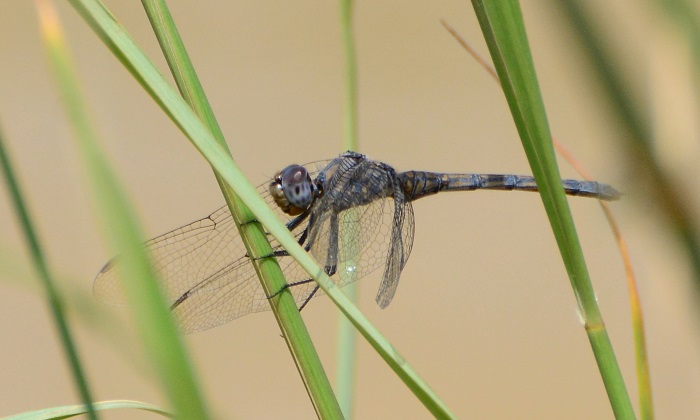
Females are variable and best told by their association with the males.

Click here for more details on identification.

Pinhey’s Wisp Agriocnemis pinheyi – Female
Near Underberg, KwaZulu-Natal
Photo by Ryan Tippett

Habitat

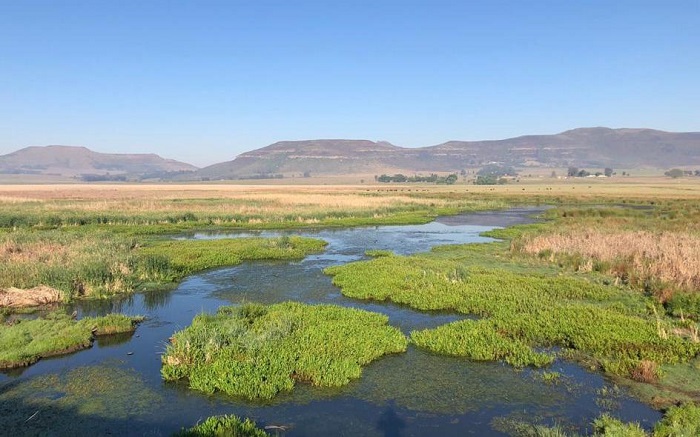
Pinhey’s Wisp inhabits the dense grass and sedge margins of pools, dams, seeps, and marshes, as well as the fringes of slow-moving streams. It is found at a fairly high altitude, from 1200m to 1600m above sea level.

Habitat – Middelburg, Mpumalanga
Photo by Andries De Vries

Behaviour

Pinhey’s Wisp usually perches vertically on a sedge or grass stem. It typically sits low down, close to the water, among vegetation, where it is unobtrusive and easily overlooked.

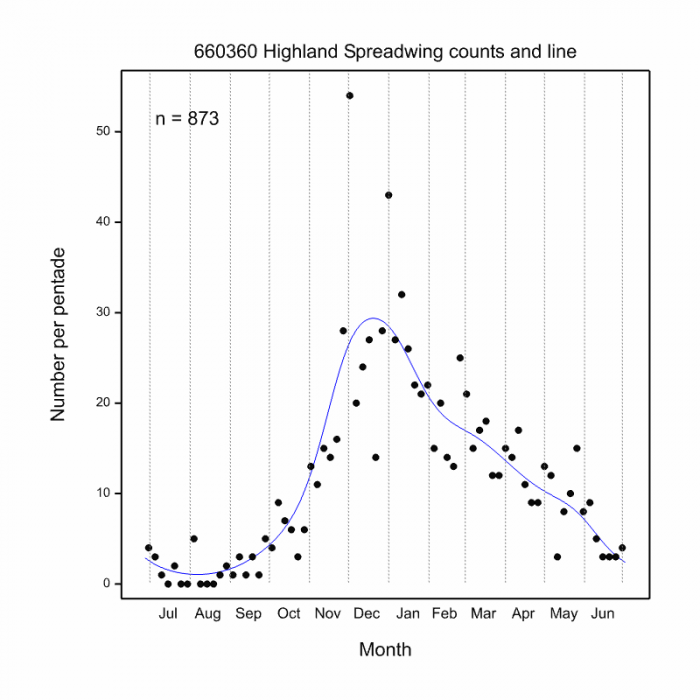
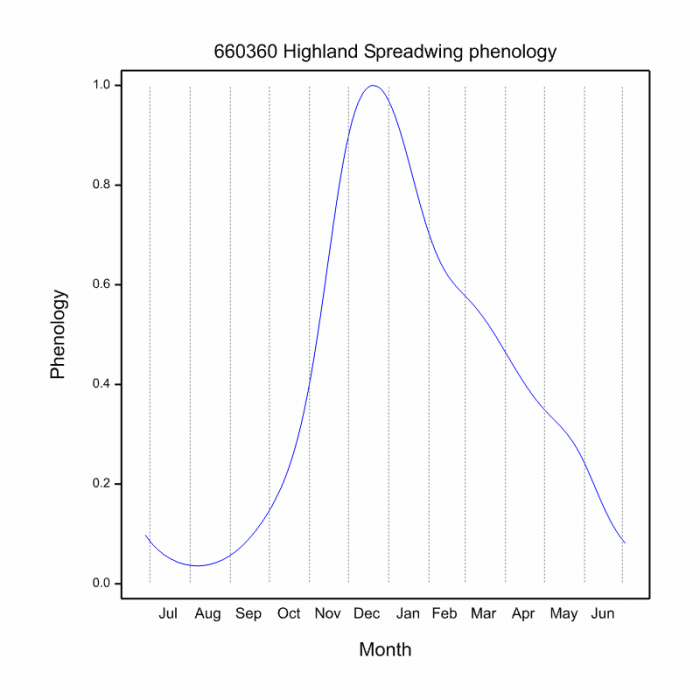
Pinhey’s Wisp is on the wing from October to April (See Phenology below).

Pinhey’s Wisp Agriocnemis pinheyi – An aged female
Near Underberg, KwaZulu-Natal
Photo by Ryan Tippett

Status and Conservation

Pinhey’s Wisp is fairly common but localised. It is listed as of Least Concern in the IUCN Red List of Threatened Species.

Distribution

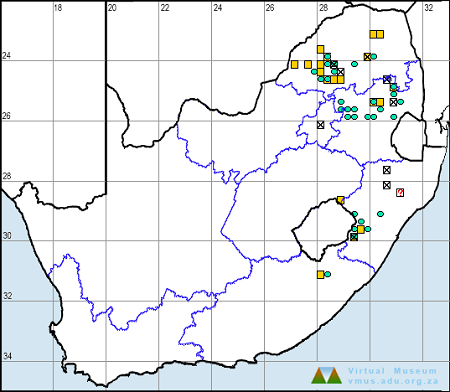
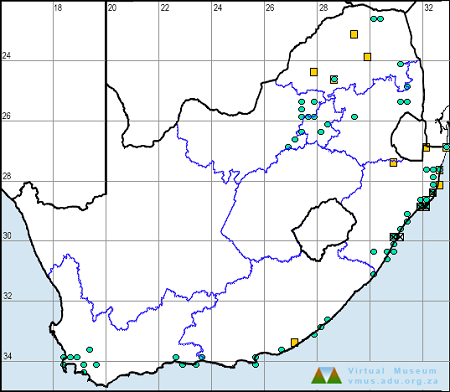
Pinhey’s Wisp occurs in southern, central, and eastern Africa. In South Africa, it is found inland, in the eastern parts of the country, from the Eastern Cape up to Limpopo.

Pinhey’s Wisp Agriocnemis pinheyi – Male
Near Underberg, KwaZulu-Natal
Photo by Ryan Tippett

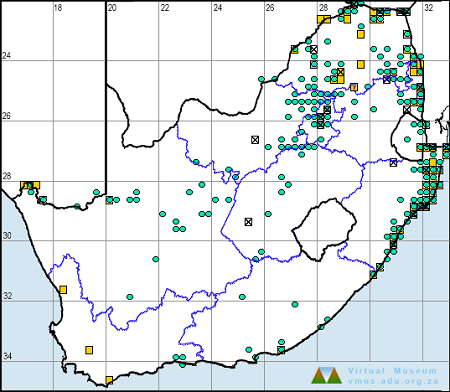
Below is a map showing the distribution of records for Pinhey’s Wisp in the OdonataMAP database as at February 2020.
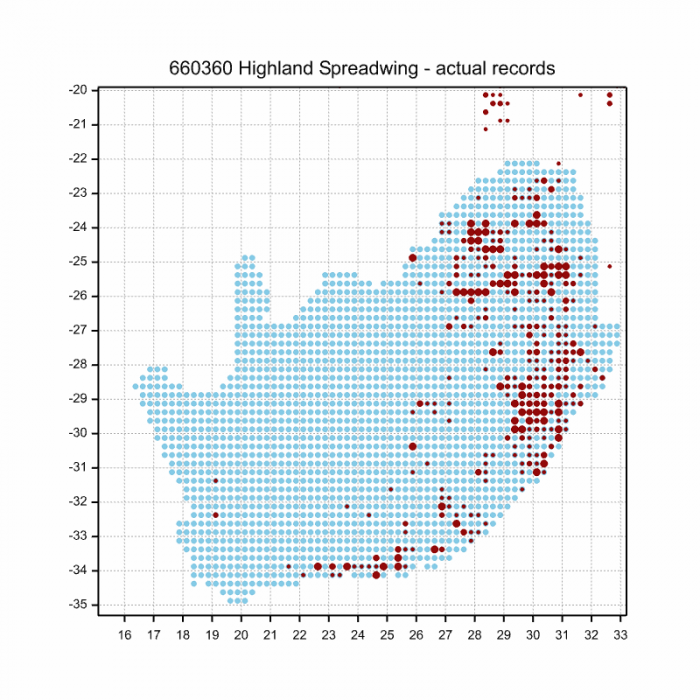
Below is a map showing the distribution of records for Pinhey’s Wisp in the OdonataMAP database as of December 2024.

The next map below is an imputed map, produced by an interpolation algorithm, which attempts to generate a full distribution map from the partial information in the map above. This map will be improved by the submission of records to the OdonataMAP section of the Virtual Museum.
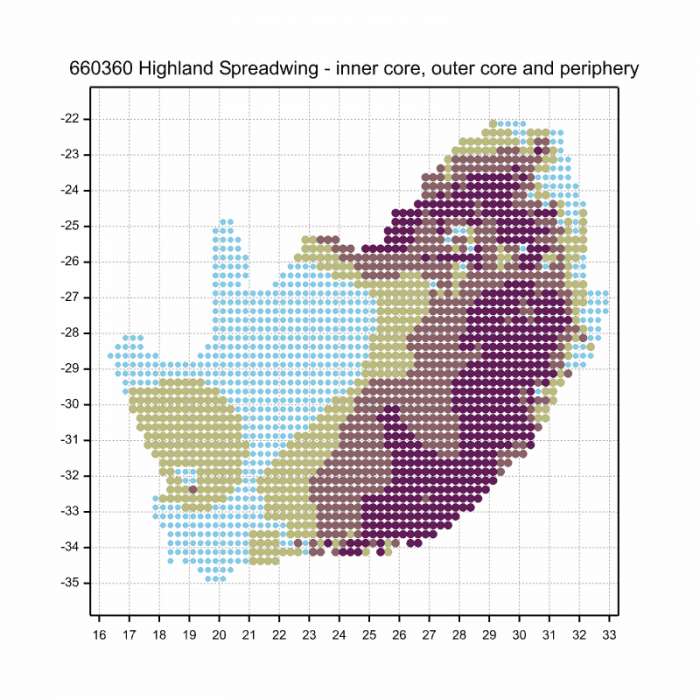
Ultimately, we will produce a series of maps for all the odonata species in the region. The current algorithm is a new algorithm. The objective is mainly to produce “smoothed” maps that could go into a field guide for odonata. This basic version of the algorithm (as mapped above) does not make use of “explanatory variables” (e.g. altitude, terrain roughness, presence of freshwater — we will be producing maps that take these variables into account soon). Currently, it only makes use of the OdonataMAP records for the species being mapped, as well as all the other records of all other species. The basic maps are “optimistic” and will generally show ranges to be larger than what they probably are.

These maps use the data in the OdonataMAP section of the Virtual Museum, and also the database assembled by the previous JRS funded project, which was led by Professor Michael Samways and Dr KD Dijkstra.

Phenology

Pinhey’s Wisp Agriocnemis pinheyi – Male
Near Underberg, KwaZulu-Natal
Photo by Ryan Tippett

Further Resources

The use of photographs by Andries De Vries and Gert Bensch is acknowledged. Other photographs by Ryan Tippett.

Pinhey’s Wisp Agriocnemis pinheyi Balinsky, 1963

Other common names: Pinhey-soetjie (Afrikaans)

Recommended citation format: Loftie-Eaton M; Navarro R; Tippett RM; Underhill L. 2025. Pinhey’s Wisp Agriocnemis pinheyi. Biodiversity and Development Institute. Available online at https://thebdi.org/2020/05/08/pinheys-wisp-agriocnemis-pinheyi/

References: Tarboton, M; Tarboton, W. (2019). A Guide to the Dragonflies & Damselflies of South Africa. Struik Nature.

Samways, MJ. (2008). Dragonflies and Damselflies of South Africa. Pensoft

Samways, MJ. (2016). Manual of Freshwater Assessment for South Africa: Dragonfly Biotic Index. Suricata 2. South African National Biodiversity Institute, Pretoria

Similar Species

Denim Dropwing (Trithemis donaldsoni)

Cover photo by John Wilkinson).

Find the Denim Dropwing in the FBIS database (Freshwater Biodiversity Information System) here.

Family Libellulidae

Identification

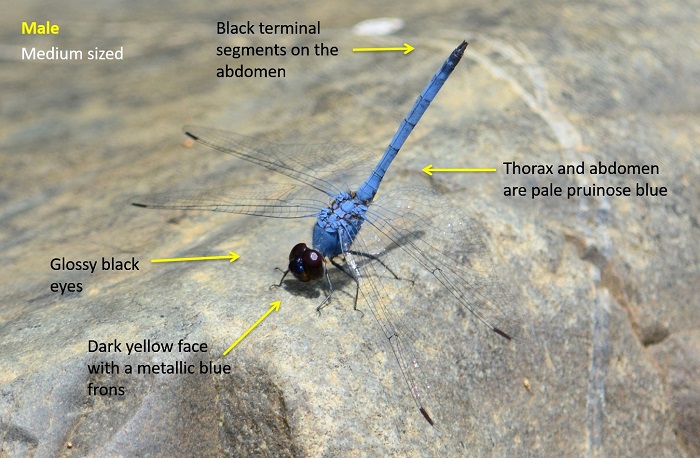
Trithemis donaldsoni – Male
Mkuze River, KwaZulu-Natal
Photo by Ryan Tippett

Medium-sized

Length up to 44mm; Wingspan reaches 71mm.

Male Denim Dropwings are recognisable by the uniformly pale blue body colouration and contrasting dark head and eyes. The black terminal segments on the abdomen are also a useful aid in identification.

Males could be confused with several other all-blue dragonflies, such as Skimmers (Orthetrum spp.) and the other blue dropwings (Trithemis spp.).

The Denim Dropwing is most similar to the Navy Dropwing (Trithemis furva), Highland Dropwing (Trithemis dorsalis), Silhouette Dropwing (Trithemis hecate) and Halfshade Dropwing (Trithemis aconita). The Denim dropwing can be told apart by its slightly larger size, paler blue colouration, contrasting black eyes, and black terminal tail segments.

Click here for more details on identification of the Denim Dropwing.

Trithemis donaldsoni – Female
Mkuze River, KwaZulu-Natal
Photo by Ryan Tippett

Habitat

The Denim Dropwing inhabits shallow, rocky, and fast-flowing rivers, mostly in hot savanna regions. It requires rocks in or near the mid-stream for perching on. Denim Dropwing males are seldom found away from such sites. Females are generally found some distance from water in the surrounding woodland.

Habitat – Mkuze River, KwaZulu-Natal
Photo by Ryan Tippett

Behaviour

Males perch close to the water on rocks, mostly where there is fast-flowing and turbulent water. The Denim Dropwing will occasionally also sit on plant stems over the water. They are alert and can be difficult to approach. Females are seldom encountered.

Trithemis donaldsoni – Male
Gamka River, Western Cape
Photo by Ryan Tippett

Status and Conservation

The Denim Dropwing is localised and generally scarce, but is listed as of Least Concern in the IUCN Red List of Threatened Species. Due to its habitat choice Trithemis donaldsoni does not make use of man-made habitats.

Trithemis donaldsoni – Young Male
Mkuze River, KwaZulu-Natal
Photo by Ryan Tippett

Distribution

The Denim Dropwing is widely distributed in Southern and East Africa, ranging from South
Africa up to Kenya and Uganda. Also occurs in northern and eastern Botswana and across to northern Namibia and Angola.

In South Africa, the Denim Dropwing is mostly found in the north and east where it is recorded from the Limpopo, North-West, Gauteng, Mpumalanga, and KwaZulu-Natal provinces. It is also present along the length of the Orange River where it may have previously been overlooked. The Denim Dropwing has also been recorded at a few sites in the Western and Eastern Cape where it may also have been overlooked in the past.

Below is a map showing the distribution of records for Denim Dropwing in the OdonataMAP database as at February 2020.

Below is a map showing the distribution of records for Denim Dropwing in the OdonataMAP database as of December 2024.

The next map below is an imputed map, produced by an interpolation algorithm, which attempts to generate a full distribution map from the partial information in the map above. This map will be improved by the submission of records to the OdonataMAP section of the Virtual Museum.

Ultimately, we will produce a series of maps for all the odonata species in the region. The current algorithm is a new algorithm. The objective is mainly to produce “smoothed” maps that could go into a field guide for odonata. This basic version of the algorithm (as mapped above) does not make use of “explanatory variables” (e.g. altitude, terrain roughness, presence of freshwater — we will be producing maps that take these variables into account soon). Currently, it only makes use of the OdonataMAP records for the species being mapped, as well as all the other records of all other species. The basic maps are “optimistic” and will generally show ranges to be larger than what they probably are.

These maps use the data in the OdonataMAP section of the Virtual Museum, and also the database assembled by the previous JRS funded project, which was led by Professor Michael Samways and Dr KD Dijkstra.

Trithemis donaldsoni – Male and female
Mkuze River, KwaZulu-Natal
Photo by Ryan Tippett

Further Resources

The use of photographs by Alan Manson is acknowledged. All other photographs by Ryan Tippett.

Denim Dropwing Trithenis donaldsoni (Calvert, 1899)

Other common names: Denimvalvlerkie (Afrikaans)

Recommended citation format: Loftie-Eaton M; Navarro R; Tippett RM; Underhill L. 2025. Denim Dropwing Trithenis donaldsoni. Biodiversity and Development Institute. Available online at https://thebdi.org/2020/05/08/denim-dropwing-trithemis-donaldsoni/

References: Tarboton, M; Tarboton, W. (2019). A Guide to the Dragonflies & Damselflies of South Africa. Struik Nature.

Samways, MJ. (2008). Dragonflies and Damselflies of South Africa. Pensoft

Samways, MJ. (2016). Manual of Freshwater Assessment for South Africa: Dragonfly Biotic Index. Suricata 2. South African National Biodiversity Institute, Pretoria

Martens, A; Suhling, F. (2007). Dragonflies and Damselflies of Namibia. Gamsberg Macmillan.

Trithemis donaldsoni – Male
Mkuze River, KwaZulu-Natal
Photo by Ryan Tippett

Similar Species

Highland Dropwing (Trithemis dorsalis)

The photo above (by Alan Manson) can be viewed in OdonataMAP here.

Find this species in the FBIS database (Freshwater Biodiversity Information System) here.

Family Libellulidae

Identification

Highland Dropwing Trithemis dorsalis – Male
Elands River, KwaZulu-Natal
Photo by Ryan Tippett

Small to medium size

Length up to 40mm; Wingspan attains 65mm.

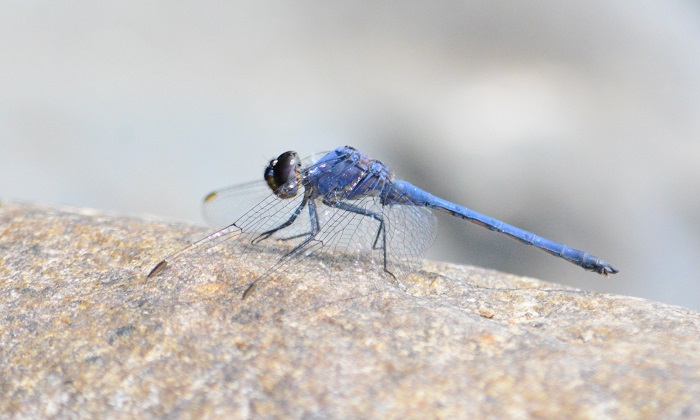
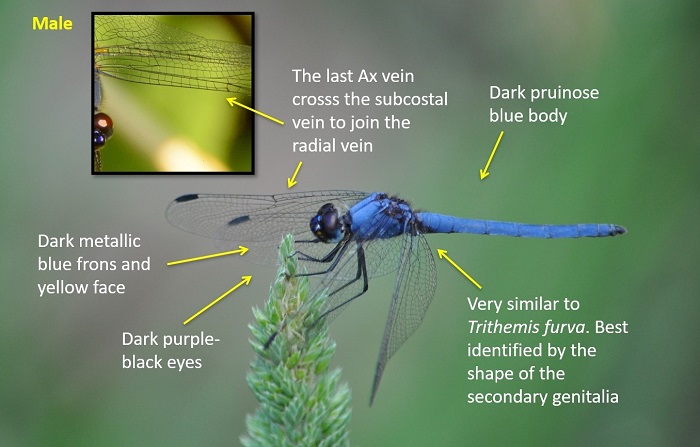
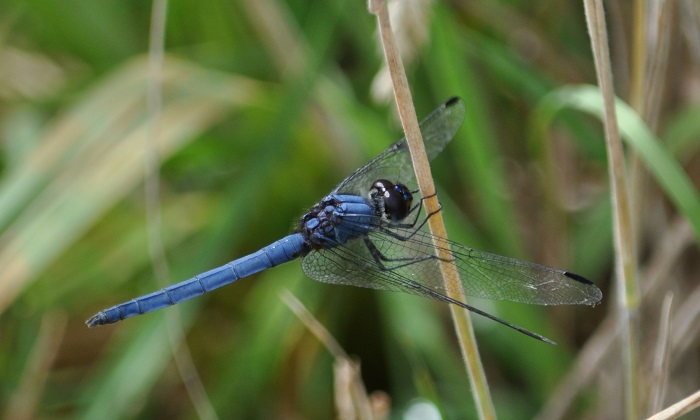
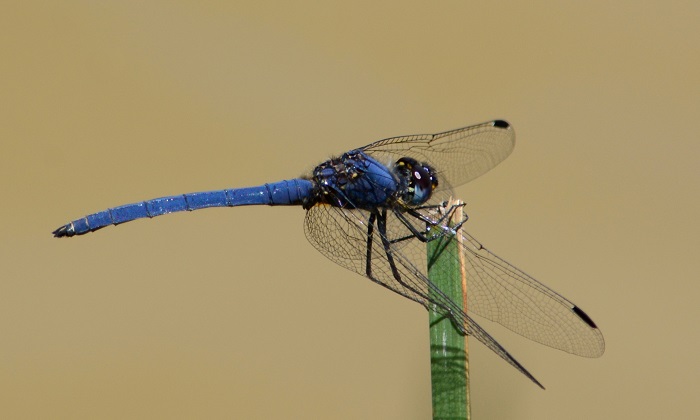
The Highland Dropwing is most likely to be confused with the very similar Navy Dropwing (Trithemis furva). Males of the two are best identified in the hand by examining the shape of the secondary genitalia. The males can also (mostly) be told apart by checking the last Ax vein in the front wings. In Trithemis furva the last Ax vein extends as far as the subcostal vein and does not reach the radial vein. Trithemis dorsalis shows Ax veins that cross the subcostal vein to meet up with the radial vein.

In addition, the two species can be tentatively identified based on their preferred habitat choice. Although they co-occur at many sites, the Highland Dropwing is far more numerous than the navy dropwing at higher altitudes.

The Denim Dropwing (Trithemis donaldsoni) is also similar but is larger and distinctly paler in colour.

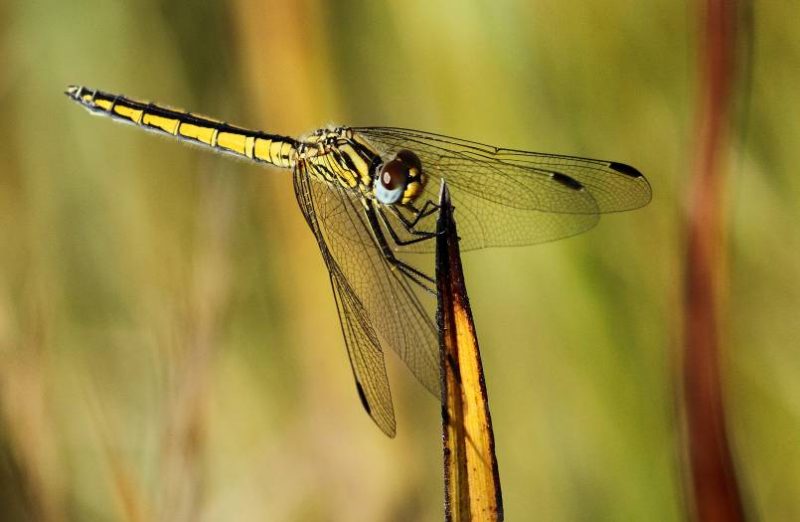
The Female Highland Dropwing is readily identified by the narrow, wavy black stripes on the sides of the thorax.

Click here for more details on identification of the Highland Dropwing.

Highland Dropwing Trithemis dorsalis – Female
Lake Naverone, KwaZulu-Natal
Photo by Ryan Tippett

Habitat

The Highland Dropwing inhabits the fringes of rivers, streams and dams. It prefers slow moving sections of rivers and is far less regular along fast flowing stretches. Highland Dropwings are common along the vegetated fringes of dams that are lined with reeds, grasses, and sedges.

Habitat – Wakkerstroom, Mpumalanga
Photo by Rowan Poortier

Behaviour

The Highland Dropwing is a conspicuous species that perches openly on emergent or fringing vegetation. At rest, it sits with its wings drooped downwards in typical ‘dropwing’ fashion. The Highland Dropwing is most common above 700m above sea level, but is regular at lower altitudes in the Western Cape.

The Highland Dropwing is on the wing from October to May.

Highland Dropwing Trithemis dorsalis – Male
Lake Naverone, KwaZulu-Natal
Photo by Ryan Tippett

Status and Conservation

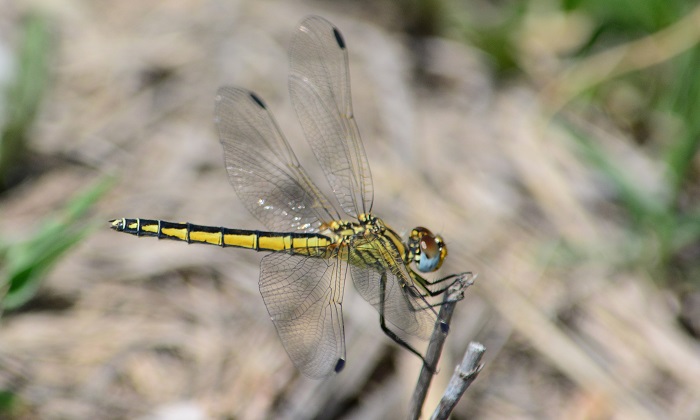
In South Africa, the Highland Dropwing is common, particularly in higher-altitude areas. It is listed as of Least Concern in the IUCN Red List of Threatened Species. The Highland Dropwing readily makes use of man-made and degraded habitats.

Highland Dropwing Trithemis dorsalis – Female
Gifberg, Western Cape
Photo by Ryan Tippett

Distribution

The Highland Dropwing is locally distributed across the highland regions of eastern and southern Africa. It is found in Angola, the Democratic Republic of the Congo, Guinea, Kenya, Mozambique, Sierra Leone, South Africa, Tanzania, Uganda, Zambia, Zimbabwe, and possibly also Burundi and Malawi.

In South Africa Trithemis dorsalis is predominantly a species of the Drakensberg and Highveld, but is widespread in mid to high altitude regions, from the south-western Cape to northern Limpopo.

Highland Dropwing Trithemis dorsalis – Male
Seweweekspoort, Western Cape
Photo by Ryan Tippett

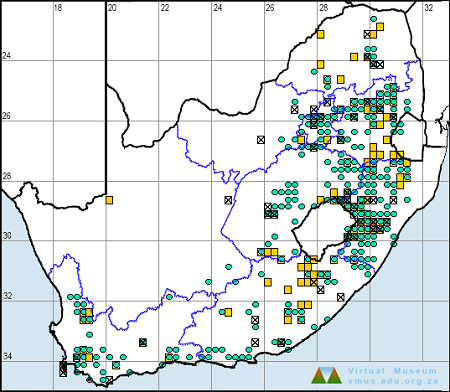
Below is a map showing the distribution of records for Highland Dropwing in the OdonataMAP database as at February 2020.

Below is a map showing the distribution of records for Highland Dropwing in the OdonataMAP database as of December 2024.

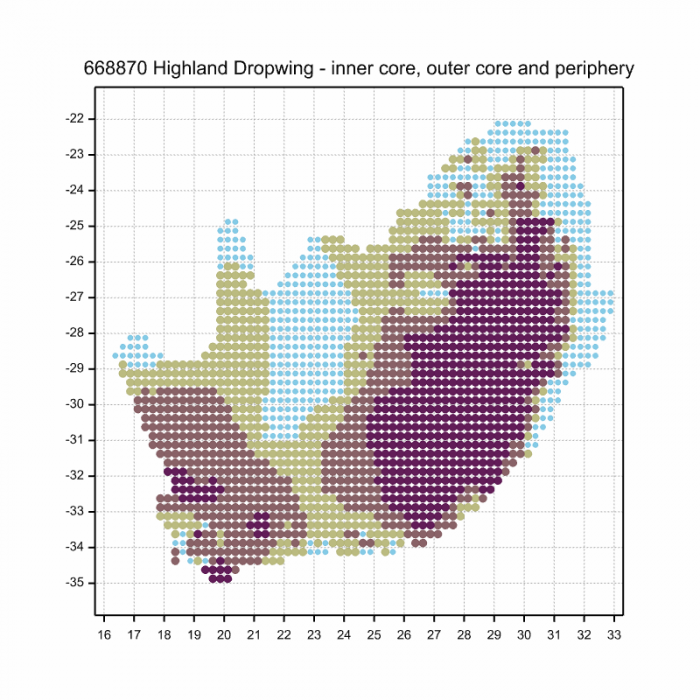
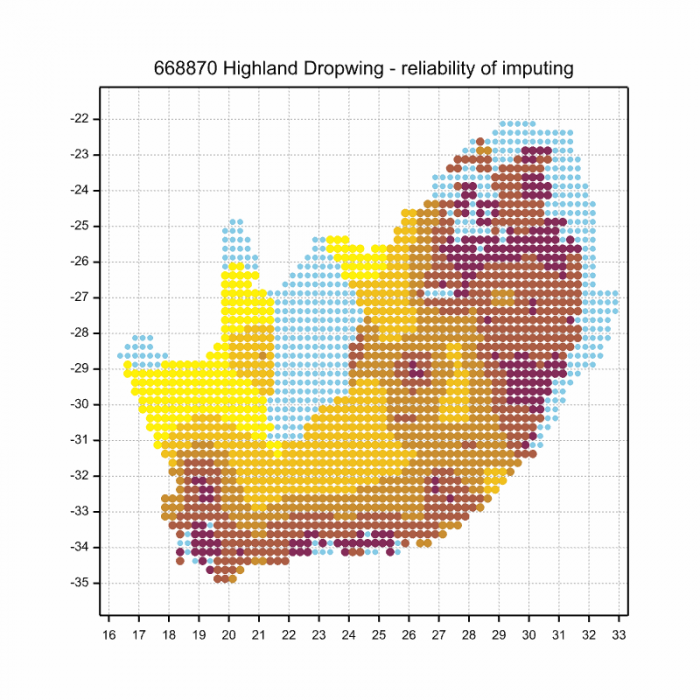
The next map below is an imputed map, produced by an interpolation algorithm, which attempts to generate a full distribution map from the partial information in the map above. This map will be improved by the submission of records to the OdonataMAP section of the Virtual Museum.

Ultimately, we will produce a series of maps for all the odonata species in the region. The current algorithm is a new algorithm. The objective is mainly to produce “smoothed” maps that could go into a field guide for odonata. This basic version of the algorithm (as mapped above) does not make use of “explanatory variables” (e.g. altitude, terrain roughness, presence of freshwater — we will be producing maps that take these variables into account soon). Currently, it only makes use of the OdonataMAP records for the species being mapped, as well as all the other records of all other species. The basic maps are “optimistic” and will generally show ranges to be larger than what they probably are.

These maps use the data in the OdonataMAP section of the Virtual Museum, and also the database assembled by the previous JRS funded project, which was led by Professor Michael Samways and Dr KD Dijkstra.

Highland Dropwing Trithemis dorsalis – Female
Wilge River, Free State
Photo by Ryan Tippett

Further Resources

The use of photographs by Alan Manson and Rowan Poortier is acknowledged. All other photographs by Ryan Tippett.

Highland Dropwing Trithemis dorsalis (Rambur, 1842)

Other common names: Dorsal Dropwing (Alt. English); Hooglandvalvlerkie (Afrikaans

Recommended citation format: Loftie-Eaton M; Navarro R; Tippett RM; Underhill L. 2025. Highland Dropwing Trithemis dorsalis. Biodiversity and Development Institute. Available online at https://thebdi.org/2020/05/08/highland-dropwing-trithemis-dorsalis/

References: Tarboton, M; Tarboton, W. (2019). A Guide to the Dragonflies & Damselflies of South Africa. Struik Nature.

Samways, MJ. (2008). Dragonflies and Damselflies of South Africa. Pensoft

Samways, MJ. (2016). Manual of Freshwater Assessment for South Africa: Dragonfly Biotic Index. Suricata 2. South African National Biodiversity Institute, Pretoria

Martens, A; Suhling, F. (2007). Dragonflies and Damselflies of Namibia. Gamsberg Macmillan.

Highland Dropwing Trithemis dorsalis – Male
Wilge River, Free State
Photo by Ryan Tippett

Similar Species

Violet Dropwing (Trithemis annulata)

Cover photo by Neels Jackson.

Find this species in the FBIS database (Freshwater Biodiversity Information System) here.

Family Libellulidae

Identification

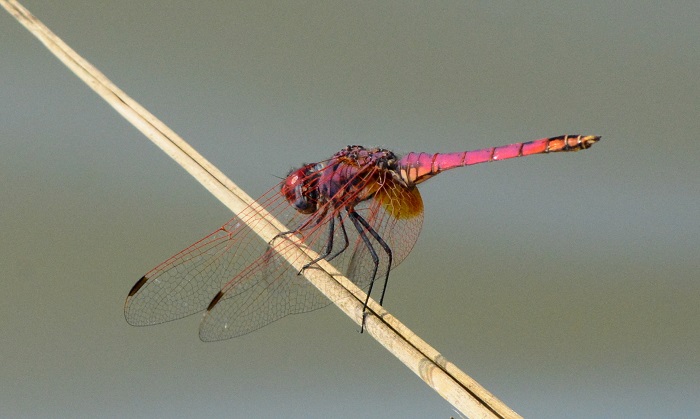
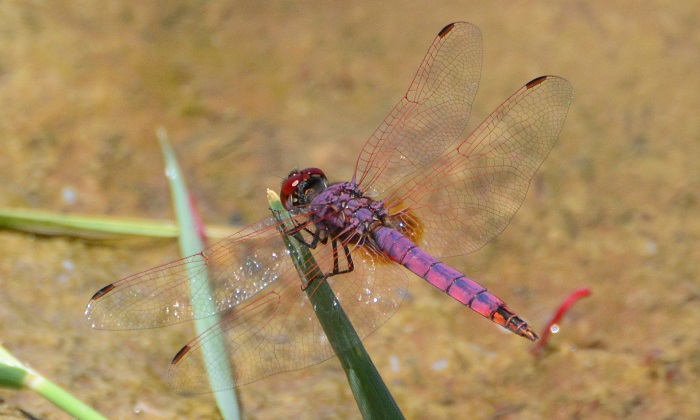
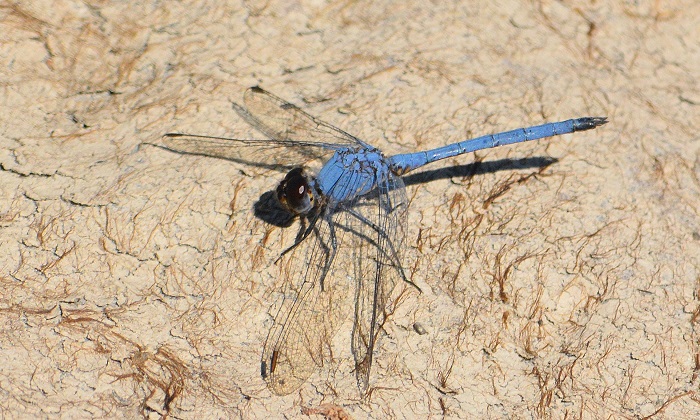
Violet Dropwing Trithemis annulata – Male
Near Hluhluwe, KwaZulu-Natal
Photo by Ryan Tippett

Small size

Length attains 38mm; Wingspan reaches 64mm.

Male Violet Dropwings are unmistakable, being brilliant violet-red with red veins in the wings. Violet Dropwing males could perhaps be confused with the male Red-veined Dropwing (Trithemis arteriosa). Red-veined Dropwings often show a violet hue on the thorax, but are distinctly red in overall colouration. The two can be further separated by the shape, colouration, and patterning of the abdomen.

Female Violet Dropwings are yellow and brown. They are distinguishable from other dropwings by the characteristic black markings on the last two abdominal segments.

Click here for more details on identification.

Violet Dropwing Trithemis annulata – Female
Near Hluhluwe, KwaZulu-Natal
Photo by Ryan Tippett

Habitat

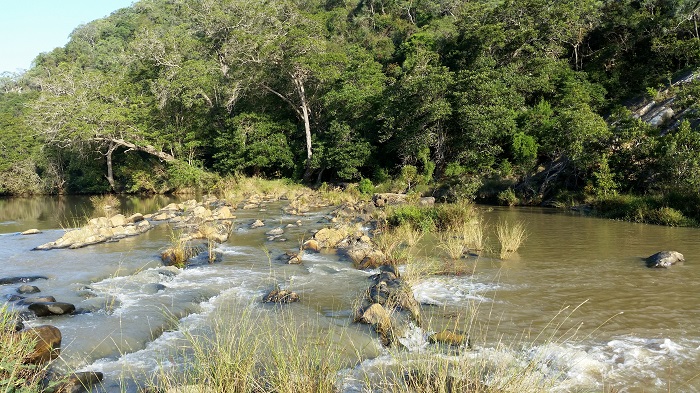
The Violet Dropwing inhabits a range of freshwater habitats, including lakes, marshes, ponds, dams, and rivers. It prefers still or slow-moving waters and is mostly found in the warmer savanna regions.

Habitat – Mkuze Game Reserve, KwaZulu-Natal
Photo by Ryan Tippett

Behaviour

Male Violet Dropwings are very conspicuous as they perch at prominent, exposed sites over the water. They often also sit on rocks closer to the ground. Like others in the genus, they received the common name of ‘dropwings’ because of their habit of immediately lowering their wings after landing on a perch. Females occupy the same areas as the males, but can also be found some distance from the water.

Violet Dropwing Trithemis annulata – Male
St. Lucia, KwaZulu-Natal
Photo by Ryan Tippett

Status and Conservation

The Violet Dropwing is a common and widespread species. It is listed as of Least Concern in the IUCN Red List of Threatened Species. The Violet Dropwing is a hardy and adaptable species. It readily makes use of man-made and somewhat degraded habitats.

Violet Dropwing Trithemis annulata – Male
Near Hluhluwe, KwaZulu-Natal
Photo by Ryan Tippett

Distribution

Trithemis annulata is found virtually throughout Africa and also occurs in the Middle East, the Arabian Peninsula, and southern Europe. The Violet Dropwing is widespread in South Africa. It is most common in the north and east, but scattered records exist over most of the country.

Violet Dropwing Trithemis annulata – Female
Linyanti, Botswana
Photo by Ryan Tippett
Below is a map showing the distribution of records for Violet Dropwing in the OdonataMAP database as at February 2020.

Below is a map showing the distribution of records for Violet Dropwing in the OdonataMAP database as of December 2024.

The next map below is an imputed map, produced by an interpolation algorithm, which attempts to generate a full distribution map from the partial information in the map above. This map will be improved by the submission of records to the OdonataMAP section of the Virtual Museum.

Ultimately, we will produce a series of maps for all the odonata species in the region. The current algorithm is a new algorithm. The objective is mainly to produce “smoothed” maps that could go into a field guide for odonata. This basic version of the algorithm (as mapped above) does not make use of “explanatory variables” (e.g. altitude, terrain roughness, presence of freshwater — we will be producing maps that take these variables into account soon). Currently, it only makes use of the OdonataMAP records for the species being mapped, as well as all the other records of all other species. The basic maps are “optimistic” and will generally show ranges to be larger than what they probably are.

These maps use the data in the OdonataMAP section of the Virtual Museum, and also the database assembled by the previous JRS funded project, which was led by Professor Michael Samways and Dr KD Dijkstra.

Violet Dropwing Trithemis annulata – Male
Near Hluhluwe, KwaZulu-Natal
Photo by Ryan Tippett
Further Resources

The use of photographs by Neels Jackson is acknowledged. Other photographs by Ryan Tippett.

Violet Dropwing Trithemis annulata (Palisot de Beauvois, 1807)

Other common names: Purpervalvlerkie (Afrikaans)

Recommended citation format: Loftie-Eaton M; Navarro R; Tippett RM; Underhill L. 2025. Violet Dropwing Trithemis annulata. Biodiversity and Development Institute. Available online at https://thebdi.org/2020/05/07/violet-dropwing-trithemis-annulata/

References: Tarboton, M; Tarboton, W. (2019). A Guide to the Dragonflies & Damselflies of South Africa. Struik Nature.

Samways, MJ. (2008). Dragonflies and Damselflies of South Africa. Pensoft

Samways, MJ. (2016). Manual of Freshwater Assessment for South Africa: Dragonfly Biotic Index. Suricata 2. South African National Biodiversity Institute, Pretoria

Martens, A; Suhling, F. (2007). Dragonflies and Damselflies of Namibia. Gamsberg Macmillan.

Violet Dropwing Trithemis annulata – Male
Orange River, Upington, Northern Cape
Photo by Ryan Tippett
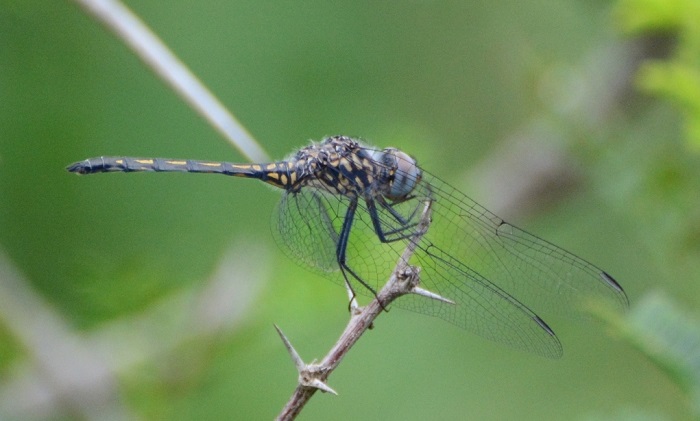
Similar Species

Rock Scarlet (Crocothemis divisa)

Cover photo by Bertie Brink.

Find this species in the FBIS database (Freshwater Biodiversity Information System) here.

Family Libellulidae

Identification

Rock Scarlet Crocothemis divisa – Male
Selous Game Reserve, Tanzania
Photo by Walter Jubber

Small Size

Length up to 39mm; Wingspan attains 68mm.

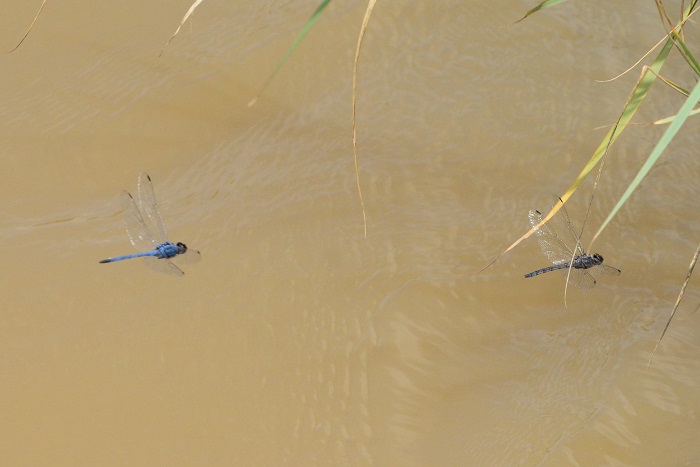
The Rock Scarlet most resembles the Little Scarlet (Crocothemis sanguinolenta). The Rock Scarlet can be told apart by lacking any amber in the wings, by its very long, red pterostigmas and by the plain brownish thorax with a red wash on top. The habitat choice of Crocothemis divisa is also diagnostic.

Click here for more details on identification.

Habitat

The Rock Scarlet inhabits rocky pools and streams in dry woodlands. The streams it frequents are typically flanked by large rock outcroppings.

Behaviour

The Rock Scarlet usually perches on the top and sides of rocks and boulders. It is generally alert and difficult to approach closely.

In South Africa, the Rock Scarlet has been recorded from September to June.

Status and Distribution

The Rock Scarlet is rare and erratic in South Africa. It is listed as of Least Concern in the IUCN Red List of Threatened Species. Most of the localities where the Rock Scarlet has been recorded in South Africa are in protected areas.

Distribution

The Rock Scarlet is widespread through much of tropical Sub-Saharan Africa and it also occurs in Madagascar.

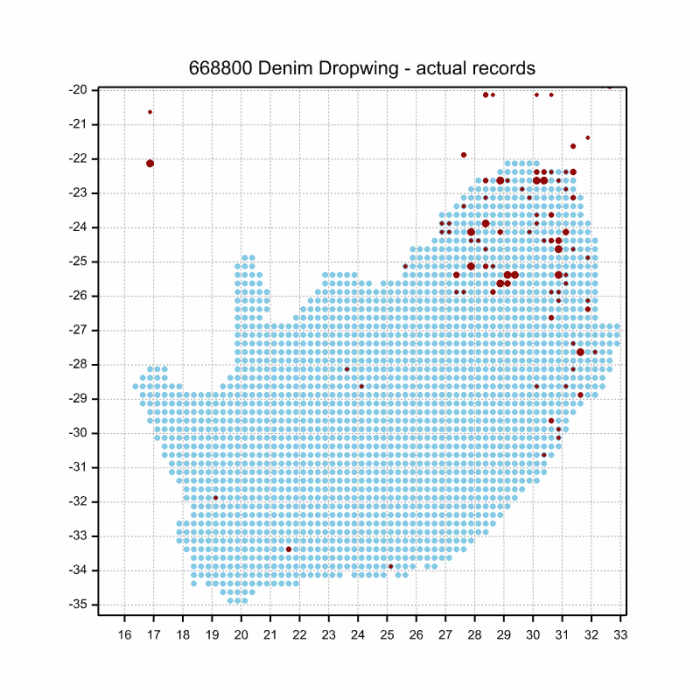
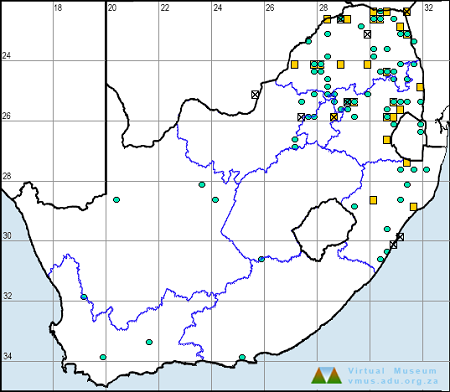
In South Africa, the Rock Scarlet is only known from a handful of sites on the Waterberg plateau in Limpopo and along the Blyde River on the boundary region between Mpumalanga and Limpopo. Recently the Rock Scarlet was also found to occur in the Northern Cape near the southern edge of the Kalahari (see the 2nd distribution map below).

Below is a map showing the distribution of records for Rock Scarlet in the OdonataMAP database as at February 2020.

Below is a map showing the distribution of records for Rock Scarlet in the OdonataMAP database as of December 2024.

The next map below is an imputed map, produced by an interpolation algorithm, which attempts to generate a full distribution map from the partial information in the map above. This map will be improved by the submission of records to the OdonataMAP section of the Virtual Museum.

Ultimately, we will produce a series of maps for all the odonata species in the region. The current algorithm is a new algorithm. The objective is mainly to produce “smoothed” maps that could go into a field guide for odonata. This basic version of the algorithm (as mapped above) does not make use of “explanatory variables” (e.g. altitude, terrain roughness, presence of freshwater — we will be producing maps that take these variables into account soon). Currently, it only makes use of the OdonataMAP records for the species being mapped, as well as all the other records of all other species. The basic maps are “optimistic” and will generally show ranges to be larger than what they probably are.

These maps use the data in the OdonataMAP section of the Virtual Museum, and also the database assembled by the previous JRS funded project, which was led by Professor Michael Samways and Dr KD Dijkstra.

Further Resources

The use of photographs by Bertie Brink and Walter Jubber is acknowledged.

Rock Scarlet Crocothemis divisa Baumann, 1898

Other common names: Divisa Scarlet (Alt. English);  Rotsblosie (Afrikaans)

Recommended citation format: Loftie-Eaton M; Navarro R; Tippett RM; Underhill L. 2025. Rock Scarlet Crocothemis divisa. Biodiversity and Development Institute. Available online at https://thebdi.org/2020/05/05/rock-scarlet-crocothemis-divisa/

References: Tarboton, M; Tarboton, W. (2019). A Guide to the Dragonflies & Damselflies of South Africa. Struik Nature.

Samways, MJ. (2008). Dragonflies and Damselflies of South Africa. Pensoft

Samways, MJ. (2016). Manual of Freshwater Assessment for South Africa: Dragonfly Biotic Index.Suricata 2. South African National Biodiversity Institute, Pretoria

Martens, A; Suhling, F. (2007). Dragonflies and Damselflies of Namibia. Gamsberg Macmillan.

Similar Species

Mozart moth: Variations on a theme

LepiMAP aims to atlas not only butterflies, but also moths. Which species of moth was recorded most frequently in LepiMAP during the lockdown period starting 27 March? The top species, with 37 records between 27 March and 3 April, was Achaea lienardi, with a proposed English common name of Lienard’s Achaea. This moth is special, because it challenges the concepts that most of us have about what constitutes a “species”.

Mozart moth Achaea lienardi from Kloof, KwaZulu-Natal
This is Mark Liptrot’s photograph of Achaea lienardi from Kloof in KwaZulu-Natal. It is LepiMAP Record 713458

This photograph was taken by Mark Liptrot at his home in Kloof, KwaZulu-Natal on 3 April. Here is another moth, identified to be the same species, this time from Lüderitz in Namibia, submitted by Jessica Kemper during the lockdown period. Compare this photo with the one above.

Mozart moth Achaea lienardi from Luderitz,  Namibia
This is Jesscia Kemper’s photograph of Achaea lienardi from Lüderitz in Namibia. It is LepiMAP Record 713178

If you look closely, there are some patterns which are the same for these two records. But the colour scheme is quite different. It is hard to believe they are the same species. It turns out that Achaea lienardi is desperately variable. There is a paper written almost a century ago (Jack 1922) which says that if you make a collection of 50 of these moths, scarcely two are alike. The little white markings on the trailing margin of the hindwing are a constant feature (but can be covered by the way the moth is sitting) and the shape of the postmedial line on the forewing is diagnostic. (To find a useful summary of the names of all the features on moths, look here.) The next picture is a collage of 18 photos of Achaea lienardi submitted during the lockdown.

A collage of 18 Mozart moths Achaea lienardi from southern Africa
A collage of 18 of the Achaea lienardi submitted during the lockdown. Their LepiMAP record numbers are 711711 713178 713458 713530 713531 713540 713539 713809 714034 714035 714111 714119 714365 714565 715673 715674 716051 and 716111

Gosh, these are all the same species! Those of us who depend on colour as the cue for identifications are lost; but the members of the moth expert panel quickly pick up the pattern of the forewing, and ignore the colours. What an awesome set of variations on a theme; this is the Mozart of moths. If the white dots at the trailing margin of the hindwing are not visible, then the hindwings are being covered by the forewings. Have another look at Mark Liptrot’s photo above; the forewings are partially covering the hindwings, and the little bit of the white dots at the bottom are just visible. Quartus Grobler, member of the LepiMAP expert panel who does a lot of the moth identifications says: “This is probably the most variable of all moths.”

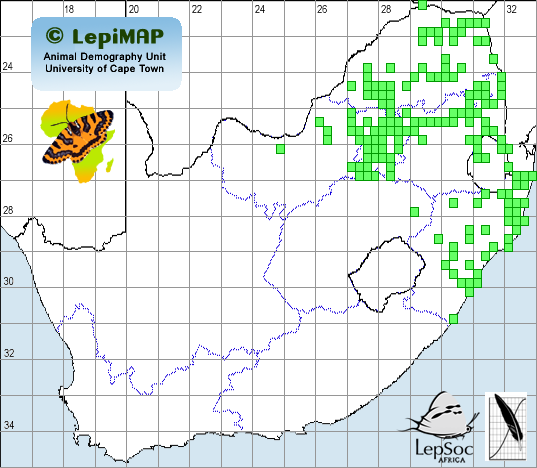
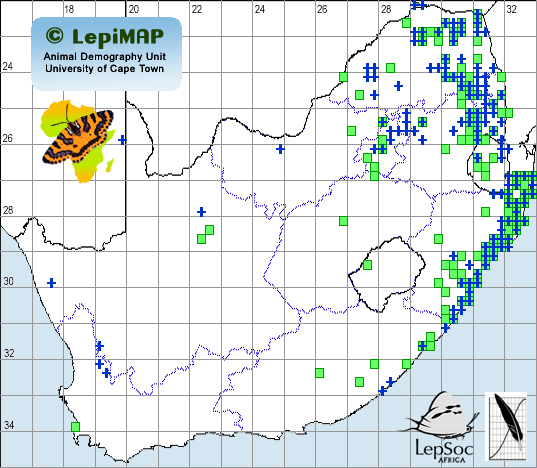
LepiMAP distribution map for Mozart moth Achaea lienardi
This is the LepiMAP distribution map for Achaea lienardi. It is based in 142 records from 100 quarter-degree grid cells in South Africa and eSwatini. Records up to 2019 are shown with green squares. Records made in 2020 have blue plus signs. Jessica Kemper’s record from Lüderitz is off the western edge of this map.

The distribution map shows that Achaea lienardi occurs mainly along the coastal region of the Eastern Cape, and northward into the Lowveld of eSwatini, Mpumalanga and Limpopo. The two “outlier” records in the Northern Cape and the Western Cape are not far from major citrus production regions along the Orange River and along the Olifants River (see the next paragraph). It also occurs in many parts of Africa south of the Sahara Desert. The abundance of this species varies hugely between years, and it seems to be particularly abundant in wet years. This is a species that is suspected of covering large distances in search of food. It needs energy-rich fuel to make these journeys!

This is one of the “fruit-feeding moths” and it is sometimes massively abundant in citrus orchards. There are two broad categories of fruit-feeding moths, “fruit-piercing moths” and “fruit-sucking moths”. This is a “fruit-sucking moth”; in other words it sucks the juice out of fruit which have already been compromised. The mouthparts of Achaea lienardi are too small and too weak to pierce the skin of an orange. As Hermann Staude puts it: “Their proboscis is simply not sharp and rigid enough to pierce the skin of fruit. Instead they, together with many other insects, exploit bleeding and over-ripe fruit for the sugar.” The initial damage is most frequently done by other insects, birds, tractors, etc, and sometimes the fruit simply splits as it grows. Therefore Achaea lienardi is not a moth that needs to be controlled at all in orchards. Even though this moth is nocturnal, it is often so abundant that it is the one encountered in orchards in the day time, so it is the one which takes the blame for crimes it did not commit!

Action box in banana yellow! May every LepiMAPper put a squashed banana in a saucer in their yard this evening. Let’s see what moths get attracted. Please upload them to LepiMAP. How to do this is here.

Thank you box. Hermann Staude and Quartus Grobler provided crucial information. And an especial thank you to all the LepiMAPpers who photographed and submitted records of moths from their homes.

“More reading” box! There are three more lockdown blogs:

1. Highlights of lockdown April for butterflies

2. BioMAPping at Home – Lock down on Biodiversity

3. Blue Sky Birds: BirdPixing blues: look up and see birds

To finish. Here are two earlier records of the “Mozart moth” Achaea lienardi, selected from the 192 records in total for the species in LepiMAP.

Mozart moth Achaea lienardi from Amanzimtoti, KwaZulu-Natal
This is Michael Purve’s photograph of a curled-up leaf. No wait, it is Achaea lienardi from Amanzimtoti in KwaZulu-Natal. This was the first record of the species to be submitted LepiMAP. It is Record 15896 and is dated 5 January 2011.
Mozart moth Achaea lienardi from Mwambwa Field Station, coast of Kenya
This is David Clarence’s photograph of Achaea lienardi from the Mwamba Field Centre, on the Kenyan coast. It is LepiMAP Record 646907 and is dated 30 April 2018.

LockdownApril: Highlights of BestMonthEver for LepiMAP

LepiMAP has had its BestMonthEver during the lockdown in April. That is amazing. We asked Fanie Rautenbach, the member of the expert panel who does almost all the formal identifications of butterflies to suggest records which he thought were especially interesting.

Fanie Rautenbach, LepiMAP identification panel, doing fieldwork
Fanie Rautenbach in LepiMAP action, furthest from the camera

In real life, Fanie is an organic chemist, a researcher at the Cape Peninsula University of Technology. His research area is the chemistry of rooibos tea, especially its health value as an antioxidant. Here’s an article in the Health SA, which you can download, and there is a whole bunch of “full-text available” papers in his profile on Researchgate. It is fascinating. But what we are celebrating now is the contribution Fanie has made to LepiMAP. He has done 88,189 identifications. He is also a big contributor to the Virtual Museum. Here he is on a trip to Robertson, where South Africa’s smallest butterfly, the Dwarf Blue Oraidium barberae was “refreshed” in this grid cell, last seen 142 years previously. We asked Fanie to select a few interesting records of butterflies submitted during Lockdown April.

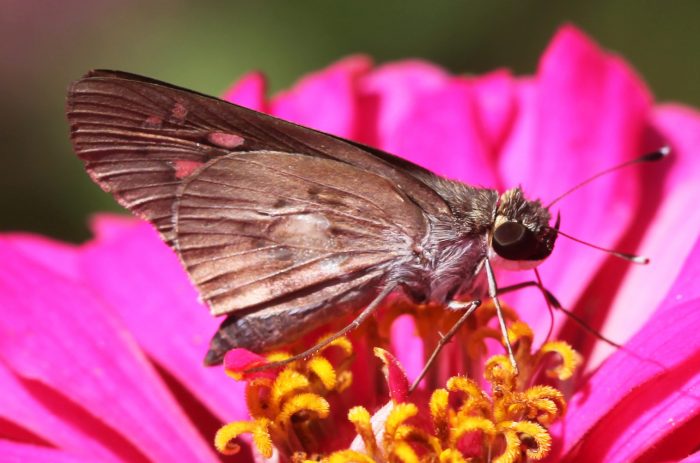
Two-pip Policeman butterfly Coeliades pisistratus in Kuruman
Two-pip Policeman Coeliades pisistratus LepiMAP record 715920 Altha Liebenberg, Kuruman, Northern Cape

There are 759 records of Two-pip Policeman in the Virtual Museum. So why did Fanie pick out this one? This is a species which has previously been confined, in South Africa, to the northeastern part of the country. It is primarily a savanna species and has a distribution which extends over Africa south of the Sahara Desert. Look at this map.

Distribution map of Two-pip Policeman, up to 2013
LepiMAP distribution map for the Two-pip Policeman Coeliades pisistratus made using all 539 records up to the end of 2013

This map is based on the 539 records, made from the beginning of museum time until 31 December 2013, of the Two-pip Policeman from South Africa, Lesotho and Swaziland. Most of the records are in the northeast. There are two grid cells which stick out as outliers; at Bloemfontein in the Free State and at Kimberley in the northern eastern corner of the Northern Cape. There are seven records, all museum specimens, five from Bloemfontein with dates between 1912 and 1934, and two Kimberley records with no dates. Mmmmmm! Early museum records were often just given the name of the nearest town or city. So let’s disregard all records made in the era of pounds, shillings and pence, and produce a map starting in 1960, and going through to 2013.

Distribution map of Two-pip Policeman 1960 to 2013
LepiMAP distribution map for the Two-pip Policeman Coeliades pisistratus made using 431 records made between the start of 1960 and the end of 2013

This 1960-2013 map, based on 431 records, looks more plausible than the previous one. The outliers have disappeared, and the “core” of the distribution has remained intact. It makes sense. It’s nice and clean. Now let’s add to this map the 198 records of Two-pipped Policeman made since January 2014. They are added with a blue plus sign. All these records were supported by photographs. Fanie seems to have a photographic memory for distribution maps, and when a record for a species is out of its normal range, he checks that the “nearest town” given by the uploader coincides with the coordinates.

Distribution map of Two-pip Policeman 1960-2013 and 2014-2020
LepiMAP distribution map for the Two-pip Policeman Coeliades pisistratus. 431 records with green squares were made between the start of 1960 and the end of 2013. 198 records made between the beginning of 2014 and April 2020 are shown with blue plus signs.

Gosh. The new map seems to resuscitate the problems of the first map. Only it’s worse. There are now four records that really stick out as outliers. But they have all been carefully checked and are genuine. In July 2014, Quartus Grobler made the astonishing discovery of Two-pip Policeman in East London (LepiMAP 549043). Altha Liebenberg has recorded it twice in Danielskuil (May 2016, 598285, and March 2017, 617341). Then, in January this year, Ryan Tippett recorded it just north of Carnarvon, the westernmost record (701775). To rub salt into the wound, Altha spent the lockdown period with family in Kuruman, and found a Two-pip Policeman in the garden on the last Sunday of the month, 26 April (715920).

Five out-of-range records of Two-pip Policeman
These are the five out-of-range records of Two-pip Policeman in LepiMAP. Do they indicate a tendency for vagrancy, or do they represent the start of a range expansion westwards?

Can these five records of Two-pip Policeman be dismissed as vagrants, individuals which moved far beyond the “normal” range? Or are they the only detections so far of a westward range expansion? We simply do not know. But we do know that we need a lot more LepiMAPpers on the ground in these sparsely populated parts of South Africa! And it would be really valuable if LepiMAPpers regularly refreshed species, even common species, throughout their ranges.

Thanks, Fanie, for picking a fascinating record to launch this blog.

But why on earth is a butterfly called a policeman? We put this question to Steve Woodhall. “In the old days, policemen patrolled on foot, and they followed a ‘beat’. This was a route through the area they were individually responsible for. They would check on things like houses they knew to be unoccupied, known lurking places for criminals, etc. And once they had completed their beat, they would return to the start and repeat it… again, and again, until their shift was finished. ‘Policeman’ butterflies do a similar thing. They patrol an area, visiting the same spots again and again, following a ‘beat’. Hence the name.” What a well thought through concept, a name based on behaviour. Thanks, Steve.

Fanie’s second choice is this butterfly submitted by Reinier Terblanche from his garden in Potchefstroom in North West Province. It is a Nomad Dart Andronymus neander neander.

Nomad Dart Andronymus neander neander from Potchefstroom
Reinier Terblanche submitted this Nomad Dart Andronymus neander neander from Potchefstroom. This record is LepiMAP 711626.

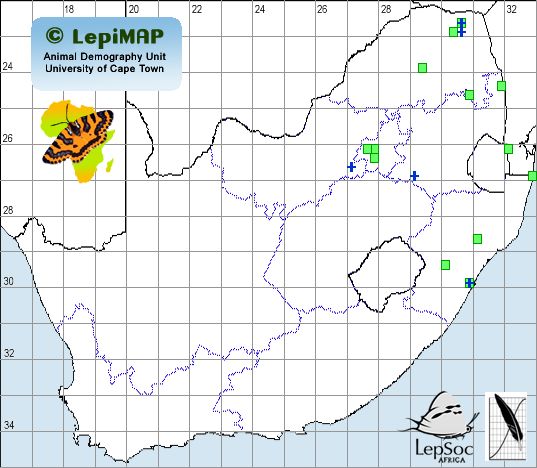
It is the third photographic record of this species in LepiMAP for South Africa. The first was made by Christopher Willis near Thohoyandou in Limpopo in March 2013 (record 28914), and the second was made in Standerton in Mpumalanga in March 2014 (record 45845). There are also photographic records for Zambia, Namibia, Malawi, Tanzania and Mozambique, and together with all the historical data there are a total of 55 records in the LepiMAP database. Here is the distribution map for South Africa, Lesotho and eSwatini.

Nomad Dart Andronymus neander neander distribution map
Distribution of Nomad Dart Andronymus neander neander based on LepiMAP records for South Africa, Lesotho and eSwatini since 1960. Records made between 1960 and 1999 have green squares (13 grid cells), and records from 1991 to April 2020 have blue plus signs (five grid cells).

The map shows that Reinier’s record is the first in North West Province. There does not appear to be certainty that the species actually breeds in this region. It breeds further north, from Zimbabwe to East Africa. The lepidopterists describe its status in South Africa as a “migrant”, but ornithologists would probably say “vagrant”. In countries like Tanzania there are records of Nomad Darts heading southwest in millions, just like in northern South Africa we see Pioneer Caper Whites (the new English common name for Brown-veined Whites) Belenois aurota heading northeast in millions. The shot gun pattern of records on this map is similar to the pattern for non-breeding bird species which overshoot their normal migration destinations and are recorded as vagrants in northern South Africa (eg Eurasian Blackcap Sylvia atricapilla, which normally migrates as far as East Africa). It does seem that the Nomad Darts arriving in South Africa are the lucky ones that survive to travel the farthest, and that Reinier’s dart was one of the luckiest of them all.

And Fanie’s third choice is a record of a species which is a bit of a puzzle. Zenobia van Dyk found this Common Evening Brown Melanitis leda in her garden at Bushmanskloof in the Cederberg northeast of Clanwilliam, where she is a senior guide. This is not the anticipated habitat for a species that is associated with leaf litter under trees in deep shade.

Common Evening Brown Melanitis lada at Bushmanskloof in the northern Cederberg
Zenobia van Dyk’s photo of a Common Evening Brown Melanitis leda at Bushmanskloof in the northern Cederberg, 29 April 2020 (LepiMAP 716380)

Fanie says: “Check out the distribution map for this species. It it usually found in the forest areas of South Africa (KwaZulu-Natal, Mpumalanga, Limpopo). However, every now and again one turns up in an unexpected place like Clanwilliam. Other strange locations are Nieuwoudtville, Komaggas and Kgalagadi Transfrontier Park. I have no explanation for this because it is not a migratory species.” So let’s go and check out the map.

LepiMAP distribution map for the Common Evening Brown Melanitis lada. Records since 1960 are shown. Records from 1960 to 2006 have green squares, and 2007 to April 2020 have blue plus signs.
LepiMAP distribution map for the Common Evening Brown Melanitis lada. Records since 1960 are shown. Records from 1960 to 2006 have green squares, and 2007 to April 2020 have blue plus signs. Zenobia van Dyk’s record is the northernmost of the cluster of three records on the border of the Northern Cape and Western Cape. The split at 2006/2007 was chosen because the two sets of records are nearly equal: 1960-2006 has 645 records and 2007-2020 has 633 records.

The map shows a well-behaved pattern in the moist areas where forested habitats occur. And then it has a badly-behaved pattern of isolated records, both for the period up to 2006 and for the period from 2007, scattered across the arid western half of this region. The scattered records are even more surprising because this species is a weak flyer. If it is disturbed it makes a short laboured flight before settling.

Reinier Terblanche, of Nomad Dart fame, has been researching butterflies for decades. In 2000, he co-authored a report on the butterflies of the Witsand Nature Reserve, near Posmasburg in the Northern Cape (go to Metamorphosis, and see pages 122-131). This is arid countryside. He and his co-author were astonished to find Common Evening Brown here. They wrote: “It is unlikely that Melanitis leda can be regarded as a migratory species, covering great distances to settle for a limited time at places far from its known distribution. It is more likely that Melanitis leda occurs at places with enough water or shade even in times of drought. Trees with enough shade are probably essential so that the [shade seeking] grasses the larvae feed on are sustained. The occurrence of Melanitis leda in the Witsand area can be indicative of the importance of available water in an area with erratic rainfall.” The Witsand Nature Reserve is an amazing place; there is permanent water, and a couple of hectares of quite thick woodland!

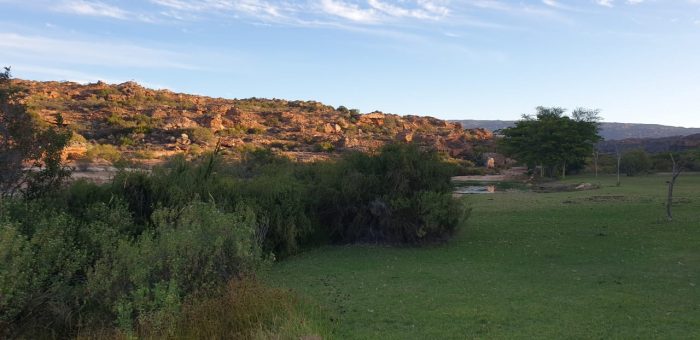
Garden at Bushmanskloof where Zenobia van Dyk recorded Common Bush Brown Melanitis leda
Part of the “oasis” at Bushmanskloof where Zenobia van Dyk recorded Common Bush Brown Melanitis leda on 29 April 2020

Likewise, at Bushmanskloof, Zenobia reports: “We have a couple of hectares of gardens and have a lot of trees. I found the butterfly late afternoon. It was not flying well, clearly at the end of its life. If you look at the photos the wings are old and broken.” Go to LepiMAP 716380 and look at the other photo uploaded by Zenobia.

The bottom line is that there are lots of butterfly distribution puzzles, and more records in LepiMAP will help solve them. I’ll give the last sentences of this blog to Reinier. In his paper, he was trying to find the words to put the discovery of Common Evening Brown into context. “The occurrence of Melanitis leda at places like Witsand will become much clearer when information on the distributions of Lepidoptera is available in atlas format” and “it is important to pay attention to distribution records of common and widespread species. Such distribution records might be vital keys in our understanding of butterflies as indicators for environmental management.” Thanks, Reinier, that underlines the importance and value of LepiMAP. We need to have BestMonthEver for LepiMAP repeatedly.

Thank you, Fanie Rautenbach, for the choice of records from LockdownApril. Thank you, Steve Woodhall (whose revised fieldguide to the butterflies has just been published) for the explanation of the name of “Policeman”. Thank, Zenobia van Dyk, for the extra photo. Thanks, Altha Liebenberg, for the idea of producing this blog.

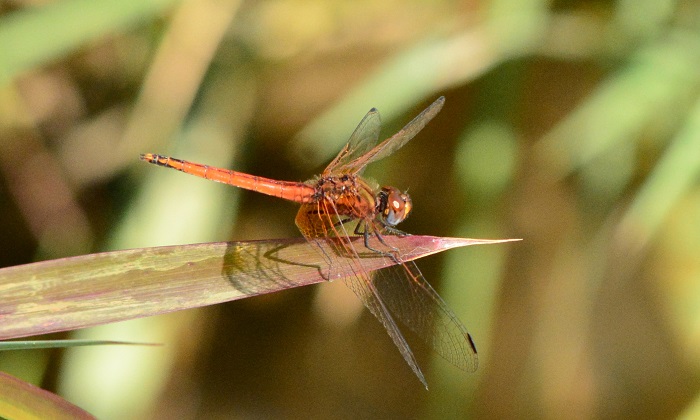
Evening Hawker (Anaciaeschna triangulifera)

Cover photo by Diana Russell.

Find the Evening Hawker in the FBIS database (Freshwater Biodiversity Information System) here.

Family Aeshnidae

Identification

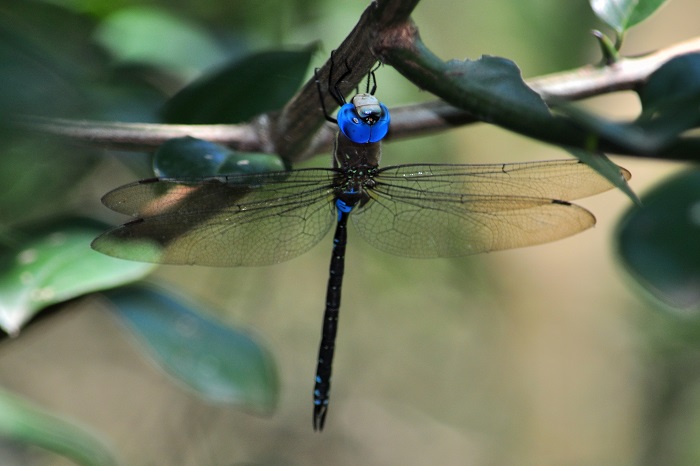
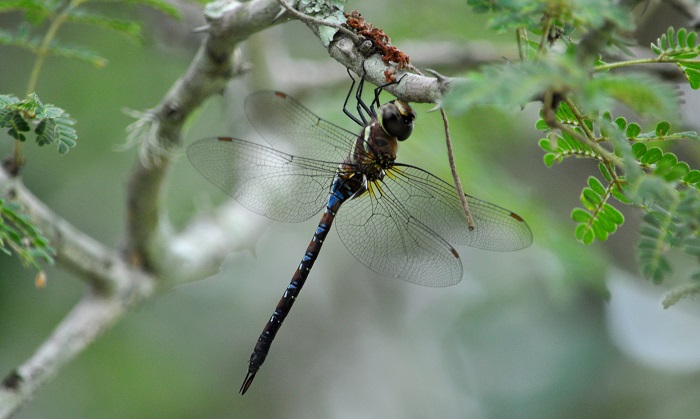
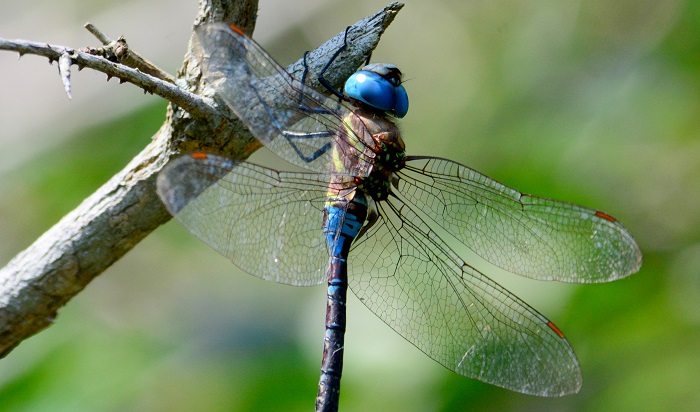
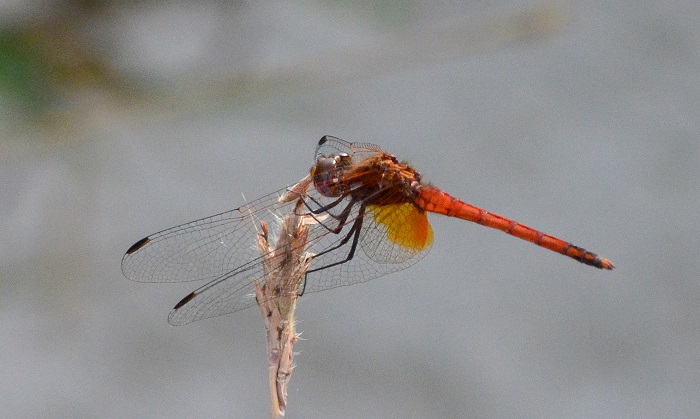
Evening Hawker Anaciaeschna triangulifera – Male
Enseleni Nature Reserve, KwaZulu-Natal
Photo by Ryan Tippett
Very large size

Length reaches 69mm; Wingspan attains 94mm.

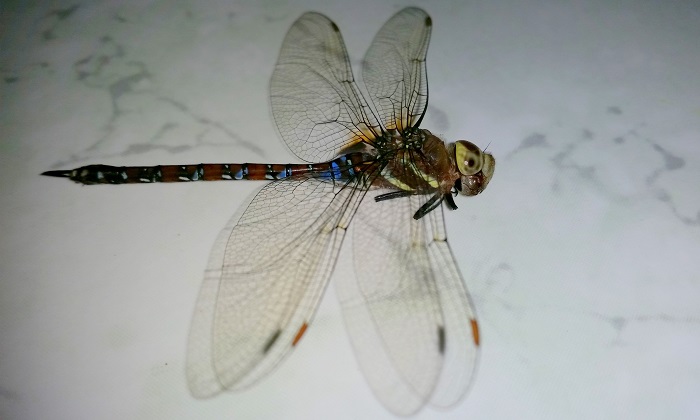
Adult males are unmistakable. The combination of brown thorax with a pair of diagonal lime-green stripes, brilliant blue eyes and large, bright blue saddle are diagnostic.

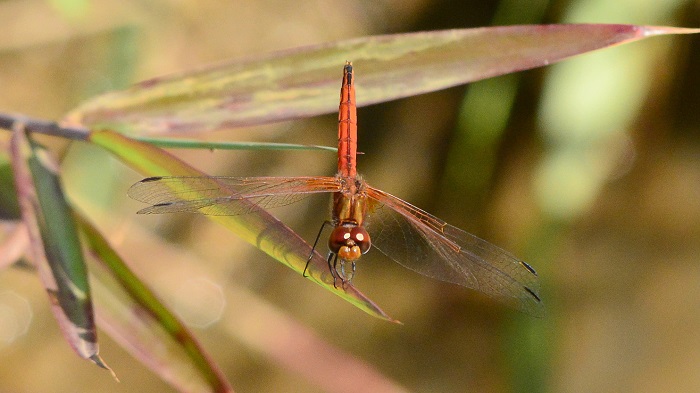
Female and young male Evening Hawkers with greenish eyes, could be confused with other Hawker species. They are most likely to be mistaken for Pinheyschna subpupillata (Stream Hawker) or Zosteraeschna minuscula (Friendly Hawker). The Evening Hawker can be distinguished by the lack of green patches on the ‘shoulders’ of the thorax and by their diagnostic forehead markings.

Click here for more details on identification of the Evening Hawker.

Evening Hawker Anaciaeschna triangulifera – Female
Near Hluhluwe, KwaZulu-Natal
Photo by Ryan Tippett
Habitat

Habitat – Muzi Pan, iSimangaliso Wetland Park, KwaZulu-Natal
Photo by Ryan Tippett

The Evening Hawker is associated with forest and dense woodland adjoining wetlands such as lakes, marshes, rivers and pans. It is usually seen hunting over reed beds, marshes, grassy clearings, and around tree canopies at dusk. During the day the Evening Hawker rests away from water in dense, shaded areas.

Habitat – Kosi Bay, iSimangaliso Wetland Park, KwaZulu-Natal
Photo by Ryan Tippett

Behaviour

The Evening Hawker is crepuscular, and is therefore most active during twilight. It is often gregarious when hunting and frequently joins mixed species feeding swarms at dusk. Evening Hawkers are also quite active on humid days, before and after rain. They spend most of the daylight hours at rest in dense shaded vegetation. The evening Hawker hangs vertically from a perch while resting.

Evening Hawker Anaciaeschna triangulifera – Male
Enseleni Nature Reserve, KwaZulu-Natal
Photo by Ryan Tippett
Status and Conservation

The Evening Hawker is scarce to locally common in South Africa. It is listed as of Least Concern in the IUCN Red List of Threatened Species. Anaciaeschna triangulifera is moderately sensitive to habitat disturbance. It can, however, be found at suitable man-made habitats, and in areas with some alien plants.

Evening Hawker Anaciaeschna triangulifera – Male
Kosi Bay, iSimangaliso Wetland Park, KwaZulu-Natal
Photo by Ryan Tippett
Distribution

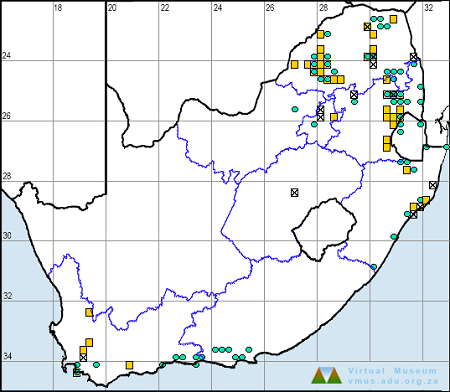
The Evening Hawker is found in sub-Saharan Africa, but mainly in Southern and East Africa, From Ethiopia in the north down to the Western Cape in South Africa. The species also occurs on Madagascar. In South Africa, the Evening Hawker is most widespread along the eastern and southern coastal regions, from northern KwaZulu-Natal down to the Western Cape. It is also present in Gauteng, Limpopo, and Mpumalanga. The Evening Hawker avoids the dry central and western regions of the country.

Below is a map showing the distribution of records for Evening Hawker in the OdonataMAP database as at February 2020.

Below is a map showing the distribution of records for Evening Hawker in the OdonataMAP database as at December 2024.

The next map below is an imputed map, produced by an interpolation algorithm, which attempts to generate a full distribution map from the partial information in the map above. This map will be improved by the submission of records to the OdonataMAP section of the Virtual Museum.

Ultimately, we will produce a series of maps for all the odonata species in the region. The current algorithm is a new algorithm. The objective is mainly to produce “smoothed” maps that could go into a field guide for odonata. This basic version of the algorithm (as mapped above) does not make use of “explanatory variables” (e.g. altitude, terrain roughness, presence of freshwater — we will be producing maps that take these variables into account soon). Currently, it only makes use of the OdonataMAP records for the species being mapped, as well as all the other records of all other species. The basic maps are “optimistic” and will generally show ranges to be larger than what they probably are.

These maps use the data in the OdonataMAP section of the Virtual Museum, and also the database assembled by the previous JRS funded project, which was led by Professor Michael Samways and Dr KD Dijkstra.

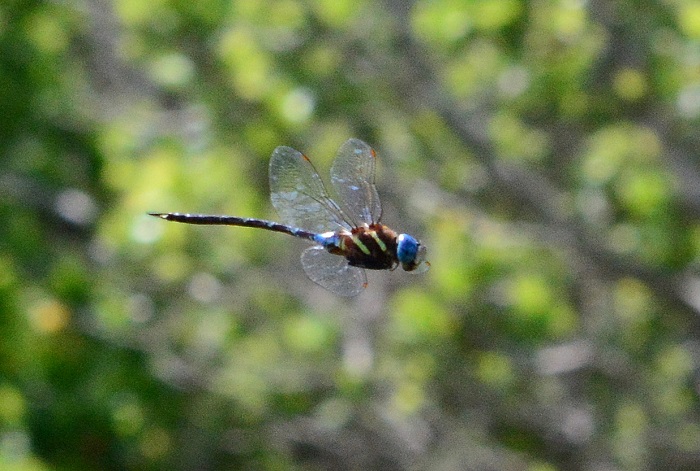
Evening Hawker Anaciaeschna triangulifera – Young male
False Bay, iSimangaliso Wetland Park, KwaZulu-Natal
Photo by Ryan Tippett
Further Resources

The use of photographs by Diana Russell is acknowledged. All other photographs by Ryan Tippett.

Evening Hawker Anaciaeschna triangulifera McLachlan, 1896

Other common names: Nagventer (Afrikaans)

Recommended citation format: Loftie-Eaton M; Navarro R; Tippett RM; Underhill L. 2025. Evening Hawker Anaciaeschna triangulifera. Biodiversity and Development Institute. Available online at https://thebdi.org/2020/04/30/evening-hawker-anaciaeschna-triangulifera/

References: Tarboton, M; Tarboton, W. (2019). A Guide to the Dragonflies & Damselflies of South Africa. Struik Nature.

Samways, MJ. (2008). Dragonflies and Damselflies of South Africa. Pensoft

Samways, MJ. (2016). Manual of Freshwater Assessment for South Africa: Dragonfly Biotic Index. Suricata 2. South African National Biodiversity Institute, Pretoria

Martens, A; Suhling, F. (2007). Dragonflies and Damselflies of Namibia. Gamsberg Macmillan.

Evening Hawker Anaciaeschna triangulifera – Male
Enseleni Nature Reserve, KwaZulu-Natal
Photo by Ryan Tippett
Similar Species

Russet Dropwing (Trithemis pluvialis)

Cover photo by Andries de Vries.

Find this species in the FBIS database (Freshwater Biodiversity Information System) here.

Family Libellulidae

Identification

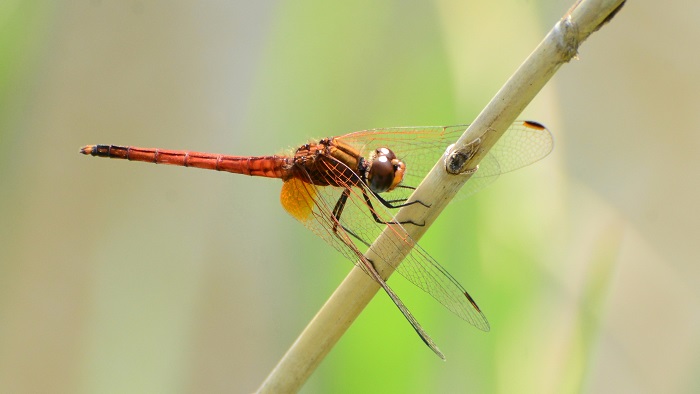
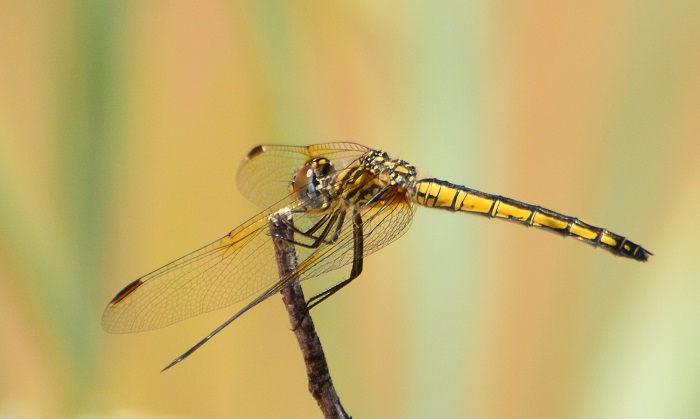
Russet Dropwing Trithemis pluvialis
Mkuze River, KwaZulu-Natal
Photo by Ryan Tippett

Small size

Length up to 37mm; Wingspan attains 62mm.

Male Russet Dropwings resemble the Red-veined Dropwing (Trithemis arteriosa), but are orange-red in general colour and have brownish-red eyes. The two species also differ in the black patterning on the abdomen.

Males may also be mistaken for the Elegant Dropwing (Trithemis werneri). Both are an overall orange colour but the Elegant Dropwing has more extensive black markings on the abdomen and thorax.

Females can be easily confused with those of several other Trithemis species. Trithemis pluvialis females can be identified by the large amber patches in the hindwings and the diagnostic black patterning on the abdomen.

Click here for more details on identification.

Habitat

The Russet Dropwing is a species of well-vegetated, flowing rivers and streams, often in rugged, hilly environments. Trithemis pluvialis prefers wooded habitats over most of its range. In the Western Cape, it also inhabits rivers in fynbos.

Habitat – Mkuze River, KwaZulu-Natal
Photo by Rowan Poortier

Behaviour

The Russet Dropwing often perches conspicuously on overhanging trees. They will also sit on rocks, as well as emergent or bankside reeds, grass, and sedges. The Russet Dropwing is most often found singly.

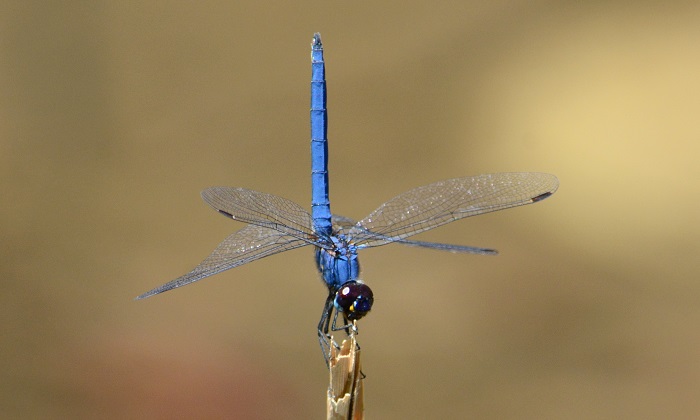
Russet Dropwing Trithemis pluvialis
Mkuze River, KwaZulu-Natal
Photo by Ryan Tippett

Status and Conservation

In South Africa, the Russet Dropwing is scarce and localised with a patchy distribution. It is listed as of Least Concern in the IUCN Red List of Threatened Species. Trithemis pluvialis occurs mostly at undisturbed sites.

Russet Dropwing Trithemis pluvialis
Mkuze River, KwaZulu-Natal
Photo by Ryan Tippett
Distribution

The Russet Dropwing occurs across southern, central, and East Africa. It ranges from Kenya and Uganda in the north across to Zambia and central Angola, and down to South Africa.

In South Africa Trithemis pluvialis is found in two disjunct populations. It occurs in north-eastern Limpopo, Gauteng, Mpumalanga, and KwaZulu-Natal. It is also present in the Western Cape and adjoining parts of the Eastern Cape. This population is apparently isolated from the populations further to the north.

Below is a map showing the distribution of records for Russet Dropwing in the OdonataMAP database as at February 2020.

Below is a map showing the distribution of records for Russet Dropwing in the OdonataMAP database as of December 2024.

The next map below is an imputed map, produced by an interpolation algorithm, which attempts to generate a full distribution map from the partial information in the map above. This map will be improved by the submission of records to the OdonataMAP section of the Virtual Museum.

Ultimately, we will produce a series of maps for all the odonata species in the region. The current algorithm is a new algorithm. The objective is mainly to produce “smoothed” maps that could go into a field guide for odonata. This basic version of the algorithm (as mapped above) does not make use of “explanatory variables” (e.g. altitude, terrain roughness, presence of freshwater — we will be producing maps that take these variables into account soon). Currently, it only makes use of the OdonataMAP records for the species being mapped, as well as all the other records of all other species. The basic maps are “optimistic” and will generally show ranges to be larger than what they probably are.

These maps use the data in the OdonataMAP section of the Virtual Museum, and also the database assembled by the previous JRS funded project, which was led by Professor Michael Samways and Dr KD Dijkstra.

Russet Dropwing Trithemis pluvialis
Mkuze River, KwaZulu-Natal
Photo by Ryan Tippett
Further Resources

The use of photographs by Andries de Vries is acknowledged. Other photographs by Ryan Tippett.

Russet Dropwing Trithemis pluvialis Förster, 1906

Other common names: River Dropwing (Alt. English); Rosbruinvalvlerkie (Afrikaans)

Recommended citation format: Loftie-Eaton M; Navarro R; Tippett RM; Underhill L. 2025. Russet Dropwing Trithemis pluvialis. Biodiversity and Development Institute. Available online at https://thebdi.org/2020/04/29/russet-dropwing-trithemis-pluvialis/
References: Tarboton, M; Tarboton, W. (2019). A Guide to the Dragonflies & Damselflies of South Africa. Struik Nature.

Samways, MJ. (2008). Dragonflies and Damselflies of South Africa. Pensoft

Samways, MJ. (2016). Manual of Freshwater Assessment for South Africa: Dragonfly Biotic Index. Suricata 2. South African National Biodiversity Institute, Pretoria

Martens, A; Suhling, F. (2007). Dragonflies and Damselflies of Namibia. Gamsberg Macmillan.

Russet Dropwing Trithemis pluvialis
Mkuze River, KwaZulu-Natal
Photo by Ryan Tippett

Similar Species

Silhouette Dropwing (Trithemis hecate)

Cover photo by Gregg Darling.

Find the Silhouette Dropwing in the FBIS database (Freshwater Biodiversity Information System) here.

Family Libellulidae

Identification

Silhouette Dropwing Trithemis hecate – Male
Linyanti, Botswana
Photo by Ryan Tippett
Small size

Length up to 43mm; Wingspan attains 68mm.

The Silhouette Dropwing is a slender, dark blue species. The thin abdomen easily differentiates it from other dark blue dropwings like Trithemis furva (Navy Dropwing) and Trithemis dorsalis (Highland Dropwing). It is closest to Trithemis aconita (Halfshade Dropwing) in appearance. Both species have slender abdomens but are easily told apart by their very different habitat choices.

Additionally, Trithemis hecate is the only dark blue dropwing in the region with pale pterostigmas.

Females are easily confused with other Trithemis species. They are best identified by their association with the males.

Click here for more details on identification of the Silhouette Dropwing.

Silhouette Dropwing Trithemis hecate – Female
Linyanti, Botswana
Photo by Ryan Tippett
Habitat

The natural habitats of the Silhouette Dropwing are subtropical and tropical pans, floodplains, and marshes. It prefers standing or still water with emergent plant growth such as reeds, grass, or sedges. The Silhouette Dropwing is frequently found perched on trees and bushes a short distance from the water, especially during the hottest time of the day.

Habitat – Near Kosi By, KwaZulu-Natal
Photo by Ryan Tippett
Behaviour

Breeding male Silouette Dropwings typically perch on emergent stems, often far from the shore, on the last reeds before the open water starts. From this position, they appear all dark and silhouetted, hence the common name. Females and non-breeding males are found on trees and bushes surrounding the wetlands, often some distance from the water.

Silhouette Dropwing Trithemis hecate – Male
Linyanti, Botswana
Photo by Ryan Tippett
Status and Conservation

In South Africa, the Silhouette Dropwing is scarce and erratic in occurence but can be abundant at sites further north, such as the Okavango Delta in Botswana. It is listed as of Least Concern in the IUCN Red List of Threatened Species. This species is found mostly in pristine habitat and is fairly sensitive to habitat degradation.

Silhouette Dropwing Trithemis hecate – Female
Okavango Delta, Botswana
Photo by Ryan Tippett
Distribution

The Silhouette Dropwing is widespread in tropical and subtropical Africa. It has been recorded in Botswana, Chad, the Democratic Republic of the Congo, Gambia, Guinea, Kenya, Liberia, Malawi, Mozambique, Namibia, Senegal, South Africa, Tanzania, Uganda, Zambia, Zimbabwe, and possibly Burundi. It also occurs on Madagascar. In South Africa, the Silhouette Dropwing is restricted to the warmer regions in the north and east.

Silhouette Dropwing Trithemis hecate – Male
Linyanti, Botswana
Photo by Ryan Tippett

Below is a map showing the distribution of records for Silhouette Dropwing in the OdonataMAP database as at February 2020.

Below is a map showing the distribution of records for Silhouette Dropwing in the OdonataMAP database as of December 2024.

The next map below is an imputed map, produced by an interpolation algorithm, which attempts to generate a full distribution map from the partial information in the map above. This map will be improved by the submission of records to the OdonataMAP section of the Virtual Museum.

Ultimately, we will produce a series of maps for all the odonata species in the region. The current algorithm is a new algorithm. The objective is mainly to produce “smoothed” maps that could go into a field guide for odonata. This basic version of the algorithm (as mapped above) does not make use of “explanatory variables” (e.g. altitude, terrain roughness, presence of freshwater — we will be producing maps that take these variables into account soon). Currently, it only makes use of the OdonataMAP records for the species being mapped, as well as all the other records of all other species. The basic maps are “optimistic” and will generally show ranges to be larger than what they probably are.

These maps use the data in the OdonataMAP section of the Virtual Museum, and also the database assembled by the previous JRS funded project, which was led by Professor Michael Samways and Dr KD Dijkstra.

Silhouette Dropwing Trithemis hecate – Male
Linyanti, Botswana
Photo by Ryan Tippett

Further Resources

The use of photographs by Gregg Darling is acknowledged.

Silhouette Dropwing Trithemis hecate Ris, 1912

Other common names: Hecate Dropwing (Alt. English); Skraalvalvlerkie (Afrikaans).

Recommended citation format: Loftie-Eaton M; Navarro R; Tippett RM; Underhill L. 2025. Silhouette Dropwing Trithemis hecate. Biodiversity and Development Institute. Available online at https://thebdi.org/2020/04/29/silhouette-dropwing-trithemis-hecate/

References: Tarboton, M; Tarboton, W. (2019). A Guide to the Dragonflies & Damselflies of South Africa. Struik Nature.

Samways, MJ. (2008). Dragonflies and Damselflies of South Africa. Pensoft

Samways, MJ. (2016). Manual of Freshwater Assessment for South Africa: Dragonfly Biotic Index. Suricata 2. South African National Biodiversity Institute, Pretoria

Martens, A; Suhling, F. (2007). Dragonflies and Damselflies of Namibia. Gamsberg Macmillan.

Silhouette Dropwing Trithemis hecate – Immature male
Linyanti, Botswana
Photo by Ryan Tippett
Similar Species