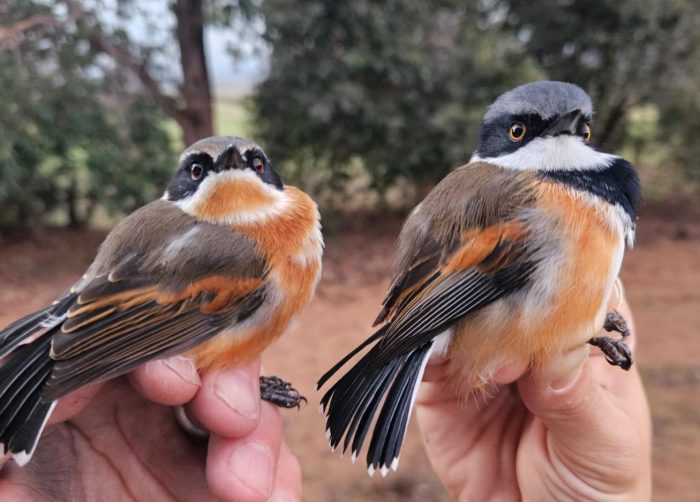
The BDI’s ninth bird ringing course, and the fourth at New Holme, was held at the New Holme Nature Lodge, in the heart of the Karoo, between Hanover and Colesburg, about 700 km from both Johannesburg and 700 km from Cape Town. This was the team:
We have ringed at a variety of sites on the farm New Holme multiple times since our first ringing trip here in 2019. Three of the 87 birds ringed in November 2019 were retrapped during the 2024 course. The most interesting was the single Southern Fiscal ringed during the 2019 trip on 12 November. It was retrapped three times in 2022: on 29 March, on 9 April and during the ringing course 1 November. In 2023 it was retrapped on 2 September. It was retrapped again during this ringing course on 10 September. The original ringing and the five retraps have all been in the gardens surrounding New Holme Nature Lodge.
The table below shows the numbers of birds ringed or retrapped during the course. Those in red and underlined have structured species texts on the BDI website. Click on them. and you are transported to the species text! The total number of retraps was 70.
We had some bitterly cold mornings at the Waterpump and the nearby waterhole!
… but once it warms up a bit and the waterhole defrosts, many birds come to drink here, and it is good spot for larks …
… at one point, we had four species in the hand at the same time: Grey-backed Sparrow-lark, Eastern Clapper Lark, Red-capped Lark and Spike-heeled Lark.
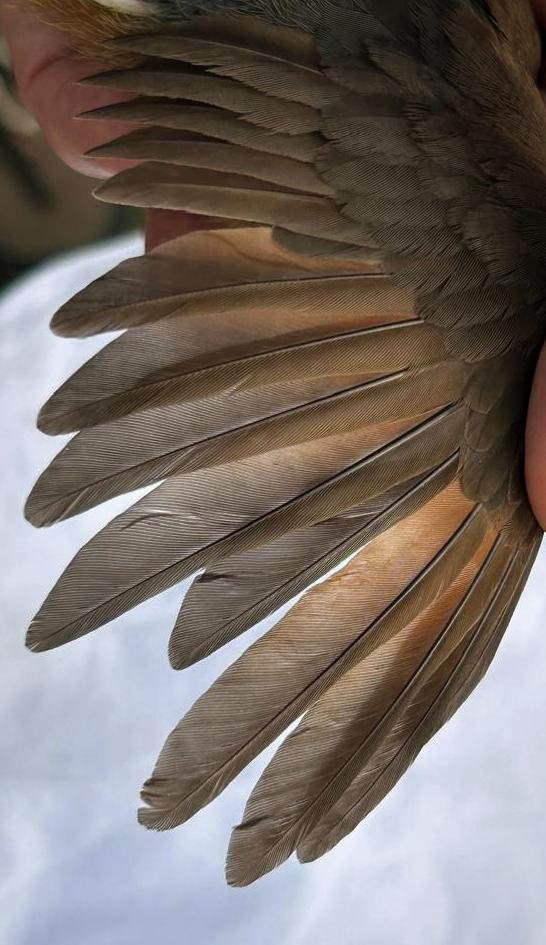
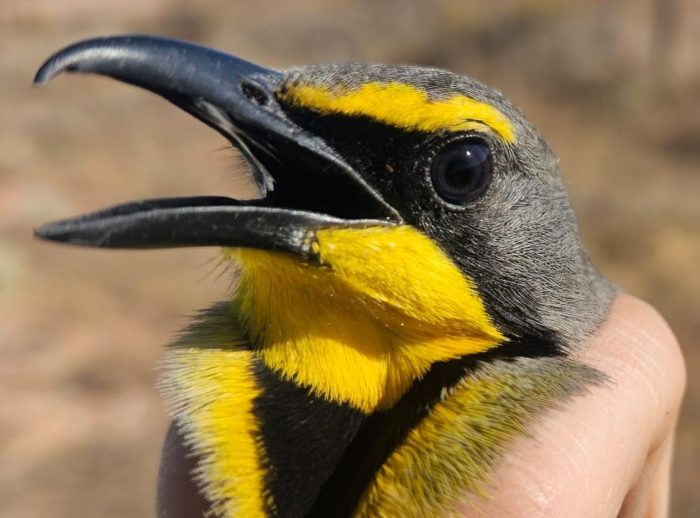
The big privilege of being a ringer is to see birds close up. The patterned eye and wrinkled red skin of this Speckled Pigeon add a new level to our appreciation of birds. Likewise for the wing below:
One night we put nets up on the mudflats along the large dam at New Holme. The reward for a huge amount of effort was one Blacksmith Lapwing …
… but that is the way ringing works, sometimes. But it was the only Blacksmith Lapwing of the course.
Cape Bird Club sponsorship
Joel Simons, of the Ingcungcu Sunbird Restoration Project on the Cape Flats of Cape Town, was sponsored by the Cape Bird Club to attend the ringing course. Joel wrote about his experiences in an article in the March 2025 edition of Promerops, the Cape Bird Club’s newsletter. This comprehensive account is reproduced here in full, and supplements the brief report above!
Joel Simons, Ingcungcu Sunbird Restoration Project, runs the school Eco Club programmeand was sponsored to attend the ringing course by the Cape Bird Club
The BDI’s 10th bird ringing course was held at Botuin, Vanrhynsdorp, from 15 to 20 November 2024. We have a selection of ringing sites in the district, which we use in rotation during our trips. We are trying to reach a point where a good proportion of the birds at these sites are ringed, and over a period of years we will be able to collect enough data that we can make, for example, estimates of survival rates for the bird species here. The importance of the data which we are collected is summarized in this blog The Value of Bird Ringing to Research and Conservation.
One of our favourite sites in the Botuin district is “the lark site” at the foot of the Maskamberg, commonly known as the Gifberg. This block of rock has an instantly recognizable profile. When you see it, it screams “VANRYHNSDORP” (which, when rewritten for English speakers, is pronounced FUN-RAINS-DORP).
So this blog opens with a series of images of “the lark site” which hopefully captures the spirit of the place.
By November, the area is taking on summer browns. In contrast, here is a winter green, with a long line of mistnets.
We never catch many birds here, but we do get information on birds we never occur at the “easy sites”. On this morning during the course the total catch was 11 birds, of seven species: Large-billed Lark, Karoo Chat, Karoo Scrub Robin, Grey-backed Cisticola, Red-billed Quelea, Southern Red Bishop and Karoo Prinia. Of these species, the ones we only obtain at this site are Large-billed Lark and the Karoo Chat.
Another ringing site in the area, new to us in the sense that we have not fully explored the opportunities here is on Maskam Farm, which in early spring has magnificent displays of flowers, and is open to the public. From the bird ringing perspective, there’s a variety of habitats, including a small farm dam, gardens, and areas like this, where the vegetation is of uneven height, but the tops of the tallest shrubs are at mistnet height:
Sewage works are an irresistible magnet for birders in general and ringers in particular! In arid areas, the sewage works is frequently one of the only places with open water.The sewage works just outside Vanrhynsdorp is no exception.That is a Maccoa Duck on the pan in the photograph below. Besides ducks, coot, moorhens, crakes, etc, the reedbeds at the sewage works provide roosts for bishops and weavers, and those are our main target species here.
The photo of the splash on the right was taken one second after the Maccao Duck on the left. What did the tail do?
Doing a ringing course in November is is especially good it you want to learn about moult. More and more, we are making photographic records, and below is a selection from an awesome collection made by Toni Hoenders, attending the course from the Netherlands, where she is a trainee ringer.
The Hoopoe above has completed primary moult. The 10 primaries (the all black feathers) have tips which are clearly demarcated and unfrayed.
Laughing Doves have 10 primaries. On this dove, the division between the primaries and the secondaries is obvious. The lighter grey secondaries all have central shafts that curve a bit to the right. Primaries one to three have been replaced, and they are the three dark grey feathers, and because they are grown in sequence, the third one is the newest. Then there are six old primaries which have had a year of use. Three + Six = Nine. So there is a primary missing. It HAS to be primary four, just outside primary three, so the six old primaries are numbers five to ten!
Look again at the three longest primaries of the dove, numbers five, six and seven. When the dove is settled, with its wings folded, the tips of these feather are exposed. You can see the impact of the sun. The last few millimetres of these three feathers are faded. When the dove is settled, the outer primaries are folded away under the other primaries, so they don’t show this pattern.
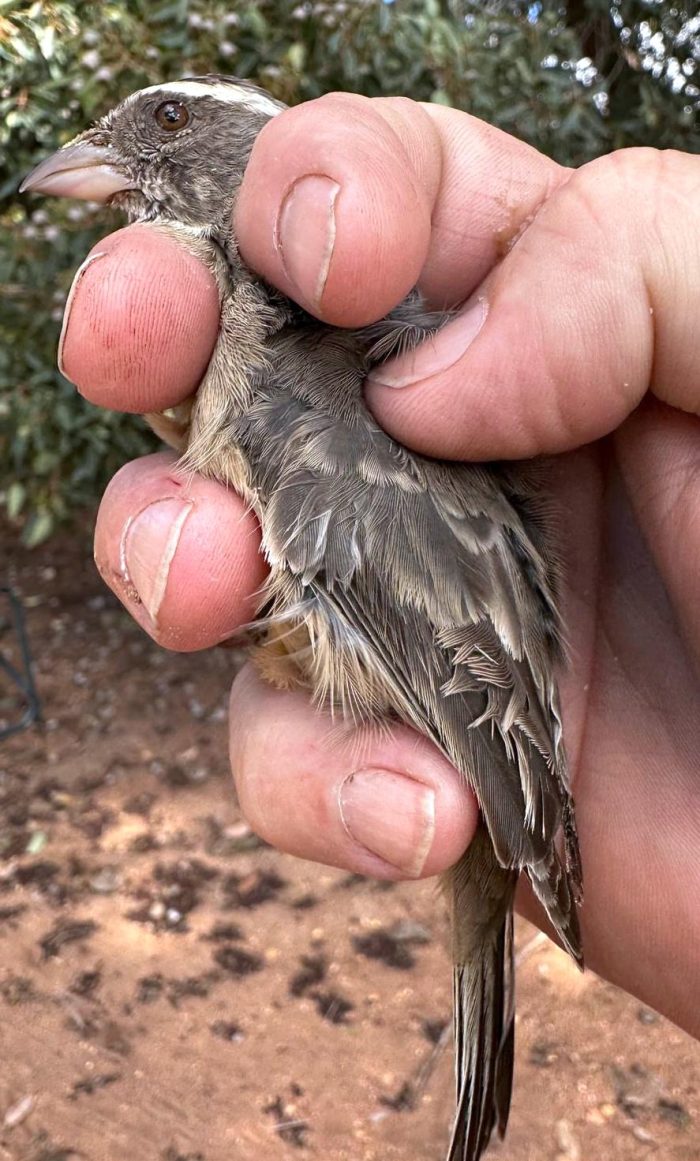
The outer five primary feathers of this Lark-like Bunting are faded compared with the inner primaries. So they are old, even though they are not particularly ragged at the ends. Lark-like Buntings have nine primaries. The outer five are old, so we are looking for four more. The brown feathers on the right are secondaries, with slightly curved shafts.Two new primaries are clearly visible. Neither is full length yet, so they are still growing. A little bit of primary three is visible under primary two. It is a bit less than half grown. So the missing fourth primary has to come next, and it HAS to be in the gap just before the old primaries, which must numbers five to nine.
Getting to the end of this primary moult tutorial. Southern Red Bishop has nine primaries. The seven outer primaries are visible, and old. Therefore we are looking for two more. The big feathers on the right are all secondaries; shafts curve right. Therefore primaries one and two must be in the gap. Because the feathers grow in sequence, that half grown feather must be primary one, with primary two, still invisible, alongside it.
In this photograph, you can see how the feathers grow. That blackish sheath, at the base of the growing primary, is the scene of the action. That is where the growth takes place, and the part of the feather grown so far is what moves slowly outwards. So the tip of the growing feather will ultimately become the tip of the feather, and will line up with the rest of the wing. Moult is an energetically expensive process; the little feather factories are a complex chemical plants, demanding both a supply of raw materials and the energy to turn them into feathers. Every feather has its own chemical plant at its base, which needs to swing into production once a year to replace feathers.
Birds don’t always moult their primaries in the conventional order, from the inside, moulting the outermost primary last. This Southern Masked Weaver above is a puzzle. The superficial classification says “no moult”. But look a bit more carefully. Weavers have nine primaries. The outer three, primaries seven to nine, are new. They are a dark colour (the others look faded), and the edges are neat. Primaries five and six look the oldest of all; the tips are worn, and frayed. Primaries one to four look in better condition, but are also faded. The secondaries are the next six feathers; they bend a bit to the right. The outer five secondaries look newish, unfaded. The sixth secondary (the innermost, above the tip of the finger), looks a bit faded and is therefore probably older than the other five. We can only guess what stresses this bird has endured.
Birds use their tails mainly for steering, balancing and breaking. Tails often have 12 feathers, and they are also replaced annually. The order of tail feather moult is often quite variable, but mostly starts with the central two tail feathers. In this Southern Marked Weaver, only eight of the tail feathers are visible, and they are obviously of very different ages.
The table shows the species handled during the course, and the numbers ringed or retrapped of each species. The total as 261 birds of 29 species, and an amazing 96 were Larklike Buntings.The species in red in the table and underlined have structured species texts in the BDI website. Click on the species and you get taken to its text.
The Cape Bird Club sponsored the attendance of two students at the Cape Peninsula University of Technology (CPUT) at the course. Muneeba Lamera and Amy Lewis wrote an appreciation to the club for the opportunity, which was published in Promerops, the newsletter of the Cape Bird Club. Here it is, extracted from Promerops 331, March 2025:
Examining a Southern Red Bishop during ringing at Maskam Farm, Vanrhynsdorp
Expedition number five to the Nuwejaars Wetlands SMA. Our accommodation was in the delightful units at Hazevlakte.
We arrived Monday 7 April, put up nets in the Hazevlakte werf and handled 53 birds before nightfall. We spent the morning of Tuesday 8 April at the floodplain of the Nuwejaars River, on the farm Moddervlei and caught 39 birds of 16 species. On Wednesday morning we ringed around the dam on the farm Kossierskraal. Between some bouts of light drizzle, we handled a total of 20 birds of 10 species. On Wednesday afternoon we caught 58 birds of 11 species in and around the protea patch on the farm Zandvlakte. We furled the nets tightly closed for the night, and went back there early on Thursday morning to handle 104 birds of 18 species. In the afternoon we went to the farm Vlooikraal, and caught 11 birds of six species! The nets were furled overnight, and a few hours at Vlooikraal on Friday 11 April, departure day, yielded 23 birds of 13 species.
This table shows the numbers handled of each species, with retraps included in this total. These were all from our previous expeditions and were retrapped at the same places where they were ringed. Species underlined and in red have structured species texts on the BDI website; click on the species, and you are linked to the species text.
The rest of this blog consists mostly of photos of a selection of these 47 species! The photos are in the same order as in the table. The species in the table with a double asterisk in front of them are the ones with photos!
Photo: Roger Walsh
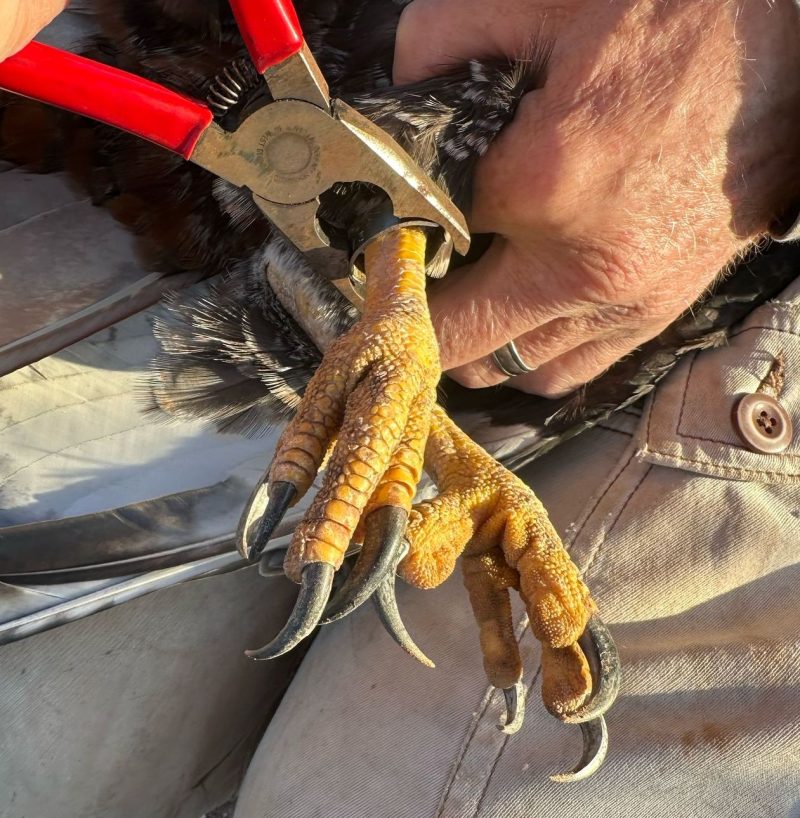
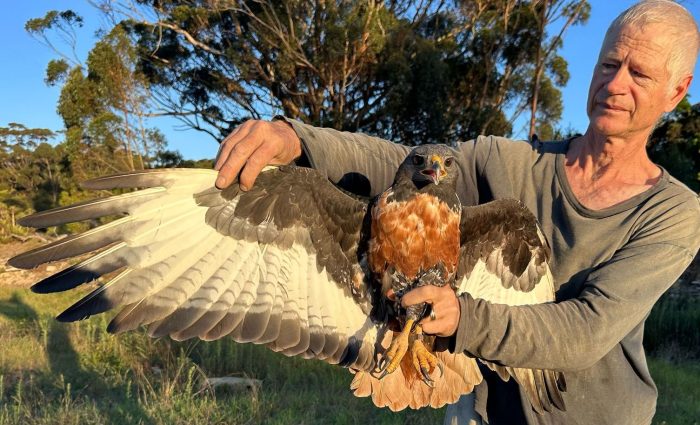
Dieter Oschadleus is holding this Jackal Buzzard which was caught using a Balchatri trap along the gravel road southwest of the farm Vlooikraal. If you travel along that road, please inspect the Jackal Buzzards to confirm that this one is alive and well!
Photo: Roger Walsh
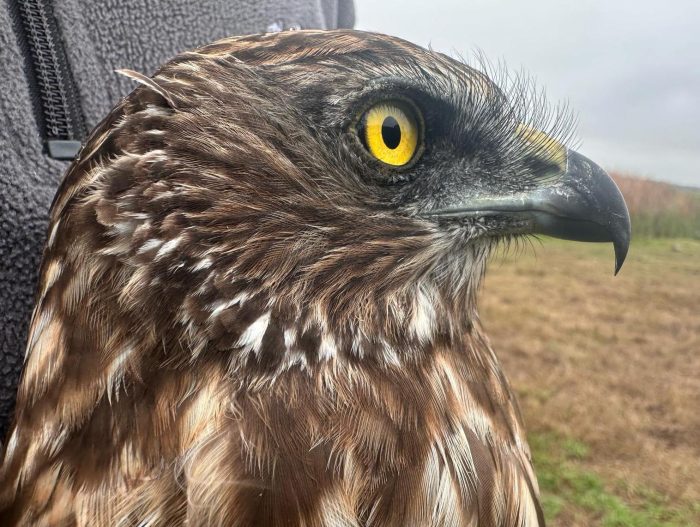
This African Marsh Harrier was caught in a large-mesh mistnet in the floodplain at Moddervlei. This is a species that demands high-quality habitat and lots of it, which the recently restored wetlands provide.
Photo: Roger Walsh
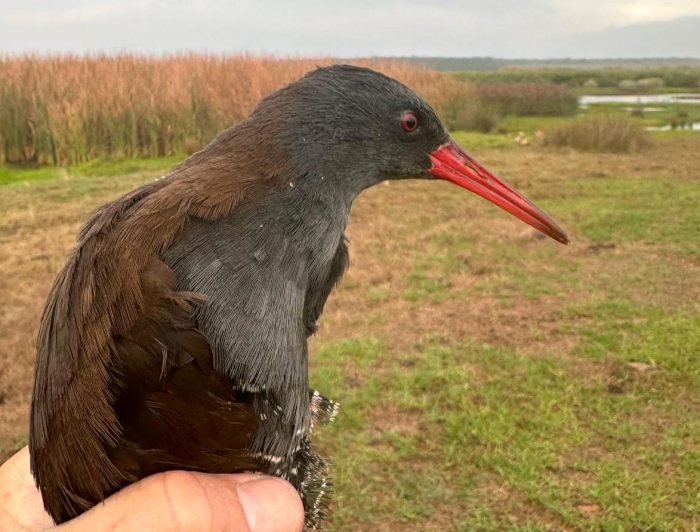
The African Rail is another species that is only present in high-quality habitats. It is not a species which is easy to observe or detect in a wetland. The fact that we caught, not one, but two, birds of this species is greatly encouraging to everyone who was involved in the wetlands restoration project.
Photo: Dieter Oschadleus
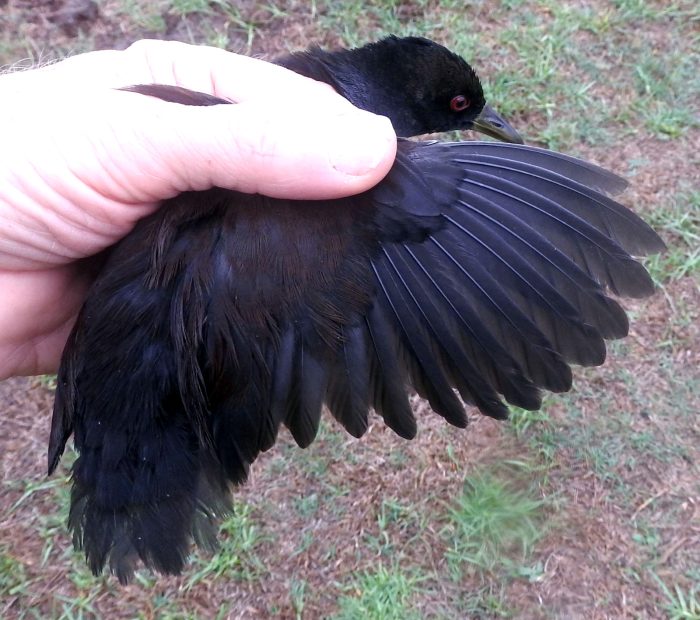
This is a juvenile Black Crake. The bill is just starting to think about turning yellow!
Roger WalshRoger Walsh
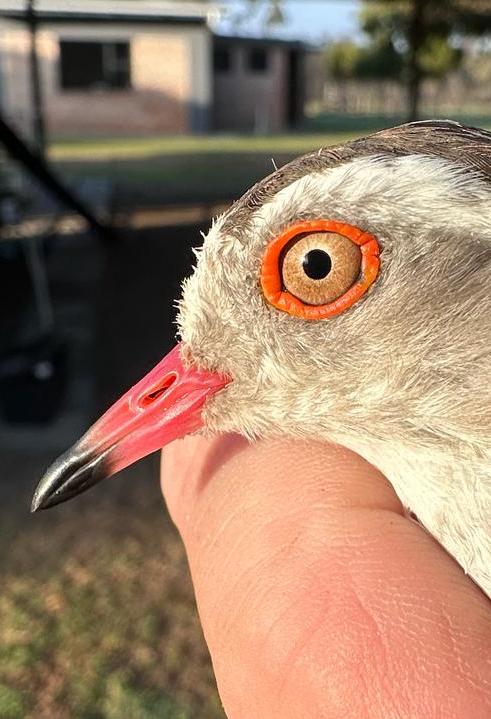
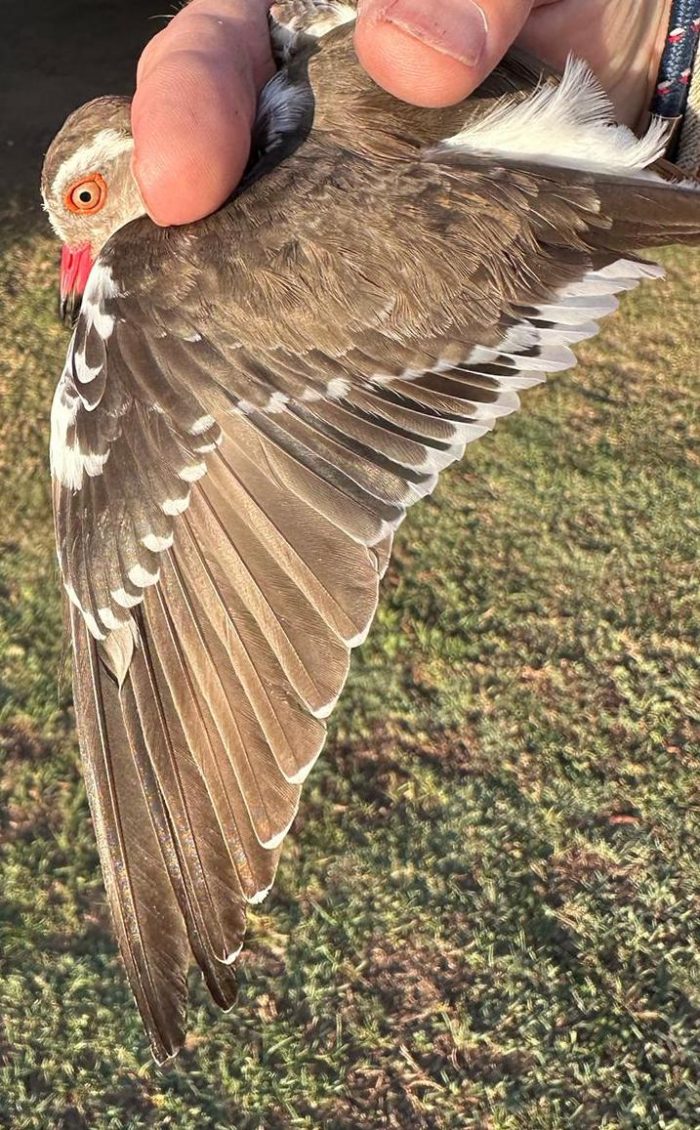
It is the privilege of being a ringer to see what the eye and eye-ring of a Three-banded Plover really look like. Careful inspection of the photo on the right reveals that this is a young bird. The photo was taken in April 2025, and this bird would have hatched in the spring 2024 breeding season. So at a guess it is somewhere between about five and eight months old. Much of the juvenile plumage has been replaced, but many of the coverts on the back have narrow white fringes; that is a give-away for a young wader! Looking at the main flight feathers in the wing, the primaries, the outermost few feathers are a darker shade of brown to the six inner primaries. It seems that this bird has moulted the outer three primaries, and replaced them. The inner primaries belong to its original set, grown in a rush in the first weeks of life, and therefore likely to be of low quality. It is the outer primaries that do the heavy lifting. So replacing them early in life is a great survival strategy.
Photo: Roger Walsh
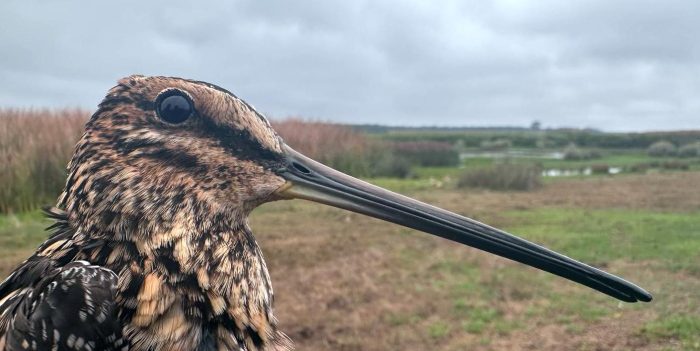
If you look up and down at the birds featured in this blog, most of them have bills which are shorter even much shorter, than their heads. The bill of this African Snipe is about two-and-a-half times as long as its head.
Photo: Dieter Oschadleus
Photo: Dieter Oschadleus
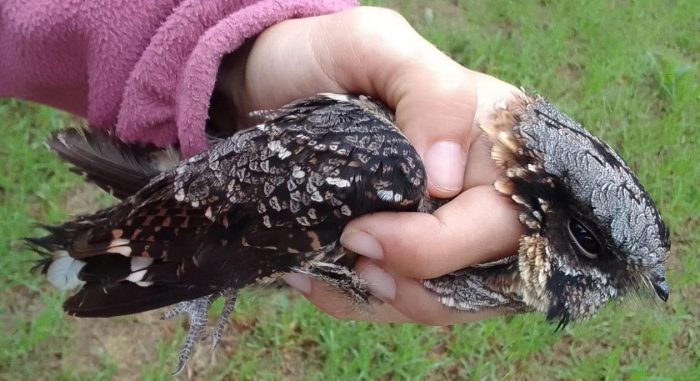
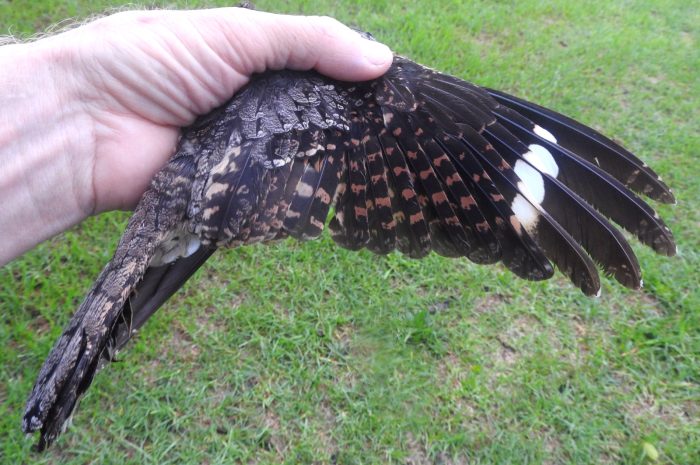
The detail of the patterns of the Fiery-necked Nightjar in the two photos above is impressive. In most species of birds the relative sizes of the primaries form a fairly sensible curve, often a parabola. Not the nightjars! The endpoints of the inner six primaries form a more or less straight line. Primary seven is much longer than number six, a serious discontinuity! Primaries eight and nine are slightly longer than primary seven. and primary ten is a bit shorter.
Photo: Roger Walsh
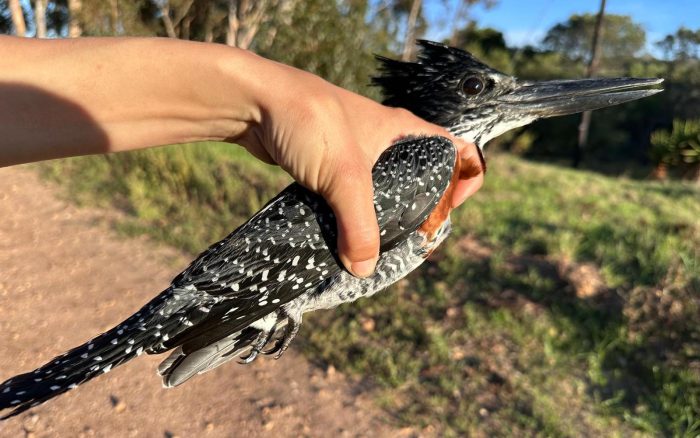
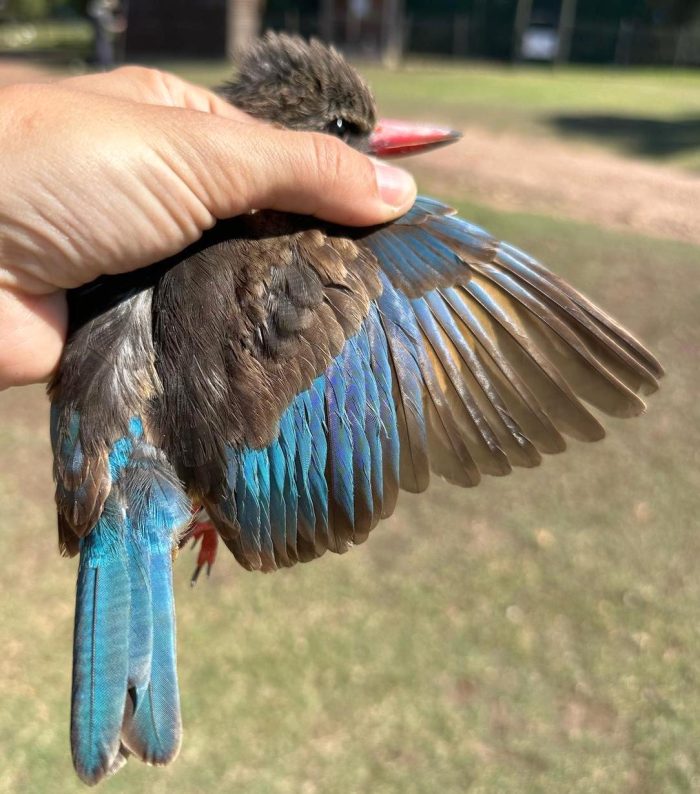
The Giant Kingfisher is a large bird. This is a male with the top of the front brown and the bottom white; in the female the colours are the other way round.
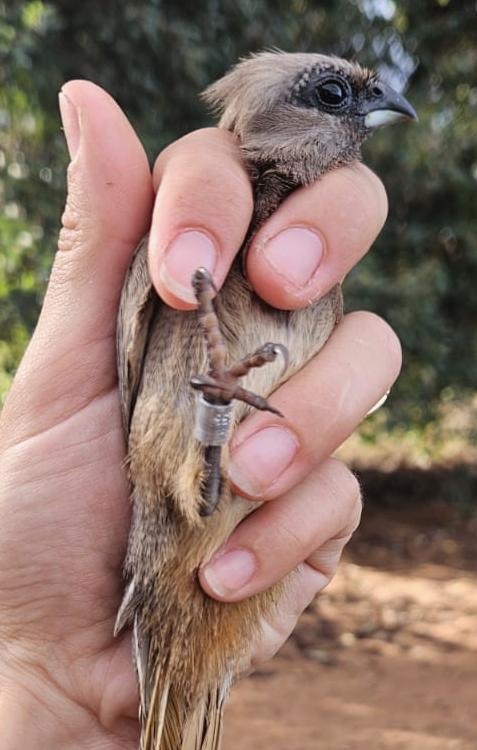
Close up, like this you can see the pattern of markings that give the Speckled Mousebird its name. It is not a useful identification feature.
The mousebird on the right is moulting its primaries. Mousebirds have 10 primaries, but only eight are easily visible against the white background. The inner four are slightly darker than the outer primaries, so are newly grown. Primary five is actively growing. The scene of growth action is at the base of the primary, where it emerges through the skin. The feather production organ here has been activated, and has a rich supply of blood. Ringers know to be careful when handling birds in moult, and to avoid making contact with these feather factories. Once the feather is fully grown, and the outer tip of the feather has lined up with the other primaries, blood supply ceases, and the feather growth organ atrophies until it is needed again, in a year’s time. The three visible outer primaries are old, and look a bit thin and fragile compared to the new ones. The 10th primary is about half size; and in the photograph it is lying on top of the ninth. That makes nine primaries so far. The missing primary has to be primary six, just outside the primary which is growing! So, in summary, primaries one to four are new, primary five is actively growing, the old primary six has been discarded, and the new feather is not yet visible, and the four outer primaries, seven to ten, are a year old, and are waiting their turn for replacement. If all the primaries were replaced at the same time, the bird would not be able to fly.
Photo: Roger Walsh
Brown-hooded Kingfisher.
Photo: Roger Walsh
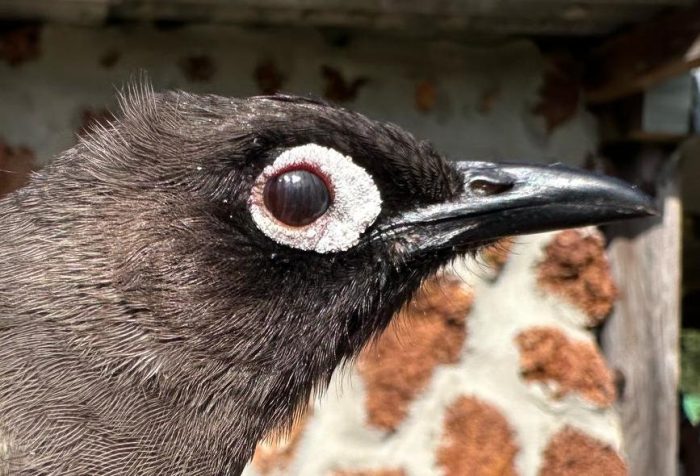
The white cere surrounding the eye of the Cape Bulbul is elliptical, not circular, and the eye is towards the back end of the oval. For the African Red-eyed Bulbul, the cere is red and circular, and the eye is in the middle of the circle. According to the field guides, the Cape Bulbul is the only species that ought to occur in the Overberg, and on the Agulhas Plain, all bulbuls really should be Cape. But there are two nearby records of African Red-eyed Bulbul: one at Stanford and one at Struisbaai, Cape Agulhas (have a look at this paper in Biodiversity Observations; and be aware that the African Red-eyed Bulbul is expanding its range southward! Read this paper, entitled Range expansion of African Red-eyed Bulbul Pycnonotus nigricans in western South Africa, OpenAccess in Ostrich). On this particular expedition, we ringed 23 Cape Bulbuls, and zero African Red-eyed Bulbuls, but we are always alert to the possibility!
Photo: Jade Wilding
It is rare to have the opportunity to take a photograph of a female (left) and male Cape Batis side-by-side. Here they are again!
Photo: Jade Wilding
Photo: Jade Wilding
The bill of the Bokmakierie is a formidable weapon. It will turn a caterpillar instantly to mincemeat, and even a beetle with a tough exoskeleton doesn’t stand a chance.
Photo: Roger Walsh
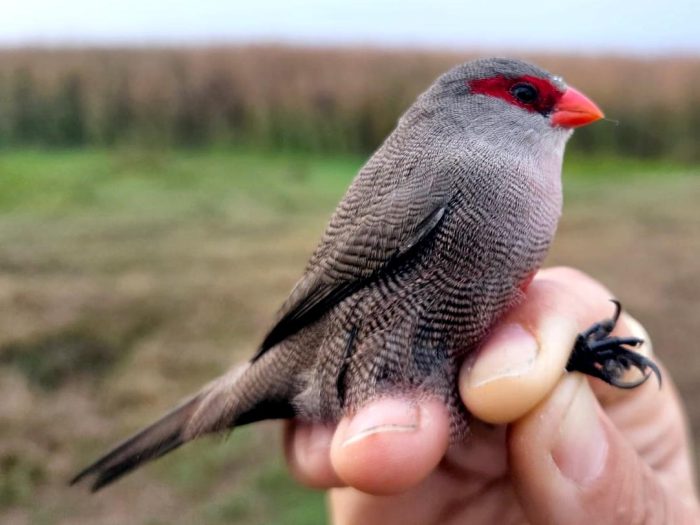
From the close-up view of the bird ringer, the Common Waxbill has the same zebra pattern all over. Simple, delicate stripes.
Photo: Dieter Oschadleus
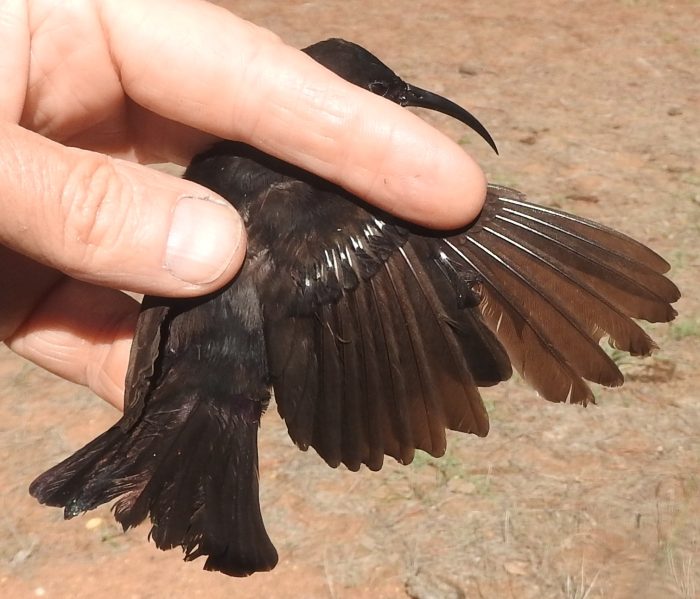
The Amethyst Sunbird is steadily extending its range westward. But it is still a relatively unusual species on the Agulhas Plain. From this angle, it is easy to grasp why its English common name was Black Sunbird.
Photo: Roger Walsh
The Streaky-headed Canary has the typical bill of a seedeater: short, stubby and roughly cone-shaped. The beak is powerful, and is used for dehusking seeds.
The team of ringers for this trip consisted of Dieter Oschadleus, Jade Wilding, Oliver Fox, Roger Walsh and myself. Jade, Oliver and Roger were visiting ringers from the UK. They are intensely involved in the Kartong Bird Observatory in The Gambia and transferred to us lots of skills gained in The Gambia and the UK.
Thanks
We are grateful to Con and Karen Neethling for enabling us to use the units at Hazevlakte as our base. Con Neethling, Liohan Giliomee and Mick D’Alton gave us permission to ring on their farms. Eugene Hahndiek, Erica Brink and Ross Kettles in the offices of the Nuwejaars Wetlands SMA helped in lots of ways.
… and …
… you can read about future ringing events here. There is a list of reports like this here. The value and importance of bird ringing to research and conservation is described here.
We had another exploratory ringing expedition to the Nuwejaars Wetlands Special Management Area (SMA) from Friday 30 May to Wednesday 4 June. This is the BDI’s sixth ringing visit to this area. The previous ones were in October and in November 2024, and in February, March and April this year. This is our first ringing trip here in early winter, and we wanted to get a feel for what birds we could anticipate ringing at this time of year.
We stayed at our usual accommodation at Hazevlakte. This is what you see when you arrive:
Photo: Les Underhill
… go through the unit, and this is the view that greets you:
Photo: Les Underhill
… the units look out over the Nuwejaars River. The lawn is kept short by a flock of multicoloured sheep!
Photo: Les Underhill
The view upstream (i.e. westward) from the stoep looks towards the floodplains which the Nuwejaars Wetlands SMA has cleared of aliens, and is now an irresistible magnet for waterbirds (and bird ringers).
Photo: Les Underhill
Looking downstream, the building in the distance across the river, between the two windpumps, is the headquarters of the Nuwejaars Wetlands SMA:
Photo: Les Underhill
These are the offices of the team that coordinates all the conservation activities across all the farms that have joined the Special Management Area. The most important of these activities is the clearance of alien vegetation. There are excellent insights in this eight-minute video.
That is enough of the context. Now, on to the birds …
On arrival late on Friday afternoon, around sunset, we put up a few mist nets on the werf at Hazevlakte, so we would be ready at dawn on …
Photo: Sue Gie
… Saturday
On Saturday morning we ringed in and around the Hazevlakte werf. In spite of a stiff breeze and a nip in the air, we caught 25 birds. The very first bird was a retrap. We had ringed this Fiscal Flycatcher here on our third visit on 24 February this year:
Photo:Dieter Oschadleus
On Saturday afternoon, we put mistnets up in the floodplain of the Nuwejaars River at Moddervlei …
Sunday
… and we were back before dawn on Sunday morning:
Photo: Sue Gie
… and put more nets up …
Photo: Sue Gie
… and some more …
Photo: Taryn Daley
… so that there were lots of mistnets! But conditions were less than perfect for mistnetting. In spite of this we ringed some impressive birds. For example, first bird was an African Snipe:
Photo: Sue Gie
… and here is a view of the patterned wing and tail, something that only ringers get to see properly …
Photo: Sue Gie
During the course of this morning, we caught the-species-of-the-expedition:
Photo: Les Underhill
Burchell’s Coucals don’t easily get caught in mistnets! Here is a different angle on the same bird:
Photo: Sue Gie
The next really special bird was Black Crake:
Photo: Sue Gie
The eyes and legs are red, and the bill is a shade of yellow reminisicient of plastic toys!
Photo: Sue Gie
Monday
Monday morning was spent at a patch of planted proteas adjacent to some good-quality fynbos.
Photo: Sue Gie
There were proteas in bloom:
Photo: Sue Gie
… and, yes, there were Cape Sugarbirds breeding:
Photo: Sue Gie
This is the wing of a male Cape Sugarbird. Primary 6 has a big notch in it. There are 10 primaries, and the outermost, Primary 10, is small. So Primary 6 is four feathers in from the outside. Primary 7 also has a notch but it is much smaller. Female Cape Sugarbirds also have these notches on their primaries, but they are quite small. It is these features of birds that only ringers really get to see.
Cape Sugarbirds breed during winter. The broodpatch of this female is evidence that she is breeding:
Video: Sue Gie
The brood patch is an area of bare skin which birds only have when they are incubating eggs. The skin is in contact with the eggs, transferring warmth to them. Feathers provide excellent insulation, so if birds had to incubate their eggs through their feathers, the job would never get finished.
There were lots of other species in the protea patch, including this Cape Weaver:
Photo: Sue Gie
This bird is a male. Only male Cape Weavers have this marie-biscuit eye colour. Adult females have brown eyes, and the brown colour contrasts with the black pupil. Very young Cape Weavers have darkish brown eyes, which hardly show any contrast with the pupil. Ageing of birds-in-the-hand is one of the skills you learn when you become a bird ringer.
A species which is now common in the eastern half of the Western Cape, and expanding into the suburbs of Cape Town, is the Fork-tailed Drongo:
Photo: Sue Gie
There are almost invariably trees in the places where it occurs, and often these are alien eucalyptus trees, such as flowering gums.
The pain threshold of a trainee ringer is being tested here by a Southern Fiscal!
… if the beak of a fiscal gets a good grip on you, it can draw blood. You don’t want to be an insect within its circle of vision!
Tuesday
One of the objectives of this expedition was to explore new ringing sites, so on Tuesday morning our focus moved to a new access point to the floodplain of the Nuwejaars River about halfway between Hazevlakte and Moddervlei. The big discovery was that there are multiple potential ringing sites along a section of the floodplain at least a kilometre in length. So we will never have to go back to the same site more than once on any ringing expedition. Bird-of-the-day for Tuesday was …
We also trapped this Blacksmith Lapwing, which had a spur two-thirds as long as a finger-nail:
Photo: Les Underhill
With a spur this vicious, this lapwing is almost certainly a male. We also had a …
Photo: Michelle Vrettos
… couple of Malachite Kingfishers. Spectacular birds in the hand. It is hard to believe that the infestation of alien invasive wattles was cleared out of this part of the floodplain only six years ago:
Photo: Sue Gie
Wednesday
We had a couple of hours of ringing back at the werf at Hazevlakte, around our accommodation before we packed up and left. Birds-of-the-day were a pair of …
Photo: Dieter Oschadleus
… Cardinal Woodpeckers. Male on the left, female on the right!
Wrap-up
Bird ringers need fuel. So we had some excellent braais:
Photo: Sue Gie
We turned a generous supply of freshly harvested apples into …
Photo: Les Underhill
… baked apple.
This table summarizes the ringing effort. The numbers for each species include both newly ringed birds and retraps of birds ringed on the previous five expeditions to the Nuwejaars Wetlands SMA. The number of retraps among the 112 birds was 15. Species underlined and in red have structured species texts on the BDI website; click on the species, and you are linked to the species text.
The value of bird ringing to research and conservation is discussed here. The data collected is first submitted to SAFRING, which administers bird ringing in South Africa. Once we have done a bunch more expeditions like this one, we will be able to provide information relevant to the conservation of the birds of the Nuwejaars Wetlands SMA. One obvious success story is the evidence that species such as African Rail, Black Crake and African Snipe, three species that are pretty fussy about habitat quality, are present in the floodplain in good numbers.
The croplands of the Agulhas Plain in particular, and the Overberg in general, have become home for large numbers of South Africa’s national bird, the Blue Crane. A big flock flew over our accommodation at Hazevlakte early one morning:
Video: Gareth Nortje
Thank you …
Thanks to Karen Neethling for the use of the units at Hazevlakte. Thanks to Con Neethling and Liohan Gilomee for access to their farms for ringing. Thanks to Ross Kettles and Erica Brink at Nuwejaars Wetlands for their help with the planning, and arranging access to the farms. Greatly appreciated.
Thanks to all the photographers.
Video!!
And if you’ve not yet watched the video about the work of the Nuwejaars Wetlands team, here it is again! It is actually only seven minutes and 28 seconds long!
Cover image of Southern Boubou by Pieter la Grange
The Southern Boubou belongs to the Bushshrike family MALACONOTIDAE. Other members of this group include Tchagra’s, Bushshrikes, Puffbacks, and Gonoleks. They are smallish passerine birds with robust bodies, strong legs and feet, and formidable shrike-like bills. Many are very colourful and most species are rather secretive. The majority occur in woodlands, but also in marshes, scrub and Afromontane or tropical forest. They were formerly classed with the true shrikes in the family Laniidae, but are now considered sufficiently distinctive to be separated from that group. The family is endemic to sub-Saharan Africa but is completely absent from Madagascar. The name Malaconotidae alludes to their fluffy back and rump feathers.
Identification
The Southern Boubou is a tri-coloured bushshrike with a distinctive call. It is sexually dimorphic, the sexes differ slightly in plumage colouration.
A male Southern Boubou (Laniarius ferrugineus) Photo by Gregg Darling
Adult males have glossy black upperparts, including the top and sides of the head, back, wings, and tail, with a conspicuous white stripe on the folded wing. The underwing coverts are cream coloured. The underparts, including the chin, throat and breast are white. The flanks are orange-yellow to rufous. The thighs and lower belly are rufous, turning rich cinnamon-rufous on the vent and lower flanks.
Female Southern Boubou (Laniarius ferrugineus) Photo by Janet du Plooy
Females are much like males but the forehead down to the mantle is dark grey and they have more extensively rufous underparts. In both sexes the bill is black and strong with a hooked tip, and the legs are dark grey. Males have black eyes while those of the female are brown. Juvenile birds resemble the adult female, but carry variable buff and dusky streaking above and their underparts are barred rufous.
Within its range the Southern Boubou is only likely to be mistaken for the Tropical Boubou (Laniarius major), but that species has pinkish (not rufous) underparts. The two species sometimes hybridise where their ranges meet in the Limpopo River valley.
Southern Boubou (Laniarius ferrugineus) Photo by Pieter Cronje
Status and Distribution
The Southern Boubou is a common to locally common resident. It is endemic to southern Africa and is confined to the moister eastern and southern parts. The Southern Boubou is found throughout southern Mozambique and very marginally in south-eastern Botswana and southern Zimbabwe. It is widespread in South Africa, occurring virtually throughout the northern, eastern and southern parts of the country.
SABAP2 distribution map for Southern Boubou (Laniarius ferrugineus) – December 2024. Details for map interpretation can be found here.
The Southern Boubou is not threatened. There is no evidence to suggest that its distribution has changed much in recent times. However, the Southern BouBou is likely to have benefitted from the spread of alien scrub and thickets in some areas.
Southern Boubou (Laniarius ferrugineus) Photo by Andrew Hodgson
Habitat
The Southern Boubou inhabits the dense tangled undergrowth of most forest and woodland types in within its range, from sea level to high altitudes. It occupies montane forest, coastal forest and thicket, riverine forest and scrub, mangroves, gardens and alien plantations. In drier areas it is confined to thickets along watercourses. In open woodland and grassland habitats the Southern Boubou occurs in thickets and along drainage lines.
Dense riverine woodland with thick, tangled vegetation. Shongweni Dam Nature Reserve, KwaZulu-Natal Photo by Alex Briggs
Behaviour
The Southern Boubou is a resident and sedentary species throughout its range. Pairs appear to remain within the same territory for life. The Southern Boubou is mostly encountered singly or in pairs. They are rather secretive, scuttling through vegetation and the woody undergrowth of thickets.
Southern Boubou (Laniarius ferrugineus) Photo by Colin Summersgill
By virtue of its skulking habits, the Southern Boubou is more often heard than seen. Its calls are distinctive, far-carrying, and well known. The calls incorporate a varied repertoire of highly developed duets. The flight is heavy and slow, with shallow, rapid wing-beats.
A Southern Boubou (Laniarius ferrugineus) giving its distinctive call. Photo by Pamela Kleiman
They mainly search for food on the ground by hopping and leaf tossing, usually keeping to the shade under vegetation. They seldom move into the open. The Southern Boubou also forages on the lower branches and trunks in the under-story, investigating holes and pulling away bits of bark for prey. Also hawks flying insects on occasion.
Southern Boubou (Laniarius ferrugineus) Photo by Neels Putter
The Southern Boubou feeds mainly on insects like beetles, grasshoppers, caterpillars, wasps, bees, and ants. They are partial to snails, and also consume ticks, earthworms and other invertebrates. The Southern Boubou is known to eat small mice and reptiles such as geckos, as well as bird eggs and nestlings. Aloe nectar, small fruits, seeds and fresh shoots are also eaten in season. Around human habitation they will feed on scraps like discarded bread crumbs, grain and porridge.
Southern Boubou (Laniarius ferrugineus) Photo by Andrew Keys
Bee stings are rubbed off against a branch, and hairy caterpillars are vigorously rubbed against a branch or in sand before being eaten. Snail shells are broken open by repeatedly banging it against a branch. They may even wedge snails in a tree fork before tearing out the flesh. They also probably impale prey on thorns from time to time in the same manner as true shrikes (Lanius spp.), after all, the Boubou Genus Laniarius also means ‘butcher Bird’.
Southern Boubou (Laniarius ferrugineus)
The Southern Boubou breeds from September to December in the north and east of its range. Breeding starts slightly earlier in the winter-rainfall region, from August to December.
Southern Boubou (Laniarius ferrugineus)
The Southern Boubou is monogamous and pairs nest solitarily. They are territorial and will aggressively defend their territory, even plundering the nests of other species breeding close by.
Southern Boubou (Laniarius ferrugineus) Photo by Philip Nieuwoudt
The nest is an untidy, shallow bowl of roots, twigs and grass bound together with spider web. The female builds the nest by herself. It is usually well hidden in a dense bush, tree branch or creeper, rarely in an exposed, leafless fork. Most nests are located within 2m of the ground.
Southern Boubou (Laniarius ferrugineus) Photo by Daryl de Beer
2 to 3 eggs are laid per clutch. Eggs are pale greenish white, lightly speckled with browns and greys. The incubation period lasts for 16 or 17 days and is done by both sexes. Once the eggs hatch the eggshells are either eaten or carried away by the adults. Newly hatched young are altricial and are blind and naked. The nestlings faecal sacs are also either eaten or carried away. The nestling period takes around 17 days. Fledglings do not return to the nest but remain dependent on their parents for up to 8 weeks. The Southern Boubou is sometimes double-brooded.
The Southern Boubou is occasionally parasitised by the Black Cuckoo (Cuculus clamosus) and less often by Jacobin Cuckoo (Clamator jacobinus).
Southern Boubou (Laniarius ferrugineus) Photo by Gareth Yearsley
Further Resources
Species text in the first Southern African Bird Atlas Project (SABAP1), 1997.
The use of photographs by Alex Briggs, Andrew Hodgson, Andrew Keys, Colin Summersgill, Daryl de Beer, Gareth Yearsley, Gregg Darling, Janet du Plooy, Johan Heyns, Neels Putter, Pamela Kleiman, Philip Nieuwoudt, Pieter Cronje, and Pieter la Grange is acknowledged.
Other common names: Suidelike waterfiskaal (Afrikaans); iBhoboni, iGqumusha (Zulu); Igqubusha (Xhosa); Gonolek boubou (French); Waterfiskaal (Dutch); Flötenwürger (German); Picanço-ferrugíneo (Portuguese).
A list of bird species in this format is available here.
Recommended citation format: Tippett RM 2025. Southern Boubou Laniarius ferrugineus. Biodiversity and Development Institute. Available online at https://thebdi.org/2025/01/23/southern-boubou-laniarius-ferrugineus/
Coucals along with Cuckoos and Malkohas belong to the family CUCULIDAE. Globally, the family also includes Roadrunners, Anis, Koels, and Couas. It is a rather diverse family of smallish to fairly large birds with varied plumage. All species have zygodactyl feet and relatively long and heavy tails. Their bills are arched along the top and may be narrow, or deep and stout. Most species are arboreal, but a few are terrestrial. The true Cuckoos are brood parasitic, but all others in the family raise and care for their own young. The group has a cosmopolitan distribution, although most species are found in the tropics.
Identification
Coucals are relatively unusual among birds in having zygocactylous feet (2 toes pointing forwards, and 2 toes pointing backwards) to aid in clambering through dense vegetation. They also have specially adapted, long claws on the hind toes (the genus name Centropus refers to this and means ‘spike foot’) which are thought to spread the birds weight as they clamber over and through loose vegetation.
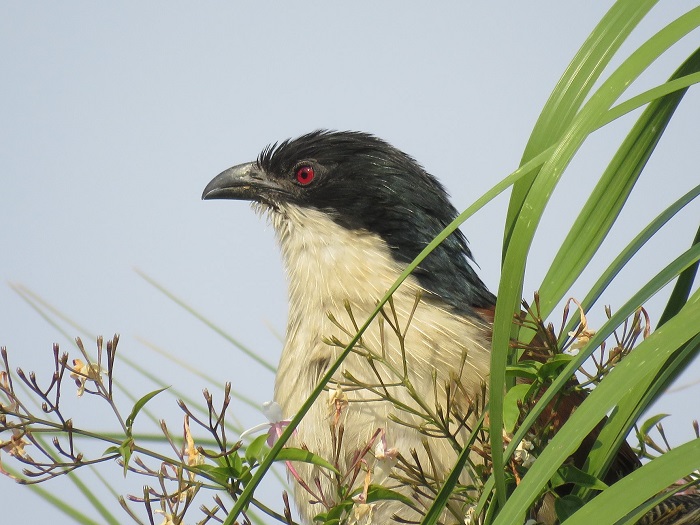
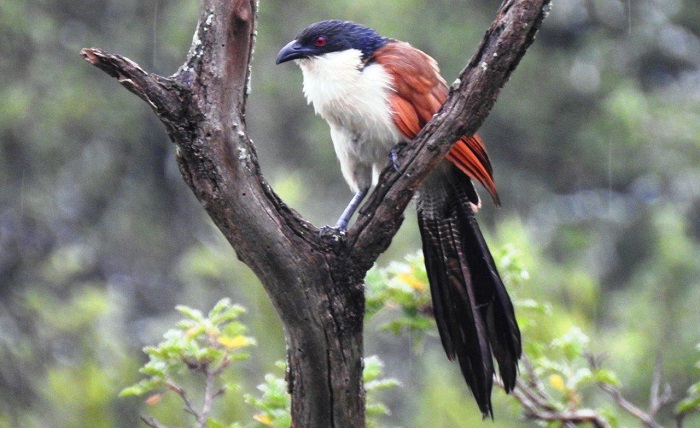
Burchell’s Coucal sexes are alike, although females are larger than males. They are predominantly tri-coloured in rich rufous, black and off-white. The Crown and face down to the upper mantle is plain black with a glossy tinge. The back and folded wings are chestnut. The rump and upper tail coverts are brown with fine buff-brown barring. The tail is relatively long and glossy black. The underparts are off-white, often with fine brown barring on the flanks and around the vent. There is noticeable white quill ‘streaking’ on the sides of the neck and upper flanks which is more conspicuous in birds from the southern parts of its range. The wings, above and below, are entirely rich rufous. The strong, arched bill is black, the eyes are red and the legs and feet are blue-grey to black.
Immature Burchell’s Coucal (Centropus burchellii) Photo by Gordon Neubert
Juvenile and immature birds have quite different plumage to the adults. Initially, as juveniles, the head and mantle are buff-coloured with off-white streaking, sometimes with white feather shafts. The rump and tail are dark matt brown with fine, dense barring. The wings are rufous with dense dark brown barring and the underparts are buff-brown and often barred. Later, immature birds develop an off-white eyebrow (supercilium) and have orange (not red) eyes. The barring on the back and wings is slowly lost with age, as is the supercilium. The underparts change from buffy-brown to off-white.
Immature Burchell’s Coucal (Centropus burchellii) Photo by Claudia Risch
There are 3 other similarly plumaged coucals in southern Africa. However, the range of the Burchell’s Coucal only overlaps with that of Senegal Coucal (Centropus senegalensis), reducing the risk of confusion. The adult Senegal Coucal lacks the fine barring at the base of the tail and on the upper tail coverts and rump. Juveniles of the two species are problematic to identify and are likely indistinguishable in the field.
Burchell’s Coucal (Centropus burchellii) Photo by Desire Darling
Status and Distribution
The Burchell’s Coucal is a fairly common to common resident and is near-endemic to Southern Africa. The distribution stretches from south-eastern Tanzania south through Mozambique, eastern Zimbabwe, to south-eastern Botswana, and most of South Africa to the south Western Cape. The Burchell’s Coucal avoids the more arid western and central parts of southern Africa, except for a narrow strip along the Orange River. It is also generally scarce at higher altitudes.
SABAP2 distribution map for Burchell’s Coucal (Centropus burchellii) – December 2024. Details for map interpretation can be found here.
The Burchell’s Coucal has expanded its range into the south-western Cape in recent years where it is now fairly common. This has been aided by its tolerance of a wide range of rank habitats, including well-wooded gardens. However, the continued loss and degradation of wetlands is likely to reduce habitat. The Burchell’s Coucal is not Threatened.
Burchell’s Coucal (Centropus burchellii) Photo by Cameron Meyer
Habitat
The Burchell’s Coucal inhabits, dense, tangled growth and rank vegetation including, thickets, reedbeds, coastal bush, and forest edge. It favours riparian margins and drainage lines, and the ecotones between wetlands and adjoining woodland, forest or grassland. It is also common in and adjacent to sugar cane fields and well-vegetated suburban gardens. The Burchell’s Coucal mostly occurs in areas where rainfall exceeds 600 mm per year.
Typical forest edge and riparian habitat with tangled growth and reedbeds near water. Kosi Bay, iSimangaliso Wetland Park Photo by Ryan Tippett
Behaviour
The Burchell’s Coucal is usually found in pairs or solitarily. It is a sedentary, resident species but may occasionally wander short distances into better habitat after fires or when wetlands dry up. They are partly crepuscular and most active in the early morning or during overcast and rainy weather. The colloquial name of ‘Rain Bird’ is fitting.
Burchell’s Coucal (Centropus burchellii) Photo by John Cox
Skulks in dense vegetation and clambers adeptly through vegetation. They often run on the ground between habitat patches, including crossing roads. Burchells Coucals are generally reluctant to fly. The flight appears heavy or laboured with alternate flapping and gliding before crashing, somewhat clumsily into dense vegetation. The Burchell’s Coucal is reportedly also able to swim when necessary.
Burchell’s Coucal (Centropus burchellii) Photo by Tony Archer
They are often shy and weary and seldom seen unless flying between thickets or perched on top of a bush or post. The Burchell’s Coucal is more often heard than seen. Their loud, liquid or bubbling call is heard most frequently in the early morning and before, during and after rain, but may continue throughout the day and on moonlit nights. They are largely silent outside of the breeding season. The Burchell’s Coucal bathes regularly in pools or wet vegetation and also sunbathes by drooping the wings and fanning the tail while perched on top of a bush.
Burchell’s Coucal (Centropus burchellii) Island Forest Reserve, Eastern Cape Photo by Rebecca Ackermann
The bill is strong and robust with a small hooked tip to kill and dismember their prey. Females have a longer and heavier bill than the males, this ensures that the sexes exploit different prey items, reducing competition for food. The Burchell’s Coucal slowly searches the ground and vegetation for prey. It is a rapacious predator that will devour any smaller creature it can overpower. Small prey is swallowed whole, but larger prey is broken into pieces or pulverised by pecking. Snails are beaten against a stone, tree root or similar hard object to break the shell. Hunts mice by stalking them like a cat and takes the chicks of domestic chickens in the same way. The Burchell’s Coucal is major predator of bird eggs and nestlings which they remove directly from nests. They are also drawn to fires to catch injured or fleeing animals.
Burchell’s Coucal (Centropus burchellii) Photo by Desire Darling
They consume a wide range of invertebrate and vertebrate prey. Invertebrates eaten include grasshoppers, locusts, crickets, mantids, bugs, beetles, moths, centipedes, scorpions, spiders, woodlice, crabs, and snails. Vertebrate prey includes chameleons, lizards, small snakes, frogs and toads, mice, shrews, young mole-rats, nestling birds, and adult birds up to the size of Laughing dove (Spilopelia senegalensis). Burchell’s Coucals are also known to take adult birds caught in mist nets! On occasion the Burchell’s Coucal will also eats fruits and berries.
Burchell’s Coucal (Centropus burchellii) with praying mantid prey. Photo by Tino Herselman
The Burchell’s Coucal is normally monogamous and pairs nest solitarily with nests widely spaced. However, it is the female who calls from a perch to advertise territory during the breeding season. This role reversal combined with the females larger size, suggests possible facultative polyandry. Facultative means optionally or flexibly in response to circumstances. This is a mating strategy wherein normally monogamous females mate with more than one male within a breeding period due to environmental pressures. The exact factors that may cause this in the Burchell’s Coucal seems to not be fully understood.
Burchell’s Coucal (Centropus burchellii) Photo by Ryan Tippett
The Burchell’s Coucal builds an unusual bulky, oval-shaped nest. It is a dome or ball up to 38cm high and up to 30cm wide. It has a circular entrance hole near the top on one side. Nests are sometimes also built without a roof. The nest is well concealed despite its size, and placed in the leafy foliage of a tree, bush, creeper, or dense stand of grass or reeds. It is typically situated 1 to 3 m above the ground, rarely at ground level. The nest is built by by both sexes or sometimes by the male only. Long, coarse strands of dry grass are used in its construction, which are roughly woven or curled around to form the ball. The interior cup is lined with finer grass and leaves. Further green leaves are added to the lining during incubation.
Immature Burchell’s Coucal (Centropus burchellii) Photo by Ryan Tippett
Eggs are laid between August and January across its range, even in the winter rainfall region. Egg laying peaks between October and December. Eggs are occasionally also laid in other months. 3 to 5 plain white eggs are usually laid per clutch at 1 to 3 day intervals. The incubation and nestling period is relatively short. Incubation lasts for 15 to 16 days and is performed by both sexes but the majority is done by the male. Incubation starts with the first laid egg and results in asynchronous hatching.
Burchell’s Coucal (Centropus burchellii) Photo by Malcolm Robinson
The nestlings are unique, having black skin and stiff, hair-like white down. They hiss when threatened or touched and void foul-smelling excreta if handled. The chicks legs develop quickly enabling them to run and clamber, and to leave the nest early. The young leave the nest at 14 to 21 days, long before they are able to fly. After leaving the nest the young are tended and cared for by both sexes. During very hot conditions the parents may regurgitate water for the chicks to drink.
A replacement clutch is often laid if the eggs or brood are lost early in the breeding process. Voluntary brood reduction may be enacted when food is scarce, with smaller, weaker nestlings being neglected to the point of starvation. The Burchell’s Coucal is multiple brooded during good conditions.
The Burchell’s Coucal (Centropus burchellii) is often active during overcast or rainy weather. Photo by Mark Stanton
Further Resources
This species text is adapted from the first Southern African Bird Atlas Project (SABAP1), 1997.
The use of photographs by Cameron Meyer, Claudia Risch, Desire Darling, Gordon Neubert, Gregg Darling, John Cox, Malcolm Robinson, Mark Stanton, Pieter Cronje, Rebecca Ackermann, Tino Herselman and Tony Archer is acknowledged.
Virtual Museum (BirdPix > Search VM > By Scientific or Common Name).
Other common names: Gewone vleiloerie (Afrikaans); uFukwe, umGugwane (Zulu); Ubikhwe (Xhosa); Burrchell-spoorkoekoek (Dutch); Coucal de Burchell (French); Tiputip (German); Cucal de Burchell (Portuguese).
Recommended citation format: Tippett RM 2025. Burchell’s Coucal Centropus burchellii. Biodiversity and Development Institute. Available online at https://thebdi.org/2025/01/15/burchells-coucal-centropus-burchellii/
Cover image of Spur-winged Goose by Ryan Tippett – Carnarvon district, Northern Cape
The Spur-winged Goose belongs to the family ANATIDAE comprising Ducks, Geese, and Swans. They are medium to very large water birds. They have broad, flattened bills with a curved nail at the tip of the upper mandible. They have robust bodies and moderate to very long necks. Their wings are relatively short, narrow and pointed while the tail is generally short. All have short but robust legs that are set far back on the body and fully webbed feet.
Identification
The Spur-winged Goose is a large, conspicuous, and distinctive water bird. It is the largest member of the family Anatidae in southern Africa.
Spur-winged Goose (Plectropterus gambensis) Umtentweni River, KwaZulu-Natal Photo by Dieter Oschadleus
The sexes are quite similar but males are larger than females. Adults are unmistakable. The head, flanks and upperparts are black with a green to violet iridescence, especially on the wings and back. The head and neck feathers are edged in brown. The face, chin, and throat carry varying amounts of white. The underparts are white, narrower on the breast and widening onto the belly and undertail coverts. In flight the wings show white forewings (axillaries, lesser coverts, and underwing coverts) and the flight feathers are glossy black. The amount of white on the wing is variable and is sometimes also visible when the wings are closed. There is also a large and prominent carpal spur on the wing.
The bare skin of the forecrown, forehead, cheeks and eye ring is usually pinkish to red and the cheek skin is variably mottled emerald and turquoise. Males usually have a dull red frontal knob that varies in size. The facial skin and frontal knob become brighter, and the knob becomes more swollen when breeding. Some also have a small bare red or orange patch on the side of the upper neck. The bill is deep pinkish red, and the nail-tip is whitish. The eyes are dark brown and the legs and feet are pink to deep pinkish red.
Females are very similar to the males, but their dark plumage is less iridescent and the bare facial skin is duller and less extensive.
Juveniles and immatures of both sexes lack bare facial skin and frontal knobs. Additionally, the face, neck, and lower body is browner than in adults. They also have no white on the face and less, or none, on the wings and underparts.
Spur-winged Goose (Plectropterus gambensis) Eastern Shores, iSimangaliso Wetland Park, KwaZulu-Natal Photo by Malcolm Robinson
The Spur-winged Goose is not likely to be confused for any other species. Its very large size and bold black and white colouration are unmistakable.
Spur-winged Goose (Plectropterus gambensis) Howick, KwaZulu-Natal Photo by Crystelle Wilson
Status and Distribution
The Spur-winged Goose is a locally common to verycommon resident with some local movement in the non-breeding season. It is distributed throughout the Afrotropics, except for the most densely forested parts of central Africa, the Lesotho plateau and the arid south-western parts of southern Africa. It extends northwards across Africa into southern Egypt, but is absent from Madagascar. The Spur-winged Goose is widespread in southern Africa but scarce in the more arid parts of the Northern Cape, southwestern Botswana, and Namibia except for the Caprivi Strip.
SABAP2 distribution map for Spur-winged Goose (Plectropterus gambensis) – December 2024. Details for map interpretation can be found here.
The Spur-winged Goose is not threatened. The negative impact of the loss of natural wetlands is largely offset by the benefits of dam-building and as a result may have increased its range into drier regions. It is sometimes regarded as an agricultural pest and has been utilising agricultural crops since the early early 1900s. The damage they cause to crops is occasionally significant but their overall impact is considered negligible.
Habitat
Typical habitat Mkhuze Game Reserve, KwaZulu-Natal Photo by Ryan Tippett
The Spur-winged goose inhabits a range of wetland habitats including floodplains, lakes, dams, pans, marshes, and to a lesser extent rivers and estuaries. They prefer larger inland waterbodies especially dams on which to gather for moulting. The Spur-winged Goose forages in a variety of habitats including dry or flooded grasslands, in the shallow waters of permanent or seasonal water bodies, and commonly in cultivated fields, usually not far from water.
Spur-winged Goose (Plectropterus gambensis) Berg River, Western Cape Photo by Rene Navarro
Behaviour
The Spur-winged Goose is generally nomadic in response to rain and the seasonal cultivation of their favoured food crops. They are generally found in pairs or small groups when breeding, but are otherwise highly gregarious and flocks of moulting birds can number up to 2000 birds. The Spur-winged Goose is usually shy and weary. Flies to the nearest water when disturbed, often settling far from shore. Disturbed birds in flightless moult move onto open water and dive if closely approached.
Spur-winged Goose (Plectropterus gambensis) Port Edward, KwaZulu-Natal Photo by Lia Steen
Male Spur-winged Geese may raise their wings in a threat display to reveal the white shoulders and carpal spurs. An attacking male will spread or flaps his wings, often with the mouth agape. The carpal spurs are used for fighting and in self defence. The Spur-winged Goose mostly roosts on dead trees or sometimes on electricity pylons. Flocks fly in staggered lines or sometimes in ‘V- shaped’ echelons, and their wings make a loud ‘swooshing’ sound in flight.
Spur-winged Goose (Plectropterus gambensis) Near Swellendam, Western Cape Photo by Gerald Gaigher
Foraging flights away from wetlands usually take place in the early morning and early evening. They may stay away from wetlands all day and occasionally all night during the wet season, when they may stay at temporary pools.
Spur-winged Goose (Plectropterus gambensis) Near Vosburg, Northern Cape Photo by Ryan Tippett
Most foraging takes place in the morning, evening or at night. On land the Spur-winged Goose grazes plant shoots or pecks at food and scratches for grubs with the bill. In water they submerge the head and neck, or sometimes up-ending, usually after raking the muddy substrate with the feet. They also filter-feed as they move about on the water. Birds in flightless moult sometimes come ashore at night to graze.
Spur-winged Goose (Plectropterus gambensis) Sappi Mbozambo Bird Sanctuary, KwaZulu-Natal Photo by Dave Rimmer
The Spur-winged Goose is omnivorous, but the bulk of the diet is made up of plant matter such as rhizomes, corms, leaves, seeds, and algae. They eat the ripe kernels and seedlings of grain crops, including maize, wheat, oats, barley, sorghum, etc. They also eat lucerne and the leaves, stems and tubers of potatoes and sweet potatoes. Peanuts, sunflower seeds, rice and over-ripe fallen fruit are also consumed. Some animal matter is also eaten, including termite alates, bugs, caterpillars, beetles and their larvae, etc. Young Spur-winged Geese are known catch small fish by diving. The Spur-winged Goose also swallows grit to help the gizzard grind up food. They are known to sometimes associate with Hippopotamus (Hippopotamus amphibius) in order to feed on disturbed plant matter and invertebrates.
Breeding data from across southern Africa indicates that the Spur-winged Goose mainly breeds from August to April with a peak between December and March. It generally breeds during the rainy season but egg laying has been recorded in all months. They can be either monogamous or polygynous breeders.
The nest is a hollow on the ground, lined with grass and down feathers, and is built by the female. It is usually located in dense vegetation near water like tall grass, reed clumps or on a termite mound. They sometimes also nest on top of Sociable Weaver (Philetairus socius), Hamerkop (Scopus umbretta) or African Fish Eagle (Haliaeetus vocifer) nests. On rare occasions they may nest in tree holes, on cliffs or in Aardvark burrows.
Spur-winged Goose (Plectropterus gambensis) Illovo, KwaZulu-Natal Photo by Garth Aiston
The Spur-winged Goose usually lays 6 to 12 eggs, rarely up to 27. Clutches over 12 eggs are probably laid by more than one female. Incubation is done by the female only and lasts for 32 to 36 days. Eggs are laid at 1 day intervals and incubation begins only once the full clutch has been laid. The eggs are covered with down when the female leaves the nest to feed. The vast majority of broods are attended by the female only. Females with small ducklings become very secretive, swimming low on the surface to lead their brood into cover when disturbed. Young birds take anywhere from 85 to 100 days to fledge and stay with the female until at least the following breeding season.
Spur-winged Goose (Plectropterus gambensis) Amanzimtoti Bird Sanctuary, KwaZulu-Natal Photo by Dave Rimmer
Further Resources
Species text from the first Southern African Bird Atlas Project (SABAP1), 1997.
The use of photographs by Crystelle Wilson, Dave Rimmer, Dieter Oschadleus, Garth Aiston, Gerald Gaigher, Lia Steen, Malcolm Robinson, Rene Navarro and Tino Herselman is acknowledged.
Virtual Museum (BirdPix > Search VM > By Scientific or Common Name).
Other common names: Wildemakou (Afrikaans); iHophe, iHoye (Zulu); lhoye (Xhosa); Sekwagongwana (Tswana); Spoorwiekgans (Dutch); Oie-armée de Gambie (French); Sporengans (German); Pato-ferrão (Portuguese)
A list of bird species in this format is available here.
Recommended citation format: Tippett RM 2025. Spur-winged Goose Plectropterus gambensis. Biodiversity and Development Institute. Available online at https://thebdi.org/2025/01/10/spur-winged-goose-plectropterus-gambensis/
Cover image of Red-headed Finch by Ryan Tippett – Carnarvon district, Northern Cape
The Red-headed Finch belongs to the family ESTRILDIDAE, along with twinspots, firefinches, waxbills, pytilias, and mannikins, etc. They are all small, seed-eating passerine birds. They are gregarious and often colonial granivores with short, conical, but pointed bills. They are all similar in structure and habits, but vary widely in plumage colour and patterns. Despite the word “finch” being included in the common names of some species, they are not closely related to birds with this name in other families.
Identification
The Red-headed Finch is a small, gregarious species with clear sexual dimorphism.
Males are easily recognised by their bright red heads, heavy, conical bills, and white scale-like spotting on the undersides. The red head fades to orangish-red when the feathers are old and worn. The mantle, back and folded wings are greyish brown. On the folded wings there are two lines of white spots formed by the pale-tipped covert feathers. The rump is darker grey-brown and faintly barred. The upper tail coverts carry dark subterminal bars with whitish tips. The tail is also greyish-brown with white outer tail tips.
The breast and flanks are tawny-brown with scattered white spots, each outlined in black, giving a scaled or scalloped appearance. The lower belly is white and the under-tail coverts are barred black, white and brown.
Red-headed Finch (Amadina erythrocephala) Etosha National Park, Namibia Photo by Johan Van Rooyen
Females resemble the males but differ in having a plain brownish-grey head, (sometimes with a hint of red on the hind crown and nape). The underparts are tawny-brown and uniformly barred in dark brown, lacking the black-edged white spots of the male. Juveniles are similar to their respective adults, but are duller. The juvenile male only shows traces of red on the head.
In both sexes the heavy, conical bill is pale horn-coloured. The eyes brown and the legs and feet are pinkish brown.
Male Red-headed Finch are most likely to be mistaken for the Red-headed Quelea (Quelea erythrops), but the latter lacks the distinctive scalloped spotting on the underparts. Females most resemble the Cut-throat Finch (Amadina fasciata) but that species has a barred (not plain) crown and nape, and a conspicuously mottled (not plain brown) mantle.
Status and Distribution
The Red-headed Finch is a common to very common resident and nomad. It is near-endemic to southern Africa.
It occurs from Luanda in Angola, south to South Africa. In southern Africa, the Red-headed Finch is widespread in Namibia, Botswana, and the central regions of South Africa. It is also found in south-western Zimbabwe where it is less common. The Red-headed Finch is virtually absent from the winter rainfall region and the more humid coastal areas and lowlands in the east.
SABAP2 distribution map for Red-headed Finch (Amadina erythrocephala) – December 2024. Details for map interpretation can be found here.
The Red-headed Finch is not threatened. It has benefitted greatly from livestock watering points in arid areas and as a result has likely expanded its range in recent decades.
Habitat
The Red-headed Finch inhabits open desert grasslands, semi-arid and arid shrublands in Namibia and the Karoo, arid savanna, croplands and farmyards. Usually with scattered trees and bushes. The Red-headed Finch is also frequently found in urban areas. They may shift from more thickly wooded thornbush in the breeding season to more open habitats after breeding.
Typical arid savanna habitat. Mokala National Park, Northern Cape Photo by Karis Daniel
Behaviour
The Red-headed Finch is found in pairs or small groups when breeding. They are otherwise gregarious in well-coordinated flocks that may number into the hundreds. They are highly nomadic by nature, especially during dry periods, and eruptive when conditions are favourable. Often feeds and drinks in association with other seed-eating bird species. The Red-headed Finch is reliant on drinking water and drinks frequently, gathering at water holes in large flocks, often with other small granivores. The flight is fast and undulating, flying to perch in a tree, bush, or fence when disturbed.
Red-headed Finch (Amadina erythrocephala) Rooiklip, Namibia Photo by Johan Van Rooyen
The Red-headed Finch forages on the ground. They mainly eat seeds, favouring grass seeds, and will also eat small insects like termites.
The Red-headed Finch is a monogamous breeder and they either nest solitarily or in small colonies. Mostly reuses the old nests of various weavers and sparrows, including Cape Sparrow (Passer melanurus), Southern Masked Weaver (Ploceus velatus), Chestnut Weaver (Ploceus rubiginosus), Sociable Weaver (Philetairus socius), White-browed Sparrow-weaver (Plocepasser mahali), and Red-billed Buffalo Weaver (Bubalornis niger). They sometimes also nest in tree holes or buildings. The Red-headed Finch occasionally also builds its own nest which is an untidy ball of grass and feathers placed in the branches of a thorny tree.
Red-headed Finch (Amadina erythrocephala) Klerksdorp, North West Photo by Tony Archer
Egg-laying has been recorded throughout the year depending on rainfall, but most eggs are laid from February to September. Anywhere from 2 to 11 eggs are laid per clutch, (usually 4 to 6 eggs). The eggs are plain white and oval in shape. The incubation period takes 12 to 14 days and is performed by both sexes. The nestling period takes a further 15 to 21 days and the young are cared for and fed by both parents.
Species text adapted from the first Southern African Bird Atlas Project (SABAP1), 1997.
The use of photographs by Johan Van Rooyen, Karis Daniel, Sybrand Venter, and Tony Archer is acknowledged.
Virtual Museum (BirdPix > Search VM > By Scientific or Common Name).
Other common names: Rooikopvink (Afrikaans); Rotkopfamadine (German); Amadine à tête rouge (French); Roodkopamandine (Dutch); Degolado-de-cabeça-vermelha (Portuguese).
Recommended citation format: Tippett RM 2025. Red-headed Finch Amadina erythrocephala. Biodiversity and Development Institute. Available online at https://thebdi.org/2025/01/06/red-headed-finch-amadina-erythrocephala/
List of bird species in this format is available here.
Cover image: Pied Kingfisher by Colin Summersgill – Albert Falls Nature Reserve, KwaZulu-Natal
Kingfishers belong to the family ALCEDINIDAE. They are small to medium-sized, brightly coloured birds in the order Coraciiformes. They have a cosmopolitan distribution, with most species living in the tropical regions of Africa, Asia, and Oceania, with just a handful of species found in Europe and the Americas. The family contains 118 species and is divided into three subfamilies and 19 genera. All kingfishers have large heads, long, sharp, pointed bills, short legs, and stubby tails. Most species have bright plumage with only small differences between the sexes. Most species are tropical in distribution, and a slight majority are found only in forests. Despite the English name ‘Kingfisher’, the majority of species do not feed on fish.
Identification
The Pied Kingfisher is easy to identify as it is the only kingfisher in the region with entirely black-and-white plumage. It is the second largest African Kingfisher after the Giant Kingfisher (Megaceryle maxima).
Male Pied Kingfisher (Ceryle rudis) Nile River, Northern State, Sudan Photo by Mohamed Salah
The head is black with a conspicuous white supercilium and with a short crest. Pied Kingfishers have a relatively large-headed appearance when compared to the rest of the body. This is due in part to the long straight, and heavy black bill. The upper parts are mottled in black and white. The underparts are mainly white, often with Some dusky flecks on the flanks. The under-tail is predominantly black. The sexes can be differentiated by the black bands across the breast. Both sexes have a broad, upper breast-band that is usually (but not always incomplete). Males also have a second, thinner breast-band below (lacking in females). In both sexes the bill, legs and feet are black, and the eyes are dark brown.
Female Pied Kingfisher (Ceryle rudis) Garden Route National Park, Western Cape Photo by Jean Hirons
Juveniles resemble the female but have a greyish-black breast band and the feathers on the face, throat, and breast have buffy edges.
The Pied Kingfisher is distinctive and conspicuous at all ages and is unlikely to be mistaken for any other species.
Pied Kingfisher (Ceryle rudis) Marievale Bird Sanctuary, Gauteng Photo by Johan Heyns
Status and Distribution
The Pied Kingfisher is a Locally common resident or local nomad in response to changing water levels. It has a very wide distribution and occurs throughout sub-Saharan Africa except the Horn of Africa and much of the south-west arid zone in southern Africa. The Pied Kingfisher is also present along the Nile River valley in Egypt. The distribution also extends across the Middle East and southern Asia to China.
SABAP2 distribution map for Pied Kingfisher (Ceryle rudis) – December 2024. Details for map interpretation can be found here.
The Pied Kingfisher is not threatened, and is well represented in protected areas. Some populations are locally impacted by the application of endosulfan to kill tsetse flies (Glossina spp), endosulfan also kills fish. Pied Kingfishers are also susceptible to other poisons used for killing both fish and Red-billed Queleas. The species has benefited widely from the construction of impoundments for irrigation and hydroelectric power.
Pied Kingfisher (Ceryle rudis) Tshipise district, Limpopo Photo by John Wilkinson
Habitat
Typical Habitat Mkhuze Game Reserve, KwaZulu-Natal Photo by Ryan Tippett
The Pied Kingfisher makes use of virtually any type of water body and its occurrence is entirely dependant on the presence of small fish. Chosen habitats include perennial streams, large rivers, lakes, ephemeral pans, temporarily flooded areas, estuaries, and rocky coastlines. They also inhabit man-made canals, dams, reservoirs, ornamental ponds and sewage works if fish are present. They are less common along well-wooded, fast-flowing streams. Pied Kingfishers are restricted to major rivers and impoundments in arid country. For breeding they require suitable banks for the excavation of nest tunnels.
Pied Kingfishers (Ceryle rudis) frequently forage along rocky coastlines. Shelly Beach, KwaZulu-Natal Photo by Lia Steen
Behaviour
The Pied Kingfisher is usually encountered solitarily, in pairs or loose family groups. They roost gregariously at night. Pied Kingfishers perch conspicuously in the open on an exposed branch, rock, pole, etc. They frequently raise and lower their tails when perched.
They bathe by diving, often repeatedly, before flying off to perch. They then shake vigorously before preening.
Pied Kingfisher (Ceryle rudis) Near Johannesburg, Gauteng Photo by Jennifer Sterne
They hunt from a prominent perch over water, or frequently by hovering. The Pied Kingfisher hovers more efficiently and far more often than any other kingfisher. Hovering enables them to hunt over open water without perches and provides a competitive advantage over other kingfisher species. This allows them to hunt far (up to 3km) from shore. The Pied Kingfisher is thought to be the world’s largest bird capable of sustained hovering in still air. When hovering, the body is held almost vertically, with the head well forward. Pied Kingfishers hover more often in windy conditions.
Pied Kingfisher (Ceryle rudis) Nile River, Northern State, Sudan Photo by Mohamed Salah
The diet consists mainly of fish up to 26 g. Frogs and large tadpoles are eaten less frequently. Invertebrates are also consumed, including crustaceans, dragonflies and their larvae, water bugs, water beetles, and the occasional terrestrial insect like grasshoppers.
Fish are usually beaten to death on a branch or rock before being swallowed, head first to prevent fish spines snagging in the throat.
Pied Kingfisher (Ceryle rudis) Marievale Bird Sanctuary, Gauteng Photo by Johan Heyns
Pied Kingfishers are monogamous breeders. Around a third of all breeding pairs are facultative cooperative breeders, with up to 4 male helpers.
Pied Kingfisher (Ceryle rudis) Pilanesberg National Park, North West Photo by Bryan Groom
There are two distinct types of helpers. Primary helpers are the male offspring of previous breeding attempts that have failed to disperse or establish breeding territories of their own. They assist from the beginning, helping to defend the territory, and are vital to breeding success. Secondary helpers are also males. They are not related to the breeding pair and usually arrive after the eggs have hatched towards the end of the breeding attempt. They are typically unmated males or males whose breeding attempts have failed. Secondary helpers are initially chased away by the breeding pair and play a lesser role in the breeding success. Primary helpers have smaller testes and lower testosterone levels than the breeding male or the secondary males. They are therefore incapable of breeding, hence their greater commitment during the breeding cycle. Primary helpers have a lower survival rate than secondary helpers due to their efforts, but this cost is offset by ensuring that their own genes are passed on by helping to raise their siblings or half-siblings.
Pied Kingfisher (Ceryle rudis) Mkhuze Game Reserve, KwaZulu-Natal Photo by Ryan Tippett
Pairs nest solitarily, but sometimes also in loose colonies. Pied Kingfishers are territorial with pairs and helpers defending the nest burrow and its immediate vicinity.
The nest is a burrow, up to 2.4 meters long, dug into a vertical sandbank. Nest tunnels are usually situated in the most inaccessible position available to reduce the threat of predation. Tunnels are excavated by both sexes. The soil is first loosened with the open bill and then kicked out with the feet. On average, the nest tunnel takes 26 days to complete, but can take anywhere from 11 to 77 days. At the end of the tunnel is an unlined nest chamber, usually around 300 mm long, 200 mm wide, 130 mm high.
Egg laying is recorded in all months but is somewhat dependant on local water levels. Most records in southern Africa are from August to November, except in the Okavango Delta, Botswana (May to June peak) due to the annual flood cycle.
Clutch size ranges from 1 to 7 eggs, although 4 to 6 eggs is the norm. The eggs are glossy and pure white in colour. Incubation begins with the first laid egg and lasts for 18 days. Incubation is performed by both sexes, but mostly by the female. During the breeding process, males will only feed their mates but helpers will feed both breeding birds.
Pied Kingfisher (Ceryle rudis) walter Sisulu Botanical Gardens, Gauteng Photo by Lia Steen
The full clutch takes up to 3 days to hatch. The newly hatched young are altricial and are born blind and naked with pink skin. The nestling period takes 24 to 29 days. The nestlings are brooded by both sexes and sometimes also by the helpers. Young can shake and beat fish within 3 days of leaving the nest and start diving for prey within 14 days after fledging. However, the young are still fed by their parents and helpers for up to 2 months after leaving the nest. If there are no helpers, the young are fed almost equally by both adults. If helpers are present, the female does very little feeding or no feeding at all.
Pied Kingfisher (Ceryle rudis) walter Sisulu Botanical Gardens, Gauteng Photo by Colin Summersgill
Clutches and broods of the Pied Kingfisher are often at risk from flooding, trampling, irregular incubation, and predation by ants, snakes, and mammals, particularly the Water Mongoose (Atilax paludinosus) which is amajor predator of both young and adults. Nestlings of pairs without helpers have a reduced chance of survival and frequently starve to death. Pied Kingfishers will frequently re-lay after an early breeding failure.
Pied Kingfisher (Ceryle rudis) walter Sisulu Botanical Gardens, Gauteng Photo by Ruth Robinson
Further Resources
This species text is adapted from the first Southern African Bird Atlas Project (SABAP1), 1997.
The use of photographs by Ansie Dee Reis, Colin Summersgill, Dawie de Swardt, Dieter Oschadleus, Johan Van Rooyen Lia Steen, Marius Meiring, Neels Putter, Pamela Kleiman, Walter Jubber and Wiekus Moolman is acknowledged.
Virtual Museum (BirdPix > Search VM > By Scientific or Common Name).
Other common names: Bontvisvanger (Afrikaans); iHIabahlabane, isiQuba, isiXula (Zulu); Isaxwila (Xhosa); N’waripetani, Xicelele (Tswana); Bonte Ijsvogel (Dutch); Alcyon pie, Martin-pêcheur pie (French); Graufischer (German); Pica-peixe-malhado (Portuguese).
Recommended citation format: Tippett RM 2024. Pied Kingfisher Ceryle rudis. Biodiversity and Development Institute. Available online at https://thebdi.org/2024/05/23/malachite-kingfisher-alcedo-cristata/
Cover image of Golden-breasted Bunting by Ansie Dee Reis – Dikhololo Resort, North West
Buntings belong to the Family: EMBERIZIDAE. The buntings are a group of Old World passerine birds forming the genus Emberiza, which is the only genus in the family. The family contains 44 species. They are seed-eating birds with stubby, conical bills, comparatively long tails, and short legs. The feet are relatively large for scratching on the ground.
Identification
The Golden-breasted Bunting is a small, colourful species with slight differences in plumage coloration between the sexes.
In adult males the forehead, lores, face, crown, nape and neck are black, with a white median crown stripe, a broad white supercilium and a shorter white moustachial stripe below the eye. There is a pale collar on the hind neck and the mantle and back are pinkish brown to chestnut, with blackish brown centres and pinkish-brown borders. The folded wings show two white wing bars. The rump is grey and the upper tail coverts are buffy grey while the tail is grey-brown, with white outer tail feathers.
On the undersides, the chin is pale yellowish-orange and the throat is rich yellow. The breast is golden orange, fading to rich yellow on the belly. The flanks are pale greyish olive or occasionally white. The thighs are rich yellow and the under tail coverts are white. The bill is two-toned with a blackish upper mandible and a pale greyish-pink lower mandible. The legs and feet are dull greyish-pink and the eyes are dark brown.
Golden-breasted Bunting (Emberiza flaviventris) Kruger National Park, Limpopo Photo by Colin Summersgill
Females are similar to males, but their black head markings are suffused with brown. They are duller overall, including the chestnut back and wings. Juveniles resemble females but are duller with brown streaks on the breast.
In southern Africa, the Golden-breasted Bunting is only likely to be mistaken for Cabanis’s Bunting Emberiza cabanisi. The latter lacks the white stripe below the eye and has white (not yellowish) sides to the throat. The back is greyish (not rufous) with black streaks and the breast is plain yellow (not golden-orange).
Golden-breasted Bunting (Emberiza flaviventris) Hwange National Park, Zimbabwe Photo by Derek Solomon
Status and Distribution
The Golden-breasted Bunting is a fairlycommon resident and local nomad. It is found throughout most of sub-Saharan Africa but is absent from much of West Africa. The Golden-breasted Bunting is widespread in southern Africa except for southern and western Namibia, the south-western Kalahari, the semiarid and arid Karoo, and Western Cape fynbos.
SABAP2 distribution map for Golden-breasted Bunting (Emberiza flaviventris) – December 2024. Details for map interpretation can be found here.
The Golden-breasted Bunting has been able to colonise alien plantations in previously treeless grasslands. There is no evidence that the overall distribution has changed much in the recent past. The Golden-breasted Bunting is not threatened and remains a common and widespread species across its range.
Golden-breasted Bunting (Emberiza flaviventris) Mokala National Park, Northern Cape Photo by John Todd
Habitat
The Golden-breasted Bunting prefers open broadleaved woodlands as well as mixed woodlands and Savanna. It also inhabits dry woodlands along rivers, tall shrubland on stony or rocky ground, exotic plantations, farmyards, the edges of croplands, and gardens. It is less common in pure Vachellia/Senegalia (Acacia) woodlands. The Golden-breasted Bunting avoids tall, dense riverine woodland.
Typical woodland habitat Ithala Game Reserve, KwaZulu-Natal Photo by Ryan Tippett
Behaviour
The Golden-breasted Bunting is unobtrusive, but not particularly shy. They are normally encountered singly, in pairs, or family groups during the breeding season. They are generally found in pairs or small flocks of up to 20 birds in the non-breeding season. The Golden-breasted Bunting is mostly resident but may become locally nomadic during the dry season when they may also form mixed species flocks with other buntings and canaries.
Golden-breasted Bunting (Emberiza flaviventris) Pilanesberg National Park, North West Photo by Philip Nieuwoudt
Golden-breasted Buntings forage on the ground (usually on bare patches) and in the canopies of shrubs and small trees. They are drawn to freshly burnt areas to take advantage of dead or injured insects and other food items. They walk with small steps but sometimes also hop. The flight is somewhat undulating.
Golden-breasted Bunting (Emberiza flaviventris) Bonamanzi Game Reserve, KwaZulu-Natal Photo by Jorrie Jordaan
The diet consists of flower buds, seeds, and insects, including small grasshoppers, beetles, termites, and ants. Occasionally they take grass seeds directly from seed heads on low-growing tufts. They have also been seen to peck at salt licks put out for cattle. Golden-breasted Buntings drink and bathe regularly.
Golden-breasted Bunting (Emberiza flaviventris) Kruger National Park, Mpumalanga Photo by Terry Terblanche
The Golden-breasted Bunting is a monogamous, solitary nester and is not known to be territorial. Courtship displays involve the male singing from conspicuous perches and in bouncing ‘butterfly flight’ while singing. Males will also courtship-feed the female prior to copulation.
The nest is a fairly deep, loosely built cup of grass, pliable plant stems, tendrils, and leaf petioles. It is lined with fine rootlets and hair. All nest construction is done by the female, but she is accompanied by the male on trips to gather material. The nest is typically placed 0.5 to 2.0 m above the ground on a horizontal fork in a bush or tree.
Nesting data all comes from October to May, with a November/December peak over most of the range. Two to five (usually two or three) eggs are laid per clutch. The eggs are either white, pale cream, pale greenish blue or pale bluish white, decorated with black, brown and grey spots and scrolled lines.
The incubation period takes up to 13 days and all incubation is performed by the female only. Newly hatched young have orange skin. The nestling period lasts for 16 to 17 days and the young are cared for by both adults. The nestlings are fed by both parents on regurgitated insects and some seeds. Fledglings out of the nest are known to be fed with small grasshoppers.
Golden-breasted Bunting broods are sometimes parasitised by Diederik Cuckoo Chrysococcyx caprius.
Golden-breasted Bunting (Emberiza flaviventris) Tshipise, Limpopo Photo by John Wilkinson
Further Resources
Species text in the first Southern African Bird Atlas Project (SABAP1), 1997.
The use of photographs by Ansie Dee Reis, Colin Summersgill, Derek Solomon, Gregg Darling, John Wilkinson, Jorrie Jordaan, Neels Putter, Philip Nieuwoudt, John Todd, Terry Terblanche, and Tino Herselman is acknowledged.
Virtual Museum (BirdPix > Search VM > By Scientific or Common Name).
Other common names: Rooirugstreepkoppie (Afrikaans); umNdweza (Zulu); Intsasa (Xhosa); Mavotiyo (Tswana); Gelbbauchammer (German); Bruant à poitrine dorée (French); Goudborstgors, Acacia-gors (Dutch); Escrevedeira-de-peito-dourado (Portuguese).
List of bird species in this format is available here.
Recommended citation format: Tippett RM 2024. Golden-breasted Bunting Emberiza flaviventris. Biodiversity and Development Institute. Available online at https://thebdi.org/2024/12/10/golden-breasted-bunting-emberiza-flaviventris/