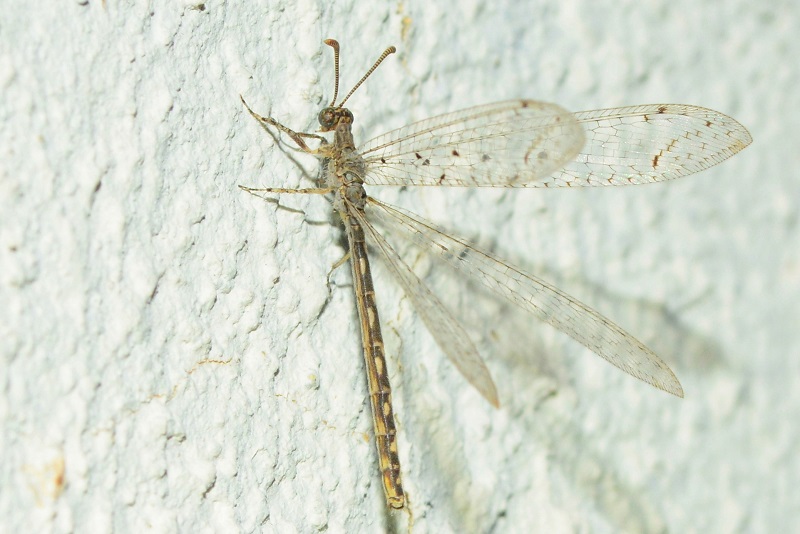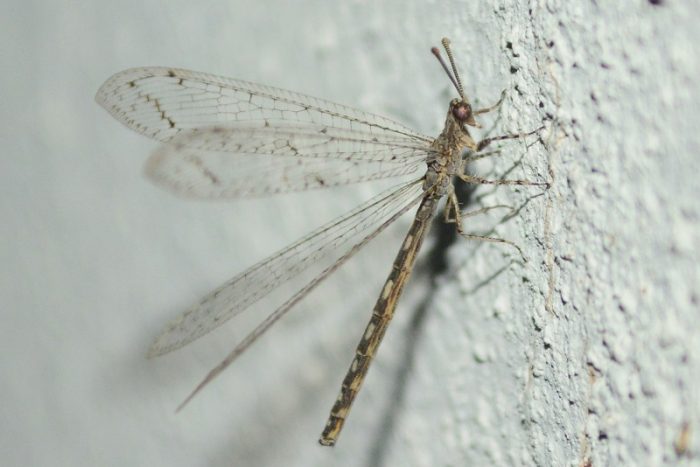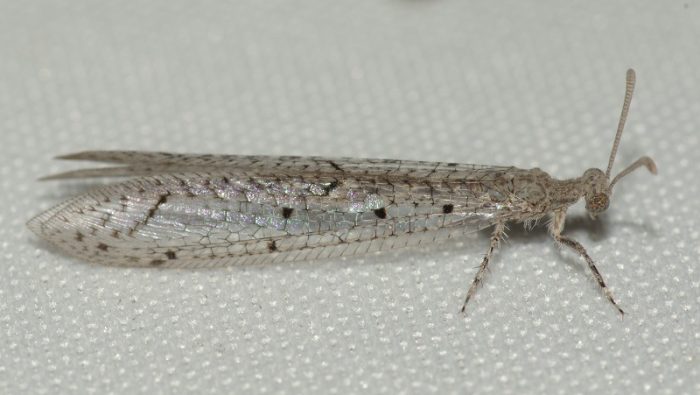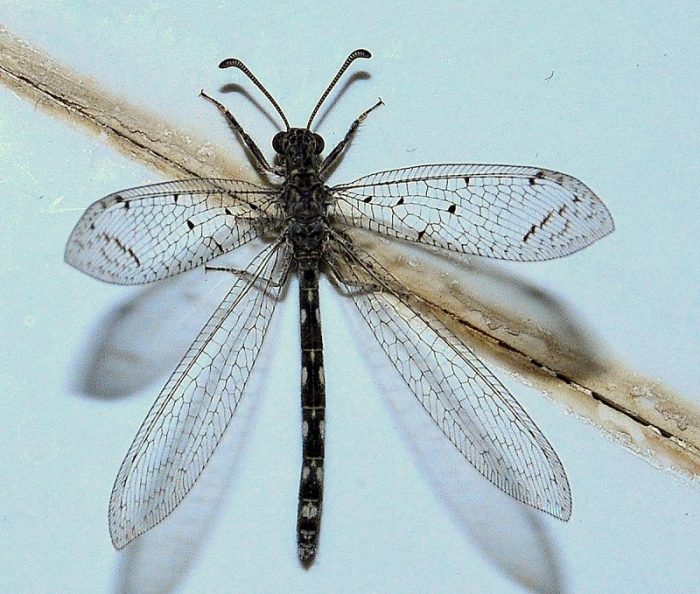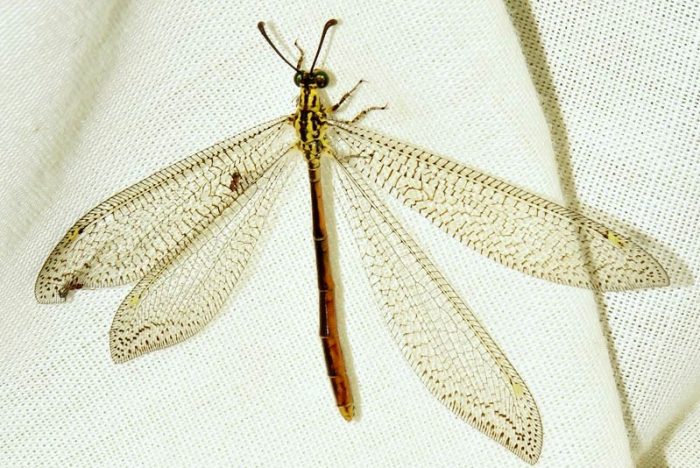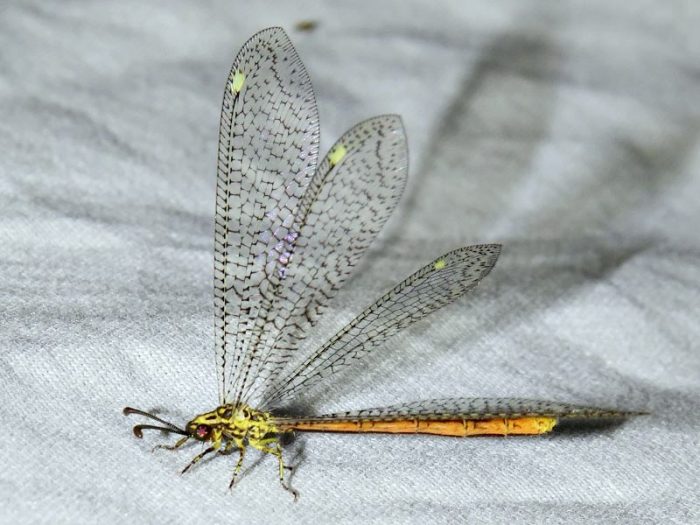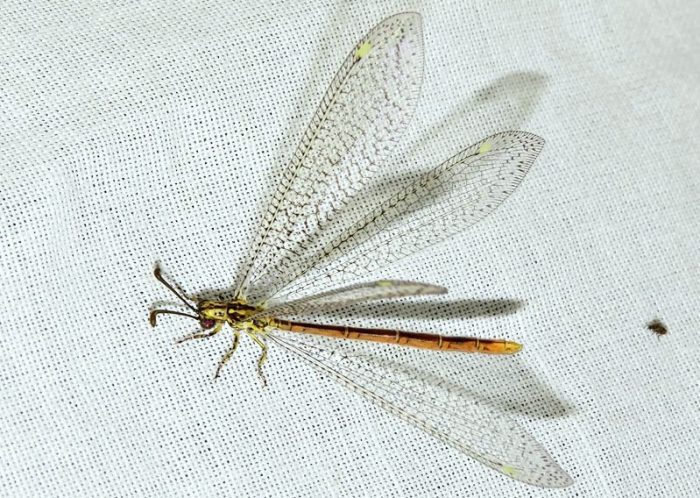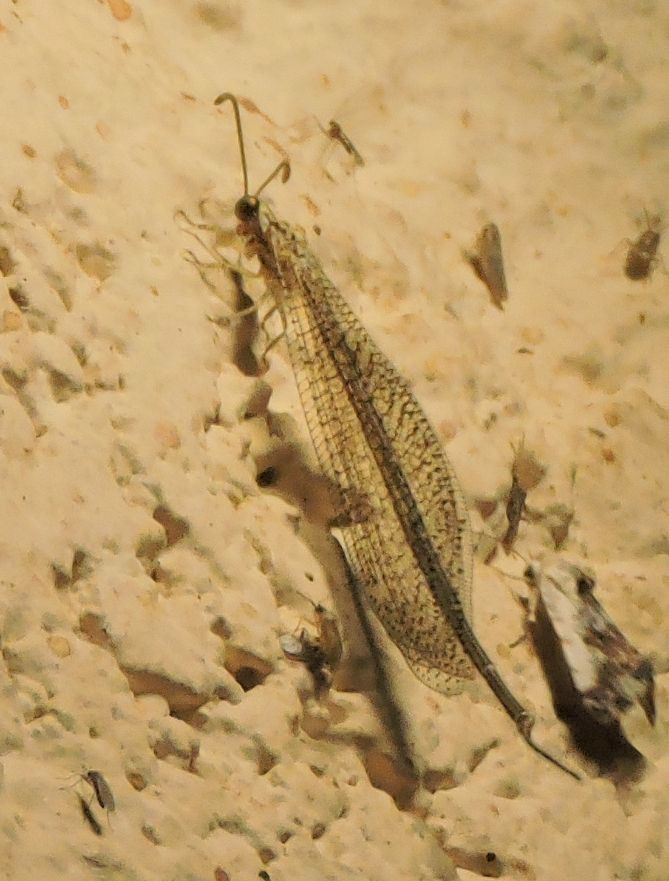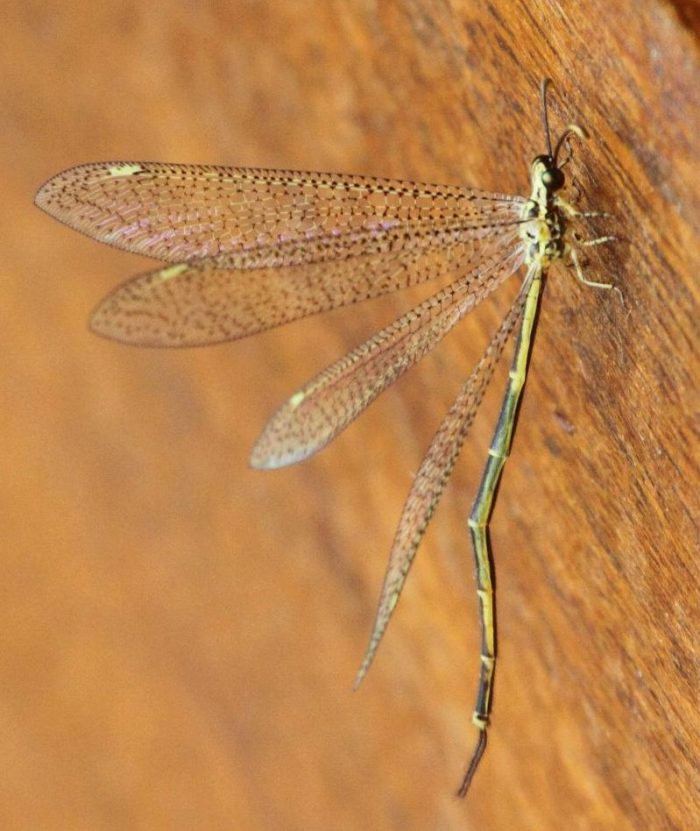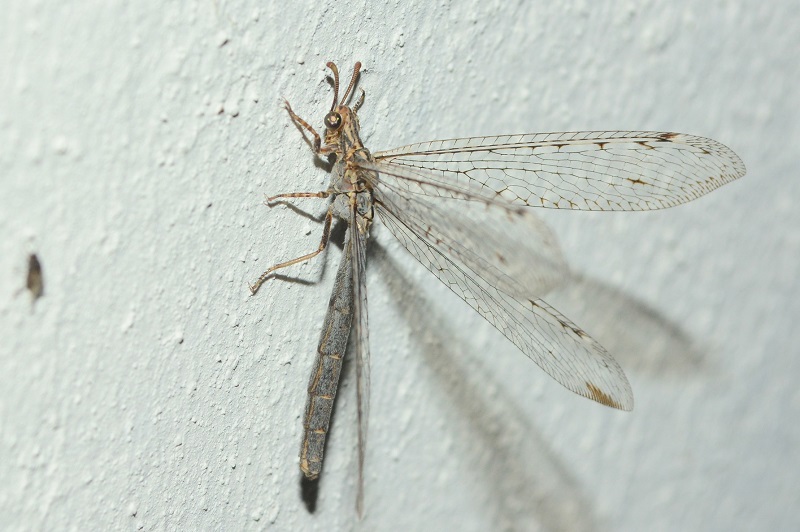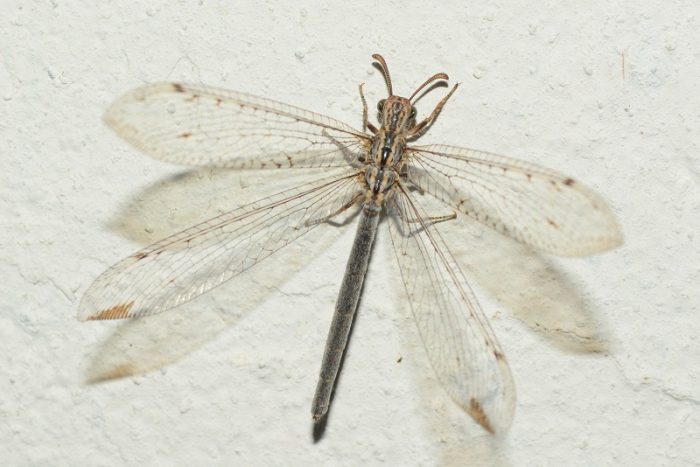
Eremoides bicristatus

View the above photo record (by Stephen Ball) in LacewingMAP here.

Ascalaphidae (Owlflies)

Eremoides bicristatus

 (Banks, 1924)

Identification

Size: Medium sized (Wingspan 60mm)

Males have very characteristic “epaulets or flanges” on the thorax – hence the name “bicristatus”, each ending in a small hook. The flanges are absent in females.

The body is predominantly yellow with some brown lines running lengthwise down the abdomen. The wings are clear with a conspicuous brown leading edge.

As with other owlflies, they possess long, clubbed antennae.

The larvae of this species are unknown.

Eremoides bicristatus (Male) – Near Beestekraal, North West Province
Photo by Evert Kleynhans
Eremoides bicristatus (Male) – Near Beestekraal, North West Province
Photo by Evert Kleynhans

Habitat

Eremoides bicristatus is a species of grasslands and grassy areas in woodland and savanna. It is often found in damp places near wetlands.

Habitat – Near Hluhluwe, KwaZulu-Natal
Photo by Ryan Tippett

Behaviour

Adults are frequently flushed from long grass. They fly rapidly but will soon settle again on a grass stem. They hawk smaller flying insects at dusk.

Eremoides bicristatus is sometimes attracted to light. Adults are recorded during Summer from September to March.

The larvae, like others in the genus, are thought to live on vegetation where they are ambush predators of other insects.

Eremoides bicristatus (Female) – Nylsvlei Nature Reserve, Limpopo
Photo by Jacobus Labuschagne

Status and Distribution

Eremoides bicristatus is fairly common and widespread in the northern parts of South Africa and is also known from Botswana, Mozambique, Namibia, Swaziland, Zimbabwe and Zambia.

Distribution of Eremoides bicristatus. Taken from the LacewingMAP database, January 2023.

Taxonomy:

Order: Neuroptera Family: Ascalaphidae Subfamily: Ascalaphinae Tribe: Ascalaphini Genus: Eremoides Species: bicristatus

Eremoides bicristatus (Female) – Danielskuil, Northern Cape
Photo by Aletta Liebenberg

Further Resources

Virtual Museum (LacewingMAP > Search VM > By Scientific or Common Name)

Acknowledgements:

The use of photographs by Aletta Liebenberg, Evert Kleynhans, Jacobus Labuschagne and Stephen Ball is acknowledged. This species text has benefited enormously from comments made by Mervyn Mansell on records he has identified in LacewingMAP. We acknowledge his important contribution.

Recommended citation format for this species text:

Tippett RM 2022. Eremoides bicristatus. Biodiversity and Development Institute, Cape Town.
Available online at http://thebdi.org/2023/01/09/eremoides-bicristatus/

Syngenes longicornis

View the above photo record (by Ryan Tippett) in LacewingMAP here.

Myrmeleontidae (Antlions)

Syngenes longicornis

(Rambur, 1842)

Identification

Size: Medium sized

Syngenes longicornis is an attractive species with a bold black and yellow abdomen and intricately patterned wings. The thorax and legs are covered in conspicuous bristle-like setae (hairs).

Larvae: The large larvae have a striking white colouration.

Syngenes longicornis – Eastern Cape
Photo by Marie Delport
Syngenes longicornis – Ndumo Game Reserve, KwaZulu-Natal
Photo by Richard Johnstone

Habitat

Syngenes longicornis occupies sandy, well-wooded habitats including bushveld, Sandforest and dune forest along the East Coast of South Africa.

Habitat – Mlalazi Nature Reserve, KwaZulu-Natal
Photo by Ryan Tippett

Behaviour

Adults often form aggregations on the undersides of branches where they are well camouflaged against tree bark. They are occasionally attracted to lights and are active during late Summer from December to April.

The larvae live in coastal dune sand and are very active, but do not construct pits.

Syngenes sp. larvae – Selati Game Reserve, Limpopo
Photo by Ross Hawkins

Status and Distribution

Syngenes longicornis appears to be uncommon but is perhaps overlooked. This species is confined to the east coast of Southern Africa, extending from Wilderness in the south, northwards along the coastal plain to Mozambique.

Distribution of Syngenes longicornis. Taken from the LacewingMAP database, January 2022.

Taxonomy:

Order: Neuroptera Family: Myrmeleontidae  Subfamily: Myrmeleontinae Tribe: Acanthaclisini Genus: Syngenes Species: longicornis

Syngenes longicornis – Near Hluhluwe, KwaZulu-Natal
Photo by Ryan Tippett

Further Resources

Virtual Museum (LacewingMAP > Search VM > By Scientific or Common Name)

Acknowledgements:

The use of photographs by Marie Delport, Richard Johnstone and Ross Hawkins is acknowledged. This species text has benefited enormously from comments made by Mervyn Mansell on records he has identified in LacewingMAP. We acknowledge his important contribution.

Recommended citation format for this species text:

Tippett RM 2022. Syngenes longicornis. Biodiversity and Development Institute, Cape Town.
Available online at http://thebdi.org/2023/01/03/syngenes-longicornis/

Syngenes longicornis – Ndumo Game Reserve, KwaZulu-Natal
Photo by Richard Johnstone

Neuroleon chloranthe

View the above photo record (by Ryan Tippett) in LacewingMAP here.

Myrmeleontidae (Antlions)

Neuroleon chloranthe

(Banks, 1911)

Identification

Size: Small

Neuroleon chloranthe is characterised by its distinctive pale-spotted abdomen pattern. The wing markings are also a useful aid to identification.

Males have more elongate abdomens than the females.

This species is is similar to Neuroleon guttatus but lacks the obvious black spots in the forewings.

Neuroleon chloranthe – Bushmanskloof, Western Cape
Photo by Zenobia van Dyk
Neuroleon chloranthe – Danielskuil, Northern Cape
Photo by Aletta Liebenberg
Neuroleon chloranthe – Heidelberg, Gauteng
Photo by Johan Heyns

Habitat

Neuroleon chloranthe occupies a range of habitat types including savanna, fynbos and Karoo scrub.

Behaviour

Adults are readily attracted to light.

The larvae live concealed on dusty rock ledges in small caves and under rock overhangs. They are sit and wait hunters and do not actively seek out their prey.

Adults are most active during the warmer months from September to April but may be active all year in hotter areas.

Neuroleon chloranthe – Near Carnarvon, Northern Cape
Photo by Ryan Tippett

Status and Distribution

Neuroleon chloranthe is a fairly common and widespread species, occurring over most of South Africa and all neighbouring countries.

Distribution of Neuroleon chloranthe. Taken from the LacewingMAP database, December 2022.

Taxonomy

Order: Neuroptera Family: Myrmeleontidae Subfamily: Nemoleontinae Tribe: Nemoleontini (Pit-trapping Antlions) Genus: Neuroleon Species: chloranthe

Neuroleon chloranthe – Near Carnarvon, Northern Cape
Photo by Ryan Tippett

Further Resources

Virtual Museum (LacewingMAP > Search VM > By Scientific or Common Name)

Neuroleon chloranthe – Near Carnarvon, Northern Cape
Photo by Ryan Tippett

Acknowledgements:

The use of photographs by Aletta Liebenberg, Johan Heyns and Zenobia van Dyk is acknowledged. This species text has benefited enormously from comments made by Mervyn Mansell on records he has identified in LacewingMAP. We acknowledge his important contribution.

Recommended citation format for this species text:

Tippett RM 2022. Neuroleon chloranthe. Biodiversity and Development Institute, Cape Town.
Available online at http://thebdi.org/2022/12/16/neuroleon-chloranthe/

Neuroleon chloranthe – Bushmanskloof, Western Cape
Photo by Zenobia van Dyk

Neuroleon guttatus

View the above photo record (by Ryan Tippett) in LacewingMAP here.

Myrmeleontidae (Antlions)

Neuroleon guttatus

(Navas, 1914)

Identification

Size: Small

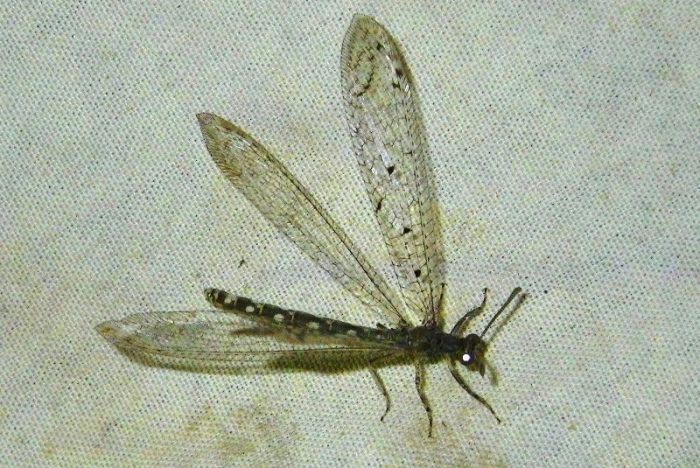
Neuroleon guttatus has a distinctive abdomen pattern, a grey thorax and a characteristic arrangement of black dots in the forewings.

N. guttatus is similar to Neuroleon chloranthe, however, N. chloranthe lacks the diagnostic spots in the forewings.

Neuroleon guttatus – Near Carnarvon, Northern Cape
Photo by Ryan Tippett
Neuroleon guttatus – Near Kachikau, Botswana
Photo by Craig Peter

Habitat

Neuroleon guttatus inhabits a variety of habitat types, ranging from dry Karoo scrub to humid savanna woodlands.

Behaviour

It is often attracted to lights, and most collected specimens have been taken this way.

Adults are most active during the summer months from…

The larvae live concealed in dust in rock crevices and are “sit and wait predators”, which do not actively pursue their prey.

Neuroleon guttatus – Kimberley, Northern Cape
Photo by Nellie Spangenberg

Status and Distribution

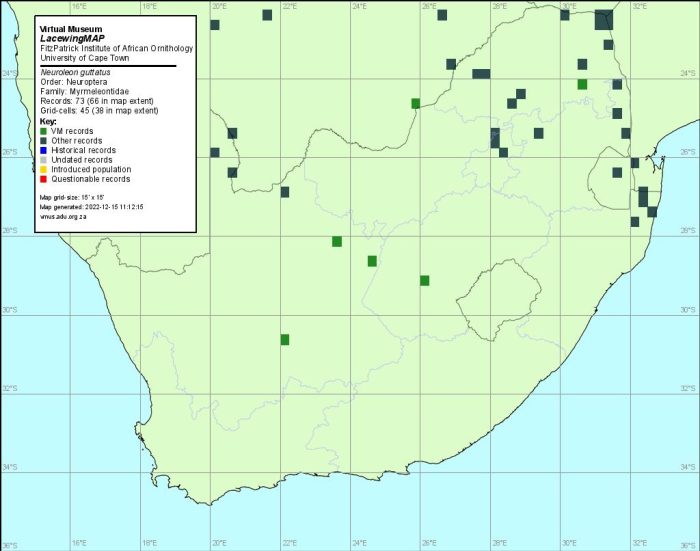
Neuroleon guttatus is uncommon but widespread in the northern parts of South Africa and extends to Zimbabwe, Botswana, Kenya, Namibia and Madagascar.

Distribution of Neuroleon guttatus. Taken from the LacewingMAP database, December 2022.

Taxonomy

Order: Neuroptera Family: Myrmeleontidae Subfamily: Nemoleontinae Tribe: Nemoleontini (Pit-trapping Antlions) Genus: Neuroleon Species: guttatus

Neuroleon guttatus – Danielskuil, Northern Cape
Photo by Aletta Liebenberg

Further Resources

Virtual Museum (LacewingMAP > Search VM > By Scientific or Common Name)

Acknowledgements:

The use of photographs by Aletta Liebenberg, Craig Peter and Nellie Spangenberg is acknowledged. This species text has benefited enormously from comments made by Mervyn Mansell on records he has identified in LacewingMAP. We acknowledge his important contribution.

Recommended citation format for this species text:

Tippett RM 2022. Neuroleon guttatus. Biodiversity and Development Institute, Cape Town.
Available online at http://thebdi.org/2022/12/15/neuroleon-guttatus/

Macronemurus tinctus

View the above photo record (by Kate Braun) in LacewingMAP here.

Myrmeleontidae (Antlions)

Macronemurus tinctus 

Kolbe, 1897

Identification

Size: Small-Medium (Wingspan around 62mm)

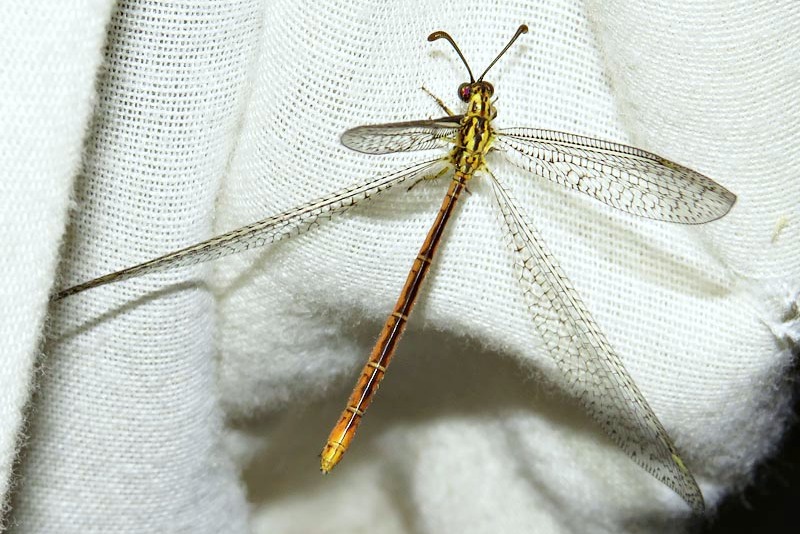
Superficially similar to Macronemurus perlatus. The head and thorax are yellow with black markings and the abdomen is orange-brown with darker dorsal patterning. The wings are clear with attractive black veining. The males are very characteristic due to their long ectoprocts.

Larvae: The larvae are unknown.

Macronemurus tinctus male – Oshikoto, Namibia
Photo by N. Thomson
Macronemurus tinctus female – Near Mbabane, eSwatini
Photo by Kate Braun

Habitat

Macronemurus tinctus inhabits savanna and grasslands, often in moist areas.

Behaviour

Not much is known about Macronemurus tinctus. The adults are nocturnal and spend the day resting among tall grass or other vegetation. Adults are regularly attracted to lights. 

Adults are on the wing from from December to May.

Nothing is known about the larvae of this species.

Macronemurus tinctus – Near Mbabane, eSwatini
Photo by Kate Braun

Status and Distribution

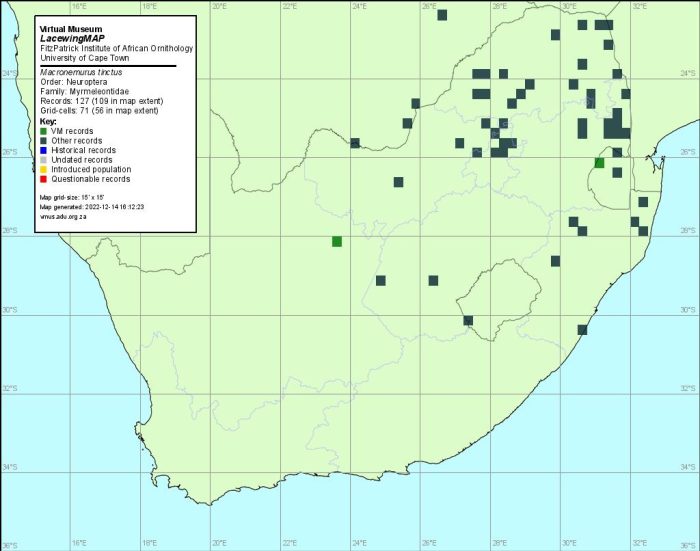
Macronemurus tinctus is a common and widespread species throughout much of South Africa. It also occurs in all of our neighbouring countries and extends as far north as Tanzania and Kenya.

Distribution of Macronemurus tinctus. Taken from the LacewingMAP database, December 2022.

Taxonomy:

Order: Neuroptera Family: Myrmeleontidae Subfamily: Nemoleontinae Tribe: Nemoleontini Genus: Macronemurus Species: tinctus

Macronemurus tinctus – Near Mbabane, eSwatini
Photo by Kate Braun

Further Resources

Virtual Museum (LacewingMAP > Search VM > By Scientific or Common Name)

Acknowledgements:

The use of photographs by Kate Braun and N. Thomson is acknowledged. This species text has benefited enormously from comments made by Mervyn Mansell on records he has identified in LacewingMAP. We acknowledge his important contribution.

Recommended citation format for this species text:

Tippett RM 2022. Macronemurus tinctus. Biodiversity and Development Institute, Cape Town.
Available online at http://thebdi.org/2022/12/14/macronemurus-tinctus/

Macronemurus tinctus male – Oshikoto, Namibia
Photo by N. Thomson

Macronemurus perlatus

View the above photo record (by Vaughan Jessnitz) in LacewingMAP here.

Myrmeleontidae (Antlions)

Macronemurus perlatus 

(Gerstaecker, 1885)

Identification

Size: Small-Medium (Wingspan around 62mm)

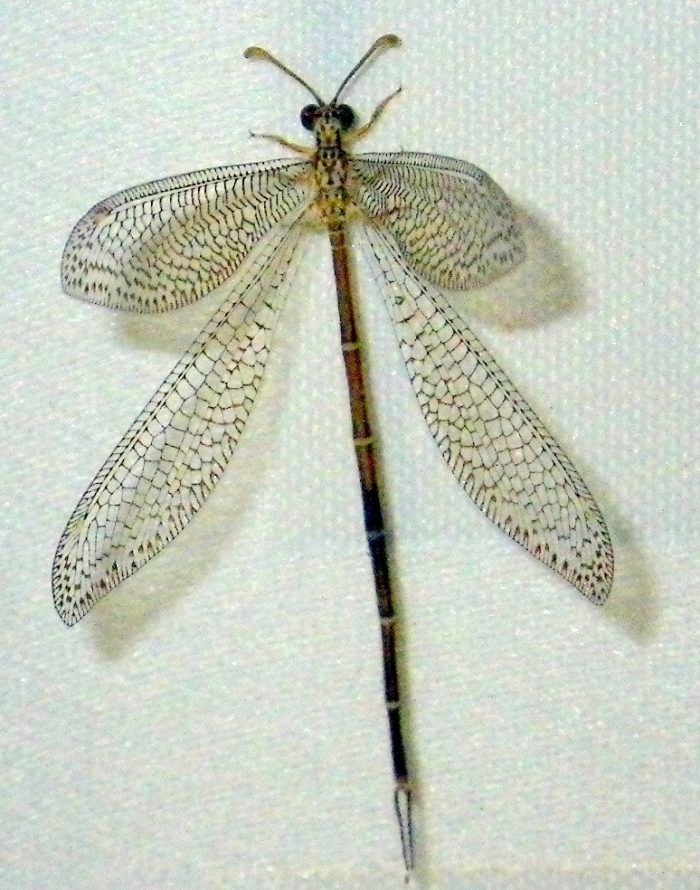
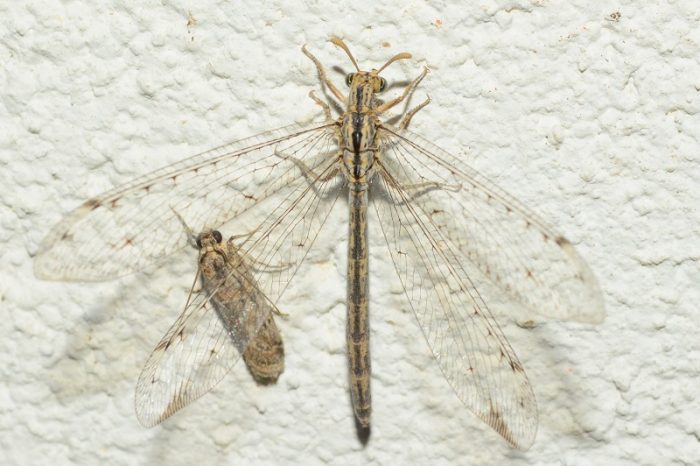
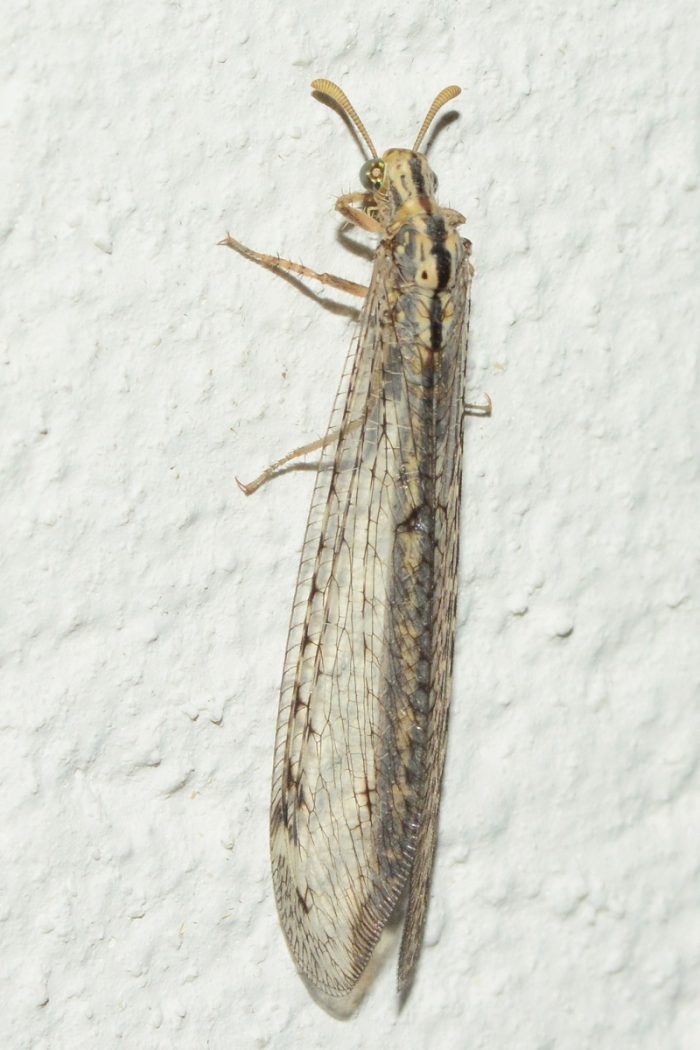
The head and thorax are yellow with black markings and the abdomen is orange-brown with darker dorsal patterning. The wings are clear with attractive black veining. Macronemurus perlatus is sexually dimorphic with males having longer, more slender abdomens and very long filamentous ectoprocts.

This species is very similar to Macronemurus tinctus.

Larvae: The larvae are unknown.

Macronemurus perlatus male – Near Newcastle, KwaZulu-Natal
Photo by Cornelia Rautenbach
Macronemurus perlatus female – Mlawula Nature Reserve, eSwatini
Photo by Kate Braun

Habitat

Macronemurus perlatus inhabits grasslands and grassy areas in savanna and woodlands.

Behaviour

Nothing much is known about the biology of this species. The adults are nocturnal and spend the day resting among tall grass or other vegetation. Macronemurus perlatus is frequently attracted to lights. 

Adults have been recorded during late Summer from from December to April.

Nothing is known about the larvae of this species.

Macronemurus perlatus male – Near Newcastle, KwaZulu-Natal
Photo by Cornelia Rautenbach

Status and Distribution

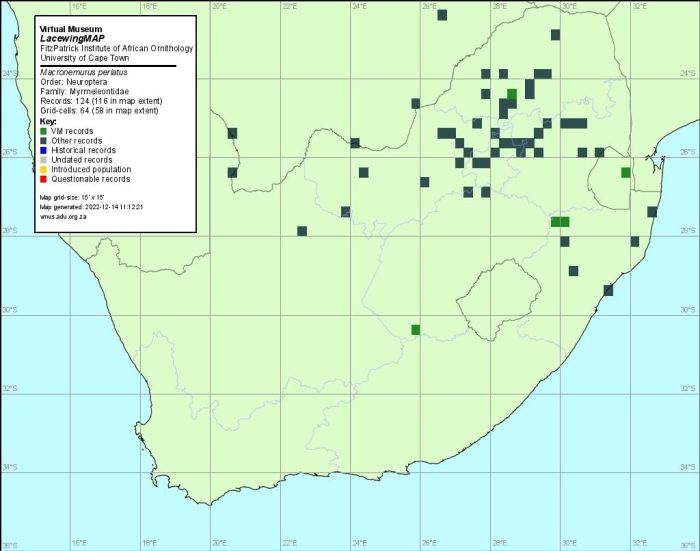
Macronemurus perlatus is a fairly common and widespread species in South Africa. This species is also known from Botswana, Namibia and Zimbabwe.

Distribution of Macronemurus perlatus. Taken from the LacewingMAP database, December 2022.

Taxonomy:

Order: Neuroptera Family: Myrmeleontidae Subfamily: Nemoleontinae Tribe: Nemoleontini Genus: Macronemurus Species: perlatus

Macronemurus perlatus female – Mlawula Nature Reserve, eSwatini
Photo by Kate Braun

Further Resources

Virtual Museum (LacewingMAP > Search VM > By Scientific or Common Name)

Acknowledgements:

The use of photographs by Alan Manson, Cornelia Rautenbach, Kate Braun and Vaughan Jessnitz is acknowledged. This species text has benefited enormously from comments made by Mervyn Mansell on records he has identified in LacewingMAP. We acknowledge his important contribution.

Recommended citation format for this species text:

Tippett RM 2022. Macronemurus perlatus. Biodiversity and Development Institute, Cape Town.
Available online at http://thebdi.org/2022/12/14/macronemurus-perlatus/
Macronemurus perlatus – Cyferfontein, Free State
Photo by Alan Manson

Hagenomyia tristis

View the above photo record (by Craig Peter) in LacewingMAP here.

Myrmeleontidae (Antlions)

Hagenomyia tristis 

(Walker, 1853)

Identification

Size: Small to medium sized (Wingspan around 58mm)

Hagenomyia tristis is the mimic of Banyutus lethalis and the two bear a close resemblance. B. lethalis has longer antennae and clear wings with prominent black veining and a bicoloured pterostigma. H. tristis has shorter antennae, slightly irridescent wings with inconspicuous black veins and has smaller white pterostigmas.

Larvae: closely resemble those of Myrmeleon species.

Hagenomyia tristis – Duba Plains, Botswana
Photo by Ryan Tippett
Hagenomyia tristis – Lusaka Province, Zambia
Photo by Norman Barrett

Habitat

Hagenomyia tristis inhabits savanna woodland and forest regions. Adults are often found among tall grass in the dappled light beneath trees. Often in the same habitat as Banyutus lethalis.

Habitat – Ndumo Game Reserve, KwaZulu-Natal
Photo by Ryan Tippett

Behaviour

The adults are nocturnal and spend the day resting among tall grass. They are frequently attracted to light.  Hagenomyia tristis is gregarious and often flies in mixed swarms with Banyutus lethalis, which it closely resembles – in a mimicry complex.

Hagenomyia tristis is often gregarious – Highlands Wilderness, Limpopo
Photo by Christopher Willis
Hagenomyia tristis – Lusaka Province, Zambia
Photo by Esme Tenner

Adults are on the wing primarily during the Summer months from October to April but they may be recorded throughout the year in warmer areas.

The Larvae build pitfall traps and can often be found at the base of trees.

Status and Distribution

A common and widespread species throughout the tropics and subtropics of Africa, occurring from southern KZN and North West Province through Africa to Cameroon, Ethiopia and Madagascar. Hagenomyia tristis is absent from the drier areas of southern Africa.

Distribution of Hagenomyia tristis. Taken from the LacewingMAP database, November 2022.

Taxonomy:

Order: Neuroptera Family: Myrmeleontidae Subfamily: Myrmeleontinae Tribe: Myrmeleontini Genus: Hagenomyia Species: tristis

Hagenomyia tristis – Near Hluhluwe, KwaZulu-Natal
Photo by Ryan Tippett

Further Resources

Virtual Museum (LacewingMAP > Search VM > By Scientific or Common Name)

Acknowledgements:

The use of photographs by Christopher Willis, Craig Peter, Esme Tenner, Norman Barrett and Wilna Steenkamp is acknowledged. This species text has benefited enormously from comments made by Mervyn Mansell on records he has identified in LacewingMAP. We acknowledge his important contribution.

Recommended citation format for this species text:

Tippett RM 2022. Hagenomyia tristis. Biodiversity and Development Institute, Cape Town.
Available online at http://thebdi.org/2022/12/13/hagenomyia-tristis/

Hagenomyia tristis – Harare, Zimbabwe
Photo by Wilna Steenkamp

Hagenomyia lethifer

View the above photo record (by Evert Kleynhans) in LacewingMAP here.

Myrmeleontidae (Antlions)

Hagenomyia lethifer 

(Walker, 1853)

Identification

Size: Small-medium (Wingspan 60mm)

Hagenomyia lethifer is easily recognised by its distinctive colouration. The head, thorax and abdomen are black with a broad cream stripe along the sides. The legs are bright red. Both pairs of wings are clear and unmarked.

Larvae: The larvae are characteristically pink in colour.

Hagenomyia lethifer – Kranzkloof Nature Reserve, KwaZulu-Natal
Photo by Rob Dickinson
Hagenomyia lethifer Near Hluhluwe, KwaZulu-Natal
Photo by Ryan Tippett

Habitat

Hagenomyia lethifer inhabits grasslands and savanna and is often found in damp areas with tall grass.

Habitat – Mzinene River, KwaZulu-Natal
Photo by Ryan Tippett

Behaviour

The adults are nocturnal and spend the day resting among tall grass. They are occasionally attracted to light. 

The larvae construct pitfall traps, often in open and exposed places.

In South Africa adults have been recorded from August to April, although most commonly recorded from December to April.

Hagenomyia lethifer – Near Loeriekloof, Gauteng
Photo by Stephen Ball

Status and Distribution

Hagenomyia lethifer is common and very widespread in South Africa, from the Western Cape Province northwards through most provinces, excluding the drier western areas. It extends northwards into Africa: Mozambique, Botswana, Zimbabwe, Zambia, Tanzania, Malawi, Angola, Burundi.

Distribution of Hagenomyia lethifer. Taken from the LacewingMAP database, December 2022.

Taxonomy:

Order: Neuroptera Family: Myrmeleontidae Subfamily: Myrmeleontinae Tribe: Myrmeleontini Genus: Hagenomyia Species: lethifer

Hagenomyia lethifer – Magalies ridge, Gauteng
Photo by T. de Wit

Further Resources

Virtual Museum (LacewingMAP > Search VM > By Scientific or Common Name)

Acknowledgements:

The use of photographs by Evert Kleynhans, Rob Dickinson, Stephen Ball and T. de Wit is acknowledged. This species text has benefited enormously from comments made by Mervyn Mansell on records he has identified in LacewingMAP. We acknowledge his important contribution.

Recommended citation format for this species text:

Tippett RM 2022. Hagenomyia lethifer. Biodiversity and Development Institute, Cape Town.
Available online at http://thebdi.org/2022/12/13/hagenomyia-lethifer/

Hagenomyia lethifer – Near Wakkerstroom, Mpumalanga
Photo by Rick Nuttall

Furgella damarinus

View the above photo record (by Ryan Tippett) in LacewingMAP here.

Myrmeleontidae (Antlions)

Furgella damarinus

(Péringuey, 1910)

Identification

Size: Small

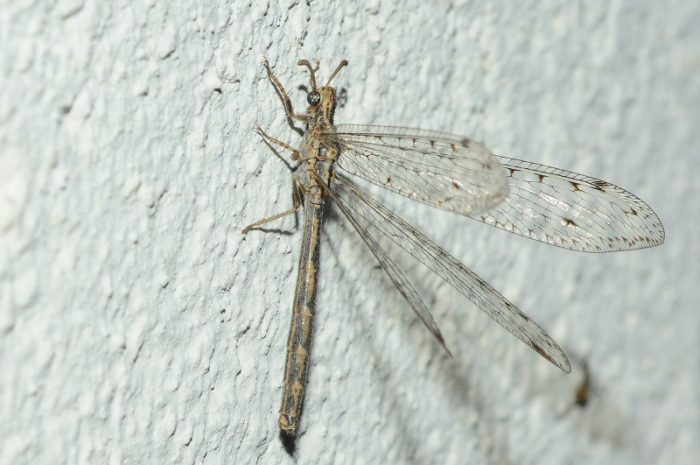
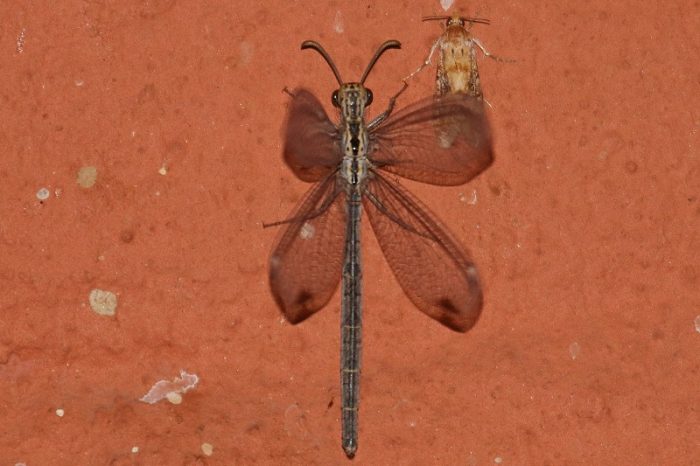
The thorax is grey and pale yellowish with a broad black dorsal line running from the head to the start of the abdomen. The abdomen is mostly plain grey with variable yellowish-pink markings along the sides.

The wings are clear and thinly marked with scattered brown markings. The most distinctive of which are wedge shaped and found near the tips of the hind wings.

Larvae: The larvae are pink and resemble those of the genus Cueta.

Furgella damarinus – Near Carnarvon, Northern Cape
Photo by Ryan Tippett
Furgella damarinusNear Carnarvon, Northern Cape
Photo by Ryan Tippett

Habitat

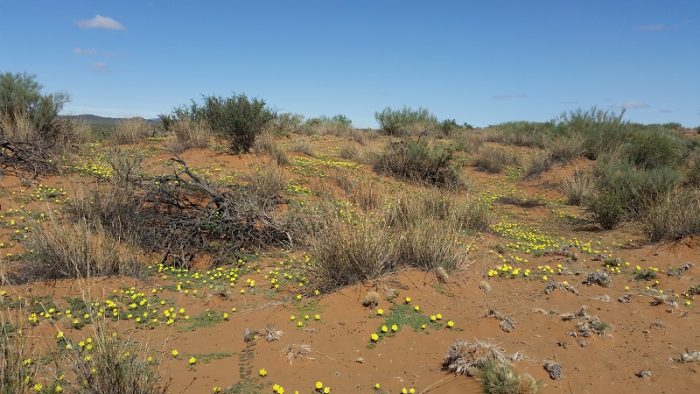
Furgella damarinus inhabits arid shrublands of the Nama Karoo as well as Kalahari scrub and savanna. It is usually found on sandy soils.

Habitat – Near Carnarvon, Northern Cape
Photo by Ryan Tippett

Behaviour

Adults are nocturnal and they are sometimes attracted to lights. Nothing else is known about the biology of this species.

Adults are active during summer and have been recorded from November to March.

The larvae do not construct pits but instead live freely in loose sand.

Furgella damarinusKgalagadi Transfrontier Park, Northern Cape
Photo by P. Nieuwoudt

Status and Distribution

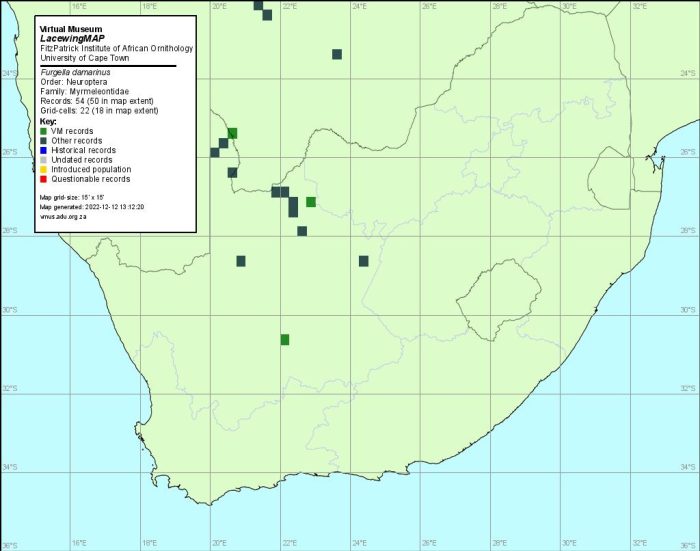
Furgella damarinus is uncommon and is endemic to South Africa, Botswana and Namibia. In South Africa, it is known only from the Northern Cape Province. It is fairly widespread in the Kalahari ecosystem.

Distribution of Furgella damarinus. Taken from the LacewingMAP database, November 2022.

Taxonomy

Order: Neuroptera Family: Myrmeleontidae Subfamily: Myrmeleontinae Tribe: Myrmecaelurini Genus: Furgella  Species: damarinus

Furgella damarinus – Near Carnarvon, Northern Cape
Photo by Ryan Tippett

Further Resources

Virtual Museum (LacewingMAP > Search VM > By Scientific or Common Name)

Acknowledgements:

The use of photographs by P. Nieuwoudt is acknowledged. This species text has benefited enormously from comments made by Mervyn Mansell on records he has identified in LacewingMAP. We acknowledge his important contribution.

Recommended citation format for this species text:

Tippett RM 2022. Furgella damarinus. Biodiversity and Development Institute, Cape Town.
Available online at http://thebdi.org/2022/12/12/furgella-damarinus/

Furgella damarinus – Near Carnarvon, Northern Cape
Photo by Ryan Tippett

Distoleon pulverulentus

View the above photo record (by Alan Manson) in LacewingMAP here.

Myrmeleontidae (Antlions)

Distoleon pulverulentus

(Rambur, 1842)

Identification

Size: Small

Distoleon pulverulentus is generally dark gey in colouration with yellow accents, particularly on the thorax. The legs are yellow and the wings are clear with many small black speckles and yellow veins.

Larvae: Nothing is known of its larvae.

Distoleon pulverulentus – Garden Castle, KwaZulu-Natal
Photo by Craig Peter
Distoleon pulverulentusGrootvadersbosch Nature Reserve, Western Cape
Photo by Andrew & Heather Hodgson

Habitat

Distoleon pulverulentus inhabits mid to high altitude grassland, often in mountainous regions. It is fairly common in the Drakensberg grasslands.

Habitat – Near Himeville, KwaZulu-Natal
Photo by Ryan Tippett

Behaviour

Adults are most active during the late summer months from December to April. They are readily attracted to lights.

Distoleon pulverulentus is most often encountered at rest as they cling vertically to grass stems and are frequently flushed along grass-lined pathways.

Distoleon pulverulentus – Mating pair – Near Grahamstown, Eastern Cape
Photo by Craig Peter

Status and Distribution

Distoleon pulverulentus is widespread but thinly distributed in South Africa. It can, however, be fairly common at some sites such as the grasslands of the Drakensberg. It has been recorded from all provinces in South Africa and is also known from Lesotho and Swaziland.

Distribution of Distoleon pulverulentus. Taken from the LacewingMAP database, November 2022.

Taxonomy

Order: Neuroptera Family: Myrmeleontidae Subfamily: Nemoleontinae Tribe: Nemoleontini (Pit-trapping Antlions) Genus: Distoleon Species: pulverulentus

Distoleon pulverulentus – Grootvadersbosch Nature Reserve, Western Cape
Photo by Andrew & Heather Hodgson

Further Resources

Virtual Museum (LacewingMAP > Search VM > By Scientific or Common Name)

Acknowledgements:

The use of photographs by Alan Manson, Andrew & Heather Hodgson and Craig Peter is acknowledged. This species text has benefited enormously from comments made by Mervyn Mansell on records he has identified in LacewingMAP. We acknowledge his important contribution.

Recommended citation format for this species text:

Tippett RM 2022. Myrmeleon obscurus. Biodiversity and Development Institute, Cape Town.
Available online at http://thebdi.org/2022/12/11/distoleon-pulverulentus/

Distoleon pulverulentus – Near Steynsburg, Eastern Cape
Photo by Alan Manson