Sclater’s Lark (Spizocorys sclateri)

Cover image. Sclater’s Lark by Alan Collett – Carnarvon District, Northern Cape – BirdPix No. 142244

Identification

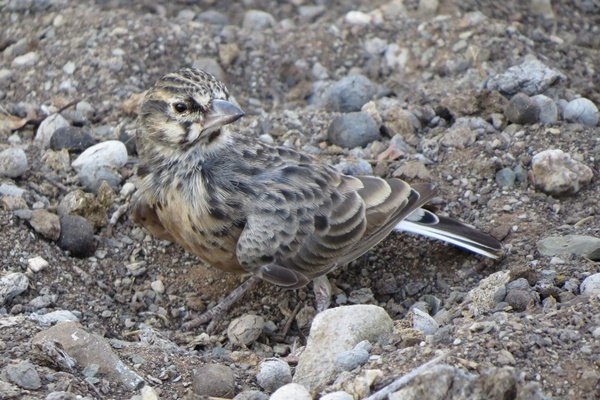
Sclater’s Lark is a small species with a stocky build and a large, horn-coloured beak.
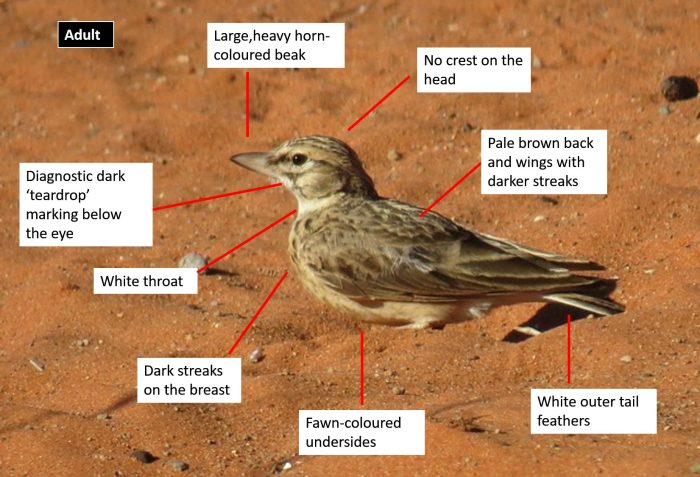
Identification adult Sclater's Lark
Sclater’s Lark (Spizocorys sclateri) – Near Uppington, Northern Cape
Photo by Pamela Ruth Kleiman

These birds have an overall buff-brown colouration. Its most distinctive feature, apart from the beak, is the diagnostic dark ‘tear-drop’ marking below the eye.

The upperparts are buffy grey-brown with dark streaks. The throat is white and gives way to buff-coloured underparts. The breast and belly have a warmer tone than the rest of the body. There are variable bold black streaks on the breast.

In flight the tail appears fairly short and dark above with broad white outer tail feathers.

The sexes are alike.

Juveniles resemble the adults but they have less distinct facial patterning.

Sclater's Lark
Sclater’s Lark (Spizocorys sclateri) – Williston District, Northern Cape
Photo by Zenobia van Dyk

Status and Distribution

The Sclater’s lark is endemic to Southern Africa, its distribution is entirely confined to the Nama Karoo. The majority of records are from the Northern Cape province, with scattered records from Southern Namibia. It is most abundant on the stony plains of Bushmanland in the Northern Cape with outlying records from near Mariental, (central Namibia), Beaufort West (Western Cape) and Aberdeen (Eastern Cape).

It is both uncommon and local in occurence, especially in Namibia. It is currently listed as Near-threatened.
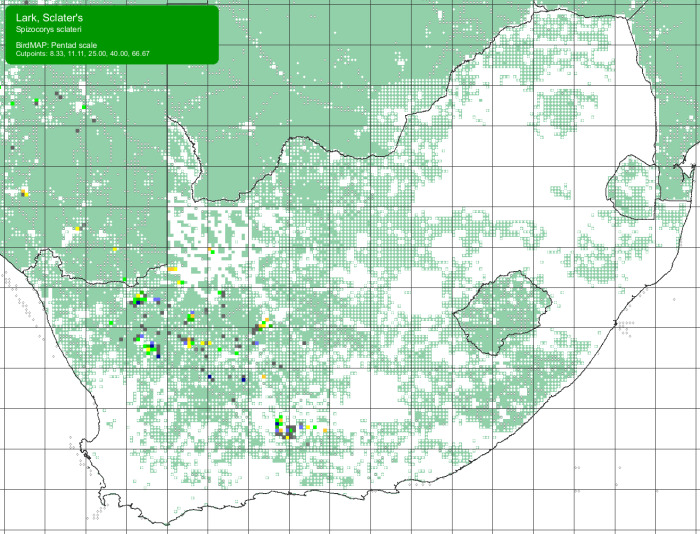
SABAP2 distribution map Sclater's Lark
SABAP2 distribution map for Sclater’s Lark (Spizocorys sclateri)– February 2023.
Details for map interpretation can be found here.

Habitat
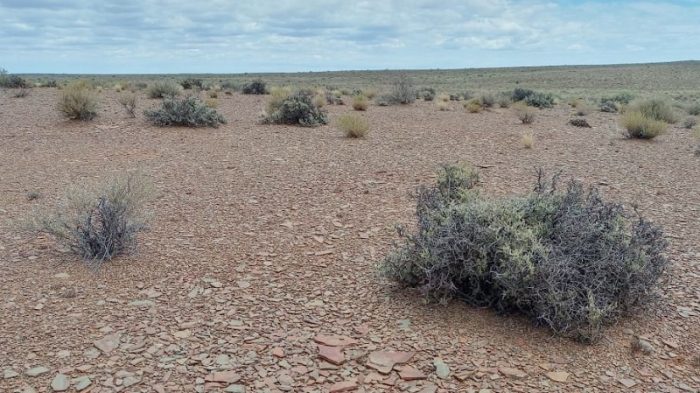
Habitat Sclater's Lark
Typical shale gravel habitat in the upper Karoo.
Carnarvon District, Northern Cape
Photo by Ryan Tippett

Sclater’s Lark inhabits arid to semi-arid plains with low, sparse shrubs, grasses and extensive bare patches of gravel and stones. It is most closely associated with open areas of quartz pebbles or shale gravel.
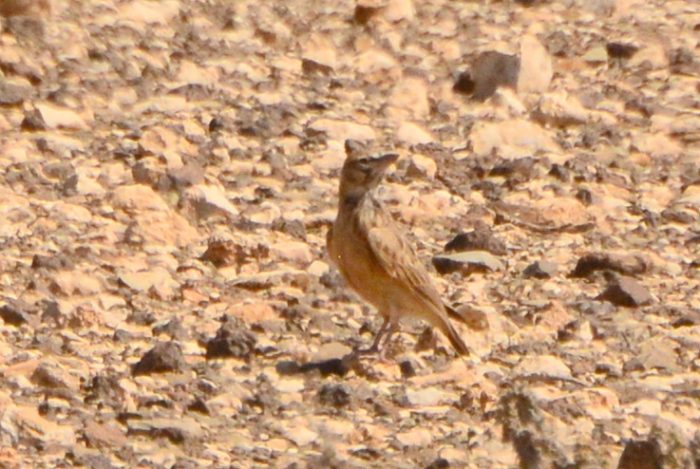
Spizocorys sclateri
Sclater’s Lark (Spizocorys sclateri) in gravel plains habitat – Near Vanwyksvlei, Northern Cape
Photo by Ryan Tippett

Behaviour

Sclater’s Lark is an opportunistic and highly nomadic species, moving into areas after rain before nesting and then moving on. They are found in pairs when breeding and usually in small, dispersed flocks of up to 25 birds when not breeding.

Forages by walking with a slow, plodding gait on bare, open plains where there are few other birds. They are known to turn over small flat stones while foraging. Sclater’s Larks feed mostly on Harvester Ants (Messor spp.) and Harvester Termites (Hodotermes spp.) as well as a range of seeds picked off the ground.

Drinks frequently, particularly when breeding. They often drink with the eyes partially closed. Typically flies to water in small groups and the flight is fast and dipping, accompanied by intermittent calling.

Sclater’s Larks are well camouflaged and are often only seen when flushed. They usually fly quite far before settling. Roosts in a shallow depression in open gravel plains.
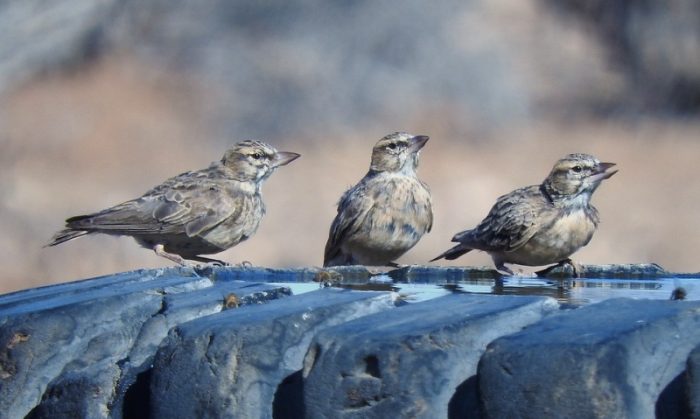
Sclater's Lark
Sclater’s Lark (Spizocorys sclateri) travels to water in small groups – Williston District, Northern Cape
Photo by Etienne Marais

Sclater’s Larks are Monogamous, solitary nesters, but some nests may only be several meters apart.

The nest is a tidy cup composed of fine, grass leaves, stems and awns. The nest is built inside a hollow in the substrate which is excavated by both sexes using their feet. The nest sits flush with the edge of the hollow and small stones are often placed around it. The stones presumably help to disguise the nest from predators. Most nests are situated in completely exposed situations in bare stony patches, far from shrubs or grass tufts. The nest is always within 1km of a water source.

Nesting in the open conceals the nest from predators which mostly forage around the base of vegetation. However, nesting in the open can expose the eggs or chicks to intense heat, something to which the Sclater’s Lark is well adapted. The incubating parent will stand over the nest to shade it, normally facing into the breeze or towards the sun. The incubating bird may pant continuously and raise its feathers and half close the eyes to aid in cooling. The dense nest lining may also help to insulate eggs and small chicks from high ground temperatures.

Egg laying takes place mainly from August to November and breeding takes place during the driest time of the year. Very high ground temperatures from December to March likely prevent breeding during this period. Just one egg is laid per clutch and is incubated by both sexes.
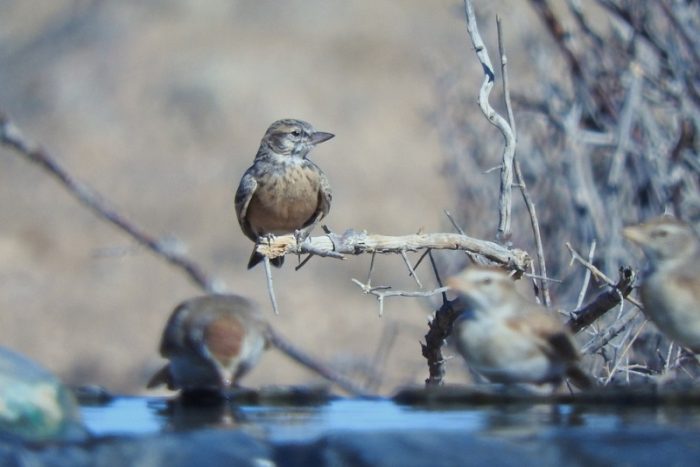
Spizocorys sclateri
Sclater’s Lark (Spizocorys sclateri) travels to water in small groups – Williston District, Northern Cape
Photo by Ettienne Marais

Further Resources

Species text adapted from the first Southern African Bird Atlas Project (SABAP1), 1997.

The use of photographs by Alan Collett, Etienne Marais, Pamela Ruth Kleiman and Zenobia van Dyk is acknowledged.

Virtual Museum (BirdPix > Search VM > By Scientific or Common Name).

Other common names: Namakwalewerik (Afrikaans); Alouette de Sclater (French); Sclaters Kurzhaubenlerche (German); Namagua-leeuwerik (Dutch); Cotovia de Sclater (Portuguese)

A list of bird species in this format is available here.

Recommended citation format: Tippett RM 2023. Sclater’s Lark (Spizocorys sclateri) Biodiversity and Development Institute. Available online at http://thebdi.org/2023/02/10/sclaters-lark-spizocorys-sclateri/
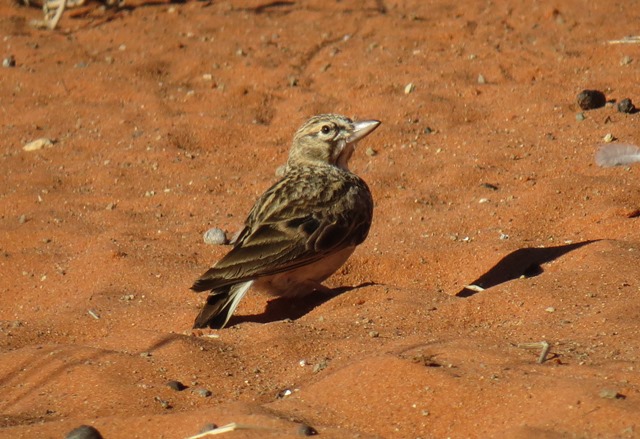
Bird identificationbirding

Sclater's Lark
Sclater’s Lark (Spizocorys sclateri) – Near Uppington, Northern Cape
Photo by Pamela Ruth Kleiman

Black-eared Sparrow-lark (Eremopterix australis)

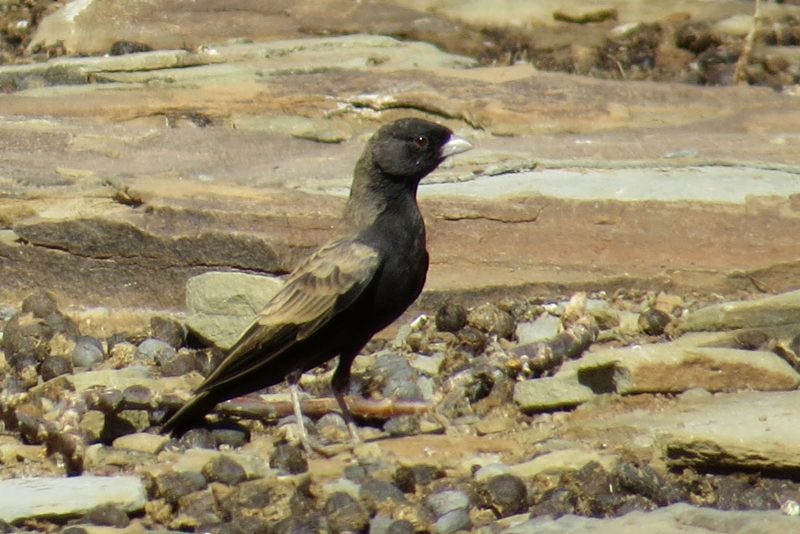
Cover image: Black-eared Sparrow-lark by Alan Collett – Carnarvon District, Northern Cape – BirdPix No. 70664

Identification

The Black-eared Sparrow-lark is a small, compact lark with a conical grey-white beak. The species shows marked sexual dimorphism.

Adult males are unmistakable, being entirely black save for chestnut brown feathers on the back, wings and upper-tail. Pitch-black underwings render males very conspicuous in flight.

Identification male Black-eared Sparrow-lark
Black-eared Sparrow-lark (Eremopterix australis) – Carnarvon District, Northern Cape
Photo by Ryan Tippett

Females are pale brown above on the back and wings. The undersides are cream-coloured, with heavy but variable black streaks. The streaks are predominantly on the chest but may extend onto the belly. Lacks the dark belly patch of other sparrow-lark females. In flight shows distinctive black secondaries.

Immature birds resemble the females but are variably buff and white spotted above.

Identification female Black-eared Sparrow-lark
Black-eared Sparrow-lark (Eremopterix australis) Immature female – Calvinia District, Northern Cape
Photo by Tino Herselman

Status and Distribution

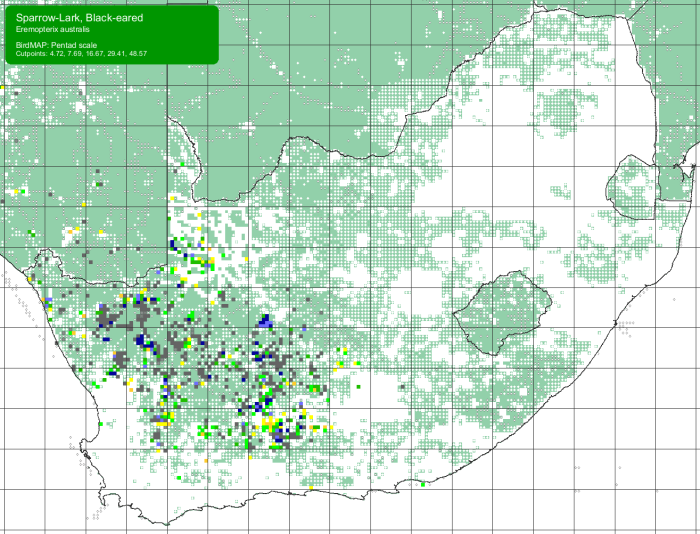
The Black-eared Sparrow-lark is endemic to Southern Africa. It occurs mainly in southern Namibia and the Northern Cape in South Africa. It is marginal in the Western Cape, Eastern Cape and Free State and its its presence in these provinces can be erratic.

It is most numerous in the central and upper Karoo of the Northern Cape.

SABAP2 distribution map Black-eared Sparrow-lark
SABAP2 distribution map for Black-eared Sparrow-lark (Eremopterix australis) – February 2023.
Details for map interpretation can be found here.

Habitat

Occurs in arid, sparse shrublands and grassland, particularly on red soils. Favours sandy soil but is also found on poorly drained clays and stony substrates in the Karoo. The Black-eared Sparrow-lark is also present in the southern Kalahari.

Habitat Black-eared Sparrow-lark
Typical habitat in the upper Karoo. Note the red sandy soil. 
Carnarvon District, Northern Cape
Photo by Ryan Tippett

Behaviour

Gregarious at all times, even when breeding and flocks usually number 5 to 10 birds. Flock sizes swell after breeding and can range from 50 to several hundred birds. Aggregates in large numbers in areas receiving good rainfall.

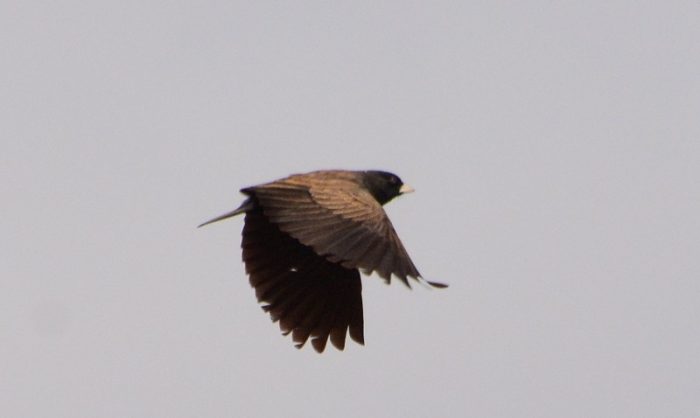
Forages in open places among shrubs and stones. Flies readily when disturbed, in typically bouncing erratic flight. Males perform a circular, butterfly-like display flight with exaggerated wingbeats and sometimes with dangling legs.

Eremopterix australis
Males are conspicuous in flight.
Black-eared Sparrow-lark (Eremopterix australis) – Carnarvon District, Northern Cape
Photo by Ryan Tippett

Collects food items off the ground or from the base of plants. The diet consists of various insects and a wide range of seeds. Favours grass seeds but also consumes the seeds of forbs and shrubs. Insect prey is known to include termites, beetles, ants and leaf-hoppers. Very seldom drinks and gets almost all its moisture requirement from the food it eats (Metabolic water).

Black-eared Sparrow-lark
Black-eared Sparrow-lark (Eremopterix australis) with its leaf-hopper prey – Namaqualand National Park, Northern Cape
Photo by Vaughan Jessnitz

The Black-eared Sparrow-lark is a monogamous, territorial and solitary nester, even though nests may only be a few meters apart. Breeding may take place at any time of the year and is linked to rainfall. They require at least 40 to 50mm of rainfall to stimulate widespread breeding.

The nest is a cup composed of fine grass leaves, panicles, feathery awns and rootlets. The nest is placed in an excavated hollow, usually in sandy substrate. The nest rim is normally slightly raised and decorated with the soil encrusted webs of Buckspoor Spiders (Seothyra spp.). The nest is usually situated at the base of a shrub or grass tuft and facing south or east for shade. The nest is built entirely by the female.

1 to 4 (normally 2 or 3) eggs are laid per clutch. Clutches are largest after heavy or follow-up rainfall. The eggs are white and finely speckled with pinkish-brown markings. The markings are often concentrated at the obtuse end. Incubation begins after all the eggs have been laid and is shared equally between the sexes.

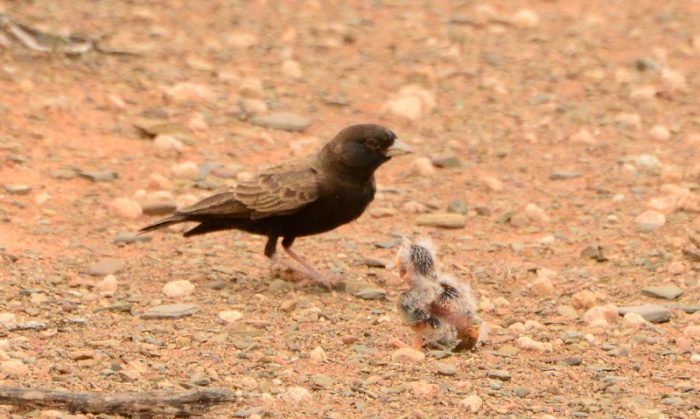
The nestling period lasts just 7 to 10 days and parental duties are shared by both sexes. The young are fed exclusively on arthropods, particularly Harvester Termites, caterpillars and grasshoppers. The adults perform distraction displays when the eggs or young are threatened. The male will hover over the nest while alarm calling. Both sexes perform an injury-feigning display by flying towards an intruder with loud wing-beats, before dropping to the ground and fluttering away while giving distress calls.

Eremopterix australis
Black-eared Sparrow-lark (Eremopterix australis) – Carnarvon District, Northern Cape
Photo by Ryan Tippett

Further Resources

Species text adapted from the first Southern African Bird Atlas Project (SABAP1), 1997.

The use of photographs by Alan Collett, Gerald Wingate, Tino Herselman and Vaughan Jessnitz is acknowledged.

Virtual Museum (BirdPix > Search VM > By Scientific or Common Name).

Other common names: Swartoorlewerik (Afrikaans); Moinelette à oreillons noirs (French); Schwarzwangenlerche (German); Cotovia-pardal-preta (Portuguese)

Recommended citation format: Tippett RM 2023. Black-eared Sparrow-lark (Eremopterix australis) Biodiversity and Development Institute. Available Online at http://thebdi.org/2023/02/04/black-eared-sparrow-lark-eremopterix-australis/

Bird identificationbirding

Black-eared Sparrow-lark
Black-eared Sparrow-lark (Eremopterix australis) – Verlorenvlei, Western Cape, South Africa
Photo by Gerald Wingate

Namaqua Warbler (Phragmacia substriata)

Cover image: Namaqua Warbler by Sue Gie – Aquila Game Reserve, Western Cape – BirdPix No. 175614

Identification

The Namaqua Warbler is a small, slender, prinia-like species. Its most diagnostic features are the pale whiteish face and supercilium combined with the russet back and rump. The tail is long and graduated and lacks buff-coloured terminal spots. The breast is variably but finely streaked. This streaking is confined to the breast and does not extend onto the belly or flanks.

The sexes are similar but males show more prominent streaking on the breast.

Identification Namaqua Warbler
Namaqua Warbler (Phragmacia substriata) – Near Aliwal North, Free State
Photo by Dawie De Swardt

Immatures are similar to adults but are paler brown above and have shorter tails. The supercilium and facial area is also buff-coloured as opposed to the whitish face of the adults. Young birds have less conspicuous streaking on the breast.

Identification immature Namaqua Warbler
Namaqua Warbler (Phragmacia substriata) – Ouberg Private Nature Reserve, Western Cape
Photo by Ryan Tippett

Status and Distribution

The Namaqua Warbler is endemic to South Africa and southern Namibia. It is localised but fairly common in suitable habitat.

In South Africa it is found throughout the Northern Cape and in the drier parts of the Western Cape, Eastern Cape and Free State provinces. The paucity of records from the northern Karoo and Bushmanland, south of the Orange river is largely due to a lack of drainage lines in that region.

SABAP2 distribution Namaqua Warbler
SABAP2 distribution map for Namaqua Warbler (Phragmacia substriata) – January 2023.
Details for map interpretation can be found here.

Habitat

The Namaqua Warbler is found throughout the Karoo but is characteristically associated with water-courses, where it occupies fringing thickets and reeds. It favours drainage lines with a mix of Acacia (Vachelia) Karoo thicket and Phragmites reeds. It also forages in nearby karoo scrub and has adapted to overgrown gardens and orchards along drainage lines. Dry water courses may provide suitable habitat but a prolonged absence of water can cause the habitat to become unsuitable.

Habitat Namaqua Warbler
Namaqua Warbler (Phragmacia substriata) – Near Loeriesfontein, Northern Cape
Photo by Zenobia van Dyk

Behaviour

During the breeding season the Namaqua Warbler is usually to be found solitarily or in pairs. They are found in small family groups after breeding.

Forages by searching among leaves, twigs and tangled vegetation, sometimes forages on the floor. Keeps largely to dense bushy growth. Their movements are quick and restless. Males sing from the tops of trees or bushes

The diet consists largely of insects and other small arthropods. Also feeds on small berries and fruit when available.

Phragmacia substriata
Namaqua Warbler (Phragmacia substriata) – Near Ceres, Western Cape
Photo by Gerald Wingate

Breeding may take place from August to April. The nest is a deep cup composed of grass and strips of bark. The nest is attached to upright plant stems with grass. The nest interior is lined with feathers, fluffy seeds, hair and other fine plant material. The outer parts of the nest are camouflaged with lichen, twigs, dead leaves and bits of bark.

2 to 4 (3) eggs are laid per clutch. The eggs range in colour from pale to deep blue with red-grey spotting. The incubation period lasts around 16 days and the chicks are fully fledged after at least another 15 days.

Phragmacia substriata
Namaqua Warbler (Phragmacia substriata) – Middelburg, Eastern Cape
Photo by Tino Herselman

Further Resources

Species text adapted from the first Southern African Bird Atlas Project (SABAP1), 1997.

The use of photographs by Dawie De Swardt, Gerald Wingate, Sue Gie, Sybrand Venter, Tino Herselman and Zenobia van Dyk is acknowledged.

Virtual Museum (BirdPix > Search VM > By Scientific or Common Name).

Other common names: Namakwalangstertjie (Afrikaans); Namaqua-prinia (Dutch); Prinia du Namaqua (French); Namasänger (German); Prínia da Namaqua (Portuguese)

A list of bird species in this format is available here.

Recommended citation format: Tippett RM 2023. Namaqua Warbler (Phragmacia substriata). Biodiversity and Development Institute. Available Online at http://thebdi.org/2023/01/28/namaqua-warbler-phragmacia-substriata/

Namaqua Warbler
Namaqua Warbler (Phragmacia substriata) – Carnarvon District, Northern Cape
Photo by Sybrand Venter

Bird identificationbirding

Burchell’s Courser (Cursorius rufus)

Cover image: Burchell’s Courser by Phillip Nieuwoudt– Garingboom Guest Farm, Free State – BirdPix No. 138305

Identification

Burchell’s Courser is a smallish plover-like species. Its most diagnostic feature is the blue-grey hind crown and nape, distinguishing it from the similar Temminck’s Courser. It has a white supercilium which extends from the eye onto the nape. There is a narrow, sometimes indistinct, black line behind the eye. The back and chest are uniformly brown with little contrast between the two. There is an indistinct black band separating the brown upper belly from the white lower belly. The vent and lower belly are white. The bill is relatively long when compared to other coursers and the legs are whiteish.

The sexes are alike.

Immatures have mottled cream and black upper parts and lack the distinctive head markings of the adult.

Identfication Burchell's Courser
Burchell’s Courser (Cursorius rufus
Photos by Gregg Darling (left) and Tino Herselman (right)

In flight shows a broad white trailing edge to the secondaries. This is distinct from other coursers in the region.

Cursorius rufus in flight
Note the diagnostic white trailing edge to the secondaries.
Burchell’s Courser (Cursorius rufus) – Karoo-Gariep Nature Reserve, Northern Cape
Photo by Gerald Wingate

Status and Distribution

The Burchell’s courser is endemic to Southern Africa, extending marginally into south-western Angola. It is generally uncommon across its range but may be locally common at some sites in Namibia and the arid west of South Africa.

The population, notably near the edge of its distribution in the south and east, is known to have declined sharply in recent years. In the past it was regularly recorded from Botswana but recently there have been very few confirmed sightings. The nature and causes of its decline are not understood and should be investigated.

SABAP2 distribution map for Burchell's Courser
SABAP2 distribution map for Burchell’s Courser (Cursorius rufus) – January 2023.
Details for map interpretation can be found here.

Habitat

Burchell’s courser inhabits dry, open short or burnt grassland, Karoo scrub, stony semidesert and open desert plains. It is very partial to bare saltpans and ploughed and fallow lands. It is absent from fynbos and avoids woodlands of any kind.

Habitat for Burchell's Courser
Inhabits open, bare patches in arid areas.
Burchell’s Courser (Cursorius rufus) – Near Poffadder, Northern Cape
Photo by Zenobia van Dyk

Behaviour

Burchell’s Courser is highly nomadic and possibly seasonally migratory in some areas. This species feeds on a range of insects and is especially fond of Harvester Termites. It runs rapidly and forages by pecking at the ground after running a short distance. It may dig with its bill in soft soil. The posture is very upright and when alarmed bobs its tail and sways its body while holding its head still. May be found in pairs but is more often gregarious in groups of 5 to 15 birds.

Cursorius rufus
Burchell’s Courser (Cursorius rufus) – New Holme Guest Farm, Hanover, Northern Cape
Photo by Tino Herselman

Breeding may take place during most months but mainly August to December. 1 or 2 eggs are laid per clutch, usually directly on the substrate. No true nest is constructed, but the site may be lined with antelope or sheep droppings, stones or clumps of earth.

The eggs are incubated by both sexes, however, further details are unrecorded.

Cursorius rufus
An adult incubating its egg.
Burchell’s Courser (Cursorius rufus) – Ncandu Nature Reserve, KwaZulu-Natal
Photo by Garth Aiston
Burchell's Courser
The egg is laid on bare ground and no nest is constructed.
Burchell’s Courser (Cursorius rufus) – Ncandu Nature Reserve, KwaZulu-Natal
Photo by Garth Aiston

Further Resources

Species text adapted from the first Southern African Bird Atlas Project (SABAP1), 1997.

The use of photographs by Garth Aiston, Gerald Wingate, Gregg Darling, Michael Wright, Phillip Nieuwoudt, Tino Herselman and Zenobia van Dyk is acknowledged.

Virtual Museum (BirdPix > Search VM > By Scientific or Common Name).

Other common names: Bloukopdrawwertjie (Afrikaans): Ingegane (Xhosa); Makopjoane (South Sotho); Rosse Renvogel (Dutch); Courvite de Burchell (French); Rostrennvogel (German); Corredor de Burchell (Portuguese)

Recommended citation format: Tippett RM 2023. Burchell’s Courser (Cursorius rufus). Biodiversity and Development Institute. Available Online at http://thebdi.org/2023/01/25/burchells-courser-cursorius-rufus/

List of bird species in this format is available here.

Bird identificationbirding

Burchell’s Courser (Cursorius rufus) – Near Normandien, KwaZulu-Natal
Photo by Michael Wright

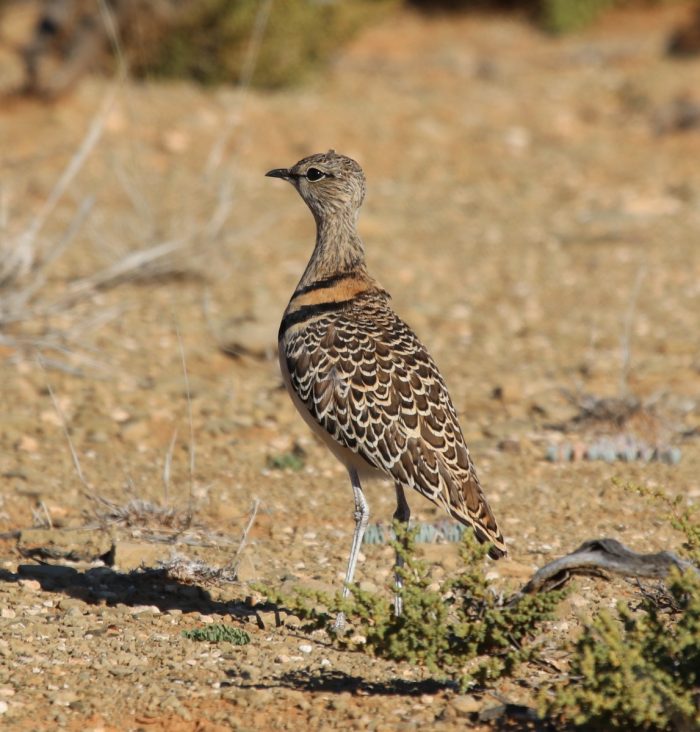
Double-banded Courser (Rhinoptilus africanus)

Cover image of Double-banded Courser by Desire Darling – Mountain Zebra National Park, Eastern Cape – BirdPix No. 52169

Identification

The Double-banded Courser is a small, pale coloured species. Its most distinctive feature is the two narrow black bands across the breast, which are diagnostic. The undersides are pale sandy or cream coloured. The upper sides are sandy brown with white edging to the feathers, giving a scaled appearance. The neck is slightly darker with fine vertical streaking. The crown is plain and there is a prominent cream-coloured supercilium. The long legs are pale whitish.

The sexes are alike.

Double-banded Courser - identification
Double-banded Courser (Rhinoptilus africanus) – Masilonyana Local Municipality, Free State
Photo by Janet du Plooy

In flight shows distinctive rust-coloured secondaries and inner primaries and white uppertail coverts (see the photograph below).

Juveniles are similar to the adults but have chestnut breastbands and a less well-defined supercilium.

Rhinoptilus africanus in flight
In flight, this courser shows distinctive rust-coloured secondaries and inner primaries as well as white upper tail coverts.
Double-banded Courser (Rhinoptilus africanus) – Carnarvon district, Northern Cape
Photo by Ryan Tippett

Distribution

The Double-banded courser is widespread and found in three separate populations, in southern Africa, East Africa and north-east Africa. In South Africa it occurs mainly in the arid western and central regions.

SABAP2 distribution map for Double-banded Courser
SABAP2 distribution map for Double-banded Courser (Rhinoptilus africanus) – January 2023. Details for map interpretation can be found here.

Habitat

This is a species of flat plains with low, sparse vegetation and bare open areas. It is often found in stony places and dry pans. It is partial to pale calcrete gravel and is most numerous in Nama Karoo shrublands, arid grasslands and the Kalahari. The species also occurs in sparse Mopane scrub in northern Botswana and Namibia.

Rhinoptilus africanus
Frequents open, bare patches in arid areas.
Double-banded Courser (Rhinoptilus africanus) – Carnarvon district, Northern Cape
Photo by Sybrand Venter

Behaviour

The Double-banded Courser feeds on a range of insects and is especially fond of Harvester Termites. It forages by pecking at the ground after running a short distance. This species may be found solitarily, in pairs or in small groups of three to four birds.

Breeding may take place at anytime of the year. One egg is laid per clutch, either in a shallow scrape on directly on the substrate. The nest site is often lined with small stones, sheep or antelope droppings or bits of dried plant matter.

nest of Rhinoptilus africanus
The egg is well camouflaged among stones and pebbles
Double-banded Courser (Rhinoptilus africanus) – Steytlerville District, Eastern Cape
Photo by Dave Brown

The egg is incubated by both parents for 26 to 27 days. Chicks are known to fledge five to six weeks after hatching. They are fed by both parents.

The Double-banded Courser is known to be highly nomadic throughout its range and it appears to be most numerous during dry conditions.

Double-banded Courser
Double-banded Courser (Rhinoptilus africanus) – Middelburg, Eastern Cape
Photo by Tino Herselman

Further Resources

Species text from the first Southern African Bird Atlas Project (SABAP1), 1997.

The use of photographs by Dave Brown, Desire Darling, Janet du Plooy, Sybrand Venter and Tino Herselman is acknowledged.

Virtual Museum (BirdPix > Search VM > By Scientific or Common Name).

Other common names: Dubbelbanddrawwertjie (Afrikaans): Segolagola (Tswana); Dubbelbandrenvogel (Dutch); Courvite à double collier (French); Doppelband-Rennvogel (German).

Recommended citation format: Tippett RM 2023. Double-banded Courser Rhinoptilus africanus. Biodiversity and Development Institute. Available Online at http://thebdi.org/2023/01/23/double-banded-courser-rhinoptilus-africanus/

List of bird species in this format is available here.

Bird identificationbirding

Rhinoptilus africanus
Double-banded Courser (Rhinoptilus africanus) – Mountain Zebra National Park, Eastern Cape
Photo by Desire Darling

SABAP2 – The Southern African Bird Atlas Project

bird atlas project citizen science

SABAP2 is a citizen science bird atlas project that is driven by the energy of several hundred volunteers who are mapping the distribution of birds across several southern African countries. SABAP2 is the follow-up project to the Southern African Bird Atlas Project (SABAP1), which took place from 1987-1991. The second bird atlas project started on 1 July 2007 and is still growing. The project aims to map the distribution and relative abundance of birds in southern Africa and includes: South Africa, Lesotho, Botswana, Namibia, Mozambique, Eswatini, Zimbabwe, Zambia. To gather data, volunteers select a geographical ‘pentad’ on a map and record all the bird species seen within a set time frame, in order of species seen. This information is uploaded to the SABAP2 database and is used for research and analysis by several different agencies, including the South African National Biodiversity Institute, BirdLife South Africa, as well as academics and students at various universities.

Since 2007, more than 17 million records have been collected with about 2 million more being added each year. This valuable dataset is key to determining the conservation status of bird species, correctly assigning red-list status and establishing Important Bird and Biodiversity Areas, as well as forming the basis for informing environmental impact assessments. To gather valuable and useful data atlas coverage needs to be as thorough as possible. Ideally, each pentad should have a baseline of at least four comprehensive checklists (‘cards’), over several years and seasons. On the coverage maps this will mean a pentad turns ‘green’. Coverage intensity is scaled from yellow to dark purple, making it easy to identify which regions need more checklists.

SABAP2 is based at the University of Cape Town and is funded by the FitzPatrick Institute of African Ornithology and the South African National Biodiversity Institute. The project is actively supported by BirdLife South Africa and BirdLasser.

Cape Wagtail (Motacilla capensis)

Cover photo by Anthony Archer – BirdPix 188952 Cape Wagtail

Identification

Cape Wagtails are medium-sized, greyish-brown birds with long tails and a distinct dark grey collar on their chests (the exact shape of the collar can vary quite a bit between individual birds). Other distinguishing features include a thin white line above and below the eye, a whitish throat, a thin, black bill, and bright white outer tail feathers, often seen in flight. The legs and feet are blackish, and males and females look alike. 

Identification guide to adult Cape Wagtails
Main Photo: BirdPix 59643 – Andrea Myburgh, KwaZulu-Natal, 26 August 2018. Inset photo (side view): BirdPix 7679 – Gregg Darling, Eastern Cape, 2 May 2014. Inset photo (tail): BirdPix 119075 – Karis Daniel, Western Cape, 29 June 2020.

Though juvenile Cape Wagtails closely resemble adult birds, there are a few differences to note: juveniles tend to be more brown overall than gray, and the feathers on their wings often have broad, buffy edges. Many juveniles also have a distinct yellowish tinge to their underparts.

Identification guide to juvenile Cape Wagtail
Juvenile Cape Wagtail – BirdPix 77102 – Rick Nuttall, Free State, 24 November 2018.

Habitat

The Cape Wagtail frequents open habitats especially those near water. It also prefers lawns, gardens, parks and rocky coastlines. It is a mostly resident, territorial species, but it can undertake limited altitudinal migration or form flocks outside of the breeding season.

Distribution

The Cape Wagtail has a wide distribution range. It occupies Uganda, eastern DRC and Kenya, but the bulk of its population extends from southern DRC through Zambia and Angola to southern Africa. In southern Africa it is especially common across South Africa, eSwatini and Lesotho It is more scarce in Namibia, northern and south-eastern Botswana, Zimbabwe and southern Mozambique.

SABAP2 distribution map for Cape Wagtail
SABAP2 distribution map for Cape Wagtail, downloaded on 23 January 2023. Details for map interpretation can be found here

Behaviour

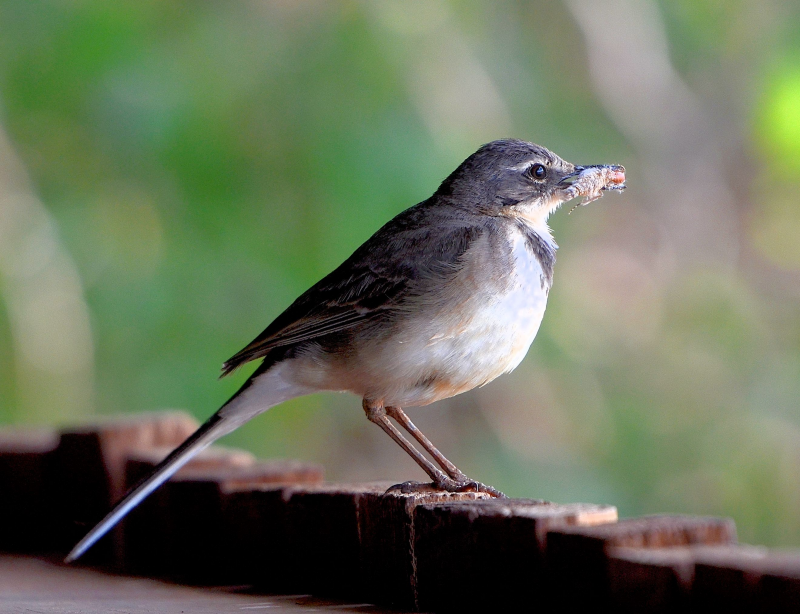
The Cape Wagtail forages for food while walking along the ground, bobbing its head and tail constantly. It mainly eats invertebrates and scraps of human food. It often eats insects which get attracted to lights in the early morning or caught in car radiators.

Its call is a buzzy “tseeei” that is often doubled and it has a complex song consisting of a jumble of different repeated notes. Take a listen here.

birdpix/195755-1.jpg
Cape Wagtail with a delicious morsel – BirdPix 195755 – John and Anne Todd, Northern Cape, 24 November 2021.

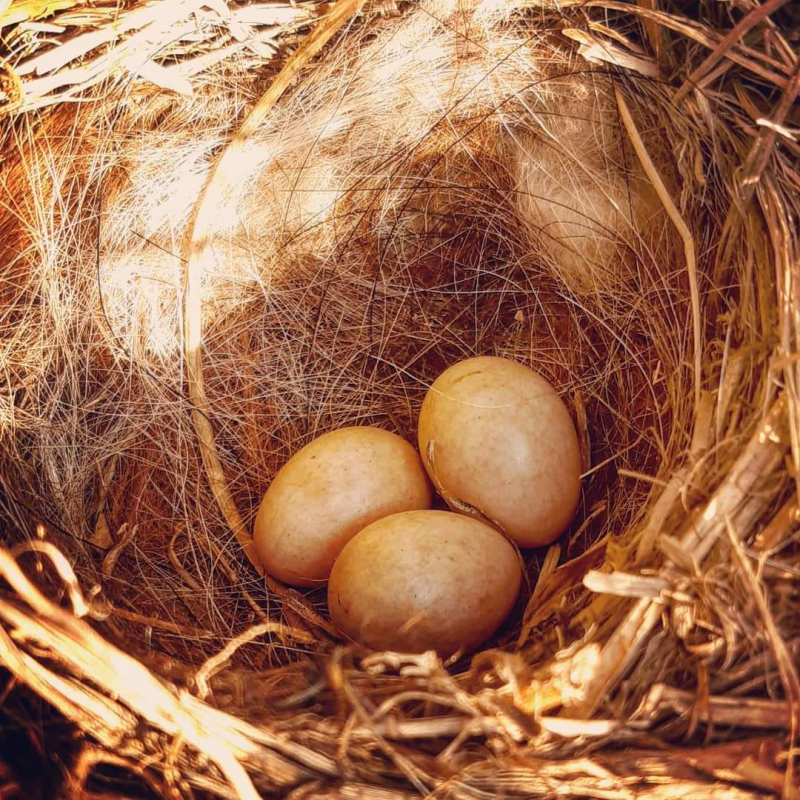
The Cape wagtail is a monogamous, territorial solitary nester, and breeding pairs stay together over a number of breeding seasons. The nest is built by both sexes and consists of a cup made of a wide range of materials, both natural and artificial, which is lined with hair, rootlets, wool and feathers. The nest is situated in a recess within a steep bank, tree, or bush, or in a man-made location such as a hole in a wall, a pot plant, or a bridge.

birdpix/089501-1.jpg
Cape Wagtail eggs in the nest – BirdPix 89501 – Ashwell Glasson, Kei River mouth, Eastern Cape, 25 August 2019.

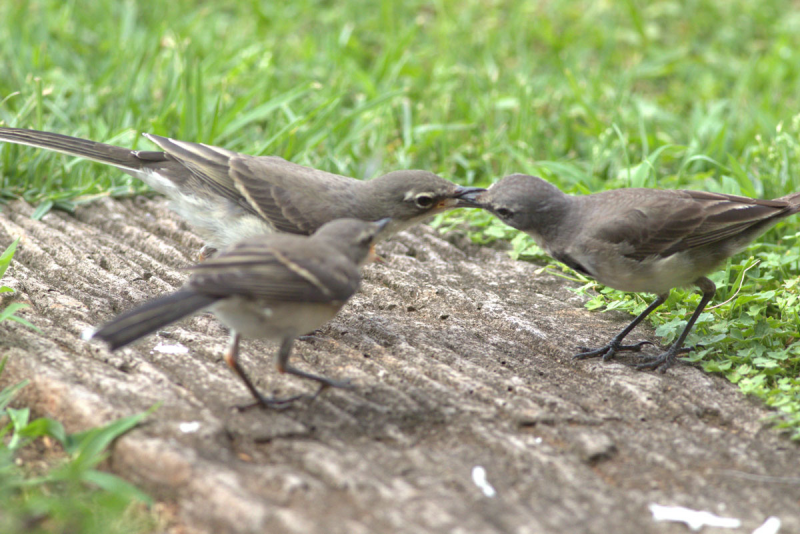
It breeds all year round but egg-laying peaks from July until December (mid-winter to early summer). Between one and five eggs are laid, which both parents take turns incubating for 13–15 days. Once hatched, the chicks are fed by both parents, until they leave the nest after 14–18 days. Once fledged they adults continue to feed them for another 20–25 days, and the young become fully independent around 44 days – 60 days after fledging.

birdpix/199350-2.jpg Cape Wagtail feeding young
Feeding the young ones – BirdPix 199350 – Chris Wilson, KwaZulu-Natal, 12 December 2021.

Further Resources

Species text from the first Southern African Bird Atlas Project (SABAP1), 1997.

Virtual Museum (BirdPix > Search VM > By Scientific or Common Name).

Other common names: Gewone Kwikkie (Afrikaans); Umcelu (Xhosa); umVemve (Zulu); Bergeronnette du Cap (French); Kapstelze (German).

A list of bird species in this format is available here.

Recommended citation format: Loftie-Eaton M and Daniel KA 2023. Cape Wagtail Motacilla capensis. BDI Bird Feeder Project. Biodiversity and Development Institute. Available Online at http://thebdi.org/2023/01/23/cape-wagtail-motacilla-capensis/

Melambrotus papio

View the above photo record (by Mark Galpin) in LacewingMAP here.

Ascalaphidae (Owlflies)

Melambrotus papio

 Tjeder, 1992

Identification

Size: Medium sized (Wingspan 60mm)

Owlflies in the genus Melambrotus are commonly known as Black-line Owlflies, due to the prominent black stripe along the leading edge of the wings. All species in the genus are closely similar and are separated on wing characteristics. Melambrotus papio has Dark lines on the forewing ending at the pterostigma, followed by a linear spot that does not reach the wing margin.

The body is mostly grey and the thorax is very hairy. There are two round, velvety black spots on top of the thorax.

As with other owlflies, they possess long, clubbed antennae.

The larvae are unknown.

Melambrotus papio – Bushmanskloof, Western Cape
Photo by Zenobia van Dyk

Habitat

Mostly recorded from fairly arid, shrubby habitats.

Behaviour

Adults emerge during Summer from October to April.

The winged adults are active at dusk and are often attracted to light. Virtually nothing is known of its biology and the larvae of this species are unknown.

Melambrotus papio – Bushmanskloof, Western Cape
Photo by Zenobia van Dyk

Status and Distribution

Melambrotus papio seems to be scarce but is fairly widespread in South Africa. Its distribution is mainly centred in the Western Cape, but is also recorded from the Western Cape, Eastern Cape, Northern Cape and Mpumalanga. It appears to be endemic to South Africa.

Distribution of Melambrotus papio. Taken from the LacewingMAP database, February 2023.

Taxonomy:

Order: Neuroptera Family: Ascalaphidae Subfamily: Ascalaphinae Tribe: Haplogleniini Genus: Melambrotus Species: papio

Further Resources

Virtual Museum (LacewingMAP > Search VM > By Scientific or Common Name)

Acknowledgements:

The use of photographs by Andre Kok, Mark Galpin and Zenobia van Dyk is acknowledged. This species text has benefited enormously from comments made by Mervyn Mansell on records he has identified in LacewingMAP. We acknowledge his important contribution.

Recommended citation format for this species text:

Tippett RM 2023. Melambrotus papio. Biodiversity and Development Institute, Cape Town.
Available online at http://thebdi.org/2023/01/15/melambrotus-papio/

Melambrotus papio – Karoo National Park, Western Cape
Photo by Andre Kok

Ascalaphus festivus

View the above photo record (by Richard Johnstone) in LacewingMAP here.

Ascalaphidae (Owlflies)

Ascalaphus festivus

 (Rambur, 1842)

Identification

Size: Medium sized (Wingspan 60mm)

Adults can be recognised by the striking chequered pattern of black/brown yellow and white along the abdomen.

The body is predominantly yellow with a few dark brown, parallel lines on the thorax. The wings are clear with a conspicuous amber-coloured leading edge.

As with other owlflies, they possess long, clubbed antennae.

The larvae closely resemble those of antlions (Myrmeleontidae).

Ascalaphus festivus – False Bay, iSimangaliso Wetland Park, KwaZulu-Natal
Photo by Ryan Tippett
Ascalaphus festivus – False Bay, iSimangaliso Wetland Park, KwaZulu-Natal
Photo by Ryan Tippett

Habitat

Ascalaphus festivus inhabits grasslands, especially in damp places such as moist or flooded grassland as well as marshes, floodplains and other wetlands fringes.

Habitat – Near Hluhluwe, KwaZulu-Natal
Photo by Ryan Tippett

Behaviour

Adults are recorded during Summer from October to April.

The winged adults are frequently flushed from long grass. They fly rapidly but will soon settle again on a grass stem in typical posture, wings pointing downwards and the abdomen held out at an angle to the grass stem.

They hawk smaller flying insects at dusk.

Eggs are laid in batches on leaves and stems, and the larvae are sedentary ambush-predators.

Ascalaphus festivus – Mooketsi, Limpopo
Photo by Bernardine Altenroxel

Status and Distribution

Ascalaphus festivus is Common and widespread throughout the Afrotropical Region – and beyond. In South Africa it is absent only from the Eastern and Western Cape provinces.

Distribution of Ascalaphus festivus. Taken from the LacewingMAP database, January 2023.

Taxonomy:

Order: Neuroptera Family: Ascalaphidae Subfamily: Ascalaphinae Tribe: Ascalaphini Genus: Ascalaphus Species: festivus

Further Resources

Virtual Museum (LacewingMAP > Search VM > By Scientific or Common Name)

Acknowledgements:

The use of photographs by Alan Manson, Bernardine Altenroxel and Richard Johnstone is acknowledged. This species text has benefited enormously from comments made by Mervyn Mansell on records he has identified in LacewingMAP. We acknowledge his important contribution.

Recommended citation format for this species text:

Tippett RM 2022. Ascalaphus festivus. Biodiversity and Development Institute, Cape Town.
Available online at http://thebdi.org/2023/01/15/ascalaphus-festivus/

Ascalaphus festivus – Mkomazi River, KwaZulu-Natal
Photo by Alan Manson

Ascalaphus bilineatus

View the above photo record (by Ryan Tippett) in LacewingMAP here.

Ascalaphidae (Owlflies)

Ascalaphus bilineatus

 (Kolbe, 1897)

Identification

Size: Medium sized (Wingspan 60mm)

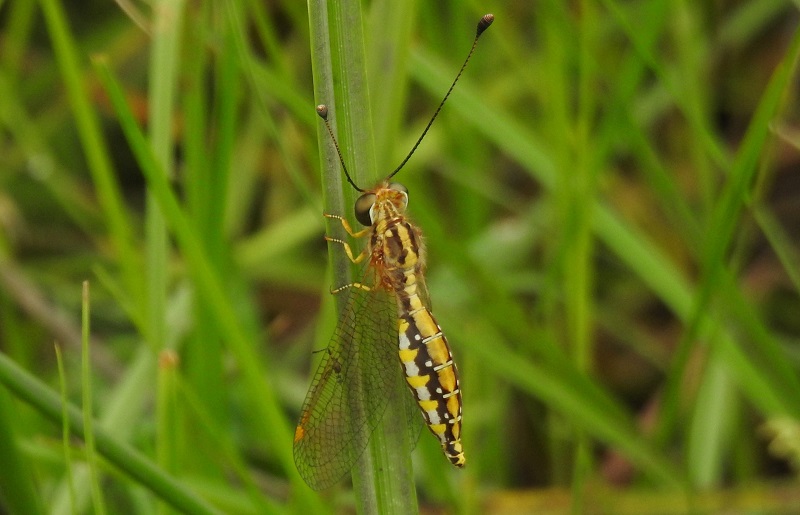
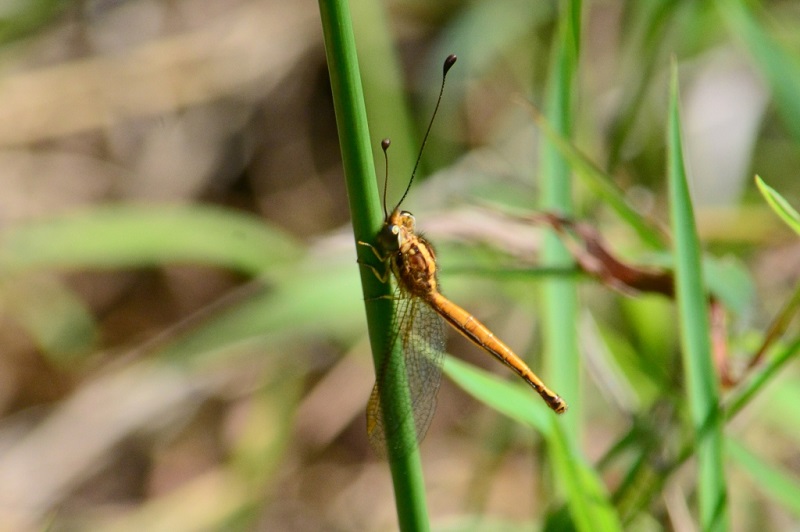
Adults can be recognised by the pair of broad, parallel, dark brown lines on the upper thorax – hence the name “bilineatus”.

The body is predominantly orange-yellow with a checquered pattern of brown yellow and white along the abdomen. The wings are clear with a conspicuous amber-coloured leading edge.

As with other owlflies, they possess long, clubbed antennae.

Ascalaphus bilineatus – Near Richards Bay, KwaZulu-Natal
Photo by Richard Johnstone
Ascalaphus bilineatus – Lake Mzingazi Nature Reserve, KwaZulu-Natal
Photo by Richard Johnstone

Habitat

Ascalaphus bilineatus inhabits damp places such as moist or flooded grassland as well as marshes, floodplains and other wetlands fringes.

Habitat – Near Hluhluwe, KwaZulu-Natal
Photo by Ryan Tippett

Behaviour

Adults are recorded during Summer from October to April.

The winged adults are frequently flushed from long grass. They fly rapidly but will soon settle again on a grass stem in typical posture, wings pointing downwards and the abdomen held out at an angle to the grass stem.

Ascalaphus bilineatus – Lake Mposa Dam Wall, KwaZulu-Natal
Photo by Richard Johnstone

Eggs are laid in batches on blades of grass (about 30-35 per batch).

The larvae are sit-and-wait ambush predators and seldom move position. They take about a year to progress from egg stage to adult.

Status and Distribution

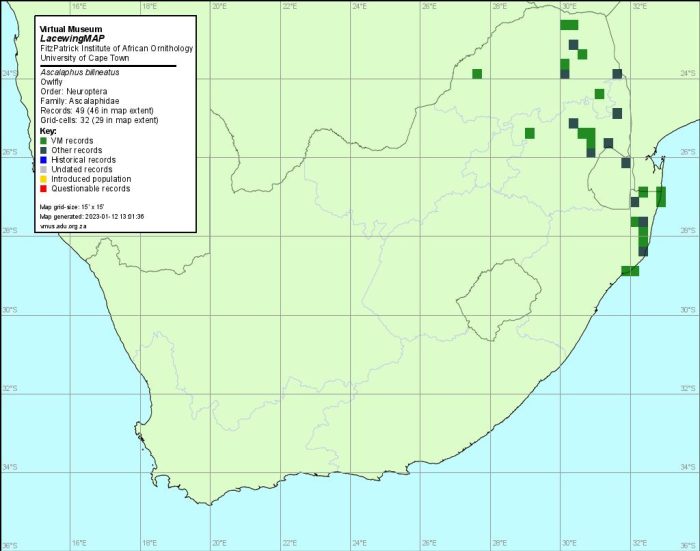
Ascalaphus bilineatus is common and widespread in the northern parts of South Africa, including Mpumalanga, KZN, North-West and Limpopo. Its range extends northwards to Zimbabwe, Malawi, Tanzania and Kenya. It has also been recorded from eSwatini (formerly Swaziland).

Distribution of Ascalaphus bilineatus. Taken from the LacewingMAP database, January 2023.

Taxonomy:

Order: Neuroptera Family: Ascalaphidae Subfamily: Ascalaphinae Tribe: Ascalaphini Genus: Ascalaphus Species: bilineatus

Further Resources

Virtual Museum (LacewingMAP > Search VM > By Scientific or Common Name)

Acknowledgements:

The use of photographs by Richard Johnstone is acknowledged. This species text has benefited enormously from comments made by Mervyn Mansell on records he has identified in LacewingMAP. We acknowledge his important contribution.

Recommended citation format for this species text:

Tippett RM 2022. Ascalaphus bilineatus. Biodiversity and Development Institute, Cape Town.
Available online at http://thebdi.org/2023/01/12/ascalaphus-bilineatus/

Ascalaphus bilineatus – Lake Mzingazi Nature Reserve, KwaZulu-Natal
Photo by Richard Johnstone