Malachite Sunbird (Nectarina famosa)

Cover image: Malachite Sunbird by Pamela Kleiman – Steytlerville, Eastern Cape –  BirdPix No. 10960

Identification

The Malachite Sunbird is notable for being the largest sunbird in southern Africa. The adult male in breeding plumage is highly distinctive and unmistakeable.
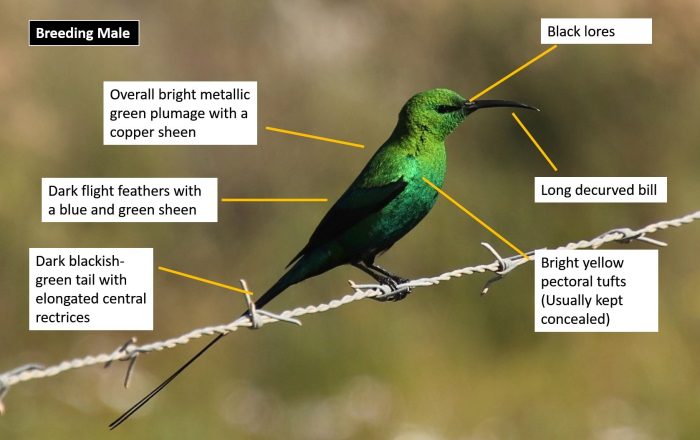
Identification guide to Malachite Sunbird male
Malachite Sunbird (Nectarina famosa)
Near Darling, Western Cape
Photo by Marius Meiring

The overall plumage is bright metallic green with a copper sheen when seen in bright sunlight. The rump and upper tail coverts are slightly darker green. The tail is dark blackish-green with a blue gloss and the central tail feathers are elongated. The feathers in the folded wings are blackish with a green and blue metallic sheen. Displaying males have bright yellow pectoral tufts but these remain concealed at other times. The lores between the eyes and bill are black. The bill is very long and decurved. The bill and legs are black.

male Malachite Sunbird
Malachite Sunbird (Nectarina famosa) 
Steytlerville, Eastern Cape
Photo by Gregg Darling

Females are olive-grey above and paler grey-brown to yellow-brown below. The pale underparts contrast with the darker upperparts. Females have a pale yellowish supercilium and malar stripe. The tail is dark brown with white outer tail feathers and lacks the elongated central rectrices of the breeding males.

female Malachite Sunbird
Malachite Sunbird (Nectarina famosa). Female
De Kelders, Western Cape
Photo by Sybrand Venter

Non-breeding males in eclipse plumage resemble females but have variable green-blotches on the underparts and wings. Juveniles closely resemble the females.

Male Malachite Sunbird in eclipse plumage
Malachite Sunbird (Nectarina famosa). Male in eclipse plumage.
Mpofu Dam, Eastern Cape
Photo by Gregg Darling

Status and Distribution

The Malachite Sunbird is a locally common to common resident and partial migrant. Its distribution is discontinuous from central Ethiopia south through east Africa to South Africa. In South Africa the Malachite Sunbird ranges from central Limpopo Province south through Mpumalanga and western Swaziland to KwaZulu-Natal, and down to the Western Cape and up to Namaqualand and extreme southern Namibia. There is also an isolated population in the eastern highlands of Zimbabwe and adjacent Mozambique.
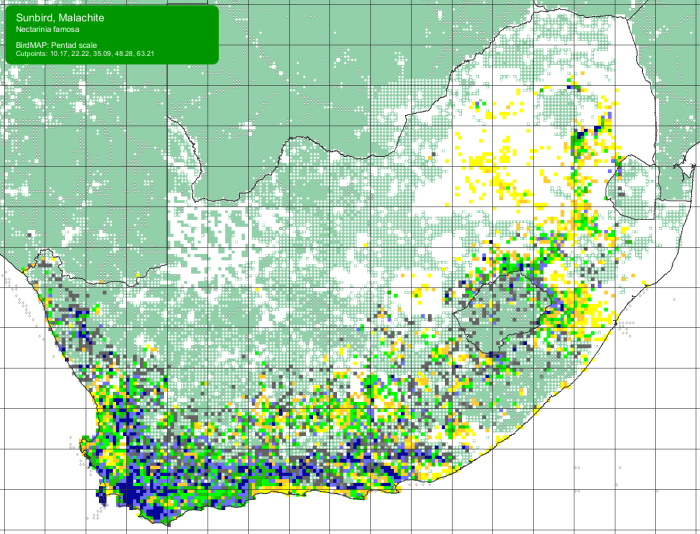
SABAP2 distribution map for Malachite Sunbird
SABAP2 distribution map for Malachite Sunbird (Nectarina famosa) – February 2024.
Details for map interpretation can be found here.

In South Africa the Malachite Sunbird appears to concentrate in the east of its range during the summer and in the west during winter. It generally moves out of the drier western areas (winter rainfall) in summer when it is hot and dry and flowering plants become scarce. This sunbird is an altitudinal migrant in the high altitude regions, particularly the Drakensberg, and moves to warmer, lower lying areas during the winter months.

There is no evidence of significant changes to its distribution or abundance. The Species has benefited from the planting of garden ornamentals which may have allowed the Malachite Sunbird to expand its range. In some areas, agriculture, forestry, urban development and alien plant infestations have impacted on its natural habitat. The Malachite Sunbird is not considered threatened.

Habitat

The Malachite Sunbird occupies a range of habitats from fynbos to mountain grasslands, forest edge and karoo scrub. It is often associated with scrubby hillsides and riverine bush, as well as parks, gardens and alien plantations. As a primarily nectarivorous species, its distribution and abundance are determined by the flowering cycles of food plants.
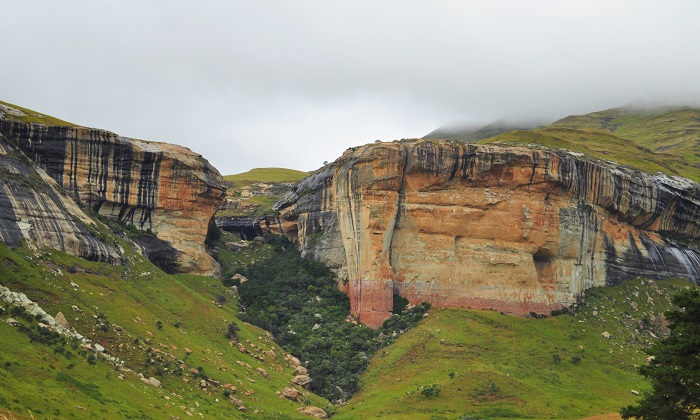
Habitat Malachite Sunbird
Montane grassland habitat
Golden Gate Highlands National Park, Free State
Photo by Ryan Tippett

The Malachite Sunbird is most common in montane grasslands and fynbos, followed by the Succulent Karoo and the southern parts of the Nama Karoo. It generally avoids the central and northern regions of the Nama Karoo which is more grass dominated and offers little food for sunbirds.

Behaviour

The Malachite Sunbird is an active and conspicuous species. It is usually encountered singly or in pairs when breeding. Gathers in large numbers at localised, rich food sources outside of the breeding season. Malachite Sunbirds may get displaced by Cape Sugarbird (Promerops cafer), Gurney’s Sugarbird (Promerops gurneyi) and the more aggressive Bronzy Sunbird (Nectarina kilimensis), but males regularly chase conspecifics and other, smaller sunbirds.
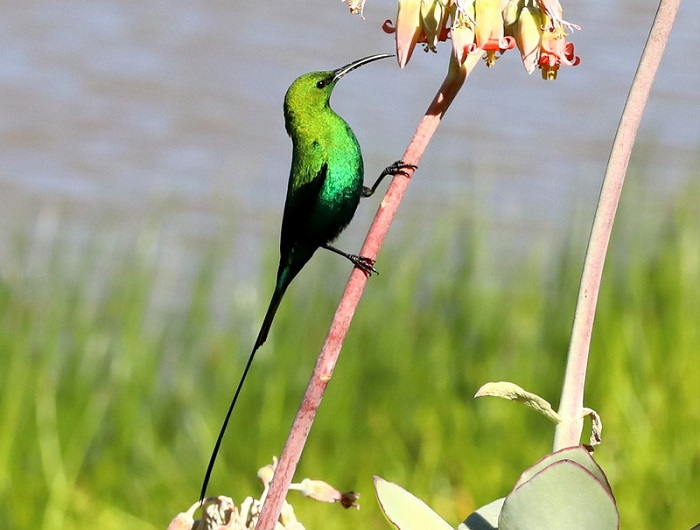
Nectarina famosa
Malachite Sunbird (Nectarina famosa)
Somerset West, Western Cape
Photo by Corrie du Toit

The diet consists mostly of nectar and is supplemented with arthropods, especially spiders and small insects like flies, moths, caterpillars, bugs and beetles. Insect prey is mostly gleaned from vegetation but the Malachite Sunbird will also hawk flying insects from time to time. Some pollen is also eaten and they readily take sugar water mixes from garden nectar feeders.

The Malachite Sunbird feeds on the nectar from a diverse array of plant species. The flowers of various Protea, Aloe, Leonotis and Kniphofia species are particularly important, and this sunbird is a key pollinator of these plants.

Nectarina famosa
Malachite Sunbird (Nectarina famosa)
Waaihoek Mountains, Western Cape
Photo by Fanie Rautenbach

Bathes in rain-soaked foliage, bird baths and in irrigation sprays. The flight is fast and direct.

An interesting adaptation of the Malachite Sunbird is its ability to enter torpor (daily hibernation) at night. This saves up to 60% of energy by reducing body temperature to as low as 26°C.
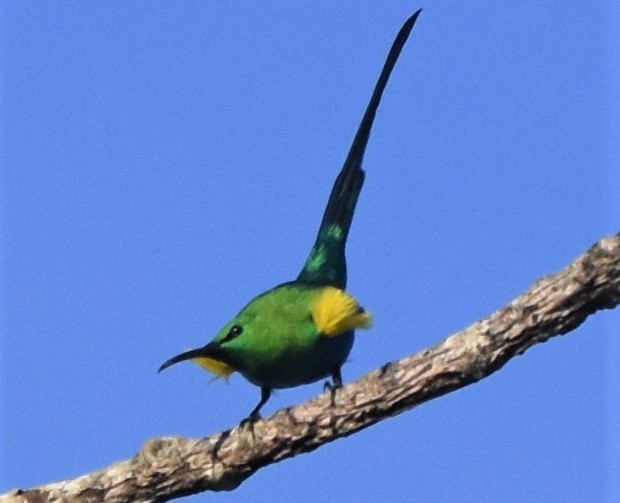
Nectarina famosa
A displaying male showing off his bright yellow pectoral tufts.
Malachite Sunbird (Nectarina famosa)
Near Durbanville, Western Cape
Photo by Gerald Wingate

The Malachite Sunbird breeds from May to November in the winter rainfall Western Cape, and during the summer months (mainly October to January) over the rest of its range. The nest is an oval of grass, leaves, twigs and roots, bound together with spider web. The nest has a side-top entrance and the inside is lined with fine grass, hair, feathers and plant fibres. The entrance usually has an overhanging ‘porch-style’ roof. The nest is often placed over a stream, gully or cliff face and is built entirely by the female.

Nectarina famosa
Malachite Sunbird (Nectarina famosa)
Hermanus, Western Cape
Photo by Andries de Vries

One to three (usually two) eggs are laid per clutch. Incubation lasts for around 13 days and is performed solely by the female. The nestling period takes about 20 days, during which time the young are fed and cared for by both parents.

Malachite Sunbird nests are frequently parasitised by Klaas’s Cuckoo (Chrysococcyx klaas), and to a lesser extent by Red-Chested Cuckoo (Cuculus solitarius) and Diederik Cuckoo (Chrysococcyx caprius).

Further Resources

Species text adapted from the first Southern African Bird Atlas Project (SABAP1), 1997.

The use of photographs by Andries de Vries, Cobus Elstadt, Corrie du Toit, Fanie Rautenbach, Gerald Wingate, Gregg Darling, Marius Meiring, Pamela Kleiman and Sybrand Venter is acknowledged.

Virtual Museum (BirdPix > Search VM > By Scientific or Common Name).

Other common names: Jangroentjie (Afrikaans); iNcuncu, iNcwincwi, uHlazazana (Zulu); Tale-tale (South Sotho); Souimanga malachite (French); Emeraldhoningzuiger (Dutch); Malachitnektarvogel (German); Beija-flor-verde (Portuguese).

List of bird species in this format is available here.

Recommended citation format: Tippett RM 2024. Malachite Sunbird Nectarina famosa. Biodiversity and Development Institute. Available online at https://thebdi.org/malachite-sunbird-nectarina-famosa/

Bird identificationbirding

Malachite Sunbird
Malachite Sunbird (Nectarina famosa)
Uniondale district, Western Cape
Photo by Cobus Elstadt
Bird Ringing Course at Botuin, Vanrhynsdorp: 31 January to 6 February 2024

This was the seventh BDI bird ringing course. You get links to the previous courses and other bird ringing events here.

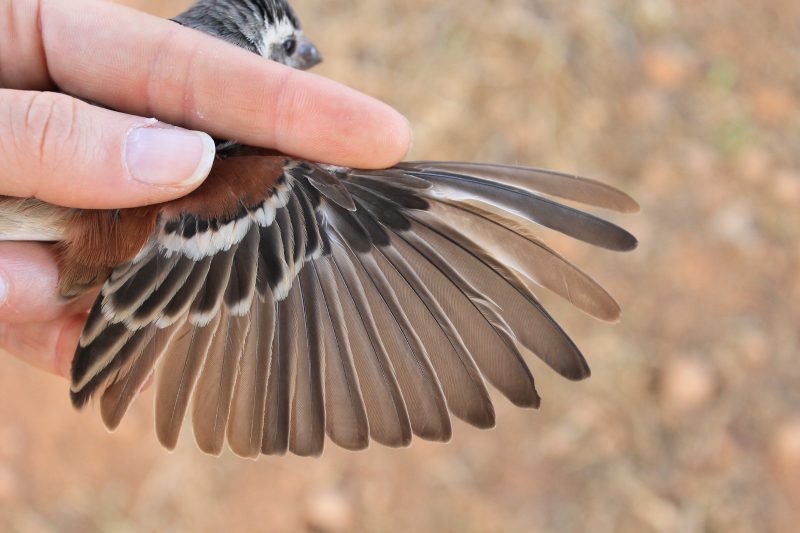
Although we had some extremely hot (over 40°C) and windy days, the last 3 days started with overcast conditions. Our week long ringing course was based at Botuin in Vanrhynsdorp, from 31 January to 6 February 2024. We caught 285 birds, including retraps, of 37 species. As on previous trips, we visited the sewage works and the Gifberg “lark site”, in addition to ringing in the Botuin gardens.

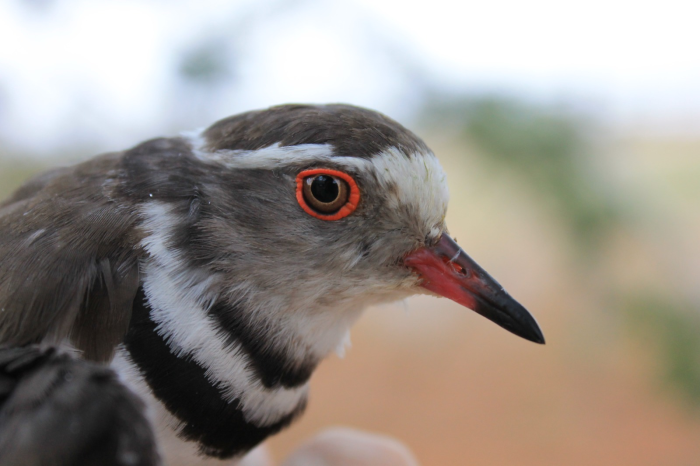
Three-banded Plover ringed at the Vanrhynsdorp Sewage Works

The species diversity was highest in the large garden at Botuin, with some exciting species being Namaqua Warbler, Chestnut-vented Warbler and a Fairy Flycatcher (Table 1). Most birds were caught at the Vanrhynsdorp Sewage Works, with a total catch of 65 Southern Red Bishops on two visits. Exciting species here included four Three-banded Plovers and a Little Stint. The karoo veld on the slopes of Gifberg had lower numbers and species but this site produced five Rufous-eared Warblers (a pair caught in a spring trap simultaneously!), three Large-billed Larks and a Karoo Chat.

Overall the most caught species were the Southern Red Bishop (67 birds) and Cape Sparrow (59). Lots of retraps from previous ringing events at Vanrhynsdorp were processed, including several that had moved between the sewage works and Botuin, a straight line distance of 1.5 km (see more here).

Table 1. Number of birds caught by species and site, 31 January-6 February, 2024

Sp noCountEnglishSewage worksGifbergBotuin
2383Three-banded Plover3
2531Little Stint1
31718Laughing Dove18
3185Namaqua Dove41
3911White-backed Mousebird1
3924Red-faced Mousebird4
4633Large-billed Lark3
4951White-throated Swallow1
5092Brown-throated Martin2
5444African Red-eyed Bulbul4
5661Karoo Chat1
5764African Stonechat22
5811Cape Robin-chat1
5835Karoo Scrub Robin113
6041Lesser Swamp Warbler1
6064African Reed Warbler13
6195Rufous-eared Warbler5
6462Levaillant’s Cisticola2
6535Namaqua Warbler5
6584Chestnut-vented Warbler4
6651Fiscal Flycatcher1
6781Fairy Flycatcher1
6863Cape Wagtail21
7222Bokmakierie11
7331Common Starling1
7603Southern Double-collared Sunbird3
7846House Sparrow24
78659Cape Sparrow1643
79912Cape Weaver813
80320Southern Masked Weaver128
80867Southern Red Bishop6511
8655White-throated Canary41
8661Yellow Canary1
87124Lark-like Bunting969
8732Cape Bunting2
11723Cape White-eye3
41391Karoo Prinia1
Total birds28513328124
No. of species37181323
Thanks very much to Salome for hosting us so well!

BDInsight – February 2024

Cover image: Malachite Sunbird (Nectarina famosa) – Middelburg district, Eastern Cape – Photo by Tino Herselman

Welcome to the February 2024 edition of the BDInsight. We have plenty of news to share and plenty of exciting events coming up. Read on to find out more…..

BDI-style Bird Species Texts

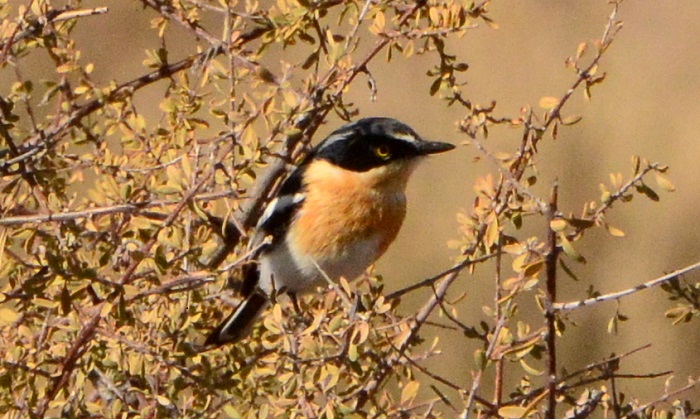
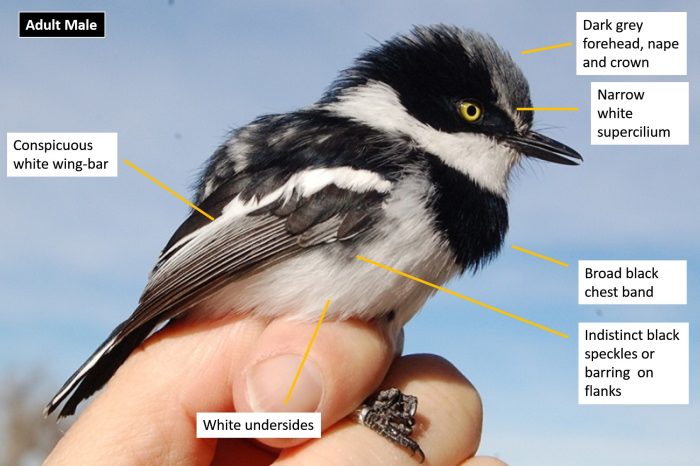
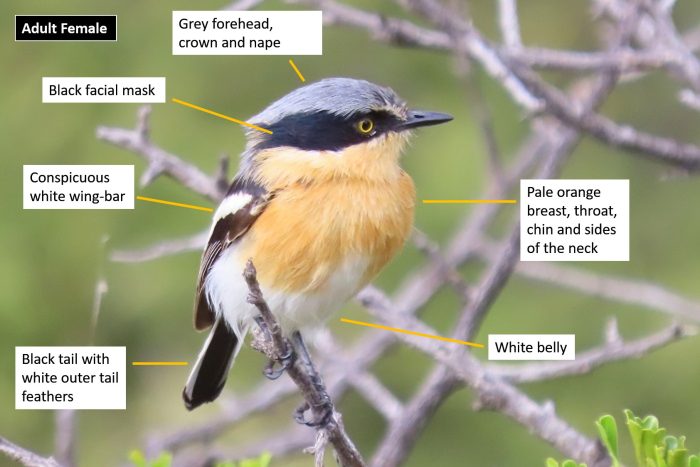
We are aiming to make it easier for beginner birders! Key to this is the production of “BDI-style” species texts on the BDI website. Each of the texts starts with an annotated photograph like this one for the Pririt Batis:

Each of the texts starts with an annotated photograph like the one above. The next sections cover Habitat (with photos), Distribution (with bird atlas map), and Behaviour (with words and photos).

The BDI-style texts do not only focus on identification but provides all sorts of interesting information; to see the full text for this species, click here.

We added texts for five species during January 2024:

New Biodiversity Observations Papers

Biodiversity Observations is an Open Access ejournal which focuses on the publication of descriptive papers which report observations relating to biodiversity. There is a great new paper which reflects on the papers submitted to the Journal during 2023.

Of the papers published in 2023, the one with the most downloads is A Guide to the Common Garden Birds of Cape Town, South Africa which had been downloaded 1172 times by 31 August. You can find the the paper here: https://journals.uct.ac.za/index.php/BO/article/view/1316. This link does not download the paper itself; it takes you to the page where you click on the PDF to get the paper.

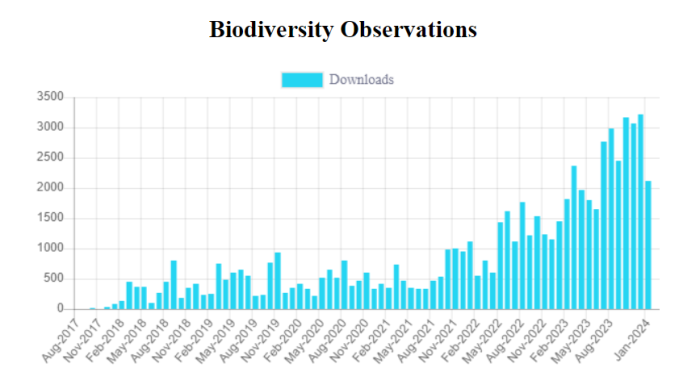
The graph below shows that Biodiversity Observations had its best month ever for number of papers downloaded; 3219 downloads of papers were made during December 2023. For January 2024, the number of papers downloaded were 2110.

A new year also means the start of a new Volume. Volume 14 (2024) already contains two papers which you can access here.

Bird Ringing

Bird ringing remains one of the most important research methods for discovering some of the most important basic information about each species. Conservation initiatives need a lot of information. Two key factors to understand are rates of survival and extent of movement. There is a discussion about the value of ringing here.

Diederik Cuckoo (Chrysococcyx caprius)
Tygerberg Nature Reserve, Western Cape
Photo by Gerald Wingate

There are three ringing courses planned for 2024. They are:

  • 31 January to 6 February at BoTuin, Vanrhynsdorp, Western Cape
  • 1 to 7 May at Ouberg Private Nature Reserve, Montagu, Western Cape
  • 09 to 15 September at New Holme Lodge, near Hanover, Northern Cape.
  • More details are here. There is a broad description of the course activities here.

Virtual Museum

Up-to-date distribution maps for species are critical for taking conservation decisions about species. Spring is springing, and the butterflies and moths, dragonflies and damselflies, will soon be out and about. Now is the time to dust off your cameras and get out into the field and start refreshing records in the Virtual Museum.

Records made long ago in a grid cell are slowly losing their value as evidence that the species is still present there, and need to be refreshed.

If your access to the Virtual Museum is not working (eg password issues) please contact Megan Loftie-Eaton for help (megan@thebdi.org).

Pririt Batis (Batis pririt)

Cover image: Pririt Batis by Ryan Tippett– Carnarvon district, Northern Cape –  BirdPix No. 252534

Batises make up a genus of small, uniquely African, flycatcher-like birds, that are in fact most closely related to the Bushshrikes and Helmetshrikes.

Identification

The Pririt Batis is sexually dimorphic, with the sexes differing in plumage colouration. Unusually for birds, the females are more colourful than the males.

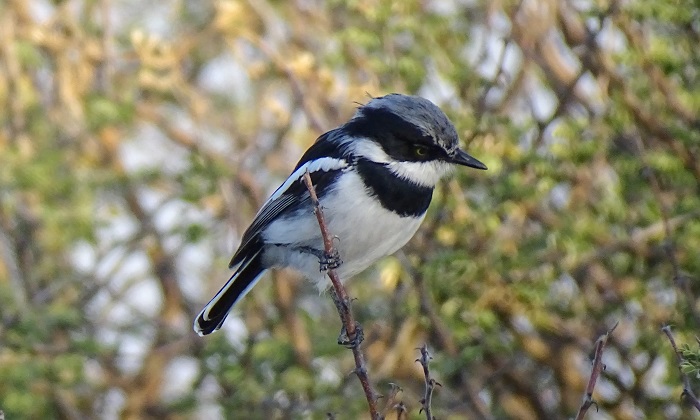
Identification of male Pririt Batis
Pririt Bati (Batis pririt) Male
Saaipoort, Northern Cape
Photo by Dieter Oschadlius

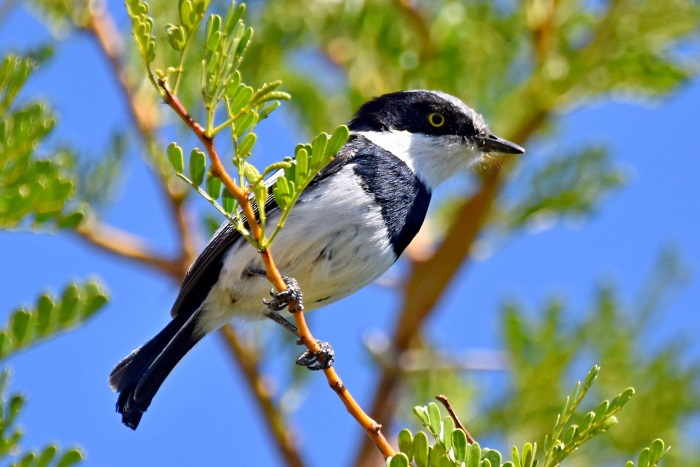
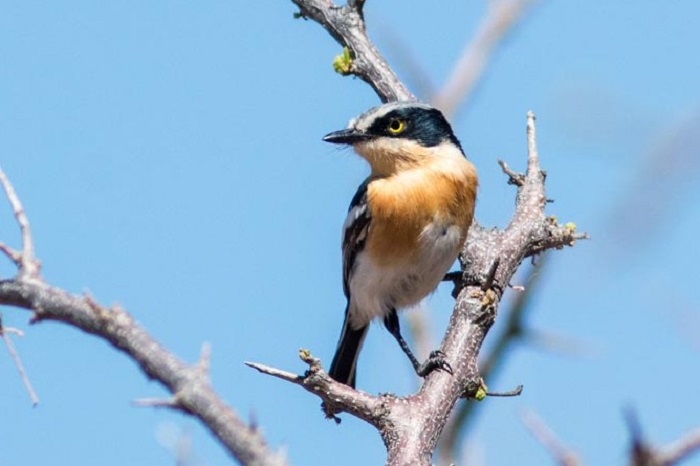
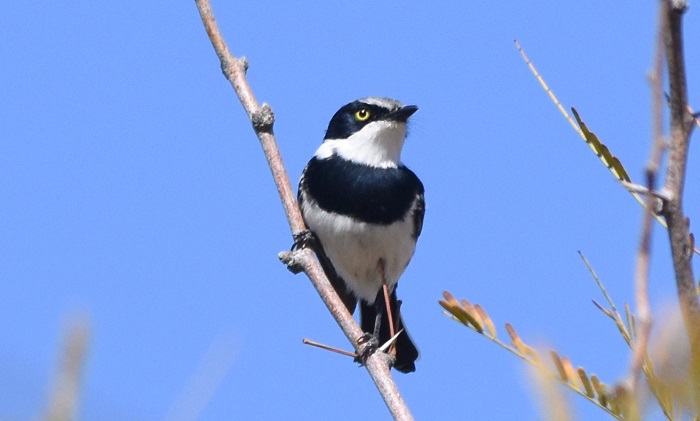
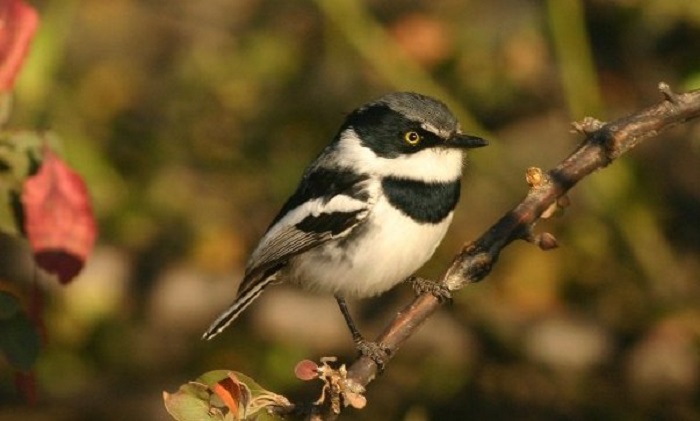
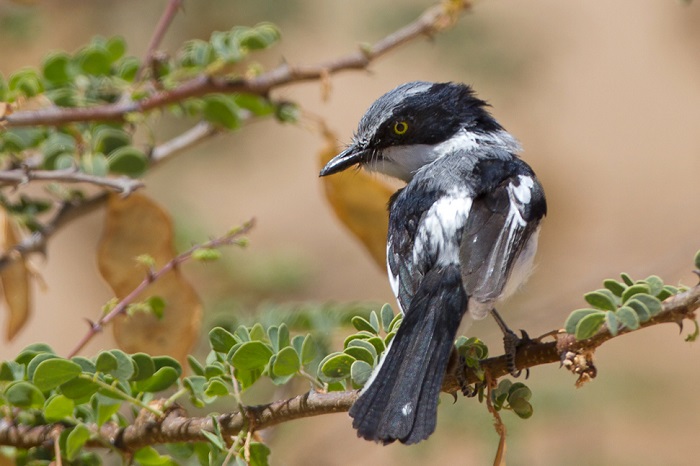
Males are striking black, white and grey birds. The forehead, crown and nape are dark grey, bordered by a narrow white supercilium. A black facial mask extends from the base of the bill to the sides of the neck. The rest of the upper parts from the hind neck to the rump are grey. Flight feathers are black with a distinct white wing bar. The undersides, from the chin to the vent are white, except for a broad, glossy black breast band. The flanks show indistinct grey speckling. The tail is black with white outer tail feathers.

Identification of female Pririt Batis
Pririt Batis (Batis pririt) Female
Middelburg district, Eastern Cape
Photo by Zenobia van Dyk

Females have the same general plumage as the males, but the chin, throat, lower sides of the neck and breast are pale orange, shading to white on the belly. Juveniles resemble females but are duller with dark brown mottling on the buff-orange breast. In both sexes and juveniles, the bill, legs and feet are black and the eyes are relatively large and yellow.

The female Pririt Batis is unlikely to be mistaken for any other species within its range, but males closely resemble those of the Chinspot Batis (Batis molitor). The Chinspot Batis lacks the grey speckled flanks. The distribution of the two species overlaps marginally in the north and east of the Pririt Batis’s range.

Batis pririt
Pririt Batis (Batis pririt) Male
Kgalagadi Transfrontier Park, Northern Cape
Photo by Josu Meléndez

Male Pririt Batises could also be confused with the black, white and grey of the Fairy Flycatcher (Stenostira scita), but that species has a longer tail and does not have a broad black breast band.

Status and Distribution

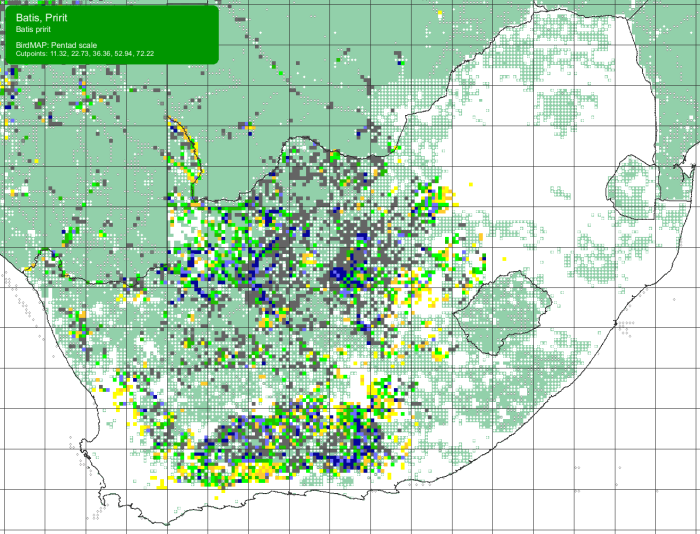
The Pririt Batis is a common resident and near-endemic to southern Africa, extending only marginally into south-western Angola. There are two disjunct populations. The northern population occurs in Namibia, Botswana and central and north-western South Africa (Northern Cape, Free State and North West Province.) The southern population occurs in the succulent Karoo regions of the Western and Eastern Cape. The gap in distribution corresponds to a high-lying and virtually treeless region on the escarpment and central plateau.

SABAP2 distribution map for Pririt Batis
SABAP2 distribution map for Pririt Batis (Batis pririt) – January 2024.
Details for map interpretation can be found here.

No widespread regular movements have been recorded for the Pririt Batis. However, there may be some movement into the periphery of its range, mainly in the south and east, during winter and drought periods. The Pririt Batis does not seem to be under any threat across its large range. The species probably benefits from bush encroachment in response to overgrazing.

Habitat

Habitat for Pririt Batis
Habitat near Carnarvon, Northern Cape
Photo by Ryan Tippett

The Pririt Batis inhabits various arid and semi-arid woodlands, especially Acacia (Vachelia) savanna. It also occurs along wooded watercourses in deserts and Karoo scrub. In the north-eastern part of its range it is present in dry Mopane (Colophospermum mopane) woodland. In the Karoo, the Pririt Batis also occurs in stands of alien Mesquite (Prosopis spp). The Pririt Batis is a common garden bird at farmsteads and villages in the Karoo.

Behaviour

Batis pririt
Pririt Batis (Batis pririt) Male
Nelspoort Road, Eastern Cape
Photo by Jorrie Jordaan

The Pririt Batis occurs in pairs or small family groups and readily associates with mixed bird parties, especially in winter. It is quite tame and inquisitive. The Pririt Batis is very active, often jerking the head and flicking its tail as it searches the canopies of trees and bushes for food. Flights between trees are undulating, often with conspicuous ‘wing-snapping’. They frequently mob predators such as the Pearl-spotted Owlet.

Batis pririt
Pririt Batis (Batis pririt) Female
Waterberg Plateau, Namibia
Photo by J.K. Boyce

Most prey is captured by gleaning insects from leaves, twigs and branches, and food items are often seized with an audible bill snap. Also hawks flying insects, and sometimes descends to the ground to catch prey. The Pririt Batis is insectivorous feeding on a variety of small crawling and flying insects.

Over most of its range it is the only batis present, but along an extensive common boundary in the north and east it comes into contact with the Chinspot Batis. There appears to be regular interaction between these species where they co-occur.

Pririt Batis
Pririt Batis (Batis pririt) Male
Biedouw Valley, Western Cape
Photo by Gerald Wingate

The Pririt Batis mostly breeds during summer from September to May. Breeding has also been recorded in July and August which suggests breeding may be opportunistic at any time of the year according to rainfall.

The nest is a small, neat cup made from plant fibres and bound with spider web and decorated on the outside with cocoons and small bits of bark. The nest is most often placed on a fairly slender, horizontal branch in thorn trees.

Batis pririt
Pririt Batis (Batis pririt) Male
Kleinpoort, Eastern Cape
Photo by M. Booysen

1 to 4 eggs are laid per clutch. The eggs are incubated by the female only and the eggs hatch after 17 days or so. The nestling period also lasts for around 17 days, during which time they are fed and cared for by both parents. Fledglings are dependant on their parents for about 6 weeks after leaving the nest. The Pririt Batis is a regular host of the brood parasitic Klaas’s Cuckoo (Chrysococcyx klaas).

Further Resources

Species text adapted from the first Southern African Bird Atlas Project (SABAP1), 1997.

The use of photographs by Dieter Oschadleus, Gerald Wingate, Gregg Darling, J.K. Boyce, Jorrie Jordaan, Josu Meléndez, Maans Booysen and Zenobia van Dyk is acknowledged.

Virtual Museum (BirdPix > Search VM > By Scientific or Common Name).

Other common names: Priritbosbontrokkie (Afrikaans); Pririt de Vieillot (French); Pririt-vliegenvanger (Dutch); Priritschnäpper (German); Batis de Pririt (Portuguese)

Recommended citation format: Tippett RM 2023. Pririt Batis Batis pririt. Biodiversity and Development Institute. Available online at https://thebdi.org/2024/01/29/pririt-batis-batis-pririt/

List of bird species in this format is available here.

Bird identificationbirding

Pririt Batis
Pririt Batis (Batis pririt) Male
Erongo Lodge, Namibia
Photo by Gregg Darling

Fairy Flycatcher (Stenostira scita)

Cover image: Fairy Flycatcher by Marna Buys – Wonderboom, Gauteng –  BirdPix No. 261347

Identification

This species is notable for being one of the smallest birds in southern Africa, weighing in at just 6 grams.

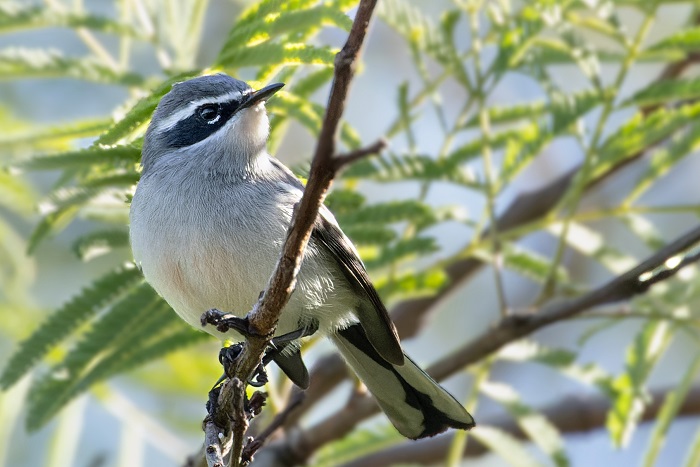
Fairy Flycatcher (Stenostira scita) 
Middelburg district, Eastern Cape
Photo by Tino Herselman

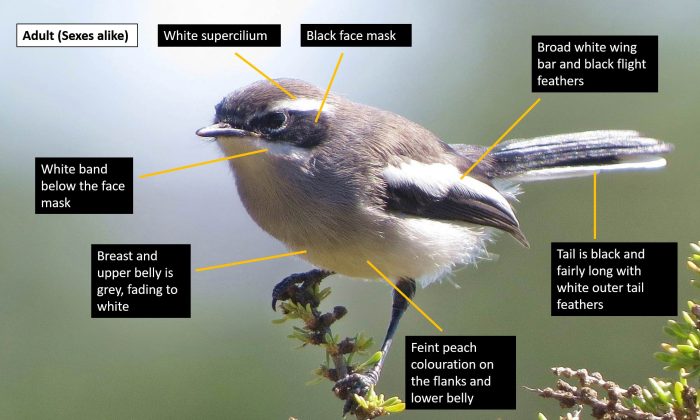
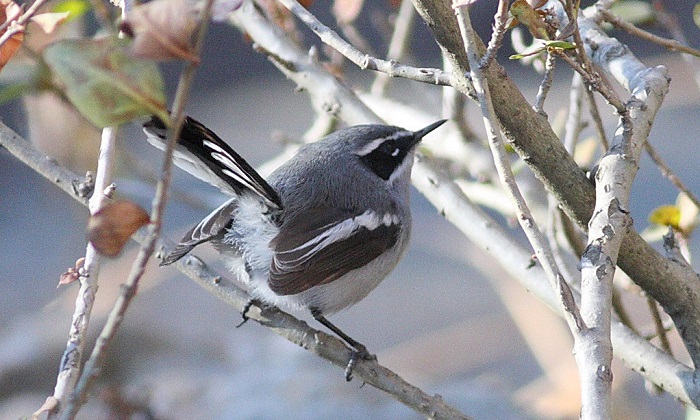
The Fairy Flycatcher has distinctive grey, black and white plumage. The head is grey with a black facial mask, surrounded by white. The mantle and back are plain grey, and the breast and upper belly is grey, fading to white with a slight peach-coloured wash on the flanks and lower belly. The flight feathers are black with a conspicuous white wing bar. The tail is black and fairly long with white outer tail feathers.

The sexes are alike, while juveniles are browner above and lack the peach flanks.

The Fairy Flycatcher is perhaps most likely to be mistaken for the black, white and grey male of the Pririt Batis (Batis pririt), but that species has a distinctive, broad black breast-band and a shorter tail.

Fairy Flycatcher (Stenostira scita) 
Standerton, Mpumalanga
Photo by JC van Rensburg

Status and Distribution

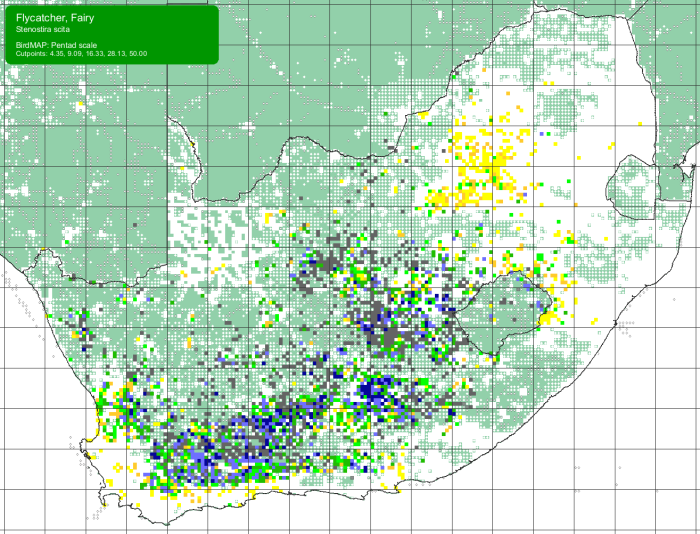
The Fairy Flycatcher is fairly common to common and is endemic to southern Africa. Its range encompasses most of South Africa, but is mostly absent from hot low lying areas like the lowveld and Zululand. Its range also excludes a broad coastal strip from near East London in the Eastern Cape to northern KwaZulu-Natal.

The range includes all of Lesotho and just reaches into Eswatini (Swaziland). It also occurs during winter in southern Namibia, south-eastern Botswana and very marginally in Zimbabwe.

SABAP2 distribution map for Fairy Flycatcher (Stenostira scita) – October 2023.
Details for map interpretation can be found here.

The Fairy Flycatcher is most numerous in the Nama Karoo where it is resident, moving into surrounding biomes as an altitudinal migrant during the winter months.

There is no evidence of changes to its distribution, and the Fairy Flycatcher is not considered threatened.

Fairy Flycatcher (Stenostira scita)
Near Anysberg, Western Cape
Photo by Sue Gie

Habitat

The Fairy Flycatcher prefers semi-arid Karoo shrublands, of both the Nama and Succulent Karoo. It also inhabits fynbos and grassland regions. It requires an element of woody growth, however sparse, in which to forage, such as thorny thickets, scrubby mountain kloofs, wooded hillsides and drainage lines.

It is mostly resident in the Nama and Succulent Karoo biomes, moving into Acacia savanna, montane scrub, fynbos, plantations and gardens, particularly in the northern and eastern parts of its distribution. The Fairy Flycatcher normally avoids extensive closed woodlands.

Habitat near Carnarvon, Northern Cape
Photo by Ryan Tippett

Behaviour

The Fairy Flycatcher is an active species that moves around singly, in pairs or occasionally in loose family groups. Restless, agile and constantly on the move, the Fairy Flycatcher forages among foliage, flitting between trees and shrubs. It frequently fans and raises its tail. Flies low from bush to bush and seldom flies far.

Fairy Flycatcher (Stenostira scita)
Hillston Farm, Eastern Cape
Photo by David Solomon

Fairy Flycatchers join mixed-species foraging parties with other small insectivorous species. Gleans small prey from twigs and leaves and flowers within leafy bushes, or in tree canopies. Often hawks airborne insects in short, fluttering flights. The Fairy Flycatcher’s dies consists entirely of small invertebrates, including flies mosquitoes, Hemiptera (Bugs), very small beetles, lacewings, wasps, moths and spiders.

Fairy Flycatcher (Stenostira scita)
Soutpan district, Free State
Photo by Toby Esplin

The Fairy Flycatcher breeds from October to December. It is a monogamous, solitary nester. The nest is a small, deep cup of finely shredded grass, weed stems and shredded bark, bound with spider web and is built entirely by the female. The outside of the nest is camouflaged with a layer of lichen, strands of bark and dry foliage secured with spider web to the outer wall. The nest is well hidden and usually placed in a densely foliaged shrub around 1m above the ground.

Fairy Flycatcher (Stenostira scita)
Sani Pass, KwaZulu-Natal
Photo by Dave Rimmer

2 or 3 glossy, pale green-brown eggs are laid per clutch. The incubation period lasts from 17 to 18 days and all incubation is likely performed by the female. The male feeds the female in the nest. The young are altricial but further details regarding the nestling period etc. are unrecorded.

Further Resources

Species text adapted from the first Southern African Bird Atlas Project (SABAP1), 1997.

The use of photographs by Dave Rimmer, David Solomon, JC van Rensburg, Lance Robinson, Marna Buys, Sue Gie, Tino Herselman and Toby Esplin is acknowledged.

Virtual Museum (BirdPix > Search VM > By Scientific or Common Name).

Other common names: Fairy Warbler (Alt. English); Feevlieëvanger (Afrikaans); Mignard enchanteur, Érythrocerque de Livingstone (French); Elf-apalis (Dutch); Livingstones Rotschwanzschnäpper (German); Papa-moscas-d’asa-branca (Portuguese).

List of bird species in this format is available here.

Recommended citation format: Tippett RM 2023. Fairy Flycatcher Stenostira scita. Biodiversity and Development Institute. Available online at https://thebdi.org/2024/01/22/fairy-flycatcher-stenostira-scita/

Bird identificationbirding

Fairy Flycatcher (Stenostira scita)
Klipriviersberg Nature Reserve, Gauteng
Photo by Lance Robinson

Secretarybird (Sagittarius serpentarius)

Cover image of Secretarybird by Johan and Estelle van Rooyen – Kgalagadi Transfrontier Park, Northern Cape – BirdPix No. 230151

The Secretarybird belongs to its own family: Sagittariidae, but are closely related to diurnal raptors. The name ‘Secretarybird’ is derived from ‘Saqr-et-tair’, the arabic name for this species which means ‘hunter bird’.

Identification

The Secretarybird is a large, striking and unmistakeable species.

Secretarybird (Sagittarius serpentarius) 
Kgalagadi Transfrontier Park, Northern Cape
Photo by Anne Todd

It is noticeably long-legged with bare pinkish-grey lower legs. The upper legs and lower belly are black. The rest of the underparts and the head are pale grey. The upper parts are mostly plain bluish grey with black flight feathers. There is a characteristic, dark-tipped, long erectile crest on the head. The bare facial skin is orange and the bill is horn-grey. The tail is elongated and grey with broad black bands and a white tip.

The sexes are very similar but males are larger with a longer crest and tail. Juveniles have duller, browner plumage, shorter tails and the bare facial skin is yellowish.

Secretarybird (Sagittarius serpentarius) 
Ithala Game Reserve, KwaZulu-Natal
Photo by Carel van der Merwe

The Secretarybird is unlike any other species but superficially resembles Blue Crane from a distance. That species lacks any black colouration and has un-feathered upper legs.

Status and Distribution

The Secretarybird is an Afrotropical species occurring throughout the savanna regions of Africa. It avoids the Sahara desert of north Africa, the central and west African rain forest belt and the most arid parts of north-east Africa. It is widely distributed across Southern Africa.

SABAP2 distribution map for Secretarybird Sagittarius serpentarius – January 2024. Details for map interpretation can be found here.

The Secretarybird is considered locally fairly common to uncommon in southern Africa and is listed as Near-threatened due to decreases in some local populations. Overall, the current distribution of the Secretarybird is believed to reflect closely the historical range, and any changes are likely to be in abundance and not distributional.

Habitat

Habitat – Vanwyksvlei district, Northern Cape
Photo by Ryan Tippett

The Secretarybird is an inhabitant of open country, mainly savanna, open woodland, grassland, dry floodplains and Karoo shrublands. It prefers habitats with relatively short grass. Some man-made habitats are also used, such as airfields, grazing paddocks and fallow fields. The Secretarybird avoids mountain fynbos, forest, dense woodland and very rocky, hilly or mountainous areas.

Behaviour

Secretarybird (Sagittarius serpentarius)
Kgalagadi Transfrontier Park, Northern Cape
Photo by Zenobia van Dyk

Secretarybirds usually occur singly or in pairs, and occasionally in family groups of 3 to 4 birds. Groups of up to 50have been recorded at waterholes in arid areas. The Secretarybird is not known to undertake any regular seasonal movements, but is nomadic with increased local movements outside the breeding season. It is highly nomadic in low-rainfall areas.

Secretarybird (Sagittarius serpentarius)
Zimanga Game Reserve, KwaZulu-Natal
Photo by Vaughan Jessnitz

Secretarybirds roost singly or in pairs, usually in the crown of a flat-topped thorn tree, and often roosts on the nest. Flies to roost 1-2 hr before dark and often only leaves the roost a couple hours after sunrise. They frequently enjoy a dustbath and drinks water regularly in arid areas. The Secretarybird is often active during the heat of the day, but sometimes rests in shade when it gets too hot.

Secretarybird (Sagittarius serpentarius)
Kgalagadi Transfrontier Park, Northern Cape
Photo by Anne Todd

They are well adapted to soaring which enables them to disperse widely and efficiently. Secretarybirds have to run to take off from the ground, usually by running into the prevailing wind with the wings open for balance and to increase lift.

Secretarybird (Sagittarius serpentarius)
Farm district, Eastern Cape
Photo by Lance Robinson

Spends hours at a time striding across open veld in search of prey, occasionally stamping repeatedly in a small area to disturb or dislodge prey. Raises its wings in excitement and for balance when prey is sighted. All prey is captured on the ground, usually with the bill. Any prey that gets disturbed during stamping bouts is quickly dispatched with hard downward blows from the feet, which are equipped with short, strong toes and robust claws. Small prey items, such as insects or small tortoises, are swallowed whole. Larger prey items are secured with the feet and torn up with bill.

Secretarybird (Sagittarius serpentarius) 
Kgalagadi Transfrontier Park, Northern Cape
Photo by Josu Meléndez

Consumes a wide variety of animal prey. Most prey items are small, favouring grasshoppers, locusts and lizards which usually form the bulk of the diet. Other commonly consumed, smallish prey items include amphibians, rodents and birds, including their young and eggs. Larger prey items include birds up to the size of francolins, mammals up to the size of hares and large snakes, including highly venomous species like puffadder and cobras.

Secretary birds are well equipped to deal with snakes, the long, bare legs are covered with tough armour-like scales to prevent injury or bites from its prey, and the upper legs are densely feathered to provide further protection. However, contrary to popular belief, snakes are not a staple and make up only a small percentage of the Secretarybird’s diet.

Some interesting prey items that have been recorded include Striped Polecat (Ictonyx striatus), Slender Mongoose (Herpestes sanguinea), and Southern African Hedgehog (Atelerix frontalis). Secretarybirds are often attracted to recently burnt areas to feed on animals displaced by the fire, but they do not eat carrion.

Secretarybird (Sagittarius serpentarius)
Pilanesberg National Park, North West
Photo by Helen Badenhorst

The Secretarybird breeds throughout southern Africa and in all months except during mid-winter in the winter-rainfall regions. They are territorial and maintain territories of 20-230 km2 around nest, depending on habitat.

The nest is is a large, flat platform of sticks up to, 2.5m in diameter and about 50cm thick. Nests are usually sunk into the top of a dense, thorny tree or large bush making the nest difficult to see. The central bowl of the nest is lined with grass and sometimes with pieces of dried dung.

Secretarybird (Sagittarius serpentarius)
Kruger National Park, Mpumalanga
Photo by Len de Beer

1 to 3 (usually 2) eggs are laid per clutch. As with most raptors, incubation starts before clutch completion, resulting in asynchronous hatching and chicks of different ages. The eggs are chalky white or pale greenish-blue. Incubation lasts for around 45 days and most incubation is performed by the female. The male provides for the female at this time by bring her food on the nest. The young are altricial and the nestling period lasts for up to 106 days during which time they are fed by both parents. Young chicks are fed by regurgitation but are presented with whole prey items as they get older. If 3 chicks hatch the youngest usually starves to death as it gets out-competed by its older siblings.

Secretarybird (Sagittarius serpentarius)
Greyton district, Western Cape
Photo by Stuart Shearer

Young birds that have left the nest start hunting for themselves, but remain partly dependent on their parents for food for a further 3 months or so.

Further Resources

This species text is adapted from the first Southern African Bird Atlas Project (SABAP1), 1997.

The use of photographs by Anne Todd, Carel van der Merwe, Helen Badenhorst, Johan and Estelle van Rooyen, Josu Meléndez, Lance Robinson, Len de Beer, Stuart Shearer, Vaughan Jessnitz and Zenobia van Dyk is acknowledged.

Virtual Museum (BirdPix > Search VM > By Scientific or Common Name).

Other common names: Sekretarisvoël (Afrikaans); iNtungunono (Zulu); Ingxangxosi (Xhosa); Secretarisvogel (Dutch); Messager serpentaire, Messager sagittaire (French); Sekretär (German); Secretário (Portuguese).

A list of bird species in this format is available here.

Recommended citation format: Tippett RM 2023. Secretarybird Sagittarius serpentarius. Biodiversity and Development Institute. Available Online at https://thebdi.org/2024/01/13/secretarybird-sagittarius-serpentarius/

Bird identificationbirding

Secretarybird (Sagittarius serpentarius)
Zimanga Game Reserve, KwaZulu-Natal
Photo by Vaughan Jessnitz

Cape Crow (Corvus capensis)

Cover image of Cape Crow by Anne Todd – Kgalagadi Transfrontier Park, Northern Cape – BirdPix No. 270764

Identification

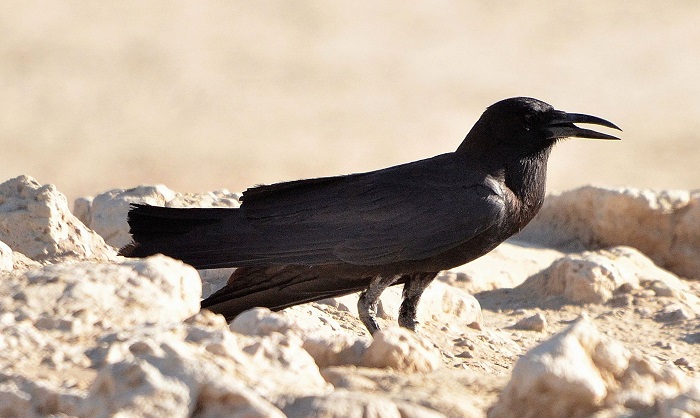
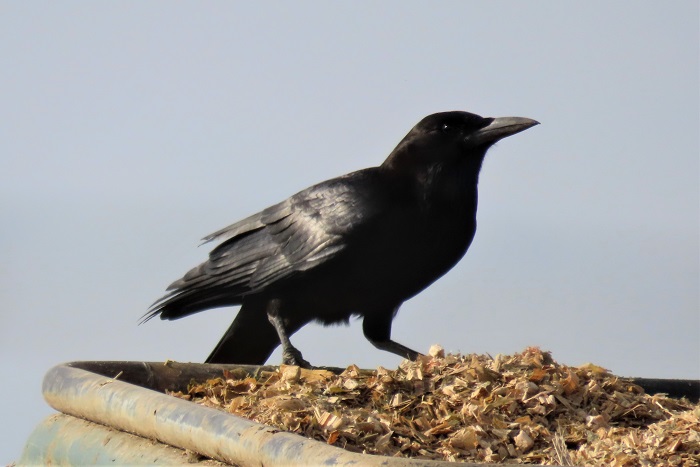
The Cape Crow is a distinctive black corvid. It is easily recognisable as the only all-black crow in the region. In both sexes the entire body is glossy black. The bill, legs and feet are also black. The head is rounded and the bill is pointed and more slender than in other corvids.

Juveniles are a duller brownish black.

Identification of Cape Crow
Cape Crow Corvus capensis
Lotheni Nature Reserve, KwaZulu-Natal
Photo by Andrew Kruger

The Cape Crow is unlikely to be mistaken for any other species except the introduced House Crow (Corvus splendens), but that species has a dark greyish nape, mantle and breast. The House Crow is also smaller with a shorter, heavier bill.

Corvus capensis
Cape Crow Corvus capensis
Mackenzie Country Club, KwaZulu-Natal
Photo by Malcolm Robinson

Status and Distribution

The Cape Crow is generally a common species across its range. It occurs from Angola and Zambia Southwards, extending across southern Africa in a rather unusual distribution pattern. It is distributed almost continuously along the coast and adjacent interior from the Kunene River, through Cape Aghulhas to Richards Bay. An axis of distribution runs from the Etosha Pan in Namibia, through Botswana to Mpumalanga and western eSwatini (Swaziland). It It also ocurrs on the central plateau of Zimbabwe.

A second subspecies of the Cape Crow is found in nort-east Africa, centered on Ethiopia. The two subspecies do not overlap.

SABAP2 distribution map for Cape Crow
SABAP2 distribution map for Cape Crow Corvus capensis – download in January 2024.
Details for map interpretation can be found here.

It is likely that the distribution of this adaptable species has been greatly influenced by human activities. Black Crows frequently build their nests on telephone poles and electricity pylons, and the erection of these structures has probably facilitated the spread of the Cape Crow into otherwise unsuitable, treeless areas. It is considered a pest by maize farmers.

Habitat

The Cape Crow is most common in open habitats with patches of trees or wooded watercourses. In the eastern regions of southern Africa it is generally a species of montane grasslands, and in the west of southern Africa it inhabits open, arid areas. It is uncommon in the Nama Karoo and in well-developed woodlands, but occurs in open, dry savannas, especially in the Kalahari. It is also common in cereal croplands where the natural vegetation has been removed for agriculture.

Habitat for Cape Crow
Typical grassland habitat.
Near Estcourt, KwaZulu-Natal
Photo by Colin Summersgill

Behaviour

Cape Crows usually live as permanently territorial pairs but can occasionally be found in groups of up to 50 or more. They are less often solitary. The Cape Crow is a sedentary, resident species and is not known to undertake seasonal movements.

Corvus capensis
Cape Crow Corvus capensis
Near Estcourt, KwaZulu-Natal
Photo by Colin Summersgill

The Cape Crow is less aerial than other southern African corvids and spends much time perched or foraging on the ground.

Cape Crows are omnivorous. Insects are an important part of the Cape Crow’s diet, including a number of pest species suck as swarming locusts and the Karoo Caterpillar (Loxostege frustalis). Other insects taken include various beetles and their larvae, grasshoppers, termites etc. They also consume various arachnids, snails, lizards, frogs, young tortoises, and sometimes the chicks of domestic chickens

Cape Crow
Cape Crow Corvus capensis
Midmar Nature Reserve, KwaZulu-Natal
Photo by Malcolm Robinson

The plant side of its diet consists mainly of bulbs, fruit and seeds, including fallen grain. They are fond of the fruits of the alien Prickly Pear (Opuntia ficus-indica) and are implicated in the dispersal of this pest in parts of the Karoo.

Cape Crows forage primarily on the ground, searching the bases of shrubs, grass and other low-growing vegetation. They regularly search for food along road verges and are partial to roadkill, although less so than the Pied Crow (Corvus albus). Cape Crows regularly follow ploughs to snap up any fleeing prey items and they are attracted to areas with livestock in order to probe around dung for insects and grubs. It is not known to attack young lambs in the manner of other, larger corvids. The Cape Crow is also less inclined to scavenge around human habitation than the Pied crow (Corvus albus), and is not often found in urban areas.

Corvus capensis
Cape Crow Corvus capensis
Near Wartburg, KwaZulu-Natal
Photo by Malcolm Robinson

Roosts in trees, either in pairs or family groups, and sometimes communally, forming large groups in trees. They roost on telephone poles and pylons in otherwise treeless desert and semi-desert regions. Cape Crows drink water regularly and are partial to bathing. Bathes by wading belly-deep in water and dipping the head and shaking the wings to wet the entire body.

Cape Crows are recorded breeding from July to January, although most breeding takes place from September to November. The nest is a bulky cup-like structure made from plant stems and leaves. The nest is is a large bowl of sticks, twigs and sometimes bits of wire. it is thickly lined with wool, fur, cloth, string, feathers and dry dung. The nest us usually placed among thin branches near the top of a tall tree or at the top of a telephone pole.

Cape Crow nest
Cape Crow Corvus capensis
Near Underberg, KwaZulu-Natal
Photo by Pamela Kleiman

Anywhere from one to six (usually four) eggs are laid per clutch. The eggs are pale pink with brown to purplish spots and speckles. Incubation takes 18 or 19 days and duties are shared by both sexes. The nestling period lasts 36 to 39 days and the young are also fed by both parents. Fledged birds are dependent on their parents for food for up to three months after leaving the nest and may remain with the parents for up to six months.

Corvus capensis chicks
Cape Crow Corvus capensis
Between Calvinia and Williston, Northern Cape
Photo by Amour McCarthy

Further Resources

Species text in first Southern African Bird Atlas Project (SABAP1), 1997.

The use of photographs by Amour McCarthy, Andrew Kruger, Anne Todd, Colin Summersgill, Malcolm Robinson and Pamela Kleiman is acknowledged.

Virtual Museum (BirdPix > Search VM > By Scientific or Common Name).

Other common names: Black Crow (Alternative English); Swartkraai (Afrikaans); iNgwababane (Zulu); Unomyayi (Xhosa); Corbeau du Cap, Corneille du Cap (French); Kapkrähe (German); Kaapse Roek (Dutch); Gralha do Cabo (Portuguese)

Recommended citation format: Tippett RM 2024. Cape Crow Corvus capensis. Biodiversity and Development Institute. Available online at https://thebdi.org/2024/01/10/cape-crow-corvus-capensis/

List of bird species in this format is available here.

Bird identificationbirding

Cape Crow
Cape Crow Corvus capensis
Near Uniondale, Western Cape
Photo by Cobus Elstadt
Diederik Cuckoo (Chrysococcyx caprius)

Cover image: Diederik Cuckoo by Sybrand Venter – Woody Cape Nature Reserve, Eastern Cape – BirdPix No. 243119

Identification

The Diederik Cuckoo is a distinctive, small and slender species. It is among the most conspicuous of all cuckoos. The sexes are similar in plumage coloration but females are duller and slightly larger than males.

Identification male Diederik Cuckoo Chrysococcyx caprius
Diederik Cuckoo (Chrysococcyx caprius)
Matatiele district, KwaZulu-Natal
Photo by John Cox

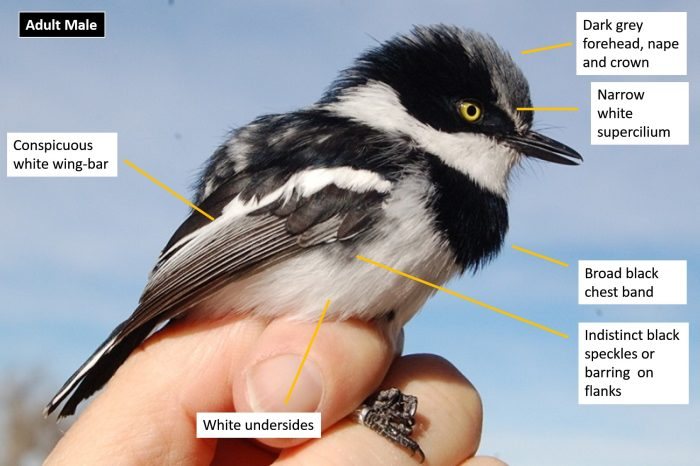
In adult males the head and back is metallic green with bronze patches on the back of the head and nape. The supercilium, forehead and crown stripe are white. The tail is dark green with white tips and white spots along both edges. The upper wings are glossy bronze-green, with large white spots. The flight feathers are black with white bars across the primaries. Underwing coverts and the undersides of the flight feathers are dark, with white bars. The underparts are white and the flanks, thighs and under tail coverts are barred green. The bill is black while the eyes and eye-ring are red. The legs and feet are grey.

Adult females are duller and have barring that extends onto the breast and they often have a buff-coloured throat.

Identification female Diederik Cuckoo Chrysococcyx caprius
Diederik Cuckoo (Chrysococcyx caprius)
St. Francis Bay, Eastern Cape
Photo by Desire Darling

In juveniles the upper parts are dull green, bright rufous or intermediate, with green and rufous barring. In some individuals the rufous is restricted to the crown only. The upper wing coverts carry pale spots (except in rufous birds). The underparts are white and the throat has dark greenish or rufous streaks. The breast and belly have blackish or dark green spots. The bill is pinkish-red and the eyes are greyish-brown. The legs and feet are dark brown.

Diederik Cuckoo Chrysococcyx caprius
Diederik Cuckoo (Chrysococcyx caprius)
St. Francis Bay, Eastern Cape
Photo by Gregg Darling

The Diederik Cuckoo is most likely to be confused with the male Klaas’s Cuckoo (Chrysococcyx klaas) but that species has a small white patch behind the eye and a green half collar extending onto the sides of the breast. The female Klaas’s Cuckoo has a whitish streak behind the eye, an indistinct half collar on the sides of the breast, and a grey (not whitish) throat with finely barred underparts. The red bill of juvenile Diederik Cuckoo separates it from all other African Chrysococcyx species of all ages.

Diederik Cuckoo (Chrysococcyx caprius)
Moreleta Kloof Nature Reserve, Gauteng
Photo by Pieter Cronje
Chrysococcyx caprius
Diederik Cuckoo (Chrysococcyx caprius)
Walter Sisulu National Botanical Garden, Gauteng
Photo by Philip Nieuwoudt

Distribution and Status

A common intra-African migrant. The Diederik Cuckoo is widespread across the Afrotropics, from West to East Africa and throughout central and southern Africa. It is also known to occur on the southern Arabian Peninsula. The species is widespread in southern Africa, but is largely absent from the Namib Desert and most of the central and north-western Karoo.

The Diederik Cuckoo is likely to have expanded its range in recent times. Its increased abundance in the Western Cape is attributed to an increase in the abundance of its host species. The Diederik Cuckoo is not considered threatened.

SABAP2 distribution  map for Diederik Cuckoo Chrysococcyx caprius
SABAP2 distribution map for Diederik Cuckoo (Chrysococcyx caprius) – November 2023. Details for map interpretation can be found here.

Habitat

Habitat for Diederik Cuckoo Chrysococcyx caprius
Habitat – Near Hluhluwe, KwaZulu-Natal
Photo by Ryan Tippett

The Diederik Cuckoo occurs in a variety of habitats, from forest edge, savanna and closed woodlands, to semi-arid shrublands, parks and gardens. It is not usually found in closed canopy forest and is uncommon in Mopane woodlands. It is otherwise tolerant of a wide range of woodland habitats.

Behaviour

The Diederik Cuckoo is usually encountered solitarily or in pairs. Males are highly conspicuous in the breeding season when they call for extended periods from prominent perches. Females are skulking and less conspicuous, but are often seen in interactions with males. Females tend to sit for long periods concealed in foliage close to the breeding colonies of host species. The flight is swift and direct, with fast wing-beats.

Chrysococcyx caprius
Diederik Cuckoo (Chrysococcyx caprius)
Schoemanskloof, Mpumalanga
Photo by Giles Mulholland

Forages in trees and shrubs, moving from perch to perch through the foliage. Mostly gleans prey from leaves and stems, but also takes prey from the ground or from tree stems. Eats mainly caterpillars, including spiny, hairy and distasteful species. The Diederik Cuckoo also feeds on termites and their alates, grasshoppers, butterflies and various other insects. Caterpillars are grasped near the head, and eviscerated from vigorous shaking. Juveniles skin caterpillars by holding it at one end and flicking it until the skin separates from the body, they then shake them to remove the skin. Brood host eggs are also sometimes eaten.

Chrysococcyx caprius
Diederik Cuckoo (Chrysococcyx caprius)
Riversdale district, Western Cape
Photo by Johan and Estelle van Rooyen

Diederik Cuckoos are brood parasitic on a diverse assemblage of other bird species. Recorded hosts in southern Africa include Southern Red Bishop, various weaver and sparrow species, Cape Wagtail, Chestnut-vented Warbler, Golden-breasted Bunting, Karoo Prinia, Mountain Wheatear, White-winged Widowbird, Scrub Robins, Marico Flycatcher, African Paradise Flycatcher and Rattling Cisticola amongst others. Parasitism levels vary within and between host species, and between years. Variation in the colour of cuckoo eggs within a particular colony of hosts indicates parasitism by several females. Offspring typically select same host species as the mother.

Diederik Cuckoo Chrysococcyx caprius
Diederik Cuckoo (Chrysococcyx caprius)
Tygerberg Nature Reserve, Western Cape
Photo by Gerald Wingate

Females are territorial, defending colonies of potential hosts from other females. Males range across female territories. Males compete for access to territorial females by chasing one another while giving a fast, high-pitched version of its characteristic song. In advertising display, a male will call persistently to attract females. Most calling is done in the early morning and late afternoon from a prominent perch and several females may respond.

Prior to egg laying the female will observe a weaver or bishop colony for some time and flies in alone to inspect a potential nest. If she is detected, she will be driven off by the potential host, or mobbed and driven to ground. She will enter the nest if the host is absent.

Diederik Cuckoo Chrysococcyx caprius
Diederik Cuckoo (Chrysococcyx caprius)
Darvill Bird Sanctuary, KwaZulu-Natal
Photo by Dave Rimmer

The female either eats or discards the host’s egg from the nest. Eggs are laid between October and March. and usually 1 egg is laid per host nest. One female can lay up to 24 eggs during the breeding season. The egg colour is variable, either white, greenish white or greenish blue, plain or speckled, and they frequently match the colour and markings of the host eggs.

Cuckoo eggs develop quickly and incubation is completed in 11 to 12 days. The newly hatched cuckoo chick evicts the host’s eggs and young after two or three days. They are largely independent on leaving nest, and are not fed by hosts.

Diederik Cuckoo Chrysococcyx caprius
Diederik Cuckoo (Chrysococcyx caprius)
St. Francis Bay, Eastern Cape
Photo by Desire Darling

Further Resources

This species text is adapted from the first Southern African Bird Atlas Project (SABAP1), 1997.

The use of photographs by Dave Rimmer, Desire Darling, Gerald Wingate, Giles Mulholland, Gregg Darling, Johan and Estelle van Rooyen, John Cox, Philip Nieuwoudt, Pieter Cronje, Sybrand Venter and Tony Archer is acknowledged.

Virtual Museum (BirdPix > Search VM > By Scientific or Common Name).

Other common names: Diderick Cuckoo, Diederik Cuckoo, Dideric Cuckoo (Alternative English); Diederikkie (Afrikaans); uNononekhanda (Zulu); Umgcibilitshane (Xhosa); Goudkoekoek, Diederikkoekoek (Dutch); Coucou didric (French); Diderikkuckuck, Goldkuckuck (German); Cuco-bronzeado-maior (Portuguese)

Recommended citation format: Tippett RM 2023. Diederik Cuckoo Chrysococcyx caprius. Biodiversity and Development Institute. Available Online at https://thebdi.org/2024/01/06/diederik-cuckoo-chrysococcyx-caprius/

List of bird species in this format is available here.

Bird identificationbirding

Diederik Cuckoo Chrysococcyx caprius
Diederik Cuckoo (Chrysococcyx caprius)
Palmietfontein, North West
Photo by Tony Archer

RAVE : Days 12 and 13 (8 and 9 December 2023)

The first week of the RAVE (RAVE = Ringing, Atlasing, Virtual-museuming Expedition) was spent at Botuin, Vanrhynsdorp, and the report on the first four days, is here, and the report on the Days 5 to 7 is here. RAVE then moved to Vondeling Wine Farm, and the eastern edge of the Paardeberg. The report for Days 8 to 11 is here. This is the report on Days 12 to 13, Friday and Saturday, 8 and 9 December. This report largely focuses on two aspects of our time at Vondeling Wine Farm, bird ringing and OdonataMAPping.

Ringing

The total number of birds ringed at Vondeling Wine Farm was 209 birds of 28 species.

Common nameHandled
Redbilled Teal3
Red-eyed Dove1
Ring-necked Dove3
Laughing Dove4
Speckled Mousebird1
Malachite Kingfisher1
Greater Striped Swallow2
Cape Bulbul8
Cape Robin-chat2
Lesser Swamp Warbler1
African Reed Warbler14
Bar-throated Apalis2
Levaillant’s Cisticola5
Fiscal Flycatcher10
Common Starling5
Malachite Sunbird1
House Sparrow16
Cape Sparrow8
Cape Weaver53
Southern Masked Weaver26
Southern Red Bishop19
Yellow Bishop3
Common Waxbill2
Cape Canary2
Streaky-headed Canary4
Cape White-eye4
Karoo Prinia7
Southern Grey-headed Sparrow2

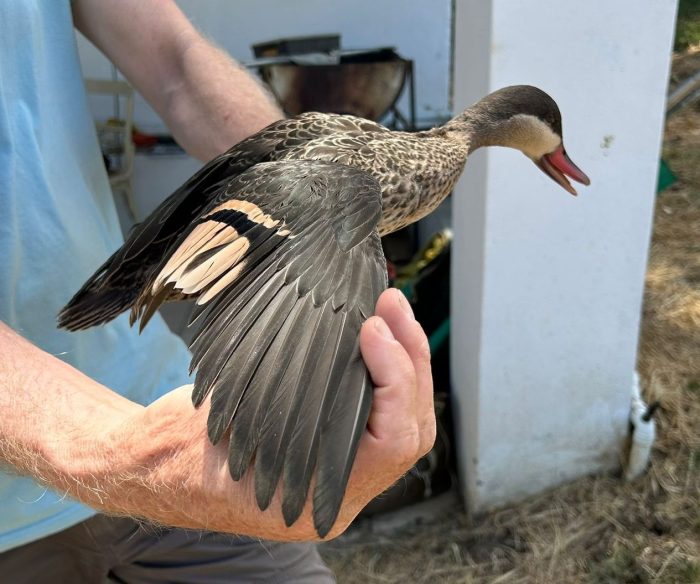
This includes a few rehabilitated birds that were brought to us for ringing; the Red-billed Teals had been raised from the tiny duckling stage, and were almost ready for release. It was interesting to see them in the hand. One of them is in the photo below.

OdonataMAPping

We explored the Vondeling farm and the adjacent Paardeberg as intensively as feasible for dragonflies and damselflies. The objective was to collect records for the OdonataMAP section of the Virtual Museum. There was no flowing water on the top of this range of granite hills. We were looking for a few of the Western Cape endemics, but failed to find them. The total number of species found was 18, which represents about 12% of the total number of species of dragonflies and damselflies in South Africa.

Common Citril (Ceriagrion glabrum)
Masai Sprite (Pseudagrion massaicum)
Tropical Bluetail (Ischnura senegalensis)
Blue Emperor (Anax imperator)
Friendly Hawker (Zosteraeschna minuscula)
Common Thorntail (Ceratogomphus pictus)
Common Hooktail (Paragomphus genei)
Darting Cruiser (Phyllomacromia picta)
Two-striped Skimmer (Orthetrum caffrum)
Cape Skimmer (Orthetrum capicola)
Long Skimmer (Orthetrum trinacria)
Eastern Blacktail (Nesciothemis farinosa)
Black Percher (Diplacodes levebvrii)
Broad Scarlet (Crocothemis erythraea)
Little Scarlet (Crocothemis sanguinolenta)
Nomad (Sympetrum fonscolombi)
Red-veined Dropwing (Trithemis arteriosa)
Ferruginous Glider (Tramea limbata)

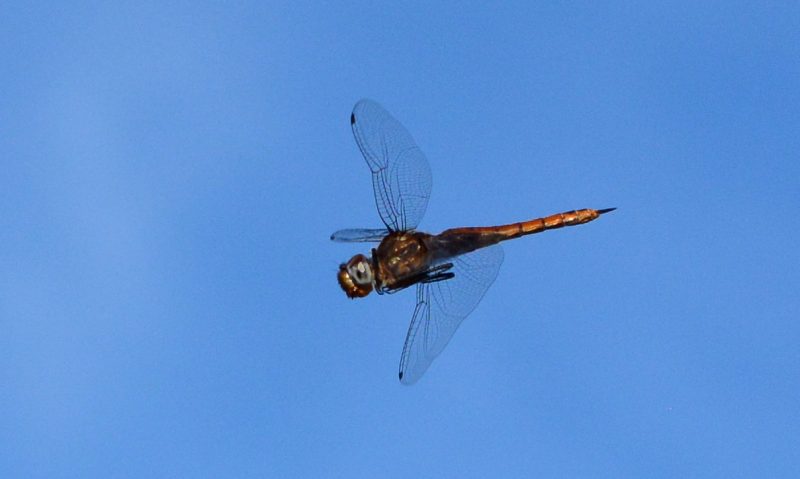
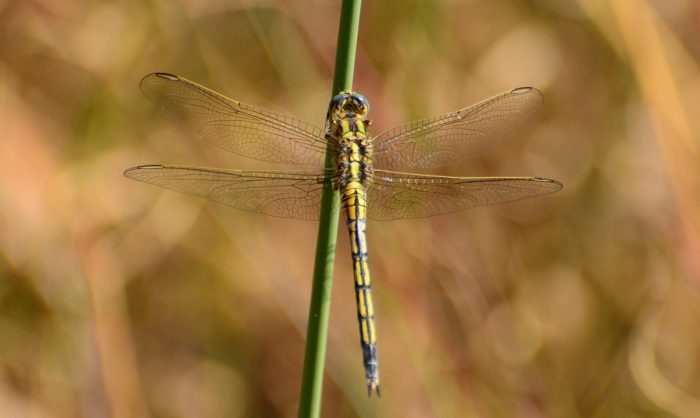
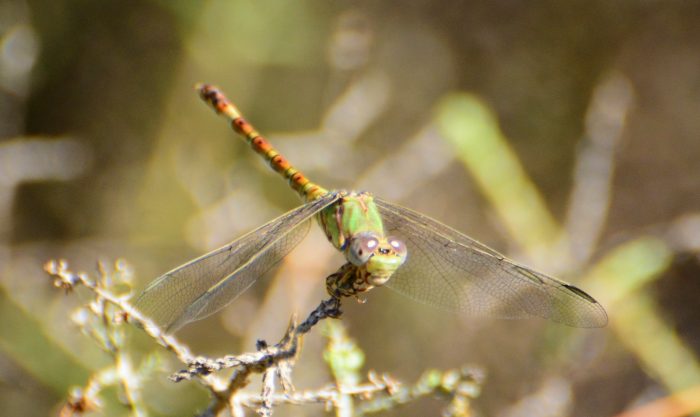
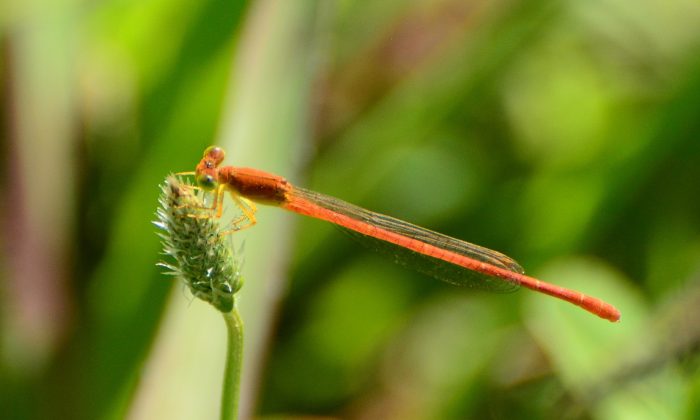
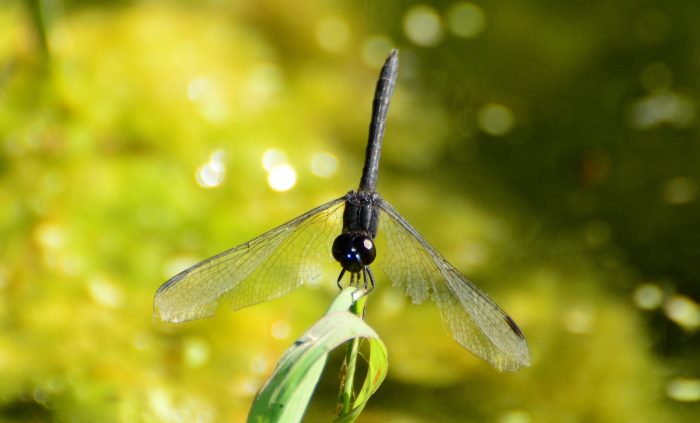
Four of these species are illustrated below:

The third leg of the RAVE is at Ouberg Private Nature Reserve.

RAVE : Days 8 to 11 (4 to 7 December 2023)

On 4 December, the RAVE scene moved to Vondeling Wine Farm, and the eastern edge of the Paardeberg. (RAVE = Ringing, Atlasing, Virtual-museuming Expedition.) This is the report on Days 8 to 11, Monday to Thursday. The first week of the RAVE was spent at Botuin, Vanrhynsdorp, and the report on the first four days, is here, and on the Days 5 to 7 is here.

ScorpionMAP

A nightwalk on the lower slopes of the Paardeberg with several UV torches generated records of Uroplectes carinatus. This is a widespread species that we also recorded last week at Botuin. Here is the photo, under UV light, taken with a cell phone:

… and here is the photo being taken!

FrogMAP

We have records of six species of frogs. This is a Clicking Stream Frog Strongylopus grayii.

… and here is a Cape Sandfrog!

LepiMAP

This is the set up we use for attracting moths. It’s a UV light hanging above a white sheet.

Here is one of the many moths attracted to the light:

This moth is Nama Knob Acantholipes namacensis,

On the Paardeberg there were also butterflies to contribute to LepiMAP. Two records are shown here …

… on the left is the Protea Charaxes Charaxes pelias. The two photos on the right are the upper side and the under side of the male of the Vivid Pierrot Tarucus thespis.

ReptileMAP

This Southern Rock Agama Agama atra lizard demonstrated his ability to do push ups.

LacewingMAP

The insects attracted to the UV light are mostly moths, but it also attracts species from other orders. Here is an antlion which landed on the sheet. It will be uploaded to LacewingMAP:

It is Palpares speciousus which has Spotted Veld Antlion as its English name. The wingspan of this individual was close on 12 cm.

DungbeetleMAP

The UV lamp attracted a single dung beetle. This is Onitis aygulus.

MammalMAP

Appropriately for a wine farm, the theme for this section is mammals in the vineyards.

Here is Duiker taking shelter in the vineyards …

… and here is a hare making its risky way across a lawn heading for the safety of the vineyard.

Ringing

Bird ringing has taken place during the cooler half of the mornings, and most evenings. Among the many species ringed were both malachites:

… Malachite Kingfisher and Malachite Sunbird.

BirdPixing

We have done lots of BirdPixing. African Paradise Flycatchers had bred in a small patch of oaks:

The male with its long tail on the right. On the left, a newly fledged young, still being fed by the adults.

It’s breeding season for the peafowl at Vondeling. This male, with its impressive tail, is the width of the gravel road. Peafowl have been feral here for at least two decades.

Atlasing

The RAVE team did a checklist for pentad 3310_1805 in the West Coast National Park, with 44 species.

Appreciation

We greatly value the hospitality of the entire team at Vondeling Wine Farm. Wine tasting and wine sales have moved to Vrymansfontein, close to Paarl. This farm is part of the Vondeling Wines family. We enjoyed a magnificent lunch at the new restaurant at Vrymansfontein, which opened less than a month ago. The view stretches all the way to Table Mountain. Recommended!

Part of the RAVE team at Vrymansfontein.

Friday and Saturday are our last full days at Vondeling Wine Farm, and on Sunday we move on to Ouberg Private Nature Reserve in the mountains behind Montagu.