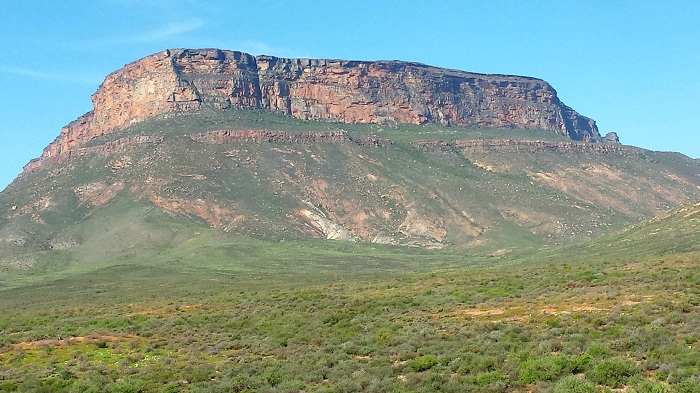
Salome Willemse is a citizen scientist in Vanrhynsdorp, in the northwestern corner of the Western Cape, just south of one of South Africa’s most important centres of plant endemism, the Knersvlakte. For many years, the chief characteristic of this area was that it was a gap in all citizen science projects. Salome has been the catalyst that is leading the charge in filling that gap.
We wanted to get to know Salome a little better, so we asked her a few questions. Here responses below provide great insight from the perspective of this citizen scientist in Vanrhynsdorp.
BDI: How did you become a citizen scientist? What got you going?
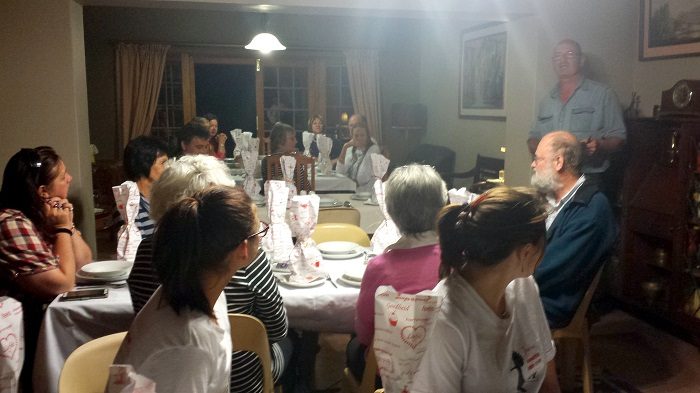
I attended a birding course done by Anton Odendaal in 2013. Soon afterwards I realised that there is little data available for the Namaqualand region and subsequently started the Namaqua Bird Club. As I ventured deeper into the world of birding, I learned about SABAP2. We held a Citizen Scientist Day in Vredendal in 2015 and that day I realised that one individual can make a difference.
BDI: What has been the highlight for you?
Turning Namaqualand “green”, in other words getting at least full protocol checklists for all the pentads in the northwestern corner of the Western Cape, and also beyond, into the adjacent part of the Northern Cape.

BDI: How has being a citizen scientist changed your view of the world?
The Namaqua BioBashes were the first bashes where data on other taxa were recorded via the Virtual Museum. Doing other taxa like scorpions and spiders has changed my whole life. I use to be petrified of spiders and now I respect their place in this world. I guess what I want to say is that getting to learn other species makes you understand and respect them. It makes one realise that we are all part of a cycle.
On another level I have made friends with like-minded people whom I now call my best friends.
BDI: What does the term “citizen scientist” mean to you?
Observing nature and learning so much about species

BDI: What are you still hoping to achieve? This might be in terms of species, coverage, targets …
Turning the whole of Namaqualand green … And the Northern Cape
BDI: What resources have been the most helpful? (And how can they be made better?)
BirdLasser has been a wonderful tool that has turned atlassing into fun. And then also a dedicated person like Prof Les Underhill who keeps the interest going with social media.
BDI: How do you react to the statement that “Being a citizen scientist is good for my health, both physical and mental!”?
Amen
BDI: What do you see as the role which citizen science plays in biodiversity conservation? What is the link?
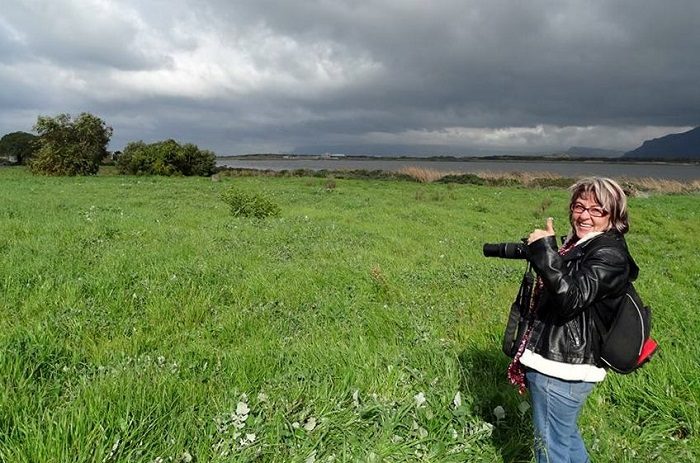
Scientists themselves cannot be everywhere. We as citizen scientists can take a picture of a species and submit it. Being in the field and observing nature you often get to see really strange behaviour. If you are able to capture these moments other people can learn from that.
Thank you, Salome, for your efforts in this precious part of South Africa – keep up the excellent work!
Postscript, 2026!
Salome is at Botuin, which is a wonderful place to stay on the edge of Vanrhynsdorp. This is true both if you are planning to stay for several days or just passing through overnight. For visitors it is an excellent base from which to explore the wildflowers in early spring. And if you are travelling along the N7 either north towards Namibia, or south towards Cape Town, Botuin is a great stopover point, almost exactly midway between Cape Town and the border.
Salome is a qualified bird ringer, and Botuin is one the three sites where the BDI does regular ringing. Here is a report of one ringing expedition to Botuin.
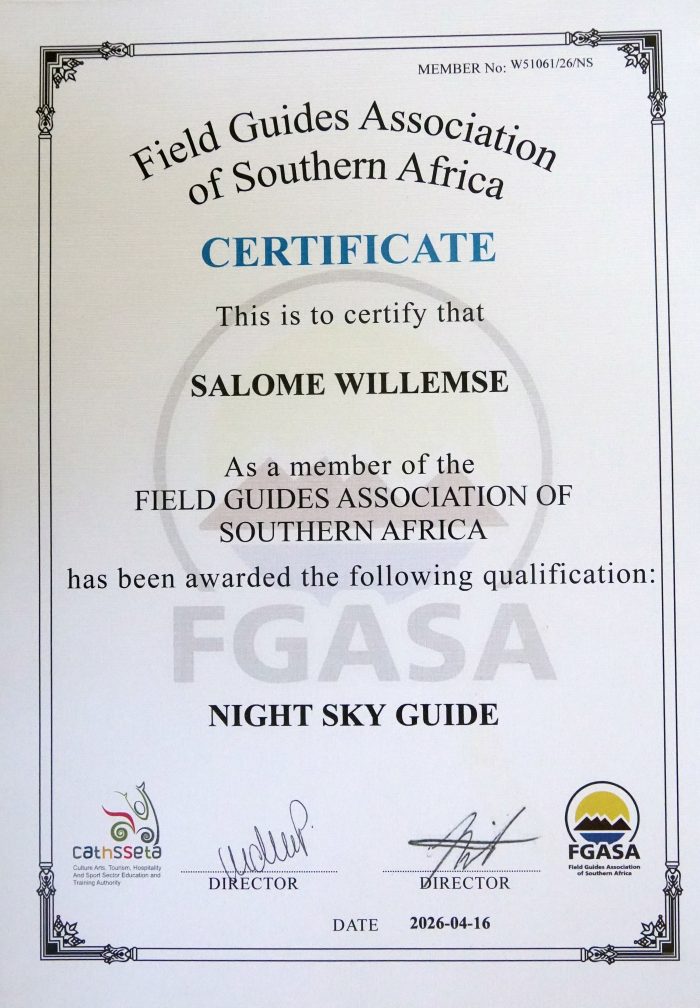
Salome is far more than just a citizen scientist in Vanrhynsdorp. She knows the local biodiversity well, especially the birds, and the wildflowers. She is a qualified guide, registered with the Field Guides Association of South Africa. Her latest qualification is as Night Sky Guide. There is little light pollution at Botuin, so it is a great place to learn about the stars.
Salome was interviewed in a 28-minute video called Op Soek na Maskam by Melt van der Spuy. He writes: “The video is a digital postcard to a time and place that will never exist again. It is an understated story about a mountain, a valley and the people who choose to live there. Shot over three weather-beaten days in the Matzikama region on South Africa’s West Coast, the film explores how land, weather and community quietly shape who we become. Up close, this is one of the most unique biomes in the world. It is a place of extremes. Floods and droughts. Intense sun and quiet mist. A mountain that carries another world of water and plants on its back. A community that has learnt to bend with the land instead of fighting it.” This is the world in which Salome belongs.
