

Cover photo by John Wilkinson.
Find the Swarthy Sprite in the FBIS database (Freshwater Biodiversity Information System) here.
Family Coenagrionidae
Identification

Mkuze River, KwaZulu-Natal
Photo by Ryan Tippett
Small size
Length up to 39mm; Wingspan reaches 50mm.
The Swarthy Sprite shows considerable variation in colouration, depending on age.
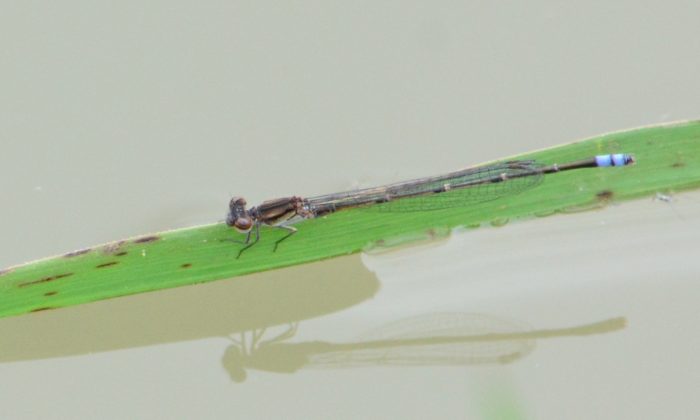
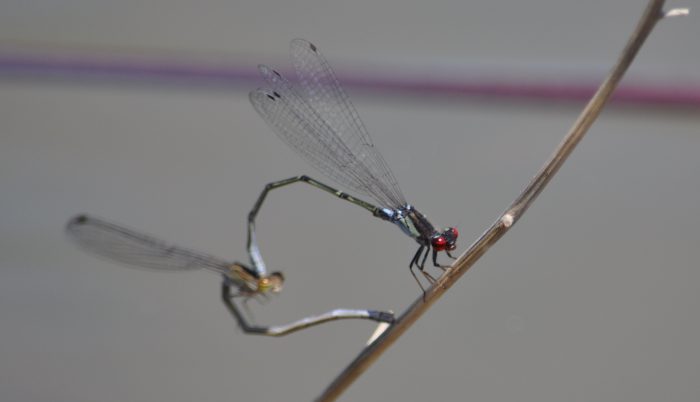
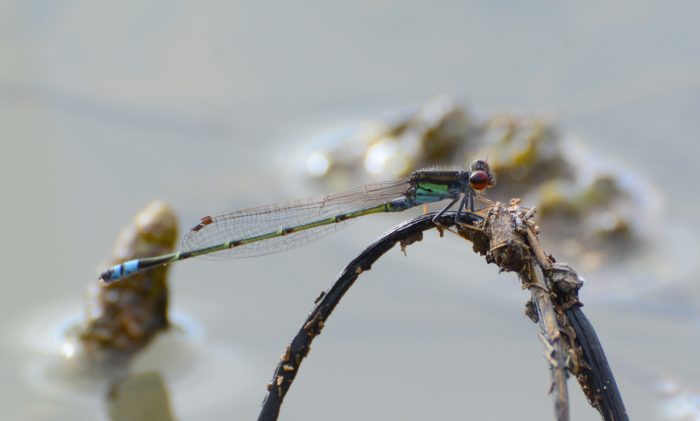
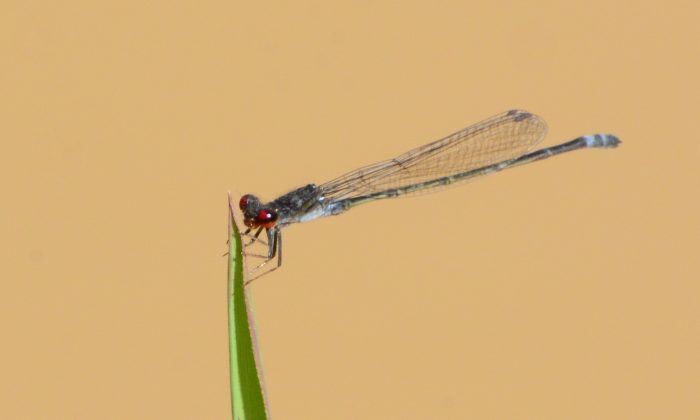
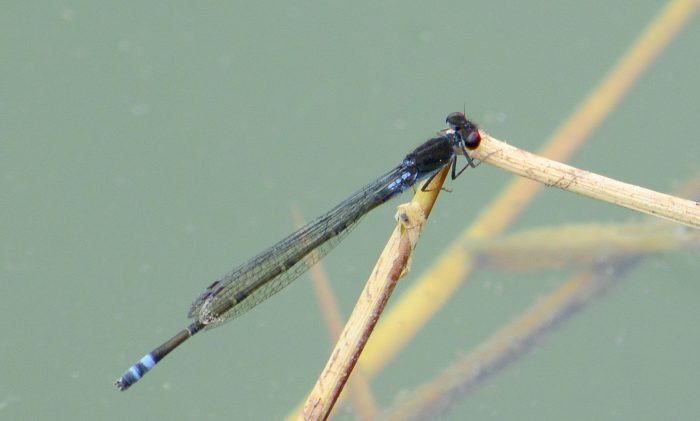
Males most closely resemble Pseudagrion commoniae (Black Sprite). Both species may show a uniformly pruinescent black upper thorax, blue sides on the thorax, and blue between the wings. P. hamoni has red and black eyes, with the red being visible on both the top and front of the eyes. The eyes of P. commoniae are black above and in front, only showing a small amount of red on the undersides.
Females are similar to those of many other Pseudagrion species and are best identified by their association with the males.
Click here for more details on identification.
Amakhosi Game Reserve, KwaZulu-Natal
Photo by Ryan Tippett
Habitat
The Swarthy Sprite occupies still or slow-moving sections of rivers, as well as the vegetated fringes of dams, pans, and pools. It is often found on patches of floating aquatic plants. The Swarthy Sprite is mainly a species of the Savanna biome.

Photo by Rowan Poortier
Behaviour
Swarthy Sprites perch on vegetation or rocks near the water. Males and females are frequently found side by side. They feed on small aerial insects like mosquitoes and moths.
Most active from October to April but recorded year round at some sites. See Phenology below.
Mkuze River, KwaZulu-Natal
Photo by Ryan Tippett
Status and Conservation
The Swarthy Sprite is a common resident and is listed as of Least Concern in the IUCN Red List of Threatened Species. It is an adaptable species that can make use of man-made dams and somewhat degraded habitats.
Mkuze River, KwaZulu-Natal
Photo by Ryan Tippett
Distribution
The Swarthy Sprite is widespread across much of Sub-Saharan Africa.
In South Africa, it is restricted to the north-east and is found in KwaZulu-Natal, Mpumalanga, Limpopo, North-West, and Gauteng.
Below is a map showing the distribution of records for Swarthy Sprite in the OdonataMAP database as at February 2020.

Below is a map showing the distribution of records for Swarthy Sprite in the OdonataMAP database as of December 2024.
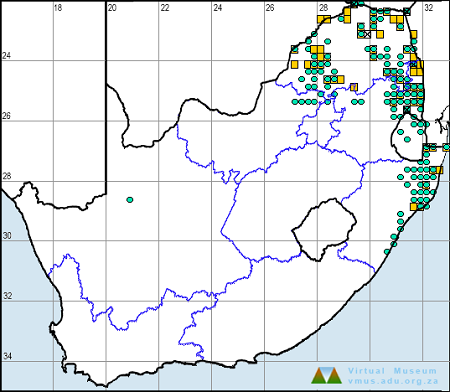
The next map below is an imputed map, produced by an interpolation algorithm, which attempts to generate a full distribution map from the partial information in the map above. This map will be improved by the submission of records to the OdonataMAP section of the Virtual Museum.


Ultimately, we will produce a series of maps for all the odonata species in the region. The current algorithm is a new algorithm. The objective is mainly to produce “smoothed” maps that could go into a field guide for odonata. This basic version of the algorithm (as mapped above) does not make use of “explanatory variables” (e.g. altitude, terrain roughness, presence of freshwater — we will be producing maps that take these variables into account soon). Currently, it only makes use of the OdonataMAP records for the species being mapped, as well as all the other records of all other species. The basic maps are “optimistic” and will generally show ranges to be larger than what they probably are.
These maps use the data in the OdonataMAP section of the Virtual Museum, and also the database assembled by the previous JRS funded project, which was led by Professor Michael Samways and Dr KD Dijkstra.

Amakhosi Game Reserve, KwaZulu-Natal
Photo by Ryan Tippett
Phenology


Amakhosi Game Reserve, KwaZulu-Natal
Photo by Ryan Tippett
Further Resources
The use of photographs by John Wilkinson and Rowan Poortier is acknowledged.
Swarthy Sprite Pseudagrion hamoni Fraser, 1955
Other common names: Drab Sprite, Hamon’s Sprite (Alt. English); Donkergesie (Afrikaans).
Recommended citation format: Loftie-Eaton M; Navarro R; Tippett RM; Underhill L. 2025. Swarthy Sprite Pseudagrion hamoni. Biodiversity and Development Institute. Available online at https://thebdi.org/2020/05/21/swarthy-sprite-pseudagrion-hamoni/
References: Tarboton, M; Tarboton, W. (2019). A Guide to the Dragonflies & Damselflies of South Africa. Struik Nature.
Samways, MJ. (2008). Dragonflies and Damselflies of South Africa. Pensoft
Samways, MJ. (2016). Manual of Freshwater Assessment for South Africa: Dragonfly Biotic Index. Suricata 2. South African National Biodiversity Institute, Pretoria
Martens, A; Suhling, F. (2007). Dragonflies and Damselflies of Namibia. Gamsberg Macmillan.
Hluhluwe district, KwaZulu-Natal
Photo by Ryan Tippett