
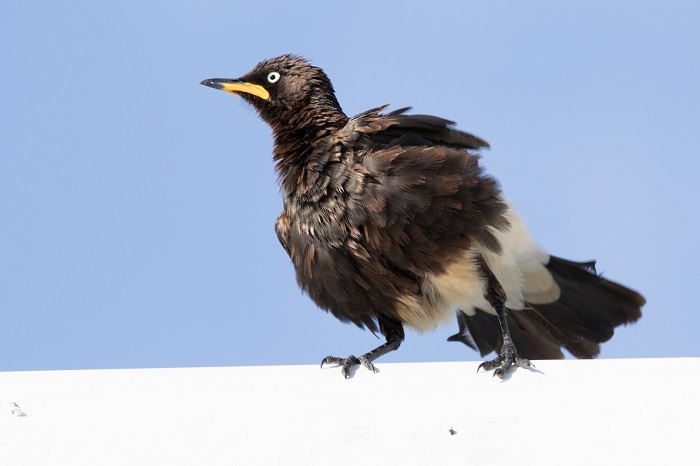
Cover image of Pied Starling Starling by Lance Robinson – Near Frankfort, Free State
Starlings belong to the family STURNIDAE. All members of the family, which also includes Mynas, are collectively known as starlings. They are small to medium-sized passerine birds known for their often iridescent plumage, complex vocalisations, and their distinctive, swarming behaviour, known as murmurations. Most have strong bills of medium length that are arched on the culmen. They have moderately long and strong legs with large, strong feet. Wing and tail shape are variable.
Starlings are native to Europe, Asia, and Africa, as well as northern Australia and the islands of the tropical Pacific. Several European and Asian species have been widely introduced around the world. The family contains 125 species from 36 genera.
Identification
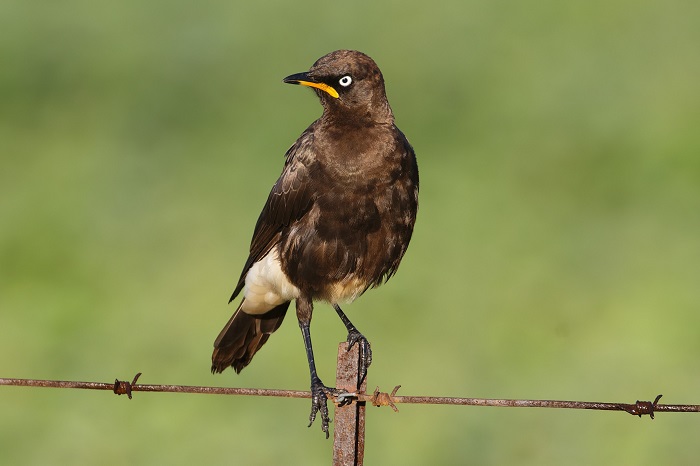
Drakensberg, KwaZulu-Natal
Photo by Roelof van der Breggen
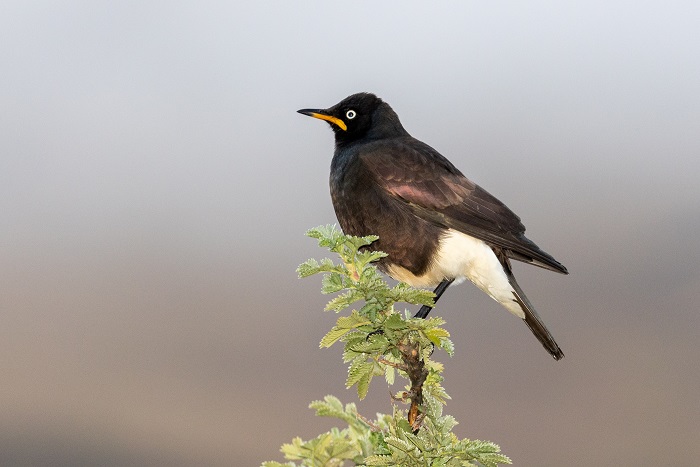
The Pied Starling is a large, distinctive and easily recognisable species. Adult birds are predominantly blackish-brown with a slightly greenish, glossy sheen. The undertail and lower belly are white. The uppertail is dark with a greenish gloss. They have striking, white eyes, and the bill is black with a yellow lower mandible and a conspicuous yellow wattle at the gape. The legs and feet are black. The sexes are alike.
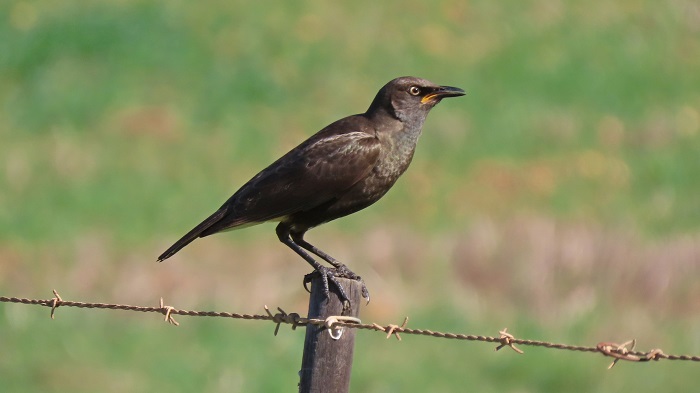
Near Swellendam, Western Cape
Photo by Johan van Rooyen
Immatures are similar to adults but the lower mandible is dark, gradually becoming yellow. The eyes are dark brown and gradually whiten with age. Juvenile plumage is matt black, without any gloss. The bill is black, except for a yellowish-white base to the lower mandible and a white wattle at the gape. The eyes dark brown.
The Pied Starling is unlikely to be mistaken for any other species within its range.
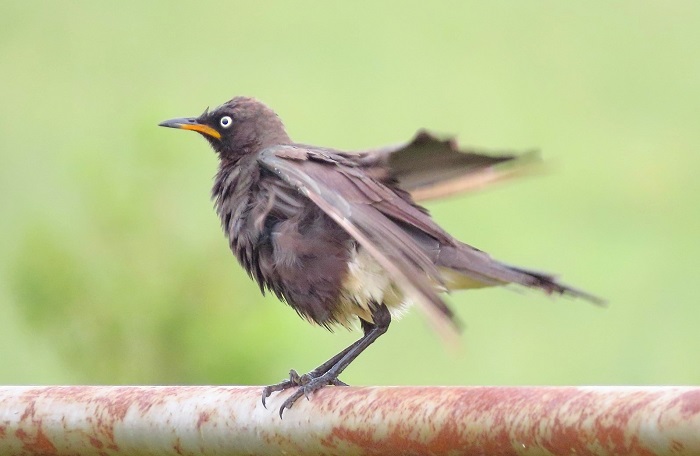
Ukhahlamba Drakensberg Park, KwaZulu-Natal
Photo by Colin Summersgill
Status and Distribution
The Pied Starling is locally common to abundant and is endemic to South Africa, Lesotho, and eSwatini (Swaziland). It occurs in all 9 South African provinces, although only marginally in southern Limpopo province.
It is absent from most of the Limpopo and Mpumalanga provinces, and the eastern lowlands of KwaZulu-Natal and the Eastern Cape. The Pied Starling also avoids the driest parts of the Northern Cape.
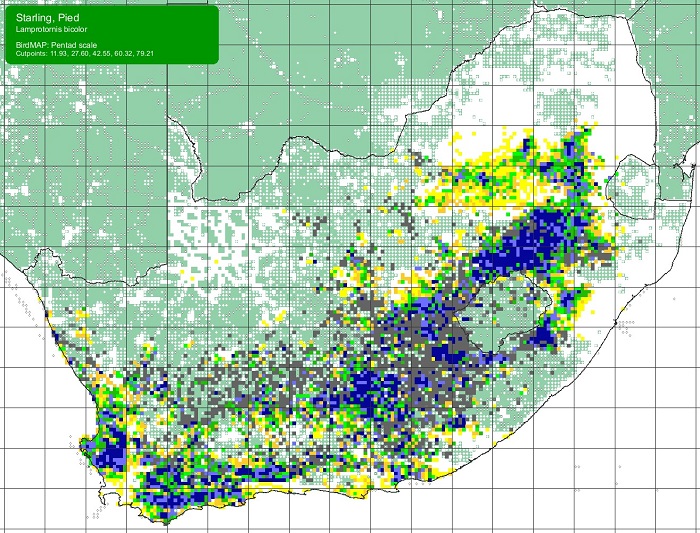
Details for map interpretation can be found here.
The Pied Starling is not threatened and is present in large numbers in many parts of its range, and is common in many protected areas. There has been some loss of habitat from urbanisation, such as on the Cape Peninsula. The loss of natural habitat to agriculture has had little impact as the Pied Starling thrives in farmlands.
Habitat
The Pied Starling is primarily a species of open areas dominated by grassland and semi-arid Karoo scrub. It is regularly found up to 2500 m in the Drakensberg, but occurs down to sea level in the west and south of its range. The Pied Starling is commonly associated with agriculture; often on open ground around farm homesteads, on cultivated lands, and near domestic stock. It also frequents villages, small towns and farmsteads in rural areas, but is absent from larger urban settlements. The Pied Starling is not found in wooded areas, nor in the most arid parts of the interior. Its frequent occurrence in the Fynbos biome is likely due to widespread agriculture in that region. The availability of reedbeds and vertical banks for roosting and nesting is probably a limiting factor on population densities.

Near Vanwyksvlei, Northern Cape
Photo by Ryan Tippett
Behaviour
The Pied Starling is resident and mostly sedentary, but occasionally forms large nomadic flocks in the dry season.
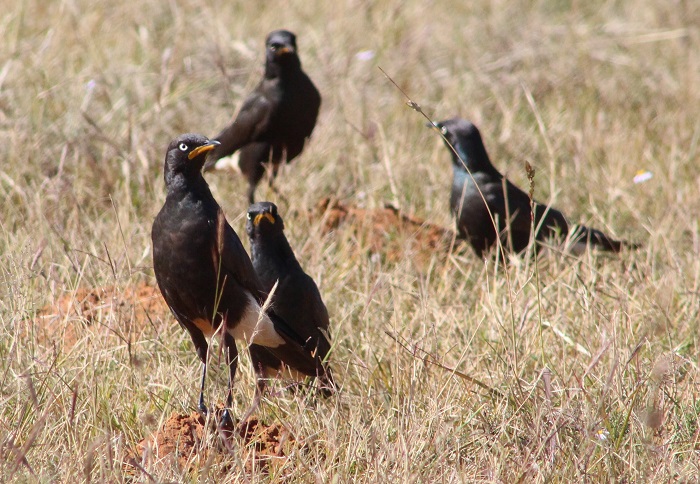
Welkom, Free State
Photo by Janet du Plooy
Pied Starlings are highly gregarious at all times, usually in flocks of 10 to 20 birds. They roost communally in reeds or trees, often alongside other species, especially Wattled Starlings (Creatophora cinerea). Roosting flocks sometimes number well over 1000 birds. Pied Starlings are noisy when approaching the roost, and large flocks often perform coordinated murmurations at dusk before suddenly diving into the roost site. The loud chorus then continues until nightfall.
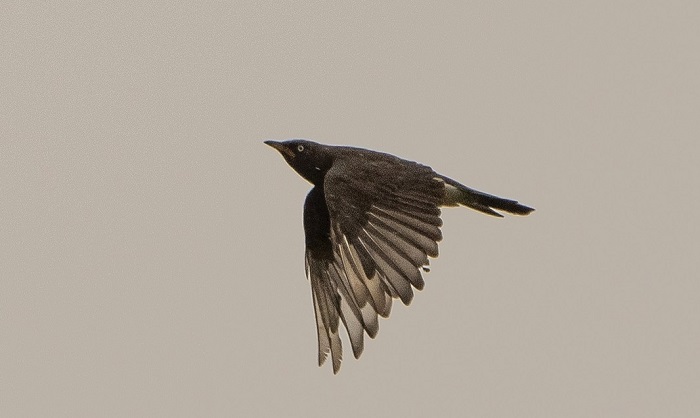
Carnarvon district, Northern Cape
Photo by Ryan Tippett
The Pied Starling forages mostly on the ground, walking or running after prey. They feed on insects disturbed by livestock, and regularly perch on sheep and cattle to remove ticks. They frequently flip over dry cowpats to expose insects underneath. They also forage at locust swarms and often form mixed-species foraging flocks with Wattled Starlings. Pied Starlings are also known to search for food in the rocky intertidal zone and feed on amphipods from kelp washed up onto beaches.
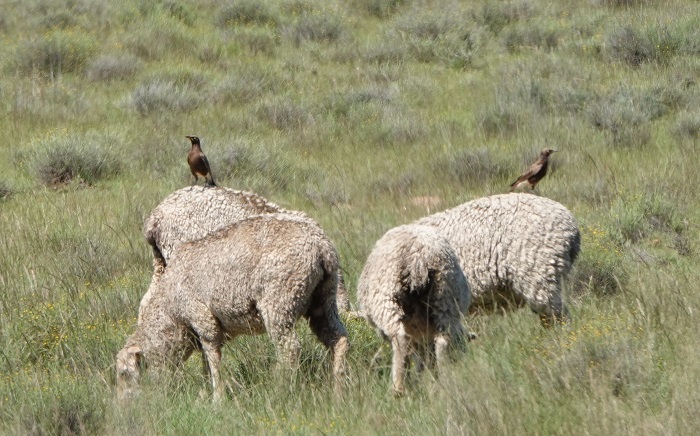
Near Hanover, Northern Cape
Photo by Itxaso Quintana
The diet of the Pied Starling comprises a wide range of arthropods, including termites, ants, beetles, grasshoppers, spiders, and ticks, etc. They also feed on plant material like seeds, fruit, and nectar. Around human habitation, Pied Starlings will feed on kitchen scraps, including bread, porridge and fruit.
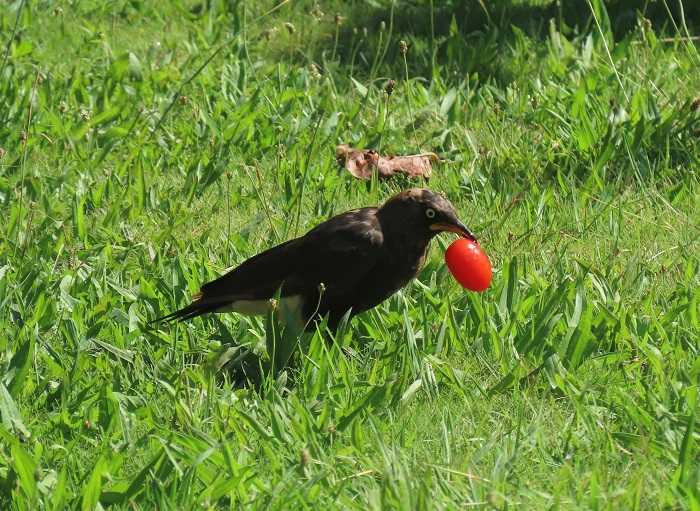
Near Hanover, Northern Cape
Photo by Jon Blanco
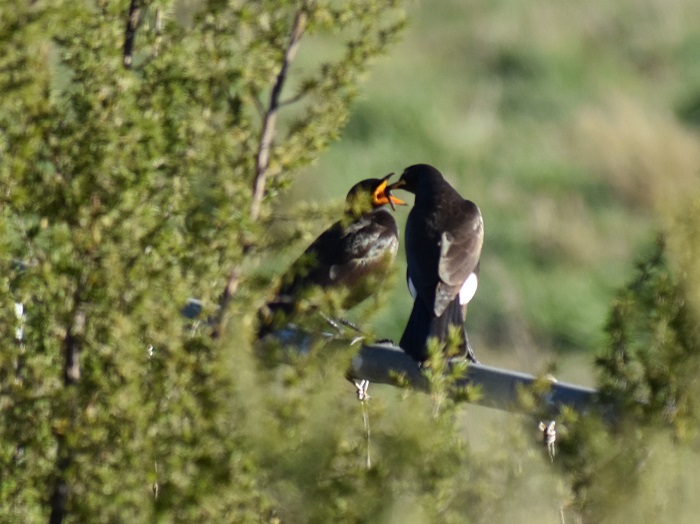
Allofeeding is a common behaviour of the Pied Starling and is thought to establish and maintain bonds within a flock.
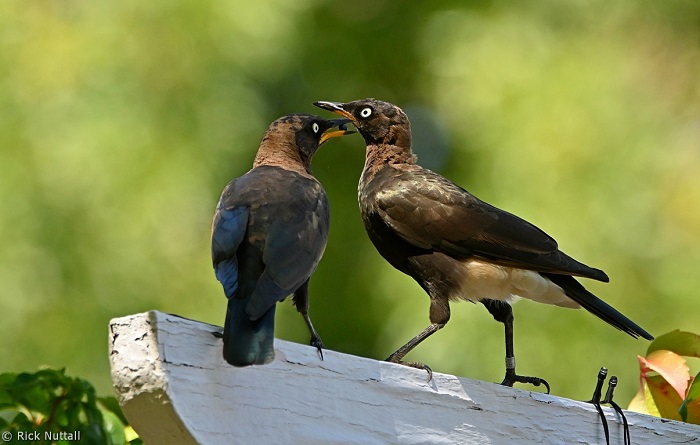
Near Hanover, Northern Cape
Photo by Rick Nuttall
The Pied Starling breeds from August to November in the winter rainfall region, from November to March in the Karoo, and throughout the year in the north of its range with a peak from September to November.
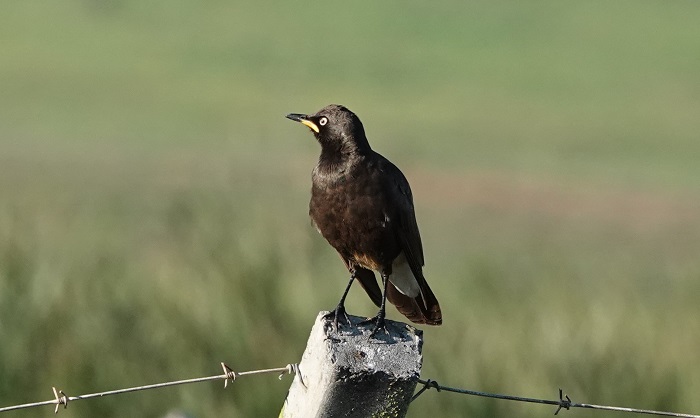
Vanrhynsdorp, Western Cape
Photo by Les Underhill
The Pied Starling is monogamous and is either a solitary or, more usually, a colonial nester, with colonies ranging in size from a handful of pairs to thousands of pairs. It is a cooperative breeder with helpers assisting in the feeding of chicks. The nest is a pad of grass, feathers, wool, and other material, built by both sexes. It is usually situated in a tunnel which the pair also excavate themselves. The tunnel is up to 1.5 m long and most often located in a riverbank, erosion donga, quarry, or cutting. They sometimes also nest in holes in buildings, bales of hay, or occasionally in a natural tree hole.
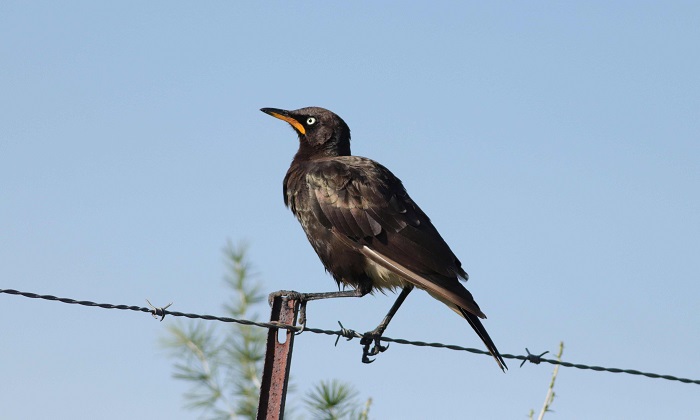
Bloemfontein, Free State
Photo by Dawie de Swardt
2 to 6 eggs are laid per clutch, and larger clutches may involve more than 1 female. The eggs are bright blueish-green and may be plain or with some red spotting. The incubation period lasts from 14 to 16 days. Incubation is performed entirely by the female and begins before the clutch has been completed. The newly hatched young are altricial. They are fed mostly on insects and small amounts of fruit. The nestling period takes 23 to 27 days. Fully fledged young are fed by helpers for at least 1 week after leaving the nest. Pied Starlings are regularly double-brooded. Their broods are frequently parasitised by the Great Spotted Cuckoo (Clamator glandularis), and less often by Greater Honeyguides (Indicator indicator).
Op-Die-Berg, Western Cape
Photo by Karis Daniel
Further Resources
Species text adapted from the first Southern African Bird Atlas Project (SABAP1), 1997.
The use of photographs by Colin Summersgill, Dawie de Swardt, Itxaso Quintana, Janet du Plooy, Johan van Rooyen, Jon Blanco, Karis Daniel, Lance Robinson, Les Underhill, Rick Nuttall, and Roelof van der Breggen is acknowledged.
Other common names: Spreo bicolor (Alt. Scientific Name); African Pied Starling (Alt. English); Witgatspreeu (Afrikaans); iGwayigwayi, iKhwikhwi, iNgwangwa (Zulu); lgiwu-giwu, lgiyo-giyo (Xhosa); Spréo bicolore (French); Zweifarbenstar (German); Tweekleurige Glansspreeuw (Dutch); Estorninho-de-ventre-branco (Portuguese)
Recommended citation format: Tippett RM 2026. Pied Starling Lamprotornis bicolor. Biodiversity and Development Institute. Available online at https://thebdi.org/2026/01/23/pied-starling-lamprotornis-bicolor/
Golden Gate National Park, Free State
Photo by Roelof van der Breggen
