
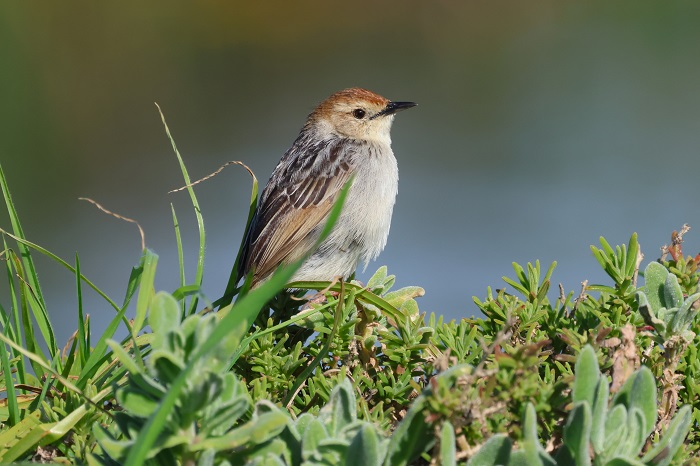
Cover image: Levaillant’s Cisticola by Gerald Wingate – Strandfontein Sewage Works, Western Cape
Cisticolas belong to the Family CISTICOLIDAE. This is a group of small passerine birds found mainly in warmer southern regions of the Old World and contains around 168 species divided into 26 genera. This family is thought to have originated in Africa, which is home to the majority of species, but members of the family can also be found in Europe, tropical Asia, and Australasia. They were formerly included within the Old World warbler family Sylviidae.
Identification
Levaillant’s Cisticola is one of the dark-backed cisticolas, which are more easily identified than other cisticola species.
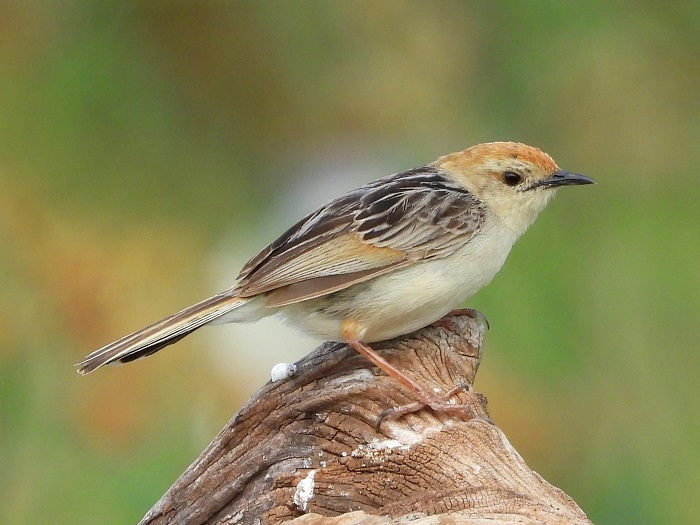
Marievale Bird Sanctuary, Gauteng
Photo by Ansie Dee Reis
Breeding adults have a bright rufous crown, with light blackish streaks on the hind-crown, while the face and supercilium are off-white. The upperparts, including the mantle and back, are black and grey with a scaled appearance. The rump is buff-coloured with faint black streaks. The tail is dark brown to red-brown with buff tips. The underparts are buffy-white, sometimes with blackish streaks on the flanks. The bill is black with a pinkish base. The eyes are pale brown, and the legs and feet are pinkish. The sexes are alike.
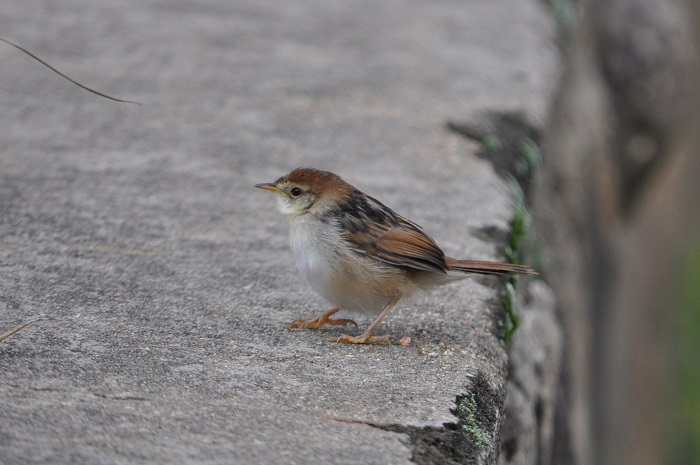
Underberg district, KwaZulu-Natal
Photo by Ryan Tippett
Non-breeding adults are similar but carry more prominent streaking on the crown and have buffier upper parts, and darker greyish-buff underparts.
Juveniles resemble non-breeding adults, but are duller and browner overall.
Levaillant’s Cisticola is most easily mistaken for the Rufous-winged Cisticola (Cisticola galactotes), but the latter has a dark grey (not rufous) tail, and dark (not pale) lores. Levaillant’s Cisticola could also be confused with the Grey-backed Cisticola (Cisticola subruficapilla), but that species has a less richly coloured crown and tail, as well as darker and greyer underparts.
Status and Distribution
Levaillant’s Cisticola is a locally common resident but may undertake local movements during the dry season.
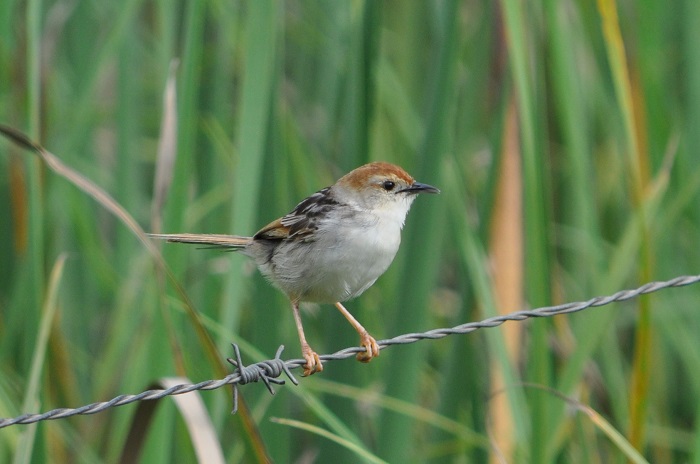
Underberg district, KwaZulu-Natal
Photo by Ryan Tippett
It has a discontinuous range from the west Kenyan highlands south and west to Angola, southern DRC, Zambia, Malawi and South Africa. In southern Africa, it is found mainly in South Africa, where it is widespread and with an isolated population on the Zimbabwe plateau, extending marginally into western Mozambique. In South Africa, it prefers regions with a relatively temperate climate, being replaced by the Rufous-winged Cisticola Cisticola galactotes in the subtropical north and east.
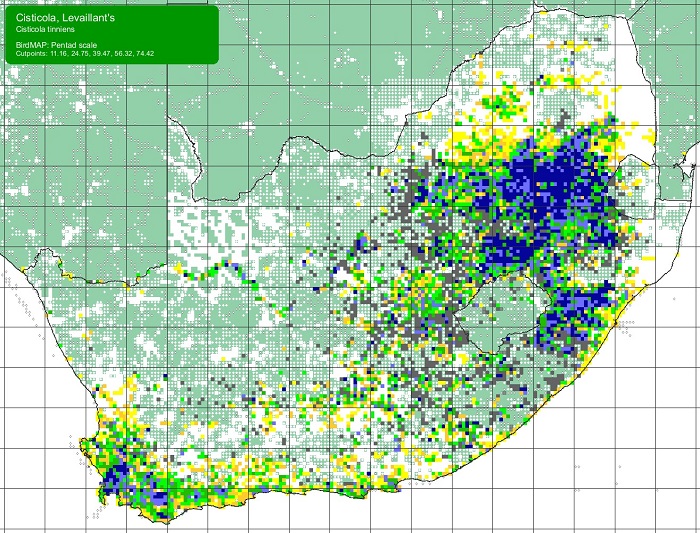
Details for map interpretation can be found here.
Levaillant’s Cisticola is not threatened. Its historical distribution is not known to have differed from that of the present. However, the construction of dams has likely created much new habitat in areas where it did not previously occur. The loss of natural wetland habitats has been offset as a result.
Habitat
Levaillant’s Cisticola typically inhabits rank vegetation along streams and rivers, at the edges of reedbeds, and in moist grassland, marshes, and emergent vegetation in water. It is sometimes found in rank vegetation on drier ground, usually when wetlands have dried out. Levaillant’s Cisticola may also occur in irrigated pastures or croplands such as maize and sugarcane fields adjoining wetlands. Levaillant’s Cisticola occurs in wetlands in all the biomes within its distribution, but is most numerous in the Grassland and Fynbos biomes.
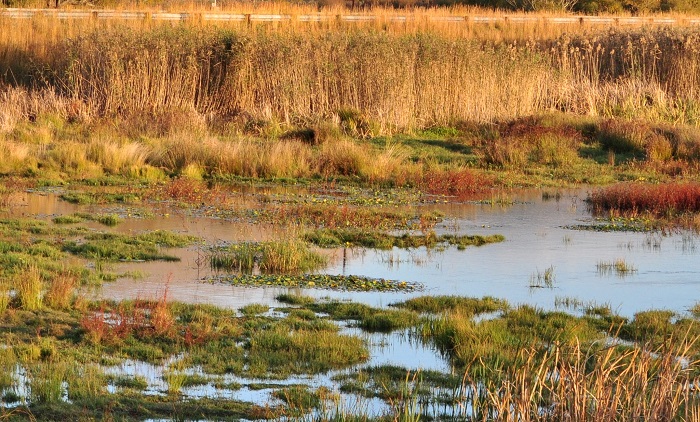
Photo by Ryan Tippett
Behaviour
Levaillant’s Cisticola is usually found in pairs, but may also be encountered singly or in small family groups. This species is highly vocal and therefore conspicuous, and is frequently detected by its call, which can be heard throughout the year. However, Levaillant’s Cisticolas only sing in summer during the breeding season when males make distinctive display flights and call from exposed perches.
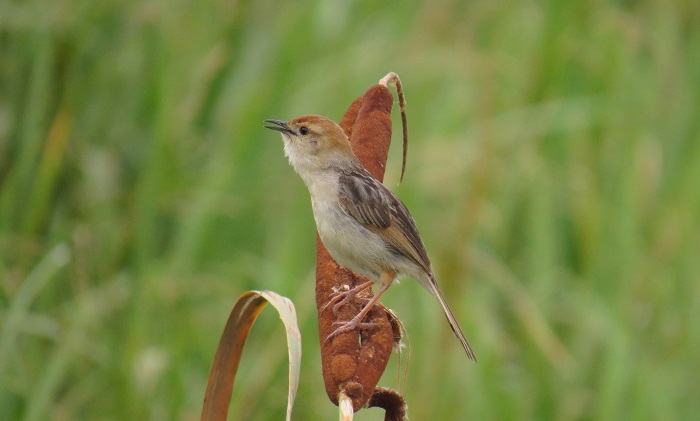
Underberg district, KwaZulu-Natal
Photo by Pamela Kleiman
When disturbed, the Levaillant’s Cisticola perches high up on vegetation to view the intruder. They frequently utter alarm-calls and may fly back and forth in an agitated manner. They forage low down in vegetation and feed on small insects such as termites, grasshoppers, caterpillars, flies, and small beetles.
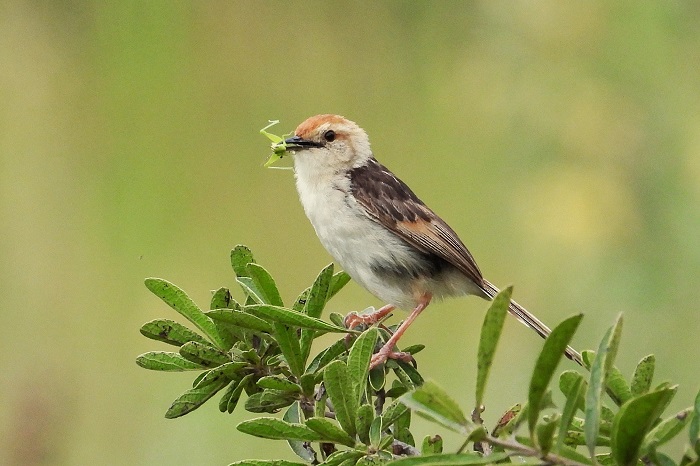
Dullstroom district, Mpumalanga
Photo by Joanne Putter
Levaillant’s Cisticola begins breeding in July in the winter rainfall region with peak egg-laying from August to October. Populations further north and east, in the summer rainfall regions breed later between October and April. The nest is an oval ball with a side top entrance, and is usually placed in vegetation over water. It is woven out of dry grass blades, rootlets and spider web, and is lined with fluffy plant down.
2 to 5 eggs are laid per clutch. They vary in colour from white through green to blue and may be plain or with grey-brown spots. The incubation period lasts for 11 to 14 days, but few other details have been recorded. The nestling period takes around 14 days.
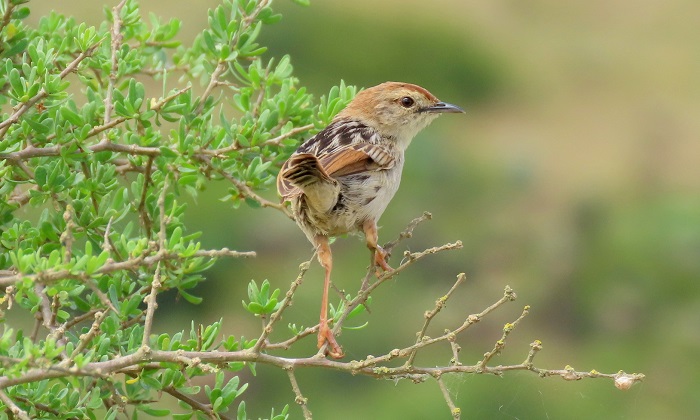
Near Heidelberg, Western Cape
Photo by Johan van Rooyen
Further Resources
This species text is adapted from the first Southern African Bird Atlas Project (SABAP1), 1997.
The use of photographs by Ansie Dee Reis, Dembo Jatta, Gerald Wingate, Joanne Putter, Johan van Rooyen, and Pamela Kleiman is acknowledged. Additional photographs by Ryan Tippett.
Other common names: Vleitinktinkie (Afrikaans); lmvila, Umvila (Xhosa); Cisticole à sonnette (French); Vallei-graszanger (Dutch); Uferzistensänger (German); Fuinha-zunidora (Portuguese).
Recommended citation format: Tippett RM 2026. Levaillant’s Cisticola Cisticola tinniens. Biodiversity and Development Institute. Available online at https://thebdi.org/2026/01/19/levaillants-cisticola-cisticola-tinniens/
List of bird species in this format is available here.
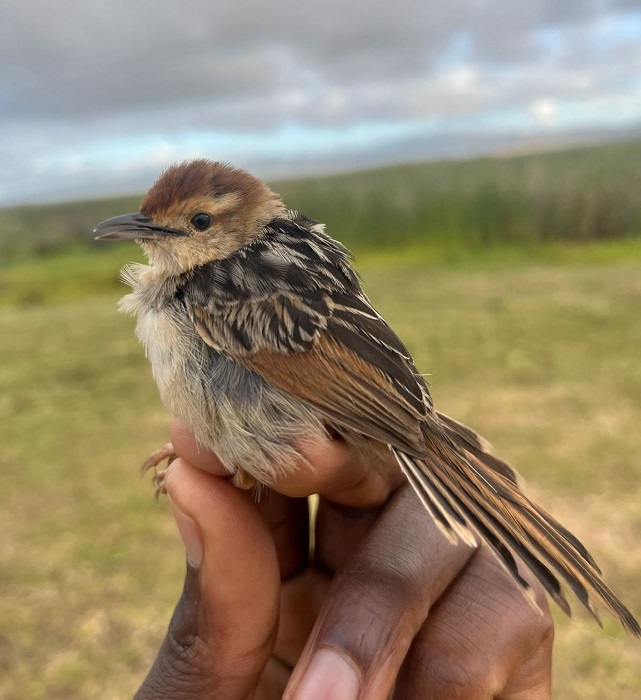
Nuwejaars Wetland Special Management Area, Western Cape
Photo by Dembo Jatta
