
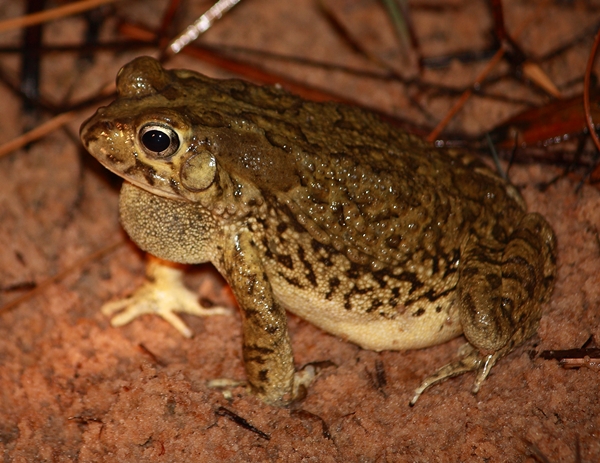
View the above photo record (by Vaughah Jessnitz) in FrogMAP here.
Find the Western Olive Toad in the FBIS database (Freshwater Biodiversity Information System) here.
Family Bufonidae
WESTERN OLIVE TOAD – Sclerophrys poweri
(Hewitt, 1935)
Habitat
This species inhabits thornveld and open savanna in lower-rainfall areas of the Savanna Biome, including river valleys on Kalahari sand. Activity patterns and movements require further study, but these toads are probably inactive for substantial periods, especially in drier areas, as they take shelter under logs, grass tussocks or in rock crannies, and emerge opportunistically after rain or on humid nights. Like most toads, foraging individuals probably roam widely and are often encountered on roads. Juvenile S. poweri have been recorded sheltering in termitaria (Channing 2001).
Breeding occurs in pans, dams and marshes.
Behaviour
Breeding begins early in the season, usually in mid-September, following the first spring rains, but this varies among years and locations. Choruses of calling males form on mud banks and in open, shallow water. Around 23 000 eggs are laid in double strands that are attached to submerged and floating vegetation (Channing 2001). Eggs hatch within 24 hours. Aspects of the life history such as larval period and age distribution of breeding adults, are unknown and require study.
Predators are unrecorded. Prey includes beetles (Channing 2001).
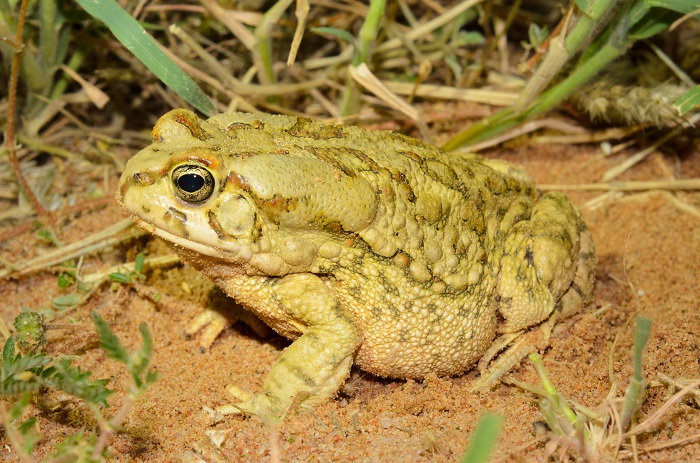
Photo by Kyle Finn
Status and Conservation
S. poweri is common and often locally abundant, and has been recorded from a number of statutory conservation areas including Augrabies Falls, Vaalbos and Pilanesberg national parks, Kgalagadi Transfrontier Park, and Sandveld and Botsalano nature reserves. Much of its habitat occurs in cattle- and game-farming regions, and is well protected.
Further research is needed to investigate the taxonomic status of the species and its relationship to S. garmani. This research should include genetic, morphological and call analyses, based on extensive field work around the transition area, and should identify locations where distinct eastern and western forms co-occur and potentially interbreed (Channing 1991; Cunningham and Cherry 2000).
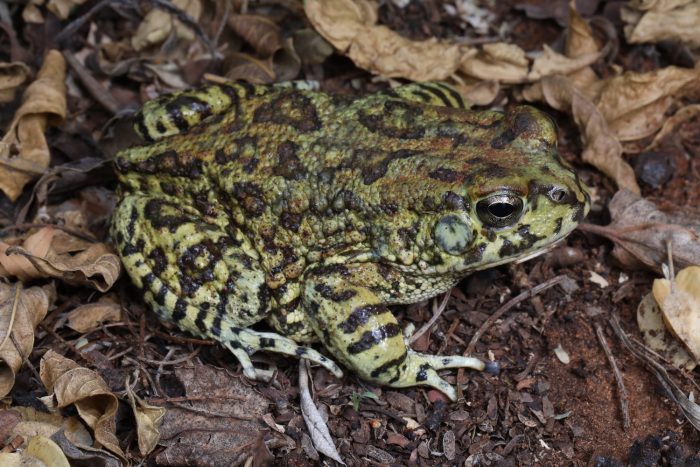
Photo by Luke Kemp
Distribution
At present, S. poweri is a poorly defined species that, in the view of some authors, represents nothing more than a geographical variant of S. garmani (Poynton 1995; Cunningham and Cherry 2000). Nevertheless, populations from arid southwestern Africa, including Namibia, Botswana, western Zimbabwe and western South Africa have been assigned to S. poweri (Tandy 1972; Poynton and Broadley 1988; Passmore and Carruthers 1995; Channing 1991, 2001), while populations in the eastern parts of the atlas region are currently assigned to S. garmani.
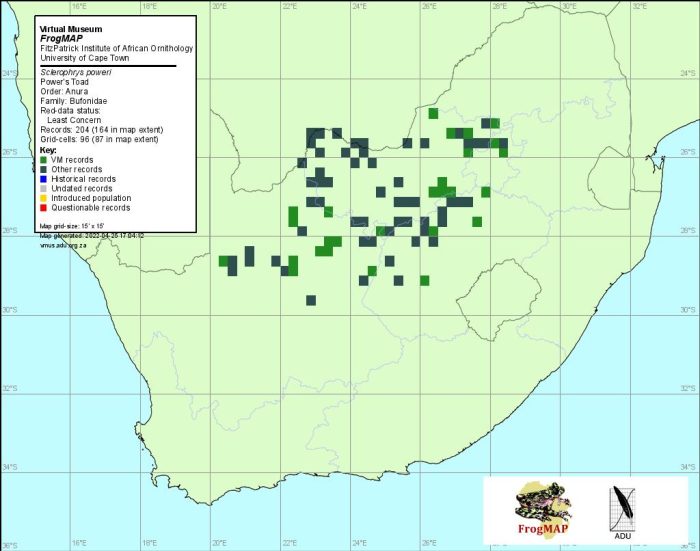
The type locality of S. poweri is Kimberley. Within the atlas region, the species has been recorded north of 30°S in the Northern Cape Province, and in adjoining areas in the western and northwestern Free State, localities throughout North West Province and the area west of 29°E in Gauteng and Limpopo provinces. The most easterly record of S. poweri in the atlas region is from Naboomspruit (Passmore 1972). However, the extent to which the ranges of the western (poweri) and eastern (garmani) forms overlap is unclear (Channing 1991; Passmore and Carruthers 1995).
It is difficult to distinguish S. poweri from the morphologically similar S. garmani, and identifications based on calls require sonagraphic analysis (see S. garmani account). More intensive distribution surveys, based on recorded calls, are required to determine the limits of distribution of these species.
Further Resources
Virtual Museum (FrogMAP > Search VM > By Scientific or Common Name)
More common names: Power’s Toad (Alternative English Name); Power se Skurwepadda (Afrikaans)
Recommended citation format for this species text:
du Preez LH, Cunningham M, Turner A, Tippett RM. Power’s Toad Sclerophrys poweri. BDI, Cape Town.
Available online at http://thebdi.org/2022/02/03/powers-toad-sclerophrys-poweri/
Recommended citation format:
This species text has been updated and expanded from the text in the
2004 frog atlas. The reference to the text and the book are as follows:
du Preez LH, Cunningham M, Turner A 2004 Sclerophrys poweri Power’s Toad. In Minter LR
et al 2004.
Minter LR, Burger M, Harrison JA, Braack HH, Bishop PJ, Kloepfer D (eds)
2004. Atlas and Red Data Book of the Frogs of South Africa, Lesotho and
Swaziland. Smithsonian Institution, Washington, and Avian Demography
Unit, Cape Town.

