

Cover photo by Andrew Hankey.
Find the African Bullfrog Frog in the FBIS database (Freshwater Biodiversity Information System) here.
Family Pyxicephalidae
Identification
The African Bullfrog is a large and robust species reaching a length of 120mm. The dorsal surface is light brown with greyish to brown patches and long dorsal ridges. A pale yellowish to green vertebral stripe is often present. The head is broad but the snout is more pointed than that of the Giant Bullfrog. The upper jaw carries irregular vertical bars that help to distinguish it from the Giant Bullfrog which lacks similar markings. The African Bullfrog also has a white crescent-shaped marking on the tympanum (diagnostic). The ventral surface is smooth and white to creamy yellow. The throat is sometimes mottled. The sexes are similar but breeding males are often bright green and males are larger than females.
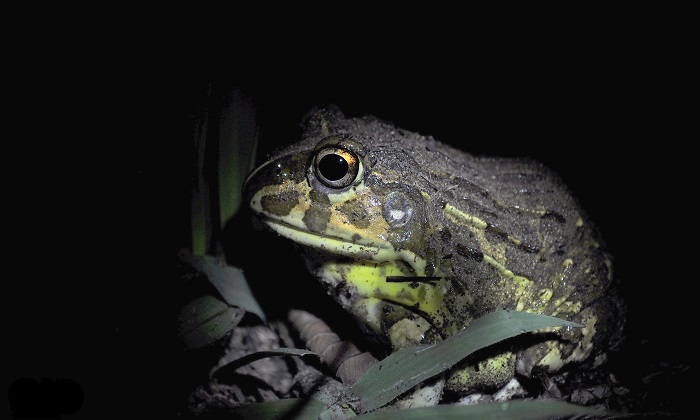
Hluhluwe district, KwaZulu-Natal
Photo by Ryan Tippett
At present there appear to be no reliable, diagnostic, morphological characters that allow one to distinguish P. edulis from small individuals of P. adspersus (Channing et al. 1994a). For this reason, museum specimens and literature records, unless accompanied by call or other relevant behavioural data, have to be treated with circumspection.
Habitat
The African Bullfrog inhabits flat, low-lying areas in open, grassy woodland, that becomes flooded after heavy rain. Prime breeding habitat includes shallow, grassy pans that can support large breeding populations (e.g., in Kruger National Park, Naboomspruit, Vivo, Soekmekaar and Giyani districts). Smaller breeding aggregations form in artificial impoundments such as roadside furrows, borrow pits, waterholes, ponds and dams (Jacobsen 1989; L.R.M. pers. obs). Channing et al. (1994a) found this species breeding in rice paddies in Mozambique.
Within the atlas region, the African Bullfrog inhabits several woodland vegetation types in the north-eastern parts of the Savanna Biome, from sea level to an altitude of about 1500 m (Jacobsen 1989).
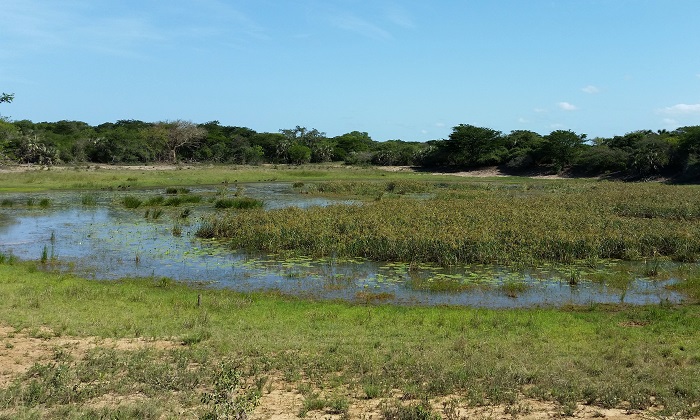
Bonamanzi Game Reserve, KwaZulu-Natal
Photo by Ryan Tippett
Behaviour
The African Bullfrog spends up to 10 months of the year in a dormant state beneath the soil surface (Mitchell 1946). The production of a cocoon to prevent desiccation has not been observed, but Stewart (1967) noted that “when hibernating during the dry season, eyes are closed and depressed to the level of the head”.
Breeding takes place at night (cf. P. adspersus) after heavy rain. No aggressive behaviour was observed in a breeding population near Beira (Channing et al. 1994a), but in Kruger National Park, males calling at distances of 0.5–1.5 m from each other in shallow, flooded grassland were seen charging one another (L.R.M. pers. obs.). However, this species does not appear to display the same level of aggressive behaviour as the Giant Bullfrog P. adspersus. Males call from the water, with only the head and vocal sac projecting above the surface. Guarding of tadpole swarms and channel construction by males were observed in a breeding population of P. edulis near Jock of the Bushveld Rest Camp in the Kruger National Park (H. Braack pers. comm.).
Food items include a variety of invertebrates and small vertebrates, including frogs. Several bird species, Nile Monitors Varanus niloticus and humans are known to prey on this species (Peters 1882; Stewart 1967; Channing 2001).
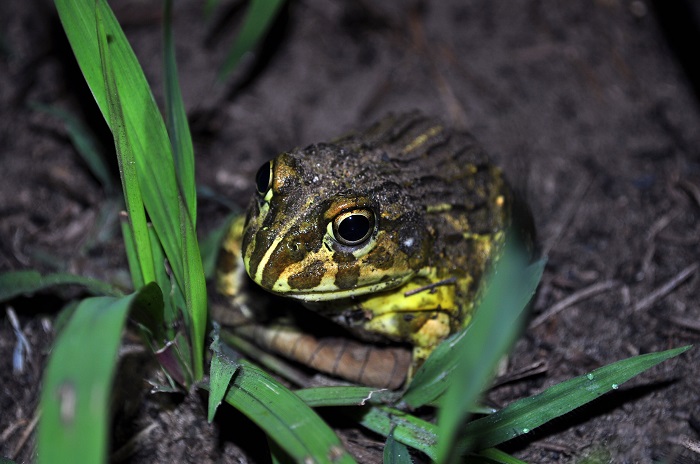
Hluhluwe district, KwaZulu-Natal
Photo by Ryan Tippett
Status and Conservation
The occurrence of the African Bullfrog in the atlas region is marginal in terms of its global distribution. Within this area it is relatively common and does not appear to be at risk. Large populations are known to occur in private and provincial nature reserves and national parks, such as the Kruger National Park.
The effect of human predation outside protected areas should be evaluated. More detailed studies of habitat requirements, breeding biology, duration of the larval stage and development are recommended for this species.
Distribution
The African Bullfrog was formerly synonymized with P. adspersus (Poynton 1964) and later treated as a subspecies of P. adspersus (Parry 1982; Poynton and Broadley 1985b; Lambiris 1989a). This taxon was again recognised as a full species by Channing et al. (1994a) on the basis of clear differences in advertisement call and breeding behaviour.
Outside of the atlas region, P. edulis occurs in Mozambique (Channing et al. 1994a) and extends into Kenya (Channing 2001). The species is probably also widespread in Central and East Africa. Its presence along the north-eastern border of South Africa indicates that P. edulis is also likely to occur in Botswana and Zimbabwe.
In the atlas region, records based on calls were collected in the north-eastern parts of North West Province, Limpopo Province, eastern Mpumalanga Province, northern and eastern Swaziland and north-eastern KwaZulu-Natal as far south as Empangeni (2831DD).
Fieldwork involving the collection of advertisement calls and knowledge of intra- and inter-specific variation in the morphology of adults, juveniles and tadpoles, is required before the distribution of this species can be accurately mapped (Channing et al. 1994a; Channing 2001).
The atlas data are reasonably reliable given the problems outlined above, but are not comprehensive.
Further Resources
The use of photographs by Andrew Hankey is acknowledged. Other images by Ryan Tippett.
African Bullfrog Pyxicephalus edulis Peters, 1854
Other Common Names: Edible Bullfrog, Lesser Bullfrog (Alt. English); Kleinbrulpadda (Afrikaans).
Recommended citation format: Cook, CL; Minter, LR; Tippett, RM. African Bullfrog Pyxicephalus edulis. BDI, Cape Town. Available online at http://thebdi.org/2021/11/17/african-bullfrog-pyxicephalus-edulis/
This species text has been updated and expanded from the text in the
2004 frog atlas: Du Preez, LH; Cook CL. (2004). African Bullfrog Pyxicephalus edulis. In Minter LR
et al 2004.
References:
Minter, LR; Burger, M; Harrison, JA; Braack, HH; Bishop, PJ; Kloepfer, D. (Editors). (2004). Atlas and Red Data Book of the Frogs of South Africa, Lesotho and
Swaziland. Smithsonian Institution, Washington, and Avian Demography
Unit, Cape Town.
Carruthers, V; du Preez, L. (2017). Frogs of southern Africa: A Complete Guide. Struik Nature, Cape Town.
Channing, A. (2001) Amphibians of Central and Southern Africa. Protea Book House, Pretoria
Claus, B; Claus, R. (2002). Common Amphibians and Reptiles of Botswana. Gamsberg Macmillan, Windhoek.
