
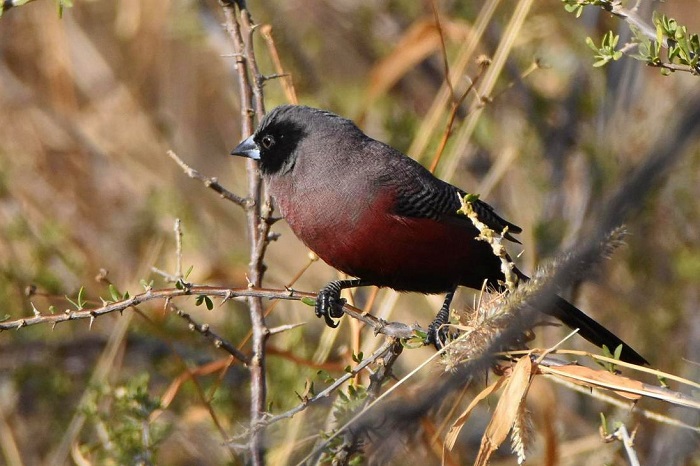
Image of Black-faced Waxbill by Rick Nuttall – Dealesville, Free State
Waxbills belong to the Family ESTRILDIDAE. This family also includes the Firefinches, Twinspots, Mannikins, Pytilias, etc. They are small, seed-eating passerines with short conical bills. They are all similar in structure and habits, but vary widely in plumage colours and patterns. Most species are very colourful. They are usually gregarious and often colonial. Their nests are generally a ball of grass with a side entrance and are either placed in a tree or on or close to the ground. The family contains 138 species from 39 genera. They are restricted to the Old World and are found throughout sub-Saharan Africa and Madagascar, as well as southern Asia and Australasia.
Identification
The Black-faced Waxbill is a distinct and unmistakable bird in southern Africa.
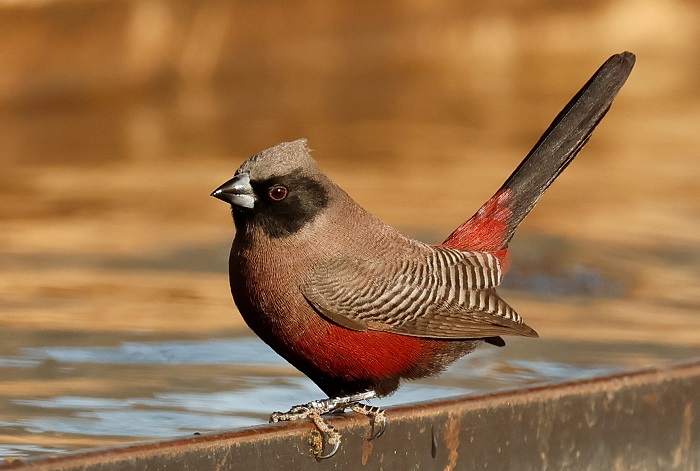
Near Christiana, Free State
Photo by Tino Herselman
The sexes are similar, but females are overall paler and duller.
In males, the forehead is pale grey, and the mantle, upper back, and scapulars are greyish-brown with very fine, dark barring and a pinkish wash. They have a conspicuous black facial mask. The lower back, rump, and upper tail coverts are deep red. The tail is black and is relatively long and graduated. The folded wings are grey with neat black barring. The throat is pale greyish pink and very faintly barred. The lower breast is reddish pink, and the flanks are reddish pink to deep crimson. The centre of the belly and undertail coverts are black. The short, conical bill is black with a bluish-grey base. The legs and feet are black, and the eyes are dark red.
Juveniles resemble adult females, but with more extensive faint barring, and the upper tail coverts and rump are dark orange-red.
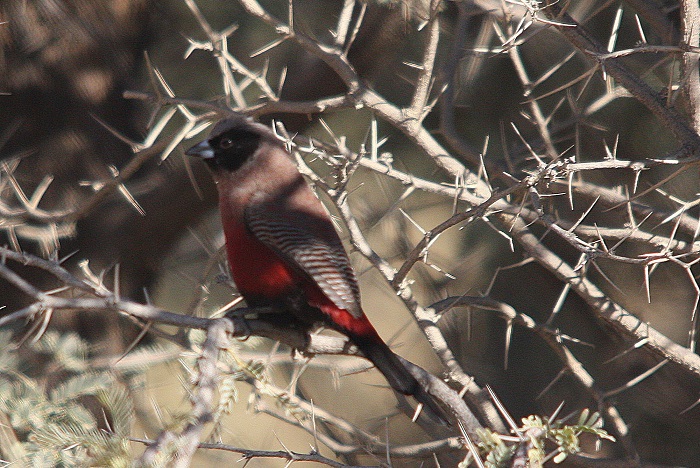
Kgalagadi Transfrontier Park, Northern Cape
Photo by Maans Booysen
Status and Distribution
The Black-faced Waxbill is a common but localised resident.
It is found in two oddly disjunct populations; one in East Africa (Tanzania, Kenya & Uganda), and one in southern Africa. The southern population extends from southern Angola and south-western Zambia through north-central Namibia, Botswana, southern and western Zimbabwe to South Africa. In South Africa, it occurs in central and western Limpopo, North West province, central and western Free State, and the north-eastern parts of the Northern Cape.
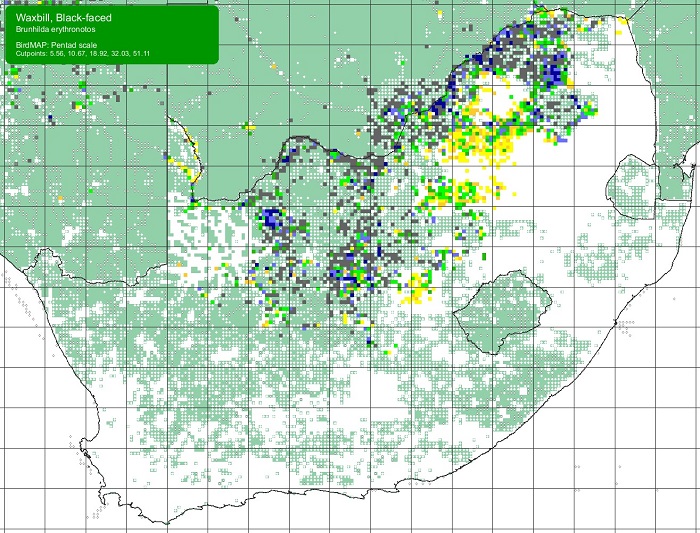
Details for map interpretation can be found here.
The Black-faced Waxbill is not threatened. The clearing of savannas for urbanisation and agriculture impact locally on its population. The Black-faced Waxbill is not abundant in most places, and its trapping for the cage-bird trade should be closely monitored.
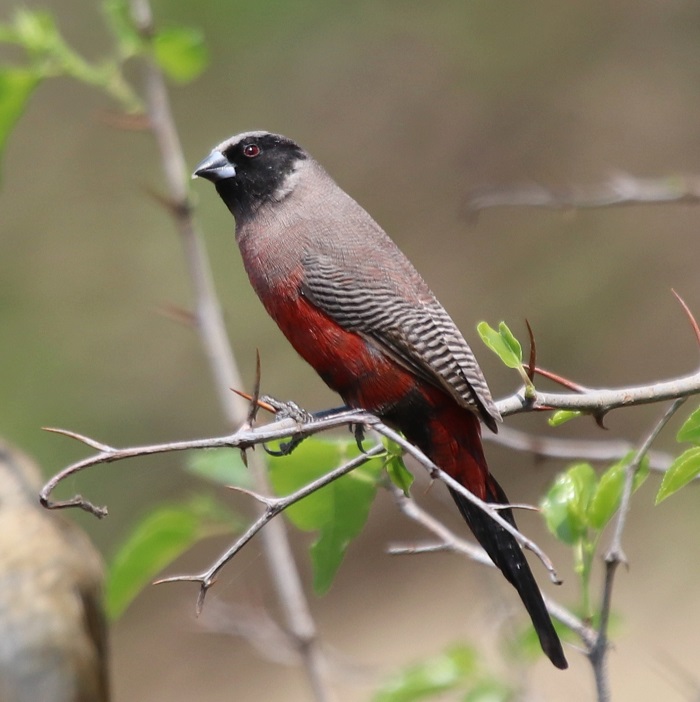
Mokala National Park, Northern Cape
Photo by Sybrand Venter
Habitat
The Black-faced Waxbill inhabits arid and semi-arid thornveld savanna and riverine thornbush. It is dependent on permanent surface water. The Black-faced Waxbill also requires tree cover and is reportedly more arboreal than others in its family. This probably explains its absence from the Karoo and drier parts of the Kalahari.
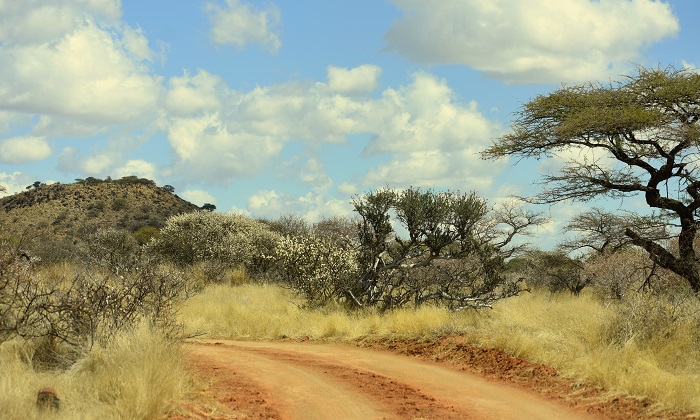
Mokala National Park, Northern Cape
Photo by Karis Daniel
Behaviour
The Black-faced Waxbill is resident and sedentary, but subject to some local movements; may disappear from an area for long periods before suddenly reappearing. Moves into drier parts of Kalahari during wet season, particularly in years of high rainfall.
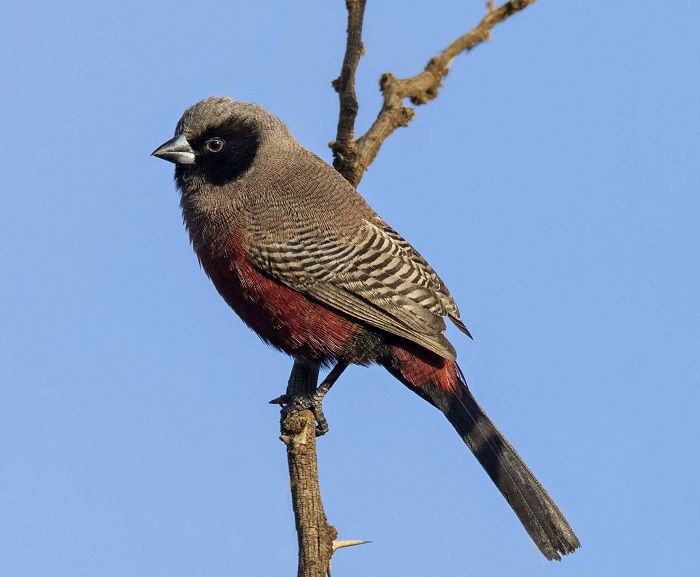
Near Klerksdorp, North West
Photo by Tony Archer
P1057 Black-faced Waxbill Black-cheeked Waxbill
In pairs or small groups, comprising either ad pair and recently fledged young or several pairs. Sometimes gathers in larger flocks of up to 18 birds when not br, possibly at rich food sources. Rather secretive, but easily located by fairly loud contact calls, often given in flight. Birds foraging on ground or low down in vegetation fly into nearby bushes when disturbed. Greeting display performed by pair members after even short separation. Birds perch alongside one another in upright position, with body feathers slightly fluffed and tails angled towards one another. Crown feathers are raised to form characteristic ‘triangular’ head; birds then alternately lower bodies to below horizontal, with tail moving from side to side, and perform a ritualised bill wipe before returning to upright posture. Sometimes roosts at night in old weaver nest, incl of Southern Masked- Weaver, White-browed Sparrow-Weaver and Red-billed Buffalo Weaver, with up to 30 birds in 1 nest. Drinks mainly 09h00-13h00, also at dusk. After drinking and bathing, birds sit in dense foliage and preen (incl allopreening) for extended periods.
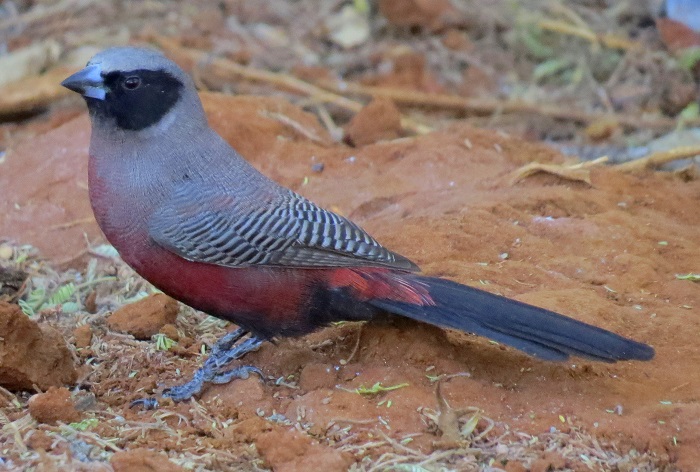
Mokala National Park, Northern Cape
Photo by Terry Terblanche
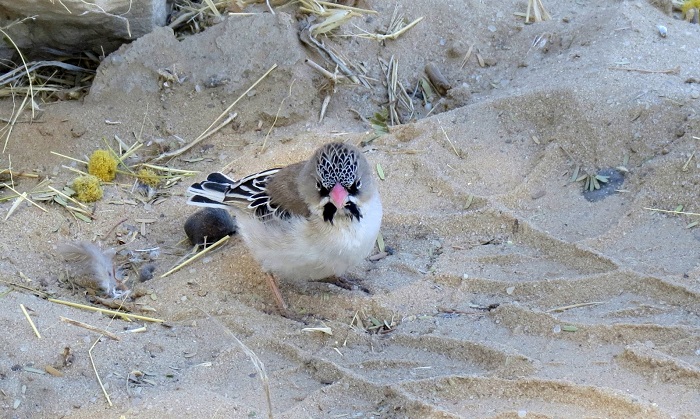
Kgalagadi Transfrontier Park, Northern Cape
Photo by Andre Kok
Forages mainly during morning and in the late afternoon, often in loose association with other spp, incl Blue and Violet-eared Waxbills and Green-winged Pytilia. Forages on bare ground or among surface litter, searching for seeds, or reaches up to take seeds directly from plants. Flies up to land on grass stem, forcing seeding head to ground before removing seeds, or takes seed head tip in bill, bearing it to ground and then perching on seed head to feed. May also perch on stem close to inflorescence, feeding on seeds while in upright position or hanging upside down; also perches on twig or wire fence close to seeding grasses, leaning forward to remove seeds. Small insects hawked from perch or gleaned from vegetation up to 5 m above ground. Eats mainly grass seeds, but also insects (incl termites, small numbers of beetles and small caterpillars) and nectar (incl Spotted Aloe Aloe greatheadii), often destroying blossoms in process (eg of Acacia spp and cultivated apricots). Grass seeds eaten incl Buffelsgras Cenchrus ciliaris, lovegrasses (Eragrostis spp), Guinea Grass Panicum maximum, P. gilvum, Bur Bristle Grass Setaria verticillata, Sporobolus spp, Blousaadgras Tricholaena monachne and Gonya Grass Urochloa mosambicensis. In w Free State, seeds of Bur Bristle Grass comprise bulk of diet when available, taken both in ‘milky’ stage and when dry. Also eats fleshy fruits and tiny seeds of waxberry plant Pollichia campestrio and flowers of Buffalo-thorn Ziziphus mucronata. Probably faces food shortage in early summer, when seeds germinate following first rains, possibly forcing birds to disperse or to switch diet to incl more insects.
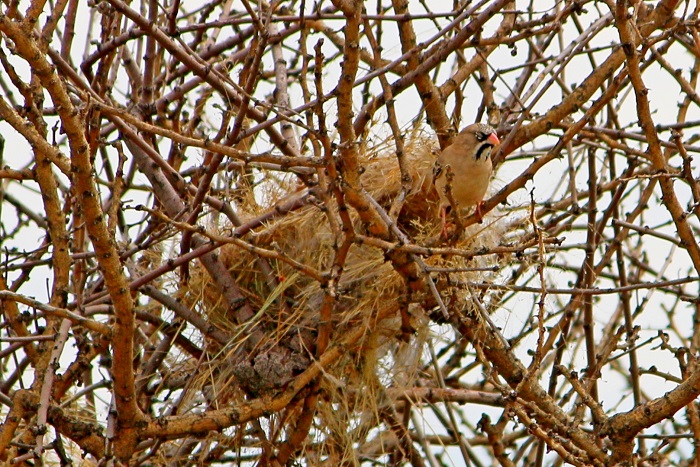
Danielskuil, Northern Cape
Photo by Aletta Liebenberg
Monogamous. Solitary nester, with nests widely spaced; probably territorial. Mate fidelity possibly high; 3 ringed pairs remained together at least 3-15 mo after br. In courtship display, singing male holds 1 end of grass inflorescence in bill and throws head backwards and forwards while bobbing body up and down on perch beside female.
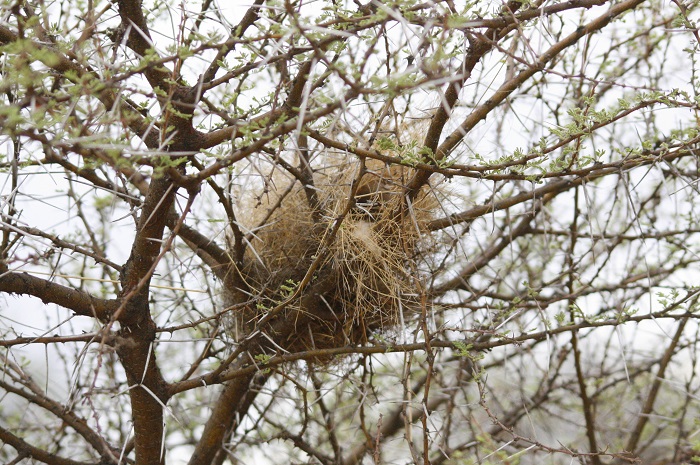
Near Boshof, Free State
Photo by Dawie de Swardt
Nest: Built by both sexes; material collected by male. In 10 min, 1 male collected 3 green Guinea Grass Panicum maximum inflorescences and 4 bits of dry grass, 90 m from nest; all material held in bill tip. Nest bulky, thick-walled and ball-shaped, with long, downward-pointing, spout-like entrance built of fine, green seeding grass inflorescences (mainly Guinea Grass), some of which usually protrude from end of entrance tunnel. Some nests incl a cup-shaped false- or ‘cock’s’ nest, 100 x 65 mm wide, attached on top of nest, which probably serves as decoy to lure predators from true entrance. Nest lined with soft, fine grass inflorescences incl Aristida spp, lovegrass Eragrostis barbinodis, Natal Redtop Melinis repens and Blousaadgras Tricholaena monachne; feathers sometimes used. Both sexes continue to line nest during incubation. Outside diam ca 100 mm, height ca 180 mm; entrance tunnel length 75-125 mm, diam 25 mm. Placed 3-9 m (usually 4-5 m) above ground among dense, thorny twigs in uppermost, central part of thorn tree (often Umbrella Thorn Acacia tortilis); successive nests often built in same tree, often near remains of old structure. Laying dates: Namibia Jan-May (14 of 18 records Feb-Mar); Botswana Dec (2), Jan (4), Apr (2); Zimbabwe Sept-Apr (16 of 21 records Jan-Mar); ne S Africa Dec-May. Eggs: 2-6 (3.8, n = 2. Sub-elliptical. White to cream. Size (n = 26) 13.9-15.9 x 10.1-11.4 mm (14.8 x 10.9 mm). Incubation: Period 12 d (in captivity); by both sexes; incubating bird sits tight. Development & care of young: Newly hatched young has palate pale, with 5 black spots; 2 black spots on tongue more or less fused in mid-line. Interior of lower mandible with or without black, crescent-shaped marking. Gape tubercles yellowish white, each with large black spot on inner surface. Young fed in part on small beetles (Coleoptera), but few or no termites. Nestling period 22 d; captive young self-feeding 10 d later. Breeding success: No data. Generally not susceptible to brood parasitism by Vidua spp, although in c Namibia, where Shaft-tailed Whydahs are more common than their Violet-eared Waxbill hosts, male whydahs occasionally incl Black-faced Waxbill song elements in their song, suggesting occasional parasitism.
Further Resources
This species text is adapted from the first Southern African Bird Atlas Project (SABAP1), 1997.
The use of photographs by Aletta Liebenberg, Andre Kok, Dawie de Swardt, Joanne Putter, Karis Daniel, Kyle Finn, Norman Barrett, Ryan Tippett, Sybrand Venter, Terry Terblanche, and Zenobia van Dyk is acknowledged.
Other names: Black-cheeked Waxbill (Alt. English); Swartwangsysie (Afrikaans); Astrild à moustaches (French); Elfenastrild (Dutch); Elfenastrild (German); Bico-de-lacre-de-faces-pretas (Portuguese).
Recommended citation format: Tippett RM. 2026. Black-faced Waxbill Estrilda erythronotos. Biodiversity and Development Institute. Available online at https://thebdi.org/2026/03/31/black-faced-waxbill-estrilda-erythronotos/
List of bird species in this format is available here.
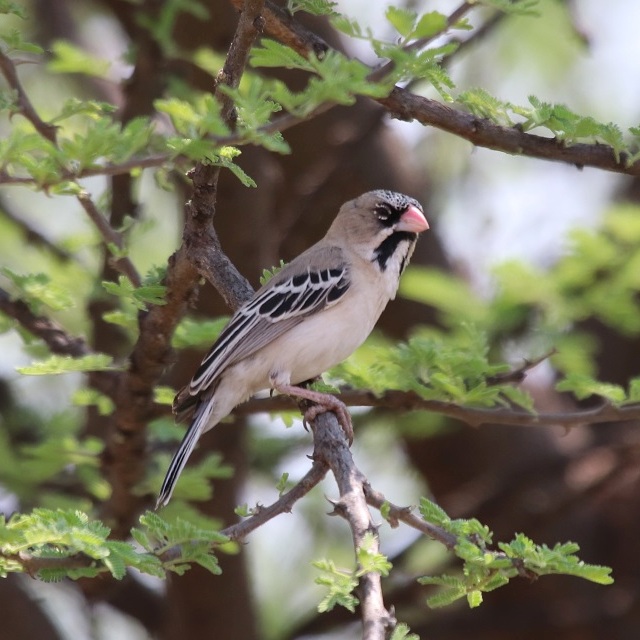
Mokala National Park, Northern Cape
Photo by Sybrand Venter
