
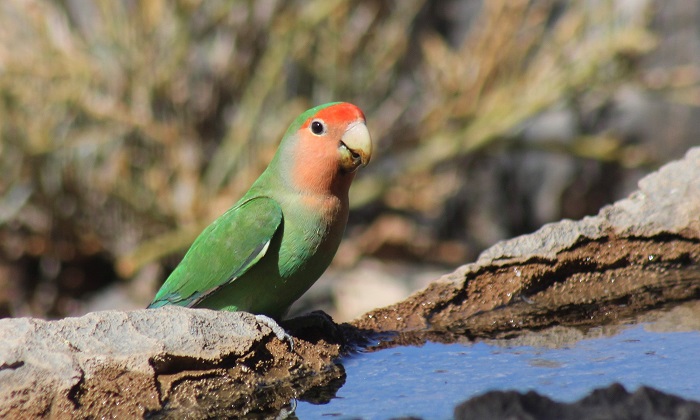
Cover image of Rosy-faced Lovebird by Roy Earle – Karas, Namibia
Lovebirds are members of the family PSITTACULIDAE (Old World Parrots). The Psittaculiudae is one of four parrot families in the order Psittaciformes. Characteristic features of all parrots include a strong, curved bill, an upright stance, strong legs, and zygodactyl feet. Many parrots are vividly coloured and exhibit little or no sexual dimorphism. They form the most variably sized bird order in terms of length. The most important components of most parrots’ diets are seeds, nuts, fruit, buds, and other plant material. A few species sometimes eat animals and carrion, while the lories and lorikeets are specialised for feeding on floral nectar and soft fruits. Almost all parrots nest in tree hollows and lay white eggs. The Psittaculiudae is made up of 201 species from 41 genera. There are 9 species of Lovebirds and they are restricted to sub-Saharan Africa and Madagascar.
Identification
The Rosy-faced Lovebird is a small, colourful, and noisy parrot with a dumpy, short-tailed appearance.
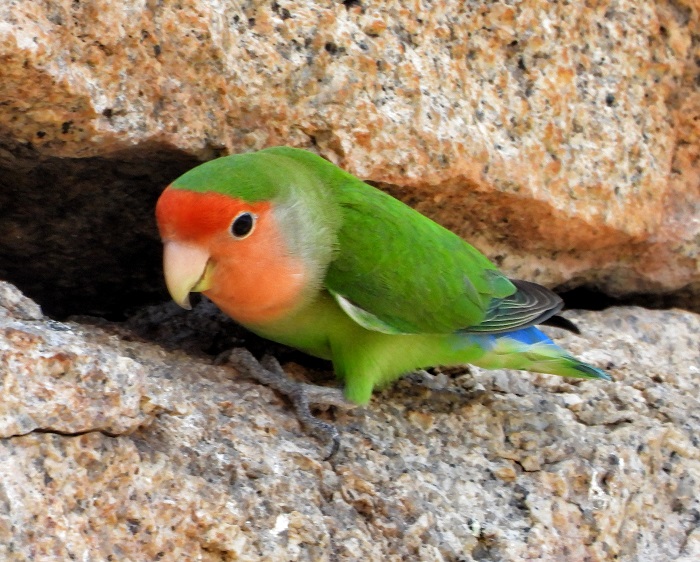
Erongo, Namibia
Photo by Lappies Labuschagne
It is predominantly bright, grass green, although slightly yellower on the undersides. The face, throat, and breast are rose pink, and the forehead and eyebrow are bright pinkish red. The rump is bright cobalt blue. The eyes are dark brown with a white eye-ring. The bill is pale yellowish-horn, and the legs and feet are grey. The sexes are similar, but males have brighter pink colouration on the head and face. Immature birds resemble the adults but are duller, with a greenish forehead and a black base to the upper mandible.
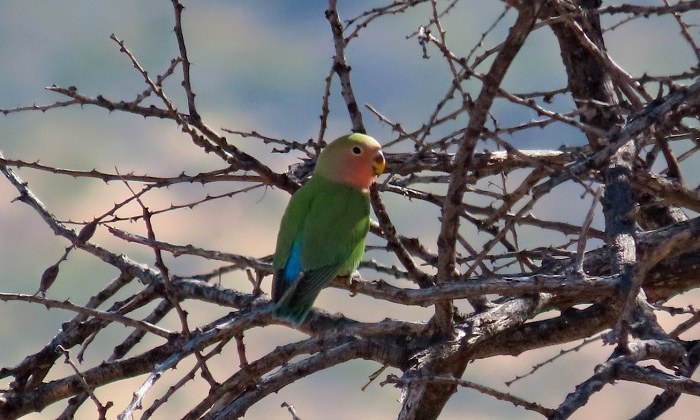
Karas, Namibia
Photo by Johan van Rooyen
The Rosy-faced Lovebird is easily distinguished from Lilian’s Lovebird (Agapornis lilianae) by its pale (not redish) bill, and by its blue (not green) rump and pink face and upper breast. Additionally, the natural ranges of the two do not overlap.
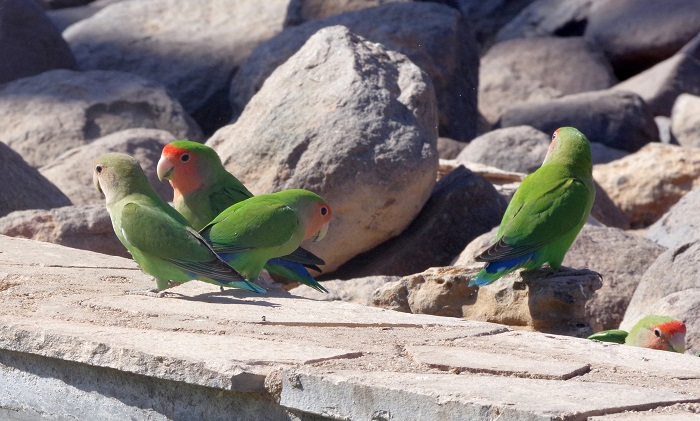
Fish River Canyon National Park, Namibia
Photo by Craig Peter
Status and Distribution
The Rosy-faced Lovebird is a locally common resident. Its range extends from just south of the Orange River, near Kenhardt, in the Northern Cape, through Namibia and into Angola. It historically occurred east to Lake Ngami in Botswana, but there have been no recent records from that area. The Rosy-faced Lovebird frequently escapes from captivity, and there is a well-established feral population in Gauteng. This population consists of escaped pets and their descendants, including hybrid mixtures with other lovebird species.
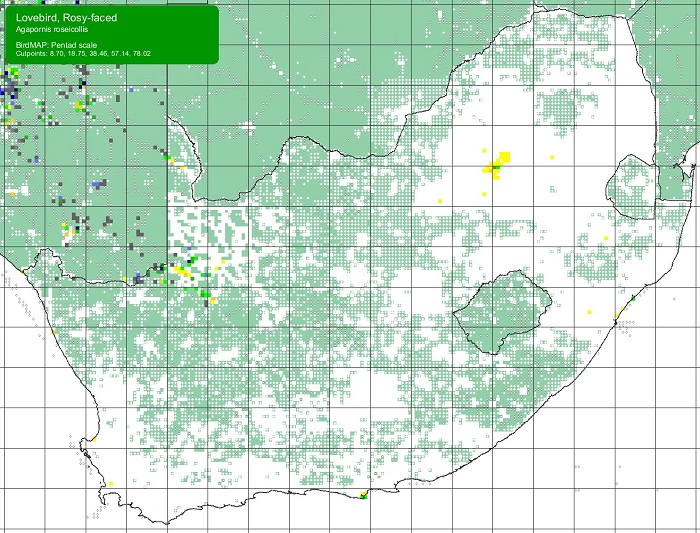
The Rosy-faced Lovebird is not threatened. Its range in southern Africa has probably increased in recent years with the provision of artificial structures for nest sites and water points in arid regions. However, trapping for the cage bird trade has resulted in substantial decreases in southern Angola.
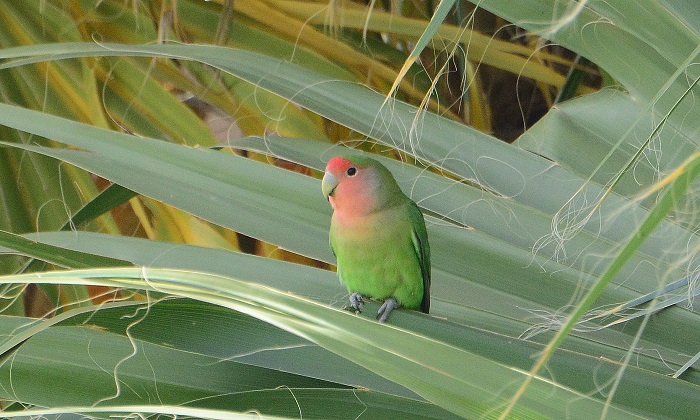
Keimoes, Northern Cape
Photo by Ryan Tippett
Habitat
The Rosy-faced Lovebird inhabits dry woodland, scrubby hillsides, riparian woodlands, and tree-lined watercourses in arid regions. It favours places with rocky outcrops, which are used for breeding. The Rosy-faced Lovebird is highly water-dependent and often congregates around farm dams and reservoirs. It forages in nearby semi-desert shrublands, but is absent from very open habitats. The Rosy-faced Lovebird also visits gardens on farms and in some suburban areas.
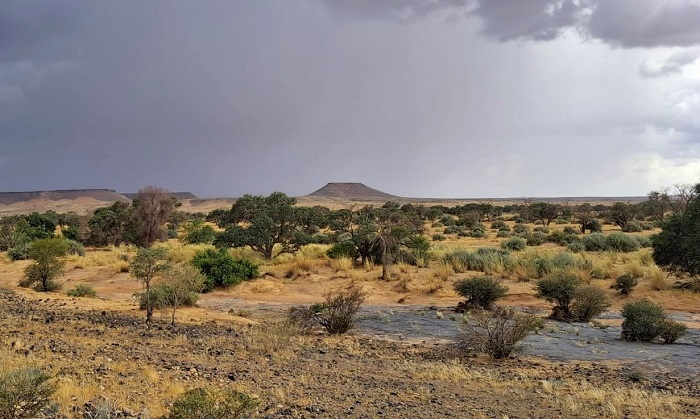
Between Aus and Keetmanshoop, Namibia
Photo by Les Underhill
Behaviour
The Rosy-faced Lovebird is highly nomadic; its movements are dictated by water and food availability. They are noisy and usually gregarious in flocks of up to 15 birds, but larger flocks gather at water and reliable food sources. The Rosy-faced Lovebird is highly dependent on water and may drink several times per day. The flight is agile, rapid, and direct.
Flocks often roost in the nests of Sociable Weaver (Philetairus socius) and White-browed Sparrow-weaver (Plocepasser mahali). In cool weather, birds huddle in small groups on branches.
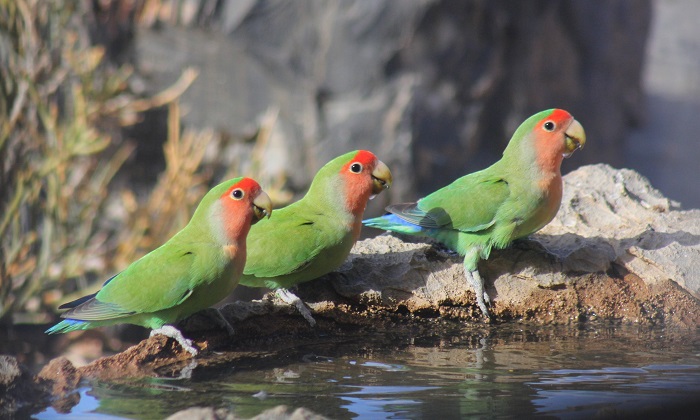
Karas, Namibia
Photo by Roy Earle
The Rosy-faced Lovebird forages by clambering about in the branches of trees and shrubs and gathers seeds from the ground. The diet consists of various seeds (especially grasses), fruits, berries, flowers, and grain crops such as millet, maize, and sunflower seeds.
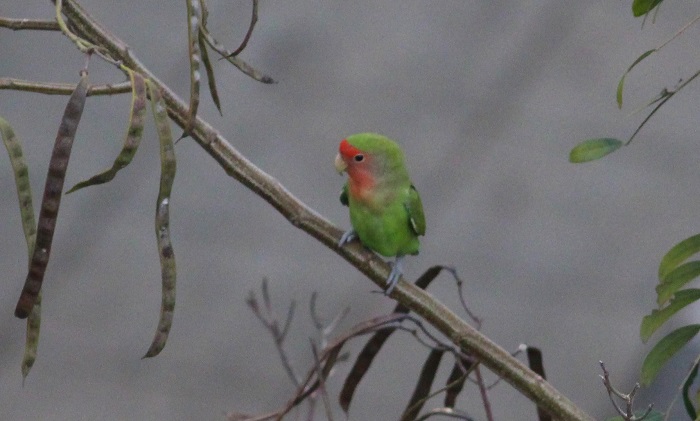
Luanda, Angola
Photo by Maans Booysen
Rosy-faced Lovebirds are monogamous and form pair bonds, which are maintained for life, while still in immature plumage. They have the extraordinary ability to breed when only 2 months old.
Rosy-faced Lovebirds are colonial nesters and breed mainly from February to April. Nests are most often placed in a hole in a rock face, or building, or in a chamber within a Sociable Weaver nest. They have also been recorded nesting under the eaves of houses and in nest boxes. The nest is a deep cup of bark strips, leaves, or grass. Nesting material is sourced and cut by the female and carried to the nest in her rump feathers. Grass is sometimes removed or stolen from the outside of Sociable Weaver nests to be used in nest construction. No nesting material is added to nests inside Sociable Weaver colonies.
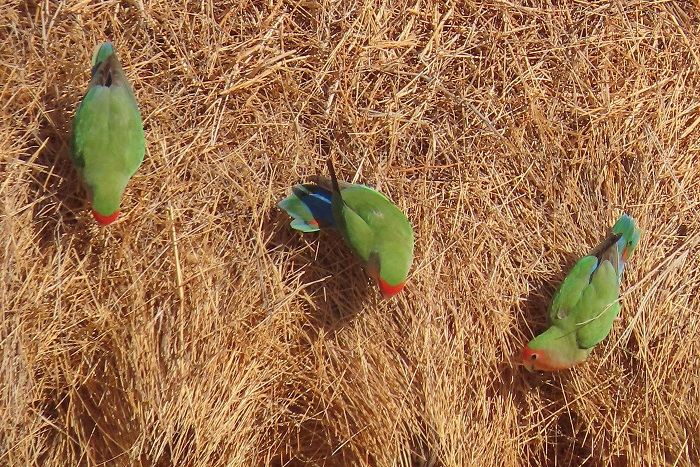
Hardap, Namibia
Photo by Cobus Elstadt
4 to 6 dull white eggs are laid per clutch. Eggs are typically laid at 2 day intervals, and incubation begins a day or two after the first egg is laid. The incubation period lasts up to 23 days and is done entirely by the female.
Young chicks take around 43 days to fledge. During this time, they are closely brooded by the female, who receives food from the male. The female feeds her young chicks by regurgitation. Older chicks are later fed by both parents. Juvenile birds are dependent on their parents for a few months after fledging.
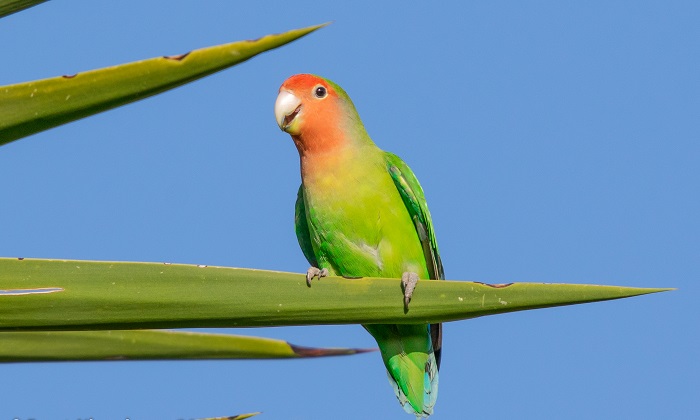
Fochville, Gauteng
Photo by Evert Kleynhans
Further Resources
Species text adapted from the first Southern African Bird Atlas Project (SABAP1), 1997.
The use of photographs by Cobus Elstadt, Craig Peter, Evert Kleynhans, Johan van Rooyen, Lappies Labuschagne, Les Underhill, Maans Booysen, Roy Earle, and Ryan Tippett is acknowledged.
Other common names: Rooiwangparkiet (Afrikaans); Inséparable rosegorge (French); Rosenpapagei (German); Perzikkopagapornis (Dutch); Inseparável-de-faces-rosadas (Portuguese)
Recommended citation format: Tippett RM. 2026. Rosy-faced Lovebird Agapornis roseicollis. Biodiversity and Development Institute. Available online at https://thebdi.org/2026/03/06/rosy-faced-lovebird-agapornis-roseicollis/
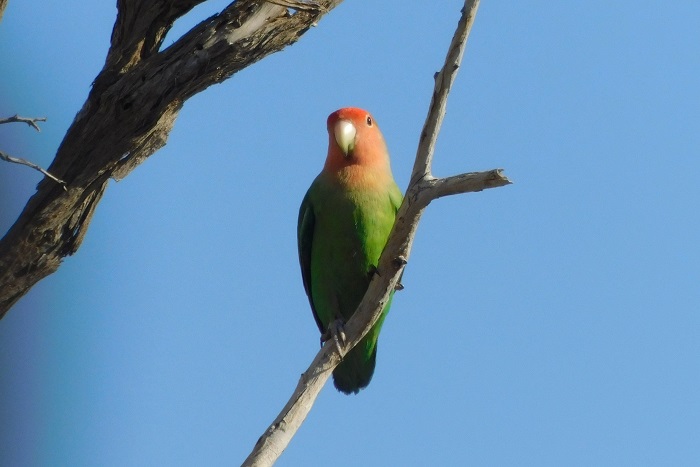
Karas, Namibia
Photo by Roy Earle
